

IEC 60300-3-14:2004
(Main)Dependability management - Part 3-14: Application guide - Maintenance and maintenance support
General Information
- Abstract
Describes a framework for maintenance and maintenance support and the various minimal common practices that should be undertaken.Outlines in a generic manner, management, processes and techniques related to maintenance and maintenance support that are necessary to achieve adequate dependability to meet the operational needs of the customer. Applicable to items, which include all types of products, equipment and systems (hardware and associated software). Most of these require a certain level of maintenance to ensure that their required functionality, dependability, capability, economic, safety and regulatory requirements are achieved.
- Status
- Published
- Publication Date
- 23-Mar-2004
- Technical Committee
- TC 56 - Dependability
- Drafting Committee
- WG 3 - TC 56/WG 3
- Current Stage
- DELPUB - Deleted Publication
- Start Date
- 09-Aug-2024
- Completion Date
- 12-Feb-2021
Buy Documents
IEC 60300-3-14:2004 - Dependability management - Part 3-14: Application guide - Maintenance and maintenance support Released:3/24/2004
IEC 60300-3-14:2004 - Dependability management - Part 3-14: Application guide - Maintenance and maintenance support Released:3/24/2004
IEC 60300-3-14:2004 - Overview
Standard Reference: IEC 60300-3-14:2004
Title: Dependability management - Part 3-14: Application guide - Maintenance and maintenance support
IEC 60300-3-14 is an application guide that defines a generic framework of management, processes and minimal common practices for maintenance and maintenance support to achieve required dependability throughout an item’s life cycle. It applies to all types of items (products, equipment and systems, including hardware and associated software) where maintenance is needed to meet functionality, safety, regulatory and economic requirements.
Key topics and technical requirements
The standard addresses the following technical subjects in a generic, life‑cycle oriented way:
- Life cycle aspects: guidance for maintenance across concept, design, manufacturing, installation, operation/maintenance and disposal phases.
- Maintenance policy and management responsibility: management commitment, customer needs, planning, authority and communication.
- Maintenance processes: identification, analysis, preparation and execution of maintenance tasks; preventive vs corrective maintenance.
- Indenture levels and echelons: structuring maintenance responsibilities and support levels.
- Maintenance support resources: human resources and training, infrastructure, support equipment, maintenance facilities, and built‑in test equipment (BITE).
- Information and documentation: maintenance documentation, maintenance information systems and computerized maintenance management.
- Materials and spare parts: quantification, identification and provisioning processes for spares.
- Measurement, analysis and improvement: monitoring customer‑related and maintenance‑related metrics, assessment, continuous improvement and managing modifications.
- Factors affecting maintenance: design and operational factors (informative annex).
Practical applications and who uses it
IEC 60300-3-14 is practical for organizations that need to establish or improve structured maintenance and support to meet dependability targets:
- Maintenance managers and planners - for developing maintenance policies, planning tasks and spare provisioning.
- Reliability and asset management engineers - to integrate maintenance into dependability and lifecycle planning.
- Systems and design engineers - to consider maintainability and supportability during design and development.
- Logistics, procurement and operations teams - for setting up infrastructure, training, documentation and logistics for maintenance.
- Regulators and contract managers - to specify minimum maintenance support requirements in procurement and compliance contexts.
Use cases include creating maintenance programs, choosing preventive vs corrective strategies, designing support facilities, establishing CMMS data and spare parts strategies, and measuring maintenance performance.
Related standards
- IEC 60300-1 / IEC 60300-2 - broader dependability management guidance referenced by this part.
- Integrated Logistic Support (ILS) practices - IEC 60300-3-14 offers a more general approach applicable where ILS is not fully implemented.
Keywords: IEC 60300-3-14, dependability management, maintenance, maintenance support, lifecycle maintenance, preventive maintenance, spare parts provisioning, maintenance planning, reliability.
Relations
- Effective Date
- 05-Sep-2023
Buy Documents
IEC 60300-3-14:2004 - Dependability management - Part 3-14: Application guide - Maintenance and maintenance support Released:3/24/2004
IEC 60300-3-14:2004 - Dependability management - Part 3-14: Application guide - Maintenance and maintenance support Released:3/24/2004
Get Certified
Connect with accredited certification bodies for this standard

BSI Group
BSI (British Standards Institution) is the business standards company that helps organizations make excellence a habit.

Bureau Veritas
Bureau Veritas is a world leader in laboratory testing, inspection and certification services.

DNV
DNV is an independent assurance and risk management provider.
Sponsored listings
Frequently Asked Questions
IEC 60300-3-14:2004 is a standard published by the International Electrotechnical Commission (IEC). Its full title is "Dependability management - Part 3-14: Application guide - Maintenance and maintenance support". This standard covers: Describes a framework for maintenance and maintenance support and the various minimal common practices that should be undertaken.Outlines in a generic manner, management, processes and techniques related to maintenance and maintenance support that are necessary to achieve adequate dependability to meet the operational needs of the customer. Applicable to items, which include all types of products, equipment and systems (hardware and associated software). Most of these require a certain level of maintenance to ensure that their required functionality, dependability, capability, economic, safety and regulatory requirements are achieved.
Describes a framework for maintenance and maintenance support and the various minimal common practices that should be undertaken.Outlines in a generic manner, management, processes and techniques related to maintenance and maintenance support that are necessary to achieve adequate dependability to meet the operational needs of the customer. Applicable to items, which include all types of products, equipment and systems (hardware and associated software). Most of these require a certain level of maintenance to ensure that their required functionality, dependability, capability, economic, safety and regulatory requirements are achieved.
IEC 60300-3-14:2004 is classified under the following ICS (International Classification for Standards) categories: 03.100.40 - Research and development; 03.120.01 - Quality in general. The ICS classification helps identify the subject area and facilitates finding related standards.
IEC 60300-3-14:2004 has the following relationships with other standards: It is inter standard links to IEC 60300-3-14:2024. Understanding these relationships helps ensure you are using the most current and applicable version of the standard.
IEC 60300-3-14:2004 is available in PDF format for immediate download after purchase. The document can be added to your cart and obtained through the secure checkout process. Digital delivery ensures instant access to the complete standard document.
Standards Content (Sample)
INTERNATIONAL IEC
STANDARD 60300-3-14
First edition
2004-03
Dependability management –
Part 3-14:
Application guide –
Maintenance and maintenance support
Reference number
Publication numbering
As from 1 January 1997 all IEC publications are issued with a designation in the
60000 series. For example, IEC 34-1 is now referred to as IEC 60034-1.
Consolidated editions
The IEC is now publishing consolidated versions of its publications. For example,
edition numbers 1.0, 1.1 and 1.2 refer, respectively, to the base publication, the
base publication incorporating amendment 1 and the base publication incorporating
amendments 1 and 2.
Further information on IEC publications
The technical content of IEC publications is kept under constant review by the IEC,
thus ensuring that the content reflects current technology. Information relating to
this publication, including its validity, is available in the IEC Catalogue of
publications (see below) in addition to new editions, amendments and corrigenda.
Information on the subjects under consideration and work in progress undertaken
by the technical committee which has prepared this publication, as well as the list
of publications issued, is also available from the following:
• IEC Web Site (www.iec.ch)
• Catalogue of IEC publications
The on-line catalogue on the IEC web site (http://www.iec.ch/searchpub/cur_fut.htm)
enables you to search by a variety of criteria including text searches, technical
committees and date of publication. On-line information is also available on
recently issued publications, withdrawn and replaced publications, as well as
corrigenda.
• IEC Just Published
This summary of recently issued publications (http://www.iec.ch/online_news/
justpub/jp_entry.htm) is also available by email. Please contact the Customer
Service Centre (see below) for further information.
• Customer Service Centre
If you have any questions regarding this publication or need further assistance,
please contact the Customer Service Centre:
Email: custserv@iec.ch
Tel: +41 22 919 02 11
Fax: +41 22 919 03 00
INTERNATIONAL IEC
STANDARD 60300-3-14
First edition
2004-03
Dependability management –
Part 3-14:
Application guide –
Maintenance and maintenance support
IEC 2004 Copyright - all rights reserved
No part of this publication may be reproduced or utilized in any form or by any means, electronic or
mechanical, including photocopying and microfilm, without permission in writing from the publisher.
International Electrotechnical Commission, 3, rue de Varembé, PO Box 131, CH-1211 Geneva 20, Switzerland
Telephone: +41 22 919 02 11 Telefax: +41 22 919 03 00 E-mail: inmail@iec.ch Web: www.iec.ch
PRICE CODE
Commission Electrotechnique Internationale X
International Electrotechnical Commission
Международная Электротехническая Комиссия
For price, see current catalogue
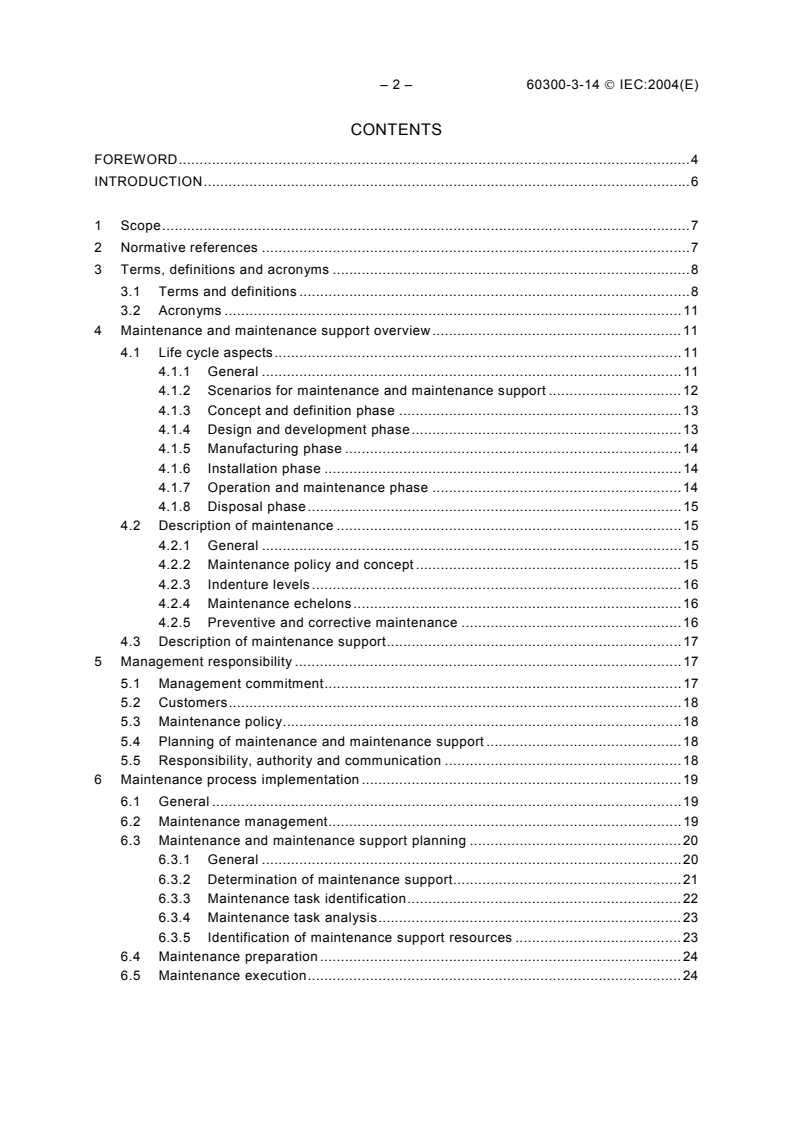
– 2 – 60300-3-14 IEC:2004(E)
CONTENTS
FOREWORD.4
INTRODUCTION.6
1 Scope.7
2 Normative references .7
3 Terms, definitions and acronyms .8
3.1 Terms and definitions .8
3.2 Acronyms.11
4 Maintenance and maintenance support overview.11
4.1 Life cycle aspects.11
4.1.1 General.11
4.1.2 Scenarios for maintenance and maintenance support .12
4.1.3 Concept and definition phase .13
4.1.4 Design and development phase.13
4.1.5 Manufacturing phase.14
4.1.6 Installation phase.14
4.1.7 Operation and maintenance phase .14
4.1.8 Disposal phase.15
4.2 Description of maintenance .15
4.2.1 General.15
4.2.2 Maintenance policy and concept .15
4.2.3 Indenture levels.16
4.2.4 Maintenance echelons.16
4.2.5 Preventive and corrective maintenance .16
4.3 Description of maintenance support.17
5 Management responsibility.17
5.1 Management commitment.17
5.2 Customers.18
5.3 Maintenance policy.18
5.4 Planning of maintenance and maintenance support .18
5.5 Responsibility, authority and communication .18
6 Maintenance process implementation .19
6.1 General.19
6.2 Maintenance management.19
6.3 Maintenance and maintenance support planning .20
6.3.1 General.20
6.3.2 Determination of maintenance support.21
6.3.3 Maintenance task identification.22
6.3.4 Maintenance task analysis.23
6.3.5 Identification of maintenance support resources .23
6.4 Maintenance preparation.24
6.5 Maintenance execution.24
60300-3-14 IEC:2004(E) – 3 –
7 Resource management.25
7.1 Provision of resources.25
7.2 Human resources.26
7.2.1 General.26
7.2.2 Training.26
7.3 Infrastructure.27
7.3.1 General.27
7.3.2 Support equipment .27
7.3.3 Built-in test equipment (BITE).29
7.3.4 Maintenance facilities.29
7.3.5 Administration and technical facilities .29
7.3.6 Computerized maintenance information systems .30
7.4 Information resources.30
7.4.1 General.30
7.4.2 Documentation.30
7.4.3 Maintenance information.33
7.5 Materials and spare parts .34
7.5.1 General.34
7.5.2 Spare parts quantification.34
7.5.3 Spare parts identification.36
8 Measurement, analysis and improvement .37
8.1 General.37
8.2 Monitoring and measurement.37
8.2.1 General.37
8.2.2 Customer-related measurement.37
8.2.3 Maintenance-related measurement.38
8.3 Maintenance assessment.38
8.4 Maintenance improvement.39
8.5 Modifications.39
Annex A (informative) Factors affecting maintenance and maintenance support .40
A.1 General.40
A.2 Application to complex systems .40
A.3 Factors during the design phase .40
A.4 Factors during the operation and maintenance phase .41
Bibliography.43
Figure 1 – Maintenance and maintenance support during the life cycle .12
Figure 2 – Interrelationship of maintenance terms.15
Figure 3 – Types of maintenance tasks.17
Figure 4 – Maintenance processes.19
Figure 5 – Maintenance and maintenance support planning process .21
Figure 6 – Spare parts provisioning process .36
– 4 – 60300-3-14 IEC:2004(E)
INTERNATIONAL ELECTROTECHNICAL COMMISSION
___________
DEPENDABILITY MANAGEMENT –
Part 3-14: Application guide –
Maintenance and maintenance support
FOREWORD
1) The International Electrotechnical Commission (IEC) is a worldwide organization for standardization comprising
all national electrotechnical committees (IEC National Committees). The object of IEC is to promote
international co-operation on all questions concerning standardization in the electrical and electronic fields. To
this end and in addition to other activities, IEC publishes International Standards, Technical Specifications,
Technical Reports, Publicly Available Specifications (PAS) and Guides (hereafter referred to as “IEC
Publication(s)”). Their preparation is entrusted to technical committees; any IEC National Committee interested
in the subject dealt with may participate in this preparatory work. International, governmental and non-
governmental organizations liaising with the IEC also participate in this preparation. IEC collaborates closely
with the International Organization for Standardization (ISO) in accordance with conditions determined by
agreement between the two organizations.
2) The formal decisions or agreements of IEC on technical matters express, as nearly as possible, an international
consensus of opinion on the relevant subjects since each technical committee has representation from all
interested IEC National Committees.
3) IEC Publications have the form of recommendations for international use and are accepted by IEC National
Committees in that sense. While all reasonable efforts are made to ensure that the technical content of IEC
Publications is accurate, IEC cannot be held responsible for the way in which they are used or for any
misinterpretation by any end user.
4) In order to promote international uniformity, IEC National Committees undertake to apply IEC Publications
transparently to the maximum extent possible in their national and regional publications. Any divergence
between any IEC Publication and the corresponding national or regional publication shall be clearly indicated in
the latter.
5) IEC provides no marking procedure to indicate its approval and cannot be rendered responsible for any
equipment declared to be in conformity with an IEC Publication.
6) All users should ensure that they have the latest edition of this publication.
7) No liability shall attach to IEC or its directors, employees, servants or agents including individual experts and
members of its technical committees and IEC National Committees for any personal injury, property damage or
other damage of any nature whatsoever, whether direct or indirect, or for costs (including legal fees) and
expenses arising out of the publication, use of, or reliance upon, this IEC Publication or any other IEC
Publications.
8) Attention is drawn to the Normative references cited in this publication. Use of the referenced publications is
indispensable for the correct application of this publication.
9) Attention is drawn to the possibility that some of the elements of this IEC Publication may be the subject of
patent rights. IEC shall not be held responsible for identifying any or all such patent rights.
International Standard IEC 60300-3-14 has been prepared by IEC technical committee 56:
Dependability.
This first edition of IEC 60300-3-14 cancels and replaces IEC 60706-4, and provides a more
general approach to maintenance and maintenance support.
The text of this standard is based on the following documents:
FDIS Report on voting
56/929/FDIS 56/940/RVD
Full information on the voting for the approval of this standard can be found in the report on
voting indicated in the above table.
This publication has been drafted in accordance with the ISO/IEC Directives, Part 2.
60300-3-14 IEC:2004(E) – 5 –
The committee has decided that the contents of this publication will remain unchanged until
2009. At this date, the publication will be
• reconfirmed;
• withdrawn;
• replaced by a revised edition, or
• amended.
– 6 – 60300-3-14 IEC:2004(E)
INTRODUCTION
The provision of maintenance and maintenance support is a key element in ensuring the
dependability of items (products, equipment and systems) throughout their life cycle. Proper
functionality, capability and dependability performance are achieved by providing the
necessary maintenance and maintenance support in conjunction with appropriate design,
quality manufacturing, and sound operating practices.
The amount and type of maintenance and maintenance support depends on customer needs,
the nature of the item, its condition, required availability and other factors. As these factors
change, especially during the operation and maintenance phase, maintenance and
maintenance support may need to be adjusted.
A number of different functions, such as maintenance management and asset management,
include maintenance and maintenance support. This standard does not preclude their use, but
does indicate what should be addressed under these headings.
Inadequate, excessive or incorrect maintenance can cause failures, which may significantly
reduce the availability of items and result in greatly increased cost due to loss of performance
and possible secondary damage. The reduced availability often produces operational
penalties and a consequent loss of revenue, which can be significantly greater than the cost
of maintenance or even the cost of the original failure. Safety may also be affected and in
some industries this may be the most important consideration.
This standard provides a more general approach to maintenance and maintenance support
than used in integrated logistic support (ILS). ILS is a method by which all logistic support
services are considered and provided for customers as an integral part of product
development. This standard addresses the case for complex systems where maintenance and
maintenance support need to be adjusted to specific situations during both the design phase
and the operation and maintenance phase.
60300-3-14 IEC:2004(E) – 7 –
DEPENDABILITY MANAGEMENT –
Part 3-14: Application guide –
Maintenance and maintenance support
1 Scope
This part of IEC 60300 describes a framework for maintenance and maintenance support and
the various minimal common practices that should be undertaken. The purpose of this
standard is to outline, in a generic manner, management, processes and techniques related to
maintenance and maintenance support that are necessary to achieve adequate dependability
to meet the operational needs of the customer.
NOTE 1 Maintenance and maintenance support are a major element of dependability as described in IEC 60300-1
and IEC 60300-2.
In some cases, regulatory and other mandatory requirements need to be considered.
Maintenance and maintenance support requirements and obligations may therefore need to
be specified in a contract, which cites this standard.
This standard is intended for use by a wide range of suppliers, maintenance support
organizations and users and can be applied to all items.
This standard is applicable to items, which include all types of products, equipment and
systems (hardware and associated software). Most of these require a certain level of
maintenance to ensure that their required functionality, dependability, capability, economic,
safety and regulatory requirements are achieved.
NOTE 2 For consistency, this standard will use the term “item” as defined in 3.1.5, except where the context
requires otherwise.
2 Normative references
The following referenced documents are indispensable for the application of this document.
For dated references, only the edition cited applies. For undated references, the latest edition
of the referenced document (including any amendments) applies.
IEC 60300-1:2003, Dependability management – Part 1: Dependability management systems
IEC 60300-2:2004, Dependability management – Part 2: Guidelines for dependability
management
IEC 60300-3-2, Dependability management – Part 3: Application guide – Section 2: Collection
of dependability data from the field
IEC 60300-3-3, Dependability management – Part 3: Application guide – Section 3: Life cycle
costing
IEC 60300-3-10, Dependability management – Part 3-10: Application guide – Maintainability
– 8 – 60300-3-14 IEC:2004(E)
IEC 60300-3-11, Dependability management – Part 3-11: Application guide – Reliability
centred maintenance
IEC 60300-3-12, Dependability management – Part 3-12: Application guide – Integrated
logistic support
IEC 60706-3, Guide on maintainability of equipment – Part 3: Sections Six and Seven –
Verification and collection, analysis and presentation of data
IEC 60706-5, Guide on maintainability of equipment – Part 5: Section 4: Diagnostic testing
IEC 60812, Analysis techniques for system reliability – Procedure for failure mode and effects
analysis (FMEA)
IEC 61025, Fault tree analysis (FTA)
IEC 61649, Goodness-of-fit tests, confidence intervals and lower confidence limits for Weibull
distributed data
3 Terms, definitions and acronyms
3.1 Terms and definitions
For the purposes of this document the following definitions apply.
3.1.1
corrective maintenance
maintenance carried out after fault recognition and intended to put an item into a state in
which it can perform a required function
NOTE In French, the term “dépannage” sometimes implies a provisional restoration.
[IEV 191-07-08:1990]
3.1.2
dependability
collective term used to describe the availability performance and its influencing factors:
reliability performance, maintainability performance and maintenance support performance
NOTE Dependability is used only for general descriptions in non-quantitative terms.
[IEV 191-02-03:1990]
3.1.3
indenture level
level of subdivision of an item from the point of view of a maintenance action
NOTE 1 Examples of indenture levels could be a subsystem, a circuit board, a component.
NOTE 2 The indenture level depends on the complexity of the item’s construction, the accessibility to subitems,
skill level of maintenance personnel, test equipment facilities, safety considerations, etc.
[IEV 191-07-05:1990]
3.1.4
integrated logistic support
ILS
management method by which all the logistic support services required by a customer can be
brought together in a structured way and in harmony with a product
60300-3-14 IEC:2004(E) – 9 –
3.1.5
item
any part, component, device, subsystem, functional unit, equipment or system that can be
individually considered
NOTE 1 An item may consist of hardware, software or both, and may also, in particular cases, include people.
NOTE 2 In French the term “entité” is preferred to the term “dispositif” due to its more general meaning. The term
“dispositif” is also the common equivalent to the English term “device”.
NOTE 3 In French the term “individu” is used mainly in statistics.
NOTE 4 A number of items, e.g. a population of items or a sample, may itself be considered as an item.
[IEV 191-01-01:1990]
3.1.6
level of maintenance
set of maintenance actions to be carried out at a specified indenture level
NOTE Examples of a maintenance action are replacing a component, a printed circuit board, a subsystem, etc.
[IEV 191-07-06:1990]
3.1.7
maintainability (performance)
ability of an item under given conditions of use, to be retained in, or restored to, a state in
which it can perform a required function, when maintenance is performed under given
conditions and using stated procedures and resources
NOTE The term “maintainability” is also used as a measure of maintainability performance (see 191-13-01).
[IEV 191-02-07:1990]
3.1.8
maintenance
combination of all technical and administrative actions, including supervision actions,
intended to retain an item in, or restore it to, a state in which it can perform a required
function
[IEV 191-07-01:1990]
3.1.9
maintenance action
maintenance task
sequence of elementary maintenance activities carried out for a given purpose
NOTE Examples are fault diagnosis, fault localization, function check-out, or combinations thereof.
[IEV 191-07-18:1990]
3.1.10
maintenance concept
interrelationship between the maintenance echelons, the indenture levels and the levels of
maintenance to be applied for the maintenance of an item
3.1.11
maintenance echelon
position in an organization where specified levels of maintenance are to be carried out on an
item
NOTE 1 Examples of maintenance echelons are: field, repair shop, manufacturer.
NOTE 2 The maintenance echelon is characterized by the level of skill of the personnel, the facilities available,
the location, etc.
[IEV 191-07-04:1990]
– 10 – 60300-3-14 IEC:2004(E)
3.1.12
maintenance policy
general approach to the provision of maintenance and maintenance support based on the
objectives and policies of owners, users and customers
3.1.13
maintenance support
resources required to maintain an item under a given maintenance concept and guided by a
maintenance policy
NOTE Resources include human resources, support equipment, materials and spare parts, maintenance facilities,
documentation, information and maintenance information systems.
3.1.14
maintenance support performance
ability of a maintenance organization, under given conditions, to provide upon demand, the
resources required to maintain an item, under a given maintenance concept and guided by a
maintenance policy
NOTE The given conditions are related to the item itself and to the conditions under which the item is used and
maintained.
[IEV 191-02-08:1990, modified]
3.1.15
preventive maintenance
maintenance carried out at predetermined intervals or according to prescribed criteria and
intended to reduce the probability of failure or the degradation of the functioning of an item
[IEV 191-07-07:1990]
NOTE 1 Preventive maintenance includes condition-based tasks that consist of condition monitoring, inspection
and functional testing.
NOTE 2 Predetermined intervals apply to repair or replacement that are carried out at specific intervals such as
elapsed time, operating hours, distance, number of cycles or other relevant measures.
3.1.16
product
any specified deliverable goods or service
NOTE 1 In the context of dependability, a product may be simple (e.g. a device, a software algorithm) or complex
(e.g. a system or an integrated network comprising of hardware, software and human elements and support
facilities and activities).
NOTE 2 A product has its own life cycle phases.
3.1.17
scheduled maintenance
preventive maintenance carried out in accordance with an established time schedule
[IEV 191-07-10:1990]
3.1.18
system
set of interrelated or interacting elements
[ISO 9000:2000, 3.2.1]
NOTE 1 In the context of dependability, a system will have
a) a defined purpose expressed in terms of required functions;
b) stated conditions of operation/use (191-01-12);
c) defined boundaries.
NOTE 2 The structure of a system may be hierarchical.
60300-3-14 IEC:2004(E) – 11 –
3.1.19
testability
qualitative design characteristic which determines the degree to which an item can be tested
under stated conditions
3.1.20
unscheduled maintenance
maintenance carried out, not in accordance with an established time schedule, but after
reception of an indication regarding the state of an item
[IEV 191-07-11:1990]
3.2 Acronyms
ATE automatic test equipment
BITE built-in test equipment
CBIT continuous built-in test
COTS commercial-off-the-shelf
FMEA failure mode and effects analysis
FMECA failure mode, effects and criticality analysis
ILS integrated logistic support
IBIT interruptive built-in test
LORA level of repair analysis
MTBF mean operating time between failures
MTTF mean time to failure
POST power on self test
RCM reliability centred maintenance
STTE special to type test equipment
4 Maintenance and maintenance support overview
4.1 Life cycle aspects
4.1.1 General
Maintenance and maintenance support need to be considered during all phases of the life
cycle. The specific tasks that need to be carried out are outlined in this clause and are
illustrated in Figure 1.
The major maintenance driver is the initial design, which determines the maintainability of an
item. Where an item is designed by one organization and used as part of a larger system or
used within different applications or environments, the design of the system has to ensure
that the inherent maintainability of the item is not degraded.
The dependability that can be achieved during operation is greatly influenced by decisions
that are made during the early phases of the life cycle. Planning for maintenance and
maintenance support should be considered as early as possible so that trade-offs can be
considered between functional needs, capability, life cycle cost (see IEC 60300-3-3),
reliability, maintainability and maintenance support.
– 12 – 60300-3-14 IEC:2004(E)
Life cycle phase
Concept and Design and Operation and
Task or process definition development Manufacturing Installation maintenance Disposal
1. General customer needs,
constraints and
requirements
2. Required reliability,
maintainability and
testability
3. General maintenance
support definition
4. Failure mode and effects
analysis
5. Definition of maintenance
concept
6. Planning of maintenance
support resources
7. Reliability Centred
Maintenance
8. Preparation of technical
documentation
9. Preparation and provision
of training
10. Verification of
maintenance activities and
maintenance
11. Provistion of spare parts,
tools, support equipment,
information systems and
facilities
12. Gathering of
maintenance-related
information
13. Management of
maintenance
14. Maintenance preparation
15. Maintenance execution
16. Measurement and
analysis of maintenance
performance
17. Maintenance
improvement/modification
18. Elimination of
maintenance activities and
support resources
IEC 260/04
Figure 1 – Maintenance and maintenance support during the life cycle
4.1.2 Scenarios for maintenance and maintenance support
There are different scenarios for planning and providing maintenance and maintenance
support, depending on who takes responsibility for their implementation and in which phase of
the life cycle they occur.
A common scenario for many items is that the manufacturer provides complete maintenance
and maintenance support services as an integrated component of the delivery of the product.
These services are either provided on a contractual basis or are accessed as needed by the
user. The planning and provision of maintenance and maintenance support can thus occur
during design and development and remains the primary responsibility of the manufacturer,
vendor or other outsourced support organization. The user of the product depends primarily
upon this network to supply total support services during the operation and maintenance
phase. In this case, the end user environment and support capabilities are known and the
application of integrated logistic support should apply in these cases (see IEC 60300-3-12)
with the development of the maintenance and maintenance support undertaken as part of the
design and development process.
60300-3-14 IEC:2004(E) – 13 –
Another common scenario is that item vendors provide only basic or standardized main-
tenance support planning. Users then provide the required maintenance and maintenance
support for their specific application, often using internal resources. This occurs especially
when existing products are combined into complex systems by another vendor or organization
and are then supplied to a user. The responsibility for developing maintenance and
maintenance support then needs to be established between the vendor and user.
Maintenance and maintenance support recommendations require flexibility because there is a
wide range of different support scenarios. Information on factors that may result in changes to
maintenance and maintenance support at the various stages of the life cycle by owners,
operators and users is provided in Annex A.
4.1.3 Concept and definition phase
It is important to consider maintenance and maintenance support at the earliest stage of the
life cycle. Decisions made at this point may enhance or limit the effectiveness of maintenance
support in later life cycle phases.
During the concept and definition stage, this can be achieved by identifying a conceptual
maintenance policy that consists of the following:
– general maintenance and maintenance support objectives, customer needs, regulatory
requirements and constraints;
– required availability, reliability, maintainability and testability;
– general maintenance and maintenance support definition.
4.1.4 Design and development phase
Specific maintenance and maintenance support needs are identified during the design and
development phase based on the needs identified in the previous phase. Availability,
performance, production, safety and economic objectives are often dependent on achieving a
high degree of reliability, maintainability and maintenance support. Maintainability aspects are
outlined in IEC 60300-3-10. Operational and environmental factors are also important
considerations. A failure mode, effects and criticality analysis (FMECA) may be carried out to
evaluate the design and identify unacceptable failure modes. These may be addressed by
redesign, restrictions to operational use, maintenance or some other solution.
For items such as software, consumer products or military equipment, maintenance and
maintenance support are planned, tested and provided during this phase. Customers should
be consulted to ensure their needs are met but they usually depend upon suppliers or other
support organizations to provide maintenance and maintenance support services during the
life of the product or systems. This scenario is known as custom development and an
integrated logistic support approach is recommended as described in IEC 60300-3-12.
In other instances, a supplier manufactures a product that is then integrated into a larger
system such as a manufacturing facility, process plant or telecommunications network by an
independent design and construction organization. The original supplier provides basic
maintenance support planning but the design and construction organization should consider
the consequences of the use of the products and integration in the final system design.
Final aspects of maintenance and maintenance support may be established and implemented
by the user, operator or customer (see Annex A). The developer of the maintenance and
maintenance support plan and the user should determine the maintenance concept early in
the design. Regardless of who finalizes maintenance and maintenance support needs, these
should be established prior to operation so that they can be planned properly. Maintenance
and maintenance support resources may be derived from a reliability centred maintenance
analysis as described in IEC 60300-3-11 or by other methods.
– 14 – 60300-3-14 IEC:2004(E)
Trade-offs may need to be made and maintenance and maintenance support may have to be
adjusted to optimize performance, reliability, maintainability, safety and cost. It may be
desirable to eliminate the need for maintenance if it is technically possible or economically
feasible.
Training documentation, aids and equipment need to be identified and provided at the time
that training is performed prior to operation and maintenance. This training will continue as
needed during the operation and maintenance phase.
It may be necessary to provide verification and testing of planned maintenance activities and
the effectiveness of maintenance support procedures, tools, documentation, facilities and
other resources during the design and manufacturing phases. This should include the
customer, operator or user to ensure that their needs are met (see IEC 60706-3).
4.1.5 Manufacturing phase
In addition to design and component selection, the quality of manufacturing also directly
affects the reliability of products and systems and subsequent maintenance efforts. Where
feasible, users should ensure that the level of reliability, maintainability and testability meets
their objectives so that maintenance and maintenance support can be achieved as planned
during the operation and maintenance phase.
The tools, support equipment and facilities needed to undertake maintenance activities should
be provided during this phase. The gathering of manufacturing information and maintenance-
related data may be important for maintenance and maintenance purposes. The need to
procure spare parts should also be considered at this stage.
4.1.6 Installation phase
Correct installation and commissioning of items is essential to successful use and operation.
Instructions and procedures provided by the manufacturer should be followed and items
should not be operated outside specified limits during testing activities.
Maintainability demonstrations and testing of maintenance support may be carried out during
this phase in addition to earlier testing carried out during the design and development phase.
Performance and other testing may provide a baseline for condition monitoring and
maintenance tasks.
4.1.7 Operation and maintenance phase
During the operation and maintenance phase, the user or operator implements the
maintenance and maintenance support planned during the design and development phase. If
these have not been fully determined, they need to be developed and documented as early as
possible (see Annex A).
For the initial warranty period, operating and maintenance practices defined by the
manufacturer should be carefully followed to ensure validity of the warranty in case of failure.
Organizational responsibilities should be defined and assigned for all maintenance and
maintenance support. The organization may choose to carry out all of the required
maintenance and maintenance support itself or to outsource some or all of them. If the user
outsources some or all of these activities, they still retain ultimate responsibility but it
becomes important to establish a service level agreement in order to specify contractual
obligations with these external organizations. Manufacturers may take responsibility for a
prescribed time period to provide technical support and resources such as spare parts, either
as a part of the original procurement agreement or in a subsequent maintenance agreement.
Maintenance and maintenance support needs to be reviewed on a regular basis to adjust for
changes in customer needs and operating conditions and for advances in maintenance
technology such as tools and condition monitoring methods. It may also need to be modified
60300-3-14 IEC:2004(E) – 15 –
as items age or on the basis of age exploration if a RCM programme has been implemented.
Whenever new systems are added or modifications are made, changes in maintenance and
maintenance support should be addressed.
4.1.8 Disposal phase
The need to replace and dispose of an item can be for a number of reasons including
obsolescence, inability to meet functional specifications, the withdrawal of maintenance
support capability by the manufacturer, or other external support resources, or for economic
reasons. Maintenance support may have to be modified or eliminated when disposal occurs.
The lack of suitable, cost effective maintenance support may itself lead to disposal of an item
as it becomes non-repairable, and therefore the availability of long-term support, throughout
the proposed life of the item, should always be examined.
4.2 Description of maintenance
4.2.1 General
Maintenance is the combination of all technical and administrative actions, including
supervisory actions, intended to retain an item in, or restore it to, a state in which it can
perform a required function.
Basic terms relating to maintenance and their interrelationship are illustrated in Figure 2.
Maintenance policy
Item hierarchy Organization providing maintenance
Maintenance resources:
Facility
Management
-people
-information
-support equipment
External
System System System Planning Area
-spare parts
repair shop
-facilities
-finances
Equipment Equipment Mechanical Electrical
Component Component
Maintenance
Indenture levels
echelon
Maintenance concept
Preventive and corrective
maintenance task
IEC 261/04
Figure 2 – Interrelationship of maintenance terms
4.2.2 Maintenance policy and concept
A maintenance policy defines the general approach for the provision of maintenance and
maintenance support based on the objectives and policies of owners, users and customers
(see 5.3). It influences the decisions made on maintenance activities and resources during
the complete life cycle of an item.
– 16 – 60300-3-14 IEC:2004(E)
The maintenance concept is the specific maintenance approach developed for items using the
different levels of maintenance based on the indenture levels. It makes use of maintenance
support resources within the framework of the maintenance policy and is performed by a
maintenance echelon.
4.2.3 Indenture levels
Items may be subdivided into a hierarchy (for example, facility, system, assembly, equipment
and component) or indenture levels against which maintenance tasks are prescribed. The set
of maintenance tasks to be carried out at a specified indenture level are referred to as the
level of maintenance. The level of maintenance can be broken down into units of work or
elementary maintenance activities. A sequence of elementary maintenance activities carried
out for a given purpose becomes the actual maintenance task.
4.2.4 Maintenance echelons
Organizational units where maintenance is carried out are referred to as the lines of
maintenance or maintenance echelons. These can be internal groups such as field mechanics
and personnel in repair shops or they can be external such as personnel in manufacturer
overhaul facilities.
4.2.5 Preventive and corrective maintenance
Preventive maintenance may be carried out at regular intervals or according to prescribed
criteria to reduce the probability of failure or degradation in order to retain the functioning of
an item or to detect a hidden fault. This can be condition based and achieved by monitoring
its condition until failure is imminent, or by functional checks to detect failure of hidden
functions, and then performing maintenance. It can also be predetermined, based on a fixed
interval (such as calendar time, operating hours, number of cycles) consisting of regular
refurbishment or replacement of an item or its components.
Corrective maintenance restores the functions of an item after failure has occurred or
performance fails to meet stated limits. Some failu
...
IEC 60300-3-14
Edition 1.0 2004-03
INTERNATIONAL
STANDARD
NORME
INTERNATIONALE
Dependability management –
Part 3-14: Application guide – Maintenance and maintenance support
Gestion de la sûreté de fonctionnement –
Partie 3-14: Guide d’application – Maintenance et support de maintenance
All rights reserved. Unless otherwise specified, no part of this publication may be reproduced or utilized in any form or by
any means, electronic or mechanical, including photocopying and microfilm, without permission in writing from either IEC or
IEC's member National Committee in the country of the requester.
If you have any questions about IEC copyright or have an enquiry about obtaining additional rights to this publication,
please contact the address below or your local IEC member National Committee for further information.
Droits de reproduction réservés. Sauf indication contraire, aucune partie de cette publication ne peut être reproduite
ni utilisée sous quelque forme que ce soit et par aucun procédé, électronique ou mécanique, y compris la photocopie
et les microfilms, sans l'accord écrit de la CEI ou du Comité national de la CEI du pays du demandeur.
Si vous avez des questions sur le copyright de la CEI ou si vous désirez obtenir des droits supplémentaires sur cette
publication, utilisez les coordonnées ci-après ou contactez le Comité national de la CEI de votre pays de résidence.
IEC Central Office
3, rue de Varembé
CH-1211 Geneva 20
Switzerland
Email: inmail@iec.ch
Web: www.iec.ch
About the IEC
The International Electrotechnical Commission (IEC) is the leading global organization that prepares and publishes
International Standards for all electrical, electronic and related technologies.
About IEC publications
The technical content of IEC publications is kept under constant review by the IEC. Please make sure that you have the
latest edition, a corrigenda or an amendment might have been published.
ƒ Catalogue of IEC publications: www.iec.ch/searchpub
The IEC on-line Catalogue enables you to search by a variety of criteria (reference number, text, technical committee,…).
It also gives information on projects, withdrawn and replaced publications.
ƒ IEC Just Published: www.iec.ch/online_news/justpub
Stay up to date on all new IEC publications. Just Published details twice a month all new publications released. Available
on-line and also by email.
ƒ Electropedia: www.electropedia.org
The world's leading online dictionary of electronic and electrical terms containing more than 20 000 terms and definitions
in English and French, with equivalent terms in additional languages. Also known as the International Electrotechnical
Vocabulary online.
ƒ Customer Service Centre: www.iec.ch/webstore/custserv
If you wish to give us your feedback on this publication or need further assistance, please visit the Customer Service
Centre FAQ or contact us:
Email: csc@iec.ch
Tel.: +41 22 919 02 11
Fax: +41 22 919 03 00
A propos de la CEI
La Commission Electrotechnique Internationale (CEI) est la première organisation mondiale qui élabore et publie des
normes internationales pour tout ce qui a trait à l'électricité, à l'électronique et aux technologies apparentées.
A propos des publications CEI
Le contenu technique des publications de la CEI est constamment revu. Veuillez vous assurer que vous possédez
l’édition la plus récente, un corrigendum ou amendement peut avoir été publié.
ƒ Catalogue des publications de la CEI: www.iec.ch/searchpub/cur_fut-f.htm
Le Catalogue en-ligne de la CEI vous permet d’effectuer des recherches en utilisant différents critères (numéro de référence,
texte, comité d’études,…). Il donne aussi des informations sur les projets et les publications retirées ou remplacées.
ƒ Just Published CEI: www.iec.ch/online_news/justpub
Restez informé sur les nouvelles publications de la CEI. Just Published détaille deux fois par mois les nouvelles
publications parues. Disponible en-ligne et aussi par email.
ƒ Electropedia: www.electropedia.org
Le premier dictionnaire en ligne au monde de termes électroniques et électriques. Il contient plus de 20 000 termes et
définitions en anglais et en français, ainsi que les termes équivalents dans les langues additionnelles. Egalement appelé
Vocabulaire Electrotechnique International en ligne.
ƒ Service Clients: www.iec.ch/webstore/custserv/custserv_entry-f.htm
Si vous désirez nous donner des commentaires sur cette publication ou si vous avez des questions, visitez le FAQ du
Service clients ou contactez-nous:
Email: csc@iec.ch
Tél.: +41 22 919 02 11
Fax: +41 22 919 03 00
IEC 60300-3-14
Edition 1.0 2004-03
INTERNATIONAL
STANDARD
NORME
INTERNATIONALE
Dependability management –
Part 3-14: Application guide – Maintenance and maintenance support
Gestion de la sûreté de fonctionnement –
Partie 3-14: Guide d’application – Maintenance et support de maintenance
INTERNATIONAL
ELECTROTECHNICAL
COMMISSION
COMMISSION
ELECTROTECHNIQUE
PRICE CODE
INTERNATIONALE
X
CODE PRIX
ICS 03.100.40; 03.120.01 ISBN 2-8318-7563-3
– 2 – 60300-3-14 © CEI:2004
SOMMAIRE
AVANT PROPOS .6
INTRODUCTION.10
1 Domaine d'application .12
2 Références normatives.12
3 Termes, définitions et acronymes .14
3.1 Termes et définitions .14
3.2 Acronymes .20
4 Vue d’ensemble du support de maintenance et de la maintenance .20
4.1 Aspects du cycle de vie.20
4.1.1 Généralités.20
4.1.2 Scénarios pour la maintenance et le support de maintenance.24
4.1.3 Concept et phase de définition .24
4.1.4 Conception et phase de développement .24
4.1.5 Phase de fabrication.26
4.1.6 Phase d’installation .28
4.1.7 Phase de fonctionnement et de maintenance.28
4.1.8 Phase de retrait.28
4.2 Description de la maintenance .28
4.2.1 Généralités.28
4.2.2 Politique de maintenance et concept .30
4.2.3 Niveaux d’intervention .30
4.2.4 Echelons de maintenance.30
4.2.5 Maintenance préventive et corrective.32
4.3 Description du support de maintenance.34
5 Responsabilité de gestion.34
5.1 Engagement de gestion.34
5.2 Clients.34
5.3 Politique de maintenance .34
5.4 Planification de la maintenance et du support de maintenance .36
5.5 Responsabilité, autorité et communication.36
6 Mise en application du processus de maintenance .36
6.1 Généralités.36
6.2 Gestion de la maintenance .38
6.3 Maintenance et planification du support de maintenance .38
6.3.1 Généralités.38
6.3.2 Description du support de maintenance .40
6.3.3 Identification des tâches de maintenance .42
6.3.4 Analyse des tâches de maintenance.44
6.3.5 Identification des ressources de support de maintenance .46
6.4 Préparation de la maintenance .48
6.5 Exécution de la maintenance.48
60300-3-14 © IEC:2004 – 3 –
CONTENTS
FOREWORD.7
INTRODUCTION.11
1 Scope.13
2 Normativereferences.13
3 Terms, definitions and acronyms .15
3.1 Terms and definitions .15
3.2 Acronyms.21
4 Maintenance and maintenance support overview.21
4.1 Life cycle aspects.21
4.1.1 General.21
4.1.2 Scenarios for maintenance and maintenance support .25
4.1.3 Concept and definition phase .25
4.1.4 Design and development phase.25
4.1.5 Manufacturing phase.27
4.1.6 Installation phase.29
4.1.7 Operation and maintenance phase .29
4.1.8 Disposal phase.29
4.2 Description of maintenance .29
4.2.1 General.29
4.2.2 Maintenance policy and concept .31
4.2.3 Indenture levels.31
4.2.4 Maintenance echelons.31
4.2.5 Preventive and corrective maintenance .33
4.3 Description of maintenance support.35
5 Management responsibility.35
5.1 Management commitment.35
5.2 Customers.35
5.3 Maintenance policy.35
5.4 Planning of maintenance and maintenance support .37
5.5 Responsibility, authority and communication .37
6 Maintenance process implementation .37
6.1 General.37
6.2 Maintenance management.39
6.3 Maintenance and maintenance support planning .39
6.3.1 General.39
6.3.2 Determination of maintenance support.41
6.3.3 Maintenance task identification.43
6.3.4 Maintenance task analysis.45
6.3.5 Identification of maintenance support resources .47
6.4 Maintenance preparation.49
6.5 Maintenance execution.49
– 4 – 60300-3-14 © CEI:2004
7 Gestion de ressource .50
7.1 Disposition des ressources.50
7.2 Ressources humaines .50
7.2.1 Généralités.50
7.2.2 Formation .52
7.3 Infrastructure.52
7.3.1 Généralités.52
7.3.2 Equipement de support.52
7.3.3 Equipement de test intégré (BITE).56
7.3.4 Moyens de maintenance .58
7.3.5 Moyens techniques et administratifs .58
7.3.6 Systèmes d’information de maintenance informatisés .60
7.4 Ressources d’information .60
7.4.1 Généralités.60
7.4.2 Documentation .60
7.4.3 Information de maintenance .66
7.5 Matériels et pièces détachées .68
7.5.1 Généralités.68
7.5.2 Quantification des pièces détachées.70
7.5.3 Identification des pièces détachées .72
8 Mesures, analyses et amélioration.74
8.1 Généralités.74
8.2 Surveillance et mesures .74
8.2.1 Généralités.74
8.2.2 Mesures liées aux clients.74
8.2.3 Mesures liées aux clients.76
8.3 Evaluation de la maintenance.76
8.4 Amélioration de la maintenance.78
8.5 Modifications .78
Annexe A (informative) Facteurs affectant la maintenance et le support de
maintenance.82
A.1 Généralités.82
A.2 Application à des systèmes complexes.82
A.3 Facteurs pendant la phase de conception.84
A.4 Facteurs pendant la phase de maintenance et de fonctionnement .86
Bibliographie.90
Figure 1 – Maintenance et support de maintenance pendant le cycle de vie.22
Figure 2 – Relations entre les termes de maintenance.30
Figure 3 – Types de tâches de maintenance .32
Figure 4 – Processus de maintenance .38
Figure 5 – Procédé de planification du support de maintenance et de la maintenance .40
Figure 6 – Processus d’approvisionnement des pièces détachées .72
60300-3-14 © IEC:2004 – 5 –
7 Resource management.51
7.1 Provision of resources.51
7.2 Human resources.51
7.2.1 General.51
7.2.2 Training.53
7.3 Infrastructure.53
7.3.1 General.53
7.3.2 Support equipment .53
7.3.3 Built-in test equipment (BITE).57
7.3.4 Maintenance facilities.59
7.3.5 Administration and technical facilities .59
7.3.6 Computerized maintenance information systems .61
7.4 Information resources.61
7.4.1 General.61
7.4.2 Documentation.61
7.4.3 Maintenance information.67
7.5 Materials and spare parts .69
7.5.1 General.69
7.5.2 Spare parts quantification.71
7.5.3 Spare parts identification.73
8 Measurement, analysis and improvement .75
8.1 General.75
8.2 Monitoring and measurement.75
8.2.1 General.75
8.2.2 Customer-related measurement.75
8.2.3 Maintenance-related measurement.77
8.3 Maintenance assessment.77
8.4 Maintenance improvement.79
8.5 Modifications.79
Annex A (informative) Factors affecting maintenance and maintenance support .83
A.1 General.83
A.2 Application to complex systems .83
A.3 Factors during the design phase .85
A.4 Factors during the operation and maintenance phase .87
Bibliography.91
Figure 1 – Maintenance and maintenance support during the life cycle .23
Figure 2 – Interrelationship of maintenance terms.31
Figure 3 – Types of maintenance tasks.33
Figure 4 – Maintenance processes.39
Figure 5 – Maintenance and maintenance support planning process .41
Figure 6 – Spare parts provisioning process .73
– 6 – 60300-3-14 © CEI:2004
COMMISSION ÉLECTROTECHNIQUE INTERNATIONALE
____________
GESTION DE LA SÛRETÉ DE FONCTIONNEMENT –
Partie 3-14: Guide d’application –
Maintenance et support de maintenance
AVANT PROPOS
1) La Commission Électrotechnique Internationale (CEI) est une organisation mondiale de normalisation
composée de l'ensemble des comités électrotechniques nationaux (Comités nationaux de la CEI). La CEI a
pour objet de favoriser la coopération internationale pour toutes les questions de normalisation dans les
domaines de l'électricité et de l'électronique. A cet effet, la CEI – entre autres activités – publie des Normes
internationales, des Spécifications techniques, des Rapports techniques, des Spécifications accessibles au
public (PAS) et des Guides (ci-après dénommés "Publication(s) de la CEI"). Leur élaboration est confiée à des
comités d'études, aux travaux desquels tout Comité national intéressé par le sujet traité peut participer. Les
organisations internationales, gouvernementales et non gouvernementales, en liaison avec la CEI, participent
également aux travaux. La CEI collabore étroitement avec l'Organisation Internationale de Normalisation (ISO),
selon des conditions fixées par accord entre les deux organisations.
2) Les décisions ou accords officiels de la CEI concernant les questions techniques représentent, dans la mesure
du possible, un accord international sur les sujets étudiés, étant donné que les Comités nationaux intéressés
sont représentés dans chaque comité d’études.
3) Les publications de la CEI se présentent sous la forme de recommandations internationales et sont agréées
comme tels par les Comités nationaux de la CEI. Tous les efforts raisonnables sont entrepris afin que la CEI
s'assure de l'exactitude du contenu technique de ses publications; la CEI ne peut pas être tenue responsable
de l'éventuelle mauvaise utilisation ou interprétation qui en est faite par un quelconque utilisateur final
4) Dans le but d'encourager l'unification internationale, les Comités nationaux de la CEI s'engagent à appliquer de
façon transparente, dans toute la mesure possible, les Normes internationales de la CEI dans leurs normes
nationales et régionales. Toute divergence entre la norme de la CEI et la norme nationale ou régionale
correspondante doit être indiquée en termes clairs dans cette dernière.
5) La CEI n’a fixé aucune procédure concernant le marquage comme indication d’approbation et sa responsabilité
n’est pas engagée quand un matériel est déclaré conforme à l’une de ses normes.
6) Tous les utilisateurs doivent s'assurer qu'ils sont en possession de la dernière édition de cette publication.
7) Aucune responsabilité ne doit être imputée à la CEI, à ses administrateurs, employés, auxiliaires ou
mandataires, y compris ses experts particuliers et les membres de ses comités d'études et des Comités
nationaux de la CEI, pour tout préjudice causé en cas de dommages corporels et matériels, ou de tout autre
dommage de quelque nature que ce soit, directe ou indirecte, ou pour supporter les coûts (y compris les frais
de justice) et les dépenses découlant de la publication ou de l'utilisation de cette Publication de la CEI ou de
toute autre Publication de la CEI, ou au crédit qui lui est accordé.
8) L'attention est attirée sur les références normatives citées dans cette publication. L'utilisation de publications
référencées est obligatoire pour une application correcte de la présente publication.
9) L’attention est attirée sur le fait que certains des éléments de la présente Publication de la CEI peuvent faire
l’objet de droits de propriété intellectuelle ou de droits analogues. La CEI ne saurait être tenue pour
responsable de ne pas avoir identifié de tels droits de propriété et de ne pas avoir signalé leur existence.
La Norme internationale CEI 60300-3-14 a été établie par le comité d’études 56 de la CEI:
Sûreté de fonctionnement.
La présente version bilingue, publiée en 2004-07, correspond à la version anglaise.
Cette première édition de la CEI 60300-3-14 annule et remplace la CEI 60706-4, et fournit
une approche plus générale à la maintenance et au support de maintenance.
Le texte anglais de cette norme est issu des documents 56/929/FDIS et 56/940/RVD.
Le rapport de vote 56/940/RVD donne toute information sur le vote ayant abouti à
l’approbation de cette norme.
60300-3-14 © IEC:2004 – 7 –
INTERNATIONAL ELECTROTECHNICAL COMMISSION
___________
DEPENDABILITY MANAGEMENT –
Part 3-14: Application guide –
Maintenance and maintenance support
FOREWORD
1) The International Electrotechnical Commission (IEC) is a worldwide organization for standardization comprising
all national electrotechnical committees (IEC National Committees). The object of IEC is to promote
international co-operation on all questions concerning standardization in the electrical and electronic fields. To
this end and in addition to other activities, IEC publishes International Standards, Technical Specifications,
Technical Reports, Publicly Available Specifications (PAS) and Guides (hereafter referred to as “IEC
Publication(s)”). Their preparation is entrusted to technical committees; any IEC National Committee interested
in the subject dealt with may participate in this preparatory work. International, governmental and non-
governmental organizations liaising with the IEC also participate in this preparation. IEC collaborates closely
with the International Organization for Standardization (ISO) in accordance with conditions determined by
agreement between the two organizations.
2) The formal decisions or agreements of IEC on technical matters express, as nearly as possible, an international
consensus of opinion on the relevant subjects since each technical committee has representation from all
interested IEC National Committees.
3) IEC Publications have the form of recommendations for international use and are accepted by IEC National
Committees in that sense. While all reasonable efforts are made to ensure that the technical content of IEC
Publications is accurate, IEC cannot be held responsible for the way in which they are used or for any
misinterpretation by any end user.
4) In order to promote international uniformity, IEC National Committees undertake to apply IEC Publications
transparently to the maximum extent possible in their national and regional publications. Any divergence
between any IEC Publication and the corresponding national or regional publication shall be clearly indicated in
the latter.
5) IEC provides no marking procedure to indicate its approval and cannot be rendered responsible for any
equipment declared to be in conformity with an IEC Publication.
6) All users should ensure that they have the latest edition of this publication.
7) No liability shall attach to IEC or its directors, employees, servants or agents including individual experts and
members of its technical committees and IEC National Committees for any personal injury, property damage or
other damage of any nature whatsoever, whether direct or indirect, or for costs (including legal fees) and
expenses arising out of the publication, use of, or reliance upon, this IEC Publication or any other IEC
Publications.
8) Attention is drawn to the Normative references cited in this publication. Use of the referenced publications is
indispensable for the correct application of this publication.
9) Attention is drawn to the possibility that some of the elements of this IEC Publication may be the subject of
patent rights. IEC shall not be held responsible for identifying any or all such patent rights.
International Standard IEC 60300-3-14 has been prepared by IEC technical committee 56:
Dependability.
This bilingual version, published in 2004-07, corresponds to the English version.
This first edition of IEC 60300-3-14 cancels and replaces IEC 60706-4, and provides a more
general approach to maintenance and maintenance support.
The text of this standard is based on the following documents:
FDIS Report on voting
56/929/FDIS 56/940/RVD
Full information on the voting for the approval of this standard can be found in the report on
voting indicated in the above table.
– 8 – 60300-3-14 © CEI:2004
La version française n’a pas été soumise au vote.
Cette publication a été rédigée selon les Directives ISO/CEI, Partie 2.
Le comité a décidé que le contenu de cette publication ne sera pas modifié avant la date de
maintenance indiquée sur le site web de la CEI sous "http://webstore.iec.ch" dans les
données relatives à la publication recherchée. A cette date, la publication sera
• reconduite,
• supprimée,
• remplacée par une édition révisée, ou
• amendée.
60300-3-14 © IEC:2004 – 9 –
This publication has been drafted in accordance with the ISO/IEC Directives, Part 2.
The committee has decided that the contents of this publication will remain unchanged until
the maintenance result date indicated on the IEC web site under "http://webstore.iec.ch" in
the data related to the specific publication. At this date, the publication will be
• reconfirmed,
• withdrawn,
• replaced by a revised edition, or
• amended.
– 10 – 60300-3-14 © CEI:2004
INTRODUCTION
Les dispositions de maintenance et le support de maintenance constituent un élément clé
pour assurer la sûreté de fonctionnement des entités (produits, équipement et systèmes)
durant leur cycle de vie. La fonctionnalité propre, la capabilité et la sûreté de fonctionnement
sont atteintes par l’apport de la maintenance nécessaire et du support de maintenance
combiné à une conception appropriée, à une fabrication de qualité et à des modes
opératoires robustes.
La quantité et le type de maintenance et de support de maintenance dépendent des besoins
du client, de la nature de l’entité, de son état, de la disponibilité requise et d’autres facteurs.
La maintenance et le support de maintenance peuvent nécessiter d’être ajustés au fur et à
mesure des évolutions de ces facteurs, plus particulièrement pendant le fonctionnement et la
phase de maintenance.
Nombre de fonctions différentes, telles que la gestion de la maintenance et la gestion des
biens, traitent déjà de la maintenance et du support de maintenance. Cette norme n’exclut
pas leur utilisation, mais indique ce qu’il est important d’appliquer.
Une maintenance incorrecte, excessive ou inadéquate peut entraîner des défaillances qui
peuvent réduire significativement la disponibilité des entités et résulter en des coûts accrus
dus à une perte de l’aptitude à fonctionner et des dommages secondaires possibles. La
disponibilité limitée produit souvent des pénalités opérationnelles et une perte conséquente
de revenu, qui peut significativement être plus importante que le coût de la maintenance ou
même de la défaillance originale. La sécurité peut également être touchée, et, dans certaines
industries, cela peut être la considération la plus importante.
Cette norme fournit une approche plus générale de la maintenance et du support de
maintenance que celle d’un support logistique intégré (ILS). ILS est une méthode par laquelle
tous les services de support logistique sont considérés et fournis comme une partie intégrante
du développement du produit. Cette norme aborde le cas de systèmes complexes où la
maintenance et le support de maintenance ont besoin d’être ajustés à des situations
spécifiques pendant la phase de conception et pendant la phase de fonctionnement et de
maintenance.
60300-3-14 © IEC:2004 – 11 –
INTRODUCTION
The provision of maintenance and maintenance support is a key element in ensuring the
dependability of items (products, equipment and systems) throughout their life cycle. Proper
functionality, capability and dependability performance are achieved by providing the
necessary maintenance and maintenance support in conjunction with appropriate design,
quality manufacturing, and sound operating practices.
The amount and type of maintenance and maintenance support depends on customer needs,
the nature of the item, its condition, required availability and other factors. As these factors
change, especially during the operation and maintenance phase, maintenance and
maintenance support may need to be adjusted.
A number of different functions, such as maintenance management and asset management,
include maintenance and maintenance support. This standard does not preclude their use, but
does indicate what should be addressed under these headings.
Inadequate, excessive or incorrect maintenance can cause failures, which may significantly
reduce the availability of items and result in greatly increased cost due to loss of performance
and possible secondary damage. The reduced availability often produces operational
penalties and a consequent loss of revenue, which can be significantly greater than the cost
of maintenance or even the cost of the original failure. Safety may also be affected and in
some industries this may be the most important consideration.
This standard provides a more general approach to maintenance and maintenance support
than used in integrated logistic support (ILS). ILS is a method by which all logistic support
services are considered and provided for customers as an integral part of product
development. This standard addresses the case for complex systems where maintenance and
maintenance support need to be adjusted to specific situations during both the design phase
and the operation and maintenance phase.
– 12 – 60300-3-14 © CEI:2004
GESTION DE LA SÛRETÉ DE FONCTIONNEMENT –
Partie 3-14: Guide d’application –
Maintenance et support de maintenance
1 Domaine d'application
Cette partie de la CEI 60300 décrit un cadre pour la maintenance et le support de
maintenance et les diverses pratiques communes minimales qui peuvent être prises. L’objet
de cette norme est de souligner, d’une façon générique, la gestion, les procédés et
techniques liés à la maintenance et au support de maintenance qui sont nécessaires pour
atteindre une sûreté de fonctionnement adéquate répondant aux besoins opérationnels du
client.
NOTE 1 La maintenance et le support de maintenance constituent un élément majeur de la sûreté de
fonctionnement décrite dans la CEI 60300-1 et CEI 60300-2.
Dans certains cas, il faut prendre en considération les exigences réglementaires et
obligatoires. Il peut être nécessaire de spécifier dans un contrat citant cette norme les
exigences de maintenance, support de maintenance et obligations.
Cette norme est destinée à être utilisée par un grand nombre de fournisseurs, d’organisations
de support de maintenance et d’utilisateurs, et peut être appliquée à toute entité.
Cette norme est applicable aux entités, qui comprennent tout type de produits, équipements
et systèmes (matériel et logiciel associé). La plupart de ceux-ci nécessitent un certain niveau
de maintenance pour assurer que leurs exigences de fonctionnalité, de sûreté de
fonctionnement, de capabilité, de coût, de sécurité et de réglementation sont respectées.
NOTE 2 Pour plus de cohérence, cette norme utilisera le terme « entité » tel que défini en 3.1.5, sauf si le
contexte ne s’y prête pas.
2 Références normatives
Les documents de référence suivants sont indispensables pour l'application du présent
document. Pour les références datées, seule l'édition citée s'applique. Pour les références
non datées, la dernière édition du document de référence s'applique (y compris les éventuels
amendements).
CEI 60300-1:2003, Gestion de la sûreté de fonctionnement – Partie 1: Systèmes de gestion
de la sûreté de fonctionnement (en anglais seulement)
CEI 60300-2:2004, Gestion de la sûreté de fonctionnement – Partie 2: Lignes directrices pour
la gestion de la sûreté de fonctionnement
CEI 60300-3-2, Gestion de la sûreté de fonctionnement – Partie 3: Guide d’application –
Section 2: Recueil de données de la sûreté de fonctionnement dans des conditions
d’exploitation
CEI 60300-3-3, Gestion de la sûreté de fonctionnement – Partie 3: Guide d’application –
Section 3: Evaluation du coût du cycle de vie
CEI 60300-3-10, Gestion de la sûreté de fonctionnement – Partie 3-10: Guide d’application –
Maintenabilité
60300-3-14 © IEC:2004 – 13 –
DEPENDABILITY MANAGEMENT –
Part 3-14: Application guide –
Maintenance and maintenance support
1 Scope
This part of IEC 60300 describes a framework for maintenance and maintenance support and
the various minimal common practices that should be undertaken. The purpose of this
standard is to outline, in a generic manner, management, processes and techniques related to
maintenance and maintenance support that are necessary to achieve adequate dependability
to meet the operational needs of the customer.
NOTE 1 Maintenance and maintenance support are a major element of dependability as described in IEC 60300-1
and IEC 60300-2.
In some cases, regulatory and other mandatory requirements need to be considered.
Maintenance and maintenance support requirements and obligations may therefore need to
be specified in a contract, which cites this standard.
This standard is intended for use by a wide range of suppliers, maintenance support
organizations and users and can be applied to all items.
This standard is applicable to items, which include all types of products, equipment and
systems (hardware and associated software). Most of these require a certain level of
maintenance to ensure that their required functionality, dependability, capability, economic,
safety and regulatory requirements are achieved.
NOTE 2 For consistency, this standard will use the term “item” as defined in 3.1.5, except where the context
requires otherwise.
2 Normativereferences
The following referenced documents are indispensable for the application of this document.
For dated references, only the edition cited applies. For undated references, the latest edition
of the referenced document (including any amendments) applies.
IEC 60300-1:2003, Dependability management – Part 1: Dependability management systems
IEC 60300-2:2004, Dependability management – Part 2: Guidelines for dependability
management
IEC 60300-3-2, Dependability management – Part 3: Application guide – Section 2: Collection
of dependability data from the field
IEC 60300-3-3, Dependability management – Part 3: Application guide – Section 3: Life cycle
costing
IEC 60300-3-10, Dependability management – Part 3-10: Application guide – Maintainability
– 14 – 60300-3-14 © CEI:2004
CEI 60300-3-11, Gestion de la sûreté de fonctionnement – Partie 3-11: Guide d’application –
Maintenance basée sur la fiabilité
CEI 60300-3-12, Gestion de la sûreté de fonctionnement – Partie 3-12: Guide d’application –
Soutien logistique intégré
CEI 60706-3, Guide de maintenabilité de matériel – Partie 3: Sections six et sept –
Vérification et recueil, analyse et présentation des données
CEI 60706-5, Guide de maintenabilité de matériel – Partie 5: Section 4: Essais pour
diagnostic
CEI 60812, Techniques d’analyse de la fiabilité des systèmes – Procédure d’analyse des
modes de défaillance et de leurs d’effets (AMDE)
CEI 61025, Analyse par arbre de panne (AAP)
CEI 61649, Procédures pour les tests d’adéquation, les intervalles de confiance et les limites
inférieures de confiance pour les données suivant la distribution de Weibull
3 Termes, définitions et acronymes
3.1 Termes et définitions
Pour les besoins du présent document, les définitions suivantes s'appliquent.
3.1.1
maintenance corrective
maintenance effectuée après détection de panne et destinée à mettre une entité dans un état
lui permettant d’accomplir une fonction requise
NOTE En
...