

IEC TR 61660-3:2000
(Main)Short-circuit currents in d.c. auxiliary installations in power plants and substations - Part 3: Examples of calculations
General Information
- Abstract
- Status
- Published
- Publication Date
- 28-Feb-2000
- Technical Committee
- TC 73 - Short-circuit currents
- Current Stage
- PPUB - Publication issued
- Start Date
- 29-Feb-2000
- Completion Date
- 31-Mar-2000
Overview
IEC TR 61660-3:2000 is a technical report published by the International Electrotechnical Commission (IEC) that provides guidance and practical examples for calculating short-circuit currents in direct current (d.c.) auxiliary installations within power plants and substations. This document supports users in the correct application of IEC 61660-1 and IEC 61660-2, focusing specifically on the calculation processes through worked examples relevant to real-world d.c. power auxiliary systems.
Short-circuit current calculations are crucial in ensuring the safety, reliability, and protection of d.c. auxiliary power networks. These calculations help engineers assess the potential effects of faults, determine the adequacy of protection systems, and design equipment to withstand electrical and mechanical stresses during fault conditions.
Key Topics
- Short-Circuit Current Calculations: The report systematically covers the process of calculating short-circuit currents at various points (F1-F4) in a sample d.c. auxiliary installation, referencing methods from IEC 61660-1 and 61660-2.
- Worked Calculation Examples: Step-by-step demonstrations help users understand the application of relevant equations, highlighting calculation paths for different types of equipment such as rectifiers, batteries, capacitors, and motors.
- Mechanical and Thermal Effects: The document includes examples illustrating how to estimate the mechanical and thermal impacts of short-circuit events, supporting design decisions for conductors and busbars.
- Correction Factors and Special Cases: Annexes address scenarios that deviate from standard cases in IEC 61660-1 and provide additional considerations, such as the use of correction factors when installation arrangements differ.
Applications
IEC TR 61660-3:2000 is widely applicable to:
- Power Plant Design: Essential for engineers planning auxiliary systems in power generation facilities, ensuring the correct sizing of cables, breakers, and protective devices.
- Substation Engineering: Critical for designing d.c. auxiliary systems in substations where rapid and robust fault response is required.
- Electrical System Protection: Guides protection engineers in setting relay parameters and verifying that systems will operate safely under fault conditions.
- Training and Education: Used as a reference for engineering education, supporting better understanding of short-circuit phenomena in d.c. auxiliary circuits.
- Compliance and Safety Assessments: Facilitates documentation and verification processes for compliance with IEC 61660 standards, ensuring installations meet international safety and reliability requirements.
Related Standards
IEC TR 61660-3:2000 operates in conjunction with several key standards:
- IEC 61660-1: Short-circuit currents in d.c. auxiliary installations in power plants and substations – Part 1: Calculation of short-circuit currents.
- IEC 61660-2: Short-circuit currents in d.c. auxiliary installations in power plants and substations – Part 2: Calculation of effects.
- IEC 60909 Series: Short-circuit currents in three-phase a.c. systems, which is relevant for installations interfacing with or converting from alternating current systems.
- IEC 60050: International Electrotechnical Vocabulary, for terminology reference.
- IEC 60027, IEC 60417, IEC 60617: Standards for graphical and letter symbols used in electrical documentation.
Practical Value
By using IEC TR 61660-3:2000, engineers and designers:
- Improve the accuracy and reliability of short-circuit current assessments in d.c. auxiliary networks.
- Enhance system safety by verifying that auxiliary installations can withstand fault events mechanically and thermally.
- Streamline compliance with international standards, supporting both internal best practices and regulatory audits.
- Reduce the risk of equipment damage and improve operational continuity in power plants and substations.
For anyone responsible for d.c. auxiliary system design, protection, or maintenance in critical power installations, IEC TR 61660-3:2000 provides essential, practical guidance to support robust and compliant engineering solutions.
Get Certified
Connect with accredited certification bodies for this standard

BSMI (Bureau of Standards, Metrology and Inspection)
Taiwan's standards and inspection authority.
Sponsored listings
Frequently Asked Questions
IEC TR 61660-3:2000 is a technical report published by the International Electrotechnical Commission (IEC). Its full title is "Short-circuit currents in d.c. auxiliary installations in power plants and substations - Part 3: Examples of calculations". This standard covers: Short-circuit currents in d.c. auxiliary installations in power plants and substations - Part 3: Examples of calculations
Short-circuit currents in d.c. auxiliary installations in power plants and substations - Part 3: Examples of calculations
IEC TR 61660-3:2000 is classified under the following ICS (International Classification for Standards) categories: 17.220.01 - Electricity. Magnetism. General aspects. The ICS classification helps identify the subject area and facilitates finding related standards.
IEC TR 61660-3:2000 is available in PDF format for immediate download after purchase. The document can be added to your cart and obtained through the secure checkout process. Digital delivery ensures instant access to the complete standard document.
Standards Content (Sample)
RAPPORT CEI
TECHNIQUE IEC
TR 61660-3
TECHNICAL
Première édition
REPORT
First edition
2000-02
Courants de court-circuit dans les installations
auxiliaires alimentées en courant continu
dans les centrales et les postes –
Partie 3:
Exemples de calculs
Short-circuit currents in d.c. auxiliary installations
in power plants and substations –
Part 3:
Examples of calculations
Numéro de référence
Reference number
IEC/TR 61660-3:2000
Numéros des publications Numbering
Depuis le 1er janvier 1997, les publications de la CEI As from 1 January 1997 all IEC publications are
sont numérotées à partir de 60000. issued with a designation in the 60000 series.
Publications consolidées Consolidated publications
Les versions consolidées de certaines publications de Consolidated versions of some IEC publications
la CEI incorporant les amendements sont disponibles. including amendments are available. For example,
Par exemple, les numéros d’édition 1.0, 1.1 et 1.2 edition numbers 1.0, 1.1 and 1.2 refer, respectively, to
indiquent respectivement la publication de base, la the base publication, the base publication incor-
publication de base incorporant l’amendement 1, et la porating amendment 1 and the base publication
publication de base incorporant les amendements 1 incorporating amendments 1 and 2.
et 2.
Validité de la présente publication Validity of this publication
Le contenu technique des publications de la CEI est The technical content of IEC publications is kept
constamment revu par la CEI afin qu'il reflète l'état under constant review by the IEC, thus ensuring that
actuel de la technique. the content reflects current technology.
Des renseignements relatifs à la date de reconfir- Information relating to the date of the reconfirmation
mation de la publication sont disponibles dans le of the publication is available in the IEC catalogue.
Catalogue de la CEI.
Les renseignements relatifs à des questions à l’étude et Information on the subjects under consideration and
des travaux en cours entrepris par le comité technique work in progress undertaken by the technical
qui a établi cette publication, ainsi que la liste des committee which has prepared this publication, as well
publications établies, se trouvent dans les documents ci- as the list of publications issued, is to be found at the
dessous: following IEC sources:
• «Site web» de la CEI* • IEC web site*
• Catalogue des publications de la CEI • Catalogue of IEC publications
Publié annuellement et mis à jour Published yearly with regular updates
régulièrement (On-line catalogue)*
(Catalogue en ligne)*
• IEC Bulletin
• Bulletin de la CEI Available both at the IEC web site* and
Disponible à la fois au «site web» de la CEI* as a printed periodical
et comme périodique imprimé
Terminology, graphical and letter
Terminologie, symboles graphiques
et littéraux symbols
For general terminology, readers are referred to
En ce qui concerne la terminologie générale, le lecteur
se reportera à la CEI 60050: Vocabulaire Electro- IEC 60050: International Electrotechnical Vocabulary
technique International (VEI). (IEV).
For graphical symbols, and letter symbols and signs
Pour les symboles graphiques, les symboles littéraux
approved by the IEC for general use, readers are
et les signes d'usage général approuvés par la CEI, le
referred to publications IEC 60027: Letter symbols to
lecteur consultera la CEI 60027: Symboles littéraux à
utiliser en électrotechnique, la CEI 60417: Symboles be used in electrical technology, IEC 60417: Graphical
graphiques utilisables sur le matériel. Index, relevé et symbols for use on equipment. Index, survey and
compilation of the single sheets and IEC 60617:
compilation des feuilles individuelles, et la CEI 60617:
Graphical symbols for diagrams.
Symboles graphiques pour schémas.
* Voir adresse «site web» sur la page de titre. * See web site address on title page.
RAPPORT CEI
TECHNIQUE IEC
TR 61660-3
TECHNICAL
Première édition
REPORT
First edition
2000-02
Courants de court-circuit dans les installations
auxiliaires alimentées en courant continu
dans les centrales et les postes –
Partie 3:
Exemples de calculs
Short-circuit currents in d.c. auxiliary installations
in power plants and substations –
Part 3:
Examples of calculations
IEC 2000 Droits de reproduction réservés Copyright - all rights reserved
Aucune partie de cette publication ne peut être reproduite ni No part of this publication may be reproduced or utilized in
utilisée sous quelque forme que ce soit et par aucun procédé, any form or by any means, electronic or mechanical,
électronique ou mécanique, y compris la photo-copie et les including photocopying and microfilm, without permission in
microfilms, sans l'accord écrit de l'éditeur. writing from the publisher.
International Electrotechnical Commission 3, rue de Varembé Geneva, Switzerland
Telefax: +41 22 919 0300 e-mail: inmail@iec.ch IEC web site http://www.iec.ch
CODE PRIX
Commission Electrotechnique Internationale
X
PRICE CODE
International Electrotechnical Commission
Pour prix, voir catalogue en vigueur
For price, see current catalogue
– 2 – TR 61660-3 © CEI:2000
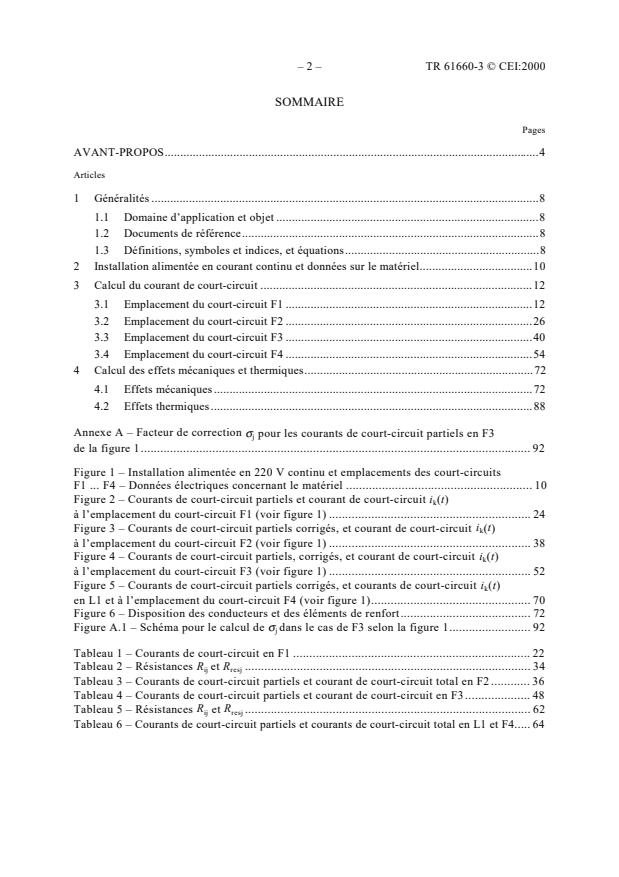
SOMMAIRE
Pages
AVANT-PROPOS.4
Articles
1 Généralités .8
1.1 Domaine d’application et objet .8
1.2 Documents de référence.8
1.3 Définitions, symboles et indices, et équations.8
2 Installation alimentée en courant continu et données sur le matériel.10
3 Calcul du courant de court-circuit .12
3.1 Emplacement du court-circuit F1 .12
3.2 Emplacement du court-circuit F2 .26
3.3 Emplacement du court-circuit F3 .40
3.4 Emplacement du court-circuit F4 .54
4 Calcul des effets mécaniques et thermiques.72
4.1 Effets mécaniques .72
4.2 Effets thermiques .88
Annexe A – Facteur de correction
σ pour les courants de court-circuit partiels en F3
j
de la figure 1. 92
Figure 1 – Installation alimentée en 220 V continu et emplacements des court-circuits
F1 . F4 – Données électriques concernant le matériel . 10
Figure 2 – Courants de court-circuit partiels et courant de court-circuit i (t)
k
à l’emplacement du court-circuit F1 (voir figure 1) . 24
Figure 3 – Courants de court-circuit partiels corrigés, et courant de court-circuit i (t)
k
à l’emplacement du court-circuit F2 (voir figure 1) . 38
Figure 4 – Courants de court-circuit partiels, corrigés, et courant de court-circuit i (t)
k
à l’emplacement du court-circuit F3 (voir figure 1) . 52
Figure 5 – Courants de court-circuit partiels corrigés, et courants de court-circuit i (t)
k
en L1 et à l’emplacement du court-circuit F4 (voir figure 1). 70
Figure 6 – Disposition des conducteurs et des éléments de renfort. 72
Figure A.1 – Schéma pour le calcul de σ dans le cas de F3 selon la figure 1. 92
j
Tableau 1 – Courants de court-circuit en F1 . 22
Tableau 2 – Résistances R et R . 34
ij resj
Tableau 3 – Courants de court-circuit partiels et courant de court-circuit total en F2 . 36
Tableau 4 – Courants de court-circuit partiels et courant de court-circuit en F3 . 48
Tableau 5 – Résistances R et R . 62
ij resj
Tableau 6 – Courants de court-circuit partiels et courants de court-circuit total en L1 et F4. 64
TR 61660-3 © IEC:2000 – 3 –
CONTENTS
Page
FOREWORD .5
Clause
1 General.9
1.1 Scope and object.9
1.2 Reference documents .9
1.3 Definitions, symbols, subscripts and equations .9
2 DC installation and data of the equipment .11
3 Short-circuit current calculation .13
3.1 Short-circuit location F1 .13
3.2 Short-circuit location F2 .27
3.3 Short-circuit location F3 .41
3.4 Short-circuit location F4 .55
4 Calculation of the mechanical and thermal effects.73
4.1 Mechanical effects .73
4.2 Thermal effect .89
Annex A – Correction factor
σ for the partial short-circuit currents in F3 of figure 1 . 93
j
Figure 1 – 220 V d.c. installation and short-circuit locations F1 . F4 – Electrical
equipment data. 11
Figure 2 – Partial short-circuit currents and short-circuit current i (t) at the short-circuit
k
location F1 (see figure 1) . 25
Figure 3 – Partial short-circuit currents, corrected, and short-circuit current i (t) at
k
the short-circuit location F2 (see figure 1). 39
Figure 4 – Partial short-circuit currents, corrected, and short-circuit current i (t) at
k
the short-circuit location F3 (see figure 1). 53
i t
Figure 5 – Partial short-circuit currents, corrected, and short-circuit currents ( ) in L1
k
and at the short-circuit location F4 (see figure 1) . 71
Figure 6 – Arrangement of conductors and stiffening elements. 73
σ
Figure A.1 – Scheme for the calculation of in the case of F3 in figure 1 . 93
j
Table 1 – Short-circuit currents in F1 . 23
Table 2 – R and R resistances . 35
ij resj
Table 3 – Partial short-circuit currents and total short-circuit current in F2 . 37
Table 4 – Partial short-circuit currents and short-circuit current in F3 . 49
R R
Table 5 – and resistances . 63
ij resj
Table 6 – Partial short-circuit currents and total short-circuit currents in L1 and F4 . 65
– 4 – TR 61660-3 © CEI:2000
COMMISSION ÉLECTROTECHNIQUE INTERNATIONALE
____________
COURANTS DE COURT-CIRCUIT DANS LES INSTALLATIONS
AUXILIAIRES ALIMENTÉES EN COURANT CONTINU
DANS LES CENTRALES ET LES POSTES –
Partie 3: Exemples de calculs
AVANT-PROPOS
1) La CEI (Commission Électrotechnique Internationale) est une organisation mondiale de normalisation composée
de l'ensemble des comités électrotechniques nationaux (Comités nationaux de la CEI). La CEI a pour objet de
favoriser la coopération internationale pour toutes les questions de normalisation dans les domaines de
l'électricité et de l'électronique. A cet effet, la CEI, entre autres activités, publie des Normes internationales. Leur
élaboration est confiée à des comités d'études, aux travaux desquels tout Comité national intéressé par le sujet
traité peut participer. Les organisations internationales, gouvernementales et non gouvernementales, en liaison
avec la CEI, participent également aux travaux. La CEI collabore étroitement avec l'Organisation Internationale
de Normalisation (ISO), selon des conditions fixées par accord entre les deux organisations.
2) Les décisions ou accords officiels de la CEI concernant les questions techniques représentent, dans la mesure du
possible, un accord international sur les sujets étudiés, étant donné que les Comités nationaux intéressés sont
représentés dans chaque comité d’études.
3) Les documents produits se présentent sous la forme de recommandations internationales. Ils sont publiés comme
normes, spécifications techniques, rapports techniques ou guides et agréés comme tels par les Comités nationaux.
4) Dans le but d'encourager l'unification internationale, les Comités nationaux de la CEI s'engagent à appliquer de
façon transparente, dans toute la mesure possible, les Normes internationales de la CEI dans leurs normes
nationales et régionales. Toute divergence entre la norme de la CEI et la norme nationale ou régionale
correspondante doit être indiquée en termes clairs dans cette dernière.
5) La CEI n’a fixé aucune procédure concernant le marquage comme indication d’approbation et sa responsabilité
n’est pas engagée quand un matériel est déclaré conforme à l’une de ses normes.
L’attention est attirée sur le fait que certains des éléments du présent rapport technique peuvent faire l’objet de
6)
droits de propriété intellectuelle ou de droits analogues. La CEI ne saurait être tenue pour responsable de ne pas
avoir identifié de tels droits de propriété et de ne pas avoir signalé leur existence.
La tâche principale des comités d’études de la CEI est l’élaboration des Normes internationales.
Toutefois, un comité d’études peut proposer la publication d’un rapport technique lorsqu’il a
réuni des données de nature différente de celles qui sont normalement publiées comme Normes
internationales, cela pouvant comprendre, par exemple, des informations sur l’état de la
technique.
Un rapport technique ne doit pas nécessairement être révisé avant que les données qu’il contient
ne soient plus jugées valables ou utiles par le groupe de maintenance.
TR 61660-3 © IEC:2000 – 5 –
INTERNATIONAL ELECTROTECHNICAL COMMISSION
____________
SHORT-CIRCUIT CURRENTS IN DC AUXILIARY INSTALLATIONS
IN POWER PLANTS AND SUBSTATIONS –
Part 3: Examples of calculations
FOREWORD
1) The IEC (International Electrotechnical Commission) is a worldwide organization for standardization comprising
all national electrotechnical committees (IEC National Committees). The object of the IEC is to promote
international co-operation on all questions concerning standardization in the electrical and electronic fields. To
this end and in addition to other activities, the IEC publishes International Standards. Their preparation is
entrusted to technical committees; any IEC National Committee interested in the subject dealt with may
participate in this preparatory work. International, governmental and non-governmental organizations liaising
with the IEC also participate in this preparation. The IEC collaborates closely with the International Organization
for Standardization (ISO) in accordance with conditions determined by agreement between the two organizations.
2) The formal decisions or agreements of the IEC on technical matters express, as nearly as possible, an international
consensus of opinion on the relevant subjects since each technical committee has representation from all
interested National Committees.
3) The documents produced have the form of recommendations for international use and are published in the form of
standards, technical specifications, technical reports or guides and they are accepted by the National Committees
in that sense.
4) In order to promote international unification, IEC National Committees undertake to apply IEC International
Standards transparently to the maximum extent possible in their national and regional standards. Any divergence
between the IEC Standard and the corresponding national or regional standard shall be clearly indicated in the
latter.
5) The IEC provides no marking procedure to indicate its approval and cannot be rendered responsible for any
equipment declared to be in conformity with one of its standards.
6) Attention is drawn to the possibility that some of the elements of this technical report may be the subject of patent
rights. The IEC shall not be held responsible for identifying any or all such patent rights.
The main task of IEC technical committees is to prepare International Standards. However, a
technical committee may propose the publication of a technical report when it has collected data
of a different kind from that which is normally published as an International Standard, for
example "state of the art".
Technical reports do not necessarily have to be reviewed until the data they provide are
considered to be no longer valid or useful by the maintenance team.
– 6 – TR 61660-3 © CEI:2000
La CEI 61660-3 qui est un rapport technique, a été établie par le comité d’études 73 de la CEI:
Courants de court-circuit.
Ce rapport technique doit être utilisé conjointement avec la CEI 61660-1 et la CEI 61660-2.
Le texte de ce rapport technique est issu des documents suivants:
Projet d'enquête Rapport de vote
73/106/CDV 73/109/RVC
Le rapport de vote indiqué dans le tableau ci-dessus donne toute information sur le vote ayant
abouti à l’approbation de ce rapport technique.
Cette publication a été rédigée selon les Directives ISO/CEI, Partie 3.
Ce document, purement informatif, ne doit pas être considéré comme une Norme internationale.
La CEI 61660 comprend les parties suivantes, présentées sous le titre général: Courants de court-
circuit dans les installations auxiliaires alimentées en courant continu dans les centrales et les
postes:
– Partie 1: Calcul des courants de court-circuit
– Partie 2: Calcul des effets
– Partie 3: Exemples de calculs
TR 61660-3 © IEC:2000 – 7 –
IEC 61660-3, which is a technical report, has been prepared by IEC technical committee 73:
Short-circuit currents.
This technical report should be read in conjunction with IEC 61660-1 and IEC 61660-2.
The text of this technical report is based on the following documents:
Enquiry draft Report on voting
73/106/CDV 73/109/RVC
Full information on the voting for the approval of this technical report can be found in the report
on voting indicated in the above table.
This publication has been drafted in accordance with ISO/IEC Directives, Part 3.
This document which is purely informative is not to be regarded as an International Standard.
IEC 61660 consists of the following parts, under the general title: Short-circuit currents in d.c.
auxiliary installations in power plants and substations:
– Part 1: Calculation of short-circuit currents
– Part 2: Calculation of effects
– Part 3: Examples of calculations
– 8 – TR 61660-3 © CEI:2000
COURANTS DE COURT-CIRCUIT DANS LES INSTALLATIONS
AUXILIAIRES ALIMENTÉES EN COURANT CONTINU
DANS LES CENTRALES ET LES POSTES –
Partie 3: Exemples de calculs
1 Généralités
1.1 Domaine d’application et objet
La CEI 61660-3 qui est un rapport technique fournit une aide pour appliquer la CEI 61660-1 et la
CEI 61660-2. Par conséquent, le calcul destiné aux installations alimentées en courant continu
indiquées à la figure 1 sont strictement réalisées en conformité avec la CEI 61660-1 et la
CEI 61660-2.
Le schéma d’installation correspondant à l’emplacement du court-circuit F3 de la figure 1 ne
correspond pas à la figure 3 de la CEI 61660-1. Par conséquent, des considérations
supplémentaires portant sur le facteur de correction σ sont nécessaires et il convient de
j
consulter l’annexe A.
La ligne de connexion L1 de la figure 1 est constituée de barres en cuivre (voir article 4). Les
lignes de connexion L2 et L3 sont des connexions par câble. Par conséquent, les effets
mécaniques et thermiques sont uniquement calculés pour L1 en cas de court-circuit à
l’emplacement F4.
1.2 Documents de référence
CEI 61660-1:1997, Courants de court-circuit dans les installations auxiliaires alimentées en
courant continu dans les centrales et les postes – Partie 1: Calcul des courants de court-circuit
CEI 61660-2:1997, Courants de court-circuit dans les installations auxiliaires alimentées en
courant continu dans les centrales et les postes – Partie 2: Calcul des effets
CEI 60909-0:—, Courants de court-circuit dans les réseaux triphasés à courant alternatif –
1)
Partie 0: Calcul des courants
1.3 Définitions, symboles et indices, et équations
Les définitions, les symboles et indices, ainsi que les équations, sont les mêmes que dans la
CEI 61660-1 et dans la CEI 61660-2. Les références données à l’article 3 correspondent à
la CEI 61660-1 et les références données à l’article 4 correspondent à la CEI 61660-2. Ces
références sont indiquées entre crochets.
________
1)
A publier.
TR 61660-3 © IEC:2000 – 9 –
SHORT-CIRCUIT CURRENTS IN DC AUXILIARY INSTALLATIONS
IN POWER PLANTS AND SUBSTATIONS –
Part 3: Examples of calculations
1 General
1.1 Scope and object
IEC 61660-3 which is a technical report gives help for the application of IEC 61660-1 and
IEC 61660-2. Therefore, the calculations for the d.c. installation in figure 1 are strictly carried
out in accordance with IEC 61660-1 and 61660-2.
The installation scheme with respect to the short-circuit location F3 in figure 1 does not
correspond to figure 3 of IEC 61660-1. Therefore, additional considerations related to the
correction factor σ are necessary and annex A should be consulted.
j
The connecting line L1 in figure 1 consists of copper bars (see clause 4). The lines L2 and L3
are cable connections. Therefore, the mechanical and thermal effects are calculated only for L1
in case of a short circuit at the location F4.
1.2 Reference documents
IEC 61660-1:1997, Short-circuit currents in d.c. auxiliary installations in power plants and
substations – Part 1: Calculation of short-circuit currents
IEC 61660-2:1997, Short-circuit currents in d.c. auxiliary installations in power plants and
substations – Part 2: Calculation of effects
IEC 60909-0:—, Short-circuit currents in three-phase a.c. systems – Part 0: Calculation of
1)
currents
1.3 Definitions, symbols, subscripts and equations
Definitions, symbols, subscripts and equations are the same as those used in IEC 61660-1 and
IEC 61660-2. References in square brackets in clause 3 relate to IEC 61660-1 and references in
square brackets in clause 4 relate to IEC 61660-2.
________
1)
To be published.
– 10 – TR 61660-3 © CEI:2000
2 Installation alimentée en courant continu et données sur le matériel
Réseau triphasé en courant alternatif
U = 660 V; f = 50 Hz
nQ
''
I = 30 kA; c = 1,05
max
kQmax
Q
R /X =0,3
Q Q
N
Transformateur:
T
U /U = 660 V/244 V
rTHV rTLV
S = 364 kVA; P = 4,01 kW; u = 3,2 %
rT krT kr
Redresseur:
I = 1 kA
D
rD
S Réactance de lissage:
R ; L = 30 μH
= 0,88 mΩ
S S
Condensateur
C
L1
C = 75 mF F4
c.a.
F1
R = 10 m R = 0,44 m
Ω Ω
C L1 B
L2
L = 6,5 μH
L1
R = 0,23 m
Ω
L2
L = 3,78 μH
L2 Batterie au plomb de 107 éléments
U ′ /élément = 2,0 V
nB
E = 1,05 U = 224,7 V
B nB
(U = 220 V)
n
′
R
/élément = 0,13 mΩ
B
F2
′
L
/élément = 0,2 μH
B
L3
=
M
R
3~ = 1,39 mΩ
L3
L = 15,6 μH
L3
G
3~
F3
Moteur:
U = 220 V; P = 100 kW; I = 497 A
rM rM rM
-1
n = 25 s ;n = 1,08 n ; n 0 pour T 1 s
→ ≥
rM OM rM K
R = 42,2 m ; L = 0,4 mH
Ω
M M
R = 10 ; L = 10 H
Ω
F F
IEC 214/2000
J
= 6,6 kg⋅m
Figure 1 – Installation alimentée en 220 V continu et emplacements des court-circuits F1 . F4 –
Données électriques concernant le matériel
TR 61660-3 © IEC:2000 – 11 –
2 DC installation and data of the equipment
Three-phase a.c. system
U = 660 V; f = 50 Hz
nQ
''
I 30 kA; c = 1,05
=
max
kQmax
Q
R /X =0,3
Q Q
N
Transformer:
T
U /U = 660 V/244 V
rTHV rTLV
S = 364 kVA; P = 4,01 kW; u = 3,2 %
rT krT kr
Rectifier:
I = 1 kA
D rD
S
R ; L = 30 H
Smoothing reactor: = 0,88 mΩ μ
S S
Capacitor
C
L1
C = 75 mF F4
a.c.
F1
R = 10 m R = 0,44 m
Ω Ω
C L1 B
L2
L = 6,5 μH
L1
R = 0,23 m
Ω
L2
L = 3,78 μH
Lead-acid battery 107 cells
L2
U ′ /cell = 2,0 V
nB
E = 1,05 U = 224,7 V
B nB
(U = 220 V)
n
R′
B /cell = 0,13 mΩ
F2
′
L /cell = 0,2 μH
B
L3
=
M
3~ R = 1,39 mΩ
L3
L = 15,6 μH
L3
G
3~
F3
Motor:
U = 220 V; P = 100 kW; I = 497 A
rM rM rM
-1
n = 25 s ; n = 1,08 n ; n 0 for T 1 s
→ ≥
K
rM OM rM
R = 42,2 m ; L = 0,4 mH
Ω
M M
R = 10 ; L = 10 H
Ω
F F
IEC 214/2000
J
= 6,6 kg⋅m
Figure 1 – 220 V d.c. installation and short-circuit locations F1 . F4 – Electrical equipment data
– 12 – TR 61660-3 © CEI:2000
3 Calcul du courant de court-circuit
Les courants de court-circuit les plus importants doivent être calculés aux emplacements de
court-circuit F1 . F4. La durée du court-circuit dans cet exemple est prise égale à T = 0,1 s.
k
Cette valeur est utilisée pour trouver la fonction d’approximation normalisée [figure 2]. Le
courant total de court-circuit en fin de court-circuit est supposé être le courant de court-circuit I ,
k
quasi permanent s’écartant de la définition citée en [1.3.7].
NOTE Pour trouver les courants de court-circuit partiel i (t), i (t), i (t) et i (t), les courants de court-circuit quasi
D B C M
permanent I (t), I (t), I (t) et I (t) sont les valeurs envisagées des courants de court-circuit 1 s après de début du
kD kB kC kM
court-circuit.
3.1 Emplacement du court-circuit F1
3.1.1 Courant de court-circuit partiel du redresseur D
Impédance de court-circuit du réseau triphasé à courant alternatif au point de connexion Q,
conformément à la CEI 60909-0 et avec le facteur c = c = 1,05 (tableau 1 de la CEI 60909-0).
max
Indice t pour l’impédance transposée du côté basse tension du transformateur.
2 2
cU
U
1,05 × 660 V 244 V
nQ
rTLV
Z = = = 1,823 mΩ
Qt
′′ U 660 V
3I 3 × 30 kA
rTHV
kQ max
Z
1,823 mQt
X = = = 1,746 m
Qt
2 2
()
1 + 0,3
()
1 + R /X
Qt Qt
R = 0,3 X = 0,524 mΩ
Qt Qt
Impédance du transformateur T:
u 2
U
3,2 % (244 V)
kr rTLV
Z = = = 5,234 mΩ
TLV
100 % S 100 % 364 kVA
rT
U
(244 V)
rTLV
R = P = 4,01 kW = 1,802 mΩ
TLV krT
2 2
S (364 kVA)
rT
2 2 2 2
X = Z − R = 5,234 − 1,802 mΩ = 4,914 mΩ
TLV TLV TLV
Résistances et réactances du côté alternatif à l’emplacement du redresseur [équations (8) et (9)]:
R = R + R = 0,524 mΩ + 1,802 mΩ = 2,326 mΩ
N Qt TLV
Z = 7,054 mΩ
N
X = X + X = 1,746 mΩ + 4,914 mΩ = 6,660 mΩ
N Qt TLV
L =X / 2 πf = 6,66 mΩ/2 π50 Hz = 21,2+
N N
TR 61660-3 © IEC:2000 – 13 –
3 Short-circuit current calculation
Maximum short-circuit currents shall be calculated at the short-circuit locations F1 . F4. The
short-circuit duration in this example is taken as T = 0,1 s. This value is used to find the
k
standard approximation function [figure 2]. The total short-circuit current at the end of the short-
circuit duration is assumed as quasi steady-state short-circuit current I , deviating from the
k
definition in [1.3.7].
NOTE To find the partial short-circuit currents i (t), i (t), i (t) and i (t), the quasi stady-state short-circuit currents
D B C M
I (t), I (t), I (t) and I (t) are the prospected values of the short-circuit currents at 1 s after the beginning of the
kD kB kC kM
short circuit.
3.1 Short-circuit location F1
3.1.1 Partial short-circuit current of the rectifier D
Short-circuit impedance of the three-phase a.c. system at the connection point Q according to
IEC 60909-0 with the factor c = c = 1,05 (table 1 of IEC 60909-0). Index t for the transferred
max
impedance to the low-voltage side of the transformer.
cU
U
1,05 × 660 V 244 V
nQ
rTLV
Z = = = 1,823 mΩ
Qt
′′ U 660 V
3I 3 × 30 kA
rTHV
kQ max
Z
1,823 mQt
X = = = 1,746 m
Qt
2 2
()
1 + 0,3
()
1 + R /X
Qt Qt
R = 0,3 X = 0,524 mΩ
Qt Qt
Impedance of the transformer T:
u 2
U
3,2 % (244 V)
kr rTLV
Z = = = 5,234 mΩ
TLV
100 % S 100 % 364 kVA
rT
U
(244 V)
rTLV
R = P = 4,01 kW = 1,802 mΩ
TLV krT
2 2
S (364 kVA)
rT
2 2 2 2
X = Z − R = 5,234 − 1,802 mΩ = 4,914 mΩ
TLV TLV TLV
Resistances and reactances of the a.c. side at the location of the rectifier [equations (8) and (9)]:
R = R + R = 0,524 mΩ + 1,802 mΩ = 2,326 mΩ
N Qt TLV
Z = 7,054 mΩ
N
X = X + X = 1,746 mΩ + 4,914 mΩ = 6,660 mΩ
N Qt TLV
L =X / 2 πf = 6,66 mΩ/2 π 50 Hz = 21,2+
N N
– 14 – TR 61660-3 © CEI:2000
Résistance et inductance du côté continu de la branche du redresseur [équations (11) et (12)]:
R = R = 0,88 mΩ
DBr S
L = L = 30+
DBr S
Ceci conduit aux égalités suivantes:
R
2,326 mΩ
N
= = 0,349
X 6,660 mΩ
N
R
0,88 mΩ
DBr
= = 0,378
R 2,326 mΩ
N
L
30+DBr
= = 1,415
L 21,2+
N
Courant de court-circuit quasi permanent I [équation (13)]:
kD
cU U
3 2 3 2 1,05 × 660 V 244 V
n rTLV
I =× × = 0,974 × × × = 27,58 kA
kD D
π U π 660 V
3 Z 3 × 7,054 mΩ
rTHV
N
avec λ = 0,974 provenant de la [figure 7 ou de l’équation (54)]
D
Courant de court-circuit de crête i [équation (14)]:
pD
i = κ I = 1,14 × 27,58 kA = 31,44 kA
pD D kD
où κ = 1,14 [figure 8] en fonction de
D
R R L
2 2
N DBr DBr
1 + × = 0,349 1 + × 0,378 = 0,437 and = 1,415
X 3 R 3 L
N N N
Temps pour atteindre la crête t [équation (16)] pour L /L > 1:
pD DBr N
L
DBr
t =()3 + 6 + 4 − 1 ms =[]()3 × 1,14 + 6 + 4(1,415 − 1) ms = 11,08 ms ≈ 11,1 ms
pD D
L
N
Constante de temps de croissance τ [équation (17)] pour κ ≥ 1,05:
1D D
L
DBr
2= 2 +()− 0,9 2,5 + 9 ms =[]2 +()1,14 − 0,9(2,5 + 9 × 1,415) ms = 5,66 ms ≈ 5,7 ms
1D D
L
N
Constante de temps de décroissance τ [équation (19)]:
2D
2 ms 2 ms
2= = = 6,095 ms ≈ 6,1 ms
2D
0,349 (0,6 + 0,9 × 0,378)
R R
N DBr
0,6 + 0,9
X R
N N
TR 61660-3 © IEC:2000 – 15 –
Resistance and inductance of the d.c. side of the rectifier branch [equations (11) and (12)]:
R = R = 0,88 mΩ
DBr S
L = L = 30+
DBr S
This leads to the following relations:
R
2,326 mΩ
N
= = 0,349
X 6,660 mΩ
N
R
0,88 mΩ
DBr
= = 0,378
R 2,326 mΩ
N
L
30+DBr
= = 1,415
L 21,2+
N
Quasi steady-state short-circuit current I [equation (13)]:
kD
cU U
3 2 3 2 1,05 × 660 V 244 V
n rTLV
I =× × = 0,974 × × × = 27,58 kA
kD D
π U π 660 V
3 Z 3 × 7,054 mΩ
rTHV
N
with λ = 0,974 from [figure 7 or equation (54)]
D
Peak short-circuit current i [equation (14)]:
pD
i = κ I = 1,14 × 27,58 kA = 31,44 kA
pD D kD
with κ = 1,14 [figure 8] depending on
D
R
R L
2 2
N DBr DBr
1 + × = 0,349 1 + × 0,378 = 0,437 and = 1,415
X 3 R 3 L
N N N
Time to peak t [equation (16)] for L /L > 1:
pD DBr N
L
DBr
t =()3 + 6 + 4 − 1 ms =[]()3 × 1,14 + 6 + 4(1,415 − 1) ms = 11,08 ms ≈ 11,1 ms
pD D
L
N
Rise time constant τ [equation (17)] for κ ≥ 1,05:
1D D
L
DBr
2= 2 +()− 0,9 2,5 + 9 ms =[]2 +()1,14 − 0,9(2,5 + 9 × 1,415) ms = 5,66 ms ≈ 5,7 ms
1D D
L
N
Decay time constant τ [equation (19)]:
2D
2 ms 2 ms
2= = = 6,095 ms ≈ 6,1 ms
2D
0,349 (0,6 + 0,9 × 0,378)
R
R
N DBr
0,6 + 0,9
X R
N N
– 16 – TR 61660-3 © CEI:2000
3.1.2 Courant de court-circuit partiel de la batterie B
Conformément à [2.5]
E = 1,05 U pour les batteries chargées: E = 1,05 × 107 × 2,0 V = 224,7 V
B nB B
R = 107 × 0,13 mΩ = 13,91 mΩ
B
L = 107 × 0,2 μH = 21,40 μH
B
Résistances et inductances de la branche batteries [équations (20) et (21)]:
R = 0,9 R + R = 0,9 × 13,91 mΩ + 0,44 mΩ = 12,959 mΩ
BBr B L1
L = L + L = 21,40 μH + 6,5 μH = 27,9 μH
BBr B L1
Courant de court-circuit quasi permanent I [équation (22)]:
kB
0,95 E 0,95 × 224,7 V
B
I = = = 14,88 kA
kB
R + 0,1 R()12,959 + 0,1×13,91 mΩ
BBr B
Courant de court-circuit de crête i [équation (23)]:
pB
E
224,7 V
B
i = = = 17,34 kA
pB
R 12,959 mΩ
BBr
Constante de temps pour atteindre la crête t et constante de temps de croissance τ avec 1/δ
pB 1B
[équation (24)]:
2 ms
1 2 2
= = = = 4,02 ms
R 12,959 mΩ 1/1 0,464 + 0,033
BBr
+
+
L T 27,9+30 ms
BBr B
t = 12 ms
pB
[]
figure 10
2= 2 ms
1B
Constante de temps de décroissance τ [équation (25)]:
2B
τ = 100 ms
2B
3.1.3 Courant de court-circuit partiel du condensateur C
Résistances, inductances et capacitance de la branche condensateur [équations (26) et (27)].
R = R = 10 mΩ
CBr C
L = 0
CBr
C = 1,2 C = 1,2 × 75 mF = 90 mF
c.a.
Courant de court-circuit quasi permanent I [2.6.2.1]:
kC
I = 0
kC
TR 61660-3 © IEC:2000 – 17 –
3.1.2 Partial short-circuit current of the battery B
According to [2.5]
E = 1,05 U for charged batteries: E = 1,05 × 107 × 2,0 V = 224,7 V
B nB B
R = 107 × 0,13 mΩ = 13,91 mΩ
B
L = 107 × 0,2 μH = 21,40 μH
B
Resistances and inductances of battery branch [equations (20) and (21)]:
R = 0,9 R + R = 0,9 × 13,91 mΩ + 0,44 mΩ = 12,959 mΩ
BBr B L1
L = L + L = 21,40 μH + 6,5 μH = 27,9 μH
BBr B L1
Quasi steady-state short-circuit current I [equation (22)]:
kB
0,95 E 0,95 224,7 V
×
B
I 14,88 kA
= = =
kB
R + 0,1 R()12,959 + 0,1×13,91 mΩ
BBr B
Peak short-circuit current i equation (23) :
[ ]
pB
E
224,7 V
B
i = = = 17,34 kA
pB
R 12,959 mΩ
BBr
Time to peak t and rise time constant τ with 1/δ [equation (24)]:
pB 1B
1 2 2 2 ms
= = = = 4,02 ms
R 12,959 mΩ/1 1 +
0,464 0,033
BBr
+
+
27,9+30 ms
L T
BBr B
t = 12 ms
pB
[]figure 10
2= 2 ms
1B
Decay time constant τ [equation (25)]:
2B
τ = 100 ms
2B
3.1.3 Partial short-circuit current of the capacitor C
Resistance, inductance and capacitance of the capacitor branch [equations (26) and (27)].
R = R = 10 mΩ
CBr C
L = 0
CBr
C = 1,2 C = 1,2 × 75 mF = 90 mF
a.c.
Quasi steady-state short-circuit current I [2.6.2.1]:
kC
I = 0
kC
– 18 – TR 61660-3 © CEI:2000
Courant de court-circuit de crête i [équation (28)] avec E = 1,05 U :
pC C nB
E
224,7 V
C
i == 1,0 × = 22,47 kA
pC C
R 10 mΩ
CBr
avec κ = 1,0 [2.6.2.2] avec L = 0
C CBr
Temps pour atteindre la crête t avec L = 0
pC CBr
t = 0
pC
Constante de temps de croissance τ [équation (31)] avec t = 0:
1C pC
τ = k t = 0
1C 1C pC
Constante de temps de décroissance τ [équation (32)] avec k = 1,0:
2C 2C
τ = k R C = 1,0 × 10 mΩ × 90 mF = 0,9 ms
2C 2C CBr
3.1.4 Courant de court-circuit partiel du moteur M
Résistances et inductances de la branche moteur [équations (33) et (34)] et τ [équation (35)]:
M
R = R + R = 42,2 mΩ + 0,23 mΩ = 42,43 mΩ
MBr M L2
L = L + L = 0,4 mH + 3,78 μH = 403,78 μH
MBr M L2
τ = L /R = 403,78 μH/42,43 mΩ = 9,52 ms
M MBr MBr
Courant de court-circuit quasi permanent I [équation (37)]:
kM
I = 0 pour n → 0
kM
Courant de court-circuit de crête i [équation (38)]:
pM
U − I R 220 V − 497 A × 0,0422 Ω
rM rM M
i == 0,86 × = 4,03 kA
pM M
R 42,43 mΩ
MBr
avec κ provenant de la [figure 17] en fonction de 1/δ et ω :
M 0
−1 2
2 πn JR I 2 πn JR I
2 π × 1,08 × 25 s × 6,6 kgm × 42,43 mΩ × 497 A
0M MBr rM 0M MBr rM
2= = =
mec
P 100 kW
M U
rM
r rM
× 220 V
× U
rM
−1
2 πn 2 π × 25 s
rM
où P est la puissance mécanique du moteur.
rM
τ = 169 ms
mec
τ = L /R = 10 H/10 Ω = 1 s
F F F
TR 61660-3 © IEC:2000 – 19 –
Peak short-circuit current i [equation (28)] with E = 1,05 U :
pC C nB
E
224,7 V
C
i == 1,0 × = 22,47 kA
pC C
R 10 mΩ
CBr
with κ = 1,0 [2.6.2.2] with L = 0
C CBr
Time to peak t with L = 0
pC CBr
t = 0
pC
Rise time constant τ [equation (31)] with t = 0:
1C pC
τ = k t = 0
1C 1C pC
Decay time constant τ [equation (32)] with k = 1,0:
2C 2C
τ = k R C = 1,0 × 10 mΩ × 90 mF = 0,9 ms
2C 2C CBr
3.1.4 Partial short-circuit current of the motor M
Resistances and inductances of the motor branch [equation (33) and (34)] and τ [equation (35)]:
M
R = R + R = 42,2 mΩ + 0,23 mΩ = 42,43 mΩ
MBr M L2
L = L + L = 0,4 mH + 3,78 μH = 403,78 μH
MBr M L2
τ = L /R = 403,78 μH/42,43 mΩ = 9,52 ms
M MBr MBr
Quasi steady-state short-circuit current I [equation (37)]:
kM
I = 0 for n → 0
kM
Peak short-circuit current i [equation (38)]:
pM
U − I R 220 V 497 A 0,0422
− × Ω
rM rM M
i == 0,86 × = 4,03 kA
pM M
R 42,43 mΩ
MBr
with κ from [figure 17] depending on 1/δ and ω :
M 0
−1 2
2 πn JR I 2 πn JR I
2 π × 1,08 × 25 s × 6,6 kgm × 42,43 mΩ × 497 A
0M MBr rM 0M MBr rM
2= = =
mec
P 100 kW
M U
rM
r rM
× 220 V
× U
rM
−1
2 πn 2 π × 25 s
rM
where P is the mechanical power of the motor.
rM
τ = 169 ms
mec
τ = L /R = 10 H/10 Ω = 1 s
F F F
– 20 – TR 61660-3 © CEI:2000
τ = 169 ms < 10 τ = 10 × 1 s = 10 s conduit à κ = 0,86 provenant de la [figure 17] en
mec F M
δ τ [ ]
fonction de 1/ = 2 = 19,04 ms tiré de l’ équation (41) et de
M
R I
1 1 0,0422× 497 A
M rM
&= 1 − = 1 −
0
22U 169 ms × 9,52 ms 220 V
mec M rM
−1
= 23,74 s de[]l'équation (19) .
Temps pour atteindre la crête t et constante de temps de croissance pour la vitesse de
pM
décroissance avec τ < 10 τ [2.7.2.3b] et [équation (45)]:
mec F
t = 30 ms
pM
provenant de la [figure 19] et de l’équation (46)].
Pour la vitesse de décroissance τ < 10τ [figure 19]:
mec F
τ = k τ = 0,85 × 9,52 ms = 8,1 ms
1M 3M M
avec k = 0,85 [figure 20]
3M
Constante de temps de décroissance τ [équation (48)]:
2M
τ = k τ = 1,0 × 169 ms = 169 ms
2M 4M mec
avec k = 1,0 [figure 21] pour la vitesse de décroissance et τ < 10 τ
4M mec F
3.1.5 Courant de court-circuit à l’emplacement du court-circuit F1
Le courant de court-circuit en F1 est déterminé par la figure 2 à partir de la superposition des
courants de court-circuit partiels i (t), i (t), i (t) et i (t) conformément à l’[équation (51)].
D B C M
Courants de court-circuit partiels i(t):
Branche redresseur D:
−t /2−t / 5,70 ms
1D
1 − e 1 − e
i (t) = i = 31,44 kA ×
1D pD
−t /2−11,1 ms / 5,7 ms
pD 1D
1 − e
1 − e
−t / 5,70 ms
= 36,7 kA()1−e
p = I /i = 27,6 kA/31,44 kA = 0,877
D kD pD
−()t−t /2pD 2D
i t = i[]()− p e + p
( ) 1
2D pD D D
−()t−11,1 ms / 6,1 ms
=[]+ e
31,4 kA 0,877 0,12
TR 61660-3 © IEC:2000 – 21 –
τ = 169 ms < 10 τ = 10 × 1 s = 10 s leads to κ = 0,86 from [figure 17] depending on 1/δ =
mec F M
τ [ ]
2 = 19,04 ms from equation (41) and
M
R I
1 1 0,0422× 497 A
M rM
&= 1 − = 1 −
0
22U 169 ms × 9,52 ms 220 V
mec M rM
−1
= 23,74 s from[]equation (19) .
Time to peak t and rise time constant τ for the decreasing speed with τ < 10 τ [2.7.2.3b] and
pM 1M mec F
[equation (45)]:
t = 30 ms
pM
from [figure 19] and from [equation (46)].
For decreasing speed with τ < 10 τ [figure 19]:
mec F
τ = k τ = 0,85 × 9,52 ms = 8,1 ms
1M 3M M
with k = 0,85 [figure 20]
3M
Decay time constant τ [equation (48)]:
2M
τ = k τ = 1,0 × 169 ms = 169 ms
2M 4M mec
with k = 1,0 [figure 21] for decreasing speed and τ < 10 τ
4M mec F
3.1.5 Short-circuit current at the short-circuit location F1
The short-circuit current in F1 is determined with figure 2 from the super-position of the partial
short-circuit currents i (t), i (t), i (t) and i (t) according to [equation (51)].
D B C M
The partial short-circuit currents i(t):
Rectifier branch D:
−t /2−t / 5,70 ms
1D
1 − e 1 − e
i (t) = i = 31,44 kA ×
1D pD
−t /2−11,1 ms / 5,7 ms
pD 1D
1 − e
1 − e
−t / 5,70 ms
= 36,7 kA()1−e
= = =
p I /i 27,6 kA/31,44 kA 0,877
D kD pD
−()t−t /2pD 2D
i (t) = i[]()1 − p e + p
2D pD D D
−()t−11,1 ms / 6,1 ms
= 31,4 kA[]0,877 + 0,12 e
– 22 – TR 61660-3 © CEI:2000
Branche batterie B:
−t /2−t / 2 ms
1B
1 − e 1 − e
−t / 2 ms
i (t) = i =17,34 kA = 17,38 kA[]1 − e
1B pB
−t /2−12 ms / 2 ms
pB 1B
1 − e
1 − e
p = I /i = 14,88 kA/17,34 kA = 0,858
B kB pB
−()t−t /2pB 2B
i (t) = i[]()1 − p e + p
2B pB B B
( 12 ms) 100 ms
− t− /
= 17,34 kA[]0,858 + 0,142e
Branche condensateur C:
−t /21C
1 − e
i (t) = i = 22,47 kA
1C pC
−t /2pC 1C
1 − e
p = I /i = 0
C kC pC
−(t−t ) /2−t / 0,9 ms
pC 2C
i (t) = i e = 22,47 kA e
2C pC
Branche moteur M:
−t /2−
t / 8,1 ms
1M
1 − e 1 − e
i (t) = i = 4,03 kA ×
1M pM
−t /2−30 ms / 8,1 ms
pM 1M
− e
− e 1
−t / 8,1 ms
= 4,13 kA[]1 − e
p = I /i = 0
M kM pM
− −
(t t ) /2−(t−30 ms) /169 ms
pM 2M
i (t) = i e = 4,03 kA e
2M pM
3.1.6 Relevé des résultats
Le tableau 1 donne les principaux résultats pour les courants de court-circuit en F1.
Tableau 1 – Courants de court-circuit en F1
i I t
p k p τ τ
1 2
Branche
kA kA ms ms ms
Redresseur D 31,4 27,6 11,1 5,7 6,1
Batterie B 17,3 14,9 12,0 2,0 100
Condensateur C 22,5 0 0 0 0,9
Moteur M 4,03 0 30,0 8,1 169
Total des courants de court- 52,1 46,1 11,1 3,7 34,5
1)
circuit
1)
Obtenu à partir de la figure 2 pour la fonction d’approximation et pour le courant de court-circuit total i (t).
k
TR 61660-3 © IEC:2000 – 23 –
Battery branch B:
−t /2−t / 2 ms
1B
1 − e 1 − e
−t / 2 ms
i (t) = i =17,34 kA = 17,38 kA[]1 − e
1B pB
−t /2−12 ms / 2 ms
pB 1B
1 − e
1 − e
p = I /i = 14,88 kA/17,34 kA = 0,858
B kB pB
−()t−t /2pB 2B
i (t) = i[]()1 − p e + p
2B pB B B
( 12 ms) 100 ms
− t− /
= 17,34 kA[]0,858 + 0,142e
Capacitor branch C:
−t /21C
1 − e
i (t) = i = 22,47 kA
1C pC
−t /2pC 1C
1 − e
p = I /i = 0
C kC pC
−(t−t ) /2−t / 0,9 ms
pC 2C
i (t) = i e = 22,47 kA e
2C pC
Motor branch M:
−t /2−
t / 8,1 ms
1M
1 − e 1 − e
i (t) = i = 4,03 kA ×
1M pM
−t /2−30 ms / 8,1 ms
pM 1M
− e
− e 1
−t / 8,1 ms
= 4,13 kA[]1 − e
p = I /i = 0
M kM pM
− −
(t t ) /2−(t−30 ms) /169 ms
pM 2M
i (t) = i e = 4,03 kA e
2M pM
3.1.6 Collection of results
Table 1 gives the main results for the short-circuit currents in F1.
Table 1 – Short-circuit currents in F1
i I t τ τ
p k p 1 2
Branch
kA kA ms
ms ms
Rectifier D 31,4 27,6 11,1 5,7 6,1
Battery B 17,3 14,9 12,0 2,0 100
Capacitor C 22,5 0 0 0 0,9
Motor M 4,03 0 30,0 8,1 169
1)
52,1 46,1 11,1 3,7 34,5
Total short-circuit current
1)
Found from figure 2 for the approximation function for the total short-circuit current i (t).
k
– 24 – TR 61660-3 © CEI:2000
kA
31,4
27,6
i (t)
D
0 10 20 30 40 50 60 70 80 90 100
ms
11,1
17,3
20 15,9
kA
i (t)
B
0 10 20 30 40 50 60 70 80 90 100
ms
kA
22,5
i (t)
c
0 10 20 30 40 50 60 70 80 90 100
ms
t
kA
4,0
2,7
i (t)
M
0 10 20 30 40 50 60 70 80 90 100
ms
kA
52,1
50 0,9 (i - I ) 46,1
p k
i (t)
k
11,1 79
0 10 20 30 40 50 60 70 80 90 100
ms
11,1
t
IEC 215/2000
––––––– courant de court-circuit
- - - - - - - - - fonction d’approximation normalisée pour le
...