

IEC 63466-1:2025
(Main)Leaky waveguides - Part 1: Generic specification - General requirements and test methods
- Abstract
IEC 63466-1:2025 specifies the general requirements and test methods for leaky waveguides, including terms and definitions, design and structure, type designation, ratings and characteristics, identification, marking and labelling, requirements and test methods, etc.
This document is applicable to leaky waveguides, including rigid rectangular leaky waveguides and elliptic leaky waveguides. These leaky waveguides are intended for use in tunnels, railways, highways, subways, elevators and other installations in which conventional antenna transmission is not satisfactory or even impossible.
- Status
- Published
- Publication Date
- 19-Nov-2025
- Technical Committee
- TC 46 - Cables, wires, waveguides, RF connectors, RF and microwave passive components and accessories
- Drafting Committee
- WG 13 - TC 46/WG 13
- Current Stage
- PPUB - Publication issued
- Start Date
- 20-Nov-2025
- Completion Date
- 12-Dec-2025
Buy Documents
IEC 63466-1:2025 - Leaky waveguides - Part 1: Generic specification - General requirements and test methods Released:11/20/2025
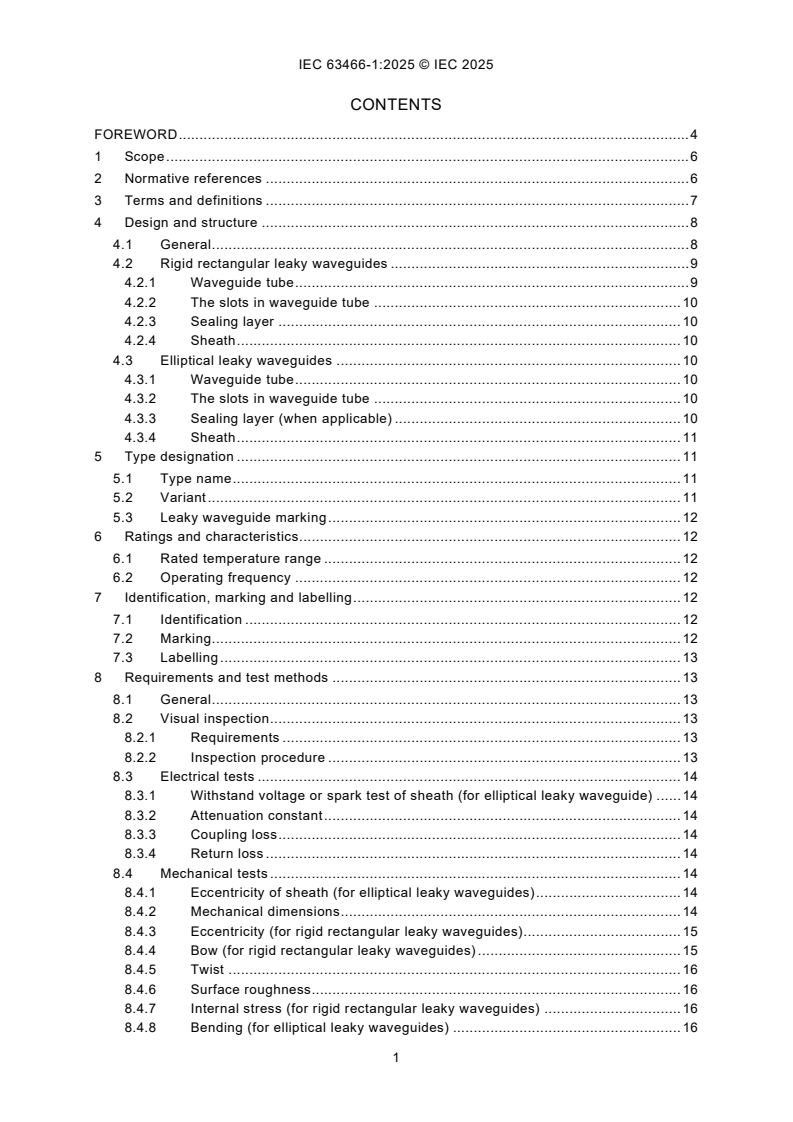
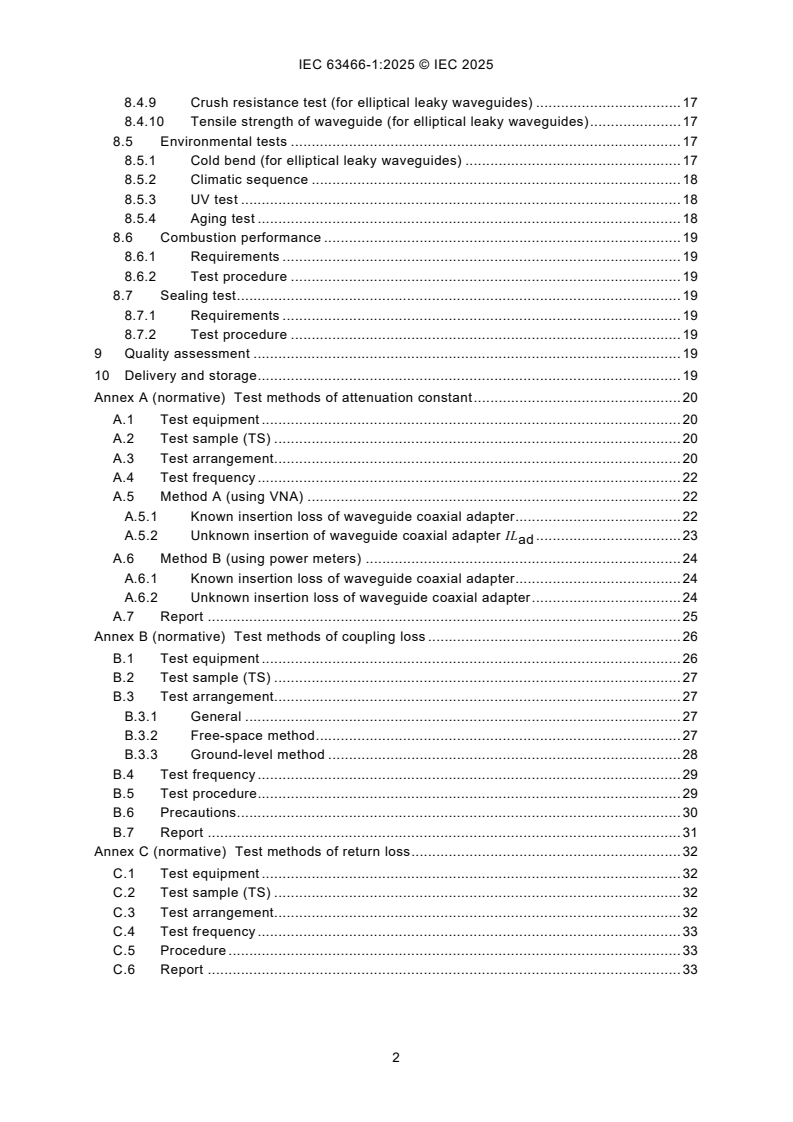
iec63466-1{ed1.0}en - IEC 63466-1:2025 - Leaky waveguides - Part 1: Generic specification - General requirements and test methods
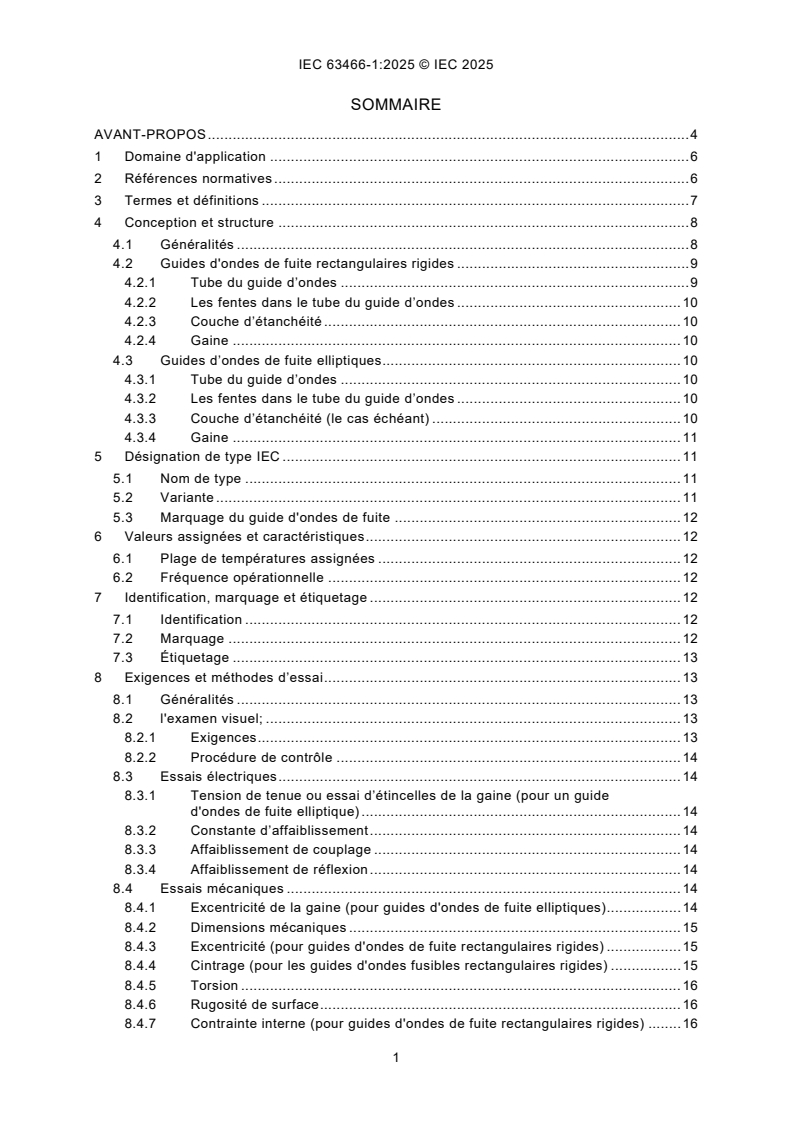
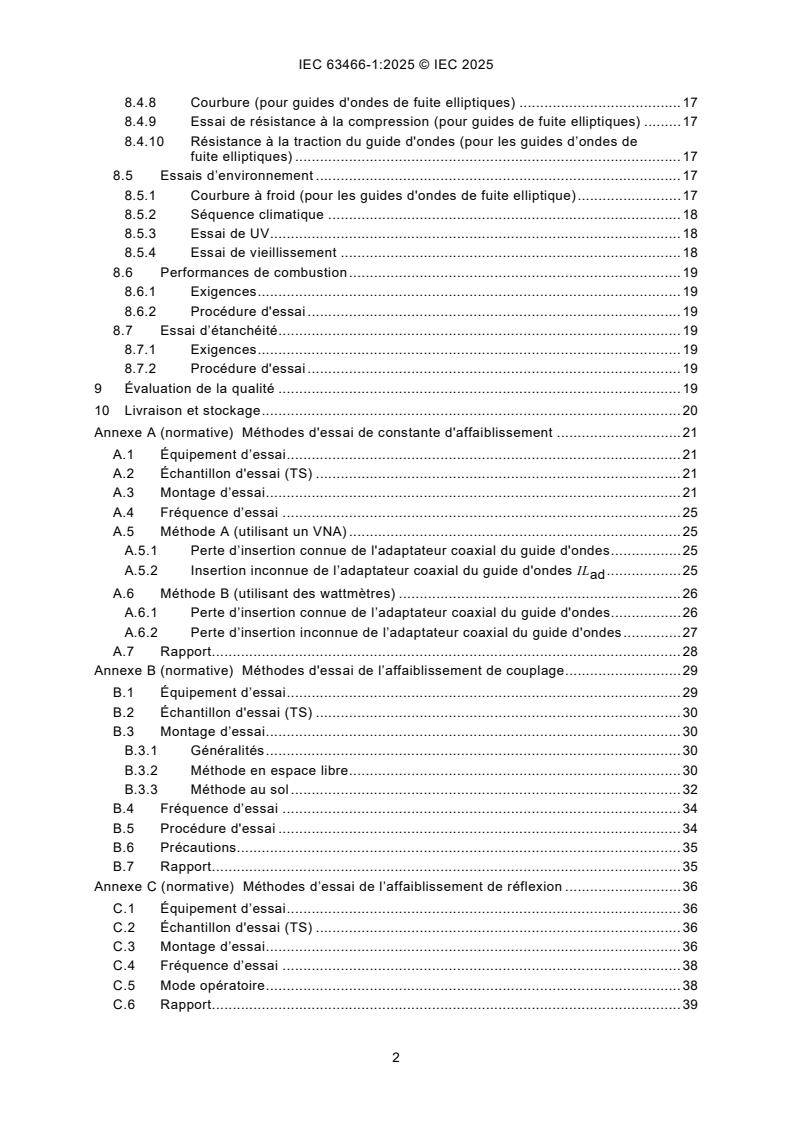
iec63466-1{ed1.0}fr - Guides d’ondes de fuite - Partie 1: Spécification générique - Exigences générales et méthodes d’essai
Overview
IEC 63466-1:2025 - Leaky waveguides: Part 1: Generic specification specifies the general requirements and test methods for leaky waveguides. It defines terms, design and structure, type designation, ratings and characteristics, marking, and the full suite of requirements and test procedures for both rigid rectangular leaky waveguides and elliptical (elliptic) leaky waveguides. The standard is intended for leaky waveguide systems used where conventional antenna coverage is unsatisfactory or impractical - for example in tunnels, railways, subways, highways, and elevators.
Key topics and technical requirements
IEC 63466-1:2025 covers these core technical topics and test methods:
- Design and structure: normative descriptions of waveguide tube, slot configuration, sealing layers and sheath for both rectangular and elliptical types.
- Type designation and marking: rules for type names, variants, identification and labelling for traceability.
- Ratings and characteristics: rated temperature range and operating frequency declarations.
- Electrical tests:
- Attenuation constant (Annex A) - measurement methods (VNA or power meter arrangements)
- Coupling loss (Annex B) - free-space and ground-level measurement methods
- Return loss (Annex C)
- Sheath withstand voltage/spark testing (elliptical types)
- Mechanical tests:
- Dimensional checks, eccentricity, bow, twist, surface roughness, internal stress (where applicable)
- Bending, crush resistance and tensile strength for elliptical leaky waveguides (Annexes D and E)
- Environmental tests: cold bend, climatic sequence, UV exposure, aging.
- Combustion performance, sealing tests, quality assessment, delivery and storage requirements.
Practical applications and users
This standard is essential for:
- Manufacturers of leaky waveguides and radiating cables to ensure product design, labelling and compliance.
- System integrators and installers deploying coverage systems in tunnels, rail transit, highways, metros and elevators.
- Test laboratories and certification bodies performing acceptance and type tests (attenuation, coupling loss, return loss, mechanical and environmental).
- Infrastructure operators and specifiers preparing procurement specifications and verifying compliance during installation and maintenance.
Practical uses include product type approval, factory acceptance testing, on-site commissioning, and routine maintenance/quality assurance.
Related standards
- IEC 63466-1:2025 is the generic part (Part 1) of the leaky waveguide series; users should check for additional parts in the IEC 63466 series or other IEC/ISO documents referenced in normative references for complementary requirements and application-specific guidance.
Keywords: IEC 63466-1:2025, leaky waveguides, leaky waveguide test methods, attenuation constant, coupling loss, return loss, tunnels, railways, subways, radiating cable standards.
Buy Documents
IEC 63466-1:2025 - Leaky waveguides - Part 1: Generic specification - General requirements and test methods Released:11/20/2025
iec63466-1{ed1.0}en - IEC 63466-1:2025 - Leaky waveguides - Part 1: Generic specification - General requirements and test methods
iec63466-1{ed1.0}fr - Guides d’ondes de fuite - Partie 1: Spécification générique - Exigences générales et méthodes d’essai
Get Certified
Connect with accredited certification bodies for this standard

ANCE
Mexican certification and testing association.

Intertek Slovenia
Intertek testing, inspection, and certification services in Slovenia.

LNE (Laboratoire National de Métrologie et d'Essais)
French national laboratory for metrology and testing.
Sponsored listings
Frequently Asked Questions
IEC 63466-1:2025 is a standard published by the International Electrotechnical Commission (IEC). Its full title is "Leaky waveguides - Part 1: Generic specification - General requirements and test methods". This standard covers: IEC 63466-1:2025 specifies the general requirements and test methods for leaky waveguides, including terms and definitions, design and structure, type designation, ratings and characteristics, identification, marking and labelling, requirements and test methods, etc. This document is applicable to leaky waveguides, including rigid rectangular leaky waveguides and elliptic leaky waveguides. These leaky waveguides are intended for use in tunnels, railways, highways, subways, elevators and other installations in which conventional antenna transmission is not satisfactory or even impossible.
IEC 63466-1:2025 specifies the general requirements and test methods for leaky waveguides, including terms and definitions, design and structure, type designation, ratings and characteristics, identification, marking and labelling, requirements and test methods, etc. This document is applicable to leaky waveguides, including rigid rectangular leaky waveguides and elliptic leaky waveguides. These leaky waveguides are intended for use in tunnels, railways, highways, subways, elevators and other installations in which conventional antenna transmission is not satisfactory or even impossible.
IEC 63466-1:2025 is classified under the following ICS (International Classification for Standards) categories: 33.120.10 - Coaxial cables. Waveguides. The ICS classification helps identify the subject area and facilitates finding related standards.
IEC 63466-1:2025 is available in PDF format for immediate download after purchase. The document can be added to your cart and obtained through the secure checkout process. Digital delivery ensures instant access to the complete standard document.
Standards Content (Sample)
IEC 63466-1 ®
Edition 1.0 2025-11
INTERNATIONAL
STANDARD
Leaky waveguides -
Part 1: Generic specification - General requirements and test methods
ICS 33.120.10 ISBN 978-2-8327-0863-7
All rights reserved. Unless otherwise specified, no part of this publication may be reproduced or utilized in any form or
by any means, electronic or mechanical, including photocopying and microfilm, without permission in writing from either
IEC or IEC's member National Committee in the country of the requester. If you have any questions about IEC copyright
or have an enquiry about obtaining additional rights to this publication, please contact the address below or your local
IEC member National Committee for further information.
IEC Secretariat Tel.: +41 22 919 02 11
3, rue de Varembé info@iec.ch
CH-1211 Geneva 20 www.iec.ch
Switzerland
About the IEC
The International Electrotechnical Commission (IEC) is the leading global organization that prepares and publishes
International Standards for all electrical, electronic and related technologies.
About IEC publications
The technical content of IEC publications is kept under constant review by the IEC. Please make sure that you have the
latest edition, a corrigendum or an amendment might have been published.
IEC publications search - IEC Products & Services Portal - products.iec.ch
webstore.iec.ch/advsearchform Discover our powerful search engine and read freely all the
The advanced search enables to find IEC publications by a
publications previews, graphical symbols and the glossary.
variety of criteria (reference number, text, technical With a subscription you will always have access to up to date
committee, …). It also gives information on projects, content tailored to your needs.
replaced and withdrawn publications.
Electropedia - www.electropedia.org
IEC Just Published - webstore.iec.ch/justpublished The world's leading online dictionary on electrotechnology,
Stay up to date on all new IEC publications. Just Published containing more than 22 500 terminological entries in English
details all new publications released. Available online and and French, with equivalent terms in 25 additional languages.
once a month by email. Also known as the International Electrotechnical Vocabulary
(IEV) online.
IEC Customer Service Centre - webstore.iec.ch/csc
If you wish to give us your feedback on this publication or
need further assistance, please contact the Customer
Service Centre: sales@iec.ch.
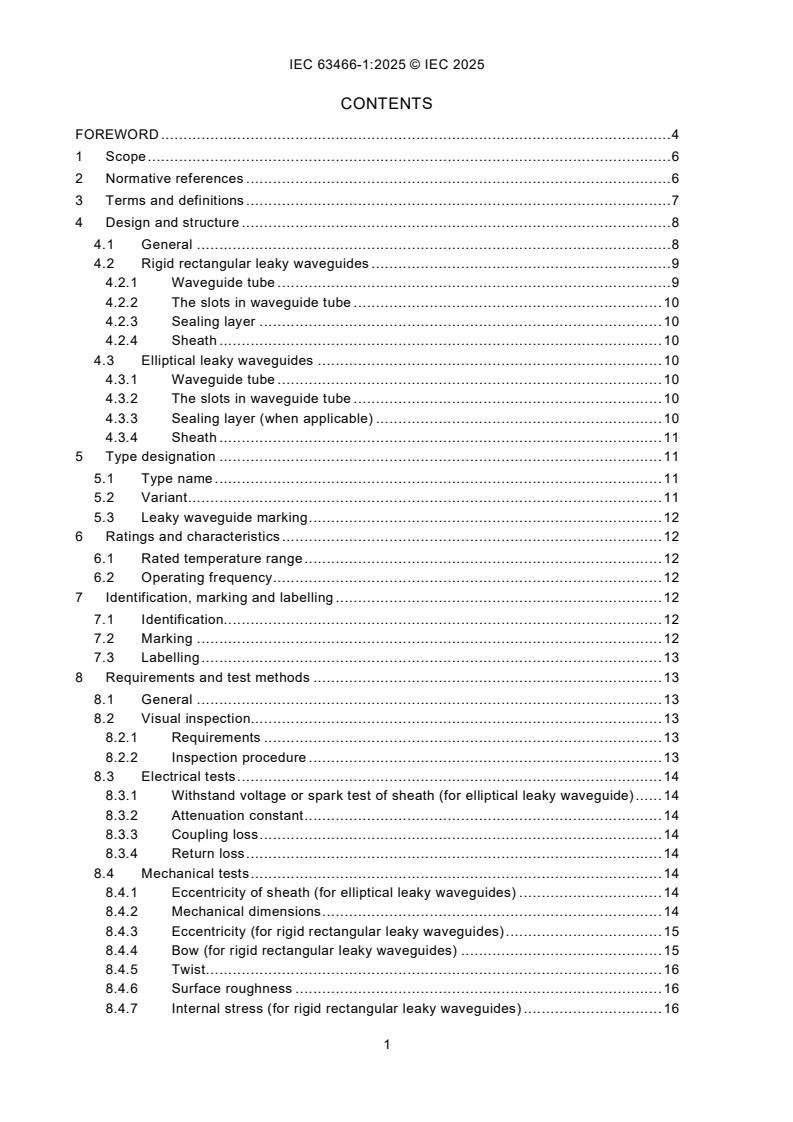
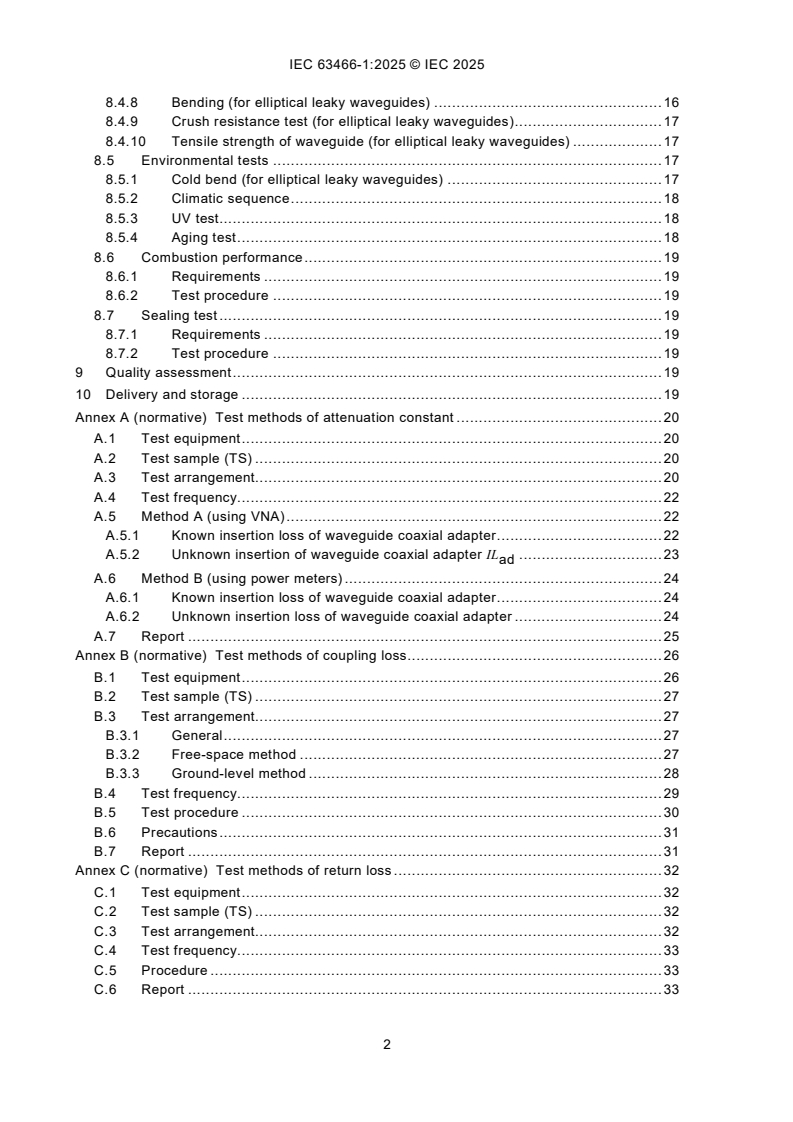
CONTENTS
FOREWORD . 4
1 Scope . 6
2 Normative references . 6
3 Terms and definitions . 7
4 Design and structure . 8
4.1 General . 8
4.2 Rigid rectangular leaky waveguides . 9
4.2.1 Waveguide tube . 9
4.2.2 The slots in waveguide tube . 10
4.2.3 Sealing layer . 10
4.2.4 Sheath . 10
4.3 Elliptical leaky waveguides . 10
4.3.1 Waveguide tube . 10
4.3.2 The slots in waveguide tube . 10
4.3.3 Sealing layer (when applicable) . 10
4.3.4 Sheath . 11
5 Type designation . 11
5.1 Type name . 11
5.2 Variant . 11
5.3 Leaky waveguide marking . 12
6 Ratings and characteristics . 12
6.1 Rated temperature range . 12
6.2 Operating frequency . 12
7 Identification, marking and labelling . 12
7.1 Identification. 12
7.2 Marking . 12
7.3 Labelling . 13
8 Requirements and test methods . 13
8.1 General . 13
8.2 Visual inspection. 13
8.2.1 Requirements . 13
8.2.2 Inspection procedure . 13
8.3 Electrical tests . 14
8.3.1 Withstand voltage or spark test of sheath (for elliptical leaky waveguide) . 14
8.3.2 Attenuation constant . 14
8.3.3 Coupling loss . 14
8.3.4 Return loss . 14
8.4 Mechanical tests . 14
8.4.1 Eccentricity of sheath (for elliptical leaky waveguides) . 14
8.4.2 Mechanical dimensions . 14
8.4.3 Eccentricity (for rigid rectangular leaky waveguides) . 15
8.4.4 Bow (for rigid rectangular leaky waveguides) . 15
8.4.5 Twist . 16
8.4.6 Surface roughness . 16
8.4.7 Internal stress (for rigid rectangular leaky waveguides) . 16
8.4.8 Bending (for elliptical leaky waveguides) . 16
8.4.9 Crush resistance test (for elliptical leaky waveguides) . 17
8.4.10 Tensile strength of waveguide (for elliptical leaky waveguides) . 17
8.5 Environmental tests . 17
8.5.1 Cold bend (for elliptical leaky waveguides) . 17
8.5.2 Climatic sequence . 18
8.5.3 UV test . 18
8.5.4 Aging test . 18
8.6 Combustion performance . 19
8.6.1 Requirements . 19
8.6.2 Test procedure . 19
8.7 Sealing test . 19
8.7.1 Requirements . 19
8.7.2 Test procedure . 19
9 Quality assessment . 19
10 Delivery and storage . 19
Annex A (normative) Test methods of attenuation constant . 20
A.1 Test equipment . 20
A.2 Test sample (TS) . 20
A.3 Test arrangement. 20
A.4 Test frequency. 22
A.5 Method A (using VNA) . 22
A.5.1 Known insertion loss of waveguide coaxial adapter . 22
A.5.2 Unknown insertion of waveguide coaxial adapter IL . 23
ad
A.6 Method B (using power meters) . 24
A.6.1 Known insertion loss of waveguide coaxial adapter . 24
A.6.2 Unknown insertion loss of waveguide coaxial adapter . 24
A.7 Report . 25
Annex B (normative) Test methods of coupling loss . 26
B.1 Test equipment . 26
B.2 Test sample (TS) . 27
B.3 Test arrangement. 27
B.3.1 General . 27
B.3.2 Free-space method . 27
B.3.3 Ground-level method . 28
B.4 Test frequency. 29
B.5 Test procedure . 30
B.6 Precautions . 31
B.7 Report . 31
Annex C (normative) Test methods of return loss . 32
C.1 Test equipment . 32
C.2 Test sample (TS) . 32
C.3 Test arrangement. 32
C.4 Test frequency. 33
C.5 Procedure . 33
C.6 Report . 33
Annex D (normative) Test methods of bending for elliptical leaky waveguides . 34
D.1 Test equipment . 34
D.2 Test sample . 34
D.3 Procedure . 34
D.4 Test report . 35
Annex E (normative) Test method for crush resistance of elliptical leaky waveguides. 36
E.1 Equipment . 36
E.2 Test sample . 36
E.3 Procedure . 36
E.4 Test report . 37
Bibliography . 38
Figure 1 – Typical structure of rigid rectangular leaky waveguides . 9
Figure 2 – Typical structure of elliptical leaky waveguides. 9
Figure A.1 – Method A: Free-space arrangement for attenuation constant test
by using VNA . 21
Figure A.2 – Method B: Free space arrangement for attenuation constant test by using
power meters . 21
Figure A.3 – Method A: Ground-level arrangement for attenuation constant test
by using VNA . 22
Figure A.4 – Method B: Ground-level arrangement for attenuation constant test
by using power meters . 22
Figure B.1 – Test arrangement for free-space method . 28
Figure B.2 – Antenna orientations with free-space method . 28
Figure B.3 – Test arrangement for ground-level method . 29
Figure B.4 – Antenna orientations with ground-level method . 29
Figure C.1 – Free space arrangement for return loss test . 32
Figure C.2 – Ground-level arrangement for return loss test . 33
Figure D.1 – Schematic diagram of bending test . 35
Figure E.1 – Crush resistance test . 37
INTERNATIONAL ELECTROTECHNICAL COMMISSION
____________
Leaky waveguides -
Part 1: Generic specification -
General requirements and test methods
FOREWORD
1) The International Electrotechnical Commission (IEC) is a worldwide organization for standardization comprising all
national electrotechnical committees (IEC National Committees). The object of IEC is to promote international co-
operation on all questions concerning standardization in the electrical and electronic fields. To this end and in addition
to other activities, IEC publishes International Standards, Technical Specifications, Technical Reports, Publicly
Available Specifications (PAS) and Guides (hereafter referred to as "IEC Publication(s)"). Their preparation is
entrusted to technical committees; any IEC National Committee interested in the subject dealt with may participate
in this preparatory work. International, governmental and non-governmental organizations liaising with the IEC also
participate in this preparation. IEC collaborates closely with the International Organization for Standardization (ISO)
in accordance with conditions determined by agreement between the two organizations.
2) The formal decisions or agreements of IEC on technical matters express, as nearly as possible, an international
consensus of opinion on the relevant subjects since each technical committee has representation from all interested
IEC National Committees.
3) IEC Publications have the form of recommendations for international use and are accepted by IEC National
Committees in that sense. While all reasonable efforts are made to ensure that the technical content of IEC
Publications is accurate, IEC cannot be held responsible for the way in which they are used or for any
misinterpretation by any end user.
4) In order to promote international uniformity, IEC National Committees undertake to apply IEC Publications
transparently to the maximum extent possible in their national and regional publications. Any divergence between
any IEC Publication and the corresponding national or regional publication shall be clearly indicated in the latter.
5) IEC itself does not provide any attestation of conformity. Independent certification bodies provide conformity
assessment services and, in some areas, access to IEC marks of conformity. IEC is not responsible for any services
carried out by independent certification bodies.
6) All users should ensure that they have the latest edition of this publication.
7) No liability shall attach to IEC or its directors, employees, servants or agents including individual experts and
members of its technical committees and IEC National Committees for any personal injury, property damage or other
damage of any nature whatsoever, whether direct or indirect, or for costs (including legal fees) and expenses arising
out of the publication, use of, or reliance upon, this IEC Publication or any other IEC Publications.
8) Attention is drawn to the Normative references cited in this publication. Use of the referenced publications is
indispensable for the correct application of this publication.
9) IEC draws attention to the possibility that the implementation of this document may involve the use of (a) patent(s).
IEC takes no position concerning the evidence, validity or applicability of any claimed patent rights in respect thereof.
As of the date of publication of this document, IEC had not received notice of (a) patent(s), which may be required
to implement this document. However, implementers are cautioned that this may not represent the latest information,
which may be obtained from the patent database available at https://patents.iec.ch. IEC shall not be held responsible
for identifying any or all such patent rights.
IEC 63466-1 has been prepared by IEC technical committee 46: Cables, wires, waveguides, RF
connectors, RF and microwave passive components and accessories. It is an International
Standard.
The text of this International Standard is based on the following documents:
Draft Report on voting
46/1065/FDIS 46/1072/RVD
Full information on the voting for its approval can be found in the report on voting indicated in the
above table.
The language used for the development of this International Standard is English.
This document was drafted in accordance with ISO/IEC Directives, Part 2, and developed in
accordance with ISO/IEC Directives, Part 1 and ISO/IEC Directives, IEC Supplement, available at
www.iec.ch/members_experts/refdocs. The main document types developed by IEC are described
in greater detail at www.iec.ch/publications.
A list of all parts in the IEC 63466 series, published under the general title Leaky waveguides, can
be found on the IEC website.
The committee has decided that the contents of this document will remain unchanged until the
stability date indicated on the IEC website under webstore.iec.ch in the data related to the specific
document. At this date, the document will be
– reconfirmed,
– withdrawn, or
– revised.
1 Scope
This part of IEC 63466 specifies the general requirements and test methods for leaky waveguides,
including terms and definitions, design and structure, type designation, ratings and characteristics,
identification, marking and labelling, requirements and test methods, etc.
This document is applicable to leaky waveguides, including rigid rectangular leaky waveguides
and elliptic leaky waveguides. These leaky waveguides are intended for use in tunnels, railways,
highways, subways, elevators and other installations in which conventional antenna transmission
is not satisfactory or even impossible.
2 Normative references
The following documents are referred to in the text in such a way that some or all of their content
constitutes requirements of this document. For dated references, only the edition cited applies.
For undated references, the latest edition of the referenced document (including any amendments)
applies.
IEC 60068-1:2013, Environmental testing - Part 1: General and guidance
IEC 60153-1, Hollow metallic waveguides - Part 1: General requirements and measuring methods
IEC 60261, Sealing test for pressurized waveguide tubing and assemblies
IEC 60332-1-2, Tests on electric and optical fibre cables under fire conditions - Part 1-2: Test for
vertical flame propagation for a single insulated wire or cable - Procedure for 1 kW pre-mixed flame
IEC 60754-1, Test on gases evolved during combustion of materials from cables - Part 1:
Determination of the halogen acid gas content
IEC 61034-2, Measurement of smoke density of cables burning under defined conditions - Part 2:
Test procedure and requirements
IEC 61196-1:2005, Coaxial communication cables - Part 1: Generic specification - General,
definitions and requirements
IEC 61196-1-106, Coaxial communication cables - Part 1-106: Electrical test methods - Test for
withstand voltage of cable sheath
IEC 61196-1-212, Coaxial communication cables - Part 1-212: Environmental test methods - UV
stability
IEC 61196-1-215, Coaxial communication cables - Part 1-215: Environmental test methods - High
temperature cable ageing
IEC 61196-1-302, Coaxial communication cables - Part 1-302: Mechanical test methods - Test for
eccentricity
IEC 61196-1-316, Coaxial communication cables - Part 1-316: Mechanical test methods - Test of
maximum pulling force of cable
IEC 62230, Electric cables - Spark-test method
ISO 3274, Geometrical Product Specifications (GPS) - Surface texture: Profile method - Nominal
characteristics of contact (stylus) instruments
ISO 21920-3, Geometrical product specifications (GPS) - Surface texture: Profile - Part 3:
Specification operators
3 Terms and definitions
For the purposes of this document, the following terms and definitions apply.
ISO and IEC maintain terminology databases for use in standardization at the following addresses:
– IEC Electropedia: available at https://www.electropedia.org/
– ISO Online browsing platform: available at https://www.iso.org/obp
3.1
leaky waveguide
waveguide with hollow metallic tube that is intentionally not completely closed, so that part of the
electromagnetic wave energy transmitted or received through the waveguides is coupled by a
bidirectional transmission system formed by the hollow metallic tube of the waveguides and the
external environment
Note 1 to entry: The coupling intensity between leaky waveguide and mobile equipment depends on:
– structure of the leaky waveguide;
– characteristics of antenna (such as the type, the orientation, gain, etc.);
– distance and orientation of the mobile antenna from the leaky waveguide;
– nature of ambient atmosphere;
– operating frequency range;
– manner of installation of the leaky waveguide;
– shape, material and size of surrounding buildings.
3.2
rigid rectangular leaky waveguide
leaky waveguide with rectangular cross-section metallic tube not allowing bending and torsion
during installation and operation
3.3
twist
angle rotating around the longitudinal axis over the specified length of the rigid rectangular leaky
waveguide
3.4
bow
maximum deviation of the actual axis length of the rigid rectangular leaky waveguide from the
straight distance of specified length connecting two end points on that axis
3.5
eccentricity
half of the difference between the measured thickness of opposite walls of the rigid rectangular
leaky waveguide
3.6
elliptical leaky waveguide
leaky waveguide with elliptical cross-section metallic tube allowing limited bending and torsion
during installation and operation
3.7
E plane
plane perpendicular to the long axis of the elliptical leaky waveguide and parallel to the short axis
of the elliptical leaky waveguide
3.8
H plane
plane perpendicular to the short axis of the elliptical leaky waveguide and parallel to the long axis
of the elliptical leaky waveguide
3.9
E bend
bending along the E plane of the elliptical leaky waveguide
3.10
H bend
bending along the H plane of the elliptical leaky waveguide
3.11
coupling loss
ratio of the power P transmitted into the leaky waveguide at one point to the power P received by
t r
a half-wavelength dipole antenna located at a distance from the leaky waveguide at the same point
Note 1 to entry: See Formula (1):
P
t
L = 10log
(1)
c 10
P
r
where
L is the coupling loss, in dB;
c
P is the transmission power in the leaky waveguide at one point, in W;
t
P is the receiving power of the half-wavelength dipole antenna at a distance from the leaky waveguide at the same
r
point, in W.
4 Design and structure
4.1 General
The typical structure of rigid rectangular leaky waveguides is shown in Figure 1, and the typical
structure of elliptical leaky waveguides is shown in Figure 2.
The design and structure of the leaky waveguide shall be in accordance with 4.2 or 4.3 and the
relevant specifications.
Key
1 Waveguide tube
2 Slot
3 Sealing layer
4 Sheath
Figure 1 – Typical structure of rigid rectangular leaky waveguides
Key
1 Waveguide tube
2 Slot
3 Sealing layer
4 Sheath
5 Marking of installation or radiating direction
Figure 2 – Typical structure of elliptical leaky waveguides
4.2 Rigid rectangular leaky waveguides
4.2.1 Waveguide tube
The material for waveguide tube shall be as specified in the relevant specifications.
The internal structure and dimensions of waveguide tube shall comply with IEC 60153-1 or relevant
specifications.
Unless otherwise specified, the ratio between the height and width of the inside cross-section is
1:2.
The thickness and tolerance of waveguide tube wall shall be as specified in the relevant
specifications. The inner angle radius shall be specified in the relevant specifications.
The nominal values and tolerances of the height and width of the outside cross-section of
waveguide tube shall be specified in the relevant specifications.
4.2.2 The slots in waveguide tube
The shape and dimensions of the slots in the waveguide shall be such that the electrical
requirements are met.
4.2.3 Sealing layer
The material of sealing layer shall be as specified in the relevant specifications.
The sealing layer should be adhered to the slots of the metal waveguide tube and closely bonded
with the waveguides.
The thickness of the sealing layer shall comply with the requirements for gastight tests of the leaky
waveguides.
4.2.4 Sheath
The material of sheath shall be as specified in the relevant specifications.
The sheath shall cover the whole sealing layer, which can cover only a part of the waveguide tube
or the entire waveguide tube as required.
The thickness and tolerance of the sheath shall be as specified in the relevant specifications.
For outdoor leaky waveguides, UV stability tests shall be passed in accordance with
IEC 61196-1-212.
4.3 Elliptical leaky waveguides
4.3.1 Waveguide tube
The materials for elliptical waveguides tubes shall be as specified in the relevant specifications.
The long and short axis dimensions of elliptical waveguide tubes shall be as specified in the
relevant specifications.
The wall thickness of the elliptical waveguide tubes shall be as specified in the relevant
specifications.
The peak, root, pitch of the elliptical waveguide tube shall be as specified in the relevant
specifications.
4.3.2 The slots in waveguide tube
The shape and dimensions of the slots in the waveguide shall be such that the electrical
requirements are met.
4.3.3 Sealing layer (when applicable)
The material for sealing layer shall be as specified in the relevant specifications.
The sealing layer should be adhered to the slots of the metal waveguide tube and closely bonded
with the waveguides.
The thickness of the sealing layer shall comply with the requirements for gastight tests of the leaky
waveguides.
4.3.4 Sheath
The material for sheath shall be as specified in the relevant specifications.
The sheath shall cover the whole elliptical leaky waveguide, the thickness and tolerance of the
sheath shall be as specified in the relevant specifications.
For outdoor leaky waveguides, UV stability tests shall be passed in accordance with
IEC 61196-1-212.
5 Type designation
5.1 Type name
The type name of the leaky waveguides covered by this specification shall comprise the following:
a) letter "L" indicating the leaky waveguides;
b) a letter indicating the shape of the inside cross-section of the leaky waveguides:
1) R rigid rectangular leaky waveguides.
2) E elliptical leaky waveguides.
NOTE For other types of waveguides, the letter can be in accordance with the relevant specification sheets.
5.2 Variant
The variant of the leaky waveguides covered by this specification shall comprise the following:
a) a number characterizing a particular size of waveguide. This number indicates the centre
frequency characteristic of the leaky waveguide, approximated in multiples of 100 MHz;
b) a dash symbol;
c) two numbers indicating the lowest operating frequency and the highest operating frequency of
the leaky waveguide and a symbol "/" between them. The two numbers are approximated in
multiples of 100 MHz;
d) a dash symbol;
e) waveguide tube material and its structure;
f) material and structure shall be as specified in the relevant specifications;
g) a dash symbol;
h) sheath material.
The material for sheath shall be as specified in the relevant specifications.
5.3 Leaky waveguide marking
The leaky waveguide marking consists of type, variants and IEC standard number, expressed as
follows:
EXAMPLE 1 LR 58-57/59 IEC 63466-3 means a rigid rectangular leaky waveguide with its centre frequency
approximately 5,8 GHz in the dominant mode and operating frequency range from 5,7 GHz to 5,9 GHz. It complies with
IEC 63466-3 .
EXAMPLE 2 LE 58-57/59 IEC 63466-2 means an elliptical leaky waveguides with its centre frequency approximately
5,8 GHz in the dominant mode and operating frequency range from 5,7 GHz to 5,9 GHz. It complies with IEC 63466-2 .
6 Ratings and characteristics
6.1 Rated temperature range
The operating, storage and installation temperature range shall be as specified in the relevant
specifications.
6.2 Operating frequency
Operating frequency range shall be as specified in the relevant specifications.
7 Identification, marking and labelling
7.1 Identification
Waveguides shall be identified in accordance with 5.3.
When applicable, the outer sheath of the waveguide shall be marked with installation and radiation
direction.
7.2 Marking
The manufacturer's mark shall be specified in the relevant specifications.
The marking abrasion resistance shall be as specified in the relevant specifications.
___________
Under consideration.
Under preparation. Stage at the time of publication: IEC CC 63466-2:2025.
7.3 Labelling
Unless otherwise specified in the relevant specification, each leaky waveguide or its package shall
be provided with a label with durable print and give the following minimum information:
a) type designation;
b) length, in meters;
c) name or code of manufacturer or supplier.
8 Requirements and test methods
8.1 General
Unless otherwise specified, all tests shall be carried out in accordance with IEC 60068-1.
Before the measurements are made, the leaky waveguides shall be stored at the measuring
temperature for a period of time to keep the entire leaky waveguides stable at this temperature.
When measurements are made at a temperature other than the specified temperature, the
measurement results shall, when necessary, be corrected at the specified temperature. The
temperature at which the measurements are made shall be stated in the test report.
8.2 Visual inspection
8.2.1 Requirements
8.2.1.1 Workmanship
The leaky waveguides should be precisely manufactured to ensure that its processing accuracy
meets the design and standard requirements.
The hollow metallic tube of the leaky waveguide shall be uniform with its inner face smooth and its
wall thickness uniform. There shall be no burrs, cracks, die marks, chatter marks, dirt, grease or
other irregularities at the slots of hollow metallic tube and its outer face.
The sheath surface of the leaky waveguides shall be smooth, integrated, with no crazing and
cracks.
The finished leaky waveguides should be uniform without kink.
The rigid rectangular leakage waveguides should be straight and free visible bowing or twisting.
8.2.1.2 Deterioration after electrical and mechanical tests
Unless otherwise specified, there shall be no visible deterioration likely to influence the
performance.
8.2.1.3 Marking
It shall be correct in accordance with 7.2 and be legible after any of the specified tests.
8.2.2 Inspection procedure
The inspection will be performed visually or under a magnification as specified in the relevant
specification.
8.3 Electrical tests
8.3.1 Withstand voltage or spark test of sheath (for elliptical leaky waveguide)
8.3.1.1 Requirements
Withstand voltage or spark test of sheath shall be specified in the relevant specifications.
8.3.1.2 Test procedure
Test procedure shall be in accordance with IEC 61196-1-106 (or IEC 62230).
8.3.2 Attenuation constant
8.3.2.1 Requirements
The attenuation constant shall be as specified in the relevant specifications.
8.3.2.2 Test procedure
The attenuation constant shall be measured in accordance with Annex A.
8.3.3 Coupling loss
8.3.3.1 Requirements
Coupling loss shall be as specified in the relevant specifications.
8.3.3.2 Test procedure
Coupling loss shall be measured in accordance with Annex B.
8.3.4 Return loss
8.3.4.1 Requirements
Return loss shall be as specified in the relevant specifications.
8.3.4.2 Test procedure
Return loss shall be measured in accordance with Annex C.
8.4 Mechanical tests
8.4.1 Eccentricity of sheath (for elliptical leaky waveguides)
8.4.1.1 Requirements
Eccentricity of sheath shall be as specified in the relevant specifications.
8.4.1.2 Test procedure
Test procedure shall be in accordance with IEC 61196-1-302.
8.4.2 Mechanical dimensions
8.4.2.1 Requirements
The mechanical dimensions of the leaky waveguides shall comply with 4.2 or 4.3.
8.4.2.2 Test procedure
Dimensions shall be measured by using applicable measuring tools with adequate accuracy. The
test procedure shall be in accordance with IEC 61196-1:2005, 4.3.
8.4.3 Eccentricity (for rigid rectangular leaky waveguides)
8.4.3.1 Requirements
The eccentricity shall be as specified in the relevant specifications.
8.4.3.2 Test procedure
The maximum and minimum thicknesses of opposite walls of the rigid rectangular leaky waveguide
shall be measured by using an applicable tool with adequate accuracy separately.
Calculate the maximum difference between the maximum thickness of one wall and the minimum
thicknesses of the opposite wall.
Then the eccentricity is the half of the maximum difference which can be calculated by Formula (2):
TT−
E= (2)
where
E is the eccentricity of rigid rectangular leaky waveguide;
T is the maximum wall thickness of the rigid rectangular leaky waveguide, in mm;
T is the minimum wall thickness opposite maximum wall thickness of the rigid rectangular leaky
waveguide, in mm.
8.4.4 Bow (for rigid rectangular leaky waveguides)
8.4.4.1 Requirements
For a length of 10 times the internal width, the external bow shall not exceed 10 times the specified
tolerance on the internal width.
For a length of 50 times the internal width, the external bow shall not exceed 40 times the specified
tolerance on the internal width.
8.4.4.2 Test procedure
The test procedure shall be done as follows:
a) take a leaky waveguide with its length of 10 times or 50 times the internal width;
b) measure its axis length with an applicable tool with adequate accuracy. Measurement shall be
done on the external surface of the leaky waveguide;
c) measure the straight distance between two ends of the leaky waveguide;
d) calculate the maximum deviation of the actual axis length from the straight distance between
two ends of the leaky waveguide;
e) for the determination of the external bow, the waveguide shall be so positioned that gravity
does not tend to affect the value of bow.
8.4.5 Twist
8.4.5.1 Requirements
The rate of twist shall not exceed:
a) 0,5° per meter for rigid rectangular leaky waveguides with an internal width equal or larger than
100 mm;
b) 0,5° per length of rigid rectangular leaky waveguides equal to ten times the internal width when
the latter is less than 100 mm;
c) over a length equal to 50 times the internal width of the rigid rectangular leaky waveguide, the
accumulated twist shall not exceed 2°. The direction of twist should not be systematic in a
batch of rigid rectangular leaky waveguides;
d) the twist angle of elliptical leaky waveguides shall be specified in the relevant specifications.
8.4.5.2 Inspection procedure
Use measuring tools with adequate accuracy to measure the length and the angle.
8.4.6 Surface roughness
8.4.6.1 Requirements
When applicable, inner surface roughness of the leaky waveguide's tube shall be in accordance
with the relevant specifications.
8.4.6.2 Inspection procedure
Surface roughness of the leaky waveguides shall be tested in accordance with ISO 3274 and
ISO 21920-3.
8.4.7 Internal stress (for rigid rectangular leaky waveguides)
8.4.7.1 Requirements
After cutting, the cross-section dimensions of the leaky waveguide tube shall still be within the
specified tolerances.
8.4.7.2 Inspection procedure
The leaky waveguide tube shall be cut by a saw in a controlled manner to avoid any distortion. A
fine high-speed saw is recommended.
After cutting, measurement shall be done by using measuring tools with adequate accuracy.
8.4.8 Bending (for elliptical leaky waveguides)
8.4.8.1 Requirements
The bending radius and the repeated number of the E bend and H bend for the elliptical leaky
waveguides shall be as specified in the relevant specifications.
After test, the sample shall meet the following requirements:
a) there shall be no physical damages of waveguides tube, sealing layer and sheaths;
b) the change of the return loss before and after the test shall be in accordance with the relevant
specifications;
c) sealing test after the bend test shall be in accordance with the relevant specifications.
8.4.8.2 Test procedure
Test procedure shall be done in accordance with Annex D.
8.4.9 Crush resistance test (for elliptical leaky waveguides)
8.4.9.1 Requirements
The force loaded on the E plane and H plane of the elliptical leaky waveguides shall be as specified
in the relevant specifications.
After the crush resistance test, the change of the return loss before and after the test shall be in
accordance with the relevant specifications.
8.4.9.2 Test procedure
Test procedure shall be in accordance with Annex E.
8.4.10 Tensile strength of waveguide (for elliptical leaky waveguides)
8.4.10.1 Requirements
Tensile strength of waveguide shall be as specified in the relevant specifications.
8.4.10.2 Test procedure
Test procedure shall be in accordance with IEC 61196-1-316.
8.5 Environmental tests
8.5.1 Cold bend (for elliptical leaky waveguides)
8.5.1.1 Requirements
The bending radius and the repeated number of the E bend and H bend of the elliptical leaky
waveguides shall be as specified in the relevant specifications.
After test, the sample shall meet the following requirements:
a) there shall be no physical damages of waveguides tube, sealing layer and sheath;
b) the change of the return loss before and after the test shall be in accordance with the relevant
specifications;
c) sealing test after the bend test shall be in accordance with the relevant specifications.
8.5.1.2 Test procedure
The test sample shall be cooled at the temperature in accordance with the relevant specifications
and maintained for a period of not less than 4 h while the sample shall be kept reasonably straight.
After the conditioning period and while the sample is still at the test temperature, the cold bending
test of the sample shall be carried out in accordance with Annex D.
8.5.2 Climatic sequence
8.5.2.1 Requirements
After test, the sample shall meet the following requirements:
a) there shall be no physical damages of waveguides tube, sealing layer and sheath;
b) the change of the return loss before and after the test shall be in accordance with the relevant
specifications;
c) sealing test after the bend test shall be in accordance with the relevant specifications.
8.5.2.2 Test procedure
Climatic sequence shall be tested in accordance with IEC 60068-1:2013, Clause 6.
8.5.3 UV test
8.5.3.1 Requirements
The change ratios of the tensile strength and elongation at break of the sheath samples before
a
...
IEC 63466-1 ®
Edition 1.0 2025-11
INTERNATIONAL
STANDARD
Leaky waveguides -
Part 1: Generic specification - General requirements and test methods
ICS 33.120.10 ISBN 978-2-8327-0863-7
All rights reserved. Unless otherwise specified, no part of this publication may be reproduced or utilized in any form or
by any means, electronic or mechanical, including photocopying and microfilm, without permission in writing from either
IEC or IEC's member National Committee in the country of the requester. If you have any questions about IEC copyright
or have an enquiry about obtaining additional rights to this publication, please contact the address below or your local
IEC member National Committee for further information.
IEC Secretariat Tel.: +41 22 919 02 11
3, rue de Varembé info@iec.ch
CH-1211 Geneva 20 www.iec.ch
Switzerland
About the IEC
The International Electrotechnical Commission (IEC) is the leading global organization that prepares and publishes
International Standards for all electrical, electronic and related technologies.
About IEC publications
The technical content of IEC publications is kept under constant review by the IEC. Please make sure that you have the
latest edition, a corrigendum or an amendment might have been published.
IEC publications search - IEC Products & Services Portal - products.iec.ch
webstore.iec.ch/advsearchform Discover our powerful search engine and read freely all the
The advanced search enables to find IEC publications by a publications previews, graphical symbols and the glossary.
variety of criteria (reference number, text, technical With a subscription you will always have access to up to date
committee, …). It also gives information on projects, content tailored to your needs.
replaced and withdrawn publications.
Electropedia - www.electropedia.org
The world's leading online dictionary on electrotechnology,
IEC Just Published - webstore.iec.ch/justpublished
Stay up to date on all new IEC publications. Just Published containing more than 22 500 terminological entries in English
details all new publications released. Available online and and French, with equivalent terms in 25 additional languages.
once a month by email. Also known as the International Electrotechnical Vocabulary
(IEV) online.
IEC Customer Service Centre - webstore.iec.ch/csc
If you wish to give us your feedback on this publication or
need further assistance, please contact the Customer
Service Centre: sales@iec.ch.
CONTENTS
FOREWORD . 4
1 Scope . 6
2 Normative references . 6
3 Terms and definitions . 7
4 Design and structure . 8
4.1 General . 8
4.2 Rigid rectangular leaky waveguides . 9
4.2.1 Waveguide tube . 9
4.2.2 The slots in waveguide tube . 10
4.2.3 Sealing layer . 10
4.2.4 Sheath . 10
4.3 Elliptical leaky waveguides . 10
4.3.1 Waveguide tube . 10
4.3.2 The slots in waveguide tube . 10
4.3.3 Sealing layer (when applicable) . 10
4.3.4 Sheath . 11
5 Type designation . 11
5.1 Type name . 11
5.2 Variant . 11
5.3 Leaky waveguide marking . 12
6 Ratings and characteristics . 12
6.1 Rated temperature range . 12
6.2 Operating frequency . 12
7 Identification, marking and labelling . 12
7.1 Identification . 12
7.2 Marking . 12
7.3 Labelling . 13
8 Requirements and test methods . 13
8.1 General . 13
8.2 Visual inspection . 13
8.2.1 Requirements . 13
8.2.2 Inspection procedure . 13
8.3 Electrical tests . 14
8.3.1 Withstand voltage or spark test of sheath (for elliptical leaky waveguide) . 14
8.3.2 Attenuation constant . 14
8.3.3 Coupling loss . 14
8.3.4 Return loss . 14
8.4 Mechanical tests . 14
8.4.1 Eccentricity of sheath (for elliptical leaky waveguides) . 14
8.4.2 Mechanical dimensions . 14
8.4.3 Eccentricity (for rigid rectangular leaky waveguides) . 15
8.4.4 Bow (for rigid rectangular leaky waveguides) . 15
8.4.5 Twist . 16
8.4.6 Surface roughness. 16
8.4.7 Internal stress (for rigid rectangular leaky waveguides) . 16
8.4.8 Bending (for elliptical leaky waveguides) . 16
8.4.9 Crush resistance test (for elliptical leaky waveguides) . 17
8.4.10 Tensile strength of waveguide (for elliptical leaky waveguides) . 17
8.5 Environmental tests . 17
8.5.1 Cold bend (for elliptical leaky waveguides) . 17
8.5.2 Climatic sequence . 18
8.5.3 UV test . 18
8.5.4 Aging test . 18
8.6 Combustion performance . 19
8.6.1 Requirements . 19
8.6.2 Test procedure . 19
8.7 Sealing test . 19
8.7.1 Requirements . 19
8.7.2 Test procedure . 19
9 Quality assessment . 19
10 Delivery and storage . 19
Annex A (normative) Test methods of attenuation constant . 20
A.1 Test equipment . 20
A.2 Test sample (TS) . 20
A.3 Test arrangement. 20
A.4 Test frequency . 22
A.5 Method A (using VNA) . 22
A.5.1 Known insertion loss of waveguide coaxial adapter. 22
A.5.2 Unknown insertion of waveguide coaxial adapter IL . 23
ad
A.6 Method B (using power meters) . 24
A.6.1 Known insertion loss of waveguide coaxial adapter. 24
A.6.2 Unknown insertion loss of waveguide coaxial adapter . 24
A.7 Report . 25
Annex B (normative) Test methods of coupling loss . 26
B.1 Test equipment . 26
B.2 Test sample (TS) . 27
B.3 Test arrangement. 27
B.3.1 General . 27
B.3.2 Free-space method . 27
B.3.3 Ground-level method . 28
B.4 Test frequency . 29
B.5 Test procedure. 29
B.6 Precautions. 30
B.7 Report . 31
Annex C (normative) Test methods of return loss . 32
C.1 Test equipment . 32
C.2 Test sample (TS) . 32
C.3 Test arrangement. 32
C.4 Test frequency . 33
C.5 Procedure . 33
C.6 Report . 33
Annex D (normative) Test methods of bending for elliptical leaky waveguides . 34
D.1 Test equipment . 34
D.2 Test sample . 34
D.3 Procedure . 34
D.4 Test report . 35
Annex E (normative) Test method for crush resistance of elliptical leaky waveguides . 36
E.1 Equipment . 36
E.2 Test sample . 36
E.3 Procedure . 36
E.4 Test report . 37
Bibliography . 38
Figure 1 – Typical structure of rigid rectangular leaky waveguides . 9
Figure 2 – Typical structure of elliptical leaky waveguides . 9
Figure A.1 – Method A: Free-space arrangement for attenuation constant test
by using VNA . 21
Figure A.2 – Method B: Free space arrangement for attenuation constant test by using
power meters . 21
Figure A.3 – Method A: Ground-level arrangement for attenuation constant test
by using VNA . 22
Figure A.4 – Method B: Ground-level arrangement for attenuation constant test
by using power meters . 22
Figure B.1 – Test arrangement for free-space method . 28
Figure B.2 – Antenna orientations with free-space method . 28
Figure B.3 – Test arrangement for ground-level method . 29
Figure B.4 – Antenna orientations with ground-level method . 29
Figure C.1 – Free space arrangement for return loss test . 32
Figure C.2 – Ground-level arrangement for return loss test . 33
Figure D.1 – Schematic diagram of bending test . 35
Figure E.1 – Crush resistance test . 37
INTERNATIONAL ELECTROTECHNICAL COMMISSION
____________
Leaky waveguides -
Part 1: Generic specification -
General requirements and test methods
FOREWORD
1) The International Electrotechnical Commission (IEC) is a worldwide organization for standardization comprising
all national electrotechnical committees (IEC National Committees). The object of IEC is to promote international
co-operation on all questions concerning standardization in the electrical and electronic fields. To this end and
in addition to other activities, IEC publishes International Standards, Technical Specifications, Technical Reports,
Publicly Available Specifications (PAS) and Guides (hereafter referred to as "IEC Publication(s)"). Their
preparation is entrusted to technical committees; any IEC National Committee interested in the subject dealt with
may participate in this preparatory work. International, governmental and non-governmental organizations liaising
with the IEC also participate in this preparation. IEC collaborates closely with the International Organization for
Standardization (ISO) in accordance with conditions determined by agreement between the two organizations.
2) The formal decisions or agreements of IEC on technical matters express, as nearly as possible, an international
consensus of opinion on the relevant subjects since each technical committee has representation from all
interested IEC National Committees.
3) IEC Publications have the form of recommendations for international use and are accepted by IEC National
Committees in that sense. While all reasonable efforts are made to ensure that the technical content of IEC
Publications is accurate, IEC cannot be held responsible for the way in which they are used or for any
misinterpretation by any end user.
4) In order to promote international uniformity, IEC National Committees undertake to apply IEC Publications
transparently to the maximum extent possible in their national and regional publications. Any divergence between
any IEC Publication and the corresponding national or regional publication shall be clearly indicated in the latter.
5) IEC itself does not provide any attestation of conformity. Independent certification bodies provide conformity
assessment services and, in some areas, access to IEC marks of conformity. IEC is not responsible for any
services carried out by independent certification bodies.
6) All users should ensure that they have the latest edition of this publication.
7) No liability shall attach to IEC or its directors, employees, servants or agents including individual experts and
members of its technical committees and IEC National Committees for any personal injury, property damage or
other damage of any nature whatsoever, whether direct or indirect, or for costs (including legal fees) and
expenses arising out of the publication, use of, or reliance upon, this IEC Publication or any other IEC
Publications.
8) Attention is drawn to the Normative references cited in this publication. Use of the referenced publications is
indispensable for the correct application of this publication.
9) IEC draws attention to the possibility that the implementation of this document may involve the use of (a)
patent(s). IEC takes no position concerning the evidence, validity or applicability of any claimed patent rights in
respect thereof. As of the date of publication of this document, IEC had not received notice of (a) patent(s), which
may be required to implement this document. However, implementers are cautioned that this may not represent
the latest information, which may be obtained from the patent database available at https://patents.iec.ch. IEC
shall not be held responsible for identifying any or all such patent rights.
IEC 63466-1 has been prepared by IEC technical committee 46: Cables, wires, waveguides, RF
connectors, RF and microwave passive components and accessories. It is an International
Standard.
The text of this International Standard is based on the following documents:
Draft Report on voting
46/1065/FDIS 46/1072/RVD
Full information on the voting for its approval can be found in the report on voting indicated in
the above table.
The language used for the development of this International Standard is English.
This document was drafted in accordance with ISO/IEC Directives, Part 2, and developed in
accordance with ISO/IEC Directives, Part 1 and ISO/IEC Directives, IEC Supplement, available
at www.iec.ch/members_experts/refdocs. The main document types developed by IEC are
described in greater detail at www.iec.ch/publications.
A list of all parts in the IEC 63466 series, published under the general title Leaky waveguides,
can be found on the IEC website.
The committee has decided that the contents of this document will remain unchanged until the
stability date indicated on the IEC website under webstore.iec.ch in the data related to the
specific document. At this date, the document will be
– reconfirmed,
– withdrawn, or
– revised.
1 Scope
This part of IEC 63466 specifies the general requirements and test methods for leaky
waveguides, including terms and definitions, design and structure, type designation, ratings and
characteristics, identification, marking and labelling, requirements and test methods, etc.
This document is applicable to leaky waveguides, including rigid rectangular leaky waveguides
and elliptic leaky waveguides. These leaky waveguides are intended for use in tunnels, railways,
highways, subways, elevators and other installations in which conventional antenna
transmission is not satisfactory or even impossible.
2 Normative references
The following documents are referred to in the text in such a way that some or all of their content
constitutes requirements of this document. For dated references, only the edition cited applies.
For undated references, the latest edition of the referenced document (including any
amendments) applies.
IEC 60068-1:2013, Environmental testing - Part 1: General and guidance
IEC 60153-1, Hollow metallic waveguides - Part 1: General requirements and measuring
methods
IEC 60261, Sealing test for pressurized waveguide tubing and assemblies
IEC 60332-1-2, Tests on electric and optical fibre cables under fire conditions - Part 1-2: Test
for vertical flame propagation for a single insulated wire or cable - Procedure for 1 kW pre-
mixed flame
IEC 60754-1, Test on gases evolved during combustion of materials from cables - Part 1:
Determination of the halogen acid gas content
IEC 61034-2, Measurement of smoke density of cables burning under defined conditions - Part
2: Test procedure and requirements
IEC 61196-1:2005, Coaxial communication cables - Part 1: Generic specification - General,
definitions and requirements
IEC 61196-1-106, Coaxial communication cables - Part 1-106: Electrical test methods - Test for
withstand voltage of cable sheath
IEC 61196-1-212, Coaxial communication cables - Part 1-212: Environmental test methods -
UV stability
IEC 61196-1-215, Coaxial communication cables - Part 1-215: Environmental test methods -
High temperature cable ageing
IEC 61196-1-302, Coaxial communication cables - Part 1-302: Mechanical test methods - Test
for eccentricity
IEC 61196-1-316, Coaxial communication cables - Part 1-316: Mechanical test methods - Test
of maximum pulling force of cable
IEC 62230, Electric cables - Spark-test method
ISO 3274, Geometrical Product Specifications (GPS) - Surface texture: Profile method -
Nominal characteristics of contact (stylus) instruments
ISO 21920-3, Geometrical product specifications (GPS) - Surface texture: Profile - Part 3:
Specification operators
3 Terms and definitions
For the purposes of this document, the following terms and definitions apply.
ISO and IEC maintain terminology databases for use in standardization at the following
addresses:
– IEC Electropedia: available at https://www.electropedia.org/
– ISO Online browsing platform: available at https://www.iso.org/obp
3.1
leaky waveguide
waveguide with hollow metallic tube that is intentionally not completely closed, so that part of
the electromagnetic wave energy transmitted or received through the waveguides is coupled by
a bidirectional transmission system formed by the hollow metallic tube of the waveguides and
the external environment
Note 1 to entry: The coupling intensity between leaky waveguide and mobile equipment depends on:
– structure of the leaky waveguide;
– characteristics of antenna (such as the type, the orientation, gain, etc.);
– distance and orientation of the mobile antenna from the leaky waveguide;
– nature of ambient atmosphere;
– operating frequency range;
– manner of installation of the leaky waveguide;
– shape, material and size of surrounding buildings.
3.2
rigid rectangular leaky waveguide
leaky waveguide with rectangular cross-section metallic tube not allowing bending and torsion
during installation and operation
3.3
twist
angle rotating around the longitudinal axis over the specified length of the rigid rectangular
leaky waveguide
3.4
bow
maximum deviation of the actual axis length of the rigid rectangular leaky waveguide from the
straight distance of specified length connecting two end points on that axis
3.5
eccentricity
half of the difference between the measured thickness of opposite walls of the rigid rectangular
leaky waveguide
3.6
elliptical leaky waveguide
leaky waveguide with elliptical cross-section metallic tube allowing limited bending and torsion
during installation and operation
3.7
E plane
plane perpendicular to the long axis of the elliptical leaky waveguide and parallel to the short
axis of the elliptical leaky waveguide
3.8
H plane
plane perpendicular to the short axis of the elliptical leaky waveguide and parallel to the long
axis of the elliptical leaky waveguide
3.9
E bend
bending along the E plane of the elliptical leaky waveguide
3.10
H bend
bending along the H plane of the elliptical leaky waveguide
3.11
coupling loss
ratio of the power P transmitted into the leaky waveguide at one point to the power P received
t r
by a half-wavelength dipole antenna located at a distance from the leaky waveguide at the same
point
Note 1 to entry: See Formula (1):
P
t
L = 10log
(1)
c 10
P
r
where
L is the coupling loss, in dB;
c
P is the transmission power in the leaky waveguide at one point, in W;
t
P is the receiving power of the half-wavelength dipole antenna at a distance from the leaky waveguide at the
r
same point, in W.
4 Design and structure
4.1 General
The typical structure of rigid rectangular leaky waveguides is shown in Figure 1, and the typical
structure of elliptical leaky waveguides is shown in Figure 2.
The design and structure of the leaky waveguide shall be in accordance with 4.2 or 4.3 and the
relevant specifications.
Key
1 Waveguide tube
2 Slot
3 Sealing layer
4 Sheath
Figure 1 – Typical structure of rigid rectangular leaky waveguides
Key
1 Waveguide tube
2 Slot
3 Sealing layer
4 Sheath
5 Marking of installation or radiating direction
Figure 2 – Typical structure of elliptical leaky waveguides
4.2 Rigid rectangular leaky waveguides
4.2.1 Waveguide tube
The material for waveguide tube shall be as specified in the relevant specifications.
The internal structure and dimensions of waveguide tube shall comply with IEC 60153-1 or
relevant specifications.
Unless otherwise specified, the ratio between the height and width of the inside cross-section
is 1:2.
The thickness and tolerance of waveguide tube wall shall be as specified in the relevant
specifications. The inner angle radius shall be specified in the relevant specifications.
The nominal values and tolerances of the height and width of the outside cross-section of
waveguide tube shall be specified in the relevant specifications.
4.2.2 The slots in waveguide tube
The shape and dimensions of the slots in the waveguide shall be such that the electrical
requirements are met.
4.2.3 Sealing layer
The material of sealing layer shall be as specified in the relevant specifications.
The sealing layer should be adhered to the slots of the metal waveguide tube and closely
bonded with the waveguides.
The thickness of the sealing layer shall comply with the requirements for gastight tests of the
leaky waveguides.
4.2.4 Sheath
The material of sheath shall be as specified in the relevant specifications.
The sheath shall cover the whole sealing layer, which can cover only a part of the waveguide
tube or the entire waveguide tube as required.
The thickness and tolerance of the sheath shall be as specified in the relevant specifications.
For outdoor leaky waveguides, UV stability tests shall be passed in accordance with
IEC 61196-1-212.
4.3 Elliptical leaky waveguides
4.3.1 Waveguide tube
The materials for elliptical waveguides tubes shall be as specified in the relevant specifications.
The long and short axis dimensions of elliptical waveguide tubes shall be as specified in the
relevant specifications.
The wall thickness of the elliptical waveguide tubes shall be as specified in the relevant
specifications.
The peak, root, pitch of the elliptical waveguide tube shall be as specified in the relevant
specifications.
4.3.2 The slots in waveguide tube
The shape and dimensions of the slots in the waveguide shall be such that the electrical
requirements are met.
4.3.3 Sealing layer (when applicable)
The material for sealing layer shall be as specified in the relevant specifications.
The sealing layer should be adhered to the slots of the metal waveguide tube and closely
bonded with the waveguides.
The thickness of the sealing layer shall comply with the requirements for gastight tests of the
leaky waveguides.
4.3.4 Sheath
The material for sheath shall be as specified in the relevant specifications.
The sheath shall cover the whole elliptical leaky waveguide, the thickness and tolerance of the
sheath shall be as specified in the relevant specifications.
For outdoor leaky waveguides, UV stability tests shall be passed in accordance with
IEC 61196-1-212.
5 Type designation
5.1 Type name
The type name of the leaky waveguides covered by this specification shall comprise the
following:
a) letter "L" indicating the leaky waveguides;
b) a letter indicating the shape of the inside cross-section of the leaky waveguides:
1) R rigid rectangular leaky waveguides.
2) E elliptical leaky waveguides.
NOTE For other types of waveguides, the letter can be in accordance with the relevant specification sheets.
5.2 Variant
The variant of the leaky waveguides covered by this specification shall comprise the following:
a) a number characterizing a particular size of waveguide. This number indicates the centre
frequency characteristic of the leaky waveguide, approximated in multiples of 100 MHz;
b) a dash symbol;
c) two numbers indicating the lowest operating frequency and the highest operating frequency
of the leaky waveguide and a symbol "/" between them. The two numbers are approximated
in multiples of 100 MHz;
d) a dash symbol;
e) waveguide tube material and its structure;
f) material and structure shall be as specified in the relevant specifications;
g) a dash symbol;
h) sheath material.
The material for sheath shall be as specified in the relevant specifications.
5.3 Leaky waveguide marking
The leaky waveguide marking consists of type, variants and IEC standard number, expressed
as follows:
EXAMPLE 1 LR 58-57/59 IEC 63466-3 means a rigid rectangular leaky waveguide with its centre frequency
approximately 5,8 GHz in the dominant mode and operating frequency range from 5,7 GHz to 5,9 GHz. It complies
with IEC 63466-3 .
EXAMPLE 2 LE 58-57/59 IEC 63466-2 means an elliptical leaky waveguides with its centre frequency approximately
5,8 GHz in the dominant mode and operating frequency range from 5,7 GHz to 5,9 GHz. It complies with
IEC 63466-2 .
6 Ratings and characteristics
6.1 Rated temperature range
The operating, storage and installation temperature range shall be as specified in the relevant
specifications.
6.2 Operating frequency
Operating frequency range shall be as specified in the relevant specifications.
7 Identification, marking and labelling
7.1 Identification
Waveguides shall be identified in accordance with 5.3.
When applicable, the outer sheath of the waveguide shall be marked with installation and
radiation direction.
7.2 Marking
The manufacturer's mark shall be specified in the relevant specifications.
The marking abrasion resistance shall be as specified in the relevant specifications.
___________
Under consideration.
Under preparation. Stage at the time of publication: IEC CC 63466-2:2025.
7.3 Labelling
Unless otherwise specified in the relevant specification, each leaky waveguide or its package
shall be provided with a label with durable print and give the following minimum information:
a) type designation;
b) length, in meters;
c) name or code of manufacturer or supplier.
8 Requirements and test methods
8.1 General
Unless otherwise specified, all tests shall be carried out in accordance with IEC 60068-1.
Before the measurements are made, the leaky waveguides shall be stored at the measuring
temperature for a period of time to keep the entire leaky waveguides stable at this temperature.
When measurements are made at a temperature other than the specified temperature, the
measurement results shall, when necessary, be corrected at the specified temperature. The
temperature at which the measurements are made shall be stated in the test report.
8.2 Visual inspection
8.2.1 Requirements
8.2.1.1 Workmanship
The leaky waveguides should be precisely manufactured to ensure that its processing accuracy
meets the design and standard requirements.
The hollow metallic tube of the leaky waveguide shall be uniform with its inner face smooth and
its wall thickness uniform. There shall be no burrs, cracks, die marks, chatter marks, dirt, grease
or other irregularities at the slots of hollow metallic tube and its outer face.
The sheath surface of the leaky waveguides shall be smooth, integrated, with no crazing and
cracks.
The finished leaky waveguides should be uniform without kink.
The rigid rectangular leakage waveguides should be straight and free visible bowing or twisting.
8.2.1.2 Deterioration after electrical and mechanical tests
Unless otherwise specified, there shall be no visible deterioration likely to influence the
performance.
8.2.1.3 Marking
It shall be correct in accordance with 7.2 and be legible after any of the specified tests.
8.2.2 Inspection procedure
The inspection will be performed visually or under a magnification as specified in the relevant
specification.
8.3 Electrical tests
8.3.1 Withstand voltage or spark test of sheath (for elliptical leaky waveguide)
8.3.1.1 Requirements
Withstand voltage or spark test of sheath shall be specified in the relevant specifications.
8.3.1.2 Test procedure
Test procedure shall be in accordance with IEC 61196-1-106 (or IEC 62230).
8.3.2 Attenuation constant
8.3.2.1 Requirements
The attenuation constant shall be as specified in the relevant specifications.
8.3.2.2 Test procedure
The attenuation constant shall be measured in accordance with Annex A.
8.3.3 Coupling loss
8.3.3.1 Requirements
Coupling loss shall be as specified in the relevant specifications.
8.3.3.2 Test procedure
Coupling loss shall be measured in accordance with Annex B.
8.3.4 Return loss
8.3.4.1 Requirements
Return loss shall be as specified in the relevant specifications.
8.3.4.2 Test procedure
Return loss shall be measured in accordance with Annex C.
8.4 Mechanical tests
8.4.1 Eccentricity of sheath (for elliptical leaky waveguides)
8.4.1.1 Requirements
Eccentricity of sheath shall be as specified in the relevant specifications.
8.4.1.2 Test procedure
Test procedure shall be in accordance with IEC 61196-1-302.
8.4.2 Mechanical dimensions
8.4.2.1 Requirements
The mechanical dimensions of the leaky waveguides shall comply with 4.2 or 4.3.
8.4.2.2 Test procedure
Dimensions shall be measured by using applicable measuring tools with adequate accuracy.
The test procedure shall be in accordance with IEC 61196-1:2005, 4.3.
8.4.3 Eccentricity (for rigid rectangular leaky waveguides)
8.4.3.1 Requirements
The eccentricity shall be as specified in the relevant specifications.
8.4.3.2 Test procedure
The maximum and minimum thicknesses of opposite walls of the rigid rectangular leaky
waveguide shall be measured by using an applicable tool with adequate accuracy separately.
Calculate the maximum difference between the maximum thickness of one wall and the
minimum thicknesses of the opposite wall.
Then the eccentricity is the half of the maximum difference which can be calculated by
Formula (2):
TT−
E= (2)
where
E is the eccentricity of rigid rectangular leaky waveguide;
T is the maximum wall thickness of the rigid rectangular leaky waveguide, in mm;
T is the minimum wall thickness opposite maximum wall thickness of the rigid rectangular
leaky waveguide, in mm.
8.4.4 Bow (for rigid rectangular leaky waveguides)
8.4.4.1 Requirements
For a length of 10 times the internal width, the external bow shall not exceed 10 times the
specified tolerance on the internal width.
For a length of 50 times the internal width, the external bow shall not exceed 40 times the
specified tolerance on the internal width.
8.4.4.2 Test procedure
The test procedure shall be done as follows:
a) take a leaky waveguide with its length of 10 times or 50 times the internal width;
b) measure its axis length with an applicable tool with adequate accuracy. Measurement shall
be done on the external surface of the leaky waveguide;
c) measure the straight distance between two ends of the leaky waveguide;
d) calculate the maximum deviation of the actual axis length from the straight distance between
two ends of the leaky waveguide;
e) for the determination of the external bow, the waveguide shall be so positioned that gravity
does not tend to affect the value of bow.
8.4.5 Twist
8.4.5.1 Requirements
The rate of twist shall not exceed:
a) 0,5° per meter for rigid rectangular leaky waveguides with an internal width equal or larger
than 100 mm;
b) 0,5° per length of rigid rectangular leaky waveguides equal to ten times the internal width
when the latter is less than 100 mm;
c) over a length equal to 50 times the internal width of the rigid rectangular leaky waveguide,
the accumulated twist shall not exceed 2°. The direction of twist should not be systematic
in a batch of rigid rectangular leaky waveguides;
d) the twist angle of elliptical leaky waveguides shall be specified in the relevant specifications.
8.4.5.2 Inspection procedure
Use measuring tools with adequate accuracy to measure the length and the angle.
8.4.6 Surface roughness
8.4.6.1 Requirements
When applicable, inner surface roughness of the leaky waveguide's tube shall be in accordance
with the relevant specifications.
8.4.6.2 Inspection procedure
Surface roughness of the leaky waveguides shall be tested in accordance with ISO 3274 and
ISO 21920-3.
8.4.7 Internal stress (for rigid rectangular leaky waveguides)
8.4.7.1 Requirements
After cutting, the cross-section dimensions of the leaky waveguide tube shall still be within the
specified tolerances.
8.4.7.2 Inspection procedure
The leaky waveguide tube shall be cut by a saw in a controlled manner to avoid any distortion.
A fine high-speed saw is recommended.
After cutting, measurement shall be done by using measuring tools with adequate accuracy.
8.4.8 Bending (for elliptical leaky waveguides)
8.4.8.1 Requirements
The bending radius and the repeated number of the E bend and H bend for the elliptical leaky
waveguides shall be as specified in the relevant specifications.
After test, the sample shall meet the following requirements:
a) there shall be no physical damages of waveguides tube, sealing layer and sheaths;
b) the change of the return loss before and after the test shall be in accordance with the
relevant specifications;
c) sealing test after the bend test shall be in accordance with the relevant specifications.
8.4.8.2 Test procedure
Test procedure shall be done in accordance with Annex D.
8.4.9 Crush resistance test (for elliptical leaky waveguides)
8.4.9.1 Requirements
The force loaded on the E plane and H plane of the elliptical leaky waveguides shall be as
specified in the relevant specifications.
After the crush resistance test, the change of the return loss before and after the test shall be
in accordance with the relevant specifications.
8.4.9.2 Test procedure
Test procedure shall be in accordance with Annex E.
8.4.10 Tensile strength of waveguide (for elliptical leaky waveguides)
8.4.10.1 Requirements
Tensile strength of waveguide shall be as specified in the relevant specifications.
8.4.10.2 Test procedure
Test procedure shall be in accordance with IEC 61196-1-316.
8.5 Environmental tests
8.5.1 Cold bend (for elliptical leaky waveguides)
8.5.1.1 Requirements
The bending radius and the repeated number of the E bend and H bend of the elliptical leaky
waveguides shall be as specified in the relevant specifications.
After test, the sample shall meet the following requirements:
a) there shall be no physical damages of waveguides tube, sealing layer and sheath;
b) the change of the return loss before and after the test shall be in accordance with the
relevant specifications;
c) sealing test after the bend test shall be in accordance with the relevant specifications.
8.5.1.2 Test procedure
The test sample shall be cooled at the temperature in accordance with the relevant
specifications and maintained for a period of not less than 4 h while the sample shall be kept
reasonably straight.
After the conditioning period and while the sample is still at the test temperature, the cold
bending test of the sample shall be carried out in accordance with Annex D.
...
IEC 63466-1 ®
Edition 1.0 2025-11
NORME
INTERNATIONALE
Guides d’ondes de fuite -
Partie 1: Spécification générique - Exigences générales et méthodes d’essai
ICS 33.120.10 ISBN 978-2-8327-1559-8
Droits de reproduction réservés. Sauf indication contraire, aucune partie de cette publication ne peut être reproduite ni
utilisée sous quelque forme que ce soit et par aucun procédé, électronique ou mécanique, y compris la photocopie et
les microfilms, sans l'accord écrit de l'IEC ou du Comité national de l'IEC du pays du demandeur. Si vous avez des
questions sur le copyright de l'IEC ou si vous désirez obtenir des droits supplémentaires sur cette publication, utilisez
les coordonnées ci-après ou contactez le Comité national de l'IEC de votre pays de résidence.
IEC Secretariat Tel.: +41 22 919 02 11
3, rue de Varembé info@iec.ch
CH-1211 Geneva 20 www.iec.ch
Switzerland
A propos de l'IEC
La Commission Electrotechnique Internationale (IEC) est la première organisation mondiale qui élabore et publie des
Normes internationales pour tout ce qui a trait à l'électricité, à l'électronique et aux technologies apparentées.
A propos des publications IEC
Le contenu technique des publications IEC est constamment revu. Veuillez vous assurer que vous possédez l’édition la
plus récente, un corrigendum ou amendement peut avoir été publié.
Recherche de publications IEC - IEC Products & Services Portal - products.iec.ch
webstore.iec.ch/advsearchform Découvrez notre puissant moteur de recherche et consultez
La recherche avancée permet de trouver des publications gratuitement tous les aperçus des publications, symboles
IEC en utilisant différents critères (numéro de référence, graphiques et le glossaire. Avec un abonnement, vous aurez
texte, comité d’études, …). Elle donne aussi des toujours accès à un contenu à jour adapté à vos besoins.
informations sur les projets et les publications remplacées
ou retirées. Electropedia - www.electropedia.org
Le premier dictionnaire d'électrotechnologie en ligne au
IEC Just Published - webstore.iec.ch/justpublished monde, avec plus de 22 500 articles terminologiques en
Restez informé sur les nouvelles publications IEC. Just anglais et en français, ainsi que les termes équivalents
dans 25 langues additionnelles. Egalement appelé
Published détaille les nouvelles publications parues.
Disponible en ligne et une fois par mois par email. Vocabulaire Electrotechnique International (IEV) en ligne.
Service Clients - webstore.iec.ch/csc
Si vous désirez nous donner des commentaires sur cette
publication ou si vous avez des questions contactez-
nous: sales@iec.ch.
SOMMAIRE
AVANT-PROPOS . 4
1 Domaine d'application . 6
2 Références normatives . 6
3 Termes et définitions . 7
4 Conception et structure . 8
4.1 Généralités . 8
4.2 Guides d'ondes de fuite rectangulaires rigides . 9
4.2.1 Tube du guide d’ondes . 9
4.2.2 Les fentes dans le tube du guide d’ondes . 10
4.2.3 Couche d’étanchéité . 10
4.2.4 Gaine . 10
4.3 Guides d’ondes de fuite elliptiques . 10
4.3.1 Tube du guide d’ondes . 10
4.3.2 Les fentes dans le tube du guide d’ondes . 10
4.3.3 Couche d’étanchéité (le cas échéant) . 10
4.3.4 Gaine . 11
5 Désignation de type IEC . 11
5.1 Nom de type . 11
5.2 Variante . 11
5.3 Marquage du guide d'ondes de fuite . 12
6 Valeurs assignées et caractéristiques . 12
6.1 Plage de températures assignées . 12
6.2 Fréquence opérationnelle . 12
7 Identification, marquage et étiquetage . 12
7.1 Identification . 12
7.2 Marquage . 12
7.3 Étiquetage . 13
8 Exigences et méthodes d’essai . 13
8.1 Généralités . 13
8.2 l'examen visuel; . 13
8.2.1 Exigences . 13
8.2.2 Procédure de contrôle . 14
8.3 Essais électriques . 14
8.3.1 Tension de tenue ou essai d’étincelles de la gaine (pour un guide
d'ondes de fuite elliptique) . 14
8.3.2 Constante d’affaiblissement . 14
8.3.3 Affaiblissement de couplage . 14
8.3.4 Affaiblissement de réflexion . 14
8.4 Essais mécaniques . 14
8.4.1 Excentricité de la gaine (pour guides d'ondes de fuite elliptiques). 14
8.4.2 Dimensions mécaniques . 15
8.4.3 Excentricité (pour guides d'ondes de fuite rectangulaires rigides) . 15
8.4.4 Cintrage (pour les guides d'ondes fusibles rectangulaires rigides) . 15
8.4.5 Torsion . 16
8.4.6 Rugosité de surface . 16
8.4.7 Contrainte interne (pour guides d'ondes de fuite rectangulaires rigides) . 16
8.4.8 Courbure (pour guides d'ondes de fuite elliptiques) . 17
8.4.9 Essai de résistance à la compression (pour guides de fuite elliptiques) . 17
8.4.10 Résistance à la traction du guide d'ondes (pour les guides d’ondes de
fuite elliptiques) . 17
8.5 Essais d’environnement . 17
8.5.1 Courbure à froid (pour les guides d'ondes de fuite elliptique) . 17
8.5.2 Séquence climatique . 18
8.5.3 Essai de UV . 18
8.5.4 Essai de vieillissement . 18
8.6 Performances de combustion . 19
8.6.1 Exigences . 19
8.6.2 Procédure d'essai . 19
8.7 Essai d’étanchéité . 19
8.7.1 Exigences . 19
8.7.2 Procédure d'essai . 19
9 Évaluation de la qualité . 19
10 Livraison et stockage . 20
Annexe A (normative) Méthodes d'essai de constante d'affaiblissement . 21
A.1 Équipement d’essai . 21
A.2 Échantillon d'essai (TS) . 21
A.3 Montage d’essai . 21
A.4 Fréquence d’essai . 25
A.5 Méthode A (utilisant un VNA) . 25
A.5.1 Perte d’insertion connue de l'adaptateur coaxial du guide d'ondes . 25
A.5.2 Insertion inconnue de l’adaptateur coaxial du guide d'ondes IL . 25
ad
A.6 Méthode B (utilisant des wattmètres) . 26
A.6.1 Perte d’insertion connue de l’adaptateur coaxial du guide d'ondes. 26
A.6.2 Perte d’insertion inconnue de l’adaptateur coaxial du guide d'ondes . 27
A.7 Rapport . 28
Annexe B (normative) Méthodes d'essai de l’affaiblissement de couplage . 29
B.1 Équipement d’essai . 29
B.2 Échantillon d'essai (TS) . 30
B.3 Montage d’essai . 30
B.3.1 Généralités . 30
B.3.2 Méthode en espace libre . 30
B.3.3 Méthode au sol . 32
B.4 Fréquence d’essai . 34
B.5 Procédure d'essai . 34
B.6 Précautions. 35
B.7 Rapport . 35
Annexe C (normative) Méthodes d’essai de l’affaiblissement de réflexion . 36
C.1 Équipement d’essai . 36
C.2 Échantillon d'essai (TS) . 36
C.3 Montage d’essai . 36
C.4 Fréquence d’essai . 38
C.5 Mode opératoire . 38
C.6 Rapport . 39
Annexe D (normative) Méthodes d'essai de courbure pour les guides d'ondes de fuite
elliptiques . 40
D.1 Équipement d’essai . 40
D.2 Échantillon d’essai . 40
D.3 Mode opératoire . 40
D.4 Rapport d'essai . 42
Annexe E (normative) Méthode d'essai pour la résistance à l'écrasement des guides
d'ondes elliptiques . 43
E.1 Matériel . 43
E.2 Échantillon d’essai . 43
E.3 Mode opératoire . 43
E.4 Rapport d'essai . 44
Bibliographie . 45
Figure 1 – Structure typique de guides d'ondes de fuite rectangulaires rigides . 9
Figure 2 – Structure typique de guides d'ondes de fuite elliptiques . 9
Figure A.1 – Méthode A: Disposition d'espace libre pour l'essai de constante
d'affaiblissement en utilisant un VNA . 22
Figure A.2 – Méthode B: Disposition en espace libre pour l'essai de constante
d'affaiblissement en utilisant un wattmètre . 23
Figure A.3 – Méthode A: Disposition au niveau du sol pour l'essai de constante
d'affaiblissement en utilisant VNA . 24
Figure A.4 – Méthode B: Disposition au niveau du sol pour l'essai de constante
d'affaiblissement en utilisant des wattmètres . 24
Figure B.1 – Montage d'essai pour méthode en espace libre . 31
Figure B.2 – Orientations des antennes avec la méthode en espace libre . 32
Figure B.3 – Montage d'essai pour méthode au sol . 33
Figure B.4 – Orientations des antennes avec méthode au sol . 33
Figure C.1 – Disposition en espace libre pour l’essai d'affaiblissement de réflexion . 37
Figure C.2 – Disposition au niveau du sol pour l'essai d'affaiblissement de réflexion . 38
Figure D.1 – Schéma de l'essai de courbure . 41
Figure E.1 – Essai de résistance à l’écrasement . 44
COMMISSION ÉLECTROTECHNIQUE INTERNATIONALE
____________
Guides d’ondes de fuite -
Partie 1: Spécification générique -
Exigences générales et méthodes d’essai
AVANT-PROPOS
1) La Commission Électrotechnique Internationale (IEC) est une organisation mondiale de normalisation composée
de l'ensemble des comités électrotechniques nationaux (Comités nationaux de l'IEC). L'IEC a pour objet de
favoriser la coopération internationale pour toutes les questions de normalisation dans les domaines de
l'électricité et de l'électronique. À cet effet, l'IEC – entre autres activités – publie des Normes internationales,
des Spécifications techniques, des Rapports techniques, des Spécifications accessibles au public (PAS) et des
Guides (ci-après dénommés "Publication(s) de l'IEC"). Leur élaboration est confiée à des comités d'études, aux
travaux desquels tout Comité national intéressé par le sujet traité peut participer. Les organisations
internationales, gouvernementales et non gouvernementales, en liaison avec l'IEC, participent également aux
travaux. L'IEC collabore étroitement avec l'Organisation Internationale de Normalisation (ISO), selon des
conditions fixées par accord entre les deux organisations.
2) Les décisions ou accords officiels de l'IEC concernant les questions techniques représentent, dans la mesure du
possible, un accord international sur les sujets étudiés, étant donné que les Comités nationaux de l'IEC intéressés
sont représentés dans chaque comité d'études.
3) Les Publications de l'IEC se présentent sous la forme de recommandations internationales et sont agréées
comme telles par les Comités nationaux de l'IEC. Tous les efforts raisonnables sont entrepris afin que l'IEC
s'assure de l'exactitude du contenu technique de ses publications; l'IEC ne peut pas être tenue responsable de
l'éventuelle mauvaise utilisation ou interprétation qui en est faite par un quelconque utilisateur final.
4) Dans le but d'encourager l'uniformité internationale, les Comités nationaux de l'IEC s'engagent, dans toute la
mesure possible, à appliquer de façon transparente les Publications de l'IEC dans leurs publications nationales
et régionales. Toutes divergences entre toutes Publications de l'IEC et toutes publications nationales ou
régionales correspondantes doivent être indiquées en termes clairs dans ces dernières.
5) L'IEC elle-même ne fournit aucune attestation de conformité. Des organismes de certification indépendants
fournissent des services d'évaluation de conformité et, dans certains secteurs, accèdent aux marques de
conformité de l'IEC. L'IEC n'est responsable d'aucun des services effectués par les organismes de certification
indépendants.
6) Tous les utilisateurs doivent s'assurer qu'ils sont en possession de la dernière édition de cette publication.
7) Aucune responsabilité ne doit être imputée à l'IEC, à ses administrateurs, employés, auxiliaires ou mandataires,
y compris ses experts particuliers et les membres de ses comités d'études et des Comités nationaux de l'IEC,
pour tout préjudice causé en cas de dommages corporels et matériels, ou de tout autre dommage de quelque
nature que ce soit, directe ou indirecte, ou pour supporter les coûts (y compris les frais de justice) et les dépenses
découlant de la publication ou de l'utilisation de cette Publication de l'IEC ou de toute autre Publication de l'IEC,
ou au crédit qui lui est accordé.
8) L'attention est attirée sur les références normatives citées dans cette publication. L'utilisation de publications
référencées est obligatoire pour une application correcte de la présente publication.
9) L'IEC attire l'attention sur le fait que la mise en application du présent document peut entraîner l'utilisation d'un
ou de plusieurs brevets. L’IEC ne prend pas position quant à la preuve, à la validité et à l’applicabilité de tout
droit de brevet revendiqué à cet égard. À la date de publication du présent document, l’IEC n’avait pas reçu
notification qu’un ou plusieurs brevets pouvaient être nécessaires à sa mise en application. Toutefois, il y a lieu
d'avertir les responsables de la mise en application du présent document que des informations plus récentes
sont susceptibles de figurer dans la base de données de brevets, disponible à l'adresse https://patents.iec.ch.
L’IEC ne saurait être tenue pour responsable de ne pas avoir identifié de tels droits de propriété et averti de leur
existence.
L'IEC 63466-1 a été établie par le comité d'études 46 de l'IEC: Câbles, fils, guides d'ondes,
connecteurs, composants passifs pour micro-onde et accessoires. Il s'agit d'une Norme
internationale.
La présente version bilingue (2026-10) correspond à la version anglaise monolingue publiée en
2025-11.
La version française de cette norme n'a pas été soumise au vote.
La langue employée pour l'élaboration de cette Norme internationale est l'anglais.
Ce document a été rédigé selon les Directives ISO/IEC, Partie 2, il a été développé selon les
Directives ISO/IEC, Partie 1 et les Directives ISO/IEC, Supplément IEC, disponibles sous
www.iec.ch/members_experts/refdocs. Les principaux types de documents développés par
l'IEC sont décrits plus en détail sous www.iec.ch/publications.
Une liste de toutes les parties de la série IEC 63466, publiées sous le titre général Guides
d’onde de fuite, se trouve sur le site web de l'IEC.
Le comité a décidé que le contenu de ce document ne sera pas modifié avant la date de stabilité
indiquée sur le site web de l'IEC sous webstore.iec.ch dans les données relatives au document
recherché. À cette date, le document sera
– reconduit,
– supprimé, ou
– révisé.
1 Domaine d'application
La présente partie de l’IEC 63466 spécifie les exigences générales et les méthodes d’essai
relatives aux guides d’ondes de fuite, notamment les termes et les définitions, la conception et
la structure, la désignation de type, les valeurs assignées et les caractéristiques, l’identification,
le marquage et l’étiquetage, les exigences et les méthodes d’essai, etc.
Le présent document s'applique aux guides d'ondes de fuite, y compris les guides d'ondes de
fuite rectangulaires rigides et les guides d'ondes de fuite elliptiques. Ces guides d’ondes de
fuite sont destinés à être utilisés dans des tunnels, voies ferrées, autoroutes, métros,
ascenseurs et toute autre installation dans laquelle une transmission conventionnelle par
antenne est insatisfaisante, voire même impossible.
2 Références normatives
Les documents suivants sont cités dans le texte de sorte qu'ils constituent, pour tout ou partie
de leur contenu, des exigences du présent document. Pour les références datées, seule
l'édition citée s'applique. Pour les références non datées, la dernière édition du document de
référence s'applique (y compris les éventuels amendements).
IEC 60068-1:2013, Essais d'environnement - Partie 1: Généralités et lignes directrices
IEC 60153-1, Guides d’ondes métalliques creux - Partie 1: Exigences générales et méthodes
de mesure
IEC 60261, Essai d’étanchéité applicable aux guides d’ondes soumis à la pression et à leurs
dispositifs d’assemblage
IEC 60332-1-2, Essais des câbles électriques et des câbles à fibres optiques soumis au feu -
Partie 1-2: Essai de propagation verticale de la flamme sur conducteur ou câble isolé -
Procédure pour flamme à prémélange de 1 kW
IEC 60754-1, Essai sur les gaz émis lors de la combustion des matériaux prélevés sur câbles
- Partie 1: Détermination de la quantité de gaz acide halogéné
IEC 61034-2, Mesure de la densité de fumées dégagées par des câbles brûlant dans des
conditions définies - Partie 2: Procédure d’essai et exigences
IEC 61196-1:2005, Câbles coaxiaux de communication - Partie 1: Spécification générique -
Généralités, définitions et exigences
IEC 61196-1-106, Câbles coaxiaux de communication - Partie 1-106: Méthodes d’essais
électriques - Essai de tenue en tension des gaines de câble
IEC 61196-1-212, Coaxial communication cables - Part 1-212: Environmental test methods -
UV stability (disponible en anglais seulement)
IEC 61196-1-215, Coaxial communication cables - Part 1-215: Environmental test methods -
High temperature cable ageing (disponible en anglais seulement)
IEC 61196-1-302, Câbles coaxiaux de communication - Partie 1-302: Méthodes d’essais
mécaniques - Essai d’excentricité
IEC 61196-1-316, Câbles coaxiaux de communication - Partie 1-316: Méthodes d’essais
mécaniques - Essai de force de traction maximale du câble
IEC 62230, Câbles électriques - Méthode d’essai au défilement à sec (sparker)
ISO 3274, Spécification géométrique des produits (GPS) - État de surface: Méthode du profil -
Caractéristiques nominales des appareils à contact (palpeur)
ISO 21920-3, Spécification géométrique des produits (GPS) - État de surface: Méthode du
profil - Partie 3: Opérateurs de spécification
3 Termes et définitions
Pour les besoins du présent document, les termes et définitions suivants s'appliquent.
L'ISO et l'IEC tiennent à jour des bases de données terminologiques destinées à être utilisées
en normalisation, consultables aux adresses suivantes:
– IEC Electropedia: disponible à l'adresse https://www.electropedia.org/
– ISO Online browsing platform: disponible à l'adresse https://www.iso.org/obp
3.1
guides d’ondes de fuite
guide d’onde avec tube métallique creux qui n'est volontairement pas complètement fermé, de
sorte qu'une partie de l'énergie électromagnétique transmise ou reçue par les guides d'ondes
est couplée par un système de transmission bidirectionnel formé par le tube métallique creux
des guides d'ondes et le milieu extérieur
Note 1 à l'article: L'intensité de couplage entre le guide d'ondes fusible et l'équipement mobile dépend de:
– la structure du guide d'ondes de fuite;
– des caractéristiques de l’antenne (telles que le type, l’orientation, le gain, etc.);
– de la distance et de l’orientation de l’antenne mobile par rapport au guide d’ondes de fuite;
– de la nature de l’atmosphère ambiante;
– la plage de fréquences de fonctionnement;
– le mode d'installation du guide d'ondes de fuite;
– de la forme, du matériau et de la taille des bâtiments environnants.
3.2
guide d’ondes de fuite rigide rectangulaire
guide d'ondes de fuite avec un tube métallique de section rectangulaire ne permettant ni
courbure ni torsion lors de l'installationet du fonctionnement
3.3
torsion
angle tournant autour de l'axe longitudinal sur la longueur spécifiée du guide d'ondes de fuite
rectangulaire rigide
3.4
cintrage
écart maximal de la longueur réelle de l'axe du guide d'ondes de fuite rectangulaire rigide par
rapport à la distance droite de longueur spécifiée reliant deux points d'extrémité sur cet axe
3.5
excentricité
moitié de la différence entre l’épaisseur mesurée des parois opposées du guide d'ondes de
fuite rectangulaire rigide
3.6
guide d’ondes de fuite elliptique
guide d'ondes de fuite avec un tube métallique elliptique permettant une flexion et une torsion
limitées pendant l'installation et le fonctionnement
3.7
plan E
plan perpendiculaire à l'axe long du guide d'ondes de fuite elliptique et parallèle à l'axe court
du guide d'ondes de fuite elliptique
3.8
plan H
plan perpendiculaire à l'axe court du guide d'ondes de fuite elliptique et parallèle à l'axe long
du guide d'ondes de fuite elliptique
3.9
courbure E
courbure se terminant le long du plan E du guide d'ondes de fuite elliptique
3.10
courbure H
courbure le long du plan H du guide d'ondes de fuite elliptique
3.11
affaiblissement de couplage
transmise dans le guide d'ondes de fuite en un point à la puissance
rapport de la puissance P
t
P reçue par une antenne dipôle à demi-longueur d'onde située à une certaine distance du
r
guide d'ondes de fuite au même point
Note 1 à l'article: Voir Formule (1):
P
t
L = 10log
(1)
c 10
P
r
où
L est l’affaiblissement de couplage, en dB;
c
P est la puissance de transmission dans le guide d'ondes de fuite en un point, en W;
t
P est la puissance de réception de l'antenne dipôle demi-longueur d'onde à une certaine distance du guide
r
d'ondes de fuite au même point, en W.
4 Conception et structure
4.1 Généralités
La structure typique des guides d'ondes de fuite rectangulaires rigides est représentée à la
Figure 1 et la structure typique des guides d'ondes de fuite elliptiques est représentée à la
Figure 2.
La conception et la structure du guide d'ondes de fuite doivent être conformes à 4.2 ou 4.3 et
aux spécifications applicables.
Légende
1 Tube du guide d’ondes
2 Fente
3 Couche d’étanchéité
4 Gaine
Figure 1 – Structure typique de guides d'ondes de fuite rectangulaires rigides
Légende
1 Tube du guide d’ondes
2 Fente
3 Couche d’étanchéité
4 Gaine
5 Marquage de sens d’installation ou de rayonnement
Figure 2 – Structure typique de guides d'ondes de fuite elliptiques
4.2 Guides d'ondes de fuite rectangulaires rigides
4.2.1 Tube du guide d’ondes
Le matériau utilisé pour le tube de guide d'ondes doit être comme indiqué dans les
spécifications applicables.
La structure interne et les dimensions du tube de guide d'ondes doivent être conformes à l'IEC
60153-1 ou aux spécifications applicables.
Sauf spécification contraire, le rapport entre la hauteur et la largeur de la section transversale
intérieure est 1:2.
L’épaisseur et la tolérance de la paroi du tube de guide d'ondes doivent être comme indiquées
dans les spécifications applicables. Le rayon de l'angle intérieur doit être indiqué dans les
spécifications applicables.
Les valeurs nominales et les tolérances de hauteur et de largeur de la section extérieure du
tube guide d'ondes doivent être indiquées dans les spécifications applicables.
4.2.2 Les fentes dans le tube du guide d’ondes
La forme et les dimensions des fentes dans le guide d'ondes doivent être telles que les
exigences électriques soient satisfaites.
4.2.3 Couche d’étanchéité
Le matériau de la couche d’étanchéité doit être comme indiqué dans les spécifications
applicables.
Il convient que la couche d’étanchéité adhère aux fentes du tube du guide d’ondes métallique
et soit solidement collée sur les guides d’ondes.
L’épaisseur de la couche d’étanchéité doit satisfaire aux exigences des essais d’étanchéité aux
gaz des guides d’ondes de fuite.
4.2.4 Gaine
Le matériau de la gaine doit être comme indiqué dans les spécifications applicables.
La gaine doit recouvrir toute la couche d'étanchéité, qui peut couvrir seulement une partie du
tube du guide d'ondes ou le tube du guide d'ondes entier selon ce qui est exigé.
L’épaisseur et la tolérance de la gaine doivent être comme indiquées dans les spécifications
applicables.
Pour les guides d’ondes de fuite extérieurs, les essais de stabilité aux UV doivent satisfaire à
l'IEC 61196-1-212.
4.3 Guides d’ondes de fuite elliptiques
4.3.1 Tube du guide d’ondes
Les matériaux pour les tubes des guides d'ondes elliptiques doivent être comme indiqués dans
les spécifications applicables.
Les dimensions des axes long et court des tubes des guides d'ondes elliptiques doivent être
comme indiquées dans les spécifications applicables.
L’épaisseur du tube du guide d'ondes elliptique doit être comme indiqué dans les spécifications
applicables.
La pointe, la base et le pas du tube du guide d’ondes elliptique doivent être comme indiqués
dans les spécifications applicables.
4.3.2 Les fentes dans le tube du guide d’ondes
La forme et les dimensions des fentes dans le guide d'ondes doivent être telles que les
exigences électriques soient satisfaites.
4.3.3 Couche d’étanchéité (le cas échéant)
Le matériau de la couche d’étanchéité doit être comme indiqué dans les spécifications
applicables.
Il convient que la couche d’étanchéité adhère aux fentes du tube du guide d’ondes métallique
et soit solidement collée sur les guides d’ondes.
L’épaisseur de la couche d’étanchéité doit satisfaire aux exigences des essais d’étanchéité aux
gaz des guides d’ondes de fuite.
4.3.4 Gaine
Le matériau pour la gaine doit être comme indiqué dans les spécifications applicables.
La gaine doit recouvrir l'ensemble du guide d'ondes de fuite elliptique, l’épaisseur et la
tolérance de la gaine doivent être comme indiquées dans les spécifications applicables.
Pour les guides d’ondes de fuite extérieurs, les essais de stabilité aux UV doivent satisfaire à
l’IEC 61196-1-212.
5 Désignation de type IEC
5.1 Nom de type
Le nom de type des guides d’ondes de fuite couverts par la présente spécification doit
comprendre les éléments suivants:
a) la lettre "L" indiquant les guides d’ondes de fuite;
b) une lettre indiquant la forme de la section intérieure du guide d'ondes fusibles:
1) R guides d'ondes de fuite rectangulaires rigides;
2) E guides d’ondes de fuite elliptiques.
NOTE Pour les autres types de guides d'ondes, la lettre peut être conforme aux feuilles de spécification
correspondantes.
5.2 Variante
La variante des guides d’ondes de fuite couverts par la présente spécification doit comprendre
les éléments suivants:
a) un nombre caractérisant une taille particulière de guide d’ondes. Ce nombre indique la
caractéristique de fréquence centrale du guide d’ondes de fuite, dont la valeur approchée
est un multiple de 100 MHz;
b) un tiret;
c) deux chiffres indiquant la fréquence de fonctionnement la plus basse et la fréquence de
fonctionnement la plus élevée du guide d’ondes de fuite et un symbole "/" entre eux. Les
deux nombres sont des valeurs approchées d’un multiple de 100 MHz;
d) un tiret;
e) le matériau du tube du guide d’ondes et sa structure;
f) le matériau et la structure doivent être comme indiqué dans les spécifications applicables;
g) un tiret;
h) le matériau de la gaine.
Le matériau pour la gaine doit être comme indiqué dans les spécifications applicables.
5.3 Marquage du guide d'ondes de fuite
Le marquage du guide d’ondes de fuite indique le type, les variantes et le numéro de norme
IEC, exprimé comme suit:
Anglais Français
IEC standard number Numéro de norme IEC
Material and structure Matériau et structure
Frequency Fréquence
Type name Nom de type
EXEMPLE 1 LR 58-57/59 IEC 63466-3 désigne un guide d'ondes de fuite rectangulaire rigide dont la fréquence
centrale est d'environ 5,8 GHz en mode dominant et dans la plage de fréquences de fonctionnement de 5,7 GHz à
5,9 GHz. Il est conforme à l'IEC 63466-3 .
EXEMPLE 2 LE 58-57/59 IEC 63466-2 désigne un guide d'ondes de fuite elliptique dont la fréquence centrale est
d'environ 5,8 GHz dans le mode dominant et dont la plage de fréquences de fonctionnement est comprise entre 5,7
GHz et 5,9 GHz. Il est conforme à l'IEC 63466-2 .
6 Valeurs assignées et caractéristiques
6.1 Plage de températures assignées
La plage de températures de fonctionnement, de stockage et d'installation doit être celle
indiquée dans les spécifications applicables.
6.2 Fréquence opérationnelle
La plage de fréquences de fonctionnement doit être celle indiquée dans les spécifications
applicables.
7 Identification, marquage et étiquetage
7.1 Identification
Les guides d'ondes doivent être identifiés conformément à 5.3.
Le cas échéant, la gaine extérieure du guide d'ondes doit être marquée avec la direction
d'installation et la direction de rayonnement.
7.2 Marquage
La marque du fabricant doit être indiquée dans les spécifications applicables.
___________
À l'étude.
En cours d’élaboration. Stade au moment de la publication: IEC CC 63466-2:2025.
La résistance à l'abrasion du marquage doit être comme indiquée dans les spécifications
applicables.
7.3 Étiquetage
Sauf indication contraire dans la spécification applicable, chaque guide d'ondes de fuite ou son
emballage doit être doté d’une étiquette d'impression durable et doit fournir les informations
minimales suivantes:
a) désignation de type IEC;
b) longueur, en mètres;
c) nom ou code du fabricant ou du fournisseur.
8 Exigences et méthodes d’essai
8.1 Généralités
Sauf spécification contraire, tous les essais doivent être réalisés conformément à l'IEC 60068-
1.
Avant d'effectuer les mesures, les guides d'ondes de fuite doivent être stockés à la température
de mesure pendant un laps de temps permettant de maintenir l'ensemble des guides d'ondes
de fuite stables à cette température.
Lorsque les mesures sont effectuées à une température autre que la température spécifiée, les
résultats des mesures doivent, si nécessaire, être corrigés à la température spécifiée. La
température à laquelle les mesures sont effectuées doit être consignée dans le rapport d'essai.
8.2 l'examen visuel;
8.2.1 Exigences
8.2.1.1 Fabrication
Il convient que les guides d’ondes de fuite soient fabriqués avec précision afin de garantir que
la précision de leur traitement respecte les exigences de conception et de norme.
Le tube métallique creux du guide d’ondes de fuite doit être uniforme, sa face intérieure lisse
et son épaisseur uniforme. Il ne doit y avoir aucune bavure, fissure, marque de matrice, marque
de bavure, saleté, graisse ou autres irrégularités au niveau des fentes du tube métallique creux
et de sa face externe.
La surface de la gaine des guides d’ondes de fuite doit être lisse, intégrée, sans craquelures ni
fissures.
Il convient que les guides d'ondes de fuite finis soient uniformes sans pliage.
Il convient que les guides d'ondes de fuite rectangulaires rigides soient droits et exempts de
toute courbure ou torsion visible.
8.2.1.2 Détérioration à l’issue des essais électriques et mécaniques
Sauf spécification contraire, il ne doit y avoir aucune détérioration visible susceptible d’avoir un
effet sur les performances.
8.2.1.3 Marquage
Il doit être conforme à 7.2, et être lisible après un quelconque essai parmi ceux spécifiés.
8.2.2 Procédure de contrôle
L’examen est réalisé simplement à l’œil ou avec un dispositif de grossissement, selon ce qui
est indiqué dans la spécification applicable.
8.3 Essais électriques
8.3.1 Tension de tenue ou essai d’étincelles de la gaine (pour un guide d'ondes de
fuite elliptique)
8.3.1.1 Exigences
La tension de tenue ou l'essai d’étincelles de la gaine doit être stipulé dans les spécifications
applicables.
8.3.1.2 Procédure d'essai
Le mode opératoire d’essai doit être conforme à l’IEC 61196-1-106 (ou l’IEC 62230).
8.3.2 Constante d’affaiblissement
8.3.2.1 Exigences
La constante d'affaiblissement doit être comme indiquée dans les spécifications applicables.
8.3.2.2 Procédure d'essai
La constante d'affaiblissement doit être mesurée conformément à l’Annexe A.
8.3.3 Affaiblissement de couplage
8.3.3.1 Exigences
L’affaiblissement de couplage doit être comme indiqué dans les spécifications applicables.
8.3.3.2 Procédure d'essai
L’affaiblissement de couplage doit être mesuré conformément à l’Annexe B.
8.3.4 Affaiblissement de réflexion
8.3.4.1 Exigences
L'affaiblissement de réflexion doit être comme indiqué dans les spécifications applicables.
8.3.4.2 Procédure d'essai
L'affaiblissement de réflexion doit être mesuré conformément à l’Annexe C.
8.4 Essais mécaniques
8.4.1 Excentricité de la gaine (pour guides d'ondes de fuite elliptiques)
8.4.1.1 Exigences
L'excentricité de la gaine doit être conforme aux spécifications applicables.
8.4.1.2 Procédure d'essai
Le mode opératoire d’essai doit être conforme à l’IEC 61196-1-302.
8.4.2 Dimensions mécaniques
8.4.2.1 Exigences
Les dimensions mécaniques des guides d'ondes de fuite doivent être conformes à 4.2 ou 4.3.
8.4.2.2 Procédure d'essai
Les dimensions doivent être mesurées en utilisant les outils de mesure appropriés avec une
précision adéquate. Le mode opératoire d’essai doit être conforme à l’IEC 61196-1:2005, 4.3.
8.4.3 Excentricité (pour guides d'ondes de fuite rectangulaires rigides)
8.4.3.1 Exigences
L'excentricité doit être comme indiquée dans les spécifications applicables.
8.4.3.2 Procédure d'essai
Les épaisseurs maximale et minimale des parois opposées du guide d'ondes de fuite
rectangulaire rigide doivent être mesurées séparément en utilisant un outil applicable offrant
une précision adéquate.
Calculer la différence maximale entre l’épaisseur maximale d’une paroi et les épaisseurs
minimales de la paroi opposée.
L’excentricité correspond alors à la moitié de la différence maximale qui peut être calculée par
la Formule (2):
TT−
E= (2)
où
E est l'excentricité du guide d'ondes de fuite rectangulaire rigide;
T est l’épaisseur maximale de paroi du guide d'ondes de fuite rectangulaire rigide, en mm;
T est l’épaisseur minimale de paroi opposée à l’épaisseur maximale de paroi du guide
d'ondes de fuite rectangulaire rigide, exprimée en mm.
8.4.4 Cintrage (pour les guides d'ondes fusibles rectangulaires rigides)
8.4.4.1 Exigences
Pour une longueur égale à 10 fois la largeur intérieure, le cintrage extérieur ne doit pas
dépasser 10 fois la tolérance spécifiée sur la largeur intérieure.
Pour une longueur égale à 50 fois la largeur intérieure, le cintrage extérieur ne doit pas
dépasser 40 fois la tolérance spécifiée sur la largeur intérieure.
8.4.4.2 Procédure d'essai
La procédure d'essai doit être effectuée comme suit:
a) prendre un guide d'ondes de fuite ayant une longueur égale à 10 fois ou 50 fois la largeur
interne;
b) mesurer la longueur de son axe à l'aide d'un outil approprié offrant une précision suffisante.
La mesure doit être effectuée sur la surface externe du guide d'ondes de fuite;
c) mesurer la distance droite entre les deux extrémités du guide d'ondes de fuite;
d) calculer l’écart maximal de la longueur réelle de l'axe à partir de la distance droite entre les
deux extrémités du guide d'ondes de fuite;
e) pour la détermination du cintrage extérieur, le guide d’ondes doit être positionné de telle
sorte que la pesanteur n’affecte pas la valeur du cintrage.
8.4.5 Torsion
8.4.5.1 Exigences
L’amplitude de torsion ne doit pas dépasser:
a) 0,5° par mètre pour les guides d'ondes de fuite rectangulaires rigides de largeur interne
supérieure ou égale à 100 mm;
b) 0,5° par longueur de guides d'ondes
...