

IEC 62351-4:2018
(Main)Power systems management and associated information exchange - Data and communications security - Part 4: Profiles including MMS and derivatives
General Information
- Abstract
IEC 62351:2018 specifies security requirements both at the transport layer and at the application layer. While IEC TS 62351-4:2007 primarily provided some limited support at the application layer for authentication during handshake for the Manufacturing Message Specification (MMS) based applications, this document provides support for extended integrity and authentication both for the handshake phase and for the data transfer phase. It provides for shared key management and data transfer encryption at the application layer and it provides security end-to-end (E2E) with zero or more intermediate entities. While IEC TS 62351-4:2007 only provides support for systems based on the MMS, i.e. systems using an Open Systems Interworking (OSI) protocol stack, this document provides support for application protocols using other protocol stacks, e.g. an Internet protocol suite. This support is extended to protect application protocols using XML encoding. This extended security at the application layer is referred to as E2E-security. In addition to E2E security, this part of IEC 62351 also provides mapping to environmental protocols carrying the security related information. Only OSI and XMPP environments are currently considered.
- Status
- Published
- Publication Date
- 16-Jul-2020
- Technical Committee
- TC 57 - Power systems management and associated information exchange
- Drafting Committee
- WG 15 - TC 57/WG 15
- Current Stage
- PPUB - Publication issued
- Start Date
- 19-Nov-2018
- Completion Date
- 23-Nov-2018
Buy Documents
iec62351-4{ed1.0}en - IEC 62351-4:2018 - Power systems management and associated information exchange - Data and communications security - Part 4: Profiles including MMS and derivatives Released:11/19/2018 Isbn:9782832262627

iec62351-4{ed1.1}b - IEC 62351-4:2018+AMD1:2020 CSV - Power systems management and associated information exchange - Data and communications security - Part 4: Profiles including MMS and derivatives Released:7/17/2020
Overview
IEC 62351-4:2018 is an international standard developed by the International Electrotechnical Commission (IEC) focusing on data and communications security for power systems management and associated information exchange. As part of the IEC 62351 series, this standard builds on and extends the earlier IEC TS 62351-4:2007 by introducing robust security requirements at both the transport layer and application layer for protocols including the Manufacturing Message Specification (MMS) and its derivatives.
A primary feature of IEC 62351-4:2018 is its support for end-to-end (E2E) security, incorporating mechanisms for data integrity, authentication, data transfer encryption, and shared key management. The standard broadens its scope by not only securing systems based on the traditional Open Systems Interconnection (OSI) protocol stack but also enabling security adaptations for application protocols over other protocol stacks, such as the Internet protocol suite, including those using XML encoding and environments like XMPP.
With its focus on power systems communication security, IEC 62351-4:2018 is an essential reference for utility operators, system integrators, vendors, and organizations responsible for the cybersecurity of critical infrastructures.
Key Topics
Application and Transport Layer Security
Specifies requirements at both the transport and application layers, supporting stronger authentication and integrity throughout data communication processes.End-to-End (E2E) Security
Provides comprehensive protections from source to destination, even when intermediate network entities are present. E2E security ensures that authenticity and confidentiality are retained across the entire communication path.Protocol Compatibility and Interoperability
Defines a compatibility mode for interoperability with systems based on IEC TS 62351-4:2007, and a native mode with advanced security for new deployments.Extended Environment Support
Expands application security coverage to protocols operating over the Internet protocol suite and secures application protocols using XML encoding. Addresses security mapping in OSI and XMPP (Extensible Messaging and Presence Protocol) environments.Threat Mitigation
Details the types of security threats and attack vectors countered, including unauthorized access, message tampering, and eavesdropping.Cryptographic Techniques
References the application of cryptographic algorithms for secure authentication, integrity validation, and encryption.
Applications
The implementations of IEC 62351-4:2018 are vital in contexts where secure data exchange is critical for the reliable operation of modern energy and utility systems. Examples include:
Electric Power Utilities
Safeguarding SCADA system communications, substation automation, and real-time monitoring processes.Grid Communications
Securing inter-control center protocol exchanges, including those relying on MMS and derivatives, across public and private network infrastructures.Smart Grid and Renewable Integration
Ensuring secure integration of distributed generation sources and smart devices through protected communication protocols.Interoperable Systems
Facilitating secure data exchange between equipment from different vendors by adhering to standardized security measures at both protocol stack and application levels.Critical Infrastructure Cybersecurity
Meeting compliance requirements for the protection of essential systems against evolving cybersecurity threats.
Related Standards
IEC 62351 Series
A multi-part series addressing security for communication protocols in power system operations, including standards on network and data object security.IEC TS 62351-4:2007
The technical specification preceding this standard, focusing on initial application layer security for MMS-based operations.IEC 61850
Communications networks and systems for power utility automation - can rely on IEC 62351-4 for securing information exchange.IEC 60870-6
Telecontrol equipment and systems - compatibility with security profiles defined by IEC 62351-4.IETF Standards
Such as those relating to Transport Layer Security (TLS) and XMPP, referenced for implementing secured communication channels within the scope of the standard.
By adopting IEC 62351-4:2018, organizations can ensure the confidentiality, integrity, and reliability of communications across power system management networks, enabling secure integration, interoperability, and compliance with global cybersecurity best practices.
Relations
- Effective Date
- 05-Sep-2023
Buy Documents
iec62351-4{ed1.0}en - IEC 62351-4:2018 - Power systems management and associated information exchange - Data and communications security - Part 4: Profiles including MMS and derivatives Released:11/19/2018 Isbn:9782832262627
iec62351-4{ed1.1}b - IEC 62351-4:2018+AMD1:2020 CSV - Power systems management and associated information exchange - Data and communications security - Part 4: Profiles including MMS and derivatives Released:7/17/2020
Get Certified
Connect with accredited certification bodies for this standard

ANCE
Mexican certification and testing association.

Intertek Slovenia
Intertek testing, inspection, and certification services in Slovenia.

LNE (Laboratoire National de Métrologie et d'Essais)
French national laboratory for metrology and testing.
Sponsored listings
Frequently Asked Questions
IEC 62351-4:2018 is a standard published by the International Electrotechnical Commission (IEC). Its full title is "Power systems management and associated information exchange - Data and communications security - Part 4: Profiles including MMS and derivatives". This standard covers: IEC 62351:2018 specifies security requirements both at the transport layer and at the application layer. While IEC TS 62351-4:2007 primarily provided some limited support at the application layer for authentication during handshake for the Manufacturing Message Specification (MMS) based applications, this document provides support for extended integrity and authentication both for the handshake phase and for the data transfer phase. It provides for shared key management and data transfer encryption at the application layer and it provides security end-to-end (E2E) with zero or more intermediate entities. While IEC TS 62351-4:2007 only provides support for systems based on the MMS, i.e. systems using an Open Systems Interworking (OSI) protocol stack, this document provides support for application protocols using other protocol stacks, e.g. an Internet protocol suite. This support is extended to protect application protocols using XML encoding. This extended security at the application layer is referred to as E2E-security. In addition to E2E security, this part of IEC 62351 also provides mapping to environmental protocols carrying the security related information. Only OSI and XMPP environments are currently considered.
IEC 62351:2018 specifies security requirements both at the transport layer and at the application layer. While IEC TS 62351-4:2007 primarily provided some limited support at the application layer for authentication during handshake for the Manufacturing Message Specification (MMS) based applications, this document provides support for extended integrity and authentication both for the handshake phase and for the data transfer phase. It provides for shared key management and data transfer encryption at the application layer and it provides security end-to-end (E2E) with zero or more intermediate entities. While IEC TS 62351-4:2007 only provides support for systems based on the MMS, i.e. systems using an Open Systems Interworking (OSI) protocol stack, this document provides support for application protocols using other protocol stacks, e.g. an Internet protocol suite. This support is extended to protect application protocols using XML encoding. This extended security at the application layer is referred to as E2E-security. In addition to E2E security, this part of IEC 62351 also provides mapping to environmental protocols carrying the security related information. Only OSI and XMPP environments are currently considered.
IEC 62351-4:2018 is classified under the following ICS (International Classification for Standards) categories: 33.200 - Telecontrol. Telemetering. The ICS classification helps identify the subject area and facilitates finding related standards.
IEC 62351-4:2018 has the following relationships with other standards: It is inter standard links to IEC TS 62351-4:2007. Understanding these relationships helps ensure you are using the most current and applicable version of the standard.
IEC 62351-4:2018 is available in PDF format for immediate download after purchase. The document can be added to your cart and obtained through the secure checkout process. Digital delivery ensures instant access to the complete standard document.
Standards Content (Sample)
IEC 62351-4 ®
Edition 1.0 2018-11
INTERNATIONAL
STANDARD
colour
inside
Power systems management and associated information exchange – Data and
communications security –
Part 4: Profiles including MMS and derivatives
All rights reserved. Unless otherwise specified, no part of this publication may be reproduced or utilized in any form
or by any means, electronic or mechanical, including photocopying and microfilm, without permission in writing from
either IEC or IEC's member National Committee in the country of the requester. If you have any questions about IEC
copyright or have an enquiry about obtaining additional rights to this publication, please contact the address below or
your local IEC member National Committee for further information.
IEC Central Office Tel.: +41 22 919 02 11
3, rue de Varembé info@iec.ch
CH-1211 Geneva 20 www.iec.ch
Switzerland
About the IEC
The International Electrotechnical Commission (IEC) is the leading global organization that prepares and publishes
International Standards for all electrical, electronic and related technologies.
About IEC publications
The technical content of IEC publications is kept under constant review by the IEC. Please make sure that you have the
latest edition, a corrigenda or an amendment might have been published.
IEC Catalogue - webstore.iec.ch/catalogue Electropedia - www.electropedia.org
The stand-alone application for consulting the entire The world's leading online dictionary of electronic and
bibliographical information on IEC International Standards, electrical terms containing 21 000 terms and definitions in
Technical Specifications, Technical Reports and other English and French, with equivalent terms in 16 additional
documents. Available for PC, Mac OS, Android Tablets and languages. Also known as the International Electrotechnical
iPad. Vocabulary (IEV) online.
IEC publications search - webstore.iec.ch/advsearchform IEC Glossary - std.iec.ch/glossary
The advanced search enables to find IEC publications by a 67 000 electrotechnical terminology entries in English and
variety of criteria (reference number, text, technical French extracted from the Terms and Definitions clause of
committee,…). It also gives information on projects, replaced IEC publications issued since 2002. Some entries have been
and withdrawn publications. collected from earlier publications of IEC TC 37, 77, 86 and
CISPR.
IEC Just Published - webstore.iec.ch/justpublished
Stay up to date on all new IEC publications. Just Published IEC Customer Service Centre - webstore.iec.ch/csc
details all new publications released. Available online and If you wish to give us your feedback on this publication or
also once a month by email. need further assistance, please contact the Customer Service
Centre: sales@iec.ch.
IEC 62351-4 ®
Edition 1.0 2018-11
INTERNATIONAL
STANDARD
colour
inside
Power systems management and associated information exchange – Data and
communications security –
Part 4: Profiles including MMS and derivatives
INTERNATIONAL
ELECTROTECHNICAL
COMMISSION
ICS 33.200 ISBN 978-2-8322-6262-7
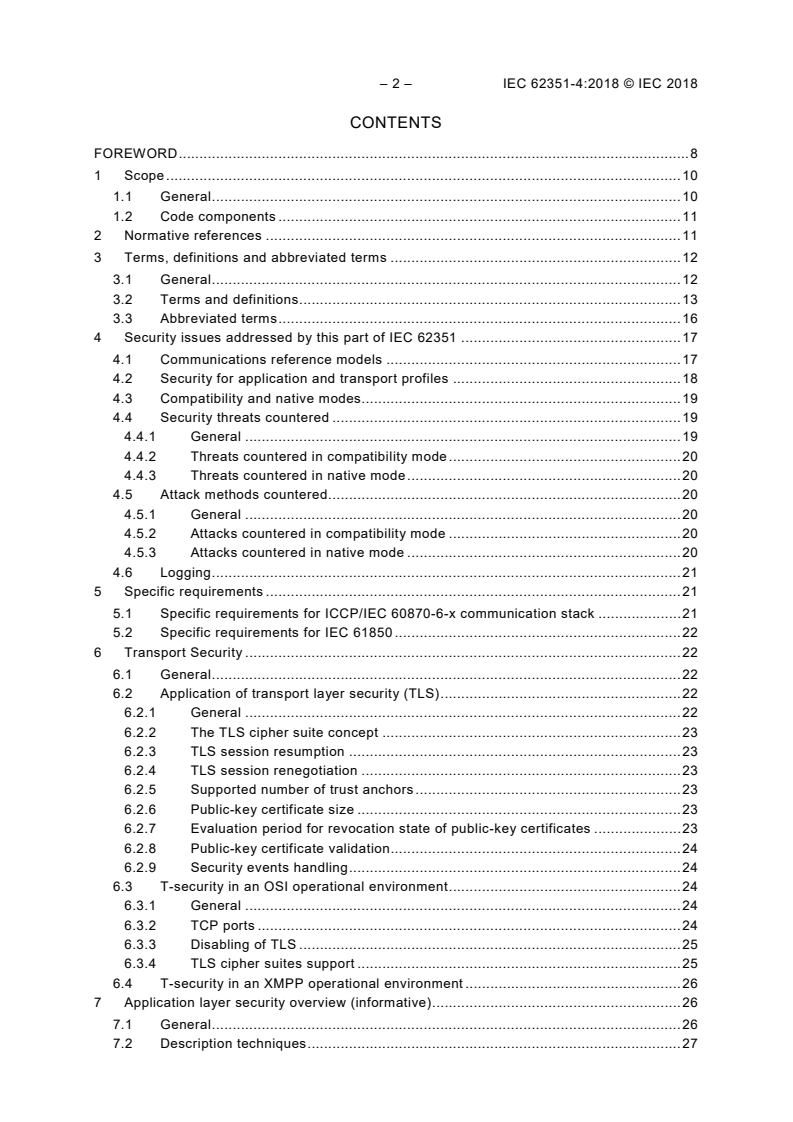
– 2 – IEC 62351-4:2018 © IEC 2018
CONTENTS
FOREWORD . 8
1 Scope . 10
1.1 General . 10
1.2 Code components . 11
2 Normative references . 11
3 Terms, definitions and abbreviated terms . 12
3.1 General . 12
3.2 Terms and definitions . 13
3.3 Abbreviated terms . 16
4 Security issues addressed by this part of IEC 62351 . 17
4.1 Communications reference models . 17
4.2 Security for application and transport profiles . 18
4.3 Compatibility and native modes. 19
4.4 Security threats countered . 19
4.4.1 General . 19
4.4.2 Threats countered in compatibility mode . 20
4.4.3 Threats countered in native mode . 20
4.5 Attack methods countered . 20
4.5.1 General . 20
4.5.2 Attacks countered in compatibility mode . 20
4.5.3 Attacks countered in native mode . 20
4.6 Logging . 21
5 Specific requirements . 21
5.1 Specific requirements for ICCP/IEC 60870-6-x communication stack . 21
5.2 Specific requirements for IEC 61850 . 22
6 Transport Security . 22
6.1 General . 22
6.2 Application of transport layer security (TLS) . 22
6.2.1 General . 22
6.2.2 The TLS cipher suite concept . 23
6.2.3 TLS session resumption . 23
6.2.4 TLS session renegotiation . 23
6.2.5 Supported number of trust anchors . 23
6.2.6 Public-key certificate size . 23
6.2.7 Evaluation period for revocation state of public-key certificates . 23
6.2.8 Public-key certificate validation . 24
6.2.9 Security events handling . 24
6.3 T-security in an OSI operational environment . 24
6.3.1 General . 24
6.3.2 TCP ports . 24
6.3.3 Disabling of TLS . 25
6.3.4 TLS cipher suites support . 25
6.4 T-security in an XMPP operational environment . 26
7 Application layer security overview (informative) . 26
7.1 General . 26
7.2 Description techniques . 27
7.2.1 General . 27
7.2.2 ASN.1 as an XML schema definition . 27
7.2.3 W3C XML Schema Definition (W3C XSD) . 28
7.2.4 XML namespace . 28
8 Use of cryptographic algorithms . 28
8.1 General . 28
8.2 Basic cryptographic definitions . 28
8.3 Public-key algorithms . 29
8.4 Hash algorithms . 30
8.5 Signature algorithms . 30
8.6 Symmetric encryption algorithms used for encryption only . 30
8.7 Authenticated encryption algorithms . 31
8.8 Integrity check value algorithms . 31
9 Object identifier allocation (normative) . 32
10 General OSI upper layer requirements (normative) . 32
10.1 Overview. 32
10.2 General on OSI upper layer requirements . 33
10.3 Session protocol requirements . 33
10.4 Presentation protocol requirements . 34
10.4.1 Context list . 34
10.4.2 Abstract syntaxes . 34
10.4.3 Presentation user data . 34
10.4.4 ASN.1 encoding requirements . 35
10.5 Association control service element (ACSE) protocol requirements . 36
10.5.1 General . 36
10.5.2 Protocol version . 36
10.5.3 Titles . 36
10.5.4 Use of ASN.1 EXTERNAL data type . 36
11 A-security-profile (normative) . 37
11.1 OSI requirements specific to A-security profile . 37
11.1.1 General . 37
11.1.2 Additional session protocol requirements . 37
11.1.3 Additional presentation protocol requirement . 37
11.1.4 Additional ACSE requirements . 37
11.2 MMS Authentication value . 39
11.2.1 General . 39
11.2.2 MMS-Authentication value data type . 39
11.2.3 Handling of the association request (AARQ-apdu) . 40
11.2.4 Handling of the association result (AARE-apdu) . 40
12 End-to-end application security model . 41
12.1 Introduction and general architecture . 41
12.2 Abstract syntax specifications . 42
12.2.1 General . 42
13 End-to-end application security (normative) . 43
13.1 Association management . 43
13.1.1 General concept . 43
13.1.2 UTC time specification . 43
13.1.3 Handshake request . 43
– 4 – IEC 62351-4:2018 © IEC 2018
13.1.4 Handshake accept . 44
13.1.5 Association reject by the protected protocol . 45
13.1.6 Association reject due to security issues. 45
13.1.7 Handshake security abort . 46
13.1.8 Data transfer security abort . 46
13.1.9 Abort by protected protocol . 46
13.1.10 Association release request . 47
13.1.11 Association release response . 47
13.2 Data transfer phase . 47
13.2.1 General . 47
13.2.2 Clear data transfer . 48
13.2.3 Encrypted data transfer . 48
13.3 ClearToken data types . 49
13.3.1 The ClearToken1 data type . 49
13.3.2 The ClearToken2 data type . 53
13.3.3 The ClearToken3 data type . 54
13.4 Authentication and integrity specifications . 55
13.4.1 The Signature data type . 55
13.4.2 The authenticator data type . 55
14 E2E security error handling (normative) . 56
14.1 General . 56
14.2 Specification of diagnostics . 56
14.2.1 Handshake diagnostics . 56
14.2.2 The data transfer diagnostics . 57
14.3 Checking of E2E-security handshake request and accept . 58
14.3.1 General . 58
14.3.2 Signature checking . 58
14.3.3 Protected protocol identity checking . 59
14.3.4 ClearToken1 checking . 59
14.4 Checking of security protocol control information during data transfer . 60
14.4.1 General . 60
14.4.2 Authenticator checking . 60
14.4.3 Checks of the ClearToken2 value . 60
15 E2E security used in an OSI operational environment . 61
15.1 General . 61
15.2 Additional upper layer requirements . 61
15.2.1 Additional presentation layer requirements . 61
15.2.2 Additional ACSE requirements . 61
15.3 Association management in an OSI operational environment . 62
15.3.1 General . 62
15.3.2 Mapping to ACSE association request . 62
15.3.3 Mapping to ACSE association response . 62
15.3.4 Mapping to ACSE abort . 63
15.3.5 Mapping to ACSE release request . 64
15.3.6 Mapping to ACSE release response . 64
15.4 Data transfer in OSI operational environment . 64
15.4.1 General . 64
15.4.2 Mapping of the clear data transfer SecPDU . 64
15.4.3 Mapping of the encrypted data transfer SecPDU . 65
15.5 OSI upper layer routing . 65
15.6 OSI operational environment checking . 66
15.6.1 General checking . 66
15.6.2 Environment mapping checking . 66
15.6.3 OSI operational environment diagnostics . 67
16 E2E security used in in an XMPP operational environment . 67
16.1 General on wrapping to an XMPP operational environment . 67
16.2 Mapping of SecPDUs to iq stanzas . 68
16.3 Mapping of SecPDUs to message stanzas . 69
16.4 XMPP stanza error handling . 69
16.5 XML namespaces . 70
16.6 Encoding of EnvPDUs within XMPP stanzas . 70
16.7 Multiple associations . 71
16.8 Release collision consideration . 71
17 Conformance to this document . 71
17.1 General . 71
17.2 Notation . 71
17.3 Conformance to operational environment . 71
17.4 Conformance to modes of operation . 72
17.5 Conformance to compatibility mode . 72
17.6 Conformance to native mode . 73
Annex A (normative) Formal ASN.1 specification for the A-security-profile . 75
Annex B (normative) Formal ASN.1 specification for the End-to-End security. 76
Annex C (normative) Formal W3C XSD specification for the end-to-end security . 82
Annex D (normative) ASN.1 module for OSI operational environment . 89
D.1 Scope of annex . 89
D.2 ASN.1 module . 89
Annex E (normative) ASN.1 modules and W3C XSDs for an XMPP operational
environment . 91
E.1 Scope of Annex . 91
E.2 ASN.1 modules for the XMPP operational environment . 91
E.2.1 ASN.1 module for the urn:ietf:params:xml:ns:xmpp-stanzas XML
namespace . 91
E.2.2 ASN.1 module for the http://www.iec.ch/62351/2018/ENV_4 XML
namespace . 91
E.3 W3C XSDs for the XMPP operational environment . 93
E.3.1 W3C XSD for the urn:ietf:params:xml:ns:xmpp-stanzas XML namespace . 93
E.3.2 W3C XSD for the http://www.iec.ch/62351/2018/ENV_4 XML
namespace . 94
Annex F (normative) Template for virtual API specifications . 96
F.1 General . 96
F.2 ASN.1 virtual API specification . 97
F.3 W3C XSD virtual API specification . 97
Annex G (normative) End-entity public-key certificate specification . 98
G.1 Scope of annex . 98
G.2 General requirement . 98
G.3 Length considerations . 98
G.4 Basic Structure requirement and recommendations . 98
G.4.1 Version component . 98
– 6 – IEC 62351-4:2018 © IEC 2018
G.4.2 Serial number component . 98
G.4.3 Issuer signature algorithm component . 98
G.4.4 Issuer component . 99
G.4.5 Validity component . 99
G.4.6 Subject component . 99
G.4.7 Subject public key Information component . 99
G.4.8 Issuer unique ID and subject unique ID components . 100
G.5 Extensions . 100
G.5.1 General . 100
G.5.2 Key usage extension . 100
G.5.3 Revocation checking . 100
G.5.4 IEC user role information extension . 101
G.6 Specific requirements for operational environments . 101
G.6.1 General . 101
G.6.2 OSI operational environment . 101
G.6.3 XMPP operational environment . 101
Annex H (normative) Lower layer requirements for the OSI operational environment . 102
H.1 Scope of annex . 102
H.2 Transport protocol class 0 . 102
H.2.1 Enforcement of maximum lengths . 102
H.2.2 Response to Class 0 unsupported TPDUs . 102
H.2.3 Transport selectors . 102
H.3 IETF RFC 1006 . 103
H.3.1 General . 103
H.3.2 Version number . 103
H.3.3 Length . 103
H.3.4 Keep-alive . 103
Annex I (informative) ASN.1 definition of ACSE . 104
Bibliography . 108
Figure 1 – Application and transport profiles (informative) . 18
Figure 2 – T-profiles without and with TLS protection . 24
Figure 3 – Association establishment . 33
Figure 4 – Inclusion of User-data in SESSION DATA TRANFER SPDU . 35
Figure 5 – E2E security building blocks . 41
Figure 6 – Relationship between environment, E2E-security and protected protocol . 41
Figure 7 – Relationships between APDUs . 42
Figure 8 – The scope of E2E-security specification . 42
Figure 9 – Upper layer routing . 65
Figure F.1 – Virtual API concept . 96
Table 1 – Relationship between security and security measure combinations . 19
Table 2 – Commented recommended cipher suites from IEC TS 62351-4:2007 . 25
Table 3 – Cipher suites combinations in the context of this document . 26
Table 4 – Mapping of SecPDUs to ACSE APDUs . 62
Table 5 – Mapping of SecPDUs to XMPP stanzas . 68
Table 6 – Conformance to operational environment . 72
Table 7 – Conformance to modes of operation . 72
Table 8 – Conformance to compatibility mode . 72
Table 9 – Conformance to TLS cipher suites in compatibility mode . 73
Table 10 – Conformance to native mode . 73
Table 11 – Conformance to mode of encryption . 73
Table 12 – Conformance to TLS cipher suites in native mode . 74
Table 13 – Conformance to cryptographic algorithms for E2E-security . 74
Table H.1 – TP class 0 maximum sizes . 102
– 8 – IEC 62351-4:2018 © IEC 2018
INTERNATIONAL ELECTROTECHNICAL COMMISSION
____________
POWER SYSTEMS MANAGEMENT AND
ASSOCIATED INFORMATION EXCHANGE –
DATA AND COMMUNICATIONS SECURITY –
Part 4: Profiles including MMS and derivatives
FOREWORD
1) The International Electrotechnical Commission (IEC) is a worldwide organization for standardization comprising
all national electrotechnical committees (IEC National Committees). The object of IEC is to promote
international co-operation on all questions concerning standardization in the electrical and electronic fields. To
this end and in addition to other activities, IEC publishes International Standards, Technical Specifications,
Technical Reports, Publicly Available Specifications (PAS) and Guides (hereafter referred to as “IEC
Publication(s)”). Their preparation is entrusted to technical committees; any IEC National Committee interested
in the subject dealt with may participate in this preparatory work. International, governmental and non-
governmental organizations liaising with the IEC also participate in this preparation. IEC collaborates closely
with the International Organization for Standardization (ISO) in accordance with conditions determined by
agreement between the two organizations.
2) The formal decisions or agreements of IEC on technical matters express, as nearly as possible, an international
consensus of opinion on the relevant subjects since each technical committee has representation from all
interested IEC National Committees.
3) IEC Publications have the form of recommendations for international use and are accepted by IEC National
Committees in that sense. While all reasonable efforts are made to ensure that the technical content of IEC
Publications is accurate, IEC cannot be held responsible for the way in which they are used or for any
misinterpretation by any end user.
4) In order to promote international uniformity, IEC National Committees undertake to apply IEC Publications
transparently to the maximum extent possible in their national and regional publications. Any divergence
between any IEC Publication and the corresponding national or regional publication shall be clearly indicated in
the latter.
5) IEC itself does not provide any attestation of conformity. Independent certification bodies provide conformity
assessment services and, in some areas, access to IEC marks of conformity. IEC is not responsible for any
services carried out by independent certification bodies.
6) All users should ensure that they have the latest edition of this publication.
7) No liability shall attach to IEC or its directors, employees, servants or agents including individual experts and
members of its technical committees and IEC National Committees for any personal injury, property damage or
other damage of any nature whatsoever, whether direct or indirect, or for costs (including legal fees) and
expenses arising out of the publication, use of, or reliance upon, this IEC Publication or any other IEC
Publications.
8) Attention is drawn to the Normative references cited in this publication. Use of the referenced publications is
indispensable for the correct application of this publication.
9) Attention is drawn to the possibility that some of the elements of this IEC Publication may be the subject of
patent rights. IEC shall not be held responsible for identifying any or all such patent rights.
International Standard IEC 62351-4 has been prepared by IEC technical committee 57: Power
systems management and associated exchange.
The text of this standard is based on the following documents:
FDIS Report on voting
57/2032/FDIS 57/2053/RVD
Full information on the voting for the approval of this standard can be found in the report on
voting indicated in the above table.
This publication has been drafted in accordance with the ISO/IEC Directives, Part 2.
A list of all parts in the IEC 62351 series, published under the general title Power systems
management and associated information exchange – Data and communications security, can
be found on the IEC website.
This IEC standard includes Code Components i.e. components that are intended to be directly
processed by a computer. Such content is any text found between the markers
BEGINS> and , or otherwise is clearly labelled in this standard as a Code
Component.
The purchase of this IEC standard carries a copyright license for the purchaser to sell
software containing Code Components from this standard to end users either directly or via
distributors, subject to IEC software licensing conditions, which can be found at:
www.iec.ch/CCv1.
In this document the following print types are used:
– Abstract Syntax Notation One (ASN.1) and W3C XML Schema Definition (W3C XSD)
notions are presented in bold Courier New typeface; and
– when ASN.1 types and values are referenced in normal text, they are differentiated from
normal text by presenting them in bold Courier New typeface.
A list of all parts in the IEC 62351 series, published under the general title Power systems
management and associated information exchange – Data and communications security, can
be found on the IEC website.
The committee has decided that the contents of this publication will remain unchanged until
the stability date indicated on the IEC web site under "http://webstore.iec.ch" in the data
related to the specific publication. At this date, the publication will be
• reconfirmed,
• withdrawn,
• replaced by a revised edition, or
• amended.
A bilingual version of this publication may be issued at a later date.
IMPORTANT – The 'colour inside' logo on the cover page of this publication indicates
that it contains colours which are considered to be useful for the correct
understanding of its contents. Users should therefore print this document using a
colour printer.
– 10 – IEC 62351-4:2018 © IEC 2018
POWER SYSTEMS MANAGEMENT AND
ASSOCIATED INFORMATION EXCHANGE –
DATA AND COMMUNICATIONS SECURITY –
Part 4: Profiles including MMS and derivatives
1 Scope
1.1 General
This part of IEC 62351 extends the scope of IEC TS 62351-4:2007 [1] by specifying a
compatibility mode that provides interoperation with implementation based on IEC TS 62351-
4:2007 and by specifying extended capabilities referred to as native mode.
This part of IEC 62351 specifies security requirements both at the transport layer and at the
application layer. While IEC TS 62351-4:2007 primarily provided some limited support at the
application layer for authentication during handshake for the Manufacturing Message
Specification (MMS) based applications, this document also provides support for extended
integrity and authentication both for the handshake phase and for the data transfer phase. It
provides for shared key management and data transfer encryption at the application layer and
it provides security end-to-end (E2E) with zero or more intermediate entities. While IEC TS
62351-4:2007 only provides support for systems based on the MMS, i.e. systems using an
Open Systems Interworking (OSI) protocol stack, this document also provides support for
application protocols using other protocol stacks, e.g. an Internet protocol suite (see 4.1).
This support is extended to protect application protocols using XML encoding. This extended
security at the application layer is referred to as E2E-security.
In addition to E2E security, this part of IEC 62351 also provides mapping to environmental
protocols carrying the security related information. Only OSI and XMPP environments are
currently considered.
It is intended that this part of IEC 62351 be referenced as a normative part of standards that
have a need for using application protocols, e.g., MMS, in a secure manner.
It is anticipated that there are implementations, in particular Inter-Control Centre
Communications Protocol (ICCP) implementations that are dependent on the IEC TS 62351-
4:2007 specifications of the T-profile and the A-security-profile. The specifications from IEC
TS 62351-4:2007 are therefore included in this part of IEC 62351. Implementations supporting
these specifications will interwork with implementation based on IEC TS 62351-4:2007.
NOTE The A-security-profile is in the strict sense not a profile, but the term is here kept for historical reasons.
This document represents a set of mandatory and optional security specifications to be
implemented to protect application protocols.
The initial audience for this document is the members of the working groups developing or
making use of protocols. For the measures described in this part of IEC 62351 to take effect,
they shall be accepted and referenced by the specifications for the protocols themselves.
The subsequent audience for this document is the developers of products that implement
these protocols and the end user that want to specify requirements for its own environment.
___________
Numbers in square brackets refer to the bibliography.
Portions of this document may also be of use to managers and executives in order to
understand the purpose and requirements of the work.
1.2 Code components
The purchase of this IEC standard carries a copyright license for the purchaser to sell
software containing Code Components from this standard to end users either directly or via
distributors, subject to IEC software licensing conditions, which can be found at:
www.iec.ch/CCv1.
The Code Components included in this IEC standard are also available as electronic machine
readable file at: www.iec.ch/public/tc57/supportdocuments/IEC_62351-4.ASN.1_XSD.full.zip
In this document, code components are contained within Annexes A, B, C, D and E.
2 Normative references
The following documents are referred to in the text in such a way that some or all of their
content constitutes requirements of this document. For dated references, only the edition
cited applies. For undated references, the latest edition of the referenced document (including
any amendments) applies.
IEC TS 62351-1, Power systems management and associated information exchange – Data
and communications security – Part 1: Communication network and system security –
Introduction to security issues
IEC TS 62351-2, Power systems management and associated information exchange – Data
and communications security – Part 2: Glossary of terms
IEC 62351-3:2014, Power systems management and associated information exchange – Data
and communications security – Part 3: Communication network and system security – Profiles
including TCP/IP
IEC 62351-3:2014/AMD1:2018
IEC TS 62351-8:2011, Power systems management and associated information exchange –
Data and communications security – Part 8: Role-based access control
IEC 62351-9:2017, Power systems management and associated information exchange – Data
and communications security – Part 9: Cyber security key management for power system
equipment
ISO/IEC 8073:1997 | Rec. ITU-T X.224 (1995), Information technology – open systems
interconnection – Protocol for providing the connection-mode transport service
ISO/IEC 8823-1:1994 | Rec. ITU-T X.226 (1994), Information technology – open systems
interconnection – connection-oriented presentation protocol: Protocol specification
ISO/IEC 8824-1 | Rec. ITU-T X.680, Information technology – Abstract Syntax Notation One
(ASN.1): Specification of basic notation
ISO/IEC 8825-1 | Rec. ITU-T X.690, Information technology – ASN.1 encoding rules:
Specification of Basic Encoding Rules (BER), Canonical Encoding Rules (CER) and
Distinguished Encoding Rules (DER)
ISO/IEC 8825-4 | Rec. ITU-T X.693, Information technology – ASN.1 encoding rules: XML
Encoding Rules (XER)
– 12 – IEC 62351-4:2018 © IEC 2018
ISO 8601:2004, Data elements and interchange formats – Information interchange –
Representation of dates and times
ISO 9506-2:2003, Industrial automation systems – Manufacturing Message Specification –
Part 2: Protocol specification
ISO/IEC 9594-8: | Rec.
...
IEC 62351-4 ®
Edition 1.1 2020-07
CONSOLIDATED VERSION
INTERNATIONAL
STANDARD
NORME
INTERNATIONALE
colour
inside
Power systems management and associated information exchange – Data and
communications security –
Part 4: Profiles including MMS and derivatives
Gestion des systèmes de puissance et échanges d'informations associés –
Sécurité des communications et des données –
Partie 4: Profils comprenant le MMS et ses dérivés
All rights reserved. Unless otherwise specified, no part of this publication may be reproduced or utilized in any form
or by any means, electronic or mechanical, including photocopying and microfilm, without permission in writing from
either IEC or IEC's member National Committee in the country of the requester. If you have any questions about IEC
copyright or have an enquiry about obtaining additional rights to this publication, please contact the address below or
your local IEC member National Committee for further information.
Droits de reproduction réservés. Sauf indication contraire, aucune partie de cette publication ne peut être reproduite
ni utilisée sous quelque forme que ce soit et par aucun procédé, électronique ou mécanique, y compris la photocopie
et les microfilms, sans l'accord écrit de l'IEC ou du Comité national de l'IEC du pays du demandeur. Si vous avez des
questions sur le copyright de l'IEC ou si vous désirez obtenir des droits supplémentaires sur cette publication, utilisez
les coordonnées ci-après ou contactez le Comité national de l'IEC de votre pays de résidence.
IEC Central Office Tel.: +41 22 919 02 11
3, rue de Varembé info@iec.ch
CH-1211 Geneva 20 www.iec.ch
Switzerland
About the IEC
The International Electrotechnical Commission (IEC) is the leading global organization that prepares and publishes
International Standards for all electrical, electronic and related technologies.
About IEC publications
The technical content of IEC publications is kept under constant review by the IEC. Please make sure that you have the
latest edition, a corrigendum or an amendment might have been published.
IEC publications search - webstore.iec.ch/advsearchform Electropedia - www.electropedia.org
The advanced search enables to find IEC publications by a The world's leading online dictionary on electrotechnology,
variety of criteria (reference number, text, technical containing more than 22 000 terminological entries in English
committee,…). It also gives information on projects, replaced and French, with equivalent terms in 16 additional languages.
and withdrawn publications. Also known as the International Electrotechnical Vocabulary
(IEV) online.
IEC Just Published - webstore.iec.ch/justpublished
Stay up to date on all new IEC publications. Just Published IEC Glossary - std.iec.ch/glossary
details all new publications released. Available online and 67 000 electrotechnical terminology entries in English and
once a month by email. French extracted from the Terms and definitions clause of
IEC publications issued between 2002 and 2015. Some
IEC Customer Service Centre - webstore.iec.ch/csc entries have been collected from earlier publications of IEC
If you wish to give us your feedback on this publication or TC 37, 77, 86 and CISPR.
need further assistance, please contact the Customer Service
Centre: sales@iec.ch.
A propos de l'IEC
La Commission Electrotechnique Internationale (IEC) est la première organisation mondiale qui élabore et publie des
Normes internationales pour tout ce qui a trait à l'électricité, à l'électronique et aux technologies apparentées.
A propos des publications IEC
Le contenu technique des publications IEC est constamment revu. Veuillez vous assurer que vous possédez l’édition la
plus récente, un corrigendum ou amendement peut avoir été publié.
Recherche de publications IEC - Electropedia - www.electropedia.org
webstore.iec.ch/advsearchform Le premier dictionnaire d'électrotechnologie en ligne au
La recherche avancée permet de trouver des publications IEC monde, avec plus de 22 000 articles terminologiques en
en utilisant différents critères (numéro de référence, texte, anglais et en français, ainsi que les termes équivalents dans
comité d’études,…). Elle donne aussi des informations sur les 16 langues additionnelles. Egalement appelé Vocabulaire
projets et les publications remplacées ou retirées. Electrotechnique International (IEV) en ligne.
IEC Just Published - webstore.iec.ch/justpublished Glossaire IEC - std.iec.ch/glossary
Restez informé sur les nouvelles publications IEC. Just 67 000 entrées terminologiques électrotechniques, en anglais
Published détaille les nouvelles publications parues. et en français, extraites des articles Termes et définitions des
Disponible en ligne et une fois par mois par email. publications IEC parues entre 2002 et 2015. Plus certaines
entrées antérieures extraites des publications des CE 37, 77,
Service Clients - webstore.iec.ch/csc 86 et CISPR de l'IEC.
Si vous désirez nous donner des commentaires sur cette
publication ou si vous avez des questions contactez-nous:
sales@iec.ch.
IEC 62351-4 ®
Edition 1.1 2020-07
CONSOLIDATED VERSION
INTERNATIONAL
STANDARD
NORME
INTERNATIONALE
colour
inside
Power systems management and associated information exchange – Data and
communications security –
Part 4: Profiles including MMS and derivatives
Gestion des systèmes de puissance et échanges d'informations associés –
Sécurité des communications et des données –
Partie 4: Profils comprenant le MMS et ses dérivés
INTERNATIONAL
ELECTROTECHNICAL
COMMISSION
COMMISSION
ELECTROTECHNIQUE
INTERNATIONALE
ICS 33.200 ISBN 978-2-8322-8621-0
IEC 62351-4 ®
Edition 1.1 2020-07
REDLINE VERSION
VERSION REDLINE
colour
inside
Power systems management and associated information exchange – Data and
communications security –
Part 4: Profiles including MMS and derivatives
Gestion des systèmes de puissance et échanges d'informations associés –
Sécurité des communications et des données –
Partie 4: Profils comprenant le MMS et ses dérivés
– 2 – IEC 62351-4:2018+AMD1:2020 CSV
© IEC 2020
CONTENTS
FOREWORD . 8
1 Scope . 10
1.1 General . 10
1.2 Code components . 11
2 Normative references . 11
3 Terms, definitions and abbreviated terms . 12
3.1 General . 12
3.2 Terms and definitions . 13
3.3 Abbreviated terms . 16
4 Security issues addressed by this part of IEC 62351 . 18
4.1 Communications reference models . 18
4.2 Security for application and transport profiles . 18
4.3 Compatibility and native modes. 19
4.4 Security threats countered . 19
4.4.1 General . 19
4.4.2 Threats countered in compatibility mode . 20
4.4.3 Threats countered in native mode . 20
4.5 Attack methods countered . 20
4.5.1 General . 20
4.5.2 Attacks countered in compatibility mode . 20
4.5.3 Attacks countered in native mode . 20
4.6 Logging . 21
5 Specific requirements . 21
5.1 Specific requirements for ICCP/IEC 60870-6-x communication stack . 21
5.2 Specific requirements for IEC 61850 . 22
6 Transport Security . 22
6.1 General . 22
6.2 Application of transport layer security (TLS) . 22
6.2.1 General . 22
6.2.2 The TLS cipher suite concept . 23
6.2.3 TLS session resumption . 23
6.2.4 TLS session renegotiation . 23
6.2.5 Supported number of trust anchors . 23
6.2.6 Public-key certificate size . 23
6.2.7 Evaluation period for revocation state of public-key certificates . 23
6.2.8 Public-key certificate validation . 24
6.2.9 Security events handling . 24
6.3 T-security in an OSI operational environment . 24
6.3.1 General . 24
6.3.2 TCP ports . 24
6.3.3 Disabling of TLS . 25
6.3.4 TLS cipher suites support . 25
6.4 T-security in an XMPP operational environment . 27
7 Application layer security overview (informative) . 27
7.1 General . 27
7.2 Description techniques . 28
© IEC 2020
7.2.1 General . 28
7.2.2 ASN.1 as an XML schema definition . 28
7.2.3 W3C XML Schema Definition (W3C XSD) . 28
7.2.4 XML namespace . 29
8 Use of cryptographic algorithms . 29
8.1 General . 29
8.2 Basic cryptographic definitions . 29
8.3 Public-key algorithms . 30
8.4 Hash algorithms . 31
8.5 Signature algorithms . 31
8.6 Symmetric encryption key algorithms used for encryption only . 31
8.7 Authenticated encryption algorithms . 32
8.8 Integrity check value algorithms . 32
9 Object identifier allocation (normative) . 33
10 General OSI upper layer requirements (normative) . 33
10.1 Overview. 33
10.2 General on OSI upper layer requirements . 34
10.3 Session protocol requirements . 34
10.4 Presentation protocol requirements . 35
10.4.1 Context list . 35
10.4.2 Abstract syntaxes . 35
10.4.3 Presentation user data . 36
10.4.4 ASN.1 encoding requirements . 36
10.5 Association control service element (ACSE) protocol requirements . 37
10.5.1 General . 37
10.5.2 Protocol version . 37
10.5.3 Titles . 37
10.5.4 Use of ASN.1 EXTERNAL data type . 38
11 A-security profile (normative) . 38
11.1 OSI requirements specific to A-security profile . 38
11.1.1 General . 38
11.1.2 Additional session protocol requirements . 38
11.1.3 Additional presentation protocol requirement . 38
11.1.4 Additional ACSE requirements . 39
11.2 MMS Authentication value . 41
11.2.1 General . 41
11.2.2 MMS-Authentication value data type . 41
11.2.3 Handling of the association request (AARQ-apdu) . 42
11.2.4 Handling of the association result (AARE-apdu) . 42
12 End-to-end application security model . 43
12.1 Introduction and general architecture . 43
12.2 Abstract syntax specifications . 45
12.2.1 General . 45
13 End-to-end application security (normative) . 45
13.1 Association management . 45
13.1.1 General concept . 45
13.1.2 UTC time specification . 45
13.1.3 Handshake request . 46
– 4 – IEC 62351-4:2018+AMD1:2020 CSV
© IEC 2020
13.1.4 Handshake accept . 47
13.1.5 Association reject by the protected protocol . 47
13.1.6 Association reject due to security issues. 48
13.1.7 Handshake security abort . 48
13.1.8 Data transfer security abort . 48
13.1.9 Abort by protected protocol . 49
13.1.10 Association release request . 49
13.1.11 Association release response . 50
13.2 Data transfer phase . 50
13.2.1 General . 50
13.2.2 Clear data transfer . 50
13.2.3 Encrypted data transfer . 50
13.3 ClearToken data types . 51
13.3.1 The ClearToken1 data type . 51
13.3.2 The ClearToken2 data type . 58
13.3.3 The ClearToken3 data type . 59
13.4 Authentication and integrity specifications . 60
13.4.1 The Signature data type . 60
13.4.2 The authenticator data type . 60
14 E2E security error handling (normative) . 61
14.1 General . 61
14.2 Specification of diagnostics . 61
14.2.1 Handshake diagnostics . 61
14.2.2 The data transfer diagnostics . 63
14.3 Checking of E2E-security handshake request and accept . 64
14.3.1 General . 64
14.3.2 Signature checking . 64
14.3.3 Protected protocol identity checking . 65
14.3.4 ClearToken1 checking . 65
14.4 Checking of security protocol control information during data transfer . 67
14.4.1 General . 67
14.4.2 Authenticator checking . 67
14.4.3 Checks of the ClearToken2 value . 67
15 E2E security used in an OSI operational environment . 68
15.1 General . 68
15.2 Additional upper layer requirements . 68
15.2.1 Additional presentation layer requirements . 68
15.2.2 Additional ACSE requirements . 68
15.3 Association management in an OSI operational environment . 69
15.3.1 General . 69
15.3.2 Mapping to ACSE association request . 69
15.3.3 Mapping to ACSE association response . 69
15.3.4 Mapping to ACSE abort . 70
15.3.5 Mapping to ACSE release request . 71
15.3.6 Mapping to ACSE release response . 71
15.4 Data transfer in OSI operational environment . 71
15.4.1 General . 71
15.4.2 Mapping of the clear data transfer SecPDU . 71
15.4.3 Mapping of the encrypted data transfer SecPDU . 72
© IEC 2020
15.5 OSI upper layer routing . 72
15.6 OSI operational environment checking . 74
15.6.1 General checking . 74
15.6.2 Environment mapping checking . 75
15.6.3 OSI operational environment diagnostics . 75
16 E2E security used in in an XMPP operational environment . 75
16.1 General on wrapping to an XMPP operational environment . 75
16.2 Mapping of SecPDUs to iq stanzas . 76
16.3 Mapping of SecPDUs to message stanzas . 77
16.4 XMPP stanza error handling . 77
16.5 XML namespaces . 78
16.6 Encoding of EnvPDUs within XMPP stanzas . 78
16.7 Multiple associations . 79
16.8 Release collision consideration . 79
17 Conformance to this document . 79
17.1 General . 79
17.2 Notation . 79
17.3 Conformance to operational environment . 80
17.4 Conformance to modes of operation . 80
17.5 Conformance to compatibility mode . 80
17.6 Conformance to native mode . 81
Annex A (normative) Formal ASN.1 specification for the A-security-profile . 83
Annex B (normative) Formal ASN.1 specification for the End-to-End security. 84
Annex C (normative) Formal W3C XSD specification for the end-to-end security . 95
Annex D (normative) ASN.1 module for OSI operational environment . 110
D.1 Scope of annex . 110
D.2 ASN.1 module . 110
Annex E (normative) ASN.1 modules and W3C XSDs for an XMPP operational
environment . 112
E.1 Scope of Annex . 112
E.2 ASN.1 modules for the XMPP operational environment . 112
E.2.1 ASN.1 module for the urn:ietf:params:xml:ns:xmpp-stanzas XML
namespace . 112
E.2.2 ASN.1 module for the http://www.iec.ch/62351/2018/ENV_4 XML
namespace . 112
E.3 W3C XSDs for the XMPP operational environment . 114
E.3.1 W3C XSD for the urn:ietf:params:xml:ns:xmpp-stanzas XML namespace . 114
E.3.2 W3C XSD for the http://www.iec.ch/62351/2018/ENV_4 XML
namespace . 115
Annex F (normative) Template for virtual API specifications . 117
F.1 General . 117
F.2 ASN.1 virtual API specification . 118
F.3 ASN.1 virtual API specification for OSI environment . 118
F.34 W3C XSD virtual API specification . 118
Annex G (normative) End-entity public-key certificate specification . 120
G.1 Scope of annex . 120
G.2 General requirement . 120
G.3 Length considerations . 120
G.4 Basic Structure requirement and recommendations . 120
– 6 – IEC 62351-4:2018+AMD1:2020 CSV
© IEC 2020
G.4.1 Version component . 120
G.4.2 Serial number component . 120
G.4.3 Issuer signature algorithm component . 120
G.4.4 Issuer component . 121
G.4.5 Validity component . 121
G.4.6 Subject component . 121
G.4.7 Subject public key Information component . 121
G.4.8 Issuer unique ID and subject unique ID components . 122
G.5 Extensions . 122
G.5.1 General . 122
G.5.2 Key usage extension . 122
G.5.3 Revocation checking . 122
G.5.4 IEC user role information extension . 123
G.6 Specific requirements for operational environments . 123
G.6.1 General . 123
G.6.2 OSI operational environment . 123
G.6.3 XMPP operational environment . 123
Annex H (normative) Lower layer requirements for the OSI operational environment . 124
H.1 Scope of annex . 124
H.2 Transport protocol class 0 . 124
H.2.1 Enforcement of maximum lengths . 124
H.2.2 Response to Class 0 unsupported TPDUs . 124
H.2.3 Transport selectors . 124
H.3 IETF RFC 1006 . 125
H.3.1 General . 125
H.3.2 Version number . 125
H.3.3 Length . 125
H.3.4 Keep-alive . 125
Annex I (informative) ASN.1 definition of ACSE . 126
Bibliography . 130
Figure 1 – Application and transport profiles (informative) . 18
Figure 2 – T-profiles without and with TLS protection . 24
Figure 3 – Association establishment . 34
Figure 4 – Inclusion of User-data in SESSION DATA TRANFER SPDU . 36
Figure 5 – E2E security building blocks . 43
Figure 6 – Relationship between environment, E2E-security and protected protocol . 44
Figure 7 – Relationships between APDUs . 44
Figure 8 – The scope of E2E-security specification . 44
Figure 9 – Upper layer routing . 73
Figure F.1 – Virtual API concept . 117
Table 1 – Relationship between security and security measure combinations . 19
Table 2 – Commented recommended cipher suites from IEC TS 62351-4:2007 . 26
Table 3 – Cipher suites combinations in the context of this document . 27
Table 4 – Mapping of SecPDUs to ACSE APDUs EnvPDUs . 69
© IEC 2020
Table 5 – Mapping of SecPDUs to XMPP stanzas . 76
Table 6 – Conformance to operational environment . 80
Table 7 – Conformance to modes of operation . 80
Table 8 – Conformance to compatibility mode .
Table 98 – Conformance to TLS cipher suites in compatibility mode . 81
Table 119 – Conformance to mode of encryption . 81
Table 10 – Conformance to native mode .
Table 1210 – Conformance to TLS cipher suites in native mode . 82
Table 1311 – Conformance to cryptographic algorithms for E2E-security . 82
Table H.1 – TP class 0 maximum sizes . 124
– 8 – IEC 62351-4:2018+AMD1:2020 CSV
© IEC 2020
INTERNATIONAL ELECTROTECHNICAL COMMISSION
____________
POWER SYSTEMS MANAGEMENT AND
ASSOCIATED INFORMATION EXCHANGE –
DATA AND COMMUNICATIONS SECURITY –
Part 4: Profiles including MMS and derivatives
FOREWORD
1) The International Electrotechnical Commission (IEC) is a worldwide organization for standardization comprising
all national electrotechnical committees (IEC National Committees). The object of IEC is to promote
international co-operation on all questions concerning standardization in the electrical and electronic fields. To
this end and in addition to other activities, IEC publishes International Standards, Technical Specifications,
Technical Reports, Publicly Available Specifications (PAS) and Guides (hereafter referred to as “IEC
Publication(s)”). Their preparation is entrusted to technical committees; any IEC National Committee interested
in the subject dealt with may participate in this preparatory work. International, governmental and non-
governmental organizations liaising with the IEC also participate in this preparation. IEC collaborates closely
with the International Organization for Standardization (ISO) in accordance with conditions determined by
agreement between the two organizations.
2) The formal decisions or agreements of IEC on technical matters express, as nearly as possible, an international
consensus of opinion on the relevant subjects since each technical committee has representation from all
interested IEC National Committees.
3) IEC Publications have the form of recommendations for international use and are accepted by IEC National
Committees in that sense. While all reasonable efforts are made to ensure that the technical content of IEC
Publications is accurate, IEC cannot be held responsible for the way in which they are used or for any
misinterpretation by any end user.
4) In order to promote international uniformity, IEC National Committees undertake to apply IEC Publications
transparently to the maximum extent possible in their national and regional publications. Any divergence
between any IEC Publication and the corresponding national or regional publication shall be clearly indicated in
the latter.
5) IEC itself does not provide any attestation of conformity. Independent certification bodies provide conformity
assessment services and, in some areas, access to IEC marks of conformity. IEC is not responsible for any
services carried out by independent certification bodies.
6) All users should ensure that they have the latest edition of this publication.
7) No liability shall attach to IEC or its directors, employees, servants or agents including individual experts and
members of its technical committees and IEC National Committees for any personal injury, property damage or
other damage of any nature whatsoever, whether direct or indirect, or for costs (including legal fees) and
expenses arising out of the publication, use of, or reliance upon, this IEC Publication or any other IEC
Publications.
8) Attention is drawn to the Normative references cited in this publication. Use of the referenced publications is
indispensable for the correct application of this publication.
9) Attention is drawn to the possibility that some of the elements of this IEC Publication may be the subject of
patent rights. IEC shall not be held responsible for identifying any or all such patent rights.
This consolidated version of the official IEC Standard and its amendment has been
prepared for user convenience.
IEC 62351-4 edition 1.1 contains the first edition (2018-11) [documents 57/2032/FDIS and
57/2053/RVD] and its amendment 1 (2020-07) [documents 57/2217/FDIS and
57/2053/RVD].
In this Redline version, a vertical line in the margin shows where the technical content
is modified by amendment 1. Additions are in green text, deletions are in strikethrough
red text. A separate Final version with all changes accepted is available in this
publication.
© IEC 2020
International Standard IEC 62351-4 has been prepared by IEC technical committee 57: Power
systems management and associated exchange.
This publication has been drafted in accordance with the ISO/IEC Directives, Part 2.
A list of all parts in the IEC 62351 series, published under the general title Power systems
management and associated information exchange – Data and communications security, can
be found on the IEC website.
This IEC standard includes Code Components i.e. components that are intended to be directly
processed by a computer. Such content is any text found between the markers
BEGINS> and , or otherwise is clearly labelled in this standard as a Code
Component.
The purchase of this IEC standard carries a copyright license for the purchaser to sell
software containing Code Components from this standard to end users either directly or via
distributors, subject to IEC software licensing conditions, which can be found at:
www.iec.ch/CCv1.
In this document the following print types are used:
– Abstract Syntax Notation One (ASN.1) and W3C XML Schema Definition (W3C XSD)
notions are presented in bold Courier New typeface; and
– when ASN.1 types and values are referenced in normal text, they are differentiated from
normal text by presenting them in bold Courier New typeface.
A list of all parts in the IEC 62351 series, published under the general title Power systems
management and associated information exchange – Data and communications security, can
be found on the IEC website.
The committee has decided that the contents of the base publication and its amendment will
remain unchanged until the stability date indicated on the IEC web site under
"http://webstore.iec.ch" in the data related to the specific publication. At this date, the
publication will be
• reconfirmed,
• withdrawn,
• replaced by a revised edition, or
• amended.
IMPORTANT – The 'colour inside' logo on the cover page of this publication indicates
that it contains colours which are considered to be useful for the correct
understanding of its contents. Users should therefore print this document using a
colour printer.
– 10 – IEC 62351-4:2018+AMD1:2020 CSV
© IEC 2020
POWER SYSTEMS MANAGEMENT AND
ASSOCIATED INFORMATION EXCHANGE –
DATA AND COMMUNICATIONS SECURITY –
Part 4: Profiles including MMS and derivatives
1 Scope
1.1 General
This part of IEC 62351 extends the scope of IEC TS 62351-4:2007 [1] by specifying a
compatibility mode that provides interoperation with implementation based on IEC TS 62351-
4:2007 and by specifying extended capabilities referred to as native mode.
This part of IEC 62351 specifies security requirements both at the transport layer and at the
application layer. While IEC TS 62351-4:2007 primarily provided some limited support at the
application layer for authentication during handshake for the Manufacturing Message
Specification (MMS) based applications, this document also provides support for extended
integrity and authentication both for the handshake phase and for the data transfer phase. It
provides for shared key management and data transfer encryption at the application layer and
it provides security end-to-end (E2E) with zero or more intermediate entities. While IEC TS
62351-4:2007 only provides support for systems based on the MMS, i.e. systems using an
Open Systems Interworking (OSI) protocol stack, this document also provides support for
application protocols using other protocol stacks, e.g. an Internet protocol suite (see 4.1).
This support is extended to protect application protocols using XML encoding. This extended
security at the application layer is referred to as E2E-security.
In addition to E2E security, this part of IEC 62351 also provides mapping to environmental
protocols carrying the security related information. Only OSI and XMPP environments are
currently considered.
It is intended that this part of IEC 62351 be referenced as a normative part of standards that
have a need for using application protocols, e.g., MMS, in a secure manner.
It is anticipated that there are implementations, in particular Inter-Control Centre
Communications Protocol (ICCP) implementations that are dependent on the IEC TS 62351-
4:2007 specifications of the T-profile and the A-security-profile. The specifications from IEC
TS 62351-4:2007 are therefore included in this part of IEC 62351. Implementations supporting
these specifications will interwork with implementation based on IEC TS 62351-4:2007.
NOTE The A-security-profile is in the strict sense not a profile, but the term is here kept for historical reasons.
This document represents a set of mandatory and optional security specifications
...