

IEC TS 63331:2024
(Main)Electric dishwashers for household use - Methods for measuring the microbiological efficacy of the dishwashing process
General Information
- Abstract
IEC TS 63331:2024 applies to electric dishwashers for household and similar use that are supplied with hot and/or cold water.
This document deals with measurement procedures regarding the reduction of microbial contamination resulting from the use of electric dishwashers for household and similar use.
This document specifies methods that enable reproducible measurements. These derived measurement results can only be used for a relative statement. Absolute statements, i.e. health-related claims or conclusions about prevention or treatment of a disease or health improvement, are reserved for explicit regulatory action after a medical assessment.
This document does not apply to appliances intended to be used in medical, veterinary, or pharmaceutical applications.
This document does not address sanitization, disinfection or sterilization measures.
The dishwashing process is a complex operation consisting of cleaning dish items and cleaning the dishwasher itself. This document only focusses on the dish items to be cleaned.
- Status
- Published
- Publication Date
- 23-Sep-2024
- Technical Committee
- SC 59A - Electric dishwashers
- Drafting Committee
- WG 3 - TC 59/SC 59A/WG 3
- Current Stage
- PPUB - Publication issued
- Start Date
- 24-Sep-2024
- Completion Date
- 18-Oct-2024
Overview
IEC TS 63331:2024 is a technical specification developed by the International Electrotechnical Commission (IEC) that outlines standardized methods for measuring the microbiological efficacy of the dishwashing process in electric dishwashers designed for household and similar use. By providing reliable and reproducible procedures, this standard helps manufacturers, testing laboratories, and industry professionals assess the reduction of microbial contamination on dish items cleaned by electric dishwashers supplied with hot and/or cold water. Importantly, results obtained using these methods offer relative, not absolute, statements about microbial removal and are not intended for health claims or disease prevention assessments.
Key Topics
- Scope of Application: The standard applies exclusively to household electric dishwashers and similar appliances. It does not cover dishwashers for medical, veterinary, or pharmaceutical use, nor does it address processes such as sanitization, disinfection, or sterilization.
- Microbiological Efficacy Measurement: IEC TS 63331:2024 details the procedures for quantifying the reduction of microbial load on dish items throughout a dishwashing cycle, providing essential protocols to ensure repeatability and comparability in test outcomes.
- Test Conditions and Equipment: The document specifies standardized test conditions, including ambient temperature, water quality and temperature, types and quantities of test soils, load configurations, and the use of specified reference detergents and rinse aids.
- Laboratory Practices: Emphasis is placed on safe laboratory practices, recommending that only trained professionals conduct these tests in suitably equipped settings due to the potential use of microorganisms that can be harmful.
- Result Interpretation: The standard provides guidance on expressing and evaluating test results, focusing on relative changes in microbial contamination rather than absolute efficacy or safety claims.
Applications
IEC TS 63331:2024 offers practical value for various stakeholders in the appliance industry:
- Manufacturers of Electric Dishwashers: Utilize the standard to develop, refine, and test products for microbiological cleaning efficacy, facilitating comparison with competitors and compliance with industry expectations.
- Testing Laboratories: Enable consistent and reproducible microbiological efficacy measurements, supporting product claims and providing data for relative performance comparisons.
- Certification Bodies: Reference the standard when evaluating household dishwasher models’ microbiological removal capabilities for consumer safety and marketing claims.
- Consumer Protection and Quality Assurance: Allow consumer organizations and quality testers to benchmark dishwasher performance based on standardized microbiological testing methods.
- Regulatory and Standards Development Organizations: Serve as a technical foundation for future regulations or supplemental standards concerning appliance hygiene and performance.
Related Standards
To fully implement and understand the microbiological efficacy measurement methods in IEC TS 63331:2024, familiarity with these related standards is recommended:
- IEC 60436: Electric dishwashers for household use - Methods for measuring performance. Forms the basis for load configurations, detergent specifications, and general testing protocol referenced in IEC TS 63331.
- ISO 19458: Water quality - Sampling for microbiological analysis. Provides standardized water sampling protocols for test setups.
- ISO 607: Surface active agents and detergents - Methods of sample division. Ensures consistent detergent sample preparation.
- ISO 15883-1 and ISO/TS 15883-5: Washer-disinfectors - General and testing requirements relevant to cleaning efficacy, valuable for understanding cleaning versus microbiological efficacy.
- NSF/ANSI 184: Residential Dishwashers. Pertinent for markets adhering to North American standards.
By adhering to IEC TS 63331:2024 and its related references, industry professionals can accurately measure, compare, and communicate the microbiological efficacy of household dishwashers, supporting informed product development and quality assurance.
Frequently Asked Questions
IEC TS 63331:2024 is a technical specification published by the International Electrotechnical Commission (IEC). Its full title is "Electric dishwashers for household use - Methods for measuring the microbiological efficacy of the dishwashing process". This standard covers: IEC TS 63331:2024 applies to electric dishwashers for household and similar use that are supplied with hot and/or cold water. This document deals with measurement procedures regarding the reduction of microbial contamination resulting from the use of electric dishwashers for household and similar use. This document specifies methods that enable reproducible measurements. These derived measurement results can only be used for a relative statement. Absolute statements, i.e. health-related claims or conclusions about prevention or treatment of a disease or health improvement, are reserved for explicit regulatory action after a medical assessment. This document does not apply to appliances intended to be used in medical, veterinary, or pharmaceutical applications. This document does not address sanitization, disinfection or sterilization measures. The dishwashing process is a complex operation consisting of cleaning dish items and cleaning the dishwasher itself. This document only focusses on the dish items to be cleaned.
IEC TS 63331:2024 applies to electric dishwashers for household and similar use that are supplied with hot and/or cold water. This document deals with measurement procedures regarding the reduction of microbial contamination resulting from the use of electric dishwashers for household and similar use. This document specifies methods that enable reproducible measurements. These derived measurement results can only be used for a relative statement. Absolute statements, i.e. health-related claims or conclusions about prevention or treatment of a disease or health improvement, are reserved for explicit regulatory action after a medical assessment. This document does not apply to appliances intended to be used in medical, veterinary, or pharmaceutical applications. This document does not address sanitization, disinfection or sterilization measures. The dishwashing process is a complex operation consisting of cleaning dish items and cleaning the dishwasher itself. This document only focusses on the dish items to be cleaned.
IEC TS 63331:2024 is classified under the following ICS (International Classification for Standards) categories: 97.040.40 - Dishwashers. The ICS classification helps identify the subject area and facilitates finding related standards.
IEC TS 63331:2024 is available in PDF format for immediate download after purchase. The document can be added to your cart and obtained through the secure checkout process. Digital delivery ensures instant access to the complete standard document.
Standards Content (Sample)
IEC TS 63331 ®
Edition 1.0 2024-09
TECHNICAL
SPECIFICATION
colour
inside
Electric dishwashers for household use – Methods for measuring the
microbiological efficacy of the dishwashing process
All rights reserved. Unless otherwise specified, no part of this publication may be reproduced or utilized in any form
or by any means, electronic or mechanical, including photocopying and microfilm, without permission in writing from
either IEC or IEC's member National Committee in the country of the requester. If you have any questions about IEC
copyright or have an enquiry about obtaining additional rights to this publication, please contact the address below or
your local IEC member National Committee for further information.
IEC Secretariat Tel.: +41 22 919 02 11
3, rue de Varembé info@iec.ch
CH-1211 Geneva 20 www.iec.ch
Switzerland
About the IEC
The International Electrotechnical Commission (IEC) is the leading global organization that prepares and publishes
International Standards for all electrical, electronic and related technologies.
About IEC publications
The technical content of IEC publications is kept under constant review by the IEC. Please make sure that you have the
latest edition, a corrigendum or an amendment might have been published.
IEC publications search - webstore.iec.ch/advsearchform IEC Products & Services Portal - products.iec.ch
The advanced search enables to find IEC publications by a Discover our powerful search engine and read freely all the
variety of criteria (reference number, text, technical publications previews, graphical symbols and the glossary.
committee, …). It also gives information on projects, replaced With a subscription you will always have access to up to date
and withdrawn publications. content tailored to your needs.
IEC Just Published - webstore.iec.ch/justpublished
Electropedia - www.electropedia.org
Stay up to date on all new IEC publications. Just Published
The world's leading online dictionary on electrotechnology,
details all new publications released. Available online and once
containing more than 22 500 terminological entries in English
a month by email.
and French, with equivalent terms in 25 additional languages.
Also known as the International Electrotechnical Vocabulary
IEC Customer Service Centre - webstore.iec.ch/csc
(IEV) online.
If you wish to give us your feedback on this publication or need
further assistance, please contact the Customer Service
Centre: sales@iec.ch.
IEC TS 63331 ®
Edition 1.0 2024-09
TECHNICAL
SPECIFICATION
colour
inside
Electric dishwashers for household use – Methods for measuring the
microbiological efficacy of the dishwashing process
INTERNATIONAL
ELECTROTECHNICAL
COMMISSION
ICS 97.040.40 ISBN 978-2-8322-9738-4
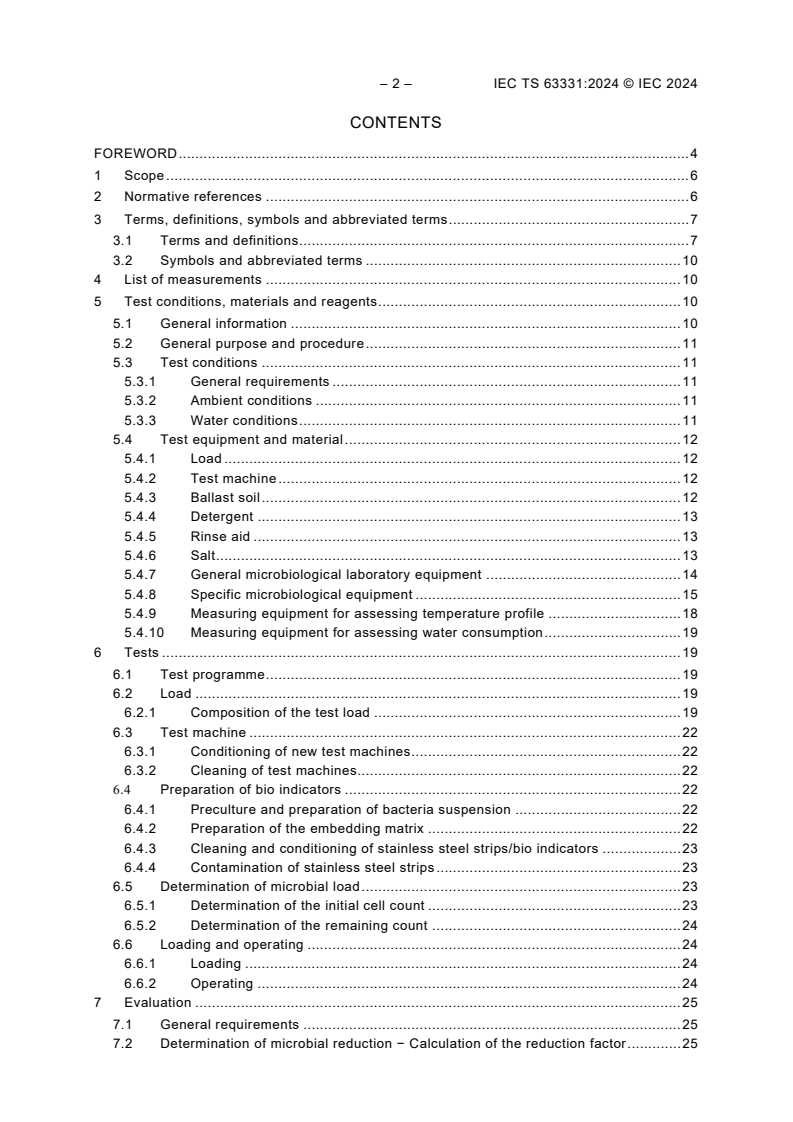
– 2 – IEC TS 63331:2024 © IEC 2024
CONTENTS
FOREWORD . 4
1 Scope . 6
2 Normative references . 6
3 Terms, definitions, symbols and abbreviated terms . 7
3.1 Terms and definitions . 7
3.2 Symbols and abbreviated terms . 10
4 List of measurements . 10
5 Test conditions, materials and reagents . 10
5.1 General information . 10
5.2 General purpose and procedure . 11
5.3 Test conditions . 11
5.3.1 General requirements . 11
5.3.2 Ambient conditions . 11
5.3.3 Water conditions . 11
5.4 Test equipment and material . 12
5.4.1 Load . 12
5.4.2 Test machine . 12
5.4.3 Ballast soil . 12
5.4.4 Detergent . 13
5.4.5 Rinse aid . 13
5.4.6 Salt . 13
5.4.7 General microbiological laboratory equipment . 14
5.4.8 Specific microbiological equipment . 15
5.4.9 Measuring equipment for assessing temperature profile . 18
5.4.10 Measuring equipment for assessing water consumption . 19
6 Tests . 19
6.1 Test programme . 19
6.2 Load . 19
6.2.1 Composition of the test load . 19
6.3 Test machine . 22
6.3.1 Conditioning of new test machines . 22
6.3.2 Cleaning of test machines . 22
6.4 Preparation of bio indicators . 22
6.4.1 Preculture and preparation of bacteria suspension . 22
6.4.2 Preparation of the embedding matrix . 22
6.4.3 Cleaning and conditioning of stainless steel strips/bio indicators . 23
6.4.4 Contamination of stainless steel strips . 23
6.5 Determination of microbial load . 23
6.5.1 Determination of the initial cell count . 23
6.5.2 Determination of the remaining count . 24
6.6 Loading and operating . 24
6.6.1 Loading . 24
6.6.2 Operating . 24
7 Evaluation . 25
7.1 General requirements . 25
7.2 Determination of microbial reduction − Calculation of the reduction factor . 25
7.3 Results . 25
7.3.1 Expression of results . 25
7.3.2 Evaluation of results . 25
8 Test report . 25
8.1 Documentation . 25
8.2 Data in the test report . 26
Annex A (informative) Prediction of microbial inactivation . 27
A.1 General information and purpose . 27
A.1.1 General information . 27
A.1.2 Purpose . 27
A.1.3 Background . 27
A.2 Calculation of MIE unit . 28
A.2.1 Requirements . 28
A.2.2 Calculation . 29
A.2.3 Results . 29
Annex B (informative) Test report . 30
Annex C (informative) Addresses of suppliers . 31
Bibliography . 32
Figure 1 – Stainless steel strip / Bio indicator . 17
Figure 2 – Holders for bio indicators . 18
Figure 3 – Exemplary loading scheme of rack containing bio indicators (13 place
settings) . 21
Table 1 – Recipe for production of ballast soil . 12
Table 2 – Composition of tryptic soy agar . 15
Table 3 – Composition of tryptic soy broth . 15
Table 4 – Composition of sodium chloride solution . 16
Table 5 – Composition of neutralisation solution . 16
Table 6 – Specifications for data sensor . 18
Table 7 – Specifications for measuring equipment for water consumption . 19
Table 8 – Quantity of bio indicators according to rated dishwasher capacity . 20
Table B.1 – Results of tests with bio indicators . 30
– 4 – IEC TS 63331:2024 © IEC 2024
INTERNATIONAL ELECTROTECHNICAL COMMISSION
____________
ELECTRIC DISHWASHERS FOR HOUSEHOLD USE –
METHODS FOR MEASURING THE MICROBIOLOGICAL
EFFICACY OF THE DISHWASHING PROCESS
FOREWORD
1) The International Electrotechnical Commission (IEC) is a worldwide organization for standardization comprising
all national electrotechnical committees (IEC National Committees). The object of IEC is to promote international
co-operation on all questions concerning standardization in the electrical and electronic fields. To this end and
in addition to other activities, IEC publishes International Standards, Technical Specifications, Technical Reports,
Publicly Available Specifications (PAS) and Guides (hereafter referred to as "IEC Publication(s)"). Their
preparation is entrusted to technical committees; any IEC National Committee interested in the subject dealt with
may participate in this preparatory work. International, governmental and non-governmental organizations liaising
with the IEC also participate in this preparation. IEC collaborates closely with the International Organization for
Standardization (ISO) in accordance with conditions determined by agreement between the two organizations.
2) The formal decisions or agreements of IEC on technical matters express, as nearly as possible, an international
consensus of opinion on the relevant subjects since each technical committee has representation from all
interested IEC National Committees.
3) IEC Publications have the form of recommendations for international use and are accepted by IEC National
Committees in that sense. While all reasonable efforts are made to ensure that the technical content of IEC
Publications is accurate, IEC cannot be held responsible for the way in which they are used or for any
misinterpretation by any end user.
4) In order to promote international uniformity, IEC National Committees undertake to apply IEC Publications
transparently to the maximum extent possible in their national and regional publications. Any divergence between
any IEC Publication and the corresponding national or regional publication shall be clearly indicated in the latter.
5) IEC itself does not provide any attestation of conformity. Independent certification bodies provide conformity
assessment services and, in some areas, access to IEC marks of conformity. IEC is not responsible for any
services carried out by independent certification bodies.
6) All users should ensure that they have the latest edition of this publication.
7) No liability shall attach to IEC or its directors, employees, servants or agents including individual experts and
members of its technical committees and IEC National Committees for any personal injury, property damage or
other damage of any nature whatsoever, whether direct or indirect, or for costs (including legal fees) and
expenses arising out of the publication, use of, or reliance upon, this IEC Publication or any other IEC
Publications.
8) Attention is drawn to the Normative references cited in this publication. Use of the referenced publications is
indispensable for the correct application of this publication.
9) IEC draws attention to the possibility that the implementation of this document may involve the use of (a)
patent(s). IEC takes no position concerning the evidence, validity or applicability of any claimed patent rights in
respect thereof. As of the date of publication of this document, IEC had not received notice of (a) patent(s), which
may be required to implement this document. However, implementers are cautioned that this may not represent
the latest information, which may be obtained from the patent database available at https://patents.iec.ch. IEC
shall not be held responsible for identifying any or all such patent rights.
IEC TS 63331 has been prepared by subcommittee 59A: Electric dishwashers, of IEC technical
committee 59: Performance of household electrical appliances. It is a Technical Specification.
The text of this Technical Specification is based on the following documents:
Draft Report on voting
59A/262/DTS 59A/267/RVDTS
Full information on the voting for its approval can be found in the report on voting indicated in
the above table.
The language used for the development of this Technical Specification is English.
This document was drafted in accordance with ISO/IEC Directives, Part 2, and developed in
accordance with ISO/IEC Directives, Part 1 and ISO/IEC Directives, IEC Supplement, available
at www.iec.ch/members_experts/refdocs. The main document types developed by IEC are
described in greater detail at www.iec.ch/publications.
Words in bold in the text are defined in Clause 3.
The committee has decided that the contents of this document will remain unchanged until the
stability date indicated on the IEC website under webstore.iec.ch in the data related to the
specific document. At this date, the document will be
• reconfirmed,
• withdrawn, or
• revised.
IMPORTANT – The "colour inside" logo on the cover page of this document indicates
that it contains colours which are considered to be useful for the correct understanding
of its contents. Users should therefore print this document using a colour printer.
– 6 – IEC TS 63331:2024 © IEC 2024
ELECTRIC DISHWASHERS FOR HOUSEHOLD USE –
METHODS FOR MEASURING THE MICROBIOLOGICAL
EFFICACY OF THE DISHWASHING PROCESS
1 Scope
This document applies to electric dishwashers for household and similar use that are supplied
with hot and/or cold water.
This document deals with measurement procedures regarding the reduction of microbial
contamination resulting from the use of electric dishwashers for household and similar use.
This document specifies methods that enable reproducible measurements. These derived
measurement results can only be used for a relative statement. Absolute statements, i.e. health-
related claims or conclusions about prevention or treatment of a disease or health improvement,
are reserved for explicit regulatory action after a medical assessment.
This document does not apply to appliances intended to be used in medical, veterinary, or
pharmaceutical applications.
This document does not address sanitization, disinfection or sterilization measures.
The dishwashing process is a complex operation consisting of cleaning dish items and cleaning
the dishwasher itself. This document only focusses on the dish items to be cleaned.
2 Normative references
The following documents are referred to in the text in such a way that some or all of their content
constitutes requirements of this document. For dated references, only the edition cited applies.
For undated references, the latest edition of the referenced document (including any
amendments) applies.
IEC 60436:2015, Electric dishwashers for household use – Methods for measuring the
performance
IEC 60436:2015/AMD1:2020
ISO 607:1980, Surface active agents and detergents – Methods of sample division
ISO 15883-1:2006, Washer-disinfectors – Part 1: General requirements, terms and definitions
and tests
ISO/TS 15883-5:2005 , Washer-disinfectors – Part 5: Test soils and methods for demonstrating
cleaning efficacy
ISO 19458:2006, Water quality – Sampling for microbiological analysis
NSF/ANSI 184-2019, Residential Dishwashers
___________
A consolidated version of this document exists, comprising IEC 60436:2015 and IEC 60436:2015/AMD1:2020.
This standard has been revised by ISO 15883-5:2021 but the listed edition applies.
EN 10088-1:2014 , Stainless steels – Part 1: List of stainless steels
3 Terms, definitions, symbols and abbreviated terms
3.1 Terms and definitions
For the purposes of this document, the following terms and definitions apply.
ISO and IEC maintain terminology databases for use in standardization at the following
addresses:
• IEC Electropedia: available at https://www.electropedia.org/
• ISO Online browsing platform: available at https://www.iso.org/obp
3.1.1
dishwasher
machine that cleans, rinses and dries tableware by chemical, mechanical, thermal and electric
means
[SOURCE: IEC 60436:2015, 3.1.1, modified – The notes to entry have been omitted.]
3.1.2
microbiological efficacy
antimicrobial action created by the properties of the appliance
3.1.3
test machine
dishwasher under test
[SOURCE: IEC 60436:2015, 3.1.5]
3.1.4
test run
single cycle performance assessment of a selected test programme
3.1.5
test series
set of test runs which are collectively used to assess the performance
[SOURCE: IEC 60436:2015, 3.1.8]
3.1.6
tableware
dishware, glassware, cutlery and serving pieces used according to this standard to test a
dishwasher
[SOURCE: IEC 60436:2015, 3.1.9]
3.1.7
operation
each event that occurs during the dishwasher programme such as cleaning, rinsing or drying
[SOURCE: IEC 60436:2015, 3.1.13]
___________
Withdrawn.
– 8 – IEC TS 63331:2024 © IEC 2024
3.1.8
programme
series of operations which are pre-defined within the dishwasher and which are declared as
suitable for specified levels of soil and/or type of load
Note 1 to entry: Usually, an end of programme indicator signals the end of the programme and the user has access
to the load.
[SOURCE: IEC 60436:2015, 3.1.14 and IEC 60436:2015/AMD1:2020, 3.1.14]
3.1.9
automatic dispenser
device activated automatically which injects or dispenses detergent or rinse aid, one or more
times into the dishwasher at predetermined points in the dishwasher programme
[SOURCE: IEC 60436:2015, 3.1.18]
3.1.10
water softener
device which reduces the hardness of water
[SOURCE: IEC 60436:2015, 3.1.20]
3.1.11
rack
support for holding dishware, cutlery, and/or glassware in the dishwasher
[SOURCE: IEC 60436:2015, 3.1.22]
3.1.12
place setting
set of tableware for the use by one person, not including serving pieces
Note 1 to entry: A place setting is comprised of different items used for breakfast and lunch (type A); and dessert
and dinner (type B). For details, see IEC 60436:2015 and IEC 60436:2015/AMD1:2020.
[SOURCE: IEC 60436:2015, 3.1.10, modified – Note 1 to entry has been modified to add
reference to IEC 60436.]
3.1.13
serving pieces
set of items for preparation and serving of food which can include pots, serving bowls, serving
cutlery and a platter
[SOURCE: IEC 60436:2015, 3.1.11]
3.1.14
rated dishwasher capacity
whole number of place settings together with the serving pieces which can be cleaned and
dried in one cycle when loaded in accordance with the manufacturer's instructions
Note 1 to entry: The rated dishwasher capacity is declared by the manufacturer and expressed as a number of
place settings.
[SOURCE: IEC 60436:2015, 3.1.12]
3.1.15
detergent
cleaning agent for use in dishwashers to aid in the removal of food soils by chemical means
Note 1 to entry: A reference detergent in powder form is specified for use in IEC 60436:2015, 5.7.
[SOURCE: IEC 60436:2015, 3.1.23, modified – Note 1 to entry has been modified to clarify the
reference to IEC 60436.]
3.1.16
rinse aid
chemical agent added to the water in the last rinsing operation to improve the drying effect and
reduce water marks
Note 1 to entry: A reference rinse aid is specified for use in 60436:2015, 5.8.
[SOURCE: IEC 60436:2015, 3.1.24, modified – Note 1 to entry has been modified to clarify the
reference to IEC 60436.]
3.1.17
refrigerated
storage of foods at a temperature of (4 ± 3) °C
[SOURCE: IEC 60436:2015, 3.1.32]
3.1.18
freeze
storage of foods at a temperature of (−18 ± 3) °C
[SOURCE: IEC 60436:2015, 3.1.33]
3.1.19
filter
device in the sump of the dishwasher to separate soils out of the dishwashing solution
3.1.20
temperature profile
temperature data collected in the dishwasher over the duration of the programme
3.1.21
demineralized water
water that has been depleted of the salt content by reverse osmosis or ion exchange processes
Note 1 to entry: E.g. by ion exchange or reverse osmosis processes.
3.1.22
bio indicator
standardized test object which has been contaminated with an embedding matrix and test
bacteria and is used for checking the microbial efficacy of dishwashers
3.1.23
stainless steel strips
standardized test object which is intended to be contaminated with an embedding matrix and
test bacteria
– 10 – IEC TS 63331:2024 © IEC 2024
3.2 Symbols and abbreviated terms
CFU colony forming unit
N average value of microorganism amount of the three positive controls, before
dishwashing (CFU/bio indicator)
N average value of microorganism amount per x bio indicators, after dishwashing
(CFU/bio indicator)
RF reduction factor
-1
v microorganism amount in a 10 times diluted solution
-x x
v microorganism amount in a 10 times diluted solution
s standard deviation of N
N 0
s standard deviation of N
N
4 List of measurements
This document describes test methods for the measurement of the following parameters:
a) capability to reduce microorganisms in a dishwashing process,
b) microbial inactivation equivalent unit as a simplified method for assessing the reduction of
microorganisms under well-defined conditions without performing microbiological tests.
WARNING:
The tests given in this document shall be performed by expert staff trained to handle
microorganism-related techniques and in properly equipped laboratories under the supervision
of a skilled microbiologist. Some of the test micro-organisms can be facultative pathogens for
humans, animals and plants; their handling requires a laboratory of an appropriate biosafety
level. National and international safety procedures for working with infectious biomaterials exist
to prevent any contamination of laboratory staff, apparatus, the workplace or the environment.
This document does not purport to address all the safety aspects, if any, associated with its
use. It is the responsibility of the user to establish appropriate health and safety practices and
to ensure compliance with any national, regional or international regulatory conditions.
5 Test conditions, materials and reagents
5.1 General information
Each dishwashing process and the resulting hygienic condition of the dishes are determined by
the interaction of the following main factors:
a) Machine related parameter:
– temperature profile of the programme;
– contact time;
– mechanics;
– water quality and volume;
– treatment agents;
– rinsing;
– drying.
b) Procedure related parameter:
– type and quantity of the introduced soil as well as length of time for which and the
temperature at which they have been allowed to dry on the dishes;
– shape, surface characteristics, design, degree of soiling and quantity on the dishes;
– shape of the dishes and its loading;
NOTE Due to the interdependency of all the listed parameters, it is crucial to follow the prescribed procedure in the
following subclauses. To reach a high repeatability within one laboratory and a high reproducibility between different
laboratories, the conditions need to be as similar as possible.
5.2 General purpose and procedure
The purpose of this test is to measure the reduction of the microbial load of bio indicators
achieved by a selected dishwasher programme.
The tests are carried out under conditions described in 5.3. The test machine shall be prepared
according to 5.4 using a load specified in 5.4.1. The ballast soil to be used during the test is
described in 5.4.3. The bio indicators shall be prepared according to 6.4. The loading and
operation of the dishwasher is specified in 6.6 and the evaluation is specified in Clause 7.
5.3 Test conditions
5.3.1 General requirements
For all requirements regarding electricity supply, see IEC 60436:2015. Deviations shall be
reported in the test report.
5.3.2 Ambient conditions
It is recommended to run the test machine in a controlled climate ((23 ± 2) °C ambient
temperature and (55 ± 5) % ambient relative humidity) and to record and report the ambient
conditions.
For the soiling and preparation of the stainless steel strips, similar conditions to the ones
mentioned above are recommended.
For the drying of the bio indicators, the conditions are described under 6.4.4.
5.3.3 Water conditions
5.3.3.1 Water quality
The inlet water should contain less than 100 CFU/mL at 30 °C. Microorganisms for test
purposes as listed in 5.4.8.1 shall not be present in the water. Water sampling shall be done
according to ISO 19458 as outlined for the assessment of water quality in the main distributor.
The water shall be sampled close to the connecting valve of the dishwasher. Aerator and O-
rings of the sampling point shall be removed and the water tap disinfected. Water tap shall be
rinsed until water temperature is constant before sampling.
5.3.3.2 Water temperature
For the tests cold water as described in IEC 60436:2015, IEC 60436:2015, 5.6.2 is
recommended. Deviations shall be reported in the test report.
5.3.3.3 Water quantity
For a valid test run, the amount of water in three test runs should not exceed a standard
deviation of 5 %. In this calculation, intermittently recurring functions according to
IEC 60436:2015 are excluded.
– 12 – IEC TS 63331:2024 © IEC 2024
5.4 Test equipment and material
5.4.1 Load
The load shall consist of the maximal number of place settings as specified by the
manufacturer. It is defined in IEC 60436:2015.
The load shall be clean and without imperfection. Dish items shall not be soiled, the ballast soil
will be added separately (see 5.4.3).
The composition of test load is described in 6.2.
5.4.2 Test machine
The dishwasher manufacturer's instructions regarding installation and use of the dishwasher
shall be followed.
Manufacturers should provide sufficient information on relevant test conditions for the test
machine, including installation instructions, detergent amounts, rinse aid settings, water
softener settings (if applicable), filter type, and loading schemes.
5.4.3 Ballast soil
To simulate the total soil burden of a fully loaded dishwasher according to IEC 60436, one
portion of frozen ballast soil (100 g for a dishwasher ≥ 10 place settings and 60 g for < 10
place settings) is added to the dishwasher load. The ingredients are milk, minced meat, egg,
oat flakes, spinach, and margarine according to IEC 60436.
The recipe for a 10 kg ballast soil is specified in Table 1.
Table 1 – Recipe for production of ballast soil
Ingredient Mass
g
Porridge 2 940
Oat flakes 141
Milk 700
Water 2 100
Margarine 840
Minced spinach 2 870
Minced meat 1 540
mixture
Minced beef 1 155
Whole egg 385
(pasteurised)
Egg yolk 1 960
(pasteurised)
Sum 10 150
~𝑆𝑆um (after ~10 000
evaporation of water
during cooking)
The preparation steps of the ballast soil are as follows:
a) Mix oat flakes with water and milk. Prepare porridge by bringing the mixture to the boiling
point.
b) Add the minced meat mixture and minced spinach and allow to simmer for 10 min.
c) Turn off the heat and add the margarine stirring well.
d) Add the pasteurized egg yolk when the complete mixture is cooled down to a temperature
of about 40 °C and stir well.
e) If total mass is less than 10 kg, add water.
f) Fill appropriate portions in containers and freeze it at −18 °C.
The frozen ballast soil is placed under a cup/mug/glass in the front area of the rack.
5.4.4 Detergent
5.4.4.1 General
The detergent to be used is IEC reference detergent D according to IEC 60436:2015.
The detergent shall be stored in a waterproof container in quantities of no more than 1 kg in a
cool and dry atmosphere. It shall be used within six months after production. Before use, the
detergent shall be homogenized in accordance with ISO 607.
Alternative detergents may be used for a specific test aim. Type and name of the detergent,
recipe (if available) and dosage shall be listed in the test report.
5.4.4.2 Dosage in test run
The quantity of detergent for one test run shall be 8 g + 1 g per place setting. The quantity
of detergent used during the tests shall be reported.
The detergent shall be placed in the dishwasher immediately prior to starting the test run in
the locations specified by the manufacturer. If a dispenser is fitted, some or all of the detergent
dose shall be placed in it according to the manufacturer's instructions. The dispenser shall be
clean and dry prior to the placement of detergent. In the absence of manufacturer's
recommendations, the detergent shall be placed in the main compartment of the dispenser.
Alternative dosages may be used for a specific test aim. The dosage shall be listed in the test
report.
5.4.5 Rinse aid
The rinse aid Formula "III" according to IEC 60436 shall be used.
For dishwashers with an adjustable automatic dispenser, the setting shall be as
recommended by the manufacturer. In the absence of such an indication, the setting shall be
used which gives the lowest quantity of rinse aid. Any requirement or recommendation to
experiment with the setting by the laboratory shall be ignored. For machines without automatic
dispensers, the rinse aid shall be added manually, if so recommended by the manufacturer
and in accordance with their instructions.
NOTE Details of a supplier of suitable test materials like detergent or rinse aid are given in Annex C.
5.4.6 Salt
If the dishwasher is equipped with a water softener that requires salt, fill the salt reservoir in
accordance with the manufacturer's instructions. The salt shall have a purity of > 99,4 % NaCl
and insoluble components < 0,05 %.
– 14 – IEC TS 63331:2024 © IEC 2024
For dishwashers with an adjustable water softener, the setting shall be as recommended by
the manufacturer for the water hardness used for the test. Where there is no recommendation,
use the lowest setting.
5.4.7 General microbiological laboratory equipment
5.4.7.1 General
Test conditions, materials, equipment and instrumentation shall be handled in compliance with
good laboratory and microbiology practice.
5.4.7.2 Incubator
The incubator shall be capable of maintaining a constant temperature of 30 ± 1 °C for
incubations performed during a test and its control and validation.
5.4.7.3 Autoclave
The autoclave shall be capable of sterilizing equipment and supplies by subjecting them to
+3 +3
saturated steam at 121 °C for at least 15 minutes or at 134 °C for at least 5 minutes.
−0 −0
5.4.7.4 Test tubes
Test tubes for the extraction of microorganisms from the bio indicators shall have dimensions
of approximately 160 mm (length) × 16 mm (diameter).
5.4.7.5 Pipettes
Pipettes shall have an adequate nominal volume of 0,1 to 10,0 mL.
5.4.7.6 Electromechanical agitator
A commonly used agitator is the Vortex® mixer.
5.4.7.7 Centrifuge, centrifuge tube
The centrifuge shall be capable of maintaining and be used at a relative centrifugal force of
4 500 g to 5 000 g with 50 mL centrifuge tubes (sterile).
5.4.7.8 Ultrasonic bath
The ultrasonic bath shall have an adequate size for stainless steel strips/bio indicators and
an operating time of three minutes shall be adjustable.
5.4.7.9 Tilt/roller mixer
The tilt/roller mixer shall be capable of maintaining a controlled speed of 80 r/min. It shall be
adequate to extract at least four test tubes simultaneously.
5.4.7.10 PH-meter
The pH-meter should have an inaccuracy of calibration of no more than ± 0,1 pH units
(at 20 °C ± 1 °C).
___________
Vortex® is an example of a suitable product available commercially. This information is given for the convenience
of users of this document and does not constitute an endorsement by IEC of this product.
5.4.7.11 Glass beads
Sterile glass beads for extraction shall have a diameter of 3 mm.
5.4.8 Specific microbiological equipment
5.4.8.1 Test strain
For the test purpose, the following non-pathogenic microorganism shall be used:
Micrococcus luteus ATCC 10240 (DSM 1790)
Additional microorganisms may be used, if proven to deliver differentiating results.
NOTE ATCC = American Type Culture Collection; DSM = Deutsche Sammlung von Mikroorganismen (German
Collection of Microorganisms).
5.4.8.2 Culture media and solutions
5.4.8.2.1 Culture media
All media and solutions shall be of microbiology grade and sterilized appropriately prior to use.
It is recommended to use commercially available and/or water free dry materials for the culture
media.
5.4.8.2.2 Tryptic soy agar (TSA)
The composition of tryptic soy agar (TSA) shall be according to Table 2.
Table 2 – Composition of tryptic soy agar
Description Specification
Casein peptone (pancreatic digest) 15,0 g/L
Soy peptone (papaic digest) 5,0 g/L
Sodium chloride 5,0 g/L
Agar 15,0 g/L
Water (5.4.8.3) To 1,0 L
Final pH 7,3 ± 0,2
5.4.8.2.3 Tryptic soy broth (TSB)
The composition of tryptic soy broth (TSB) shall be according to Table 3.
Table 3 – Composition of tryptic soy broth
Description Specification
Tryptone, pancreatic digest of casein 17,0 g/L
Soy peptone, papaic digest of soybean meal 3,0 g/L
Sodium chloride (NaCl) 5,0 g/L
Dipotassium hygrogen phosphate (K HPO ) 2,5 g/L
2 4
Glucose 2,5 g/L
Water (5.4.8.3) To 1,0 L
Final pH 7,3 ± 0,2
– 16 – IEC TS 63331:2024 © IEC 2024
5.4.8.3 Water for culture media and solutions
Water may be bi-distilled or demineralized. However, the water shall be sterilised prior to use.
5.4.8.4 Diluting agent
As diluting agent for the dilution series physiological sodium chloride solution shall be used.
The composition is given in Table 4.
Table 4 – Composition of sodium chloride solution
Description Specification
Sodium chloride (NaCl) 9,0 g/L
Water (5.4.8.3) To 1,0 L
5.4.8.5 Neutralisation solution
For the retrieval of test microorganisms after a test run, neutralisation solution shall be used
in combination with TSB. The composition of a recommended neutralisation solution is given in
Table 5.
Table 5 – Composition of neutralisation solution
Description Specification
Tryptic soy broth As given in Table 3
"Polysorbate 80" (Tween 80) 30,0 g/L
Lecithin 3,0 g/L
L-Histidine 1,0 g/L
Sodium thiosulphate 5,0 g/L
Water (5.4.8.3) To 1,0 L
Other neutralisation solutions may be used. The neutralisation solution shall be validated for
the tests.
Sterilize the neutralisation solution after preparation. The solution can be kept in the refrigerator
for up to 2 months after sterilisation. Alternatively, the freshly prepared solution can be sterilized
in extraction tubes directly.
5.4.8.6 Embedding matrix
The used embedding matrix BAMS, a mixture of bovine albumin, mucin and maize starch, is
made up as follows:
– 0,6 % bovine albumin (mass fraction),
– 1,0 % mucin (mass fraction),
– 3,0 % maize starch (mass fraction).
For maize starch, use regular starch consisting of 20 % to 25 % amylose and 70 % to 80 %
amylopectin from natural cultivation (use as a filler and/or carrier in the pharmaceutical industry).
Maize starch shall be used. Refer to CAS 9005-25-8 for the purity and quality standards to be
used.
The preparation of BAMS is described in 6.4.2.
5.4.8.7 Stainless steel strips
The stainless steel strip (see Figure 1) is a test specimen which is made of stainless steel with
a surface ground to a specified grade, having one drill hole to the left and one to the right of
the contamination area for fastening to holders (see Figure 2). It is contaminated with an
inoculum of bacteria in an embedding matrix. The prepared bio indicator shall not be used for
more than 200 test runs.
Bio indicators shall not be used if there are scratches or other changes on the surface.
Austenitic steel, material no. 1.4301 as specified in EN 10088-1, thickness: 1 mm.
Surface: 80 grit longitudinally ground.
NOTE Austenitic steel, material no. 4301-304-00-1 as specified in ISO 15510 can be used as substitute, but the
longevity could be affected due to subtle differences.
Dimensions in millimetres
NOTE 1 Drawing reproduced from Brands et al. 2020 with permission of Britta Brands.
NOTE 2 Bio indicators are also described in EN 17735:2022.
Figure 1 – Stainless steel strip / Bio indicator
– 18 – IEC TS 63331:2024 © IEC 2024
NOTE Drawing reproduced from Brands et al. 2020 with permission of Britta Brands.
Figure 2 – Holders for bio indicators
5.4.9 Measuring equipment for assessing temperature profile
The temperature shall be measured by a temperature sensor placed in the sump of the
dishwasher. The temperature sensor shall comply with the specifications in Table 6 and shall
not influence the filter function when installed.
Table 6 – Specifications for data sensor
Description Specification
Temperature range 0 °C to 100 °C
Accuracy ≤ 0,5 °C over full range
Resolution ≤ 0,1 °C
Response time TC (10 – 90 %) water ≤ 2 min
Response time TC (10 – 90 %) moving air ≤ 5 min
Sampling rate ≤ 10 s
NOTE TC (10 – 90 %) is the time for the sensor to traverse between 10 % and 90 %
of its final value. Response time can also be expressed as TC 63 % value. The 63 %
figure is the time for the sensor to reach 63 % of its final value. TC (10 − 90 %) and
TC 63 % value are approximately of the same order of magnitude for a given sensor.
5.4.10 Measuring equipment for assessing water consumption
The volume of water inlet shall be measured in litres. Separate metering for hot and cold inlets,
where applicable.
Devices using viscosity should be calibrated at the actual nominal temperature ± 5 °C, and the
nominal flow rate.
The water consumption of each test cycle shall be measured and the mean of a test series
shall be calculated including standard deviation.
The equipment for measuring the water consumption shall comply with the specifications in
Table 7.
Table 7 – Specifications for measuring equipment for water consumption
Description Specification
Accuracy ≤ ± 2 %
Resolution ≤ 0,1 L
6 Tests
6.1 Test programme
A certain test programme is not prescribed, but the selected test programme shall be reported.
NOTE Dishwashing programmes with main wash temperatures of higher than 60 °C will probably lead to a total
microbial reduction of the test strain on the bio indicators.
6.2 Load
6.2.1 Composition of the test load
6.2.1.1 General
The composition of the test load follows IEC 60436 except a reduced number of dinner plates,
to enable inclusion of the bio indicators. The number of dinner plates is calculated in the
following way. Use half of the number of declared place settings given as rated dishwasher
capacity or, if the declared number of place settings is an uneven number, then use half
+ 0,5. Each dinner plate is equipped with a holder and a bio indicator. The number of dinner
plates in use is given in Table 8.
If there is not enough space to position all the plates equipped with
...