

IEC 60300-3-11:2009
(Main)Dependability management - Part 3-11: Application guide - Reliability centred maintenance
General Information
- Abstract
IEC 60300-3-11:2009 provides guidelines for the development of failure management policies for equipment and structures using reliability centred maintenance (RCM) analysis techniques. This part serves as an application guide and is an extension of IEC 60300-3-10, IEC 60300-3-12 and IEC 60300-3-14. Maintenance activities recommended in all three standards, which relate to preventive maintenance, may be implemented using this standard. The previous edition was based on ATA1-MGS-3; whereas this edition applies to all industries and defines a revised RCM algorithm and approach to the analysis process.
- Status
- Published
- Publication Date
- 16-Jun-2009
- Technical Committee
- TC 56 - Dependability
- Current Stage
- PPUB - Publication issued
- Start Date
- 17-Jun-2009
- Completion Date
- 30-Jun-2009
Overview
IEC 60300-3-11:2009, published by the International Electrotechnical Commission (IEC), provides global guidelines for developing failure management policies through the application of reliability centred maintenance (RCM) analysis. As part of IEC’s dependability management standards, IEC 60300-3-11 serves as a comprehensive application guide for RCM, which is a systematic methodology used to identify the most effective maintenance strategies to maximize safety, availability, and optimize costs for equipment and structures in all industries.
RCM enables organizations to analyze failure modes, evaluate consequences, and select appropriate maintenance actions-enhancing both preventive and corrective maintenance frameworks. This standard extends the guidance of IEC 60300-3-10, IEC 60300-3-12, and IEC 60300-3-14, providing greater applicability and a refined RCM approach suitable for a wide range of industries beyond its origins in aviation.
Key Topics
- RCM Process Phases: Outlines structured steps, including initiation and planning, functional failure analysis, task selection, implementation, and continuous improvement.
- Functional Failure Analysis: Provides methodologies to identify system functions, failure modes, effects, and their criticality.
- Maintenance Task Selection: Guides the process for choosing effective maintenance policies based on the consequences of identified failures.
- Preventive and Corrective Maintenance: Describes frameworks for both proactive (condition-based, scheduled) and reactive ('run-to-failure', deferred repairs) maintenance.
- Continuous Improvement: Emphasizes monitoring, feedback, and regular reassessment to refine maintenance programs over time.
- Criticality and Risk Assessment: Discusses how to assess the severity and risk of failures to determine maintenance priorities.
- Applicability Across Industries: The RCM algorithm and process are designed to be industry-agnostic, suitable for assets such as power plants, vehicles, industrial systems, and infrastructure.
- Integration with Existing Standards: Acts as an extension of related IEC standards and aligns with other international dependability and maintenance management practices.
Applications
The practical value of IEC 60300-3-11:2009 lies in its broad applicability to reliability engineering and operational dependability across sectors. Organizations implementing the standard can expect:
- Optimized Maintenance Programs: Improved selection of maintenance tasks tailored to the operational context, reducing unnecessary interventions and costs.
- Enhanced Safety and Compliance: Structured process ensures critical functions are maintained, reducing risk to personnel and the environment.
- Cost Efficiency: Focuses resources on interventions with the greatest impact, minimizing total life cycle costs and unexpected failures.
- Improved Asset Dependability: Prolongs useful life of assets by addressing functional degradation early and documenting failure management strategies.
- Documentation and Traceability: Provides a comprehensive audit trail of maintenance decisions and policy revisions, supporting accountability and regulatory compliance.
- Informed Decision-Making: Enables data-driven improvements, offering feedback for design improvements and strategic maintenance planning.
Typical users include maintenance managers, reliability engineers, asset managers, and organizations responsible for complex systems in sectors like manufacturing, transportation, energy, and infrastructure management.
Related Standards
- IEC 60300-3-10: Dependability management – Application guide – Maintainability
Offers guidance on maintainability for systems, supporting complementary activities to RCM. - IEC 60300-3-12: Application guide – Integrated logistic support
Provides strategies for integrated maintenance support, aligning logistics with RCM findings. - IEC 60300-3-14: Application guide – Maintenance and maintenance support
Supports the development of maintenance support systems and strategies. - IEC 60812: Analysis techniques for system reliability – Procedure for failure mode and effects analysis (FMEA)
Supplies methodologies for detailed failure analysis, feeding data into the RCM process. - IEC 60050-191: International Electrotechnical Vocabulary – Dependability and quality of service
Defines essential terms, ensuring consistency in application and interpretation of dependability standards.
By following IEC 60300-3-11:2009, organizations ensure best practices in reliability centred maintenance, drive continuous operational improvement, and align with internationally recognized dependability management frameworks.
Relations
- Effective Date
- 05-Sep-2023
Get Certified
Connect with accredited certification bodies for this standard

BSI Group
BSI (British Standards Institution) is the business standards company that helps organizations make excellence a habit.

Bureau Veritas
Bureau Veritas is a world leader in laboratory testing, inspection and certification services.

DNV
DNV is an independent assurance and risk management provider.
Sponsored listings
Frequently Asked Questions
IEC 60300-3-11:2009 is a standard published by the International Electrotechnical Commission (IEC). Its full title is "Dependability management - Part 3-11: Application guide - Reliability centred maintenance". This standard covers: IEC 60300-3-11:2009 provides guidelines for the development of failure management policies for equipment and structures using reliability centred maintenance (RCM) analysis techniques. This part serves as an application guide and is an extension of IEC 60300-3-10, IEC 60300-3-12 and IEC 60300-3-14. Maintenance activities recommended in all three standards, which relate to preventive maintenance, may be implemented using this standard. The previous edition was based on ATA1-MGS-3; whereas this edition applies to all industries and defines a revised RCM algorithm and approach to the analysis process.
IEC 60300-3-11:2009 provides guidelines for the development of failure management policies for equipment and structures using reliability centred maintenance (RCM) analysis techniques. This part serves as an application guide and is an extension of IEC 60300-3-10, IEC 60300-3-12 and IEC 60300-3-14. Maintenance activities recommended in all three standards, which relate to preventive maintenance, may be implemented using this standard. The previous edition was based on ATA1-MGS-3; whereas this edition applies to all industries and defines a revised RCM algorithm and approach to the analysis process.
IEC 60300-3-11:2009 is classified under the following ICS (International Classification for Standards) categories: 01 - GENERALITIES. TERMINOLOGY. STANDARDIZATION. DOCUMENTATION; 03.100.40 - Research and development; 03.120.01 - Quality in general. The ICS classification helps identify the subject area and facilitates finding related standards.
IEC 60300-3-11:2009 has the following relationships with other standards: It is inter standard links to IEC 60300-3-11:1999. Understanding these relationships helps ensure you are using the most current and applicable version of the standard.
IEC 60300-3-11:2009 is available in PDF format for immediate download after purchase. The document can be added to your cart and obtained through the secure checkout process. Digital delivery ensures instant access to the complete standard document.
Standards Content (Sample)
IEC 60300-3-11 ®
Edition 2.0 2009-06
INTERNATIONAL
STANDARD
NORME
INTERNATIONALE
Dependability management –
Part 3-11: Application guide – Reliability centred maintenance
Gestion de la sûreté de fonctionnement –
Partie 3-11: Guide d'application – Maintenance basée sur la fiabilité
All rights reserved. Unless otherwise specified, no part of this publication may be reproduced or utilized in any form or by
any means, electronic or mechanical, including photocopying and microfilm, without permission in writing from either IEC or
IEC's member National Committee in the country of the requester.
If you have any questions about IEC copyright or have an enquiry about obtaining additional rights to this publication,
please contact the address below or your local IEC member National Committee for further information.
Droits de reproduction réservés. Sauf indication contraire, aucune partie de cette publication ne peut être reproduite
ni utilisée sous quelque forme que ce soit et par aucun procédé, électronique ou mécanique, y compris la photocopie
et les microfilms, sans l'accord écrit de la CEI ou du Comité national de la CEI du pays du demandeur.
Si vous avez des questions sur le copyright de la CEI ou si vous désirez obtenir des droits supplémentaires sur cette
publication, utilisez les coordonnées ci-après ou contactez le Comité national de la CEI de votre pays de résidence.
IEC Central Office
3, rue de Varembé
CH-1211 Geneva 20
Switzerland
Email: inmail@iec.ch
Web: www.iec.ch
About the IEC
The International Electrotechnical Commission (IEC) is the leading global organization that prepares and publishes
International Standards for all electrical, electronic and related technologies.
About IEC publications
The technical content of IEC publications is kept under constant review by the IEC. Please make sure that you have the
latest edition, a corrigenda or an amendment might have been published.
ƒ Catalogue of IEC publications: www.iec.ch/searchpub
The IEC on-line Catalogue enables you to search by a variety of criteria (reference number, text, technical committee,…).
It also gives information on projects, withdrawn and replaced publications.
ƒ IEC Just Published: www.iec.ch/online_news/justpub
Stay up to date on all new IEC publications. Just Published details twice a month all new publications released. Available
on-line and also by email.
ƒ Electropedia: www.electropedia.org
The world's leading online dictionary of electronic and electrical terms containing more than 20 000 terms and definitions
in English and French, with equivalent terms in additional languages. Also known as the International Electrotechnical
Vocabulary online.
ƒ Customer Service Centre: www.iec.ch/webstore/custserv
If you wish to give us your feedback on this publication or need further assistance, please visit the Customer Service
Centre FAQ or contact us:
Email: csc@iec.ch
Tel.: +41 22 919 02 11
Fax: +41 22 919 03 00
A propos de la CEI
La Commission Electrotechnique Internationale (CEI) est la première organisation mondiale qui élabore et publie des
normes internationales pour tout ce qui a trait à l'électricité, à l'électronique et aux technologies apparentées.
A propos des publications CEI
Le contenu technique des publications de la CEI est constamment revu. Veuillez vous assurer que vous possédez
l’édition la plus récente, un corrigendum ou amendement peut avoir été publié.
ƒ Catalogue des publications de la CEI: www.iec.ch/searchpub/cur_fut-f.htm
Le Catalogue en-ligne de la CEI vous permet d’effectuer des recherches en utilisant différents critères (numéro de référence,
texte, comité d’études,…). Il donne aussi des informations sur les projets et les publications retirées ou remplacées.
ƒ Just Published CEI: www.iec.ch/online_news/justpub
Restez informé sur les nouvelles publications de la CEI. Just Published détaille deux fois par mois les nouvelles
publications parues. Disponible en-ligne et aussi par email.
ƒ Electropedia: www.electropedia.org
Le premier dictionnaire en ligne au monde de termes électroniques et électriques. Il contient plus de 20 000 termes et
définitions en anglais et en français, ainsi que les termes équivalents dans les langues additionnelles. Egalement appelé
Vocabulaire Electrotechnique International en ligne.
ƒ Service Clients: www.iec.ch/webstore/custserv/custserv_entry-f.htm
Si vous désirez nous donner des commentaires sur cette publication ou si vous avez des questions, visitez le FAQ du
Service clients ou contactez-nous:
Email: csc@iec.ch
Tél.: +41 22 919 02 11
Fax: +41 22 919 03 00
IEC 60300-3-11 ®
Edition 2.0 2009-06
INTERNATIONAL
STANDARD
NORME
INTERNATIONALE
Dependability management –
Part 3-11: Application guide – Reliability centred maintenance
Gestion de la sûreté de fonctionnement –
Partie 3-11: Guide d'application – Maintenance basée sur la fiabilité
INTERNATIONAL
ELECTROTECHNICAL
COMMISSION
COMMISSION
ELECTROTECHNIQUE
PRICE CODE
INTERNATIONALE
X
CODE PRIX
ICS 03.100.40; 03.120.01 ISBN 978-2-88910-098-9
– 2 – 60300-3-11 © IEC:2009
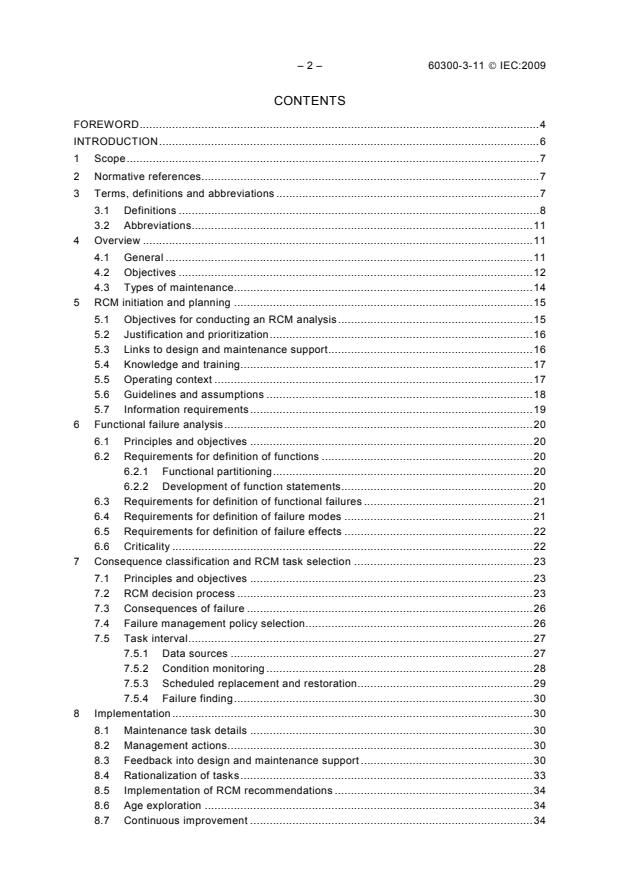
CONTENTS
FOREWORD.4
INTRODUCTION.6
1 Scope.7
2 Normative references.7
3 Terms, definitions and abbreviations .7
3.1 Definitions .8
3.2 Abbreviations.11
4 Overview .11
4.1 General .11
4.2 Objectives .12
4.3 Types of maintenance.14
5 RCM initiation and planning .15
5.1 Objectives for conducting an RCM analysis.15
5.2 Justification and prioritization.16
5.3 Links to design and maintenance support.16
5.4 Knowledge and training.17
5.5 Operating context .17
5.6 Guidelines and assumptions .18
5.7 Information requirements .19
6 Functional failure analysis.20
6.1 Principles and objectives .20
6.2 Requirements for definition of functions .20
6.2.1 Functional partitioning.20
6.2.2 Development of function statements.20
6.3 Requirements for definition of functional failures .21
6.4 Requirements for definition of failure modes .21
6.5 Requirements for definition of failure effects .22
6.6 Criticality .22
7 Consequence classification and RCM task selection .23
7.1 Principles and objectives .23
7.2 RCM decision process .23
7.3 Consequences of failure .26
7.4 Failure management policy selection.26
7.5 Task interval.27
7.5.1 Data sources .27
7.5.2 Condition monitoring .28
7.5.3 Scheduled replacement and restoration.29
7.5.4 Failure finding.30
8 Implementation .30
8.1 Maintenance task details .30
8.2 Management actions.30
8.3 Feedback into design and maintenance support .30
8.4 Rationalization of tasks.33
8.5 Implementation of RCM recommendations .34
8.6 Age exploration .34
8.7 Continuous improvement .34
60300-3-11 © IEC:2009 – 3 –
8.8 In-service feedback .35
Annex A (informative) Criticality analysis .37
Annex B (informative) Failure finding task intervals.40
Annex C (informative) Failure patterns .42
Annex D (informative) Application of RCM to structures .44
Bibliography .47
Figure 1 – Overview of the RCM process.12
Figure 2 – Evolution of an RCM maintenance programme.14
Figure 3 – Types of maintenance tasks .15
Figure 4 – Relationship between RCM and other support activities.17
Figure 5 – RCM decision diagram.25
Figure 6 – P-F Interval .28
Figure 7 – ILS management process and relationship with RCM analysis .32
Figure 8 – Risk versus cost considerations for rationalization of tasks .33
Figure 9 – RCM continuous improvement cycle.35
Figure C.1 – Dominant failure patterns .42
Table A.1 – Example of a criticality matrix .39
Table C.1 – Failure pattern categories and frequency of occurrence .43
– 4 – 60300-3-11 © IEC:2009
INTERNATIONAL ELECTROTECHNICAL COMMISSION
_____________
DEPENDABILITY MANAGEMENT –
Part 3-11: Application guide –
Reliability centred maintenance
FOREWORD
1) The International Electrotechnical Commission (IEC) is a worldwide organization for standardization comprising
all national electrotechnical committees (IEC National Committees). The object of IEC is to promote
international co-operation on all questions concerning standardization in the electrical and electronic fields. To
this end and in addition to other activities, IEC publishes International Standards, Technical Specifications,
Technical Reports, Publicly Available Specifications (PAS) and Guides (hereafter referred to as “IEC
Publication(s)”). Their preparation is entrusted to technical committees; any IEC National Committee interested
in the subject dealt with may participate in this preparatory work. International, governmental and non-
governmental organizations liaising with the IEC also participate in this preparation. IEC collaborates closely
with the International Organization for Standardization (ISO) in accordance with conditions determined by
agreement between the two organizations.
2) The formal decisions or agreements of IEC on technical matters express, as nearly as possible, an international
consensus of opinion on the relevant subjects since each technical committee has representation from all
interested IEC National Committees.
3) IEC Publications have the form of recommendations for international use and are accepted by IEC National
Committees in that sense. While all reasonable efforts are made to ensure that the technical content of IEC
Publications is accurate, IEC cannot be held responsible for the way in which they are used or for any
misinterpretation by any end user.
4) In order to promote international uniformity, IEC National Committees undertake to apply IEC Publications
transparently to the maximum extent possible in their national and regional publications. Any divergence
between any IEC Publication and the corresponding national or regional publication shall be clearly indicated in
the latter.
5) IEC provides no marking procedure to indicate its approval and cannot be rendered responsible for any
equipment declared to be in conformity with an IEC Publication.
6) All users should ensure that they have the latest edition of this publication.
7) No liability shall attach to IEC or its directors, employees, servants or agents including individual experts and
members of its technical committees and IEC National Committees for any personal injury, property damage or
other damage of any nature whatsoever, whether direct or indirect, or for costs (including legal fees) and
expenses arising out of the publication, use of, or reliance upon, this IEC Publication or any other IEC
Publications.
8) Attention is drawn to the Normative references cited in this publication. Use of the referenced publications is
indispensable for the correct application of this publication.
9) Attention is drawn to the possibility that some of the elements of this IEC Publication may be the subject of
patent rights. IEC shall not be held responsible for identifying any or all such patent rights.
International Standard IEC 60300-3-11 has been prepared by IEC technical committee 56:
Dependability.
This second edition cancels and replaces the first edition, published in 1999, and constitutes a
technical revision.
The previous edition was based on ATA -MGS-3; whereas this edition applies to all industries
and defines a revised RCM algorithm and approach to the analysis process.
___________
The Air Transport Association of America.
60300-3-11 © IEC:2009 – 5 –
The text of this standard is based on the following documents:
FDIS RVD
56/1312/FDIS 56/1320/RVD
Full information on the voting for the approval of this standard can be found in the report on
voting indicated in the above table.
A list of all parts in the IEC 60300 series, under the general title Dependability management
can be found on the IEC website.
The committee has decided that the contents of this publication will remain unchanged until the
maintenance result date indicated on the IEC web site under "http://webstore.iec.ch" in the data
related to the specific publication. At this date, the publication will be:
• reconfirmed,
• withdrawn,
• replaced by a revised edition, or
• amended.
– 6 – 60300-3-11 © IEC:2009
INTRODUCTION
Reliability centred maintenance (RCM) is a method to identify and select failure management
policies to efficiently and effectively achieve the required safety, availability and economy of
operation. Failure management policies can include maintenance activities, operational
changes, design modifications or other actions in order to mitigate the consequences of failure.
RCM was initially developed for the commercial aviation industry in the late 1960s, resulting in
the publication of ATA-MGS-3 [1] . RCM is now a proven and accepted methodology used in a
wide range of industries.
RCM provides a decision process to identify applicable and effective preventive maintenance
requirements, or management actions, for equipment in accordance with the safety,
operational and economic consequences of identifiable failures, and the degradation
mechanism responsible for those failures. The end result of working through the process is a
judgement as to the necessity of performing a maintenance task, design change or other
alternatives to effect improvements.
The basic steps of an RCM programme are as follows:
a) initiation and planning;
b) functional failure analysis;
c) task selection;
d) implementation;
e) continuous improvement.
All tasks are based on safety in respect of personnel and environment, and on operational or
economic concerns. However, it should be noted that the criteria considered will depend on the
nature of the product and its application. For example, a production process will be required to
be economically viable, and may be sensitive to strict environmental considerations, whereas
an item of defence equipment should be operationally successful, but may have less stringent
safety, economic and environmental criteria.
Maximum benefit can be obtained from an RCM analysis if it is conducted at the design stage,
so that feedback from the analysis can influence design. However, RCM is also worthwhile
during the operation and maintenance phase to improve existing maintenance tasks, make
necessary modifications or other alternatives.
Successful application of RCM requires a good understanding of the equipment and structure,
as well as the operational environment, operating context and the associated systems, together
with the possible failures and their consequences. Greatest benefit can be achieved through
targeting of the analysis to where failures would have serious safety, environmental, economic
or operational effects.
___________
Figures in square brackets refer to the bibliography.
60300-3-11 © IEC:2009 – 7 –
DEPENDABILITY MANAGEMENT –
Part 3-11: Application guide –
Reliability centred maintenance
1 Scope
This part of IEC 60300 provides guidelines for the development of failure management policies
for equipment and structures using reliability centred maintenance (RCM) analysis techniques.
This part serves as an application guide and is an extension of IEC 60300-3-10, IEC 60300-3-
12 and IEC 60300-3-14. Maintenance activities recommended in all three standards, which
relate to preventive maintenance, may be implemented using this standard.
The RCM method can be applied to items such as ground vehicles, ships, power plants,
aircraft, and other systems which are made up of equipment and structure, e.g. a building,
airframe or ship's hull. Typically, equipment comprises a number of electrical, mechanical,
instrumentation or control systems and subsystems which can be further broken down into
progressively smaller groupings, as required.
This standard is restricted to the application of RCM techniques and does not include aspects
of maintenance support, which are covered by the above-mentioned standards or other
dependability and safety standards.
2 Normative references
The following referenced documents are indispensable for the application of this document. For
dated references, only the edition cited applies. For undated references, the latest edition of
the referenced document (including any amendments) applies.
IEC 60050-191:1990, International Electrotechnical Vocabulary – Chapter 191: Dependability
and quality of service
IEC 60300-3-2, Dependability management – Part 3-2: Application guide – Collection of
dependability data from the field
IEC 60300-3-10, Dependability management – Part 3-10: Application guide – Maintainability
IEC 60300-3-12, Dependability management – Part 3-12: Application guide – Integrated logistic
support
IEC 60300-3-14, Dependability management – Part 3-14: Application guide – Maintenance and
maintenance support
IEC 60812, Analysis techniques for system reliability – Procedure for failure mode and effects
analysis (FMEA)
3 Terms, definitions and abbreviations
For the purposes of this document, the terms and definitions of IEC 60050-191 apply, together
with the following.
– 8 – 60300-3-11 © IEC:2009
3.1 Definitions
3.1.1
age exploration
systematic evaluation of an item based on analysis of collected information from in-service
experience to determine the optimum maintenance task interval
NOTE The evaluation assesses the item's resistance to a deterioration process with respect to increasing age or
usage.
3.1.2
criticality
severity of effect of a deviation from the specified function of an item, with respect to specified
evaluation criteria
NOTE 1 The extent of effects considered may be limited to the item itself, to the system of which it is a part, or
range beyond the system boundary.
NOTE 2 The deviation may be a fault, a failure, a degradation, an excess temperature, an excess pressure, etc.
NOTE 3 In some applications, the evaluation of criticality may include other factors such as the probability of
occurrence of the deviation, or the probability of detection.
3.1.3
damage-tolerant
capable of sustaining damage and continuing to function as required, possibly at reduced
loading or capacity
3.1.4
failure (of an item)
loss of ability to perform as required
3.1.5
failure effect
consequence of a failure mode on the operation, function or status of the item
3.1.6
failure management policy
maintenance activities, operational changes, design modifications or other actions in order to
mitigate the consequences of failure
3.1.7
function
intended purpose of an item as described by a required standard of performance
3.1.8
failure mode
manner in which failure occurs
NOTE A failure mode may be defined by the function lost or the state transition that occurred.
3.1.9
failure-finding task
scheduled inspection or specific test used to determine whether a specific hidden failure has
occurred
3.1.10
functional failure
reduction in function performance below desired level
60300-3-11 © IEC:2009 – 9 –
3.1.11
hidden failure mode
failure mode whose effects do not become apparent to the operator under normal
circumstances
3.1.12
indenture level
level of subdivision of an item from the point of view of a maintenance action
NOTE 1 Examples of indenture levels could be a subsystem, a circuit board, a component.
NOTE 2 The indenture level depends on the complexity of the item’s construction, the accessibility to subitems,
skill level of maintenance personnel, test equipment facilities, safety considerations, etc.
[IEV 191-07-05:1990]
3.1.13
inspection
identification and evaluation of the actual condition against a specification
3.1.14
maintenance action
maintenance task
sequence of elementary maintenance activities carried out for a given purpose
NOTE Examples include diagnosis, localization, function check-out, or combinations thereof.
3.1.15 tem
part, component, device, subsystem, functional unit, equipment or system that can be
individually considered
NOTE 1 An item may consist of hardware, software or both, and may also, in particular cases, include people.
Elements of a system may be natural or man-made material objects, as well as modes of thinking and the results
thereof (e.g. forms of organization, mathematical methods and programming languages).
NOTE 2 In French the term "entité" is preferred to the term "dispositif” due to its more general meaning. The term
"dispositif' is also the common equivalent for the English term "device".
NOTE 3 In French the term "individu" is used mainly in statistics.
NOTE 4 A group of items, e.g. a population of items or a sample, may itself be considered as an item.
NOTE 5 A software item may be a source code,an object code, a job control code, control data, or a collection of
these.
3.1.16
maintenance concept
interrelationship between the maintenance echelons, the indenture levels and the levels of
maintenance to be applied for the maintenance of an item
3.1.17
maintenance echelon
position in an organization where specified levels of maintenance are to be carried out on an
item
NOTE 1 Examples of maintenance echelons are: field, repair shop, and manufacturer.
NOTE 2 The maintenance echelon is characterized by the level of skill of the personnel, the facilities available,
the location, etc.
[IEV 191-07-04:1990]
– 10 – 60300-3-11 © IEC:2009
3.1.18
maintenance policy
general approach to the provision of maintenance and maintenance support based on the
objectives and policies of owners, users and customers
3.1.19
maintenance programme
list of all the maintenance tasks developed for a system for a given operating context and
maintenance concept
3.1.20
operating context
circumstances in which an item is expected to operate
3.1.21
potential failure
identifiable condition that indicates that a functional failure is either about to occur or is in the
process of occurring
3.1.22
potential failure – functional failure (P-F) interval
interval between the point at which a potential failure becomes detectable and the point at
which it degrades into a functional failure
3.1.23
reliability centred maintenance
method to identify and select failure management policies to efficiently and effectively achieve
the required safety, availability and economy of operation.
3.1.24
safe life
age before which no failures are expected to occur
3.1.25
system
set of interrelated or interacting elements
[ISO 9000, 3.2.1][2]
NOTE 1 In the context of dependability, a system will have:
a) a defined purpose expressed in terms of required functions;
b) stated conditions of operation/use;
c) defined boundaries.
NOTE 2 The structure of a system may be hierarchical.
3.1.26
useful life
time interval to a given instant when a limited state is reached
NOTE 1 Limited state may be a function of failure intensity, maintenance support requirement, physical condition,
age, obsolesence, etc.
NOTE 2 The time interval may start at first use, at a subsequent instant, i.e. remaining useful life.
60300-3-11 © IEC:2009 – 11 –
3.2 Abbreviations
FMEA Failure mode and effects analysis
FMECA Failure mode, effects and criticality analysis
ILS Integrated logistic support
HUMS Health usage management systems
LORA Level of repair analysis
NDI Non-destructive inspection
RCM Reliability centred maintenance
4 Overview
4.1 General
The RCM process is fully described in this standard and provides information on each of the
following elements:
a) RCM initiation and planning;
b) functional failure analysis;
c) task selection;
d) implementation;
e) on-going improvement.
Figure 1 shows the overall RCM process, divided into five steps. It can be seen from this figure
that RCM provides a comprehensive programme that addresses not just the analysis process
but also the preliminary and follow-on activities necessary to ensure that the RCM effort
achieves the desired results. The RCM process can be applied to all types of systems. Annex
D provides guidance on how the process should be interpreted for structures for which the
failure mechanisms and resultant tasks are more narrowly defined.
– 12 – 60300-3-11 © IEC:2009
1. INITIATION AND PLANNING
a) Determine the boundaries and objectives
of the analysis
OUTPUTS
b) Determine the content of the analysis
c) Identify the specialist knowledge and experience
available, responsibilities, the need for outside Analysis plan and
expertise and any training requirements operating context
d) Develop operating context for the item(s)
2. FUNCTIONAL FAILURE ANALYSIS
a) Collect and analyse any field data
and available test data
b) Perform functional partitioning
c) Identify functions, functional failures,
failure modes, effects and criticality
FMEA/FMECA
3. TASK SELECTION
a) Evaluate failure consequences
b) Select the most appropriate and effective failure
Maintenance
management policy
tasks
c) Determine task interval, if appropriate
4. IMPLEMENTATION
a) Identify maintenance task details
b) Prioritize and implement other actions
c) Rationalize task intervals
Maintenance
d) Initial age exploration programme
5. CONTINUOUS IMPROVEMENT
a) Monitor maintenance effectiveness
Field data
b) Monitor against safety, operational and
economic targets
c) Perform age exploration
IEC 913/09
Figure 1 – Overview of the RCM process
4.2 Objectives
As part of a maintenance policy, the objectives of an effective preventive maintenance
programme are as follows:
a) to maintain the function of an item at the required dependability performance level within
the given operating context;
b) to obtain the information necessary for design improvement or addition of redundancy for
those items whose reliability proves inadequate;
c) to accomplish these goals at a minimum total LCC, including maintenance costs and the
costs of residual failures;
60300-3-11 © IEC:2009 – 13 –
d) to obtain the information necessary for the ongoing maintenance programme which
improves upon the initial programme, and its revisions, by systematically assessing the
effectiveness of previously defined maintenance tasks. Monitoring the condition of specific
safety, critical or costly components plays an important role in the development of a
programme.
These objectives recognize that maintenance programmes, as such, cannot correct design
deficiencies in the safety and reliability levels of the equipment and structures. The
maintenance programme can only minimize deterioration and restore the item to its design
levels. If the reliability intrinsic levels are found to be unsatisfactory, design modification,
operational changes or procedural changes (such as training programmes) may be necessary
to achieve the desired performance.
RCM improves maintenance effectiveness and provides a mechanism for managing
maintenance with a high degree of control and awareness. Potential benefits can be
summarized as follows:
1) system dependability can be increased by using more appropriate maintenance activities;
2) overall costs can be reduced by more efficient planned maintenance effort;
3) a fully documented audit trail is produced;
4) a process to review and revise the failure management policies in the future can be
implemented with relatively minimum effort;
5) maintenance managers have a management tool which enhances control and direction;
6) maintenance organization obtains an improved understanding of its objectives and
purpose and the reasons for which it is performing the scheduled maintenance tasks.
The maintenance programme is a list of all the maintenance tasks developed for a system for a
given operating context and maintenance concept, including those arising from the RCM
process. Maintenance programmes are generally composed of an initial programme and an on-
going, "dynamic" programme. Figure 2 shows the principal factors which need to be considered
in the development stage, that is before operation, and those which are used to update the
programme, based on operational experience, once the product is in service.
The initial maintenance programme, which is often a collaborative effort between the supplier
and the user, is defined prior to operation and may include tasks based on the RCM
methodology. The on-going maintenance programme, which is a development of the initial
programme, is initiated as soon as possible by the user once operation begins, and is based on
actual degradation or failure data, changes in operating context, advances in technology,
materials, maintenance techniques and tools. The on-going programme is maintained using
RCM methodologies. The initial maintenance programme is updated to reflect changes made to
the programme during operation.
An initial RCM programme may be initiated when the product is in service, in order to renew
and improve on an existing maintenance programme, based on experience or manufacturer's
recommendations, but without the benefit of a standard approach such as RCM.
– 14 – 60300-3-11 © IEC:2009
Analysis of maintenance
Specification Maintenance inputs
programme
Failure data
Function Task development (RCM)
Maintenance procedures
Operating context Task frequency (RCM)
Maintenance tools
Availability, reliability and Maintenance resources
Supplier recommendations
safety targets
INITIAL MAINTENANCE PROGRAMME
Before operation
During operation
ON-GOING MAINTENANCE PROGRAMME
Maintenance data/maintainer input New technology
Operational data/operator input New materials
Failure data
New maintenance techniques and tools
IEC 914/09
Figure 2 – Evolution of an RCM maintenance programme
4.3 Types of maintenance
Different approaches are taken to maintenance tasks as illustrated in Figure 3. There are two
types of maintenance action: preventive and corrective.
Preventive maintenance is undertaken prior to failure. This can be condition-based, which can
be achieved by monitoring the condition until failure is imminent, or by functional checks to
detect failure of hidden functions. Preventive maintenance can also be predetermined, based
on a fixed interval (such as calendar time, operating hours, number of cycles) consisting of
scheduled refurbishment or replacement of an item or its components.
Corrective maintenance restores the functions of an item after failure has occurred or
performance fails to meet stated limits. Some failures are acceptable if the consequences of
failure (such as production loss, safety, environmental impact, failure cost) are tolerable
compared to the cost of preventive maintenance and the subsequent loss due to failure. This
results in a planned run-to-failure approach to maintenance.
Preventive maintenance is normally scheduled or based on a predetermined set of conditions
while corrective maintenance is unscheduled. It is not unusual to defer corrective maintenance
for a later convenient time when redundancy preserves function. RCM identifies the optimal
preventive and corrective maintenance tasks.
60300-3-11 © IEC:2009 – 15 –
MAINTENANCE
Before failure After failure
Corrective maintenance
Preventive maintenance
Condition-based
Predetermined
Scheduled Immediate Deferred
Condition monitoring Scheduled
Failure finding
replacement maintenance maintenance
restoration
and inspection
If not If not
OK OK
Cleaning, lubrication, adjustment, calibration, repair, refurbishment, replacement
IEC 915/09
Figure 3 – Types of maintenance tasks
5 RCM initiation and planning
5.1 Objectives for conducting an RCM analysis
The first phase of planning an RCM analysis is to determine the need and extent for the study,
taking into consideration the following objectives as a minimum:
a) establish optimal maintenance tasks for the item;
b) identify opportunities for design improvement;
c) evaluate where the current maintenance tasks are ineffective, inefficient or inappropriate;
d) identify the dependability improvements.
The process of assessing the need for RCM analysis should be a regular management activity
within the organization’s programme of continuous maintenance improvement.
A broad analysis of available data within the organization’s maintenance management system
will identify target systems, where the current failure management policy has failed or is
suspect. Data indicating the following parameters will identify potential items:
1) changes in the operating context;
2) inadequate availability and/or reliability;
3) safety incidents;
4) unacceptably high preventive and/or corrective maintenance man hours;
5) backlog of maintenance work;
6) excessive maintenance cost;
7) unacceptably high ratio of “corrective to preventive” maintenance;
8) new maintenance techniques;
9) item technology changes.
– 16 – 60300-3-11 © IEC:2009
Total reliance on data within a maintenance management system may be misleading and
should be supported by additional evidence from maintenance personnel or a system
inspection to reveal any features that may not be included in the data. An assessment of the
completeness and accuracy of information available should be included in the RCM planning
process.
There are other advantages in engaging maintenance personnel in the RCM team; they will
become familiar with the item and provide opportunities to understand the operating context
and have a direct discussion regarding existing maintenance, failure modes and failure
patterns (see Annex C).
5.2 Justification and prioritization
As part of a wider maintenance policy, an RCM analysis should only be implemented when
there is confidence that it can be cost effective or when direct commercial cost considerations
are overridden by other critical objectives, such as requirements for safety and the
environment. These factors should be considered over the entire life time of the item.
Those discrete systems that are judged to have an effect on the overall business goals will be
identified as in need of analysis. The selection and priority by which they should be addressed
should be based on a wide range of criteria such as:
a) maintenance efficiency;
b) dependability improvement;
c) design/operation change.
The priority of systems will depend on the priority of the organization’s business objectives.
The methods used to select and prioritize the systems can be divided into:
1) qualitative methods based on past history and collective engineering judgement,
2) quantitative methods, based on quantitative criteria, such as criticality rating, safety
factors, probability of failure, failure rate, life cycle cost, etc., used to evaluate the
importance of system degradation/failure on equipment safety, performance and costs.
Implementation of this approach is facilitated when appropriate models and data sources
exist,
3) combination of qualitative and quantitative methods.
The purpose of this activity is to produce a listing of items ranked by criticality and priority.
5.3 Links to design and maintenance support
The majority of the maintenance support requirements for a system is decided at the initial
design, and hence the planning for maintenance and maintenance support should be
considered as early as possible so that trade-offs can be considered between functional needs,
capability, life cycle cost, dependability and safety.
Maintenance and maintenance support should be considered during all phases of the life cycle.
The specific tasks that should be performed are given in IEC 60300-3-14 and maintainability
aspects are given in IEC 60300-3-10.
The approach for determining the total support requirements during the life of the system prior
to initial operation is known as “integrated logistic support” (ILS) and this should be conducted
in accordance with IEC 60300-3-12. Figure 4 illustrates the relationship between RCM and
other support and analysis activities.
60300-3-11 © IEC:2009 – 17 –
IEC 60300-3-10 IEC 60300-3-12 IEC 60300-3-14
Dependability management Dpendability management Dependability management
Part 3-10: Application guide – Part 3-12: Application guide – Part 3-14: Application guide –
Maintainability Integrated logistic support Maintenance and maintenance support
Supports Supports Supports
IEC 60300-3-11
Dependability mangement
Part 3-11: Application guide –
Reliability centred maintenance
Supports
IEC 60812
Analysis techniques for system
reliability – Procedure for failure mode
and effects analysis (FMEA)
IEC 916/09
Figure 4 – Relationship between RCM and other support activities
5.4 Knowledge and training
An RCM analysis requires specialist knowledge and experience with the item and its operating
context. The analysis requires the following:
a) knowledge of and experience with the RCM process;
b) detailed knowledge of the item and the appropriate design features;
c) knowledge of the item’s operating context;
d) knowledge of the condition of the item (when analysing existing equipment);
e) understanding of the failure modes and their effects;
f) specialist knowledge of constraints, such as safety and environmental legislation, regulation
etc;
g) knowledge of the maintenance techniques and tools;
h) knowledge of costs.
Where there is a lack of knowledge and experience with the RCM process, additional training
should be provided.
5.5 Operating context
Prior to conducting an RCM analysis, it is essential that an operating context statement is
developed. The operating context should describe how the item is operated, giving details of
the desired performance of the systems.
For the analysis of a large item with many systems it is likely that a hierarchy of operating
contexts is necessary.
– 18 – 60300-3-11 © IEC:2009
The highest function level statement is normally written first and describes the item’s physical
characteristics, its primary role and systems, demand profiles and operating and support
environment.
The statement at lowest functional/system level precisely defines the performance
characteristics of the function under review. It is important to note that specific performance
parameters are necessary to clearly determine what constitutes a failure, and what effects such
failures will have upon specific equipment performance.
The operation of an item may vary depending on demand. Therefore, it may be necessary to
generate different operati
...