

IEC 80601-2-89:2025
(Main)Medical electrical equipment - Part 2-89: Particular requirements for the basic safety and essential performance of medical beds for children
General Information
- Abstract
IEC 80601-2-89:2025 applies to the BASIC SAFETY and ESSENTIAL PERFORMANCE of MEDICAL BEDS, hereafter referred to as MEDICAL BEDS as defined in 201.3.219, intended for CHILDREN as defined in 201.3.207, and ADULTS with atypical anatomy (ADULTS ranging outside the definition for ADULTS in 201.3.201).
This document applies to both electrical and non-electrical(manual) MEDICAL BEDS with or without adjustable functions. This document applies to MEDICAL BEDS with an INTERNAL LENGTH of up to 180 cm suitable to a body length of 155 cm.
If a MANUFACTURER wishes to make a bed that can be used by both a CHILD and an ADULT, e.g. INTERNAL LENGTH of 180 cm or more, then IEC 80601-2-52 and this document apply.
This document does not apply to:
• ADULT only beds covered by IEC 80601-2-52;
• SPECIALITY MATTRESS covered by the ISO 20342 series;
• incubators covered by IEC 60601-2-19;
• devices for which the INTENDED USE is mainly for examination or transportation under medical supervision (e.g. stretcher, examination table).
If a clause or subclause is specifically intended to be applicable to a MEDICAL BED only, or to ME SYSTEMS only, the title and content of that clause or subclause will say so. If that is not the case, the clause or subclause applies both to MEDICAL BEDS and to ME SYSTEMS, as relevant.
HAZARDS inherent in the intended physiological function of MEDICAL BEDS or ME SYSTEMS within the scope of this document are not covered by specific requirements in this document except in IEC 60601-1:2005, IEC 60601-1:2005/AMD1:2012 and IEC 60601-1:2005/AMD2:2020, 7.2.13 and 8.4.1.
- Status
- Published
- Publication Date
- 03-Dec-2025
- Technical Committee
- SC 62D - Particular medical equipment, software, and systems
- Drafting Committee
- JWG 4 - TC 62/SC 62D/JWG 4
- Current Stage
- PPUB - Publication issued
- Start Date
- 04-Dec-2025
- Completion Date
- 19-Dec-2025
Buy Documents
IEC 80601-2-89:2025 - Medical electrical equipment - Part 2-89: Particular requirements for the basic safety and essential performance of medical beds for children Released:12/4/2025
IEC 80601-2-89:2025 - Appareils électromédicaux - Partie 2-89: Exigences particulieres pour la sécurité de base et les performances essentielles des lits médicaux pour enfants Released:12/4/2025
IEC 80601-2-89:2025 - Medical electrical equipment - Part 2-89: Particular requirements for the basic safety and essential performance of medical beds for children Released:12/4/2025
Overview
IEC 80601-2-89:2025 - Medical electrical equipment - Part 2-89 - sets particular requirements for the basic safety and essential performance of medical beds for children. The standard applies to both electrical and non‑electrical (manual) medical beds with or without adjustable functions, intended for children and for adults with atypical anatomy when their body length falls outside the usual adult definition. It covers beds with an internal length up to 180 cm (suitable to a body length of 155 cm). If a manufacturer intends a bed usable by both children and adults (internal length ≥ 180 cm), both IEC 80601-2-89 and IEC 80601-2-52 apply.
Key topics and technical requirements
The standard provides detailed, testable requirements and guidance for:
- General requirements for design, testing and documentation of medical beds for children (ME EQUIPMENT and ME SYSTEMS).
- Classification, identification and marking, including graphic symbols for safe working load and patient weight.
- Protection against electrical hazards for electrically powered beds.
- Protection against mechanical hazards, with a focus on patient entrapment, side‑rail design, stability, strength and impact resistance.
- Temperature and thermal safety for patient‑contacting parts.
- Accuracy of controls and protection against hazardous outputs, including requirements for pendant controls and actuators.
- Programmable electrical medical systems (PEMS) considerations and software-related safety.
- Electromagnetic compatibility (EMC) of bed systems in clinical environments.
- Annexes: informative rationale, additional design requirements, V‑shaped entrapment assessment, and guidance for periodic inspection and maintenance.
Figures and test tools (e.g., impactors, loading pads, entrapment probes) and several tables (e.g., safe working loads, temperature limits) support implementable testing procedures.
Practical applications - who uses this standard
IEC 80601-2-89 is essential for:
- Medical bed manufacturers and designers developing pediatric or mixed-use beds.
- Test laboratories and conformity assessors performing safety and performance verification.
- Regulatory bodies and procurement teams evaluating device compliance and hospital purchasing specifications.
- Biomedical engineers and maintenance staff implementing periodic inspection and safe use practices.
- Standards developers and clinical risk managers addressing pediatric patient safety (entrapment, falls, thermal and mechanical hazards).
Using this standard helps reduce pediatric risk, improve device labelling and ensure consistent test methods for safety and essential performance.
Related standards
- IEC 80601-2-52 - Particular requirements for adult medical beds (applies when bed length targets adults).
- IEC 60601-1:2005 (+AMD1:2012 +AMD2:2020) - General requirements for basic safety and essential performance addressing some physiological hazards.
- IEC 60601-2-19 - Incubators (excluded from this standard).
- ISO 20342 series - Specialty mattresses (excluded).
Keywords: IEC 80601-2-89, medical beds for children, pediatric medical bed safety, essential performance, patient entrapment, safe working load, medical electrical equipment.
Buy Documents
IEC 80601-2-89:2025 - Medical electrical equipment - Part 2-89: Particular requirements for the basic safety and essential performance of medical beds for children Released:12/4/2025
IEC 80601-2-89:2025 - Appareils électromédicaux - Partie 2-89: Exigences particulieres pour la sécurité de base et les performances essentielles des lits médicaux pour enfants Released:12/4/2025
IEC 80601-2-89:2025 - Medical electrical equipment - Part 2-89: Particular requirements for the basic safety and essential performance of medical beds for children Released:12/4/2025
Get Certified
Connect with accredited certification bodies for this standard

BSI Group
BSI (British Standards Institution) is the business standards company that helps organizations make excellence a habit.

TÜV Rheinland
TÜV Rheinland is a leading international provider of technical services.

TÜV SÜD
TÜV SÜD is a trusted partner of choice for safety, security and sustainability solutions.
Sponsored listings
Frequently Asked Questions
IEC 80601-2-89:2025 is a standard published by the International Electrotechnical Commission (IEC). Its full title is "Medical electrical equipment - Part 2-89: Particular requirements for the basic safety and essential performance of medical beds for children". This standard covers: IEC 80601-2-89:2025 applies to the BASIC SAFETY and ESSENTIAL PERFORMANCE of MEDICAL BEDS, hereafter referred to as MEDICAL BEDS as defined in 201.3.219, intended for CHILDREN as defined in 201.3.207, and ADULTS with atypical anatomy (ADULTS ranging outside the definition for ADULTS in 201.3.201). This document applies to both electrical and non-electrical(manual) MEDICAL BEDS with or without adjustable functions. This document applies to MEDICAL BEDS with an INTERNAL LENGTH of up to 180 cm suitable to a body length of 155 cm. If a MANUFACTURER wishes to make a bed that can be used by both a CHILD and an ADULT, e.g. INTERNAL LENGTH of 180 cm or more, then IEC 80601-2-52 and this document apply. This document does not apply to: • ADULT only beds covered by IEC 80601-2-52; • SPECIALITY MATTRESS covered by the ISO 20342 series; • incubators covered by IEC 60601-2-19; • devices for which the INTENDED USE is mainly for examination or transportation under medical supervision (e.g. stretcher, examination table). If a clause or subclause is specifically intended to be applicable to a MEDICAL BED only, or to ME SYSTEMS only, the title and content of that clause or subclause will say so. If that is not the case, the clause or subclause applies both to MEDICAL BEDS and to ME SYSTEMS, as relevant. HAZARDS inherent in the intended physiological function of MEDICAL BEDS or ME SYSTEMS within the scope of this document are not covered by specific requirements in this document except in IEC 60601-1:2005, IEC 60601-1:2005/AMD1:2012 and IEC 60601-1:2005/AMD2:2020, 7.2.13 and 8.4.1.
IEC 80601-2-89:2025 applies to the BASIC SAFETY and ESSENTIAL PERFORMANCE of MEDICAL BEDS, hereafter referred to as MEDICAL BEDS as defined in 201.3.219, intended for CHILDREN as defined in 201.3.207, and ADULTS with atypical anatomy (ADULTS ranging outside the definition for ADULTS in 201.3.201). This document applies to both electrical and non-electrical(manual) MEDICAL BEDS with or without adjustable functions. This document applies to MEDICAL BEDS with an INTERNAL LENGTH of up to 180 cm suitable to a body length of 155 cm. If a MANUFACTURER wishes to make a bed that can be used by both a CHILD and an ADULT, e.g. INTERNAL LENGTH of 180 cm or more, then IEC 80601-2-52 and this document apply. This document does not apply to: • ADULT only beds covered by IEC 80601-2-52; • SPECIALITY MATTRESS covered by the ISO 20342 series; • incubators covered by IEC 60601-2-19; • devices for which the INTENDED USE is mainly for examination or transportation under medical supervision (e.g. stretcher, examination table). If a clause or subclause is specifically intended to be applicable to a MEDICAL BED only, or to ME SYSTEMS only, the title and content of that clause or subclause will say so. If that is not the case, the clause or subclause applies both to MEDICAL BEDS and to ME SYSTEMS, as relevant. HAZARDS inherent in the intended physiological function of MEDICAL BEDS or ME SYSTEMS within the scope of this document are not covered by specific requirements in this document except in IEC 60601-1:2005, IEC 60601-1:2005/AMD1:2012 and IEC 60601-1:2005/AMD2:2020, 7.2.13 and 8.4.1.
IEC 80601-2-89:2025 is classified under the following ICS (International Classification for Standards) categories: 11.140 - Hospital equipment. The ICS classification helps identify the subject area and facilitates finding related standards.
IEC 80601-2-89:2025 is available in PDF format for immediate download after purchase. The document can be added to your cart and obtained through the secure checkout process. Digital delivery ensures instant access to the complete standard document.
Standards Content (Sample)
IEC 80601-2-89
Edition 1.0 2025-12
INTERNATIONAL
STANDARD
Medical electrical equipment -
Part 2-89: Particular requirements for the basic safety and essential performance
of medical beds for children
ICS 11.140 ISBN 978-2-8327-0886-6
IEC 80601-2-89: 2025-12(en)
All rights reserved. Unless otherwise specified, no part of this publication may be reproduced or utilized in any form or
by any means, electronic or mechanical, including photocopying and microfilm, without permission in writing from either
IEC or IEC's member National Committee in the country of the requester. If you have any questions about IEC copyright
or have an enquiry about obtaining additional rights to this publication, please contact the address below or your local
IEC member National Committee for further information.
IEC Secretariat Tel.: +41 22 919 02 11
3, rue de Varembé info@iec.ch
CH-1211 Geneva 20 www.iec.ch
Switzerland
About the IEC
The International Electrotechnical Commission (IEC) is the leading global organization that prepares and publishes
International Standards for all electrical, electronic and related technologies.
About IEC publications
The technical content of IEC publications is kept under constant review by the IEC. Please make sure that you have the
latest edition, a corrigendum or an amendment might have been published.
IEC publications search - IEC Products & Services Portal - products.iec.ch
webstore.iec.ch/advsearchform Discover our powerful search engine and read freely all the
The advanced search enables to find IEC publications by a
publications previews, graphical symbols and the glossary. With
variety of criteria (reference number, text, technical a subscription you will always have access to up to date content
committee, …). It also gives information on projects, replaced tailored to your needs.
and withdrawn publications.
Electropedia - www.electropedia.org
IEC Just Published - webstore.iec.ch/justpublished The world's leading online dictionary on electrotechnology,
Stay up to date on all new IEC publications. Just Published containing more than 22 500 terminological entries in English
details all new publications released. Available online and and French, with equivalent terms in 25 additional languages.
once a month by email. Also known as the International Electrotechnical Vocabulary
(IEV) online.
IEC Customer Service Centre - webstore.iec.ch/csc
If you wish to give us your feedback on this publication or need
further assistance, please contact the Customer Service
Centre: sales@iec.ch.
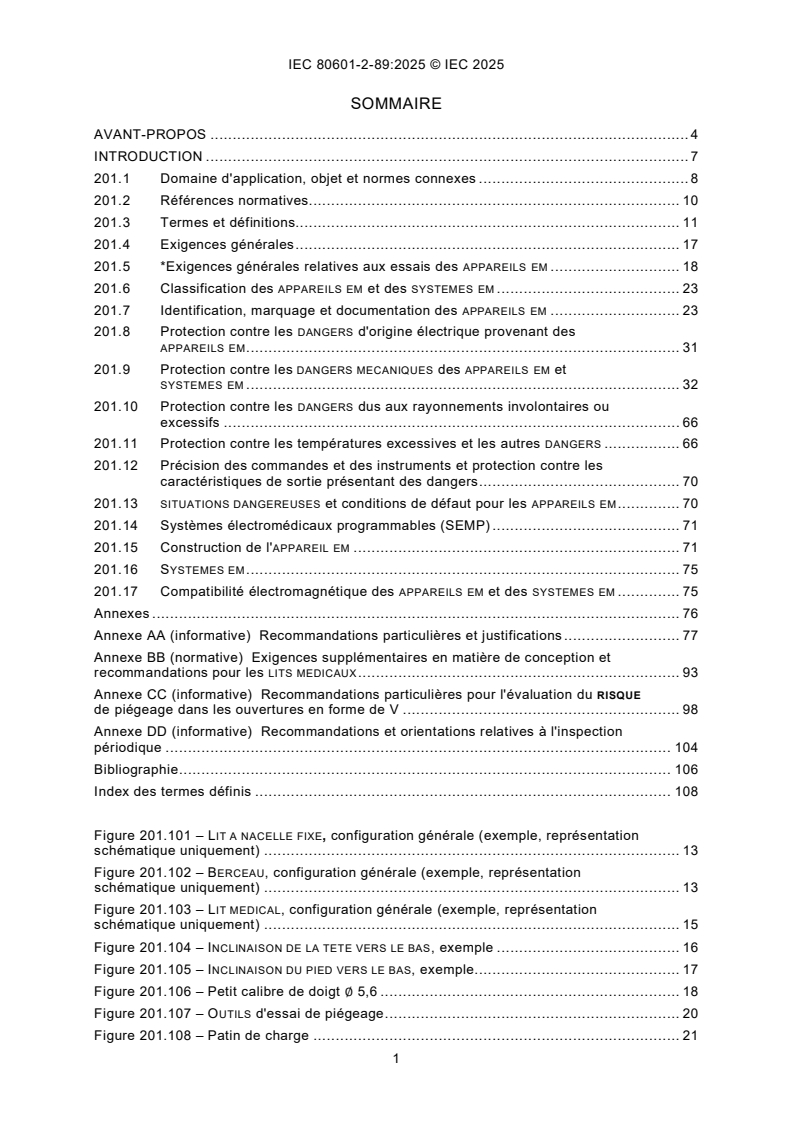
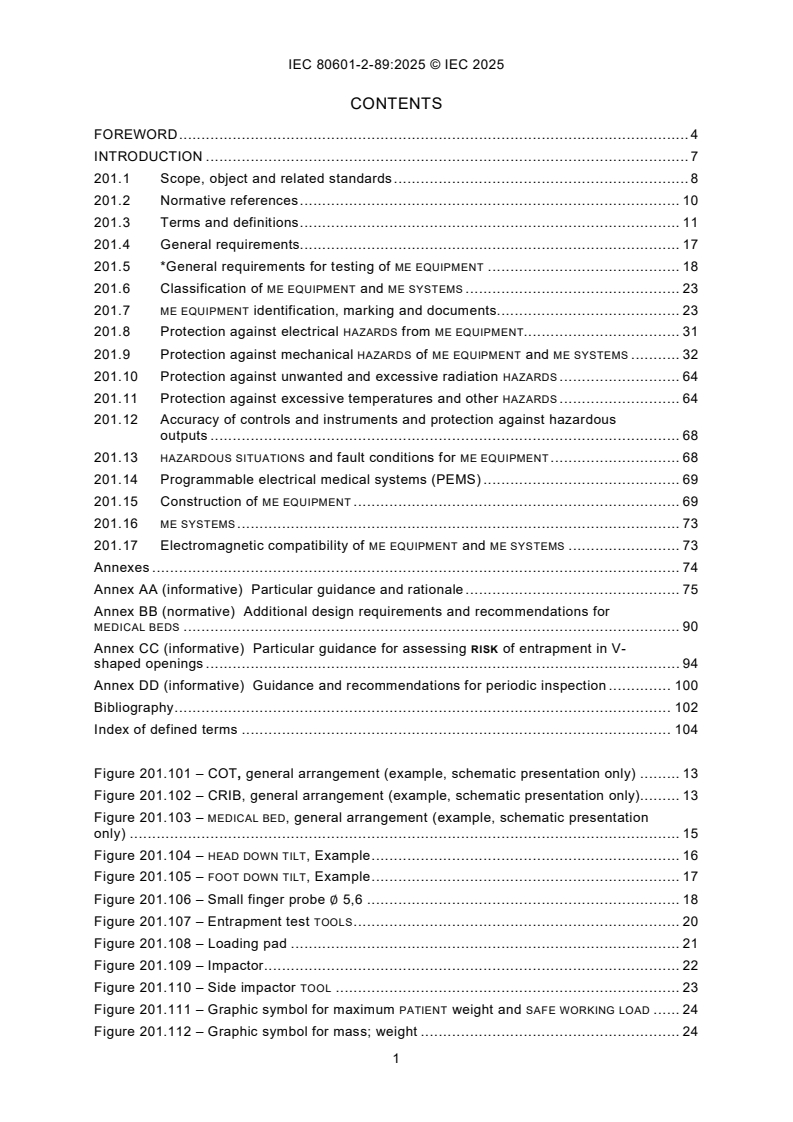
CONTENTS
FOREWORD . 4
INTRODUCTION . 7
201.1 Scope, object and related standards . 8
201.2 Normative references . 10
201.3 Terms and definitions . 11
201.4 General requirements. 17
201.5 *General requirements for testing of ME EQUIPMENT . 18
201.6 Classification of ME EQUIPMENT and ME SYSTEMS . 23
201.7 ME EQUIPMENT identification, marking and documents. 23
201.8 Protection against electrical HAZARDS from ME EQUIPMENT. 31
201.9 Protection against mechanical HAZARDS of ME EQUIPMENT and ME SYSTEMS . 32
201.10 Protection against unwanted and excessive radiation HAZARDS . 64
201.11 Protection against excessive temperatures and other HAZARDS . 64
201.12 Accuracy of controls and instruments and protection against hazardous
outputs . 68
201.13 HAZARDOUS SITUATIONS and fault conditions for ME EQUIPMENT . 68
201.14 Programmable electrical medical systems (PEMS) . 69
201.15 Construction of ME EQUIPMENT . 69
201.16 ME SYSTEMS . 73
201.17 Electromagnetic compatibility of ME EQUIPMENT and ME SYSTEMS . 73
Annexes . 74
Annex AA (informative) Particular guidance and rationale . 75
Annex BB (normative) Additional design requirements and recommendations for
MEDICAL BEDS . 90
Annex CC (informative) Particular guidance for assessing RISK of entrapment in V-
shaped openings . 94
Annex DD (informative) Guidance and recommendations for periodic inspection . 100
Bibliography . 102
Index of defined terms . 104
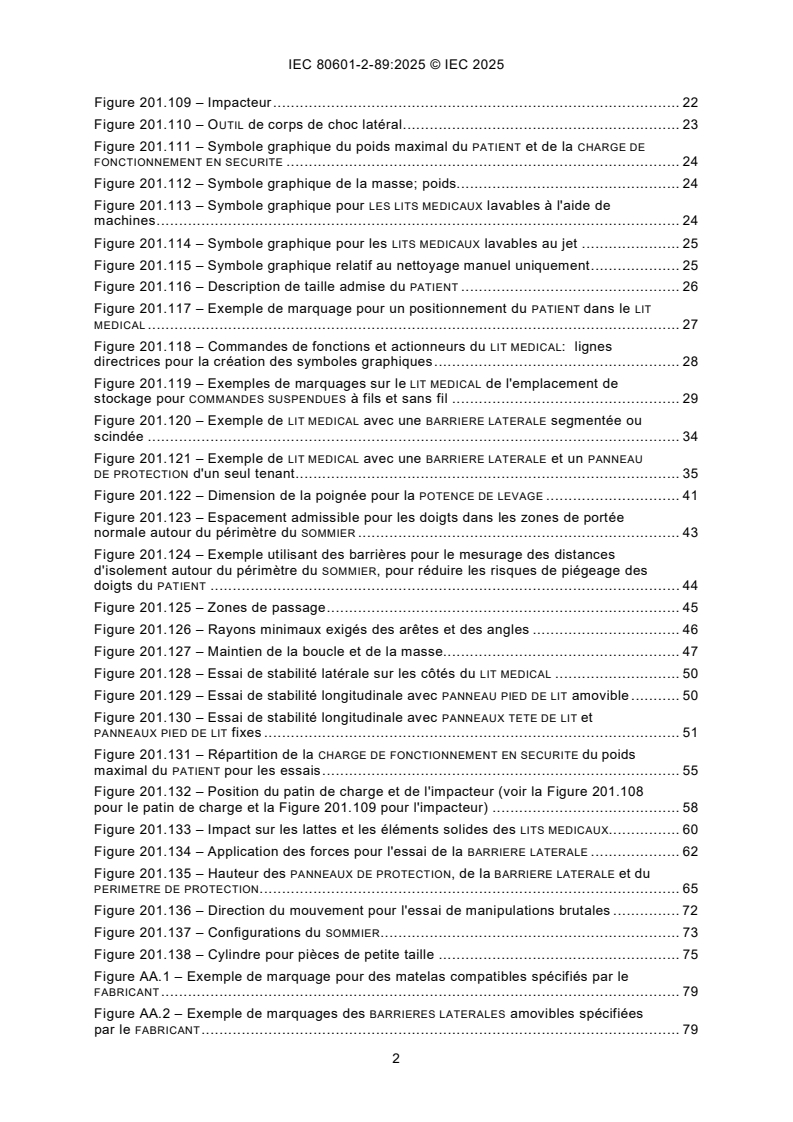
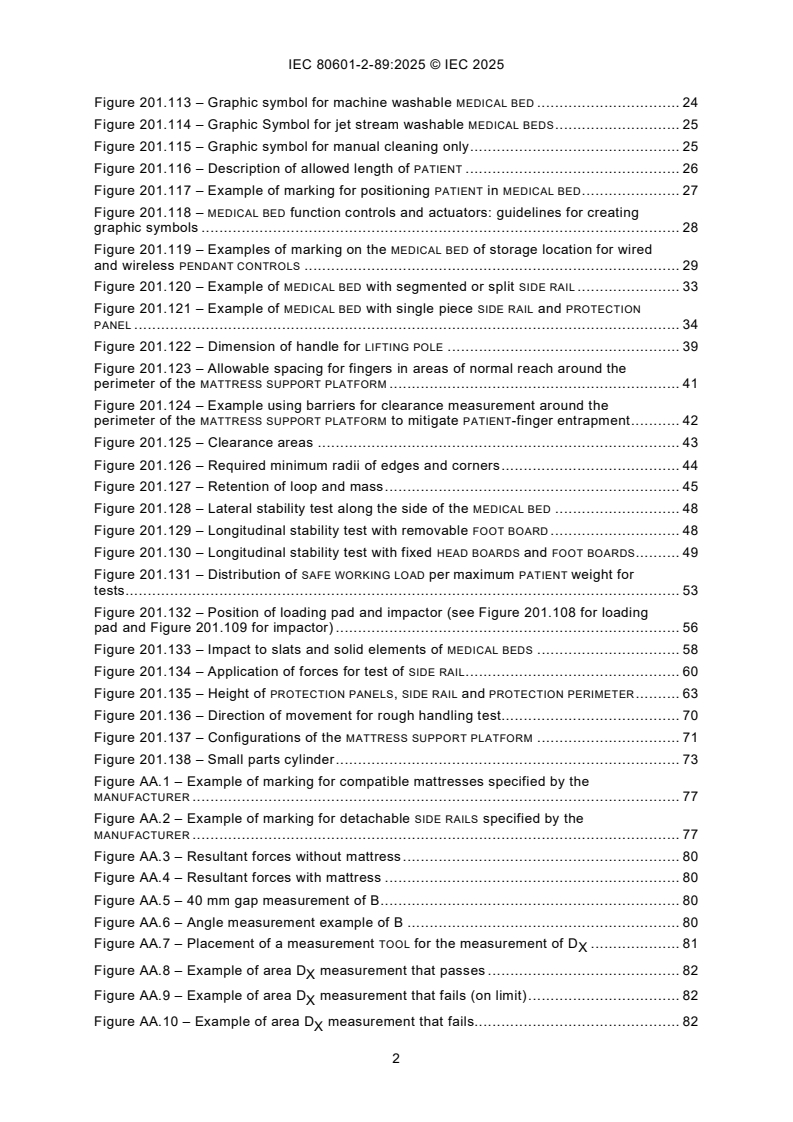
Figure 201.101 – COT, general arrangement (example, schematic presentation only) . 13
Figure 201.102 – CRIB, general arrangement (example, schematic presentation only). 13
Figure 201.103 – MEDICAL BED, general arrangement (example, schematic presentation
only) . 15
Figure 201.104 – HEAD DOWN TILT, Example . 16
Figure 201.105 – FOOT DOWN TILT, Example . 17
Figure 201.106 – Small finger probe ∅ 5,6 . 18
Figure 201.107 – Entrapment test TOOLS . 20
Figure 201.108 – Loading pad . 21
Figure 201.109 – Impactor . 22
Figure 201.110 – Side impactor TOOL . 23
Figure 201.111 – Graphic symbol for maximum PATIENT weight and SAFE WORKING LOAD . 24
Figure 201.112 – Graphic symbol for mass; weight . 24
Figure 201.113 – Graphic symbol for machine washable MEDICAL BED . 24
Figure 201.114 – Graphic Symbol for jet stream washable MEDICAL BEDS . 25
Figure 201.115 – Graphic symbol for manual cleaning only . 25
Figure 201.116 – Description of allowed length of PATIENT . 26
Figure 201.117 – Example of marking for positioning PATIENT in MEDICAL BED . 27
Figure 201.118 – MEDICAL BED function controls and actuators: guidelines for creating
graphic symbols . 28
Figure 201.119 – Examples of marking on the MEDICAL BED of storage location for wired
and wireless PENDANT CONTROLS . 29
Figure 201.120 – Example of MEDICAL BED with segmented or split SIDE RAIL . 33
Figure 201.121 – Example of MEDICAL BED with single piece SIDE RAIL and PROTECTION
PANEL . 34
Figure 201.122 – Dimension of handle for LIFTING POLE . 39
Figure 201.123 – Allowable spacing for fingers in areas of normal reach around the
perimeter of the MATTRESS SUPPORT PLATFORM . 41
Figure 201.124 – Example using barriers for clearance measurement around the
perimeter of the MATTRESS SUPPORT PLATFORM to mitigate PATIENT-finger entrapment . 42
Figure 201.125 – Clearance areas . 43
Figure 201.126 – Required minimum radii of edges and corners . 44
Figure 201.127 – Retention of loop and mass . 45
Figure 201.128 – Lateral stability test along the side of the MEDICAL BED . 48
Figure 201.129 – Longitudinal stability test with removable FOOT BOARD . 48
Figure 201.130 – Longitudinal stability test with fixed HEAD BOARDS and FOOT BOARDS . 49
Figure 201.131 – Distribution of SAFE WORKING LOAD per maximum PATIENT weight for
tests . 53
Figure 201.132 – Position of loading pad and impactor (see Figure 201.108 for loading
pad and Figure 201.109 for impactor) . 56
Figure 201.133 – Impact to slats and solid elements of MEDICAL BEDS . 58
Figure 201.134 – Application of forces for test of SIDE RAIL . 60
Figure 201.135 – Height of PROTECTION PANELS, SIDE RAIL and PROTECTION PERIMETER . 63
Figure 201.136 – Direction of movement for rough handling test. 70
Figure 201.137 – Configurations of the MATTRESS SUPPORT PLATFORM . 71
Figure 201.138 – Small parts cylinder . 73
Figure AA.1 – Example of marking for compatible mattresses specified by the
MANUFACTURER . 77
Figure AA.2 – Example of marking for detachable SIDE RAILS specified by the
MANUFACTURER . 77
Figure AA.3 – Resultant forces without mattress . 80
Figure AA.4 – Resultant forces with mattress . 80
Figure AA.5 – 40 mm gap measurement of B . 80
Figure AA.6 – Angle measurement example of B . 80
Figure AA.7 – Placement of a measurement TOOL for the measurement of D . 81
X
Figure AA.8 – Example of area D measurement that passes . 82
X
Figure AA.9 – Example of area D measurement that fails (on limit) . 82
X
Figure AA.10 – Example of area D measurement that fails. 82
X
Figure AA.11 – Example of potential PATIENT entrapment in area A within the SIDE RAIL. 83
Figure AA.12 – Example of potential PATIENT entrapment in area A below the SIDE RAIL . 83
Figure AA.13 – Example of potential PATIENT entrapment in area B . 83
Figure AA.14 – Example of potential PATIENT entrapment in area C between segmented
or split SIDE RAIL . 83
Figure AA.15 – Example of potential PATIENT entrapment in area C between SIDE RAIL
and HEAD BOARD . 83
Figure AA.16 – Example of potential PATIENT entrapment in area D . 83
Figure AA.17 – Example of potential PATIENT entrapment in area A below a single
piece SIDE RAIL . 84
Figure BB.1 – Schematic presentation of under MEDICAL BED clearance . 92
Figure BB.2 – Angles for different sections of the MATTRESS SUPPORT PLATFORM . 93
Figure CC.1 – Wedge TOOL. 95
Figure CC.2 – V-shaped opening in relation to B. 96
Figure CC.3 – Acceptance criteria in relation to area B . 96
Figure CC.4 – Positioning of wedge TOOL . 97
Figure CC.5 – Acceptance criteria in relation to area C between HEAD BOARD and FOOT
BOARD . 98
Figure CC.6 – Acceptance criteria in relation to area C between segmented or split
SIDE RAILS . 99
Table 201.101 – Protection against PATIENT entrapment . 35
Table 201.102 – Minimum SAFE WORKING LOADS . 52
Table 201.103 – Protection against inadvertent PATIENT falls and climbing out of
MEDICAL BED . 63
Table 201.104 – Allowable maximum temperatures for skin contact with MEDICAL BED
APPLIED PARTS . 64
Table 201.105 – Machine washable compliance PROCEDURE . 66
Table AA.1 – Protection against PATIENT entrapment in non-moving parts. 79
Table AA.2 – Height of protective barriers according to age . 88
INTERNATIONAL ELECTROTECHNICAL COMMISSION
____________
Medical electrical equipment -
Part 2-89: Particular requirements for the basic safety
and essential performance of medical beds for children
FOREWORD
1) The International Electrotechnical Commission (IEC) is a worldwide organization for standardization comprising
all national electrotechnical committees (IEC National Committees). The object of IEC is to promote international
co-operation on all questions concerning standardization in the electrical and electronic fields. To this end and
in addition to other activities, IEC publishes International Standards, Technical Specifications, Technical Reports,
Publicly Available Specifications (PAS) and Guides (hereafter referred to as "IEC Publication(s)"). Their
preparation is entrusted to technical committees; any IEC National Committee interested in the subject dealt with
may participate in this preparatory work. International, governmental and non-governmental organizations liaising
with the IEC also participate in this preparation. IEC collaborates closely with the International Organization for
Standardization (ISO) in accordance with conditions determined by agreement between the two organizations.
2) The formal decisions or agreements of IEC on technical matters express, as nearly as possible, an international
consensus of opinion on the relevant subjects since each technical committee has representation from all
interested IEC National Committees.
3) IEC Publications have the form of recommendations for international use and are accepted by IEC National
Committees in that sense. While all reasonable efforts are made to ensure that the technical content of IEC
Publications is accurate, IEC cannot be held responsible for the way in which they are used or for any
misinterpretation by any end user.
4) In order to promote international uniformity, IEC National Committees undertake to apply IEC Publications
transparently to the maximum extent possible in their national and regional publications. Any divergence between
any IEC Publication and the corresponding national or regional publication shall be clearly indicated in the latter.
5) IEC itself does not provide any attestation of conformity. Independent certification bodies provide conformity
assessment services and, in some areas, access to IEC marks of conformity. IEC is not responsible for any
services carried out by independent certification bodies.
6) All users should ensure that they have the latest edition of this publication.
7) No liability shall attach to IEC or its directors, employees, servants or agents including individual experts and
members of its technical committees and IEC National Committees for any personal injury, property damage or
other damage of any nature whatsoever, whether direct or indirect, or for costs (including legal fees) and
expenses arising out of the publication, use of, or reliance upon, this IEC Publication or any other IEC
Publications.
8) Attention is drawn to the Normative references cited in this publication. Use of the referenced publications is
indispensable for the correct application of this publication.
9) IEC draws attention to the possibility that the implementation of this document may involve the use of (a)
patent(s). IEC takes no position concerning the evidence, validity or applicability of any claimed patent rights in
respect thereof. As of the date of publication of this document, IEC had not received notice of (a) patent(s), which
may be required to implement this document. However, implementers are cautioned that this may not represent
the latest information, which may be obtained from the patent database available at https://patents.iec.ch. IEC
shall not be held responsible for identifying any or all such patent rights.
IEC 80601-2-89 has been prepared by a Joint Working Group of IEC subcommittee 62D:
Particular medical equipment, software, and systems, of IEC technical committee 62: Medical
equipment, software, and systems, and ISO technical committee 173: Assistive products. It is
an International Standard.
This publication is published as a double logo standard.
The text of this International Standard is based on the following documents of IEC:
Draft Report on voting
62D/2239/FDIS 62D/2272/RVD
Full information on the voting for its approval can be found in the report on voting indicated in
the above table. In ISO, the document was approved by XXX P members out of YYY having
cast a vote.
The language used for the development of this International Standard is English.
This document was drafted in accordance with ISO/IEC Directives, Part 2, and developed in
accordance with ISO/IEC Directives, Part 1 and ISO/IEC Directives, IEC Supplement, available
at www.iec.ch/members_experts/refdocs. The main document types developed by IEC are
described in greater detail at www.iec.ch/publications.
In this standard, the following print types are used:
– requirements and definitions: roman type;
– test specifications: italic type;
– informative material appearing outside of tables, such as notes, examples and references: in smaller type.
Normative text of tables is also in a smaller type;
– terms defined in clause 3 of IEC 60601-1:2005, IEC 60601-1:2005/AMD1:2012 AND
IEC 60601-1:2005/AMD2:2020, IN THIS DOCUMENT OR AS NOTED: SMALL CAPITALS.
In referring to the structure of this document, the term
– "clause" means one of the seventeen numbered divisions within the table of contents,
inclusive of all subdivisions (e.g. Clause 7 includes subclauses 7.1, 7.2, etc.);
– "subclause" means a numbered subdivision of a clause (e.g. 7.1, 7.2 and 7.2.1 are all
subclauses of Clause 7).
References to clauses within this document are preceded by the term "Clause" followed by the
clause number. References to subclauses within this document are by number only.
In this document, the conjunctive "or" is used as an "inclusive or" so a statement is true if any
combination of the conditions is true.
The verbal forms used in this document conform to usage described in Clause 7 of the ISO/IEC
Directives, Part 2. For the purposes of this document, the auxiliary verb:
– "shall" means that compliance with a requirement or a test is mandatory for compliance with
this document;
– "should" means that compliance with a requirement or a test is recommended but is not
mandatory for compliance with this document;
– "may" is used to describe a permissible way to achieve compliance with a requirement or
test.
An asterisk (*) as the first character of a title or at the beginning of a paragraph or table title
indicates that there is guidance or rationale related to that item in Annex AA.
A list of all parts of the IEC 80601 series, published under the general title Medical electrical
equipment, can be found on the IEC website.
The committee has decided that the contents of this document will remain unchanged until the
stability date indicated on the IEC website under webstore.iec.ch in the data related to the
specific document. At this date, the document will be
– reconfirmed,
– withdrawn, or
– revised.
INTRODUCTION
IEC 80601-2-52[1] applies to the BASIC SAFETY and ESSENTIAL PERFORMANCE of MEDICAL BEDS
for ADULTS, hence not covering requirement for beds for CHILDREN and ADULTS with atypical
anatomy. This particular standard is based on EN 50637[2], which was created pursuant to
Mandate M/467 Medical beds issued by the European Commission with the following
background information:
It appears, from a first analysis undertaken by EU Competent Authorities, that the current set
of standards is not adapted to the needs of CHILDREN or ADULTS with an atypical anatomy.
IEC 80601-2-52 does not foresee a maximum distance for the bars that is small enough to
prevent accidents.
According to the EU Competent Authorities' representatives, a part of the safety problem is due
to the fact that MEDICAL BEDS for ADULTS are not appropriately labelled as being designed only
for ADULTS with a normal anatomy. Users are therefore not always aware of the risk of MEDICAL
BEDS for young PATIENTS or for ADULTS with an atypical anatomy. Hospital administrations do
not always see a need to buy MEDICAL BEDS which are appropriate for CHILDREN or for ADULTS
with an atypical anatomy. Therefore, clear labelling of the targeted PATIENT groups for MEDICAL
BEDS complying with IEC 80601-2-52 could reduce the risk of inappropriate use of this kind of
MEDICAL BEDS for CHILDREN or for ADULTS with an atypical anatomy.
EU Competent Authorities' representatives also stated that there is a need for the development
of requirements for MEDICAL BEDS and COTS for CHILDREN and ADULTS with an atypical anatomy.
In order to prevent IEC 80601-2-52 from being extraordinarily complex to use, TC 62 decided
to develop this particular standard rather than further amending IEC 80601-2-52 in relation to
use for CHILDREN and ADULTS with an atypical anatomy.
This standard is based on EN 50637 and IEC 80601-2-52 with input from the following
standards and reports:
• EN 716-1, Furniture – V Children's cots and folding cots for domestic use – Part 1: Safety
requirements
• EN 716-2, Furniture – Children's cots and folding cots for domestic use – Part 2: Test
methods
• EN 1130, Furniture – Children's furniture – Cribs – Safety requirements and test methods
• EN 747-1, Furniture – Bunk beds and high beds – Part 1: Safety, strength and durability
requirements
• EN 747-2, Furniture – Bunk beds and high beds – Part 2: Test methods
• CEN/TR 13387 (all parts), Child use and care articles – General safety guidelines
• DIN 32623, Hospital children's cots made from metal and plastic – Safety requirements and
testing
• Nordic Requirements specification for Adjustable beds for disabled children
___________
Numbers in square brackets refer to the Bibliography.
201.1 Scope, object and related standards
IEC 60601-1:2005, IEC 60601-1:2005/AMD1:2012 and IEC 60601-1:2005/AMD2:2020,
Clause 1, applies, except as follows:
201.1.1 * Scope
Replacement:
This International Standard applies to the BASIC SAFETY and ESSENTIAL PERFORMANCE of MEDICAL
BEDS, hereafter referred to as MEDICAL BEDS as defined in 201.3.219, intended for CHILDREN as
defined in 201.3.207, and ADULTS with atypical anatomy (ADULTS ranging outside the definition
for ADULTS in 201.3.201).
This document applies to both electrical and non-electrical (manual) MEDICAL BEDS with or
without adjustable functions. This document applies to MEDICAL BEDS with an INTERNAL LENGTH
of up to 180 cm suitable to a body length of 155 cm.
NOTE 1 The limitation of 180 cm is in order to minimize the foreseeable misuse, of a parent sharing the bed with
the CHILD or that the bed will be used by an ADULT.
If a MANUFACTURER wishes to make a MEDICAL BED that can be used by both a CHILD and an
ADULT, e.g. INTERNAL LENGTH of 180 cm or more, then IEC 80601-2-52 and this document apply.
This document does not apply to:
• ADULT only MEDICAL BEDS covered by IEC 80601-2-52;
• SPECIALITY MATTRESS covered by the ISO 20342 series[5];
• incubators covered by IEC 60601-2-19;
• devices for which the INTENDED USE is mainly for examination or transportation under
medical supervision (e.g. stretcher, examination table).
If a clause or subclause is specifically intended to be applicable to a MEDICAL BED only, or to ME
SYSTEMS only, the title and content of that clause or subclause will say so. If that is not the case,
the clause or subclause applies both to MEDICAL BEDS and to ME SYSTEMS, as relevant.
HAZARDS inherent in the intended physiological function of MEDICAL BEDS or ME SYSTEMS within
the scope of this document are not covered by specific requirements in this document except
in IEC 60601-1:2005, IEC 60601-1:2005/AMD1:2012 and IEC 60601-1:2005/AMD2:2020,
7.2.13 and 8.4.1.
NOTE 2 See also IEC 60601-1:2005, IEC 60601-1:2005/AMD1:2012 and IEC 60601-1:2005/AMD2:2020, 4.2.
NOTE 3 Whenever the term MEDICAL ELECTRICAL EQUIPMENT (MEE, ME Equipment) is used within the series
of IEC 60601 standards, it refers to MEDICAL BEDS, both electrical and non-electrical.
201.1.2 Object
Replacement:
The object of this document is to establish particular BASIC SAFETY and ESSENTIAL PERFORMANCE
requirements and test methods for MEDICAL BEDS as defined in 201.3.219 intended for CHILDREN
as defined in 201.3.207 and ADULTS with atypical anatomy, i.e. ADULTS ranging outside the
definition for ADULTS in 202.3.201.
201.1.3 Collateral standards
Addition:
This document refers to those applicable collateral standards that are listed in Clause 2 of
IEC 60601-1:2005, IEC 60601-1:2005/AMD1:2012 and IEC 60601-1:2005/AMD2:2020 and
Clause 201.2 of this document.
IEC 60601-1-3 and IEC 60601-1-10 do not apply. All other published collateral standards in the
IEC 60601-1 series apply as published.
NOTE Some IEC 60601-1-8 requirements can be excluded if they do not affect PATIENT safety, could lead to user
confusion, or are inappropriate to MEDICAL BED usage.
201.1.4 Particular standards
Replacement:
In the IEC 60601 series, particular standards may modify, replace or delete requirements
contained in IEC 60601-1:2005, IEC 60601-1:2005/AMD1:2012 and
IEC 60601-1:2005/AMD2:2020, including the collateral standards as appropriate for the
particular ME EQUIPMENT under consideration, and may add other BASIC SAFETY and ESSENTIAL
PERFORMANCe requirements.
Requirements of this document takes priority over IEC 60601-1:2005,
IEC 60601-1:2005/AMD1:2012 and IEC 60601-1:2005/AMD2:2020.
The numbering of clauses and subclauses of this particular standard corresponds to that of
IEC 60601-1:2005, IEC 60601-1:2005/AMD1:2012 and IEC 60601-1:2005/AMD2:2020 with the
prefix "201" (e.g. 201.1 in this document addresses the content of Clause 1 of
IEC 60601-1:2005, IEC 60601-1:2005/AMD1:2012 and IEC 60601-1:2005/AMD2:2020) or
applicable collateral standard with the prefix "20x" where x is the final digit(s) of the collateral
standard document number (e.g. 202.4 in this document addresses the content of Clause 4 of
the IEC 60601-1-2:2015 collateral standard, 203.4 in this document addresses the content of
Clause 4 of the IEC 60601-1-3:2008 collateral standard, etc.). The changes to the text of
IEC 60601-1:2005, IEC 60601-1:2005/AMD1:2012 and IEC 60601-1:2005/AMD2:2020 are
specified by the use of the following words:
"Replacement" means that the clause or subclause of IEC 60601-1:2005,
IEC 60601-1:2005/AMD1:2012 and IEC 60601-1:2005/AMD2:2020 or applicable collateral
standard is replaced completely by the text of this document.
"Addition" means that the text of this document is additional to the requirements of
IEC 60601-1:2005, IEC 60601-1:2005/AMD1:2012 and IEC 60601-1:2005/AMD2:2020 or
applicable collateral standard.
"Amendment" means that the clause or subclause of IEC 60601-1:2005,
IEC 60601-1:2005/AMD1:2012 and IEC 60601-1:2005/AMD2:2020 or applicable collateral
standard is amended as indicated by the text of this document.
Subclauses, figures or tables which are additional to those of IEC 60601-1:2005,
IEC 60601-1:2005/AMD1:2012 and IEC 60601-1:2005/AMD2:2020 are numbered starting from
201.101. However, due to the fact that definitions in IEC 60601-1:2005,
IEC 60601-1:2005/AMD1:2012 and IEC 60601-1:2005/AMD2:2020 are numbered 3.1 through
3.154, additional definitions in this document are numbered beginning from 201.3.201.
Additional annexes are lettered AA, BB, etc., and additional items aa), bb), etc.
Subclauses, figures or tables which are additional to those of a collateral standard are
numbered starting from 20x, where "x" is the number of the collateral standard, e.g. 202 for
IEC 60601-1-2, 203 for IEC 60601-1-3, etc.
Where there is no corresponding clause or subclause in this particular standard, the clause or
subclause of IEC 60601-1:2005, IEC 60601-1:2005/AMD1:2012 and
IEC 60601-1:2005/AMD2:2020 or applicable collateral standard, although possibly not relevant,
applies without modification; where it is intended that any part of IEC 60601-1:2005,
IEC 60601-1:2005/AMD1:2012 and IEC 60601-1:2005/AMD2:2020 or applicable collateral
standard, although possibly relevant, is not to be applied, a statement to that effect is given in
this document.
201.2 Normative references
The following documents are referred to in the text in such a way that some or all of their content
constitutes requirements of this document. For dated references, only the edition cited applies.
For undated references, the latest edition of the referenced document (including any
amendments) applies.
NOTE Informative references are listed in the Bibliography.
IEC 60601-1:2005, IEC 60601-1:2005/AMD1:2012 and IEC 60601-1:2005/AMD2:2020,
Clause 2, applies except as follows:
Addition:
IEC 60529, Degrees of protection provided by enclosures (IP Code)
IEC 60601-1:2005, Medical electrical equipment - Part 1: General requirements for basic
safety and essential performance
IEC 60601-1:2005/AMD1:2012
IEC 60601-1:2005/AMD2:2020
ISO 48-5:2018, Rubber, vulcanized or thermoplastic - Determination of hardness - Part 5:
Indentation hardness by IRHD pocket meter method
ISO 3746, Acoustics - Determination of sound power levels of noise sources using sound
pressure - Survey method using an enveloping measurement surface over a reflecting plane
EN 71-3, Safety of toys - Part 3: Migration of certain elements
EN 597-1, Furniture - Assessment of the ignitability of mattresses and upholstered bed bases -
Part 1: Ignition source : Smouldering cigarette
EN 597-2, Furniture - Assessment of the ignitability of mattresses and upholstered bed bases -
Part 2: Ignition source: Match flame equivalent
EN 716-2, Furniture - Children's cots and folding cots for domestic use - Part 2: Test methods
201.3 Terms and definitions
For the purposes of this document, the terms and definitions given in IEC 60601-1:2005,
IEC 60601-1:2005/AMD1:2012 and IEC 60601-1:2005/AMD2:2020, and the following apply.
ISO and IEC maintain terminology databases for use in standardization at the following
addresses:
– IEC Electropedia: available at https://www.electropedia.org/
– ISO Online browsing platform: available at https://www.iso.org/obp
NOTE An index of defined terms is given after the Bibliography.
201.3.76
PATIENT
Replacement:
living person undergoing a medical PROCEDURE or PERSON WITH DISABILITY
Note 1 to entry: Whenever the term PATIENT is used, it comprises both ADULTS with an atypical anatomy and
CHILDREN.
201.3.109
SAFE WORKING LOAD
SWL
Replacement:
sum of:
1) the PATIENT;
2) the mattress;
3) the ACCESSORIES of the MEDICAL BED, only if they are supported by the support system of the
MEDICAL BED; and
4) the SAFE WORKING LOADS supported by those ACCESSORIES, excluding PATIENT weight
201.3.131
* TRAPPING ZONE
Replacement:
locations where the PATIENT or other persons can become entrapped, entangled, wedged, or
stuck in or between parts of the MEDICAL BED, such as the SIDE RAILS, HEAD/FOOT BOARD,
MATTRESS SUPPORT PLATFORM or mattress
Additional terms and definitions:
201.3.201
ADULT
PATIENT having a physical size equal to or more than 146 cm, a mass equal to or more than 40
kg and a body mass index (BMI) equal to or more than 17
201.3.202
APPLICATION ENVIRONMENT 1
*
intensive care or critical care provided in a hospital where 24 h medical supervision and
constant monitoring is required and provision of life support equipment used in medical
PROCEDURES is essential to maintain or improve the vital functions of the PATIENT
201.3.203
* APPLICATION ENVIRONMENT 2
acute care provided in a hospital or other medical facility where medical supervision and
monitoring is required and MEDICAL BED used in medical PROCEDURES is often provided to help
maintain or improve the condition of the PATIENT
201.3.204
* APPLICATION ENVIRONMENT 3
long-term care in a medical area where medical supervision is required and monitoring is
provided if necessary and MEDICAL BED used in medical PROCEDURES may be provided to help
maintain or improve the condition of the PATIENT
Note 1 to entry: This includes use in CHILDREN'S nursing homes and in rehabilitation facilities.
201.3.205
* APPLICATION ENVIRONMENT 4
care provided in a domestic area where MEDICAL BED is used to alleviate or compensate for an
injury, disability or disease
Note 1 to entry: This excludes use in all other application environments (e.g. CHILDREN'S nursing homes and
rehabilitation facilities) when a MEDICAL BED is purely designed for APPLICATION ENVIRONMENT 4.
201.3.206
* APPLICATION ENVIRONMENT 5
outpatient care or ambulatory care, which is provided in a hospital or other medical facility,
under medical supervision where MEDICAL BED, is provided for the need of persons with illness,
injury or disability for treatment, diagnosis or monitoring
201.3.207
CHILD
PATIENT having a body length equal to or less than 155 cm and a mass equal to or less than
70 kg and may display cognitive immaturity, exploratory behaviours, risk taking tendencies or
any combination.
Note 1 to entry: Body length is measured from crown to sole.
201.3.208
COT
MEDICAL BED with an INTERNAL LENGTH ≥90 cm and <140 cm provided with PROTECTION PANELS
also intended for CHILDREN able to stand up in bed
Note 1 to entry: See Figure 201.101.
Figure 201.101 – COT, general arrangement
(example, schematic presentation only)
201.3.209
CRIB
MEDICAL BED with an INTERNAL LENGTH <90 cm provided with PROTECTION PERIMETER, intended
for CHILDREN until they are able to sit, kneel or to pull themselves up
Note 1 to entry: See Figure 201.102.
Note 2 to entry: Excluded are MEDICAL BEDS with a swinging or rocking function.
Dimensions in millimetres
Figure 201.102 – CRIB, general arrangement
(example, schematic presentation only)
201.3.210
PERSON WITH DISABILITY
person with one or more impairments, one or more activity limitations, one or more participation
restrictions or a combination thereof
[SOURCE: ISO 9999:2022, 3.10]
201.3.211
HEAD OR FOOT BOARD
assembly mounted to MEDICAL BED, which identifies for the PATIENT the edge of the head or foot
end of the MEDICAL BED or MATTRESS SUPPORT PLATFORM
Note 1 to entry: It can be used as handles to push a MEDICAL BED intended to transport PATIENTS.
201.3.212
INTERNAL LENGTH
length of MATTRESS SUPPORT PLATFORM measured from inside bed HEAD BOARD to FOOT BOARD.
201.3.213
JUNIOR BED
MEDICAL BED with an INTERNAL LENGTH ≥140 cm and <180 cm
201.3.214
LIFTING POLE
ACCESSORY attached to a MEDICAL BED and intended to assist support of a PATIENT when
changing position by providing a gripping support above the PATIENT
201.3.215
LOCKING DEVICE
mechanism intended to maintain the MEDICAL BED or parts of it in its locked position
201.3.216
LOCKING SYSTEM
mechanism consisting of a LOCKING DEVICE and one or more operating devices, which can
deactivate the LOCKING DEVICE, e.g. by pushing a button, pressing a lever or turning a knob
201.3.217
MATTRESS OVERLAY
supplementary mattress, which is intended to be placed on an existing mattress, and generally
used for prophylactic or therapeutic effect
201.3.218
MATTRESS SUPPORT PLATFORM
structure which supports a PATIENT surface
EXAMPLE Mattress.
Note 1 to entry: The platform can articulate or change positions to facilitate various therapeutic, diagnostic and
convenience positions. See Figure 201.103, Subfigures a) to d) of Figure 201.137 and Figure BB.2.
Key
1 HEAD BOARD
2 Back section
3 Seat section
4 Upper leg section
5 Lower leg section
6 FOOT BOARD
Figure 201.103 – MEDICAL BED, general arrangement
(example, schematic presentation only)
201.3.219
* MEDICAL BED
device for which the INTENDED USE is sleeping, resting or both that contains a MATTRESS SUPPORT
PLATFORM and intended to assist in diagnosis, monitoring, prevention, treatment, alleviation of
disease or compensation for an injury or disability
Note 1 to entry: Whenever the term MEDICAL BED is used, it comprises CRIBS, COTS AND JUNIOR BEDS.
201.3.220
MOTION LOCKOUT CONTROL
auxiliary subsystem that deactivates motion controls
201.3.221
OVERSIZE COT
COT with an INTERNAL LENGTH ≥140 cm and <180 cm provided with PROTECTION PANELS also
intended for CHILDREN able to stand up in bed
201.3.222
PENDANT CONTROL
hand-held device, which has a FUNCTIONAL CONNECTION to the MEDICAL BED, controlling at least
MEDICAL BED articulations, movements or both
Note 1 to entry: PENDANT CONTROLS can be wired or wireless, and can integrate other functions such as
communications, radio, TV, etc.
201.3.223
PROTECTION PERIMETER
fully enclosed solid physical barrier e.g. bowl or basin, which is integral to the overall
construction of a MEDICAL BED, which will prevent the PATIENT from falling out of bed and which
can be movable, e.g. sliding sides, drop sides, folding sides
Note 1 to entry: Wherever a solid physical barrier is used, there can be a RISK of suffocation caused by lack of
oxygen.
201.3.224
PROTECTION PANEL
physical barrier, which shall be integral to the overall construction of a MEDICAL BED and is
positioned to the side(s) and ends of the MEDICAL BED to prevent the PATIENT from getting out of
bed unaided, and which can be movable, e.g. sliding sides, drop sides, folding sides
Note 1 to entry: Whenever the term SIDE RAIL is used, it comprises a PROTECTION PANEL. See COT and CRIB.
201.3.225
SIDE RAIL
ACCESSORY or integral to the overall construction
physical barrier, which may be a detachable
of a MEDICAL BED and is mounted to the side(s) of the MEDICAL BED
Note 1 to entry: When a SIDE RAIL is located in the "up" position, it provides a physical barrier, which is intended to
reduce the RISK of the PATIENT accidentally slipping or rolling off the mattress.
201.3.226
SPECIALITY MATTRESS
mattress intended for prophylactic or therapeutic effect
201.3.227
UNDERCARRIAGE
all components of the MEDICAL BED below the MATTRESS SUPPORT PLATFORM
201.3.228
HEAD DOWN TILT
entire MATTRESS SUPPORT SURFACE positioned in a head down angle less than 12° with respect
to horizontal
Note 1 to entry: See Figure 201.104.
Key
1 HEAD BOARD
2 FOOT BOARD
3 MATTRESS SUPPORT PLATFORM
Figure 201.104 – HEAD DOWN TILT, Example
201.3.229
FOOT DOWN TILT
entire MATTRESS SUPPORT SURFACE positioned in any foot down angle with respect to horizontal
Note 1 to entry: See Figure 201.105.
Key
1 HEAD BOARD
2 FOOT BOARD
3 MATTRESS SUPPORT PLATFORM
Figure 201.105 – FOOT DOWN TILT, Example
201.4 General requirements
IEC 60601-1:2005, IEC 60601-1:2005/AMD1:2012 and IEC 60601-1:2005/AMD2:2020,
Clause 4, applies, except as follows:
201.4.2 *RISK MANAGEMENT PROCESS for ME EQUIPMENT or ME SYSTEMS
Addition:
The MANUFACTURER shall include, in the RISK MANAGEMENT PROCESS for JUNIOR BEDS and
OVERSIZED COTS, HAZARDS related to PATIENTS taller than 155 cm and with a mass greater than
70 kg due to changes to the PATIENT while using the MEDICAL BED. The ACCOMPANYING DOCUMENT
shall document any HAZARDS associated with this use case.
NOTE E.g. greater reach of arms in relation to safe distances for not being able to open PROTECTION SIDE RAILS.
Compliance is checked by inspection of the RISK MANAGEMENT FILE and ACCOMPANYING
DOCUMENTS.
201.5 *General requirements for testing of ME EQUIPMENT
IEC 60601-1:2005, IEC 60601-1:2005/AMD1:2012 and IEC 60601-1:2005/AMD2:2020,
Clause 5, applies, except as follows:
201.5.9.2.1 Test finger
Replacement:
Parts of MEDICAL BEDS that shall be regarded as ACCESSIBLE PARTS are identified by inspection
and, where necessary, by testing. In case of doubt, accessibility is determined by a test with
the small finger probe shown in Figure 201.111, applied in a bent or stra
...
IEC 80601-2-89
Edition 1.0 2025-12
NORME
INTERNATIONALE
Appareils électromédicaux -
Partie 2-89: Exigences particulières pour la sécurité de base et les performances
essentielles des lits médicaux pour enfants
ICS 11.140 ISBN 978-2-8327-0886-6
Droits de reproduction réservés. Sauf indication contraire, aucune partie de cette publication ne peut être reproduite ni
utilisée sous quelque forme que ce soit et par aucun procédé, électronique ou mécanique, y compris la photocopie et
les microfilms, sans l'accord écrit de l'IEC ou du Comité national de l'IEC du pays du demandeur. Si vous avez des
questions sur le copyright de l'IEC ou si vous désirez obtenir des droits supplémentaires sur cette publication, utilisez
les coordonnées ci-après ou contactez le Comité national de l'IEC de votre pays de résidence.
IEC Secretariat Tel.: +41 22 919 02 11
3, rue de Varembé info@iec.ch
CH-1211 Geneva 20 www.iec.ch
Switzerland
A propos de l'IEC
La Commission Electrotechnique Internationale (IEC) est la première organisation mondiale qui élabore et publie des
Normes internationales pour tout ce qui a trait à l'électricité, à l'électronique et aux technologies apparentées.
A propos des publications IEC
Le contenu technique des publications IEC est constamment revu. Veuillez vous assurer que vous possédez l’édition la
plus récente, un corrigendum ou amendement peut avoir été publié.
Recherche de publications IEC - IEC Products & Services Portal - products.iec.ch
webstore.iec.ch/advsearchform Découvrez notre puissant moteur de recherche et consultez
La recherche avancée permet de trouver des publications gratuitement tous les aperçus des publications, symboles
IEC en utilisant différents critères (numéro de référence, graphiques et le glossaire. Avec un abonnement, vous aurez
texte, comité d’études, …). Elle donne aussi des toujours accès à un contenu à jour adapté à vos besoins.
informations sur les projets et les publications remplacées
ou retirées. Electropedia - www.electropedia.org
Le premier dictionnaire d'électrotechnologie en ligne au
IEC Just Published - webstore.iec.ch/justpublished monde, avec plus de 22 500 articles terminologiques en
Restez informé sur les nouvelles publications IEC. Just anglais et en français, ainsi que les termes équivalents
Published détaille les nouvelles publications parues. dans 25 langues additionnelles. Egalement appelé
Disponible en ligne et une fois par mois par email. Vocabulaire Electrotechnique International (IEV) en ligne.
Service Clients - webstore.iec.ch/csc
Si vous désirez nous donner des commentaires sur cette
publication ou si vous avez des questions contactez-
nous: sales@iec.ch.
SOMMAIRE
AVANT-PROPOS . 4
INTRODUCTION . 7
201.1 Domaine d'application, objet et normes connexes . 8
201.2 Références normatives . 10
201.3 Termes et définitions. 11
201.4 Exigences générales . 17
201.5 *Exigences générales relatives aux essais des APPAREILS EM . 18
201.6 Classification des APPAREILS EM et des SYSTEMES EM . 23
201.7 Identification, marquage et documentation des APPAREILS EM . 23
201.8 Protection contre les DANGERS d'origine électrique provenant des
APPAREILS EM . 31
201.9 Protection contre les DANGERS MECANIQUES des APPAREILS EM et
SYSTEMES EM . 32
201.10 Protection contre les DANGERS dus aux rayonnements involontaires ou
excessifs . 66
201.11 Protection contre les températures excessives et les autres DANGERS . 66
201.12 Précision des commandes et des instruments et protection contre les
caractéristiques de sortie présentant des dangers . 70
201.13 SITUATIONS DANGEREUSES et conditions de défaut pour les APPAREILS EM . 70
201.14 Systèmes électromédicaux programmables (SEMP) . 71
201.15 Construction de l'APPAREIL EM . 71
201.16 SYSTEMES EM . 75
201.17 Compatibilité électromagnétique des APPAREILS EM et des SYSTEMES EM . 75
Annexes . 76
Annexe AA (informative) Recommandations particulières et justifications . 77
Annexe BB (normative) Exigences supplémentaires en matière de conception et
recommandations pour les LITS MEDICAUX . 93
Annexe CC (informative) Recommandations particulières pour l'évaluation du RISQUE
de piégeage dans les ouvertures en forme de V . 98
Annexe DD (informative) Recommandations et orientations relatives à l'inspection
périodique . 104
Bibliographie . 106
Index des termes définis . 108
Figure 201.101 – LIT A NACELLE FIXE, configuration générale (exemple, représentation
schématique uniquement) . 13
Figure 201.102 – BERCEAU, configuration générale (exemple, représentation
schématique uniquement) . 13
Figure 201.103 – LIT MEDICAL, configuration générale (exemple, représentation
schématique uniquement) . 15
Figure 201.104 – INCLINAISON DE LA TETE VERS LE BAS, exemple . 16
Figure 201.105 – INCLINAISON DU PIED VERS LE BAS, exemple . 17
Figure 201.106 – Petit calibre de doigt ∅ 5,6 . 18
Figure 201.107 – OUTILS d'essai de piégeage . 20
Figure 201.108 – Patin de charge . 21
Figure 201.109 – Impacteur . 22
Figure 201.110 – OUTIL de corps de choc latéral . 23
Figure 201.111 – Symbole graphique du poids maximal du PATIENT et de la CHARGE DE
FONCTIONNEMENT EN SECURITE . 24
Figure 201.112 – Symbole graphique de la masse; poids. 24
Figure 201.113 – Symbole graphique pour LES LITS MEDICAUX lavables à l'aide de
machines . 24
Figure 201.114 – Symbole graphique pour les LITS MEDICAUX lavables au jet . 25
Figure 201.115 – Symbole graphique relatif au nettoyage manuel uniquement . 25
Figure 201.116 – Description de taille admise du PATIENT . 26
Figure 201.117 – Exemple de marquage pour un positionnement du PATIENT dans le LIT
MEDICAL . 27
Figure 201.118 – Commandes de fonctions et actionneurs du LIT MEDICAL: lignes
directrices pour la création des symboles graphiques . 28
Figure 201.119 – Exemples de marquages sur le LIT MEDICAL de l'emplacement de
stockage pour COMMANDES SUSPENDUES à fils et sans fil . 29
Figure 201.120 – Exemple de LIT MEDICAL avec une BARRIERE LATERALE segmentée ou
scindée . 34
Figure 201.121 – Exemple de LIT MEDICAL avec une BARRIERE LATERALE et un PANNEAU
DE PROTECTION d'un seul tenant . 35
Figure 201.122 – Dimension de la poignée pour la POTENCE DE LEVAGE . 41
Figure 201.123 – Espacement admissible pour les doigts dans les zones de portée
normale autour du périmètre du SOMMIER . 43
Figure 201.124 – Exemple utilisant des barrières pour le mesurage des distances
d'isolement autour du périmètre du SOMMIER, pour réduire les risques de piégeage des
doigts du PATIENT . 44
Figure 201.125 – Zones de passage . 45
Figure 201.126 – Rayons minimaux exigés des arêtes et des angles . 46
Figure 201.127 – Maintien de la boucle et de la masse. 47
Figure 201.128 – Essai de stabilité latérale sur les côtés du LIT MEDICAL . 50
Figure 201.129 – Essai de stabilité longitudinale avec PANNEAU PIED DE LIT amovible . 50
Figure 201.130 – Essai de stabilité longitudinale avec PANNEAUX TETE DE LIT et
PANNEAUX PIED DE LIT fixes . 51
Figure 201.131 – Répartition de la CHARGE DE FONCTIONNEMENT EN SECURITE du poids
maximal du PATIENT pour les essais . 55
Figure 201.132 – Position du patin de charge et de l'impacteur (voir la Figure 201.108
pour le patin de charge et la Figure 201.109 pour l'impacteur) . 58
Figure 201.133 – Impact sur les lattes et les éléments solides des LITS MEDICAUX. 60
Figure 201.134 – Application des forces pour l'essai de la BARRIERE LATERALE . 62
Figure 201.135 – Hauteur des PANNEAUX DE PROTECTION, de la BARRIERE LATERALE et du
PERIMETRE DE PROTECTION . 65
Figure 201.136 – Direction du mouvement pour l'essai de manipulations brutales . 72
Figure 201.137 – Configurations du SOMMIER . 73
Figure 201.138 – Cylindre pour pièces de petite taille . 75
Figure AA.1 – Exemple de marquage pour des matelas compatibles spécifiés par le
FABRICANT . 79
Figure AA.2 – Exemple de marquages des BARRIERES LATERALES amovibles spécifiées
par le FABRICANT . 79
Figure AA.3 – Forces résultantes sans matelas . 82
Figure AA.4 – Forces résultantes avec matelas . 82
Figure AA.5 – Mesurage d'un espace de 40 mm de B . 83
Figure AA.6 – Exemple de mesurage de l'angle de B . 83
Figure AA.7 – Emplacement de l'OUTIL de mesure pour le mesurage de D . 84
X
Figure AA.8 – Exemple de mesurage concluant de la zone D . 84
X
Figure AA.9 – Exemple de mesurage de la zone D qui échoue (à limite) . 84
X
Figure AA.10 – Exemple de mesurage de la zone D qui échoue . 85
X
Figure AA.11 – Exemple de piégeage potentiel du PATIENT dans la zone A dans la
BARRIERE LATERALE . 85
Figure AA.12 – Exemple de piégeage potentiel du PATIENT dans la zone A sous la
BARRIERE LATERALE . 85
Figure AA.13 – Exemple de piégeage potentiel du PATIENT dans la zone B . 86
Figure AA.14 – Exemple de piégeage potentiel du PATIENT dans la zone C entre les
BARRIERES LATERALES segmentées ou scindées. 86
Figure AA.15 – Exemple de piégeage potentiel du PATIENT dans la zone C entre la
BARRIERE LATERALE et le PANNEAU TETE DE LIT . 86
Figure AA.16 – Exemple de piégeage potentiel du PATIENT dans la zone D . 86
Figure AA.17 – Exemple de piégeage potentiel du PATIENT dans la zone A sous une
BARRIERE LATERALE d'un seul tenant . 86
Figure BB.1 – Représentation schématique de la distance d'isolement sous le LIT
MEDICAL . 95
Figure BB.2 – Angles des différentes sections du SOMMIER . 97
Figure CC.1 – OUTIL de coincement. 99
Figure CC.2 – Ouverture en forme de V par rapport à B . 100
Figure CC.3 – Critères d'acceptation par rapport à la zone B . 100
Figure CC.4 – Positionnement de l'OUTIL de coincement . 101
Figure CC.5 – Critères d'acceptation par rapport à la zone C entre le PANNEAU TETE DE
LIT et le PANNEAU PIED DE LIT . 102
Figure CC.6 – Critères d'acceptation par rapport à la zone C entre les BARRIERES
LATERALES segmentées ou scindées . 103
Tableau 201.101 – Protection contre un piégeage du PATIENT . 36
Tableau 201.102 – CHARGES DE FONCTIONNEMENT EN SECURITE minimales . 54
Tableau 201.103 – Protection contre les chutes involontaires de PATIENTS et leur
extraction du LIT MEDICAL . 65
Tableau 201.104 – Températures maximales admissibles pour le contact de la peau
avec des PARTIES APPLIQUEES DE LITS MEDICAUX . 66
Tableau 201.105 – PROCEDURE DE CONFORMITE AU LAVAGE A L'AIDE DE MACHINES . 68
Tableau AA.1 – Protection contre un piégeage du PATIENT dans les parties non mobiles . 81
Tableau AA.2 – Hauteur des barrières de protection en fonction de l'âge . 91
COMMISSION ÉLECTROTECHNIQUE INTERNATIONALE
____________
Appareils électromédicaux -
Partie 2-89: Exigences particulières pour la sécurité de base et
les performances essentielles des lits médicaux pour enfants
AVANT-PROPOS
1) La Commission Électrotechnique Internationale (IEC) est une organisation mondiale de normalisation composée
de l'ensemble des comités électrotechniques nationaux (Comités nationaux de l'IEC). L'IEC a pour objet de
favoriser la coopération internationale pour toutes les questions de normalisation dans les domaines de
l'électricité et de l'électronique. À cet effet, l'IEC – entre autres activités – publie des Normes internationales,
des Spécifications techniques, des Rapports techniques, des Spécifications accessibles au public (PAS) et des
Guides (ci-après dénommés "Publication(s) de l'IEC"). Leur élaboration est confiée à des comités d'études, aux
travaux desquels tout Comité national intéressé par le sujet traité peut participer. Les organisations
internationales, gouvernementales et non gouvernementales, en liaison avec l'IEC, participent également aux
travaux. L'IEC collabore étroitement avec l'Organisation Internationale de Normalisation (ISO), selon des
conditions fixées par accord entre les deux organisations.
2) Les décisions ou accords officiels de l'IEC concernant les questions techniques représentent, dans la mesure du
possible, un accord international sur les sujets étudiés, étant donné que les Comités nationaux de l'IEC intéressés
sont représentés dans chaque comité d'études.
3) Les Publications de l'IEC se présentent sous la forme de recommandations internationales et sont agréées
comme telles par les Comités nationaux de l'IEC. Tous les efforts raisonnables sont entrepris afin que l'IEC
s'assure de l'exactitude du contenu technique de ses publications; l'IEC ne peut pas être tenue responsable de
l'éventuelle mauvaise utilisation ou interprétation qui en est faite par un quelconque utilisateur final.
4) Dans le but d'encourager l'uniformité internationale, les Comités nationaux de l'IEC s'engagent, dans toute la
mesure possible, à appliquer de façon transparente les Publications de l'IEC dans leurs publications nationales
et régionales. Toutes divergences entre toutes Publications de l'IEC et toutes publications nationales ou
régionales correspondantes doivent être indiquées en termes clairs dans ces dernières.
5) L'IEC elle-même ne fournit aucune attestation de conformité. Des organismes de certification indépendants
fournissent des services d'évaluation de conformité et, dans certains secteurs, accèdent aux marques de
conformité de l'IEC. L'IEC n'est responsable d'aucun des services effectués par les organismes de certification
indépendants.
6) Tous les utilisateurs doivent s'assurer qu'ils sont en possession de la dernière édition de cette publication.
7) Aucune responsabilité ne doit être imputée à l'IEC, à ses administrateurs, employés, auxiliaires ou mandataires,
y compris ses experts particuliers et les membres de ses comités d'études et des Comités nationaux de l'IEC,
pour tout préjudice causé en cas de dommages corporels et matériels, ou de tout autre dommage de quelque
nature que ce soit, directe ou indirecte, ou pour supporter les coûts (y compris les frais de justice) et les dépenses
découlant de la publication ou de l'utilisation de cette Publication de l'IEC ou de toute autre Publication de l'IEC,
ou au crédit qui lui est accordé.
8) L'attention est attirée sur les références normatives citées dans cette publication. L'utilisation de publications
référencées est obligatoire pour une application correcte de la présente publication.
9) L'attention est attirée sur le fait que certains des éléments de la présente Publication de l'IEC peuvent faire l'objet
de droits de brevet. L'IEC ne saurait être tenue pour responsable de ne pas avoir identifié de tels droits de
brevets. À la date de publication du présent document, l'IEC n'avait pas reçu notification qu'un ou plusieurs
brevets pouvaient être nécessaires à sa mise en application. Toutefois, il y a lieu d'avertir les responsables de
la mise en application du présent document que des informations plus récentes sont susceptibles de figurer dans
la base de données de brevets, disponible à l'adresse https://patents.iec.ch. L'IEC ne saurait être tenue pour
responsable de ne pas avoir identifié de tels droits de brevets.
L'IEC 80601-2-89 a été établie par un groupe de travail mixte du sous-comité 62D de
l'IEC: Équipements, logiciels et systèmes médicaux particuliers, du comité d'études 62 de
l'IEC: Équipement médical, logiciels et systèmes médicaux, et du comité d'études 173 de
l'ISO: Produits d'assistance. Il s'agit d'une Norme internationale.
La présente publication est publiée en tant que norme double logo.
Le texte de cette Norme internationale est issu des documents suivants de l'IEC:
Projet Rapport de vote
62D/2239/FDIS 62D/2272/RVD
Le rapport de vote indiqué dans le tableau ci-dessus donne toute information sur le vote ayant
abouti à son approbation. À l'ISO, le document a été approuvé par XXX membres P sur un total
de YYY votes exprimés.
La langue employée pour l'élaboration de cette Norme internationale est l'anglais.
Ce document a été rédigé selon les Directives ISO/IEC, Partie 2, il a été développé selon les
Directives ISO/IEC, Partie 1 et les Directives ISO/IEC, Supplément IEC, disponibles sous
www.iec.ch/members_experts/refdocs. Les principaux types de documents développés par
l'IEC sont décrits plus en détail sous www.iec.ch/publications.
Dans la présente norme, les caractères d'imprimerie suivants sont utilisés:
– exigences et définitions: caractères romains;
– modalités d'essais: caractères italiques;
– indications de nature informative qui apparaissent hors des tableaux, comme les notes, les exemples et les
références: petits caractères. Le texte normatif à l'intérieur des tableaux est également en petits caractères;
– termes définis à l'Article 3 de l'IEC 60601-1:2005, L'IEC 60601-1:2005/AMD1:2012 ET
L'IEC 60601-1:2005/AMD2:2020, DANS LE PRESENT DOCUMENT OU COMME NOTES: PETITES
MAJUSCULES.
Concernant la structure du présent document, le terme:
– "article" désigne l'une des dix-sept sections numérotées dans la table des matières, avec
toutes ses subdivisions (par exemple, l'Article 7 inclut les paragraphes 7.1, 7.2, etc.);
– "paragraphe" désigne une subdivision numérotée d'un article (par exemple, 7.1, 7.2 et 7.2.1
sont tous des paragraphes appartenant à l'Article 7).
Dans le présent document, les références à des articles sont précédées du mot "Article" suivi
du numéro de l'article concerné. Dans le présent document, les références aux paragraphes
utilisent uniquement le numéro du paragraphe concerné.
Dans le présent document, la conjonction "ou" a la valeur d'un "ou inclusif". Ainsi, un énoncé
est vrai si une combinaison des conditions, quelle qu'elle soit, est vraie.
Les formes verbales utilisées dans le présent document sont conformes à l'usage donné à
l'Article 7 des Directives ISO/IEC, Partie 2. Pour les besoins du présent document:
– le verbe "devoir" signifie que la conformité à une exigence ou à un essai est obligatoire pour
assurer la conformité au présent document;
– l'expression "il convient" signifie que la conformité à une exigence ou à un essai est
recommandée, mais n'est pas obligatoire pour assurer la conformité au présent document;
– "pouvoir" mis au présent de l'indicatif est utilisé pour décrire un moyen admissible pour
satisfaire à une exigence ou à un essai.
Lorsqu'un astérisque (*) est utilisé comme premier caractère devant un titre ou au début d'un
titre d'alinéa ou de tableau, il indique l'existence de recommandations ou d'une justification à
consulter à l'Annexe AA.
Une liste de toutes les parties de la série IEC 80601, publiées sous le titre général Appareils
électromédicaux, se trouve sur le site web de l'IEC.
Le comité a décidé que le contenu de la publication de base et de son amendement ne sera
pas modifié avant la date de stabilité indiquée sur le site web de l'IEC sous webstore.iec.ch
dans les données relatives à la publication recherchée. À cette date, la publication sera
– reconduite,
– supprimée, ou
– révisée.
INTRODUCTION
L'IEC 80601-2-52[1] s'applique à la SECURITE DE BASE et aux PERFORMANCES ESSENTIELLES des
LITS MEDICAUX pour ADULTES, mais ne couvre toutefois pas les exigences concernant les lits
pour ENFANTS et ADULTES qui présentent une anatomie atypique. La présente norme particulière
est fondée sur l'EN 50637[2], qui a été créée conformément au mandat M/467 Lits médicaux,
délivré par la Commission européenne avec les informations contextuelles suivantes:
Une première analyse réalisée par les autorités compétentes de l'UE révèle une non-adaptation
de l'ensemble actuel de normes aux besoins des ENFANTS ou des ADULTES qui présentent une
anatomie atypique. L'IEC 80601-2-52 ne prévoit pas d'espacement maximal pour les barreaux
qui soit suffisamment faible pour empêcher les accidents.
Selon les représentants des autorités compétentes de l'UE, le problème de sécurité a pour
origine, en partie, un étiquetage inapproprié des LITS MEDICAUX pour ADULTES qui les désignent
comme conçus uniquement pour les ADULTES qui présentent une anatomie normale. Les
utilisateurs n'ont par conséquent pas toujours conscience du risque que présentent les LITS
MEDICAUX pour les jeunes PATIENTS ou les ADULTES qui présentent une anatomie atypique. Les
administrations hospitalières ne perçoivent pas toujours la nécessité d'acquérir des LITS
MEDICAUX adaptés aux ENFANTS ou aux ADULTES qui présentent une anatomie atypique. Par
conséquent, un étiquetage clair destiné aux groupes de PATIENTS ciblés pour les LITS MEDICAUX
conformes à l'IEC 80601-2-52 peut réduire le risque d'une utilisation inappropriée de ce type
de LITS MEDICAUX pour les ENFANTS ou ADULTES qui présentent une anatomie atypique.
Les représentants des autorités compétentes de l'UE ont également indiqué la nécessité de
développer des exigences concernant les LITS MEDICAUX et les LITS A NACELLE FIXES pour
ENFANTS et ADULTES qui présentent une anatomie atypique.
Afin d'éviter que l'utilisation de l'IEC 80601-2-52 se révèle extraordinairement complexe, le
comité d'études 62 a décidé de développer la présente norme particulière et non de modifier
davantage l'IEC 80601-2-52 par rapport à une utilisation pour les ENFANTS et ADULTES qui
présentent une anatomie atypique.
La présente norme est fondée sur l'EN 50637 et l'IEC 80601-2-52 et s'appuie sur les normes et
rapports suivants:
• EN 716-1, Mobilier – Lits à nacelle fixes et pliants à usage domestique pour enfants –
Partie 1: Exigences de sécurité
• EN 716-2, Mobilier – Lits à nacelle fixes et pliants à usage domestique pour enfants –
Partie 2: Méthodes d'essai
• EN 1130, Mobilier de puériculture – Berceaux – Exigences de sécurité et méthodes d'essai
• EN 747-1, Meubles – Lits superposés et lits surélevés – Partie 1: Exigences de sécurité, de
résistance et de durabilité
• EN 747-2, Meubles – Lits superposés et lits surélevés – Partie 2: Méthodes d'essai
• CEN/TR 13387 (toutes les parties), Articles de puériculture – Conseils relatifs à la sécurité
• DIN 32623, Hospital children's cots made from metal and plastic – Safety requirements and
testing
• Nordic Requirements specification for Adjustable beds for disabled children
___________
Les chiffres entre crochets renvoient à la Bibliographie.
201.1 Domaine d'application, objet et normes connexes
L'Article 1 de l'IEC 60601-1:2005, l'IEC 60601-1:2005/AMD1:2012 et l'IEC 60601-1:2005/
AMD2:2020 s'applique, avec les exceptions suivantes:
201.1.1 * Domaine d'application
Remplacement:
La présente Norme international s'applique à la SECURITE DE BASE et aux PERFORMANCES
ESSENTIELLES des LITS MEDICAUX, désignés ci-après LITS MEDICAUX tels que définis en 201.3.219,
destinés aux ENFANTS tels que définis au 201.3.219, et aux ADULTES qui présentent une
anatomie atypique (ADULTES qui ne relèvent pas de la définition propre aux ADULTES au
201.3.201).
Le présent document s'applique aux LITS MEDICAUX électriques et non électriques (manuels)
avec ou sans fonctions réglables. Le présent document s'applique aux LITS MEDICAUX de
LONGUEUR INTERNE maximale de 180 cm adaptés à une longueur du corps (taille) de 155 cm.
NOTE 1 Cette limite de 180 cm vise à réduire le plus possible une mauvaise utilisation prévisible du lit par un
parent qui partage celui-ci avec un ENFANT, ou une utilisation du lit par un ADULTE.
Si un FABRICANT souhaite proposer un lit qui puisse être utilisé à la fois par un ENFANT et par un
ADULTE, par exemple un lit d'une LONGUEUR INTERNE de 180 cm ou plus, alors l'IEC 80601-2-52
et le présent document doivent s'appliquent.
Le présent document ne s'applique pas aux:
• LITS MEDICAUX destinés uniquement aux ADULTES couverts par l'IEC 80601-2-52;
• MATELAS THERAPEUTIQUES couverts par la série ISO 20342[5];
• incubateurs couverts par l'IEC 60601-2-19;
• dispositifs pour lesquels l'UTILISATION PREVUE est principalement l'examen ou le transport
sous surveillance médicale (par exemple, brancard, table d'examen).
Si un article ou un paragraphe est spécifiquement destiné à être applicable uniquement à un
LIT MEDICAL ou uniquement aux SYSTEMES EM, le titre et le contenu de cet article ou de ce
paragraphe l'indiquent. Si cela n'est pas le cas, l'article ou le paragraphe s'applique à la fois
aux LITS MEDICAUX et aux SYSTEMES EM, selon le cas.
Les DANGERS inhérents à la fonction physiologique prévue des APPAREILS EM ou des
SYSTEMES EM compris dans le domaine d'application du présent document ne sont pas couverts
par des exigences spécifiques dans le présent document, en dehors de l'IEC 60601-1:2005,
l'IEC 60601-1:2005/AMD1:2012 et l'IEC 60601-1:2005/AMD2:2020, 7.2.13 et 8.4.1.
NOTE 2 Voir aussi l'IEC 60601-1:2005, l'IEC 60601-1:2005/AMD1:2012 et l'IEC 60601-1:2005/AMD2:2020, 4.2.
NOTE 3 Lorsque le terme APPAREIL ÉLECTROMÉDICAL (APPAREIL EM) est utilisé dans la série des normes
IEC 60601, il fait référence aux LITS MÉDICAUX, électriques comme non électriques.
201.1.2 Objet
Remplacement:
L'objet du présent document est d'établir des exigences particulières et des méthodes d'essai
pour la SECURITE DE BASE et les PERFORMANCES ESSENTIELLES des LITS MEDICAUX tels qu'ils sont
définis au 201.3.219, destinés aux ENFANTS tels qu'ils sont définis au 201.3.207 et aux ADULTES
qui présentent une anatomie atypique, c'est-à-dire aux ADULTES qui ne relèvent pas de la
définition propre aux ADULTES au 202.3.201.
201.1.3 Normes collatérales
Addition:
Le présent document fait référence aux normes collatérales applicables énumérées à l'Article 2
de l'IEC 60601-1:2005, l'IEC 60601-1:2005/AMD1:2012 et l'IEC 60601-1:2005/AMD2:2020 et à
l'Article 201.2 du présent document.
L'IEC 60601-1-3 et l'IEC 60601-1-10 ne s'appliquent pas. Toutes les autres normes collatérales
publiées dans la série IEC 60601-1 s'appliquent telles qu'elles sont publiées.
NOTE Certaines exigences de l'IEC 60601-1-8 peuvent être exclues si elles n'ont pas d'incidence sur la sécurité
du PATIENT, si elles peuvent entraîner une confusion de l'utilisateur ou si elles sont inappropriées à l'utilisation d'un
LIT MÉDICAL.
201.1.4 Normes particulières
Remplacement:
Dans la série IEC 60601, des normes particulières peuvent modifier, remplacer ou supprimer
des exigences contenues dans l'IEC 60601-1:2005, l'IEC 60601-1:2005/AMD1:2012 et
l'IEC 60601-1:2005/AMD2:2020 y compris les normes collatérales en fonction de l'APPAREIL EM
concerné. Elles peuvent également ajouter des exigences supplémentaires pour la SECURITE
DE BASE et les PERFORMANCES ESSENTIELLES.
Les exigences du présent document prévalent sur l'exigence correspondante de
l'IEC 60601-1:2005, l'IEC 60601-1:2005/AMD1:2012 et l'IEC 60601-1:2005/AMD2:2020.
La numérotation des articles et des paragraphes de la présente norme particulière correspond
à celle de l'IEC 60601-1:2005, l'IEC 60601-1:2005/AMD1:2012 et
l'IEC 60601-1:2005/AMD2:2020 avec le préfixe "201" (par exemple, le 201.1 du présent
document concerne le contenu de l'Article 1 de l'IEC 60601-1:2005,
l'IEC 60601-1:2005/AMD1:2012 et l'IEC 60601-1:2005/AMD2:2020) ou à celle de la norme
collatérale applicable avec le préfixe "20x", où x représente le ou les derniers chiffres du
numéro de document de la norme collatérale (par exemple, le 202.4 du présent document
concerne le contenu de l'Article 4 de la norme collatérale IEC 60601-1-2:2015, le 203.4 du
présent document concerne le contenu de l'Article 4 de la norme collatérale
IEC 60601-1-3:2008, etc.). Les modifications apportées au texte de l'IEC 60601-1:2005,
l'IEC 60601-1:2005/AMD1:2012 et l'IEC 60601-1:2005/AMD2:2020 sont précisées en utilisant
les termes suivants:
"Remplacement" signifie que l'article ou le paragraphe de l'IEC 60601-1:2005,
l'IEC 60601-1:2005/AMD1:2012 et l'IEC 60601-1:2005/AMD2:2020 ou de la norme collatérale
applicable est remplacé complètement par le texte du présent document.
"Addition" signifie que le texte du présent document vient s'ajouter aux exigences de
l'IEC 60601-1:2005, l'IEC 60601-1:2005/AMD1:2012 et l'IEC 60601-1:2005/AMD2:2020 ou de
la norme collatérale applicable.
"Amendement" signifie que l'article ou le paragraphe de l'IEC 60601-1:2005,
l'IEC 60601-1:2005/AMD1:2012 et l'IEC 60601-1:2005/AMD2:2020 ou de la norme collatérale
applicable est modifié comme cela est indiqué par le texte du présent document.
Les paragraphes, figures ou tableaux qui sont ajoutés à ceux de l'IEC 60601-1:2005,
l'IEC 60601-1:2005/AMD1:2012 et l'IEC 60601-1:2005/AMD2:2020 sont numérotés à partir de
201.101. Toutefois, en raison du fait que les définitions dans l'IEC 60601-1:2005,
l'IEC 60601-1:2005/AMD1:2012 et l'IEC 60601-1:2005/AMD2:2020 sont numérotées de 3.1 à
3.154, les définitions qui sont ajoutées dans le présent document sont numérotées à partir de
201.3.201. Les annexes supplémentaires sont nommées AA, BB, etc., et les points
supplémentaires aa), bb), etc.
Les paragraphes, figures ou tableaux qui sont ajoutés à ceux d'une norme collatérale sont
numérotés à partir de 20x, où "x" est le chiffre de la norme collatérale, par exemple 202 pour
l'IEC 60601-1-2, 203 pour l'IEC 60601-1-3, etc.
Lorsque la présente ne comprend pas d'article ou de paragraphe correspondant, l'article ou le
paragraphe de l'IEC 60601-1:2005, l'IEC 60601-1:2005/AMD1:2012 et
l'IEC 60601-1:2005/AMD2:2020 ou de la norme collatérale applicable, bien qu'il puisse être
sans objet, s'applique sans modification; lorsqu'il est demandé qu'une partie quelconque de
l'IEC 60601-1:2005, l'IEC 60601-1:2005/AMD1:2012 et l'IEC 60601-1:2005/AMD2:2020 ou de
la norme collatérale applicable, bien que potentiellement pertinente, ne s'applique pas, cela est
expressément mentionné dans le présent document.
201.2 Références normatives
Les documents suivants sont cités dans le texte de sorte qu'ils constituent, pour tout ou partie
de leur contenu, des exigences du présent document. Pour les références datées, seule
l'édition citée s'applique. Pour les références non datées, la dernière édition du document de
référence s'applique (y compris les éventuels amendements).
NOTE Une liste de références informatives est donnée dans la Bibliographie.
L'Article 2 de l'IEC 60601-1:2005, l'IEC 60601-1:2005/AMD1:2012 et
l'IEC 60601-1:2005/AMD2:2020 s'applique, avec l'exception suivante:
Addition:
IEC 60529, Degrés de protection procurés par les enveloppes (Code IP)
IEC 60601-1:2005, Appareils électromédicaux - Partie 1: Exigences générales pour la
sécurité de base et les performances essentielles
IEC 60601-1:2005/AMD1:2012
IEC 60601-1:2005/AMD2:2020
ISO 48-5:2018, Caoutchouc vulcanisé ou thermoplastique - Détermination de la dureté -
Partie 5: Dureté par pénétration par la méthode au duromètre de poche étalonné en DIDC
ISO 3746, Acoustique - Détermination des niveaux de puissance acoustique et des niveaux
d'énergie acoustique émis par les sources de bruit à partir de la pression acoustique - Méthode
de contrôle employant une surface de mesure enveloppante au-dessus d'un plan réfléchissant
EN 71-3, Sécurité des jouets - Partie 3: Migration des éléments
EN 597-1, Ameublement - Évaluation de l'allumabilité des matelas et des sommiers
rembourrés - Partie 1: Source d'allumage: Cigarette en combustion
EN 597-2 Ameublement - Évaluation de l'allumabilité des matelas et des sommiers
rembourrés - Partie 2: Source d'allumage: Flamme équivalente à celle d'une allumette
EN 716-2, Mobilier - Lits à nacelle fixes et pliants à usage domestique pour enfants -
Partie 2: Méthodes d'essai
201.3 Termes et définitions
Pour les besoins du présent document, les termes et les définitions de l'IEC 60601-1:2005,
l'IEC 60601-1:2005/AMD1:2012 et l'IEC 60601-1:2005/AMD2:2020 ainsi que les suivants
s'appliquent.
L'ISO et l'IEC tiennent à jour des bases de données terminologiques destinées à être utilisées
en normalisation, consultables aux adresses suivantes:
– IEC Electropedia: disponible à l'adresse https://www.electropedia.org/
– ISO Online browsing platform: disponible à l'adresse https://www.iso.org/obp
NOTE Un index des termes définis est donné après la Bibliographie.
201.3.76
PATIENT
Remplacement:
personne vivante soumise à une PROCEDURE de nature médicale, ou PERSONNE EN SITUATION DE
HANDICAP
Note 1 à l'article: Lorsque le terme "PATIENT" est utilisé, il comprend à la fois les ADULTES qui présentent une
anatomie atypique et les ENFANTS.
201.3.109
CHARGE DE FONCTIONNEMENT EN SECURITE
CFS
Remplacement:
somme des éléments suivants:
1) le PATIENT;
2) le matelas;
3) les ACCESSOIRES du LIT MEDICAL, uniquement s'ils sont soutenus par le système de support
du LIT MEDICAL; et
4) les CHARGES DE FONCTIONNEMENT EN SECURITE supportées par ces ACCESSOIRES, à l'exclusion
du poids du PATIENT
201.3.131
* ZONE DE PIEGEAGE
Remplacement:
PATIENT ou d'autres personnes peuvent être emprisonnés,
emplacements au niveau desquels le
enchevêtrés, bloqués, ou coincés à l'intérieur ou entre des parties du LIT MEDICAL, telles que
les BARRIERES LATERALES, le PANNEAU TETE ET PIED DE LIT, le SOMMIER ou le matelas
Termes et définitions complémentaires:
201.3.201
ADULTE
PATIENT de taille supérieure ou égale à 146 cm, de poids supérieur ou égal à 40 kg et d'indice
de masse corporelle (IMC) supérieur ou égal à 17
201.3.202
* ENVIRONNEMENT D'APPLICATION 1
soins intensifs dispensés dans un hôpital où une surveillance médicale continue et un
monitorage constant sont exigés, et où la mise à disposition d'équipements d'assistance vitale
utilisés dans les PROCEDURES de nature médicale est essentielle pour maintenir ou améliorer
les fonctions vitales du PATIENT
201.3.203
* ENVIRONNEMENT D'APPLICATION 2
soins de courte durée dispensés dans un hôpital ou autre infrastructure médicale, où une
surveillance et un monitorage médicaux sont exigés, et où un LIT MEDICAL utilisé dans les
PROCEDURES de nature médicale est souvent fourni pour aider à maintenir ou à améliorer l'état
du PATIENT
201.3.204
* ENVIRONNEMENT D'APPLICATION 3
soins de longue durée dispensés dans une infrastructure médicale, où une surveillance
médicale est exigée et où un monitorage est réalisé si nécessaire, et où un LIT MEDICAL utilisé
dans les PROCEDURES de nature médicale peut être fourni pour aider à maintenir ou à améliorer
l'état du PATIENT
Note 1 à l'article: Ceci inclut une utilisation dans les maisons de soins pour ENFANTS et les centres de réadaptation.
201.3.205
* ENVIRONNEMENT D'APPLICATION 4
soins dispensés à domicile et pour lesquels un LIT MEDICAL est utilisé pour atténuer ou
compenser les effets d'une blessure, d'une incapacité ou d'une maladie
Note 1 à l'article: Ceci exclut une utilisation dans tous les autres environnements d'application (par exemple,
maisons de soins pour ENFANTS et centres de réadaptation) lorsqu'un LIT MEDICAL est purement conçu pour
l'ENVIRONNEMENT D'APPLICATION 4.
201.3.206
* ENVIRONNEMENT D'APPLICATION 5
soins externes ou ambulatoires, dispensés dans un hôpital ou autre infrastructure médicale,
sous surveillance médicale, et où un LIT MEDICAL est fourni pour les besoins des personnes
malades, blessées ou handicapées, pour le traitement, le diagnostic ou le monitorage
201.3.207
ENFANT
PATIENT de taille inférieure ou égale à 155 cm et de poids inférieur ou égal à 70 kg et qui peut
montrer une immaturité cognitive, un comportement exploratoire, une tendance à la prise de
risque ou une combinaison de ces caractéristiques
Note 1 à l'article: La longueur du corps (taille) est mesurée entre le haut du crâne et la plante des pieds.
201.3.208
LIT A NACELLE FIXE
LIT MEDICAL de LONGUEUR INTERNE ≥ 90 cm et < 140 cm, équipé de PANNEAUX DE PROTECTION,
destiné également à des ENFANTS capables de se tenir debout dans un lit
Note 1 à l'article: Voir la Figure 201.101.
Figure 201.101 – LIT A NACELLE FIXE, configuration générale
(exemple, représentation schématique uniquement)
201.3.209
BERCEAU
LIT MEDICAL de LONGUEUR INTERNE < 90 cm comportant un PERIMETRE DE PROTECTION, destiné
aux ENFANTS jusqu'à ce qu'ils puissent s'asseoir, s'agenouiller ou se lever
Note 1 à l'article: Voir la Figure 201.102.
Note 2 à l'article: Les LITS MEDICAUX avec fonction de pivotement ou de basculement sont exclus.
Dimensions en millimètres
Figure 201.102 – BERCEAU, configuration générale
(exemple, représentation schématique uniquement)
201.3.210
PERSONNE EN SITUATION DE HANDICAP
personne qui a une ou plusieurs déficiences, une ou plusieurs limitations d'activité, une ou
plusieurs restrictions de la participation, ou une combinaison de déficiences, de limitations
d'activité et/ou de restrictions de la participation
[SOURCE: ISO 9999:2022, 3.10]
201.3.211
PANNEAU TETE OU PIED DE LIT
ensemble monté sur le LIT MEDICAL, qui identifie pour le PATIENT le bord de l'extrémité de la tête
ou du pied du LIT MEDICAL ou du SOMMIER
Note 1 à l'article: Il peut être utilisé comme des poignées pour pousser un LIT MEDICAL destiné à transporter des
PATIENTS.
201.3.212
LONGUEUR INTERNE
longueur du SOMMIER mesurée de l'intérieur du PANNEAU TETE DE LIT au PANNEAU PIED DE LIT
201.3.213
LIT JUNIOR
LIT MEDICAL de LONGUEUR INTERNE ≥ 140 cm et < 180 cm
201.3.214
POTENCE DE LEVAGE
ACCESSOIRE fixé à un LIT MEDICAL et destiné à aider un PATIENT à se tenir lorsqu'il change de
position, en fournissant un support de préhension au-dessus du PATIENT
201.3.215
DISPOSITIF DE VERROUILLAGE
mécanisme destiné à maintenir le LIT MEDICAL ou des parties du lit en position verrouillée
201.3.216
SYSTEME DE VERROUILLAGE
mécanisme consistant
...
IEC 80601-2-89
Edition 1.0 2025-12
INTERNATIONAL
STANDARD
NORME
INTERNATIONALE
Medical electrical equipment -
Part 2-89: Particular requirements for the basic safety and essential performance
of medical beds for children
Appareils électromédicaux -
Partie 2-89: Exigences particulières pour la sécurité de base et les performances
essentielles des lits médicaux pour enfants
ICS 11.140 ISBN 978-2-8327-0886-6
All rights reserved. Unless otherwise specified, no part of this publication may be reproduced or utilized in any form or
by any means, electronic or mechanical, including photocopying and microfilm, without permission in writing from either
IEC or IEC's member National Committee in the country of the requester. If you have any questions about IEC copyright
or have an enquiry about obtaining additional rights to this publication, please contact the address below or your local
IEC member National Committee for further information.
Droits de reproduction réservés. Sauf indication contraire, aucune partie de cette publication ne peut être reproduite ni
utilisée sous quelque forme que ce soit et par aucun procédé, électronique ou mécanique, y compris la photocopie et
les microfilms, sans l'accord écrit de l'IEC ou du Comité national de l'IEC du pays du demandeur. Si vous avez des
questions sur le copyright de l'IEC ou si vous désirez obtenir des droits supplémentaires sur cette publication, utilisez
les coordonnées ci-après ou contactez le Comité national de l'IEC de votre pays de résidence.
IEC Secretariat Tel.: +41 22 919 02 11
3, rue de Varembé info@iec.ch
CH-1211 Geneva 20 www.iec.ch
Switzerland
About the IEC
The International Electrotechnical Commission (IEC) is the leading global organization that prepares and publishes
International Standards for all electrical, electronic and related technologies.
About IEC publications
The technical content of IEC publications is kept under constant review by the IEC. Please make sure that you have the
latest edition, a corrigendum or an amendment might have been published.
IEC publications search - IEC Products & Services Portal - products.iec.ch
webstore.iec.ch/advsearchform Discover our powerful search engine and read freely all the
The advanced search enables to find IEC publications by a publications previews, graphical symbols and the glossary.
variety of criteria (reference number, text, technical With a subscription you will always have access to up to date
committee, …). It also gives information on projects, content tailored to your needs.
replaced and withdrawn publications.
Electropedia - www.electropedia.org
IEC Just Published - webstore.iec.ch/justpublished The world's leading online dictionary on electrotechnology,
Stay up to date on all new IEC publications. Just Published containing more than 22 500 terminological entries in English
details all new publications released. Available online and and French, with equivalent terms in 25 additional languages.
once a month by email. Also known as the International Electrotechnical Vocabulary
(IEV) online.
IEC Customer Service Centre - webstore.iec.ch/csc
If you wish to give us your feedback on this publication or
need further assistance, please contact the Customer
Service Centre: sales@iec.ch.
A propos de l'IEC
La Commission Electrotechnique Internationale (IEC) est la première organisation mondiale qui élabore et publie des
Normes internationales pour tout ce qui a trait à l'électricité, à l'électronique et aux technologies apparentées.
A propos des publications IEC
Le contenu technique des publications IEC est constamment revu. Veuillez vous assurer que vous possédez l’édition la
plus récente, un corrigendum ou amendement peut avoir été publié.
Recherche de publications IEC - IEC Products & Services Portal - products.iec.ch
webstore.iec.ch/advsearchform Découvrez notre puissant moteur de recherche et consultez
La recherche avancée permet de trouver des publications gratuitement tous les aperçus des publications, symboles
IEC en utilisant différents critères (numéro de référence, graphiques et le glossaire. Avec un abonnement, vous aurez
texte, comité d’études, …). Elle donne aussi des toujours accès à un contenu à jour adapté à vos besoins.
informations sur les projets et les publications remplacées
ou retirées. Electropedia - www.electropedia.org
Le premier dictionnaire d'électrotechnologie en ligne au
IEC Just Published - webstore.iec.ch/justpublished monde, avec plus de 22 500 articles terminologiques en
Restez informé sur les nouvelles publications IEC. Just anglais et en français, ainsi que les termes équivalents
Published détaille les nouvelles publications parues. dans 25 langues additionnelles. Egalement appelé
Disponible en ligne et une fois par mois par email. Vocabulaire Electrotechnique International (IEV) en ligne.
Service Clients - webstore.iec.ch/csc
Si vous désirez nous donner des commentaires sur cette
publication ou si vous avez des questions contactez-
nous: sales@iec.ch.
CONTENTS
FOREWORD . 4
INTRODUCTION . 7
201.1 Scope, object and related standards . 8
201.2 Normative references . 10
201.3 Terms and definitions . 11
201.4 General requirements. 17
201.5 *General requirements for testing of ME EQUIPMENT . 18
201.6 Classification of ME EQUIPMENT and ME SYSTEMS . 23
201.7 ME EQUIPMENT identification, marking and documents. 23
201.8 Protection against electrical HAZARDS from ME EQUIPMENT. 31
201.9 Protection against mechanical HAZARDS of ME EQUIPMENT and ME SYSTEMS . 32
201.10 Protection against unwanted and excessive radiation HAZARDS . 64
201.11 Protection against excessive temperatures and other HAZARDS . 64
201.12 Accuracy of controls and instruments and protection against hazardous
outputs . 68
201.13 HAZARDOUS SITUATIONS and fault conditions for ME EQUIPMENT . 68
201.14 Programmable electrical medical systems (PEMS) . 69
201.15 Construction of ME EQUIPMENT . 69
201.16 ME SYSTEMS . 73
201.17 Electromagnetic compatibility of ME EQUIPMENT and ME SYSTEMS . 73
Annexes . 74
Annex AA (informative) Particular guidance and rationale . 75
Annex BB (normative) Additional design requirements and recommendations for
MEDICAL BEDS . 90
Annex CC (informative) Particular guidance for assessing RISK of entrapment in V-
shaped openings . 94
Annex DD (informative) Guidance and recommendations for periodic inspection . 100
Bibliography . 102
Index of defined terms . 104
Figure 201.101 – COT, general arrangement (example, schematic presentation only) . 13
Figure 201.102 – CRIB, general arrangement (example, schematic presentation only). 13
Figure 201.103 – MEDICAL BED, general arrangement (example, schematic presentation
only) . 15
Figure 201.104 – HEAD DOWN TILT, Example . 16
Figure 201.105 – FOOT DOWN TILT, Example . 17
Figure 201.106 – Small finger probe ∅ 5,6 . 18
Figure 201.107 – Entrapment test TOOLS . 20
Figure 201.108 – Loading pad . 21
Figure 201.109 – Impactor . 22
Figure 201.110 – Side impactor TOOL . 23
Figure 201.111 – Graphic symbol for maximum PATIENT weight and SAFE WORKING LOAD . 24
Figure 201.112 – Graphic symbol for mass; weight . 24
Figure 201.113 – Graphic symbol for machine washable MEDICAL BED . 24
Figure 201.114 – Graphic Symbol for jet stream washable MEDICAL BEDS . 25
Figure 201.115 – Graphic symbol for manual cleaning only . 25
Figure 201.116 – Description of allowed length of PATIENT . 26
Figure 201.117 – Example of marking for positioning PATIENT in MEDICAL BED . 27
Figure 201.118 – MEDICAL BED function controls and actuators: guidelines for creating
graphic symbols . 28
Figure 201.119 – Examples of marking on the MEDICAL BED of storage location for wired
and wireless PENDANT CONTROLS . 29
Figure 201.120 – Example of MEDICAL BED with segmented or split SIDE RAIL . 33
Figure 201.121 – Example of MEDICAL BED with single piece SIDE RAIL and PROTECTION
PANEL . 34
Figure 201.122 – Dimension of handle for LIFTING POLE . 39
Figure 201.123 – Allowable spacing for fingers in areas of normal reach around the
perimeter of the MATTRESS SUPPORT PLATFORM . 41
Figure 201.124 – Example using barriers for clearance measurement around the
perimeter of the MATTRESS SUPPORT PLATFORM to mitigate PATIENT-finger entrapment . 42
Figure 201.125 – Clearance areas . 43
Figure 201.126 – Required minimum radii of edges and corners . 44
Figure 201.127 – Retention of loop and mass . 45
Figure 201.128 – Lateral stability test along the side of the MEDICAL BED . 48
Figure 201.129 – Longitudinal stability test with removable FOOT BOARD . 48
Figure 201.130 – Longitudinal stability test with fixed HEAD BOARDS and FOOT BOARDS . 49
Figure 201.131 – Distribution of SAFE WORKING LOAD per maximum PATIENT weight for
tests . 53
Figure 201.132 – Position of loading pad and impactor (see Figure 201.108 for loading
pad and Figure 201.109 for impactor) . 56
Figure 201.133 – Impact to slats and solid elements of MEDICAL BEDS . 58
Figure 201.134 – Application of forces for test of SIDE RAIL . 60
Figure 201.135 – Height of PROTECTION PANELS, SIDE RAIL and PROTECTION PERIMETER . 63
Figure 201.136 – Direction of movement for rough handling test. 70
Figure 201.137 – Configurations of the MATTRESS SUPPORT PLATFORM . 71
Figure 201.138 – Small parts cylinder . 73
Figure AA.1 – Example of marking for compatible mattresses specified by the
MANUFACTURER . 77
Figure AA.2 – Example of marking for detachable SIDE RAILS specified by the
MANUFACTURER . 77
Figure AA.3 – Resultant forces without mattress . 80
Figure AA.4 – Resultant forces with mattress . 80
Figure AA.5 – 40 mm gap measurement of B . 80
Figure AA.6 – Angle measurement example of B . 80
Figure AA.7 – Placement of a measurement TOOL for the measurement of D . 81
X
Figure AA.8 – Example of area D measurement that passes . 82
X
Figure AA.9 – Example of area D measurement that fails (on limit) . 82
X
Figure AA.10 – Example of area D measurement that fails. 82
X
Figure AA.11 – Example of potential PATIENT entrapment in area A within the SIDE RAIL. 83
Figure AA.12 – Example of potential PATIENT entrapment in area A below the SIDE RAIL . 83
Figure AA.13 – Example of potential PATIENT entrapment in area B . 83
Figure AA.14 – Example of potential PATIENT entrapment in area C between segmented
or split SIDE RAIL . 83
Figure AA.15 – Example of potential PATIENT entrapment in area C between SIDE RAIL
and HEAD BOARD . 83
Figure AA.16 – Example of potential PATIENT entrapment in area D . 83
Figure AA.17 – Example of potential PATIENT entrapment in area A below a single
piece SIDE RAIL . 84
Figure BB.1 – Schematic presentation of under MEDICAL BED clearance . 92
Figure BB.2 – Angles for different sections of the MATTRESS SUPPORT PLATFORM . 93
Figure CC.1 – Wedge TOOL. 95
Figure CC.2 – V-shaped opening in relation to B. 96
Figure CC.3 – Acceptance criteria in relation to area B . 96
Figure CC.4 – Positioning of wedge TOOL . 97
Figure CC.5 – Acceptance criteria in relation to area C between HEAD BOARD and FOOT
BOARD . 98
Figure CC.6 – Acceptance criteria in relation to area C between segmented or split
SIDE RAILS . 99
Table 201.101 – Protection against PATIENT entrapment . 35
Table 201.102 – Minimum SAFE WORKING LOADS . 52
Table 201.103 – Protection against inadvertent PATIENT falls and climbing out of
MEDICAL BED . 63
Table 201.104 – Allowable maximum temperatures for skin contact with MEDICAL BED
APPLIED PARTS . 64
Table 201.105 – Machine washable compliance PROCEDURE . 66
Table AA.1 – Protection against PATIENT entrapment in non-moving parts. 79
Table AA.2 – Height of protective barriers according to age . 88
INTERNATIONAL ELECTROTECHNICAL COMMISSION
____________
Medical electrical equipment -
Part 2-89: Particular requirements for the basic safety
and essential performance of medical beds for children
FOREWORD
1) The International Electrotechnical Commission (IEC) is a worldwide organization for standardization comprising
all national electrotechnical committees (IEC National Committees). The object of IEC is to promote international
co-operation on all questions concerning standardization in the electrical and electronic fields. To this end and
in addition to other activities, IEC publishes International Standards, Technical Specifications, Technical Reports,
Publicly Available Specifications (PAS) and Guides (hereafter referred to as "IEC Publication(s)"). Their
preparation is entrusted to technical committees; any IEC National Committee interested in the subject dealt with
may participate in this preparatory work. International, governmental and non-governmental organizations liaising
with the IEC also participate in this preparation. IEC collaborates closely with the International Organization for
Standardization (ISO) in accordance with conditions determined by agreement between the two organizations.
2) The formal decisions or agreements of IEC on technical matters express, as nearly as possible, an international
consensus of opinion on the relevant subjects since each technical committee has representation from all
interested IEC National Committees.
3) IEC Publications have the form of recommendations for international use and are accepted by IEC National
Committees in that sense. While all reasonable efforts are made to ensure that the technical content of IEC
Publications is accurate, IEC cannot be held responsible for the way in which they are used or for any
misinterpretation by any end user.
4) In order to promote international uniformity, IEC National Committees undertake to apply IEC Publications
transparently to the maximum extent possible in their national and regional publications. Any divergence between
any IEC Publication and the corresponding national or regional publication shall be clearly indicated in the latter.
5) IEC itself does not provide any attestation of conformity. Independent certification bodies provide conformity
assessment services and, in some areas, access to IEC marks of conformity. IEC is not responsible for any
services carried out by independent certification bodies.
6) All users should ensure that they have the latest edition of this publication.
7) No liability shall attach to IEC or its directors, employees, servants or agents including individual experts and
members of its technical committees and IEC National Committees for any personal injury, property damage or
other damage of any nature whatsoever, whether direct or indirect, or for costs (including legal fees) and
expenses arising out of the publication, use of, or reliance upon, this IEC Publication or any other IEC
Publications.
8) Attention is drawn to the Normative references cited in this publication. Use of the referenced publications is
indispensable for the correct application of this publication.
9) IEC draws attention to the possibility that the implementation of this document may involve the use of (a)
patent(s). IEC takes no position concerning the evidence, validity or applicability of any claimed patent rights in
respect thereof. As of the date of publication of this document, IEC had not received notice of (a) patent(s), which
may be required to implement this document. However, implementers are cautioned that this may not represent
the latest information, which may be obtained from the patent database available at https://patents.iec.ch. IEC
shall not be held responsible for identifying any or all such patent rights.
IEC 80601-2-89 has been prepared by a Joint Working Group of IEC subcommittee 62D:
Particular medical equipment, software, and systems, of IEC technical committee 62: Medical
equipment, software, and systems, and ISO technical committee 173: Assistive products. It is
an International Standard.
This publication is published as a double logo standard.
The text of this International Standard is based on the following documents of IEC:
Draft Report on voting
62D/2239/FDIS 62D/2272/RVD
Full information on the voting for its approval can be found in the report on voting indicated in
the above table. In ISO, the document was approved by XXX P members out of YYY having
cast a vote.
The language used for the development of this International Standard is English.
This document was drafted in accordance with ISO/IEC Directives, Part 2, and developed in
accordance with ISO/IEC Directives, Part 1 and ISO/IEC Directives, IEC Supplement, available
at www.iec.ch/members_experts/refdocs. The main document types developed by IEC are
described in greater detail at www.iec.ch/publications.
In this standard, the following print types are used:
– requirements and definitions: roman type;
– test specifications: italic type;
– informative material appearing outside of tables, such as notes, examples and references: in smaller type.
Normative text of tables is also in a smaller type;
– terms defined in clause 3 of IEC 60601-1:2005, IEC 60601-1:2005/AMD1:2012 AND
IEC 60601-1:2005/AMD2:2020, IN THIS DOCUMENT OR AS NOTED: SMALL CAPITALS.
In referring to the structure of this document, the term
– "clause" means one of the seventeen numbered divisions within the table of contents,
inclusive of all subdivisions (e.g. Clause 7 includes subclauses 7.1, 7.2, etc.);
– "subclause" means a numbered subdivision of a clause (e.g. 7.1, 7.2 and 7.2.1 are all
subclauses of Clause 7).
References to clauses within this document are preceded by the term "Clause" followed by the
clause number. References to subclauses within this document are by number only.
In this document, the conjunctive "or" is used as an "inclusive or" so a statement is true if any
combination of the conditions is true.
The verbal forms used in this document conform to usage described in Clause 7 of the ISO/IEC
Directives, Part 2. For the purposes of this document, the auxiliary verb:
– "shall" means that compliance with a requirement or a test is mandatory for compliance with
this document;
– "should" means that compliance with a requirement or a test is recommended but is not
mandatory for compliance with this document;
– "may" is used to describe a permissible way to achieve compliance with a requirement or
test.
An asterisk (*) as the first character of a title or at the beginning of a paragraph or table title
indicates that there is guidance or rationale related to that item in Annex AA.
A list of all parts of the IEC 80601 series, published under the general title Medical electrical
equipment, can be found on the IEC website.
The committee has decided that the contents of this document will remain unchanged until the
stability date indicated on the IEC website under webstore.iec.ch in the data related to the
specific document. At this date, the document will be
– reconfirmed,
– withdrawn, or
– revised.
INTRODUCTION
IEC 80601-2-52[1] applies to the BASIC SAFETY and ESSENTIAL PERFORMANCE of MEDICAL BEDS
for ADULTS, hence not covering requirement for beds for CHILDREN and ADULTS with atypical
anatomy. This particular standard is based on EN 50637[2], which was created pursuant to
Mandate M/467 Medical beds issued by the European Commission with the following
background information:
It appears, from a first analysis undertaken by EU Competent Authorities, that the current set
of standards is not adapted to the needs of CHILDREN or ADULTS with an atypical anatomy.
IEC 80601-2-52 does not foresee a maximum distance for the bars that is small enough to
prevent accidents.
According to the EU Competent Authorities' representatives, a part of the safety problem is due
to the fact that MEDICAL BEDS for ADULTS are not appropriately labelled as being designed only
for ADULTS with a normal anatomy. Users are therefore not always aware of the risk of MEDICAL
BEDS for young PATIENTS or for ADULTS with an atypical anatomy. Hospital administrations do
not always see a need to buy MEDICAL BEDS which are appropriate for CHILDREN or for ADULTS
with an atypical anatomy. Therefore, clear labelling of the targeted PATIENT groups for MEDICAL
BEDS complying with IEC 80601-2-52 could reduce the risk of inappropriate use of this kind of
MEDICAL BEDS for CHILDREN or for ADULTS with an atypical anatomy.
EU Competent Authorities' representatives also stated that there is a need for the development
of requirements for MEDICAL BEDS and COTS for CHILDREN and ADULTS with an atypical anatomy.
In order to prevent IEC 80601-2-52 from being extraordinarily complex to use, TC 62 decided
to develop this particular standard rather than further amending IEC 80601-2-52 in relation to
use for CHILDREN and ADULTS with an atypical anatomy.
This standard is based on EN 50637 and IEC 80601-2-52 with input from the following
standards and reports:
• EN 716-1, Furniture – V Children's cots and folding cots for domestic use – Part 1: Safety
requirements
• EN 716-2, Furniture – Children's cots and folding cots for domestic use – Part 2: Test
methods
• EN 1130, Furniture – Children's furniture – Cribs – Safety requirements and test methods
• EN 747-1, Furniture – Bunk beds and high beds – Part 1: Safety, strength and durability
requirements
• EN 747-2, Furniture – Bunk beds and high beds – Part 2: Test methods
• CEN/TR 13387 (all parts), Child use and care articles – General safety guidelines
• DIN 32623, Hospital children's cots made from metal and plastic – Safety requirements and
testing
• Nordic Requirements specification for Adjustable beds for disabled children
___________
Numbers in square brackets refer to the Bibliography.
201.1 Scope, object and related standards
IEC 60601-1:2005, IEC 60601-1:2005/AMD1:2012 and IEC 60601-1:2005/AMD2:2020,
Clause 1, applies, except as follows:
201.1.1 * Scope
Replacement:
This International Standard applies to the BASIC SAFETY and ESSENTIAL PERFORMANCE of MEDICAL
BEDS, hereafter referred to as MEDICAL BEDS as defined in 201.3.219, intended for CHILDREN as
defined in 201.3.207, and ADULTS with atypical anatomy (ADULTS ranging outside the definition
for ADULTS in 201.3.201).
This document applies to both electrical and non-electrical (manual) MEDICAL BEDS with or
without adjustable functions. This document applies to MEDICAL BEDS with an INTERNAL LENGTH
of up to 180 cm suitable to a body length of 155 cm.
NOTE 1 The limitation of 180 cm is in order to minimize the foreseeable misuse, of a parent sharing the bed with
the CHILD or that the bed will be used by an ADULT.
If a MANUFACTURER wishes to make a MEDICAL BED that can be used by both a CHILD and an
ADULT, e.g. INTERNAL LENGTH of 180 cm or more, then IEC 80601-2-52 and this document apply.
This document does not apply to:
• ADULT only MEDICAL BEDS covered by IEC 80601-2-52;
• SPECIALITY MATTRESS covered by the ISO 20342 series[5];
• incubators covered by IEC 60601-2-19;
• devices for which the INTENDED USE is mainly for examination or transportation under
medical supervision (e.g. stretcher, examination table).
If a clause or subclause is specifically intended to be applicable to a MEDICAL BED only, or to ME
SYSTEMS only, the title and content of that clause or subclause will say so. If that is not the case,
the clause or subclause applies both to MEDICAL BEDS and to ME SYSTEMS, as relevant.
HAZARDS inherent in the intended physiological function of MEDICAL BEDS or ME SYSTEMS within
the scope of this document are not covered by specific requirements in this document except
in IEC 60601-1:2005, IEC 60601-1:2005/AMD1:2012 and IEC 60601-1:2005/AMD2:2020,
7.2.13 and 8.4.1.
NOTE 2 See also IEC 60601-1:2005, IEC 60601-1:2005/AMD1:2012 and IEC 60601-1:2005/AMD2:2020, 4.2.
NOTE 3 Whenever the term MEDICAL ELECTRICAL EQUIPMENT (MEE, ME Equipment) is used within the series
of IEC 60601 standards, it refers to MEDICAL BEDS, both electrical and non-electrical.
201.1.2 Object
Replacement:
The object of this document is to establish particular BASIC SAFETY and ESSENTIAL PERFORMANCE
requirements and test methods for MEDICAL BEDS as defined in 201.3.219 intended for CHILDREN
as defined in 201.3.207 and ADULTS with atypical anatomy, i.e. ADULTS ranging outside the
definition for ADULTS in 202.3.201.
201.1.3 Collateral standards
Addition:
This document refers to those applicable collateral standards that are listed in Clause 2 of
IEC 60601-1:2005, IEC 60601-1:2005/AMD1:2012 and IEC 60601-1:2005/AMD2:2020 and
Clause 201.2 of this document.
IEC 60601-1-3 and IEC 60601-1-10 do not apply. All other published collateral standards in the
IEC 60601-1 series apply as published.
NOTE Some IEC 60601-1-8 requirements can be excluded if they do not affect PATIENT safety, could lead to user
confusion, or are inappropriate to MEDICAL BED usage.
201.1.4 Particular standards
Replacement:
In the IEC 60601 series, particular standards may modify, replace or delete requirements
contained in IEC 60601-1:2005, IEC 60601-1:2005/AMD1:2012 and
IEC 60601-1:2005/AMD2:2020, including the collateral standards as appropriate for the
particular ME EQUIPMENT under consideration, and may add other BASIC SAFETY and ESSENTIAL
PERFORMANCe requirements.
Requirements of this document takes priority over IEC 60601-1:2005,
IEC 60601-1:2005/AMD1:2012 and IEC 60601-1:2005/AMD2:2020.
The numbering of clauses and subclauses of this particular standard corresponds to that of
IEC 60601-1:2005, IEC 60601-1:2005/AMD1:2012 and IEC 60601-1:2005/AMD2:2020 with the
prefix "201" (e.g. 201.1 in this document addresses the content of Clause 1 of
IEC 60601-1:2005, IEC 60601-1:2005/AMD1:2012 and IEC 60601-1:2005/AMD2:2020) or
applicable collateral standard with the prefix "20x" where x is the final digit(s) of the collateral
standard document number (e.g. 202.4 in this document addresses the content of Clause 4 of
the IEC 60601-1-2:2015 collateral standard, 203.4 in this document addresses the content of
Clause 4 of the IEC 60601-1-3:2008 collateral standard, etc.). The changes to the text of
IEC 60601-1:2005, IEC 60601-1:2005/AMD1:2012 and IEC 60601-1:2005/AMD2:2020 are
specified by the use of the following words:
"Replacement" means that the clause or subclause of IEC 60601-1:2005,
IEC 60601-1:2005/AMD1:2012 and IEC 60601-1:2005/AMD2:2020 or applicable collateral
standard is replaced completely by the text of this document.
"Addition" means that the text of this document is additional to the requirements of
IEC 60601-1:2005, IEC 60601-1:2005/AMD1:2012 and IEC 60601-1:2005/AMD2:2020 or
applicable collateral standard.
"Amendment" means that the clause or subclause of IEC 60601-1:2005,
IEC 60601-1:2005/AMD1:2012 and IEC 60601-1:2005/AMD2:2020 or applicable collateral
standard is amended as indicated by the text of this document.
Subclauses, figures or tables which are additional to those of IEC 60601-1:2005,
IEC 60601-1:2005/AMD1:2012 and IEC 60601-1:2005/AMD2:2020 are numbered starting from
201.101. However, due to the fact that definitions in IEC 60601-1:2005,
IEC 60601-1:2005/AMD1:2012 and IEC 60601-1:2005/AMD2:2020 are numbered 3.1 through
3.154, additional definitions in this document are numbered beginning from 201.3.201.
Additional annexes are lettered AA, BB, etc., and additional items aa), bb), etc.
Subclauses, figures or tables which are additional to those of a collateral standard are
numbered starting from 20x, where "x" is the number of the collateral standard, e.g. 202 for
IEC 60601-1-2, 203 for IEC 60601-1-3, etc.
Where there is no corresponding clause or subclause in this particular standard, the clause or
subclause of IEC 60601-1:2005, IEC 60601-1:2005/AMD1:2012 and
IEC 60601-1:2005/AMD2:2020 or applicable collateral standard, although possibly not relevant,
applies without modification; where it is intended that any part of IEC 60601-1:2005,
IEC 60601-1:2005/AMD1:2012 and IEC 60601-1:2005/AMD2:2020 or applicable collateral
standard, although possibly relevant, is not to be applied, a statement to that effect is given in
this document.
201.2 Normative references
The following documents are referred to in the text in such a way that some or all of their content
constitutes requirements of this document. For dated references, only the edition cited applies.
For undated references, the latest edition of the referenced document (including any
amendments) applies.
NOTE Informative references are listed in the Bibliography.
IEC 60601-1:2005, IEC 60601-1:2005/AMD1:2012 and IEC 60601-1:2005/AMD2:2020,
Clause 2, applies except as follows:
Addition:
IEC 60529, Degrees of protection provided by enclosures (IP Code)
IEC 60601-1:2005, Medical electrical equipment - Part 1: General requirements for basic
safety and essential performance
IEC 60601-1:2005/AMD1:2012
IEC 60601-1:2005/AMD2:2020
ISO 48-5:2018, Rubber, vulcanized or thermoplastic - Determination of hardness - Part 5:
Indentation hardness by IRHD pocket meter method
ISO 3746, Acoustics - Determination of sound power levels of noise sources using sound
pressure - Survey method using an enveloping measurement surface over a reflecting plane
EN 71-3, Safety of toys - Part 3: Migration of certain elements
EN 597-1, Furniture - Assessment of the ignitability of mattresses and upholstered bed bases -
Part 1: Ignition source : Smouldering cigarette
EN 597-2, Furniture - Assessment of the ignitability of mattresses and upholstered bed bases -
Part 2: Ignition source: Match flame equivalent
EN 716-2, Furniture - Children's cots and folding cots for domestic use - Part 2: Test methods
201.3 Terms and definitions
For the purposes of this document, the terms and definitions given in IEC 60601-1:2005,
IEC 60601-1:2005/AMD1:2012 and IEC 60601-1:2005/AMD2:2020, and the following apply.
ISO and IEC maintain terminology databases for use in standardization at the following
addresses:
– IEC Electropedia: available at https://www.electropedia.org/
– ISO Online browsing platform: available at https://www.iso.org/obp
NOTE An index of defined terms is given after the Bibliography.
201.3.76
PATIENT
Replacement:
living person undergoing a medical PROCEDURE or PERSON WITH DISABILITY
Note 1 to entry: Whenever the term PATIENT is used, it comprises both ADULTS with an atypical anatomy and
CHILDREN.
201.3.109
SAFE WORKING LOAD
SWL
Replacement:
sum of:
1) the PATIENT;
2) the mattress;
3) the ACCESSORIES of the MEDICAL BED, only if they are supported by the support system of the
MEDICAL BED; and
4) the SAFE WORKING LOADS supported by those ACCESSORIES, excluding PATIENT weight
201.3.131
* TRAPPING ZONE
Replacement:
locations where the PATIENT or other persons can become entrapped, entangled, wedged, or
stuck in or between parts of the MEDICAL BED, such as the SIDE RAILS, HEAD/FOOT BOARD,
MATTRESS SUPPORT PLATFORM or mattress
Additional terms and definitions:
201.3.201
ADULT
PATIENT having a physical size equal to or more than 146 cm, a mass equal to or more than 40
kg and a body mass index (BMI) equal to or more than 17
201.3.202
APPLICATION ENVIRONMENT 1
*
intensive care or critical care provided in a hospital where 24 h medical supervision and
constant monitoring is required and provision of life support equipment used in medical
PROCEDURES is essential to maintain or improve the vital functions of the PATIENT
201.3.203
* APPLICATION ENVIRONMENT 2
acute care provided in a hospital or other medical facility where medical supervision and
monitoring is required and MEDICAL BED used in medical PROCEDURES is often provided to help
maintain or improve the condition of the PATIENT
201.3.204
* APPLICATION ENVIRONMENT 3
long-term care in a medical area where medical supervision is required and monitoring is
provided if necessary and MEDICAL BED used in medical PROCEDURES may be provided to help
maintain or improve the condition of the PATIENT
Note 1 to entry: This includes use in CHILDREN'S nursing homes and in rehabilitation facilities.
201.3.205
* APPLICATION ENVIRONMENT 4
care provided in a domestic area where MEDICAL BED is used to alleviate or compensate for an
injury, disability or disease
Note 1 to entry: This excludes use in all other application environments (e.g. CHILDREN'S nursing homes and
rehabilitation facilities) when a MEDICAL BED is purely designed for APPLICATION ENVIRONMENT 4.
201.3.206
* APPLICATION ENVIRONMENT 5
outpatient care or ambulatory care, which is provided in a hospital or other medical facility,
under medical supervision where MEDICAL BED, is provided for the need of persons with illness,
injury or disability for treatment, diagnosis or monitoring
201.3.207
CHILD
PATIENT having a body length equal to or less than 155 cm and a mass equal to or less than
70 kg and may display cognitive immaturity, exploratory behaviours, risk taking tendencies or
any combination.
Note 1 to entry: Body length is measured from crown to sole.
201.3.208
COT
MEDICAL BED with an INTERNAL LENGTH ≥90 cm and <140 cm provided with PROTECTION PANELS
also intended for CHILDREN able to stand up in bed
Note 1 to entry: See Figure 201.101.
Figure 201.101 – COT, general arrangement
(example, schematic presentation only)
201.3.209
CRIB
MEDICAL BED with an INTERNAL LENGTH <90 cm provided with PROTECTION PERIMETER, intended
for CHILDREN until they are able to sit, kneel or to pull themselves up
Note 1 to entry: See Figure 201.102.
Note 2 to entry: Excluded are MEDICAL BEDS with a swinging or rocking function.
Dimensions in millimetres
Figure 201.102 – CRIB, general arrangement
(example, schematic presentation only)
201.3.210
PERSON WITH DISABILITY
person with one or more impairments, one or more activity limitations, one or more participation
restrictions or a combination thereof
[SOURCE: ISO 9999:2022, 3.10]
201.3.211
HEAD OR FOOT BOARD
assembly mounted to MEDICAL BED, which identifies for the PATIENT the edge of the head or foot
end of the MEDICAL BED or MATTRESS SUPPORT PLATFORM
Note 1 to entry: It can be used as handles to push a MEDICAL BED intended to transport PATIENTS.
201.3.212
INTERNAL LENGTH
length of MATTRESS SUPPORT PLATFORM measured from inside bed HEAD BOARD to FOOT BOARD.
201.3.213
JUNIOR BED
MEDICAL BED with an INTERNAL LENGTH ≥140 cm and <180 cm
201.3.214
LIFTING POLE
ACCESSORY attached to a MEDICAL BED and intended to assist support of a PATIENT when
changing position by providing a gripping support above the PATIENT
201.3.215
LOCKING DEVICE
mechanism intended to maintain the MEDICAL BED or parts of it in its locked position
201.3.216
LOCKING SYSTEM
mechanism consisting of a LOCKING DEVICE and one or more operating devices, which can
deactivate the LOCKING DEVICE, e.g. by pushing a button, pressing a lever or turning a knob
201.3.217
MATTRESS OVERLAY
supplementary mattress, which is intended to be placed on an existing mattress, and generally
used for prophylactic or therapeutic effect
201.3.218
MATTRESS SUPPORT PLATFORM
structure which supports a PATIENT surface
EXAMPLE Mattress.
Note 1 to entry: The platform can articulate or change positions to facilitate various therapeutic, diagnostic and
convenience positions. See Figure 201.103, Subfigures a) to d) of Figure 201.137 and Figure BB.2.
Key
1 HEAD BOARD
2 Back section
3 Seat section
4 Upper leg section
5 Lower leg section
6 FOOT BOARD
Figure 201.103 – MEDICAL BED, general arrangement
(example, schematic presentation only)
201.3.219
* MEDICAL BED
device for which the INTENDED USE is sleeping, resting or both that contains a MATTRESS SUPPORT
PLATFORM and intended to assist in diagnosis, monitoring, prevention, treatment, alleviation of
disease or compensation for an injury or disability
Note 1 to entry: Whenever the term MEDICAL BED is used, it comprises CRIBS, COTS AND JUNIOR BEDS.
201.3.220
MOTION LOCKOUT CONTROL
auxiliary subsystem that deactivates motion controls
201.3.221
OVERSIZE COT
COT with an INTERNAL LENGTH ≥140 cm and <180 cm provided with PROTECTION PANELS also
intended for CHILDREN able to stand up in bed
201.3.222
PENDANT CONTROL
hand-held device, which has a FUNCTIONAL CONNECTION to the MEDICAL BED, controlling at least
MEDICAL BED articulations, movements or both
Note 1 to entry: PENDANT CONTROLS can be wired or wireless, and can integrate other functions such as
communications, radio, TV, etc.
201.3.223
PROTECTION PERIMETER
fully enclosed solid physical barrier e.g. bowl or basin, which is integral to the overall
construction of a MEDICAL BED, which will prevent the PATIENT from falling out of bed and which
can be movable, e.g. sliding sides, drop sides, folding sides
Note 1 to entry: Wherever a solid physical barrier is used, there can be a RISK of suffocation caused by lack of
oxygen.
201.3.224
PROTECTION PANEL
physical barrier, which shall be integral to the overall construction of a MEDICAL BED and is
positioned to the side(s) and ends of the MEDICAL BED to prevent the PATIENT from getting out of
bed unaided, and which can be movable, e.g. sliding sides, drop sides, folding sides
Note 1 to entry: Whenever the t
...