

ISO TR 24971:2013
(Main)Medical devices -- Guidance on the application of ISO 14971
General Information
- Abstract
ISO TR 24971:2013 provides guidance in addressing specific areas of ISO 14971 when implementing risk management. This guidance is intended to assist manufacturers and other users of the standard to understand the role of international product safety and process standards in risk management, develop the policy for determining the criteria for risk acceptability, incorporate production and post-production feedback loop into risk management, differentiate between "information for safety" and "disclosure of residual risk", and evaluate overall residual risk.
- Status
- Published
- Publication Date
- 18-Jun-2013
- Technical Committee
- SC 62A - Common aspects of medical equipment, software, and systems
- Drafting Committee
- JWG 1 - TC 62/SC 62A/JWG 1
- Current Stage
- DELPUB - Deleted Publication
- Start Date
- 19-Jun-2020
- Completion Date
- 24-Nov-2017
Buy Documents
ISO TR 24971:2013 - Medical devices -- Guidance on the application of ISO 14971

ISO TR 24971:2013 - Medical devices -- Guidance on the application of ISO 14971 Released:6/19/2013
Overview
ISO TR 24971:2013 - "Medical devices - Guidance on the application of ISO 14971" is a Technical Report that clarifies specific aspects of implementing ISO 14971 (medical device risk management). It supplements ISO 14971 by providing practical guidance on how to interpret and apply risk-management requirements across device design, production and post‑production activities. The report is intended to help manufacturers and other stakeholders translate international product safety and process standards into effective risk-control measures.
Key Topics
- Role of international product safety standards: How standards (for example IEC 60601 series) can be used as de-facto risk-control measures and when compliance can justify that residual risk is acceptable, unless there is objective evidence to the contrary.
- Policy for risk acceptability: Guidance on developing company policies and criteria for deciding when residual risks are acceptable.
- Production and post‑production feedback loop: Practical approach to observation, transmission, assessment and action for production and post‑market surveillance to keep the risk-management file current.
- Information for safety vs disclosure of residual risk: How to differentiate risk-control communications intended to ensure safe use (e.g., instructions and warnings) from formal disclosures about remaining risks.
- Evaluation of overall residual risk: Inputs and considerations for assessing aggregated risks after all controls are applied.
Practical implementation tips
- Start by identifying hazards and hazardous situations per ISO 14971 and then check whether relevant product safety standards address them.
- Where a standard specifies technical requirements and acceptance criteria (e.g., stability test on a 10° incline or leakage current limits in IEC 60601‑1), manufacturers may rely on conformity testing and design specs as verification of risk control.
- For hazards not covered by standards, perform the full ISO 14971 risk-estimation and evaluation cycle.
- Integrate post‑production data (complaints, vigilance reports, recalls) into the risk management file and update risk assessments and controls as needed.
Applications
- Device design validation and verification planning
- Creation of risk-management policies and acceptability criteria
- Post‑market surveillance and corrective action planning
- Labeling decisions: distinguishing between safety instructions and residual-risk disclosure
Who should use this standard
- Medical device manufacturers and risk managers
- Regulatory and quality professionals (QA/RA)
- Notified bodies and conformity assessment teams
- Usability engineers, clinical engineers and product development teams
Related standards
- ISO 14971 (risk management for medical devices)
- IEC 60601 series (medical electrical equipment) - examples cited in the report
- IEC 62304 (software life-cycle processes)
- IEC 62366 (usability engineering)
- ISO 10993 series (biological evaluation)
Keywords: ISO TR 24971:2013, ISO 14971, medical device risk management, residual risk, product safety standards, post-production surveillance, risk acceptability.
Relations
- Effective Date
- 05-Sep-2023
Buy Documents
ISO TR 24971:2013 - Medical devices -- Guidance on the application of ISO 14971
ISO TR 24971:2013 - Medical devices -- Guidance on the application of ISO 14971 Released:6/19/2013
Get Certified
Connect with accredited certification bodies for this standard

BSI Group
BSI (British Standards Institution) is the business standards company that helps organizations make excellence a habit.

TÜV Rheinland
TÜV Rheinland is a leading international provider of technical services.

TÜV SÜD
TÜV SÜD is a trusted partner of choice for safety, security and sustainability solutions.
Sponsored listings
Frequently Asked Questions
ISO TR 24971:2013 is a technical report published by the International Electrotechnical Commission (IEC). Its full title is "Medical devices -- Guidance on the application of ISO 14971". This standard covers: ISO TR 24971:2013 provides guidance in addressing specific areas of ISO 14971 when implementing risk management. This guidance is intended to assist manufacturers and other users of the standard to understand the role of international product safety and process standards in risk management, develop the policy for determining the criteria for risk acceptability, incorporate production and post-production feedback loop into risk management, differentiate between "information for safety" and "disclosure of residual risk", and evaluate overall residual risk.
ISO TR 24971:2013 provides guidance in addressing specific areas of ISO 14971 when implementing risk management. This guidance is intended to assist manufacturers and other users of the standard to understand the role of international product safety and process standards in risk management, develop the policy for determining the criteria for risk acceptability, incorporate production and post-production feedback loop into risk management, differentiate between "information for safety" and "disclosure of residual risk", and evaluate overall residual risk.
ISO TR 24971:2013 is classified under the following ICS (International Classification for Standards) categories: 11.040.01 - Medical equipment in general; 29.035.50 - Mica based materials. The ICS classification helps identify the subject area and facilitates finding related standards.
ISO TR 24971:2013 has the following relationships with other standards: It is inter standard links to ISO TR 24971:2020. Understanding these relationships helps ensure you are using the most current and applicable version of the standard.
ISO TR 24971:2013 is available in PDF format for immediate download after purchase. The document can be added to your cart and obtained through the secure checkout process. Digital delivery ensures instant access to the complete standard document.
Standards Content (Sample)
TECHNICAL ISO/TR
REPORT 24971
First edition
2013-07-01
Medical devices — Guidance on the
application of ISO 14971
Dispositifs médicaux — Directives relatives à l’ISO 14971
Reference number
ISO/TR 24971:2013(E)
©
ISO 2013
ISO/TR 24971:2013(E)
© ISO 2013
All rights reserved. Unless otherwise specified, no part of this publication may be reproduced or utilized otherwise in any form
or by any means, electronic or mechanical, including photocopying, or posting on the internet or an intranet, without prior
written permission. Permission can be requested from either ISO at the address below or ISO’s member body in the country of
the requester.
ISO copyright office
Case postale 56 • CH-1211 Geneva 20
Tel. + 41 22 749 01 11
Fax + 41 22 749 09 47
E-mail copyright@iso.org
Web www.iso.org
Published in Switzerland
ii © ISO 2013 – All rights reserved
ISO/TR 24971:2013(E)
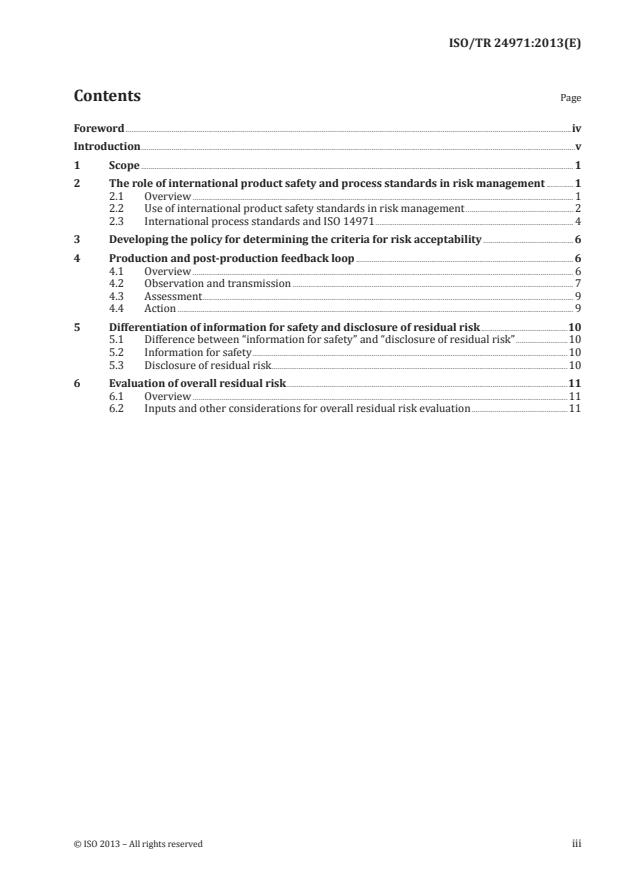
Contents Page
Foreword .iv
Introduction .v
1 Scope . 1
2 The role of international product safety and process standards in risk management .1
2.1 Overview . 1
2.2 Use of international product safety standards in risk management . 2
2.3 International process standards and ISO 14971 . 4
3 Developing the policy for determining the criteria for risk acceptability .6
4 Production and post-production feedback loop . 6
4.1 Overview . 6
4.2 Observation and transmission . 7
4.3 Assessment . 9
4.4 Action . 9
5 Differentiation of information for safety and disclosure of residual risk .10
5.1 Difference between “information for safety” and “disclosure of residual risk” .10
5.2 Information for safety .10
5.3 Disclosure of residual risk .10
6 Evaluation of overall residual risk .11
6.1 Overview .11
6.2 Inputs and other considerations for overall residual risk evaluation .11
ISO/TR 24971:2013(E)
Foreword
ISO (the International Organization for Standardization) is a worldwide federation of national standards
bodies (ISO member bodies). The work of preparing International Standards is normally carried out
through ISO technical committees. Each member body interested in a subject for which a technical
committee has been established has the right to be represented on that committee. International
organizations, governmental and non-governmental, in liaison with ISO, also take part in the work.
ISO collaborates closely with the International Electrotechnical Commission (IEC) on all matters of
electrotechnical standardization.
The procedures used to develop this document and those intended for its further maintenance are
described in the ISO/IEC Directives, Part 1. In particular the different approval criteria needed for the
different types of ISO documents should be noted. This document was drafted in accordance with the
editorial rules of the ISO/IEC Directives, Part 2. www.iso.org/directives
Attention is drawn to the possibility that some of the elements of this document may be the subject of
patent rights. ISO shall not be held responsible for identifying any or all such patent rights. Details of any
patent rights identified during the development of the document will be in the Introduction and/or on
the ISO list of patent declarations received. www.iso.org/patents
Any trade name used in this document is information given for the convenience of users and does not
constitute an endorsement.
ISO/TR 24971 was prepared jointly by Technical Committee ISO/TC 210, Quality management and
corresponding general aspects for medical devices, and Technical Committee IEC/SC 62A, Common aspects
of electrical equipment used in medical practice. The draft was circulated for voting to the national bodies
of both ISO and IEC.
iv © ISO 2013 – All rights reserved
ISO/TR 24971:2013(E)
Introduction
Experience indicates that manufacturers have difficulty with practical implementation of some clauses
of the risk management International Standard, ISO 14971:2007, Medical devices — Application of risk
management to medical devices. This Technical Report provides guidance to assist in the development,
implementation and maintenance of risk management for medical devices that aim to meet the
requirements of ISO 14971. It provides guidance for specific aspects of ISO 14971 for a wide variety
of medical devices. These medical devices include active, non-active, implantable, and non-implantable
medical devices and in vitro diagnostic medical devices.
This Technical Report is not intended to be an overall guidance document on the implementation of
ISO 14971 for organizations. It supplements the guidance contained in the informative annexes of
ISO 14971 related to the following areas.
— Guidance on the role of international product safety and process standards in risk management
— Guidance on developing the policy for determining the criteria for risk acceptability
— Guidance on how the production and post-production feedback loop can work
— Guidance on the differentiation of information for safety as a risk control measure and disclosure of
residual risk
— Guidance on the evaluation of overall residual risk
This Technical Report provides some approaches that an organization can use to implement and maintain
some aspects of a risk management system that conforms to ISO 14971. Alternative approaches can be
used if these satisfy the requirements of ISO 14971.
When judging the applicability of the guidance in this Technical Report, one should consider the nature
of the medical device(s) to which it will apply, the risks associated with the use of these medical devices,
and the applicable regulatory requirements.
TECHNICAL REPORT ISO/TR 24971:2013(E)
Medical devices — Guidance on the application of ISO 14971
1 Scope
This Technical Report provides guidance in addressing specific areas of ISO 14971 when implementing
risk management.
The guidance is intended to assist manufacturers and other users of the standard to:
— understand the role of international product safety and process standards in risk management;
— develop the policy for determining the criteria for risk acceptability;
— incorporate production and post-production feedback loop into risk management;
— differentiate between “information for safety” and “disclosure of residual risk”; and
— evaluate overall residual risk.
2 The role of international product safety and process standards in risk manage-
ment
2.1 Overview
International product safety and process standards play a significant role in risk management as
described by ISO 14971. In principle, these standards are developed using a type of risk management
that can include identifying hazards and hazardous situations, estimating risks, evaluating risks,
and specifying risk control measures. More information on a process for developing medical device
standards using a type of risk management can be found in documents such as ISO/IEC Guide 51 and
ISO/IEC Guide 63. International product safety and process standards are developed by experts in the
field and represent the generally accepted state of the art (see D.4 of ISO 14971:2007).
These standards can have an important role in risk management. When performing risk management,
the manufacturer first needs to consider the medical device being designed, its intended use and the
hazards/hazardous situations related to it. Manufacturers can, if they choose, identify standard(s) that
contain specific requirements that help manage the risks related to those hazards/hazardous situations.
For medical devices that satisfy the requirements and compliance criteria of these standards, the
residual risks related to those hazards/hazardous situations can be considered acceptable unless there
is objective evidence to the contrary. Some potential sources of objective evidence to the contrary can
include reports of adverse events, product recalls and complaints. The requirements of International
Standards, such as engineering or analytical processes, specific output limits, warning statements, or
design specifications, can be considered risk control measures established by the standards writers
that are intended to address the risks of specific hazardous situations that have been identified and
evaluated as needing risk control.
In many cases, the standards writers have taken on and completed elements of risk management
and provided manufacturers with answers in the form of design requirements and test methods for
establishing conformity. When performing risk management activities, manufacturers can take
advantage of the work of the standards writers and need not repeat the analyses leading to the
requirements of the standard. International standards, therefore, provide valuable information on risk
acceptability that has been validated during a worldwide evaluation process, including multiple rounds
of review, comment, and voting.
ISO/TR 24971:2013(E)
2.2 Use of international product safety standards in risk management
An international product safety standard can establish requirements that, when implemented, result in
acceptable risk for specific hazardous situations (e.g. safety limits). The manufacturer can apply these
requirements in the following way when managing risk.
a) Where an international product safety standard specifies technical requirements addressing
particular hazards or hazardous situations, together with specific acceptance criteria, compliance
with those requirements is presumed to establish that the residual risks have been reduced to
acceptable levels unless there is objective evidence to the contrary. For example, in IEC 60601-1,
Medical electrical equipment — Part 1: General requirements for basic safety and essential performance,
leakage current must be controlled to achieve an acceptable level of risk. IEC 60601-1 provides
leakage current limits that are considered to result in an acceptable level of risk when measured
under the conditions stated in 8.7 of IEC 60601-1:2005. For this example, further risk management
would not be necessary. The following steps need to be taken in this case.
1) Implement 4.2 and 4.3 of ISO 14971:2007 to identify characteristics related to safety and
identify hazards and hazardous situations associated with the device as completely as possible.
2) Identify those hazards and hazardous situations relevant to the particular medical device that
are exactly covered by the international product safety standard.
3) For those identified hazards and hazardous situations exactly covered by the international
product safety standard, the manufacturer may choose not to estimate (4.4 of ISO 14971:2007) or
evaluate (Clause 5 of ISO 14971:2007) the risks so identified but rather rely on the requirements
contained in the international standard to demonstrate the completion of risk estimation and
risk evaluation.
4) To the extent possible, the manufacturer should identify the design specifications that satisfy
the requirements in the standard and serve as risk control measures (6.2 of ISO 14971:2007).
NOTE For some international product safety standards, the possibility of identifying all the specific risk
control measures is limited. One example is electromagnetic compatibility testing in IEC 60601–1-2, Medical
electrical equipment — Part 1-2: General requirements for basic safety and essential performance — Collateral
standard: Electromagnetic compatibility — Requirements and tests, for complex medical devices.
5) Verification of the implementation of the risk control measures for these hazardous situations
is obtained from the design documents. Verification of the effectiveness of the risk control
measures is obtained from the tests and test results demonstrating that the device meets the
relevant requirements of the international product safety standard.
6) If the relevant requirements are met, the associated residual risk is considered acceptable.
b) Where an international product safety standard does not completely specify technical requirements
and associated tests and test acceptance criteria, the situation is more complex. In some cases, the
standard directs the manufacturer to perform specific tests related to known hazards or hazardous
situations but does not provide specific test acceptance criteria (e.g. IEC 60601-2-16, Medical
electrical equipment — Part 2-16: Particular requirements for basic safety and essential performance of
haemodialysis, haemodiafiltration and haemofiltration equipment). In some other cases, the standard
can simply direct the manufacturer to investigate specific hazards or hazardous situations in
their risk analysis (e.g. 10.2 of IEC 60601-1:2005). The range of alternatives is too large to provide
specific guidance on how to use such standards in the risk management process. Manufacturers
are encouraged, however, to use the content of such standards in their risk management of the
particular medical device.
c) For hazards or hazardous situations that are identified for the particular medical device but are
not specifically addressed in any standard, the manufacturer needs to address those hazards or
hazardous situations in the risk management process. The manufacturer is required to estimate
and evaluate the risks and, if necessary, control these risks (see 4.4 and Clauses 5 and 6 of
ISO 14971:2007).
2 © ISO 2013 – All rights reserved
ISO/TR 24971:2013(E)
See Figure 1 for a flowchart and an example outlining the use of international product safety standards.
Identify Hazards/Hazardous situations Hazardous situation identi€ied: patient (and medical device)
(H/HS)
needs to be transfered from one room to another; if put in
(4.3 of ISO 14971:2007).
transport position, equipment overbalances and patient falls
2 c) Input the identi€ied Are the H/HS
hazards and hazardous addressed in international
No Yes: IEC 60601-1:2005, Subclause 9.4.2.1
situations into the risk product safety
management process. standard(s)?
Yes
2 b) Use the identi€ied hazards,
hazardous situations, test How is it
methods, or other relevant 2 b) addressed? Choose between 2 a)
information in the risk 2 a) and 2 b).
management process.
2 a)
Yes: there is a speci€ied requirement:
2 a): International product
The equipment shall not overbalance when placed in any
safety standard speci€ies
transport position of normal use on a plane inclined at an angle
requirements and provides
of 10° from the horizontal plane, and speci€ic acceptance criteria
speci€ic test acceptance
(de€ined test). If the equipment overbalances, it does not comply
criteria.
with the requirement.
Use the identi€ied hazards,
Do
hazardous situations, test
requirement(s) fully match Yes, equipment is transportable, and it can be transported with
methods, or other relevant No
the design including the patient on it to accommodate patient transfers.
information in the risk
intended use?
management process.
Yes
No need to estimate (4.4) Risk is not estimated nor evaluated prior to implementation of
or evaluate risk (5) risk control measure.
Identify the design
speci€ications that achieve
Identi€ied in the risk management €ile
the requirement in the
standard (6.2).
Verify the effectiveness Test performed: equipment placed on a plane inclined at an
(6.3) by performing test(s) angle 10º from the horizontal plane. Result: medical device does
according to the standard. not overbalance
If the test is passed,
related residual risks Medical device does not overbalance, so the related residual risk
are considered is considered acceptable.
acceptable (6.4).
Figure 1 — Use of international product safety standards and example of such standard that
specifies requirements and provides specific test acceptance criteria
ISO/TR 24971:2013(E)
2.3 International process standards and ISO 14971
International process standards, as shown in the examples below, can often be used in conjunction with
ISO 14971. This is performed in one of two ways:
— The international process standard requires application of ISO 14971 as part of the implementation
of the international process standard, e.g. IEC 62304 on software life cycle processes; or
— The international process standard is intended to be used in risk management, e.g. IEC 62366 on
usability engineering and the ISO 10993 series on biological evaluation.
In either case, proper use of the international process standard requires attention to the interfaces
between that standard and ISO 14971 in order to achieve acceptable levels of risk for the medical device.
The two standards should work together such that inputs, outputs and their timing are optimized. Three
examples are given below to demonstrate this ideal situation.
a) IEC 62304, Medical device software — Software life cycle processes
The relationship between IEC 62304 and ISO 14971 is well-described in the introduction to IEC 62304:
As a basic foundation it is assumed that medical device software is developed and maintained
within a quality management system (see 4.1 of IEC 62304:2006) and a risk management process
(see 4.2 of IEC 62304:2006). The risk management process is already very well addressed by the
International Standard ISO 14971. Therefore IEC 62304 makes use of this advantage simply by a
normative reference to ISO 14971. Some minor additional risk management requirements are
needed for software, especially in the area of identification of contributing software factors related
to hazards. These requirements are summarized and captured in Clause 7 of IEC 62304:2006 as
the software risk management process.
Whether software is a contributing factor to a hazard is determined during the hazard identification
activity of the risk management process. hazards that could be indirectly caused by software
(for example, by providing misleading information that could cause inappropriate treatment to be
administered) need to be considered when determining whether software is a contributing factor.
The decision to use software to control risk is made during the risk control activity of the risk
management process. The software risk management process required in this standard has to
be embedded in the device risk management process according to ISO 14971.
IEC 62304 makes a normative reference to ISO 14971 and specifically requires:
— software development planning (5.1 of IEC 62304:2006) that is consistent with the risk
management plan required by ISO 14971; and
— a software risk management process (Clause 7 of IEC 62304:2006) based upon ISO 14971.
b) IEC 62366, Medical devices — Application of usability engineering to medical devices
The flow diagram in Figure A.1 of IEC 62366:2007 demonstrates the relationship and interconnection
of the two parallel and interconnecting processes. In addition to making a normative reference to
ISO 14971, IEC 62366:2007 identifies three specific clauses where the usability engineering process
can supplement and interact with risk management as described in ISO 14971:
— 5.3.1 of IEC 62366:2007 requires: “An identification of characteristics related to safety (part of
a risk analysis) that focuses on usability shall be performed according to ISO 14971:2007, 4.2.”
— 5.3.2 of IEC 62366:2007 requires: “The manufacturer shall identify known or foreseeable
hazards (part of a risk analysis) related to usability according to ISO 14971:2007, 4.3.”
— 5.9 of IEC 62366:2007 on Usability Validation makes several references to activities that would
be undertaken as part of risk management.
4 © ISO 2013 – All rights reserved
ISO/TR 24971:2013(E)
c) ISO 10993 (all parts), Biological evaluation of medical devices
The introduction to ISO 10993-1 states that ISO 10993-1 is intended to be a guidance document
for the biological evaluation of medical devices within risk management, as part of the overall
evaluation and development of each device.
Annex B of ISO 10993-1:2009 applies ISO 14971 to provide guidance on the risk management approach
for identification of biological hazards associated with medical devices, estimation and evaluation of
the risks, control of the risks, and monitoring the effectiveness of the risk control measures.
This approach combines the review and evaluation of existing data from all sources, with the
selection and application of additional tests (where necessary), thus enabling a full evaluation to be
made of the biological responses to each medical device, relevant to its safety in use.
ISO 10993-1:2009 aligns itself explicitly within risk management as described in ISO 14971.
The biological evaluation should be conducted in a manner similar to that used for other product
risks, and should include:
— Risk analysis (What are the hazards and associated risks?)
— Risk evaluation (Are they acceptable?)
— Risk control (How will they be controlled?)
— Overall residual risk/benefit evaluation
Following the processes defined in ISO 14971, if the overall residual risk evaluation concludes from
existing data that t
...
TECHNICAL ISO/TR
REPORT 24971
First edition
2013-07-01
Medical devices — Guidance on the
application of ISO 14971
Dispositifs médicaux — Directives relatives à l’ISO 14971
Reference number
ISO/TR 24971:2013(E)
©
ISO 2013
ISO/TR 24971:2013(E)
© ISO 2013
All rights reserved. Unless otherwise specified, no part of this publication may be reproduced or utilized otherwise in any form
or by any means, electronic or mechanical, including photocopying, or posting on the internet or an intranet, without prior
written permission. Permission can be requested from either ISO at the address below or ISO’s member body in the country of
the requester.
ISO copyright office
Case postale 56 • CH-1211 Geneva 20
Tel. + 41 22 749 01 11
Fax + 41 22 749 09 47
E-mail copyright@iso.org
Web www.iso.org
Published in Switzerland
ii © ISO 2013 – All rights reserved
ISO/TR 24971:2013(E)
Contents Page
Foreword .iv
Introduction .v
1 Scope . 1
2 The role of international product safety and process standards in risk management .1
2.1 Overview . 1
2.2 Use of international product safety standards in risk management . 2
2.3 International process standards and ISO 14971 . 4
3 Developing the policy for determining the criteria for risk acceptability .6
4 Production and post-production feedback loop . 6
4.1 Overview . 6
4.2 Observation and transmission . 7
4.3 Assessment . 9
4.4 Action . 9
5 Differentiation of information for safety and disclosure of residual risk .10
5.1 Difference between “information for safety” and “disclosure of residual risk” .10
5.2 Information for safety .10
5.3 Disclosure of residual risk .10
6 Evaluation of overall residual risk .11
6.1 Overview .11
6.2 Inputs and other considerations for overall residual risk evaluation .11
ISO/TR 24971:2013(E)
Foreword
ISO (the International Organization for Standardization) is a worldwide federation of national standards
bodies (ISO member bodies). The work of preparing International Standards is normally carried out
through ISO technical committees. Each member body interested in a subject for which a technical
committee has been established has the right to be represented on that committee. International
orga nizations, governmental and non-governmental, in liaison with ISO, also take part in the work.
ISO collaborates closely with the International Electrotechnical Commission (IEC) on all matters of
electrotechnical standardization.
The procedures used to develop this document and those intended for its further maintenance are
described in the ISO/IEC Directives, Part 1. In particular the different approval criteria needed for the
different types of ISO documents should be noted. This document was drafted in accordance with the
editorial rules of the ISO/IEC Directives, Part 2. www.iso.org/directives
Attention is drawn to the possibility that some of the elements of this document may be the subject of
patent rights. ISO shall not be held responsible for identifying any or all such patent rights. Details of any
patent rights identified during the development of the document will be in the Introduction and/or on
the ISO list of patent declarations received. www.iso.org/patents
Any trade name used in this document is information given for the convenience of users and does not
constitute an endorsement.
ISO/TR 24971 was prepared jointly by Technical Committee ISO/TC 210, Quality management and
corresponding general aspects for medical devices, and Technical Committee IEC/SC 62A, Common aspects
of electrical equipment used in medical practice. The draft was circulated for voting to the national bodies
of both ISO and IEC.
iv © ISO 2013 – All rights reserved
ISO/TR 24971:2013(E)
Introduction
Experience indicates that manufacturers have difficulty with practical implementation of some clauses
of the risk management International Standard, ISO 14971:2007, Medical devices — Application of risk
management to medical devices. This Technical Report provides guidance to assist in the development,
implementation and maintenance of risk management for medical devices that aim to meet the
requirements of ISO 14971. It provides guidance for specific aspects of ISO 14971 for a wide variety
of medical devices. These medical devices include active, non-active, implantable, and non-implantable
medical devices and in vitro diagnostic medical devices.
This Technical Report is not intended to be an overall guidance document on the implementation of
ISO 14971 for organizations. It supplements the guidance contained in the informative annexes of
ISO 14971 related to the following areas.
— Guidance on the role of international product safety and process standards in risk management
— Guidance on developing the policy for determining the criteria for risk acceptability
— Guidance on how the production and post-production feedback loop can work
— Guidance on the differentiation of information for safety as a risk control measure and disclosure of
residual risk
— Guidance on the evaluation of overall residual risk
This Technical Report provides some approaches that an organization can use to implement and maintain
some aspects of a risk management system that conforms to ISO 14971. Alternative approaches can be
used if these satisfy the requirements of ISO 14971.
When judging the applicability of the guidance in this Technical Report, one should consider the nature
of the medical device(s) to which it will apply, the risks associated with the use of these medical devices,
and the applicable regulatory requirements.
TECHNICAL REPORT ISO/TR 24971:2013(E)
Medical devices — Guidance on the application of ISO 14971
1 Scope
This Technical Report provides guidance in addressing specific areas of ISO 14971 when implementing
risk management.
The guidance is intended to assist manufacturers and other users of the standard to:
— understand the role of international product safety and process standards in risk management;
— develop the policy for determining the criteria for risk acceptability;
— incorporate production and post-production feedback loop into risk management;
— differentiate between “information for safety” and “disclosure of residual risk”; and
— evaluate overall residual risk.
2 The role of international product safety and process standards in risk manage-
ment
2.1 Overview
International product safety and process standards play a significant role in risk management as
described by ISO 14971. In principle, these standards are developed using a type of risk management
that can include identifying hazards and hazardous situations, estimating risks, evaluating risks,
and specifying risk control measures. More information on a process for developing medical device
standards using a type of risk management can be found in documents such as ISO/IEC Guide 51 and
ISO/IEC Guide 63. International product safety and process standards are developed by experts in the
field and represent the generally accepted state of the art (see D.4 of ISO 14971:2007).
These standards can have an important role in risk management. When performing risk management,
the manufacturer first needs to consider the medical device being designed, its intended use and the
hazards/hazardous situations related to it. Manufacturers can, if they choose, identify standard(s) that
contain specific requirements that help manage the risks related to those hazards/hazardous situations.
For medical devices that satisfy the requirements and compliance criteria of these standards, the
residual risks related to those hazards/hazardous situations can be considered acceptable unless there
is objective evidence to the contrary. Some potential sources of objective evidence to the contrary can
include reports of adverse events, product recalls and complaints. The requirements of International
Standards, such as engineering or analytical processes, specific output limits, warning statements, or
design specifications, can be considered risk control measures established by the standards writers
that are intended to address the risks of specific hazardous situations that have been identified and
evaluated as needing risk control.
In many cases, the standards writers have taken on and completed elements of risk management
and provided manufacturers with answers in the form of design requirements and test methods for
establishing conformity. When performing risk management activities, manufacturers can take
advantage of the work of the standards writers and need not repeat the analyses leading to the
requirements of the standard. International standards, therefore, provide valuable information on risk
acceptability that has been validated during a worldwide evaluation process, including multiple rounds
of review, comment, and voting.
ISO/TR 24971:2013(E)
2.2 Use of international product safety standards in risk management
An international product safety standard can establish requirements that, when implemented, result in
acceptable risk for specific hazardous situations (e.g. safety limits). The manufacturer can apply these
requirements in the following way when managing risk.
a) Where an international product safety standard specifies technical requirements addressing
particular hazards or hazardous situations, together with specific acceptance criteria, compliance
with those requirements is presumed to establish that the residual risks have been reduced to
acceptable levels unless there is objective evidence to the contrary. For example, in IEC 60601-1,
Medical electrical equipment — Part 1: General requirements for basic safety and essential performance,
leakage current must be controlled to achieve an acceptable level of risk. IEC 60601-1 provides
leakage current limits that are considered to result in an acceptable level of risk when measured
under the conditions stated in 8.7 of IEC 60601-1:2005. For this example, further risk management
would not be necessary. The following steps need to be taken in this case.
1) Implement 4.2 and 4.3 of ISO 14971:2007 to identify characteristics related to safety and
identify hazards and hazardous situations associated with the device as completely as possible.
2) Identify those hazards and hazardous situations relevant to the particular medical device that
are exactly covered by the international product safety standard.
3) For those identified hazards and hazardous situations exactly covered by the international
product safety standard, the manufacturer may choose not to estimate (4.4 of ISO 14971:2007) or
evaluate (Clause 5 of ISO 14971:2007) the risks so identified but rather rely on the requirements
contained in the international standard to demonstrate the completion of risk estimation and
risk evaluation.
4) To the extent possible, the manufacturer should identify the design specifications that satisfy
the requirements in the standard and serve as risk control measures (6.2 of ISO 14971:2007).
NOTE For some international product safety standards, the possibility of identifying all the specific risk
control measures is limited. One example is electromagnetic compatibility testing in IEC 60601–1-2, Medical
electrical equipment — Part 1-2: General requirements for basic safety and essential performance — Collateral
standard: Electromagnetic compatibility — Requirements and tests, for complex medical devices.
5) Verification of the implementation of the risk control measures for these hazardous situations
is obtained from the design documents. Verification of the effectiveness of the risk control
measures is obtained from the tests and test results demonstrating that the device meets the
relevant requirements of the international product safety standard.
6) If the relevant requirements are met, the associated residual risk is considered acceptable.
b) Where an international product safety standard does not completely specify technical requirements
and associated tests and test acceptance criteria, the situation is more complex. In some cases, the
standard directs the manufacturer to perform specific tests related to known hazards or hazardous
situations but does not provide specific test acceptance criteria (e.g. IEC 60601-2-16, Medical
electrical equipment — Part 2-16: Particular requirements for basic safety and essential performance of
haemodialysis, haemodiafiltration and haemofiltration equipment). In some other cases, the standard
can simply direct the manufacturer to investigate specific hazards or hazardous situations in
their risk analysis (e.g. 10.2 of IEC 60601-1:2005). The range of alternatives is too large to provide
specific guidance on how to use such standards in the risk management process. Manufacturers
are encouraged, however, to use the content of such standards in their risk management of the
particular medical device.
c) For hazards or hazardous situations that are identified for the particular medical device but are
not specifically addressed in any standard, the manufacturer needs to address those hazards or
hazardous situations in the risk management process. The manufacturer is required to estimate
and evaluate the risks and, if necessary, control these risks (see 4.4 and Clauses 5 and 6 of
ISO 14971:2007).
2 © ISO 2013 – All rights reserved
ISO/TR 24971:2013(E)
See Figure 1 for a flowchart and an example outlining the use of international product safety standards.
Identify Hazards/Hazardous situations Hazardous situation identi€ied: patient (and medical device)
(H/HS)
needs to be transfered from one room to another; if put in
(4.3 of ISO 14971:2007).
transport position, equipment overbalances and patient falls
2 c) Input the identi€ied Are the H/HS
hazards and hazardous addressed in international
No Yes: IEC 60601-1:2005, Subclause 9.4.2.1
situations into the risk product safety
management process. standard(s)?
Yes
2 b) Use the identi€ied hazards,
hazardous situations, test How is it
methods, or other relevant 2 b) addressed? Choose between 2 a)
information in the risk 2 a) and 2 b).
management process.
2 a)
Yes: there is a speci€ied requirement:
2 a): International product
The equipment shall not overbalance when placed in any
safety standard speci€ies
transport position of normal use on a plane inclined at an angle
requirements and provides
of 10° from the horizontal plane, and speci€ic acceptance criteria
speci€ic test acceptance
(de€ined test). If the equipment overbalances, it does not comply
criteria.
with the requirement.
Use the identi€ied hazards,
Do
hazardous situations, test
requirement(s) fully match Yes, equipment is transportable, and it can be transported with
methods, or other relevant No
the design including the patient on it to accommodate patient transfers.
information in the risk
intended use?
management process.
Yes
No need to estimate (4.4) Risk is not estimated nor evaluated prior to implementation of
or evaluate risk (5) risk control measure.
Identify the design
speci€ications that achieve
Identi€ied in the risk management €ile
the requirement in the
standard (6.2).
Verify the effectiveness Test performed: equipment placed on a plane inclined at an
(6.3) by performing test(s) angle 10º from the horizontal plane. Result: medical device does
according to the standard. not overbalance
If the test is passed,
related residual risks Medical device does not overbalance, so the related residual risk
are considered is considered acceptable.
acceptable (6.4).
Figure 1 — Use of international product safety standards and example of such standard that
specifies requirements and provides specific test acceptance criteria
ISO/TR 24971:2013(E)
2.3 International process standards and ISO 14971
International process standards, as shown in the examples below, can often be used in conjunction with
ISO 14971. This is performed in one of two ways:
— The international process standard requires application of ISO 14971 as part of the implementation
of the international process standard, e.g. IEC 62304 on software life cycle processes; or
— The international process standard is intended to be used in risk management, e.g. IEC 62366 on
usability engineering and the ISO 10993 series on biological evaluation.
In either case, proper use of the international process standard requires attention to the interfaces
between that standard and ISO 14971 in order to achieve acceptable levels of risk for the medical device.
The two standards should work together such that inputs, outputs and their timing are optimized. Three
examples are given below to demonstrate this ideal situation.
a) IEC 62304, Medical device software — Software life cycle processes
The relationship between IEC 62304 and ISO 14971 is well-described in the introduction to IEC 62304:
As a basic foundation it is assumed that medical device software is developed and maintained
within a quality management system (see 4.1 of IEC 62304:2006) and a risk management process
(see 4.2 of IEC 62304:2006). The risk management process is already very well addressed by the
International Standard ISO 14971. Therefore IEC 62304 makes use of this advantage simply by a
normative reference to ISO 14971. Some minor additional risk management requirements are
needed for software, especially in the area of identification of contributing software factors related
to hazards. These requirements are summarized and captured in Clause 7 of IEC 62304:2006 as
the software risk management process.
Whether software is a contributing factor to a hazard is determined during the hazard identification
activity of the risk management process. hazards that could be indirectly caused by software
(for example, by providing misleading information that could cause inappropriate treatment to be
administered) need to be considered when determining whether software is a contributing factor.
The decision to use software to control risk is made during the risk control activity of the risk
management process. The software risk management process required in this standard has to
be embedded in the device risk management process according to ISO 14971.
IEC 62304 makes a normative reference to ISO 14971 and specifically requires:
— software development planning (5.1 of IEC 62304:2006) that is consistent with the risk
management plan required by ISO 14971; and
— a software risk management process (Clause 7 of IEC 62304:2006) based upon ISO 14971.
b) IEC 62366, Medical devices — Application of usability engineering to medical devices
The flow diagram in Figure A.1 of IEC 62366:2007 demonstrates the relationship and interconnection
of the two parallel and interconnecting processes. In addition to making a normative reference to
ISO 14971, IEC 62366:2007 identifies three specific clauses where the usability engineering process
can supplement and interact with risk management as described in ISO 14971:
— 5.3.1 of IEC 62366:2007 requires: “An identification of characteristics related to safety (part of
a risk analysis) that focuses on usability shall be performed according to ISO 14971:2007, 4.2.”
— 5.3.2 of IEC 62366:2007 requires: “The manufacturer shall identify known or foreseeable
hazards (part of a risk analysis) related to usability according to ISO 14971:2007, 4.3.”
— 5.9 of IEC 62366:2007 on Usability Validation makes several references to activities that would
be undertaken as part of risk management.
4 © ISO 2013 – All rights reserved
ISO/TR 24971:2013(E)
c) ISO 10993 (all parts), Biological evaluation of medical devices
The introduction to ISO 10993-1 states that ISO 10993-1 is intended to be a guidance document
for the biological evaluation of medical devices within risk management, as part of the overall
evaluation and development of each device.
Annex B of ISO 10993-1:2009 applies ISO 14971 to provide guidance on the risk management approach
for identification of biological hazards associated with medical devices, estimation and evaluation of
the risks, control of the risks, and monitoring the effectiveness of the risk control measures.
This approach combines the review and evaluation of existing data from all sources, with the
selection and application of additional tests (where necessary), thus enabling a full evaluation to be
made of the biological responses to each medical device, relevant to its safety in use.
ISO 10993-1:2009 aligns itself explicitly within risk management as described in ISO 14971.
The biological evaluation should be conducted in a manner similar to that used for other product
risks, and should include:
— Risk analysis (What are the hazards and associated risks?)
— Risk evaluation (Are they acceptable?)
— Risk control (How will they be controlled?)
— Overall residual risk/benefit evaluation
Following the processes defined in ISO 14971, if the overall residual risk evaluation concludes f
...