

IEC 60519-4:1995
(Main)Safety in electroheat installations - Part 4: Particular requirements for arc furnace installations
General Information
- Abstract
Applies in particular to direct arc furnaces and submerged arc furnaces (or arc resistance furnaces). Applies to that part of the installation which is situated on the output side of the furnace feeding transformer. This publication has the status of a report.
- Status
- Published
- Publication Date
- 17-Apr-2000
- Technical Committee
- TC 27 - Industrial electroheating and electromagnetic processing
- Drafting Committee
- WG 7 - TC 27/WG 7
- Current Stage
- DELPUB - Deleted Publication
- Start Date
- 16-Aug-2006
- Completion Date
- 28-Aug-2026
Overview
IEC 60519-4:1995, titled "Safety in Electroheat Installations - Part 4: Particular Requirements for Arc Furnace Installations," is an international standard published by the International Electrotechnical Commission (IEC). This standard specifically addresses safety requirements for arc furnace installations, including direct arc furnaces and submerged arc furnaces (also known as arc resistance furnaces). It applies particularly to the section of the installation situated on the output side of the furnace feeding transformer.
As part of the broader IEC 60519 series on electroheat installations, this standard supplements general safety guidelines with particular rules tailored to the unique risks and operational characteristics of arc furnace systems. The document aims to enhance equipment safety, protect personnel, and prevent hazards such as electric shock, overcurrent, thermal effects, and fire.
Key Topics
Scope and Applicability:
- Focused on direct arc furnaces, submerged arc furnaces, ladle arc heating furnaces, and indirect arc heating furnaces.
- Applies to installations on the output side of the furnace feeding transformer.
General and Specific Safety Requirements:
- Prohibition of using earth as part of an active circuit to prevent electric shock risks.
- Protection measures against overcurrent and overvoltage to ensure electrical stability and equipment longevity.
- Mandatory isolation, switching, and sectioning protocols to facilitate maintenance and emergency procedures.
Electrical and Thermal Protection:
- Comprehensive protection against electric shocks for workforce safety.
- Thermal safeguards addressing risks posed by high operating temperatures and thermal effects around arc furnaces.
Fire and Explosion Risk Mitigation:
- Safety measures aimed at reducing ignition hazards in installation environments prone to heat and electrical arc exposure.
Marking, Labelling, and Documentation:
- Clear indications and circuit diagrams to support safe operation, maintenance, and emergency response.
Installation, Inspection, and Maintenance:
- Guidelines to ensure proper commissioning, ongoing operation, and regular maintenance of arc furnace installations.
Additional Safety Systems (Annexes A & B):
- Annex A details systems designed to improve personnel safety near energized electrodes or live parts.
- Annex B addresses safety requirements concerning non-electrical components of furnace installations.
Classification Frameworks:
- Classification of electrothermal equipment according to voltage and frequency bands, integral for applying suitable safety measures.
Applications
IEC 60519-4 is crucial for:
Industrial Electroheat Installations: Manufacturers and operators of arc furnace systems rely on this standard to ensure safe and compliant design, installation, and operational procedures.
Safety Engineering and Risk Management: Safety professionals use the standard as a benchmark to identify and control electrical, thermal, and fire hazards in arc furnace environments.
Equipment Manufacturers: Design of transformers, control systems, switching devices, and related components for arc furnace installations must align with these safety requirements.
Maintenance and Inspection Teams: Provides detailed protocols to uphold safety standards during inspection, testing, and preventive maintenance activities.
By adhering to this standard, industries can reduce workplace accidents related to arc furnace operations and ensure compliance with international safety expectations.
Related Standards
IEC 60519-4 should be used in conjunction with other pertinent standards for comprehensive safety management:
IEC 60519-1: General Requirements for Safety in Electroheat Installations - provides foundational safety principles applicable across all electroheating equipment.
IEC 60050(841): International Electrotechnical Vocabulary - Electroheat Terminology, supporting correct use of technical terms and definitions.
IEC 60364 series: Electrical Installations in Buildings - Safety protections against overcurrent, electric shock, and installation practices.
IEC 60479-1: Effects of Current on Human Beings and Livestock - guidelines related to electric shock risks.
IEC 60073 / IEC 60027 / IEC 60417 / IEC 60617: Standards on coding, graphical symbols, and labelling used on electrical equipment and diagrams.
Together, these standards create a comprehensive framework to achieve both safety and operational efficiency in electroheat and arc furnace installations.
By following IEC 60519-4:1995, industries handling arc furnace installations can systematically manage risks associated with high-voltage electrothermal processes, thereby protecting personnel, equipment, and assets while ensuring compliance with internationally recognized safety practices. This supports safer industrial environments and fosters trust in electroheat technologies worldwide.
Relations
- Effective Date
- 05-Sep-2023
- Effective Date
- 05-Sep-2023
Get Certified
Connect with accredited certification bodies for this standard

DVS-ZERT GmbH
German welding certification society.
CARES (UK Certification Authority for Reinforcing Steels)
UK certification for reinforcing steels and construction.
EWF/IIW (European/International Welding Federation)
International welding personnel certification.
Sponsored listings
Frequently Asked Questions
IEC 60519-4:1995 is a standard published by the International Electrotechnical Commission (IEC). Its full title is "Safety in electroheat installations - Part 4: Particular requirements for arc furnace installations". This standard covers: Applies in particular to direct arc furnaces and submerged arc furnaces (or arc resistance furnaces). Applies to that part of the installation which is situated on the output side of the furnace feeding transformer. This publication has the status of a report.
Applies in particular to direct arc furnaces and submerged arc furnaces (or arc resistance furnaces). Applies to that part of the installation which is situated on the output side of the furnace feeding transformer. This publication has the status of a report.
IEC 60519-4:1995 is classified under the following ICS (International Classification for Standards) categories: 25.180.10 - Electric furnaces. The ICS classification helps identify the subject area and facilitates finding related standards.
IEC 60519-4:1995 has the following relationships with other standards: It is inter standard links to IEC 60519-4:1995/AMD1:2000, IEC 60519-4:2006. Understanding these relationships helps ensure you are using the most current and applicable version of the standard.
IEC 60519-4:1995 is available in PDF format for immediate download after purchase. The document can be added to your cart and obtained through the secure checkout process. Digital delivery ensures instant access to the complete standard document.
Standards Content (Sample)
NORME CEI
INTERNATIONALE IEC
60519-4
INTERNATIONAL
Edition 2.1
STANDARD
2000-04
Edition 2:1995 consolidée par l'amendement 1:2000
Edition 2:1995 consolidated with amendment 1:2000
Sécurité dans les installations électrothermiques –
Partie 4:
Règles particulières pour les installations
des fours à arc
Safety in electroheat installations –
Part 4:
Particular requirements for arc furnace
installations
Numéro de référence
Reference number
CEI/IEC 60519-4:1995+A1:2000
Numéros des publications Numbering
Depuis le 1er janvier 1997, les publications de la CEI As from 1 January 1997 all IEC publications are
sont numérotées à partir de 60000. issued with a designation in the 60000 series.
Publications consolidées Consolidated publications
Les versions consolidées de certaines publications de Consolidated versions of some IEC publications
la CEI incorporant les amendements sont disponibles. including amendments are available. For example,
Par exemple, les numéros d’édition 1.0, 1.1 et 1.2 edition numbers 1.0, 1.1 and 1.2 refer, respectively, to
indiquent respectivement la publication de base, la the base publication, the base publication incor-
publication de base incorporant l’amendement 1, et la porating amendment 1 and the base publication
publication de base incorporant les amendements 1 incorporating amendments 1 and 2.
et 2.
Validité de la présente publication Validity of this publication
Le contenu technique des publications de la CEI est The technical content of IEC publications is kept
constamment revu par la CEI afin qu'il reflète l'état under constant review by the IEC, thus ensuring that
actuel de la technique. the content reflects current technology.
Des renseignements relatifs à la date de reconfir- Information relating to the date of the reconfirmation
mation de la publication sont disponibles dans le of the publication is available in the IEC catalogue.
Catalogue de la CEI.
Les renseignements relatifs à des questions à l’étude et Information on the subjects under consideration and
des travaux en cours entrepris par le comité technique work in progress undertaken by the technical
qui a établi cette publication, ainsi que la liste des committee which has prepared this publication, as well
publications établies, se trouvent dans les documents ci- as the list of publications issued, is to be found at the
dessous: following IEC sources:
• «Site web» de la CEI* • IEC web site*
• Catalogue des publications de la CEI • Catalogue of IEC publications
Publié annuellement et mis à jour Published yearly with regular updates
régulièrement (On-line catalogue)*
(Catalogue en ligne)*
• Bulletin de la CEI
• IEC Bulletin
Disponible à la fois au «site web» de la CEI*
Available both at the IEC web site* and
et comme périodique imprimé
as a printed periodical
Terminologie, symboles graphiques
Terminology, graphical and letter
et littéraux
symbols
En ce qui concerne la terminologie générale, le lecteur
For general terminology, readers are referred to
se reportera à la CEI 60050: Vocabulaire Electro-
IEC 60050: International Electrotechnical Vocabulary
technique International (VEI).
(IEV).
Pour les symboles graphiques, les symboles littéraux
For graphical symbols, and letter symbols and signs
et les signes d'usage général approuvés par la CEI, le
approved by the IEC for general use, readers are
lecteur consultera la CEI 60027: Symboles littéraux à
referred to publications IEC 60027: Letter symbols to
utiliser en électrotechnique, la CEI 60417: Symboles
be used in electrical technology, IEC 60417: Graphical
graphiques utilisables sur le matériel. Index, relevé et
symbols for use on equipment. Index, survey and
compilation des feuilles individuelles, et la CEI 60617:
compilation of the single sheets and IEC 60617:
Symboles graphiques pour schémas.
Graphical symbols for diagrams.
* Voir adresse «site web» sur la page de titre.
* See web site address on title page.
NORME CEI
INTERNATIONALE IEC
60519-4
INTERNATIONAL
Edition 2.1
STANDARD
2000-04
Edition 2:1995 consolidée par l'amendement 1:2000
Edition 2:1995 consolidated with amendment 1:2000
Sécurité dans les installations électrothermiques –
Partie 4:
Règles particulières pour les installations
des fours à arc
Safety in electroheat installations –
Part 4:
Particular requirements for arc furnace
installations
IEC 2000 Droits de reproduction réservés Copyright - all rights reserved
Aucune partie de cette publication ne peut être reproduite ni No part of this publication may be reproduced or utilized in
utilisée sous quelque forme que ce soit et par aucun procédé, any form or by any means, electronic or mechanical,
électronique ou mécanique, y compris la photocopie et les including photocopying and microfilm, without permission in
microfilms, sans l'accord écrit de l'éditeur. writing from the publisher.
International Electrotechnical Commission 3, rue de Varembé Geneva, Switzerland
Telefax: +41 22 919 0300 e-mail: inmail@iec.ch IEC web site http://www.iec.ch
CODE PRIX
Commission Electrotechnique Internationale
Q
PRICE CODE
International Electrotechnical Commission
Pour prix, voir catalogue en vigueur
For price, see current catalogue
©
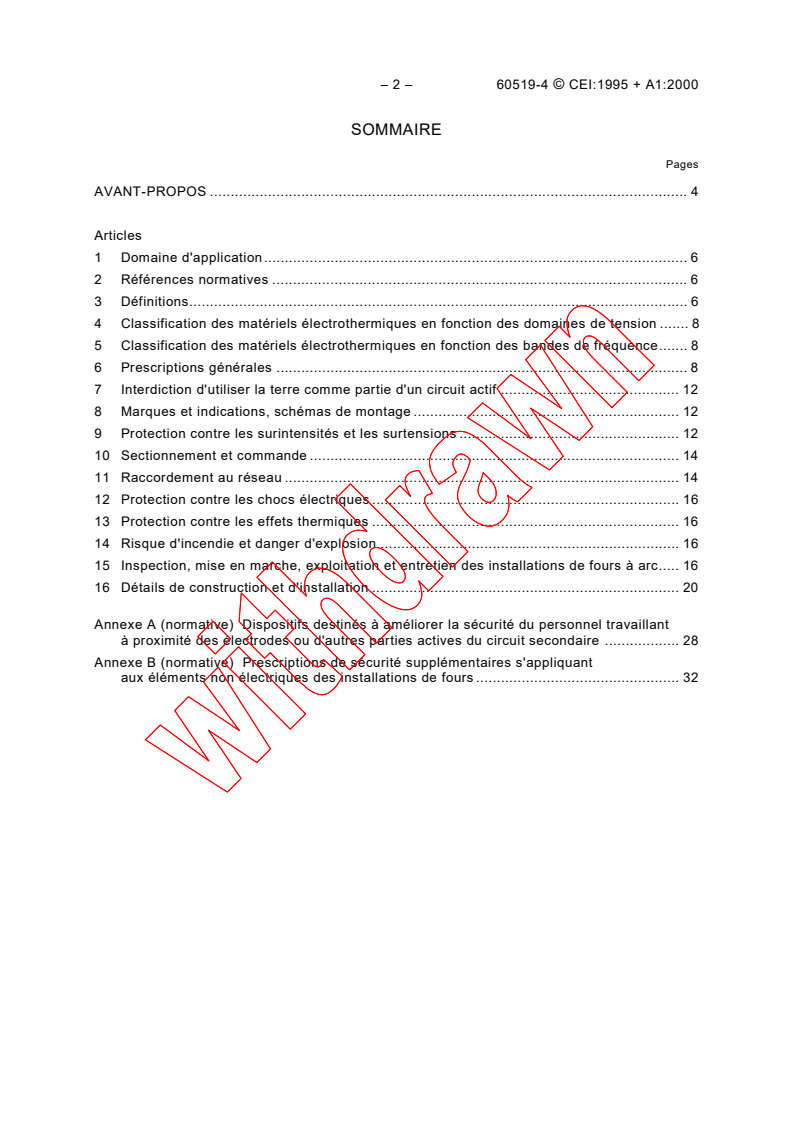
– 2 – 60519-4 CEI:1995 + A1:2000
SOMMAIRE
Pages
AVANT-PROPOS . 4
Articles
1 Domaine d'application. 6
2 Références normatives . 6
3 Définitions. 6
4 Classification des matériels électrothermiques en fonction des domaines de tension . 8
5 Classification des matériels électrothermiques en fonction des bandes de fréquence. 8
6 Prescriptions générales . 8
7 Interdiction d'utiliser la terre comme partie d'un circuit actif . 12
8 Marques et indications, schémas de montage . 12
9 Protection contre les surintensités et les surtensions . 12
10 Sectionnement et commande . 14
11 Raccordement au réseau . 14
12 Protection contre les chocs électriques . 16
13 Protection contre les effets thermiques . 16
14 Risque d'incendie et danger d'explosion . 16
15 Inspection, mise en marche, exploitation et entretien des installations de fours à arc. 16
16 Détails de construction et d'installation . 20
Annexe A (normative) Dispositifs destinés à améliorer la sécurité du personnel travaillant
à proximité des électrodes ou d'autres parties actives du circuit secondaire . 28
Annexe B (normative) Prescriptions de sécurité supplémentaires s'appliquant
aux éléments non électriques des installations de fours . 32
60519-4 IEC:1995 + A1:2000 – 3 –
CONTENTS
Page
FOREWORD . 5
Clause
1 Scope. 7
2 Normative references . 7
3 Definitions . 7
4 Classification of electroheat equipment according to voltage bands. 9
5 Classification of electroheat equipment according to frequency bands. 9
6 General requirements. 9
7 Prohibition of the use of earth as part of an active circuit. 13
8 Marking inscriptions, labelling and circuit diagrams . 13
9 Protection against overcurrent and overvoltage . 13
10 Isolation and switching . 15
11 Connections to the supply network . 15
12 Protection against electric shock . 17
13 Protection against thermal influences . 17
14 Risk of fire and danger of explosion. 17
15 Inspection commissioning, utilization and maintenance of arc furnace installations. 17
16 Design requirements . 21
Annex A (normative) Systems assuring improved safety to personnel working
in the vicinity of electrodes and other live parts of secondary circuit . 29
Annex B (normative) Additional requirements for the safety of non-electrical components
of furnace installations . 33
©
– 4 – 60519-4 CEI:1995 + A1:2000
COMMISSION ÉLECTROTECHNIQUE INTERNATIONALE
___________
SÉCURITÉ DANS LES INSTALLATIONS ÉLECTROTHERMIQUES –
Partie 4: Règles particulières pour les installations des fours à arc
AVANT-PROPOS
1) La CEI (Commission Électrotechnique Internationale) est une organisation mondiale de normalisation
composée de l'ensemble des comités électrotechniques nationaux (Comités nationaux de la CEI). La CEI a
pour objet de favoriser la coopération internationale pour toutes les questions de normalisation dans les
domaines de l'électricité et de l'électronique. A cet effet, la CEI, entre autres activités, publie des Normes
internationales. Leur élaboration est confiée à des comités d'études, aux travaux desquels tout Comité national
intéressé par le sujet traité peut participer. Les organisations internationales, gouvernementales et non
gouvernementales, en liaison avec la CEI, participent également aux travaux. La CEI collabore étroitement
avec l'Organisation Internationale de Normalisation (ISO), selon des conditions fixées par accord entre les
deux organisations.
2) Les décisions ou accords officiels de la CEI concernant les questions techniques représentent, dans la mesure
du possible, un accord international sur les sujets étudiés, étant donné que les Comités nationaux intéressés
sont représentés dans chaque comité d’études.
3) Les documents produits se présentent sous la forme de recommandations internationales. Ils sont publiés
comme normes, spécifications techniques, rapports techniques ou guides et agréés comme tels par les
Comités nationaux.
4) Dans le but d'encourager l'unification internationale, les Comités nationaux de la CEI s'engagent à appliquer de
façon transparente, dans toute la mesure possible, les Normes internationales de la CEI dans leurs normes
nationales et régionales. Toute divergence entre la norme de la CEI et la norme nationale ou régionale
correspondante doit être indiquée en termes clairs dans cette dernière.
5) La CEI n’a fixé aucune procédure concernant le marquage comme indication d’approbation et sa responsabilité
n’est pas engagée quand un matériel est déclaré conforme à l’une de ses normes.
6) L’attention est attirée sur le fait que certains des éléments de la présente Norme internationale peuvent faire
l’objet de droits de propriété intellectuelle ou de droits analogues. La CEI ne saurait être tenue pour
responsable de ne pas avoir identifié de tels droits de propriété et de ne pas avoir signalé leur existence.
La Norme internationale CEI 60519-4 a été établie par le comité d'études 27 de la CEI:
Chauffage électrique industriel.
Cette deuxième édition annule et remplace la première édition parue en 1977.
La présente partie de la CEI 60519 doit être lue conjointement avec la CEI 60519-1,
deuxième édition. Elle est destinée à modifier, remplacer ou apporter des compléments à la
CEI 60519-1, à l'aide de prescriptions particulières concernant les installations de fours à arc.
La présente version consolidée de la CEI 60519-4 est issue de la deuxième édition (1995)
[documents 27(BC)104 et 27(BC)109] et de son amendement 1 (2000) [documents
27/235/FDIS et 27/240/RVD].
Elle porte le numéro d'édition 2.1.
Une ligne verticale dans la marge indique où la publication de base a été modifiée par
l'amendement 1.
Les annexes A et B font partie intégrante de cette norme.
60519-4 IEC:1995 + A1:2000 – 5 –
INTERNATIONAL ELECTROTECHNICAL COMMISSION
___________
SAFETY IN ELECTROHEAT INSTALLATIONS –
Part 4: Particular requirements for arc furnace installations
FOREWORD
1) The IEC (International Electrotechnical Commission) is a worldwide organization for standardization comprising
all national electrotechnical committees (IEC National Committees). The object of the IEC is to promote
international co-operation on all questions concerning standardization in the electrical and electronic fields. To
this end and in addition to other activities, the IEC publishes International Standards. Their preparation is
entrusted to technical committees; any IEC National Committee interested in the subject dealt with may
participate in this preparatory work. International, governmental and non-governmental organizations liaising
with the IEC also participate in this preparation. The IEC collaborates closely with the International
Organization for Standardization (ISO) in accordance with conditions determined by agreement between the
two organizations.
2) The formal decisions or agreements of the IEC on technical matters express, as nearly as possible, an
international consensus of opinion on the relevant subjects since each technical committee has representation
from all interested National Committees.
3) The documents produced have the form of recommendations for international use and are published in the form
of standards, technical specifications, technical reports or guides and they are accepted by the National
Committees in that sense.
4) In order to promote international unification, IEC National Committees undertake to apply IEC International
Standards transparently to the maximum extent possible in their national and regional standards. Any
divergence between the IEC Standard and the corresponding national or regional standard shall be clearly
indicated in the latter.
5) The IEC provides no marking procedure to indicate its approval and cannot be rendered responsible for any
equipment declared to be in conformity with one of its standards.
6) Attention is drawn to the possibility that some of the elements of this International Standard may be the subject
of patent rights. The IEC shall not be held responsible for identifying any or all such patent rights.
International Standard IEC 60519-4 has been prepared by IEC technical committee 27:
Industrial electroheating equipment.
This second edition cancels and replaces the first edition published in 1977.
This part of IEC 60519 shall be read in conjunction with IEC 60519-1, 2nd edition. It is
intended to modify, replace or make additions to IEC 60519-1 for particular requirements
concerning arc furnace installations.
This consolidated version of IEC 60519-4 is based on the second edition (1995) [documents
27(CO)104 and 27(CO)109] and its amendment 1 (2000) [documents 27/235/FDIS and
27/240/RVD].
It bears the edition number 2.1.
A vertical line in the margin shows where the base publication has been modified by
amendment 1.
Annexes A and B form an integral part of this standard.
©
– 6 – 60519-4 CEI:1995 + A1:2000
SÉCURITÉ DANS LES INSTALLATIONS ÉLECTROTHERMIQUES –
Partie 4: Règles particulières pour les installations des fours à arc
1 Domaine d'application
La présente partie de la CEI 60519 est applicable aux installations électrothermiques telles que:
– fours utilisant le chauffage par arc direct tels que fours à arc direct, fours à arc
submergés, fours poches avec chauffage à l'arc;
– fours à arc indirect.
2 Références normatives
Les documents normatifs suivants contiennent des dispositions qui, par suite de la référence
qui y est faite, constituent des dispositions valables pour la présente partie de la CEI 60519.
Au moment de la publication, les éditions indiquées étaient en vigueur. Tout document
normatif est sujet à révision et les parties prenantes aux accords fondés sur la présente
partie de la CEI 60519 sont invitées à rechercher la possibilité d'appliquer les éditions les
plus récentes des documents normatifs indiqués ci-après. Les membres de la CEI et de l'ISO
possèdent le registre des Normes internationales en vigueur.
CEI 60050(841):1983, Vocabulaire Electrotechnique International (VEI) – Chapitre 841:
Electrothermie industrielle
CEI 60073:1991, Codage des dispositifs indicateurs et des organes de commande par
couleurs et moyens supplémentaires
CEI 60364-4-43:1977, Installations électriques des bâtiments – Partie 4: Protection pour
assurer la sécurité – Chapitre 43: Protection contre les surintensités
CEI 60364-4-473:1977, Installations électriques des bâtiments – Partie 4: Protection pour
assurer la sécurité – Chapitre 47: Application des mesures de protection pour assurer la
sécurité – Section 473: Mesures de protection contre les surintensités
CEI 60479-1:1994,
Effets du courant sur l'homme et les animaux domestiques – Partie 1:
Aspects généraux
CEI 60519-1:1984,
Sécurité dans les installations électrothermiques – Partie 1: Règles
générales
3 Définitions
Pour les besoins de la présente partie de la CEI 60519, les définitions données dans la
CEI 60519-1 et la CEI 60050(841) sont applicables.
60519-4 IEC:1995 + A1:2000 – 7 –
SAFETY IN ELECTROHEAT INSTALLATIONS –
Part 4: Particular requirements for arc furnace installations
1 Scope
This part of IEC 60519 is applicable to electroheat installations such as:
– furnaces for direct-arc heating such as direct arc furnaces, submerged arc furnaces, ladle
arc heating furnaces;
– furnaces for indirect arc heating.
2 Normative references
The following normative documents contain provisions which, through reference in this text,
constitute provisions of this part of IEC 60519. At the time of publication, the editions
indicated were valid. All normative documents are subject to revision, and parties to
agreements based on this part of IEC 60519 are encouraged to investigate the possibility of
applying the most recent editions of the normative documents indicated below. Members of
IEC and ISO maintain registers of currently valid International Standards.
IEC 60050(841):1983, International Electrotechnical Vocabulary (IEV) – Chapter 841:
Industrial electroheating
IEC 60073:1991, Coding of indicating devices and actuators by colours and supplementary
means
IEC 60364-4-43:1977, Electrical installations of buildings – Part 4: Protection for safety –
Chapter 43: Protection against overcurrent
IEC 60364-4-473:1977, Electrical installations of buildings – Part 4: Protection for safety –
Chapter 47: Application of protective measures for safety – Section 473: Measures of
protection against overcurrent
IEC 60479-1:1994, Effects of current on human beings and livestock – Part 1: General
aspects
IEC 60519-1:1984, Safety in electroheat installations – Part 1: General requirements
3 Definitions
For the purposes of this part of IEC 60519, the definitions given in IEC 60519-1 and in
IEC 60050(841) apply.
©
– 8 – 60519-4 CEI:1995 + A1:2000
4 Classification des matériels électrothermiques en fonction des domaines de
tension
Les prescriptions de l'article 4 de la CEI 60519-1 sont applicables, avec l'exception suivante:
4.1 Addition:
Le domaine de tension est fixé par la valeur entre phases de la tension nominale
d'alimentation appliquée en circuit ouvert aux électrodes.
4.2.2 Addition:
Les fours à arc direct doivent être classés sous le domaine de tension 2, même si leur tension
assignée dépasse 1 000 V en courant alternatif (1 500 V en courant continu) mais ne dépasse
pas 1 500 V en courant alternatif (2 100 V en courant continu).
Cela est soumis à la condition préalable suivante:
a) les installations d’alimentation en énergie électrique avec une tension assignée supérieure
à 1 000 V en courant alternatif (1 500 V en courant continu), qui sont placées dans des
locaux de fonctionnement fermés, ont été conçues conformément aux normes applicables;
b) les mesures envisagées et les matériels auxiliaires selon 15.3 satisfont aux prescriptions
de la véritable tension assignée;
c) l’isolation des conducteurs transportant des courants élevés vers la terre satisfait aux
prescriptions minimales des normes applicables.
5 Classification des matériels électrothermiques en fonction des bandes de
fréquence
Les prescriptions de l'article 5 de la CEI 60519-1 sont applicables, avec l'exception suivante:
5.1 Addition:
Le courant continu est classé comme basse fréquence.
6 Prescriptions générales
Les prescriptions de l'article 6 de la CEI 60519-1 sont applicables, avec les exceptions
suivantes:
Remplacement:
6.1.3
Le four doit être conçu de façon à avoir une stabilité mécanique suffisante, même en
l'absence de garnissage réfractaire. Dans le cas de fours à arc submergé rectangulaires
nécessitant une garniture réfractaire pour la stabilité mécanique, la conception doit être telle
que les ajustements en cas d'expansion du four soient possibles.
Dans toute la mesure où ce sera raisonnablement praticable, l'emplacement des dispositifs de
commande doit permettre un accès facile et en toute sécurité à l'opérateur (ou aux opé-
rateurs) à partir de l'emplacement de travail normal.
60519-4 IEC:1995 + A1:2000 – 9 –
4 Classification of electroheat equipment according to voltage bands
The requirements of clause 4 of IEC 60519-1 apply, except as follows:
4.1 Addition:
The voltage band is determined by the line-to-like open circuit rated supply voltage to the
electrodes.
4.2.2 Addition:
Direct arc furnaces shall be classified under voltage band 2, even if their rated voltage
exceeds 1 000 V a.c. (1 500 V d.c.) but does not exceed 1 500 V a.c. (2 100 V d.c.).
This is under the precondition that:
a) the electrical power installations with a rated voltage above 1 000 V a.c. (1 500 V d.c.),
which are located in enclosed operating premises, have been designed in accordance with
the relevant standards;
b) the envisaged measures and auxiliary equipment according to 15.3 fulfil the requirements
of the actual nominal voltage;
c) the insulation of the high current conductors to the ground fulfil the minimum requirements
of the relevant standards.
5 Classification of electroheat equipment according to frequency bands
The requirements of clause 5 of IEC 60519-1 apply, except as follows:
5.1 Addition:
DC is classified as low frequency.
6 General requirements
The requirements of clause 6 of IEC 60519-1 apply, except as follows:
6.1.3 Replacement:
Sufficient mechanical stability of the furnace shall be ensured even without a refractory lining.
In case of rectangular submerged arc furnaces where refractory lining is needed to obtain
mechanical stability, the design shall be such that adjustments in accordance with furnace
expansion are possible.
The operating devices shall be arranged within easy and safe reach of the operator, or
operators, at his or their normal positions as far as is reasonably practicable.
©
– 10 – 60519-4 CEI:1995 + A1:2000
Les dispositifs de commande doivent être conçus et placés pour empêcher leur mise en route
inintentionnelle dans la mesure du possible. Lorsque ces dispositifs de commande sont
connectables par fiche, la prise doit être verrouillable mécaniquement et ne pas pouvoir être
connectée au réseau d'alimentation.
6.1.5 Remplacement:
Les tuyaux flexibles d'alimentation (eau, liquide hydraulique, etc.) ne doivent pas être soumis
à des contraintes mécaniques supérieures à la normale pendant les mouvements des
installations.
6.2.1 Remplacement:
Le matériel électrique placé à proximité d'éléments ayant une température de travail élevée
doit avoir une résistance thermique suffisante et être muni d'une protection adéquate.
6.2.3 Remplacement:
Toutes les précautions doivent être prises pour que les surtensions transitoires pouvant
apparaître en marche normale dans les circuits comportant à la fois transformateurs,
inducteurs, redresseurs et condensateurs ne constituent pas un risque pour le personnel. Les
matériels doivent être conçus pour éliminer et/ou supporter les surtensions très élevées qui
sont normales pendant le fonctionnement d'un four à arc.
6.2.6 Remplacement:
Les matériels électriques doivent être disposés de telle façon qu’en fonctionnement normal,
ils ne se détériorent pas par suite des effets chimiques et physiques dus par exemple à la
chaleur émanant du milieu environnant, aux projections de matières en fusion et de sels, à
l’humidité, à l’huile, aux chocs, aux frottements ou aux forces électromagnétiques créés par le
courant de fonctionnement. En cas de nécessité, des mesures relatives à la construction
même doivent être prises, par exemple l’installation de gouttières, de conduits de protection
ou de dispositifs analogues.
6.3.2 Remplacement:
Des précautions analogues doivent être prises en ce qui concerne les effets des fuites
électromagnétiques (champ de dispersion), par exemple courants de Foucault ou tensions
induites, dans la mesure du possible.
6.4 Remplacement:
Pour les fours à arc en courant continu, des mesures doivent être prises pour éviter
l’influence des champs magnétiques élevés sur certains dispositifs électriques, par exemple
les écrans de visualisation, les unités de commande, les valves électromagnétiques, les
capteurs; la magnétisation de certaines parties en métal doit être prise en considération.
6.5 Addition:
Les mêmes prescriptions s'appliquant à tous les autres matériels refroidis par circulation
d'eau tels que les électrodes de bas de cuve pour les fours à courant continu. Voir également
15.4.7.
6.5.6 Addition:
– pression d'entrée minimale et maximale.
60519-4 IEC:1995 + A1:2000 – 11 –
The operating devices shall be designed and placed to prevent their unintended activation, as
far as is reasonably practicable. Operating devices designed for plug connection shall have
connectors that are mechanically lockable and which do not march with supply network
connectors.
6.1.5 Replacement:
Utility supply hoses (for water, hydraulic liquid, etc.) shall not be subjected to undue
mechanical overstressing during the movements of the installations.
6.2.1 Replacement:
Electrical equipment installed near components with high operating temperatures shall have
sufficient thermal strength and sufficient protection.
6.2.3 Replacement:
Precautions shall be taken to avoid any hazard to persons due to transient voltages which
might occur during normal operation in circuits comprising transformers, inductors, rectifiers
and capacitors, etc. The equipment shall be designed to suppress and/or withstand the very
high voltages which are normal in the operation of an arc furnace.
6.2.6 Replacement:
The electrical equipment shall be so arranged that it does not deteriorate in normal operation
due to physical and chemical effects, such as those due to heat from the environment, spatter
of melted materials and salts, humidity, oil, shocks, friction or electromagnetic forces created
by the operating current if necessary, suitable structural measures shall be taken for example
by providing gutters, protective channels and similar means.
6.3.2 Replacement:
Similar precautions shall also be taken concerning the effects of electromagnetic leakage
(stray fields), for example eddy currents and induced voltages, as far as it is reasonably
practicable.
6.4 Replacement:
For d.c. arc furnaces, measures shall be taken to avoid the influence of strong d.c. magnetic
field on some electrical devices, for example video display units, control units,
electromagnetic valves, sensors; the magnetisation of some steel-made parts shall be
considered.
6.5 Addition:
This also applies to other water cooled elements like bottom electrodes at d.c. furnaces. See
also 15.4.7.
6.5.6 Addition:
– minimum and maximum inlet pressure
©
– 12 – 60519-4 CEI:1995 + A1:2000
7 Interdiction d'utiliser la terre comme partie d'un circuit actif
Cet article s’applique avec l’exception suivante:
7.2 Addition:
Les rails de basculement ne doivent pas être utilisés comme circuits de retour.
8 Marques et indications, schémas de montage
Les prescriptions de l'article 8 de la CEI 60519-1 sont applicables avec les exceptions
suivantes:
8.1 Addition:
k) repérage des connections principales (par exemple chiffre de référence porté sur un
dessin montrant les principaux circuits du four).
8.2 Addition:
L'emplacement préféré de la plaque signalétique est le panneau de contrôle principal du four.
S'il y a une modification dans les éléments d'une partie quelconque des installations, la
plaque signalétique doit être complétée.
8.4 Addition:
En outre, dans le cas d'une installation de four à arc, les notices de fonctionnement,
consignes d'exploitation et d'entretien, et schémas des circuits relatifs aux différents matériels
constituant l'installation électrothermique doivent être fournis en temps voulu. La langue
utilisée pour cette documentation doit faire l'objet d'un accord entre constructeur et utilisateur.
A moins qu'un accord différent ne soit intervenu, la documentation doit être rédigée dans la
langue du pays dans lequel le matériel doit être installé.
9 Protection contre les surintensités et les surtensions
Les prescriptions de l'article 9 de la CEI 60519-1 sont applicables avec les exceptions
suivantes:
Remplacement:
Le cas échéant, les mesures de protection contre les surintensités doivent être prises
conformément à la CEI 60364-4-43 et à la CEI 60364-4-473.
Si nécessaire, des protections adéquates contre les surintensités (surcharges et courts-
circuits) doivent être installées, même si elles sont en dehors du domaine d'application strict
défini dans ces normes.
NOTE La CEI 60364-4-43 et la CEI 60364-4-473 sont relatives à la protection des câbles et conducteurs jusqu'à
1 000 V.
60519-4 IEC:1995 + A1:2000 – 13 –
7 Prohibition of the use of earth as part of an active circuit
This clause applies except as follows:
7.2 Addition:
The tilt tracks shall not be used as return circuits.
8 Marking inscriptions, labelling and circuit diagrams
The requirements of clause 8 of IEC 60519-1 apply, except as follows:
8.1 Addition:
k) identification of the principal connections (e.g. reference number of a drawing showing the
principal circuit of the furnace).
8.2 Addition:
The preferred location of the nameplate is on the main furnace control panel. Wherever there
is significant change in the details in any part of the installations, then the nameplate shall be
updated.
Addition:
8.4
Moreover, function descriptions, operating instructions and circuit diagrams as well as
maintenance instructions for the components of the electroheat installation shall be made
available in the case of arc furnace installations. The language used for this documentation
shall be as mutually agreed between the manufacturer and the user.
Unless agreed otherwise, the documents shall be in the language of the country in which the
equipment has to be installed.
9 Protection against overcurrent and overvoltage
The requirements of clause 9 of IEC 60519-1 apply, except as follows:
Replacement:
Where relevant, protective measures against overcurrent shall be provided in according with
IEC 60364-4-43 and IEC 60364-4-473.
Where necessary, protective measures against overcurrent (overloads and short circuits)
shall be provided even if in excess of the scope specified in these standards.
NOTE IEC 60364-4-43 and IEC 60364-4-473 refer to the protection of cables and wiring up to 1 000 V.
©
– 14 – 60519-4 CEI:1995 + A1:2000
Addition:
9.1 Le dispositif de coupure reliant l'installation électrothermique au réseau d'alimentation
doit être capable de couper en toute sécurité tous les courants qui peuvent se présenter, y
compris les courants de défaut.
Lorsque l'installation comporte deux interrupteurs en série, alors en association, ils doivent
être capables de supporter et de couper en toute sécurité tous les courants qui peuvent se
présenter, y compris les courants de défaut.
9.2 Des précautions spéciales doivent être prises pour éviter des surtensions excessives du
côté secondaire, risquant d'endommager l'installation.
9.3 La protection contre les surintensités doit être assurée en prenant également en
considération les règles décrites en 4.2.2.
10 Sectionnement et commande
Les prescriptions de l'article 10 de la CEI 60519-1 sont applicables, avec les exceptions
suivantes:
Addition:
10.5 Les dispositifs à ARRÊT D'URGENCE doivent être clairement peints en rouge selon la
CEI 60073. La zone où sera placée la poignée de commande à l'endroit de l'installation doit
être peinte en jaune de façon à créer un contraste et la rendre clairement visible. Ces
dispositifs de commande ARRÊT D'URGENCE doivent être placés à l'extérieur de la zone
dangereuse et être facilement accessibles au personnel.
10.6 L'accès aux superstructures du four ou le travail à proximité des électrodes, y compris
les électrodes du bas d’un four à arc en courant continu, ou d'autres éléments conducteurs,
ne doit être autorisé qu'après avoir procédé aux mesures d'isolation et/ou de mise à la terre
énumérées à l'annexe A. Des moyens appropriés interdisant une remise sous tension par
inadvertance du circuit doivent être fournis.
10.7 Lorsque l'installation comporte un transformateur à circuit intermédiaire (Buck-boost,
figure A.3 de l'annexe A), on doit s'assurer que l'emplacement où se tiennent les opérateurs
travaillant sur les électrodes est relié de façon aussi sûre et solide que possible au point de
mise à la terre des dispositifs assurant la mise au court-circuit côté basse tension et les mises
à la terre.
Le déclenchement du disjoncteur haute tension doit être réalisé par des voltmètres et
ampèremètres spéciaux en cas de défaut du système lorsque le four est hors tension, de
façon à s'assurer que la fonction temps/courant C1, selon la CEI 60479-1, n'est pas
dépassée.
10.8 Dans la mesure du possible, tous les dispositifs de commande associés au four doivent
être du type «fail safe» de façon à assurer la sécurité de l'installation en cas de défaut. La
fonction ARRÊT D'URGENCE ne doit pas, dans la mesure du possible, comporter de
composant électronique.
11 Raccordement au réseau
Les prescriptions de l'article 11 de la CEI 60519-1 sont applicables.
60519-4 IEC:1995 + A1:2000 – 15 –
Addition:
9.1 The switching device used for connecting the electroheat installation to the power supply
shall be capable of safely interrupting all currents that may occur, including fault currents.
When two switches are in series, then in combination, they shall be capable of safely carrying
and interrupting all current that may arise, including fault currents.
9.2 Special precautions shall be taken to avoid excessive overvoltages on the secondary
side that could damage the installation.
9.3 Protection against overcurrent shall be provided under additional consideration of the
regulations described in 4.2.2.
10 Isolation and switching
The requirements of clause 10 of IEC 60519-1 apply, except as follows:
Addition:
10.5 EMERGENCY-OFF operating devices shall be conspicuously marked in red colour in
accordance with IEC 60073. The colour of the area under the handle at the place of
installation shall be a contrasting yellow to make the handle clearly visible. The actuating
elements of the EMERGENCY-OFF operating devices shall be located outside the danger
area and easily accessible to the personnel.
10.6 Before access is gained to the top of furnace or before working in the vicinity of the
electrodes, including the bottom electrodes of a d.c. furnace or other conductive parts is
allowed, an isolating and/or earthing procedure as listed in annex A shall be carried out.
Means shall be provided to prevent inadvertent re-establishment of the circuit.
10.7 For buck-boost supply systems (figure A.3 of annex A) special care shall be taken to
ensure that the place on which operators stand during work on the electrodes is connected to
the earthing point of the low voltage short-circuiting and earthing devices as safely and solidly
as possible.
Special indicators for current and voltage shall trip the high voltage circuit breaker at any fault
of the system during the condition furnace OFF to ensure that the current-time-function C1
according to IEC 60479-1 will be not exceeded.
10.8 As far as reasonably practicable, all controls associated with the furnace shall be
designed to be "fail safe". The EMERGENCY-OFF function shall be independent of electronic
components as far as it is reasonably practicable.
11 Connections to the supply network
The requirements of clause 11 of IEC 60519-1 apply.
©
– 16 – 60519-4 CEI:1995 + A1:2000
12 Protection contre les chocs électriques
Les prescriptions de l'article 12 de la CEI 60519-1 sont applicables, avec les exceptions
suivantes:
12.1 Addition:
Jusqu'à nouvel avis, les normes nationales de chaque pays doivent s'appliquer aux instal-
lations de la classe de tension 3.
La protection contre les chocs électriques doit être assurée en prenant en considération les
règles de 4.2.2.
12.2 devient 12.2.1
Ajouter les articles suivants:
12.2.2 Les contacts directs avec les parties sous tension ne doivent pas être autorisés.
Cependant certaines procédures d’exploitation agrées par les autorités locales peuvent
permettre des contacts avec les parties sous tension en utilisant les équipements et outils
spéciaux prévus à cet effet.
12.2.3 Pour assurer une exploitation sans danger dans l’optique de contacts indirects,
seules les exigences de la CEI 60364-4-41 et 60364-4-47 relatives aux systèmes avec
schéma IT sont applicables.
12.4.1 Remplacement:
Sur un four à arc, toutes les parties métalliques accessibles pouvant être mises sous tension
accidentellement en cas de défaut d'isolation doivent être reliées électriquement entre elles et
à une prise de terre ou au contact de terre du connecteur. Les connexions nécessaires
doivent être réalisées de façon aussi courte, aussi sûre et solide que possible.
13 Protection contre les effets thermiques
Les prescriptions de l'article 13 de la CEI 60519-1 sont applicables.
14 Risque d'incendie et danger d'explosion
Les prescriptions de l'article 10 de la CEI 60519-1 sont applicables.
15 Inspection, mise en marche, exploitation et entretien des installations de
fours à arc
Les prescriptions de l'article 15 de la CEI 60519-1 sont applicables, avec les exceptions
suivantes:
15.1 Addition:
Les procédures pour l'isolation de l'installation doivent faire l'objet d'instructions séparées.
Des notices doivent être affichées à proximité des appareils de coupure et/ou remises au
personnel intéressé sous forme de manuel d'instructions dont il sera accusé réception.
60519-4 IEC:1995 + A1:2000 – 17 –
12 Protection against electric shock
The requirements of clause 12 of IEC 60519-1 apply, except as follows:
12.1 Addition:
The national standards of the countries shall apply to the installations of voltage band 3 until
further notice.
Protection against electric shock shall be provided under the conditions described in 4.2.2.
12.2 becomes 12.2.1
Add the following new subclauses:
12.2.2 Direct contacts with live parts shall not be permissible. However certain operating
procedures agreed with the local authorities may allow contacts with live parts with the use of
special equipment and tools designed for this purpose.
12.2.3 To ensure safe operation with a view to indirect contacts, solely those requirements
of IEC 60364-4-41 and 60364-4-47 relating to IT earthing systems are applicable.
12.4.1 Replacement:
At arc furnace, all accessible metal parts which are liable to become live accidentally in the
event of an insulation fault shall be connected electrically as safely and solidly as possible, by
the shortest possible path, to an earth terminal or to an earth contact of the connector plug.
13 Protection against thermal influences
The requirements of clause 13 of IEC 60519-1 apply.
14 Risk of fire and danger of explosion
The requirements of clause 10 of IEC 60519-1 apply.
15 Inspection commissioning, utilization and maintenance of arc furnace
installations
The requirements of clause 15 of IEC 60519-1 apply, except as follows:
15.1 Addition:
Details for isolation shall be laid down in separate instructions. These shall be post-up notices
in the switching area and/or by giving appropriate personnel a book of instructions for which
acknowledgment is obtained.
©
– 18 – 60519-4 CEI:1995 + A1:2000
15.3 Addition:
15.3.4 Tout le personnel doit porter des vêtements de protection et disposer d'autres
moyens de protection appropriés aux diverses opérations du four en service, par exemple:
– chaussures de protection;
– casques de protection ignifuges en matière isolante;
– masques isolants (tels que visières et verres bleutés);
– protège-tympans;
– tabliers;
– gants isolants;
– lunettes bleutées.
Pour le choix des lunettes bleutées pour le travail près des fours à arc à courant continu, il y
a lieu de prendre en considération l’intensité la plus élevée de l’arc en courant continu.
15.3.5 L’accès aux parties conductrices du four, y compris au système de l’électrode de sole
d’un four à courant continu, ne doit être autorisé qu’à du personnel qualifié.
15.3.6 Le personnel doit être averti des dangers présentés par le four. En outre, des
panneaux d'avertissement doivent mettre le personnel en garde contre tout accès aux zones
dangereuses situées au-dessous du four et aux parties sous tension. Dans la mesure du
possible, une ou des barrières doivent interdire l'accès aux zones dangereuses.
15.3.7 Les mesures de protection prescrites en 10.6 doivent être prises avant d'effect
...