

IEC TR 60919-1:2020
(Main)Performance of high-voltage direct current (HVDC) systems with line-commutated converters - Part 1: Steady-state conditions
General Information
- Abstract
IEC TR 60919-1:2020(E) provides general guidance on the steady-state performance requirements of high-voltage direct current (HVDC) systems. It concerns the steady-state performance of two-terminal HVDC systems utilizing 12-pulse converter units comprised of three-phase bridge (double-way) connections, but it does not cover multiterminal HVDC transmission systems. Both terminals are assumed to use thyristor valves as the main semiconductor valves and to have power flow capability in both directions. Diode valves are not considered in this document. This edition includes the following significant technical changes with respect to the previous edition:
- Figure 8 and Figure 20 have been updated, a new Figure 18 "LCC/VSC hybrid bipolar system" has been added;
- the HVDC system control objectives have been supplemented;
- additional explanations regarding the HVDC system control structure have been given;
- a new subclause 13.6 on HVDC system protection has been added.
- Status
- Published
- Publication Date
- 15-Apr-2020
- Drafting Committee
- JMT 5 - TC 22/SC 22F/JMT 5
- Current Stage
- PPUB - Publication issued
- Start Date
- 16-Apr-2020
- Completion Date
- 14-Apr-2020
Buy Documents
IEC TR 60919-1:2020 - Performance of high-voltage direct current (HVDC) systems with line-commutated converters - Part 1: Steady-state conditions Released:4/16/2020
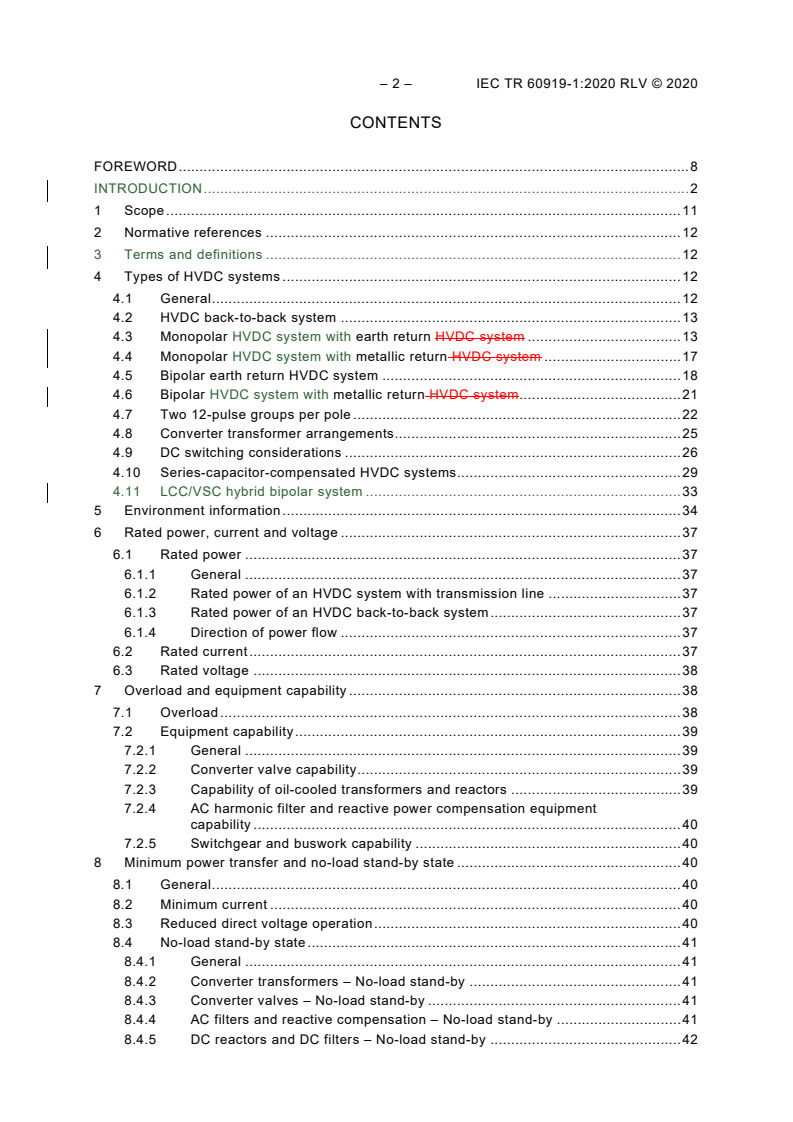
IEC TR 60919-1:2020 RLV - Performance of high-voltage direct current (HVDC) systems with line-commutated converters - Part 1: Steady-state conditions Released:4/16/2020
Overview
IEC TR 60919-1:2020 is an IEC technical report that gives general guidance on the steady‑state performance of two‑terminal high‑voltage direct current (HVDC) systems using line‑commutated converters (LCC). This fourth edition (2020) focuses on systems built from 12‑pulse converter units with three‑phase bridge connections and assumes thyristor valves at both terminals (diode valves and multi‑terminal HVDC are excluded). The edition adds updates to figures, supplements HVDC system control objectives and structure, and introduces a new subclause on HVDC protection.
Key topics and technical requirements
The report addresses steady‑state aspects that are essential for planning, specifying and operating LCC HVDC links:
- Types of HVDC systems and converter transformer arrangements (clauses 4.x) including bipolar, monopolar, back‑to‑back and LCC/VSC hybrid bipolar configurations.
- Rated power, voltage and current definitions and requirements (clause 6).
- Equipment capability and overload considerations for valves, transformers, reactors and filter banks (clause 7).
- Minimum power transfer, no‑load stand‑by and reduced direct‑voltage operation (clause 8).
- AC system interaction: voltage, frequency ranges, system impedance and harmonic sources (clause 9).
- Reactive power needs and supply for conventional and series‑capacitor compensated schemes (clause 10).
- HVDC transmission line and earth electrode parameters for overhead lines and cables (clause 11).
- Reliability metrics, outage definitions and availability calculations (clause 12).
- HVDC control: objectives, hierarchical control structure (converter firing, pole, substation and master control), control limits and redundancy (clause 13).
- Protection, measurements and telecommunication requirements (new subclause 13.6; clauses 13 & 14).
- Auxiliary power, batteries/UPS and audible noise considerations (clauses 15–16).
Applications and who uses it
IEC TR 60919-1 is practical for:
- HVDC project engineers and system designers specifying steady‑state performance and interfaces.
- Utilities and transmission system operators defining performance, availability and reliability requirements.
- Manufacturers of converters, transformers, reactors and protection/control systems for compliance checks.
- Consultants, planners and regulatory bodies assessing HVDC link behavior, reactive power needs and AC interactions.
- Operations teams for establishing control setpoints, redundancy and telecommunication needs.
Related standards
Refer to IEC technical committee publications on HVDC, converter equipment and protection as complementary references. IEC TR 60919‑1 is intended as guidance for steady‑state performance; project specifications should cite it alongside applicable normative IEC standards for detailed test, safety and protection requirements.
Keywords: IEC TR 60919-1, HVDC, line‑commutated converters, steady‑state performance, 12‑pulse converter, thyristor valves, HVDC control, HVDC protection, LCC/VSC hybrid.
Relations
- Effective Date
- 05-Sep-2023
- Effective Date
- 05-Sep-2023
- Effective Date
- 05-Sep-2023
Buy Documents
IEC TR 60919-1:2020 - Performance of high-voltage direct current (HVDC) systems with line-commutated converters - Part 1: Steady-state conditions Released:4/16/2020
IEC TR 60919-1:2020 RLV - Performance of high-voltage direct current (HVDC) systems with line-commutated converters - Part 1: Steady-state conditions Released:4/16/2020
Get Certified
Connect with accredited certification bodies for this standard

IMQ S.p.A. (Certification)
Italian electrical product certification.

SLG Prüf- und Zertifizierungs GmbH
German testing and certification body.

UL Solutions
Global safety science company with testing, inspection and certification.
Sponsored listings
Frequently Asked Questions
IEC TR 60919-1:2020 is a technical report published by the International Electrotechnical Commission (IEC). Its full title is "Performance of high-voltage direct current (HVDC) systems with line-commutated converters - Part 1: Steady-state conditions". This standard covers: IEC TR 60919-1:2020(E) provides general guidance on the steady-state performance requirements of high-voltage direct current (HVDC) systems. It concerns the steady-state performance of two-terminal HVDC systems utilizing 12-pulse converter units comprised of three-phase bridge (double-way) connections, but it does not cover multiterminal HVDC transmission systems. Both terminals are assumed to use thyristor valves as the main semiconductor valves and to have power flow capability in both directions. Diode valves are not considered in this document. This edition includes the following significant technical changes with respect to the previous edition: - Figure 8 and Figure 20 have been updated, a new Figure 18 "LCC/VSC hybrid bipolar system" has been added; - the HVDC system control objectives have been supplemented; - additional explanations regarding the HVDC system control structure have been given; - a new subclause 13.6 on HVDC system protection has been added.
IEC TR 60919-1:2020(E) provides general guidance on the steady-state performance requirements of high-voltage direct current (HVDC) systems. It concerns the steady-state performance of two-terminal HVDC systems utilizing 12-pulse converter units comprised of three-phase bridge (double-way) connections, but it does not cover multiterminal HVDC transmission systems. Both terminals are assumed to use thyristor valves as the main semiconductor valves and to have power flow capability in both directions. Diode valves are not considered in this document. This edition includes the following significant technical changes with respect to the previous edition: - Figure 8 and Figure 20 have been updated, a new Figure 18 "LCC/VSC hybrid bipolar system" has been added; - the HVDC system control objectives have been supplemented; - additional explanations regarding the HVDC system control structure have been given; - a new subclause 13.6 on HVDC system protection has been added.
IEC TR 60919-1:2020 is classified under the following ICS (International Classification for Standards) categories: 29.200 - Rectifiers. Convertors. Stabilized power supply; 29.240.99 - Other equipment related to power transmission and distribution networks. The ICS classification helps identify the subject area and facilitates finding related standards.
IEC TR 60919-1:2020 has the following relationships with other standards: It is inter standard links to IEC TR 60919-1:2010/AMD1:2013, IEC TR 60919-1:2010, IEC TR 60919-1:2010/AMD2:2017. Understanding these relationships helps ensure you are using the most current and applicable version of the standard.
IEC TR 60919-1:2020 is available in PDF format for immediate download after purchase. The document can be added to your cart and obtained through the secure checkout process. Digital delivery ensures instant access to the complete standard document.
Standards Content (Sample)
IEC TR 60919-1 ®
Edition 4.0 2020-04
TECHNICAL
REPORT
colour
inside
Performance of high-voltage direct current (HVDC) systems with
line‑commutated converters –
Part 1: Steady-state conditions
All rights reserved. Unless otherwise specified, no part of this publication may be reproduced or utilized in any form
or by any means, electronic or mechanical, including photocopying and microfilm, without permission in writing from
either IEC or IEC's member National Committee in the country of the requester. If you have any questions about IEC
copyright or have an enquiry about obtaining additional rights to this publication, please contact the address below or
your local IEC member National Committee for further information.
IEC Central Office Tel.: +41 22 919 02 11
3, rue de Varembé info@iec.ch
CH-1211 Geneva 20 www.iec.ch
Switzerland
About the IEC
The International Electrotechnical Commission (IEC) is the leading global organization that prepares and publishes
International Standards for all electrical, electronic and related technologies.
About IEC publications
The technical content of IEC publications is kept under constant review by the IEC. Please make sure that you have the
latest edition, a corrigendum or an amendment might have been published.
IEC publications search - webstore.iec.ch/advsearchform Electropedia - www.electropedia.org
The advanced search enables to find IEC publications by a The world's leading online dictionary on electrotechnology,
variety of criteria (reference number, text, technical containing more than 22 000 terminological entries in English
committee,…). It also gives information on projects, replaced and French, with equivalent terms in 16 additional languages.
and withdrawn publications. Also known as the International Electrotechnical Vocabulary
(IEV) online.
IEC Just Published - webstore.iec.ch/justpublished
Stay up to date on all new IEC publications. Just Published IEC Glossary - std.iec.ch/glossary
details all new publications released. Available online and 67 000 electrotechnical terminology entries in English and
once a month by email. French extracted from the Terms and Definitions clause of
IEC publications issued since 2002. Some entries have been
IEC Customer Service Centre - webstore.iec.ch/csc collected from earlier publications of IEC TC 37, 77, 86 and
If you wish to give us your feedback on this publication or CISPR.
need further assistance, please contact the Customer Service
Centre: sales@iec.ch.
IEC TR 60919-1 ®
Edition 4.0 2020-04
TECHNICAL
REPORT
colour
inside
Performance of high-voltage direct current (HVDC) systems with
line‑commutated converters –
Part 1: Steady-state conditions
INTERNATIONAL
ELECTROTECHNICAL
COMMISSION
ICS 29.200; 29.240.99 ISBN 978-2-8322-8038-6
– 2 – IEC TR 60919-1:2020 © 2020
CONTENTS
FOREWORD . 8
INTRODUCTION . 10
1 Scope . 11
2 Normative references . 12
3 Terms and definitions . 12
4 Types of HVDC systems . 12
4.1 General . 12
4.2 HVDC back-to-back system . 12
4.3 Monopolar HVDC system with earth return . 13
4.4 Monopolar HVDC system with metallic return . 16
4.5 Bipolar earth return HVDC system . 17
4.6 Bipolar HVDC system with metallic return . 20
4.7 Two 12-pulse groups per pole . 21
4.8 Converter transformer arrangements . 24
4.9 DC switching considerations . 25
4.10 Series-capacitor-compensated HVDC systems . 28
4.11 LCC/VSC hybrid bipolar system . 32
5 Environment information . 33
6 Rated power, current and voltage . 36
6.1 Rated power . 36
6.1.1 General . 36
6.1.2 Rated power of an HVDC system with transmission line . 36
6.1.3 Rated power of an HVDC back-to-back system . 36
6.1.4 Direction of power flow . 37
6.2 Rated current . 37
6.3 Rated voltage . 37
7 Overload and equipment capability . 37
7.1 Overload . 37
7.2 Equipment capability . 38
7.2.1 General . 38
7.2.2 Converter valve capability . 38
7.2.3 Capability of oil-cooled transformers and reactors . 39
7.2.4 AC harmonic filter and reactive power compensation equipment
capability . 39
7.2.5 Switchgear and buswork capability . 39
8 Minimum power transfer and no-load stand-by state . 39
8.1 General . 39
8.2 Minimum current . 39
8.3 Reduced direct voltage operation . 40
8.4 No-load stand-by state . 40
8.4.1 General . 40
8.4.2 Converter transformers – No-load stand-by . 40
8.4.3 Converter valves – No-load stand-by . 40
8.4.4 AC filters and reactive compensation – No-load stand-by . 41
8.4.5 DC reactors and DC filters – No-load stand-by . 41
8.4.6 Auxiliary power system – No-load stand-by . 41
8.4.7 Control and protection – No-load stand-by . 41
9 AC system . 41
9.1 General . 41
9.2 AC voltage . 41
9.2.1 Rated AC voltage . 41
9.2.2 Steady-state voltage range . 41
9.2.3 Negative sequence voltage . 42
9.3 Frequency . 42
9.3.1 Rated frequency . 42
9.3.2 Steady-state frequency range . 43
9.3.3 Short-term frequency variation . 43
9.3.4 Frequency variation during emergency . 43
9.4 System impedance at fundamental frequency . 43
9.5 System impedance at harmonic frequencies . 43
9.6 Positive and zero-sequence surge impedance. 43
9.7 Other sources of harmonics . 44
9.8 Subsynchronous torsional interaction (SSTI) . 44
10 Reactive power . 44
10.1 General . 44
10.2 Conventional HVDC systems . 44
10.3 Series capacitor compensated HVDC schemes . 46
10.4 Converter reactive power consumption . 46
10.5 Reactive power balance with the AC system . 46
10.6 Reactive power supply . 46
10.7 Maximum size of switchable VAR banks . 47
11 HVDC transmission line, earth electrode line and earth electrode . 47
11.1 General . 47
11.2 Overhead line(s) . 47
11.2.1 General . 47
11.2.2 Electrical parameters . 47
11.3 Cable line(s) . 48
11.3.1 General . 48
11.3.2 Electrical parameters . 48
11.4 Earth electrode line . 49
11.5 Earth electrode . 49
12 Reliability . 49
12.1 General . 49
12.2 Outage . 49
12.2.1 General . 49
12.2.2 Scheduled outage . 49
12.2.3 Forced outage . 49
12.3 Capacity . 50
12.3.1 General . 50
12.3.2 Maximum continuous capacity P . 50
m
12.3.3 Outage capacity P . 50
o
12.3.4 Outage derating factor (ODF) . 50
12.4 Outage duration terms . 50
– 4 – IEC TR 60919-1:2020 © 2020
12.4.1 Actual outage duration (AOD) . 50
12.4.2 Equivalent outage duration (EOD) . 50
12.4.3 Period hours (PH) . 50
12.4.4 Actual outage hours (AOH) . 51
12.4.5 Equivalent outage hours (EOH) . 51
12.5 Energy unavailability (EU) . 51
12.5.1 General . 51
12.5.2 Forced energy unavailability (FEU) . 51
12.5.3 Scheduled energy unavailability (SEU) . 52
12.6 Energy availability (EA) . 52
12.7 Maximum permitted number of forced outages . 52
12.8 Statistical probability of outages . 52
12.8.1 Component faults . 52
12.8.2 External faults . 52
13 HVDC control . 52
13.1 Control objectives . 52
13.2 Control structure . 53
13.2.1 General . 53
13.2.2 Converter unit firing control . 53
13.2.3 Pole control . 54
13.2.4 HVDC substation control . 56
13.2.5 Master control. 58
13.3 Control order settings . 58
13.4 Current limits . 58
13.5 Control circuit redundancy . 59
13.6 Protection system . 59
13.7 Measurements . 59
14 Telecommunication . 60
14.1 Types of telecommunication links . 60
14.2 Telephone . 60
14.3 Power line carrier (PLC) . 60
14.4 Microwave . 61
14.5 Radio link . 61
14.6 Optical fibre telecommunication . 61
14.7 Classification of data to be transmitted . 61
14.8 Fast response telecommunication . 62
14.9 Reliability . 62
15 Auxiliary power supplies . 63
15.1 General . 63
15.2 Reliability and load classification . 63
15.3 AC auxiliary supplies . 64
15.4 Batteries and uninterruptible power supplies (UPS). 64
15.5 Emergency supply . 65
16 Audible noise . 65
16.1 General . 65
16.2 Public nuisance. 65
16.2.1 General . 65
16.2.2 Valves and valve coolers . 66
16.2.3 Converter transformers . 66
16.2.4 DC reactors . 66
16.2.5 AC filter reactors . 66
16.3 Noise in working areas . 66
17 Harmonic interference – AC . 67
17.1 AC side harmonic generation . 67
17.2 Filters . 67
17.3 Interference disturbance criteria . 70
17.4 Levels for interference . 71
17.5 Filter performance . 72
18 Harmonic interference – DC. 72
18.1 DC side interference . 72
18.1.1 Harmonic currents in HVDC transmission line . 72
18.1.2 Characteristic and non-characteristic harmonics . 72
18.1.3 Groups of harmonics . 73
18.1.4 Calculation of harmonic currents . 73
18.1.5 Calculation of induced voltages . 73
18.1.6 Personnel safety . 73
18.1.7 DC filters . 73
18.2 DC filter performance . 74
18.2.1 Requirements for voice communication circuits . 74
18.2.2 Levels of interference . 74
18.2.3 Safety . 74
18.3 Specification requirements . 75
18.3.1 Economic level of filtering . 75
18.3.2 General criteria . 76
18.3.3 Factors to be taken into account for calculations . 76
18.3.4 Calculation of currents . 77
19 Power line carrier interference (PLC) . 77
19.1 General . 77
19.2 Performance specification . 78
20 Radio frequency interference . 79
20.1 General . 79
20.2 RFI from HVDC systems . 80
20.2.1 RFI sources . 80
20.2.2 RFI propagation . 80
20.2.3 RFI characteristics . 80
20.3 RFI performance specification . 81
20.3.1 RFI risk assessment . 81
20.3.2 Specification RFI limit and its verification . 81
20.3.3 Design aspects . 82
21 Power losses . 82
21.1 General . 82
21.2 Main contributing sources . 83
21.2.1 General . 83
21.2.2 AC filters and reactive power compensation . 83
21.2.3 Converter bridges . 83
21.2.4 Converter transformer . 83
– 6 – IEC TR 60919-1:2020 © 2020
21.2.5 DC reactor . 83
21.2.6 DC filter . 84
21.2.7 Auxiliary equipment . 84
21.2.8 Other components . 84
22 Provision for extensions to the HVDC systems . 84
22.1 General . 84
22.2 Specification for extensions . 84
Annex A (informative) Factors affecting reliability and availability of converter stations . 87
A.1 Design and documentation . 87
A.1.1 General . 87
A.1.2 General design principles . 87
A.1.3 More detailed design principles . 88
A.1.4 Software design principles . 88
A.1.5 RAM records. 89
A.2 Operation . 89
A.2.1 Training . 89
A.2.2 Maintenance programs affecting reliability . 90
A.2.3 Spare parts . 91
Bibliography . 94
Figure 1 – Twelve-pulse converter unit . 11
Figure 2 – Examples of back-to-back HVDC systems . 13
Figure 3 – Monopolar HVDC system with earth return . 14
Figure 4 – Two 12-pulse units in series . 15
Figure 5 – Two 12-pulse units in parallel . 16
Figure 6 – Monopolar HVDC system with metallic return . 17
Figure 7 – Bipolar system . 18
Figure 8 – Metallic return operation of the unfaulted pole in a bipolar system . 19
Figure 9 – Bipolar HVDC system with metallic return . 21
Figure 10 – Bipolar system with two 12-pulse units in series per pole . 23
Figure 11 – Bipolar system with two 12-pulse units in parallel per pole . 24
Figure 12 – DC switching of line conductors . 26
Figure 13 – DC switching of converter poles . 27
Figure 14 – DC switching – Overhead line to cable . 28
Figure 15 – DC switching – Two bipolar converters and lines . 29
Figure 16 – DC switching – Intermediate . 30
Figure 17 – Capacitor commutated converter configurations . 31
Figure 18 – LCC/VSC hybrid bipolar system . 33
Figure 19 – Variations of reactive power Q with active power P of an HVDC converter . 45
Figure 20 – Control hierarchy for HVDC/UHVDC system . 55
Figure 21 – Converter voltage-current characteristic . 57
Figure 22 – Examples of AC filter connections for a bipole HVDC system . 68
Figure 23 – Circuit diagrams for different filter types . 69
Figure 24 – RY COM interference meter results averaged – Typical plot of converter
interference levels on the DC line . 79
Figure 25 – Recommended measurement procedure with definition of measuring point . 82
Figure 26 – Extension methods for HVDC systems . 86
Table 1 – Information supplied for HVDC substation . 34
Table 2 – Performance parameters for voice communication circuits: Subscribers and
trunk circuits . 75
– 8 – IEC TR 60919-1:2020 © 2020
INTERNATIONAL ELECTROTECHNICAL COMMISSION
____________
PERFORMANCE OF HIGH-VOLTAGE DIRECT CURRENT
(HVDC) SYSTEMS WITH LINE-COMMUTATED CONVERTERS –
Part 1: Steady-state conditions
FOREWORD
1) The International Electrotechnical Commission (IEC) is a worldwide organization for standardization comprising
all national electrotechnical committees (IEC National Committees). The object of IEC is to promote
international co-operation on all questions concerning standardization in the electrical and electronic fields. To
this end and in addition to other activities, IEC publishes International Standards, Technical Specifications,
Technical Reports, Publicly Available Specifications (PAS) and Guides (hereafter referred to as “IEC
Publication(s)”). Their preparation is entrusted to technical committees; any IEC National Committee interested
in the subject dealt with may participate in this preparatory work. International, governmental and non-
governmental organizations liaising with the IEC also participate in this preparation. IEC collaborates closely
with the International Organization for Standardization (ISO) in accordance with conditions determined by
agreement between the two organizations.
2) The formal decisions or agreements of IEC on technical matters express, as nearly as possible, an international
consensus of opinion on the relevant subjects since each technical committee has representation from all
interested IEC National Committees.
3) IEC Publications have the form of recommendations for international use and are accepted by IEC National
Committees in that sense. While all reasonable efforts are made to ensure that the technical content of IEC
Publications is accurate, IEC cannot be held responsible for the way in which they are used or for any
misinterpretation by any end user.
4) In order to promote international uniformity, IEC National Committees undertake to apply IEC Publications
transparently to the maximum extent possible in their national and regional publications. Any divergence
between any IEC Publication and the corresponding national or regional publication shall be clearly indicated in
the latter.
5) IEC itself does not provide any attestation of conformity. Independent certification bodies provide conformity
assessment services and, in some areas, access to IEC marks of conformity. IEC is not responsible for any
services carried out by independent certification bodies.
6) All users should ensure that they have the latest edition of this publication.
7) No liability shall attach to IEC or its directors, employees, servants or agents including individual experts and
members of its technical committees and IEC National Committees for any personal injury, property damage or
other damage of any nature whatsoever, whether direct or indirect, or for costs (including legal fees) and
expenses arising out of the publication, use of, or reliance upon, this IEC Publication or any other IEC
Publications.
8) Attention is drawn to the Normative references cited in this publication. Use of the referenced publications is
indispensable for the correct application of this publication.
9) Attention is drawn to the possibility that some of the elements of this IEC Publication may be the subject of
patent rights. IEC shall not be held responsible for identifying any or all such patent rights.
The main task of IEC technical committees is to prepare International Standards. However, a
technical committee may propose the publication of a technical report when it has collected
data of a different kind from that which is normally published as an International Standard, for
example "state of the art".
IEC TR 60919-1, which is a technical report, has been prepared by subcommittee 22F: Power
electronics for electrical transmission and distribution systems, of IEC technical committee 22:
Power electronic systems and equipment.
This fourth edition cancels and replaces the third edition, published in 2010,
Amendment 1:2013 and Amendment 2:2017. This edition constitutes a technical revision.
This edition includes the following significant technical changes with respect to the previous
edition:
a) Figure 8 and Figure 20 have been updated, a new Figure 18 "LCC/VSC hybrid bipolar
system" has been added;
b) the HVDC system control objectives have been supplemented;
c) additional explanations regarding the HVDC system control structure have been given;
d) a new subclause 13.6 on HVDC system protection has been added.
The text of this Technical Report is based on the following documents:
Draft TR Report on voting
22F/535/DTR 22F/549A/RVDTR
Full information on the voting for the approval of this Technical Report can be found in the
report on voting indicated in the above table.
This document has been drafted in accordance with the ISO/IEC Directives, Part 2.
A list of all parts of the IEC 60919 series, published under the general title Performance of
high-voltage direct current (HVDC) systems with line-commutated converters, can be found on
the IEC website.
The committee has decided that the contents of this document will remain unchanged until the
stability date indicated on the IEC website under "http://webstore.iec.ch" in the data related to
the specific document. At this date, the document will be
• reconfirmed,
• withdrawn,
• replaced by a revised edition, or
• amended.
IMPORTANT – The 'colour inside' logo on the cover page of this publication indicates
that it contains colours which are considered to be useful for the correct
understanding of its contents. Users should therefore print this document using a
colour printer.
– 10 – IEC TR 60919-1:2020 © 2020
INTRODUCTION
The difference between system performance specifications and equipment design
specifications for individual components of a system is realized. Frequently, performance
specifications are prepared as a single package for the two HVDC substations in a particular
system. Alternatively, some parts of the HVDC system can be separately specified and
purchased. In such cases, due consideration is given to coordination of each part with the
overall HVDC system performance objectives and to ensuring that the interface of each with
the system is clearly defined. Typical of such parts, listed in the appropriate order of relative
ease for separate treatment and interface definition, are:
a) DC line, electrode line and earth electrode;
b) telecommunication system;
c) converter building, foundations and other civil engineering work;
d) reactive power supply including AC shunt capacitor banks, shunt reactors, synchronous
and static reactive power (var) compensators;
e) AC switchgear;
f) DC switchgear;
g) auxiliary systems;
h) AC filters;
i) DC filters;
j) DC reactors;
k) converter transformers;
l) surge arresters;
m) series commutation capacitors;
n) valves and their ancillaries;
o) control and protection systems.
NOTE The last four items are the most difficult to separate, and, in fact, separation of these four can be
inadvisable.
Clause 4 to Clause 22 of this document set out a complete steady-state performance
specification for an HVDC system.
Since the equipment items are usually separately specified and purchased, the HVDC
transmission line, earth electrode line and earth electrode (see Clause 11) are included only
because of their influence on the HVDC system performance.
For the purpose of this document, an HVDC substation is assumed to consist of one or more
converter units installed in a single location together with buildings, reactors, filters, reactive
power supply, control, monitoring, protective, measuring and auxiliary equipment. While there
is no discussion of AC switching substations in this document, AC filters and reactive power
sources are included, although they can be connected to an AC bus separate from the HVDC
substation, as discussed in Clause 17.
PERFORMANCE OF HIGH-VOLTAGE DIRECT CURRENT
(HVDC) SYSTEMS WITH LINE-COMMUTATED CONVERTERS –
Part 1: Steady-state conditions
1 Scope
This part of IEC 60919 provides general guidance on the steady-state performance
requirements of high-voltage direct current (HVDC) systems. It concerns the steady-state
performance of two-terminal HVDC systems utilizing 12-pulse converter units comprised of
three-phase bridge (double-way) connections (see Figure 1), but it does not cover
multi-terminal HVDC transmission systems. Both terminals are assumed to use thyristor
valves as the main semiconductor valves and to have power flow capability in both directions.
Diode valves are not considered in this document.
Key
1 Transformer valve windings
Figure 1 – Twelve-pulse converter unit
Only line-commutated converters are covered in this document, which includes capacitor
commutated converter circuit configurations. General aspects of semiconductor
line-commutated converters are given in IEC 60146-1-1, IEC TR 60146-1-2 and
IEC 60146-1-3. Voltage-sourced converters are not considered.
The distinction is made between system performance specifications and equipment design
specifications for individual components of a system. Equipment specifications and testing
requirements are not defined in this document. Also excluded from this document are detailed
seismic performance requirements. In addition, because there are many variations between
different possible HVDC systems, this document does not consider these in detail;
consequently, it is not used directly as a specification for a particular project, but rather to
provide the basis for an appropriate specification tailored to fit actual system requirements.
This document, which covers steady-state performance, is followed by the additional
documents of IEC TR 60919-2 on faults and switching as well as IEC TR 60919-3 on dynamic
– 12 – IEC TR 60919-1:2020 © 2020
conditions. All three aspects are considered when preparing two-terminal HVDC system
specifications.
2 Normative references
The following documents are referred to in the text in such a way that some or all of their
content constitutes requirements of this document. For dated references, only the edition
cited applies. For undated references, the latest edition of the referenced document (including
any amendments) applies.
IEC 60633, High-voltage direct current (HVDC) transmission – Vocabulary
CIGRÉ Technical Brochure (TB) No. 391:2009, Guide for measurement of radio frequency
interference from HV and MV substations. Disturbance propagation, characteristics of
disturbance sources, measurement techniques, conversion methodologies and limits
3 Terms and definitions
For the purposes of this document, the terms and definitions given in IEC 60633 apply.
ISO and IEC maintain terminological databases for use in standardization at the following
addresses:
• IEC Electropedia: available at http://www.electropedia.org/
• ISO Online browsing platform: available at http://www.iso.org/obp
4 Types of HVDC systems
4.1 General
This part of the specification should include the following basic data:
a) general information on the location of the HVDC substations and the purpose of the
project;
b) type of system needed, including a simple one-line diagram;
c) number of 12-pulse converter units;
d) pertinent information derived from the discussion in Clause 4.
Generally, in studies of projects of the types discussed in this document, economic
considerations should take into account the capital costs, the cost of losses, cost of outages
and other expected annual expenses.
In terms of the type of system, the "capacitor-commutated converter (CCC)" and "controlled
series capacitor converter (CSCC)" technology may be suitable alternatives to a conventional
HVDC scheme. These are described in 4.10.
4.2 HVDC back-to-back system
In this arrangement there is no DC transmission line and both converters are located at one
site. The valves for both converters may be located in one valve hall, or even in one
integrated structure or separately as outdoor valves. Similarly, many other items for the two
converters, such as the control system, cooling equipment, auxiliary system, etc., may be
located in one are
...
IEC TR 60919-1 ®
Edition 4.0 2020-04
REDLINE VERSION
TECHNICAL
REPORT
colour
inside
Performance of high-voltage direct current (HVDC) systems with
line‑commutated converters –
Part 1: Steady-state conditions
All rights reserved. Unless otherwise specified, no part of this publication may be reproduced or utilized in any form
or by any means, electronic or mechanical, including photocopying and microfilm, without permission in writing from
either IEC or IEC's member National Committee in the country of the requester. If you have any questions about IEC
copyright or have an enquiry about obtaining additional rights to this publication, please contact the address below or
your local IEC member National Committee for further information.
IEC Central Office Tel.: +41 22 919 02 11
3, rue de Varembé info@iec.ch
CH-1211 Geneva 20 www.iec.ch
Switzerland
About the IEC
The International Electrotechnical Commission (IEC) is the leading global organization that prepares and publishes
International Standards for all electrical, electronic and related technologies.
About IEC publications
The technical content of IEC publications is kept under constant review by the IEC. Please make sure that you have the
latest edition, a corrigendum or an amendment might have been published.
IEC publications search - webstore.iec.ch/advsearchform Electropedia - www.electropedia.org
The advanced search enables to find IEC publications by a The world's leading online dictionary on electrotechnology,
variety of criteria (reference number, text, technical containing more than 22 000 terminological entries in English
committee,…). It also gives information on projects, replaced and French, with equivalent terms in 16 additional languages.
and withdrawn publications. Also known as the International Electrotechnical Vocabulary
(IEV) online.
IEC Just Published - webstore.iec.ch/justpublished
Stay up to date on all new IEC publications. Just Published IEC Glossary - std.iec.ch/glossary
details all new publications released. Available online and 67 000 electrotechnical terminology entries in English and
once a month by email. French extracted from the Terms and Definitions clause of
IEC publications issued since 2002. Some entries have been
IEC Customer Service Centre - webstore.iec.ch/csc collected from earlier publications of IEC TC 37, 77, 86 and
If you wish to give us your feedback on this publication or CISPR.
need further assistance, please contact the Customer Service
Centre: sales@iec.ch.
IEC TR 60919-1 ®
Edition 4.0 2020-04
REDLINE VERSION
TECHNICAL
REPORT
colour
inside
Performance of high-voltage direct current (HVDC) systems with
line‑commutated converters –
Part 1: Steady-state conditions
INTERNATIONAL
ELECTROTECHNICAL
COMMISSION
ICS 29.200; 29.240.99 ISBN 978-2-8322-8226-7
– 2 – IEC TR 60919-1:2020 RLV © 2020
CONTENTS
FOREWORD . 8
INTRODUCTION . 2
1 Scope . 11
2 Normative references . 12
3 Terms and definitions . 12
4 Types of HVDC systems . 12
4.1 General . 12
4.2 HVDC back-to-back system . 13
4.3 Monopolar HVDC system with earth return HVDC system . 13
4.4 Monopolar HVDC system with metallic return HVDC system . 17
4.5 Bipolar earth return HVDC system . 18
4.6 Bipolar HVDC system with metallic return HVDC system . 21
4.7 Two 12-pulse groups per pole . 22
4.8 Converter transformer arrangements . 25
4.9 DC switching considerations . 26
4.10 Series-capacitor-compensated HVDC systems . 29
4.11 LCC/VSC hybrid bipolar system . 33
5 Environment information . 34
6 Rated power, current and voltage . 37
6.1 Rated power . 37
6.1.1 General . 37
6.1.2 Rated power of an HVDC system with transmission line . 37
6.1.3 Rated power of an HVDC back-to-back system . 37
6.1.4 Direction of power flow . 37
6.2 Rated current . 37
6.3 Rated voltage . 38
7 Overload and equipment capability . 38
7.1 Overload . 38
7.2 Equipment capability . 39
7.2.1 General . 39
7.2.2 Converter valve capability . 39
7.2.3 Capability of oil-cooled transformers and reactors . 39
7.2.4 AC harmonic filter and reactive power compensation equipment
capability . 40
7.2.5 Switchgear and buswork capability . 40
8 Minimum power transfer and no-load stand-by state . 40
8.1 General . 40
8.2 Minimum current . 40
8.3 Reduced direct voltage operation . 40
8.4 No-load stand-by state . 41
8.4.1 General . 41
8.4.2 Converter transformers – No-load stand-by . 41
8.4.3 Converter valves – No-load stand-by . 41
8.4.4 AC filters and reactive compensation – No-load stand-by . 41
8.4.5 DC reactors and DC filters – No-load stand-by . 42
8.4.6 Auxiliary power system – No-load stand-by . 42
8.4.7 Control and protection – No-load stand-by . 42
9 AC system . 42
9.1 General . 42
9.2 AC voltage . 42
9.2.1 Rated AC voltage . 42
9.2.2 Steady-state voltage range . 42
9.2.3 Negative sequence voltage . 43
9.3 Frequency . 43
9.3.1 Rated frequency . 43
9.3.2 Steady-state frequency range . 43
9.3.3 Short-term frequency variation . 43
9.3.4 Frequency variation during emergency . 44
9.4 System impedance at fundamental frequency . 44
9.5 System impedance at harmonic frequencies . 44
9.6 Positive and zero-sequence surge impedance. 44
9.7 Other sources of harmonics . 44
9.8 Subsynchronous torsional interaction (SSTI) . 44
10 Reactive power . 45
10.1 General . 45
10.2 Conventional HVDC systems . 45
10.3 Series capacitor compensated HVDC schemes . 47
10.4 Converter reactive power consumption . 47
10.5 Reactive power balance with the AC system . 47
10.6 Reactive power supply . 47
10.7 Maximum size of switchable VAR banks . 48
11 HVDC transmission line, earth electrode line and earth electrode . 48
11.1 General . 48
11.2 Overhead line(s) . 48
11.2.1 General . 48
11.2.2 Electrical parameters . 48
11.3 Cable line(s) . 49
11.3.1 General . 49
11.3.2 Electrical parameters . 49
11.4 Earth electrode line . 50
11.5 Earth electrode . 50
12 Reliability . 50
12.1 General . 50
12.2 Outage . 50
12.2.1 General . 50
12.2.2 Scheduled outage . 50
12.2.3 Forced outage . 50
12.3 Capacity . 51
12.3.1 General . 51
12.3.2 Maximum continuous capacity P . 51
m
12.3.3 Outage capacity P . 51
o
12.3.4 Outage derating factor (ODF) . 51
12.4 Outage duration terms . 51
– 4 – IEC TR 60919-1:2020 RLV © 2020
12.4.1 Actual outage duration (AOD) . 51
12.4.2 Equivalent outage duration (EOD) . 51
12.4.3 Period hours (PH) . 51
12.4.4 Actual outage hours (AOH) . 52
12.4.5 Equivalent outage hours (EOH) . 52
12.5 Energy unavailability (EU) . 52
12.5.1 General . 52
12.5.2 Forced energy unavailability (FEU) . 53
12.5.3 Scheduled energy unavailability (SEU) . 53
12.6 Energy availability (EA) . 53
12.7 Maximum permitted number of forced outages . 53
12.8 Statistical probability of outages . 53
12.8.1 Component faults . 53
12.8.2 External faults . 53
13 HVDC control . 54
13.1 Control objectives . 54
13.2 Control structure . 54
13.2.1 General . 54
13.2.2 Converter unit firing control . 54
13.2.3 Pole control . 55
13.2.4 HVDC substation control . 58
13.2.5 Master control. 60
13.3 Control order settings . 60
13.4 Current limits . 60
13.5 Control circuit redundancy . 61
13.6 Protection system . 61
13.7 Measurements . 61
14 Telecommunication . 62
14.1 Types of telecommunication links . 62
14.2 Telephone . 62
14.3 Power line carrier (PLC) . 62
14.4 Microwave . 63
14.5 Radio link . 63
14.6 Optical fibre telecommunication . 63
14.7 Classification of data to be transmitted . 63
14.8 Fast response telecommunication . 64
14.9 Reliability . 64
15 Auxiliary power supplies . 65
15.1 General . 65
15.2 Reliability and load classification . 65
15.3 AC auxiliary supplies . 66
15.4 Batteries and uninterruptible power supplies (UPS). 66
15.5 Emergency supply . 67
16 Audible noise . 67
16.1 General . 67
16.2 Public nuisance. 67
16.2.1 General . 67
16.2.2 Valves and valve coolers . 68
16.2.3 Converter transformers . 68
16.2.4 DC reactors . 68
16.2.5 AC filter reactors . 68
16.3 Noise in working areas . 68
17 Harmonic interference – AC . 69
17.1 AC side harmonic generation . 69
17.2 Filters . 69
17.3 Interference disturbance criteria . 72
17.4 Levels for interference . 73
17.5 Filter performance . 74
18 Harmonic interference – DC. 74
18.1 DC side interference . 74
18.1.1 Harmonic currents in HVDC transmission line . 74
18.1.2 Characteristic and non-characteristic harmonics . 74
18.1.3 Groups of harmonics . 75
18.1.4 Calculation of harmonic currents . 75
18.1.5 Calculation of induced voltages . 75
18.1.6 Personnel safety . 75
18.1.7 DC filters . 75
18.2 DC filter performance . 76
18.2.1 Requirements for voice communication circuits . 76
18.2.2 Levels of interference . 76
18.2.3 Safety . 76
18.3 Specification requirements . 77
18.3.1 Economic level of filtering . 77
18.3.2 General criteria . 78
18.3.3 Factors to be taken into account for calculations . 78
18.3.4 Calculation of currents . 79
19 Power line carrier interference (PLC) . 80
19.1 General . 80
19.2 Performance specification . 81
20 Radio frequency interference . 82
20.1 General . 84
20.2 RFI from HVDC systems . 84
20.2.1 RFI sources . 84
20.2.2 RFI propagation . 85
20.2.3 RFI characteristics . 85
20.3 RFI performance specification . 86
20.3.1 RFI risk assessment . 86
20.3.2 Specification RFI limit and its verification . 86
20.3.3 Design aspects . 87
21 Power losses . 82
21.1 General . 87
21.2 Main contributing sources . 88
21.2.1 General . 88
21.2.2 AC filters and reactive power compensation . 88
21.2.3 Converter bridges . 88
21.2.4 Converter transformer . 88
– 6 – IEC TR 60919-1:2020 RLV © 2020
21.2.5 DC reactor . 88
21.2.6 DC filter . 88
21.2.7 Auxiliary equipment . 89
21.2.8 Other components . 89
22 Provision for extensions to the HVDC systems . 89
22.1 General . 89
22.2 Specification for extensions . 89
Annex A (informative) Factors affecting reliability and availability of converter stations . 92
A.1 Design and documentation . 92
A.1.1 General . 92
A.1.2 General design principles . 92
A.1.3 More detailed design principles . 93
A.1.4 Software design principles . 93
A.1.5 RAM records. 94
A.2 Operation . 94
A.2.1 Training . 94
A.2.2 Maintenance programs affecting reliability . 95
A.2.3 Spare parts . 96
Bibliography . 99
Figure 1 – Twelve-pulse converter unit . 11
Figure 2 – Examples of back-to-back HVDC systems . 14
Figure 3 – Monopolar HVDC system with earth return . 15
Figure 4 – Two 12-pulse units in series . 16
Figure 5 – Two 12-pulse units in parallel . 17
Figure 6 – Monopolar HVDC system with metallic return system . 18
Figure 7 – Bipolar system . 19
Figure 8 – Metallic return operation of the unfaulted pole in a bipolar system . 20
Figure 9 – Bipolar metallic return HVDC system with metallic return . 22
Figure 10 – Bipolar system with two 12-pulse units in series per pole . 24
Figure 11 – Bipolar system with two 12-pulse units in parallel per pole . 25
Figure 12 – DC switching of line conductors . 27
Figure 13 – DC switching of converter poles . 28
Figure 14 – DC switching – Overhead line to cable . 29
Figure 15 – DC switching – Two bipolar converters and lines . 30
Figure 16 – DC switching – Intermediate . 31
Figure 17 – Capacitor commutated converter configurations . 32
Figure 18 – LCC/VSC hybrid bipolar system . 34
Figure 19 – Variations of reactive power Q with active power P of an HVDC converter . 46
Figure 20 – Control hierarchy for HVDC/UHVDC system . 57
Figure 21 – Converter voltage-current characteristic . 59
Figure 22 – Examples of AC filter connections for a bipole HVDC system . 70
Figure 23 – Circuit diagrams for different filter types . 71
Figure 24 – RY COM noise interference meter results averaged – Typical plot of
converter noise interference levels on the DC line corrected and normalized to 3 kHz
bandwidth –0 dBm = 0,775 V . 82
Figure 25 – Recommended measurement procedure with definition of measuring point . 87
Figure 26 – Extension methods for HVDC systems . 91
Table 1 – Information supplied for HVDC substation . 35
Table 2 – Performance parameters for voice communication circuits: Subscribers and
trunk circuits . 77
– 8 – IEC TR 60919-1:2020 RLV © 2020
INTERNATIONAL ELECTROTECHNICAL COMMISSION
____________
PERFORMANCE OF HIGH-VOLTAGE DIRECT CURRENT
(HVDC) SYSTEMS WITH LINE-COMMUTATED CONVERTERS –
Part 1: Steady-state conditions
FOREWORD
1) The International Electrotechnical Commission (IEC) is a worldwide organization for standardization comprising
all national electrotechnical committees (IEC National Committees). The object of IEC is to promote
international co-operation on all questions concerning standardization in the electrical and electronic fields. To
this end and in addition to other activities, IEC publishes International Standards, Technical Specifications,
Technical Reports, Publicly Available Specifications (PAS) and Guides (hereafter referred to as “IEC
Publication(s)”). Their preparation is entrusted to technical committees; any IEC National Committee interested
in the subject dealt with may participate in this preparatory work. International, governmental and non-
governmental organizations liaising with the IEC also participate in this preparation. IEC collaborates closely
with the International Organization for Standardization (ISO) in accordance with conditions determined by
agreement between the two organizations.
2) The formal decisions or agreements of IEC on technical matters express, as nearly as possible, an international
consensus of opinion on the relevant subjects since each technical committee has representation from all
interested IEC National Committees.
3) IEC Publications have the form of recommendations for international use and are accepted by IEC National
Committees in that sense. While all reasonable efforts are made to ensure that the technical content of IEC
Publications is accurate, IEC cannot be held responsible for the way in which they are used or for any
misinterpretation by any end user.
4) In order to promote international uniformity, IEC National Committees undertake to apply IEC Publications
transparently to the maximum extent possible in their national and regional publications. Any divergence
between any IEC Publication and the corresponding national or regional publication shall be clearly indicated in
the latter.
5) IEC itself does not provide any attestation of conformity. Independent certification bodies provide conformity
assessment services and, in some areas, access to IEC marks of conformity. IEC is not responsible for any
services carried out by independent certification bodies.
6) All users should ensure that they have the latest edition of this publication.
7) No liability shall attach to IEC or its directors, employees, servants or agents including individual experts and
members of its technical committees and IEC National Committees for any personal injury, property damage or
other damage of any nature whatsoever, whether direct or indirect, or for costs (including legal fees) and
expenses arising out of the publication, use of, or reliance upon, this IEC Publication or any other IEC
Publications.
8) Attention is drawn to the Normative references cited in this publication. Use of the referenced publications is
indispensable for the correct application of this publication.
9) Attention is drawn to the possibility that some of the elements of this IEC Publication may be the subject of
patent rights. IEC shall not be held responsible for identifying any or all such patent rights.
This redline version of the official IEC Standard allows the user to identify the changes
made to the previous edition. A vertical bar appears in the margin wherever a change
has been made. Additions are in green text, deletions are in strikethrough red text.
The main task of IEC technical committees is to prepare International Standards. However, a
technical committee may propose the publication of a technical report when it has collected
data of a different kind from that which is normally published as an International Standard, for
example "state of the art".
IEC TR 60919-1, which is a technical report, has been prepared by subcommittee 22F: Power
electronics for electrical transmission and distribution systems, of IEC technical committee 22:
Power electronic systems and equipment.
This fourth edition cancels and replaces the third edition, published in 2010,
Amendment 1:2013 and Amendment 2:2017. This edition constitutes a technical revision.
This edition includes the following significant technical changes with respect to the previous
edition:
a) Figure 8 and Figure 20 have been updated, a new Figure 18 "LCC/VSC hybrid bipolar
system" has been added;
b) the HVDC system control objectives have been supplemented;
c) additional explanations regarding the HVDC system control structure have been given;
d) a new subclause 13.6 on HVDC system protection has been added.
The text of this Technical Report is based on the following documents:
Draft TR Report on voting
22F/535/DTR 22F/549A/RVDTR
Full information on the voting for the approval of this Technical Report can be found in the
report on voting indicated in the above table.
This document has been drafted in accordance with the ISO/IEC Directives, Part 2.
A list of all parts of the IEC 60919 series, published under the general title Performance of
high-voltage direct current (HVDC) systems with line-commutated converters, can be found on
the IEC website.
The committee has decided that the contents of this document will remain unchanged until the
stability date indicated on the IEC website under "http://webstore.iec.ch" in the data related to
the specific document. At this date, the document will be
• reconfirmed,
• withdrawn,
• replaced by a revised edition, or
• amended.
IMPORTANT – The 'colour inside' logo on the cover page of this publication indicates
that it contains colours which are considered to be useful for the correct
understanding of its contents. Users should therefore print this document using a
colour printer.
– 10 – IEC TR 60919-1:2020 RLV © 2020
INTRODUCTION
The difference between system performance specifications and equipment design
specifications for individual components of a system is realized. Frequently, performance
specifications are prepared as a single package for the two HVDC substations in a particular
system. Alternatively, some parts of the HVDC system can be separately specified and
purchased. In such cases, due consideration should be is given to coordination of each part
with the overall HVDC system performance objectives and to ensuring that the interface of
each with the system should be is clearly defined. Typical of such parts, listed in the
appropriate order of relative ease for separate treatment and interface definition, are:
a) DC line, electrode line and earth electrode;
b) telecommunication system;
c) converter building, foundations and other civil engineering work;
d) reactive power supply including AC shunt capacitor banks, shunt reactors, synchronous
and static reactive power (var) compensators;
e) AC switchgear;
f) DC switchgear;
g) auxiliary systems;
h) AC filters;
i) DC filters;
j) DC reactors;
k) converter transformers;
l) surge arresters;
m) series commutation capacitors;
n) valves and their ancillaries;
o) control and protection systems.
NOTE The last four items are the most difficult to separate, and, in fact, separation of these four may can be
inadvisable.
Clause 4 to Clause 22 of this document set out a complete steady-state performance
specification for an HVDC system should consider Clauses 3 to 21 of this report.
Terms and definitions for high-voltage direct current (HVDC) transmission used in this report
are given in IEC 60633.
Since the equipment items are usually separately specified and purchased, the HVDC
transmission line, earth electrode line and earth electrode (see Clause 11) are included only
because of their influence on the HVDC system performance.
For the purpose of this document, an HVDC substation is assumed to consist of one or more
converter units installed in a single location together with buildings, reactors, filters, reactive
power supply, control, monitoring, protective, measuring and auxiliary equipment. While there
is no discussion of AC switching substations in this document, AC filters and reactive power
sources are included, although they may can be connected to an AC bus separate from the
HVDC substation, as discussed in Clause 17.
PERFORMANCE OF HIGH-VOLTAGE DIRECT CURRENT
(HVDC) SYSTEMS WITH LINE-COMMUTATED CONVERTERS –
Part 1: Steady-state conditions
1 Scope
This part of IEC 60919 provides general guidance on the steady-state performance
requirements of high-voltage direct current (HVDC) systems. It concerns the steady-state
performance of two-terminal HVDC systems utilizing 12-pulse converter units comprised of
three-phase bridge (double-way) connections (see Figure 1), but it does not cover
multi-terminal HVDC transmission systems. Both terminals are assumed to use thyristor
valves as the main semiconductor valves and to have power flow capability in both directions.
Diode valves are not considered in this document.
Key
1 Transformer valve windings
Figure 1 – Twelve-pulse converter unit
Only line-commutated converters are covered in this document, which includes capacitor
commutated converter circuit configurations. General requirements for aspects of
semiconductor line-commutated converters are given in IEC 60146-1-1, IEC TR 60146-1-2
and IEC 60146-1-3. Voltage-sourced converters are not considered.
This technical report, which covers steady-state performance, is followed by additional
documents on dynamic performance and transient performance. All three aspects should be
considered when preparing two-terminal HVDC system specifications.
The difference distinction is made between system performance specifications and equipment
design specifications for individual components of a system should be realized. Equipment
specifications and testing requirements are not defined in this document. Also excluded from
this document are detailed seismic performance requirements. In addition, because there are
many variations between different possible HVDC systems, this document does not consider
should is not be used directly as a specification for a
these in detail; consequently, it
– 12 – IEC TR 60919-1:2020 RLV © 2020
particular project, but rather to provide the basis for an appropriate specification tailored to fit
actual system requirements.
This document, which covers steady-state performance, is followed by the additional
documents of IEC TR 60919-2 on faults and switching as well as IEC TR 60919-3 on dynamic
conditions. All three aspects are considered when preparing two-terminal HVDC system
specifications.
2 Normative references
The following documents are referred to in the text in such a way that some or all of their
content constitutes requirements of this document. For dated references, only the edition
cited applies. For undated references, the latest edition of the referenced document (including
any amendments) applies.
IEC 60146-1-1, Semiconductor converters – General requirements and line commutated
converters – Part 1-1: Specifications of basic requirements
IEC/TR 60146-1-2, Semiconductor convertors – General requirements and line commutated
convertors – Part 1-2: Application guide
IEC 60146-1-3, Semiconductor convertors – General requirements and line commutated
convertors – Part 1-3: Transformers and reactors
IEC 60633, Terminology for High-voltage direct current (HVDC) transmission – Vocabulary
CIGRÉ Technical Brochure (TB) No. 391:2009, Guide for measurement of radio frequency
interference from HV and MV substations. Disturbance propagation, characteristics of
disturbance sources, measurement techniques, conversion methodologies and limits
3 Terms and definitions
For the purposes of this document, the terms and definitions given in IEC 60633 apply.
ISO and IEC maintain terminological databases for use in standardization at the following
addresses:
• IEC Electropedia: available at http://www.electropedia.org/
...