

IEC TR 61282-4:2003
(Main)Fibre optic communication system design guides - Part 4: Accommodation and utilization of non-linear effects
General Information
- Abstract
This Technical Report is intended to describe physically and analytically non-linear effects in fibre optic systems, their impact on system performance, ways of minimizing the effects or using them to advantage, and methods of measuring and quantifying them.
- Status
- Published
- Publication Date
- 17-Jun-2003
- Technical Committee
- SC 86C - Fibre optic systems, sensing and active devices
- Drafting Committee
- WG 1 - TC 86/SC 86C/WG 1
- Current Stage
- DELPUB - Deleted Publication
- Start Date
- 19-Nov-2013
- Completion Date
- 28-Aug-2026
Overview
IEC TR 61282-4:2003 is a technical report from the International Electrotechnical Commission (IEC) focused on fibre optic communication system design, specifically targeting the accommodation and utilization of non-linear effects. As the demand for higher bandwidth and longer transmission distances in optical networks grows, understanding and managing non-linear effects in optical fibers has become essential for system designers and telecommunications engineers.
This document provides a comprehensive analytical and practical overview of physically-based non-linear phenomena, how these effects can influence fibre optic system performance, and strategies both for their mitigation and, when advantageous, their utilization. It also outlines methods for measuring and quantifying non-linear effects, offering critical support in fibre optic system design for long-haul and high-capacity telecommunications applications.
Key Topics
IEC TR 61282-4:2003 covers several key non-linear mechanisms that influence the behavior and capacity of fibre optic systems, including:
- Non-linear effects origin: Explains how increased optical power and longer link distances in fibre optic communication can lead to non-linear phenomena.
- Types of fibre non-linearity:
- Scattering-based effects:
- Stimulated Brillouin Scattering (SBS): Backwards scattering that limits transmitted power.
- Stimulated Raman Scattering (SRS): Forward-scattering inducing crosstalk, especially in dense wavelength division multiplexing (DWDM) systems.
- Index-based effects:
- Self-phase modulation (SPM)
- Cross-phase modulation (XPM)
- Four-wave mixing (FWM)
- Modulation instability (MI)
- Scattering-based effects:
- System implications: Outlines how non-linear interactions impact signal power, cause crosstalk, distort signals, or even limit system reach.
- Mitigation and utilization: Details strategies to minimize adverse effects (e.g., adjusting channel power, fiber design, and dispersion management) and, in some cases, take advantage of non-linear phenomena (e.g., Raman amplification).
- Measurement and quantification: Discusses approaches for measuring non-linear effects to ensure reliable system performance.
Applications
Understanding and managing non-linear effects described in IEC TR 61282-4:2003 is critical for several practical applications in optical communications:
- Long-haul and ultra-long-haul fibre optic transmission: Accurate assessment and control of non-linear effects can improve reach and reliability, especially for global and intercontinental systems.
- DWDM systems: In high-density channel environments, mitigation of non-linear crosstalk and distortion is essential for ensuring low error rates and maximizing channel capacity.
- Optical amplifier deployment: Proper design choices are necessary to avoid signal degradation due to non-linearities caused by increased power from optical amplifiers.
- Advanced network planning: Incorporating non-linear analysis into simulations and design enables optimization for both capacity and performance.
- Test and measurement: Implementation of standard measurement protocols for non-linearity assessment during deployment and maintenance.
Related Standards
Several other standards complement IEC TR 61282-4:2003, providing additional guidance for fibre optic communication systems:
- IEC 60793-1 & IEC 60793-2: Specify measurement methods and product specifications for optical fibers, addressing properties that influence non-linearity.
- IEC 61292-3: Covers optical amplifier classification, characteristics, and applications related to non-linear effects.
- ITU-T G.663: Offers recommendations on non-linear penalties in optical systems, often referenced for benchmarking.
- DWDM and system test standards: Built around understanding and minimizing non-linear impairments across transmission networks.
By aligning with IEC TR 61282-4:2003 and related standards, system designers, engineers, and network operators can ensure robust, high-performance fibre optic networks that meet evolving bandwidth and distance requirements while managing the impact of non-linear effects.
Relations
- Effective Date
- 10-Feb-2026
- Effective Date
- 10-Feb-2026
- Effective Date
- 05-Sep-2023
Get Certified
Connect with accredited certification bodies for this standard

ANCE
Mexican certification and testing association.

Intertek Slovenia
Intertek testing, inspection, and certification services in Slovenia.

LNE (Laboratoire National de Métrologie et d'Essais)
French national laboratory for metrology and testing.
Sponsored listings
Frequently Asked Questions
IEC TR 61282-4:2003 is a technical report published by the International Electrotechnical Commission (IEC). Its full title is "Fibre optic communication system design guides - Part 4: Accommodation and utilization of non-linear effects". This standard covers: This Technical Report is intended to describe physically and analytically non-linear effects in fibre optic systems, their impact on system performance, ways of minimizing the effects or using them to advantage, and methods of measuring and quantifying them.
This Technical Report is intended to describe physically and analytically non-linear effects in fibre optic systems, their impact on system performance, ways of minimizing the effects or using them to advantage, and methods of measuring and quantifying them.
IEC TR 61282-4:2003 is classified under the following ICS (International Classification for Standards) categories: 33.180.01 - Fibre optic systems in general. The ICS classification helps identify the subject area and facilitates finding related standards.
IEC TR 61282-4:2003 has the following relationships with other standards: It is inter standard links to EN 60728-6:2011, EN 60728-6:2003, IEC TR 61282-4:2013. Understanding these relationships helps ensure you are using the most current and applicable version of the standard.
IEC TR 61282-4:2003 is available in PDF format for immediate download after purchase. The document can be added to your cart and obtained through the secure checkout process. Digital delivery ensures instant access to the complete standard document.
Standards Content (Sample)
TECHNICAL IEC
REPORT
TR 61282-4
First edition
2003-06
Fibre optic communication system
design guides –
Part 4:
Accommodation and utilization
of non-linear effects
Guides de conception des systèmes de communication
à fibres optiques –
Partie 4:
Adaptation et utilisation des effets non linéaires
Reference number
IEC/TR 61282-4:2003(E)
Publication numbering
As from 1 January 1997 all IEC publications are issued with a designation in the
60000 series. For example, IEC 34-1 is now referred to as IEC 60034-1.
Consolidated editions
The IEC is now publishing consolidated versions of its publications. For example,
edition numbers 1.0, 1.1 and 1.2 refer, respectively, to the base publication, the
base publication incorporating amendment 1 and the base publication incorporating
amendments 1 and 2.
Further information on IEC publications
The technical content of IEC publications is kept under constant review by the IEC,
thus ensuring that the content reflects current technology. Information relating to
this publication, including its validity, is available in the IEC Catalogue of
publications (see below) in addition to new editions, amendments and corrigenda.
Information on the subjects under consideration and work in progress undertaken
by the technical committee which has prepared this publication, as well as the list
of publications issued, is also available from the following:
• IEC Web Site (www.iec.ch)
• Catalogue of IEC publications
The on-line catalogue on the IEC web site (http://www.iec.ch/searchpub/cur_fut.htm)
enables you to search by a variety of criteria including text searches, technical
committees and date of publication. On-line information is also available on
recently issued publications, withdrawn and replaced publications, as well as
corrigenda.
• IEC Just Published
This summary of recently issued publications (http://www.iec.ch/online_news/
justpub/jp_entry.htm) is also available by email. Please contact the Customer
Service Centre (see below) for further information.
• Customer Service Centre
If you have any questions regarding this publication or need further assistance,
please contact the Customer Service Centre:
Email: custserv@iec.ch
Tel: +41 22 919 02 11
Fax: +41 22 919 03 00
TECHNICAL IEC
REPORT
TR 61282-4
First edition
2003-06
Fibre optic communication system
design guides –
Part 4:
Accommodation and utilization
of non-linear effects
Guides de conception des systèmes de communication
à fibres optiques –
Partie 4:
Adaptation et utilisation des effets non linéaires
IEC 2003 Copyright - all rights reserved
No part of this publication may be reproduced or utilized in any form or by any means, electronic or
mechanical, including photocopying and microfilm, without permission in writing from the publisher.
International Electrotechnical Commission, 3, rue de Varembé, PO Box 131, CH-1211 Geneva 20, Switzerland
Telephone: +41 22 919 02 11 Telefax: +41 22 919 03 00 E-mail: inmail@iec.ch Web: www.iec.ch
PRICE CODE
Commission Electrotechnique Internationale S
International Electrotechnical Commission
МеждународнаяЭлектротехническаяКомиссия
For price, see current catalogue
– 2 – TR 61282-4 IEC:2003(E)
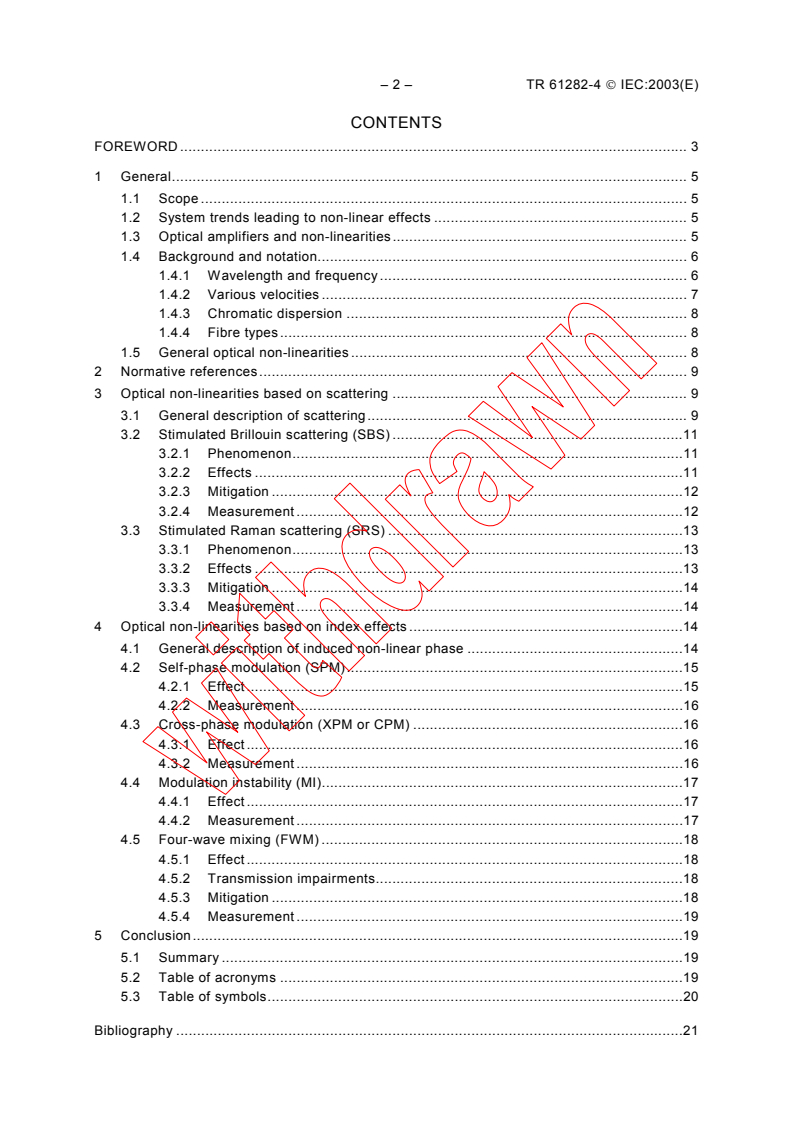
CONTENTS
FOREWORD . 3
1 General. 5
1.1 Scope . 5
1.2 System trends leading to non-linear effects . 5
1.3 Optical amplifiers and non-linearities. 5
1.4 Background and notation. 6
1.4.1 Wavelength and frequency . 6
1.4.2 Various velocities . 7
1.4.3 Chromatic dispersion . 8
1.4.4 Fibre types. 8
1.5 General optical non-linearities . 8
2 Normative references. 9
3 Optical non-linearities based on scattering . 9
3.1 General description of scattering. 9
3.2 Stimulated Brillouin scattering (SBS) .11
3.2.1 Phenomenon.11
3.2.2 Effects .11
3.2.3 Mitigation .12
3.2.4 Measurement .12
3.3 Stimulated Raman scattering (SRS) .13
3.3.1 Phenomenon.13
3.3.2 Effects .13
3.3.3 Mitigation .14
3.3.4 Measurement .14
4 Optical non-linearities based on index effects .14
4.1 General description of induced non-linear phase .14
4.2 Self-phase modulation (SPM).15
4.2.1 Effect.15
4.2.2 Measurement .16
4.3 Cross-phase modulation (XPM or CPM) .16
4.3.1 Effect.16
4.3.2 Measurement .16
4.4 Modulation instability (MI).17
4.4.1 Effect.17
4.4.2 Measurement .17
4.5 Four-wave mixing (FWM) .18
4.5.1 Effect.18
4.5.2 Transmission impairments.18
4.5.3 Mitigation .18
4.5.4 Measurement .19
5 Conclusion.19
5.1 Summary .19
5.2 Table of acronyms .19
5.3 Table of symbols.20
Bibliography .21
TR 61282-4 IEC:2003(E) – 3 –
INTERNATIONAL ELECTROTECHNICAL COMMISSION
____________
FIBRE OPTIC COMMUNICATION SYSTEM DESIGN GUIDES –
Part 4: Accommodation and utilization of non-linear effects
FOREWORD
1) The IEC (International Electrotechnical Commission) is a worldwide organization for standardization comprising
all national electrotechnical committees (IEC National Committees). The object of the IEC is to promote
international co-operation on all questions concerning standardization in the electrical and electronic fields. To
this end and in addition to other activities, the IEC publishes International Standards. Their preparation is
entrusted to technical committees; any IEC National Committee interested in the subject dealt with may
participate in this preparatory work. International, governmental and non-governmental organizations liaising
with the IEC also participate in this preparation. The IEC collaborates closely with the International Organization
for Standardization (ISO) in accordance with conditions determined by agreement between the two
organizations.
2) The formal decisions or agreements of the IEC on technical matters express, as nearly as possible, an
international consensus of opinion on the relevant subjects since each technical committee has representation
from all interested National Committees.
3) The documents produced have the form of recommendations for international use and are published in the form
of standards, technical specifications, technical reports or guides and they are accepted by the National
Committees in that sense.
4) In order to promote international unification, IEC National Committees undertake to apply IEC International
Standards transparently to the maximum extent possible in their national and regional standards. Any
divergence between the IEC Standard and the corresponding national or regional standard shall be clearly
indicated in the latter.
5) The IEC provides no marking procedure to indicate its approval and cannot be rendered responsible for any
equipment declared to be in conformity with one of its standards.
6) Attention is drawn to the possibility that some of the elements of this technical report may be the subject of
patent rights. The IEC shall not be held responsible for identifying any or all such patent rights.
The main task of IEC technical committees is to prepare International Standards. However, a
technical committee may propose the publication of a technical report when it has collected
data of a different kind from that which is normally published as an International Standard, for
example “state of the art”.
Technical reports do not necessarily have to be reviewed until the data they provide are
considered to be no longer valid or useful by the maintenance team.
IEC 61282-4, which is a technical report, has been prepared by subcommittee 86C: Fibre optic
subsystems and active devices, of IEC technical committee 86: Fibre optics.
The text of this technical report is based on the following documents:
Enquiry draft Report on voting
86C/389/DTR 86C/446A/RVC
Full information on the voting for the approval of this technical report can be found in the report
on voting indicated in the above table.
This publication has been drafted in accordance with the ISO/IEC Directives, Part 2.
– 4 – TR 61282-4 IEC:2003(E)
The committee has decided that the contents of this publication will remain unchanged until
2010. At this date, the publication will be
• reconfirmed;
• withdrawn;
• replaced by a revised edition, or
• amended.
TR 61282-4 IEC:2003(E) – 5 –
FIBRE OPTIC COMMUNICATION SYSTEM DESIGN GUIDES –
Part 4: Accommodation and utilization of non-linear effects
1 General
1.1 Scope
This part of IEC 61282, which is a technical report, is intended to describe physically and
analytically non-linear effects in fibre optic systems, their impact on system performance, ways
of minimizing the effects or using them to advantage, and methods of measuring and
quantifying them. It contains some of ITU-T Recommendation G.663 [1] with additional
material. More details on applications are considered in [2] and networks in [3].
1.2 System trends leading to non-linear effects
The market demand for new advanced telecommunications services has driven the rapid
increase of system bandwidth, and, for some applications, longer system distances.
Greater bandwidth has been addressed in two ways. One way is by increasing the channel bit-
rate, accomplished with optoelectronic time-division multiplexing (TDM) and various types of
signal encoding. Another way is by increasing the number of channels, accomplished with
channel multiplexing, such as polarization division multiplexing or (more commonly) by dense
wavelength division multiplexing (DWDM). Bandwidth limitations of the optical fibre cable can
be overcome with various dispersion management techniques.
Longer distances, defined to be the optical path lengths between 3R regenerators, can be
achieved by two methods. One method is by increasing the span length, where a span is
defined to be the optical path between optical amplifiers (OAs). A longer span length may be
attained with fibre cable of lower attenuation coefficient and with fibre optic passive
components having lower loss. The span length may also be increased with increased
launched channel power from the output of the OA at the beginning of the span or with lower
allowed power at the input of the OA at the end of the span. Another method of increasing the
optical path length is to increase the number of spans. This increases the number of OAs, but
improvements can be limited by amplifier noise degradation.
There are a number of interactive trade-offs in system design. For example, increasing the bit-
rate reduces the span length by requiring higher received power or by requiring lower link
dispersion. The latter may be addressed by dispersion compensation, but this introduces
losses. Increasing the number of channels in DWDM systems also reduces span length due to
optical multiplexing and demultiplexing losses. The loss limitations of a span can be overcome
with OAs, but these introduce noise.
1.3 Optical amplifiers and non-linearities
An OA accepts a modulated signal at its input and emits an essentially identically shaped
signal at its output. However, the optical power is higher (desired), and there is some additional
noise (not desired). This technical report is concerned with the effects of higher power on the
fibre and the implications for system design. These non-linear effects are so-called because
they are not linearly proportional to launched power into the fibre or to the fibre length in either
absolute units or in dB units. They are affected primarily by characteristics of the optical signal
(power, optical spectrum, modulation, state of polarization), of the optical fibre (effective area,
effective length, gain coefficients, non-linear index, dispersion, dispersion slope, polarization
___________
Figures in square brackets refer to the bibliography.
– 6 – TR 61282-4 IEC:2003(E)
mode dispersion), and of system aspects such as distance between regenerators and the
number and spacing of channels in DWDM systems. Power levels as low as several mW can
induce non-linear effects.
One class of non-linear effects is stimulated scattering of the signal. Stimulated Brillouin
scattering limits the power transmitted through the fibre by scattering some light backwards in
the fibre. Stimulated Raman scattering mainly causes forward crosstalk in a DWDM system.
Another class of non-linear effects is phase-shifting of the signal. This leads to self-phase
modulation and modulation instability that produce distortion even on a single channel, or to
cross-phase modulation and four-wave mixing that introduce interference between channels.
These interact with chromatic dispersion to degrade or enhance system performance. Soliton
formation is another related effect.
1.4 Background and notation
1.4.1 Wavelength and frequency
These simple concepts are essential in discussing advanced optical transmission systems.
One can interchangeably talk about the vacuum wavelength λ in nm and optical frequency ν in
THz (10 Hz or 1 000 GHz). The optical frequency is not to be confused with the signal
modulation frequency f or the signal bit-rate B. By using the speed of light in a vacuum c, one
can change between wavelength and frequency through the fundamental relation
λ()nm ×ν(THz) = c(nm/ps)
(1)
where c ≈ 299.792,458 nm/ps
The fundamental mode of a single-mode fibre has a phase (refractive) index n, which is
dimensionless, with a value around 1,46 in silica fibre. It decreases as the wavelength of light
increases, and details depend upon the refractive index profile of the fibre and the
λ
characteristic of the fundamental mode. The wavelength of light in a fibre decreases to and
n
c
the speed of the light decreases to , but the light's frequency v does not change.
n
Examples of the wavelength/frequency correspondence from Equation (1) are shown in the two
left columns of Table 1 for several significant wavelengths of interest. Note that as the
(vacuum) wavelength increases, the frequency decreases.
For DWDM systems it is important to be able to relate wavelength and frequency in terms of
differences. These differences describe channel widths and separations. From Equation (1),
λ may be related to the frequency separation Δν by
two wavelengths separated by Δ
Δλ Δν
= − (2)
λ ν
The fractional changes in wavelength and frequency are the same, though of opposite sign
(important in later discussions of chirp). This can also be written as
Δλ λ c
− = = (3)
Δν c
ν
and examples of the correspondence in wavelength and frequency spreads are shown in the
two right columns of Table 1. For a communications engineer, dealing in frequency, which is
related to information content, is more natural than dealing with wavelength. Note that a
constant frequency spread has a larger wavelength spread at longer wavelengths.
TR 61282-4 IEC:2003(E) – 7 –
2π
It is sometimes convenient to use the notation β(ω) = n(ω) for the propagation wave
λ
number in the material. It depends upon the circular frequency ω = 2πν, so Equation (1) is
ωn(ω) = cβ(ω)(4)
1.4.2 Various velocities
It is important to distinguish between two types of velocities in optical fibre. The phase of an
iφ
optical wave, as written in e , is
nz
φ = β z − ω t = 2π −ν t (5)
λ
where
z is the distance along the fibre; and
t is time.
dz
For a point of constant phase along the optical wave, dφ = 0 = βdz – ωdt, so is the phase
dt
velocity (actually “speed”) given by
ω c
v = = (6)
p
β()ω n()ν
Table 1 – Correspondence of wavelength and frequency
Wavelength Frequency 1 nm spread 100 GHz spread
nm THz GHz nm
1 260,000
(nominal lower limit due to cut-off) 237,931 188,8 0,530
1 310,000
(nominal zero dispersion for category B1 fibre) 228,849 174,7 0,572
1 395,000
(nominal water peak) 214,905 154,1 0,649
1 550,000
(nominal zero dispersion for category B2 fibre) 193,414 124,8 0,801
1 552,524
(ITU grid reference) 193,100 124,4 0,804
1 625,000
(nominal upper limit due to attenuation) 184,448 113,5 0,881
Although the optical subcarrier travels at the phase velocity, this is not the primary interest of
a communications engineer. The subcarrier is modulated to produce an analogue or digital
signal. The more slowly varying signal envelope and its associated energy travel at the group
velocity.
−1
dβ c
v = = (7)
g
dω N
is the group velocity. Here
– 8 – TR 61282-4 IEC:2003(E)
d n d n
N = n − λ = n + υ (8)
d λ dυ
is the group index. (For silica fibre in the wavelength regions of interest, this is slightly larger
than the phase index because the wavelength derivative is positive.) These “group” quantities
describe the speed at which energy and information (such as pulses) travel down the fibre.
Also, this index is the appropriate one for the pulses generated by an optical time-domain
reflectometer (OTDR). The group index can easily be measured as the time delay of a pulse or
the phase shift of an RF modulation, both for a known physical length of fibre.
1.4.3 Chromatic dispersion
The chromatic dispersion coefficient is defined as the wavelength variation of the group delay
per unit fibre length:
−1
2 2
dv
1 d N λ d n 2πc d β
g
D()λ = = = − − (9)
2 2 2
dλ c d λ
c d λ λ dω
The dispersion-slope coefficient is the derivative
2 3
d D 4πc d β 2πc d β
S()λ = = + (10)
3 2 2 3
d λ
λ dω λ dω
1.4.4 Fibre types
The various types of category B single-mode fibre according to IEC 60793-1 and IEC 60793-2
have nominally similar attenuation coefficients. They differ primarily in their dispersion
coefficients and mode-field diameters (or effective areas, as applied to non-linear effects). In
the 1 550 nm region, category B1 (dispersion-non-shifted) fibre has a positive dispersion
coefficient that averages at about 17 ps/nm-km. Category B2 (dispersion-shifted) fibre has a
zero dispersion point in this region, whereas category B4 (non-zero-dispersion) fibre has a
small positive or negative dispersion in this region. The dispersion slope of these fibres may be
important for DWDM applications. The effective area of category B1 fibre is generally larger
than for the other two types.
1.5 General optical non-linearities
These effects have been studied since the 1970s in fibres and were induced in the laboratory
by injecting the light from high-power lasers into the fibre. Now they are of practical importance
to communications engineers since such powers are found in systems at the output of OAs,
both optical fibre amplifiers (OFAs) and semiconductor optical amplifiers (SOAs).
Consider two lightwaves of the same polarization co-propagating along the fibre. The electric
field E of one wave is affected by the “pump” optical power E of the other wave. After an
incremental length dL of propagation, the first wave grows approximately as
1 γ
2
E()z + d z,dt = E(z,t)exp i(β d z − ω dt) + − α + E ()L d z (11)
1 1 2
2 A
eff
Compared to the phase of Equation (5), attenuation and gain are included. The second signal
E loses power by being converted to another wavelength and by attenuation. Here
• α is the attenuation coefficient in Np/km appropriate to the exponential notation. Relating
this to log notation, 1 Np is about 4 343 dB.
TR 61282-4 IEC:2003(E) – 9 –
• A is the effective area of the fibre cross-section over which the integrated non-linear
eff
interaction takes place. It can be slightly different (usually larger) than the area calculated
using the mode-field diameter (MFD) [4] because the field intensities are weighted
differently in the two calculations. The effective area ranges from above 85 μm for IEC
2 2
category B1 fibre, to about 60 μm for category B2 fibre, to below 25 μm for dispersion
compensating fibre (DCF). Smaller effective areas generally lead to larger non-linear
effects.
−αL
1− e
• L = is the effective length of fibre over which the integrated non-linear
eff
α
interaction takes place. It equals the fibre length only for short fibre lengths over which no
significant attenuation has taken place, but is less than the full fibre length because of the
reduced non-linear power levels with distance. For long lengths this approaches , which
α
is approximately 12,4 km at 1 310 nm (for 0,35 dB/km) and 19,7 km at 1 550 nm (for
0,22 dB/km). These are the maximum distances over which non-linear effects occur;
beyond these, the power levels causing them are low and have diminishing effect.
• y is the non-linear coefficient. If it is real and positive, it corresponds to a gain, or to a loss
if it is negative, and it is due to scattering of photons with phonons (mechanical vibrations in
the silica), producing heat. If it is imaginary, it is effectively a change in the phase index,
the Kerr effect. Both are discussed in some detail below.
2 Normative references
The following referenced documents are indispensable for the application of this document. For
dated references, only the edition cited applies. For undated references, the latest edition of
the referenced document (including any amendments) applies.
IEC 60793-1 (all parts), Optical fibres – Part 1: Measurement methods and test procedures
IEC 60793-2 (all parts), Optical fibres – Part 2: Product specifications
IEC 61292-3, Optical amplifier technical reports – Part 3: Classification, characteristics and
applications of optical amplifiers
3 Optical non-linearities based on scattering
3.1 General description of scattering
In modern low-loss silica fibre, the spectral attenuation coefficient is “linear” in the sense of
dB/km. Intrinsic absorption occurs mainly in the ultraviolet region below 500 nm, and in the
infrared region above 1 650 nm. The only significant “impurity” absorption that may exist in
some fibres is due to some “water” content that results in an absorption band beginning at a
wavelength as low as 1 360 nm, peaking at about 1 385 nm, and extending as high as
–
1 430 nm, depending upon the level of OH ion in the fibre.
Otherwise, the dominant attenuation mechanism is Rayleigh scattering in which photons
change direction due to interacting with molecular density fluctuations in the silica. (Those that
scatter in other than the forward direction are “lost”. However, captured backward scattering is
the useful principle behind OTDRs.) In this elastic scattering, there is a change in the photon
momentum direction, but no energy transfer to other photon or to phonons, so the frequencies
(and wavelengths) of the input and output light are not changed.
___________
To be published.
– 10 – TR 61282-4 IEC:2003(E)
By contrast, there is inelastic scattering in which a “pump” light photon of the incident signal
interacts with a vibrational phonon in the fibre, with an energy transfer. One result is a new
phonon to preserve the overall energy and momentum. Another result is a new signal photon,
either a Stokes photon downshifted in energy (and frequency) by the Stokes frequency, or a
new anti-Stokes photon upshifted in frequency for photons in some directions. This additional
photon may be an undesired second “signal”. Thermal equilibrium and momentum conservati
...