

IEC 60519-12:2016
(Main)Safety in installations for electroheating and electromagnetic processing - Part 12: Particular requirements for infrared electroheating
General Information
- Abstract
IEC 60519-12:2016 specifies safety requirements for industrial electroheating equipment and installations in which infrared radiation – usually generated by infrared emitters – is significantly dominating over heat convection or heat conduction as means of energy transfer to the workload. A further limitation of the scope is that the infrared emitters have a maximum spectral emission at longer wavelengths than 780 nm in air or vacuum, and are emitting wideband continuous spectra such as by thermal radiation or high pressure arcs. This second edition cancels and replaces the first edition published in 2013. This edition constitutes a technical revision. This edition includes the following significant technical changes with respect to the previous edition:
a. the structure has been redrafted according to IEC 60519-1:2015;
b. terms/definitions, normative references and bibliography have been updated and completed;
c. all requirements and content from IEC 60519-12:2013 that have been included in IEC 60519-1:2015 have been removed to avoid any duplication.
- Status
- Published
- Publication Date
- 14-Dec-2016
- Technical Committee
- TC 27 - Industrial electroheating and electromagnetic processing
- Drafting Committee
- MT 31 - TC 27/MT 31
- Current Stage
- PPUB - Publication issued
- Start Date
- 15-Dec-2016
- Completion Date
- 09-Jan-2017
Overview
IEC 60519-12:2016 is an international standard published by the International Electrotechnical Commission (IEC) that defines safety requirements for industrial infrared electroheating equipment and installations. This second edition updates and replaces the 2013 version, aligning the structure with IEC 60519-1:2015 to ensure clarity and avoid duplication.
This standard specifically addresses installations where infrared radiation (with wavelengths longer than 780 nm) is the dominant method of heat transfer to the workload, typically emitted by infrared emitters producing wideband continuous spectra such as thermal radiation or high-pressure arcs. It operates in conjunction with IEC 60519-1 (General Requirements) to cover the full scope of safety in electroheating and electromagnetic processing.
Keywords: infrared electroheating safety, industrial infrared heating, IEC 60519-12, electroheating installations, infrared radiation standards
Key Topics
- Scope and Specificity: Focuses on infrared electroheating where radiation dominates over convection or conduction as energy transfer methods, applicable to industrial processes with emitters having spectral emissions beyond 780 nm.
- Risk Assessment: Provides detailed guidance on hazard identification and risk control measures related to electric shock, radiation exposure, thermal hazards, fire, mechanical risks, and electromagnetic fields.
- Radiation Safety: Establishes limits for infrared exposure based on duration and intensity, including provisions on reducing near-field and retinal thermal radiation hazards to operators.
- Component Requirements: Specifies safety criteria for devices and assemblies used within infrared electroheating systems to ensure compliance and safe operation.
- Testing and Verification: Outlines methods for inspecting and verifying compliance with the safety requirements, including measurement techniques for total irradiance and thermal radiation exposure.
- Normative References and Terminology: Incorporates updated terms, definitions, and references consistent with the latest IEC vocabulary and related standards for consistency.
- Annexes for Practical Guidance: Contains informative annexes detailing risk groups related to infrared radiation exposure, EMC provisions, marking and warning labels, and alignment with related ISO standards.
Applications
IEC 60519-12 is essential for:
- Manufacturers of industrial infrared electroheating equipment, ensuring products meet international safety standards.
- Plant designers and engineers responsible for integrating infrared heating installations safely within industrial processes.
- Safety assessors and regulatory bodies who evaluate conformity of infrared electroheating setups.
- Maintenance personnel and operators by providing guidelines on safe use, hazard management, and protective measures against infrared radiation.
- Research and development teams aiming to innovate or adapt infrared heating technologies while maintaining compliance with established safety frameworks.
Common industrial uses include drying, curing, surface treatment, and material processing where precise heating control and safety are paramount.
Related Standards
IEC 60519-12 is part of the broader IEC 60519 series on safety in electroheating and electromagnetic processing installations, which collectively address various heating methods and hazards:
- IEC 60519-1:2015 – General safety requirements applicable to all electroheating and electromagnetic processing equipment.
- IEC 60519-2:2006 – Specific requirements for induction heating installations.
- Other parts of IEC 60519 cover arc welding, dielectric heating, and microwave processing, providing comprehensive safety coverage.
Additional relevant standards include:
- ISO 13577 series – Complementary guidelines for industrial heating processes.
- IEC 60601 series – Safety standards for related electrical medical equipment that may involve infrared technologies.
Integrating IEC 60519-12 within an organization's safety management system ensures robust control of infrared electroheating hazards and compliance with global best practices.
By adhering to IEC 60519-12:2016, stakeholders can effectively manage the risks posed by infrared radiation in industrial electroheating, thereby safeguarding personnel while optimizing process efficiency. This standard represents a critical reference for maintaining international consistency and safety excellence in electroheating installations involving infrared technology.
Relations
- Effective Date
- 05-Sep-2023
Get Certified
Connect with accredited certification bodies for this standard

DVS-ZERT GmbH
German welding certification society.
CARES (UK Certification Authority for Reinforcing Steels)
UK certification for reinforcing steels and construction.
EWF/IIW (European/International Welding Federation)
International welding personnel certification.
Sponsored listings
Frequently Asked Questions
IEC 60519-12:2016 is a standard published by the International Electrotechnical Commission (IEC). Its full title is "Safety in installations for electroheating and electromagnetic processing - Part 12: Particular requirements for infrared electroheating". This standard covers: IEC 60519-12:2016 specifies safety requirements for industrial electroheating equipment and installations in which infrared radiation – usually generated by infrared emitters – is significantly dominating over heat convection or heat conduction as means of energy transfer to the workload. A further limitation of the scope is that the infrared emitters have a maximum spectral emission at longer wavelengths than 780 nm in air or vacuum, and are emitting wideband continuous spectra such as by thermal radiation or high pressure arcs. This second edition cancels and replaces the first edition published in 2013. This edition constitutes a technical revision. This edition includes the following significant technical changes with respect to the previous edition: a. the structure has been redrafted according to IEC 60519-1:2015; b. terms/definitions, normative references and bibliography have been updated and completed; c. all requirements and content from IEC 60519-12:2013 that have been included in IEC 60519-1:2015 have been removed to avoid any duplication.
IEC 60519-12:2016 specifies safety requirements for industrial electroheating equipment and installations in which infrared radiation – usually generated by infrared emitters – is significantly dominating over heat convection or heat conduction as means of energy transfer to the workload. A further limitation of the scope is that the infrared emitters have a maximum spectral emission at longer wavelengths than 780 nm in air or vacuum, and are emitting wideband continuous spectra such as by thermal radiation or high pressure arcs. This second edition cancels and replaces the first edition published in 2013. This edition constitutes a technical revision. This edition includes the following significant technical changes with respect to the previous edition: a. the structure has been redrafted according to IEC 60519-1:2015; b. terms/definitions, normative references and bibliography have been updated and completed; c. all requirements and content from IEC 60519-12:2013 that have been included in IEC 60519-1:2015 have been removed to avoid any duplication.
IEC 60519-12:2016 is classified under the following ICS (International Classification for Standards) categories: 25.180.10 - Electric furnaces. The ICS classification helps identify the subject area and facilitates finding related standards.
IEC 60519-12:2016 has the following relationships with other standards: It is inter standard links to IEC 60519-12:2013. Understanding these relationships helps ensure you are using the most current and applicable version of the standard.
IEC 60519-12:2016 is available in PDF format for immediate download after purchase. The document can be added to your cart and obtained through the secure checkout process. Digital delivery ensures instant access to the complete standard document.
Standards Content (Sample)
IEC 60519-12 ®
Edition 2.0 2016-12
INTERNATIONAL
STANDARD
NORME
INTERNATIONALE
Safety in installations for electroheating and electromagnetic processing –
Part 12: Particular requirements for infrared electroheating
Sécurité dans les installations destinées au traitement électrothermique et
électromagnétique –
Partie 12: Exigences particulières pour chauffage électrique par rayonnement
infrarouge
All rights reserved. Unless otherwise specified, no part of this publication may be reproduced or utilized in any form
or by any means, electronic or mechanical, including photocopying and microfilm, without permission in writing from
either IEC or IEC's member National Committee in the country of the requester. If you have any questions about IEC
copyright or have an enquiry about obtaining additional rights to this publication, please contact the address below or
your local IEC member National Committee for further information.
Droits de reproduction réservés. Sauf indication contraire, aucune partie de cette publication ne peut être reproduite
ni utilisée sous quelque forme que ce soit et par aucun procédé, électronique ou mécanique, y compris la photocopie
et les microfilms, sans l'accord écrit de l'IEC ou du Comité national de l'IEC du pays du demandeur. Si vous avez des
questions sur le copyright de l'IEC ou si vous désirez obtenir des droits supplémentaires sur cette publication, utilisez
les coordonnées ci-après ou contactez le Comité national de l'IEC de votre pays de résidence.
IEC Central Office Tel.: +41 22 919 02 11
3, rue de Varembé Fax: +41 22 919 03 00
CH-1211 Geneva 20 info@iec.ch
Switzerland www.iec.ch
About the IEC
The International Electrotechnical Commission (IEC) is the leading global organization that prepares and publishes
International Standards for all electrical, electronic and related technologies.
About IEC publications
The technical content of IEC publications is kept under constant review by the IEC. Please make sure that you have the
latest edition, a corrigenda or an amendment might have been published.
IEC Catalogue - webstore.iec.ch/catalogue Electropedia - www.electropedia.org
The stand-alone application for consulting the entire The world's leading online dictionary of electronic and
bibliographical information on IEC International Standards, electrical terms containing 20 000 terms and definitions in
Technical Specifications, Technical Reports and other English and French, with equivalent terms in 15 additional
documents. Available for PC, Mac OS, Android Tablets and languages. Also known as the International Electrotechnical
iPad. Vocabulary (IEV) online.
IEC publications search - www.iec.ch/searchpub IEC Glossary - std.iec.ch/glossary
The advanced search enables to find IEC publications by a 65 000 electrotechnical terminology entries in English and
variety of criteria (reference number, text, technical French extracted from the Terms and Definitions clause of
committee,…). It also gives information on projects, replaced IEC publications issued since 2002. Some entries have been
and withdrawn publications. collected from earlier publications of IEC TC 37, 77, 86 and
CISPR.
IEC Just Published - webstore.iec.ch/justpublished
Stay up to date on all new IEC publications. Just Published IEC Customer Service Centre - webstore.iec.ch/csc
details all new publications released. Available online and If you wish to give us your feedback on this publication or
also once a month by email. need further assistance, please contact the Customer Service
Centre: csc@iec.ch.
A propos de l'IEC
La Commission Electrotechnique Internationale (IEC) est la première organisation mondiale qui élabore et publie des
Normes internationales pour tout ce qui a trait à l'électricité, à l'électronique et aux technologies apparentées.
A propos des publications IEC
Le contenu technique des publications IEC est constamment revu. Veuillez vous assurer que vous possédez l’édition la
plus récente, un corrigendum ou amendement peut avoir été publié.
Catalogue IEC - webstore.iec.ch/catalogue Electropedia - www.electropedia.org
Application autonome pour consulter tous les renseignements
Le premier dictionnaire en ligne de termes électroniques et
bibliographiques sur les Normes internationales,
électriques. Il contient 20 000 termes et définitions en anglais
Spécifications techniques, Rapports techniques et autres
et en français, ainsi que les termes équivalents dans 15
documents de l'IEC. Disponible pour PC, Mac OS, tablettes
langues additionnelles. Egalement appelé Vocabulaire
Android et iPad.
Electrotechnique International (IEV) en ligne.
Recherche de publications IEC - www.iec.ch/searchpub
Glossaire IEC - std.iec.ch/glossary
65 000 entrées terminologiques électrotechniques, en anglais
La recherche avancée permet de trouver des publications IEC
en utilisant différents critères (numéro de référence, texte, et en français, extraites des articles Termes et Définitions des
comité d’études,…). Elle donne aussi des informations sur les publications IEC parues depuis 2002. Plus certaines entrées
projets et les publications remplacées ou retirées. antérieures extraites des publications des CE 37, 77, 86 et
CISPR de l'IEC.
IEC Just Published - webstore.iec.ch/justpublished
Service Clients - webstore.iec.ch/csc
Restez informé sur les nouvelles publications IEC. Just
Published détaille les nouvelles publications parues. Si vous désirez nous donner des commentaires sur cette
Disponible en ligne et aussi une fois par mois par email. publication ou si vous avez des questions contactez-nous:
csc@iec.ch.
IEC 60519-12 ®
Edition 2.0 2016-12
INTERNATIONAL
STANDARD
NORME
INTERNATIONALE
Safety in installations for electroheating and electromagnetic processing –
Part 12: Particular requirements for infrared electroheating
Sécurité dans les installations destinées au traitement électrothermique et
électromagnétique –
Partie 12: Exigences particulières pour chauffage électrique par rayonnement
infrarouge
INTERNATIONAL
ELECTROTECHNICAL
COMMISSION
COMMISSION
ELECTROTECHNIQUE
INTERNATIONALE
ICS 25.180.10 ISBN 978-2-8322-3709-0
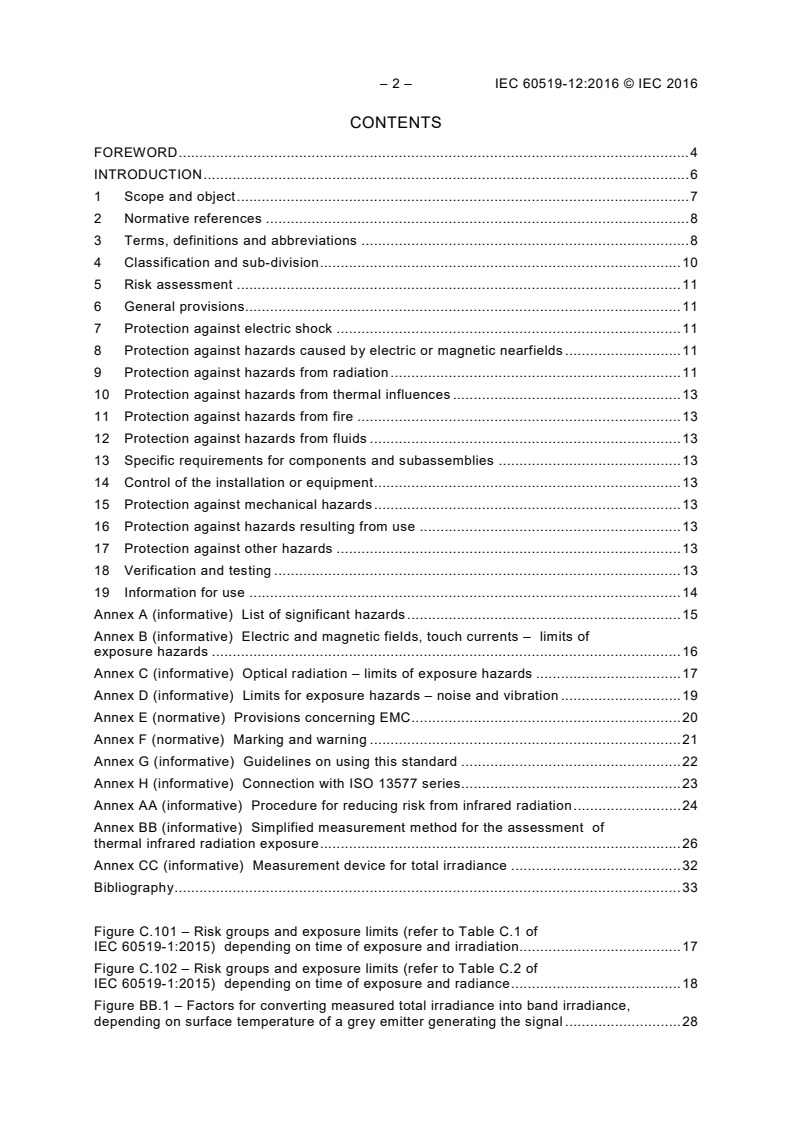
– 2 – IEC 60519-12:2016 © IEC 2016
CONTENTS
FOREWORD . 4
INTRODUCTION . 6
1 Scope and object . 7
2 Normative references . 8
3 Terms, definitions and abbreviations . 8
4 Classification and sub-division . 10
5 Risk assessment . 11
6 General provisions. 11
7 Protection against electric shock . 11
8 Protection against hazards caused by electric or magnetic nearfields . 11
9 Protection against hazards from radiation . 11
10 Protection against hazards from thermal influences . 13
11 Protection against hazards from fire . 13
12 Protection against hazards from fluids . 13
13 Specific requirements for components and subassemblies . 13
14 Control of the installation or equipment . 13
15 Protection against mechanical hazards . 13
16 Protection against hazards resulting from use . 13
17 Protection against other hazards . 13
18 Verification and testing . 13
19 Information for use . 14
Annex A (informative) List of significant hazards . 15
Annex B (informative) Electric and magnetic fields, touch currents – limits of
exposure hazards . 16
Annex C (informative) Optical radiation – limits of exposure hazards . 17
Annex D (informative) Limits for exposure hazards – noise and vibration . 19
Annex E (normative) Provisions concerning EMC . 20
Annex F (normative) Marking and warning . 21
Annex G (informative) Guidelines on using this standard . 22
Annex H (informative) Connection with ISO 13577 series . 23
Annex AA (informative) Procedure for reducing risk from infrared radiation . 24
Annex BB (informative) Simplified measurement method for the assessment of
thermal infrared radiation exposure . 26
Annex CC (informative) Measurement device for total irradiance . 32
Bibliography . 33
Figure C.101 – Risk groups and exposure limits (refer to Table C.1 of
IEC 60519-1:2015) depending on time of exposure and irradiation. 17
Figure C.102 – Risk groups and exposure limits (refer to Table C.2 of
IEC 60519-1:2015) depending on time of exposure and radiance . 18
Figure BB.1 – Factors for converting measured total irradiance into band irradiance,
depending on surface temperature of a grey emitter generating the signal . 28
Figure BB.2 – Factor for converting measured total radiance into relevant retinal
thermal radiance, depending on surface temperature of a grey emitter generating the
signal . 31
Figure CC.1 – Example of a detector for total irradiance measurement . 32
Table AA.1 – Procedure for assessment and reduction of radiation exposure through
design . 25
Table BB.1 – Measurement procedure . 26
– 4 – IEC 60519-12:2016 © IEC 2016
INTERNATIONAL ELECTROTECHNICAL COMMISSION
____________
SAFETY IN INSTALLATIONS FOR ELECTROHEATING
AND ELECTROMAGNETIC PROCESSING –
Part 12: Particular requirements for infrared electroheating
FOREWORD
1) The International Electrotechnical Commission (IEC) is a worldwide organization for standardization comprising
all national electrotechnical committees (IEC National Committees). The object of IEC is to promote
international co-operation on all questions concerning standardization in the electrical and electronic fields. To
this end and in addition to other activities, IEC publishes International Standards, Technical Specifications,
Technical Reports, Publicly Available Specifications (PAS) and Guides (hereafter referred to as “IEC
Publication(s)”). Their preparation is entrusted to technical committees; any IEC National Committee interested
in the subject dealt with may participate in this preparatory work. International, governmental and non-
governmental organizations liaising with the IEC also participate in this preparation. IEC collaborates closely
with the International Organization for Standardization (ISO) in accordance with conditions determined by
agreement between the two organizations.
2) The formal decisions or agreements of IEC on technical matters express, as nearly as possible, an international
consensus of opinion on the relevant subjects since each technical committee has representation from all
interested IEC National Committees.
3) IEC Publications have the form of recommendations for international use and are accepted by IEC National
Committees in that sense. While all reasonable efforts are made to ensure that the technical content of IEC
Publications is accurate, IEC cannot be held responsible for the way in which they are used or for any
misinterpretation by any end user.
4) In order to promote international uniformity, IEC National Committees undertake to apply IEC Publications
transparently to the maximum extent possible in their national and regional publications. Any divergence
between any IEC Publication and the corresponding national or regional publication shall be clearly indicated in
the latter.
5) IEC itself does not provide any attestation of conformity. Independent certification bodies provide conformity
assessment services and, in some areas, access to IEC marks of conformity. IEC is not responsible for any
services carried out by independent certification bodies.
6) All users should ensure that they have the latest edition of this publication.
7) No liability shall attach to IEC or its directors, employees, servants or agents including individual experts and
members of its technical committees and IEC National Committees for any personal injury, property damage or
other damage of any nature whatsoever, whether direct or indirect, or for costs (including legal fees) and
expenses arising out of the publication, use of, or reliance upon, this IEC Publication or any other IEC
Publications.
8) Attention is drawn to the Normative references cited in this publication. Use of the referenced publications is
indispensable for the correct application of this publication.
9) Attention is drawn to the possibility that some of the elements of this IEC Publication may be the subject of
patent rights. IEC shall not be held responsible for identifying any or all such patent rights.
International Standard IEC 60519-12 has been prepared by IEC technical committee 27:
Industrial electroheating and electromagnetic processing.
This second edition cancels and replaces the first edition published in 2013. This edition
constitutes a technical revision.
This edition includes the following significant technical changes with respect to the previous
edition:
a) the structure has been redrafted according to IEC 60519-1:2015;
b) terms/definitions, normative references and bibliography have been updated and
completed;
c) all requirements and content from IEC 60519-12:2013 that have been included in
IEC 60519-1:2015 have been removed to avoid any duplication.
The text of this standard is based on the following documents:
CDV Report on voting
27/967/CDV 27/982/RVC
Full information on the voting for the approval of this International Standard can be found in
the report on voting indicated in the above table.
This document has been drafted in accordance with the ISO/IEC Directives, Part 2.
A list of all parts in the IEC 60519 series, published under the general title Safety in
installations for electroheating and electromagnetic processing, can be found on the IEC
website.
Future standards in this series will carry the new general title as cited above. Titles of existing
standards in this series will be updated at the time of the next edition.
The clauses of parts of the IEC 60519 series (hereinafter called Particular Requirements)
supplement or modify the corresponding clauses of IEC 60519-1:2015 (General Requirements
hereinafter called Part 1).
This part of IEC 60519 is to be read in conjunction with Part 1. It supplements or modifies the
corresponding clauses of Part 1. Where the text indicates an "addition" to or a "replacement"
of the relevant provision of Part 1, these changes are made to the relevant text of Part 1.
Where no change is necessary, the words "This clause of Part 1 is applicable" are used.
When a particular subclause of Part 1 is not mentioned in this part, that subclause applies as
far as is reasonable.
Additional specific provisions to those in Part 1, given as individual clauses or subclauses, are
numbered starting from 101.
NOTE The following numbering system is used:
• subclauses, tables and figures that are numbered starting from 101 are additional to those in Part 1;
• unless notes are in a new subclause or involve notes in Part 1, they are numbered starting from 101, including
those in a replaced clause or subclause;
• additional annexes are lettered AA, BB, etc.
In this standard, the following print types are used:
• requirements and definitions: in roman type;
• NOTES: in smaller roman type;
• terms used throughout this standard which have been defined in Clause 3: in bold type.
– 6 – IEC 60519-12:2016 © IEC 2016
INTRODUCTION
The scope of this standard covers a broad range of types and designs of infrared equipment
which are used for many different purposes. This standard is intended to cover all industrial
infrared equipment types, with some few exceptions provided in Clause 1.
Many other types of electroheating equipment emit infrared radiation of hazardous levels,
therefore IEC 60519-1:2015 provides all general requirements addressing optical radiation
and this document provides specific considerations for infrared equipment and helpful
methods.
With reference to IEC 60519-2:2006 it has been agreed in TC 27 that this standard covers all
kinds of infrared emission hazards of industrial electroheating installations and provisions not
given in IEC 60519-1:2015.
The discussion of infrared radiation assessment has become quite detailed in this standard,
as for the industry there is not any single useful source available for simple, versatile, easy to
use and cost effective measurement methods.
The other principles for covering the risks caused by infrared radiation were:
• the manufacturer usually does not employ an expert in optical radiation measurement or
has access to an optical laboratory with all the necessary equipment needed for elaborate
measurements;
• operating staff with limited experience in radiation measurement is usually responsible for
the task of performing the necessary measurements and will appreciate a simple and easy
to follow guide;
• the scope of IEC 62471:2006 is limited to lamps but is applicable for other light sources.
Therefore, core aspects were adapted from that standard and if possible simplified for this
document.
• figures illustrating the classes defined in IEC 62471:2006 and listed in IEC 60519-1:2015
are included;
• relevant documents of American National Standard Institute/Illuminating Engineering
Society of North America, the ANSI/IESNA RP 27 series, are based on the ICNIRP
recommendations as well. They provide no extra or contradictory material with regard to
this standard and its references.
SAFETY IN INSTALLATIONS FOR ELECTROHEATING
AND ELECTROMAGNETIC PROCESSING –
Part 12: Particular requirements for infrared electroheating
1 Scope and object
1.1 Scope
This clause of Part 1 is replaced by the following.
Replacement:
This part of IEC 60519 specifies safety requirements for industrial electroheating equipment
and installations in which infrared radiation – usually generated by infrared emitters – is
significantly dominating over heat convection or heat conduction as means of energy transfer
to the workload. A further limitation of the scope is that the infrared emitters have a maximum
spectral emission at longer wavelengths than 780 nm in air or vacuum, and are emitting
wideband continuous spectra such as by thermal radiation or high pressure arcs.
IEC 60519-1:2015 defines infrared as radiation within the frequency range between 400 THz
and 300 GHz. This corresponds to a wavelength range between 780 nm and 10 µm in
vacuum. Industrial infrared heating commonly uses thermal infrared sources with rated
temperatures between 500 °C and 3 000 °C; the emitted radiation from these sources
dominates in the wavelength range between 780 nm and 10 µm.
Since substantial emission of thermal emitters can extend either to wavelengths below
780 nm or above 3 000 nm, the safety aspects of emitted visible light and emission at
wavelengths longer than 3 000 nm are also considered in this document.
This standard is not applicable to:
• infrared installations with lasers or light-emitting diodes (LEDs) as main sources – they are
covered by IEC 62471:2006 and IEC 60825-1:2014;
• appliances for use by the general public;
• appliances for laboratory use – they are covered by IEC 61010-1:2010;
• electroheating installations where resistance heated bare wires, tubes or bars are used as
heating elements, and infrared radiation is not a dominant side effect of the intended use,
covered by IEC 60519-2:2006;
• infrared heating equipment with a nominal combined electrical power of the infrared
emitters of less than 250 W;
• handheld infrared equipment.
Industrial infrared electroheating equipment under the scope of this standard typically uses
the Joule effect for the conversion of electric energy into infrared radiation by one or several
sources. Radiation is then emitted from one or several elements onto the material to be
treated. Such infrared heating elements are in particular:
• thermal infrared emitters in the form of tubular, plate-like or otherwise shaped ceramics
with a resistive element inside;
• infrared quartz glass tube or halogen lamp emitters with a hot filament as a source;
– 8 – IEC 60519-12:2016 © IEC 2016
• non insulated elements made from molybdenum disilicide, silicon carbide, graphite, iron-
chromium-aluminium alloys, refractory metals or comparable materials;
• wide-spectrum arc lamps.
1.2 Object
This clause of Part 1 is applicable.
2 Normative references
This clause of Part 1 is applicable except as follows.
Addition:
IEC 60519-1:2015, Safety in installations for electroheating and electromagnetic processing –
Part 1: General requirements
3 Terms, definitions and abbreviations
This clause of Part 1 is applicable except as follows.
Addition:
3.1 General concepts
3.1.101
infrared radiation
optical radiation for which the wavelengths are longer than those for visible radiation
Note 1 to entry: The infrared radiation range between 780 nm and 1 mm is commonly subdivided into:
IR-A 780 nm to 1 400 nm, or for a grey emitter 3 450 °C to 1 800 °C surface temperature;
IR-B 1 400 nm to 3 000 nm, or for a grey emitter 1 800 °C to 690 °C surface temperature;
IR-C 3 000 nm to 1 mm, or for a grey emitter less than 690 °C surface temperature.
The temperature corresponds to a spectrum where maximum intensity is at the wavelength of the limit.
These ranges comply with IEC 62471:2006.
Note 2 to entry: In IEC 60050-841:2004, the following terms are defined:
841-24-04 – shortwave infrared radiation or near infrared radiation (780 nm to 2 µm);
841-24-03 – mediumwave infrared radiation or medium infrared radiation (2 µm to 4 µm);
841-24-02 – longwave infrared radiation or far infrared radiation (4 µm to 1 mm).
These terms are not used in this standard.
[SOURCE: IEC 62471:2006, 3.14, modified – Note 1 has been modified and Note 2 added]
3.1.102
infrared heating
heating consisting in absorption of thermal and optical radiation, mostly infrared radiation,
emitted by especially constructed equipment
[SOURCE: IEC 60050-841:2004, 841-24-05, modified – The definition has been editorially
improved.]
3.2 Equipment and state of equipment
3.2.103
infrared installation
infrared electroheating installation
electroheating installation, where processing of the workload is achieved by infrared heating
[SOURCE: IEC 60050-841:2004, 841-24-09, modified – The synonym has been added and
the definition has been shortened.]
3.2.101
infrared emitter
component from which infrared radiation is emitted
Note 1 to entry: This component is usually replaceable.
3.2.102
infrared source
part of the infrared emitter, where electric energy is converted by the Joule effect into heat or
radiation
3.2.103
filament
conductive wire or thread of an infrared emitter, in which electric energy is converted into heat
by the Joule effect
[SOURCE: IEC 60050-841:2004, 841-24-27, modified – The definition has been clarified.]
3.2.104
infrared ceramic heater
infrared emitter made of or covered with ceramic material
[SOURCE: IEC 60050-841:2004, 841-24-13, modified – The definition has been shortened.]
3.2.105
tubular infrared emitter
infrared emitter in which one of the basic dimensions is dominant
Note 1 to entry: The emitter can include reflecting means and be straight or bent.
[SOURCE: IEC 60050-841:2004, 841-24-24, modified – The definition has been shortened
and Note 1 has been added.]
3.2.106
infrared plate emitter
infrared emitter in which two of the basic dimensions are dominant
Note 1 to entry: The emitter can include reflecting means and can be flat or curved.
[SOURCE: IEC 60050-841:2004, 841-24-25, modified – The definition has been shortened
and Note 1 has been added.]
3.2.107
infrared quartz emitter
infrared emitter in which the source is inside a quartz glass envelope
Note 1 to entry: Glass envelopes made from hard glasses comparable to quartz glass are included.
– 10 – IEC 60519-12:2016 © IEC 2016
[SOURCE: IEC 60050-841:2004, 841-24-26, modified – The definition has been shortened
and Note 1 has been added.]
3.2.108
halogen lamp emitter
infrared emitter with a tungsten filament placed inside a gas tight glass envelope with
halogen, containing atmosphere where the halogen actively transports tungsten from the
glass wall to the tungsten filament
[SOURCE: IEC 60050-841:2004, 841-24-22, modified – The definition has been clarified.]
3.2.109
infrared reflector
passive, non transmitting component which reflects and directs infrared radiation
Note 1 to entry: The reflector can be part of an infrared emitter and can cause specular or diffuse reflection or a
combination of both.
3.2.110
infrared refractor
passive, transmitting component that focuses and directs infrared radiation
Note 1 to entry: The refractor can be part of an infrared emitter.
3.2.111
wavelength converter
element inside the infrared installation that is heated up by infrared radiation during normal
operation to a temperature, where its own emitted radiation participates in heating up the
workload
Note 1 to entry: The spectrum of a wavelength converter has a substantially longer wavelength than the
wavelength of major emission of the infrared emitters.
3.2.112
infrared module
component housing one or more infrared emitters
Note 1 to entry: The module can include reflectors, refractors, filters, or other means for protecting the emitter as
well as cooling devices.
3.2.113
rated temperature
maximum surface temperature of the infrared filament or infrared emitter at rated voltage
Note 1 to entry: This temperature is used for the determination of the spectral emission of thermal infrared
emitters.
Note 2 to entry: The temperature applies under conditions of normal operation.
3.3 Parts and accessories
3.3.101
filter
partially transparent, partially absorbing or reflecting component, designed to reduce
transmission at selected wavelength
4 Classification and sub-division
This clause of Part 1 is applicable.
5 Risk assessment
This clause of Part 1 is applicable with the following addition:
Addition:
NOTE 101 Annex AA provides additional information about a procedure for risk reduction from infrared radiation
with the specific focus on projects with a shared design responsibility between manufacturer and user.
6 General provisions
This clause of Part 1 is applicable.
7 Protection against electric shock
This clause of Part 1 is applicable.
8 Protection against hazards caused by electric or magnetic nearfields
This clause of Part 1 is applicable.
9 Protection against hazards from radiation
This clause of Part 1 is applicable with the following addition:
Addition:
9.101 Protective measures against infrared radiation
9.101.1 General aspects
Technical measures to reduce exposure to infrared radiation include:
• The installation of suitable shields to reduce or avoid the emission of visible or infrared
radiation from the equipment. This includes sufficient infrared enclosure (i.e. housing) of
the infrared equipment. Shields and housing can become dangerously hot to the touch, if
no sufficient measures are taken.
• Positioning of the radiation source so that no or only reduced radiation is directed towards
persons.
• Suitable filters reduce the emission of infrared radiation emitted from the infrared
electroheating equipment. Absorbing filters can become dangerously hot surfaces to
touch.
Organisational measures are suitable during commissioning or maintenance work only, they
include:
• Limiting access by physical means. Installation of infrared barriers to hinder access to
areas with high radiation.
• Reducing exposure time of persons.
• Placement of suitable warning signs.
• Instruction of the operating staff in the hazards of infrared radiation and in the use of
suitable protective measures.
• Use of personal protective measures and equipment.
– 12 – IEC 60519-12:2016 © IEC 2016
• Use of suitable clothing and gloves for the protection of the skin.
• Use of suitable glasses and filters for the protection of the eyes. Filters shall reduce the
dangerous level of emission, without impairing the needed visual information.
NOTE Measures to reduce exposure include avoidance of exposure through the use of another heating method
(see ISO 12100:2010). As most other heating methods generate infrared radiation that reach similar infrared
intensity as infrared electroheating itself, avoidance is usually not possible through this measure.
9.101.2 Access points in the infrared enclosure
As part of the routine maintenance or setting of an installation, it can be necessary to
measure the intensity or intensity distribution inside the infrared equipment, or to inspect the
workload visually, or to inspect the inside of the equipment visually. If there is a need for
access to the inside of the equipment or to the infrared radiation inside of the equipment,
access points in the infrared enclosure shall be included during the design stage. The
construction of access points shall not create emission of radiation above the level specified
in the design targets.
To reduce emission through access points, the following measures shall be considered:
• they can be sealed by a door, which shall be able to open only with a tool, or
• they can have a window that shall include an infrared filter reducing the emission from that
access point to a safe level.
9.101.3 Design of shields
Wherever possible, the infrared radiation shall be enclosed to prevent inadvertent access to
levels of radiation above the design target level. The design of enclosure and shields depends
on how these components are to be used including whether they will be removable or fixed
and if they will require maintenance.
The equipment and the materials used for the attenuation of radiation shall withstand all
effects of the environmental and operating conditions expected at intended use as well as
during fault conditions. These factors include the climate, chemical and biological factors, the
atmosphere near and inside the equipment (dust, vapours, and flammability), effects from
periodic cleaning, and mechanical factors like vibration.
When applicable, the following requirements for the infrared enclosure and shields shall be
fulfilled:
• the infrared emitter(s) shall be positioned so that the enclosure cannot be damaged by
normal operation or any single fault condition which would lead to a change in the
emission characteristics. If necessary, further mechanical protection shall be provided in
order to achieve this;
• the emitter(s) shall be securely mounted. Normal operation or single fault conditions shall
not cause them to dislodge;
• if the opening of a shield, a barrier or part of the enclosure gives an automatic "stop"
command, the closing of the respective shield, barrier or enclosure shall not reactivate the
emission without a further operation;
• the design of the enclosure and the mount(s) shall facilitate infrared emitter replacement
without significant exposure to the operator;
• any further mechanical protection shall not increase the radiation emission hazard or other
hazards by virtue of its presence or location;
• all detectors and indicators, the power source, all shields, shutters, and interlocks shall
operate in a "fail to safety" mode.
9.101.4 Removing of shields
If the design target levels of radiation exposure will be exceeded when shields are removed
• the emitters shall be automatically switched off, or
• mechanical shutters or other means used to restrict the emissions to the design target
levels shall hinder emission.
If this is not possible, then the shield shall
• have fastenings which require a tool to release them, and
• suitable permanent warnings signs shall be affixed to them.
If shields or parts of them are designed to be removed for maintenance, the arrangement of
fasteners shall ensure correct replacement.
10 Protection against hazards from thermal influences
This clause of Part 1 is applicable.
11 Protection against hazards from fire
This clause of Part 1 is applicable.
12 Protection against hazards from fluids
This clause of Part 1 is applicable.
13 Specific requirements for components and subassemblies
This clause of Part 1 is applicable.
14 Control of the installation or equipment
This clause of Part 1 is applicable.
15 Protection against mechanical hazards
This clause of Part 1 is applicable.
16 Protection against hazards resulting from use
This clause of Part 1 is applicable.
17 Protection against other hazards
This clause of Part 1 is applicable.
18 Verification and testing
This clause of Part 1 is applicable with the following addition:
Addition:
– 14 – IEC 60519-12:2016 © IEC 2016
18.101 Considerations and methods for measurements of infrared radiation
The measurement of optical radiation for the purpose of computing photo-biological radiation
values poses significant challenges. Spectral irradiance or radiance measurements using a
monochromator or spectrometer are difficult to make in the infrared due to a lack of simple or
cost effective equipment made for industrial applications.
As no weighting function is defined at wavelengths greater than 1 400 nm, broadband
measurements are suitable in evaluating those infrared hazard conditions that have no
weighting function to consider. If the cumbersome measurement of spectrally resolved data
and application of weight functions is not undertaken, either the maximum value of the weight
function may be used over the complete wavelength range, or the measurement method of
Annex BB. This measurement method does not need spectrally resolved measurements in the
infrared, but still takes weight functions into account.
All hazard values shall be reported
• at a distance of 100 mm from the equipment, if the equipment is freely accessible, or
• if access is restricted, at all exposed and accessible positions.
The measurement equipment shall be oriented, to capture the highest signal.
NOTE Visually black surfaces can be reflective to infrared radiation.
The infrared equipment shall be operated under conditions that generate the maximum
radiation emission from the equipment within normal operating conditions; single fault
conditions being excluded. If different conditions during normal operation for different phases
of the life cycle ensue, all of these need to be tested if possible:
• in case of equipment that is operated with or without workload, both cases shall be
considered;
• in case of equipment that runs cyclic, all phases of a cycle shall be considered;
• in case of equipment with doors opening and closing during processing, open and closed
states shall be considered.
For a simplified measurement method that uses a broad band detector as the sole
measurement device, use Annex BB.
If Annex BB of this standard is used as measurement method, it shall supplement 5.2 and 5.3
of IEC 62471:2006.
19 Information for use
This clause of Part 1 is applicable.
Annex A
(informative)
List of significant hazards
Annex A of Part 1 is applicable.
– 16 – IEC 60519-12:2016 © IEC 2016
Annex B
(informative)
Electric and magnetic fields, touch currents –
limits of exposure hazards
Annex B of Part 1 is applicable with two additional notes in B.1.3.
B.1.3 Hazard sources and hazard effects
Addition
NOTE 101 Electric and magnetic fields generated by infrared electroheating are usually below relevant hazard
levels.
NOTE 102 Ceramics and glasses become conductive at elevated temperatures thus providing the possibility of
touch voltages.
Annex C
(informative)
Optical radiation – limits of exposure hazards
Annex C of Part 1 is applicable, except where modified by the following.
Additions:
Figure C.101 illustrates the exposure limits from Table C.1 of IEC 60519-1:2015 and the risk
groups for the hazards of burning of the skin and burning of the cornea caused by exposure to
high irradiation.
Figure C.102 illustrates the exposure limits from Table C.2 of IEC 60519-1:2015 and the risk
groups for the hazard of retinal burn caused by exposure to high radiation with visual
stimulus.
100 000
(b)
(a)
10 000
(3)
(2)
1 000
(1)
(0)
0 1 10 100 1 000 10 000
t (s)
IEC
Key
(0) Exempt group (a) Exposure limit for the eye
(1) Low risk group (b) Exposure limit for the skin
(2) Moderate risk group
(3) High risk group
Figure C.101 – Risk groups and exposure limits (refer to Table C.1 of IEC 60519-1:2015)
depending on time of exposure and irradiation
–2
L (W m )
– 18 – IEC 60519-12:2016 © IEC 2016
100 000
(3)
(2)
10 000
(0), (1)
1 000
0,1 1 10 100 1 000 10 000
t (s)
IEC
Key
(0) Exempt group (2) Moderate risk group
(1) Low risk group (3) High risk group
NOTE Angular subtense of the source is not included.
Figure C.102 – Risk groups and exposure limits (refer to Table C.2 of IEC 60519-1:2015)
depending on time of exposure and radiance
–2
L (W m )
Annex D
(informative)
Limits for exposure hazards – noise and vibration
Annex D of Part 1 is applicable.
– 20 – IEC 60519-12:2016 © IEC 2016
Annex E
(normative)
Provisions concerning EMC
Annex E of Part 1 is applicable.
Annex F
(normative)
Marking and warning
Annex F of Part 1 is applicable.
– 22 – IEC 60519-12:2016 © IEC 2016
Annex G
(informative)
Guidelines on using this standard
Annex G of Part 1 is applicable.
Annex H
(informative)
Connection with ISO 13577 series
Annex H of Part 1 is applicable.
– 24 – IEC 60519-12:2016 © IEC 2016
Annex AA
(informative)
Procedure for reducing risk from infrared radiation
If the equipment can cause hazardous emission of infrared radiation during some stages of its
life cycle, the procedure given in Table AA.1 can be used for risk assessment and risk
reduction.
Some steps of the procedure for assessing and reducing radiation exposure of persons from
the equipment through technical means depend on the product being a unique installation
made to order or being manufactured repetitively. Repetitively manufactured equipment and
made to order equipment usually differ in their respective design process. Manufacturers and
users usually agree jointly on the design only in the design process for made to order
equipment. Therefore, in this case responsibility for design decisions can be shared between
the manufacturer and user.
If emission occurs by intent only during commissioning or maintenance phase and
organisational means are sufficient to prevent harm, the procedure given in Table AA.1 is not
necessary, but classification and documentation follow this standard.
Table AA.1 – Procedure for assessment and reduction
of radiation exposure through design
Made to purpose industrial equipment Repetitively manufactured industrial equipment
This is an individual process, to be undertaken for This process is type testing and done once and
each installation individually. before placing the product on the market.
The process takes place during the design, The procedure shall be repeated, if design changes
construction and commissioning phases of the can affect the emission of infrared radiation from
product. the product.
a) Specify the design target of risk groups according Specify the design target of risk groups according
to intended purpose, environment, and national to intended purpose, environment, and national
regulations for all phases of the life cycle. The regulations for all phases of the life cycle.
manufacturer can involve the user during this
Annex C of IEC 60519-1:2015 in combination with
process.
this document can be used if no
...