

ISO/IEC 30142:2020
(Main)Internet of Things (IoT) - Underwater acoustic sensor network (UWASN) - Network management system overview and requirements
General Information
- Abstract
ISO/IEC 30142:2020 provides the overview and requirements of a network management system in underwater acoustic sensor network (UWASN) environment. It specifies the following:
– functions which support underwater network management system;
– entities required for underwater network management system;
– data about the communication between elements in underwater network management system;
– guidelines to model the underwater network management system;
– general and functional requirements of underwater network management system
- Status
- Published
- Publication Date
- 21-Jun-2020
- Technical Committee
- ISO/IEC JTC 1/SC 41 - Internet of Things and Digital Twin
- Drafting Committee
- WG 5 - ISO/IEC JTC 1/SC 41/WG 5
- Current Stage
- PPUB - Publication issued
- Start Date
- 22-Jun-2020
- Completion Date
- 26-Jun-2020
Overview
ISO/IEC 30142:2020 - "Internet of Things (IoT) - Underwater acoustic sensor network (UWASN) - Network management system overview and requirements" defines the architecture, functions and requirements for a network management system (U‑NMS) tailored to underwater acoustic sensor networks. Published jointly under ISO/IEC and prepared by JTC 1/SC 41, the standard describes the entities, data flows, modelling approach and both general and functional requirements needed to manage constrained underwater IoT deployments.
Key topics and technical requirements
The standard focuses on practical network management concerns specific to the underwater acoustic environment and includes:
- U‑NMS overview and objectives - purpose, advantages and problem statements unique to UWASNs (e.g., acoustic link constraints, energy and latency challenges).
- Core management functions (FCAPSC) - Fault, Configuration, Accounting (or Account), Performance, Security and Constrained management functions adapted for underwater networks.
- Functional modules - detailed treatment of:
- Fault management (detection, reporting and remediation)
- Configuration management (initial setup, reconfiguration and firmware or parameter management)
- Account management (access, roles and user/account control)
- Performance management (monitoring acoustic channel metrics and node performance)
- Security management (authentication, integrity and secure communications)
- Constrained management (strategies for devices and networks with limited bandwidth, energy and compute)
- Components and interfaces - management station, U‑NMS agents, managed elements, management protocol and underwater Management Information Base (u‑MIB) for standardized data exchange.
- Modeling and architecture - FCAPSC modelling, U‑NMS architectural models and specific architectures to support interoperability.
- Requirements - tables of general, functional and constrained requirements that guide implementation, testing and procurement.
Practical applications and who uses it
ISO/IEC 30142:2020 is applicable to real-world underwater IoT systems and use cases such as:
- Environmental and oceanographic monitoring
- Pipeline leakage detection and infrastructure monitoring
- Natural resource and fish-farm management
- Harbour security and underwater surveillance
Typical users include:
- System architects and IoT solution designers for UWASNs
- Marine researchers and environmental monitoring program managers
- Network and operations teams responsible for underwater deployments
- Vendors, integrators and test labs developing U‑NMS components (management stations, agents, u‑MIB implementations)
- Regulatory bodies and procurement teams specifying management requirements
Related standards and keywords
- Related: ISO/IEC 30140 series and ISO/IEC JTC 1 SC41 IoT guidance
- Keywords: ISO/IEC 30142:2020, UWASN, Underwater acoustic sensor network, U‑NMS, u‑MIB, network management, IoT underwater, FCAPSC, constrained device management
This standard helps ensure interoperable, secure and maintainable underwater IoT networks by prescribing a common set of management functions, components and requirements tailored to the acoustic and resource-constrained marine environment.
Get Certified
Connect with accredited certification bodies for this standard

BSI Group
BSI (British Standards Institution) is the business standards company that helps organizations make excellence a habit.

NYCE
Mexican standards and certification body.
Sponsored listings
Frequently Asked Questions
ISO/IEC 30142:2020 is a standard published by the International Electrotechnical Commission (IEC). Its full title is "Internet of Things (IoT) - Underwater acoustic sensor network (UWASN) - Network management system overview and requirements". This standard covers: ISO/IEC 30142:2020 provides the overview and requirements of a network management system in underwater acoustic sensor network (UWASN) environment. It specifies the following: – functions which support underwater network management system; – entities required for underwater network management system; – data about the communication between elements in underwater network management system; – guidelines to model the underwater network management system; – general and functional requirements of underwater network management system
ISO/IEC 30142:2020 provides the overview and requirements of a network management system in underwater acoustic sensor network (UWASN) environment. It specifies the following: – functions which support underwater network management system; – entities required for underwater network management system; – data about the communication between elements in underwater network management system; – guidelines to model the underwater network management system; – general and functional requirements of underwater network management system
ISO/IEC 30142:2020 is classified under the following ICS (International Classification for Standards) categories: 35.110 - Networking. The ICS classification helps identify the subject area and facilitates finding related standards.
ISO/IEC 30142:2020 is available in PDF format for immediate download after purchase. The document can be added to your cart and obtained through the secure checkout process. Digital delivery ensures instant access to the complete standard document.
Standards Content (Sample)
ISO/IEC 30142
Edition 1.0 2020-06
INTERNATIONAL
STANDARD
colour
inside
Internet of things (IoT) – Underwater acoustic sensor network (UWASN) –
Network management system overview and requirements
All rights reserved. Unless otherwise specified, no part of this publication may be reproduced or utilized in any form
or by any means, electronic or mechanical, including photocopying and microfilm, without permission in writing from
either IEC or IEC's member National Committee in the country of the requester. If you have any questions about
ISO/IEC copyright or have an enquiry about obtaining additional rights to this publication, please contact the address
below or your local IEC member National Committee for further information.
IEC Central Office Tel.: +41 22 919 02 11
3, rue de Varembé info@iec.ch
CH-1211 Geneva 20 www.iec.ch
Switzerland
About the IEC
The International Electrotechnical Commission (IEC) is the leading global organization that prepares and publishes
International Standards for all electrical, electronic and related technologies.
About IEC publications
The technical content of IEC publications is kept under constant review by the IEC. Please make sure that you have the
latest edition, a corrigendum or an amendment might have been published.
IEC publications search - webstore.iec.ch/advsearchform Electropedia - www.electropedia.org
The advanced search enables to find IEC publications by a The world's leading online dictionary on electrotechnology,
variety of criteria (reference number, text, technical containing more than 22 000 terminological entries in English
committee,…). It also gives information on projects, replaced and French, with equivalent terms in 16 additional languages.
and withdrawn publications. Also known as the International Electrotechnical Vocabulary
(IEV) online.
IEC Just Published - webstore.iec.ch/justpublished
Stay up to date on all new IEC publications. Just Published IEC Glossary - std.iec.ch/glossary
details all new publications released. Available online and 67 000 electrotechnical terminology entries in English and
once a month by email. French extracted from the Terms and Definitions clause of
IEC publications issued since 2002. Some entries have been
IEC Customer Service Centre - webstore.iec.ch/csc collected from earlier publications of IEC TC 37, 77, 86 and
If you wish to give us your feedback on this publication or CISPR.
need further assistance, please contact the Customer Service
Centre: sales@iec.ch.
ISO/IEC 30142
Edition 1.0 2020-06
INTERNATIONAL
STANDARD
colour
inside
Internet of things (IoT) – Underwater acoustic sensor network (UWASN) –
Network management system overview and requirements
INTERNATIONAL
ELECTROTECHNICAL
COMMISSION
ICS 35.110 ISBN 978-2-8322-8484-1
– 2 – ISO/IEC 30142:2020 © ISO/IEC 2020
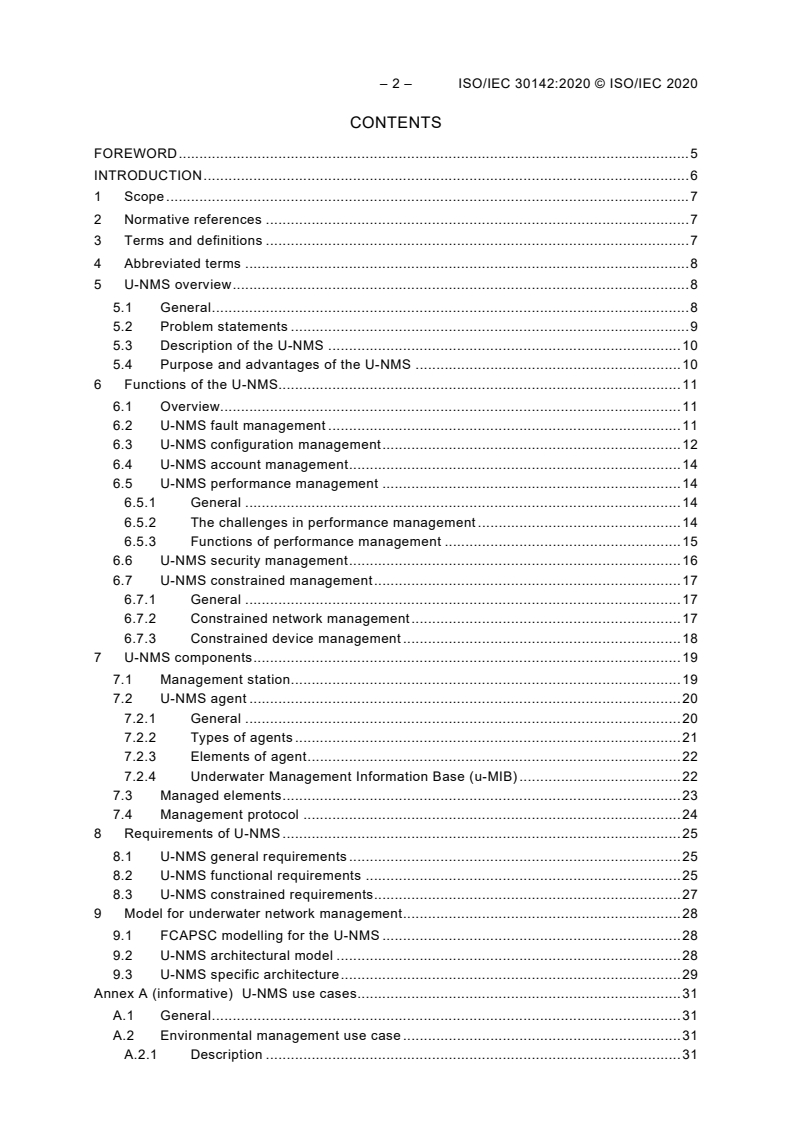
CONTENTS
FOREWORD . 5
INTRODUCTION . 6
1 Scope . 7
2 Normative references . 7
3 Terms and definitions . 7
4 Abbreviated terms . 8
5 U-NMS overview . 8
5.1 General . 8
5.2 Problem statements . 9
5.3 Description of the U-NMS . 10
5.4 Purpose and advantages of the U-NMS . 10
6 Functions of the U-NMS. 11
6.1 Overview. 11
6.2 U-NMS fault management . 11
6.3 U-NMS configuration management . 12
6.4 U-NMS account management . 14
6.5 U-NMS performance management . 14
6.5.1 General . 14
6.5.2 The challenges in performance management . 14
6.5.3 Functions of performance management . 15
6.6 U-NMS security management . 16
6.7 U-NMS constrained management . 17
6.7.1 General . 17
6.7.2 Constrained network management . 17
6.7.3 Constrained device management . 18
7 U-NMS components . 19
7.1 Management station . 19
7.2 U-NMS agent . 20
7.2.1 General . 20
7.2.2 Types of agents . 21
7.2.3 Elements of agent . 22
7.2.4 Underwater Management Information Base (u-MIB) . 22
7.3 Managed elements . 23
7.4 Management protocol . 24
8 Requirements of U-NMS . 25
8.1 U-NMS general requirements . 25
8.2 U-NMS functional requirements . 25
8.3 U-NMS constrained requirements. 27
9 Model for underwater network management . 28
9.1 FCAPSC modelling for the U-NMS . 28
9.2 U-NMS architectural model . 28
9.3 U-NMS specific architecture . 29
Annex A (informative) U-NMS use cases. 31
A.1 General . 31
A.2 Environmental management use case . 31
A.2.1 Description . 31
A.2.2 Actors . 32
A.2.3 Potential requirements . 32
A.2.4 Environmental monitoring and management use case diagram . 32
A.3 Underwater pipeline management use case . 35
A.3.1 General . 35
A.3.2 Actors . 35
A.3.3 Potential requirements . 35
A.3.4 Pipeline leakage detection and management use case diagram . 36
A.4 Underwater natural resource management use case . 37
A.5 Underwater fish farm management use case . 37
A.6 Harbour security management use case . 38
Bibliography . 39
Figure 1 – Stack of layers in a U-NMS . 9
Figure 2 – Functions of the U-NMS . 11
Figure 3 – Fault management in the U-NMS. 12
Figure 4 – Configuration management in the U-NMS. 13
Figure 5 – Account management in U-NMS . 14
Figure 6 – Performance management in U-NMS . 15
Figure 7 – Security management in U-NMS . 16
Figure 8 – Constrained network management in U-NMS . 18
Figure 9 – Constrained device management in U-NMS . 19
Figure 10 – Management station . 20
Figure 11 – U-NMS agent architecture . 21
Figure 12 – Components of Agent . 22
Figure 13 – u-MIB in different devices . 23
Figure 14 – Managed elements . 23
Figure 15 – Management protocol in U-NMS system . 24
Figure 16 – FCAPSC modelling for the U-NMS . 28
Figure 17 – U-NMS architectural model. 29
Figure 18 – U-NMS specific architecture . 30
Figure A.1 – Environmental management use case . 31
Figure A.2 – Environmental management use case diagram . 33
Figure A.3 – Use case for network management station . 34
Figure A.4 – Use case for agents in environmental management . 34
Figure A.5 – Underwater pipeline management use case . 35
Figure A.6 – Underwater pipeline leakage management use case . 36
Figure A.7 – Underwater natural resource management use case . 37
Figure A.8 – Underwater fish farm management use case . 37
Figure A.9 – Harbour security management use case . 38
– 4 – ISO/IEC 30142:2020 © ISO/IEC 2020
Table 1 – Types of agents in different devices of U-NMS . 21
Table 2 – General requirements of U-NMS . 25
Table 3 – Functional requirements of U-NMS . 26
Table 4 – Constrained requirements of the U-NMS . 27
Table A.1 – Potential U-NMS requirements of environmental monitoring application . 32
Table A.2 – Potential U-NMS requirements of pipeline monitoring application . 36
INTERNET OF THINGS (IoT) –
UNDERWATER ACOUSTIC SENSOR NETWORK (UWASN) –
NETWORK MANAGEMENT SYSTEM OVERVIEW AND REQUIREMENTS
FOREWORD
1) ISO (the International Organization for Standardization) and IEC (the International Electrotechnical Commission)
form the specialized system for worldwide standardization. National bodies that are members of ISO or IEC
participate in the development of International Standards through technical committees established by the
respective organization to deal with particular fields of technical activity. ISO and IEC technical committees
collaborate in fields of mutual interest. Other international organizations, governmental and non-governmental, in
liaison with ISO and IEC, also take part in the work. In the field of information technology, ISO and IEC have
established a joint technical committee, ISO/IEC JTC 1.
2) The formal decisions or agreements of IEC and ISO on technical matters express, as nearly as possible, an
international consensus of opinion on the relevant subjects since each technical committee has representation
from all interested IEC National Committees and ISO member bodies.
3) IEC, ISO and ISO/IEC publications have the form of recommendations for international use and are accepted
by IEC National Committees and ISO member bodies in that sense. While all reasonable efforts are made to
ensure that the technical content of IEC, ISO and ISO/IEC publications is accurate, IEC or ISO cannot be held
responsible for the way in which they are used or for any misinterpretation by any end user.
4) In order to promote international uniformity, IEC National Committees and ISO member bodies undertake to
apply IEC, ISO and ISO/IEC publications transparently to the maximum extent possible in their national and
regional publications. Any divergence between any ISO, IEC or ISO/IEC publication and the corresponding
national or regional publication should be clearly indicated in the latter.
5) ISO and IEC do not provide any attestation of conformity. Independent certification bodies provide conformity
assessment services and, in some areas, access to IEC marks of conformity. ISO or IEC are not responsible
for any services carried out by independent certification bodies.
6) All users should ensure that they have the latest edition of this publication.
7) No liability shall attach to IEC or ISO or its directors, employees, servants or agents including individual experts
and members of their technical committees and IEC National Committees or ISO member bodies for any
personal injury, property damage or other damage of any nature whatsoever, whether direct or indirect, or for
costs (including legal fees) and expenses arising out of the publication of, use of, or reliance upon, this ISO/IEC
publication or any other IEC, ISO or ISO/IEC publications.
8) Attention is drawn to the normative references cited in this publication. Use of the referenced publications is
indispensable for the correct application of this publication.
9) Attention is drawn to the possibility that some of the elements of this ISO/IEC publication may be the subject of
patent rights. ISO and IEC shall not be held responsible for identifying any or all such patent rights.
International Standard ISO/IEC 30142 was prepared by subcommittee 41: Internet of Things
and related technologies, of ISO/IEC joint technical committee 1: Information technology.
The text of this International Standard is based on the following documents:
FDIS Report on voting
JTC1-SC41/149/FDIS JTC1-SC41/160/RVD
Full information on the voting for the approval of this International Standard can be found in
the report on voting indicated in the above table.
This publication has been drafted in accordance with the ISO/IEC Directives, Part 2.
IMPORTANT – The 'colour inside' logo on the cover page of this publication indicates
that it contains colours which are considered to be useful for the correct
understanding of its contents. Users should therefore print this document using a
colour printer.
– 6 – ISO/IEC 30142:2020 © ISO/IEC 2020
INTRODUCTION
Water covers approximately 70 % of the surface of the Earth. Modern technologies introduce
new methods to monitor the body of water, such as pollution monitoring and detection.
Underwater data gathering techniques require exploring the water environment, which can be
most effectively performed by underwater acoustic sensor networks (UWASNs). Applications
developed for the UWASNs can record underwater climate, detect and control water pollution,
monitor marine biology, discover natural resources, detect pipeline leakages, monitor and find
underwater intruders, perform strategic surveillance, and so on.
In order to build and apply the UWASN technology, most suitable methods for managing the
network have been developed based on the ISO/IEC 30140 series. This document describes
the network management outline and requirements appropriate to the UWASN under the
constraints of underwater physical environment.
The ISO/IEC 30140 series provides general requirements, reference architecture (RA)
including the entity models and high-level interface guidelines supporting interoperability
among UWASNs in order to provide the essential UWASN construction information to help
and guide architects, developers and implementers of UWASNs.
This document provides the information such as requirements of an underwater network
management system (U-NMS), functions supporting U-NMS and components required for
U-NMS in UWASN.
Various technical standards derived from the R&D results of the technical areas under the
UWASN and underwater communication fields not covered by the ISO/IEC 30140 series are
continuously proposed and developed.
INTERNET OF THINGS (IoT) –
UNDERWATER ACOUSTIC SENSOR NETWORK (UWASN) –
NETWORK MANAGEMENT SYSTEM OVERVIEW AND REQUIREMENTS
1 Scope
This document provides the overview and requirements of a network management system in
underwater acoustic sensor network (UWASN) environment. It specifies the following:
– functions which support underwater network management system;
– entities required for underwater network management system;
– data about the communication between elements in underwater network management
system;
– guidelines to model the underwater network management system;
– general and functional requirements of underwater network management system.
2 Normative references
There are no normative references in this document.
3 Terms and definitions
For the purposes of this document, the following terms and definitions apply.
ISO and IEC maintain terminological databases for use in standardization at the following
addresses:
• IEC Electropedia: available at http://www.electropedia.org/
• ISO Online browsing platform: available at http://www.iso.org/obp
3.1
agent
software program that manages the devices installed in underwater
3.2
u-MIB
collection of managed objects, which acts as the database for the management of each
device in the underwater environment
3.3
manager
program installed in the management station, which is used for the management of devices in
underwater networks
– 8 – ISO/IEC 30142:2020 © ISO/IEC 2020
4 Abbreviated terms
UUV unmanned underwater vehicle
UWASN underwater acoustic sensor network
UWA-GW underwater acoustic gateway
UWA-SNode underwater acoustic sensor node
U-NMS underwater network management system
UWA-CH underwater acoustic cluster head
u-MIB underwater management information base
OID object identifier
FCAPS fault-management, configuration, accounting, performance and security
FCAPSC fault, configuration, accounting, performance, security and constrained
management
MO managed object
UUV unmanned underwater vehicle
AUV autonomous underwater vehicle
5 U-NMS overview
5.1 General
The UWASN operates in a constrained environment as compared to terrestrial network’s
operating environment. Hence, the UWASN needs an efficient network management system
to handle and compensate for phenomenological difficulties encountered in the underwater
environments. This system can be termed an "underwater network management system" or
"U-NMS".
Figure 1 shows the diagrammatic representation of a U-NMS module residing within the UWA-
Application Layer.
Figure 1 – Stack of layers in a U-NMS
5.2 Problem statements
As the conditions of the underwater environment differ significantly from terrestrial networks,
it becomes mandatory to have an appropriate network management system designed uniquely
for the underwater environments.
The specific challenges or issues for the UWASNs to operate with the help of U-NMS are
given below.
– Low data rate: In UWASN, the total amount of data collected during the monitoring
process by each sensor is less, when compared to terrestrial networks. This is because of
the limitation in memory, battery power, etc. in underwater devices.
– Transmission range: In UWASN, the nodes can cover only less distance when considering
the network coverage and battery power planning. On the other hand, signals are usually
transmitted in low frequencies under water, in order to avoid being absorbed by water.
This in turn allows longer transmission ranges, but at the same time increases the
chances for interference and collision.
– Battery charge level: As battery backup is limited for all devices in the underwater
environment, energy efficiency turns out to be a major challenge when considering the
cost of battery recharging.
– Attenuation: In UWASN, the transmission loss can occur based on an absorption in the
underwater environments.
– Deployment depth: In UWASN, the node deployment and the node management encounter
difficulties due to the depth of sea.
– Size of the antenna: In UWASN, the size of the antenna is designed as small for short
range communication and bigger for long range communication. So, it faces difficulties
during deployment in underwater communication.
– 10 – ISO/IEC 30142:2020 © ISO/IEC 2020
– Data delivery rate: In UWASN, the total packets delivered to the receiver can be
influenced by various factors such as time, traffic, etc.
– Delay of data transmission: In UWASN, as the underwater environment is heavily
congested with acoustic signals, this situation can cause delays during data transmission.
– Bit errors: In UWASN, the increased bit errors at receivers are caused by various factors
such as noise, attenuation, interference, etc.
5.3 Description of the U-NMS
The U-NMS is a program or collection of programs that allows the administrators to
independently manage and control every component in an underwater network system.
Operations performed by the U-NMS are the following:
– configuring underwater networks;
– monitoring the performance of components;
– identifying and controlling traffic;
– dealing with problems like device failure, attacks, etc.
5.4 Purpose and advantages of the U-NMS
The main purposes of the U-NMS are to
– monitor the network systems and functions of UWASNs, and
– ensure that the generated data can be transmitted and received at the destination
efficiently through the network.
The advantages of using the U-NMS include, but are not limited to, the following.
– Cost reduction: In a constrained environment, it is difficult to manage the devices
physically at all times. For example, power, memory, deployment, fouling cleaning, etc.
require efficient management mechanisms. Also, the cost is very high for direct
management. If a proper management system is employed, then the operational cost,
installation cost, etc. can be reduced.
– Easy network monitoring: Each device and the network can be used for monitoring the
connection between the devices and network in the underwater environments.
– Error handling: In the underwater environment, the errors can occur in both the devices
and network sides and this can be easily handled using the U-NMS.
– Automatic software updates: In the U-NMS, the automatic updating of software over the
underwater network is essential.
– Network configuration flexibility: The U-NMS provides easy configuration support among
the hardware, software, devices, network, etc. In this way, flexible connections can be
made between devices and network.
– Service improvement: The U-NMS can provide the high-quality services such as data
collection, processing, predicting, communicating, etc.
– Data control over network: The U-NMS can control the status of devices such as memory,
power, network range, etc. Also, the U-NMS can control each underwater management
device by collecting and processing dynamic data.
– Security solutions: The U-NMS consists of a security module which can protect the
underwater devices from authorization and authentication related issues. Also, the U-NMS
can manage the security level of the system based on the security rules.
– Log data analysis: In the U-NMS, log data is the set of underwater activity observation
data captured by underwater devices, underwater networks, operating system, etc. Log
data can be used to analyse user behaviour, security risks, audit, etc.
6 Functions of the U-NMS
6.1 Overview
In UWASN, the network management system utilizes different methods and tools to assist a
human operator in order to manage underwater devices, networks or systems. The functions
of U-NMS are modelled using Fault, Configuration, Accounting, Performance, Security and
Constrained management (FCAPSC).
FCAPSC functions of U-NMS are described in Figure 2.
Figure 2 – Functions of the U-NMS
6.2 U-NMS fault management
The main goal of fault management in U-NMS is to notify the faults and abnormal operations
in the UWASN. U-NMS fault management functionality includes examining and maintaining
the error logs, responding to notifications, finding the faults, performing the diagnostic tests
and correcting the faults.
Network problems are detected, isolated and corrected at the fault management level in the
U-NMS. As a fault may occur in various components of the system, it is important to identify
the relationship between these components. The network always stays operational with the
help of the fault management mechanism. The fault management shows how to design and
install the services of faults in the U-NMS.
The U-NMS fault management steps are as follows.
– Detect the fault: In U-NMS, the fault detection is indicated by notification messages. The
u-MIB has the information related to types of fault that will correlate and find the reasons
for the occurrence of faults such as device faults, battery faults, etc.
– Isolate the problem: The source of fault occurring in the U-NMS such as device, battery,
network, etc. can be identified.
– 12 – ISO/IEC 30142:2020 © ISO/IEC 2020
– Solve the problem: The faults identified are resolved, repaired or corrected depending on
the severity of faults.
Figure 3 – Fault management in the U-NMS
Figure 3 shows how the fault management mechanism works in the U-NMS. The faults that
occur in the underwater network and devices are, for example, battery failure, error in
devices, connection failure. This fault information is collected by the diagnosis engine inside
the master agent and subagent. The notifications sent by the diagnosis engine are processed
by the dynamic data processing rules module, which consists of three sub-modules such as
Events collector, Processing and Send notification. The events collector module collects all
the notifications sent by the diagnosis engine. The filters are used to validate the data
received from different devices based on the dynamic data processing rules. After receiving
the notification, the U-NMS will process the functions such as redo/undo changes,
hardware/software updating, manage the changes, etc.
6.3 U-NMS configuration management
The main purpose of configuration management in the U-NMS is to monitor the configuration
between the underwater networks and the system. Therefore, the issues that occur in different
components such as hardware and software components of UWASN can be found and
managed using a configuration management function in the U-NMS.
The parameters used for the configuration management in the U-NMS are as follows:
– reconfiguration;
– change detection;
– hardware/software update.
The functions of U-NMS configuration management are as follows.
– Installation/update: The installation module is used to install or update the software or
hardware parts inside the devices.
– Track change detection: This module is used to track the type of changes that appear in
the devices and network.
– Redo/undo changes: This module supports the forward and reverse operation while doing
the configuration or reconfiguration.
– Manage the changes: This module can manage the changes done during reconfiguration,
e.g. device location, device ID, etc.
– Configuration auditing: This module is used to check whether the changes are made
correctly or not.
Figure 4 – Configuration management in the U-NMS
Figure 4 shows how the configuration management mechanism works in the U-NMS. The
failures that occur in the underwater network and devices are, for example, error in devices,
connection failure, etc. This fault information is collected by the diagnosis engine inside the
master agent and subagent. The notifications sent by the diagnosis engine are processed
using the dynamic data processing rules module which consists of three sub-modules: Events
collector, Processing and Send notification. The events collector collects all notifications sent
by the diagnosis engine. The filters are used to validate the data received from different
devices based on the dynamic data processing rules. After receiving the notification, the
U-NMS will process the functions such as redo/undo changes, hardware/software updating,
manage the changes, etc.
– 14 – ISO/IEC 30142:2020 © ISO/IEC 2020
6.4 U-NMS account management
In the U-NMS, every user has their own space for storing and retrieving files. The main goal
of U-NMS Account Management is to check whether or not the underwater network system is
effectively used by each user. Therefore, the account management provides fair resource
sharing in UWASN among the users. Figure 5 shows the account management system of the
U-NMS.
Figure 5 – Account management in U-NMS
6.5 U-NMS performance management
6.5.1 General
Performance management in the U-NMS has a set of functions that aims to calculate and
record the performance of the U-NMS components and the entire network. The main aim is to
monitor and maintain the performance of the entire network.
The primary goal of performance management is to monitor and control the U-NMS system.
As the size of the network increases, it is difficult to maintain and monitor the performance of
the U-NMS. Therefore, in order to manage the full capacity of the network and devices, the
performance management is much needed in any network management system.
6.5.2 The challenges in performance management
– Identify and collect the data.
– Validate the data.
– Distribute the data.
– Analyse the data.
6.5.3 Functions of performance management
– Maintain the throughput of the system stable.
– Keep track of the use percentage.
– Identify time of response.
– Examine active log report.
– Collect statistical data.
– Evaluate element performance.
– Check device reliability.
– Calculate service time required.
– Create complete performance report as graph.
– Report the battery condition and charging status.
Figure 6 – Performance management in U-NMS
Figure 6 shows how the performance management mechanism works in the U-NMS. The
performance of the underwater networks and devices such as device reliability, response time,
etc. are collected by the diagnosis engine and sent to the dynamic data processing rules
module in U-NMS. The dynamic data processing rules module can collect, process and send a
notification message to the manager. Based on the notifications received by the server, the
U-NMS can maintain the throughput of the system, keep track of use percentage, collect
statistical data and perform other functions.
– 16 – ISO/IEC 30142:2020 © ISO/IEC 2020
6.6 U-NMS security management
U-NMS should provide the facility for reporting the security-related events of the UWASN.
The main goal of security management in U-NMS is to make some conditions to access the
resources and to prevent the attacks. The attacks can affect the whole network and may
cause the loss of important data. So, by using some control mechanisms, only the authorized
users can access the data in UWASN. Figure 7 shows the security management system of the
U-NMS.
The functions of security management are as follows:
1) user authentication;
2) control access;
3) confidentiality;
4) authorization;
5) audit.
Figure 7 – Security management in U-NMS
6.7 U-NMS constrained management
6.7.1 General
The main objective of constrained management in U-NMS is to handle the constrained
environment of UWASN.
The constrained management consists of two modules:
– constrained network management;
– constrained device management.
6.7.2 Constrained network management
The constrained network management module in Figure 8 shows how the constrained network
management works in the underwater environments.
Diagnosis engine: The underwater network events like underwater, network status, discovery
of network topology, network scalability, etc. are collected by the diagnosis engine and sent
as notification using underwater communication protocols.
Dynamic data processing rules: The dynamic data processing rules module consists of sub-
modules such as events collector, processing and send notification. The events collector
collects all the events that occur in the constrained network and devices. The filters are used
to validate the data received from different devices based on the dynamic data processing
rules. The parsing is used to group similar types of data for easy communication. Send
notification is used to send the message to the U-NMS.
Centralized manager: The centralized manager includes devices such as UWA-GWs that act
as the manager for underwater devices. The agent and the manager are deployed in those
devices for communication.
– 18 – ISO/IEC 30142:2020 © ISO/IEC 2020
Figure 8 – Constrained network management in U-NMS
6.7.3 Constrained device management
The constrained device management module in Figure 9 shows how it works in the
underwater environments.
Diagnosis engine: The underwater device activities such as device status, device energy
status, device resource availability, etc. are collected by the diagnosis engine and sent as
notification using underwater communication protocols.
Dynamic data processing rules: The dynamic data processing rules module can collect,
process and send notification to the server.
Centralized manager: The centralized manager includes the devices such as gateway that act
as the manager for underwater devices. This can solve various problems such as underwater
device recovery, device reconfiguration, etc.
Figure 9 – Constrained device management in U-NMS
7 U-NMS components
7.1 Management station
Management station is a shared system which acts as the manager to monitor and control the
underwater networks. The management station consists of DMD (device management
database) for storing the information. The main operations performed by the network
management station are analysis of data, fault identification, recovery, etc.
The management station includes the following modules.
1) Device Management Database (DMD) acts as the main database for storing information.
The information will be aggregated and stored in DMD.
2) Object Identifiers (OID) provides a unique identifier to each Managed Object (MO) in
Underwater Management Information Base (u-MIB) hierarchy.
3) Underwater Management Information Base (u-MIB) contains the collection of MOs. u-MIB
acts as the database for the device management in the underwater environment.
4) Managed Object (MO), also known as u-MIB object. Managed elements contain many
MOs. An MO is made up of one or more objects and its data is gathered in to the MIB. An
OID uniquely identifies the managed object in the MIB hierarchy tree.
5) Management Application (MA) is the software installed in U-NMS for the management of
the entire network system.
6) Communication protocols (CP) are the standards used to control the communication
between Agent and Network Management Station.
– 20 – ISO/IEC 30142:2020 © ISO/IEC 2020
7) Operating system (OS) is the software used in the server for managing the hardware and
other resources inside the system.
8) Communication module is used to exchange the information between different modules.
9) Data values are the MO values in u-MIB.
Figure 10 shows the components of the management station.
Figure 10 – Management station
7.2 U-NMS agent
7.2.1 General
In U-NMS, an agent is a software program that manages the devices installed in underwater.
This program in the device allows the Network Management Station to manage the devices,
e.g. UWA-SNodes, UWA-CH, UWA-GW, and UUVs.
The agent performs the following operations:
• storing information locally;
• transmitting the collected information to the manager;
• providing status information of each node; and
• giving the response in accordance with the manager’s request.
Figure 11 – U-NMS agent architecture
Figure 11 shows the agent architecture of different devices in underwater. The U-NMS
consists of devices such as management station, UUV, UWA-GW, UWA-CH and UWA-SNode.
Each device is installed with different types of agents such as master agent, subagent and
proxy agent, as shown in Table 1.
Table 1 – Types of agents in different devices of U-NMS
Devices Agents
UUVs Installed with master agent
UWA-GWs Installed with proxy agent
UWA-CHs Installed with master agent
UWA-SNodes Installed with subagent
Management station Installed with manager
7.2.2 Types of agents
7.2.2.1 Master agent
Master agents are the programs installed in the devices such as UUVs and UWA-CHs, which
receive the message from the subagent and transfer the message to the manager via the
proxy agent.
7.2.2.2 Subagent
The subagent can collect the data from the environment or from other sensor nodes and then
pass the data to the master agent. For example, mines, minerals, fish source, etc.
7.2.2.3 Proxy agent
The proxy agent is the software program installed in UWA-GWs that acts as the interface
between UUVs and management station. Therefore, in the U-NMS the proxy agent can
transfer the message from master agent to management station.
– 22 – ISO/IEC 30142:2020 © ISO/IEC 2020
7.2.3 Elements of agent
Figure 12 shows the components of agents in the U-NMS.
Figure 12 – Components of Agent
• u-MIB acts as the database for each device in the underwater environment. It contains the
collection of MOs, OIDs.
• MOs consist of managed value for management system.
• OIDs are the unique number for each object.
• Agent software is the application installed in each device for management.
7.2.4 Underwater Management Information Base (u-MIB)
u-MIB is the collection of managed objects (MOs) and it acts as the database for the
management of each device in the underwater environment. The u-MIB shall be known to
agent and the manager. The devices like UWA-SNode, UWA-CH, UWA-GW, UUVs, etc.
consist of u-MIB for the individual management of each device. MOs are the components
inside the u-MIB and the MO consists of OID and values.
Figure 13 shows the u-MIB structure of different devices.
Figure 13 – u-MIB in different devices
7.3 Managed elements
Figure 14 shows the description of managed elements in U-NMS. Managed elements are the
devices installed with agent software, which are properly monitored and controlled underwater
devices. The managed elements consist of u-MIB. The data is stored inside the u-MIB of each
device.
Figure 14 – Managed elements
– 24 – ISO/IEC 30142:2020 © ISO/IEC 2020
7.4 Management protocol
Figure 15 shows the structure of management protocols. In U-NMS, the management
protocols are the standards used to control the communication between agent and manager.
The management protocols run between the management station and the managed elements.
The management station can send the query to a managed element and will get a response
through agents.
Figure 15 – Management protocol in U-NMS system
The methods performed by U-NMS protocols are as follows.
– Get request: The get request message is used to request specific data from the agent.
The get request message is used by the manager.
– Get response: To provide the corresponding response to the request message, the get
response mes
...