

IEC 80000-6:2008
(Main)Quantities and units - Part 6: Electromagnetism
General Information
- Abstract
In IEC 80000-6:2008, names, symbols, and definitions for quantities and units of electromagnetism are given. Where appropriate, conversion factors are also given. International Standard IEC 80000-6 has been prepared by IEC technical committee 25: Quantities and units, and their letter symbols in close cooperation with ISO/TC 12, Quantities, units, symbols, conversion factors. This first edition of IEC 80000-6 cancels and replaces the second edition of ISO 31-5, published in 1992, and its amendment 1 (1998).
- Status
- Published
- Publication Date
- 25-Mar-2008
- Technical Committee
- TC 25 - Quantities and units
- Drafting Committee
- WG 1 - TC 25/WG 1
- Current Stage
- DELPUB - Deleted Publication
- Start Date
- 16-Nov-2022
- Completion Date
- 31-Jul-2017
Overview
IEC 80000-6:2008 Quantities and Units – Part 6: Electromagnetism is an international standard published by the International Electrotechnical Commission (IEC). This document defines the names, symbols, and definitions for quantities and units specific to electromagnetism, ensuring globally consistent terminology and measurement standards across scientific, technical, and industrial domains. Where applicable, conversion factors and references to established systems and vocabularies are included, supporting accuracy and interoperability in the use of electromagnetic quantities and units.
IEC 80000-6 was developed in close collaboration with ISO, building on previous standards such as ISO 31-5. By specifying recommended practices and detailed conventions for electromagnetic units, it promotes international uniformity for measurement and reporting in electrical, electronic, and related disciplines.
Key Topics
Standardized Quantity Names and Symbols
Defines the recommended English and French terms and associated symbols for core quantities in electromagnetism, including electric current, electric charge, electric field strength, magnetic flux density, and related properties.SI and Non-SI Units
Details the coherent SI units for each electromagnetic quantity, including their definitions and applicable conversion factors. Also covers select non-SI units accepted for use with the SI and legacy units (e.g., CGS system) for reference.Quantities, Definitions, and Relationships
Provides concise definitions and mathematical relationships for each quantity. This includes scalars, vectors, and tensorial properties, as well as links to more comprehensive references within the International Electrotechnical Vocabulary (IEV).Quantity and Unit Tables
Offers a structured arrangement of quantity and unit tables, facilitating clarity and quick reference. Each quantity on the left-hand page corresponds with its unit(s) detailed on the facing right-hand page.Numerical Statements and Uncertainty
Specifies notation and conventions for expressing numerical values, uncertainties, and dimensionless quantities, aligning with SI guidelines.
Applications
IEC 80000-6 is essential in any field involving electromagnetism, providing practical value for:
Technical Documentation and Specifications
Ensures that technical datasheets, product manuals, and engineering standards use internationally recognized terms and units, avoiding ambiguity.Scientific Research and Education
Standardizes the language and expressions used in publications, laboratory protocols, and educational materials, fostering clear communication and reproducibility.Product Design and Compliance
Assists manufacturers and designers in aligning their products (e.g., electrical instruments, sensors, electronic circuits) with international measurement conventions, facilitating regulatory compliance and market acceptance.Calibration and Testing
Supports testing laboratories in referencing exact definitions and units when performing measurements, calibrations, and certifications, reducing errors and discrepancies.
Related Standards
IEC 80000-6 forms part of the broader IEC/ISO 80000 series on quantities and units. Related and referenced standards include:
- IEC 60027-1: Letter symbols to be used in electrical technology
- IEC 60050-111, -121, -131: International Electrotechnical Vocabulary sections pertaining to physics, electromagnetism, and circuit theory
- ISO 80000-3, ISO 80000-4: Quantities and units for space, time, and mechanics
- SI Brochure: International System of Units (by BIPM)
These standards, together with IEC 80000-6, underpin precision and uniformity in the measurement and communication of electromagnetic phenomena worldwide.
Keywords: IEC 80000-6, electromagnetism, SI units, standardized quantities, electromagnetic quantities, international standard, electric current, magnetic flux, electrical engineering, scientific measurement, technical vocabulary.
Relations
- Effective Date
- 09-Feb-2026
- Effective Date
- 05-Sep-2023
Get Certified
Connect with accredited certification bodies for this standard

BSMI (Bureau of Standards, Metrology and Inspection)
Taiwan's standards and inspection authority.
Sponsored listings
Frequently Asked Questions
IEC 80000-6:2008 is a standard published by the International Electrotechnical Commission (IEC). Its full title is "Quantities and units - Part 6: Electromagnetism". This standard covers: In IEC 80000-6:2008, names, symbols, and definitions for quantities and units of electromagnetism are given. Where appropriate, conversion factors are also given. International Standard IEC 80000-6 has been prepared by IEC technical committee 25: Quantities and units, and their letter symbols in close cooperation with ISO/TC 12, Quantities, units, symbols, conversion factors. This first edition of IEC 80000-6 cancels and replaces the second edition of ISO 31-5, published in 1992, and its amendment 1 (1998).
In IEC 80000-6:2008, names, symbols, and definitions for quantities and units of electromagnetism are given. Where appropriate, conversion factors are also given. International Standard IEC 80000-6 has been prepared by IEC technical committee 25: Quantities and units, and their letter symbols in close cooperation with ISO/TC 12, Quantities, units, symbols, conversion factors. This first edition of IEC 80000-6 cancels and replaces the second edition of ISO 31-5, published in 1992, and its amendment 1 (1998).
IEC 80000-6:2008 is classified under the following ICS (International Classification for Standards) categories: 01.040.29 - Electrical engineering (Vocabularies); 17.220.01 - Electricity. Magnetism. General aspects. The ICS classification helps identify the subject area and facilitates finding related standards.
IEC 80000-6:2008 has the following relationships with other standards: It is inter standard links to EN ISO 12402-7:2006, IEC 80000-6:2022. Understanding these relationships helps ensure you are using the most current and applicable version of the standard.
IEC 80000-6:2008 is available in PDF format for immediate download after purchase. The document can be added to your cart and obtained through the secure checkout process. Digital delivery ensures instant access to the complete standard document.
Standards Content (Sample)
IEC 80000-6
Edition 1.0 2008-03
INTERNATIONAL
STANDARD
NORME
INTERNATIONALE
Quantities and units –
Part 6: Electromagnetism
Grandeurs et unités –
Partie 6: Electromagnétisme
All rights reserved. Unless otherwise specified, no part of this publication may be reproduced or utilized in any form or by
any means, electronic or mechanical, including photocopying and microfilm, without permission in writing from either IEC or
IEC's member National Committee in the country of the requester.
If you have any questions about IEC copyright or have an enquiry about obtaining additional rights to this publication,
please contact the address below or your local IEC member National Committee for further information.
Droits de reproduction réservés. Sauf indication contraire, aucune partie de cette publication ne peut être reproduite
ni utilisée sous quelque forme que ce soit et par aucun procédé, électronique ou mécanique, y compris la photocopie
et les microfilms, sans l'accord écrit de la CEI ou du Comité national de la CEI du pays du demandeur.
Si vous avez des questions sur le copyright de la CEI ou si vous désirez obtenir des droits supplémentaires sur cette
publication, utilisez les coordonnées ci-après ou contactez le Comité national de la CEI de votre pays de résidence.
IEC Central Office
3, rue de Varembé
CH-1211 Geneva 20
Switzerland
Email: inmail@iec.ch
Web: www.iec.ch
About the IEC
The International Electrotechnical Commission (IEC) is the leading global organization that prepares and publishes
International Standards for all electrical, electronic and related technologies.
About IEC publications
The technical content of IEC publications is kept under constant review by the IEC. Please make sure that you have the
latest edition, a corrigenda or an amendment might have been published.
ƒ Catalogue of IEC publications: www.iec.ch/searchpub
The IEC on-line Catalogue enables you to search by a variety of criteria (reference number, text, technical committee,…).
It also gives information on projects, withdrawn and replaced publications.
ƒ IEC Just Published: www.iec.ch/online_news/justpub
Stay up to date on all new IEC publications. Just Published details twice a month all new publications released. Available
on-line and also by email.
ƒ Electropedia: www.electropedia.org
The world's leading online dictionary of electronic and electrical terms containing more than 20 000 terms and definitions
in English and French, with equivalent terms in additional languages. Also known as the International Electrotechnical
Vocabulary online.
ƒ Customer Service Centre: www.iec.ch/webstore/custserv
If you wish to give us your feedback on this publication or need further assistance, please visit the Customer Service
Centre FAQ or contact us:
Email: csc@iec.ch
Tel.: +41 22 919 02 11
Fax: +41 22 919 03 00
A propos de la CEI
La Commission Electrotechnique Internationale (CEI) est la première organisation mondiale qui élabore et publie des
normes internationales pour tout ce qui a trait à l'électricité, à l'électronique et aux technologies apparentées.
A propos des publications CEI
Le contenu technique des publications de la CEI est constamment revu. Veuillez vous assurer que vous possédez
l’édition la plus récente, un corrigendum ou amendement peut avoir été publié.
ƒ Catalogue des publications de la CEI: www.iec.ch/searchpub/cur_fut-f.htm
Le Catalogue en-ligne de la CEI vous permet d’effectuer des recherches en utilisant différents critères (numéro de référence,
texte, comité d’études,…). Il donne aussi des informations sur les projets et les publications retirées ou remplacées.
ƒ Just Published CEI: www.iec.ch/online_news/justpub
Restez informé sur les nouvelles publications de la CEI. Just Published détaille deux fois par mois les nouvelles
publications parues. Disponible en-ligne et aussi par email.
ƒ Electropedia: www.electropedia.org
Le premier dictionnaire en ligne au monde de termes électroniques et électriques. Il contient plus de 20 000 termes et
définitions en anglais et en français, ainsi que les termes équivalents dans les langues additionnelles. Egalement appelé
Vocabulaire Electrotechnique International en ligne.
ƒ Service Clients: www.iec.ch/webstore/custserv/custserv_entry-f.htm
Si vous désirez nous donner des commentaires sur cette publication ou si vous avez des questions, visitez le FAQ du
Service clients ou contactez-nous:
Email: csc@iec.ch
Tél.: +41 22 919 02 11
Fax: +41 22 919 03 00
IEC 80000-6
Edition 1.0 2008-03
INTERNATIONAL
STANDARD
NORME
INTERNATIONALE
Quantities and units –
Part 6: Electromagnetism
Grandeurs et unités –
Partie 6: Electromagnétisme
INTERNATIONAL
ELECTROTECHNICAL
COMMISSION
COMMISSION
ELECTROTECHNIQUE
PRICE CODE
INTERNATIONALE
W
CODE PRIX
ICS 01.040.29; 17.220.01 ISBN 2-8318-9624-X
– 2 – 80000-6 © IEC:2008
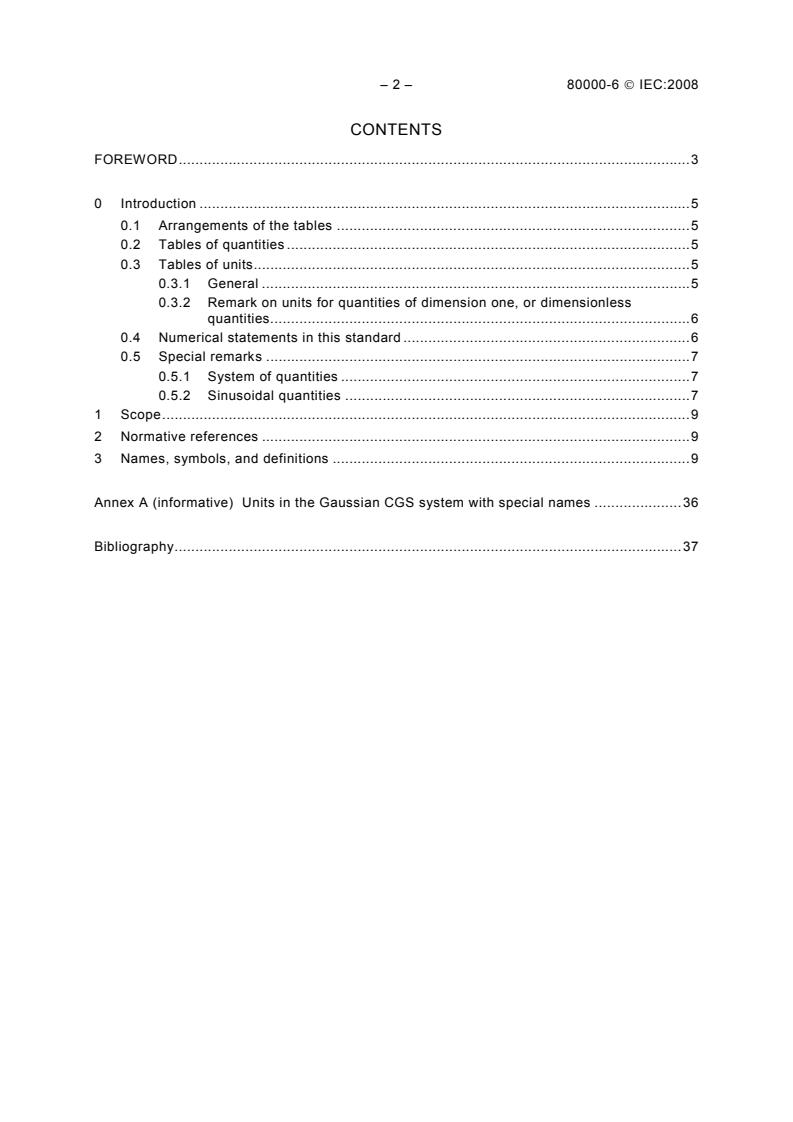
CONTENTS
FOREWORD.3
0 Introduction .5
0.1 Arrangements of the tables .5
0.2 Tables of quantities .5
0.3 Tables of units.5
0.3.1 General .5
0.3.2 Remark on units for quantities of dimension one, or dimensionless
quantities.6
0.4 Numerical statements in this standard .6
0.5 Special remarks .7
0.5.1 System of quantities .7
0.5.2 Sinusoidal quantities .7
1 Scope.9
2 Normative references .9
3 Names, symbols, and definitions .9
Annex A (informative) Units in the Gaussian CGS system with special names .36
Bibliography.37
80000-6 © IEC:2008 – 3 –
INTERNATIONAL ELECTROTECHNICAL COMMISSION
____________
QUANTITIES AND UNITS –
Part 6: Electromagnetism
FOREWORD
1) The International Electrotechnical Commission (IEC) is a worldwide organization for standardization comprising
all national electrotechnical committees (IEC National Committees). The object of IEC is to promote
international co-operation on all questions concerning standardization in the electrical and electronic fields. To
this end and in addition to other activities, IEC publishes International Standards, Technical Specifications,
Technical Reports, Publicly Available Specifications (PAS) and Guides (hereafter referred to as “IEC
Publication(s)”). Their preparation is entrusted to technical committees; any IEC National Committee interested
in the subject dealt with may participate in this preparatory work. International, governmental and non-
governmental organizations liaising with the IEC also participate in this preparation. IEC collaborates closely
with the International Organization for Standardization (ISO) in accordance with conditions determined by
agreement between the two organizations.
2) The formal decisions or agreements of IEC on technical matters express, as nearly as possible, an international
consensus of opinion on the relevant subjects since each technical committee has representation from all
interested IEC National Committees.
3) IEC Publications have the form of recommendations for international use and are accepted by IEC National
Committees in that sense. While all reasonable efforts are made to ensure that the technical content of IEC
Publications is accurate, IEC cannot be held responsible for the way in which they are used or for any
misinterpretation by any end user.
4) In order to promote international uniformity, IEC National Committees undertake to apply IEC Publications
transparently to the maximum extent possible in their national and regional publications. Any divergence
between any IEC Publication and the corresponding national or regional publication shall be clearly indicated in
the latter.
5) IEC provides no marking procedure to indicate its approval and cannot be rendered responsible for any
equipment declared to be in conformity with an IEC Publication.
6) All users should ensure that they have the latest edition of this publication.
7) No liability shall attach to IEC or its directors, employees, servants or agents including individual experts and
members of its technical committees and IEC National Committees for any personal injury, property damage or
other damage of any nature whatsoever, whether direct or indirect, or for costs (including legal fees) and
expenses arising out of the publication, use of, or reliance upon, this IEC Publication or any other IEC
Publications.
8) Attention is drawn to the Normative references cited in this publication. Use of the referenced publications is
indispensable for the correct application of this publication.
9) Attention is drawn to the possibility that some of the elements of this IEC Publication may be the subject of
patent rights. IEC shall not be held responsible for identifying any or all such patent rights.
International Standard IEC 80000-6 has been prepared by IEC technical committee 25:
Quantities and units, and their letter symbols in close cooperation with ISO/TC 12, Quantities,
units, symbols, conversion factors.
This first edition of IEC 80000-6 cancels and replaces the second edition of ISO 31-5,
published in 1992, and its amendment 1 (1998).
The text of this standard is based on the following documents:
FDIS Report on voting
25/370/FDIS 25/376/RVD
Full information on the voting for the approval of this standard can be found in the report on
voting indicated in the above table.
This publication has been drafted in accordance with the ISO/IEC Directives, Part 2.
– 4 – 80000-6 © IEC:2008
The committee has decided that the contents of this publication will remain unchanged until
the maintenance result date indicated on the IEC web site under "http://webstore.iec.ch" in
the data related to the specific publication. At this date, the publication will be
• reconfirmed,
• withdrawn,
• replaced by a revised edition, or
• amended.
IEC 80000 consists of the following parts, under the general title Quantities and units:
– Part 6: Electromagnetism
– Part 13: Information science and technology
– Part 14: Telebiometrics related to human physiology
The following parts are published by ISO:
– Part 1: General
– Part 2: Mathematical signs and symbols to be used in the natural sciences and technology
– Part 3: Space and time
– Part 4: Mechanics
– Part 5: Thermodynamics
– Part 7: Light
– Part 8: Acoustics
– Part 9: Physical chemistry and molecular physics
– Part 10: Atomic and nuclear physics
– Part 11: Characteristic numbers
– Part 12: Solid state physics
80000-6 © IEC:2008 – 5 –
0 Introduction
0.1 Arrangements of the tables
The tables of quantities and units in ISO/IEC 80000 are arranged so that the quantities are
presented on the left-hand pages and the units on the corresponding right-hand pages.
All units between two full lines on the right-hand pages belong to the quantities between the
corresponding full lines on the left-hand pages.
Where the numbering of an item has been changed in the revision of a part of ISO 31, the
number in the preceding edition is shown in parenthesis on the left-hand page under the new
number for the quantity; a dash is used to indicate that the item in question did not appear in
the preceding edition.
0.2 Tables of quantities
The names in English and in French of the most important quantities within the field of this
document are given together with their symbols and, in most cases, their definitions. These
names and symbols are recommendations. The definitions are given for identification of the
quantities in the International System of Quantities (ISQ), listed on the left hand pages of
Table 1; they are not intended to be complete.
The scalar, vectorial or tensorial character of quantities is pointed out, especially when this is
needed for the definitions.
In most cases only one name and only one symbol for the quantity are given; where two or
more names or two or more symbols are given for one quantity and no special distinction is
made, they are on an equal footing. When two types of italic letters exist (for example as with
ϑ and θ; φ and φ; a and a; g and g) only one of these is given. This does not mean that the
other is not equally acceptable. It is recommended that such variants should not be given
different meanings. A symbol within parenthesis implies that it is a reserve symbol, to be used
when, in a particular context, the main symbol is in use with a different meaning.
In this English edition the quantity names in French are printed in an italic font, and are preceded by fr.
The gender of the French name is indicated by (m) for masculine and (f) for feminine, immediately after
the noun in the French name.
0.3 Tables of units
0.3.1 General
The names of units for the corresponding quantities are given together with the international
symbols and the definitions. These unit names are language-dependent, but the symbols are
th
international and the same in all languages. For further information, see the SI Brochure (8
edition 2006) from BIPM and ISO 80000-1 (under preparation).
The units are arranged in the following way:
a) The coherent SI units are given first. The SI units have been adopted by the General
Conference on Weights and Measures (Conférence Générale des Poids et Mesures,
CGPM). The use of coherent SI units, and their decimal multiples and submultiples formed
with the SI prefixes are recommended, although the decimal multiples and submultiples
are not explicitly mentioned.
b) Some non-SI units are then given, being those accepted by the International Committee
for Weights and Measures (Comité International des Poids et Mesures, CIPM), or by the
International Organization of Legal Metrology (Organisation Internationale de Métrologie
Légale, OIML), or by ISO and IEC, for use with the SI.
– 6 – 80000-6 © IEC:2008
Such units are separated from the SI units in the item by use of a broken line between the
SI units and the other units.
c) Non-SI units currently accepted by the CIPM for use with the SI are given in small print
(smaller than the text size) in the “Conversion factors and remarks” column.
d) Non-SI units that are not recommended are given only in annexes in some parts of
ISO/IEC 80000. These annexes are informative, in the first place for the conversion
factors, and are not integral parts of the standard. These deprecated units are arranged in
two groups:
1) units in the CGS system with special names;
2) units based on the foot, pound, second, and some other related units.
e) Other non-SI units given for information, especially regarding the conversion factors are
given in another informative annex.
0.3.2 Remark on units for quantities of dimension one, or dimensionless quantities
The coherent unit for any quantity of dimension one, also called a dimensionless quantity, is
the number one, symbol 1. When the value of such a quantity is expressed, the unit symbol 1
is generally not written out explicitly.
EXAMPLE
Refractive index n = 1,53 × 1 = 1,53
Prefixes shall not be used to form multiples or submultiples of this unit. Instead of prefixes,
powers of 10 are recommended.
EXAMPLE
Reynolds number Re = 1,32 × 10
Considering that plane angle is generally expressed as the ratio of two lengths and solid
angle as the ratio of two areas, in 1995 the CGPM specified that, in the SI, the radian, symbol
rad, and steradian, symbol sr, are dimensionless derived units. This implies that the quantities
plane angle and solid angle are considered as derived quantities of dimension one. The units
radian and steradian are thus equal to one; they may either be omitted, or they may be used
in expressions for derived units to facilitate distinction between quantities of different kinds
but having the same dimension.
0.4 Numerical statements in this standard
The sign = is used to denote “is exactly equal to”, the sign ≈ is used to denote “is
approximately equal to”, and the sign := is used to denote “is by definition equal to”.
Numerical values of physical quantities that have been experimentally determined always
have an associated measurement uncertainty. This uncertainty should always be specified. In
this standard, the magnitude of the uncertainty is represented as in the following example.
EXAMPLE
l = 2,347 82(32) m
In this example, l = a(b) m, the numerical value of the uncertainty b indicated in parentheses
is assumed to apply to the last (and least significant) digits of the numerical value a of the
length l. This notation is used when b represents one standard uncertainty (estimated
standard deviation) in the last digits of a. The numerical example given above may be
interpreted to mean that the best estimate of the numerical value of the length l, when l is
80000-6 © IEC:2008 – 7 –
expressed in the unit metre, is 2,347 82 and that the unknown value of l is believed to lie
between (2,347 82 −0,000 32) m and (2,347 82 + 0,000 32) m with a probability determined
by the standard uncertainty 0,000 32 m and the probability distribution of the values of l.
0.5 Special remarks
The items given in ISO 80000-6 are generally in conformity with the International
Electrotechnical Vocabulary (IEV), especially IEC 60050-121 and IEC 60050-131. For each
quantity, the reference to IEV is given in the form: “See IEC 60050-121, item 121-xx-xxx.”.
0.5.1 System of quantities
For electromagnetism, several different systems of quantities have been developed and used
depending on the number and the choice of base quantities on which the system is based.
However, in electromagnetism and electrical engineering, only the International System of
Quantities, ISQ, and the associated International System of Units, SI, are acknowledged and
are reflected in the standards of ISO and IEC. The SI has seven base units, among them
metre, symbol m, kilogram, symbol kg, second, symbol s, and ampere, symbol A.
0.5.2 Sinusoidal quantities
For quantities that vary sinusoidally with time, and for their complex representations, the IEC
has standardized two ways to build symbols. Capital and lowercase letters are generally used
for electric current (item 6-1) and for voltage (item 6-11.3), and additional marks for other
quantities. These are given in IEC 60027-1.
EXAMPLE 1
The sinusoidal variation with time of an electric current (item 6-1) can be expressed in real
representation as
i = 2 I cos(ωt − ϕ)
and its complex representation (termed phasor) is expressed as
− jϕ
II= e
where i is the instantaneous value of the current, I is its root-mean-square (rms) value, (ωt –
φ) is the phase, φ is the initial phase.
– 8 – 80000-6 © IEC:2008
EXAMPLE 2
The sinusoidal variation with time of a magnetic flux (item 6-22.1) can be expressed in real
representation as
ˆ
Φ =Φ cos(ωt − ϕ) = 2Φ cos(ωt − ϕ)
eff
ˆ
where Φ is the instantaneous value of the flux, Φ is its peak value and Φ is its rms value.
eff
80000-6 © IEC:2008 – 9 –
QUANTITIES AND UNITS –
Part 6: Electromagnetism
1 Scope
In IEC 80000-6 names, symbols, and definitions for quantities and units of electromagnetism
are given. Where appropriate, conversion factors are also given.
2 Normative references
The following referenced documents are indispensable for the application of this document.
For dated references, only the edition cited applies. For undated references, the latest edition
of the referenced document (including any amendments) applies.
IEC 60027-1:1992, Letter symbols to be used in electrical technology – Part 1: General
IEC 60050-111, International electrotechnical vocabulary – Part 111: Physics and chemistry
IEC 60050-121, International electrotechnical vocabulary – Part 121: Electromagnetism
IEC 60050-131, International electrotechnical vocabulary – Part 131: Circuit theory
ISO 31-0:1992, Quantities and units – Part 0: General principles (under revision)
ISO 80000-3:2006, Quantities and units – Part 3: Space and time
ISO 80000-4:2006, Quantities and units – Part 4: Mechanics
3 Names, symbols, and definitions
The names, symbols, and definitions for quantities and units of electromagnetism are given in
the tables on the following pages.
– 10 – 80000-6 © IEC:2008
ELECTROMAGNETISM QUANTITIES
Item No. Name Symbol Definition Remarks
6-1 electric current electric current is one of the base quantities in Electric current is the
I, i
(5-1) the International System of Quantities, ISQ, on quantity that can often be
fr courant (m)
which the International System of Units, SI, is measured with an ammeter.
électrique
based
The electric current through
a surface is the quotient of
the electric charge (item 6-2)
transferred through the
surface during a time interval
by the duration of that
interval.
For a more complete defini-
tion, see item 6-8 and
IEC 60050-121,
item 121-11-13.
6-2 electric charge Electric charge is carried by
Q, q dQ = Idt
(5-2) discrete particles and can be
fr charge (f)
positive or negative. The
where I is electric current (item 6-1) and t is
électrique
sign convention is such that
time (ISO 80000-3, item 3-7)
the elementary electric
charge e, i.e. the charge of
the proton, is positive.
See IEC 60050-121,
item121-11-01.
To denote a point charge q
is often used, and that is
done in the present
document.
6-3 electric charge density, See IEC 60050-121, item
ρ, ρ dQ
V
(5-3) volumic electric charge ρ= 121-11-07.
dV
fr charge (f)
électrique
where Q is electric charge (item 6-2) and V is
volumique
volume (ISO 80000-3, item 3-4)
6-4 surface density of See IEC 60050-121, item
dQ
ρ , σ
A
(5-4) electric charge, 121-11-08.
ρ =
A
areic electric charge dA
fr charge (f)
where Q is electric charge (item 6-2) and A is
électrique
area (ISO 80000-3, item 3-3)
surfacique
80000-6 © IEC:2008 – 11 –
UNITS ELECTROMAGNETISM
Item No. Name Inter- Definition Conversion factors and remarks
national
symbol
6-1.a ampere A ampere is that constant electric This definition implies that the magnetic
current which, if maintained in two
constant μ (item 6-26.1) is exactly
parallel conductors of infinite
–7
4π × 10 H/m.
length, of negligible circular
cross-section, and placed 1 metre
apart in vacuum, would produce
In this definition “force” is used instead of
between these conductors a force
“lineic force” or “force per length”.
equal to
Accordingly the last unit should be
–7
2 × 10 newton per metre of
“newton per metre” without “of length”.
th
length [9 CGPM (1948)]
6-2.a coulomb C 1 C := 1 A · s The unit ampere hour, is used for
electrolytic devices, such as storage
batteries.
1 A · h = 3,6 kC
6-3.a coulomb per cubic
C/m
metre
6-4.a coulomb per square
C/m
metre
– 12 – 80000-6 © IEC:2008
ELECTROMAGNETISM QUANTITIES
Item No. Name Symbol Definition Remarks
6-5 linear density of See IEC 60050-121,
dQ
ρ ,τ
l
(5-5) electric charge, item121-11-09.
ρ =
l
lineic electric charge
dl
fr charge (f)
where Q is electric charge (item 6-2) and l is
électrique linéique
length (ISO 80000-3, item 3-1.1)
6-6 electric dipole moment The electric dipole moment
p p = q(r – r )
+ –
(5-14) of a substance within a
fr moment (m)
domain is the vector sum of
where r and r are the position vectors (ISO
+ –
électrique
electric dipole moments of all
80000-3, item 3-1.11) to carriers of electric
moment (m) de
electric dipoles included in
dipôle électrique
charges q and –q (item 6-2), respectively
the domain.
See IEC 60050-121, items
121-11-35 and 121-11-36.
6-7 electric polarization
See IEC 60050-121, item
P P = dp/dV
(5-13) 121-11-37.
fr polarisation (f) where p is electric dipole moment (item 6-6) of
électrique
a substance within a domain with volume V
(ISO 80000-3, item 3-4)
6-8 electric current
J J = ρv Electric current I (item 6-1)
(5-15) density,
through a surface S is
areic electric current
where ρ is electric charge density (item 6-3)
fr densité (f) de
I = J ⋅ e dA
n
and v is velocity (ISO 80000-3, item 3-8.1)
∫
courant électrique
S
where e dA is vector
n
surface element.
See IEC 60050-121, item
121-11-11.
6-9 linear electric current
J J = ρ v Electric current I (item
S S A
(―) density,
6-1) through a curve C on a
lineic electric current
surface is
where ρ is surface density of electric charge
A
fr densité (f) linéique
(item 6-4) and v is velocity (ISO 80000-3, item
de courant
I = J × e ⋅ dr
3-8.1) S n
∫
électrique
C
where e is a unit vector
n
perpendicular to the surface
and line vector element and
dr is the differential of
position vector r.
See IEC 60050-121, item
121-11-12.
6-10 electric field strength See IEC 60050,
E E = F/q
(5-5) item 121-11-18.
fr champ (m)
where F is force (ISO 80000-4, item
électrique
q is the charge of a test
4-9.1) and q is electric charge (item 6-2)
particle at rest.
80000-6 © IEC:2008 – 13 –
UNITS ELECTROMAGNETISM
Item No. Name Inter- Definition Conversion factors and remarks
national
symbol
6-5.a coulomb per metre C/m
6-6.a coulomb metre C · m
6-7.a coulomb per metre
C/m
squared
6-8.a ampere per square
A/m
metre
6-9.a ampere per metre A/m
6-10.a volt per metre V/m 1 V/m = 1 N/C For the definition of the volt, see
item 6-11.a.
– 14 – 80000-6 © IEC:2008
ELECTROMAGNETISM QUANTITIES
Item No. Name Symbol Definition Remarks
6-11.1 electric potential The electric potential is not
V, ϕ ∂A
(5-6.1) unique, since any constant scalar
–grad V = E +
fr potential (m)
field quantity can be added to it
∂t
électrique
without changing its gradient.
where E is electric field strength (item 6-
See IEC 60050-121, item
10), A is magnetic vector potential (item 121-11-25.
6-32) and t is time (ISO 80000-3,
item 3-7)
6-11.2 electric potential
V r V = V – V
ab ab a b
b
(5-6.2) difference
∂A
where V and V are the
V = (E + ) ⋅ dr a b
ab
∫
fr différence (f) de ∂t
potentials at points a and b,
r (C)
potential
a respectively.
électrique
See IEC 60050-121,
where E is electric field strength (item 6-
item 121-11-26.
10), A is magnetic vector potential (item
6-32), t is time (ISO 80000-3, item 3-7),
and r is position vector (ISO 80000-3,
item 3-1.11) along a given curve C from
point a to point b
6-11.3 voltage, in electric circuit theory, For an electric field within a
U, U
ab
(5-6.3) electric tension medium
U = V – V
ab a b
r
b
fr tension (f) where V and V are the electric
a b
électrique
potentials (item 6-11.1) at points a and b,
U = E ⋅ dr
ab
∫
respectively
(The name “voltage”,
r (C)
a
commonly used in the
English language, is
where E is electric field strength
given in the IEV but is
(item 6-10) and r is position
an exception from the
vector (ISO 80000-3, item 3-1.11)
principle that a
along a given curve C from point a
quantity name should
to point b.
not refer to any name
of unit.)
For an irrotational electric field,
the voltage is independent of the
path between the two points a
and b.
See IEC 60050-121, item
121-11-27.
6-12 electric flux density, The electric flux density is related
D
D =ε E + P
(5-7) to electric charge density via
electric displacement
div D = ρ
where ε is the electric constant (item
fr induction (f)
6-14.1), E is electric field strength (item
where div denotes the divergence.
électrique
6-10), and P is electric polarization (item
See IEC 60050-121, item
6-7)
121-11-40.
6-13 capacitance See IEC 60050-131, item
C C = Q/U
(5-9) 131-12-13.
fr capacité (f)
where Q is electric charge (item 6-2) and
U is voltage (6-11.3)
80000-6 © IEC:2008 – 15 –
UNITS ELECTROMAGNETISM
Item No. Name Inter- Definition Conversion factors and remarks
national
symbol
6-11.a volt V 1 V := 1 W/A
6-12.a coulomb per metre
C/m
squared
6-13.a farad F 1 F := 1 C/V
– 16 – 80000-6 © IEC:2008
ELECTROMAGNETISM QUANTITIES
Item No. Name Symbol Definition Remarks
6-14.1 electric constant,
ε ε ≈
0 0
(5-10.2) permittivity of vacuum –12
ε =
8,854 188 × 10 F/m
μ c
fr constante (f) 00
See IEC 60050-121,
électrique,
item 121-11-03.
permittivité (f) du
where μ is the magnetic constant (item
vide
6-26.1) and c is the speed of light (item
6-35.2)
6-14.2 permittivity This definition applies to an
ε D = εE
(5-10.1) isotropic medium. For an
fr permittivité (f)
anisotropic medium, permittivity is
where D is electric flux density (item
a second order tensor.
6-12) and E is electric field strength
See IEC 60050-121,
(item 6-10)
item 121-12-12.
6-15 relative permittivity See IEC 60050-121,
ε ε = ε/ε
r 0
r
(5-11) item 121-12-13.
fr permittivité (f)
where ε is permittivity (item 6-14.2) and
relative
ε is the electric constant (item 6-14.1)
6-16 electric susceptibility
χ P = ε χE χ = ε – 1
r
(5-12)
fr susceptibilité (f)
The definition applies to an
P is electric polarization (item
where
électrique
isotropic medium. For an
6-7), ε is the electric constant (item
anisotropic medium, electric
susceptibility is a second order
E is electric field strength
6-14.1) and
tensor.
(item 6-10)
See IEC 60050-121,
item 121-12-19.
6-17 electric flux See IEC 60050-121,
Ψ
Ψ = D ⋅ e dA
(5-8) item 121-11-41.
n
∫
fr flux (m) électrique
S
over a surface S, where D is electric flux
density (item 6-12) and e dA is the
n
vector surface element (ISO 80000-3,
item 3-3)
6-18 displacement current See IEC 60050-121,
J
D ∂D
(―) density item 121-11-42.
J =
D
∂t
fr densité (f) de
courant de
where D is electric flux density
déplacement
(item 6-12) and t is time (ISO 80000-3,
item 3-7)
80000-6 © IEC:2008 – 17 –
UNITS ELECTROMAGNETISM
Item No. Name Inter- Definition Conversion factors and remarks
national
symbol
6-14.a farad per metre F/m 1 F/m = 1 C/(V · m)
6-15.a one 1 See the introduction, 0.3.2.
6-16.a one 1 See the introduction, 0.3.2.
6-17.a coulomb C
6-18.a ampere per square
A/m
metre
– 18 – 80000-6 © IEC:2008
ELECTROMAGNETISM QUANTITIES
Item No. Name Symbol Definition Remarks
6-19.1 displacement current See IEC 60050-121,
I
D
I=⋅Je d A
(―) item 121-11-43.
DD n
∫
fr courant (m) de
S
déplacement
over a surface S, where J is displacement
D
current density (item 6-18) and e dA is the
n
vector surface element (ISO 80000-3,
item 3-3)
6-19.2 total current See IEC 60050-121,
I , I I = I + I
tot t tot D
(―) item 121-11-45.
fr courant (m) total
where I is electric current (item 6-1) and I is
D
displacement current (item 6-19.1)
6-20 total current density See IEC 60050-121,
J , J J = J + J
tot t tot
D
(―) item 121-11-44.
fr densité (f) de
where J is electric current density (item 6-8)
courant total
and J is displacement current density (item
D
6-18)
6-21 magnetic flux density The magnetic flux density
B F = qv × B
(5-19) has zero divergence,
fr induction (f)
div B = 0.
where F is force (ISO 80000-4, item 4-9.1)
magnétique
and v is velocity (ISO 80000-3, item 3-8.1) of
See IEC 60050-121,
item 121-11-19.
any test particle with electric charge q
(item 6-2)
6-22.1 magnetic flux See IEC 60050-121,
Φ
Φ=⋅Be d A
(5-20) item 121-11-21.
n
∫
fr flux (m)
S
magnétique,
flux (m)
over a surface S, where B is magnetic flux
d’induction
density (item 6-21) and e dA is vector
magnétique n
surface element (ISO 80000-3, item 3-3)
6-22.2 linked flux
Ψ , Ψ Line vector element dr is the
m
= A ⋅ dr
Ψm
(―)
∫
differential of position vector
fr flux (m) totalisé
C
r (ISO 80000-3, item
3-1.11).
where A is magnetic vector potential (item
See IEC 60050-121, item
6-32) and dr is line vector element of the
121-11-24.
curve C
6-23 magnetic moment, The magnetic moment of a
m m = I e A
n
(5-27) magnetic area moment substance within a domain is
the vector sum of the
where I is electric current (item 6-1) in a small
fr moment (m)
magnetic moments of all
magnétique,
closed loop, e is a unit vector perpendicular
n
entities included in the
moment (m)
domain.
to the loop, and A is area (ISO 80000-3, item
magnétique
3-3) of the loop
ampérien See IEC 60050-121, items
121-11-49 and 121-11-50.
6-24 magnetization See IEC 60050-121, item
M = dm/dV
M, H
i
(5-28) 121-11-52.
fr aimantation (f)
where m is magnetic moment (item 6-23) of a
substance in a domain with volume V
(ISO 80000-3, item 3-4)
80000-6 © IEC:2008 – 19 –
UNITS ELECTROMAGNETISM
Item No. Name Inter- Definition Conversion factors and remarks
national
symbol
6-19.a ampere A
6-20.a ampere per square
A/m
metre
6-21.a tesla T 1 T:= 1 N/(A · m)
1 T = 1 Wb/m
6-22.a weber Wb 1 Wb:= 1 V · s
6-23.a ampere square metre
A · m
6-24.a ampere per metre A/m
– 20 – 80000-6 © IEC:2008
ELECTROMAGNETISM QUANTITIES
Item No. Name Symbol Definition Remarks
6-25 magnetic field The magnetic field strength
H
B
(5-17) strength, is related to the total current
H = − M
magnetizing field
μ density J (item 6-20) via
tot
fr champ (m)
rot H = J
tot
magnétique, where B is magnetic flux density (item 6-21),
excitation (f)
μ is the magnetic constant (item 6-26.1), and
0 See IEC 60050-121,
magnétique
item 121-11-56.
M is magnetization (item 6-24)
–7
6-26.1 magnetic constant,
μ μ = 4π × 10 H/m
0 0 For this definition of μ see
(5-24.2) permeability of vacuum
item 6-1.a.
fr constante (f)
−6
μ ≈ 1,256 637 × 10 H/m
magnétique,
perméabilité (f) du
See IEC 60050-121,
vide
item 121-11-14.
6-26.2 permeability This definition applies to an
μ B = μH
(5-24.1) isotropic medium. For an
fr perméabilité (f)
anisotropic medium
where B is magnetic flux density (item 6-21)
permeability is a second
and H is magnetic field strength (item 6-25)
order tensor.
See IEC 60050-121, item
121-12-28.
6-27 relative permeability See IEC 60050-121, item
μ μ = μ/μ
r r 0
(5-25) 121-12-29.
fr perméabilité (f)
where μ is permeability (item 6-26.2) and
relative
μ is the magnetic constant (item 6-26.1)
6-28 magnetic susceptibility
M = κ H
κ, (χ ) κ = μ – 1
m
r
(5-26)
fr susceptibilité (f)
This definition applies to an
where M is magnetization (item 6-24) and
magnétique
isotropic medium. For an
H is magnetic field strength (item 6-25)
anisotropic medium magnetic
susceptibility is a second
order tensor.
See IEC 60050-121,
item 121-12-37.
6-29 magnetic polarization See IEC 60050-121, item
J
m J = μ M
m 0
(5-29) 121-11-54.
fr polarisation (f)
magnétique where μ is the magnetic constant
(item 6-26.1),
and M is magnetization (item 6-24)
6-30 magnetic dipole See IEC 60050-121, item
j , j
m j = μ m
m
(―) moment 121-11-55.
where μ is the magnetic constant
fr moment (m) 0
magnétique
(item 6-26.1) and m is magnetic moment
coulombien
(item 6-23)
80000-6 © IEC:2008 – 21 –
UNITS ELECTROMAGNETISM
Item No. Name Inter- Definition Conversion factors and remarks
national
symbol
6-25.a ampere per metre A/m
6-26.a henry per metre H/m 1 H/m = 1 V · s/(A · m) For the definition of henry see item
6-37.a.
6-27.a one 1 See introduction, 0.3.2.
6-28.a one 1 See introduction, 0.3.2.
6-29.a tesla T
6-30.a weber metre Wb · m
– 22 – 80000-6 © IEC:2008
ELECTROMAGNETISM QUANTITIES
Item No. Name Symbol Definition Remarks
6-31 coercivity magnetic field strength (item 6-25) to be See IEC 60050-121, item
H
c,B
(―) applied to bring the magnetic flux density (item 121-12-69.
fr coercitivité (f)
6-21) in a substance from its remaining
Also called coercive field
magnetic flux density to zero
strength.
6-32 magnetic vector The magnetic vector
A B = rot A
(5-21) potential potential is not unique since
any irrotational vector field
where B is magnetic flux density (item 6-21)
fr potentiel (m)
can be added to it without
vecteur
changing its rotation.
magnétique
See IEC 60050-121,
item 121-11-23.
6-33 electromagnetic- See IEC 60050-121,
w w = (1/2)(E ⋅ D + B ⋅ H)
(5-30) energy density, item 121-11-65.
volumic electro-
where
magnetic energy
E is electric field strength (item 6-10),
fr énergie (f) électro-
D is electric flux density (item 6-12),
magnétique
B is magnetic flux density (item 6-21), and
volumique,
H is magnetic field strength (item 6-25)
densité (f)
d’énergie électro-
magnétique
6-34 Poynting vector See IEC 60050-121,
S S = E × H
(5-31) item 121-11-66.
fr vecteur (m) de
where E is electric field strength (item 6-10)
Poynting
and H is magnetic field strength (item 6-25)
6-35.1 phase speed of See ISO 80000-3,
c c = ω/k
(5-32.1) electromagnetic waves item 3-20.1.
where ω is angular frequency (ISO 80000-3,
fr vitesse (f) de
phase des ondes item 3-16) and k is angular wavenumber
électro-
(ISO 80000-3, item 3-19)
magnétiques
6-35.2 speed of light, speed of electromagnetic waves in vacuum
c For this value of c see
0 0
(5-32.2) light speed
ISO 80000-3, item 3-1.a.
c = 299 792 458 m/s
fr vitesse (f) de la
lumière
c = 1 εμ
0 00
See IEC 60050-111, item
111-13-07.
6-36 source voltage, voltage (item 6-11.3) between the two The name “electromotive
U
s
(5-6.3) source tension terminals of a voltage source when there is no force“ with the abbreviation
electric current (item 6-1) through the source
EMF and the symbol E is
fr tension (f) de
deprecated.
source
See IEC 60050-131, item
131-12-22.
80000-6 © IEC:2008 – 23 –
UNITS ELECTROMAGNETISM
Item No. Name Inter- Definition Conversion factors and remarks
national
symbol
6-31.a ampere per metre A/m
6-32.a weber per metre Wb/m
6-33.a joule per cubic metre
J/m
6-34.a watt per square metre
W/m
6-35.a metre per second m/s
6-36.a volt V
– 24 – 80000-6 © IEC:2008
ELECTROMAGNETISM QUANTITIES
Item No. Name Symbol Definition Remarks
6-37.1 scalar magnetic The magnetic scalar
for an irrotational magnetic field strength
V , φ
m
(―) potential potential is not unique since
any constant scalar field can
H = –grad V
m
fr potentiel (m)
be added to it without
magnétique
changing its gradient.
where H is magnetic field strength (item 6-25)
scalaire
See IEC 60050-121,
item 121-11-58.
6-37.2 magnetic tension r For an irrotational magnetic
b
U
m
(5-18.1) field strength this quantity is
fr tension (f) U = H ⋅ dr
m
∫ equal to the magnetic
magnétique
r (C) potential difference.
a
See IEC 60050-121,
where H is magnetic field strength (item 6-25)
item121-11-57.
and r is position vector (ISO 80000-3,
item 3-1.11) along a given curve C from point
a to point b
6-37.3 magnetomotive force This quantity name is under
F
m
F = H ⋅ dr
m
(5-18.2) consideration. Compare
∫
fr force (f)
remark to item 6-36.
C
magnétomotrice
See IEC 60050-121, item
where H is magnetic field strength (item 6-25)
121-11-60.
and r is position vector (ISO 80000-3,
item 3-1.11) along a closed curve C
6-37.4 current linkage net electric current (item 6-1) through a
Θ When Θ results from N (item
(5-18.3) surface delimited by a closed loop
6-38) equal electric currents
fr courant (m)
totalisé, I (item 6-1), then Θ = NI.
solénation (f)
See IEC 60050-121,
item 121-11-46.
6-38 number of turns in a number of turns in a winding (same as the N may be non-integer
N
(5-40.1) winding quantity name) number, see ISO 80000-3,
item 3-14.
fr nombre (m) de
tours d’un
enroulement,
nombre (m) de
spires d’un
enroulement
6-39 reluctance See IEC 60050-131,
R , R R = U /Φ
m m m
(5-38) item 131-12-28.
fr réluctance (f)
where U is magnetic tension (item 6-37.2)
m
and Φ is magnetic flux (item 6-22.1)
6-40 permeance See IEC 60050-131,
Λ Λ = 1/R
m
(5-39) item 131-12-29.
fr perméance (f)
where R is reluctance (item 6-39)
m
80000-6 © IEC:2008 – 25 –
UNITS ELECTROMAGNETISM
Item No. Name Inter- Definition Conversion factors and remarks
national
symbol
6-37.a ampere A
6-38.a one 1 See introduction, 0.3.2.
–1
6-39.a henry to the power
H
minus one
6-40.a henry H
– 26 – 80000-6 © IEC:2008
ELECTROMAGNETISM QUANTITIES
Item No. Name Symbol Definition Remarks
6-41.1 inductance, The name ”self inductance“
L, L L = Ψ/I
m
(5-22.1) self inductance is used for the quantity
associated to mutual
where I is an electric current (item 6-1) in a
fr inductance (f)
inductance when n = m.
thin conducting loop and Ψ is the linked flux
inductance (f)
(item 6-22.2) caused by that electric current
See IEC 60050-131, items
propre
131-12-19 and 131-12-35.
6-41.2 mutual inductance
L L = Ψ /I L = L
mn mn m n mn nm
(5-22.2)
fr inductance (f)
where I is an electric current (item 6-1) in a For two loops, the symbol M
n
mutuelle
thin conducting loop n and Ψ is the linked is used for L .
m
flux (item 6-22.2) caused by that electric
See IEC 60050-131, items
current in another loop m
131-12-36.
6-42.1 coupling factor for inductive coupling between two inductive See IEC 60050-131,
k
(5-23.1) elements item 131-12-41.
fr facteur (m) de
couplage
k = L / L L
mn m n
where L and L are their self inductances
m n
(item 6-41.1), and L is their mutual
mn
inductance (item 6-41.2)
6-42.2 leakage factor 2 See IEC 60050-131,
σ σ = 1 – k
(5-23.2) item 131-12-42.
fr facteur (m) de
where k is the coupling factor (item 6-42.1)
dispersion
6-43 conductivity This definition applies to an
σ, γ J = σE
(5-37) isotropic medium. For an
fr conductivité (f)
anisotropic medium σ is a
J is electric current density (item 6-8)
where
second order tensor.
and E is electric field strength (item 6-10)
κ is used in electrochemistry.
See IEC 60050-121,
item 121-12-03.
6-44 resistivity See IEC 60050-121, item
ρ
ρ = 1/σ
(5-36) 121-12-04.
fr résistivité (f)
if it exists, where σ is conductivity (item 6-43)
6-45 power, See IEC 60050-131,
p p = ui
(5-35) instantaneous power item 131-11-30.
where u is instantaneous voltage (item 6-11.3)
fr puissance (f),
puissance (f) and i is instantaneous electric current
instantanée
(item 6
...