

IEC 61823:2002
(Main)Electrical installations for lighting and beaconing of aerodromes - AGL series transformers
General Information
- Abstract
IEC 61823:2002 specifies the characteristics of aeronautical ground lighting series trans-formers (AGLST) used in aeronautical ground lighting for 6,6 A series circuits, at a service voltage of up to 5 kV, supplied by constant current regulators up to 30 kVA in rating. AGL series transformers provide power to airport lighting luminaires or other loads (resistive) from their secondary circuits. The AGL series transformers provide continuity of the series circuit in the event of a loss of the load on the transformer, and electrical isolation between the primary circuit supplied by a constant current regulator, and the secondary circuit connected to the load under conditions defined in this standard. This bilingual version (2016-11) corresponds to the English version, published in 2002-12.
- Status
- Published
- Publication Date
- 12-Dec-2002
- Technical Committee
- TC 97 - Electrical installations for lighting and beaconing of aerodromes
- Current Stage
- PPUB - Publication issued
- Start Date
- 13-Dec-2002
- Completion Date
- 31-Dec-2002
Buy Documents
IEC 61823:2002 - Electrical installations for lighting and beaconing of aerodromes - AGL series transformers Released:12/13/2002
IEC 61823:2002 - Electrical installations for lighting and beaconing of aerodromes - AGL series transformers Released:12/13/2002
Overview
IEC 61823:2002 defines requirements for AGL series transformers used in aeronautical ground lighting (AGL). It specifies electrical and mechanical characteristics for transformers intended for 6.6 A series circuits, with a service voltage up to 5 kV, and supplied by constant current regulators (CCRs) up to 30 kVA. The standard ensures transformers provide power to airport lighting luminaires (or other resistive loads), maintain series-circuit continuity if a load is lost, and deliver electrical isolation between primary and secondary circuits under defined conditions.
Key topics and technical requirements
- Rated current and voltages
- Rated primary and secondary currents: 6.6 A.
- Service voltage: up to 5 kV.
- Designed for CCR supply per IEC 61822.
- Transformer types
- Seven nominal power classes: 30 W, 45 W, 65 W, 100 W, 150 W, 200 W, 300 W.
- Construction and safety
- Two electrically and physically separate windings on a magnetic core (primary and secondary).
- Must provide continuity of the series circuit on loss of secondary load and withstand permanent short or open-circuit secondary conditions.
- Electrical isolation between primary and secondary under specified conditions.
- Leads and connectors
- Primary: two insulated multi‑stranded copper conductors (minimum cross section given in standard), ~60 cm length to connector; connectors: style 2 male plug and style 9 female receptacle (shipping caps typical).
- Secondary: two‑core lead with overall jacket, cores minimum cross section noted in standard, ~120 cm length; connectors: style 7 or 8 female receptacle.
- Testing and verification
- Type tests and routine tests required: electrical characteristics, temperature‑rise, AC/DC leakage current, shock tests, gas‑tightness, physical size demonstration and marking checks.
- Environmental and installation
- Designed for any orientation and moderate ambient conditions; encapsulation and earthing options covered.
Applications and users
IEC 61823 is used by:
- Airport electrical and lighting engineers specifying or maintaining runway, taxiway and apron lighting systems.
- Manufacturers and designers of AGL series transformers and connectors.
- Test laboratories performing compliance and type testing (leakage, temperature rise, shock).
- Procurement teams and regulators who need to ensure equipment compatibility with CCRs and international safety requirements.
Practical applications include powering individual runway/edge lights from series circuits while ensuring circuit continuity, electrical isolation for maintenance safety, and standardized interconnection across equipment suppliers.
Related standards
- IEC 61822 - Constant current regulators for AGL systems (directly referenced).
- IEC 60085 - Thermal evaluation and classification of electrical insulation.
Keywords: IEC 61823, AGL series transformers, aeronautical ground lighting, airport lighting, 6.6 A series circuits, constant current regulator, 5 kV, transformer testing.
Buy Documents
IEC 61823:2002 - Electrical installations for lighting and beaconing of aerodromes - AGL series transformers Released:12/13/2002
IEC 61823:2002 - Electrical installations for lighting and beaconing of aerodromes - AGL series transformers Released:12/13/2002
Get Certified
Connect with accredited certification bodies for this standard

IMQ S.p.A. (Certification)
Italian electrical product certification.

SLG Prüf- und Zertifizierungs GmbH
German testing and certification body.

UL Solutions
Global safety science company with testing, inspection and certification.
Sponsored listings
Frequently Asked Questions
IEC 61823:2002 is a standard published by the International Electrotechnical Commission (IEC). Its full title is "Electrical installations for lighting and beaconing of aerodromes - AGL series transformers". This standard covers: IEC 61823:2002 specifies the characteristics of aeronautical ground lighting series trans-formers (AGLST) used in aeronautical ground lighting for 6,6 A series circuits, at a service voltage of up to 5 kV, supplied by constant current regulators up to 30 kVA in rating. AGL series transformers provide power to airport lighting luminaires or other loads (resistive) from their secondary circuits. The AGL series transformers provide continuity of the series circuit in the event of a loss of the load on the transformer, and electrical isolation between the primary circuit supplied by a constant current regulator, and the secondary circuit connected to the load under conditions defined in this standard. This bilingual version (2016-11) corresponds to the English version, published in 2002-12.
IEC 61823:2002 specifies the characteristics of aeronautical ground lighting series trans-formers (AGLST) used in aeronautical ground lighting for 6,6 A series circuits, at a service voltage of up to 5 kV, supplied by constant current regulators up to 30 kVA in rating. AGL series transformers provide power to airport lighting luminaires or other loads (resistive) from their secondary circuits. The AGL series transformers provide continuity of the series circuit in the event of a loss of the load on the transformer, and electrical isolation between the primary circuit supplied by a constant current regulator, and the secondary circuit connected to the load under conditions defined in this standard. This bilingual version (2016-11) corresponds to the English version, published in 2002-12.
IEC 61823:2002 is classified under the following ICS (International Classification for Standards) categories: 29.140.50 - Lighting installation systems; 93.120 - Construction of airports. The ICS classification helps identify the subject area and facilitates finding related standards.
IEC 61823:2002 is available in PDF format for immediate download after purchase. The document can be added to your cart and obtained through the secure checkout process. Digital delivery ensures instant access to the complete standard document.
Standards Content (Sample)
INTERNATIONAL IEC
STANDARD
First edition
2002-12
Electrical installations for lighting
and beaconing of aerodromes –
AGL series transformers
Installations électriques pour le balisage
et l'éclairage des aérodromes –
Transformateurs séries AGL
Reference number
Publication numbering
As from 1 January 1997 all IEC publications are issued with a designation in the
60000 series. For example, IEC 34-1 is now referred to as IEC 60034-1.
Consolidated editions
The IEC is now publishing consolidated versions of its publications. For example,
edition numbers 1.0, 1.1 and 1.2 refer, respectively, to the base publication, the
base publication incorporating amendment 1 and the base publication incorporating
amendments 1 and 2.
Further information on IEC publications
The technical content of IEC publications is kept under constant review by the IEC,
thus ensuring that the content reflects current technology. Information relating to
this publication, including its validity, is available in the IEC Catalogue of
publications (see below) in addition to new editions, amendments and corrigenda.
Information on the subjects under consideration and work in progress undertaken
by the technical committee which has prepared this publication, as well as the list
of publications issued, is also available from the following:
• IEC Web Site (www.iec.ch)
• Catalogue of IEC publications
The on-line catalogue on the IEC web site (http://www.iec.ch/searchpub/cur_fut.htm)
enables you to search by a variety of criteria including text searches, technical
committees and date of publication. On-line information is also available on
recently issued publications, withdrawn and replaced publications, as well as
corrigenda.
• IEC Just Published
This summary of recently issued publications (http://www.iec.ch/online_news/
justpub/jp_entry.htm) is also available by email. Please contact the Customer
Service Centre (see below) for further information.
• Customer Service Centre
If you have any questions regarding this publication or need further assistance,
please contact the Customer Service Centre:
Email: custserv@iec.ch
Tel: +41 22 919 02 11
Fax: +41 22 919 03 00
INTERNATIONAL IEC
STANDARD
First edition
2002-12
Electrical installations for lighting
and beaconing of aerodromes –
AGL series transformers
Installations électriques pour le balisage
et l'éclairage des aérodromes –
Transformateurs séries AGL
IEC 2002 Copyright - all rights reserved
No part of this publication may be reproduced or utilized in any form or by any means, electronic or
mechanical, including photocopying and microfilm, without permission in writing from the publisher.
International Electrotechnical Commission, 3, rue de Varembé, PO Box 131, CH-1211 Geneva 20, Switzerland
Telephone: +41 22 919 02 11 Telefax: +41 22 919 03 00 E-mail: inmail@iec.ch Web: www.iec.ch
PRICE CODE
Commission Electrotechnique Internationale
S
International Electrotechnical Commission
Международная Электротехническая Комиссия
For price, see current catalogue
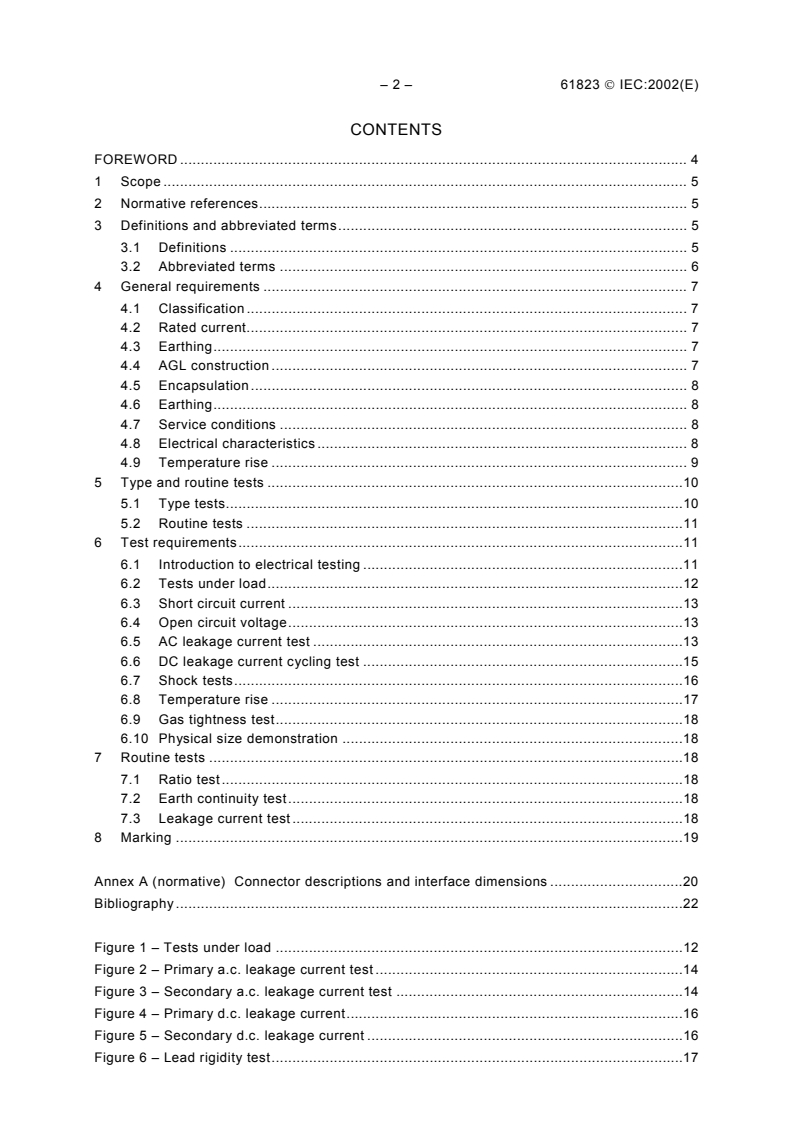
– 2 – 61823 IEC:2002(E)
CONTENTS
FOREWORD . 4
1 Scope . 5
2 Normative references. 5
3 Definitions and abbreviated terms. 5
3.1 Definitions . 5
3.2 Abbreviated terms . 6
4 General requirements . 7
4.1 Classification . 7
4.2 Rated current. 7
4.3 Earthing. 7
4.4 AGL construction . 7
4.5 Encapsulation. 8
4.6 Earthing. 8
4.7 Service conditions . 8
4.8 Electrical characteristics . 8
4.9 Temperature rise . 9
5 Type and routine tests .10
5.1 Type tests.10
5.2 Routine tests .11
6 Test requirements.11
6.1 Introduction to electrical testing .11
6.2 Tests under load.12
6.3 Short circuit current .13
6.4 Open circuit voltage.13
6.5 AC leakage current test .13
6.6 DC leakage current cycling test .15
6.7 Shock tests.16
6.8 Temperature rise .17
6.9 Gas tightness test.18
6.10 Physical size demonstration .18
7 Routine tests .18
7.1 Ratio test.18
7.2 Earth continuity test.18
7.3 Leakage current test.18
8 Marking .19
Annex A (normative) Connector descriptions and interface dimensions .20
Bibliography.22
Figure 1 – Tests under load .12
Figure 2 – Primary a.c. leakage current test .14
Figure 3 – Secondary a.c. leakage current test .14
Figure 4 – Primary d.c. leakage current.16
Figure 5 – Secondary d.c. leakage current .16
Figure 6 – Lead rigidity test.17
61823 IEC:2002(E) – 3 –
Figure A.1 – Style 2 primary plug .20
Figure A.2 – Style 9 primary receptacle.20
Figure A.3 – Style 8 secondary receptacle .21
Figure A.4 – Style 7 secondary receptacle .21
Table 1 – Transformer characteristics . 9
Table 2 – Encapsulation method type tests .10
Table 3 – Electrical characteristic type tests.11
Table 4 – Routine tests .11
Table 5 – DC leakage current test limits .15
Table A.1 – Interface dimensions for Figures A.1 and A.2 .20
Table A.2 – Interface dimensions for Figures A.3 and A.4 .21
– 4 – 61823 IEC:2002(E)
INTERNATIONAL ELECTROTECHNICAL COMMISSION
___________
ELECTRICAL INSTALLATIONS FOR LIGHTING
AND BEACONING OF AERODROMES –
AGL SERIES TRANSFORMERS
FOREWORD
1) The IEC (International Electrotechnical Commission) is a worldwide organization for standardization comprising
all national electrotechnical committees (IEC National Committees). The object of the IEC is to promote
international co-operation on all questions concerning standardization in the electrical and electronic fields. To
this end and in addition to other activities, the IEC publishes International Standards. Their preparation is
entrusted to technical committees; any IEC National Committee interested in the subject dealt with may
participate in this preparatory work. International, governmental and non-governmental organizations liaising
with the IEC also participate in this preparation. The IEC collaborates closely with the International
Organization for Standardization (ISO) in accordance with conditions determined by agreement between the
two organizations.
2) The formal decisions or agreements of the IEC on technical matters express, as nearly as possible, an
international consensus of opinion on the relevant subjects since each technical committee has representation
from all interested National Committees.
3) The documents produced have the form of recommendations for international use and are published in the form
of standards, technical specifications, technical reports or guides and they are accepted by the National
Committees in that sense.
4) In order to promote international unification, IEC National Committees undertake to apply IEC International
Standards transparently to the maximum extent possible in their national and regional standards. Any
divergence between the IEC Standard and the corresponding national or regional standard shall be clearly
indicated in the latter.
5) The IEC provides no marking procedure to indicate its approval and cannot be rendered responsible for any
equipment declared to be in conformity with one of its standards.
6) Attention is drawn to the possibility that some of the elements of this International Standard may be the subject
of patent rights. The IEC shall not be held responsible for identifying any or all such patent rights.
International Standard IEC 61823 has been prepared by IEC technical committee 97:
Electrical installations for lighting and beaconing of aerodromes.
The text of this standard is based on the following documents:
FDIS Report on voting
97/94/FDIS 97/95/RVD
Full information on the voting for the approval of this standard can be found in the report on
voting indicated in the above table.
This publication has been drafted in accordance with the ISO/IEC Directives, Part 2.
The committee has decided that the contents of this publication will remain unchanged
until 2006. At this date, the publication will be
• reconfirmed;
• withdrawn;
• replaced by a revised edition, or
• amended.
61823 IEC:2002(E) – 5 –
ELECTRICAL INSTALLATIONS FOR LIGHTING
AND BEACONING OF AERODROMES –
AGL SERIES TRANSFORMERS
1 Scope
This standard specifies the characteristics of aeronautical ground lighting series transformers
(AGLST) used in aeronautical ground lighting for 6,6 A series circuits, at a service voltage of
up to 5 kV, supplied by constant current regulators up to 30 kVA in rating.
AGL series transformers provide power to airport lighting luminaires or other loads (resistive)
from their secondary circuits. The AGL series transformers provide continuity of the series
circuit in the event of a loss of the load on the transformer, and electrical isolation between
the primary circuit supplied by a constant current regulator, and the secondary circuit
connected to the load under conditions defined in this standard.
An AGL series transformer is be able to withstand a permanent short or open-circuit
secondary series circuit.
Specifications for similar series transformers intended for any primary or secondary currents
other than 6,6 A, or to supply alternative voltages, constant power, reactive loads, etc., are
not included in this standard.
2 Normative references
The following referenced documents are indispensable for the application of this document.
For dated references, only the edition cited applies. For undated references, the latest edition
of the referenced document (including any amendments) applies.
IEC 60085, Thermal evaluation and classification of electrical insulation
IEC 61822, Electrical installations for lighting and beaconing of aerodromes – Constant
current regulators
ISO 48, Rubber, vulcanised or thermoplastic – Determination of hardness (hardness between
10 IRHD and 100 IRHD)
3 Definitions and abbreviated terms
3.1 Definitions
For the purposes of this standard the following definitions apply.
Where the terms voltage and current are used, they shall be r.m.s. values unless otherwise
stated.
3.1.1
AGL series transformer
aeronautical ground lighting series transformer, as specified in this standard
3.1.2
ambient temperature
the temperature of the air or other medium surrounding the AGL series transformer; for testing
purposes, a temperature of (20 ± 5) °C
– 6 – 61823 IEC:2002(E)
3.1.3
nominal power
arbitrarily selected values of power used in this standard for convenience to refer to AGL
series transformers with different characteristics
3.1.4
rated frequency
the frequency or frequency range for which the AGL series transformer is designed to operate
3.1.5
rated power
the range of powers for which each AGL series transformer is suitable.
NOTE The low and high values of these ranges are given in Table 1.
3.1.6
rated primary current
the current at which the primary of the AGL series transformer is designed to operate
3.1.7
rated secondary current
the current at which the secondary of the AGL series transformer is designed to operate
3.1.8
routine test
test for the purpose of checking manufactured products for compliance with this standard
3.1.9
service voltage
the maximum primary or secondary voltage at which the AGL series transformer is designed
to operate
3.1.10
type test
a test to confirm that the product design and production processes are capable of providing
products that meet the requirements of this standard
3.1.11
type test sample
a sample consisting of one or more similar samples used for a type test
3.2 Abbreviated terms
AC1 Source of mains power
AC2 High voltage a.c. source
AGLST AGL series transformer
DC1 Source of d.c. power
CCR Constant current regulator as specified in IEC 61822
I , I Primary and secondary currents respectively, as measured by ammeters or
1 2
equivalent devices
U , U Primary and secondary voltages respectively, as measured by voltmeters or
1 2
equivalent devices
P , P Active power measurements or calculations of respectively the primary and
1 2
secondary circuits of an AGL series transformer
61823 IEC:2002(E) – 7 –
4 General requirements
4.1 Classification
There are seven types of AGL series transformers specified in this standard, defined by their
nominal power, namely 30 W, 45 W, 65 W, 100 W, 150 W, 200 W and 300 W. See Table 1 for
the required characteristics.
4.2 Rated current
The rated primary and secondary currents shall be 6,6 A.
4.3 Earthing
AGL series transformers may be provided with or without an earthing connection.
4.4 AGL construction
The AGL series transformers shall have two electrically and physically separate windings, one
primary and one secondary, wound on a magnetic core. The polarity of the windings shall be
such that the primary plug corresponds to the large socket of the secondary receptacle.
All internal electrical connections shall be permanent, e.g. by compression high-pressure
crimping, high-temperature soldering, welding, etc.
The shapes of the transformers are optional provided they meet all the requirements of this
standard. Sharp edges shall be avoided.
The AGL series transformer including all connector leads shall be able to be inserted through
the open end of a cylinder 20 cm in diameter by 25 cm long, and shall easily and totally fit
inside such a cylinder.
The transformers shall be designed so that they may be installed and will perform to the
requirements of this standard in any orientation.
The AGL series transformers shall be provided with two single-conductor primary leads and
a two-conductor secondary lead.
4.4.1 Primary connection leads
The AGL series transformers shall be connected to the AGL primary series circuit cable by
two insulated, multi-stranded, copper conductors, with at least a 6 mm cross section, and a
+10
length measured from the transformer housing to the face of the connector of 60 cm. The
service voltage for the leads shall be 5 kV. One lead shall have a style 2 male plug at its end.
The other lead shall have a style 9 female receptacle at its end. Unless otherwise agreed
between the manufacturer and supplier, the connectors shall be provided with disposable
shipping caps.
4.4.2 Secondary connection lead
The secondary lead shall consist of two insulated, multi-stranded, copper conductors with an
overall jacket, each core of minimum cross section 2,5 mm , minimum service voltage 600 V,
and a length measured from the transformer housing to the face of the connector of
+10
120 cm. The lead shall have a type 2, class A, style 7 or style 8 female receptacle at its
end. Unless otherwise agreed between the manufacturer and supplier, the connector shall be
provided with a disposable shipping cap.
– 8 – 61823 IEC:2002(E)
4.5 Encapsulation
The AGL series transformer body, the connectors and the connection lead's sheaths, shall be
made of compatible materials. The case shall be composed of material formed directly on the
core and coil assembly, or by compound filling a container. The transformer shall be
permanently encapsulated without cracks, holes, or internal voids as far as practical. The
encapsulation of the transformer must form a watertight casing, and must bond with its
connection leads so as to provide a completely waterproof assembly.
The encapsulation material shall have a durometer hardness IRHD (Shore A) of not less
than 55 as measured in accordance with the test method of ISO 48.
The minimum thickness of the encapsulation over the internal components shall be 6,5 mm at
all points of the surface, for any type of encapsulant.
The encapsulation materials shall be capable of withstanding acid and alkaline soils, as well
as limited exposure to chemicals typically present on the aerodrome, including but not limited
to oil, gasoline, and de-icing fluids. The encapsulating materials must resist limited UV
exposure. These characteristics may be confirmed by testing material samples (only). The
characteristics may be confirmed by tests sponsored by the transformer manufacturer, or by
test results supplied by the materials manufacturer. These results may be applied to all AGL
series transformers using the encapsulation material. If a transformer manufacturer uses more
than one material for encapsulation, each such material shall meet these requirements.
4.6 Earthing
The magnetic core shall not be connected to earth or to either of the primary or secondary
electrical circuits.
AGL series transformers may be provided with or without an earthing connection. If an
earthing connection is provided, it shall be connected to that side of the secondary winding of
the transformer which is connected to the larger socket of the secondary connector. The
earthing connection must have a water barrier within the transformer body.
4.7 Service conditions
The ambient temperature range shall be –40 °C to +55 °C.
AGL series transformers shall be suitable for continuous outdoor service when installed within
enclosures or by direct earth burial.
AGL series transformer
...
IEC 61823 ®
Edition 1.0 2002-12
INTERNATIONAL
STANDARD
NORME
INTERNATIONALE
Electrical installations for lighting and beaconing of aerodromes – AGL series
transformers
Installations électriques pour l’éclairage et le balisage des aérodromes –
Transformateurs série utilisés pour l'éclairage et le balisage aéronautique au sol
All rights reserved. Unless otherwise specified, no part of this publication may be reproduced or utilized in any form
or by any means, electronic or mechanical, including photocopying and microfilm, without permission in writing from
either IEC or IEC's member National Committee in the country of the requester. If you have any questions about IEC
copyright or have an enquiry about obtaining additional rights to this publication, please contact the address below or
your local IEC member National Committee for further information.
Droits de reproduction réservés. Sauf indication contraire, aucune partie de cette publication ne peut être reproduite
ni utilisée sous quelque forme que ce soit et par aucun procédé, électronique ou mécanique, y compris la photocopie
et les microfilms, sans l'accord écrit de l'IEC ou du Comité national de l'IEC du pays du demandeur. Si vous avez des
questions sur le copyright de l'IEC ou si vous désirez obtenir des droits supplémentaires sur cette publication, utilisez
les coordonnées ci-après ou contactez le Comité national de l'IEC de votre pays de résidence.
IEC Central Office Tel.: +41 22 919 02 11
3, rue de Varembé Fax: +41 22 919 03 00
CH-1211 Geneva 20 info@iec.ch
Switzerland www.iec.ch
About the IEC
The International Electrotechnical Commission (IEC) is the leading global organization that prepares and publishes
International Standards for all electrical, electronic and related technologies.
About IEC publications
The technical content of IEC publications is kept under constant review by the IEC. Please make sure that you have the
latest edition, a corrigenda or an amendment might have been published.
IEC Catalogue - webstore.iec.ch/catalogue Electropedia - www.electropedia.org
The stand-alone application for consulting the entire The world's leading online dictionary of electronic and
bibliographical information on IEC International Standards, electrical terms containing 20 000 terms and definitions in
Technical Specifications, Technical Reports and other English and French, with equivalent terms in 15 additional
documents. Available for PC, Mac OS, Android Tablets and languages. Also known as the International Electrotechnical
iPad. Vocabulary (IEV) online.
IEC publications search - www.iec.ch/searchpub IEC Glossary - std.iec.ch/glossary
The advanced search enables to find IEC publications by a 65 000 electrotechnical terminology entries in English and
variety of criteria (reference number, text, technical French extracted from the Terms and Definitions clause of
committee,…). It also gives information on projects, replaced IEC publications issued since 2002. Some entries have been
and withdrawn publications. collected from earlier publications of IEC TC 37, 77, 86 and
CISPR.
IEC Just Published - webstore.iec.ch/justpublished
Stay up to date on all new IEC publications. Just Published IEC Customer Service Centre - webstore.iec.ch/csc
details all new publications released. Available online and If you wish to give us your feedback on this publication or
also once a month by email. need further assistance, please contact the Customer Service
Centre: csc@iec.ch.
A propos de l'IEC
La Commission Electrotechnique Internationale (IEC) est la première organisation mondiale qui élabore et publie des
Normes internationales pour tout ce qui a trait à l'électricité, à l'électronique et aux technologies apparentées.
A propos des publications IEC
Le contenu technique des publications IEC est constamment revu. Veuillez vous assurer que vous possédez l’édition la
plus récente, un corrigendum ou amendement peut avoir été publié.
Catalogue IEC - webstore.iec.ch/catalogue Electropedia - www.electropedia.org
Application autonome pour consulter tous les renseignements
Le premier dictionnaire en ligne de termes électroniques et
bibliographiques sur les Normes internationales,
électriques. Il contient 20 000 termes et définitions en anglais
Spécifications techniques, Rapports techniques et autres
et en français, ainsi que les termes équivalents dans 15
documents de l'IEC. Disponible pour PC, Mac OS, tablettes
langues additionnelles. Egalement appelé Vocabulaire
Android et iPad.
Electrotechnique International (IEV) en ligne.
Recherche de publications IEC - www.iec.ch/searchpub
Glossaire IEC - std.iec.ch/glossary
65 000 entrées terminologiques électrotechniques, en anglais
La recherche avancée permet de trouver des publications IEC
en utilisant différents critères (numéro de référence, texte, et en français, extraites des articles Termes et Définitions des
comité d’études,…). Elle donne aussi des informations sur les publications IEC parues depuis 2002. Plus certaines entrées
projets et les publications remplacées ou retirées. antérieures extraites des publications des CE 37, 77, 86 et
CISPR de l'IEC.
IEC Just Published - webstore.iec.ch/justpublished
Service Clients - webstore.iec.ch/csc
Restez informé sur les nouvelles publications IEC. Just
Published détaille les nouvelles publications parues. Si vous désirez nous donner des commentaires sur cette
Disponible en ligne et aussi une fois par mois par email. publication ou si vous avez des questions contactez-nous:
csc@iec.ch.
IEC 61823 ®
Edition 1.0 2002-12
INTERNATIONAL
STANDARD
NORME
INTERNATIONALE
Electrical installations for lighting and beaconing of aerodromes – AGL series
transformers
Installations électriques pour l’éclairage et le balisage des aérodromes –
Transformateurs série utilisés pour l'éclairage et le balisage aéronautique au sol
INTERNATIONAL
ELECTROTECHNICAL
COMMISSION
COMMISSION
ELECTROTECHNIQUE
INTERNATIONALE
ICS 29.140.50; 93.120 ISBN 978-2-8322-3743-4
– 2 – IEC 61823:2002 IEC 2002
CONTENTS
FOREWORD . 4
1 Scope . 5
2 Normative references . 5
3 Definitions and abbreviated terms . 5
3.1 Definitions . 5
3.2 Abbreviated terms . 6
4 General requirements . 7
4.1 Classification . 7
4.2 Rated current . 7
4.3 Earthing . 7
4.4 AGL construction . 7
4.5 Encapsulation. 8
4.6 Earthing . 8
4.7 Service conditions . 8
4.8 Electrical characteristics . 8
4.9 Temperature rise . 9
5 Type and routine tests . 10
5.1 Type tests . 10
5.2 Routine tests . 11
6 Test requirements . 11
6.1 Introduction to electrical testing . 11
6.2 Tests under load . 12
6.3 Short circuit current . 13
6.4 Open circuit voltage . 13
6.5 AC leakage current test . 13
6.6 DC leakage current cycling test . 15
6.7 Shock tests . 16
6.8 Temperature rise . 17
6.9 Gas tightness test . 18
6.10 Physical size demonstration . 18
7 Routine tests . 18
7.1 Ratio test. 18
7.2 Earth continuity test . 18
7.3 Leakage current test . 18
8 Marking . 19
Annex A (normative) Connector descriptions and interface dimensions . 20
Bibliography . 22
Figure 1 – Tests under load . 12
Figure 2 – Primary a.c. leakage current test . 14
Figure 3 – Secondary a.c. leakage current test . 14
Figure 4 – Primary d.c. leakage current . 16
Figure 5 – Secondary d.c. leakage current . 16
Figure 6 – Lead rigidity test . 17
Figure A.1 – Style 2 primary plug . 20
Figure A.2 – Style 9 primary receptacle . 20
Figure A.3 – Style 8 secondary receptacle . 21
Figure A.4 – Style 7 secondary receptacle . 21
Table 1 – Transformer characteristics . 9
Table 2 – Encapsulation method type tests . 10
Table 3 – Electrical characteristic type tests . 11
Table 4 – Routine tests . 11
Table 5 – DC leakage current test limits . 15
Table A.1 – Interface dimensions for Figures A.1 and A.2 . 20
Table A.2 – Interface dimensions for Figures A.3 and A.4 . 21
– 4 – IEC 61823:2002 IEC 2002
INTERNATIONAL ELECTROTECHNICAL COMMISSION
___________
ELECTRICAL INSTALLATIONS FOR LIGHTING
AND BEACONING OF AERODROMES –
AGL SERIES TRANSFORMERS
FOREWORD
1) The IEC (International Electrotechnical Commission) is a worldwide organization for standardization comprising
all national electrotechnical committees (IEC National Committees). The object of the IEC is to promote
international co-operation on all questions concerning standardization in the electrical and electronic fields. To
this end and in addition to other activities, the IEC publishes International Standards. Their preparation is
entrusted to technical committees; any IEC National Committee interested in the subject dealt with may
participate in this preparatory work. International, governmental and non-governmental organizations liaising
with the IEC also participate in this preparation. The IEC collaborates closely with the International
Organization for Standardization (ISO) in accordance with conditions determined by agreement between the
two organizations.
2) The formal decisions or agreements of the IEC on technical matters express, as nearly as possible, an
international consensus of opinion on the relevant subjects since each technical committee has representation
from all interested National Committees.
3) The documents produced have the form of recommendations for international use and are published in the form
of standards, technical specifications, technical reports or guides and they are accepted by the National
Committees in that sense.
4) In order to promote international unification, IEC National Committees undertake to apply IEC International
Standards transparently to the maximum extent possible in their national and regional standards. Any
divergence between the IEC Standard and the corresponding national or regional standard shall be clearly
indicated in the latter.
5) The IEC provides no marking procedure to indicate its approval and cannot be rendered responsible for any
equipment declared to be in conformity with one of its standards.
6) Attention is drawn to the possibility that some of the elements of this International Standard may be the subject
of patent rights. The IEC shall not be held responsible for identifying any or all such patent rights.
International Standard IEC 61823 has been prepared by IEC technical committee 97:
Electrical installations for lighting and beaconing of aerodromes.
This bilingual version (2016-11) corresponds to the English version, published in 2002-12.
The text of this standard is based on the following documents:
FDIS Report on voting
97/94/FDIS 97/95/RVD
Full information on the voting for the approval of this standard can be found in the report on
voting indicated in the above table.
The French version of this standard has not been voted upon.
This publication has been drafted in accordance with the ISO/IEC Directives, Part 2.
The committee has decided that the contents of this publication will remain unchanged
until 2006. At this date, the publication will be
• reconfirmed;
• withdrawn;
• replaced by a revised edition, or
• amended.
ELECTRICAL INSTALLATIONS FOR LIGHTING
AND BEACONING OF AERODROMES –
AGL SERIES TRANSFORMERS
1 Scope
This standard specifies the characteristics of aeronautical ground lighting series transformers
(AGLST) used in aeronautical ground lighting for 6,6 A series circuits, at a service voltage of
up to 5 kV, supplied by constant current regulators up to 30 kVA in rating.
AGL series transformers provide power to airport lighting luminaires or other loads (resistive)
from their secondary circuits. The AGL series transformers provide continuity of the series
circuit in the event of a loss of the load on the transformer, and electrical isolation between
the primary circuit supplied by a constant current regulator, and the secondary circuit
connected to the load under conditions defined in this standard.
An AGL series transformer is be able to withstand a permanent short or open-circuit
secondary series circuit.
Specifications for similar series transformers intended for any primary or secondary currents
other than 6,6 A, or to supply alternative voltages, constant power, reactive loads, etc., are
not included in this standard.
2 Normative references
The following referenced documents are indispensable for the application of this document.
For dated references, only the edition cited applies. For undated references, the latest edition
of the referenced document (including any amendments) applies.
IEC 60085, Thermal evaluation and classification of electrical insulation
IEC 61822, Electrical installations for lighting and beaconing of aerodromes – Constant
current regulators
ISO 48, Rubber, vulcanised or thermoplastic – Determination of hardness (hardness between
10 IRHD and 100 IRHD)
3 Definitions and abbreviated terms
3.1 Definitions
For the purposes of this standard the following definitions apply.
Where the terms voltage and current are used, they shall be r.m.s. values unless otherwise
stated.
3.1.1
AGL series transformer
aeronautical ground lighting series transformer, as specified in this standard
3.1.2
ambient temperature
the temperature of the air or other medium surrounding the AGL series transformer; for testing
purposes, a temperature of (20 ± 5) °C
– 6 – IEC 61823:2002 IEC 2002
3.1.3
nominal power
arbitrarily selected values of power used in this standard for convenience to refer to AGL
series transformers with different characteristics
3.1.4
rated frequency
the frequency or frequency range for which the AGL series transformer is designed to operate
3.1.5
rated power
the range of powers for which each AGL series transformer is suitable.
NOTE The low and high values of these ranges are given in Table 1.
3.1.6
rated primary current
the current at which the primary of the AGL series transformer is designed to operate
3.1.7
rated secondary current
the current at which the secondary of the AGL series transformer is designed to operate
3.1.8
routine test
test for the purpose of checking manufactured products for compliance with this standard
3.1.9
service voltage
the maximum primary or secondary voltage at which the AGL series transformer is designed
to operate
3.1.10
type test
a test to confirm that the product design and production processes are capable of providing
products that meet the requirements of this standard
3.1.11
type test sample
a sample consisting of one or more similar samples used for a type test
3.2 Abbreviated terms
AC1 Source of mains power
AC2 High voltage a.c. source
AGLST AGL series transformer
DC1 Source of d.c. power
CCR Constant current regulator as specified in IEC 61822
I , I Primary and secondary currents respectively, as measured by ammeters or
1 2
equivalent devices
U , U Primary and secondary voltages respectively, as measured by voltmeters or
1 2
equivalent devices
P , P Active power measurements or calculations of respectively the primary and
1 2
secondary circuits of an AGL series transformer
4 General requirements
4.1 Classification
There are seven types of AGL series transformers specified in this standard, defined by their
nominal power, namely 30 W, 45 W, 65 W, 100 W, 150 W, 200 W and 300 W. See Table 1 for
the required characteristics.
4.2 Rated current
The rated primary and secondary currents shall be 6,6 A.
4.3 Earthing
AGL series transformers may be provided with or without an earthing connection.
4.4 AGL construction
The AGL series transformers shall have two electrically and physically separate windings, one
primary and one secondary, wound on a magnetic core. The polarity of the windings shall be
such that the primary plug corresponds to the large socket of the secondary receptacle.
All internal electrical connections shall be permanent, e.g. by compression high-pressure
crimping, high-temperature soldering, welding, etc.
The shapes of the transformers are optional provided they meet all the requirements of this
standard. Sharp edges shall be avoided.
The AGL series transformer including all connector leads shall be able to be inserted through
the open end of a cylinder 20 cm in diameter by 25 cm long, and shall easily and totally fit
inside such a cylinder.
The transformers shall be designed so that they may be installed and will perform to the
requirements of this standard in any orientation.
The AGL series transformers shall be provided with two single-conductor primary leads and
a two-conductor secondary lead.
4.4.1 Primary connection leads
The AGL series transformers shall be connected to the AGL primary series circuit cable by
two insulated, multi-stranded, copper conductors, with at least a 6 mm cross section, and a
+10
length measured from the transformer housing to the face of the connector of 60 cm. The
service voltage for the leads shall be 5 kV. One lead shall have a style 2 male plug at its end.
The other lead shall have a style 9 female receptacle at its end. Unless otherwise agreed
between the manufacturer and supplier, the connectors shall be provided with disposable
shipping caps.
4.4.2 Secondary connection lead
The secondary lead shall consist of two insulated, multi-stranded, copper conductors with an
overall jacket, each core of minimum cross section 2,5 mm , minimum service voltage 600 V,
and a length measured from the transformer housing to the face of the connector of
+10
120 cm. The lead shall have a type 2, class A, style 7 or style 8 female receptacle at its
end. Unless otherwise agreed between the manufacturer and supplier, the connector shall be
provided with a disposable shipping cap.
– 8 – IEC 61823:2002 IEC 2002
4.5 Encapsulation
The AGL series transformer body, the connectors and the connection lead's sheaths, shall be
made of compatible materials. The case shall be composed of material formed directly on the
core and coil assembly, or by compound filling a container. The transformer shall be
permanently encapsulated without cracks, holes, or internal voids as far as practical. The
encapsulation of the transformer must form a watertight casing, and must bond with its
connection leads so as to provide a completely waterproof assembly.
The encapsulation material shall have a durometer hardness IRHD (Shore A) of not less
than 55 as measured in accordance with the test method of ISO 48.
The minimum thickness of the encapsulation over the internal components shall be 6,5 mm at
all points of the surface, for any type of encapsulant.
The encapsulation materials shall be capable of withstanding acid and alkaline soils, as well
as limited exposure to chemicals typically present on the aerodrome, including but not limited
to oil, gasoline, and de-icing fluids. The encapsulating materials must resist limited UV
exposure. These characteristics may be confirmed by testing material samples (only). The
characteristics may be confirmed by tests sponsored by the transformer manufacturer, or by
test results supplied by the materials manufacturer. These results may be applied to all AGL
series transformers using the encapsulation material. If a transformer manufacturer uses more
than one material for encapsulation, each such material shall meet these requirements.
4.6 Earthing
The magnetic core shall not be connected to earth or to either of the primary or secondary
electrical circuits.
AGL series transformers may be provided with or without an earthing connection. If an
earthing connection is provided, it shall be connected to that side of the secondary winding of
the transformer which is connected to the larger socket of the secondary connector. The
earthing connection must have a water barrier within the transformer body.
4.7 Service conditions
The ambient temperature range shall be –40 °C to +55 °C.
AGL series transformers shall be suitable for continuous outdoor service when installed within
enclosures or by direct earth burial.
AGL series transformers shall be capable of operation when completely submerged in water
for the life of the transformer.
4.8 Electrical characteristics
4.8.1 Secondary current
With the primary current I at 6,6 A, the secondary current I shall be within ±1 % of the
1 2
primary current in the range between the low and high load in ohms given in Table 1.
4.8.2 Power factor
With the primary current I at 6,6 A, and the nominal load in ohms (see Table 1) connected to
the secondary, the power factor shall be not less than 95 %.
4.8.3 Efficiency
With the primary current I at 6,6 A, and the nominal load in ohms (see Table 1) applied to the
secondary, the efficiency shall be not less than 80 % for AGL series transformers whose
nominal rating is 30 W, not less than 85 % for AGL series transformers whose nominal rating
is 45 W, 65 W or 100 W, and not less than 90 % for AGL series transformers whose nominal
rating is above 100 W.
4.8.4 Short circuit secondary current
With the primary current I at 6,6 A, the secondary short circuit current shall not exceed 6,8 A
for all AGL series transformers.
4.8.5 Open circuit secondary voltage
With the primary current I at 6,6 A, and with the secondary circuit open, the voltage at the
secondary connector terminals shall not exceed the limits given in Table 1.
4.8.6 Characteristics
To allow for lamp power tolerances and losses in the circuit connecting the lamps to the AGL
series transformers, the permanent acceptable load on the secondary may vary from the
nominal value between the low and high limits given in Table 1.
Table 1 – Transformer characteristics
Maximum
Rated power Load (resistive)
open circuit
Nominal
voltage
power W
Ω
V
W
Low High 50 Hz and
Low High Nominal
(maximum) (minimum) 60 Hz
30 25 40 0,57 0,69 0,92 20
45 35 60 0,80 1,03 1,38 20
65 50 85 1,15 1,49 1,95 30
100 80 125 1,84 2,30 2,87 40
150 120 178 2,75 3,44 4,13 60
200 160 230 3,67 4,59 5,28 70
300 220 338 5,05 6,89 7,81 110
NOTE Tolerance on loads is ±1 %.
4.9 Temperature rise
The temperature rise of the transformer shall be determined using the resistance method. The
temperature rise shall not exceed the maximum temperature permitted by the insulation class,
according to IEC 60085, of the most critical insulation, less 60 °C. The transformer shall be
operated in air at ambient temperature, with primary current set at 6,6 A, under each of the
following conditions:
• high resistive load, see Table 1;
• short circuit;
• open circuit.
– 10 – IEC 61823:2002 IEC 2002
5 Type and routine tests
5.1 Type tests
The type tests are divided into two groups, which apply respectively to the encapsulation
method (see 5.1.1), and to the electrical characteristics of each transformer (see 5.1.2).
5.1.1 Encapsulation method type tests
The following tests shall be successfully completed for three samples of one type from each
family of AGL series transformers, where a family is defined as AGL series transformers of
the same physical size (e.g. made in the same mould), differing only in characteristics which
will not effect the physical performance. Such differences would include, but are not
necessarily limited to:
• primary and/or secondary connector configurations;
• length of primary and/or secondary leads;
• electrical construction (e.g. number of turns, number of laminations or core size).
Before beginning, each AGL series transformer to be tested shall have its connector
dimensions confirmed as being in accordance with the tolerances given in Annex A.
Table 2 – Encapsulation method type tests
Sequence Test Reference
1 Physical size demonstration 6.10
2 Initial ratio 6.2.1 and 6.2.1.1
3 Shock tests 6.7
(impact and lead rigidity)
4 Gas tightness 6.9
a
5 Final ratio
6 AC leakage current test 6.5
7 DC leakage current cycling test 6.6
a
The transformer shall first be subjected to the “warm-up” procedure in accordance with 6.2.1. Then the primary
current I shall be set between 6,58 A and 6,62 A, and the value recorded. The secondary current I shall be
1 2
measured. This value shall be adjusted by multiplying by the measured primary current in this sequence
divided by the measured primary current in sequence 2. The resulting value shall not be different from the
secondary current measured in sequence 2 by more than ±67 mA.
The encapsulation type tests shown in Table 2 shall be carried out in the sequence given.
If one or more of the three test transformers fails any one of the tests, the full test sequence
shall be repeated with three new samples.
The results of these tests shall be recorded and kept for future reference.
5.1.2 Electrical characteristic type tests
These tests shall be run on three samples of each type. Types which are essentially the same
electrically, differing only in characteristics that will not materially effect the electrical
performance, may be covered by a test on one representative type. Such differences would
include, but not necessarily be limited to,
• primary and/or secondary connector configurations;
• lead lengths;
• with and without earth connection.
Table 3 – Electrical characteristic type tests
Sequence Test Reference
1 Ratio, power factor and efficiency 6.2
under load
2 Short circuit 6.3
3 Open circuit 6.4
4 AC leakage current 6.5
5 Temperature rise 6.8
The electrical type tests shown in Table 3 shall be carried out in the sequence given.
If one or more of the three test transformers fails any one of the above tests, the full test
sequence shall be repeated with three replacement transformers.
The results of these tests shall be recorded and kept for future reference.
5.2 Routine tests
All of the AGL series transformers manufactured shall be subjected to the tests shown in
Table 4.
Any transformer that fails any of the tests in Table 4 shall be discarded.
The results of these tests shall be recorded and kept for future reference. These results may
include pass/fail only.
Table 4 – Routine tests
Test Reference
Ratio 7.1
Earthing continuity (if earth connection supplied) 7.2
Leakage current test – either d.c. or a.c. 7.3
6 Test requirements
6.1 Introduction to electrical testing
6.1.1 Safety
During these tests, lethal voltages and high energy levels may be developed. It is essential
that the operators and witnesses be aware of the appropriate safety provisions.
6.1.2 Power
All testing shall be with a sinusoidal waveform of the rated frequency of the device,
(50 Hz ± 1) Hz or (60 Hz ± 1) Hz. If a transformer is rated for both 50 Hz and 60 Hz, all
electrical tests shall be carried out at both frequencies.
6.1.3 Loads
When resistors are used as loads for a transformer, they shall be of very low inductance, not
more than 0,25 µH per ohm of resistance. They shall also be inherently temperature
stabilized, or their temperature shall be stabilized, and the resistance value confirmed, prior to
measurements being taken.
– 12 – IEC 61823:2002 IEC 2002
6.1.4 Measurement
All measuring instruments shall read r.m.s.
High impedance voltage measurement equipment shall be used (at least 1 MΩ).
When measuring the current ratio, the primary and secondary currents shall be measured
simultaneously.
Allowances shall be made for the power consumption of any meters if this is material to the
results.
Metering shown in Figures 1, 2, 3, 4, and 5 is only suggestive. Other forms of metering may
be used if they accomplish the same objective.
6.2 Tests under load
6.2.1 Warm-up procedure
The transformer shall be connected as shown in Figure 1. The AC1 source shall be set
between 6,58 A and 6,62 A, and the load R to the nominal value as given in Table 1. The
transformer shall be in ambient temperature air lying on its largest flat surface on a dry solid
wooden plate at least 30 mm thick. This warm-up shall continue for a minimum of 6 h, after
which the tests of 6.2.1.1 and 6.2.1.2 shall be carried out.
P P
1 2
I
I
R
AGLST
AC1
U U
1 2
IEC 3106/02
Figure 1 – Tests under load
6.2.1.1 Ratio measurement polarity
The input current I shall be set between 6,58 A and 6,62 A, and the value recorded. The
secondary current I shall be within ±67 mA of the measured primary current for each of
the low, nominal, and high values of load given in Table 1.
6.2.1.2 Power factor and efficiency
The load R shall be set at the nominal load ±1 % given in Table 1, and the voltage, current,
and power of both the primary and the secondary circuits shall be measured and recorded.
6.2.1.2.1 Power factor
The power factor shall be measured directly, or calculated as follows:
PF = P / I × U
1 1 1
where
PF is the power factor;
P is the primary power in watts;
I is the primary current in amperes;
U is the primary voltage in volts.
The value of the power factor shall be not less than 0,95.
6.2.1.2.2 Efficiency
The efficiency shall be measured directly, or calculated as follows:
Efficiency = P × 100 / P
2 1
where
P is the primary power in watts;
P is the secondary power in watts.
The efficiency shall be not less than 80 % for AGL series transformers whose nominal rating
is 30 W, not less than 85 % for AGL series transformers whose nominal rating is 45 W, 65 W,
or 100 W and not less than 90 % for AGL series transformers whose nominal rating is above
100 W.
6.3 Short circuit current
The transformer shall be at ambient temperature and be connected as shown in Figure 1.
The primary current I shall be set between 6,58 A and 6,62 A.
The load R shall be a short circuit presenting a voltage drop of less than 0,1 V as measured
at the secondary connector of the sample.
The secondary current shall be not more than 6,8/6,6 times the measured primary current.
6.4 Open circuit voltage
The transformer shall be at ambient temperature, and connected as shown in Figure 1.
The load R shall be removed (open circuit).
The primary current shall be set between 6,58 A and 6,62 A.
The voltage U shall be not more than the value given in Table 1.
6.5 AC leakage current test
The transformer's primary and secondary leads shall be connected to the corresponding
connectors of primary and secondary leads. No additional protection such as tape or
compound shall be used on the connectors. The transformer including all connectors shall be
immersed in a tank of tap water at ambient temperature.
– 14 – IEC 61823:2002 IEC 2002
6.5.1 Primary
The transformer shall be connected as shown in Figure 2. The AC2 source shall be adjusted
to a minimum of 10 kV a.c., and applied for at least 1 min.
The measured value of I shall not exceed 10 mA.
AGLST
AC2
10 kV
PRIMARY SECONDARY
I
IEC 3107/02
Figure 2 – Primary a.c. leakage current test
6.5.2 Secondary
The transformer shall be connected as shown in Figure 3. The AC2 source shall be adjusted
to a minimum of 3,5 kV a.c., and applied for at least 1 min.
The measured value of I1 shall not exceed 10 mA.
+
AGLST
AC2
3,5 kV
PRIMARY SECONDARY
–
I
IEC 3108/02
Figure 3 – Secondary a.c. leakage current test
6.6 DC leakage current cycling test
Three sample AGL series transformers shall be prepared as specified in 6.6.1, and then
subjected to a sequence of the three operations specified in 6.6.2, 6.6.3 and 6.6.4. Repeat
the sequence 20 times.
6.6.1 Initial preparation
Test harnesses complete with corresponding connectors that are compliant to the dimensions
in Annex A shall be installed on the three connectors of the AGL series transformers. No
additional protection such as tape or compound shall be used on the connectors. The
corresponding connectors shall not be removed before completion of the 20 cycle testing. If
they are removed for any reason, tests shall be repeated so that the AGL series transformers
and their connectors satisfactorily pass 20 continuous cycles.
6.6.2 Warm-up
The AGL series transformers shall be operated, with corresponding connectors installed, for
a minimum of 6 h in air at ambient temperature, with the primary current set between 6,58 A
and 6,62 A, and the secondary circuit open.
6.6.3 Water immersion test
Immediately following the warm-up procedure of 6.6.2, the AGL series transformers, with
leads and connectors, shall be submerged in a tank of tap water at ambient temperature. The
water (and tank if metallic) shall be earthed. Care shall be taken to ensure that all connectors
(including test harness connectors) and transformer leads remain completely immersed in tap
water during this test. Additional water may be added to compensate for any evaporation. The
AGL series transformers and their connectors shall continue to be soaked in water at ambient
temperature for not less than 12 h.
6.6.4 DC leakage current
The primary and secondary d.c. leakage currents shall be measured within 10 min of
immersion of the AGL series transformers in water, and at the end of the soaking period.
Measurement of leakage current shall be made with a d.c. voltage source as shown in Figure 4
(primary) and Figure 5 (secondary). The appropriate test voltage as given in Table 5 shall be
applied for 1 min between each circuit and earth. After the instrument needle settles down
following current inrush, it shall remain steady without fluctuations, and the leakage current
shall be not more than the appropriate value specified in Table 5.
Table 5 – DC leakage current test limits
Voltage applied Maximum leakage current I
Winding under test
kV d.c. µA
Primary 15 2
a
Secondary 5 2
a
Test not required if the transformer is equipped with an earth connection.
– 16 – IEC 61823:2002 IEC 2002
+
AGLST
DC1
15 kV
PRIMARY SECONDARY
–
I
IEC 3109/02
Figure 4 – Primary d.c. leakage current
+
AGLST
DC1
5 kV
PRIMARY SECONDARY
–
I
IEC 3110/02
Figure 5 – Secondary d.c. leakage current
6.7 Shock tests
The following tests shall be carried out at ambient temperature.
6.7.1 Impact test
The transformer shall be dropped from a height of not less than 1,8 m, a total of four times, at
least once on each of three orthogonal surfaces, and once on a corner, on a flat concrete
surface.
6.7.2 Lead rigidity test
After completion of the test in 6.7.1, the transformer leads shall be tested by securing (just
below the connector) each lead one at a time, in a clamp fastened to a support, elevated a
minimum of 1,5 m above ground. The clamp shall be applied so that it shall not cause damage
to the lead at the point of attachment. The connector shall be oriented so the rear of the
connector (lead exit) points downward. See Figure 6.
The AGL series transformers shall be lifted above the clamp elevation, and released for
a free fall.
6.7.3 Physical confirmation
Any visual evidence of damage to the leads or body which may jeopardize the electrical or
watertight properties of the transformer shall be cause for rejection.
AGLST
Cable
connector
Cable
clamp
1,5 m min.
above floor
IEC 3111/02
Figure 6 – Lead rigidity test
6.8 Temperature rise
The transformer shall be prepared according to the warm-up procedure of 6.2.1.
The following loads shall then be applied in turn:
a) nominal load – see Table 1;
b) short circuit
c) open circuit
For each load, the transformers shall be operated with the primary current I set between
6,58 A and 6,62 A, and then the temperature rise determined.
– 18 – IEC 61823:2002 IEC 2002
The temperature rise of the transformers shall be determined by the resistance method, and
shall not be higher than the maximum temperature permitted by the insulation class,
according to IEC 60085, of the most critical insulation less 60 °C. All three measurements
shall be taken within 15 min of the end of the warm-up procedure.
Temperature rise shall be computed from the following formula:
Temperature rise (°C) = (234,5 + T ) – (R – R ) / R
o 1 o o
where
T is the temperature corresponding to cold resistance in degrees Celsius;
o
R is the cold resistance in ohms;
o
R is the hot resistance in ohms.
6.9 Gas tightness test
A source of compressed air at 100 kPa above normal atmospheric pressure shall be applied
to the transformer’s primary female receptacle, and secondary female receptacle, in turn.
The two leads and connectors which are not subjected to the air pressure, and the
transformer body, including the earthing connection, shall be fully immersed in tap water at
ambient temperature.
For each test the air pressure shall be applied for 15 min, and there shall be no evidence of
air bubbles in the water.
6.10 Physical size demonstration
Confirmation of the physical size shall be performed according to the requirements of 4.4.
7 Routine tests
7.1 Ratio test
The transformer shall be set up as in Figure 1.
With the input current I set between 6,58 A and 6,62 A, the secondary current I shall be
1 2
within ±67 mA of the measured primary current with the load R set at the low and high values
given in Table 1.
7.2 Earth continuity test
If a transformer is equipped with the optional earth connection, an earth continuity tester
delivering at least 10 A at less than 6 V shall be used to ensure that there is an electrical
connection between the earth stud and the large socket of the secondary connector.
7.3 Leakage current test
Test harnesses complete with corresponding connectors shall be installed on the three
connectors of the AGL series transformer. No supplementary protection such as tape or
compound shall be used on the connectors. The transformer including its leads and
connectors shall be submerged in a tank of ambient temperature tap water.
The transformer shall be tested when its internal temperature is at least 55 °C over ambient,
or after it has been soaked for at least 12 h.
...