

IEC 61331-3:2014
(Main)Protective devices against diagnostic medical X-radiation - Part 3: Protective clothing, eyewear and protective patient shields
General Information
- Abstract
IEC 61331-3:2014 applies to protective devices such as protective clothing and eyewear for the protection of persons against X radiation up to 150 kV, during radiological examinations and interventional procedures. This standard deals with general requirements on the accompanying documents, on design and on materials used and with sizing, particular design features, minimum attenuation properties of materials, marking and standardized forms of statements of compliance with this standard. It covers protective clothing mainly for the protection of the operator, such as:
- protective aprons;
- thyroid collars;
- protective gloves;
- protective mittens; and
- protective eyewear. It also covers protective devices for the protection of the patient, such as:
- protective gonad aprons;
- scrotum shields;
- ovary shields;
- shadow shields; and
- protective aprons for dental use. The latter group of protective devices is intended to be used during radiological examinations to minimize the effects of irradiation on the reproductive organs particularly with regard to genetic damage. This second edition cancels and replaces the first edition of IEC 61331-3, published in 1998. It constitutes a technical revision. This second edition has been adapted to apply to the present technology. It includes a requirement to use a better method for the determination of attenuation properties over a broader and more clinically relevant range of radiation qualities appropriate to the use of the devices. It also covers three additional protective devices, thyroid collars, protective eyewear and protective aprons for dental use.
- Status
- Published
- Publication Date
- 06-May-2014
- Technical Committee
- SC 62B - Medical imaging equipment, software, and systems
- Drafting Committee
- MT 47 - TC 62/SC 62B/MT 47
- Current Stage
- PPUB - Publication issued
- Start Date
- 07-May-2014
- Completion Date
- 31-May-2014
Overview
IEC 61331-3:2014 is an international standard developed by the International Electrotechnical Commission (IEC) that specifies requirements for protective devices against diagnostic medical X-radiation. This part 3 of IEC 61331 focuses on protective clothing, eyewear, and patient shields designed to safeguard individuals from X-rays up to 150 kV during radiological examinations and interventional procedures. The standard emphasizes safety, design, materials, and performance to ensure effective protection for medical operators and patients exposed to diagnostic X-ray radiation.
This 2014 edition supersedes the first edition published in 1998, incorporating updated methods for measuring attenuation properties across a clinically relevant range of radiation qualities. It introduces additional protective devices such as thyroid collars, protective eyewear, and protective aprons specifically designed for dental use.
Key Topics
Protective Clothing and Eyewear for Operators
- Protective aprons: Primary shielding garments that reduce radiation exposure to vital organs.
- Thyroid collars: Specialized devices protecting the thyroid gland from scattered X-rays.
- Protective gloves and mittens: Hand protection designed to minimize radiation dose during procedures.
- Protective eyewear: Shields for operators' eyes, reducing the risk of radiation-induced eye damage.
Protective Devices for Patients
- Protective gonad aprons: Shields aimed at minimizing radiation to reproductive organs to reduce genetic risks.
- Scrotum and ovary shields: Targeted protective devices to safeguard sensitive reproductive tissues.
- Shadow shields: Passive protective devices positioned to block radiation without compromising imaging.
- Protective aprons for dental use: Lightweight aprons tailored for dental radiology, enhancing patient comfort and protection.
General Requirements on Protective Devices
- Design and sizing: Devices are to be designed for adequate fit, comfort, and practicality for both operators and patients.
- Material properties: Materials must meet minimum attenuation levels to effectively reduce X-ray penetration.
- Marking and documentation: Clear labeling and standardized statements of compliance assist users in verifying device safety and suitability.
- Cleaning and maintenance: Guidance on materials' cleanability to maintain hygiene and functionality.
Measurement and Attenuation
- The standard adopts improved methods for determining the attenuation properties of protective materials, ensuring reliable protection across different diagnostic X-ray energy levels.
Applications
IEC 61331-3:2014 is applicable across various healthcare settings where diagnostic X-rays are used. Its practical value includes:
- Radiology departments: Ensuring operators and patients are equipped with certified protective clothing and shields that comply with international safety standards.
- Interventional procedures: Providing real-time protection during fluoroscopy and other image-guided interventions.
- Dental clinics: Utilizing protective aprons designed specifically for dental radiographic examinations.
- Manufacturers and designers: Guiding product development to meet stringent safety requirements and improve protective device efficacy.
- Safety compliance: Assisting healthcare facilities in establishing policies aligned with international X-ray protection standards for staff and patients.
By implementing devices that meet IEC 61331-3:2014, healthcare professionals can effectively minimize radiation exposure, reduce occupational hazards, and protect patient genetic health during diagnostic radiology.
Related Standards
- IEC 61331-1 – Protective devices against diagnostic medical X-radiation: General requirements.
- IEC 61331-2 – Protective devices: Determination of attenuation properties.
- ISO 4037 – X and gamma reference radiation for calibration and testing of dosimeters.
- IEC 60601 series – Medical electrical equipment standards, which include radiation safety aspects.
Healthcare providers and manufacturers should consult related IEC and ISO standards to ensure comprehensive radiation safety and device compliance in diagnostic radiology. Following IEC 61331-3:2014 supports a harmonized approach to radiation protection aiding regulatory approval, user confidence, and occupational health worldwide.
Keywords: IEC 61331-3, diagnostic medical X-radiation, protective clothing, X-ray protection, protective aprons, thyroid collars, protective eyewear, patient shields, radiology safety, radiation attenuation, medical X-ray devices, dental protective aprons, radiation protection standards.
Relations
- Effective Date
- 10-Jun-2026
- Effective Date
- 05-Sep-2023
Get Certified
Connect with accredited certification bodies for this standard

BSI Group
BSI (British Standards Institution) is the business standards company that helps organizations make excellence a habit.

TÜV Rheinland
TÜV Rheinland is a leading international provider of technical services.

TÜV SÜD
TÜV SÜD is a trusted partner of choice for safety, security and sustainability solutions.
Sponsored listings
Frequently Asked Questions
IEC 61331-3:2014 is a standard published by the International Electrotechnical Commission (IEC). Its full title is "Protective devices against diagnostic medical X-radiation - Part 3: Protective clothing, eyewear and protective patient shields". This standard covers: IEC 61331-3:2014 applies to protective devices such as protective clothing and eyewear for the protection of persons against X radiation up to 150 kV, during radiological examinations and interventional procedures. This standard deals with general requirements on the accompanying documents, on design and on materials used and with sizing, particular design features, minimum attenuation properties of materials, marking and standardized forms of statements of compliance with this standard. It covers protective clothing mainly for the protection of the operator, such as: - protective aprons; - thyroid collars; - protective gloves; - protective mittens; and - protective eyewear. It also covers protective devices for the protection of the patient, such as: - protective gonad aprons; - scrotum shields; - ovary shields; - shadow shields; and - protective aprons for dental use. The latter group of protective devices is intended to be used during radiological examinations to minimize the effects of irradiation on the reproductive organs particularly with regard to genetic damage. This second edition cancels and replaces the first edition of IEC 61331-3, published in 1998. It constitutes a technical revision. This second edition has been adapted to apply to the present technology. It includes a requirement to use a better method for the determination of attenuation properties over a broader and more clinically relevant range of radiation qualities appropriate to the use of the devices. It also covers three additional protective devices, thyroid collars, protective eyewear and protective aprons for dental use.
IEC 61331-3:2014 applies to protective devices such as protective clothing and eyewear for the protection of persons against X radiation up to 150 kV, during radiological examinations and interventional procedures. This standard deals with general requirements on the accompanying documents, on design and on materials used and with sizing, particular design features, minimum attenuation properties of materials, marking and standardized forms of statements of compliance with this standard. It covers protective clothing mainly for the protection of the operator, such as: - protective aprons; - thyroid collars; - protective gloves; - protective mittens; and - protective eyewear. It also covers protective devices for the protection of the patient, such as: - protective gonad aprons; - scrotum shields; - ovary shields; - shadow shields; and - protective aprons for dental use. The latter group of protective devices is intended to be used during radiological examinations to minimize the effects of irradiation on the reproductive organs particularly with regard to genetic damage. This second edition cancels and replaces the first edition of IEC 61331-3, published in 1998. It constitutes a technical revision. This second edition has been adapted to apply to the present technology. It includes a requirement to use a better method for the determination of attenuation properties over a broader and more clinically relevant range of radiation qualities appropriate to the use of the devices. It also covers three additional protective devices, thyroid collars, protective eyewear and protective aprons for dental use.
IEC 61331-3:2014 is classified under the following ICS (International Classification for Standards) categories: 11.040.50 - Radiographic equipment. The ICS classification helps identify the subject area and facilitates finding related standards.
IEC 61331-3:2014 has the following relationships with other standards: It is inter standard links to EN ISO 15382:2025, IEC 61331-3:1998. Understanding these relationships helps ensure you are using the most current and applicable version of the standard.
IEC 61331-3:2014 is available in PDF format for immediate download after purchase. The document can be added to your cart and obtained through the secure checkout process. Digital delivery ensures instant access to the complete standard document.
Standards Content (Sample)
IEC 61331-3 ®
Edition 2.0 2014-05
INTERNATIONAL
STANDARD
NORME
INTERNATIONALE
Protective devices against diagnostic medical X-radiation –
Part 3: Protective clothing, eyewear and protective patient shields
Dispositifs de protection radiologique contre les rayonnements X pour
diagnostic médical –
Partie 3: Vêtements et lunettes de protection radiologique, écrans de protection
pour le patient
All rights reserved. Unless otherwise specified, no part of this publication may be reproduced or utilized in any form
or by any means, electronic or mechanical, including photocopying and microfilm, without permission in writing from
either IEC or IEC's member National Committee in the country of the requester. If you have any questions about IEC
copyright or have an enquiry about obtaining additional rights to this publication, please contact the address below or
your local IEC member National Committee for further information.
Droits de reproduction réservés. Sauf indication contraire, aucune partie de cette publication ne peut être reproduite
ni utilisée sous quelque forme que ce soit et par aucun procédé, électronique ou mécanique, y compris la photocopie
et les microfilms, sans l'accord écrit de l'IEC ou du Comité national de l'IEC du pays du demandeur. Si vous avez des
questions sur le copyright de l'IEC ou si vous désirez obtenir des droits supplémentaires sur cette publication, utilisez
les coordonnées ci-après ou contactez le Comité national de l'IEC de votre pays de résidence.
IEC Central Office Tel.: +41 22 919 02 11
3, rue de Varembé Fax: +41 22 919 03 00
CH-1211 Geneva 20 info@iec.ch
Switzerland www.iec.ch
About the IEC
The International Electrotechnical Commission (IEC) is the leading global organization that prepares and publishes
International Standards for all electrical, electronic and related technologies.
About IEC publications
The technical content of IEC publications is kept under constant review by the IEC. Please make sure that you have the
latest edition, a corrigenda or an amendment might have been published.
IEC Catalogue - webstore.iec.ch/catalogue Electropedia - www.electropedia.org
The stand-alone application for consulting the entire The world's leading online dictionary of electronic and
bibliographical information on IEC International Standards, electrical terms containing more than 30 000 terms and
Technical Specifications, Technical Reports and other definitions in English and French, with equivalent terms in 14
documents. Available for PC, Mac OS, Android Tablets and additional languages. Also known as the International
iPad. Electrotechnical Vocabulary (IEV) online.
IEC publications search - www.iec.ch/searchpub IEC Glossary - std.iec.ch/glossary
The advanced search enables to find IEC publications by a More than 55 000 electrotechnical terminology entries in
variety of criteria (reference number, text, technical English and French extracted from the Terms and Definitions
committee,…). It also gives information on projects, replaced clause of IEC publications issued since 2002. Some entries
and withdrawn publications. have been collected from earlier publications of IEC TC 37,
77, 86 and CISPR.
IEC Just Published - webstore.iec.ch/justpublished
Stay up to date on all new IEC publications. Just Published IEC Customer Service Centre - webstore.iec.ch/csc
details all new publications released. Available online and If you wish to give us your feedback on this publication or
also once a month by email. need further assistance, please contact the Customer Service
Centre: csc@iec.ch.
A propos de l'IEC
La Commission Electrotechnique Internationale (IEC) est la première organisation mondiale qui élabore et publie des
Normes internationales pour tout ce qui a trait à l'électricité, à l'électronique et aux technologies apparentées.
A propos des publications IEC
Le contenu technique des publications IEC est constamment revu. Veuillez vous assurer que vous possédez l’édition la
plus récente, un corrigendum ou amendement peut avoir été publié.
Catalogue IEC - webstore.iec.ch/catalogue Electropedia - www.electropedia.org
Application autonome pour consulter tous les renseignements
Le premier dictionnaire en ligne de termes électroniques et
bibliographiques sur les Normes internationales,
électriques. Il contient plus de 30 000 termes et définitions en
Spécifications techniques, Rapports techniques et autres
anglais et en français, ainsi que les termes équivalents dans
documents de l'IEC. Disponible pour PC, Mac OS, tablettes
14 langues additionnelles. Egalement appelé Vocabulaire
Android et iPad.
Electrotechnique International (IEV) en ligne.
Recherche de publications IEC - www.iec.ch/searchpub
Glossaire IEC - std.iec.ch/glossary
La recherche avancée permet de trouver des publications IEC Plus de 55 000 entrées terminologiques électrotechniques, en
en utilisant différents critères (numéro de référence, texte, anglais et en français, extraites des articles Termes et
comité d’études,…). Elle donne aussi des informations sur les Définitions des publications IEC parues depuis 2002. Plus
projets et les publications remplacées ou retirées. certaines entrées antérieures extraites des publications des
CE 37, 77, 86 et CISPR de l'IEC.
IEC Just Published - webstore.iec.ch/justpublished
Service Clients - webstore.iec.ch/csc
Restez informé sur les nouvelles publications IEC. Just
Published détaille les nouvelles publications parues. Si vous désirez nous donner des commentaires sur cette
Disponible en ligne et aussi une fois par mois par email. publication ou si vous avez des questions contactez-nous:
csc@iec.ch.
IEC 61331-3 ®
Edition 2.0 2014-05
INTERNATIONAL
STANDARD
NORME
INTERNATIONALE
Protective devices against diagnostic medical X-radiation –
Part 3: Protective clothing, eyewear and protective patient shields
Dispositifs de protection radiologique contre les rayonnements X pour
diagnostic médical –
Partie 3: Vêtements et lunettes de protection radiologique, écrans de protection
pour le patient
INTERNATIONAL
ELECTROTECHNICAL
COMMISSION
COMMISSION
ELECTROTECHNIQUE
PRICE CODE
INTERNATIONALE
CODE PRIX U
ICS 11.040.50 ISBN 978-2-8322-1564-7
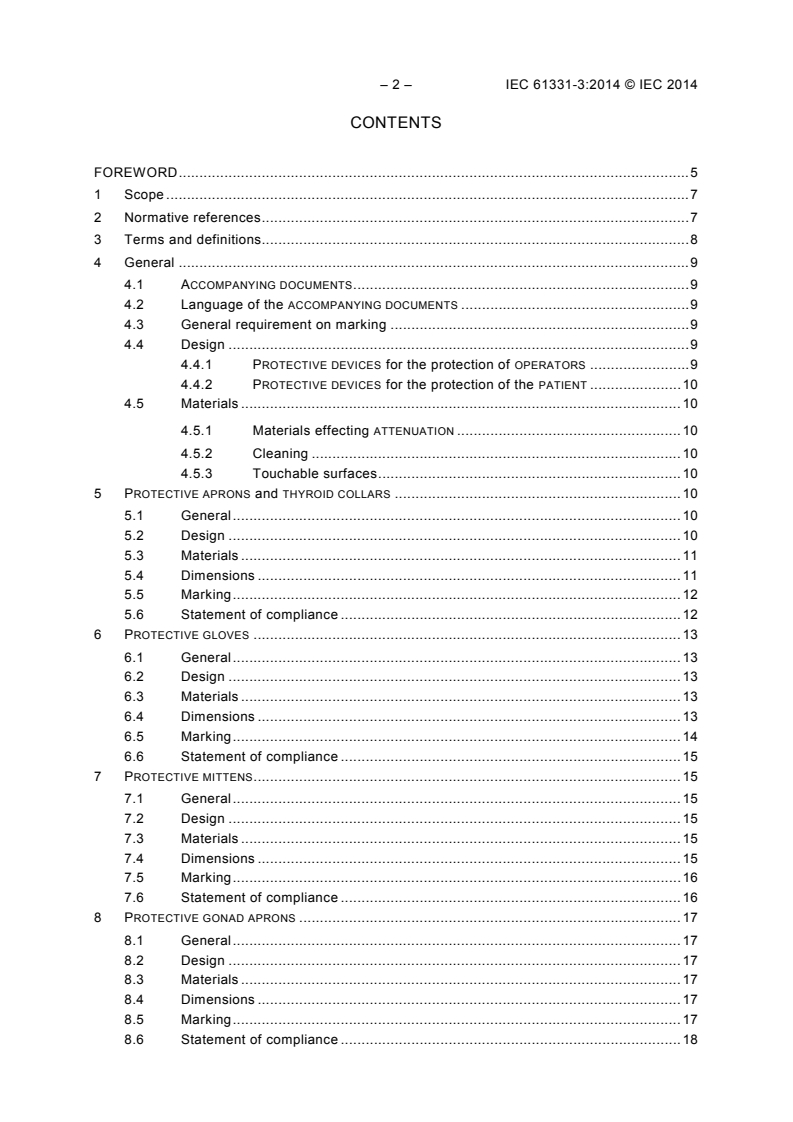
– 2 – IEC 61331-3:2014 © IEC 2014
CONTENTS
FOREWORD . 5
1 Scope . 7
2 Normative references . 7
3 Terms and definitions. 8
4 General . 9
4.1 ACCOMPANYING DOCUMENTS . 9
4.2 Language of the ACCOMPANYING DOCUMENTS . 9
4.3 General requirement on marking . 9
4.4 Design . 9
4.4.1 PROTECTIVE DEVICES for the protection of OPERATORS . 9
4.4.2 PROTECTIVE DEVICES for the protection of the PATIENT . 10
4.5 Materials . 10
4.5.1 Materials effecting ATTENUATION . 10
4.5.2 Cleaning . 10
4.5.3 Touchable surfaces . 10
5 PROTECTIVE APRONS and THYROID COLLARS . 10
5.1 General . 10
5.2 Design . 10
5.3 Materials . 11
5.4 Dimensions . 11
5.5 Marking . 12
5.6 Statement of compliance . 12
6 PROTECTIVE GLOVES . 13
6.1 General . 13
6.2 Design . 13
6.3 Materials . 13
6.4 Dimensions . 13
6.5 Marking . 14
6.6 Statement of compliance . 15
7 PROTECTIVE MITTENS . 15
7.1 General . 15
7.2 Design . 15
7.3 Materials . 15
7.4 Dimensions . 15
7.5 Marking . 16
7.6 Statement of compliance . 16
8 PROTECTIVE GONAD APRONS . 17
8.1 General . 17
8.2 Design . 17
8.3 Materials . 17
8.4 Dimensions . 17
8.5 Marking . 17
8.6 Statement of compliance . 18
9 SCROTUM SHIELDS . 18
9.1 General . 18
9.2 Design . 18
9.3 Materials . 19
9.4 Dimensions . 19
9.5 Marking . 19
9.6 Statement of compliance . 19
10 OVARY SHIELDS . 19
10.1 General . 19
10.2 Design . 20
10.3 Materials . 20
10.4 Dimensions . 20
10.5 Marking . 20
10.6 Statement of compliance . 20
11 SHADOW SHIELDS . 21
11.1 General . 21
11.2 Design . 21
11.3 Materials . 21
11.4 Dimensions . 21
11.5 Marking . 21
11.6 Statement of compliance . 21
12 PROTECTIVE APRONS FOR DENTAL USE . 22
12.1 General . 22
12.2 Design . 22
12.3 Materials . 22
12.4 Dimensions . 22
12.5 Marking . 23
12.6 Statement of compliance . 23
13 PROTECTIVE EYEWEAR . 23
13.1 General . 23
13.2 Design . 23
13.3 Materials . 24
13.4 Marking . 24
13.5 Statement of compliance . 24
Bibliography . 25
Index of defined terms used in this standard . 26
Figure 1 – Inside dimensions of PROTECTIVE GLOVES . 14
Figure 2 – Inside minimum dimensions of PROTECTIVE MITTENS . 16
Table 1 – Information and examples for marking PROTECTIVE APRONS and THYROID
COLLARS . 12
Table 2 – Standard sizes of PROTECTIVE GLOVES . 14
Table 3 – Information and examples for marking PROTECTIVE GLOVES . 14
Table 4 – Information and examples for marking PROTECTIVE MITTENS . 16
Table 5 – Standard sizes of PROTECTIVE GONAD APRONS . 17
– 4 – IEC 61331-3:2014 © IEC 2014
Table 6 – Information and examples for marking PROTECTIVE GONAD APRONS . 18
Table 7 – Information and examples for marking SCROTUM SHIELDS . 19
Table 8 – Information and examples for marking OVARY SHIELDS . 20
Table 9 – Information and examples for marking SHADOW SHIELDS . 21
Table 10 – Standard sizes of PROTECTIVE DENTAL APRONS . 22
Table 11 – Information and examples for marking PROTECTIVE APRONS. 23
Table 12 – Information and examples for marking PROTECTIVE EYEWEAR . 24
INTERNATIONAL ELECTROTECHNICAL COMMISSION
____________
PROTECTIVE DEVICES AGAINST
DIAGNOSTIC MEDICAL X-RADIATION –
Part 3: Protective clothing, eyewear and protective patient shields
FOREWORD
1) The International Electrotechnical Commission (IEC) is a worldwide organization for standardization comprising
all national electrotechnical committees (IEC National Committees). The object of IEC is to promote
international co-operation on all questions concerning standardization in the electrical and electronic fields. To
this end and in addition to other activities, IEC publishes International Standards, Technical Specifications,
Technical Reports, Publicly Available Specifications (PAS) and Guides (hereafter referred to as “IEC
Publication(s)”). Their preparation is entrusted to technical committees; any IEC National Committee interested
in the subject dealt with may participate in this preparatory work. International, governmental and non-
governmental organizations liaising with the IEC also participate in this preparation. IEC collaborates closely
with the International Organization for Standardization (ISO) in accordance with conditions determined by
agreement between the two organizations.
2) The formal decisions or agreements of IEC on technical matters express, as nearly as possible, an international
consensus of opinion on the relevant subjects since each technical committee has representation from all
interested IEC National Committees.
3) IEC Publications have the form of recommendations for international use and are accepted by IEC National
Committees in that sense. While all reasonable efforts are made to ensure that the technical content of IEC
Publications is accurate, IEC cannot be held responsible for the way in which they are used or for any
misinterpretation by any end user.
4) In order to promote international uniformity, IEC National Committees undertake to apply IEC Publications
transparently to the maximum extent possible in their national and regional publications. Any divergence
between any IEC Publication and the corresponding national or regional publication shall be clearly indicated in
the latter.
5) IEC itself does not provide any attestation of conformity. Independent certification bodies provide conformity
assessment services and, in some areas, access to IEC marks of conformity. IEC is not responsible for any
services carried out by independent certification bodies.
6) All users should ensure that they have the latest edition of this publication.
7) No liability shall attach to IEC or its directors, employees, servants or agents including individual experts and
members of its technical committees and IEC National Committees for any personal injury, property damage or
other damage of any nature whatsoever, whether direct or indirect, or for costs (including legal fees) and
expenses arising out of the publication, use of, or reliance upon, this IEC Publication or any other IEC
Publications.
8) Attention is drawn to the Normative references cited in this publication. Use of the referenced publications is
indispensable for the correct application of this publication.
9) Attention is drawn to the possibility that some of the elements of this IEC Publication may be the subject of
patent rights. IEC shall not be held responsible for identifying any or all such patent rights.
International Standard IEC 61331-3 has been prepared by subcommittee 62B: Diagnostic
imaging equipment, of IEC technical committee 62: Electrical equipment in medical practice.
This second edition cancels and replaces the first edition of IEC 61331-3, published in 1998. It
constitutes a technical revision. This second edition has been adapted to apply to the present
technology. It includes a requirement to use a better method for the determination of
attenuation properties over a broader and more clinically relevant range of RADIATION
QUALITIES appropriate to the use of the devices. It also covers three additional protective
devices, THYROID COLLARS, PROTECTIVE EYEWEAR and PROTECTIVE APRONS FOR DENTAL
USE.
– 6 – IEC 61331-3:2014 © IEC 2014
The text of this standard is based on the following documents:
FDIS Report on voting
62B/938/FDIS 62B/944/RVD
Full information on the voting for the approval of this standard can be found in the report on
voting indicated in the above table.
This publication has been drafted in accordance with the ISO/IEC Directives, Part 2.
In this standard, the following print types are used:
– requirements and definitions: roman type;
– informative material appearing outside of tables, such as notes, examples and references: in smaller type.
Normative text of tables is also in a smaller type;
– TERMS DEFINED IN CLAUSE 3 OF THIS STANDARD OR AS NOTED: SMALL CAPS.
The verbal forms used in this standard conform to usage described in Annex H of the ISO/IEC
Directives, Part 2. For the purposes of this standard, the auxiliary verb:
– “shall” means that compliance with a requirement or a test is mandatory for compliance with
this standard;
– “should” means that compliance with a requirement or a test is recommended but is not
mandatory for compliance with this standard;
– “may” is used to describe a permissible way to achieve compliance with a requirement or
test.
A list of all parts of the IEC 61331 series, published under the general title Protective devices
against diagnostic medical X-radiation, can be found on the IEC website.
The committee has decided that the contents of this publication will remain unchanged until the
stability date indicated on the IEC web site under "http://webstore.iec.ch" in the data related to
the specific publication. At this date, the publication will be
• reconfirmed,
• withdrawn,
• replaced by a revised edition, or
• amended.
PROTECTIVE DEVICES AGAINST
DIAGNOSTIC MEDICAL X-RADIATION –
Part 3: Protective clothing, eyewear and protective patient shields
1 Scope
This part of IEC 61331 applies to PROTECTIVE DEVICES such as PROTECTIVE CLOTHING and
for the protection of persons against X-RADIATION up to 150 kV, during RADIOLOGICAL
EYEWEAR
examinations and interventional procedures.
NOTE PROTECTIVE DEVICES are not intended by themselves to provide complete protection of persons, but are
used to reduce the dose to persons where other methods of protection against X-RADIATION are insufficient or not
applicable.
This standard deals with:
– general requirements on the ACCOMPANYING DOCUMENTS, on design and on materials used;
– sizing, particular design features, minimum ATTENUATION properties of materials, marking
and standardized forms of statements of compliance with this standard.
It covers PROTECTIVE CLOTHING mainly for the protection of the OPERATOR, such as:
– PROTECTIVE APRONS;
– THYROID COLLARS;
PROTECTIVE GLOVES;
–
– PROTECTIVE MITTENS;
– PROTECTIVE EYEWEAR;
and PROTECTIVE DEVICES for the protection of the PATIENT, such as:
– PROTECTIVE GONAD APRONS;
– SCROTUM SHIELDS;
– OVARY SHIELDS;
– SHADOW SHIELDS;
– PROTECTIVE APRONS FOR DENTAL USE.
The latter group of PROTECTIVE DEVICES is intended to be used during RADIOLOGICAL
examinations to minimize the effects of IRRADIATION on the reproductive organs particularly with
regard to genetic damage.
2 Normative references
The following documents, in whole or in part, are normatively referenced in this document and
are indispensable for its application. For dated references, only the edition cited applies. For
undated references, the latest edition of the referenced document (including any amendments)
applies.
IEC 60601-1:2005, Medical electrical equipment – Part 1: General requirements for basic
safety and essential performance
IEC 60601-1:2005/AMD 1:2012
– 8 – IEC 61331-3:2014 © IEC 2014
IEC 60601-1-3:2008, Medical electrical equipment – Part 1-3: General requirements for basic
safety and essential performance – Collateral Standard: Radiation protection in diagnostic X-
ray equipment
IEC 60601-1-3:2008/AMD1:2013
IEC/TR 60788:2004, Medical electrical equipment – Glossary of defined terms
IEC 61331-1:2014, Protective devices against diagnostic medical X-radiation – Part 1:
Determination of attenuation properties of materials
EN 340:2003, Protective clothing – General requirements
EN 13402-3, Size designation of clothes – Part 3: Measurements and intervals
3 Terms and definitions
For the purposes of this document, the terms and definitions given in IEC/TR 60788:2004,
IEC 60601-1:2005 and IEC 60601-1:2005/AMD1:2012, IEC 60601-1-3:2008 and IEC 60601-1-
3:2008/AMD1:2013 and the following apply.
3.1
AREA DENSITY
W
s
minimum mass per unit area of the protective material used to provide the required LEAD
EQUIVALENT of the device, at all of the stated test values of X-RAY TUBE VOLTAGES
–2
Note 1 to entry: AREA DENSITY is expressed in SI units as kg·m .
3.2
PROTECTIVE APRON FOR DENTAL USE
protective apron worn by the PATIENT to protect the region of the upper torso during
RADIOLOGICAL dental procedures
Note 1 to entry: Such an apron may have an accompanying THYROID COLLAR, separate or attached.
3.3
PROTECTIVE EYEWEAR
protective device made of transparent material to protect the eyes
3.4
PROTECTIVE GONAD APRON
protective apron worn by the PATIENT to protect the region of the gonads as an alternative to
the use of a SCROTUM SHIELD or an OVARY SHIELD
Note 1 to entry: See also rm-64-05 of IEC TR 60788:2004.
3.5
PROTECTIVE MITTEN
protective glove with open palm and separated thumb used where full perception of touch is
essential
3.6
SHADOW SHIELD
protective device to intercept the radiation beam in the areas of the gonads
Note 1 to entry: A SHADOW SHIELD is to be used when a SCROTUM SHIELD and an OVARY SHIELD cannot be used.
3.7
THYROID COLLAR
protective device to cover the thyroid gland
4 General
4.1 ACCOMPANYING DOCUMENTS
PROTECTIVE DEVICES shall not be provided without ACCOMPANYING DOCUMENTS.
The ACCOMPANYING DOCUMENTS shall contain information on the following:
a) identification of the items of PROTECTIVE DEVICE(S) to which they apply, by reference to type
or to individual items, as appropriate;
b) description of all markings on the items, with explanation of their meanings;
c) sizing information, in compliance with EN 340:2003 where appropriate, enabling garment
label size information to be correlated with body size, where such information is not fully
available on the garment label or marking itself;
d) instructions for use, which shall contain:
1) recommendations for storage when not in use;
2) recommendations for methods and materials to be used for cleaning and disinfection;
3) recommended method and frequency of periodic inspection by the OPERATOR in order to
ATTENUATION properties;
verify the maintenance of
4) particulars of compliance with this standard.
Any information included in the ACCOMPANYING DOCUMENTS that is particularly intended to be
read by the PATIENT, shall be repeated in a separate part containing all such information.
4.2 Language of the ACCOMPANYING DOCUMENTS
This standard contains no requirements concerning the language(s) in which the
ACCOMPANYING DOCUMENTS provided are to be written.
Attention is drawn to the fact that when the ACCOMPANYING DOCUMENTS are written in a
language other than that in which they were originally drafted and approved by the
MANUFACTURER of the PROTECTIVE DEVICES, these documents shall be checked carefully by an
MANUFACTURER to act in that
expert who, wherever possible, should be authorized by the
capacity.
The ACCOMPANYING DOCUMENTS shall state the language(s) in which they were originally
drafted, approved or supplied by the MANUFACTURER and shall give a reference identifying at
least one original version.
4.3 General requirement on marking
PROTECTIVE DEVICES shall be marked so that their correlation to the pertaining ACCOMPANYING
DOCUMENTS is ensured.
4.4 Design
4.4.1 PROTECTIVE DEVICES for the protection of OPERATORS
PROTECTIVE DEVICES for the protection of OPERATORS should be so designed that they can be
put on and taken off without assistance.
– 10 – IEC 61331-3:2014 © IEC 2014
4.4.2 PROTECTIVE DEVICES for the protection of the PATIENT
PROTECTIVE DEVICES for the protection of the PATIENT shall be designed so that they can be
easily applied, and they should be designed so that they can be properly placed and, where
necessary, fixed by the PATIENTS themselves.
4.5 Materials
4.5.1 Materials effecting ATTENUATION
The materials effecting the ATTENUATION shall be homogeneously distributed and should
contain elements of an atomic number higher than 47.
4.5.2 Cleaning
All outer and inner accessible surfaces of PROTECTIVE DEVICES shall be suitable for cleaning
and disinfection.
4.5.3 Touchable surfaces
It shall not be possible to touch, in NORMAL USE, uncovered or uncoated surfaces of metal
powders or other attenuating elements or compounds.
5 PROTECTIVE APRONS and THYROID COLLARS
5.1 General
NOTE 1 PROTECTIVE APRONS and THYROID COLLARS are intended to be worn by persons who are present in the
EXAMINATION ROOM during RADIOLOGICAL examinations with or without interventional procedures. They are intended
primarily to protect the main part of the body of the OPERATOR. To protect the complete body, additional protective
devices are useful, for example, PROTECTIVE EYEWEAR and helmets.
For the purpose of this standard, four different categories of PROTECTIVE APRONS are defined:
– light-duty PROTECTIVE APRONS;
– heavy-duty PROTECTIVE APRONS;
– light-duty closed PROTECTIVE APRONS;
– heavy-duty closed PROTECTIVE APRONS.
NOTE 2 Light-duty PROTECTIVE APRONS can be worn for example in the operating theatre and in the gypsum room,
or if the SIGNIFICANT ZONE OF OCCUPANCY is protected against STRAY RADIATION by other PROTECTIVE DEVICES, for
example fixed on the X-RAY EQUIPMENT.
5.2 Design
PROTECTIVE APRONS shall consist of one or more layers of protective material and shall be
designed to cover the front part of the body from the throat down to at least the knees, the
entire breastbone and the shoulders.
The width of the material on each shoulder shall be not less than 8 cm for persons having the
minimum chest girth of 76 cm (according to EN 340:2003) and shall be graded as chest girth
increases.
Unprotected stitch, or other, holes fixing parts together shall not be allowed on the front of a
PROTECTIVE APRON.
NOTE 1 X-RADIATION through stitch holes fixing the parts together on the back or sides is not considered,
because of the orientation of the OPERATOR'S front towards the source of RADIATION.
Closed PROTECTIVE APRONS shall be designed to cover, additionally:
– the sides of the body from not more than 10 cm below the armpit to the knees.
– the back down to the knees.
Closed PROTECTIVE APRONS should be designed to permit ventilation. For this purpose,
overlapping fastenings at the sides, the openings of which point towards the back, or a
fastening leaving uncovered a vertical slit in the middle of the back may be provided.
NOTE 2 PROTECTIVE APRONS can consist of two overlapping pieces, a vest and a skirt.
Closed PROTECTIVE APRONS may have overlapping panels with fastenings at the front. Where
such overlapping panels provide only partial overlap, each front panel shall have the LEAD
EQUIVALENT required under 5.3. Where such panels fully overlap, side to side, effecting full
protection to the whole front of the body, each front panel may be half the LEAD EQUIVALENT
required under 5.3.
THYROID COLLARS shall be designed to cover the front half of the neck, including the thyroid
gland, and should extend from under the jaw down to the neckline of the protective apron.
THYROID COLLARS may be sewn on the apron or separate. If separate they shall have a full
neckband with fastening at the back.
5.3 Materials
The protective material as well as any fabric covering and binding shall be flexible.
a) The LEAD EQUIVALENT of light-duty PROTECTIVE APRONS shall be not less than 0,25 mm Pb
over their entire area.
b) The LEAD EQUIVALENT of heavy-duty PROTECTIVE APRONS shall be not less than 0,35 mm Pb
for the front section, and not less than 0,25 mm Pb for the remaining parts.
c) The LEAD EQUIVALENT of light-duty closed PROTECTIVE APRONS shall be not less than
0,25 mm Pb over their entire area.
d) The LEAD EQUIVALENT of heavy-duty closed PROTECTIVE APRONS shall be not less than
0,35 mm Pb for the front section, and not less than 0,25 mm Pb for the remaining parts.
e) The LEAD EQUIVALENT of THYROID COLLARS shall be not less than 0,35 mm Pb.
The LEAD EQUIVALENT shall be determined as described in IEC 61331-1, by the inverse broad
beam geometry method for the SPECIFIED range of RADIATION QUALITIES, 50 kV, 70 kV, 90 kV
and 110 kV, according to 5.5 of IEC 61331-1.
NOTE PROTECTIVE APRONS and THYROID COLLARS are used for protection against SCATTERED RADIATION and are
tested in the 50 kV to 110 kV TUBE VOLTAGE RANGE. However such devices and materials are useful in SCATTERED
RADIATION from primary x-ray beams with TUBE VOLTAGES 60 kV to 120 kV because the scattered spectra of these
better match those of primary beams having TUBE VOLTAGES 10 kV less.
Where heavy-duty, or heavy-duty closed PROTECTIVE APRONS or THYROID COLLARS are worn for
RADIOLOGICAL examinations or in procedures where there is exposure to higher energy
radiation, greater than 125 kV, for example in “in-room CT assist” procedures, such
PROTECTIVE APRONS should also meet or exceed the LEAD EQUIVALENT values for radiation
quality 150 kV, and be marked or labelled accordingly.
5.4 Dimensions
PROTECTIVE APRONS shall be sized to fulfil the design criteria of 5.2, and should be sized in
accordance with EN 13402-3. The width of the light-duty and heavy -duty PROTECTIVE APRONS,
and the width of the front area of light-duty and heavy-duty closed PROTECTIVE APRONS, shall be
at least 60% of the larger of the chest, waist or hip circumference of the body size referenced
in EN 13402-3.
– 12 – IEC 61331-3:2014 © IEC 2014
5.5 Marking
PROTECTIVE APRONS and THYROID COLLARS shall carry the information called for under items a)
to f) in Table 1.
The information shall be marked clearly and permanently, should be on a label and shall
include the following:
Table 1 – Information and examples for marking
PROTECTIVE APRONS and THYROID COLLARS
Information Example
a) Name or trade mark of MANUFACTURER or supplier. xyz
b) Letter designating the type of PROTECTIVE APRON, namely L (light-duty), H (heavy-
duty), LC (light-duty closed) or HC (heavy-duty closed). L, H, LC or HC
c) Value(s) of the LEAD EQUIVALENT in thickness of lead, expressed as the symbol Pb
followed by the thickness in millimetres, as follows:
– for all PROTECTIVE APRONS, and THYROID COLLARS , the value applying to the
mm Pb 0,35(front)
front section
– and, if different, the value applying to the back section. mm Pb 0,25(back)
d) X-RAY TUBE VOLTAGE range used for the determination of the values of the LEAD
EQUIVALENT, appended to the marking given in accordance with item c), by adding
an oblique stroke followed by the value of the X-RAY TUBE VOLTAGE range in
kilovolts. 50 kV - 110 kV
For PROTECTIVE APRONS designed for higher energy use, to 150 kV (5.3). 50 kV - 150 kV
-2
e) AREA DENSITY, W
, the minimum mass per unit area in kg.m , required to provide
S
stated in (c) above, at X-RAY TUBE VOLTAGE range
EQUIVALENT
the value of LEAD
shown in (d) W 4,60
S
f) The size and length of the PROTECTIVE APRON, which shall, directly on the label, or
indirectly through ACCOMPANYING DOCUMENTS, enable correlation to the body
dimensions which should be referenced to EN 13402-3, by pictogram referenced
under EN 340, or MANUFACTURER'S sizing dimension tables.
g) Reference to this standard, given as "IEC 61331-3:2014 ".
5.6 Statement of compliance
If compliance of a PROTECTIVE APRON with this standard is to be stated, it shall be indicated, as
applicable, according to the following example:
1) 2) 3) 4) 5) 6)
Heavy-duty protective apron xyz H Pb 0,35 /50 – 110 4,60 IEC 61331-3:2014 .
1)
name or trade mark of MANUFACTURER or supplier;
2)
for heavy-duty PROTECTIVE APRON;
3)
LEAD EQUIVALENT;
4)
X-RAY TUBE VOLTAGE range;
5)
AREA DENSITY;
6)
year of publication of this standard.
6 PROTECTIVE GLOVES
6.1 General
PROTECTIVE GLOVES are intended primarily to be worn by the OPERATOR during those
RADIOLOGICAL examinations or interventional procedures in which the hands and forearms need
to be protected whilst in the RADIATION BEAM or in high intensities of STRAY RADIATION.
6.2 Design
PROTECTIVE GLOVES shall cover the entire hand, without gaps, and at least half of the forearm.
They should allow washable inner gloves to be worn.
PROTECTIVE GLOVES shall be designed so that the thumb is enclosed separately. The other
fingers should be enclosed separately. The axis of the thumb cover shall be turned against the
palm so as to allow the tip of the thumb to face the tip of the forefinger.
PROTECTIVE GLOVES shall allow the fingers of the wearer to be closed with ease and the hand to
be moved sideways freely from the wrist.
PROTECTIVE GLOVES shall be made so that at least the required minimum LEAD EQUIVALENT is
effective without any interruption over their entire surface, front and back, including finger and
wrist.
PROTECTIVE GLOVES shall be designed and manufactured so that any cracks and splitting of the
protective material used that could reduce its ATTENUATION properties can be identified by
visual examination.
Any external covering material shall be detachable in order that the protective material can be
examined during routine inspections.
6.3 Materials
The protective material and covering materials used for PROTECTIVE GLOVES shall be flexible.
The protective material of PROTECTIVE GLOVES shall have a LEAD EQUIVALENT of not less than
0,25 mm Pb over their entire area.
The LEAD EQUIVALENT shall be determined as described in IEC 61331-1, by the inverse broad
beam geometry method for the SPECIFIED range of RADIATION QUALITIES, 60 kV, 80 kV, 100 kV,
120 kV and 150 kV, according to 5.5 of IEC 61331-1.
6.4 Dimensions
PROTECTIVE GLOVES may be stated to conform to the standard sizes given in Table 2, in which
case they shall be substantially of the shape shown in Figure 1 and shall comply with the inside
dimensions given in Table 2.
– 14 – IEC 61331-3:2014 © IEC 2014
Table 2 – Standard sizes of PROTECTIVE GLOVES
Standard Letter Inside dimension
size symbol cm
Length Half-
circumference
A B C D E
Small S 35 11 7 16 11
Medium M 35 11,5 7 17 12
Large L 35 12 7 18,5 13
Dimensions A to E are shown in Figure 1; they are minimum dimensions.
B
C
A
IEC 1442/14
Figure 1 – Inside dimensions of PROTECTIVE GLOVES
6.5 Marking
Each PROTECTIVE GLOVE shall carry the information called for under items a) to e) of Table 3
below.
The information shall be marked clearly and permanently, and shall be attached to the glove
itself. The marking should be near the edge of the cuff and shall include the following:
Table 3 – Information and examples for marking
PROTECTIVE GLOVES
Information Example
a) Name or trade mark of MANUFACTURER or supplier. xyz
b) Value of the LEAD EQUIVALENT in thickness of lead, expressed as the symbol Pb followed by the Pb 0,25
thickness in millimetres.
c) X-RAY TUBE VOLTAGE range used for the determination of the values of the LEAD EQUIVALENT, 60 kV -
appended to the marking given in accordance with item b), by adding an oblique stroke, / , 150 kV
RAY TUBE VOLTAGE range in kilovolts.
followed by the value of the X-
d) If applicable, letter symbols corresponding to the size according to Table 2. MS
e) Reference to this standard, given as "IEC 61331-3:2014”.
E
D
6.6 Statement of compliance
If compliance of PROTECTIVE GLOVES with this standard is to be stated, it shall be indicated as
follows:
1) 2) 3) 4) 5)
Protective glove xyz Pb 0,25 /60-150 MS IEC 61331-3:2014
1)
name or trade mark of MANUFACTURER or supplier;
2)
LEAD EQUIVALENT;
3)
X-RAY TUBE VOLTAGE range;
4)
standard size according to Table 2 (medium);
5)
year of publication of this standard.
The standard size according to Table 2 may be omitted in the statement of compliance.
7 PROTECTIVE MITTENS
7.1 General
NOTE PROTECTIVE MITTENS with open palms are intended for special procedures where full perception of touch is
essential, for example when handling syringes or during interventional procedures when the possibility cannot be
excluded that the hands or forearms of the OPERATOR come into the RADIATION BEAM or into an area of high
RADIATION intensity due to STRAY RADIATION.
7.2 Design
PROTECTIVE MITTENS shall cover the entire hand except the palm and the inside of the thumb,
and are intended to cover at least half of the forearm.
PROTECTIVE MITTENS shall allow the hand of the wearer to be closed with ease and to be moved
sideways freely from the wrist.
PROTECTIVE MITTENS shall be made so that at least the required minimum LEAD EQUIVALENT is
effective without any interruption over their entire surface, except the palm and the inside of the
thumb.
PROTECTIVE MITTENS shall be designed and manufactured so that any cracks and splitting of the
protective material used that could reduce its ATTEN
...