

IEC 60404-5:2015
(Main)Magnetic materials - Part 5: Permanent magnet (magnetically hard) materials - Methods of measurement of magnetic properties
General Information
- Abstract
IEC 60404-5:2015 is to define the method of measurement of the magnetic flux density, magnetic polarization and the magnetic field strength and also to determine the demagnetization curve and recoil line of permanent magnet materials. This edition includes the following significant technical changes with respect to the previous edition:
- adaption of the measurement methods and test conditions to newly introduced magnetically hard materials with coercivity values HcJ higher than 2 MA/m;
- update of the temperature conditions to allow the measurement of new materials with high temperature coefficients.
- Status
- Published
- Publication Date
- 15-Apr-2015
- Technical Committee
- TC 68 - Magnetic alloys and steels
- Drafting Committee
- WG 5 - TC 68/WG 5
- Current Stage
- PPUB - Publication issued
- Start Date
- 16-Apr-2015
- Completion Date
- 30-Apr-2015
Buy Documents
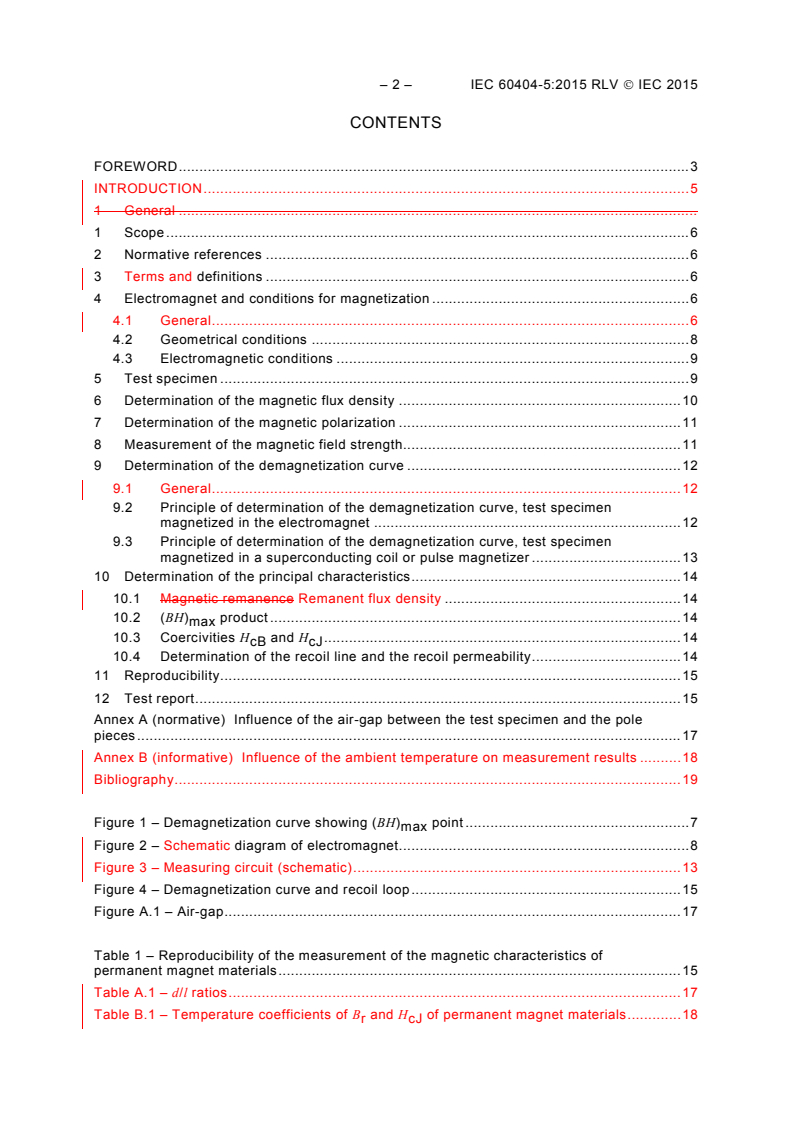
IEC 60404-5:2015 RLV - Magnetic materials - Part 5: Permanent magnet (magnetically hard) materials - Methods of measurement of magnetic properties Released:4/16/2015
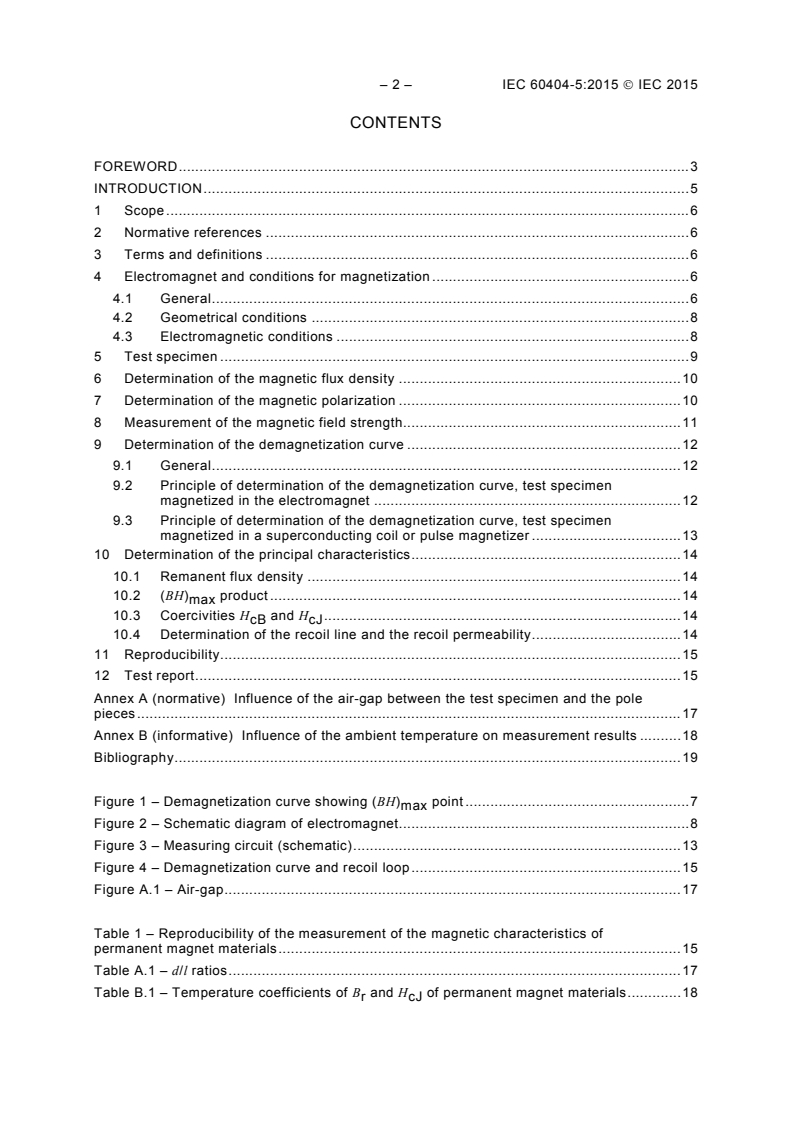
IEC 60404-5:2015 - Magnetic materials - Part 5: Permanent magnet (magnetically hard) materials - Methods of measurement of magnetic properties Released:4/16/2015
Overview
IEC 60404-5:2015 - "Magnetic materials - Part 5: Permanent magnet (magnetically hard) materials - Methods of measurement of magnetic properties" specifies standardized laboratory methods to measure the magnetic behavior of permanent magnet materials. The standard defines how to determine magnetic flux density (B), magnetic polarization (J) and magnetic field strength (H), and how to obtain the demagnetization curve, recoil line and principal characteristics such as remanence, coercivity and the maximum (BH) product. The 2015 edition updates measurement procedures for modern high-coercivity materials and tighter temperature control.
Key topics and technical requirements
- Measurement targets: B(H) and J(H) hysteresis loops, demagnetization curve, recoil line, remanent flux density (Br), intrinsic coercivity (HcJ) and coercivity relating to flux density (HcB), and (BH)max.
- Adaptation for high-coercivity materials: Procedures and test conditions extended to support magnetically hard materials with HcJ > 2 MA/m (important for modern NdFeB grades).
- Temperature control: Recommended ambient/test temperature tightened (previously 23 ±5 °C) to ±1 °C or better for materials with large temperature coefficients; updated temperature conditions to measure high-temperature-coefficient materials.
- Test setup: Measurements are carried out in a closed magnetic circuit (electromagnet + test specimen) to simulate ring-like conditions. Requirements cover electromagnet design, pole-face geometry, air-gap minimization and search-coil/measurement circuitry.
- Specimen geometry & reproducibility: Defined specimen dimensions, air-gap influence (Annex A), reproducibility metrics and required content for the test report.
- Reporting: Standardized test report elements to ensure comparable, traceable results.
Practical applications and users
IEC 60404-5:2015 is essential for:
- Permanent magnet manufacturers validating material performance and production consistency.
- Independent test laboratories performing certified magnetic property measurements.
- Motor, generator and actuator designers (especially in EV/HEV applications) who need accurate magnet parameters (Br, HcJ, (BH)max) for magnetic circuit design and simulation.
- R&D teams developing new high-coercivity or temperature-stable magnetic alloys.
- Quality assurance and procurement functions that require standardized test data for material acceptance.
Using this standard improves comparability of magnetic data, supports reliable magnetic circuit design, and ensures measurement practices keep pace with advanced magnet materials.
Related standards
- IEC 60404 series (other parts on magnetic materials)
- IEC 60404-8-1 (materials classification referenced)
- IEC TR 61807 and IEC TR 62331 (technical reports referenced for high-coercivity and elevated-temperature measurements)
Relations
- Effective Date
- 05-Sep-2023
Buy Documents
IEC 60404-5:2015 RLV - Magnetic materials - Part 5: Permanent magnet (magnetically hard) materials - Methods of measurement of magnetic properties Released:4/16/2015
IEC 60404-5:2015 - Magnetic materials - Part 5: Permanent magnet (magnetically hard) materials - Methods of measurement of magnetic properties Released:4/16/2015
Get Certified
Connect with accredited certification bodies for this standard

IMQ S.p.A. (Certification)
Italian electrical product certification.

SLG Prüf- und Zertifizierungs GmbH
German testing and certification body.

UL Solutions
Global safety science company with testing, inspection and certification.
Sponsored listings
Frequently Asked Questions
IEC 60404-5:2015 is a standard published by the International Electrotechnical Commission (IEC). Its full title is "Magnetic materials - Part 5: Permanent magnet (magnetically hard) materials - Methods of measurement of magnetic properties". This standard covers: IEC 60404-5:2015 is to define the method of measurement of the magnetic flux density, magnetic polarization and the magnetic field strength and also to determine the demagnetization curve and recoil line of permanent magnet materials. This edition includes the following significant technical changes with respect to the previous edition: - adaption of the measurement methods and test conditions to newly introduced magnetically hard materials with coercivity values HcJ higher than 2 MA/m; - update of the temperature conditions to allow the measurement of new materials with high temperature coefficients.
IEC 60404-5:2015 is to define the method of measurement of the magnetic flux density, magnetic polarization and the magnetic field strength and also to determine the demagnetization curve and recoil line of permanent magnet materials. This edition includes the following significant technical changes with respect to the previous edition: - adaption of the measurement methods and test conditions to newly introduced magnetically hard materials with coercivity values HcJ higher than 2 MA/m; - update of the temperature conditions to allow the measurement of new materials with high temperature coefficients.
IEC 60404-5:2015 is classified under the following ICS (International Classification for Standards) categories: 17.220.20 - Measurement of electrical and magnetic quantities; 29.030 - Magnetic materials. The ICS classification helps identify the subject area and facilitates finding related standards.
IEC 60404-5:2015 has the following relationships with other standards: It is inter standard links to IEC 60404-5:1993/AMD1:2007. Understanding these relationships helps ensure you are using the most current and applicable version of the standard.
IEC 60404-5:2015 is available in PDF format for immediate download after purchase. The document can be added to your cart and obtained through the secure checkout process. Digital delivery ensures instant access to the complete standard document.
Standards Content (Sample)
IEC 60404-5 ®
Edition 3.0 2015-04
REDLINE VERSION
INTERNATIONAL
STANDARD
colour
inside
Magnetic materials –
Part 5: Permanent magnet (magnetically hard) materials – Methods of
measurement of magnetic properties
All rights reserved. Unless otherwise specified, no part of this publication may be reproduced or utilized in any form
or by any means, electronic or mechanical, including photocopying and microfilm, without permission in writing from
either IEC or IEC's member National Committee in the country of the requester. If you have any questions about IEC
copyright or have an enquiry about obtaining additional rights to this publication, please contact the address below or
your local IEC member National Committee for further information.
IEC Central Office Tel.: +41 22 919 02 11
3, rue de Varembé Fax: +41 22 919 03 00
CH-1211 Geneva 20 info@iec.ch
Switzerland www.iec.ch
About the IEC
The International Electrotechnical Commission (IEC) is the leading global organization that prepares and publishes
International Standards for all electrical, electronic and related technologies.
About IEC publications
The technical content of IEC publications is kept under constant review by the IEC. Please make sure that you have the
latest edition, a corrigenda or an amendment might have been published.
IEC Catalogue - webstore.iec.ch/catalogue Electropedia - www.electropedia.org
The stand-alone application for consulting the entire The world's leading online dictionary of electronic and
bibliographical information on IEC International Standards, electrical terms containing more than 30 000 terms and
Technical Specifications, Technical Reports and other definitions in English and French, with equivalent terms in 15
documents. Available for PC, Mac OS, Android Tablets and additional languages. Also known as the International
iPad. Electrotechnical Vocabulary (IEV) online.
IEC publications search - www.iec.ch/searchpub IEC Glossary - std.iec.ch/glossary
The advanced search enables to find IEC publications by a More than 60 000 electrotechnical terminology entries in
variety of criteria (reference number, text, technical English and French extracted from the Terms and Definitions
committee,…). It also gives information on projects, replaced clause of IEC publications issued since 2002. Some entries
and withdrawn publications. have been collected from earlier publications of IEC TC 37,
77, 86 and CISPR.
IEC Just Published - webstore.iec.ch/justpublished
Stay up to date on all new IEC publications. Just Published IEC Customer Service Centre - webstore.iec.ch/csc
details all new publications released. Available online and If you wish to give us your feedback on this publication or
also once a month by email. need further assistance, please contact the Customer Service
Centre: csc@iec.ch.
IEC 60404-5 ®
Edition 3.0 2015-04
REDLINE VERSION
INTERNATIONAL
STANDARD
colour
inside
Magnetic materials –
Part 5: Permanent magnet (magnetically hard) materials – Methods of
measurement of magnetic properties
INTERNATIONAL
ELECTROTECHNICAL
COMMISSION
ICS 17.220.20; 29.030 ISBN 978-2-8322-2643-8
– 2 – IEC 60404-5:2015 RLV IEC 2015
CONTENTS
FOREWORD . 3
INTRODUCTION . 5
1 General .
1 Scope . 6
2 Normative references . 6
3 Terms and definitions . 6
4 Electromagnet and conditions for magnetization . 6
4.1 General . 6
4.2 Geometrical conditions . 8
4.3 Electromagnetic conditions . 9
5 Test specimen . 9
6 Determination of the magnetic flux density . 10
7 Determination of the magnetic polarization . 11
8 Measurement of the magnetic field strength. 11
9 Determination of the demagnetization curve . 12
9.1 General . 12
9.2 Principle of determination of the demagnetization curve, test specimen
magnetized in the electromagnet . 12
9.3 Principle of determination of the demagnetization curve, test specimen
magnetized in a superconducting coil or pulse magnetizer . 13
10 Determination of the principal characteristics . 14
10.1 Magnetic remanence Remanent flux density . 14
10.2 (BH) product . 14
max
10.3 Coercivities H and H . 14
cB cJ
10.4 Determination of the recoil line and the recoil permeability . 14
11 Reproducibility . 15
12 Test report . 15
Annex A (normative) Influence of the air-gap between the test specimen and the pole
pieces . 17
Annex B (informative) Influence of the ambient temperature on measurement results . 18
Bibliography . 19
Figure 1 – Demagnetization curve showing (BH) point . 7
max
Figure 2 – Schematic diagram of electromagnet. 8
Figure 3 – Measuring circuit (schematic) . 13
Figure 4 – Demagnetization curve and recoil loop . 15
Figure A.1 – Air-gap . 17
Table 1 – Reproducibility of the measurement of the magnetic characteristics of
permanent magnet materials . 15
Table A.1 – d/l ratios . 17
Table B.1 – Temperature coefficients of B and H of permanent magnet materials . 18
r cJ
INTERNATIONAL ELECTROTECHNICAL COMMISSION
____________
MAGNETIC MATERIALS –
Part 5: Permanent magnet (magnetically hard) materials –
Methods of measurement of magnetic properties
FOREWORD
1) The International Electrotechnical Commission (IEC) is a worldwide organization for standardization comprising
all national electrotechnical committees (IEC National Committees). The object of IEC is to promote
international co-operation on all questions concerning standardization in the electrical and electronic fields. To
this end and in addition to other activities, IEC publishes International Standards, Technical Specifications,
Technical Reports, Publicly Available Specifications (PAS) and Guides (hereafter referred to as “IEC
Publication(s)”). Their preparation is entrusted to technical committees; any IEC National Committee interested
in the subject dealt with may participate in this preparatory work. International, governmental and non-
governmental organizations liaising with the IEC also participate in this preparation. IEC collaborates closely
with the International Organization for Standardization (ISO) in accordance with conditions determined by
agreement between the two organizations.
2) The formal decisions or agreements of IEC on technical matters express, as nearly as possible, an international
consensus of opinion on the relevant subjects since each technical committee has representation from all
interested IEC National Committees.
3) IEC Publications have the form of recommendations for international use and are accepted by IEC National
Committees in that sense. While all reasonable efforts are made to ensure that the technical content of IEC
Publications is accurate, IEC cannot be held responsible for the way in which they are used or for any
misinterpretation by any end user.
4) In order to promote international uniformity, IEC National Committees undertake to apply IEC Publications
transparently to the maximum extent possible in their national and regional publications. Any divergence
between any IEC Publication and the corresponding national or regional publication shall be clearly indicated in
the latter.
5) IEC itself does not provide any attestation of conformity. Independent certification bodies provide conformity
assessment services and, in some areas, access to IEC marks of conformity. IEC is not responsible for any
services carried out by independent certification bodies.
6) All users should ensure that they have the latest edition of this publication.
7) No liability shall attach to IEC or its directors, employees, servants or agents including individual experts and
members of its technical committees and IEC National Committees for any personal injury, property damage or
other damage of any nature whatsoever, whether direct or indirect, or for costs (including legal fees) and
expenses arising out of the publication, use of, or reliance upon, this IEC Publication or any other IEC
Publications.
8) Attention is drawn to the Normative references cited in this publication. Use of the referenced publications is
indispensable for the correct application of this publication.
9) Attention is drawn to the possibility that some of the elements of this IEC Publication may be the subject of
patent rights. IEC shall not be held responsible for identifying any or all such patent rights.
This redline version of the official IEC Standard allows the user to identify the changes
made to the previous edition. A vertical bar appears in the margin wherever a change
has been made. Additions are in green text, deletions are in strikethrough red text.
– 4 – IEC 60404-5:2015 RLV IEC 2015
International Standard IEC 60404-5 has been prepared by IEC technical committee 68:
Magnetic alloys and steels.
This third edition cancels and replaces the second edition published in 1993 and
Amendment 1:2007. This edition constitutes a technical revision.
This edition includes the following significant technical changes with respect to the previous
edition:
• adaption of the measurement methods and test conditions to newly introduced
magnetically hard materials with coercivity values H higher than 2 MA/m;
cJ
• update of the temperature conditions to allow the measurement of new materials with high
temperature coefficients.
The text of this standard is based on the following documents:
FDIS Report on voting
68/497/FDIS 68/505/RVD
Full information on the voting for the approval of this standard can be found in the report on
voting indicated in the above table.
This publication has been drafted in accordance with the ISO/IEC Directives, Part 2.
A list of all parts in the IEC 60404 series, published under the general title Magnetic materials,
can be found on the IEC website.
The committee has decided that the contents of this publication will remain unchanged until
the stability date indicated on the IEC web site under "http://webstore.iec.ch" in the data
related to the specific publication. At this date, the publication will be
• reconfirmed,
• withdrawn,
• replaced by a revised edition, or
• amended.
IMPORTANT – The “colour inside” logo on the cover page of this publication indicates
that it contains colours which are considered to be useful for the correct understanding
of its contents. Users should therefore print this publication using a colour printer.
INTRODUCTION
The previous edition of IEC 60404-5 was issued in October 1993 and amended in 2007. Since
then, new applications of NdFeB sintered magnetic materials with intrinsic coercivity, H ,
cJ
higher than 2 MA/m for hybrid electric vehicles and fully electric vehicles have appeared.
Thus, IEC TC68 decided in 2011 at their meeting in Ghent to revise IEC 60404-5.
For the measurement of the coercivity relating to polarization, H , at values higher than
cJ
2 MA/m and the measurement of magnetic properties at elevated temperatures, the methods
described in the non-normative Technical Reports IEC TR 61807 and IEC TR 62331 can be
considered.
The ambient temperature previously recommended was (23 ± 5) °C. However, for permanent
magnet materials such as NdFeB and hard ferrites that have large temperature coefficients, it
is strongly recommended that the ambient temperature should be controlled within this range
to ± 1 °C or better. It is desirable to apply this temperature recommendation for
other hard magnet materials. This recommendation was already included in
IEC 60404-5:1993/AMD1:2007.
– 6 – IEC 60404-5:2015 RLV IEC 2015
MAGNETIC MATERIALS –
Part 5: Permanent magnet (magnetically hard) materials –
Methods of measurement of magnetic properties
1 General
1 Scope
The purpose of this part of IEC 60404 is to define the method of measurement of the
magnetic flux density, magnetic polarization and the magnetic field strength and also to
determine the demagnetization curve and recoil line of permanent magnet materials, such as
those specified in lEC 60404-8-1 [1] , the properties of which are presumed homogeneous
throughout their volume.
The performance of a magnetic system is not only dependent on the properties of the
permanent magnet material but also on the dimensions of the system, the air-gap and other
elements of the magnetic circuit. The methods described in this part of IEC 60404 refer to the
measurement of the magnetic properties in a closed magnetic circuit simulating a ring.
2 Normative references
The following documents, in whole or in part, are normatively referenced in this document and
are indispensable for its application. For dated references, only the edition cited applies. For
undated references, the latest edition of the referenced document (including any
amendments) applies.
IEC 60050 (all parts), International Electrotechnical Vocabulary (available at
http://www.electropedia.org)
3 Terms and Definitions
For the purposes of this document, the terms and definitions given in IEC 60050-121,
IEC 60050-151 and IEC 60050-221 apply.
4 Electromagnet and conditions for magnetization
4.1 General
For permanent magnet materials, this part of IEC 60404 deals with both the coercivity H
cB
(the coercivity relating to the magnetic flux density) and the intrinsic coercivity H (the
cJ
coercivity relating to the magnetic polarization).
The measurements specified in this part of IEC 60404 are for both the magnetic flux density,
B, and the magnetic polarization, J, as a function of the magnetic field strength, H. These
quantities are related by the following equation:
______________
Numbers in square brackets refer to the Bibliography.
B H J (1)
where
B is the magnetic flux density, in teslas;
–7
is the magnetic constant = 4 10 , in henry per metre;
H is the magnetic field strength, in amperes per metre;
J is the magnetic polarization, in teslas.
Using this relationship H H values can be obtained from the B(H) hysteresis loop and H
cJ cB cB
H values from the J(H) hysteresis loop. The point represented by H and B at which the
cJ a a
modulus of the product BH has a maximum value is called the working point of maximum
energy product for (BH) (see Figure 1).
max
The term “squareness” of the demagnetization curve described in this part of IEC 60404
specifies roughly the characteristic shape of the demagnetization curve between the remanent
flux density and the coercivity relating to the magnetic polarization in the J–H curve.
B
B
r
BH = constant
B
a
(BH)
max
H
H H
cB a
IEC
Figure 1 – Demagnetization curve showing (BH) point
max
The measurements are carried out in a closed magnetic circuit consisting of an electromagnet
made of soft magnetic material and the test specimen. The construction of the yokes shall be
symmetrical; at least one of the poles shall be movable to minimize the air-gap between the
test specimen and the pole pieces (see Figure 2). The end faces of both pole pieces shall be
ground as nearly as possible parallel to each other and as nearly as possible perpendicular to
the pole axis to minimize the air-gap (see Figure A.1).
NOTE For certain measurements, the yoke and the poles can be laminated to decrease eddy currents. The
coercivity of the material should is normally be not more than 100 A/m.
– 8 – IEC 60404-5:2015 RLV IEC 2015
To obtain a sufficiently uniform magnetizing field in the space occupied by the test specimen,
the conditions described in 4.2 and 4.3 below shall be fulfilled simultaneously.
Device for moving the pole
Yoke
Magnetizing winding
Magnetic field
d
Search coil (B) 1
strength sensor
Pole face
Test specimen
d
Pole piece
Pole of
electromagnet
IEC
Figure 1 – Schematic diagram of electromagnet
4.2 Geometrical conditions
Referring to Figure 2;
d ≥ d + 1,2 l’ (2)
1 2
≥ 2,0 l’ (3)
d
where
is the diameter of a circular pole piece or the dimension of the smallest side of a
d
rectangular pole piece, in millimetres;
l’ is the distance between the pole pieces, in millimetres;
d is the maximum diameter of the cylindrical volume with a homogeneous field, in
millimetres.
With reference to the magnetic field strength at the centre of the air-gap, condition (2)
ensures that the maximum field decrease at a radial distance of d /2 is 1 % and condition (3)
ensures that the maximum field increase along the axis of the electromagnet at the pole faces
is 1 %.
l'
4.3 Electromagnetic conditions
During the measurement of the demagnetization curve, the flux density in the pole pieces
shall be kept substantially lower than the saturation magnetic polarization so that the pole
faces shall be brought as near as possible to an equipotential. In practice, the magnetic flux
density shall be less than 1 T in iron and less than 1,2 T in iron alloy containing 35 % to 50 %
cobalt.
The yoke is excited by magnetizing coils which are arranged symmetrically as near as
possible to the test specimen (see Figure 2). The axis of the test specimen shall be coincident
with the axis of the magnetizing coils pole pieces.
Before measurement, the test specimen shall be magnetized in a magnetic field H
max
intended to bring the test specimen close to saturation (see the following note). The
determination of the demagnetization curve shall then be made in a magnetic field in with the
direction opposite to that used for the initial magnetization.
If it is not possible to magnetize the test specimen to near saturation within the yoke (for
instance if the conditions in the following note requirements of formulae (4) and (5) cannot be
met), the test specimen shall be magnetized outside the electromagnet in a superconducting
coil or pulse magnetizer.
Recommended values for H for various permanent magnet materials can be found in
max
IEC TR 62517 [2].
NOTE Where the product standard or the manufacturer does not specify the value of the
magnetizing field strength, H , it is recommended that before the measurement of the
max
demagnetization curve, the test specimen should be is magnetized to saturation. The test
specimen will be considered to be saturated if the following relationships hold for two values
of magnetic magnetizing field strength H and H :
1 2
0,024 54 InH / H
(4)
P P e 2 1
2 1
or 0,024 54 InH / H (5)
P P 10 2 1
2 1
0,02454
P P (H /H ) (4)
2 1 2 1
and H 1,2 H (5)
2 1
where
P is the maximum attainable value of (BH) in joules per cubic metre, or of coercivity H ,
2 max cB
in amperes per metre;
P is the lower value of (BH) , in joules per cubic metre or of coercivity H , in amperes per
1 max cB
metre;
H is the magnetic magnetizing field strength corresponding to P , in amperes per metre;
2 2
H is the magnetic magnetizing field strength corresponding to P , in amperes per metre.
1 1
In the special case of H / H =1,5, relationship (4) becomes P 1,01 P .
2 1 2 1
In all cases, the magnetization process shall not cause the test specimen to be heated
excessively.
5 Test specimen
The test specimen shall have a simple shape (for example a right cylinder or parallelepiped).
The length l of the test specimen shall be not less than 5 mm and its other dimensions shall
– 10 – IEC 60404-5:2015 RLV IEC 2015
be a minimum of 5 mm and shall be such that the test specimen and the sensing devices shall
be within the diameter d as defined in 4.2.
NOTE As a consequence of the high (BH) values exhibited by rare earth permanent magnet materials, the
max
length l in the direction of magnetization can be less than 5 mm. When measuring test specimens with such a
length, the homogeneity of the magnetic field between the pole pieces of the electromagnet deteriorates. The effect
of this on the measurements was reported by Chen et al. [3]. It can be considered when evaluating the results and,
if necessary, a contribution included in the measurement uncertainty. At these thicknesses, the influence of air-gap
is also increased. Therefore the air-gap is carefully minimized. Since the magnetic properties of machined surfaces
of sintered REFeB have poorer properties, the magnetic properties of specimens that have a thickness of less than
5 mm and/or higher S/V ratio are carefully evaluated (where S is the surface area of the test specimen and V is the
volume). In this case, a poor squareness of the demagnetization curves is usually observed.
The end faces of the test specimen shall be made as nearly as possible parallel to each other
and perpendicular to the test specimen axis to reduce the air-gap (see Annex A).
The cross-sectional area of the test specimen shall be as uniform as possible along its length;
any variation shall be less than 1 % of its minimum cross-sectional area. The mean cross-
sectional area shall be determined to within 1 %.
The test specimen shall be marked with the direction of magnetization.
6 Determination of the magnetic flux density
The changes in magnetic flux density in the test specimen are determined by integrating the
voltages induced in a search coil.
The search coil shall be wound as closely as possible to the test specimen and symmetrical
with respect to the pole faces. The leads shall be tightly twisted to avoid errors caused by
voltages induced in loops in the leads.
The total error of measuring the magnetic flux density shall be not greater than 2 %.
The variation of the apparent magnetic flux density B uncorrected for air flux, between the
ap
two instants t and t is given by:
1 2
t
1 2
B B B Udt
(6)
ap 2 1
t
AN
where
B is the magnetic flux density at the instant t , in teslas;
2 2
B is the magnetic flux density at the instant t , in teslas;
1 1
A is the cross-sectional area of the test specimen, in square metres;
N is the number of turns on the search coil;
t
Udt is the integrated induced voltage, expressed in webers, for the time interval of
t
integration (t – t ), in seconds.
2 1
This change in the apparent magnetic flux density B shall be corrected to take into account
ap
the air flux included in the search coil. Thus, the change in magnetic flux density B in the
test specimen is given by:
A A
t
BB H (7)
ap 0
A
where
–7
µ is the magnetic constant = 4π × 10 , in henry per metre;
∆H is the change in the measured magnetic field strength, in amperes per metre;
A is the average cross-sectional area of the search coil, in square metres.
t
7 Determination of the magnetic polarization
The changes in magnetic polarization in the test specimen are determined by integrating the
induced voltages at the terminals of a two-search-coil device composed of COIL 1 and COIL 2
where the test specimen is contained in only one of these coils COIL 2, while COIL 1 is empty.
If each of the individual coils has the same product of cross-sectional area and the number of
turns, and if both are connected electrically in opposition, the output of COIL 1 compensates
for the output of COIL 2 except the magnetic polarization J of the test specimen. The change
of magnetic polarization ∆J in the test specimen is given by:
t
∆J = J − J = Udt (8)
2 1
∫
t
AN
where
J is the magnetic polarization at the instant t , in teslas;
2 2
J is the magnetic polarization at the instant t , in teslas;
1 1
A is the cross-sectional area of the test specimen, in square metres;
N is the number of turns on the search coil;
t
Udt
is the integrated induced voltage, expressed in webers, for the time interval of
∫
t
integration (t – t ), expressed in seconds.
2 1
Thus, the output of COIL 1 compensates for the output of COIL 2 except for J within the test
specimen.
Because no individual air flux correction is needed, test specimens having a range of cross-
sectional areas may be measured with the same two-search-coil device.
The two-search-coil device shall lie be located totally within the homogeneous field defined by
conditions (2) and (3) the area limited by the diameter d . Referring to conditions (2) and (3),
this will provide the required field homogeneity.
The integrator and B coil (or J coil) used for the determination of the magnetic flux density (or
the magnetic polarization) shall be calibrated using a traceable source of magnetic flux.
The total error of measuring the magnetic polarization shall not be greater than ± 2 %.
8 Measurement of the magnetic field strength
The magnetic field strength at the surface of the test specimen is equal to the magnetic field
strength inside the test specimen only in that part of the space where the magnetic field
strength vector is parallel to the side surface of the test specimen. Therefore, a magnetic field
strength sensor is placed in the homogeneous field zone as near as possible to the test
specimen and symmetrical with respect to the end faces (see Figure 2).
To determine the magnetic field strength, a flat search coil, a magnetic potentiometer or a
Hall probe is used together with suitable instruments. The dimensions of the magnetic field
– 12 – IEC 60404-5:2015 RLV IEC 2015
sensor and its location shall be such that it shall be within the area limited by the diameter d
(see conditions (2) and (3)).
To reduce the measurement error, the air-gap between the test specimen and the pole pieces
shall be small. The influence of the air-gap is considered in Annex A.
The magnetic field strength measuring system shall be calibrated. The effective area turns,
NA (N is the number of turns and A the effective area), of the flat search coil shall be
calibrated. For the magnetic potentiometer the length of the potential coil is also required. The
Hall probe shall be calibrated using a suitable method such as NMR (Nuclear Magnetic
Resonance).
The total measuring error shall be not greater than 2 %.
NOTE The pole faces of the poles of the electromagnet should be are normally magnetically equipotential
surfaces (see Clause 4). In some permanent magnet materials with high remanence remanent flux density, high
coercivity, or both, magnetic flux densities higher than 1,0 T or 1,2 T can occur. These can then generate
unacceptably high cause magnetic flux densities saturation in parts of the pole pieces adjacent to the test
specimen. In such cases the pole faces are no longer equipotential surfaces and increased errors can occur.
9 Determination of the demagnetization curve
9.1 General
The demagnetization curve can be obtained or plotted produced as a B(H) or a J(H) graph.
Conversion of an originally obtained B-signal into a J-signal and vice versa can be performed
electrically or numerically by subtracting or adding, respectively, H according to
Equation (1).
The determination of B(H) curves is described in 9.2 and 9.3. In the case of J(H) curves, an
analogous reasoning holds if the magnetic flux density B is replaced by the magnetic
polarization J in the relevant formulae and curves.
The measurements shall be carried out at an ambient temperature of (23 5) °C. For
permanent magnet materials that are known to have a significant temperature coefficient
α(H ), a specimen temperature of 19 °C to 27 °C shall be controlled within this range to
cJ
1 °C or better during the measurements (see Annex B). The temperature of the test
specimen shall be measured by a non-magnetic temperature sensor affixed to the pole pieces
of the electromagnet. Any temperature dependence of the measuring instruments (e.g. Hall
probe) shall be taken into account.
NOTE 1 For measurement of H 1,6 MA/m, saturation effects in the pole pieces can lead to significant
cJ
measurement errors.
NOTE 2 Further information about the method (non-normative) of measurements at elevated temperatures is
provided in IEC TR 61807 [4].
9.2 Principle of determination of the demagnetization curve, test specimen
magnetized in the electromagnet
The search coil device to be used for measuring B or J is connected to a calibrated flux
integrator which is adjusted to zero. The test specimen is inserted into the search coil and
assembled into the electromagnet and magnetized to saturation. The magnetizing current is
then reduced to a very low level, zero, or reversed if necessary, to produce zero magnetic
field strength. The corresponding value of magnetic flux density or polarization is recorded
(see Figure 3).
With the current in the reverse direction to that used for magnetization, the current level is
slowly increased until the magnetic field strength has passed the coercivity H or H . The
cB cJ
speed of variation of the magnetic field strength shall be sufficiently slow to avoid the
production of a phase difference between H and B or of eddy currents in the test specimen.
With some materials there is a significant delay between the change in the magnetic flux
density and the change in magnetic field strength. In this case, the time constant of the flux
integrator shall be long enough and the zero drift sufficiently low to ensure accurate
integration.
The speed of variation of the magnetic field strength during the reversal of the polarization
shall be sufficiently slow to avoid significant magnetic viscosity and eddy current effects.
Corresponding values of H and B or H and J on the demagnetization curve shall be obtained
either from a continuous curve produced by a recorder connected to the outputs of the
magnetic field strength measurement device and the magnetic flux integrator or from point-by-
point measurements of the magnetic field strength and the magnetic flux density or magnetic
polarization.
H probe
H probe
B coil or J coil
Test specimen
Poles of electromagnet
H
R
B
(J)
E
S
IEC
Key
H H measuring equipment E power supply to magnetize the specimen
B B measuring equipment S switching equipment
J J measuring equipment
R X-Y recording equipment
Figure 3 – Measuring circuit (schematic)
9.3 Principle of determination of the demagnetization curve, test specimen
magnetized in a superconducting coil or pulse magnetizer
The test specimen is magnetized to saturation in either a superconducting coil or by using a
pulse magnetizer in accordance with Clause 4. The magnetic field strength required for
saturation depends on the magnetization process involved. For more information see
IEC TR 62517 [2].
The search coil device to be used for measuring B or J is connected to a calibrated flux
integrator which is adjusted to zero. The test specimen is inserted into the search coil and
assembled into the electromagnet and magnetized towards saturation in the same direction as
previously magnetized in the superconducting coil or pulse magnetizer.
The magnetizing current is then reduced to a very low level, zero or reversed if necessary, to
produce zero magnetic field strength. The corresponding value of magnetic flux density or
magnetic polarization is recorded.
The current in the electromagnet is then slowly increased further in the reverse direction in
accordance with 9.2 until the magnetic field strength has passed the coercivity H or H .
cB cJ
– 14 – IEC 60404-5:2015 RLV IEC 2015
The magnetic field strength that can be achieved using an electromagnet may not be sufficient to
measure very high values of the coercivity relating to the polarization, H . In such a case, the
cJ
measurement can be carried out using other methods such as a superconducting solenoid or
a pulsed field magnetometer (for the latter see IEC TR 62331 [5]). Generally, to determine the
magnetic properties of permanent magnet materials with a coercivity higher than 2 MA/m, the
method described in this standard is used for B , H and (BH) , and a magnetometer that
r cB max
uses a superconducting solenoid or a pulsed field is used for H . However, these methods
cJ
are not normative.
Corresponding values of H and B or H and J on the demagnetization curve shall be obtained
in accordance with 9.2.
10 Determination of the principal characteristics
10.1 Magnetic remanence Remanent flux density
The magnetic remanence remanent flux density is given by the intercept of the
demagnetization curve with the B or J axis.
10.2 (BH) product
max
The (BH) product is the maximum value of the modulus of the product of corresponding
max
values of B and H for the demagnetization curve.
The following are examples of methods by which it can be determined:
a) evaluation by direct reading or interpolation from a family of curves of BH = constant
(see Figure 1);
b) calculation of the B·H for a number of points of the demagnetization curve and ensuring
that the maximum value has been covered;
c) evaluation by multiplying B and H electronically and plotting the product as a function of H
or B.
10.3 Coercivities H and H
cB cJ
The coercivity H is given by the intercept of the demagnetization curve with the straight line
cB
B = 0. The coercivity H is given by the intercept of the demagnetization curve with the line
cJ
J = 0.
10.4 Determination of the recoil line and the recoil permeability
For the starting point B , H of the recoil line (Figure 4), the test specimen shall be
rec rec
previously magnetized by a magnetic field strength H . Operating in the second quadrant of
max
the hysteresis loop, the demagnetizing demagnetization current is increased to the value
corresponding to H . Then, the magnetic field strength is reduced by a value H and the
rec
corresponding change in magnetic flux density B is measured. The relative recoil
permeability is calculated from the equation:
rec
1 B
(9)
rec
H
where
is the recoil permeability;
rec
B is the change in magnetic flux density corresponding to the change H, in teslas;
H is the change in magnetic field strength from H , in amperes per metre;
rec
–7
µ is the magnetic constant = 4π × 10 , in henry per metre.
Since the recoil permeability is not usually constant along the demagnetization curve, the
values H , B , and ∆H shall be indicated.
rec rec
B = J
r r
J(H) = B – µ H
B(H)
H B
cJ rec
∆H
H
H
rec
H
cB
IEC
Figure 2 – Demagnetization curve and recoil loop
11 Reproducibility
The reproducibility of the measurements is characterized by a standard deviation given in the
following Table 1.
Table 1 – Reproducibility of the measurement of the magnetic
characteristics of permanent magnetic materials
Quantity AlNiCo Hard ferrites, RE magnet,
RECo, REFeB
B 1 % 2 %
r
H 1 % 2 %
cB
H 1 % 2 %
cJ
(BH) 1,5 % 3 %
max
12 Test report
The test report shall contain, as applicable:
– type and identification mark of the material;
– shape and dimensions of the test specimen;
– type of yoke used (single or double yoke);
– temperature of the test specimen during measurement;
– the ambient temperature;
B or J
∆B
– 16 – IEC 60404-5:2015 RLV IEC 2015
– the value of the magnetizing field strength H ;
max
– demagnetization curve;
– magnetic remanence remanent flux density B or J ;
r r
– coercivity H and H ;
cB cJ
– (BH) product;
max
– values of B and H for (BH) , that is B and H (see Figure 1);
max a a
– recoil permeability µ and the values B , H and ∆H;
rec rec rec
– in the case of anisotropic material: the direction of magnetization with respect to the
preferred axis of the material if this angle differs from zero degrees;
– estimated uncertainty of the measurements;
– type of H, and B or J sensor;
– statement of SI traceability of the measuring system.
Annex A
(normative)
Influence of the air-gap between
the test specimen and the pole pieces
The relative maximum error of the measurement of the magnetic field strength, H/H, due to
the air-gap, can be calculated approximately from the equation:
H 2dB
(A.1)
H lH
where
B, H are the values of magnetic flux density (expressed in teslas) and magnetic field
strength (expressed in amperes per metre), respectively, at a given point of the
demagnetization curve;
l is the length of the test specimen, in metres (Figure A.1);
d is the length of the air-gap between the face of the test specimen and the pole piece,
in metres;
–7
is the magnetic constant = 4 10 , in henry per metre.
For example, near the (BH) point, the error is 1 % for the following d/l ratios given in
max
Table A.1.
Table A.1 – d/l ratios
Material d/l
AINiCo 37/5 0,000 25
Hard ferrite 25/14 0,003
RECo 120/96 180/150 0,005
REFeB 340/130 0,005
Pole pieces
Test specimen
IEC
Figure A.1 – Air-gap
d l d
– 18 – IEC 60404-5:2015 RLV IEC 2015
Annex B
(informative)
Influence of the ambient temperature
on measurement results
Table B.1 shows the temperature coefficients of B and H of various kinds of permanent
r cJ
magnet materials.
Table B.1– Temperature coefficients of B and H of permanent magnet materials
r cJ
Material α(B ) %/°C α(H ) %/°C
r cJ
AlNiCo −0,02 −0,07 to +0,03
CrFeCo −0,05 to −0,03 −0,04
FeCoVCr −0,01 0
RECo −0,04 to −0,03 −0,3 to −0,25
REFeB −0,12 to −0,09 −0,6 to −0,45
Hard ferrite −0,2 +0,11 to +0,40
The ambient temperature recommended in this standard is (23 ± 5) °C. This temperature
range is considered to be adequate in the case of AlNiCo, CrFeCo and FeCoVCr permanent
magnet materials because the absolute value of temperature coefficient of H of these
cJ
materials is smaller than 0,1 %/°C.
However, in the case of temperature sensitive magnet materials such as REFeB and hard
ferrites, a temperature variation within the range of ± 5 °C may change the measured results
significantly. For example, in the case of REFeB 240/200, the difference in the measured H
cJ
values for a temperature of 18 °C (the lowest temperature in the range) to 28 °C (the highest
temperature in the range) is estimated to be 0,1 MA/m assuming a H of 2 MA/m and a
cJ
temperature coefficient of H of −0,50 %/°C.
cJ
When measuring magnet materials that are sensitive to temperature, it is strongly
recommended that a test specimen temperature of 19 °C to 27 °C should be controlled within
± 1 °C or better.
Bibliography
[1] IEC 60404-8-1, Magnetic materials – Part 8-1: Specifications for individual materials –
Magnetically hard materials
[2] IEC TR 62517, Magnetizing behaviour of permanent magnets
[3] CHEN, C.H., et al. Verification by finite element modeling for the origin of the apparent
image effect in closed-circuit magnetic measurements. Journal of Magnetism and
Magnetic Materials. 2011, 323(1), 108-114
[4] IEC TR 61807, Magnetic properties of magnetically hard materials at elevated
temperatures – Methods of measurement
[5] IEC TR 62331, Pulsed field magnetometry
_____________
IEC 60404-5 ®
Edition 3.0 2015-04
INTERNATIONAL
STANDARD
NORME
INTERNATIONALE
Magnetic materials –
Part 5: Permanent magnet (magnetically hard) materials – Methods of
measurement of magnetic properties
Matériaux magnétiques –
Partie 5: Aimants permanents (magnétiques durs) – Méthodes de mesure des
propriétés magnétiques
– 2 – IEC 60404-5:2015 IEC 2015
CONTENTS
FOREWORD . 3
INTRODUCTION . 5
1 Scope . 6
2 Normative references . 6
3 Terms and definitions . 6
4 Electromagnet and conditions for magnetization .
...
IEC 60404-5 ®
Edition 3.0 2015-04
INTERNATIONAL
STANDARD
NORME
INTERNATIONALE
Magnetic materials –
Part 5: Permanent magnet (magnetically hard) materials – Methods of
measurement of magnetic properties
Matériaux magnétiques –
Partie 5: Aimants permanents (magnétiques durs) – Méthodes de mesure des
propriétés magnétiques
All rights reserved. Unless otherwise specified, no part of this publication may be reproduced or utilized in any form
or by any means, electronic or mechanical, including photocopying and microfilm, without permission in writing from
either IEC or IEC's member National Committee in the country of the requester. If you have any questions about IEC
copyright or have an enquiry about obtaining additional rights to this publication, please contact the address below or
your local IEC member National Committee for further information.
Droits de reproduction réservés. Sauf indication contraire, aucune partie de cette publication ne peut être reproduite
ni utilisée sous quelque forme que ce soit et par aucun procédé, électronique ou mécanique, y compris la photocopie
et les microfilms, sans l'accord écrit de l'IEC ou du Comité national de l'IEC du pays du demandeur. Si vous avez des
questions sur le copyright de l'IEC ou si vous désirez obtenir des droits supplémentaires sur cette publication, utilisez
les coordonnées ci-après ou contactez le Comité national de l'IEC de votre pays de résidence.
IEC Central Office Tel.: +41 22 919 02 11
3, rue de Varembé Fax: +41 22 919 03 00
CH-1211 Geneva 20 info@iec.ch
Switzerland www.iec.ch
About the IEC
The International Electrotechnical Commission (IEC) is the leading global organization that prepares and publishes
International Standards for all electrical, electronic and related technologies.
About IEC publications
The technical content of IEC publications is kept under constant review by the IEC. Please make sure that you have the
latest edition, a corrigenda or an amendment might have been published.
IEC Catalogue - webstore.iec.ch/catalogue Electropedia - www.electropedia.org
The stand-alone application for consulting the entire The world's leading online dictionary of electronic and
bibliographical information on IEC International Standards, electrical terms containing more than 30 000 terms and
Technical Specifications, Technical Reports and other definitions in English and French, with equivalent terms in 15
documents. Available for PC, Mac OS, Android Tablets and additional languages. Also known as the International
iPad. Electrotechnical Vocabulary (IEV) online.
IEC publications search - www.iec.ch/searchpub IEC Glossary - std.iec.ch/glossary
The advanced search enables to find IEC publications by a More than 60 000 electrotechnical terminology entries in
variety of criteria (reference number, text, technical English and French extracted from the Terms and Definitions
committee,…). It also gives information on projects, replaced clause of IEC publications issued since 2002. Some entries
and withdrawn publications. have been collected from earlier publications of IEC TC 37,
77, 86 and CISPR.
IEC Just Published - webstore.iec.ch/justpublished
Stay up to date on all new IEC publications. Just Published IEC Customer Service Centre - webstore.iec.ch/csc
details all new publications released. Available online and If you wish to give us your feedback on this publication or
also once a month by email. need further assistance, please contact the Customer Service
Centre: csc@iec.ch.
A propos de l'IEC
La Commission Electrotechnique Internationale (IEC) est la première organisation mondiale qui élabore et publie des
Normes internationales pour tout ce qui a trait à l'électricité, à l'électronique et aux technologies apparentées.
A propos des publications IEC
Le contenu technique des publications IEC est constamment revu. Veuillez vous assurer que vous possédez l’édition la
plus récente, un corrigendum ou amendement peut avoir été publié.
Catalogue IEC - webstore.iec.ch/catalogue Electropedia - www.electropedia.org
Application autonome pour consulter tous les renseignements
Le premier dictionnaire en ligne de termes électroniques et
bibliographiques sur les Normes internationales,
électriques. Il contient plus de 30 000 termes et définitions en
Spécifications techniques, Rapports techniques et autres
anglais et en français, ainsi que les termes équivalents dans
documents de l'IEC. Disponible pour PC, Mac OS, tablettes
15 langues additionnelles. Egalement appelé Vocabulaire
Android et iPad.
Electrotechnique International (IEV) en ligne.
Recherche de publications IEC - www.iec.ch/searchpub
Glossaire IEC - std.iec.ch/glossary
Plus de 60 000 entrées terminologiques électrotechniques, en
La recherche avancée permet de trouver des publications IEC
en utilisant différents critères (numéro de référence, texte, anglais et en français, extraites des articles Termes et
comité d’études,…). Elle donne aussi des informations sur les Définitions des publications IEC parues depuis 2002. Plus
projets et les publications remplacées ou retirées. certaines entrées antérieures extraites des publications des
CE 37, 77, 86 et CISPR de l'IEC.
IEC Just Published - webstore.iec.ch/justpublished
Service Clients - webstore.iec.ch/csc
Restez informé sur les nouvelles publications IEC. Just
Published détaille les nouvelles publications parues. Si vous désirez nous donner des commentaires sur cette
Disponible en ligne et aussi une fois par mois par email. publication ou si vous avez des questions contactez-nous:
csc@iec.ch.
IEC 60404-5 ®
Edition 3.0 2015-04
INTERNATIONAL
STANDARD
NORME
INTERNATIONALE
Magnetic materials –
Part 5: Permanent magnet (magnetically hard) materials – Methods of
measurement of magnetic properties
Matériaux magnétiques –
Partie 5: Aimants permanents (magnétiques durs) – Méthodes de mesure des
propriétés magnétiques
INTERNATIONAL
ELECTROTECHNICAL
COMMISSION
COMMISSION
ELECTROTECHNIQUE
INTERNATIONALE
ICS 17.220.20; 29.030 ISBN 978-2-8322-2593-6
– 2 – IEC 60404-5:2015 IEC 2015
CONTENTS
FOREWORD . 3
INTRODUCTION . 5
1 Scope . 6
2 Normative references . 6
3 Terms and definitions . 6
4 Electromagnet and conditions for magnetization . 6
4.1 General . 6
4.2 Geometrical conditions . 8
4.3 Electromagnetic conditions . 8
5 Test specimen . 9
6 Determination of the magnetic flux density . 10
7 Determination of the magnetic polarization . 10
8 Measurement of the magnetic field strength. 11
9 Determination of the demagnetization curve . 12
9.1 General . 12
9.2 Principle of determination of the demagnetization curve, test specimen
magnetized in the electromagnet . 12
9.3 Principle of determination of the demagnetization curve, test specimen
magnetized in a superconducting coil or pulse magnetizer . 13
10 Determination of the principal characteristics . 14
10.1 Remanent flux density . 14
10.2 (BH) product . 14
max
10.3 Coercivities H and H . 14
cB cJ
10.4 Determination of the recoil line and the recoil permeability . 14
11 Reproducibility . 15
12 Test report . 15
Annex A (normative) Influence of the air-gap between the test specimen and the pole
pieces . 17
Annex B (informative) Influence of the ambient temperature on measurement results . 18
Bibliography . 19
Figure 1 – Demagnetization curve showing (BH) point . 7
max
Figure 2 – Schematic diagram of electromagnet. 8
Figure 3 – Measuring circuit (schematic) . 13
Figure 4 – Demagnetization curve and recoil loop . 15
Figure A.1 – Air-gap . 17
Table 1 – Reproducibility of the measurement of the magnetic characteristics of
permanent magnet materials . 15
Table A.1 – d/l ratios . 17
Table B.1 – Temperature coefficients of B and H of permanent magnet materials . 18
r cJ
INTERNATIONAL ELECTROTECHNICAL COMMISSION
____________
MAGNETIC MATERIALS –
Part 5: Permanent magnet (magnetically hard) materials –
Methods of measurement of magnetic properties
FOREWORD
1) The International Electrotechnical Commission (IEC) is a worldwide organization for standardization comprising
all national electrotechnical committees (IEC National Committees). The object of IEC is to promote
international co-operation on all questions concerning standardization in the electrical and electronic fields. To
this end and in addition to other activities, IEC publishes International Standards, Technical Specifications,
Technical Reports, Publicly Available Specifications (PAS) and Guides (hereafter referred to as “IEC
Publication(s)”). Their preparation is entrusted to technical committees; any IEC National Committee interested
in the subject dealt with may participate in this preparatory work. International, governmental and non-
governmental organizations liaising with the IEC also participate in this preparation. IEC collaborates closely
with the International Organization for Standardization (ISO) in accordance with conditions determined by
agreement between the two organizations.
2) The formal decisions or agreements of IEC on technical matters express, as nearly as possible, an international
consensus of opinion on the relevant subjects since each technical committee has representation from all
interested IEC National Committees.
3) IEC Publications have the form of recommendations for international use and are accepted by IEC National
Committees in that sense. While all reasonable efforts are made to ensure that the technical content of IEC
Publications is accurate, IEC cannot be held responsible for the way in which they are used or for any
misinterpretation by any end user.
4) In order to promote international uniformity, IEC National Committees undertake to apply IEC Publications
transparently to the maximum extent possible in their national and regional publications. Any divergence
between any IEC Publication and the corresponding national or regional publication shall be clearly indicated in
the latter.
5) IEC itself does not provide any attestation of conformity. Independent certification bodies provide conformity
assessment services and, in some areas, access to IEC marks of conformity. IEC is not responsible for any
services carried out by independent certification bodies.
6) All users should ensure that they have the latest edition of this publication.
7) No liability shall attach to IEC or its directors, employees, servants or agents including individual experts and
members of its technical committees and IEC National Committees for any personal injury, property damage or
other damage of any nature whatsoever, whether direct or indirect, or for costs (including legal fees) and
expenses arising out of the publication, use of, or reliance upon, this IEC Publication or any other IEC
Publications.
8) Attention is drawn to the Normative references cited in this publication. Use of the referenced publications is
indispensable for the correct application of this publication.
9) Attention is drawn to the possibility that some of the elements of this IEC Publication may be the subject of
patent rights. IEC shall not be held responsible for identifying any or all such patent rights.
International Standard IEC 60404-5 has been prepared by IEC technical committee 68:
Magnetic alloys and steels.
This third edition cancels and replaces the second edition published in 1993 and
Amendment 1:2007. This edition constitutes a technical revision.
This edition includes the following significant technical changes with respect to the previous
edition:
• adaption of the measurement methods and test conditions to newly introduced
magnetically hard materials with coercivity values H higher than 2 MA/m;
cJ
• update of the temperature conditions to allow the measurement of new materials with high
temperature coefficients.
– 4 – IEC 60404-5:2015 IEC 2015
The text of this standard is based on the following documents:
FDIS Report on voting
68/497/FDIS 68/505/RVD
Full information on the voting for the approval of this standard can be found in the report on
voting indicated in the above table.
This publication has been drafted in accordance with the ISO/IEC Directives, Part 2.
A list of all parts in the IEC 60404 series, published under the general title Magnetic materials,
can be found on the IEC website.
The committee has decided that the contents of this publication will remain unchanged until
the stability date indicated on the IEC web site under "http://webstore.iec.ch" in the data
related to the specific publication. At this date, the publication will be
• reconfirmed,
• withdrawn,
• replaced by a revised edition, or
• amended.
INTRODUCTION
The previous edition of IEC 60404-5 was issued in October 1993 and amended in 2007. Since
then, new applications of NdFeB sintered magnetic materials with intrinsic coercivity, H ,
cJ
higher than 2 MA/m for hybrid electric vehicles and fully electric vehicles have appeared.
Thus, IEC TC68 decided in 2011 at their meeting in Ghent to revise IEC 60404-5.
For the measurement of the coercivity relating to polarization, H , at values higher than
cJ
2 MA/m and the measurement of magnetic properties at elevated temperatures, the methods
described in the non-normative Technical Reports IEC TR 61807 and IEC TR 62331 can be
considered.
The ambient temperature previously recommended was (23 ± 5) °C. However, for permanent
magnet materials such as NdFeB and hard ferrites that have large temperature coefficients, it
is strongly recommended that the ambient temperature should be controlled within this range
to ± 1 °C or better. It is desirable to apply this temperature recommendation for
other hard magnet materials. This recommendation was already included in
IEC 60404-5:1993/AMD1:2007.
– 6 – IEC 60404-5:2015 IEC 2015
MAGNETIC MATERIALS –
Part 5: Permanent magnet (magnetically hard) materials –
Methods of measurement of magnetic properties
1 Scope
The purpose of this part of IEC 60404 is to define the method of measurement of the
magnetic flux density, magnetic polarization and the magnetic field strength and also to
determine the demagnetization curve and recoil line of permanent magnet materials, such as
those specified in lEC 60404-8-1 [1] , the properties of which are presumed homogeneous
throughout their volume.
The performance of a magnetic system is not only dependent on the properties of the
permanent magnet material but also on the dimensions of the system, the air-gap and other
elements of the magnetic circuit. The methods described in this part of IEC 60404 refer to the
measurement of the magnetic properties in a closed magnetic circuit.
2 Normative references
The following documents, in whole or in part, are normatively referenced in this document and
are indispensable for its application. For dated references, only the edition cited applies. For
undated references, the latest edition of the referenced document (including any
amendments) applies.
IEC 60050 (all parts), International Electrotechnical Vocabulary (available at
http://www.electropedia.org)
3 Terms and definitions
For the purposes of this document, the terms and definitions given in IEC 60050-121,
IEC 60050-151 and IEC 60050-221 apply.
4 Electromagnet and conditions for magnetization
4.1 General
For permanent magnet materials, this part of IEC 60404 deals with both the coercivity H
cB
(the coercivity relating to the magnetic flux density) and the intrinsic coercivity H (the
cJ
coercivity relating to the magnetic polarization).
The measurements specified in this part of IEC 60404 are for both the magnetic flux density,
B, and the magnetic polarization, J, as a function of the magnetic field strength, H. These
quantities are related by the following equation:
B = µ H + J (1)
______________
Numbers in square brackets refer to the Bibliography.
where
B is the magnetic flux density, in teslas;
–7
µ is the magnetic constant = 4π × 10 , in henry per metre;
H is the magnetic field strength, in amperes per metre;
J is the magnetic polarization, in teslas.
Using this relationship H values can be obtained from the B(H) hysteresis loop and H
cB cJ
values from the J(H) hysteresis loop. The point represented by H and B at which the
a a
modulus of the product BH has a maximum value is called the point of maximum energy
product for (BH) (see Figure 1).
max
The term “squareness” of the demagnetization curve described in this part of IEC 60404
specifies roughly the characteristic shape of the demagnetization curve between the remanent
flux density and the coercivity relating to the magnetic polarization in the J–H curve.
B
B
r
BH = constant
B
a
(BH)
max
H
H H
cB a
IEC
point
Figure 1 – Demagnetization curve showing (BH)
max
The measurements are carried out in a closed magnetic circuit consisting of an electromagnet
made of soft magnetic material and the test specimen. The construction of the yokes shall be
symmetrical; at least one of the poles shall be movable to minimize the air-gap between the
test specimen and the pole pieces (see Figure 2). The end faces of both pole pieces shall be
ground as nearly as possible parallel to each other and as nearly as possible perpendicular to
the pole axis to minimize the air-gap (see Figure A.1).
NOTE For certain measurements, the yoke and the poles can be laminated to decrease eddy currents. The
coercivity of the material is normally not more than 100 A/m.
To obtain a sufficiently uniform magnetizing field in the space occupied by the test specimen,
the conditions described in 4.2 and 4.3 below shall be fulfilled simultaneously.
– 8 – IEC 60404-5:2015 IEC 2015
Device for moving the pole
Yoke
Magnetizing winding
Magnetic field
d
Search coil (B) 1
strength sensor
Pole face
Test specimen
d
Pole piece
Pole of
electromagnet
IEC
Figure 2 – Schematic diagram of electromagnet
4.2 Geometrical conditions
Referring to Figure 2;
d ≥ d + 1,2 l’ (2)
1 2
d ≥ 2,0 l’ (3)
where
d is the diameter of a circular pole or the dimension of the smallest side of a rectangular
pole piece, in millimetres;
l’ is the distance between the pole pieces, in millimetres;
d is the maximum diameter of the cylindrical volume with a homogeneous field, in
millimetres.
With reference to the magnetic field strength at the centre of the air-gap, condition (2)
/2 is 1 % and condition (3)
ensures that the maximum field decrease at a radial distance of d
ensures that the maximum field increase along the axis of the electromagnet at the pole faces
is 1 %.
4.3 Electromagnetic conditions
During the measurement of the demagnetization curve, the flux density in the pole pieces
shall be kept substantially lower than the saturation magnetic polarization so that the pole
faces shall be brought as near as possible to an equipotential. In practice, the magnetic flux
density shall be less than 1 T in iron and less than 1,2 T in iron alloy containing 35 % to 50 %
cobalt.
l'
The yoke is excited by magnetizing coils which are arranged symmetrically as near as
possible to the test specimen (see Figure 2). The axis of the test specimen shall be coincident
with the axis of the pole pieces.
Before measurement, the test specimen shall be magnetized in a magnetic field H
max
intended to bring the test specimen to saturation. The determination of the demagnetization
curve shall then be made in a magnetic field with the direction opposite to that used for the
initial magnetization.
If it is not possible to magnetize the test specimen to near saturation within the yoke (for
instance if the requirements of formulae (4) and (5) cannot be met), the test specimen shall
be magnetized outside the electromagnet in a superconducting coil or pulse magnetizer.
Recommended values for H for various permanent magnet materials can be found in
max
IEC TR 62517 [2].
Where the product standard or the manufacturer does not specify the value of the
magnetizing field strength, H , it is recommended that before the measurement of the
max
demagnetization curve, the test specimen is magnetized to saturation. The test specimen will
be considered to be saturated if the following relationships hold for two values of magnetizing
field strength H and H :
1 2
0,02454
P ≤ P ⋅ (H /H ) (4)
2 1 2 1
and H ≥ 1,2 H (5)
2 1
where
P is the maximum attainable value of (BH) in joules per cubic metre, or of coercivity H ,
2 max cB
in amperes per metre;
P is the lower value of (BH) , in joules per cubic metre or of coercivity H , in amperes per
1 max cB
metre;
H is the magnetizing field strength corresponding to P , in amperes per metre;
2 2
H is the magnetizing field strength corresponding to P , in amperes per metre.
1 1
In the special case of H / H =1,5, relationship (4) becomes P ≤ 1,01 P .
2 1 2 1
In all cases, the magnetization process shall not cause the test specimen to be heated
excessively.
5 Test specimen
The test specimen shall have a simple shape (for example a right cylinder or parallelepiped).
The length l of the test specimen shall be not less than 5 mm and its other dimensions shall
be a minimum of 5 mm and shall be such that the test specimen and the sensing devices shall
be within the diameter d as defined in 4.2.
NOTE As a consequence of the high (BH) values exhibited by rare earth permanent magnet materials, the
max
length l in the direction of magnetization can be less than 5 mm. When measuring test specimens with such a
length, the homogeneity of the magnetic field between the pole pieces of the electromagnet deteriorates. The effect
of this on the measurements was reported by Chen et al. [3]. It can be considered when evaluating the results and,
if necessary, a contribution included in the measurement uncertainty. At these thicknesses, the influence of air-gap
is also increased. Therefore the air-gap is carefully minimized. Since the magnetic properties of machined surfaces
of sintered REFeB have poorer properties, the magnetic properties of specimens that have a thickness of less than
5 mm and/or higher S/V ratio are carefully evaluated (where S is the surface area of the test specimen and V is the
volume). In this case, a poor squareness of the demagnetization curves is usually observed.
The end faces of the test specimen shall be made as nearly as possible parallel to each other
and perpendicular to the test specimen axis to reduce the air-gap (see Annex A).
– 10 – IEC 60404-5:2015 IEC 2015
The cross-sectional area of the test specimen shall be as uniform as possible along its length;
any variation shall be less than 1 % of its minimum cross-sectional area. The mean cross-
sectional area shall be determined to within 1 %.
The test specimen shall be marked with the direction of magnetization.
6 Determination of the magnetic flux density
The changes in magnetic flux density in the test specimen are determined by integrating the
voltages induced in a search coil.
The search coil shall be wound as closely as possible to the test specimen and symmetrical
with respect to the pole faces. The leads shall be tightly twisted to avoid errors caused by
voltages induced in loops in the leads.
The total error of measuring the magnetic flux density shall be not greater than ± 2 %.
The variation of the apparent magnetic flux density ∆B uncorrected for air flux, between the
ap
two instants t and t is given by:
1 2
t
1 2
∆B = B − B = Udt (6)
ap 2 1
∫
t
AN
where
B is the magnetic flux density at the instant t , in teslas;
2 2
B is the magnetic flux density at the instant t , in teslas;
1 1
A is the cross-sectional area of the test specimen, in square metres;
N is the number of turns on the search coil;
t
is the integrated induced voltage, expressed in webers, for the time interval of
Udt
∫
t
integration (t – t ), in seconds.
2 1
This change in the apparent magnetic flux density ∆B shall be corrected to take into account
ap
the air flux included in the search coil. Thus, the change in magnetic flux density ∆B in the
test specimen is given by:
(A − A)
t
∆B = ∆B − µ ∆H (7)
ap 0
A
where
–7
µ is the magnetic constant = 4π × 10 , in henry per metre;
∆H is the change in the measured magnetic field strength, in amperes per metre;
A is the average cross-sectional area of the search coil, in square metres.
t
7 Determination of the magnetic polarization
The changes in magnetic polarization in the test specimen are determined by integrating the
induced voltages at the terminals of a two-search-coil device composed of COIL 1 and COIL 2
where the test specimen is contained in COIL 2, while COIL 1 is empty. If each of the
individual coils has the same product of cross-sectional area and the number of turns, and if
both are connected electrically in opposition, the output of COIL 1 compensates for the output
of COIL 2 except the magnetic polarization J of the test specimen. The change of magnetic
polarization ∆J in the test specimen is given by:
t
1 2
∆J = J − J = Udt (8)
2 1
∫
t
AN
where
J is the magnetic polarization at the instant t , in teslas;
2 2
J is the magnetic polarization at the instant t , in teslas;
1 1
A is the cross-sectional area of the test specimen, in square metres;
N is the number of turns on the search coil;
t
Udt is the integrated induced voltage, expressed in webers, for the time interval of
∫
t
integration (t – t ), expressed in seconds.
2 1
Thus, the output of COIL 1 compensates for the output of COIL 2 except for J within the test
specimen.
Because no individual air flux correction is needed, test specimens having a range of cross-
sectional areas may be measured with the same two-search-coil device.
The two-search-coil device shall be located totally within the area limited by the diameter d .
Referring to conditions (2) and (3), this will provide the required field homogeneity.
The integrator and B coil (or J coil) used for the determination of the magnetic flux density (or
the magnetic polarization) shall be calibrated using a traceable source of magnetic flux.
The total error of measuring the magnetic polarization shall not be greater than ± 2 %.
8 Measurement of the magnetic field strength
The magnetic field strength at the surface of the test specimen is equal to the magnetic field
strength inside the test specimen only in that part of the space where the magnetic field
strength vector is parallel to the side surface of the test specimen. Therefore, a magnetic field
strength sensor is placed in the homogeneous field zone as near as possible to the test
specimen and symmetrical with respect to the end faces (see Figure 2).
To determine the magnetic field strength, a flat search coil, a magnetic potentiometer or a
Hall probe is used together with suitable instruments. The dimensions of the magnetic field
sensor and its location shall be such that it shall be within the area limited by the diameter d
(see conditions (2) and (3)).
To reduce the measurement error, the air-gap between the test specimen and the pole pieces
shall be small. The influence of the air-gap is considered in Annex A.
The magnetic field strength measuring system shall be calibrated. The effective area turns,
NA (N is the number of turns and A the effective area), of the flat search coil shall be
calibrated. For the magnetic potentiometer the length of the potential coil is also required. The
Hall probe shall be calibrated using a suitable method such as NMR (Nuclear Magnetic
Resonance).
The total measuring error shall be not greater than ± 2 %.
– 12 – IEC 60404-5:2015 IEC 2015
NOTE The pole faces of the electromagnet are normally magnetically equipotential surfaces (see Clause 4). In
some permanent magnet materials with high remanent flux density, high coercivity, or both, magnetic flux densities
higher than 1,0 T or 1,2 T can occur. These can then cause magnetic saturation in parts of the pole pieces
adjacent to the test specimen. In such cases the pole faces are no longer equipotential surfaces and increased
errors can occur.
9 Determination of the demagnetization curve
9.1 General
The demagnetization curve can be produced as a B(H) or a J(H) graph. Conversion of an
originally obtained B-signal into a J-signal and vice versa can be performed electrically or
numerically by subtracting or adding, respectively, µ H according to Equation (1).
The determination of B(H) curves is described in 9.2 and 9.3. In the case of J(H) curves, an
analogous reasoning holds if the magnetic flux density B is replaced by the magnetic
polarization J in the relevant formulae and curves.
The measurements shall be carried out at an ambient temperature of (23 ± 5) °C. For
permanent magnet materials that are known to have a significant temperature coefficient
α(H ), a specimen temperature of 19 °C to 27 °C shall be controlled within this range to
cJ
± 1 °C or better during the measurements (see Annex B). The temperature of the test
specimen shall be measured by a non-magnetic temperature sensor affixed to the pole pieces
of the electromagnet. Any temperature dependence of the measuring instruments (e.g. Hall
probe) shall be taken into account.
NOTE 1 For measurement of H ≥ 1,6 MA/m, saturation effects in the pole pieces can lead to significant
cJ
measurement errors.
NOTE 2 Further information about the method (non-normative) of measurements at elevated temperatures is
provided in IEC TR 61807 [4].
9.2 Principle of determination of the demagnetization curve, test specimen
magnetized in the electromagnet
The search coil device to be used for measuring B or J is connected to a calibrated flux
integrator which is adjusted to zero. The test specimen is inserted into the search coil and
assembled into the electromagnet and magnetized to saturation. The magnetizing current is
then reduced to a very low level, zero, or reversed if necessary, to produce zero magnetic
field strength. The corresponding value of magnetic flux density or polarization is recorded
(see Figure 3).
With the current in the reverse direction to that used for magnetization, the current level is
slowly increased until the magnetic field strength has passed the coercivity H or H . With
cB cJ
some materials there is a significant delay between the change in the magnetic flux density
and the change in magnetic field strength. In this case, the time constant of the flux integrator
shall be long enough and the zero drift sufficiently low to ensure accurate integration.
The speed of variation of the magnetic field strength during the reversal of the polarization
shall be sufficiently slow to avoid significant magnetic viscosity and eddy current effects.
Corresponding values of H and B or H and J on the demagnetization curve shall be obtained
either from a continuous curve produced by a recorder connected to the outputs of the
magnetic field strength measurement device and the flux integrator or from point-by-point
measurements of the magnetic field strength and the magnetic flux density or magnetic
polarization.
H probe
H probe
B coil or J coil
Test specimen
Poles of electromagnet
H
R
B
(J)
E
S
IEC
Key
H H measuring equipment E power supply to magnetize the specimen
B B measuring equipment S switching equipment
J J measuring equipment
R X-Y recording equipment
Figure 3 – Measuring circuit (schematic)
9.3 Principle of determination of the demagnetization curve, test specimen
magnetized in a superconducting coil or pulse magnetizer
The test specimen is magnetized to saturation in either a superconducting coil or by using a
pulse magnetizer in accordance with Clause 4. The magnetic field strength required for
saturation depends on the magnetization process involved. For more information see
IEC TR 62517 [2].
The search coil device to be used for measuring B or J is connected to a calibrated flux
integrator which is adjusted to zero. The test specimen is inserted into the search coil and
assembled into the electromagnet and magnetized towards saturation in the same direction as
previously magnetized in the superconducting coil or pulse magnetizer.
The magnetizing current is then reduced to a very low level, zero or reversed if necessary, to
produce zero magnetic field strength. The corresponding value of magnetic flux density or
magnetic polarization is recorded.
The current in the electromagnet is then slowly increased further in the reverse direction in
or H .
accordance with 9.2 until the magnetic field strength has passed the coercivity H
cB cJ
The magnetic field strength that can be achieved using an electromagnet may not be sufficient to
. In such a case, the
measure very high values of the coercivity relating to the polarization, H
cJ
measurement can be carried out using other methods such as a superconducting solenoid or
a pulsed field magnetometer (for the latter see IEC TR 62331 [5]). Generally, to determine the
magnetic properties of permanent magnet materials with a coercivity higher than 2 MA/m, the
method described in this standard is used for B , H and (BH) , and a magnetometer that
r cB max
uses a superconducting solenoid or a pulsed field is used for H . However, these methods
cJ
are not normative.
Corresponding values of H and B or H and J on the demagnetization curve shall be obtained
in accordance with 9.2.
– 14 – IEC 60404-5:2015 IEC 2015
10 Determination of the principal characteristics
10.1 Remanent flux density
The remanent flux density is given by the intercept of the demagnetization curve with the B or
J axis.
10.2 (BH) product
max
product is the maximum value of the modulus of the product of corresponding
The (BH)
max
values of B and H for the demagnetization curve.
The following are examples of methods by which it can be determined:
a) evaluation by direct reading or interpolation from a family of curves of B × H = constant
(see Figure 1);
b) calculation of the B∙H for a number of points of the demagnetization curve and ensuring
that the maximum value has been covered;
c) evaluation by multiplying B and H electronically and plotting the product as a function of H
or B.
10.3 Coercivities H and H
cB cJ
is given by the intercept of the demagnetization curve with the straight line
The coercivity H
cB
B = 0. The coercivity H is given by the intercept of the demagnetization curve with the line
cJ
J = 0.
10.4 Determination of the recoil line and the recoil permeability
For the starting point B , H of the recoil line (Figure 4), the test specimen shall be
rec rec
previously magnetized by a magnetic field strength H . Operating in the second quadrant of
max
the hysteresis loop, the demagnetization current is increased to the value corresponding to
H . Then, the magnetic field strength is reduced by a value ∆H and the corresponding
rec
change in magnetic flux density ∆B is measured. The relative recoil permeability µ is
rec
calculated from the equation:
1 ∆B
µ = (9)
rec
µ ∆H
where
µ is the recoil permeability;
rec
∆B is the change in magnetic flux density corresponding to the change ∆H, in teslas;
∆H is the change in magnetic field strength from H , in amperes per metre;
rec
–7
µ is the magnetic constant = 4π × 10 , in henry per metre.
Since the recoil permeability is not usually constant along the demagnetization curve, the
values H , B , and ∆H shall be indicated.
rec rec
B = J
r r
J(H) = B – µ H
B(H)
H B
cJ rec
∆H
H
H
rec
H
cB
IEC
Figure 4 – Demagnetization curve and recoil loop
11 Reproducibility
The reproducibility of the measurements is characterized by a standard deviation given in the
following Table 1.
Table 1 – Reproducibility of the measurement of the magnetic
characteristics of permanent magnet materials
Quantity AlNiCo Hard ferrites, RECo,
REFeB
B 1 % 2 %
r
H 1 % 2 %
cB
H 1 % 2 %
cJ
(BH) 1,5 % 3 %
max
12 Test report
The test report shall contain, as applicable:
– type and identification mark of the material;
– shape and dimensions of the test specimen;
– temperature of the test specimen during measurement;
– the ambient temperature;
– the value of the magnetizing field strength H ;
max
– demagnetization curve;
– remanent flux density B or J ;
r r
– coercivity H and H ;
cB cJ
B or J
∆B
– 16 – IEC 60404-5:2015 IEC 2015
– (BH) product;
max
– values of B and H for (BH) , that is B and H (see Figure 1);
max a a
– recoil permeability µ and the values B , H and ∆H;
rec rec rec
– in the case of anisotropic material: the direction of magnetization with respect to the
preferred axis of the material if this angle differs from zero degrees;
– estimated uncertainty of the measurement;
– type of H, and B or J sensor;
– statement of SI traceability of the measuring system.
Annex A
(normative)
Influence of the air-gap between
the test specimen and the pole pieces
The relative maximum error of the measurement of the magnetic field strength, ∆H/H, due to
the air-gap, can be calculated approximately from the equation:
∆H 2dB
= (A.1)
H µ lH
where
B, H are the values of magnetic flux density (expressed in teslas) and magnetic field
strength (expressed in amperes per metre), respectively, at a given point of the
demagnetization curve;
l is the length of the test specimen, in metres (Figure A.1);
d is the length of the air-gap between the face of the test specimen and the pole piece,
in metres;
–7
µ is the magnetic constant = 4π × 10 , in henry per metre.
For example, near the (BH) point, the error is 1 % for the d/l ratios given in Table A.1.
max
Table A.1 – d/l ratios
Material d/l
AINiCo 37/5 0,000 25
Hard ferrite 25/14 0,003
RECo 180/150 0,005
REFeB 340/130 0,005
Pole pieces
Test specimen
IEC
Figure A.1 – Air-gap
d l d
– 18 – IEC 60404-5:2015 IEC 2015
Annex B
(informative)
Influence of the ambient temperature
on measurement results
Table B.1 shows the temperature coefficients of B and H of various kinds of permanent
r cJ
magnet materials.
Table B.1 – Temperature coefficients of B and H of permanent magnet materials
r cJ
Material α(B ) %/°C α(H ) %/°C
r cJ
AlNiCo −0,02 −0,07 to +0,03
CrFeCo −0,05 to −0,03 −0,04
FeCoVCr −0,01 0
RECo −0,04 to −0,03 −0,3 to −0,25
REFeB −0,12 to −0,09 −0,6 to −0,45
Hard ferrite −0,2 +0,11 to +0,40
The ambient temperature recommended in this standard is (23 ± 5) °C. This temperature
range is considered to be adequate in the case of AlNiCo, CrFeCo and FeCoVCr permanent
magnet materials because the absolute value of temperature coefficient of H of these
cJ
materials is smaller than 0,1 %/°C.
However, in the case of temperature sensitive magnet materials such as REFeB and hard
ferrites, a temperature variation within the range of ± 5 °C may change the measured results
significantly. For example, in the case of REFeB 240/200, the difference in the measured H
cJ
values for a temperature of 18 °C (the lowest temperature in the range) to 28 °C (the highest
temperature in the range) is estimated to be 0,1 MA/m assuming a H of 2 MA/m and a
cJ
temperature coefficient of H of −0,50 %/°C.
cJ
When measuring magnet materials that are sensitive to temperature, it is strongly
recommended that a test specimen temperature of 19 °C to 27 °C should be controlled within
± 1 °C or better.
Bibliography
[1] IEC 60404-8-1, Magnetic materials – Part 8-1: Specifications for individual materials –
Magnetically hard materials
[2] IEC TR 62517, Magnetizing behaviour of permanent magnets
[3] CHEN, C.H., et al. Verification by finite element modeling for the origin of the apparent
image effect in closed-circuit magnetic measurements. Journal of Magnetism
...