

ISO/IEC 30186:2025
(Main)Digital twin - Maturity model and guidance for a maturity assessment
General Information
- Abstract
ISO/IEC 30186:2025 provides a generic digital twin maturity model, definition of assessment indicators, and guidance for a maturity assessment.
- Status
- Published
- Publication Date
- 09-Jul-2025
- Technical Committee
- ISO/IEC JTC 1/SC 41 - Internet of Things and Digital Twin
- Drafting Committee
- WG 6 - ISO/IEC JTC 1/SC 41/WG 6
- Current Stage
- PPUB - Publication issued
- Start Date
- 10-Jul-2025
- Completion Date
- 08-Aug-2025

Overview
ISO/IEC 30186:2025 - "Digital twin - Maturity model and guidance for a maturity assessment" defines a generic digital twin maturity model, the structure and assessment indicators, and practical guidance for conducting a maturity assessment. Published jointly by ISO and IEC (JTC1/SC41), the standard helps organizations evaluate how advanced their digital twins are and plan evolution steps. It is intentionally generic and applicable across industries; an informative annex provides an example assessment for a power-plant digital twin.
Key topics and technical requirements
- Maturity model structure: Defines maturity in terms of distinct aspects and levels. The model supports a structured assessment to determine current maturity and to guide advancement.
- Five core aspects: Convergence, Capability, Integrated view, Time, and Trustworthiness. These aspects form the basis of maturity evaluation:
- Convergence aspect - correlation between physical states and digital states.
- Capability aspect - ability to reflect and predict target-entity behaviour.
- Integrated view aspect - support for user tasks across lifecycle stages and cross-team collaboration.
- Time aspect - management of temporal information for digital twins.
- Trustworthiness aspect - measures of security, reliability and conformance across the lifecycle.
- Assessment indicators: Clause 6 defines the structure and content of indicators (see Table 6 in the document) and provides specific indicator sets for each aspect (Tables 7–11). These indicators enable repeatable, evidence-based assessments.
- Requirements for assessment: Clause 7 outlines requirements and guidance for conducting maturity assessments (scoping, evidence collection, scoring and reporting).
- Normative references: The standard references ISO/IEC 30173 for core digital twin concepts and terminology.
Practical applications
- Use ISO/IEC 30186:2025 to:
- Benchmark digital twin implementations against a common maturity model.
- Identify strengths and gaps (e.g., trustworthiness or temporal modelling) to prioritize investments.
- Support architectural planning for federated or interoperable digital twin ecosystems.
- Provide a consistent assessment approach for procurement, vendor evaluation, or internal transformation roadmaps.
- The document’s annexed case study (KOEN power digital twin) illustrates practical application of the model and recommendations.
Who should use this standard
- Digital transformation leaders, system architects, IoT and digital twin engineers
- Asset owners and operators (manufacturing, energy, transport)
- System integrators and solution vendors
- Assurance teams and program managers assessing readiness and roadmap planning
Related standards
- ISO/IEC 30173 - Digital twin: Concepts and terminology (normative reference)
- Other ISO/IEC and sector standards on IoT, cybersecurity and data management may complement assessments.
Keywords: ISO/IEC 30186:2025, digital twin maturity model, maturity assessment, assessment indicators, convergence, capability, integrated view, time aspect, trustworthiness.
Get Certified
Connect with accredited certification bodies for this standard

BSI Group
BSI (British Standards Institution) is the business standards company that helps organizations make excellence a habit.

NYCE
Mexican standards and certification body.
Sponsored listings
Frequently Asked Questions
ISO/IEC 30186:2025 is a standard published by the International Electrotechnical Commission (IEC). Its full title is "Digital twin - Maturity model and guidance for a maturity assessment". This standard covers: ISO/IEC 30186:2025 provides a generic digital twin maturity model, definition of assessment indicators, and guidance for a maturity assessment.
ISO/IEC 30186:2025 provides a generic digital twin maturity model, definition of assessment indicators, and guidance for a maturity assessment.
ISO/IEC 30186:2025 is classified under the following ICS (International Classification for Standards) categories: 35.020 - Information technology (IT) in general; 35.240 - Applications of information technology. The ICS classification helps identify the subject area and facilitates finding related standards.
ISO/IEC 30186:2025 is available in PDF format for immediate download after purchase. The document can be added to your cart and obtained through the secure checkout process. Digital delivery ensures instant access to the complete standard document.
Standards Content (Sample)
ISO/IEC 30186
Edition 1.0 2025-07
INTERNATIONAL
STANDARD
Digital twin - Maturity model and guidance for a maturity assessment
ICS 35.020; 35.240 ISBN 978-2-8327-0564-3
ISO/IEC 30186: 2025-07(en)
All rights reserved. Unless otherwise specified, no part of this publication may be reproduced or utilized in any form or
by any means, electronic or mechanical, including photocopying and microfilm, without permission in writing from either
IEC or IEC's member National Committee in the country of the requester. If you have any questions about IEC copyright
or have an enquiry about obtaining additional rights to this publication, please contact the address below or your local
IEC member National Committee for further information.
IEC Secretariat Tel.: +41 22 919 02 11
3, rue de Varembé info@iec.ch
CH-1211 Geneva 20 www.iec.ch
Switzerland
About the IEC
The International Electrotechnical Commission (IEC) is the leading global organization that prepares and publishes
International Standards for all electrical, electronic and related technologies.
About IEC publications
The technical content of IEC publications is kept under constant review by the IEC. Please make sure that you have the
latest edition, a corrigendum or an amendment might have been published.
IEC publications search - IEC Products & Services Portal - products.iec.ch
webstore.iec.ch/advsearchform Discover our powerful search engine and read freely all the
The advanced search enables to find IEC publications by a publications previews, graphical symbols and the glossary. With
variety of criteria (reference number, text, technical a subscription you will always have access to up to date content
committee, …). It also gives information on projects, replaced tailored to your needs.
and withdrawn publications.
Electropedia - www.electropedia.org
The world's leading online dictionary on electrotechnology,
IEC Just Published - webstore.iec.ch/justpublished
Stay up to date on all new IEC publications. Just Published containing more than 22 500 terminological entries in English
details all new publications released. Available online and and French, with equivalent terms in 25 additional languages.
once a month by email. Also known as the International Electrotechnical Vocabulary
(IEV) online.
IEC Customer Service Centre - webstore.iec.ch/csc
If you wish to give us your feedback on this publication or need
further assistance, please contact the Customer Service
Centre: sales@iec.ch.
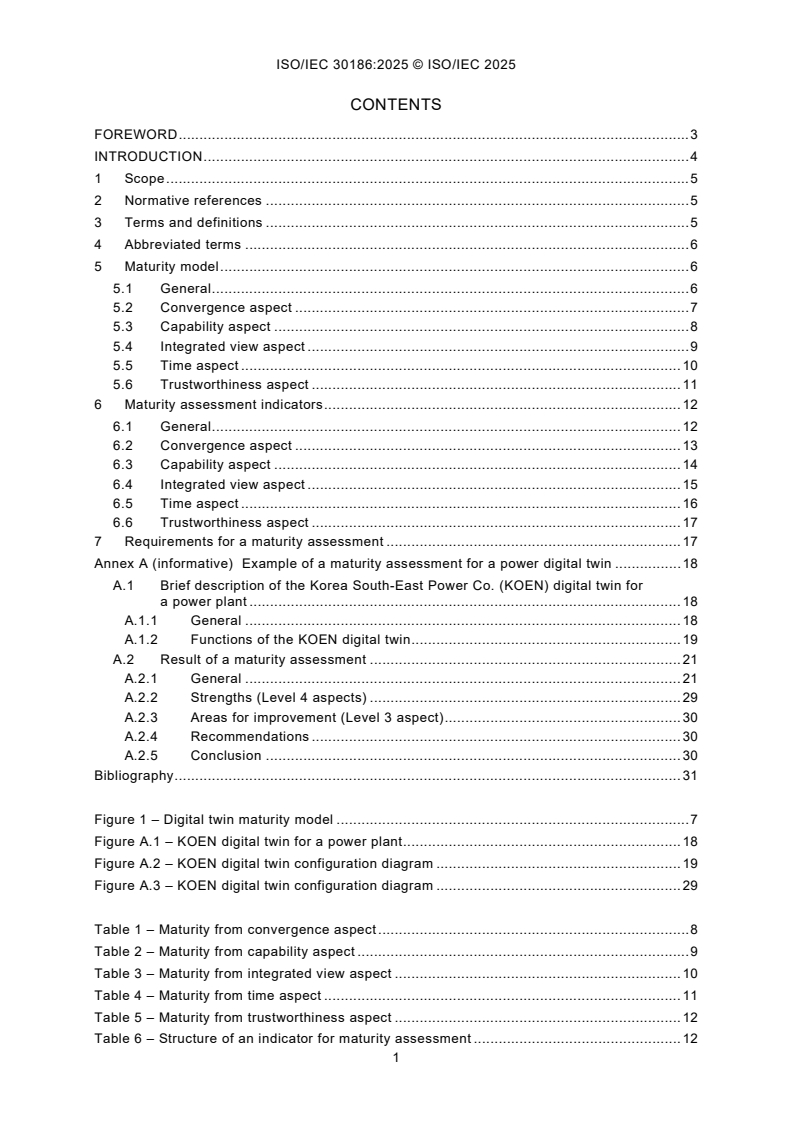
CONTENTS
FOREWORD . 3
INTRODUCTION . 4
1 Scope . 5
2 Normative references . 5
3 Terms and definitions . 5
4 Abbreviated terms . 6
5 Maturity model . 6
5.1 General . 6
5.2 Convergence aspect . 7
5.3 Capability aspect . 8
5.4 Integrated view aspect . 9
5.5 Time aspect . 10
5.6 Trustworthiness aspect . 11
6 Maturity assessment indicators . 12
6.1 General . 12
6.2 Convergence aspect . 13
6.3 Capability aspect . 14
6.4 Integrated view aspect . 15
6.5 Time aspect . 16
6.6 Trustworthiness aspect . 17
7 Requirements for a maturity assessment . 17
Annex A (informative) Example of a maturity assessment for a power digital twin . 18
A.1 Brief description of the Korea South-East Power Co. (KOEN) digital twin for
a power plant . 18
A.1.1 General . 18
A.1.2 Functions of the KOEN digital twin . 19
A.2 Result of a maturity assessment . 21
A.2.1 General . 21
A.2.2 Strengths (Level 4 aspects) . 29
A.2.3 Areas for improvement (Level 3 aspect) . 30
A.2.4 Recommendations . 30
A.2.5 Conclusion . 30
Bibliography . 31
Figure 1 – Digital twin maturity model . 7
Figure A.1 – KOEN digital twin for a power plant . 18
Figure A.2 – KOEN digital twin configuration diagram . 19
Figure A.3 – KOEN digital twin configuration diagram . 29
Table 1 – Maturity from convergence aspect . 8
Table 2 – Maturity from capability aspect . 9
Table 3 – Maturity from integrated view aspect . 10
Table 4 – Maturity from time aspect . 11
Table 5 – Maturity from trustworthiness aspect . 12
Table 6 – Structure of an indicator for maturity assessment . 12
Table 7 – Convergence aspect assessment indicators . 13
Table 8 – Capability aspect assessment indicators . 14
Table 9 – Integrated view aspect assessment indicators . 15
Table 10 – Time aspect assessment indicators . 16
Table 11 – Trustworthiness aspect assessment indicators . 17
Table A.1 – Functions of the KOEN digital twin . 19
Table A.2 – Result of a convergence aspect maturity assessment . 21
Table A.3 – Result of a capability aspect maturity assessment . 22
Table A.4 – Result of an integrated view aspect maturity assessment . 24
Table A.5 – Result of a time aspect maturity assessment . 26
Table A.6 – Result of a trustworthiness aspect maturity assessment . 27
Digital twin -
Maturity model and guidance for a maturity assessment
FOREWORD
1) ISO (the International Organization for Standardization) and IEC (the International Electrotechnical Commission)
form the specialized system for worldwide standardization. National bodies that are members of ISO or IEC
participate in the development of International Standards through technical committees established by the
respective organization to deal with particular fields of technical activity. ISO and IEC technical committees
collaborate in fields of mutual interest. Other international organizations, governmental and non-governmental,
in liaison with ISO and IEC, also take part in the work.
2) The formal decisions or agreements of IEC and ISO on technical matters express, as nearly as possible, an
international consensus of opinion on the relevant subjects since each technical committee has representation
from all interested IEC and ISO National bodies.
3) IEC and ISO documents have the form of recommendations for international use and are accepted by IEC and
ISO National bodies in that sense. While all reasonable efforts are made to ensure that the technical content of
IEC and ISO documents is accurate, IEC and ISO cannot be held responsible for the way in which they are used
or for any misinterpretation by any end user.
4) In order to promote international uniformity, IEC and ISO National bodies undertake to apply IEC and ISO
documents transparently to the maximum extent possible in their national and regional publications. Any
divergence between any IEC and ISO document and the corresponding national or regional publication shall be
clearly indicated in the latter.
5) IEC and ISO do not provide any attestation of conformity. Independent certification bodies provide conformity
assessment services and, in some areas, access to IEC and ISO marks of conformity. IEC and ISO are not
responsible for any services carried out by independent certification bodies.
6) All users should ensure that they have the latest edition of this document.
7) No liability shall attach to IEC and ISO or their directors, employees, servants or agents including individual
experts and members of its technical committees and IEC and ISO National bodies for any personal injury,
property damage or other damage of any nature whatsoever, whether direct or indirect, or for costs (including
legal fees) and expenses arising out of the publication, use of, or reliance upon, this ISO/IEC document or any
other IEC and ISO documents.
8) Attention is drawn to the Normative references cited in this document. Use of the referenced publications is
indispensable for the correct application of this document.
9) IEC and ISO draw attention to the possibility that the implementation of this document may involve the use of (a)
patent(s). IEC and ISO take no position concerning the evidence, validity or applicability of any claimed patent
rights in respect thereof. As of the date of publication of this document, IEC and ISO had not received notice of
(a) patent(s), which may be required to implement this document. However, implementers are cautioned that this
may not represent the latest information, which may be obtained from the patent database available at
https://patents.iec.ch and www.iso.org/patents. IEC and ISO shall not be held responsible for identifying any or
all such patent rights.
ISO/IEC 30186 has been prepared by subcommittee 41: Internet of Things and Digital Twin, of
ISO/IEC joint technical committee 1: Information technology. It is an International Standard.
The text of this International Standard is based on the following documents:
Draft Report on voting
JTC1-SC41/502/FDIS JTC1-SC41/525/RVD
Full information on the voting for its approval can be found in the report on voting indicated in
the above table.
The language used for the development of this International Standard is English.
This document was drafted in accordance with ISO/IEC Directives, Part 2, and developed in
accordance with ISO/IEC Directives, Part 1, and the ISO/IEC Directives, JTC 1 Supplement
available at www.iec.ch/members_experts/refdocs and www.iso.org/directives.
INTRODUCTION
Digital twins typically comprise several enabling technologies that are existing, under
development or upcoming in the near future. Similar to other evolving digital technologies,
digital twins progress through various levels of complexity. Digital twins evolve from simple to
complex structures, from standalone systems to federated networks, and from requiring human
intervention to achieving autonomy. Each successive level of a digital twin introduces
increasingly sophisticated functionalities.
Digital twins deployed in various application domains are likely requested to cooperate with
other digital twins for coping with complex problems raised across the application domains.
However, different levels of features such as convergence, capabilities and integrated view
prevent digital twin applications from cooperating with other digital twin applications.
In this situation, the digital twin maturity model is helpful to understand the features that should
be supported by a digital twin from a low level to a higher level. The digital twin maturity model
is an assessment tool of a digital twin for determining the current maturity level and common
understanding of the evolution towards another level. Its purpose is to support an organization
assessment of and advancement of its level of maturity in the technological capability of its
digital twins. It does not provide guidance on enhancing the maturity and capability of users, or
the outcomes digital twin can help deliver.
1 Scope
This document provides a generic digital twin maturity model, definition of assessment
indicators, and guidance for a maturity assessment.
2 Normative references
The following documents are referred to in the text in such a way that some or all of their content
constitutes requirements of this document. For dated references, only the edition cited applies.
For undated references, the latest edition of the referenced document (including any
amendments) applies.
ISO/IEC 30173, Digital twin - Concepts and terminology
3 Terms and definitions
For the purposes of this document, the terms and definitions given in ISO/IEC 30173 and the
following apply.
ISO and IEC maintain terminology databases for use in standardization at the following
addresses:
• IEC Electropedia: available at https://www.electropedia.org/
• ISO Online browsing platform: available at https://www.iso.org/obp
3.1
maturity level
identified extent of measured effect
Note 1 to entry: The extent of measured effect is divided into segments, referred to as levels, of increasing
competence to achieve digital twin objectives.
[SOURCE: ISO 22549-2:2020, 3.2, modified – The first preferred term “maturity level indicator”
has been deleted. In the definition, “within the maturity model” has been deleted. In Note 1 to
entry, “enterprise” has been replaced by “digital twin”.]
3.2
maturity model
set of information that indicates the characteristics of maturity levels
[SOURCE: ISO 22549-2:2020, 3.1, modified – In the definition, “that indicate the maturity of CII,
its descriptive name and characteristics” has been replaced with “that indicates the
characteristics of maturity levels”.]
3.3
maturity assessment
method for assessing the digital twin maturity level(s) (3.1) against a maturity model (3.2)
3.4
convergence aspect
maturity in terms of degrees of correlation between the target entity (physical
states) and its corresponding digital twin(s) (digital states)
3.5
capability aspect
maturity in terms of abilities of a digital twin to accurately reflect and predict the
behaviour of the target entity
3.6
integrated view aspect
maturity in terms of the user view and describing how a digital twin can support
users in their tasks from different lifecycle stages and how a digital twin can support cross-team
collaboration
3.7
time aspect
maturity in terms of the management of time information of digital twins
3.8
trustworthiness aspect
maturity in terms of measuring security, reliability and conformance of a digital
twin throughout its lifecycle
4 Abbreviated terms
AI artificial intelligence
AR augmented reality
VR virtual reality
2D two dimensions
3D three dimensions
5 Maturity model
5.1 General
As digital twin technology evolves, it is important for organizations to assess and comprehend
the maturity levels of their digital twins. A structured maturity model aids in assessing current
digital twin deployments with the strategic aims of an organization. This assessment enables
organizations to maximize their value, ensure alignment with business, and guide future
investments towards the most promising digital twin technologies.
Maturity assessment of a digital twin involves analysing the correlation between a digital twin
and its target entities, the capabilities of the digital twin, how it manages temporal data in
relation to those entities and trustworthiness of a digital twin. It is equally important to assess
the support that digital twins provide to users across various stages of their lifecycle, as well as
their ability to facilitate collaboration across different realms.
A maturity model delineates distinct levels of maturity, each characterized by a unique indicator,
descriptive name, and specific characteristics that provide essential insights for the assessment
process. Figure 1 shows the digital twin maturity model.
NOTE 1 The five identified aspects represent a minimal maturity model that can be extended by incorporating
additional aspects aligned with the dimensionality and maturity level indicators defined in this document. While
maturity levels are generally assessed independently, potential interdependencies between aspects can exist. These
interdependencies are assessed case-by-case, reflecting the specific contextual relationships that can arise.
NOTE 2 The definition of digital twin in ISO/IEC 30173:2023, 3.1.1 is focused on the level 3 convergence aspect.
However, a digital twin has more features and characteristics beyond the convergence between the physical and
digital states at an appropriate rate of synchronization. This document extends the features and characteristics of a
digital twin beyond those in ISO/IEC 30173:2023, 3.1.1 in terms of a maturity assessment.
Figure 1 – Digital twin maturity model
5.2 Convergence aspect
Convergence aspect represents the various degrees of alignment and interaction between the
physical and digital states. It assesses how effectively a digital twin mirrors its target entity,
capturing data and reflecting changes accurately. This involves not only the synchronization of
data but also the integration of processes, responses and behaviours between the target
entities and the digital twins. As the convergence level increases, a digital twin evolves from a
static representation to a highly dynamic and interactive model.
Table 1 shows the maturity levels of a digital twin by convergence aspect.
Table 1 – Maturity from convergence aspect
Maturity level Descriptive name Characteristics
indicator
Level 1 Static
• A digital twin exists for an individual target entity,
representing its initial state based on an initial state of
data collection.
• A digital twin reflects a static representation of the target
entity at a specific point in time.
For example, a smart watch digital twin represents the
watch's initial design or usage data, however it is not
connected to the watch itself.
Level 2 Paired
• A digital twin maintains a persistent and initial data
connection for read-only from the target entity.
• A digital twin reflects changes in the target entity’s state
over time.
For example, a smart watch digital twin is connected to the
smart watch and continuously receives data such as heart
rate or step count in real-time, however it cannot send data
back to the smart watch.
Level 3 Synchronized
• A digital twin synchronizes its state (read and write) with
the corresponding target entity, ensuring real-time
updates and alignment with the entity’s current state.
For example, a smart watch digital twin synchronizes both
ways with the smart watch itself. It not only receives real-time
data such as heart rate and step count but also updates the
smart watch's settings or software when necessary, ensuring
a fully synchronized state.
Level 4 Coordinated
• A digital twin coordinates interactions with other digital
twins to facilitate collaboration, optimize performance,
and support collaborative decision-making across multiple
target entities.
For example, a smart watch digital twin coordinates with other
digital twins, such as a health monitoring system digital twin
or a fitness platform digital twin. These digital twins exchange
data and collaborate to optimize the user’s health insights,
support decision-making on personalized health
recommendations, and improve overall system performance.
Level 5 Unified
• A digital twin operates autonomously with other digital
twins in the context of the target entity and connected
a
systems to optimize systems of systems performance.
For example, a smart watch digital twin operates
autonomously with digital twins from healthcare systems,
fitness platforms, and emergency response networks.
Together, these digital twins optimize the overall performance
of interconnected systems by dynamically coordinating health
data, user activity insights, and real-time emergency
responses.
a
The phrase "systems of systems" refers to a complex integration where multiple systems, each potentially
complex on their own, are interconnected and work together to form a larger, more sophisticated system.
5.3 Capability aspect
Capability aspect of a digital twin encompasses its abilities to accurately reflect and predict the
behaviour of the target entity, thereby enhancing or even substituting human decision-making.
At the foundational levels, this capability is based on empirical data and evidence designed for
descriptive, predictive and preventive maintenance tasks. As the system matures, it eventually
evolves to incorporate advanced AI and machine-learning techniques, enabling fully automated
and autonomous operations that can proactively adapt to changes without human intervention.
Table 2 shows the maturity levels of a digital twin by capability aspect.
Table 2 – Maturity from capability aspect
Maturity level Descriptive name Characteristics
indicator
Level 1 Mirroring • A digital twin describes the characteristics of the target
entity based on initial data collection, such as behaviour
and visual appearance rendered in 2D, 3D, AR or VR.
Level 2 Monitoring • A digital twin monitors the target entity through a data
connection to enable identification, diagnosis, and
analysis of issues in the target entity's lifecycle.
• A digital twin facilitates reactive operations with the target
entity by providing insights based on monitored data,
requiring human intervention.
Level 3 Predictive • A digital twin uses data or simulation tools to predict the
behaviour of the target entity and assess potential risks
and impacts.
• A digital twin enables 'what-if' analysis and time-ahead
predictions to optimize production, operation,
maintenance, and design processes.
Level 4 Federated • A digital twin facilitates interactions and information
exchange among multiple digital twins to support
collaboration and optimized performance.
• A digital twin enables federated operations with other
digital twins with human intervention for critical decision-
making.
Level 5 Autonomous • A digital twin autonomously learns from new data,
predicts outcomes, and optimizes operations without
human intervention.
• A digital twin executes autonomous decisions and
coordinates with external systems, including other digital
twins, in real-time.
• A digital twin continuously evaluates its own performance
and accuracy to align with real-world conditions.
5.4 Integrated view aspect
Integrated view aspect models the user view and describes how a digital twin can support users
in their tasks. Integrated view aspect can also be applied across different lifecycle stages and
support cross-team collaboration.
A digital twin by its very nature, function and purpose is not independent of its business systems,
where business systems are policy, practice, process and procedure across engineering,
business, and human capital. In integrated view aspect, the target entity of a digital twin(s)
should be the system of interest, which can be a single entity or a collection of entities operating
as a system.
Table 3 shows the maturity levels of a digital twin by integrated view aspect.
Table 3 – Maturity from integrated view aspect
Maturity level Descriptive name Characteristics
indicator
Level 1 Task-specific • A digital twin focuses on a specific task within the
lifecycle of the target entity, providing limited context
beyond the task's scope.
Level 2 Connected • A digital twin connects with other digital twins of the
target entity to support tasks within the same discipline,
such as mechanical, thermal or stress loads.
• A digital twin enables lifecycle data analysis to address
task-specific problems and improve decision-making.
Level 3 Preventive • A digital twin performs lifecycle-wide 'what-if' experiments
for cross-disciplinary tasks to predict and evaluate
impacts, risks and alternatives.
• A digital twin uses historical data to simulate and optimize
decision-making processes for design, manufacturing,
and operations.
Level 4 Augmented • A digital twin augments decision-making processes by
integrating real-time data analysis, providing enhanced
visualization and contextual insights.
• A digital twin connects tasks spanning engineering,
production, finance, business operations, programme
office, and suppliers to support enterprise-wide
collaboration and optimization.
Level 5 Supervising • A digital twin autonomously performs recurring tasks,
such as generating design variants and conducting
standard maintenance.
• A digital twin supports collaboration and connectivity for
tasks spanning multiple industries or domains, enabling
integrated operations.
• A digital twin provides users with operational insights,
supports issue investigation, and facilitates the
establishment of strategic guidelines for its operation.
5.5 Time aspect
Accurate time information is crucial in the context of digital twins. It enables timely monitoring
and control, facilitates predictive analysis, supports simulation of dynamic processes, and
allows scenario testing, all of which are important for capturing the evolving nature of physical
systems across industries.
Time aspect shows the management of time information of digital twins. Table 4 shows the
maturity levels of a digital twin by time aspect.
Table 4 – Maturity from time aspect
Maturity level Descriptive name Characteristics
indicator
Level 1 Un-linked • A digital twin operates independently of a standardized
time system, however can organize collected data based
on non-time attributes such as location, type, state,
priority, or data source, depending on the context when
time synchronization is unavailable.
Level 2 Linked • A digital twin is linked to a standardized time system in
data collection to sequence data across various types and
attributes.
Level 3 Parameterized • A digital twin utilizes time information to navigate
forwards and backwards in time, enabling historical
review, prediction, simulation, and performance
evaluation through an emulated time attribute as a metric.
For example, a digital twin of an engine uses historical time
data to simulate future performance and predict maintenance
schedules.
Level 4 Aligned • A digital twin, as part of multiple interacting digital twins
of the same or different target entities, uses the time
attribute to organize and order data and information.
• A digital twin, as part of multiple interacting digital twins
across systems, shares information using a standardized
time metric (e.g. International System of Units: SI).
• A digital twin collaborates with multiple digital twins and
negotiates common time metrics to share information
across entities.
For example, a manufacturing digital twin synchronizes its
time data with a robotic assembly system and a logistics
system, ensuring seamless operation coordination.
Level 5 Integrated • A digital twin operates autonomously with other digital
twins in the context of the target entity and connected
systems, with time as a fundamental unit measurement.
For example, an autonomous digital twin integrates time and
real-time data from multiple connected systems to optimize a
factory’s production and maintenance processes without
human intervention
5.6 Trustworthiness aspect
Trustworthiness aspect measures the security, data accuracy, reliability and compliance of a
digital twin throughout its lifecycle. Security focuses on protecting access, encryption, and
threat detection, while data accuracy emphasizes the validation, correction, and precision of
collected data. Maturity from trustworthiness aspect shows a progression from basic measures
to advanced, predictive, and autonomous systems that ensure the highest levels of security,
data accuracy, reliability, and compliance, reflecting the evolving capability of digital twins as
they mature.
Table 5 shows the maturity levels of a digital twin by trustworthiness aspect.
Table 5 – Maturity from trustworthiness aspect
Maturity level Descriptive name Characteristics
indicator
Level 1 Integral • A digital twin applies minimal security measures, focusing
primarily on data storage integrity.
• A digital twin provides limited verification processes to
ensure data accuracy.
Level 2 Secured • A digital twin enhances security for data transmission.
• A digital twin implements encryption and access controls
to protect data integrity and privacy.
Level 3 Reliable • A digital twin ensures comprehensive reliability across all
systems.
• A digital twin undergoes regular audits and compliance
checks.
• A digital twin integrates fault tolerance mechanisms.
Level 4 Validated • A digital twin uses advanced analytics for real-time error
detection and correction.
• A digital twin automates security protocols to a high
degree.
Level 5 Trusted • A digital twin autonomously performs self-healing and
self-optimizing operations.
• A digital twin achieves the highest level of security,
including predictive threat detection and resolution.
6 Maturity assessment indicators
6.1 General
Each aspect of the maturity model shall be assessed in the level of its aspect, and each aspect
has a set of questions to answer for each maturity level. Question answers shall be “YES” or
“NO”.
Table 6 shows the structure of an indicator for a digital twin maturity assessment.
Table 6 – Structure of an indicator for maturity assessment
Aspect Questions Maturity level indicator
Aspect name Questions for assessment Maturity level
– Aspect:
Convergence aspect, capability aspect, integrated view aspect, time aspect and
trustworthiness aspect.
– Questions:
Questions to assess maturity level satisfaction, and the answer shall be “YES” or “NO”.
The maturity scale is cumulative. All questions in a given level shall be assessed and a
“YES” answer to all questions is required in order to proceed to the next level questions.
Each level builds upon the previous question, ensuring that all lower-level questions are
relevant and applicable as the digital twin matures.
– Maturity level indicator:
Maturity level used for maturity assessment.
6.2 Convergence aspect
Table 7 shows the convergence aspect assessment indicators.
Table 7 – Convergence aspect assessment indicators
Aspect Questions Maturity level
indicator
Convergence CV.1-1 Does a digital twin exist for an individual target entity 1
aspect based on an initial state of data collection?
CV.1-2 Does a digital twin reflect a static representation of the
target entity at a specific point in time?
CV.2-1 Does a digital twin maintain a persistent and initial data 2
connection for read-only from the target entity?
Does a digital twin reflect changes in the target entity’s
CV.2-2
state over time based on the data connection?
Does a digital twin synchronize its state (read and write)
CV.3-1 3
with the corresponding target entity?
CV.3-2 Does the digital twin ensure real-time updates and
alignment with the target entity's current state?
CV.4-1 Does a digital twin coordinate interactions with other 4
digital twins to facilitate collaboration?
CV.4-2 Does the digital twin support collaborative decision-
making across multiple target entities to optimize
performance?
CV.5-1 Does a digital twin operate autonomously with other 5
digital twins in the context of the target entity and
connected systems?
CV.5-2 Does the digital twin optimize systems-of-systems
performance through dynamic coordination and real-
time responses?
6.3 Capability aspect
Table 8 shows the capability aspect assessment indicators.
Table 8 – Capability aspect assessment indicators
Aspect Questions Maturity level
indicator
Capability CA.1-1 Does a digital twin describe the characteristics of a 1
aspect target entity?
CA.1-2 Does the digital twin represent behaviour and visual
appearance of the target entity in formats such as 2D,
3D, AR, or VR?
CA.2-1 Does a digital twin monitor the target entity through a 2
data connection to enable identification, diagnosis, and
analysis of issues?
CA.2-2 Does the digital twin facilitate reactive operations with
the target entity by providing insights based on
monitored data, requiring human intervention?
CA.3-1 Does a digital twin use data or simulation tools to 3
predict the behaviour of the target entity?
CA.3-2 Does the digital twin enable 'what-if' analysis and time-
ahead predictions to optimize production, operation,
maintenance, and design processes?
CA.4-1 Does a digital twin facilitate interactions and information 4
exchange among multiple digital twins to support
collaboration and optimized performance?
CA.4-2 Does the digital twin enable federated operations with
other digital twins, with human intervention for critical
decision-making?
CA.5-1 Does a digital twin autonomously learn from new data, 5
predict outcomes, and optimize operations without
human intervention?
CA.5-2 Does the digital twin execute autonomous decisions and
coordinate with external systems, including other digital
twins, in real-time?
CA.5-3 Does the digital twin continuously evaluate its own
performance and accuracy to align with real-world
conditions?
6.4 Integrated view aspect
Table 9 shows the integrated view aspect assessment indicators.
Table 9 – Integrated view aspect assessment indicators
Aspect Questions Maturity level
indicator
Integrated view IG.1-1 Does a digital twin focus on a specific task within the 1
aspect lifecycle of the target entity, providing limited context
beyond the task's scope?
IG.1-2 Does a digital twin provide limited insights into the
impact of decisions across other lifecycle stages?
Does a digital twin connect with other digital twins of
IG.2-1 2
the target entity to support tasks within the same
discipline, such as mechanical, thermal, or stress
loads?
IG.2-2 Does a digital twin enable lifecycle data analysis to
address task-specific problems and improve decision-
making?
IG.3-1 Does a digital twin perform lifecycle-wide 'what-if' 3
experiments for cross-disciplinary tasks to predict and
evaluate impacts, risks, and alternatives?
IG.3-2 Does a digital twin use historical data to simulate and
optimize decision-making processes for design,
manufacturing, and operations?
IG.4-1 Does a digital twin augment decision-making processes 4
by integrating real-time data analysis, providing
enhanced visualization and contextual insights?
IG.4-2 Does a digital twin connect tasks spanning engineering,
production, finance, business operations, programme
office, and suppliers to support enterprise-wide
collaboration and optimization?
IG.5-1 Does a digital twin autonomously perform recurring 5
tasks, such as generating design variants and
conducting standard maintenance?
IG.5-2 Does a digital twin support collaboration and
connectivity for tasks spanning multiple industries or
domains, enabling integrated operations?
IG.5-3 Does a digital twin provide users with operational
insights, support issue investigation, and facilitate the
establishment of strategic guidelines for its operation?
6.5 Time aspect
Table 10 shows the time aspect assessment indicators.
Table 10 – Time aspect assessment indicators
Aspect Questions Maturity level
indicator
Time aspect TI.1-1 Does a digital twin operate independently of a 1
standardized time system?
TI.1-2 Does a digital twin organize collected data based on
non-time attributes such as location, type, state, priority
or data source?
TI.2-1 Does a digital twin link to a standardized time system to 2
sequence data across various types and attributes?
TI.3-1 Does a digital twin utilize time information to navigate 3
forwards and backwards in time for historical review
and prediction?
TI.4-1 Does a digital twin use the time attribute to organize 4
and order data and information when interacting with
other digital twins?
TI.4-2 Does a digital twin share information using a
standardized time metric (e.g. International System of
Units: SI) across systems?
TI.4-3 Does a digital twin negotiate common time metrics with
multiple digital twins to share information across
entities?
TI.5-1 Does a digital twin operate autonomously with other 5
digital twins, using time as a fundamental unit
measurement to optimize interconnected systems?
TI.5-2 Does a digital twin integrate time and real-time data
from multiple connected systems to optimize processes
without human intervention?
6.6 Trustworthiness aspect
Table 11 shows the trustworthiness aspect assessment indicators.
Table 11 – Trustworthiness aspect assessment indicators
Aspect Questions Maturity level
indicator
Trustworthiness TW.1-1 Does a digital twin have minimal security measures with 1
aspect primary focus on data storage integrity?
TW.1-2 Does a digital twin support limited verification processes
for data accuracy?
TW.2-1 Does a digital twin support enhanced security for data 2
transmission?
TW.2-2 Does a digital twin have initial implementation of
encryption and access controls to protect data integrity
and privacy?
TW.3-1 Does a digital twin support comprehensive reliability 3
across all systems?
TW.3-2 Does a digital twin provide regular audits and compliance
checks?
TW.3-3 Does a digital twin support fault tolerance?
TW.4-1 Does a digital twin support advanced analytics for real- 4
time error detection and correction?
TW.4-2 Does a digital twin support high degree of automation in
security protocols?
TW.5-1 Does a digital twin support autonomous self-healing and 5
self-optimizing capabilities?
TW.5-2 Does a digital twin provide the highest level of security,
including predictive threat detection and resolution?
7 Requirements for a maturity assessment
Stakeholders for maturity assessment are enterprises that wish to assess maturity levels of
their digital twin; therefore, they shall answer the assessment questionnaires introduced in
Clause 6.
Maturity assessment shall be conducted by assessing the maturity of the five aspects. The
principle of assessment is to guide enterprises to assess the current situation of digital twin
maturity, to find the weaknesses, and to set the milestones for improving digital twin maturity.
The basic requirement for assessment is that maturity assessment shall be conducted by means
of the questionnaires, resulting in a maturity level for each of the five aspects. Each aspect
shall be considered independently, and not aggregated to form an overall digital twin maturity
level for the enterprise using these levels.
An example of a maturity assessment for a power digital twin is presented in Annex A.
Annex A
(informative)
Example of a maturity assessment for a power digital twin
A.1 Brief description of the Korea South-East Power Co. (KOEN) digital twin
for a power plant
A.1.1 General
Figure A.1 presents the KOEN digital twin operated in a large-capacity coal-fired power plant
with two 870 megawatt (MW) units.
Figure A.1 – KOEN digital twin for a power plant
The KOEN digital twin is a 3D modelling-based virtual power plant that replicates the real power
plant exactly. Approximately 39 000 data sensors from the entire power plant are linked to the
KOEN digital twin. It supports AI-based predictive diagnosis and optimal decision-making by
utilizing real-time data generated from power plants, characterizing it as a power plant that
continuously accumulates data, information, and knowledge.
The KOEN digital twin is developed by storing various sensing and document data from an
actual power plant in a big data system and applying existing internal operating systems, AI,
and simulation technology shown in Figure A.2. The digital twin created in this way supports
the power plant's central co
...