

IEC SRD 63233-4:2024
(Main)Smart city standards inventory and mapping - Part 4: Guidance on standards for public health emergencies
General Information
- Abstract
IEC SRD 63233-4:2024 This document is part 4 of the IEC SRD 63233 series and proposes a guidance on identifying and mapping standards for public health emergencies following the methodology of IEC SRD 63233-1:2022. It guides identifying and categorizing relevant standards for epidemic prevention and control, and links to a database with cataloged standards for easy use by cities.
- Status
- Published
- Publication Date
- 02-Apr-2024
- Technical Committee
- SyC Smart Cities - Electrotechnical aspects of Smart Cities
- Drafting Committee
- WG 3 - SyC Smart Cities/WG 3
- Current Stage
- PPUB - Publication issued
- Start Date
- 03-Apr-2024
- Completion Date
- 12-Apr-2024
Overview
IEC SRD 63233-4:2024 - Smart city standards inventory and mapping, Part 4: Guidance on standards for public health emergencies provides practical guidance for identifying, categorizing and mapping standards relevant to public health emergencies (PHE) in urban environments. Aligned with the methodology of IEC SRD 63233-1:2022 and the catalogue structure in IEC SRD 63233-2:2023, this Systems Reference Deliverable helps cities build a structured standards inventory and access a linked database of PHE-relevant standards to support epidemic prevention, control, medical deployments and continuity of city services.
Key topics and technical scope
- Standards identification methodology: Guidance on search criteria, guiding principles (life-cycle and stakeholder perspectives) and keyword/query strategies to locate PHE standards.
- Lifecycle approach: Coverage of PHE phases-prevention, preparedness, response and recovery-and the infection life-cycle perspective for individual health events.
- Stakeholder-focused mapping: Identification and classification of standards according to stakeholders (city authorities, hospitals, emergency services, vendors, citizens) and their activities.
- Structured catalogue: Definition of a PHE standards catalogue structure and vocabulary for classification to ensure consistency and interoperability across smart city systems.
- Standards mapping to reference models: Procedures for selecting PHE reference models, implementing mappings, and producing visualized standards maps for user needs analysis.
- Supporting materials: Annexes with keywords/query combinations and examples (including COVID‑19–relevant standards and projects) to assist practical searches and inventory work.
- Deliverables: A downloadable attached file (referenced in Clause 4) and a database of catalogued standards for easy city use.
Practical applications and users
This guidance is practical for organizations that plan, operate or integrate urban health and emergency systems:
- City planners and emergency managers building standards-based response plans and continuity strategies.
- Public health authorities and hospitals seeking interoperable requirements for equipment, data exchange and facility deployment.
- Systems integrators and vendors designing solutions for epidemic monitoring, contact tracing, medical logistics and telehealth interoperability.
- Standards bodies and policy-makers mapping gaps and harmonizing national/regional standards with international references.
- Procurement and resilience teams using the catalogue to specify compliant products and services during PHEs.
Related standards
- IEC SRD 63233-1:2022 (Methodology for smart city standards inventory and mapping)
- IEC SRD 63233-2:2023 (Catalogue structure alignment)
- References to WHO International Health Regulations and ISO/IEC terminology resources are cited for context.
Keywords: IEC SRD 63233-4:2024, smart city standards, public health emergencies, PHE standards inventory, standards mapping, epidemic prevention, standards catalogue, interoperability.
Get Certified
Connect with accredited certification bodies for this standard

BSI Group
BSI (British Standards Institution) is the business standards company that helps organizations make excellence a habit.

Bureau Veritas
Bureau Veritas is a world leader in laboratory testing, inspection and certification services.

DNV
DNV is an independent assurance and risk management provider.
Sponsored listings
Frequently Asked Questions
IEC SRD 63233-4:2024 is a standardization document published by the International Electrotechnical Commission (IEC). Its full title is "Smart city standards inventory and mapping - Part 4: Guidance on standards for public health emergencies". This standard covers: IEC SRD 63233-4:2024 This document is part 4 of the IEC SRD 63233 series and proposes a guidance on identifying and mapping standards for public health emergencies following the methodology of IEC SRD 63233-1:2022. It guides identifying and categorizing relevant standards for epidemic prevention and control, and links to a database with cataloged standards for easy use by cities.
IEC SRD 63233-4:2024 This document is part 4 of the IEC SRD 63233 series and proposes a guidance on identifying and mapping standards for public health emergencies following the methodology of IEC SRD 63233-1:2022. It guides identifying and categorizing relevant standards for epidemic prevention and control, and links to a database with cataloged standards for easy use by cities.
IEC SRD 63233-4:2024 is classified under the following ICS (International Classification for Standards) categories: 03.100.70 - Management systems; 13.020.20 - Environmental economics. Sustainability. The ICS classification helps identify the subject area and facilitates finding related standards.
IEC SRD 63233-4:2024 is available in PDF format for immediate download after purchase. The document can be added to your cart and obtained through the secure checkout process. Digital delivery ensures instant access to the complete standard document.
Standards Content (Sample)
IEC SRD 63233-4 ®
Edition 1.0 2024-04
SYSTEMS REFERENCE
DELIVERABLE
Smart city standards inventory and mapping –
Part 4: Guidance on standards for public health emergencies
All rights reserved. Unless otherwise specified, no part of this publication may be reproduced or utilized in any form
or by any means, electronic or mechanical, including photocopying and microfilm, without permission in writing from
either IEC or IEC's member National Committee in the country of the requester. If you have any questions about IEC
copyright or have an enquiry about obtaining additional rights to this publication, please contact the address below or
your local IEC member National Committee for further information.
IEC Secretariat Tel.: +41 22 919 02 11
3, rue de Varembé info@iec.ch
CH-1211 Geneva 20 www.iec.ch
Switzerland
About the IEC
The International Electrotechnical Commission (IEC) is the leading global organization that prepares and publishes
International Standards for all electrical, electronic and related technologies.
About IEC publications
The technical content of IEC publications is kept under constant review by the IEC. Please make sure that you have the
latest edition, a corrigendum or an amendment might have been published.
IEC publications search - webstore.iec.ch/advsearchform IEC Products & Services Portal - products.iec.ch
The advanced search enables to find IEC publications by a Discover our powerful search engine and read freely all the
variety of criteria (reference number, text, technical publications previews, graphical symbols and the glossary.
committee, …). It also gives information on projects, replaced With a subscription you will always have access to up to date
and withdrawn publications. content tailored to your needs.
IEC Just Published - webstore.iec.ch/justpublished
Electropedia - www.electropedia.org
Stay up to date on all new IEC publications. Just Published
The world's leading online dictionary on electrotechnology,
details all new publications released. Available online and once
containing more than 22 500 terminological entries in English
a month by email.
and French, with equivalent terms in 25 additional languages.
Also known as the International Electrotechnical Vocabulary
IEC Customer Service Centre - webstore.iec.ch/csc
(IEV) online.
If you wish to give us your feedback on this publication or need
further assistance, please contact the Customer Service
Centre: sales@iec.ch.
IEC SRD 63233-4 ®
Edition 1.0 2024-04
SYSTEMS REFERENCE
DELIVERABLE
Smart city standards inventory and mapping –
Part 4: Guidance on standards for public health emergencies
INTERNATIONAL
ELECTROTECHNICAL
COMMISSION
ICS 03.100.70; 13.020.20 ISBN 978-2-8322-8474-2
– 2 – IEC SRD 63233-4:2024 © IEC 2024
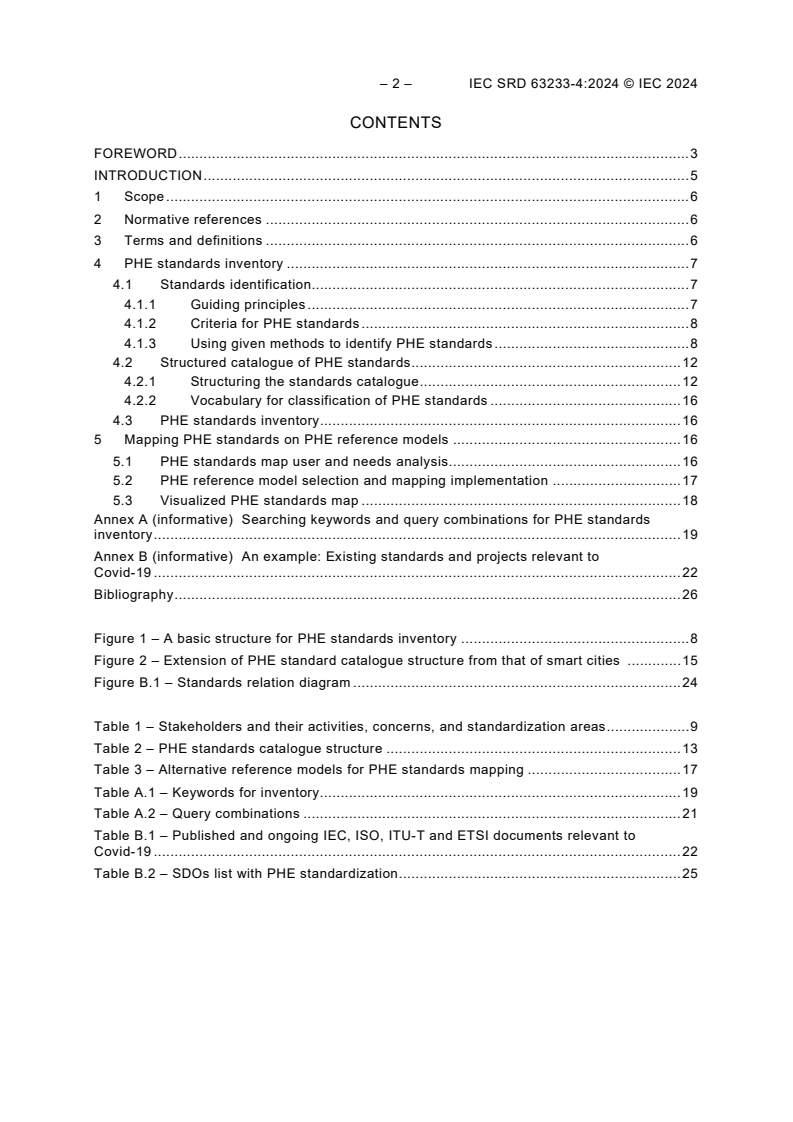
CONTENTS
FOREWORD . 3
INTRODUCTION . 5
1 Scope . 6
2 Normative references . 6
3 Terms and definitions . 6
4 PHE standards inventory . 7
4.1 Standards identification. 7
4.1.1 Guiding principles . 7
4.1.2 Criteria for PHE standards . 8
4.1.3 Using given methods to identify PHE standards . 8
4.2 Structured catalogue of PHE standards . 12
4.2.1 Structuring the standards catalogue . 12
4.2.2 Vocabulary for classification of PHE standards . 16
4.3 PHE standards inventory. 16
5 Mapping PHE standards on PHE reference models . 16
5.1 PHE standards map user and needs analysis. 16
5.2 PHE reference model selection and mapping implementation . 17
5.3 Visualized PHE standards map . 18
Annex A (informative) Searching keywords and query combinations for PHE standards
inventory . 19
Annex B (informative) An example: Existing standards and projects relevant to
Covid-19 . 22
Bibliography . 26
Figure 1 – A basic structure for PHE standards inventory . 8
Figure 2 – Extension of PHE standard catalogue structure from that of smart cities . 15
Figure B.1 – Standards relation diagram . 24
Table 1 – Stakeholders and their activities, concerns, and standardization areas . 9
Table 2 – PHE standards catalogue structure . 13
Table 3 – Alternative reference models for PHE standards mapping . 17
Table A.1 – Keywords for inventory . 19
Table A.2 – Query combinations . 21
Table B.1 – Published and ongoing IEC, ISO, ITU-T and ETSI documents relevant to
Covid-19 . 22
Table B.2 – SDOs list with PHE standardization . 25
INTERNATIONAL ELECTROTECHNICAL COMMISSION
____________
SMART CITY STANDARDS INVENTORY AND MAPPING –
Part 4: Guidance on standards for public health emergencies
FOREWORD
1) The International Electrotechnical Commission (IEC) is a worldwide organization for standardization comprising
all national electrotechnical committees (IEC National Committees). The object of IEC is to promote international
co-operation on all questions concerning standardization in the electrical and electronic fields. To this end and
in addition to other activities, IEC publishes International Standards, Technical Specifications, Technical Reports,
Publicly Available Specifications (PAS) and Guides (hereafter referred to as "IEC Publication(s)"). Their
preparation is entrusted to technical committees; any IEC National Committee interested in the subject dealt with
may participate in this preparatory work. International, governmental and non-governmental organizations liaising
with the IEC also participate in this preparation. IEC collaborates closely with the International Organization for
Standardization (ISO) in accordance with conditions determined by agreement between the two organizations.
2) The formal decisions or agreements of IEC on technical matters express, as nearly as possible, an international
consensus of opinion on the relevant subjects since each technical committee has representation from all
interested IEC National Committees.
3) IEC Publications have the form of recommendations for international use and are accepted by IEC National
Committees in that sense. While all reasonable efforts are made to ensure that the technical content of IEC
Publications is accurate, IEC cannot be held responsible for the way in which they are used or for any
misinterpretation by any end user.
4) In order to promote international uniformity, IEC National Committees undertake to apply IEC Publications
transparently to the maximum extent possible in their national and regional publications. Any divergence between
any IEC Publication and the corresponding national or regional publication shall be clearly indicated in the latter.
5) IEC itself does not provide any attestation of conformity. Independent certification bodies provide conformity
assessment services and, in some areas, access to IEC marks of conformity. IEC is not responsible for any
services carried out by independent certification bodies.
6) All users should ensure that they have the latest edition of this publication.
7) No liability shall attach to IEC or its directors, employees, servants or agents including individual experts and
members of its technical committees and IEC National Committees for any personal injury, property damage or
other damage of any nature whatsoever, whether direct or indirect, or for costs (including legal fees) and
expenses arising out of the publication, use of, or reliance upon, this IEC Publication or any other IEC
Publications.
8) Attention is drawn to the Normative references cited in this publication. Use of the referenced publications is
indispensable for the correct application of this publication.
9) IEC draws attention to the possibility that the implementation of this document may involve the use of (a)
patent(s). IEC takes no position concerning the evidence, validity or applicability of any claimed patent rights in
respect thereof. As of the date of publication of this document, IEC had not received notice of (a) patent(s), which
may be required to implement this document. However, implementers are cautioned that this may not represent
the latest information, which may be obtained from the patent database available at https://patents.iec.ch. IEC
shall not be held responsible for identifying any or all such patent rights.
IEC SRD 63233-4 has been prepared by IEC systems committee Smart Cities: Electrotechnical
aspects of Smart Cities. It is a Systems Reference Deliverable.
This document contains an attached file that is cited in Clause 4. This file can be downloaded
from https://www.iec.ch/sycsmartcities/supportingdocuments.
The text of this Systems Reference Deliverable is based on the following documents:
Draft Report on voting
SyCSmartCities/318/DTS SyCSmartCities/330/RVDTS
Full information on the voting for its approval can be found in the report on voting indicated in
the above table.
– 4 – IEC SRD 63233-4:2024 © IEC 2024
The language used for the development of this Systems Reference Deliverable is English.
This document was drafted in accordance with ISO/IEC Directives, Part 2, and developed in
accordance with ISO/IEC Directives, Part 1 and ISO/IEC Directives, IEC Supplement, available
at www.iec.ch/members_experts/refdocs. The main document types developed by IEC are
described in greater detail at www.iec.ch/publications.
A list of all parts in the IEC SRD 63233 series, published under the general title Smart city
standards inventory and mapping, can be found on the IEC website.
The committee has decided that the contents of this document will remain unchanged until the
stability date indicated on the IEC website under webstore.iec.ch in the data related to the
specific document. At this date, the document will be
• reconfirmed,
• withdrawn, or
• revised.
IMPORTANT – The "colour inside" logo on the cover page of this document indicates
that it contains colours which are considered to be useful for the correct understanding
of its contents. Users should therefore print this document using a colour printer.
INTRODUCTION
Public health emergencies (PHE) refer to major infectious disease outbreaks, mass diseases
of unknown causes, major food and occupational poisonings, and other events that seriously
affect public health that occur suddenly and cause or can cause serious damage to public health.
The International Health Regulations came into force in 2007 to manage global health
emergency measures. The purpose and scope of the "Regulations" is to prevent, resist and
control the international spread of diseases, and to provide public health response measures in
an appropriate way to address public health risks while avoiding unnecessary interference with
international traffic and trade. At 20:30 local time on 30 January 2020, World Health
Organization (WHO) Director-General Tan Desai announced in Geneva that a new coronavirus
pneumonia epidemic constituted a "PHEIC" (Public Health Emergency of International Concern).
This PHEIC impacted each aspect of cities and each person's life all over the world. Cities
including managers and citizens took necessary actions to protect life and health and tried to
carry on normal life and work. In this process, standards played an important role.
This document gives guidance on identifying and mapping standards for public health
emergencies following the methodology of IEC SRD 63233-1:2022.
A database with structured PHE relevant standards (see 4.2) is given for easy view by users
for epidemic prevention and control of public health emergencies, deployment of medical
facilities and equipment and maintaining city service continuity. The PHE standard catalogue
structure is aligned with that in IEC SRD 63233-2:2023.
– 6 – IEC SRD 63233-4:2024 © IEC 2024
SMART CITY STANDARDS INVENTORY AND MAPPING –
Part 4: Guidance on standards for public health emergencies
1 Scope
This part of IEC SRD 63233 provides guidance on public health emergencies (PHE) standards
inventory and mapping following the methodology in IEC SRD 63233-1. It guides the
identification and categorization of relevant standards for epidemic prevention and control, and
a database with catalogued standards is also given for easy use by cities.
2 Normative references
The following documents are referred to in the text in such a way that some or all of their content
constitutes requirements of this document. For dated references, only the edition cited applies.
For undated references, the latest edition of the referenced document (including any
amendments) applies.
IEC SRD 63233-1:2022, Smart city standards inventory and mapping – Part 1: Methodology
3 Terms and definitions
For the purposes of this document, the following terms and definitions apply.
ISO and IEC maintain terminology databases for use in standardization at the following
addresses:
• IEC Electropedia: available at https://www.electropedia.org/
• ISO Online browsing platform: available at https://www.iso.org/obp
3.1
event
occurrence or change of a particular set of circumstances
Note 1 to entry: An event can be one or more occurrences, and can have several causes and several consequences.
Note 2 to entry: An event can also be something that is expected which does not happen, or something that is not
expected which does happen.
Note 3 to entry: An event can be a risk source.
[SOURCE: ISO 31000:2018, 3.5]
3.2
emergency
sudden, urgent, usually unexpected occurrence or event requiring immediate action
Note 1 to entry: An emergency is usually a disruption or condition that can often be anticipated or prepared for, but
seldom exactly foreseen.
[SOURCE: ISO 22300:2021, 3.1.87]
3.3
emergency management
overall approach for preventing emergencies and managing those that occur
Note 1 to entry: In general, emergency management utilizes a risk management approach to prevention,
preparedness, response, and recovery before, during and after potentially destabilizing events and/or disruptions.
[SOURCE: ISO 22300:2021, 3.1.88]
3.4
facility
plant, machinery, property, building, transportation units at sea/land/airport, and other items of
infrastructure or plant and related systems that have a distinct and quantifiable business
function of service
Note 1 to entry: A facility can have formal boundaries as defined by, for example, legislation.
[SOURCE: ISO 22300:2021, 3.1.105]
4 PHE standards inventory
4.1 Standards identification
4.1.1 Guiding principles
Public health emergencies are not the norm in cities and have significant specificity, but they
impact nearly all systems in a city. For identifying standards relevant to PHE, the following two
principles are considered: one is derived from consideration of the time-dimension as city
evolution and another is concerned with PHE stakeholders.
– Principle 1: Covering life cycle of PHE and individual infection
As a class of emergencies, public health emergencies follow the life cycle of events from
occurrence to development to recovery. Responding to and handling events can also be
divided into prevention, preparation, response, and recovery stages accordingly. Individual
infection also has an evolutionary life cycle, usually mainly for prevention; if exposed to the
virus, it will go through various stages from infection to recovery. Therefore, when
developing PHE standards, it is important to consider the time principle of the life cycle. Not
only the occurrence, development and recovery cycle of public health emergencies, but also
the cycle from individual infection to recovery shall be considered.
– Principle 2: PHE management involving stakeholders and their activities
Public health emergencies involve public safety and need response and disposition from the
city government, hospitals, other organizations, and individuals. Furthermore, good
management of public health emergencies involves smart elements such as data and
supporting technologies and their interoperability.
A basic structure for PHE standards inventory (Figure 1) can be derived from these two
principles, which will be used in 4.1.3.
– 8 – IEC SRD 63233-4:2024 © IEC 2024
Figure 1 – A basic structure for PHE standards inventory
4.1.2 Criteria for PHE standards
PHE is categorized in the public safety system in a city. According to the criteria for smart city
standards in 5.1.2 of IEC SRD 63233-1:2022, those standards supporting PHE response and
disposition should be included in PHE standards, and the standards included in 5.1.2 c) "Smart
city cross boundary service exchange standards" and relevant to PHE will be specifically
identified as PHE standards.
4.1.3 Using given methods to identify PHE standards
Both methods in 5.1.3 and 5.1.4 of IEC SRD 63233-1:2022 are used for identifying PHE
standards.
Based on Figure 1, Table A.1 and Table A.2 in Annex A are organized for identifying standards
related to PHE using correlation analysis method.
PHEs impact nearly all systems in a city which facilitate the use case based method in 5.1.4 of
IEC SRD 63233-1:2022 used for standards identification. In the IEC SRD 63347 series,
ISO/TR 37112, IEC SRD 63273-1 and projects from IEC SyC AAL and ISO/IEC JTC 1 that are
under development for or relevant to PHE, use cases for management of PHE are collected and
analysed. These use cases include
– "foreseeing and preventing contagion network",
– "public health emergency management supported by a health code system",
– "using RPA (robotic process automation) technology to assist reporting in public health
emergency management",
– "New York: assessment of the situation, including forecasts",
– "emergency support system and seamless service using sensor",
– "applying CIM (city information modelling) in emergency management and rescue",
– "public health emergency scenario", and
– use cases for PHEs data model.
From these use cases, the stakeholders who will retrieve standards related to PHE and their
activities are identified in scenarios of PHE in Table 1. With the stakeholders' concerns,
standardization aspects can be derived.
Table 1 – Stakeholders and their activities, concerns, and standardization areas
Stakeholder Activities Concerns Standardization areas
Citizen Reside in a city. Safe and secure Effective health and
living space safety guarantee policies
Live in a community.
and individual protection
guidance
Own health code.
Take public transport.
Drive private transport.
Take infectious disease testing.
Inquire about testing result.
Work in an organization.
Study at or graduate from a school,
university or college.
Eat at a restaurant, café or canteen.
Visitor Travel from a city to another city. Whether a public Local mutual recognition
health event of individual health
occurred in the information and individual
passing area or privacy protection.
there are
confirmed cases
Isolated Isolate in a hotel or community. Basic living Privacy protection,
individual security and the external communication,
time required for and other issues
isolation
Patient Has disease. Treatment effect The treatment process
and cost from illness to recovery
Has disease symptom.
See doctor at a clinic or hospital.
Be hospitalized.
Take medicine.
Take medical examination.
Take medical operation.
Schedule a medical appointment.
Use medical insurance.
Pay medical bills.
Government Manage subordinate organizations. Comprehensive The government's
ability to respond emergency management
Provide government services.
to emergencies capacity and the
coordinated management
Publish law, policy or measure.
between different regions
– 10 – IEC SRD 63233-4:2024 © IEC 2024
Stakeholder Activities Concerns Standardization areas
Public health Manage medical organizations. Comprehensive The occurrence and
department capacity to treatment of PHE.
Publish infectious case reports.
respond to PHE
Application of intelligent
Take measures to control epidemic.
technology in medical
field.
Collect and analyse epidemic-related data.
Predict epidemic development.
Coordinate and allocate medical resources.
Redeploy medical personnel.
Publish itinerary of confirmed cases.
Track close-contact person.
Identify vulnerable people.
Identify at-risk areas.
Notify eligible people to get a vaccine.
Promote vaccines to people.
Track adverse events following
immunization.
Focus on people's mental health.
Investigate cause of food poisoning
incidents.
Monitor hospital beds usage.
Decide to build mobile, temporary hospitals.
Recruit and train epidemic prevention
volunteers.
Impose quarantine on public places.
Transportation Manage city transport. Pedestrian Timely access to relevant
department management and travel information.
Manage travel.
trajectory tracking
Individual privacy
Manage emergency supplies transportation.
protection for pedestrians
Lock down areas with high-level epidemic
risk.
Set up special vehicles for medical
personnel.
Set up site to check people and vehicles
from other cities.
Financial Distribute financial subsidies to affected Financial capacity Treatment process,
department person or organization. to deal with treatment cost and other
emergencies economic losses caused
by PHE
Public safety Investigate wilful public health emergencies. Comprehensive Causes of occurrence
department capacity to and transmission of PHE
investigate PHE
Environmental Deal with urban environmental pollution. A green and To study the
protection healthy ecological environmental pollution
Assist in investigating environmental
department environment factors that cause PHE
pollution factors of public health
emergencies.
Stakeholder Activities Concerns Standardization areas
Hospital Pre-test patient about infectious disease. Effective treatment The development process
of infected of patients from infection
Provide medical service.
patients to recovery, effective
treatment for patients and
Provide infectious disease testing.
protection of patients'
Provide vaccination. privacy
Report infectious case to public health
department.
Order and receive medical resources and
equipment.
Sell medical resources.
Pick up patients.
Clinic Sell medical resources. Basic medical Basic treatment
capabilities measures needed by
Order and receive medical resources and
patients
equipment.
Provide basic medical service.
Pharmacy Sell medical resources. Provide medical Allocation of medical
resources to help resources to provide
Order and receive medical resources and
patients treat drugs or other medical
equipment.
diseases facilities to patients and
hospitals in a timely
manner
Medical Treat patients. Medicines, Related to the
personnel vaccines, and development cycle of
Perform medical activities.
other medical PHE, drug efficacy and
equipment to so on
Diagnose the patient's condition
respond to PHE
Develop vaccine and medicine against
infectious disease.
Epidemic Disinfect public places. The ability to Individual protection and
prevention eliminate bacteria effective killing of
Maintain the order of people in line for
personnel and viruses for bacteria
vaccination or testing.
epidemic
prevention
Assist in distributing epidemic prevention
materials.
Promote epidemic prevention measures.
Medical Produce medical resources and equipment. Producing medical Functions and services of
resource equipment to help medical facilities in
Sell medical resources and equipment.
manufacturer stakeholders response to PHE
respond to PHE
Laboratory Test the sample and specimen. Ability to test Problems related to
samples quickly pathogen source and
Test swab.
and accurately pathogen tracing of PHE
Cafe/ Provide catering services. Customer's health Issues related to the
Restaurant/ information mutual recognition of
Order food.
Canteen individual health
information, privacy
Accept health quarantine.
protection and other
aspects
Logistics Ship medical resources and equipment. Traffic control Safe transport of medical
provider policies in different equipment, timely access
areas to traffic control
information and other
related issues
– 12 – IEC SRD 63233-4:2024 © IEC 2024
PHE standards identified using these above methods are listed and stored in an Excel®
document which is a light database in catalogue structure in 4.3.
4.2 Structured catalogue of PHE standards
4.2.1 Structuring the standards catalogue
The catalogue structure of PHE standards first follows the basic principles of structuring the
smart city standards catalogue in 5.2.1 b) and c) of IEC SRD 63233-1:2022, and is aligned with
the catalogue in IEC SRD 63233-2:2023, which determines the standardization area of PHE in
Table 2. PHE is within the public safety system in a city, and emergency management is needed
to be considered in the area of PHE standardization. The requirements of standards for
managing PHE are considered. Use of data and integrated technologies enable PHE
management to transform services and improve the efficiency and effectiveness, so the
standards for these smart elements should be included. In Figure 2, the sub-areas of PHE
standardization, including "Enabling technologies" and "Interoperability in PHE", for "Data and
technologies used in a city" are the same as in the smart city standards catalogue. However,
for PHE standardization, a few topics are different from those in the smart city standards
catalogue because of the specificity of PHE.
The basic principle in 5.2.1 of IEC SRD 63233-1:2022 "a) Stakeholders targeted" is also
followed when the sub-areas of Emergency management are derived. The city government,
hospitals, other organizations, and individuals, who are impacted by PHE and who are
responsible for taking measures to protect the city operation and individual safety, are divided
as sub-areas of standardization under Emergency management in Table 2. In each sub-area,
the principle of covering life cycle of PHE and individual infection is used to the specific topics
of standards.
Security, safety, and especially individual privacy in PHE, receive considerable concer
...