

IEC 63103:2020
(Main)Lighting equipment - Non-active mode power measurement
General Information
- Abstract
IEC 63103:2020 specifies methods of measurement of electrical power consumption in non-active mode(s), as applicable for electrical lighting equipment. This includes electrical lighting equipment incorporating non-illumination components.
This document specifies neither performance requirements nor limits on power consumption.
This document applies to lighting equipment connected to a supply voltage up to 1 500 V DC or up to 1 000 V AC.
This document is intended to be referenced by lighting equipment product standards for the measurement of non-active mode power consumption. Details for the non-active mode power consumption measurement and data presentation are specified in the product standards.
- Status
- Published
- Publication Date
- 21-Jul-2020
- Technical Committee
- TC 34 - Lighting
- Drafting Committee
- PT 63103 - TC 34/PT 63103
- Current Stage
- PPUB - Publication issued
- Start Date
- 22-Jul-2020
- Completion Date
- 14-Aug-2020
Buy Documents
IEC 63103:2020 - Lighting equipment - Non-active mode power measurement Released:7/22/2020
IEC 63103:2020 - Lighting equipment - Non-active mode power measurement Released:7/22/2020
Overview
IEC 63103:2020 - Lighting equipment - Non-active mode power measurement - defines standardized methods for measuring electrical power consumption in non-active modes of lighting equipment. It covers lighting products (including those with non-illumination components) supplied up to 1 500 V DC or 1 000 V AC. The standard specifies test conditions, measurement procedures and reporting formats for standby or other non-active states but does not set performance limits or energy thresholds. It is intended to be referenced by product standards for consistent measurement and presentation of non-active mode power.
Key topics
- Scope and intent: Measurement methodology for illumination-only and multi‑function lighting equipment (e.g., luminaires with integrated cameras, sensors, communication modules).
- General test conditions: Laboratory/environmental requirements, selection of supply voltage and waveform, and specification of power measurement accuracy and uncertainty.
- Network aspects: Procedures for testing networked lighting - wired networks and wireless networks (conducted and radiated connection arrangements) to ensure realistic non-active behaviour for connected lighting.
- Measurement procedures: Step-by-step approaches including direct meter reading, average reading, and sampling methods for determining non-active mode power.
- Preparation and setup: Guidance for Equipment Under Test (EUT) configuration, battery charging considerations, and separate treatment of illumination-only vs. multi-function equipment.
- Reporting: Standardized templates (Table 2) and annexed measurement setup schemes (Annexes B and C) to enable consistent reporting of non-active power across products.
Applications
- Establishing reproducible standby and non-active power measurements for luminaires, LED modules, controlgear and multi-function lighting systems.
- Supporting product standards and regulatory or energy‑efficiency programs that require verified power measurements for connected lighting.
- Enabling manufacturers and test laboratories to quantify and report the power impact of integrated sensors, cameras, communication modules and other non‑illumination functions.
- Informing design decisions to reduce idle energy use in smart/connected lighting installations.
Who uses IEC 63103
- Lighting manufacturers and R&D teams validating non-active power of new products.
- Test laboratories and certification bodies performing standardized measurements.
- Standards committees and product standards authors referencing measurement methods.
- Energy program managers, specifiers and procurement teams assessing lifecycle energy performance of lighting systems.
Related standards
- IEC 62442 (controlgear standby measurement methods) and IEC 62722-1 (luminaires) are existing standards referenced in the development of IEC 63103; IEC 63103 is intended to be referenced by product standards to harmonize non-active mode measurement practices.
Keywords: IEC 63103, non-active mode power measurement, standby power, lighting equipment, connected lighting, measurement methods, networked lighting, multi-function luminaire, power consumption measurement.
Buy Documents
IEC 63103:2020 - Lighting equipment - Non-active mode power measurement Released:7/22/2020
IEC 63103:2020 - Lighting equipment - Non-active mode power measurement Released:7/22/2020
Get Certified
Connect with accredited certification bodies for this standard

IMQ S.p.A. (Certification)
Italian electrical product certification.

SLG Prüf- und Zertifizierungs GmbH
German testing and certification body.

UL Solutions
Global safety science company with testing, inspection and certification.
Sponsored listings
Frequently Asked Questions
IEC 63103:2020 is a standard published by the International Electrotechnical Commission (IEC). Its full title is "Lighting equipment - Non-active mode power measurement". This standard covers: IEC 63103:2020 specifies methods of measurement of electrical power consumption in non-active mode(s), as applicable for electrical lighting equipment. This includes electrical lighting equipment incorporating non-illumination components. This document specifies neither performance requirements nor limits on power consumption. This document applies to lighting equipment connected to a supply voltage up to 1 500 V DC or up to 1 000 V AC. This document is intended to be referenced by lighting equipment product standards for the measurement of non-active mode power consumption. Details for the non-active mode power consumption measurement and data presentation are specified in the product standards.
IEC 63103:2020 specifies methods of measurement of electrical power consumption in non-active mode(s), as applicable for electrical lighting equipment. This includes electrical lighting equipment incorporating non-illumination components. This document specifies neither performance requirements nor limits on power consumption. This document applies to lighting equipment connected to a supply voltage up to 1 500 V DC or up to 1 000 V AC. This document is intended to be referenced by lighting equipment product standards for the measurement of non-active mode power consumption. Details for the non-active mode power consumption measurement and data presentation are specified in the product standards.
IEC 63103:2020 is classified under the following ICS (International Classification for Standards) categories: 29.140.01 - Lamps in general; 29.140.99 - Other standards related to lamps. The ICS classification helps identify the subject area and facilitates finding related standards.
IEC 63103:2020 is available in PDF format for immediate download after purchase. The document can be added to your cart and obtained through the secure checkout process. Digital delivery ensures instant access to the complete standard document.
Standards Content (Sample)
IEC 63103 ®
Edition 1.0 2020-07
INTERNATIONAL
STANDARD
colour
inside
Lighting equipment – Non-active mode power measurement
All rights reserved. Unless otherwise specified, no part of this publication may be reproduced or utilized in any form
or by any means, electronic or mechanical, including photocopying and microfilm, without permission in writing from
either IEC or IEC's member National Committee in the country of the requester. If you have any questions about IEC
copyright or have an enquiry about obtaining additional rights to this publication, please contact the address below or
your local IEC member National Committee for further information.
IEC Central Office Tel.: +41 22 919 02 11
3, rue de Varembé info@iec.ch
CH-1211 Geneva 20 www.iec.ch
Switzerland
About the IEC
The International Electrotechnical Commission (IEC) is the leading global organization that prepares and publishes
International Standards for all electrical, electronic and related technologies.
About IEC publications
The technical content of IEC publications is kept under constant review by the IEC. Please make sure that you have the
latest edition, a corrigendum or an amendment might have been published.
IEC publications search - webstore.iec.ch/advsearchform Electropedia - www.electropedia.org
The advanced search enables to find IEC publications by a The world's leading online dictionary on electrotechnology,
variety of criteria (reference number, text, technical containing more than 22 000 terminological entries in English
committee,…). It also gives information on projects, replaced and French, with equivalent terms in 16 additional languages.
and withdrawn publications. Also known as the International Electrotechnical Vocabulary
(IEV) online.
IEC Just Published - webstore.iec.ch/justpublished
Stay up to date on all new IEC publications. Just Published IEC Glossary - std.iec.ch/glossary
details all new publications released. Available online and 67 000 electrotechnical terminology entries in English and
once a month by email. French extracted from the Terms and Definitions clause of
IEC publications issued since 2002. Some entries have been
IEC Customer Service Centre - webstore.iec.ch/csc collected from earlier publications of IEC TC 37, 77, 86 and
If you wish to give us your feedback on this publication or CISPR.
need further assistance, please contact the Customer Service
Centre: sales@iec.ch.
IEC 63103 ®
Edition 1.0 2020-07
INTERNATIONAL
STANDARD
colour
inside
Lighting equipment – Non-active mode power measurement
INTERNATIONAL
ELECTROTECHNICAL
COMMISSION
ICS 29.140.01; 29.140.99 ISBN 978-2-8322-8648-7
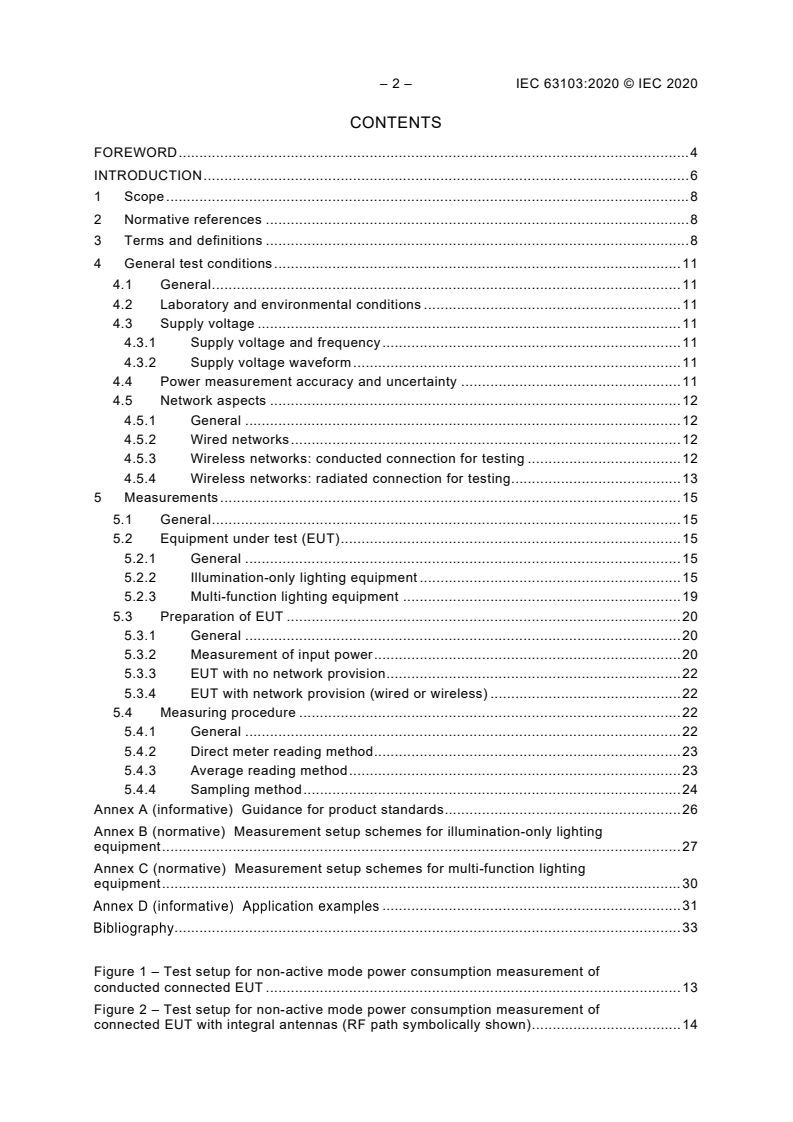
– 2 – IEC 63103:2020 © IEC 2020
CONTENTS
FOREWORD . 4
INTRODUCTION . 6
1 Scope . 8
2 Normative references . 8
3 Terms and definitions . 8
4 General test conditions . 11
4.1 General . 11
4.2 Laboratory and environmental conditions . 11
4.3 Supply voltage . 11
4.3.1 Supply voltage and frequency . 11
4.3.2 Supply voltage waveform . 11
4.4 Power measurement accuracy and uncertainty . 11
4.5 Network aspects . 12
4.5.1 General . 12
4.5.2 Wired networks . 12
4.5.3 Wireless networks: conducted connection for testing . 12
4.5.4 Wireless networks: radiated connection for testing. 13
5 Measurements . 15
5.1 General . 15
5.2 Equipment under test (EUT) . 15
5.2.1 General . 15
5.2.2 Illumination-only lighting equipment . 15
5.2.3 Multi-function lighting equipment . 19
5.3 Preparation of EUT . 20
5.3.1 General . 20
5.3.2 Measurement of input power . 20
5.3.3 EUT with no network provision . 22
5.3.4 EUT with network provision (wired or wireless) . 22
5.4 Measuring procedure . 22
5.4.1 General . 22
5.4.2 Direct meter reading method . 23
5.4.3 Average reading method . 23
5.4.4 Sampling method . 24
Annex A (informative) Guidance for product standards . 26
Annex B (normative) Measurement setup schemes for illumination-only lighting
equipment . 27
Annex C (normative) Measurement setup schemes for multi-function lighting
equipment . 30
........................................................................ 31
.......................................................................................................................... 33
Figure 1 – Test setup for non-active mode power consumption measurement of
conducted connected EUT . 13
Figure 2 – Test setup for non-active mode power consumption measurement of
connected EUT with integral antennas (RF path symbolically shown) . 14
Figure 3 – Calibration setup for non-active mode power measurement of connected
EUT with integral antennas . 14
Figure 4 – Components present within illumination-only EUT . 15
Figure 5 – Component representing an additional function (AF) of multi-function EUT . 19
Figure 6 – Configuration of multi-function lighting equipment: example including one
additional function . 19
Figure B.1 – Key to symbols used in figures of Annex B. 27
Figure B.2 – Measurement setup for determining the input power supplied to the power
supply . 27
Figure B.3 – Measurement setup (with optional network provision) for determining the
input power supplied to the control unit . 28
Figure B.4 – Measurement setup (with optional network provision) for determining the
input power supplied to the combined power supply and control unit . 28
Figure B.5 – Measurement setup for determining the input power supplied to the
combined light source and power supply . 28
Figure B.6 – Measurement setup (with optional network provision) for determining the
input power supplied to the combined light source and control unit . 28
Figure B.7 – Measurement setup (with optional network provision) for determining the
input power supplied to illumination-only lighting equipment . 29
Figure C.1 – Key to symbols used in figures of Annex C . 30
Figure C.2 – Measurement setup (with optional network provision) for determining the
input power to multi-function lighting equipment . 30
Figure D.1 – General measurement setup scheme for controlgear examples . 31
Figure D.2 – Networked standby mode measurement setup for the "basic" controlgear . 32
Figure D.3 – Networked standby mode measurement setup for controlgear with an
integrated auxiliary/bus power supply function . 32
Table 1 – Configurations and examples of illumination-only equipment and reference to
the measurement setup . 17
Table 2 – Template for reporting non-active mode power . 18
Table 3 – Example of using the template of Table 2 for reporting measured standby
power for an illumination-only luminaire with integrated presence sensor . 18
Table 4 – Example of using the template of Table 2 for reporting measured standby
power for a (multi-function) luminaire with an integrated presence sensor and an
integrated camera . 20
– 4 – IEC 63103:2020 © IEC 2020
INTERNATIONAL ELECTROTECHNICAL COMMISSION
____________
LIGHTING EQUIPMENT –
NON-ACTIVE MODE POWER MEASUREMENT
FOREWORD
1) The International Electrotechnical Commission (IEC) is a worldwide organization for standardization comprising
all national electrotechnical committees (IEC National Committees). The object of IEC is to promote
international co-operation on all questions concerning standardization in the electrical and electronic fields. To
this end and in addition to other activities, IEC publishes International Standards, Technical Specifications,
Technical Reports, Publicly Available Specifications (PAS) and Guides (hereafter referred to as “IEC
Publication(s)”). Their preparation is entrusted to technical committees; any IEC National Committee interested
in the subject dealt with may participate in this preparatory work. International, governmental and non-
governmental organizations liaising with the IEC also participate in this preparation. IEC collaborates closely
with the International Organization for Standardization (ISO) in accordance with conditions determined by
agreement between the two organizations.
2) The formal decisions or agreements of IEC on technical matters express, as nearly as possible, an international
consensus of opinion on the relevant subjects since each technical committee has representation from all
interested IEC National Committees.
3) IEC Publications have the form of recommendations for international use and are accepted by IEC National
Committees in that sense. While all reasonable efforts are made to ensure that the technical content of IEC
Publications is accurate, IEC cannot be held responsible for the way in which they are used or for any
misinterpretation by any end user.
4) In order to promote international uniformity, IEC National Committees undertake to apply IEC Publications
transparently to the maximum extent possible in their national and regional publications. Any divergence
between any IEC Publication and the corresponding national or regional publication shall be clearly indicated in
the latter.
5) IEC itself does not provide any attestation of conformity. Independent certification bodies provide conformity
assessment services and, in some areas, access to IEC marks of conformity. IEC is not responsible for any
services carried out by independent certification bodies.
6) All users should ensure that they have the latest edition of this publication.
7) No liability shall attach to IEC or its directors, employees, servants or agents including individual experts and
members of its technical committees and IEC National Committees for any personal injury, property damage or
other damage of any nature whatsoever, whether direct or indirect, or for costs (including legal fees) and
expenses arising out of the publication, use of, or reliance upon, this IEC Publication or any other IEC
Publications.
8) Attention is drawn to the Normative references cited in this publication. Use of the referenced publications is
indispensable for the correct application of this publication.
9) Attention is drawn to the possibility that some of the elements of this IEC Publication may be the subject of
patent rights. IEC shall not be held responsible for identifying any or all such patent rights.
International Standard IEC 63103 has been prepared by IEC technical committee 34: Lamps
and related equipment.
The text of this International Standard is based on the following documents:
FDIS Report on voting
34/698/FDIS 34/709/RVD
Full information on the voting for the approval of this International Standard can be found in
the report on voting indicated in the above table.
This document has been drafted in accordance with the ISO/IEC Directives, Part 2.
The committee has decided that the contents of this document will remain unchanged until the
stability date indicated on the IEC website under "http://webstore.iec.ch" in the data related to
the specific document. At this date, the document will be
• reconfirmed,
• withdrawn,
• replaced by a revised edition, or
• amended.
IMPORTANT – The 'colour inside' logo on the cover page of this publication indicates
that it contains colours which are considered to be useful for the correct
understanding of its contents. Users should therefore print this document using a
colour printer.
– 6 – IEC 63103:2020 © IEC 2020
INTRODUCTION
The first edition of this document specifies uniform requirements for measuring non-active
mode power consumption for all lighting equipment. Present performance standards for
controlgear (IEC 62442 (all parts)) and luminaires (IEC 62722-1), already include some
descriptions for measuring standby power. It is expected that these standards will be
amended, accordingly.
In addition to an illumination function, today’s lighting equipment can execute a variety of
additional non-illumination functions, for example through integrated surveillance cameras,
noise detectors, occupancy counters, vehicular and pedestrian traffic detection, weather
detection, smoke detection, visible light communication and proximity or location devices.
During the execution of these functions, the (multi-function) lighting equipment can operate in
many different (active and non-active) modes. Non-active mode power consumption of (multi-
function) lighting equipment, i.e. the power consumed when the illumination function is off, is
an important aspect of lighting equipment and is becoming more important with the
emergence of connected lighting.
This document defines and describes methods of measurement of electrical power
consumption in non-active mode(s) for lighting equipment. The document is organized into
two main clauses: Clause 4 "General test conditions" and Clause 5 "Measurements".
Clause 4 contains specifications on the general conditions for making the measurements.
Subclauses 4.1 through 4.4 cover conditions for setting up the laboratory, selecting a supply
voltage and suitable instruments for the power measurement. Subclause 4.5 covers aspects
which should be considered when the lighting equipment is connected to a network to work
properly. Subclause 4.5.2 is for wired networks and 4.5.3 and 4.5.4 give setups for wireless
networks using conducted or radiated connections, respectively. These setups for wireless
networks are harmonized with ETSI Standard EN 300 328 and modified for lighting
equipment.
Clause 5 details the procedures for making measurements of the equipment under test (EUT).
Subclause 5.1 gives general instructions for setting the EUT into the possible non-active
mode(s). Subclause 5.2 details the large variety of EUTs. These EUTs can be placed into two
categories: illumination-only (5.2.2) and multi-function (5.2.3) lighting equipment. Traditional
lighting equipment with an illumination-only function is summarized in 5.2.2, Table 1. Multi-
function lighting equipment having additional non-illumination functions is addressed in 5.2.3.
A standardized form for reporting the measured result according to the functions and modes
of the multi-function lighting equipment under test is specified in 5.2.3, Table 2. Table 2 is a
central feature of this document that will enable all users to report their non-active power
results in a consistent manner.
Subclause 5.3 specifies procedures for preparing the EUT to make measurements of the input
power. Instructions for EUTs containing battery charging functions are found in 5.3.2.
Subclause 5.3.3 gives procedures for EUTs having no network provision and 5.3.4 covers
networked EUTs whether wired or wireless.
The measurement procedure is specified in 5.4 and offers three alternative methods and the
specific stability conditions required for each. These methods are adapted for lighting
equipment from IEC 62301:2011. The direct meter method specified in 5.4.2 has the most
limited applicability. It can only be used when the power reading is stable. In cases of
discrepancy, the average reading method (5.4.3) or sampling method (5.4.4) have
precedence. The average reading method is suitable only for EUTs having stable modes
whereas the sampling method is suited for cyclic or unstable modes and if the mode is of
limited duration.
Informative annexes are included to illustrate various measurement setups (Annex B and
Annex C) and Annex D provides practical examples of controlgear, for example involving
lighting equipment having a digital addressable lighting interface network in accordance with
IEC 62386 (all parts), and of luminaires.
The methods defined and described in this document are not intended to be used to measure
power consumption of (multi-function) lighting equipment during active mode(s) (also called
"on mode(s)"), as these are generally covered by IEC standards or other product standards.
This document provides methods of measurement for lighting equipment. However, the
methods specified in this document could also be used to measure lighting system models. A
system model is a full-size portion of the lighting system containing specific functions and can
set every mode of a portion of the system. The system models should be scalable to the
entire lighting system additively. Thus, the total non-active mode power consumption of the
system should equal the summation of power measured in each system model.
Using an adaptive roadway and pedestrian lighting system as an example for illustration, the
following three system models could be present:
– (A) five luminaires connected to one daylight sensor; illuminate to compensate daylight;
– (B) a luminaire with a pedestrian sensor, a daylight sensor, connected to a crosswalk
illumination; illuminate the crosswalk upon sensing a pedestrian when needed;
– (C) a dimmable luminaire with a vehicle detector; illuminate upon sensing a vehicle when
needed.
Assume the lighting system comprises 50 A-, 10 B-, and 20 C-system models, then the total
power consumption for a specified mode of the system would be
Power(mode) = 50 × power(A) + 10 × power(B) + 20 × power(C). Table 2 (5.2.3) could be
used to specify the measurement of a system model set in various combinations of modes. In
this way, the system is evaluated in measurable pieces (system models) set to function
interactively as the entire system is intended for each mode.
– 8 – IEC 63103:2020 © IEC 2020
LIGHTING EQUIPMENT –
NON-ACTIVE MODE POWER MEASUREMENT
1 Scope
This document specifies methods of measurement of electrical power consumption in non-
active mode(s), as applicable for electrical lighting equipment. This includes electrical lighting
equipment incorporating non-illumination components.
This document specifies neither performance requirements nor limits on power consumption.
This document applies to lighting equipment connected to a supply voltage up to 1 500 V DC
or up to 1 000 V AC.
This document is intended to be referenced by lighting equipment product standards for the
measurement of non-active mode power consumption. Details for the non-active mode power
consumption measurement and data presentation are specified in the product standards.
NOTE Annex A provides guidance on details specified in product standards.
2 Normative references
The following documents are referred to in the text in such a way that some or all of their
content constitutes requirements of this document. For dated references, only the edition
cited applies. For undated references, the latest edition of the referenced document (including
any amendments) applies.
IEC 60050-845, International Electrotechnical Vocabulary – Part 845: Lighting (available at
http://www.electropedia.org)
IEC 62504, General lighting – Light emitting diode (LED) products and related equipment –
Terms and definitions
IEC TS 63105, Lighting systems and related equipment – Vocabulary
ETSI EN 300 328 V2.1.1 (2016-11), Wideband transmission systems; Data transmission
equipment operating in the 2,4 GHz ISM band and using wide band modulation techniques;
Harmonized Standard covering the essential requirements of article 3.2 of Directive
2014/53/EU
3 Terms and definitions
For the purposes of this document the terms and definitions given in IEC 60050-845,
IEC 62504 and IEC TS 63105 and the following apply.
ISO and IEC maintain terminological databases for use in standardization at the following
addresses:
• IEC Electropedia: available at http://www.electropedia.org/
• ISO Online browsing platform: available at http://www.iso.org/obp
___________
Under preparation. Stage at the time of publication IEC CDTS 63105:2020.
3.1
lighting equipment
assembly of components used for the primary function of providing illumination, or any
component thereof
EXAMPLE Integrated lamp, non-integrated lamp plus controlgear, luminaire, controlgear, luminaire with camera.
Note 1 to entry: Lighting equipment can also include non-illumination components that offer non-illumination
functions.
Note 2 to entry: Within the primary function of illumination, applications like horticultural, UV disinfection, etc. are
included.
3.2
component
constituent part which cannot be physically divided into smaller parts without losing its
function
EXAMPLE Light source, power supply, control unit.
[SOURCE: IEC 60050-151:2001, 151-11-21, modified – "of a device" and "particular" deleted.]
3.3
supply voltage
SV
voltage applied by electric connection to provide electric energy
EXAMPLE 110 V AC, 230 V AC, 24 V DC, power over Ethernet.
[SOURCE: IEC 61347-1:2015, 3.5, modified – Definition adapted for lighting and examples
added.]
3.4
network
communication infrastructure with a topology of links, an architecture, including the physical
components, organizational principles, communication procedures and formats (protocols)
3.5
function
predetermined operating characteristic
EXAMPLE Illuminating, battery charging, wireless routing, auxiliary power output.
Note 1 to entry: Functions can be either on, off, in standby or networked standby.
Note 2 to entry: Typically, instructions for use specify which functions can be turned off and how.
3.6
mode
distinct configuration of the status of functions
3.7
active mode
mode with the illumination function on
3.8
non-active mode
mode with the illumination function off
EXAMPLE Standby mode, networked standby mode, off mode, no-load mode.
– 10 – IEC 63103:2020 © IEC 2020
3.9
off mode
mode with all functions off
Note 1 to entry: An indicator that only shows the user that the lighting equipment is in the off state is included
within the classification of off mode.
3.10
standby mode
mode when the equipment is connected to a supply voltage with the
illumination function off, while capable of being activated by an external trigger not being a
trigger from a network
Note 1 to entry: Examples of external triggers are sensing or timing.
3.11
networked standby mode
mode when the equipment is connected to a supply voltage with the
illumination function off, while capable of being activated by an external trigger being a trigger
from a network
3.12
no-load mode
mode when the equipment is connected to a supply voltage where the
illumination function is switched off or disconnected at the output circuit of the controlgear
3.13
charging maintenance mode
mode to maintain the battery in a fully charged condition
Note 1 to entry: Power consumption of emergency lighting equipment is called emergency lighting charging
power.
3.14
instructions for use
information that is provided by the manufacturer or responsible vendor for users of the
equipment
Note 1 to entry: Instructions for use would include a user manual and may be in paper or electronic form.
Instructions for use do not include any special directions provided by the equipment supplier to the test laboratory
especially for testing purposes.
[SOURCE: IEC 62301:2011, 3.12, modified – "by the manufacturer or responsible vendor"
added and "product" replaced with "equipment".]
3.15
equipment under test
EUT
equipment as specified in the scope of this document subjected to non-active mode power
consumption assessment
EXAMPLE Illumination-only lighting equipment or multi-function lighting equipment.
3.16
power boundary
perimeter surrounding the equipment under test through which all forms of energy flow and at
which the sum of power is measured
3.17
packet error rate
PER
ratio of the number of packets incorrectly received to the total number of packets sent
expressed as a percentage
4 General test conditions
4.1 General
Unless otherwise specified in relevant product standards or instructions for use,
measurements on the equipment under test (EUT) shall be made under the test conditions
and with measuring instruments specified in 4.2 to 4.5.
4.2 Laboratory and environmental conditions
The test shall be carried out at a room temperature of (25 ± 5) °C.
4.3 Supply voltage
4.3.1 Supply voltage and frequency
Tests shall be carried out at the rated voltage and at the rated frequency.
In the case where a rated voltage range is specified, tests shall be carried out at the minimum
and maximum value of that specified voltage range.
In case of alternative rated voltages, tests shall be performed separately for each rated
voltage.
In case of alternative rated AC frequencies or a rated frequency range, tests shall be
performed at the minimum and maximum frequency.
The supply voltage and the frequency shall be maintained constant within ±1 % during the
test.
4.3.2 Supply voltage waveform
In case of AC supply voltage, the total harmonic distortion (THD), up to and including the 13th
harmonic, of the supply voltage when supplying the EUT in the specified mode, shall not
exceed 3 %. THD is the ratio of the RMS value of the sum of the harmonic components (in
of orders 2 to at least 13) to the RMS value of
this context, harmonic current components I
h
the fundamental component, expressed as a percentage. The power supply shall not produce
inter-harmonics when operating in the power range of interest. In addition to the above, the
ratio of peak value to RMS value of the AC test voltage (i.e. crest factor) when supplying the
EUT shall be between 1,34 and 1,49.
In case of DC supply voltage, the ripple factor of the supply voltage shall be lower than 0,5 %.
4.4 Power measurement accuracy and uncertainty
For measurement accuracy, uncertainty and traceability see ISO/IEC Guide 98-3 and
IEC Guide 115.
– 12 – IEC 63103:2020 © IEC 2020
4.5 Network aspects
4.5.1 General
When the external trigger to change between active mode and non-active mode originates
from a network connection, care shall be taken to ensure that the network in question is
properly configured and connected to the EUT, to obtain an accurate measure of power
consumption. Where the use of additional products/components is needed for the
measurement of the EUT care shall be taken in the selection and characterization of these
items such that they are fully representative to the degree that the measurement accuracy for
the EUT is not adversely affected. The instructions for use shall contain information about
which functions can be turned off for the measurement and how to turn them off.
Care shall be taken as several power levels can be possible (e.g. power can be affected by
network connection quality, connection speed or the number and type of network
connections). The power consumption can also cycle in these modes.
For non-active mode power consumption measurements, the network functionality shall be
limited to setting the (non-active) mode of the EUT, such that no additional power
consumption is induced to the EUT beyond the need to set and maintain the non-active mode.
To test an EUT connected to a wired network, guidance is given in 4.5.2.
For a wireless network, there can be a difference in power consumption between the wireless
device looking for a connection (listening) and where the network connection is established. It
is important to consider that in a network, the energy consumption of the EUT can be affected
by its design, the environment and user interaction as well as network interaction.
When an EUT has the capability to connect to multiple wireless networks, non-active mode
power shall be determined for all networks independently.
An EUT connected to a wireless network can be configured either with an antenna connector
or an integrated antenna. In the case where the EUT has antenna connectors, the EUT can be
tested either by using a cabled connection (see 4.5.3) or by using the integrated antenna (for
direct radiating measurements, see 4.5.4).
NOTE In the case of a network receiver that is only waiting for trigger signal and where the power does not
change due to the quality of the network, there is no need to establish networks in accordance with 4.5.3 and 4.5.4.
4.5.2 Wired networks
Wired networks can induce power consumption by the EUT which is not linked to the intended
function to change modes of the lighting equipment. During measurements in non-active
mode, the EUT and a suitable controller shall be the only devices being connected to the bus.
Communication in such wired network shall be limited to what is needed to switch the EUT
from non-active mode to active mode within the time specified. During measurements, the
high voltage level of the communication bus (representing one logic state) shall be set to the
rated value with a tolerance of ±2 %. If a rated voltage range is specified, the middle value of
the range shall be set with a tolerance of ±2 %. The low voltage level of the bus shall be
negligibly low.
4.5.3 Wireless networks: conducted connection for testing
For an EUT whose ports are equipped with antenna connectors, testing shall be performed
using conducted measurements in accordance with the test setup shown in Figure 1 or in
accordance with 4.5.4.
Figure 1 – Test setup for non-active mode power consumption measurement
of conducted connected EUT
When this test method is selected, the following steps shall be employed to prepare the EUT
for measurement:
– For a frequency hopping EUT, operating channel variation is accepted as is.
– For a non-frequency hopping EUT, the EUT shall be set to an operating channel that will
be employed when the EUT is used for its intended application. The operating channel
frequency shall be recorded.
– A communication link is established between the EUT and the associated companion
device using the test setup shown in Figure 1. The attenuation of the variable attenuator
shall be increased in 1 dB steps to the maximum value at which the packet error rate
(PER) remains less than or equal to 10 %. The manufacturer may specify an alternative
PER if appropriate for the intended use of the EUT. The resultant signal level at the input
of the EUT is then P and shall be recorded.
min
– Set the wireless network command refreshment rate at 1 kHz, or at a relevant rate
provided by the manufacturer.
4.5.4 Wireless networks: radiated connection for testing
For an EUT with integral antennas, i.e. without antenna connectors, testing shall be
performed using radiated measurements in accordance with the test setup shown in Figure 2.
When this test method is selected, the following steps shall be employed to prepare the EUT
for measurement:
– A test site as described in Annex B of ETSI standard EN 300 328 V2.1.1 (2016-11) and
applicable measurement procedures as described in Annex C, Clauses C.1 to C.4
inclusive of the same standard shall be used.
– The test setup shall take the form shown in Figure 2.
– 14 – IEC 63103:2020 © IEC 2020
Figure 2 – Test setup for non-active mode power consumption measurement
of connected EUT with integral antennas (RF path symbolically shown)
– The transmitted power level from the associated companion device and its physical
separation from the EUT shall be adjusted until the packet error rate (PER) approaches
but remains less than or equal to 10 %. The manufacturer may specify an alternative PER
if appropriate for the intended use of the EUT.
– The resultant signal level at the input of the EUT is measured by a spectrum analyser
using a substitution antenna as shown in Figure 3. The measurement distance between
antennas and power setting of the signalling unit or companion device are kept fixed. The
absolute signal level, P , at the EUT shall be recorded as a calibration.
min
Figure 3 – Calibration setup for non-active mode power measurement
of connected EUT with integral antennas
– Following calibration, the substitution antenna and the spectrum analyser shall be
replaced with the EUT.
– Set the wireless network command refreshment rate at 1 kHz, or at a relevant rate
provided by the manufacturer.
5 Measurements
5.1 General
The purpose of the measurements is to determine the power consumption in persistent non-
active mode(s) of lighting equipment. A non-active mode is persistent when power
consumption is constant or when there are several power levels that occur in a regular
sequence.
NOTE 1 During transition from the active mode to the non-active mode some EUTs could be waiting in a higher
power state while transition tasks are performed, or circuits are energized or de-energized, so they can take some
time to enter a stable state.
NOTE 2 Where the EUT mode changes automatically it can sometimes be necessary to operate an EUT through
the automatic sequence several times on a trial basis to ensure that sequence is fully understood and documented
before test results are recorded and reported. A sequence of separate EUT modes can also exhibit a regular
ongoing pattern of power levels.
NOTE 3 While limited duration modes can be documented using measurements in accordance with this
document, the results for such modes can be reported as an energy consumption (Wh) and related time intervals.
A variety of non-active modes can be considered for assessing, for example:
– standby mode;
– networked standby mode;
– off mode;
– no-load mode.
The EUTs assessed are described in 5.2. To assess a specific mode, an EUT shall be
prepared as described in 5.3. Guidance for EUTs with battery charging provisions is also
given in 5.3.2. After preparation, power consumption of the EUT in the specified non-active
mode is determined via the procedure described in 5.4.
5.2 Equipment under test (EUT)
5.2.1 General
The EUT to be assessed on non-active mode power consumption can be lighting equipment
for illumination-only (for example lamps, luminaires and controlgear) and multi-function
lighting equipment (which include additional non-illumination function(s)). Details on
illumination-only lighting equipment is given in 5.2.2 and on multi-function lighting equipment
in 5.2.3.
5.2.2 Illumination-only lighting equipment
Illumination-only lighting equipment can consist of one or more components, which function as
light source (LS), power supply (PS) and control unit (CU). In Figure 4 these three
components are shown with their symbols used throughout this document.
a) Light source b) Power supply c) Control unit
Figure 4 – Components present within illumination-only EUT
– 16 – IEC 63103:2020 © IEC 2020
The light source (see Figure 4 a)) is the component responsible for generating light from the
energy delivered by the power supply.
NOTE For the purposes of this document, the light source is used to indicate a luminous element as defined in
IEC 60050-845:2020, 845-28-001.
The power supply (see Figure 4 b)) is the component converting, in a controlled way, power
from a supply voltage into power entering the light source for light generation.
The control unit (see Figure 4 c)) is the component acting as the interface between (external)
communication options and the EUT. The control unit is instrumental in changing the EUT
mode from active to non-active mode and vice versa, except when physical disconnections
are made to control the light output. The control unit instructs the power supply to drive the
light source in the requested mode (active, non-active).
Triggering the control unit to change between modes can originate from a sensor, timer or
external trigger. The external trigger to change between the active mode and a non-active
mode can originate from a network connection or from another source. In the case where the
external trigger originates from a network, the mode is termed "networked standby mode". In
other cases, the non-active EUT mode is termed "standby mode".
The power supply does not have a control unit, but its settings can be controlled via a control
unit. Therefore, the power supply does not have a direct connection to an external network.
Illumination-only lighting equipment under test can be fully functional products including a
light source, a power supply and a control unit (like a lamp or luminaire) or only some of these
elements, like a controlgear which is composed of a power supply and a control unit.
In Table 1 combinations of the components light source, power supply and control unit are
given, representing illumination-only lighting equipment. The table provides EUT
configurations with examples and references to the associated measurement setup schemes
for non-active mode power measurements in Annex B. Details on the preparation of the
measurement setups are given in 5.3.
Table 1 – Configurations and examples of illumination-only equipment
and reference to the measurement setup
Measurement
EUT configuration Example(s)
setup
A Independent power supply Figure B.2
B Controller Figure B.3
Digital addressable lighting interface
C Controlgear Figure B.4
D Mains voltage lamp Figure B.5
E Dimmable lamp Figure B.6
Controllable lamp
F Integrated lamp luminaire
G Dimmable lamp with external dimmer
Mains dimmable lamp
H Dimmable lamp with external power source
Figure B.7
I Lamp with remote controlgear
J Lamp with independent power supply and
dimmer
– 18 – IEC 63103:2020 © IEC 2020
Table 2 provides an overview of modes which can be present in EUTs. The template of this
table can be used for reporting the assessed non-active mode configuration by ticking the
corresponding cells and providing the measured value for the non-active mode power. If an
EUT can be set into various non-active modes, separate templates shall be used for reporting
each individual mode.
Table 2 – Template for reporting non-active mode power
Non-active mode
Function Function status
Off Standby Networked On
standby
Illumination
Sensing
Imaging
Energy storage
Powering
High network availability
...
...
Value
Measured non-active mode power
Unit [W]
Key: greyed cells indicate non-applicability.
Table 3 is an example of the template of Table 2 reporting the standby power of
illumination-only equipment, in this case a luminaire with an integrated presence sensor (EUT
configuration F in Table 1).
Table 3 – Example of using the template of Table 2
for reporting measured standby power for an illumination-only luminaire
with integrated presence sensor
Non-active mode
Function Function status
Off Standby Networked On
standby
Illumination X
Sensing X
Imaging
Energy storage
Powering
High network avai
...
IEC 63103 ®
Edition 1.0 2020-07
INTERNATIONAL
STANDARD
NORME
INTERNATIONALE
colour
inside
Lighting equipment – Non-active mode power measurement
Appareils d'éclairage – Mesure de puissance en mode non actif
All rights reserved. Unless otherwise specified, no part of this publication may be reproduced or utilized in any form
or by any means, electronic or mechanical, including photocopying and microfilm, without permission in writing from
either IEC or IEC's member National Committee in the country of the requester. If you have any questions about IEC
copyright or have an enquiry about obtaining additional rights to this publication, please contact the address below or
your local IEC member National Committee for further information.
Droits de reproduction réservés. Sauf indication contraire, aucune partie de cette publication ne peut être reproduite
ni utilisée sous quelque forme que ce soit et par aucun procédé, électronique ou mécanique, y compris la photocopie
et les microfilms, sans l'accord écrit de l'IEC ou du Comité national de l'IEC du pays du demandeur. Si vous avez des
questions sur le copyright de l'IEC ou si vous désirez obtenir des droits supplémentaires sur cette publication, utilisez
les coordonnées ci-après ou contactez le Comité national de l'IEC de votre pays de résidence.
IEC Central Office Tel.: +41 22 919 02 11
3, rue de Varembé info@iec.ch
CH-1211 Geneva 20 www.iec.ch
Switzerland
About the IEC
The International Electrotechnical Commission (IEC) is the leading global organization that prepares and publishes
International Standards for all electrical, electronic and related technologies.
About IEC publications
The technical content of IEC publications is kept under constant review by the IEC. Please make sure that you have the
latest edition, a corrigendum or an amendment might have been published.
IEC publications search - webstore.iec.ch/advsearchform IEC online collection - oc.iec.ch
The advanced search enables to find IEC publications by a Discover our powerful search engine and read freely all the
variety of criteria (reference number, text, technical publications previews. With a subscription you will always
committee, …). It also gives information on projects, replaced have access to up to date content tailored to your needs.
and withdrawn publications.
Electropedia - www.electropedia.org
IEC Just Published - webstore.iec.ch/justpublished
The world's leading online dictionary on electrotechnology,
Stay up to date on all new IEC publications. Just Published
containing more than 22 000 terminological entries in English
details all new publications released. Available online and
and French, with equivalent terms in 18 additional languages.
once a month by email.
Also known as the International Electrotechnical Vocabulary
(IEV) online.
IEC Customer Service Centre - webstore.iec.ch/csc
If you wish to give us your feedback on this publication or
need further assistance, please contact the Customer Service
Centre: sales@iec.ch.
A propos de l'IEC
La Commission Electrotechnique Internationale (IEC) est la première organisation mondiale qui élabore et publie des
Normes internationales pour tout ce qui a trait à l'électricité, à l'électronique et aux technologies apparentées.
A propos des publications IEC
Le contenu technique des publications IEC est constamment revu. Veuillez vous assurer que vous possédez l’édition la
plus récente, un corrigendum ou amendement peut avoir été publié.
Recherche de publications IEC - IEC online collection - oc.iec.ch
webstore.iec.ch/advsearchform Découvrez notre puissant moteur de recherche et consultez
La recherche avancée permet de trouver des publications IEC gratuitement tous les aperçus des publications. Avec un
en utilisant différents critères (numéro de référence, texte, abonnement, vous aurez toujours accès à un contenu à jour
comité d’études, …). Elle donne aussi des informations sur adapté à vos besoins.
les projets et les publications remplacées ou retirées.
Electropedia - www.electropedia.org
IEC Just Published - webstore.iec.ch/justpublished
Le premier dictionnaire d'électrotechnologie en ligne au
Restez informé sur les nouvelles publications IEC. Just
monde, avec plus de 22 000 articles terminologiques en
Published détaille les nouvelles publications parues.
anglais et en français, ainsi que les termes équivalents dans
Disponible en ligne et une fois par mois par email.
16 langues additionnelles. Egalement appelé Vocabulaire
Electrotechnique International (IEV) en ligne.
Service Clients - webstore.iec.ch/csc
Si vous désirez nous donner des commentaires sur cette
publication ou si vous avez des questions contactez-nous:
sales@iec.ch.
IEC 63103 ®
Edition 1.0 2020-07
INTERNATIONAL
STANDARD
NORME
INTERNATIONALE
colour
inside
Lighting equipment – Non-active mode power measurement
Appareils d'éclairage – Mesure de puissance en mode non actif
INTERNATIONAL
ELECTROTECHNICAL
COMMISSION
COMMISSION
ELECTROTECHNIQUE
INTERNATIONALE
ICS 29.140.01; 29.140.99 ISBN 978-2-8322-9996-8
– 2 – IEC 63103:2020 © IEC 2020
CONTENTS
FOREWORD . 4
INTRODUCTION . 6
1 Scope . 8
2 Normative references . 8
3 Terms and definitions . 8
4 General test conditions . 11
4.1 General . 11
4.2 Laboratory and environmental conditions . 11
4.3 Supply voltage . 11
4.3.1 Supply voltage and frequency . 11
4.3.2 Supply voltage waveform . 11
4.4 Power measurement accuracy and uncertainty . 11
4.5 Network aspects . 12
4.5.1 General . 12
4.5.2 Wired networks . 12
4.5.3 Wireless networks: conducted connection for testing . 12
4.5.4 Wireless networks: radiated connection for testing. 13
5 Measurements . 15
5.1 General . 15
5.2 Equipment under test (EUT) . 15
5.2.1 General . 15
5.2.2 Illumination-only lighting equipment . 15
5.2.3 Multi-function lighting equipment . 19
5.3 Preparation of EUT . 20
5.3.1 General . 20
5.3.2 Measurement of input power . 20
5.3.3 EUT with no network provision . 22
5.3.4 EUT with network provision (wired or wireless) . 22
5.4 Measuring procedure . 22
5.4.1 General . 22
5.4.2 Direct meter reading method . 23
5.4.3 Average reading method . 23
5.4.4 Sampling method . 24
Annex A (informative) Guidance for product standards . 26
Annex B (normative) Measurement setup schemes for illumination-only lighting
equipment . 27
Annex C (normative) Measurement setup schemes for multi-function lighting
equipment . 30
........................................................................ 31
.......................................................................................................................... 33
Figure 1 – Test setup for non-active mode power consumption measurement of
conducted connected EUT . 13
Figure 2 – Test setup for non-active mode power consumption measurement of
connected EUT with integral antennas (RF path symbolically shown) . 14
Figure 3 – Calibration setup for non-active mode power measurement of connected
EUT with integral antennas . 14
Figure 4 – Components present within illumination-only EUT . 15
Figure 5 – Component representing an additional function (AF) of multi-function EUT . 19
Figure 6 – Configuration of multi-function lighting equipment: example including one
additional function . 19
Figure B.1 – Key to symbols used in figures of Annex B. 27
Figure B.2 – Measurement setup for determining the input power supplied to the power
supply . 27
Figure B.3 – Measurement setup (with optional network provision) for determining the
input power supplied to the control unit . 28
Figure B.4 – Measurement setup (with optional network provision) for determining the
input power supplied to the combined power supply and control unit . 28
Figure B.5 – Measurement setup for determining the input power supplied to the
combined light source and power supply . 28
Figure B.6 – Measurement setup (with optional network provision) for determining the
input power supplied to the combined light source and control unit . 28
Figure B.7 – Measurement setup (with optional network provision) for determining the
input power supplied to illumination-only lighting equipment . 29
Figure C.1 – Key to symbols used in figures of Annex C . 30
Figure C.2 – Measurement setup (with optional network provision) for determining the
input power to multi-function lighting equipment . 30
Figure D.1 – General measurement setup scheme for controlgear examples . 31
Figure D.2 – Networked standby mode measurement setup for the "basic" controlgear . 32
Figure D.3 – Networked standby mode measurement setup for controlgear with an
integrated auxiliary/bus power supply function . 32
Table 1 – Configurations and examples of illumination-only equipment and reference to
the measurement setup . 17
Table 2 – Template for reporting non-active mode power . 18
Table 3 – Example of using the template of Table 2 for reporting measured standby
power for an illumination-only luminaire with integrated presence sensor . 18
Table 4 – Example of using the template of Table 2 for reporting measured standby
power for a (multi-function) luminaire with an integrated presence sensor and an
integrated camera . 20
– 4 – IEC 63103:2020 © IEC 2020
INTERNATIONAL ELECTROTECHNICAL COMMISSION
____________
LIGHTING EQUIPMENT –
NON-ACTIVE MODE POWER MEASUREMENT
FOREWORD
1) The International Electrotechnical Commission (IEC) is a worldwide organization for standardization comprising
all national electrotechnical committees (IEC National Committees). The object of IEC is to promote
international co-operation on all questions concerning standardization in the electrical and electronic fields. To
this end and in addition to other activities, IEC publishes International Standards, Technical Specifications,
Technical Reports, Publicly Available Specifications (PAS) and Guides (hereafter referred to as “IEC
Publication(s)”). Their preparation is entrusted to technical committees; any IEC National Committee interested
in the subject dealt with may participate in this preparatory work. International, governmental and non-
governmental organizations liaising with the IEC also participate in this preparation. IEC collaborates closely
with the International Organization for Standardization (ISO) in accordance with conditions determined by
agreement between the two organizations.
2) The formal decisions or agreements of IEC on technical matters express, as nearly as possible, an international
consensus of opinion on the relevant subjects since each technical committee has representation from all
interested IEC National Committees.
3) IEC Publications have the form of recommendations for international use and are accepted by IEC National
Committees in that sense. While all reasonable efforts are made to ensure that the technical content of IEC
Publications is accurate, IEC cannot be held responsible for the way in which they are used or for any
misinterpretation by any end user.
4) In order to promote international uniformity, IEC National Committees undertake to apply IEC Publications
transparently to the maximum extent possible in their national and regional publications. Any divergence
between any IEC Publication and the corresponding national or regional publication shall be clearly indicated in
the latter.
5) IEC itself does not provide any attestation of conformity. Independent certification bodies provide conformity
assessment services and, in some areas, access to IEC marks of conformity. IEC is not responsible for any
services carried out by independent certification bodies.
6) All users should ensure that they have the latest edition of this publication.
7) No liability shall attach to IEC or its directors, employees, servants or agents including individual experts and
members of its technical committees and IEC National Committees for any personal injury, property damage or
other damage of any nature whatsoever, whether direct or indirect, or for costs (including legal fees) and
expenses arising out of the publication, use of, or reliance upon, this IEC Publication or any other IEC
Publications.
8) Attention is drawn to the Normative references cited in this publication. Use of the referenced publications is
indispensable for the correct application of this publication.
9) Attention is drawn to the possibility that some of the elements of this IEC Publication may be the subject of
patent rights. IEC shall not be held responsible for identifying any or all such patent rights.
International Standard IEC 63103 has been prepared by IEC technical committee 34: Lamps
and related equipment.
The text of this International Standard is based on the following documents:
FDIS Report on voting
34/698/FDIS 34/709/RVD
Full information on the voting for the approval of this International Standard can be found in
the report on voting indicated in the above table.
This document has been drafted in accordance with the ISO/IEC Directives, Part 2.
The committee has decided that the contents of this document will remain unchanged until the
stability date indicated on the IEC website under "http://webstore.iec.ch" in the data related to
the specific document. At this date, the document will be
• reconfirmed,
• withdrawn,
• replaced by a revised edition, or
• amended.
IMPORTANT – The 'colour inside' logo on the cover page of this publication indicates
that it contains colours which are considered to be useful for the correct
understanding of its contents. Users should therefore print this document using a
colour printer.
– 6 – IEC 63103:2020 © IEC 2020
INTRODUCTION
The first edition of this document specifies uniform requirements for measuring non-active
mode power consumption for all lighting equipment. Present performance standards for
controlgear (IEC 62442 (all parts)) and luminaires (IEC 62722-1), already include some
descriptions for measuring standby power. It is expected that these standards will be
amended, accordingly.
In addition to an illumination function, today’s lighting equipment can execute a variety of
additional non-illumination functions, for example through integrated surveillance cameras,
noise detectors, occupancy counters, vehicular and pedestrian traffic detection, weather
detection, smoke detection, visible light communication and proximity or location devices.
During the execution of these functions, the (multi-function) lighting equipment can operate in
many different (active and non-active) modes. Non-active mode power consumption of (multi-
function) lighting equipment, i.e. the power consumed when the illumination function is off, is
an important aspect of lighting equipment and is becoming more important with the
emergence of connected lighting.
This document defines and describes methods of measurement of electrical power
consumption in non-active mode(s) for lighting equipment. The document is organized into
two main clauses: Clause 4 "General test conditions" and Clause 5 "Measurements".
Clause 4 contains specifications on the general conditions for making the measurements.
Subclauses 4.1 through 4.4 cover conditions for setting up the laboratory, selecting a supply
voltage and suitable instruments for the power measurement. Subclause 4.5 covers aspects
which should be considered when the lighting equipment is connected to a network to work
properly. Subclause 4.5.2 is for wired networks and 4.5.3 and 4.5.4 give setups for wireless
networks using conducted or radiated connections, respectively. These setups for wireless
networks are harmonized with ETSI Standard EN 300 328 and modified for lighting
equipment.
Clause 5 details the procedures for making measurements of the equipment under test (EUT).
Subclause 5.1 gives general instructions for setting the EUT into the possible non-active
mode(s). Subclause 5.2 details the large variety of EUTs. These EUTs can be placed into two
categories: illumination-only (5.2.2) and multi-function (5.2.3) lighting equipment. Traditional
lighting equipment with an illumination-only function is summarized in 5.2.2, Table 1. Multi-
function lighting equipment having additional non-illumination functions is addressed in 5.2.3.
A standardized form for reporting the measured result according to the functions and modes
of the multi-function lighting equipment under test is specified in 5.2.3, Table 2. Table 2 is a
central feature of this document that will enable all users to report their non-active power
results in a consistent manner.
Subclause 5.3 specifies procedures for preparing the EUT to make measurements of the input
power. Instructions for EUTs containing battery charging functions are found in 5.3.2.
Subclause 5.3.3 gives procedures for EUTs having no network provision and 5.3.4 covers
networked EUTs whether wired or wireless.
The measurement procedure is specified in 5.4 and offers three alternative methods and the
specific stability conditions required for each. These methods are adapted for lighting
equipment from IEC 62301:2011. The direct meter method specified in 5.4.2 has the most
limited applicability. It can only be used when the power reading is stable. In cases of
discrepancy, the average reading method (5.4.3) or sampling method (5.4.4) have
precedence. The average reading method is suitable only for EUTs having stable modes
whereas the sampling method is suited for cyclic or unstable modes and if the mode is of
limited duration.
Informative annexes are included to illustrate various measurement setups (Annex B and
Annex C) and Annex D provides practical examples of controlgear, for example involving
lighting equipment having a digital addressable lighting interface network in accordance with
IEC 62386 (all parts), and of luminaires.
The methods defined and described in this document are not intended to be used to measure
power consumption of (multi-function) lighting equipment during active mode(s) (also called
"on mode(s)"), as these are generally covered by IEC standards or other product standards.
This document provides methods of measurement for lighting equipment. However, the
methods specified in this document could also be used to measure lighting system models. A
system model is a full-size portion of the lighting system containing specific functions and can
set every mode of a portion of the system. The system models should be scalable to the
entire lighting system additively. Thus, the total non-active mode power consumption of the
system should equal the summation of power measured in each system model.
Using an adaptive roadway and pedestrian lighting system as an example for illustration, the
following three system models could be present:
– (A) five luminaires connected to one daylight sensor; illuminate to compensate daylight;
– (B) a luminaire with a pedestrian sensor, a daylight sensor, connected to a crosswalk
illumination; illuminate the crosswalk upon sensing a pedestrian when needed;
– (C) a dimmable luminaire with a vehicle detector; illuminate upon sensing a vehicle when
needed.
Assume the lighting system comprises 50 A-, 10 B-, and 20 C-system models, then the total
power consumption for a specified mode of the system would be
Power(mode) = 50 × power(A) + 10 × power(B) + 20 × power(C). Table 2 (5.2.3) could be
used to specify the measurement of a system model set in various combinations of modes. In
this way, the system is evaluated in measurable pieces (system models) set to function
interactively as the entire system is intended for each mode.
– 8 – IEC 63103:2020 © IEC 2020
LIGHTING EQUIPMENT –
NON-ACTIVE MODE POWER MEASUREMENT
1 Scope
This document specifies methods of measurement of electrical power consumption in non-
active mode(s), as applicable for electrical lighting equipment. This includes electrical lighting
equipment incorporating non-illumination components.
This document specifies neither performance requirements nor limits on power consumption.
This document applies to lighting equipment connected to a supply voltage up to 1 500 V DC
or up to 1 000 V AC.
This document is intended to be referenced by lighting equipment product standards for the
measurement of non-active mode power consumption. Details for the non-active mode power
consumption measurement and data presentation are specified in the product standards.
NOTE Annex A provides guidance on details specified in product standards.
2 Normative references
The following documents are referred to in the text in such a way that some or all of their
content constitutes requirements of this document. For dated references, only the edition
cited applies. For undated references, the latest edition of the referenced document (including
any amendments) applies.
IEC 60050-845, International Electrotechnical Vocabulary – Part 845: Lighting (available at
http://www.electropedia.org)
IEC 62504, General lighting – Light emitting diode (LED) products and related equipment –
Terms and definitions
IEC TS 63105, Lighting systems and related equipment – Vocabulary
ETSI EN 300 328 V2.1.1 (2016-11), Wideband transmission systems; Data transmission
equipment operating in the 2,4 GHz ISM band and using wide band modulation techniques;
Harmonized Standard covering the essential requirements of article 3.2 of Directive
2014/53/EU
3 Terms and definitions
For the purposes of this document the terms and definitions given in IEC 60050-845,
IEC 62504 and IEC TS 63105 and the following apply.
ISO and IEC maintain terminological databases for use in standardization at the following
addresses:
• IEC Electropedia: available at http://www.electropedia.org/
• ISO Online browsing platform: available at http://www.iso.org/obp
___________
Under preparation. Stage at the time of publication IEC CDTS 63105:2020.
3.1
lighting equipment
assembly of components used for the primary function of providing illumination, or any
component thereof
EXAMPLE Integrated lamp, non-integrated lamp plus controlgear, luminaire, controlgear, luminaire with camera.
Note 1 to entry: Lighting equipment can also include non-illumination components that offer non-illumination
functions.
Note 2 to entry: Within the primary function of illumination, applications like horticultural, UV disinfection, etc. are
included.
3.2
component
constituent part which cannot be physically divided into smaller parts without losing its
function
EXAMPLE Light source, power supply, control unit.
[SOURCE: IEC 60050-151:2001, 151-11-21, modified – "of a device" and "particular" deleted.]
3.3
supply voltage
SV
voltage applied by electric connection to provide electric energy
EXAMPLE 110 V AC, 230 V AC, 24 V DC, power over Ethernet.
[SOURCE: IEC 61347-1:2015, 3.5, modified – Definition adapted for lighting and examples
added.]
3.4
network
communication infrastructure with a topology of links, an architecture, including the physical
components, organizational principles, communication procedures and formats (protocols)
3.5
function
predetermined operating characteristic
EXAMPLE Illuminating, battery charging, wireless routing, auxiliary power output.
Note 1 to entry: Functions can be either on, off, in standby or networked standby.
Note 2 to entry: Typically, instructions for use specify which functions can be turned off and how.
3.6
mode
distinct configuration of the status of functions
3.7
active mode
mode with the illumination function on
3.8
non-active mode
mode with the illumination function off
EXAMPLE Standby mode, networked standby mode, off mode, no-load mode.
– 10 – IEC 63103:2020 © IEC 2020
3.9
off mode
mode with all functions off
Note 1 to entry: An indicator that only shows the user that the lighting equipment is in the off state is included
within the classification of off mode.
3.10
standby mode
mode when the equipment is connected to a supply voltage with the
illumination function off, while capable of being activated by an external trigger not being a
trigger from a network
Note 1 to entry: Examples of external triggers are sensing or timing.
3.11
networked standby mode
mode when the equipment is connected to a supply voltage with the
illumination function off, while capable of being activated by an external trigger being a trigger
from a network
3.12
no-load mode
mode when the equipment is connected to a supply voltage where the
illumination function is switched off or disconnected at the output circuit of the controlgear
3.13
charging maintenance mode
mode to maintain the battery in a fully charged condition
Note 1 to entry: Power consumption of emergency lighting equipment is called emergency lighting charging
power.
3.14
instructions for use
information that is provided by the manufacturer or responsible vendor for users of the
equipment
Note 1 to entry: Instructions for use would include a user manual and may be in paper or electronic form.
Instructions for use do not include any special directions provided by the equipment supplier to the test laboratory
especially for testing purposes.
[SOURCE: IEC 62301:2011, 3.12, modified – "by the manufacturer or responsible vendor"
added and "product" replaced with "equipment".]
3.15
equipment under test
EUT
equipment as specified in the scope of this document subjected to non-active mode power
consumption assessment
EXAMPLE Illumination-only lighting equipment or multi-function lighting equipment.
3.16
power boundary
perimeter surrounding the equipment under test through which all forms of energy flow and at
which the sum of power is measured
3.17
packet error rate
PER
ratio of the number of packets incorrectly received to the total number of packets sent
expressed as a percentage
4 General test conditions
4.1 General
Unless otherwise specified in relevant product standards or instructions for use,
measurements on the equipment under test (EUT) shall be made under the test conditions
and with measuring instruments specified in 4.2 to 4.5.
4.2 Laboratory and environmental conditions
The test shall be carried out at a room temperature of (25 ± 5) °C.
4.3 Supply voltage
4.3.1 Supply voltage and frequency
Tests shall be carried out at the rated voltage and at the rated frequency.
In the case where a rated voltage range is specified, tests shall be carried out at the minimum
and maximum value of that specified voltage range.
In case of alternative rated voltages, tests shall be performed separately for each rated
voltage.
In case of alternative rated AC frequencies or a rated frequency range, tests shall be
performed at the minimum and maximum frequency.
The supply voltage and the frequency shall be maintained constant within ±1 % during the
test.
4.3.2 Supply voltage waveform
In case of AC supply voltage, the total harmonic distortion (THD), up to and including the 13th
harmonic, of the supply voltage when supplying the EUT in the specified mode, shall not
exceed 3 %. THD is the ratio of the RMS value of the sum of the harmonic components (in
of orders 2 to at least 13) to the RMS value of
this context, harmonic current components I
h
the fundamental component, expressed as a percentage. The power supply shall not produce
inter-harmonics when operating in the power range of interest. In addition to the above, the
ratio of peak value to RMS value of the AC test voltage (i.e. crest factor) when supplying the
EUT shall be between 1,34 and 1,49.
In case of DC supply voltage, the ripple factor of the supply voltage shall be lower than 0,5 %.
4.4 Power measurement accuracy and uncertainty
For measurement accuracy, uncertainty and traceability see ISO/IEC Guide 98-3 and
IEC Guide 115.
– 12 – IEC 63103:2020 © IEC 2020
4.5 Network aspects
4.5.1 General
When the external trigger to change between active mode and non-active mode originates
from a network connection, care shall be taken to ensure that the network in question is
properly configured and connected to the EUT, to obtain an accurate measure of power
consumption. Where the use of additional products/components is needed for the
measurement of the EUT care shall be taken in the selection and characterization of these
items such that they are fully representative to the degree that the measurement accuracy for
the EUT is not adversely affected. The instructions for use shall contain information about
which functions can be turned off for the measurement and how to turn them off.
Care shall be taken as several power levels can be possible (e.g. power can be affected by
network connection quality, connection speed or the number and type of network
connections). The power consumption can also cycle in these modes.
For non-active mode power consumption measurements, the network functionality shall be
limited to setting the (non-active) mode of the EUT, such that no additional power
consumption is induced to the EUT beyond the need to set and maintain the non-active mode.
To test an EUT connected to a wired network, guidance is given in 4.5.2.
For a wireless network, there can be a difference in power consumption between the wireless
device looking for a connection (listening) and where the network connection is established. It
is important to consider that in a network, the energy consumption of the EUT can be affected
by its design, the environment and user interaction as well as network interaction.
When an EUT has the capability to connect to multiple wireless networks, non-active mode
power shall be determined for all networks independently.
An EUT connected to a wireless network can be configured either with an antenna connector
or an integrated antenna. In the case where the EUT has antenna connectors, the EUT can be
tested either by using a cabled connection (see 4.5.3) or by using the integrated antenna (for
direct radiating measurements, see 4.5.4).
NOTE In the case of a network receiver that is only waiting for trigger signal and where the power does not
change due to the quality of the network, there is no need to establish networks in accordance with 4.5.3 and 4.5.4.
4.5.2 Wired networks
Wired networks can induce power consumption by the EUT which is not linked to the intended
function to change modes of the lighting equipment. During measurements in non-active
mode, the EUT and a suitable controller shall be the only devices being connected to the bus.
Communication in such wired network shall be limited to what is needed to switch the EUT
from non-active mode to active mode within the time specified. During measurements, the
high voltage level of the communication bus (representing one logic state) shall be set to the
rated value with a tolerance of ±2 %. If a rated voltage range is specified, the middle value of
the range shall be set with a tolerance of ±2 %. The low voltage level of the bus shall be
negligibly low.
4.5.3 Wireless networks: conducted connection for testing
For an EUT whose ports are equipped with antenna connectors, testing shall be performed
using conducted measurements in accordance with the test setup shown in Figure 1 or in
accordance with 4.5.4.
Figure 1 – Test setup for non-active mode power consumption measurement
of conducted connected EUT
When this test method is selected, the following steps shall be employed to prepare the EUT
for measurement:
– For a frequency hopping EUT, operating channel variation is accepted as is.
– For a non-frequency hopping EUT, the EUT shall be set to an operating channel that will
be employed when the EUT is used for its intended application. The operating channel
frequency shall be recorded.
– A communication link is established between the EUT and the associated companion
device using the test setup shown in Figure 1. The attenuation of the variable attenuator
shall be increased in 1 dB steps to the maximum value at which the packet error rate
(PER) remains less than or equal to 10 %. The manufacturer may specify an alternative
PER if appropriate for the intended use of the EUT. The resultant signal level at the input
of the EUT is then P and shall be recorded.
min
– Set the wireless network command refreshment rate at 1 kHz, or at a relevant rate
provided by the manufacturer.
4.5.4 Wireless networks: radiated connection for testing
For an EUT with integral antennas, i.e. without antenna connectors, testing shall be
performed using radiated measurements in accordance with the test setup shown in Figure 2.
When this test method is selected, the following steps shall be employed to prepare the EUT
for measurement:
– A test site as described in Annex B of ETSI standard EN 300 328 V2.1.1 (2016-11) and
applicable measurement procedures as described in Annex C, Clauses C.1 to C.4
inclusive of the same standard shall be used.
– The test setup shall take the form shown in Figure 2.
– 14 – IEC 63103:2020 © IEC 2020
Figure 2 – Test setup for non-active mode power consumption measurement
of connected EUT with integral antennas (RF path symbolically shown)
– The transmitted power level from the associated companion device and its physical
separation from the EUT shall be adjusted until the packet error rate (PER) approaches
but remains less than or equal to 10 %. The manufacturer may specify an alternative PER
if appropriate for the intended use of the EUT.
– The resultant signal level at the input of the EUT is measured by a spectrum analyser
using a substitution antenna as shown in Figure 3. The measurement distance between
antennas and power setting of the signalling unit or companion device are kept fixed. The
absolute signal level, P , at the EUT shall be recorded as a calibration.
min
Figure 3 – Calibration setup for non-active mode power measurement
of connected EUT with integral antennas
– Following calibration, the substitution antenna and the spectrum analyser shall be
replaced with the EUT.
– Set the wireless network command refreshment rate at 1 kHz, or at a relevant rate
provided by the manufacturer.
5 Measurements
5.1 General
The purpose of the measurements is to determine the power consumption in persistent non-
active mode(s) of lighting equipment. A non-active mode is persistent when power
consumption is constant or when there are several power levels that occur in a regular
sequence.
NOTE 1 During transition from the active mode to the non-active mode some EUTs could be waiting in a higher
power state while transition tasks are performed, or circuits are energized or de-energized, so they can take some
time to enter a stable state.
NOTE 2 Where the EUT mode changes automatically it can sometimes be necessary to operate an EUT through
the automatic sequence several times on a trial basis to ensure that sequence is fully understood and documented
before test results are recorded and reported. A sequence of separate EUT modes can also exhibit a regular
ongoing pattern of power levels.
NOTE 3 While limited duration modes can be documented using measurements in accordance with this
document, the results for such modes can be reported as an energy consumption (Wh) and related time intervals.
A variety of non-active modes can be considered for assessing, for example:
– standby mode;
– networked standby mode;
– off mode;
– no-load mode.
The EUTs assessed are described in 5.2. To assess a specific mode, an EUT shall be
prepared as described in 5.3. Guidance for EUTs with battery charging provisions is also
given in 5.3.2. After preparation, power consumption of the EUT in the specified non-active
mode is determined via the procedure described in 5.4.
5.2 Equipment under test (EUT)
5.2.1 General
The EUT to be assessed on non-active mode power consumption can be lighting equipment
for illumination-only (for example lamps, luminaires and controlgear) and multi-function
lighting equipment (which include additional non-illumination function(s)). Details on
illumination-only lighting equipment is given in 5.2.2 and on multi-function lighting equipment
in 5.2.3.
5.2.2 Illumination-only lighting equipment
Illumination-only lighting equipment can consist of one or more components, which function as
light source (LS), power supply (PS) and control unit (CU). In Figure 4 these three
components are shown with their symbols used throughout this document.
a) Light source b) Power supply c) Control unit
Figure 4 – Components present within illumination-only EUT
– 16 – IEC 63103:2020 © IEC 2020
The light source (see Figure 4 a)) is the component responsible for generating light from the
energy delivered by the power supply.
NOTE For the purposes of this document, the light source is used to indicate a luminous element as defined in
IEC 60050-845:2020, 845-28-001.
The power supply (see Figure 4 b)) is the component converting, in a controlled way, power
from a supply voltage into power entering the light source for light generation.
The control unit (see Figure 4 c)) is the component acting as the interface between (external)
communication options and the EUT. The control unit is instrumental in changing the EUT
mode from active to non-active mode and vice versa, except when physical disconnections
are made to control the light output. The control unit instructs the power supply to drive the
light source in the requested mode (active, non-active).
Triggering the control unit to change between modes can originate from a sensor, timer or
external trigger. The external trigger to change between the active mode and a non-active
mode can originate from a network connection or from another source. In the case where the
external trigger originates from a network, the mode is termed "networked standby mode". In
other cases, the non-active EUT mode is termed "standby mode".
The power supply does not have a control unit, but its settings can be controlled via a control
unit. Therefore, the power supply does not have a direct connection to an external network.
Illumination-only lighting equipment under test can be fully functional products including a
light source, a power supply and a control unit (
...