

IEC TS 62910:2015
(Main)Utility-interconnected photovoltaic inverters - Test procedure for low voltage ride-through measurements
General Information
- Abstract
IEC TS 62910:2015(E) provides a test procedure for evaluating the performance of Low Voltage Ride-Through (LVRT) functions in inverters used in utility-interconnected PV systems. The technical specification is most applicable to large systems where PV inverters are connected to utility HV distribution systems. However, the applicable procedures may also be used for LV installations in locations where evolving LVRT requirements include such installations, e.g. single-phase or 3-phase systems. The measurement procedures are designed to be as non-site-specific as possible, so that LVRT characteristics measured at one test site, for example, can also be considered valid at other sites. This technical specification is for testing of PV inverters, though it contains information that may also be useful for testing of a complete PV power plant consisting of multiple inverters connected at a single point to the utility grid. It further provides a basis for utility-interconnected PV inverter numerical simulation and model validation.
- Status
- Published
- Publication Date
- 21-Oct-2015
- Technical Committee
- TC 82 - Solar photovoltaic energy systems
- Drafting Committee
- WG 6 - TC 82/WG 6
- Current Stage
- DELPUB - Deleted Publication
- Start Date
- 24-Jul-2020
- Completion Date
- 02-Sep-2019
Buy Documents
IEC TS 62910:2015 - Utility-interconnected photovoltaic inverters - Test procedure for low voltage ride-through measurements
IEC TS 62910:2015 - Utility-interconnected photovoltaic inverters - Test procedure for low voltage ride-through measurements Released:10/22/2015
Overview
IEC TS 62910:2015 specifies a standardized test procedure for Low Voltage Ride-Through (LVRT) measurements of utility‑interconnected photovoltaic (PV) inverters. It is primarily targeted at large PV systems where inverters connect to high‑voltage distribution networks, but the procedures can also be applied to low‑voltage (single‑phase or three‑phase) installations where LVRT requirements evolve. The technical specification is intended to produce site‑independent, repeatable LVRT characteristics suitable for type testing, model validation and comparative assessment.
Key topics and requirements
- Scope and applicability: Testing of individual PV inverters and guidance useful for multi‑inverter PV plants; LVRT performance is valid for the tested configuration only.
- Test circuit and equipment: Definitions and diagrams for test circuits, measurement instruments, DC sources, short‑circuit emulators and converter‑based grid simulators.
- Measurement accuracy and instrumentation: Requirements for measuring equipment accuracy and data capture (see accuracy table in the specification).
- Short‑circuit emulator and fault simulation: Procedures to reproduce different grid fault types and controlled voltage drops without being site specific.
- Test protocol and procedure: Pre‑test checks, no‑load and load tests, tolerance handling, and generation of LVRT test curves.
- Assessment criteria: Determination of ride‑through time, drop‑depth ratio, reactive current response and active power recovery used to evaluate inverter performance.
- Annexes: Informative guidance on circuit faults, voltage vector behavior during faults, and determination of critical performance values for LVRT testing.
- Reference for simulation: Provides a basis for numerical simulation and validation of inverter grid‑interaction models.
Applications and who uses it
IEC TS 62910 is valuable for:
- PV inverter manufacturers - type testing and design validation for LVRT performance.
- Independent test laboratories and certification bodies - standardized test methods for compliance verification.
- Utilities and system integrators - commissioning, acceptance testing and grid‑connection assessments.
- Asset owners and EPC contractors - understanding inverter behavior during grid faults and assessing plant resilience.
- Researchers and modelers - validating numerical models of inverter response and grid interaction.
Practical uses include type certification, grid‑code compliance preparation, performance benchmarking, commissioning tests, and inverter model validation for power system studies.
Related standards
- IEC 61400‑21 (referenced normative document) - measurement and assessment of power quality characteristics for grid‑connected generation, useful for cross‑reference.
- National and regional LVRT/grid‑code requirements (used in conjunction with this TS for compliance).
Keywords: IEC TS 62910:2015, LVRT, Low Voltage Ride‑Through, photovoltaic inverters, PV inverter testing, utility‑interconnected PV, short‑circuit emulator, grid simulator, inverter model validation.
Relations
- Effective Date
- 05-Sep-2023
Buy Documents
IEC TS 62910:2015 - Utility-interconnected photovoltaic inverters - Test procedure for low voltage ride-through measurements
IEC TS 62910:2015 - Utility-interconnected photovoltaic inverters - Test procedure for low voltage ride-through measurements Released:10/22/2015
Get Certified
Connect with accredited certification bodies for this standard

DNV
DNV is an independent assurance and risk management provider.

Lloyd's Register
Lloyd's Register is a global professional services organisation specialising in engineering and technology.
DNV Energy Systems
Energy and renewable energy certification.
Sponsored listings
Frequently Asked Questions
IEC TS 62910:2015 is a technical specification published by the International Electrotechnical Commission (IEC). Its full title is "Utility-interconnected photovoltaic inverters - Test procedure for low voltage ride-through measurements". This standard covers: IEC TS 62910:2015(E) provides a test procedure for evaluating the performance of Low Voltage Ride-Through (LVRT) functions in inverters used in utility-interconnected PV systems. The technical specification is most applicable to large systems where PV inverters are connected to utility HV distribution systems. However, the applicable procedures may also be used for LV installations in locations where evolving LVRT requirements include such installations, e.g. single-phase or 3-phase systems. The measurement procedures are designed to be as non-site-specific as possible, so that LVRT characteristics measured at one test site, for example, can also be considered valid at other sites. This technical specification is for testing of PV inverters, though it contains information that may also be useful for testing of a complete PV power plant consisting of multiple inverters connected at a single point to the utility grid. It further provides a basis for utility-interconnected PV inverter numerical simulation and model validation.
IEC TS 62910:2015(E) provides a test procedure for evaluating the performance of Low Voltage Ride-Through (LVRT) functions in inverters used in utility-interconnected PV systems. The technical specification is most applicable to large systems where PV inverters are connected to utility HV distribution systems. However, the applicable procedures may also be used for LV installations in locations where evolving LVRT requirements include such installations, e.g. single-phase or 3-phase systems. The measurement procedures are designed to be as non-site-specific as possible, so that LVRT characteristics measured at one test site, for example, can also be considered valid at other sites. This technical specification is for testing of PV inverters, though it contains information that may also be useful for testing of a complete PV power plant consisting of multiple inverters connected at a single point to the utility grid. It further provides a basis for utility-interconnected PV inverter numerical simulation and model validation.
IEC TS 62910:2015 is classified under the following ICS (International Classification for Standards) categories: 27.160 - Solar energy engineering. The ICS classification helps identify the subject area and facilitates finding related standards.
IEC TS 62910:2015 has the following relationships with other standards: It is inter standard links to IEC TS 62910:2020. Understanding these relationships helps ensure you are using the most current and applicable version of the standard.
IEC TS 62910:2015 is available in PDF format for immediate download after purchase. The document can be added to your cart and obtained through the secure checkout process. Digital delivery ensures instant access to the complete standard document.
Standards Content (Sample)
IEC TS 62910 ®
Edition 1.0 2015-10
TECHNICAL
SPECIFICATION
colour
inside
Utility-interconnected photovoltaic inverters – Test procedure for low voltage
ride-through measurements
All rights reserved. Unless otherwise specified, no part of this publication may be reproduced or utilized in any form
or by any means, electronic or mechanical, including photocopying and microfilm, without permission in writing from
either IEC or IEC's member National Committee in the country of the requester. If you have any questions about IEC
copyright or have an enquiry about obtaining additional rights to this publication, please contact the address below or
your local IEC member National Committee for further information.
IEC Central Office Tel.: +41 22 919 02 11
3, rue de Varembé Fax: +41 22 919 03 00
CH-1211 Geneva 20 info@iec.ch
Switzerland www.iec.ch
About the IEC
The International Electrotechnical Commission (IEC) is the leading global organization that prepares and publishes
International Standards for all electrical, electronic and related technologies.
About IEC publications
The technical content of IEC publications is kept under constant review by the IEC. Please make sure that you have the
latest edition, a corrigenda or an amendment might have been published.
IEC Catalogue - webstore.iec.ch/catalogue Electropedia - www.electropedia.org
The stand-alone application for consulting the entire The world's leading online dictionary of electronic and
bibliographical information on IEC International Standards, electrical terms containing more than 30 000 terms and
Technical Specifications, Technical Reports and other definitions in English and French, with equivalent terms in 15
documents. Available for PC, Mac OS, Android Tablets and additional languages. Also known as the International
iPad. Electrotechnical Vocabulary (IEV) online.
IEC publications search - www.iec.ch/searchpub IEC Glossary - std.iec.ch/glossary
The advanced search enables to find IEC publications by a More than 60 000 electrotechnical terminology entries in
variety of criteria (reference number, text, technical English and French extracted from the Terms and Definitions
committee,…). It also gives information on projects, replaced clause of IEC publications issued since 2002. Some entries
and withdrawn publications. have been collected from earlier publications of IEC TC 37,
77, 86 and CISPR.
IEC Just Published - webstore.iec.ch/justpublished
Stay up to date on all new IEC publications. Just Published IEC Customer Service Centre - webstore.iec.ch/csc
details all new publications released. Available online and If you wish to give us your feedback on this publication or
also once a month by email. need further assistance, please contact the Customer Service
Centre: csc@iec.ch.
IEC TS 62910 ®
Edition 1.0 2015-10
TECHNICAL
SPECIFICATION
colour
inside
Utility-interconnected photovoltaic inverters – Test procedure for low voltage
ride-through measurements
INTERNATIONAL
ELECTROTECHNICAL
COMMISSION
ICS 27.160 ISBN 978-2-8322-2957-6
– 2 – IEC TS 62910:2015 IEC 2015
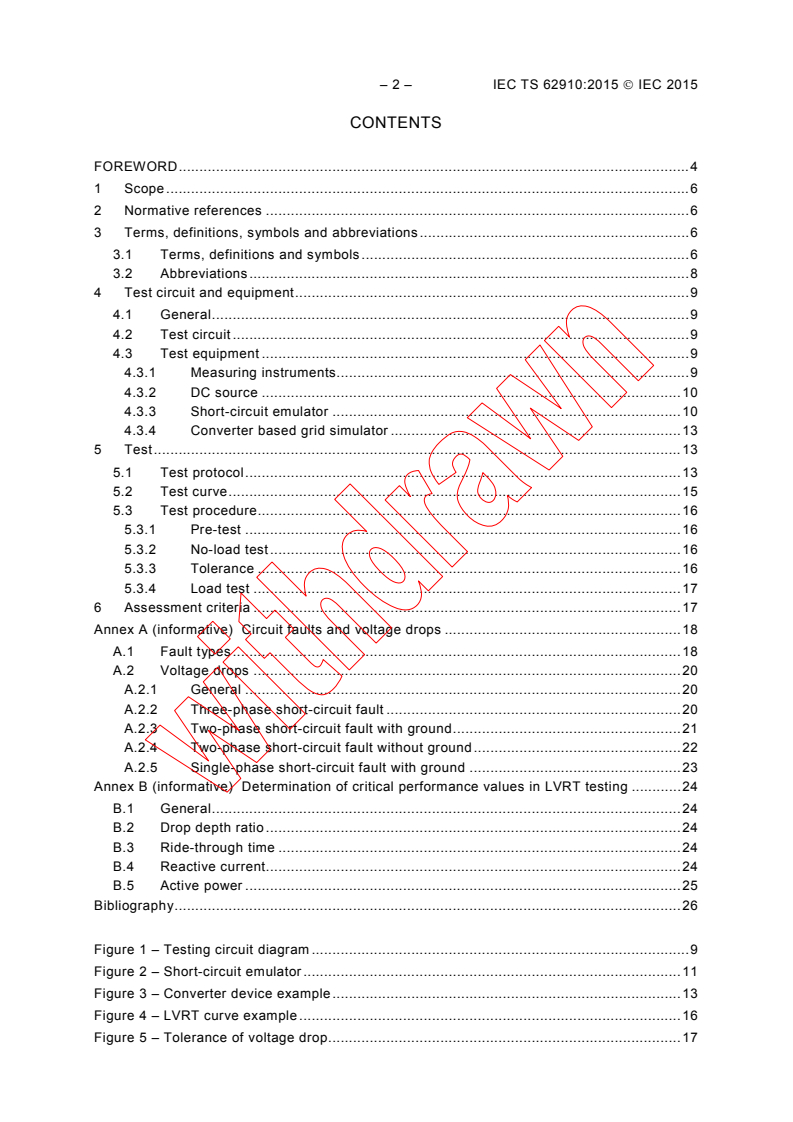
CONTENTS
FOREWORD . 4
1 Scope . 6
2 Normative references . 6
3 Terms, definitions, symbols and abbreviations . 6
3.1 Terms, definitions and symbols . 6
3.2 Abbreviations . 8
4 Test circuit and equipment . 9
4.1 General . 9
4.2 Test circuit . 9
4.3 Test equipment . 9
4.3.1 Measuring instruments. 9
4.3.2 DC source . 10
4.3.3 Short-circuit emulator . 10
4.3.4 Converter based grid simulator . 13
5 Test . 13
5.1 Test protocol . 13
5.2 Test curve . 15
5.3 Test procedure . 16
5.3.1 Pre-test . 16
5.3.2 No-load test . 16
5.3.3 Tolerance . 16
5.3.4 Load test . 17
6 Assessment criteria . 17
Annex A (informative) Circuit faults and voltage drops . 18
A.1 Fault types . 18
A.2 Voltage drops . 20
A.2.1 General . 20
A.2.2 Three-phase short-circuit fault . 20
A.2.3 Two-phase short-circuit fault with ground . 21
A.2.4 Two-phase short-circuit fault without ground . 22
A.2.5 Single-phase short-circuit fault with ground . 23
Annex B (informative) Determination of critical performance values in LVRT testing . 24
B.1 General . 24
B.2 Drop depth ratio . 24
B.3 Ride-through time . 24
B.4 Reactive current. 24
B.5 Active power . 25
Bibliography . 26
Figure 1 – Testing circuit diagram . 9
Figure 2 – Short-circuit emulator . 11
Figure 3 – Converter device example . 13
Figure 4 – LVRT curve example . 16
Figure 5 – Tolerance of voltage drop. 17
Figure A.1 – Grid fault diagram . 20
Figure A.2 – Diagram of voltage vector for three-phase short-circuit fault . 20
Figure A.3 – Diagram of voltage vector of two-phase (BC) short-circuit fault with
ground . 21
Figure A.4 – Diagram of voltage vector of two-phase (BC) short-circuit fault . 22
Figure A.5 – Diagram of voltage vector of single-phase (A) short-circuit fault with
ground . 23
Figure B.1 – Determination of reactive current output . 25
Figure B.2 – Determination of active power recovery . 25
Table 1 – Accuracy of measurements . 10
Table 2 – Fault type and switch status . 12
Table 3 – Test specification for LVRT (indicative) . 14
Table A.1 – Short-circuit paths for different fault types . 18
Table A.2 – Amplitude and phase changes in three-phase short-circuit fault . 21
Table A.3 – Amplitude and phase changes in two-phase (BC) short-circuit fault with
ground . 22
Table A.4 – Amplitude and phase changes in two-phase (BC) short-circuit fault . 22
Table A.5 – Amplitude and phase changes in single-phase (A) short-circuit fault with
ground . 23
– 4 – IEC TS 62910:2015 IEC 2015
INTERNATIONAL ELECTROTECHNICAL COMMISSION
____________
UTILITY-INTERCONNECTED PHOTOVOLTAIC INVERTERS –
TEST PROCEDURE FOR LOW VOLTAGE
RIDE-THROUGH MEASUREMENTS
FOREWORD
1) The International Electrotechnical Commission (IEC) is a worldwide organization for standardization comprising
all national electrotechnical committees (IEC National Committees). The object of IEC is to promote
international co-operation on all questions concerning standardization in the electrical and electronic fields. To
this end and in addition to other activities, IEC publishes International Standards, Technical Specifications,
Technical Reports, Publicly Available Specifications (PAS) and Guides (hereafter referred to as “IEC
Publication(s)”). Their preparation is entrusted to technical committees; any IEC National Committee interested
in the subject dealt with may participate in this preparatory work. International, governmental and non-
governmental organizations liaising with the IEC also participate in this preparation. IEC collaborates closely
with the International Organization for Standardization (ISO) in accordance with conditions determined by
agreement between the two organizations.
2) The formal decisions or agreements of IEC on technical matters express, as nearly as possible, an international
consensus of opinion on the relevant subjects since each technical committee has representation from all
interested IEC National Committees.
3) IEC Publications have the form of recommendations for international use and are accepted by IEC National
Committees in that sense. While all reasonable efforts are made to ensure that the technical content of IEC
Publications is accurate, IEC cannot be held responsible for the way in which they are used or for any
misinterpretation by any end user.
4) In order to promote international uniformity, IEC National Committees undertake to apply IEC Publications
transparently to the maximum extent possible in their national and regional publications. Any divergence
between any IEC Publication and the corresponding national or regional publication shall be clearly indicated in
the latter.
5) IEC itself does not provide any attestation of conformity. Independent certification bodies provide conformity
assessment services and, in some areas, access to IEC marks of conformity. IEC is not responsible for any
services carried out by independent certification bodies.
6) All users should ensure that they have the latest edition of this publication.
7) No liability shall attach to IEC or its directors, employees, servants or agents including individual experts and
members of its technical committees and IEC National Committees for any personal injury, property damage or
other damage of any nature whatsoever, whether direct or indirect, or for costs (including legal fees) and
expenses arising out of the publication, use of, or reliance upon, this IEC Publication or any other IEC
Publications.
8) Attention is drawn to the Normative references cited in this publication. Use of the referenced publications is
indispensable for the correct application of this publication.
9) Attention is drawn to the possibility that some of the elements of this IEC Publication may be the subject of
patent rights. IEC shall not be held responsible for identifying any or all such patent rights.
The main task of IEC technical committees is to prepare International Standards. In
exceptional circumstances, a technical committee may propose the publication of a technical
specification when
• the required support cannot be obtained for the publication of an International Standard,
despite repeated efforts, or
• the subject is still under technical development or where, for any other reason, there is the
future but no immediate possibility of an agreement on an International Standard.
Technical specifications are subject to review within three years of publication to decide
whether they can be transformed into International Standards.
IEC TS 62910, which is a technical specification, has been prepared by IEC technical
committee 82: Solar photovoltaic energy systems.
The text of this technical specification is based on the following documents:
Enquiry draft Report on voting
82/884/DTS 82/1005/RVC
Full information on the voting for the approval of this technical specification can be found in
the report on voting indicated in the above table.
This publication has been drafted in accordance with the ISO/IEC Directives, Part 2.
The committee has decided that the contents of this publication will remain unchanged until
the stability date indicated on the IEC website under "http://webstore.iec.ch" in the data
related to the specific publication. At this date, the publication will be
• transformed into an International standard,
• reconfirmed,
• withdrawn,
• replaced by a revised edition, or
• amended.
A bilingual version of this publication may be issued at a later date.
IMPORTANT – The 'colour inside' logo on the cover page of this publication indicates
that it contains colours which are considered to be useful for the correct
understanding of its contents. Users should therefore print this document using a
colour printer.
– 6 – IEC TS 62910:2015 IEC 2015
UTILITY-INTERCONNECTED PHOTOVOLTAIC INVERTERS –
TEST PROCEDURE FOR LOW VOLTAGE
RIDE-THROUGH MEASUREMENTS
1 Scope
This Technical Specification provides a test procedure for evaluating the performance of Low
Voltage Ride-Through (LVRT) functions in inverters used in utility-interconnected PV systems.
The technical specification is most applicable to large systems where PV inverters are
connected to utility HV distribution systems. However, the applicable procedures may also be
used for LV installations in locations where evolving LVRT requirements include such
installations, e.g. single-phase or 3-phase systems.
The assessed LVRT performance is valid only for the specific configuration and operational
mode of the inverter under test. Separate assessment is required for the inverter in other
factory or user-settable configurations, as these may cause the inverter LVRT response to
behave differently.
The measurement procedures are designed to be as non-site-specific as possible, so that
LVRT characteristics measured at one test site, for example, can also be considered valid at
other sites.
This technical specification is for testing of PV inverters, though it contains information that
may also be useful for testing of a complete PV power plant consisting of multiple inverters
connected at a single point to the utility grid. It further provides a basis for utility-
interconnected PV inverter numerical simulation and model validation.
2 Normative references
The following documents, in whole or in part, are normatively referenced in this document and
are indispensable for its application. For dated references, only the edition cited applies. For
undated references, the latest edition of the referenced document (including any
amendments) applies.
IEC 61400-21:2008, Wind turbines – Part 21: Measurement and assessment of power quality
characteristics of grid connected wind turbines
3 Terms, definitions, symbols and abbreviations
3.1 Terms, definitions and symbols
For the purposes of this document, the following terms, definitions and symbols apply.
3.1.1
drop depth
magnitude of voltage drop during a fault or simulated fault, as a percentage of the nominal
supply voltage
3.1.2
double drop
sudden decline of the nominal voltage to a value below 90 % of the voltage of PCC, followed
after a short time by a voltage recovery, which happened twice. Voltage changes which do not
reduce the voltage to below 90 % of the voltage of PCC are not considered to be voltage
drops
3.1.3
equipment under test
EUT
EUT indicates the equipment on which these tests are performed and refers to the utility-
interconnected PV inverter. During test period, EUT is connected with PV simulator instead of
real PV modules on the DC side, while AC side is connected with grid
3.1.4
IT system
IT power system has all live parts isolated from earth or one point connected to earth through
an impedance. The exposed-conductive-parts of the electrical installation are earthed
independently or collectively or to the earthing of the system
[SOURCE: IEC 60364-1:2005, 312.2.3]
3.1.5
I
q
output reactive current of EUT
3.1.6
low voltage ride through
LVRT
capability of an inverter to continue generating power to connected loads during a limited
duration loss or drop of grid voltage
3.1.7
maximum MPP voltage
maximum voltage at which the EUT can convert its rated power under MPPT conditions
[SOURCE: EN 50530:2010]
3.1.8
maximum power point tracking
MPPT
control strategy of operation at maximum power point or nearby
3.1.9
minimum MPP voltage
minimum voltage at which the EUT can convert its rated power under MPPT conditions
[SOURCE: EN 50530:2010]
3.1.10
N
EUT
access point of the EUT during the test
3.1.11
P
N
rated power of EUT
3.1.12
point of common coupling
PCC
point of a power supply network, electrically nearest to a particular load, at which other loads
are, or may be, connected
– 8 – IEC TS 62910:2015 IEC 2015
Note 1 to entry: These loads can be either devices, equipment or system, or distinct customer’s installations.
Note 2 to entry: In some applications, the term “point of common coupling” is restricted to public networks.
[SOURCE: IEC 60050-161:1990, 161-07-15]
3.1.13
proportionality constant K
K-factor
voltage support of EUT in accordance with the voltage drops. The K-factor is to be specified
by the EUT manufacturer.
3.1.14
PV array simulator
simulator that has I-V characteristics equivalent to a PV array
3.1.15
PV simulator MPP voltage
U
MPP, PVS
MPP voltage of the setting PV curve that is provided by the PV simulator
3.1.16
S
EUT
apparent short-circuit power at N
EUT
3.1.17
single drop
sudden decline of the nominal voltage to a value below 90 % of the voltage of PCC, followed
after a short time by a voltage recovery, which happened once. Voltage changes which do not
reduce the voltage to below 90 % of the voltage of PCC are not considered to be voltage
drops
3.1.18
Z
grid
grid short-circuit impedance value of the MP1 (see Figure 1)
3.1.19
Z
i
impedance value between the fault point and PCC
3.1.20
Z
p
impedance value between the fault point and EUT
3.2 Abbreviations
AC alternating current
A/D analog to digital
DC direct current
HV high voltage
LV low voltage
MV middle voltage
RMS root mean square
4 Test circuit and equipment
4.1 General
The circuits and equipment described in this clause are developed to allow tests that simulate
the full range of anticipated grid faults, including:
• Single phase to ground fault (any phase).
• Two phase isolated fault, between any two phases.
• Two phase grounded fault, involving any two phases.
• Three phase short-circuit fault.
A full discussion of these faults and the resulting impact on voltage magnitude and phase
angles is included in Annex A.
The short circuit emulator and grid simulator described in 4.3.3 and 4.3.4 are informative
examples and are not intended to restrict design flexibility. Other designs may be used to
achieve equivalent test functionality.
4.2 Test circuit
The LVRT test circuit includes a DC source, the EUT, a grid fault simulator and the grid. A PV
simulator (or PV array) provides input energy for the EUT. The output of the EUT is connected
to the grid via a grid fault simulator, as shown in Figure 1.
Z
Grid
MP1 MP2 MP3
PV simulator
Grid fault
EUT
or PV array
simulator
Transformer
U
Grid
(optional)
IEC
NOTE MP1 is the measurement point between the grid and the grid fault simulator; MP2 is the measurement point
at the high voltage side of the transformer; MP3 is the measurement point at the low voltage side of the
transformer.
Figure 1 – Testing circuit diagram
4.3 Test equipment
4.3.1 Measuring instruments
Waveforms shall be measured by a device with memory function, for example, a storage or
digital oscilloscope, or a high speed data acquisition device. Accuracy of the oscilloscope or
data acquisition system should be at least 0,2 % of full scale. The analogue to A/D of the
measurement device shall have at least 12 bit resolution (in order to maintain the required
measurement accuracy).
Voltage transducers (or voltage transformers) and current transducers (or current
transformers) are the required sensors for measurement. The accuracy of the transducers
should be 0,5 % of full scale or better. It is necessary to select the transducer measuring
range depending on the normal value of the signal to be measured. The selected measuring
range shall not exceed 150 % of the normal value of the measured signal. The transducer
accuracy requirements are shown in Table 1.
– 10 – IEC TS 62910:2015 IEC 2015
Table 1 – Accuracy of measurements
Measurement device Accuracy
Data acquisition device 0,2 % full scale
Voltage transducer 0,5 % full scale
Current transducer 0,5 % full scale
4.3.2 DC source
A PV array, PV array simulator or controlled DC source with PV characteristics may be used
as the DC power source to supply input energy for the LVRT test. As the EUT input source,
the DC power source shall be capable of supplying the EUT maximum input power and other
power levels during the test, at minimum and maximum input operating voltages of the EUT.
The PV simulator should emulate the current/voltage characteristic of the PV module or PV
array for which the EUT is designed. The response time of a PV simulator should not be
longer than the MPP tracking response time of EUT.
For a EUT under test without galvanic isolation between the DC side and AC side, the output
of the PV simulator shall not be earthed.
The equivalent capacitance between the output of the PV simulator and earth should be as
low as possible in order to minimize the impact on the EUT.
A PV array used as the EUT input source shall be capable of matching the EUT input power
levels specified by the test conditions. It is necessary to select a period of time in which the
solar irradiance is stable and does not vary by more than 5 % during the test.
4.3.3 Short-circuit emulator
As part of the grid simulator device, the short-circuit emulator is used to create the voltage
drops due to short-circuits between the two or three phases, or between one or two phases to
ground, via the impedance network Z and Z as shown in the test device layout in Figure 2.
1 2
Back to back circuit
N
EUT
Z
A
B
C
Connect to PV
Grid
inverter
S
(optional)
Z
S
S '
(optional)
B
(optional)
B
IEC
Figure 2 – Short-circuit emulator
The impedance Z is used to limit the effect of the short circuit on the utility service that
powers the test circuit. The sizing of Z shall therefore account for all test sequences to be
performed and limit the short-circuit current taken from the grid to values that do not cause an
excessive reduction of the grid voltage. Considering an acceptable voltage reduction of at
shall be at least 20 × Z ,
most 5 % when performing the test, the minimum value of Z
1 Grid
where Z is the grid shor
...
IEC TS 62910 ®
Edition 1.0 2015-10
TECHNICAL
SPECIFICATION
colour
inside
Utility-interconnected photovoltaic inverters – Test procedure for low voltage
ride-through measurements
All rights reserved. Unless otherwise specified, no part of this publication may be reproduced or utilized in any form
or by any means, electronic or mechanical, including photocopying and microfilm, without permission in writing from
either IEC or IEC's member National Committee in the country of the requester. If you have any questions about IEC
copyright or have an enquiry about obtaining additional rights to this publication, please contact the address below or
your local IEC member National Committee for further information.
IEC Central Office Tel.: +41 22 919 02 11
3, rue de Varembé Fax: +41 22 919 03 00
CH-1211 Geneva 20 info@iec.ch
Switzerland www.iec.ch
About the IEC
The International Electrotechnical Commission (IEC) is the leading global organization that prepares and publishes
International Standards for all electrical, electronic and related technologies.
About IEC publications
The technical content of IEC publications is kept under constant review by the IEC. Please make sure that you have the
latest edition, a corrigenda or an amendment might have been published.
IEC Catalogue - webstore.iec.ch/catalogue Electropedia - www.electropedia.org
The stand-alone application for consulting the entire The world's leading online dictionary of electronic and
bibliographical information on IEC International Standards, electrical terms containing more than 30 000 terms and
Technical Specifications, Technical Reports and other definitions in English and French, with equivalent terms in 15
documents. Available for PC, Mac OS, Android Tablets and additional languages. Also known as the International
iPad. Electrotechnical Vocabulary (IEV) online.
IEC publications search - www.iec.ch/searchpub IEC Glossary - std.iec.ch/glossary
The advanced search enables to find IEC publications by a More than 60 000 electrotechnical terminology entries in
variety of criteria (reference number, text, technical English and French extracted from the Terms and Definitions
committee,…). It also gives information on projects, replaced clause of IEC publications issued since 2002. Some entries
and withdrawn publications. have been collected from earlier publications of IEC TC 37,
77, 86 and CISPR.
IEC Just Published - webstore.iec.ch/justpublished
Stay up to date on all new IEC publications. Just Published IEC Customer Service Centre - webstore.iec.ch/csc
details all new publications released. Available online and If you wish to give us your feedback on this publication or
also once a month by email. need further assistance, please contact the Customer Service
Centre: csc@iec.ch.
IEC TS 62910 ®
Edition 1.0 2015-10
TECHNICAL
SPECIFICATION
colour
inside
Utility-interconnected photovoltaic inverters – Test procedure for low voltage
ride-through measurements
INTERNATIONAL
ELECTROTECHNICAL
COMMISSION
ICS 27.160 ISBN 978-2-8322-2957-6
– 2 – IEC TS 62910:2015 IEC 2015
CONTENTS
FOREWORD . 4
1 Scope . 6
2 Normative references . 6
3 Terms, definitions, symbols and abbreviations . 6
3.1 Terms, definitions and symbols . 6
3.2 Abbreviations . 8
4 Test circuit and equipment . 9
4.1 General . 9
4.2 Test circuit . 9
4.3 Test equipment . 9
4.3.1 Measuring instruments. 9
4.3.2 DC source . 10
4.3.3 Short-circuit emulator . 10
4.3.4 Converter based grid simulator . 13
5 Test . 13
5.1 Test protocol . 13
5.2 Test curve . 15
5.3 Test procedure . 16
5.3.1 Pre-test . 16
5.3.2 No-load test . 16
5.3.3 Tolerance . 16
5.3.4 Load test . 17
6 Assessment criteria . 17
Annex A (informative) Circuit faults and voltage drops . 18
A.1 Fault types . 18
A.2 Voltage drops . 20
A.2.1 General . 20
A.2.2 Three-phase short-circuit fault . 20
A.2.3 Two-phase short-circuit fault with ground . 21
A.2.4 Two-phase short-circuit fault without ground . 22
A.2.5 Single-phase short-circuit fault with ground . 23
Annex B (informative) Determination of critical performance values in LVRT testing . 24
B.1 General . 24
B.2 Drop depth ratio . 24
B.3 Ride-through time . 24
B.4 Reactive current. 24
B.5 Active power . 25
Bibliography . 26
Figure 1 – Testing circuit diagram . 9
Figure 2 – Short-circuit emulator . 11
Figure 3 – Converter device example . 13
Figure 4 – LVRT curve example . 16
Figure 5 – Tolerance of voltage drop. 17
Figure A.1 – Grid fault diagram . 20
Figure A.2 – Diagram of voltage vector for three-phase short-circuit fault . 20
Figure A.3 – Diagram of voltage vector of two-phase (BC) short-circuit fault with
ground . 21
Figure A.4 – Diagram of voltage vector of two-phase (BC) short-circuit fault . 22
Figure A.5 – Diagram of voltage vector of single-phase (A) short-circuit fault with
ground . 23
Figure B.1 – Determination of reactive current output . 25
Figure B.2 – Determination of active power recovery . 25
Table 1 – Accuracy of measurements . 10
Table 2 – Fault type and switch status . 12
Table 3 – Test specification for LVRT (indicative) . 14
Table A.1 – Short-circuit paths for different fault types . 18
Table A.2 – Amplitude and phase changes in three-phase short-circuit fault . 21
Table A.3 – Amplitude and phase changes in two-phase (BC) short-circuit fault with
ground . 22
Table A.4 – Amplitude and phase changes in two-phase (BC) short-circuit fault . 22
Table A.5 – Amplitude and phase changes in single-phase (A) short-circuit fault with
ground . 23
– 4 – IEC TS 62910:2015 IEC 2015
INTERNATIONAL ELECTROTECHNICAL COMMISSION
____________
UTILITY-INTERCONNECTED PHOTOVOLTAIC INVERTERS –
TEST PROCEDURE FOR LOW VOLTAGE
RIDE-THROUGH MEASUREMENTS
FOREWORD
1) The International Electrotechnical Commission (IEC) is a worldwide organization for standardization comprising
all national electrotechnical committees (IEC National Committees). The object of IEC is to promote
international co-operation on all questions concerning standardization in the electrical and electronic fields. To
this end and in addition to other activities, IEC publishes International Standards, Technical Specifications,
Technical Reports, Publicly Available Specifications (PAS) and Guides (hereafter referred to as “IEC
Publication(s)”). Their preparation is entrusted to technical committees; any IEC National Committee interested
in the subject dealt with may participate in this preparatory work. International, governmental and non-
governmental organizations liaising with the IEC also participate in this preparation. IEC collaborates closely
with the International Organization for Standardization (ISO) in accordance with conditions determined by
agreement between the two organizations.
2) The formal decisions or agreements of IEC on technical matters express, as nearly as possible, an international
consensus of opinion on the relevant subjects since each technical committee has representation from all
interested IEC National Committees.
3) IEC Publications have the form of recommendations for international use and are accepted by IEC National
Committees in that sense. While all reasonable efforts are made to ensure that the technical content of IEC
Publications is accurate, IEC cannot be held responsible for the way in which they are used or for any
misinterpretation by any end user.
4) In order to promote international uniformity, IEC National Committees undertake to apply IEC Publications
transparently to the maximum extent possible in their national and regional publications. Any divergence
between any IEC Publication and the corresponding national or regional publication shall be clearly indicated in
the latter.
5) IEC itself does not provide any attestation of conformity. Independent certification bodies provide conformity
assessment services and, in some areas, access to IEC marks of conformity. IEC is not responsible for any
services carried out by independent certification bodies.
6) All users should ensure that they have the latest edition of this publication.
7) No liability shall attach to IEC or its directors, employees, servants or agents including individual experts and
members of its technical committees and IEC National Committees for any personal injury, property damage or
other damage of any nature whatsoever, whether direct or indirect, or for costs (including legal fees) and
expenses arising out of the publication, use of, or reliance upon, this IEC Publication or any other IEC
Publications.
8) Attention is drawn to the Normative references cited in this publication. Use of the referenced publications is
indispensable for the correct application of this publication.
9) Attention is drawn to the possibility that some of the elements of this IEC Publication may be the subject of
patent rights. IEC shall not be held responsible for identifying any or all such patent rights.
The main task of IEC technical committees is to prepare International Standards. In
exceptional circumstances, a technical committee may propose the publication of a technical
specification when
• the required support cannot be obtained for the publication of an International Standard,
despite repeated efforts, or
• the subject is still under technical development or where, for any other reason, there is the
future but no immediate possibility of an agreement on an International Standard.
Technical specifications are subject to review within three years of publication to decide
whether they can be transformed into International Standards.
IEC TS 62910, which is a technical specification, has been prepared by IEC technical
committee 82: Solar photovoltaic energy systems.
The text of this technical specification is based on the following documents:
Enquiry draft Report on voting
82/884/DTS 82/1005/RVC
Full information on the voting for the approval of this technical specification can be found in
the report on voting indicated in the above table.
This publication has been drafted in accordance with the ISO/IEC Directives, Part 2.
The committee has decided that the contents of this publication will remain unchanged until
the stability date indicated on the IEC website under "http://webstore.iec.ch" in the data
related to the specific publication. At this date, the publication will be
• transformed into an International standard,
• reconfirmed,
• withdrawn,
• replaced by a revised edition, or
• amended.
A bilingual version of this publication may be issued at a later date.
IMPORTANT – The 'colour inside' logo on the cover page of this publication indicates
that it contains colours which are considered to be useful for the correct
understanding of its contents. Users should therefore print this document using a
colour printer.
– 6 – IEC TS 62910:2015 IEC 2015
UTILITY-INTERCONNECTED PHOTOVOLTAIC INVERTERS –
TEST PROCEDURE FOR LOW VOLTAGE
RIDE-THROUGH MEASUREMENTS
1 Scope
This Technical Specification provides a test procedure for evaluating the performance of Low
Voltage Ride-Through (LVRT) functions in inverters used in utility-interconnected PV systems.
The technical specification is most applicable to large systems where PV inverters are
connected to utility HV distribution systems. However, the applicable procedures may also be
used for LV installations in locations where evolving LVRT requirements include such
installations, e.g. single-phase or 3-phase systems.
The assessed LVRT performance is valid only for the specific configuration and operational
mode of the inverter under test. Separate assessment is required for the inverter in other
factory or user-settable configurations, as these may cause the inverter LVRT response to
behave differently.
The measurement procedures are designed to be as non-site-specific as possible, so that
LVRT characteristics measured at one test site, for example, can also be considered valid at
other sites.
This technical specification is for testing of PV inverters, though it contains information that
may also be useful for testing of a complete PV power plant consisting of multiple inverters
connected at a single point to the utility grid. It further provides a basis for utility-
interconnected PV inverter numerical simulation and model validation.
2 Normative references
The following documents, in whole or in part, are normatively referenced in this document and
are indispensable for its application. For dated references, only the edition cited applies. For
undated references, the latest edition of the referenced document (including any
amendments) applies.
IEC 61400-21:2008, Wind turbines – Part 21: Measurement and assessment of power quality
characteristics of grid connected wind turbines
3 Terms, definitions, symbols and abbreviations
3.1 Terms, definitions and symbols
For the purposes of this document, the following terms, definitions and symbols apply.
3.1.1
drop depth
magnitude of voltage drop during a fault or simulated fault, as a percentage of the nominal
supply voltage
3.1.2
double drop
sudden decline of the nominal voltage to a value below 90 % of the voltage of PCC, followed
after a short time by a voltage recovery, which happened twice. Voltage changes which do not
reduce the voltage to below 90 % of the voltage of PCC are not considered to be voltage
drops
3.1.3
equipment under test
EUT
EUT indicates the equipment on which these tests are performed and refers to the utility-
interconnected PV inverter. During test period, EUT is connected with PV simulator instead of
real PV modules on the DC side, while AC side is connected with grid
3.1.4
IT system
IT power system has all live parts isolated from earth or one point connected to earth through
an impedance. The exposed-conductive-parts of the electrical installation are earthed
independently or collectively or to the earthing of the system
[SOURCE: IEC 60364-1:2005, 312.2.3]
3.1.5
I
q
output reactive current of EUT
3.1.6
low voltage ride through
LVRT
capability of an inverter to continue generating power to connected loads during a limited
duration loss or drop of grid voltage
3.1.7
maximum MPP voltage
maximum voltage at which the EUT can convert its rated power under MPPT conditions
[SOURCE: EN 50530:2010]
3.1.8
maximum power point tracking
MPPT
control strategy of operation at maximum power point or nearby
3.1.9
minimum MPP voltage
minimum voltage at which the EUT can convert its rated power under MPPT conditions
[SOURCE: EN 50530:2010]
3.1.10
N
EUT
access point of the EUT during the test
3.1.11
P
N
rated power of EUT
3.1.12
point of common coupling
PCC
point of a power supply network, electrically nearest to a particular load, at which other loads
are, or may be, connected
– 8 – IEC TS 62910:2015 IEC 2015
Note 1 to entry: These loads can be either devices, equipment or system, or distinct customer’s installations.
Note 2 to entry: In some applications, the term “point of common coupling” is restricted to public networks.
[SOURCE: IEC 60050-161:1990, 161-07-15]
3.1.13
proportionality constant K
K-factor
voltage support of EUT in accordance with the voltage drops. The K-factor is to be specified
by the EUT manufacturer.
3.1.14
PV array simulator
simulator that has I-V characteristics equivalent to a PV array
3.1.15
PV simulator MPP voltage
U
MPP, PVS
MPP voltage of the setting PV curve that is provided by the PV simulator
3.1.16
S
EUT
apparent short-circuit power at N
EUT
3.1.17
single drop
sudden decline of the nominal voltage to a value below 90 % of the voltage of PCC, followed
after a short time by a voltage recovery, which happened once. Voltage changes which do not
reduce the voltage to below 90 % of the voltage of PCC are not considered to be voltage
drops
3.1.18
Z
grid
grid short-circuit impedance value of the MP1 (see Figure 1)
3.1.19
Z
i
impedance value between the fault point and PCC
3.1.20
Z
p
impedance value between the fault point and EUT
3.2 Abbreviations
AC alternating current
A/D analog to digital
DC direct current
HV high voltage
LV low voltage
MV middle voltage
RMS root mean square
4 Test circuit and equipment
4.1 General
The circuits and equipment described in this clause are developed to allow tests that simulate
the full range of anticipated grid faults, including:
• Single phase to ground fault (any phase).
• Two phase isolated fault, between any two phases.
• Two phase grounded fault, involving any two phases.
• Three phase short-circuit fault.
A full discussion of these faults and the resulting impact on voltage magnitude and phase
angles is included in Annex A.
The short circuit emulator and grid simulator described in 4.3.3 and 4.3.4 are informative
examples and are not intended to restrict design flexibility. Other designs may be used to
achieve equivalent test functionality.
4.2 Test circuit
The LVRT test circuit includes a DC source, the EUT, a grid fault simulator and the grid. A PV
simulator (or PV array) provides input energy for the EUT. The output of the EUT is connected
to the grid via a grid fault simulator, as shown in Figure 1.
Z
Grid
MP1 MP2 MP3
PV simulator
Grid fault
EUT
or PV array
simulator
Transformer
U
Grid
(optional)
IEC
NOTE MP1 is the measurement point between the grid and the grid fault simulator; MP2 is the measurement point
at the high voltage side of the transformer; MP3 is the measurement point at the low voltage side of the
transformer.
Figure 1 – Testing circuit diagram
4.3 Test equipment
4.3.1 Measuring instruments
Waveforms shall be measured by a device with memory function, for example, a storage or
digital oscilloscope, or a high speed data acquisition device. Accuracy of the oscilloscope or
data acquisition system should be at least 0,2 % of full scale. The analogue to A/D of the
measurement device shall have at least 12 bit resolution (in order to maintain the required
measurement accuracy).
Voltage transducers (or voltage transformers) and current transducers (or current
transformers) are the required sensors for measurement. The accuracy of the transducers
should be 0,5 % of full scale or better. It is necessary to select the transducer measuring
range depending on the normal value of the signal to be measured. The selected measuring
range shall not exceed 150 % of the normal value of the measured signal. The transducer
accuracy requirements are shown in Table 1.
– 10 – IEC TS 62910:2015 IEC 2015
Table 1 – Accuracy of measurements
Measurement device Accuracy
Data acquisition device 0,2 % full scale
Voltage transducer 0,5 % full scale
Current transducer 0,5 % full scale
4.3.2 DC source
A PV array, PV array simulator or controlled DC source with PV characteristics may be used
as the DC power source to supply input energy for the LVRT test. As the EUT input source,
the DC power source shall be capable of supplying the EUT maximum input power and other
power levels during the test, at minimum and maximum input operating voltages of the EUT.
The PV simulator should emulate the current/voltage characteristic of the PV module or PV
array for which the EUT is designed. The response time of a PV simulator should not be
longer than the MPP tracking response time of EUT.
For a EUT under test without galvanic isolation between the DC side and AC side, the output
of the PV simulator shall not be earthed.
The equivalent capacitance between the output of the PV simulator and earth should be as
low as possible in order to minimize the impact on the EUT.
A PV array used as the EUT input source shall be capable of matching the EUT input power
levels specified by the test conditions. It is necessary to select a period of time in which the
solar irradiance is stable and does not vary by more than 5 % during the test.
4.3.3 Short-circuit emulator
As part of the grid simulator device, the short-circuit emulator is used to create the voltage
drops due to short-circuits between the two or three phases, or between one or two phases to
ground, via the impedance network Z and Z as shown in the test device layout in Figure 2.
1 2
Back to back circuit
N
EUT
Z
A
B
C
Connect to PV
Grid
inverter
S
(optional)
Z
S
S '
(optional)
B
(optional)
B
IEC
Figure 2 – Short-circuit emulator
The impedance Z is used to limit the effect of the short circuit on the utility service that
powers the test circuit. The sizing of Z shall therefore account for all test sequences to be
performed and limit the short-circuit current taken from the grid to values that do not cause an
excessive reduction of the grid voltage. Considering an acceptable voltage reduction of at
shall be at least 20 × Z ,
most 5 % when performing the test, the minimum value of Z
1 Grid
where Z is the grid short-circuit impedance measured at t
...