

IEC 61157:2007
(Main)Standard means for the reporting of the acoustic output of medical diagnostic ultrasonic equipment
General Information
- Abstract
IEC 61157:2007 specifies a standard means and format for the reporting of the acoustic output of medical diagnostic ultrasonic equipment. The numerical values for reporting purposes represent the average values for the maximum output conditions for a given discrete- or combined-operating mode and are derived from measurements made in water. Intensity parameters are specified in this standard, but these are regarded as derived quantities that are meaningful only under certain assumptions related to the ultrasonic field being measured. This International Standard is applicable to medical diagnostic ultrasonic equipment. It provides a set of traceable acoustic parameters describing the acoustic fields. It defines a standard means and format for the reporting of the acoustic output information. It also describes a reduced dataset recommended for equipment generating low acoustic output levels. This second edition cancels and replaces the first edition published in 1992. This edition constitutes a minor revision. The changes with respect to the previous edition are listed hereafter:
- maintenance on this standard and the referenced standards IEC 61161 and IEC 62127-1;
- and a clause on compliance has been added. The contents of the corrigendum of August 2008 have been included in this copy. The French version of this standard has not been voted upon.
- Status
- Published
- Publication Date
- 27-Jan-2013
- Technical Committee
- TC 87 - Ultrasonics
- Drafting Committee
- WG 12 - TC 87/WG 12
- Current Stage
- PPUB - Publication issued
- Start Date
- 09-Aug-2007
- Completion Date
- 28-Aug-2026
Buy Documents
IEC 61157:2007 - Standard means for the reporting of the acoustic output of medical diagnostic ultrasonic equipment Released:8/9/2007
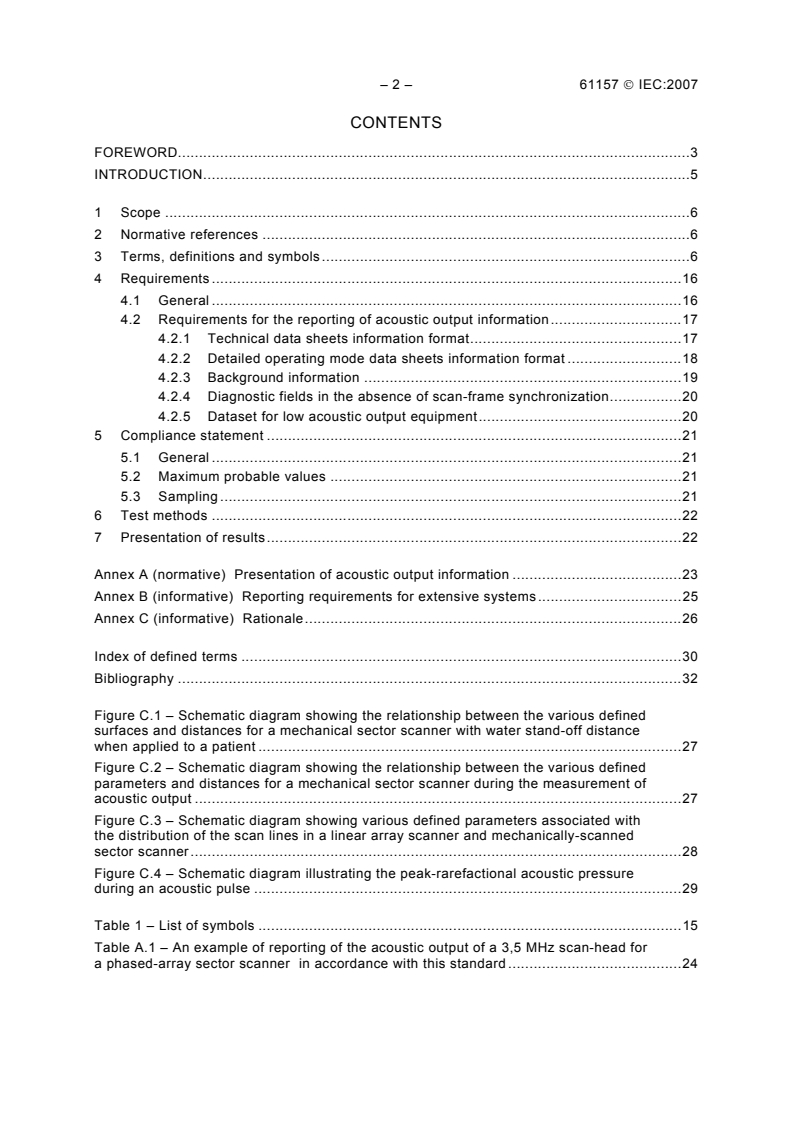
IEC 61157:2007 - Standard means for the reporting of the acoustic output of medical diagnostic ultrasonic equipment Released:8/9/2007
IEC 61157:2007+AMD1:2013 CSV - Standard means for the reporting of the acoustic output of medicaldiagnostic ultrasonic equipment Released:1/28/2013
Overview - IEC 61157:2007 (Acoustic output reporting)
IEC 61157:2007 establishes a standard means and format for reporting the acoustic output of medical diagnostic ultrasonic equipment. The standard specifies that reported numerical values represent average values for the maximum output conditions of a given operating mode and are derived from measurements made in water. Intensity parameters are included but treated as derived quantities that are meaningful only under stated assumptions about the ultrasonic field. This second edition (2007) is a minor revision of the 1992 edition and adds a clause on compliance and maintenance updates (including corrigendum 2008).
Key topics and requirements
- Standard reporting format for acoustic output information (technical data sheets and detailed operating-mode sheets).
- Traceable acoustic parameters describing acoustic fields: pressure waveforms, acoustic frequency, bandwidth, beam area and beam axis concepts (definitions and symbols are provided).
- Measurement basis: values are derived from water-based measurements (hydrophone and radiation-force techniques referenced).
- Intensity parameters: included but described as derived and valid only under specified field assumptions.
- Reduced dataset: recommended reporting set for equipment that generates low acoustic output levels.
- Compliance statement: new clause defining how to declare compliance and maximum probable values, sampling and test considerations.
- Test methods and presentation: guidance on test methods, presentation of results, and annexes with example reporting formats and rationale (Annex A–C).
Practical applications and users
IEC 61157:2007 is intended for organizations and professionals who need standardized, traceable acoustic output information:
- Ultrasound equipment manufacturers - prepare technical data sheets and compliance documentation.
- Test laboratories and calibration facilities - perform water-based acoustic measurements and produce standardized reports.
- Regulatory bodies and conformity assessors - evaluate declared acoustic outputs and compliance statements.
- Clinical safety officers and researchers - use standardized output data for exposure planning, biological-effects studies and epidemiological exposure assessments.
- Quality assurance teams - ensure consistent reporting across product families and operating modes.
Related standards and references
- IEC 62127-1 - Hydrophones: measurement and characterization of medical ultrasonic fields (up to 40 MHz).
- IEC 61161 - Ultrasonics power measurement (radiation force balances).
- ISO/IEC Guide 98 (GUM) and ISO 16269-6 - uncertainty and statistical tolerance guidance referenced for reporting.
By standardizing definitions, measurement context (water), reporting format and a reduced dataset for low-output devices, IEC 61157:2007 enables clear, comparable acoustic output data for design, compliance, testing and research in medical ultrasound.
Relations
- Effective Date
- 05-Sep-2023
- Effective Date
- 05-Sep-2023
Buy Documents
IEC 61157:2007 - Standard means for the reporting of the acoustic output of medical diagnostic ultrasonic equipment Released:8/9/2007
IEC 61157:2007 - Standard means for the reporting of the acoustic output of medical diagnostic ultrasonic equipment Released:8/9/2007
IEC 61157:2007+AMD1:2013 CSV - Standard means for the reporting of the acoustic output of medicaldiagnostic ultrasonic equipment Released:1/28/2013
Get Certified
Connect with accredited certification bodies for this standard

BSI Group
BSI (British Standards Institution) is the business standards company that helps organizations make excellence a habit.

TÜV Rheinland
TÜV Rheinland is a leading international provider of technical services.

TÜV SÜD
TÜV SÜD is a trusted partner of choice for safety, security and sustainability solutions.
Sponsored listings
Frequently Asked Questions
IEC 61157:2007 is a standard published by the International Electrotechnical Commission (IEC). Its full title is "Standard means for the reporting of the acoustic output of medical diagnostic ultrasonic equipment". This standard covers: IEC 61157:2007 specifies a standard means and format for the reporting of the acoustic output of medical diagnostic ultrasonic equipment. The numerical values for reporting purposes represent the average values for the maximum output conditions for a given discrete- or combined-operating mode and are derived from measurements made in water. Intensity parameters are specified in this standard, but these are regarded as derived quantities that are meaningful only under certain assumptions related to the ultrasonic field being measured. This International Standard is applicable to medical diagnostic ultrasonic equipment. It provides a set of traceable acoustic parameters describing the acoustic fields. It defines a standard means and format for the reporting of the acoustic output information. It also describes a reduced dataset recommended for equipment generating low acoustic output levels. This second edition cancels and replaces the first edition published in 1992. This edition constitutes a minor revision. The changes with respect to the previous edition are listed hereafter: - maintenance on this standard and the referenced standards IEC 61161 and IEC 62127-1; - and a clause on compliance has been added. The contents of the corrigendum of August 2008 have been included in this copy. The French version of this standard has not been voted upon.
IEC 61157:2007 specifies a standard means and format for the reporting of the acoustic output of medical diagnostic ultrasonic equipment. The numerical values for reporting purposes represent the average values for the maximum output conditions for a given discrete- or combined-operating mode and are derived from measurements made in water. Intensity parameters are specified in this standard, but these are regarded as derived quantities that are meaningful only under certain assumptions related to the ultrasonic field being measured. This International Standard is applicable to medical diagnostic ultrasonic equipment. It provides a set of traceable acoustic parameters describing the acoustic fields. It defines a standard means and format for the reporting of the acoustic output information. It also describes a reduced dataset recommended for equipment generating low acoustic output levels. This second edition cancels and replaces the first edition published in 1992. This edition constitutes a minor revision. The changes with respect to the previous edition are listed hereafter: - maintenance on this standard and the referenced standards IEC 61161 and IEC 62127-1; - and a clause on compliance has been added. The contents of the corrigendum of August 2008 have been included in this copy. The French version of this standard has not been voted upon.
IEC 61157:2007 is classified under the following ICS (International Classification for Standards) categories: 11.040.50 - Radiographic equipment; 17.140.50 - Electroacoustics. The ICS classification helps identify the subject area and facilitates finding related standards.
IEC 61157:2007 has the following relationships with other standards: It is inter standard links to IEC 61157:2007/AMD1:2013, IEC 61157:2007/COR1:2008. Understanding these relationships helps ensure you are using the most current and applicable version of the standard.
IEC 61157:2007 is available in PDF format for immediate download after purchase. The document can be added to your cart and obtained through the secure checkout process. Digital delivery ensures instant access to the complete standard document.
Standards Content (Sample)
IEC 61157
Edition 2.0 2007-08
INTERNATIONAL
STANDARD
Standard means for the reporting of the acoustic output of medical diagnostic
ultrasonic equipment
All rights reserved. Unless otherwise specified, no part of this publication may be reproduced or utilized in any form
or by any means, electronic or mechanical, including photocopying and microfilm, without permission in writing from
either IEC or IEC's member National Committee in the country of the requester.
If you have any questions about IEC copyright or have an enquiry about obtaining additional rights to this publication,
please contact the address below or your local IEC member National Committee for further information.
IEC Central Office
3, rue de Varembé
CH-1211 Geneva 20
Switzerland
Email: inmail@iec.ch
Web: www.iec.ch
About the IEC
The International Electrotechnical Commission (IEC) is the leading global organization that prepares and publishes
International Standards for all electrical, electronic and related technologies.
About IEC publications
The technical content of IEC publications is kept under constant review by the IEC. Please make sure that you have the
latest edition, a corrigenda or an amendment might have been published.
ƒ Catalogue of IEC publications: www.iec.ch/searchpub
The IEC on-line Catalogue enables you to search by a variety of criteria (reference number, text, technical committee,…).
It also gives information on projects, withdrawn and replaced publications.
ƒ IEC Just Published: www.iec.ch/online_news/justpub
Stay up to date on all new IEC publications. Just Published details twice a month all new publications released. Available
on-line and also by email.
ƒ Electropedia: www.electropedia.org
The world's leading online dictionary of electronic and electrical terms containing more than 20 000 terms and definitions
in English and French, with equivalent terms in additional languages. Also known as the International Electrotechnical
Vocabulary online.
ƒ Customer Service Centre: www.iec.ch/webstore/custserv
If you wish to give us your feedback on this publication or need further assistance, please visit the Customer Service
Centre FAQ or contact us:
Email: csc@iec.ch
Tel.: +41 22 919 02 11
Fax: +41 22 919 03 00
IEC 61157
Edition 2.0 2007-08
INTERNATIONAL
STANDARD
Standard means for the reporting of the acoustic output of medical diagnostic
ultrasonic equipment
INTERNATIONAL
ELECTROTECHNICAL
COMMISSION
PRICE CODE
V
ICS 11.040.50; 11.140.50 ISBN 2-8318-9257-0
– 2 – 61157 © IEC:2007(E)
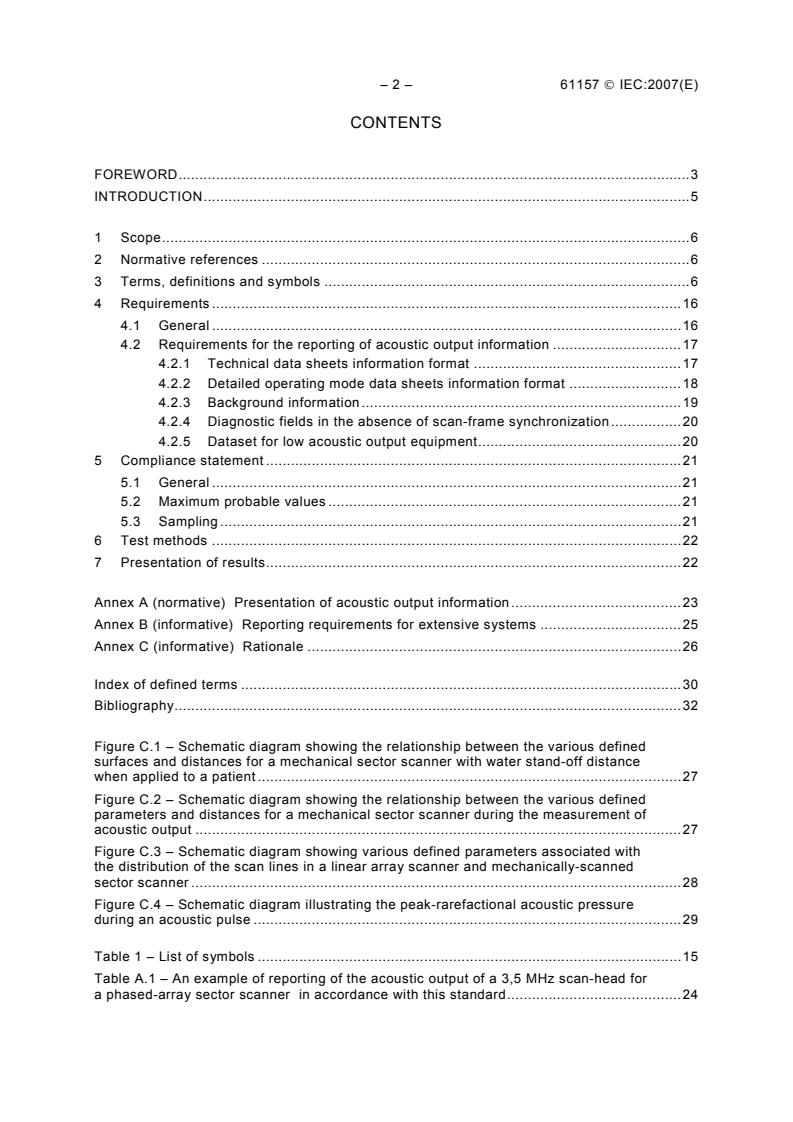
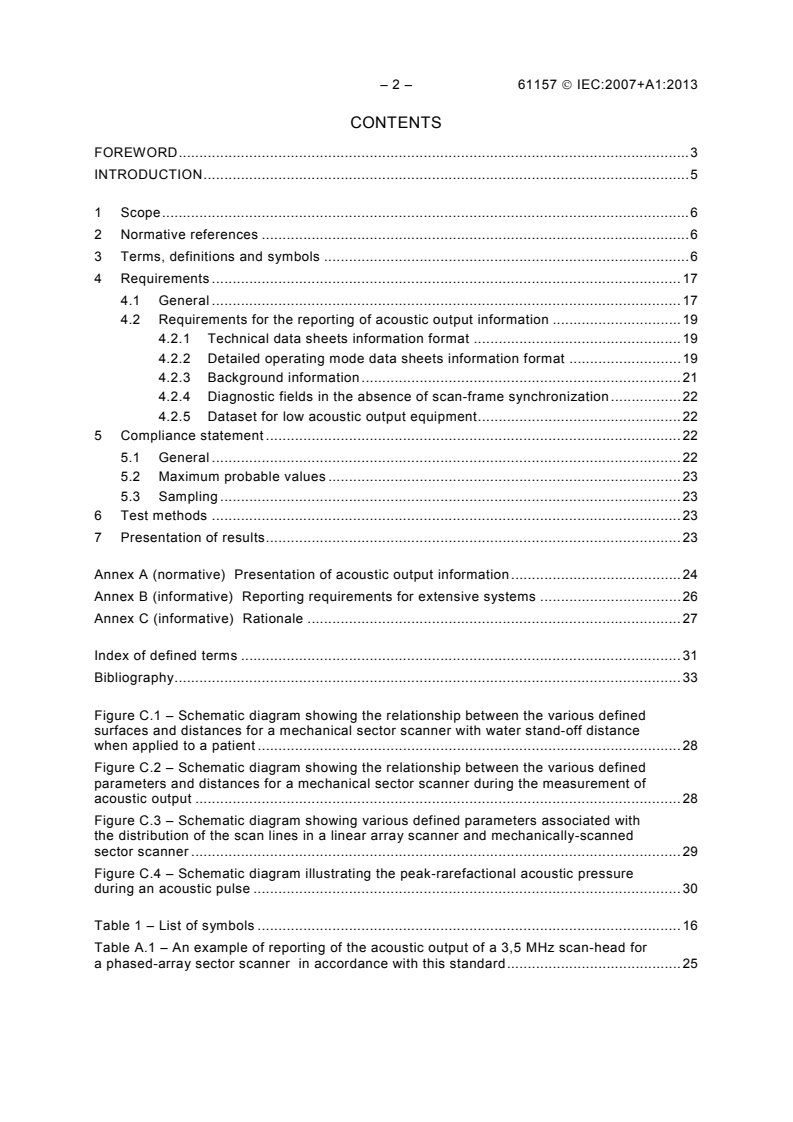
CONTENTS
FOREWORD.3
INTRODUCTION.5
1 Scope.6
2 Normative references .6
3 Terms, definitions and symbols .6
4 Requirements .16
4.1 General .16
4.2 Requirements for the reporting of acoustic output information .17
4.2.1 Technical data sheets information format .17
4.2.2 Detailed operating mode data sheets information format .18
4.2.3 Background information.19
4.2.4 Diagnostic fields in the absence of scan-frame synchronization.20
4.2.5 Dataset for low acoustic output equipment.20
5 Compliance statement .21
5.1 General .21
5.2 Maximum probable values .21
5.3 Sampling .21
6 Test methods .22
7 Presentation of results.22
Annex A (normative) Presentation of acoustic output information.23
Annex B (informative) Reporting requirements for extensive systems .25
Annex C (informative) Rationale .26
Index of defined terms .30
Bibliography.32
Figure C.1 – Schematic diagram showing the relationship between the various defined
surfaces and distances for a mechanical sector scanner with water stand-off distance
when applied to a patient .27
Figure C.2 – Schematic diagram showing the relationship between the various defined
parameters and distances for a mechanical sector scanner during the measurement of
acoustic output .27
Figure C.3 – Schematic diagram showing various defined parameters associated with
the distribution of the scan lines in a linear array scanner and mechanically-scanned
sector scanner .28
Figure C.4 – Schematic diagram illustrating the peak-rarefactional acoustic pressure
during an acoustic pulse .29
Table 1 – List of symbols .15
Table A.1 – An example of reporting of the acoustic output of a 3,5 MHz scan-head for
a phased-array sector scanner in accordance with this standard.24
61157 © IEC:2007(E) – 3 –
INTERNATIONAL ELECTROTECHNICAL COMMISSION
____________
STANDARD MEANS FOR THE REPORTING
OF THE ACOUSTIC OUTPUT OF MEDICAL DIAGNOSTIC
ULTRASONIC EQUIPMENT
FOREWORD
1) The International Electrotechnical Commission (IEC) is a worldwide organization for standardization comprising
all national electrotechnical committees (IEC National Committees). The object of IEC is to promote
international co-operation on all questions concerning standardization in the electrical and electronic fields. To
this end and in addition to other activities, IEC publishes International Standards, Technical Specifications,
Technical Reports, Publicly Available Specifications (PAS) and Guides (hereafter referred to as “IEC
Publication(s)”). Their preparation is entrusted to technical committees; any IEC National Committee interested
in the subject dealt with may participate in this preparatory work. International, governmental and non-
governmental organizations liaising with the IEC also participate in this preparation. IEC collaborates closely
with the International Organization for Standardization (ISO) in accordance with conditions determined by
agreement between the two organizations.
2) The formal decisions or agreements of IEC on technical matters express, as nearly as possible, an international
consensus of opinion on the relevant subjects since each technical committee has representation from all
interested IEC National Committees.
3) IEC Publications have the form of recommendations for international use and are accepted by IEC National
Committees in that sense. While all reasonable efforts are made to ensure that the technical content of IEC
Publications is accurate, IEC cannot be held responsible for the way in which they are used or for any
misinterpretation by any end user.
4) In order to promote international uniformity, IEC National Committees undertake to apply IEC Publications
transparently to the maximum extent possible in their national and regional publications. Any divergence
between any IEC Publication and the corresponding national or regional publication shall be clearly indicated in
the latter.
5) IEC provides no marking procedure to indicate its approval and cannot be rendered responsible for any
equipment declared to be in conformity with an IEC Publication.
6) All users should ensure that they have the latest edition of this publication.
7) No liability shall attach to IEC or its directors, employees, servants or agents including individual experts and
members of its technical committees and IEC National Committees for any personal injury, property damage or
other damage of any nature whatsoever, whether direct or indirect, or for costs (including legal fees) and
expenses arising out of the publication, use of, or reliance upon, this IEC Publication or any other IEC
Publications.
8) Attention is drawn to the Normative references cited in this publication. Use of the referenced publications is
indispensable for the correct application of this publication.
9) Attention is drawn to the possibility that some of the elements of this IEC Publication may be the subject of
patent rights. IEC shall not be held responsible for identifying any or all such patent rights.
International Standard IEC 61157 has been prepared by IEC technical committee 87:
Ultrasonics.
This second edition cancels and replaces the first edition published in 1992. This edition
constitutes a minor revision.
The changes with respect to the previous edition are listed below:
• maintenance on this standard and the referenced standards IEC 61161 and IEC 62127-1.
• a clause on compliance has been added.
The text of this standard is based on the following documents:
Enquiry draft Report on voting
87/356/CDV 87/374/RVC
– 4 – 61157 © IEC:2007(E)
Full information on the voting for the approval of this standard can be found in the report on
voting indicated in the above table.
This publication has been drafted in accordance with the ISO/IEC Directives, Part 2.
NOTE The following print types are used:
– Requirements: in roman type
– Test specifications: in italic type
– Notes: in small roman type
– Words in bold in the text are defined in Clause 3.
The committee has decided that the contents of this publication will remain unchanged until
the maintenance result date indicated on the IEC web site under "http://webstore.iec.ch" in
the data related to the specific publication. At this date, the publication will be
• reconfirmed,
• withdrawn,
• replaced by a revised edition, or
• amended.
A bilingual version of this publication may be issued at a later date.
The contents of the corrigendum of August 2008 have been included in this copy.
61157 © IEC:2007(E) – 5 –
INTRODUCTION
This International Standard specifies a standard means and format for the reporting of the
acoustic output of medical diagnostic ultrasonic equipment. The numerical values for reporting
purposes represent the average values for the maximum output conditions for a given
discrete- or combined-operating mode and are derived from measurements made in water.
Intensity parameters are specified in this standard, but these are regarded as derived
quantities that are meaningful only under certain assumptions related to the ultrasonic field
being measured.
– 6 – 61157 © IEC:2007(E)
STANDARD MEANS FOR THE REPORTING
OF THE ACOUSTIC OUTPUT OF MEDICAL DIAGNOSTIC
ULTRASONIC EQUIPMENT
1 Scope
This International Standard is applicable to medical diagnostic ultrasonic equipment.
– It provides a set of traceable acoustic parameters describing the acoustic fields.
– It defines a standard means and format for the reporting of the acoustic output information.
– It also describes a reduced dataset recommended for equipment generating low acoustic
output levels.
NOTE The information tabulated in this standard format can be used for
a) exposure planning for biological effects studies;
b) exposure data for prospective epidemiological studies conducted using exposure conditions similar
to those reported in this standard. In the absence of actual exposure data for retrospective
epidemiological studies, the information tabulated in this standard format might also be used with
cautionary comment.
2 Normative references
The following referenced documents are indispensable for the application of this document.
For dated references, only the edition cited applies. For undated references, the latest edition
of the referenced document (including any amendments) applies.
IEC 60050-801:1994 International Electrotechnical Vocabulary – Chapter 801: Acoustics and
electroacoustics
IEC 61161, Ultrasonics – Power measurement – Radiation force balances and performance
requirements
IEC 62127-1, Ultrasonics – Hydrophones – Part 1: Measurement and characterization of
medical ultrasonic fields up to 40 MHz
ISO 16269-6:2005, Statistical interpretation of data – Part 6: Determination of statistical
tolerance intervals
ISO/IEC Guide 98:1995, Guide to the expression of uncertainty in measurement (GUM)
3 Terms, definitions and symbols
For the purposes of this document, the terms and definitions given in IEC 62127-1, IEC 61161,
the Index of defined terms at the end of this standard and the following definitions apply.
Figures C.1 to C.4 illustrate some of the defined parameters given below.
3.1
acoustic output freeze
condition of a system for which the acoustic output is disabled when there is no active
updating of ultrasonic echo information
61157 © IEC:2007(E) – 7 –
3.2
acoustic pulse waveform
temporal waveform of the instantaneous acoustic pressure at a specified position in an
acoustic field and displayed over a period sufficiently long to include all significant acoustic
information in a single pulse or tone-burst, or in one or more cycles in a continuous wave
NOTE 1 Temporal waveform is a representation (e.g. oscilloscope presentation or equation) of the instantaneous
acoustic pressure.
NOTE 2 Definition adapted from IEC 60469-1.
3.3
acoustic repetition period
arp
pulse repetition period for non-automatic scanning systems and the scan repetition period
for automatic scanning systems, equal to the time interval between corresponding points of
consecutive cycles for continuous wave systems
NOTE 1 The acoustic repetition period is expressed in seconds (s).
[IEC 62127-1, definition 3.2]
3.4
acoustic frequency
acoustic-working frequency
frequency of an acoustic signal based on the observation of the output of a hydrophone
placed in an acoustic field at the position corresponding to the spatial-peak temporal-peak
acoustic pressure
NOTE 1 The signal is analysed using either the zero-crossing acoustic-working frequency technique or a
spectrum analysis method. Acoustic-working frequencies are defined in 3.4.1 and 3.4.2.
NOTE 2 In a number of cases, the present definition is not very helpful or convenient, especially for broadband
transducers. In that case, a full description of the frequency spectrum should be given in order to enable any
frequency-dependent correction to the signal.
NOTE 3 Acoustic frequency is expressed in hertz (Hz).
3.4.1
zero-crossing acoustic-working frequency
f
awf
this is determined according to the procedure specified in IEC/TR 60854
NOTE This frequency is intended for continuous wave systems only.
3.4.2
arithmetic-mean acoustic-working frequency
f
awf
arithmetic mean of the most widely separated frequencies f and f , within the range of three
1 2
times f , at which the magnitude of the acoustic pressure spectrum is 3 dB below the peak
magnitude
NOTE 1 This frequency is intended for pulse-wave systems only.
NOTE 2 It is assumed that f < f
1 2
.
3.5
bandwidth
BW
difference in the most widely separated frequencies f and f at which the magnitude of the
1 2
acoustic pressure spectrum becomes 3 dB below the peak magnitude, at a specified point in
the acoustic field
NOTE Bandwidth is expressed in hertz (Hz).
– 8 – 61157 © IEC:2007(E)
3.6
beam area
A
b
area in a specified plane perpendicular to the beam axis consisting of all points at which the
pulse-pressure-squared integral is greater than a specified fraction of the maximum value
of the pulse-pressure-squared integral in that plane
NOTE 1 If the position of the plane is not specified, it is the plane passing through the point corresponding to the
spatial-peak temporal-peak acoustic pressure in the whole acoustic field.
NOTE 2 In a number of cases, the term pulse-pressure-squared integral is replaced everywhere in the above
definition by any linearly related quantity, for example:
a) in the case of a continuous wave signal the term pulse-pressure-squared integral is replaced by mean
square acoustic pressure as defined in IEC 61689;
b) in cases where signal synchronisation with the scanframe is not available the term pulse-pressure-squared
integral may be replaced by temporal average intensity.
NOTE 3 Some specified levels are 0,25 and 0,01 for the −6 dB and −20 dB beam areas, respectively.
NOTE 4 Beam area is expressed in metres squared (m ).
3.7
beam axis
straight line that passes through the beam centrepoints of two planes perpendicular to the
line which connects the point of maximal pulse-pressure-squared integral with the centre of
the external transducer aperture
NOTE 1 The location of the first plane is the location of the plane containing the maximum pulse-pressure-
squared integral or, alternatively, is one containing a single main lobe which is in the focal Fraunhofer zone. The
location of the second plane is as far as is practicable from the first plane and parallel to the first with the same two
orthogonal scan lines (x and y axes) used for the first plane.
NOTE 2 In a number of cases, the term pulse-pressure-squared integral is replaced in the above definition by
any linearly related quantity, for example:
a) in the case of a continuous wave signal the term pulse-pressure-squared integral is replaced by mean square
acoustic pressure as defined in IEC 61689;
b) in cases where signal synchronisation with the scanframe is not available, the term pulse-pressure-squared
integral may be replaced by temporal average intensity.
[IEC 62127-1,definition 3.8 modified]
3.8
beam centrepoint
position determined by the intersection of two lines passing through the beamwidth
midpoints of two orthogonal planes, xz and yz
3.9
beamwidth midpoint
linear average of the location of the centres of beamwidths in a plane
NOTE The average is taken over as many beamwidth levels given in Table K.1 of IEC 62127-1 as signal level
permits.
3.10
beamwidth
w , w , w
6 12 20
greatest distance between two points on a specified axis perpendicular to the beam axis
where the pulse-pressure-squared integral falls below its maximum on the specified axis by
a specified amount
61157 © IEC:2007(E) – 9 –
NOTE 1 In a number of cases, the term pulse-pressure-squared integral is replaced in the above definition by
any linearly related quantity, for example:
a) in the case of a continuous wave signal the term pulse-pressure-squared integral is replaced by mean
square acoustic pressure as defined in IEC 61689,
b) in cases where signal synchronisation with the scanframe is not available the term pulse-pressure-squared
integral may be replaced by temporal average intensity.
NOTE 2 Commonly used beamwidths are specified at –6 dB, –12 dB and –20 dB levels below the maximum. The
decibel calculation implies taking 10 times the logarithm of the ratios of the integrals.
NOTE 3 Beamwidth is expressed in metres (m).
3.11
central scan line
for automatic scanning systems, the ultrasonic scan line closest to the symmetry axis of the
scan plane
3.12
external transducer aperture
part of the surface of the ultrasonic transducer or ultrasonic transducer element group
assembly that emits ultrasonic radiation into the propagation medium
NOTE This surface is either directly in contact with the patient or is in contact with a water or liquid path to the
patient (see IEC 62127-1, Figure 1).
[IEC 62127-1,definition 3.27 modified]
3.13
instantaneous acoustic pressure
p(t)
pressure minus the ambient pressure at a particular instant in time and at a particular point in
an acoustic field (see also IEV 801-21-19)
NOTE Instantaneous acoustic pressure is expressed in pascals (Pa).
3.14
instantaneous intensity
I(t)
acoustic energy transmitted per unit time in the direction of acoustic wave propagation per
unit area normal to this direction at a particular instant in time and at a particular point in an
acoustic field
NOTE 1 Instantaneous intensity is the product of instantaneous acoustic pressure and particle velocity. It is
difficult to measure intensity in the ultrasound frequency range. For the measurement purposes referred to in this
standard, and if it is reasonable to assume far field conditions, the instantaneous intensity, I is approximated as
p(t)
I(t) = (1)
ρ c
where
p(t) is the instantaneous acoustic pressure;
ρ is the density of the medium;
c is the velocity of sound in the medium.
NOTE 2 Instantaneous intensity is expressed in watts per metre squared (W/m ).
3.15
medical diagnostic ultrasonic equipment (or system)
combination of the ultrasound instrument console and the transducer assembly making up
a complete diagnostic system
– 10 – 61157 © IEC:2007(E)
3.16
nominal frequency
the ultrasonic frequency of operation of an ultrasonic transducer or ultrasonic transducer
element group quoted by the designer or manufacturer
[IEC 60854, definition 3.7 modified]
3.17
operating mode
3.17.1
combined-operating mode
mode of operation of a system that combines more than one discrete-operating modes
NOTE Examples of combined-operating modes are real-time B-mode combined with M-mode (B+M), real-time
B-mode combined with pulsed Doppler (B+D), colour M-mode (cM), real-time B-mode combined with M-mode and
pulsed Doppler (B+M+D), real-time B-mode combined with real-time flow-mapping Doppler (B+rD), i.e. flow-
mapping in which different types of acoustic pulses are used to generate the Doppler information and the imaging
information.
[IEC 62127-1, definition 3.39.1]
3.17.2
discrete-operating mode
mode of operation of medical diagnostic ultrasonic equipment in which the purpose of the
excitation of the ultrasonic transducer or ultrasonic transducer element group is to utilize only
one diagnostic methodology
NOTE 1 Examples of discrete-operating modes are A-mode (A), M-mode (M), static B-mode (sB), real-time B-
mode (B), continuous wave Doppler (cwD), pulsed Doppler (D), static flow-mapping (sD) and real-time flow-
mapping Doppler (rD) using only one type of acoustic pulse.
[IEC 62127-1, definition 3.39.2]
3.17.3
inclusive mode
combined-operating mode having acoustic output levels (p and I ) less than those
r spta
corresponding to a specified discrete-operating mode
[IEC 62127-1, definition 3.39.3]
3.17.4
non-scanning mode
mode of operation of a system that involves a sequence of ultrasonic pulses which give rise
to ultrasonic scan lines that follow the same acoustic path
[IEC 62127-1, definition 3.39.4]
3.17.5
scanning mode
mode of operation of a system that involves a sequence of ultrasonic pulses which give rise
to ultrasonic scan lines that do not follow the same acoustic path
NOTE The sequence of pulses is not necessarily made up of identical pulses. For instance, the use of sequential
multiple focal-zones is considered a scanning mode.
[IEC 62127-1, definition 3.39.5]
61157 © IEC:2007(E) – 11 –
3.18
output beam area
A
ob
area of the ultrasonic beam derived from the −12 dB beam area at the external transducer
aperture
NOTE 1 For reasons of measurement accuracy, the –12 dB output beam area may be derived from
measurements at a distance chosen to be as close as possible to the face of the transducer, and, if possible, no
more than 1 mm from the face.
NOTE 2 For contact transducers, this area can be taken as the geometrical area of the ultrasonic transducer or
ultrasonic transducer element group.
NOTE 3 The output beam area is expressed in metres squared (m ).
[IEC 62127-1, definition 3.40]
3.19
output beam dimensions
X , Y
ob ob
dimensions of the ultrasonic beam (–12 dB beamwidth) in specified directions perpendicular
to each other and in a direction normal to the beam axis and at the external transducer
aperture
NOTE 1 For reasons of measurement accuracy, the –12 dB output beam dimensions may be derived from
measurements at a distance chosen to be as close as possible to the face of the transducer, and, if possible, no
more than 1 mm from the face.
NOTE 2 For contact transducers, these dimensions can be taken as the geometrical dimensions of the ultrasonic
transducer or ultrasonic transducer element group.
NOTE 3 Output beam dimensions are expressed in metres (m)
[IEC 62127-1, definition 3.41]
3.20
output beam intensity
I
ob
temporal-average power output divided by the output beam area
NOTE Output beam intensity is expressed in watts per metre squared (W/m ).
[IEC 62127-1, definition 3.42]
3.21
patient entry plane
plane perpendicular to the beam axis, or the axis of symmetry of the scan plane for an
automatic scanner, which passes through the point on the said axis at which the ultrasound
enters the patient
NOTE See Figure C.1.
3.22
peak-rarefactional acoustic pressure
p (or p )
-
r
maximum of the modulus of the negative instantaneous acoustic pressure in an acoustic
field or in a specified plane during an acoustic repetition period
NOTE 1 Peak-rarefactional acoustic pressure is expressed as a positive number.
NOTE 2 Peak-rarefactional acoustic pressure is expressed in pascals (Pa).
NOTE 3 The definition of peak-rarefactional acoustic pressure also applies to peak-negative acoustic pressure
which is also in use in literature.
– 12 – 61157 © IEC:2007(E)
NOTE 4 See Figure C.4.
[IEC 62127-1, definition 3.44]
3.23
pulse-pressure-squared integral
ppsi
time integral of the square of the instantaneous acoustic pressure at a particular point in an
acoustic field integrated over the acoustic pulse waveform
NOTE 1 The pulse-pressure-squared integral is expressed in pascal squared seconds (Pa s).
[IEC 62127-1, definition 3.50]
3.24
pulse repetition period
prp
time interval between equivalent points on successive pulses or tone-bursts
NOTE 1 This applies to single element non-automatic scanning systems and automatic scanning systems. See
also IEC 60469-1:1987, 5.3.2.1.
NOTE 2 The pulse repetition period is expressed in seconds (s).
[IEC 62127-1, definition 3.51]
3.25
pulse repetition rate
prr
reciprocal of the pulse repetition period
NOTE 1 See also IEC 60469-1:1987, 5.3.2.2.
NOTE 2 The pulse repetition rate is expressed in hertz (Hz).
[IEC 62127-1, definition 3.51]
3.26
reference direction
for systems with scanning modes, the direction normal to the beam axis for an ultrasonic
scan line and in the scan plane. For systems with only non-scanning modes, the direction
normal to the beam axis and parallel to the direction of maximum −12 dB beamwidth
3.27
scan direction
for systems with scanning modes, the direction in the scan plane and perpendicular to a
specified ultrasonic scan line
3.28
scan plane
for automatic scanning systems, a plane containing all the ultrasonic scan lines.
NOTE 1 See 62127-1, Figure 1.
NOTE 2 Some scanning systems have the ability to steer the ultrasound beam in two directions. In this case,
there is no scan plane that meets this definition. However, it might be useful to consider a plane through the
major-axis of symmetry of the ultrasound transducer and perpendicular to the transducer face (or another suitable
plane) as being equivalent to the scan plane.
[IEC 62127-1, definition 3.56]
61157 © IEC:2007(E) – 13 –
3.29
scan repetition period
srp
time interval between identical points on two successive frames, sectors or scans, applying to
automatic scanning systems with a periodic scan sequence only
NOTE 1 In general, this standard assumes that an individual scan line repeats exactly after a number of acoustic
pulses. In the case where an ultrasonic transducer or ultrasonic transducer element group radiates ultrasound
without any sequence of repetition, it will not be possible to characterize a scanned mode in the way described in
this standard. The approach described in Annex F of IEC 62127-1 can be useful when synchronization cannot be
achieved.
NOTE 2 The scan repetition period is expressed in seconds (s).
[IEC 62127-1, definition 3.57]
3.30
scan repetition rate
srr
reciprocal of the scan repetition period
NOTE 1 The scan repetition rate is expressed in hertz (Hz).
[IEC 62127-1, definition 3.58]
3.31
spatial-peak temporal-average intensity
I
spta
maximum value of the temporal-average intensity in an acoustic field or in a specified plane
NOTE 1 For systems in combined-operating mode, the time interval over which the temporal average is taken is
sufficient to include any period during which scanning may not be taking place.
NOTE 2 Spatial-peak temporal-average intensity is expressed in watts per metre squared (W/m ).
[IEC 62127-1, definition 3.62]
3.32
temporal-average intensity
I
ta
time-average of the instantaneous intensity at a particular point in an acoustic field
NOTE 1 The time-average is taken normally over an integral number of acoustic repetition periods, if not, it
should be specified.
NOTE 2 Temporal-average intensity is expressed in watts per metre squared (W/m ).
[IEC 62127-1, definition 3.65]
3.33
transducer assembly
those parts of medical diagnostic ultrasonic equipment comprising the ultrasonic
transducer and/or ultrasonic transducer element group, together with any integral
components, such as an acoustic lens or integral stand-off
NOTE 1 The transducer assembly is usually separable from the ultrasound instrument console.
[IEC 62127-1, definition 3.69]
3.34
transducer output face
external surface of a transducer assembly which is either directly in contact with the patient
or is in contact with a water or liquid path to the patient
NOTE See Figures C.1 and C.2.
– 14 – 61157 © IEC:2007(E)
3.35
transducer stand-off distance
z
ts
shortest distance between the transducer output face and the patient entry plane
NOTE 1 The term "contact" is used to connote direct contact between the transducer output face and the patient,
with the transducer stand-off distance equal to zero.
NOTE 2 The transducer stand-off distance z is expressed in metres (m).
ts
NOTE 3 See Figure C.1.
3.36
transducer to transducer output face distance
z
tt
distance along the beam axis between the surface containing the active face of the
ultrasonic transducer or ultrasonic transducer element group and the transducer output
face
NOTE See Figures C.1 and C.2.
3.37
ultrasonic scan line
for scanning systems, the beam axis for a particular ultrasonic transducer element group,
or for a particular excitation of an ultrasonic transducer or ultrasonic transducer element
group
NOTE 1 Here, an ultrasonic scan line refers to the path of acoustic pulses and not to a line on an image on the
display screen of a system.
NOTE 2 In general, this standard assumes that an individual scan line repeats exactly after a given number of
acoustic pulses. In case an ultrasonic transducer or ultrasonic transducer element group radiates ultrasound
without any sequence of repetition, it will not be possible to characterize a scanned mode in the way described in
this standard. The approach described in Annex F of IEC 62127-1 can be useful when synchronization cannot be
achieved.
NOTE 3 The case where a single excitation produces ultrasonic beams propagating along more than one beam
axis is not considered.
[IEC 62127-1, definition 3.71]
3.38
ultrasonic scan line separation
s
s
for automatic scanning systems, the distance between the points of intersection of two
consecutive ultrasonic scan lines of the same type and a specified line in the scan plane
NOTE 1 It is assumed here that consecutive ultrasonic scan lines are spatially adjacent; this is not true for all
types of scanning equipment.
NOTE 2 The ultrasonic scan line separation is expressed in metres (m).
NOTE 3 See Figure C.3.
[IEC 62127-1, definition 3.72]
3.39
ultrasound instrument console
electronic unit to which the transducer assembly is attached
3.40
ultrasonic transducer
device capable of converting electrical energy to mechanical energy within the ultrasonic
frequency range and/or reciprocally of converting mechanical energy to electrical energy
[IEC 62127-1, definition 3.73]
61157 © IEC:2007(E) – 15 –
3.41
ultrasonic transducer element
element of an ultrasonic transducer that is excited in order to produce an acoustic signal
[IEC 62127-1, definition 3.74]
3.42
ultrasonic transducer element group
group of elements of an ultrasonic transducer which are excited together in order to produce
an acoustic signal
[IEC 62127-1, definition 3.75]
3.43
ultrasonic transducer element group dimensions
dimensions of the surface of the group of elements of an ultrasonic transducer element
group which includes the distance between the elements, hence representing the overall
dimensions
NOTE Ultrasonic transducer element group dimensions are expressed in metres (m).
[IEC 62127-1, definition 3.76]
Table 1 – List of symbols
Symbol Term Reference
arp acoustic repetition period IEC 62127-1
A output beam area IEC 62127-1
ob
f arithmetic-mean acoustic-working frequency IEC 62127-1
awf
f zero-crossing acoustic-working frequency IEC 62127-1
awf
I (z) temporal-average intensity IEC 62127-1
ta
I (z) spatial-peak temporal-average intensity IEC 62127-1
spta
I output beam intensity IEC 62127-1
ob
ppsi pulse pressure squared integral IEC 62127-1
p peak-rarefactional acoustic pressure IEC 62127-1
r
prp pulse repetition period IEC 62127-1
prr pulse repetition rate IEC 62127-1
srp scan repetition period IEC 62127-1
srr scan repetition rate IEC 62127-1
s ultrasonic scan line separation IEC 62127-1
s
−12dB output beam dimensions IEC 62127-1
X , Y
ob ob
z axial distance from the source to a specified point IEC 62127-1
z transducer stand-off distance
ts
z transducer to transducer output face distance
tt
w −12 dB beamwidth IEC 62127-1
– 16 – 61157 © IEC:2007(E)
4 Requirements
4.1 General
Statements of acoustic output shall be given in accordance with the specification given in
Clause 7, 8.1 and 8.2 of IEC 62127-1 (see Clause 5 of this standard). The reporting of the
information should be in accordance with the requirements of Clause 7 of this standard.
To simplify the tabulation of acoustical parameters, the following symbols may be used to
indicate the various modes of operation of medical diagnostic ultrasonic equipment:
A A-mode
B Real-time B-mode
sB Static B-mode
M M-mode
D Static pulsed Doppler mode
cwD Continuous-wave Doppler mode (cw Doppler)
rD Real-time flow-mapping Doppler mode (colour Doppler)
sD Static flow-mapping Doppler mode
cM Colour M-mode
B+M B-mode combined with M-mode
B+D B-mode combined with pulsed Doppler mode
B+rD B-mode combined with real-time flow mapping Doppler mode
B+D+M B-mode combined with pulsed Doppler mode and M-mode
Any discrete-operating modes or combined-operating modes other than those given
above shall be identified by using similar notation; definitions shall be given where the
meaning is not obvious by reference to the above list.
For all discrete-operating modes, the general requirements for reporting are:
• acoustic output information shall be given in accordance with 4.2;
• inclusive modes shall be stated (the combined-operating modes whose acoustic output
parameters [p and I ] do not exceed the levels of this specified discrete-operating
r spta
mode).
NOTE 1 The modes which make up the combined-operating mode do not necessarily include this specific
discrete-operating mode.
For combined-operating modes, the general requirements for reporting are:
• acoustic output information shall be specified if the system can only operate in a
combined-operating mode;
• acoustic output information shall be specified if the value of p or I for any combined-
r spta
operating mode is greater than the larger (or largest) of the corresponding values when
the system is operating in the discrete-operating modes;
• if the acoustic output levels (p and I ) of a combined-operating mode are lower than
r spta
the levels specified for a discrete-operating mode of a system, then the combined-
operating mode shall be specified as an inclusive mode of the particular discrete-
operating mode,
NOTE 2 When acoustic output information is specified for a combined-operating mode, it should be
possible to achieve this by specifying the acoustic output of one or more dominant discrete-operating
modes.
• a combined-operating mode is composed of a dominant discrete-operating mode if it
consists of a sequence of acoustic pulses for which the acoustic output parameters (p and
r
61157 © IEC:2007(E) – 17 –
I ) are determined by those pulses associated with one or more discrete-operating
spta
modes which make up the combined-operating mode. In this case, the reporting of the
acoustic output of the combined-operating mode shall be based on that for the dominant
discrete-operating mode.
Some systems capable of operating only in combined-operating modes during clinical use
may have internal test options which allow operation in discrete-operating modes for
measurement purposes. For such systems, acoustic output information for the various types
of acoustic pulses or discrete-operating modes can be determined. With the knowledge of
the appropriate pulsing sequences for the combined-operating modes, it may be possible to
make reliable estimates of the output of the combined-operating modes. This process of
estimation may be applied in all cases where the output of combined-operating modes is to
be determined.
A discrete- or combined-operating mode may consist of a sequence of acoustic pulses of
different types used to generate one ultrasonic scan line, such as a system operating in
multiple-focus mode. In this case, the acoustic pressure parameters shall be derived from the
particular acoustic pulse in the sequence which yields the highest values of the acoustical
output parameters. For instance, they would be determined from one particular focal-zone
firing. However, I would include contributions from all the focal zone firings and the overlap
spta
factors from neighbouring ultrasonic scan lines.
Two sets of acoustic pressure and derived intensity parameters may be necessary to
specify the acoustic output of certain types of equipment if system settings yielding
maximum acoustic pressure (p ) differ from those settings which yield maximum derived
r
intensities (I ). When two such sets of acoustic output parameters are necessary to
spta
specify the output of one operating mode in accordance with 4.2, a subscript shall be used
to distinguish between the symbols used to denote the two sets of values. For example, in
the case of some Doppler systems, symbol D would be used to refer to the parameters and
p
settings which yield the maximum acoustic pressure parameters (p ) whilst D would be used
r I
to denote those which yield the maximum intensity parameter (I ).
spta
4.2 Requirements for the reporting of acoustic output information
Three standard formats for the distribution of acoustic output data are defined: technical data
sheets, detailed operating mode data sheets, and background information.
4.2.1 Technical data sheets information format
The following format is defined for the reporting of information in the form of technical data
sheets.
One set of values for the five parameters, a) to e) below, shall be given for each transducer
assembly and ultrasound instrument console.
The maximum values of parameters a) to d) shall be chosen from the full information on all
modes reported in accordance with 4.2.2. The reporting of data shall include reference to the
mode which generates each of the reported maximum values.
a) Temporal-average power output. For scanning modes, this shall be the total power output
of all the acoustic pulses. A statement shall be made as to whether the power output can
be controlled by the user.
b) Peak-rarefactional acoustic pressure in the plane perpendicular to the beam axis
containing the maximum pulse-pressure-squared integral (or maximum mean square
acoustic pressure for continuous wave systems) in the whole ultrasonic field.
c) Output beam intensity.
d) Spatial-peak temporal-average intensity in the whole ultrasonic field.
e) Nominal frequency.
– 18 – 61157 © IEC:2007(E)
4.2.2 Detailed operating mode data sheets information format
The following format is defined for the presentation of detailed operating mode data sheets.
Information shall be given only for all discrete-operating modes unless the system can
operate only in combined-operating modes, in which case refer to 4.1.
The acoustical parameters a) to d) represent the maximum values for a particular transducer
assembly and associated ultrasound instrument console. Where not specified, the rest of
the parameters refer to the operating conditions which yield these maximum acoustic
parameters.
NOTE 1 See Annex A for an example of the reporting of the acoustic output information for an automatic scanning
system.
The following information shall be reported.
a) Temporal-average power output. For scanning modes, this shall be the total power output
of all the acoustic pulses.
b) Peak-rarefactional acoustic pressure (p ) in the plane perpendicular to the beam axis
r
containing the maximum pulse-pressure-squared integral (or maximum mean square
acoustic pressure for continuous wave systems) in the whole ultrasonic field.
c) Output beam intensity, I
ob.
d) Spatial-peak temporal-average intensity (I ) in the whole ultrasonic field. For
spta
scanning modes, this shall be for the central scan line (including overlapping scan line
contributions in accordance with IEC 62127-1).
e) Ultrasound instrument console settings (system settings) which yield the values
specified in a) to d). If the system settings differ in a), b), c), or d) then the system settings
shall be specified separately for the different pa
...
IEC 61157 ®
Edition 2.0 2007-08
INTERNATIONAL
STANDARD
NORME
INTERNATIONALE
Standard means for the reporting of the acoustic output of medical diagnostic
ultrasonic equipment
Critères normalisés de déclaration des émissions acoustiques des appareils
de diagnostic médical à ultrasons
All rights reserved. Unless otherwise specified, no part of this publication may be reproduced or utilized in any form
or by any means, electronic or mechanical, including photocopying and microfilm, without permission in writing from
either IEC or IEC's member National Committee in the country of the requester.
If you have any questions about IEC copyright or have an enquiry about obtaining additional rights to this publication,
please contact the address below or your local IEC member National Committee for further information.
Droits de reproduction réservés. Sauf indication contraire, aucune partie de cette publication ne peut être reproduite ni
utilisée sous quelque forme que ce soit et par aucun procédé, électronique ou mécanique, y compris la photocopie et les
microfilms, sans l'accord écrit de la CEI ou du Comité national de la CEI du pays du demandeur.
Si vous avez des questions sur le copyright de la CEI ou si vous désirez obtenir des droits supplémentaires sur cette
publication, utilisez les coordonnées ci-après ou contactez le Comité national de la CEI de votre pays de résidence.
IEC Central Office Tel.: +41 22 919 02 11
3, rue de Varembé Fax: +41 22 919 03 00
CH-1211 Geneva 20 info@iec.ch
Switzerland www.iec.ch
About the IEC
The International Electrotechnical Commission (IEC) is the leading global organization that prepares and publishes
International Standards for all electrical, electronic and related technologies.
About IEC publications
The technical content of IEC publications is kept under constant review by the IEC. Please make sure that you have the
latest edition, a corrigenda or an amendment might have been published.
Useful links:
IEC publications search - www.iec.ch/searchpub Electropedia - www.electropedia.org
The advanced search enables you to find IEC publications The world's leading online dictionary of electronic and
by a variety of criteria (reference number, text, technical electrical terms containing more than 30 000 terms and
committee,…). definitions in English and French, with equivalent terms in
It also gives information on projects, replaced and additional languages. Also known as the International
withdrawn publications. Electrotechnical Vocabulary (IEV) on-line.
IEC Just Published - webstore.iec.ch/justpublished Customer Service Centre - webstore.iec.ch/csc
Stay up to date on all new IEC publications. Just Published If you wish to give us your feedback on this publication
details all new publications released. Available on-line and or need further assistance, please contact the
also once a month by email. Customer Service Centre: csc@iec.ch.
A propos de la CEI
La Commission Electrotechnique Internationale (CEI) est la première organisation mondiale qui élabore et publie des
Normes internationales pour tout ce qui a trait à l'électricité, à l'électronique et aux technologies apparentées.
A propos des publications CEI
Le contenu technique des publications de la CEI est constamment revu. Veuillez vous assurer que vous possédez
l’édition la plus récente, un corrigendum ou amendement peut avoir été publié.
Liens utiles:
Recherche de publications CEI - www.iec.ch/searchpub Electropedia - www.electropedia.org
La recherche avancée vous permet de trouver des Le premier dictionnaire en ligne au monde de termes
publications CEI en utilisant différents critères (numéro de électroniques et électriques. Il contient plus de 30 000
référence, texte, comité d’études,…). termes et définitions en anglais et en français, ainsi que
Elle donne aussi des informations sur les projets et les les termes équivalents dans les langues additionnelles.
publications remplacées ou retirées. Egalement appelé Vocabulaire Electrotechnique
International (VEI) en ligne.
Just Published CEI - webstore.iec.ch/justpublished
Service Clients - webstore.iec.ch/csc
Restez informé sur les nouvelles publications de la CEI.
Just Published détaille les nouvelles publications parues. Si vous désirez nous donner des commentaires sur
Disponible en ligne et aussi une fois par mois par email. cette publication ou si vous avez des questions
contactez-nous: csc@iec.ch.
IEC 61157 ®
Edition 2.0 2007-08
INTERNATIONAL
STANDARD
NORME
INTERNATIONALE
Standard means for the reporting of the acoustic output of medical diagnostic
ultrasonic equipment
Critères normalisés de déclaration des émissions acoustiques des appareils
de diagnostic médical à ultrasons
INTERNATIONAL
ELECTROTECHNICAL
COMMISSION
COMMISSION
ELECTROTECHNIQUE
PRICE CODE
INTERNATIONALE
CODE PRIX V
ICS 11.040.50; 17.140.50 ISBN 978-2-83220-132-9
– 2 – 61157 IEC:2007
CONTENTS
FOREWORD. 3
INTRODUCTION . 5
1 Scope . 6
2 Normative references . 6
3 Terms, definitions and symbols . 6
4 Requirements . 16
4.1 General . 16
4.2 Requirements for the reporting of acoustic output information . 17
4.2.1 Technical data sheets information format . 17
4.2.2 Detailed operating mode data sheets information format . 18
4.2.3 Background information . 19
4.2.4 Diagnostic fields in the absence of scan-frame synchronization . 20
4.2.5 Dataset for low acoustic output equipment . 20
5 Compliance statement . 21
5.1 General . 21
5.2 Maximum probable values . 21
5.3 Sampling . 21
6 Test methods . 22
7 Presentation of results . 22
Annex A (normative) Presentation of acoustic output information . 23
Annex B (informative) Reporting requirements for extensive systems . 25
Annex C (informative) Rationale . 26
Index of defined terms . 30
Bibliography . 32
Figure C.1 – Schematic diagram showing the relationship between the various defined
surfaces and distances for a mechanical sector scanner with water stand-off distance
when applied to a patient . 27
Figure C.2 – Schematic diagram showing the relationship between the various defined
parameters and distances for a mechanical sector scanner during the measurement of
acoustic output . 27
Figure C.3 – Schematic diagram showing various defined parameters associated with
the distribution of the scan lines in a linear array scanner and mechanically-scanned
sector scanner . 28
Figure C.4 – Schematic diagram illustrating the peak-rarefactional acoustic pressure
during an acoustic pulse . 29
Table 1 – List of symbols . 15
Table A.1 – An example of reporting of the acoustic output of a 3,5 MHz scan-head for
a phased-array sector scanner in accordance with this standard . 24
61157 IEC:2007 – 3 –
INTERNATIONAL ELECTROTECHNICAL COMMISSION
____________
STANDARD MEANS FOR THE REPORTING
OF THE ACOUSTIC OUTPUT OF MEDICAL DIAGNOSTIC
ULTRASONIC EQUIPMENT
FOREWORD
1) The International Electrotechnical Commission (IEC) is a worldwide organization for standardization comprising
all national electrotechnical committees (IEC National Committees). The object of IEC is to promote
international co-operation on all questions concerning standardization in the electrical and electronic fields. To
this end and in addition to other activities, IEC publishes International Standards, Technical Specifications,
Technical Reports, Publicly Available Specifications (PAS) and Guides (hereafter referred to as “IEC
Publication(s)”). Their preparation is entrusted to technical committees; any IEC National Committee interested
in the subject dealt with may participate in this preparatory work. International, governmental and non-
governmental organizations liaising with the IEC also participate in this preparation. IEC collaborates closely
with the International Organization for Standardization (ISO) in accordance with conditions determined by
agreement between the two organizations.
2) The formal decisions or agreements of IEC on technical matters express, as nearly as possible, an international
consensus of opinion on the relevant subjects since each technical committee has representation from all
interested IEC National Committees.
3) IEC Publications have the form of recommendations for international use and are accepted by IEC National
Committees in that sense. While all reasonable efforts are made to ensure that the technical content of IEC
Publications is accurate, IEC cannot be held responsible for the way in which they are used or for any
misinterpretation by any end user.
4) In order to promote international uniformity, IEC National Committees undertake to apply IEC Publications
transparently to the maximum extent possible in their national and regional publications. Any divergence
between any IEC Publication and the corresponding national or regional publication shall be clearly indicated in
the latter.
5) IEC provides no marking procedure to indicate its approval and cannot be rendered responsible for any
equipment declared to be in conformity with an IEC Publication.
6) All users should ensure that they have the latest edition of this publication.
7) No liability shall attach to IEC or its directors, employees, servants or agents including individual experts and
members of its technical committees and IEC National Committees for any personal injury, property damage or
other damage of any nature whatsoever, whether direct or indirect, or for costs (including legal fees) and
expenses arising out of the publication, use of, or reliance upon, this IEC Publication or any other IEC
Publications.
8) Attention is drawn to the Normative references cited in this publication. Use of the referenced publications is
indispensable for the correct application of this publication.
9) Attention is drawn to the possibility that some of the elements of this IEC Publication may be the subject of
patent rights. IEC shall not be held responsible for identifying any or all such patent rights.
International Standard IEC 61157 has been prepared by IEC technical committee 87:
Ultrasonics.
This second edition cancels and replaces the first edition published in 1992. This edition
constitutes a minor revision.
The changes with respect to the previous edition are listed below:
• maintenance on this standard and the referenced standards IEC 61161 and IEC 62127-1.
• a clause on compliance has been added.
This bilingual version (2012-06) corresponds to the monolingual English version, published in
2007-08.
– 4 – 61157 IEC:2007
The text of this standard is based on the following documents:
Enquiry draft Report on voting
87/356/CDV 87/374/RVC
Full information on the voting for the approval of this standard can be found in the report on
voting indicated in the above table.
The French version of this standard has not been voted upon.
This publication has been drafted in accordance with the ISO/IEC Directives, Part 2.
NOTE The following print types are used:
– Requirements: in roman type
– Test specifications: in italic type
– Notes: in small roman type
– Words in bold in the text are defined in Clause 3.
The committee has decided that the contents of this publication will remain unchanged until
the maintenance result date indicated on the IEC web site under "http://webstore.iec.ch" in
the data related to the specific publication. At this date, the publication will be
• reconfirmed,
• withdrawn,
• replaced by a revised edition, or
• amended.
The contents of the corrigendum of August 2008 have been included in this copy.
61157 IEC:2007 – 5 –
INTRODUCTION
This International Standard specifies a standard means and format for the reporting of the
acoustic output of medical diagnostic ultrasonic equipment. The numerical values for reporting
purposes represent the average values for the maximum output conditions for a given
discrete- or combined-operating mode and are derived from measurements made in water.
Intensity parameters are specified in this standard, but these are regarded as derived
quantities that are meaningful only under certain assumptions related to the ultrasonic field
being measured.
– 6 – 61157 IEC:2007
STANDARD MEANS FOR THE REPORTING
OF THE ACOUSTIC OUTPUT OF MEDICAL DIAGNOSTIC
ULTRASONIC EQUIPMENT
1 Scope
This International Standard is applicable to medical diagnostic ultrasonic equipment.
– It provides a set of traceable acoustic parameters describing the acoustic fields.
– It defines a standard means and format for the reporting of the acoustic output information.
– It also describes a reduced dataset recommended for equipment generating low acoustic
output levels.
NOTE The information tabulated in this standard format can be used for
a) exposure planning for biological effects studies;
b) exposure data for prospective epidemiological studies conducted using exposure conditions similar to
those reported in this standard. In the absence of actual exposure data for retrospective epidemiological
studies, the information tabulated in this standard format might also be used with cautionary comment.
2 Normative references
The following referenced documents are indispensable for the application of this document.
For dated references, only the edition cited applies. For undated references, the latest edition
of the referenced document (including any amendments) applies.
IEC 60050-801:1994 International Electrotechnical Vocabulary – Chapter 801: Acoustics and
electroacoustics
IEC 61161, Ultrasonics – Power measurement – Radiation force balances and performance
requirements
IEC 62127-1, Ultrasonics – Hydrophones – Part 1: Measurement and characterization of
medical ultrasonic fields up to 40 MHz
ISO 16269-6:2005, Statistical interpretation of data – Part 6: Determination of statistical
tolerance intervals
ISO/IEC Guide 98:1995, Guide to the expression of uncertainty in measurement (GUM)
3 Terms, definitions and symbols
For the purposes of this document, the terms and definitions given in IEC 62127-1, IEC 61161,
the Index of defined terms at the end of this standard and the following definitions apply.
Figures C.1 to C.4 illustrate some of the defined parameters given below.
3.1
acoustic output freeze
condition of a system for which the acoustic output is disabled when there is no active
updating of ultrasonic echo information
61157 IEC:2007 – 7 –
3.2
acoustic pulse waveform
temporal waveform of the instantaneous acoustic pressure at a specified position in an
acoustic field and displayed over a period sufficiently long to include all significant acoustic
information in a single pulse or tone-burst, or in one or more cycles in a continuous wave
NOTE 1 Temporal waveform is a representation (e.g. oscilloscope presentation or equation) of the instantaneous
acoustic pressure.
NOTE 2 Definition adapted from IEC 60469-1.
3.3
acoustic repetition period
arp
pulse repetition period for non-automatic scanning systems and the scan repetition period
for automatic scanning systems, equal to the time interval between corresponding points of
consecutive cycles for continuous wave systems
NOTE The acoustic repetition period is expressed in seconds (s).
[IEC 62127-1, definition 3.2]
3.4
acoustic frequency
acoustic-working frequency
frequency of an acoustic signal based on the observation of the output of a hydrophone
placed in an acoustic field at the position corresponding to the spatial-peak temporal-peak
acoustic pressure
NOTE 1 The signal is analysed using either the zero-crossing acoustic-working frequency technique or a
spectrum analysis method. Acoustic-working frequencies are defined in 3.4.1 and 3.4.2.
NOTE 2 In a number of cases, the present definition is not very helpful or convenient, especially for broadband
transducers. In that case, a full description of the frequency spectrum should be given in order to enable any
frequency-dependent correction to the signal.
NOTE 3 Acoustic frequency is expressed in hertz (Hz).
3.4.1
zero-crossing acoustic-working frequency
f
awf
this is determined according to the procedure specified in IEC/TR 60854
NOTE This frequency is intended for continuous wave systems only.
3.4.2
arithmetic-mean acoustic-working frequency
f
awf
arithmetic mean of the most widely separated frequencies f and f , within the range of three
1 2
times f , at which the magnitude of the acoustic pressure spectrum is 3 dB below the peak
magnitude
NOTE 1 This frequency is intended for pulse-wave systems only.
NOTE 2 It is assumed that f < f
1 2
.
3.5
bandwidth
BW
difference in the most widely separated frequencies f and f at which the magnitude of the
1 2
acoustic pressure spectrum becomes 3 dB below the peak magnitude, at a specified point in
the acoustic field
NOTE Bandwidth is expressed in hertz (Hz).
– 8 – 61157 IEC:2007
3.6
beam area
A
b
area in a specified plane perpendicular to the beam axis consisting of all points at which the
pulse-pressure-squared integral is greater than a specified fraction of the maximum value
of the pulse-pressure-squared integral in that plane
NOTE 1 If the position of the plane is not specified, it is the plane passing through the point corresponding to the
spatial-peak temporal-peak acoustic pressure in the whole acoustic field.
NOTE 2 In a number of cases, the term pulse-pressure-squared integral is replaced everywhere in the above
definition by any linearly related quantity, for example:
a) in the case of a continuous wave signal the term pulse-pressure-squared integral is replaced by mean
square acoustic pressure as defined in IEC 61689;
b) in cases where signal synchronisation with the scanframe is not available the term pulse-pressure-squared
integral may be replaced by temporal average intensity.
NOTE 3 Some specified levels are 0,25 and 0,01 for the −6 dB and −20 dB beam areas, respectively.
NOTE 4 Beam area is expressed in metres squared (m ).
3.7
beam axis
straight line that passes through the beam centrepoints of two planes perpendicular to the
line which connects the point of maximal pulse-pressure-squared integral with the centre of
the external transducer aperture
NOTE 1 The location of the first plane is the location of the plane containing the maximum pulse-pressure-
squared integral or, alternatively, is one containing a single main lobe which is in the focal Fraunhofer zone. The
location of the second plane is as far as is practicable from the first plane and parallel to the first with the same two
orthogonal scan lines (x and y axes) used for the first plane.
NOTE 2 In a number of cases, the term pulse-pressure-squared integral is replaced in the above definition by
any linearly related quantity, for example:
a) in the case of a continuous wave signal the term pulse-pressure-squared integral is replaced by mean square
acoustic pressure as defined in IEC 61689;
b) in cases where signal synchronisation with the scanframe is not available, the term pulse-pressure-squared
integral may be replaced by temporal average intensity.
[IEC 62127-1,definition 3.8 modified]
3.8
beam centrepoint
position determined by the intersection of two lines passing through the beamwidth
midpoints of two orthogonal planes, xz and yz
3.9
beamwidth midpoint
linear average of the location of the centres of beamwidths in a plane
NOTE The average is taken over as many beamwidth levels given in Table K.1 of IEC 62127-1 as signal level
permits.
3.10
beamwidth
w , w , w
6 12 20
greatest distance between two points on a specified axis perpendicular to the beam axis
where the pulse-pressure-squared integral falls below its maximum on the specified axis by
a specified amount
61157 IEC:2007 – 9 –
NOTE 1 In a number of cases, the term pulse-pressure-squared integral is replaced in the above definition by
any linearly related quantity, for example:
a) in the case of a continuous wave signal the term pulse-pressure-squared integral is replaced by mean
square acoustic pressure as defined in IEC 61689,
b) in cases where signal synchronisation with the scanframe is not available the term pulse-pressure-squared
integral may be replaced by temporal average intensity.
NOTE 2 Commonly used beamwidths are specified at –6 dB, –12 dB and –20 dB levels below the maximum. The
decibel calculation implies taking 10 times the logarithm of the ratios of the integrals.
NOTE 3 Beamwidth is expressed in metres (m).
3.11
central scan line
for automatic scanning systems, the ultrasonic scan line closest to the symmetry axis of the
scan plane
3.12
external transducer aperture
part of the surface of the ultrasonic transducer or ultrasonic transducer element group
assembly that emits ultrasonic radiation into the propagation medium
NOTE This surface is either directly in contact with the patient or is in contact with a water or liquid path to the
patient (see IEC 62127-1, Figure 1).
[IEC 62127-1,definition 3.27 modified]
3.13
instantaneous acoustic pressure
p(t)
pressure minus the ambient pressure at a particular instant in time and at a particular point in
an acoustic field (see also IEV 801-21-19)
NOTE Instantaneous acoustic pressure is expressed in pascals (Pa).
3.14
instantaneous intensity
I(t)
acoustic energy transmitted per unit time in the direction of acoustic wave propagation per
unit area normal to this direction at a particular instant in time and at a particular point in an
acoustic field
NOTE 1 Instantaneous intensity is the product of instantaneous acoustic pressure and particle velocity. It is
difficult to measure intensity in the ultrasound frequency range. For the measurement purposes referred to in this
standard, and if it is reasonable to assume far field conditions, the instantaneous intensity, I is approximated as
p(t)
I(t) = (1)
ρ c
where
p(t) is the instantaneous acoustic pressure;
ρ is the density of the medium;
c is the velocity of sound in the medium.
NOTE 2 Instantaneous intensity is expressed in watts per metre squared (W/m ).
3.15
medical diagnostic ultrasonic equipment (or system)
combination of the ultrasound instrument console and the transducer assembly making up
a complete diagnostic system
– 10 – 61157 IEC:2007
3.16
nominal frequency
the ultrasonic frequency of operation of an ultrasonic transducer or ultrasonic transducer
element group quoted by the designer or manufacturer
[IEC 60854, definition 3.7 modified]
3.17
operating mode
3.17.1
combined-operating mode
mode of operation of a system that combines more than one discrete-operating modes
NOTE Examples of combined-operating modes are real-time B-mode combined with M-mode (B+M), real-time
B-mode combined with pulsed Doppler (B+D), colour M-mode (cM), real-time B-mode combined with M-mode and
pulsed Doppler (B+M+D), real-time B-mode combined with real-time flow-mapping Doppler (B+rD), i.e. flow-
mapping in which different types of acoustic pulses are used to generate the Doppler information and the imaging
information.
[IEC 62127-1, definition 3.39.1]
3.17.2
discrete-operating mode
mode of operation of medical diagnostic ultrasonic equipment in which the purpose of the
excitation of the ultrasonic transducer or ultrasonic transducer element group is to utilize only
one diagnostic methodology
NOTE Examples of discrete-operating modes are A-mode (A), M-mode (M), static B-mode (sB), real-time B-
mode (B), continuous wave Doppler (cwD), pulsed Doppler (D), static flow-mapping (sD) and real-time flow-
mapping Doppler (rD) using only one type of acoustic pulse.
[IEC 62127-1, definition 3.39.2]
3.17.3
inclusive mode
combined-operating mode having acoustic output levels (p and I ) less than those
r spta
corresponding to a specified discrete-operating mode
[IEC 62127-1, definition 3.39.3]
3.17.4
non-scanning mode
mode of operation of a system that involves a sequence of ultrasonic pulses which give rise
to ultrasonic scan lines that follow the same acoustic path
[IEC 62127-1, definition 3.39.4]
3.17.5
scanning mode
mode of operation of a system that involves a sequence of ultrasonic pulses which give rise
to ultrasonic scan lines that do not follow the same acoustic path
NOTE The sequence of pulses is not necessarily made up of identical pulses. For instance, the use of sequential
multiple focal-zones is considered a scanning mode.
[IEC 62127-1, definition 3.39.5]
61157 IEC:2007 – 11 –
3.18
output beam area
A
ob
area of the ultrasonic beam derived from the −12 dB beam area at the external transducer
aperture
NOTE 1 For reasons of measurement accuracy, the –12 dB output beam area may be derived from
measurements at a distance chosen to be as close as possible to the face of the transducer, and, if possible, no
more than 1 mm from the face.
NOTE 2 For contact transducers, this area can be taken as the geometrical area of the ultrasonic transducer or
ultrasonic transducer element group.
NOTE 3 The output beam area is expressed in metres squared (m ).
[IEC 62127-1, definition 3.40]
3.19
output beam dimensions
X , Y
ob ob
dimensions of the ultrasonic beam (–12 dB beamwidth) in specified directions perpendicular
to each other and in a direction normal to the beam axis and at the external transducer
aperture
NOTE 1 For reasons of measurement accuracy, the –12 dB output beam dimensions may be derived from
measurements at a distance chosen to be as close as possible to the face of the transducer, and, if possible, no
more than 1 mm from the face.
NOTE 2 For contact transducers, these dimensions can be taken as the geometrical dimensions of the ultrasonic
transducer or ultrasonic transducer element group.
NOTE 3 Output beam dimensions are expressed in metres (m)
[IEC 62127-1, definition 3.41]
3.20
output beam intensity
I
ob
temporal-average power output divided by the output beam area
NOTE Output beam intensity is expressed in watts per metre squared (W/m ).
[IEC 62127-1, definition 3.42]
3.21
patient entry plane
plane perpendicular to the beam axis, or the axis of symmetry of the scan plane for an
automatic scanner, which passes through the point on the said axis at which the ultrasound
enters the patient
NOTE See Figure C.1.
3.22
peak-rarefactional acoustic pressure
p (or p )
-
r
maximum of the modulus of the negative instantaneous acoustic pressure in an acoustic
field or in a specified plane during an acoustic repetition period
NOTE 1 Peak-rarefactional acoustic pressure is expressed as a positive number.
NOTE 2 Peak-rarefactional acoustic pressure is expressed in pascals (Pa).
NOTE 3 The definition of peak-rarefactional acoustic pressure also applies to peak-negative acoustic pressure
which is also in use in literature.
– 12 – 61157 IEC:2007
NOTE 4 See Figure C.4.
[IEC 62127-1, definition 3.44]
3.23
pulse-pressure-squared integral
ppsi
time integral of the square of the instantaneous acoustic pressure at a particular point in an
acoustic field integrated over the acoustic pulse waveform
NOTE The pulse-pressure-squared integral is expressed in pascal squared seconds (Pa s).
[IEC 62127-1, definition 3.50]
3.24
pulse repetition period
prp
time interval between equivalent points on successive pulses or tone-bursts
NOTE 1 This applies to single element non-automatic scanning systems and automatic scanning systems. See
also IEC 60469-1:1987, 5.3.2.1.
NOTE 2 The pulse repetition period is expressed in seconds (s).
[IEC 62127-1, definition 3.51]
3.25
pulse repetition rate
prr
reciprocal of the pulse repetition period
NOTE 1 See also IEC 60469-1:1987, 5.3.2.2.
NOTE 2 The pulse repetition rate is expressed in hertz (Hz).
[IEC 62127-1, definition 3.51]
3.26
reference direction
for systems with scanning modes, the direction normal to the beam axis for an ultrasonic
scan line and in the scan plane. For systems with only non-scanning modes, the direction
normal to the beam axis and parallel to the direction of maximum −12 dB beamwidth
3.27
scan direction
for systems with scanning modes, the direction in the scan plane and perpendicular to a
specified ultrasonic scan line
3.28
scan plane
for automatic scanning systems, a plane containing all the ultrasonic scan lines.
NOTE 1 See IEC 62127-1, Figure 1.
NOTE 2 Some scanning systems have the ability to steer the ultrasound beam in two directions. In this case,
there is no scan plane that meets this definition. However, it might be useful to consider a plane through the
major-axis of symmetry of the ultrasound transducer and perpendicular to the transducer face (or another suitable
plane) as being equivalent to the scan plane.
[IEC 62127-1, definition 3.56]
61157 IEC:2007 – 13 –
3.29
scan repetition period
srp
time interval between identical points on two successive frames, sectors or scans, applying to
automatic scanning systems with a periodic scan sequence only
NOTE 1 In general, this standard assumes that an individual scan line repeats exactly after a number of acoustic
pulses. In the case where an ultrasonic transducer or ultrasonic transducer element group radiates ultrasound
without any sequence of repetition, it will not be possible to characterize a scanned mode in the way described in
this standard. The approach described in Annex F of IEC 62127-1 can be useful when synchronization cannot be
achieved.
NOTE 2 The scan repetition period is expressed in seconds (s).
[IEC 62127-1, definition 3.57]
3.30
scan repetition rate
srr
reciprocal of the scan repetition period
NOTE The scan repetition rate is expressed in hertz (Hz).
[IEC 62127-1, definition 3.58]
3.31
spatial-peak temporal-average intensity
I
spta
maximum value of the temporal-average intensity in an acoustic field or in a specified plane
NOTE 1 For systems in combined-operating mode, the time interval over which the temporal average is taken is
sufficient to include any period during which scanning may not be taking place.
NOTE 2 Spatial-peak temporal-average intensity is expressed in watts per metre squared (W/m ).
[IEC 62127-1, definition 3.62]
3.32
temporal-average intensity
I
ta
time-average of the instantaneous intensity at a particular point in an acoustic field
NOTE 1 The time-average is taken normally over an integral number of acoustic repetition periods, if not, it
should be specified.
NOTE 2 Temporal-average intensity is expressed in watts per metre squared (W/m ).
[IEC 62127-1, definition 3.65]
3.33
transducer assembly
those parts of medical diagnostic ultrasonic equipment comprising the ultrasonic
transducer and/or ultrasonic transducer element group, together with any integral
components, such as an acoustic lens or integral stand-off
NOTE The transducer assembly is usually separable from the ultrasound instrument console.
[IEC 62127-1, definition 3.69]
3.34
transducer output face
external surface of a transducer assembly which is either directly in contact with the patient
or is in contact with a water or liquid path to the patient
NOTE See Figures C.1 and C.2.
– 14 – 61157 IEC:2007
3.35
transducer stand-off distance
z
ts
shortest distance between the transducer output face and the patient entry plane
NOTE 1 The term "contact" is used to connote direct contact between the transducer output face and the patient,
with the transducer stand-off distance equal to zero.
NOTE 2 The transducer stand-off distance z is expressed in metres (m).
ts
NOTE 3 See Figure C.1.
3.36
transducer to transducer output face distance
z
tt
distance along the beam axis between the surface containing the active face of the
ultrasonic transducer or ultrasonic transducer element group and the transducer output
face
NOTE See Figures C.1 and C.2.
3.37
ultrasonic scan line
for scanning systems, the beam axis for a particular ultrasonic transducer element group,
or for a particular excitation of an ultrasonic transducer or ultrasonic transducer element
group
NOTE 1 Here, an ultrasonic scan line refers to the path of acoustic pulses and not to a line on an image on the
display screen of a system.
NOTE 2 In general, this standard assumes that an individual scan line repeats exactly after a given number of
acoustic pulses. In case an ultrasonic transducer or ultrasonic transducer element group radiates ultrasound
without any sequence of repetition, it will not be possible to characterize a scanned mode in the way described in
this standard. The approach described in Annex F of IEC 62127-1 can be useful when synchronization cannot be
achieved.
NOTE 3 The case where a single excitation produces ultrasonic beams propagating along more than one beam
axis is not considered.
[IEC 62127-1, definition 3.71]
3.38
ultrasonic scan line separation
s
s
for automatic scanning systems, the distance between the points of intersection of two
consecutive ultrasonic scan lines of the same type and a specified line in the scan plane
NOTE 1 It is assumed here that consecutive ultrasonic scan lines are spatially adjacent; this is not true for all
types of scanning equipment.
NOTE 2 The ultrasonic scan line separation is expressed in metres (m).
NOTE 3 See Figure C.3.
[IEC 62127-1, definition 3.72]
3.39
ultrasound instrument console
electronic unit to which the transducer assembly is attached
3.40
ultrasonic transducer
device capable of converting electrical energy to mechanical energy within the ultrasonic
frequency range and/or reciprocally of converting mechanical energy to electrical energy
[IEC 62127-1, definition 3.73]
61157 IEC:2007 – 15 –
3.41
ultrasonic transducer element
element of an ultrasonic transducer that is excited in order to produce an acoustic signal
[IEC 62127-1, definition 3.74]
3.42
ultrasonic transducer element group
group of elements of an ultrasonic transducer which are excited together in order to produce
an acoustic signal
[IEC 62127-1, definition 3.75]
3.43
ultrasonic transducer element group dimensions
dimensions of the surface of the group of elements of an ultrasonic transducer element
group which includes the distance between the elements, hence representing the overall
dimensions
NOTE Ultrasonic transducer element group dimensions are expressed in metres (m).
[IEC 62127-1, definition 3.76]
Table 1 – List of symbols
Symbol Term Reference
arp acoustic repetition period IEC 62127-1
A output beam area IEC 62127-1
ob
f arithmetic-mean acoustic-working frequency IEC 62127-1
awf
f zero-crossing acoustic-working frequency IEC 62127-1
awf
I (z) temporal-average intensity IEC 62127-1
ta
I (z) spatial-peak temporal-average intensity IEC 62127-1
spta
I output beam intensity IEC 62127-1
ob
ppsi pulse pressure squared integral IEC 62127-1
p peak-rarefactional acoustic pressure IEC 62127-1
r
prp pulse repetition period IEC 62127-1
prr pulse repetition rate IEC 62127-1
srp scan repetition period IEC 62127-1
srr scan repetition rate IEC 62127-1
s ultrasonic scan line separation IEC 62127-1
s
−12dB output beam dimensions IEC 62127-1
X , Y
ob ob
z axial distance from the source to a specified point IEC 62127-1
transducer stand-off distance
z
ts
z transducer to transducer output face distance
tt
w −12 dB beamwidth IEC 62127-1
– 16 – 61157 IEC:2007
4 Requirements
4.1 General
Statements of acoustic output shall be given in accordance with the specification given in
Clause 7, 8.1 and 8.2 of IEC 62127-1 (see Clause 5 of this standard). The reporting of the
information should be in accordance with the requirements of Clause 7 of this standard.
To simplify the tabulation of acoustical parameters, the following symbols may be used to
indicate the various modes of operation of medical diagnostic ultrasonic equipment:
A A-mode
B Real-time B-mode
sB Static B-mode
M M-mode
D Static pulsed Doppler mode
cwD Continuous-wave Doppler mode (cw Doppler)
rD Real-time flow-mapping Doppler mode (colour Doppler)
sD Static flow-mapping Doppler mode
cM Colour M-mode
B+M B-mode combined with M-mode
B+D B-mode combined with pulsed Doppler mode
B+rD B-mode combined with real-time flow mapping Doppler mode
B+D+M B-mode combined with pulsed Doppler mode and M-mode
Any discrete-operating modes or combined-operating modes other than those given
above shall be identified by using similar notation; definitions shall be given where the
meaning is not obvious by reference to the above list.
For all discrete-operating modes, the general requirements for reporting are:
• acoustic output information shall be given in accordance with 4.2;
• inclusive modes shall be stated (the combined-operating modes whose acoustic output
parameters [p and I ] do not exceed the levels of this specified discrete-operating
r spta
mode).
NOTE 1 The modes which make up the combined-operating mode do not necessarily include this specific
discrete-operating mode.
For combined-operating modes, the general requirements for reporting are:
• acoustic output information shall be specified if the system can only operate in a
combined-operating mode;
• acoustic output information shall be specified if the value of p or I for any combined-
r spta
operating mode is greater than the larger (or largest) of the corresponding values when
the system is operating in the discrete-operating modes;
• if the acoustic output levels (p and I ) of a combined-operating mode are lower than
r spta
the levels specified for a discrete-operating mode of a system, then the combined-
operating mode shall be specified as an inclusive mode of the particular discrete-
operating mode,
NOTE 2 When acoustic output information is specified for a combined-operating mode, it should be
possible to achieve this by specifying the acoustic output of one or more dominant discrete-operating
modes.
• a combined-operating mode is composed of a dominant discrete-operating mode if it
consists of a sequence of acoustic pulses for which the acoustic output parameters (p and
r
61157 IEC:2007 – 17 –
I ) are determined by those pulses associated with one or more discrete-operating
spta
modes which make up the combined-operating mode. In this case, the reporting of the
acoustic output of the combined-operating mode shall be based on that for the dominant
discrete-operating mode.
Some systems capable of operating only in combined-operating modes during clinical use
may have internal test options which allow operation in discrete-operating modes for
measurement purposes. For such systems, acoustic output information for the various types
of acoustic pulses or discrete-operating modes can be determined. With the knowledge of
the appropriate pulsing sequences for the combined-operating modes, it may be possible to
make reliable estimates of the output of the combined-operating modes. This process of
estimation may be applied in all cases where the output of combined-operating modes is to
be determined.
A discrete- or combined-operating mode may consist of a sequence of acoustic pulses of
different types used to generate one ultrasonic scan line, such as a system operating in
multiple-focus mode. In this case, the acoustic pressure parameters shall be derived from the
particular acoustic pulse in the sequence which yields the highest values of the acoustical
output parameters. For instance, they would be determined from one particular focal-zone
firing. However, I would include contributions from all the focal zone firings and the overlap
spta
factors from neighbouring ultrasonic scan lines.
Two sets of acoustic pressure and derived intensity parameters may be necessary to
specify the acoustic output of certain types of equipment if system settings yielding
maximum acoustic pressure (p ) differ from those settings which yield maximum derived
r
intensities (I ). When two such sets of acoustic output parameters are necessary to
spta
specify the output of one operating mode in accordance with 4.2, a subscript shall be used
to distinguish between the symbols used to denote the two sets of values. For example, in
the case of some Doppler systems, symbol D would be used to refer to the parameters and
p
settings which yield the maximum acoustic pressure parameters (p ) whilst D would be used
r I
to denote those which yield the maximum intensity parameter (I ).
spta
4.2 Requirements for the reporting of acoustic output information
Three standard formats for the distribution of acoustic output data are defined: technic
...
IEC 61157 ®
Edition 2.1 2013-01
CONSOLIDATED VERSION
INTERNATIONAL
STANDARD
NORME
INTERNATIONALE
colour
inside
Standard means for the reporting of the acoustic output of medical diagnostic
ultrasonic equipment
Critères normalisés de déclaration des émissions acoustiques des appareils de
diagnostic médical à ultrasons
All rights reserved. Unless otherwise specified, no part of this publication may be reproduced or utilized in any form
or by any means, electronic or mechanical, including photocopying and microfilm, without permission in writing from
either IEC or IEC's member National Committee in the country of the requester.
If you have any questions about IEC copyright or have an enquiry about obtaining additional rights to this publication,
please contact the address below or your local IEC member National Committee for further information.
Droits de reproduction réservés. Sauf indication contraire, aucune partie de cette publication ne peut être reproduite ni
utilisée sous quelque forme que ce soit et par aucun procédé, électronique ou mécanique, y compris la photocopie et les
microfilms, sans l'accord écrit de la CEI ou du Comité national de la CEI du pays du demandeur.
Si vous avez des questions sur le copyright de la CEI ou si vous désirez obtenir des droits supplémentaires sur cette
publication, utilisez les coordonnées ci-après ou contactez le Comité national de la CEI de votre pays de résidence.
IEC Central Office Tel.: +41 22 919 02 11
3, rue de Varembé Fax: +41 22 919 03 00
CH-1211 Geneva 20 info@iec.ch
Switzerland www.iec.ch
About the IEC
The International Electrotechnical Commission (IEC) is the leading global organization that prepares and publishes
International Standards for all electrical, electronic and related technologies.
About IEC publications
The technical content of IEC publications is kept under constant review by the IEC. Please make sure that you have the
latest edition, a corrigenda or an amendment might have been published.
Useful links:
IEC publications search - www.iec.ch/searchpub Electropedia - www.electropedia.org
The advanced search enables you to find IEC publications The world's leading online dictionary of electronic and
by a variety of criteria (reference number, text, technical electrical terms containing more than 30 000 terms and
committee,…). definitions in English and French, with equivalent terms in
It also gives information on projects, replaced and additional languages. Also known as the International
withdrawn publications. Electrotechnical Vocabulary (IEV) on-line.
IEC Just Published - webstore.iec.ch/justpublished Customer Service Centre - webstore.iec.ch/csc
Stay up to date on all new IEC publications. Just Published If you wish to give us your feedback on this publication
details all new publications released. Available on-line and or need further assistance, please contact the
also once a month by email. Customer Service Centre: csc@iec.ch.
A propos de la CEI
La Commission Electrotechnique Internationale (CEI) est la première organisation mondiale qui élabore et publie des
Normes internationales pour tout ce qui a trait à l'électricité, à l'électronique et aux technologies apparentées.
A propos des publications CEI
Le contenu technique des publications de la CEI est constamment revu. Veuillez vous assurer que vous possédez
l’édition la plus récente, un corrigendum ou amendement peut avoir été publié.
Liens utiles:
Recherche de publications CEI - www.iec.ch/searchpub Electropedia - www.electropedia.org
La recherche avancée vous permet de trouver des Le premier dictionnaire en ligne au monde de termes
publications CEI en utilisant différents critères (numéro de électroniques et électriques. Il contient plus de 30 000
référence, texte, comité d’études,…). termes et définitions en anglais et en français, ainsi que
Elle donne aussi des informations sur les projets et les les termes équivalents dans les langues additionnelles.
publications remplacées ou retirées. Egalement appelé Vocabulaire Electrotechnique
International (VEI) en ligne.
Just Published CEI - webstore.iec.ch/justpublished
Service Clients - webstore.iec.ch/csc
Restez informé sur les nouvelles publications de la CEI.
Just Published détaille les nouvelles publications parues. Si vous désirez nous donner des commentaires sur
Disponible en ligne et aussi une fois par mois par email. cette publication ou si vous avez des questions
contactez-nous: csc@iec.ch.
IEC 61157 ®
Edition 2.1 2013-01
CONSOLIDATED VERSION
INTERNATIONAL
STANDARD
NORME
INTERNATIONALE
colour
inside
Standard means for the reporting of the acoustic output of medical diagnostic
ultrasonic equipment
Critères normalisés de déclaration des émissions acoustiques des appareils de
diagnostic médical à ultrasons
INTERNATIONAL
ELECTROTECHNICAL
COMMISSION
COMMISSION
ELECTROTECHNIQUE
INTERNATIONALE
ICS 11.040.50, 17.140.50 ISBN 978-2-8322-0634-8
– 2 – 61157 IEC:2007+A1:2013
CONTENTS
FOREWORD . 3
INTRODUCTION . 5
1 Scope . 6
2 Normative references . 6
3 Terms, definitions and symbols . 6
4 Requirements . 17
4.1 General . 17
4.2 Requirements for the reporting of acoustic output information . 19
4.2.1 Technical data sheets information format . 19
4.2.2 Detailed operating mode data sheets information format . 19
4.2.3 Background information . 21
4.2.4 Diagnostic fields in the absence of scan-frame synchronization . 22
4.2.5 Dataset for low acoustic output equipment . 22
5 Compliance statement . 22
5.1 General . 22
5.2 Maximum probable values . 23
5.3 Sampling . 23
6 Test methods . 23
7 Presentation of results . 23
Annex A (normative) Presentation of acoustic output information . 24
Annex B (informative) Reporting requirements for extensive systems . 26
Annex C (informative) Rationale . 27
Index of defined terms . 31
Bibliography . 33
Figure C.1 – Schematic diagram showing the relationship between the various defined
surfaces and distances for a mechanical sector scanner with water stand-off distance
when applied to a patient . 28
Figure C.2 – Schematic diagram showing the relationship between the various defined
parameters and distances for a mechanical sector scanner during the measurement of
acoustic output . 28
Figure C.3 – Schematic diagram showing various defined parameters associated with
the distribution of the scan lines in a linear array scanner and mechanically-scanned
sector scanner . 29
Figure C.4 – Schematic diagram illustrating the peak-rarefactional acoustic pressure
during an acoustic pulse . 30
Table 1 – List of symbols . 16
Table A.1 – An example of reporting of the acoustic output of a 3,5 MHz scan-head for
a phased-array sector scanner in accordance with this standard . 25
61157 IEC:2007+A1:2013 – 3 –
INTERNATIONAL ELECTROTECHNICAL COMMISSION
____________
STANDARD MEANS FOR THE REPORTING
OF THE ACOUSTIC OUTPUT OF MEDICAL DIAGNOSTIC
ULTRASONIC EQUIPMENT
FOREWORD
1) The International Electrotechnical Commission (IEC) is a worldwide organization for standardization comprising
all national electrotechnical committees (IEC National Committees). The object of IEC is to promote
international co-operation on all questions concerning standardization in the electrical and electronic fields. To
this end and in addition to other activities, IEC publishes International Standards, Technical Specifications,
Technical Reports, Publicly Available Specifications (PAS) and Guides (hereafter referred to as “IEC
Publication(s)”). Their preparation is entrusted to technical committees; any IEC National Committee interested
in the subject dealt with may participate in this preparatory work. International, governmental and non-
governmental organizations liaising with the IEC also participate in this preparation. IEC collaborates closely
with the International Organization for Standardization (ISO) in accordance with conditions determined by
agreement between the two organizations.
2) The formal decisions or agreements of IEC on technical matters express, as nearly as possible, an international
consensus of opinion on the relevant subjects since each technical committee has representation from all
interested IEC National Committees.
3) IEC Publications have the form of recommendations for international use and are accepted by IEC National
Committees in that sense. While all reasonable efforts are made to ensure that the technical content of IEC
Publications is accurate, IEC cannot be held responsible for the way in which they are used or for any
misinterpretation by any end user.
4) In order to promote international uniformity, IEC National Committees undertake to apply IEC Publications
transparently to the maximum extent possible in their national and regional publications. Any divergence
between any IEC Publication and the corresponding national or regional publication shall be clearly indicated in
the latter.
5) IEC itself does not provide any attestation of conformity. Independent certification bodies provide conformity
assessment services and, in some areas, access to IEC marks of conformity. IEC is not responsible for any
services carried out by independent certification bodies.
6) All users should ensure that they have the latest edition of this publication.
7) No liability shall attach to IEC or its directors, employees, servants or agents including individual experts and
members of its technical committees and IEC National Committees for any personal injury, property damage or
other damage of any nature whatsoever, whether direct or indirect, or for costs (including legal fees) and
expenses arising out of the publication, use of, or reliance upon, this IEC Publication or any other IEC
Publications.
8) Attention is drawn to the Normative references cited in this publication. Use of the referenced publications is
indispensable for the correct application of this publication.
9) Attention is drawn to the possibility that some of the elements of this IEC Publication may be the subject of
patent rights. IEC shall not be held responsible for identifying any or all such patent rights.
This consolidated version of the official IEC Standard and its amendment has been prepared
for user convenience.
IEC 61157 edition 2.1 contains the second edition (2007) [documents 87/356/CDV and 87/374/
RVC], its amendment 1 (2013) [documents 87/517/FDIS and 87/523/RVD] and its corrigendum of
August 2008.
A vertical line in the margin shows where the base publication has been modified by
amendment 1. Additions and deletions are displayed in red, with deletions being struck
through.
– 4 – 61157 IEC:2007+A1:2013
International Standard IEC 61157 has been prepared by IEC technical committee 87:
Ultrasonics.
The changes with respect to the previous edition are listed below:
• maintenance on this standard and the referenced standards IEC 61161 and IEC 62127-1.
• a clause on compliance has been added.
This bilingual version (2012-06) corresponds to the monolingual English version, published in
2007-08.
The French version of this standard has not been voted upon.
This publication has been drafted in accordance with the ISO/IEC Directives, Part 2.
NOTE The following print types are used:
– Requirements: in roman type
– Test specifications: in italic type
– Notes: in small roman type
– Words in bold in the text are defined in Clause 3.
The committee has decided that the contents of the base publication and its amendments will
remain unchanged until the stability date indicated on the IEC web site under
"http://webstore.iec.ch" in the data related to the specific publication. At this date, the
publication will be
• reconfirmed,
• withdrawn,
• replaced by a revised edition, or
• amended.
IMPORTANT – The “colour inside” logo on the cover page of this publication indicates
that it contains colours which are considered to be useful for the correct understanding
of its contents. Users should therefore print this publication using a colour printer.
61157 IEC:2007+A1:2013 – 5 –
INTRODUCTION
This International Standard specifies a standard means and format for the reporting of the
acoustic output of medical diagnostic ultrasonic equipment. The numerical values for reporting
purposes represent the average values for the maximum output conditions for a given
discrete- or combined-operating mode and are derived from measurements made in water.
Intensity parameters are specified in this standard, but these are regarded as derived
quantities that are meaningful only under certain assumptions related to the ultrasonic field
being measured.
– 6 – 61157 IEC:2007+A1:2013
STANDARD MEANS FOR THE REPORTING
OF THE ACOUSTIC OUTPUT OF MEDICAL DIAGNOSTIC
ULTRASONIC EQUIPMENT
1 Scope
This International Standard is applicable to medical diagnostic ultrasonic equipment.
– It provides a set of traceable acoustic parameters describing the acoustic fields.
– It defines a standard means and format for the reporting of the acoustic output information.
– It also describes a reduced dataset recommended for equipment generating low acoustic
output levels.
NOTE The information tabulated in this standard format can be used for
a) exposure planning for biological effects studies;
b) exposure data for prospective epidemiological studies conducted using exposure conditions similar to
those reported in this standard. In the absence of actual exposure data for retrospective epidemiological
studies, the information tabulated in this standard format might also be used with cautionary comment.
2 Normative references
The following referenced documents are indispensable for the application of this document.
For dated references, only the edition cited applies. For undated references, the latest edition
of the referenced document (including any amendments) applies.
IEC 60050-801:1994, International Electrotechnical Vocabulary – Chapter 801: Acoustics and
electroacoustics
IEC 60050-802, International Electrotechnical Vocabulary – Chapter 802: Ultrasonics
IEC 61161, Ultrasonics – Power measurement – Radiation force balances and performance
requirements
IEC 62127-1:2007, Ultrasonics – Hydrophones – Part 1: Measurement and characterization of
medical ultrasonic fields up to 40 MHz
Amendment 1:2013
ISO 16269-6:2005, Statistical interpretation of data – Part 6: Determination of statistical
tolerance intervals
ISO/IEC Guide 98:1995, Guide to the expression of uncertainty in measurement (GUM)
ISO/IEC Guide 98-3, Uncertainty of measurement – Part 3: Guide to the expression of
uncertainty in measurement (GUM:1995)
3 Terms, definitions and symbols
For the purposes of this document, the terms and definitions given in IEC 62127-1, IEC 61161,
the Index of defined terms at the end of this standard and the following definitions apply.
Figures C.1 to C.4 illustrate some of the defined parameters given below.
61157 IEC:2007+A1:2013 – 7 –
3.1
acoustic output freeze
condition of a system for which the acoustic output is disabled when there is no active
updating of ultrasonic echo information
3.2
acoustic pulse waveform
temporal waveform of the instantaneous acoustic pressure at a specified position in an
acoustic field and displayed over a period sufficiently long to include all significant acoustic
information in a single pulse or tone-burst, or in one or more cycles in a continuous wave
NOTE 1 Temporal waveform is a representation (e.g. oscilloscope presentation or equation) of the instantaneous
acoustic pressure.
NOTE 2 Definition adapted from IEC 60469-1.
[SOURCE: IEC 62127-1:2007, definition 3.1]
3.3
acoustic repetition period
arp
pulse repetition period for non-automatic scanning systems and the scan repetition period
for automatic scanning systems, equal to the time interval between corresponding points of
consecutive cycles for continuous wave systems
NOTE The acoustic repetition period is expressed in seconds (s).
[IEC 62127-1, definition 3.2]
3.4
acoustic frequency
acoustic-working frequency
frequency of an acoustic signal based on the observation of the output of a hydrophone
placed in an acoustic field at the position corresponding to the spatial-peak temporal-peak
acoustic pressure
NOTE 1 The signal is analysed using either the zero-crossing acoustic-working frequency technique or a
spectrum analysis method. Acoustic-working frequencies are defined in 3.4.1 and 3.4.2.
NOTE 2 In a number of cases, the present definition is not very helpful or convenient, especially for broadband
transducers. In that case, a full description of the frequency spectrum should be given in order to enable any
frequency-dependent correction to the signal.
NOTE 3 Acoustic frequency is expressed in hertz (Hz).
3.4.1
zero-crossing acoustic-working frequency
f
awf
number, n, of consecutive half-cycles (irrespective of polarity) divided by twice the time
between the commencement of the first half-cycle and the end of the n-th half-cycle
NOTE 1 None of the n consecutive half-cycles should show evidence of phase change.
NOTE 2 The measurement should be performed at terminals in the receiver, that are as close as possible to the
receiving transducer (hydrophone) and, in all cases, before rectification.
NOTE 3 This frequency is determined according to the procedure specified in IEC/TR 60854.
NOTE 4 This frequency is intended for continuous-wave systems only.
[SOURCE: IEC 62127-1:2007/Amendment 1:—, definition 3.3.1]
– 8 – 61157 IEC:2007+A1:2013
3.4.2
arithmetic-mean acoustic-working frequency
f
awf
arithmetic mean of the most widely separated frequencies f and f , within the range of three
1 2
times f , at which the magnitude of the acoustic pressure spectrum is 3 dB below the peak
magnitude
NOTE 1 This frequency is intended for pulse-wave systems only.
NOTE 2 It is assumed that f < f
1 2
.
NOTE 3 If f is not found within the range < 3f , f is to be understood as the lowest frequency above this range
2 1 2
at which the spectrum magnitude is -3 dB from the peak magnitude.
[SOURCE: IEC 62127-1, definition 3.3.2]
3.5
bandwidth
BW
difference in the most widely separated frequencies f and f at which the magnitude of the
1 2
acoustic pressure spectrum becomes 3 dB below the peak magnitude, at a specified point in
the acoustic field
NOTE Bandwidth is expressed in hertz (Hz).
[SOURCE: IEC 62127-1:2007, definition 3.6]
3.6
beam area
A A , A
b b,6 b,20
area in a specified plane perpendicular to the beam axis consisting of all points at which the
pulse-pressure-squared integral is greater than a specified fraction of the maximum value
of the pulse-pressure-squared integral in that plane
NOTE 1 If the position of the plane is not specified, it is the plane passing through the point corresponding to the
spatial-peak temporal-peak acoustic pressure maximum value of the pulse-pressure-squared integral in the
whole acoustic field.
NOTE 2 In a number of cases, the term pulse-pressure-squared integral is replaced everywhere in the above
definition by any linearly related quantity, for example:
a) in the case of a continuous wave signal the term pulse-pressure-squared integral is replaced by mean
square acoustic pressure as defined in IEC 61689;
b) in cases where signal synchronisation with the scanframe is not available the term pulse-pressure-squared
integral may be replaced by temporal average intensity.
NOTE 3 Some specified levels fractions are 0,25 and 0,01 for the −6 dB and −20 dB beam areas, respectively.
NOTE 4 Beam area is expressed in square metres squared (m ).
3.7
beam axis
straight line that passes through the beam centrepoints of two planes perpendicular to the
line which connects the point of maximal pulse-pressure-squared integral with the centre of
the external transducer aperture
NOTE 1 The location of the first plane is the location of the plane containing the maximum pulse-pressure-
squared integral or, alternatively, is one containing a single main lobe which is in the focal Fraunhofer zone. The
location of the second plane is as far as is practicable from the first plane and parallel to the first with the same two
orthogonal scan lines (x and y axes) used for the first plane.
NOTE 2 In a number of cases, the term pulse-pressure-squared integral is replaced in the above definition by
any linearly related quantity, for example:
61157 IEC:2007+A1:2013 – 9 –
a) in the case of a continuous wave signal the term pulse-pressure-squared integral is replaced by mean square
acoustic pressure as defined in IEC 61689;
b) in cases where signal synchronisation with the scanframe is not available, the term pulse-pressure-squared
integral may be replaced by temporal average intensity.
[IEC 62127-1,definition 3.8 modified]
3.8
beam centrepoint
position determined by the intersection of two lines passing through the beamwidth
midpoints of two orthogonal planes, xz and yz
3.9
beamwidth midpoint
linear average of the location of the centres of beamwidths in a plane
NOTE The average is taken over as many beamwidth levels given in Table K.1 of IEC 62127-1 as signal level
permits.
3.10
beamwidth
w , w , w
6 12 20
greatest distance between two points on a specified axis perpendicular to the beam axis
where the pulse-pressure-squared integral falls below its maximum on the specified axis by
a specified amount
NOTE 1 In a number of cases, the term pulse-pressure-squared integral is replaced in the above definition by
any linearly related quantity, for example:
a) in the case of a continuous wave signal the term pulse-pressure-squared integral is replaced by mean
square acoustic pressure as defined in IEC 61689,
b) in cases where signal synchronisation with the scanframe is not available the term pulse-pressure-squared
integral may be replaced by temporal average intensity.
NOTE 2 Commonly used beamwidths are specified at –6 dB, –12 dB and –20 dB levels below the maximum. The
decibel calculation implies taking 10 times the logarithm of the ratios of the integrals.
NOTE 3 Beamwidth is expressed in metres (m).
[SOURCE: IEC 62127-1:2007, definition 3.11]
3.11
central scan line
for automatic scanning systems, the ultrasonic scan line closest to the symmetry axis of the
scan plane
3.12
external transducer aperture
part of the surface of the ultrasonic transducer or ultrasonic transducer element group
assembly that emits ultrasonic radiation into the propagation medium
NOTE This surface is either directly in contact with the patient or is in contact with a water or liquid path to the
patient (see IEC 62127-1, Figure 1).
[IEC 62127-1,definition 3.27 modified]
3.13
instantaneous acoustic pressure
p(t)
pressure minus the ambient pressure at a particular instant in time and at a particular point in
an acoustic field (see also IEV 801-21-19)
– 10 – 61157 IEC:2007+A1:2013
NOTE Instantaneous acoustic pressure is expressed in pascals (Pa).
3.14
instantaneous intensity
I(t)
acoustic energy transmitted per unit time in the direction of acoustic wave propagation per
unit area normal to this direction at a particular instant in time and at a particular point in an
acoustic field
NOTE 1 Instantaneous intensity is the product of instantaneous acoustic pressure and particle velocity. It is
difficult to measure intensity in the ultrasound frequency range. For the measurement purposes referred to in this
International Standard, and if it is reasonable to assume far field conditions, and under conditions of sufficient
distance from the external transducer aperture (at least one transducer diameter, or an equivalent transducer
dimension in the case of a non-circular transducer) the instantaneous intensity, I is approximated as can be
approximated by the derived instantaneous intensity.
p(t)
I(t) = (1)
ρ c
where
p(t) is the instantaneous acoustic pressure;
ρ is the density of the medium;
c is the velocity of sound in the medium.
NOTE 2 Instantaneous intensity is expressed in watts per square metre squared (W/m ).
3.15
medical diagnostic ultrasonic equipment (or system)
combination of the ultrasound instrument console and the transducer assembly making up
a complete diagnostic system
3.16
nominal frequency
the ultrasonic frequency of operation of an ultrasonic transducer or ultrasonic transducer
element group quoted by the designer or manufacturer
[IEC 60854, definition 3.7 modified]
3.17
operating mode
3.17.1
combined-operating mode
mode of operation of a system that combines more than one discrete-operating modes
NOTE Examples of combined-operating modes are real-time B-mode combined with M-mode (B+M), real-time
B-mode combined with pulsed Doppler (B+D), colour M-mode (cM), real-time B-mode combined with M-mode and
pulsed Doppler (B+M+D), real-time B-mode combined with real-time flow-mapping Doppler (B+rD), i.e. flow-
mapping in which different types of acoustic pulses are used to generate the Doppler information and the imaging
information.
[IEC 62127-1, definition 3.39.1]
3.17.2
discrete-operating mode
mode of operation of medical diagnostic ultrasonic equipment in which the purpose of the
excitation of the ultrasonic transducer or ultrasonic transducer element group is to utilize only
one diagnostic methodology
61157 IEC:2007+A1:2013 – 11 –
NOTE Examples of discrete-operating modes are A-mode (A), M-mode (M), static B-mode (sB), real-time B-
mode (B), continuous wave Doppler (cwD), pulsed Doppler (D), static flow-mapping (sD) and real-time flow-
mapping Doppler (rD) using only one type of acoustic pulse.
[IEC 62127-1, definition 3.39.2]
3.17.3
inclusive mode
combined-operating mode having acoustic output levels (p and I ) less than those
r spta
corresponding to a specified discrete-operating mode
[IEC 62127-1, definition 3.39.3]
3.17.4
non-scanning mode
mode of operation of a system that involves a sequence of ultrasonic pulses which give rise
to ultrasonic scan lines that follow the same acoustic path
[IEC 62127-1, definition 3.39.4]
3.17.5
scanning mode
mode of operation of a system that involves a sequence of ultrasonic pulses which give rise
to ultrasonic scan lines that do not follow the same acoustic path
NOTE The sequence of pulses is not necessarily made up of identical pulses. For instance, the use of sequential
multiple focal-zones is considered a scanning mode.
[IEC 62127-1, definition 3.39.5]
3.18
output beam area
A
ob
area of the ultrasonic beam derived from the −12 dB beam area at the external transducer
aperture
NOTE 1 For reasons of measurement accuracy, the –12 dB output beam area may be derived from
measurements at a distance chosen to be as close as possible to the face of the transducer, and, if possible, no
more than 1 mm from the face.
NOTE 2 For contact transducers, this area can be taken as the geometrical area of the ultrasonic transducer or
ultrasonic transducer element group.
NOTE 3 The output beam area is expressed in square metres squared (m ).
[IEC 62127-1, definition 3.40]
3.19
output beam dimensions
X , Y
ob ob
dimensions of the ultrasonic beam (–12 dB beamwidth) in specified directions perpendicular
to each other and in a direction normal to the beam axis and at the external transducer
aperture
NOTE 1 For reasons of measurement accuracy, the –12 dB output beam dimensions may be derived from
measurements at a distance chosen to be as close as possible to the face of the transducer, and, if possible, no
more than 1 mm from the face.
NOTE 2 For contact transducers, these dimensions can be taken as the geometrical dimensions of the ultrasonic
transducer or ultrasonic transducer element group.
NOTE 3 Output beam dimensions are expressed in metres (m)
– 12 – 61157 IEC:2007+A1:2013
[IEC 62127-1, definition 3.41]
3.20
output beam intensity
I
ob
temporal-average power output divided by the output beam area
NOTE Output beam intensity is expressed in watts per square metre squared (W/m ).
[IEC 62127-1, definition 3.42]
3.21
patient entry plane
plane perpendicular to the beam axis, or the axis of symmetry of the scan plane for an
automatic scanner, which passes through the point on the said axis at which the ultrasound
enters the patient
NOTE See Figure C.1.
3.22
peak-rarefactional acoustic pressure
p (or p )
-
r
maximum of the modulus of the negative instantaneous acoustic pressure in an acoustic
field or in a specified plane during an acoustic repetition period
NOTE 1 Peak-rarefactional acoustic pressure is expressed as a positive number.
NOTE 2 Peak-rarefactional acoustic pressure is expressed in pascals (Pa).
NOTE 3 The definition of peak-rarefactional acoustic pressure also applies to peak-negative acoustic pressure
which is also in use in literature.
NOTE 4 See Figure C.4.
[IEC 62127-1, definition 3.44]
3.23
pulse-pressure-squared integral
ppsi
time integral of the square of the instantaneous acoustic pressure at a particular point in an
acoustic field integrated over the acoustic pulse waveform
NOTE The pulse-pressure-squared integral is expressed in pascal squared seconds (Pa s).
[IEC 62127-1, definition 3.50]
3.24
pulse repetition period
prp
time interval between equivalent points on successive pulses or tone-bursts
NOTE 1 This applies to single element non-automatic scanning systems and automatic scanning systems. See
also IEC 60469-1:1987, 5.3.2.1.
NOTE 2 The pulse repetition period is expressed in seconds (s).
[IEC 62127-1, definition 3.51]
61157 IEC:2007+A1:2013 – 13 –
3.25
pulse repetition rate
prr
reciprocal of the pulse repetition period
NOTE 1 See also IEC 60469-1:1987, 5.3.2.2.
NOTE 2 The pulse repetition rate is expressed in hertz (Hz).
[IEC 62127-1, definition 3.51]
3.26
reference direction
for systems with scanning modes, the direction normal to the beam axis for an ultrasonic
scan line and in the scan plane. For systems with only non-scanning modes, the direction
normal to the beam axis and parallel to the direction of maximum −12 dB beamwidth
3.27
scan direction
for systems with scanning modes, the direction in the scan plane and perpendicular to a
specified ultrasonic scan line
3.28
scan plane
for automatic scanning systems, a plane containing all the ultrasonic scan lines.
NOTE 1 See IEC 62127-1, Figure 1.
NOTE 2 Some scanning systems have the ability to steer the ultrasound beam in two directions. In this case,
there is no scan plane that meets this definition. However, it might be useful to consider a plane through the
major-axis of symmetry of the ultrasound transducer and perpendicular to the transducer face (or another suitable
plane) as being equivalent to the scan plane.
[IEC 62127-1, definition 3.56]
3.29
scan repetition period
srp
time interval between identical points on two successive frames, sectors or scans, applying to
automatic scanning systems with a periodic scan sequence only
NOTE 1 In general, this standard assumes that an individual scan line repeats exactly after a number of acoustic
pulses. In the case where an ultrasonic transducer or ultrasonic transducer element group radiates ultrasound
without any sequence of repetition, it will not be possible to characterize a scanned mode in the way described in
this standard. The approach described in Annex F of IEC 62127-1 can be useful when synchronization cannot be
achieved.
NOTE 2 The scan repetition period is expressed in seconds (s).
[IEC 62127-1, definition 3.57]
3.30
scan repetition rate
srr
reciprocal of the scan repetition period
NOTE The scan repetition rate is expressed in hertz (Hz).
[IEC 62127-1, definition 3.58]
3.31
spatial-peak temporal-average intensity
I
spta
maximum value of the temporal-average intensity in an acoustic field or in a specified plane
– 14 – 61157 IEC:2007+A1:2013
NOTE 1 For systems in combined-operating mode, the time interval over which the temporal average is taken is
sufficient to include any period during which scanning may not be taking place.
NOTE 2 Spatial-peak temporal-average intensity is expressed in watts per square metre squared (W/m ).
[IEC 62127-1, definition 3.62]
3.32
temporal-average intensity
I
ta
time-average of the instantaneous intensity at a particular point in an acoustic field
NOTE 1 The time-average is taken normally over an integral number of acoustic repetition periods, if not, it
should be specified.
NOTE 2 Temporal-average intensity is expressed in watts per square metre squared (W/m ).
[IEC 62127-1, definition 3.65]
3.33
transducer assembly
those parts of medical diagnostic ultrasonic equipment comprising the ultrasonic
transducer and/or ultrasonic transducer element group, together with any integral
components, such as an acoustic lens or integral stand-off
NOTE The transducer assembly is usually separable from the ultrasound instrument console.
[IEC 62127-1, definition 3.69]
3.34
transducer output face
external surface of a transducer assembly which is either directly in contact with the patient
or is in contact with a water or liquid path to the patient
NOTE See Figures C.1 and C.2.
3.35
transducer stand-off distance
z
ts
shortest distance between the transducer output face and the patient entry plane
NOTE 1 The term "contact" is used to connote direct contact between the transducer output face and the patient,
with the transducer stand-off distance equal to zero.
NOTE 2 The transducer stand-off distance z is expressed in metres (m).
ts
NOTE 3 See Figure C.1.
3.36
transducer to transducer output face distance
z
tt
distance along the beam axis between the surface containing the active face of the
ultrasonic transducer or ultrasonic transducer element group and the transducer output
face
NOTE See Figures C.1 and C.2.
3.37
ultrasonic scan line
for scanning systems, the beam axis for a particular ultrasonic transducer element group,
or for a particular excitation of an ultrasonic transducer or ultrasonic transducer element
group
NOTE 1 Here, an ultrasonic scan line refers to the path of acoustic pulses and not to a line on an image on the
display screen of a system.
61157 IEC:2007+A1:2013 – 15 –
NOTE 2 In general, this standard assumes that an individual scan line repeats exactly after a given number of
acoustic pulses. In case an ultrasonic transducer or ultrasonic transducer element group radiates ultrasound
without any sequence of repetition, it will not be possible to characterize a scanned mode in the way described in
this standard. The approach described in Annex F of IEC 62127-1 can be useful when synchronization cannot be
achieved.
NOTE 3 The case where a single excitation produces ultrasonic beams propagating along more than one beam
axis is not considered.
[IEC 62127-1, definition 3.71]
3.38
ultrasonic scan line separation
s
s
for automatic scanning systems, the distance between the points of intersection of two
consecutive ultrasonic scan lines of the same type and a specified line in the scan plane
NOTE 1 It is assumed here that consecutive ultrasonic scan lines are spatially adjacent; this is not true for all
types of scanning equipment.
NOTE 2 The ultrasonic scan line separation is expressed in metres (m).
NOTE 3 See Figure C.3.
[IEC 62127-1, definition 3.72]
3.39
ultrasound instrument console
electronic unit to which the transducer assembly is attached
3.40
ultrasonic transducer
device capable of converting electrical energy to mechanical energy within the ultrasonic
frequency range and/or reciprocally of converting mechanical energy to electrical energy
[IEC 62127-1, definition 3.73]
3.41
ultrasonic transducer element
element of an ultrasonic transducer that is excited in order to produce an acoustic signal
[IEC 62127-1, definition 3.74]
3.42
ultrasonic transducer element group
group of elements of an ultrasonic transducer which are excited together in order to produce
an acoustic signal
[IEC 62127-1, definition 3.75]
3.43
ultrasonic transducer element group dimensions
dimensions of the surface of the group of elements of an ultrasonic transducer element
group which includes the distance between the elements, hence representing the overall
dimensions
NOTE Ultrasonic transducer element group dimensions are expressed in metres (m).
[IEC 62127-1, definition 3.76]
– 16 – 61157 IEC:2007+A1:2013
3.44
derived instantaneous intensity
quotient of squared instantaneous acoustic pressure and characteristic acoustic impedance
of the medium at a particular instant in time at a particular point in an acoustic field
p(t)
(1)
I(t) =
ρ c
where:
p(t) is the instantaneous acoustic pressure;
ρ is the density of the medium;
c is the speed of sound in the medium.
NOTE 1 For measurement purposes referred to in this International Standard, the derived instantaneous
intensity is an approximation of the instantaneous intensity.
NOTE 2 Increased uncertainty should be taken into account for measurements very close to the transducer.
NOTE 3 Derived instantaneous intensity is expressed in watts per square metre (W/m ).
[SOURCE: IEC 62127-1:2007/Amendment 1:—, definition 3.78]
3.45
number of pulses per ultrasonic scan line
n
pps
the number of acoustic pulses travelling along a particular ultrasonic scan line
NOTE 1 Here ultrasonic scan line refers to the path of acoustic pulses on a particular beam axis in scanning
and non-scanning modes.
NOTE 2 This number can be used in the calculation of any ultrasound temporal average value from hydrophone
measurements.
NOTE 3 The following shows an example of the number of pulses per ultrasonic scanline and the number of
ultrasonic scanlines (shows the end of a frame):
1 2 3 4; 1 2 3 4; 1 2 3 4… n =1; n = 4
pps sl
1 1 2 2 3 3 4 4; 1 1 2 2 3 3 4 4; … n =2; n = 4
pps sl
1 1 1 1 2 2 2 2 3 3 3 3 4 4 4 4; 1 1 1 1 2 2 2 2 3 3 3 3 4 4 4 4; … n = 4; n = 4
pps sl
1 1 2 2 3 3 4 4 1 1 2 2 3 3 4 4; 1 1 2 2 3 3 4 4 1 1 2 2 3 3 4 4; … n = 4; n = 4 (within one frame the pulses
pps sl
down each line may not occur contiguously)
Within one frame, all scan lines may not have the same npps value.
An example is: 1 2 2 3 3 4; 1 2 2 3 3 4; … avg n =1,5; max n = 2; n = 4
pps pps sl
3.46
number of ultrasonic scanlines
n
sl
the quantity of ultrasonic scanlines that are excited during one scan repetition period
NOTE This number can be used in the calculation of any ultrasound temporal average value from hydrophone
measurements.
Table 1 – List of symbols
Symbol Term Reference
A A beam area corresponding to –6 dB beam area and –20 dB beam area IEC 62127-1
b,6 b,20
arp acoustic repetition period IEC 62127-1
output beam area IEC 62127-1
A
ob
BW bandwidth IEC 62127-1
f arithmetic-mean acoustic-working frequency IEC 62127-1
awf
61157 IEC:2007+A1:2013 – 17 –
f zero-crossing acoustic-working frequency IEC 62127-1
awf
I(t) instantaneous intensity IEC 62127-1
I (z) temporal-average intensity IEC 62127-1
ta
I (z) spatial-peak temporal-average intensity IEC 62127-1
spta
I output beam intensity IEC 62127-1
ob
n number of pulses per ultrasonic scan line
pps
n number of ultrasonic scan lines per image for spatial distribution
sl
ppsi pulse pressure squared integral IEC 62127-1
p peak-rarefactional acoustic pressure IEC 62127-1
r
prp pulse repetition period IEC 62127-1
prr pulse repetition rate IEC 62127-1
p(t) instantaneous acoustic pressure IEC 62127-1
srp scan repetition period IEC 62127-1
srr scan repetition rate IEC 62127-1
s ultrasonic scan line separation IEC 62127-1
s
−12dB output beam dimensions IEC 62127-1
X , Y
ob ob
z axial distance from the source to a specified point IEC 62127-1
z transducer stand-off distance
ts
z transducer to transducer output face distance
tt
w –6 dB beamwidth IEC 62127-1
w −12 dB beamwidth IEC 62127-1
w –20 dB beamwidth IEC 62127-1
z distance from the transducer output face to the point of maximum pulse- IEC 62127-1
p
pressure-squared integral
4 Requirements
4.1 General
Statements of acoustic output shall be given in accordance with the specification given in
Clause 7, 8.1 and 8.2 of IEC 62127-1 (see Clause 5 of this standard). The reporting of the
information should be in accordance with the requirements of Clause 7 of this standard.
To simplify the tabulation of acoustical parameters, the following symbols may be used to
indicate the various modes of operation of medical diagnostic
...