

IEC 62290-3:2019
(Main)Railway applications - Urban guided transport management and command/control systems - Part 3: System requirements specification
General Information
- Abstract
IEC 62290-3:2019 specifies the system architecture for Urban Guided Transport Management and Command/Control systems (UGTMS) as defined in IEC 62290-1 and IEC 62290-2, and the allocation of functions and requirements defined in IEC 62290-2 to the different UGTMS subsystems (designated as system constituents in IEC 62290-1 and IEC 62290-2), for use in urban guided passenger transport lines and networks. This document is applicable for new lines or for upgrading existing signalling and command control systems.
This document is applicable to applications using:
- continuous data transmission
- continuous supervision of train movements by train protection profile
- localisation by reporting trains, and optionally by external wayside equipment for non-reporting ones (e.g. in case of mixed operation or degraded operation)
This document is applicable as a basis to define FIS and FFFIS. For specific applications, some elements may be added to meet the requirements coming from additional functions or equipment.
The contents of the corrigendum 1 of June 2020 have been included in this copy.
- Status
- Published
- Publication Date
- 18-Sep-2019
- Technical Committee
- TC 9 - Electrical equipment and systems for railways
- Drafting Committee
- WG 40 - TC 9/WG 40


Overview
IEC 62290-3:2019 is an international standard published by the International Electrotechnical Commission (IEC) that defines the system requirements specification for Urban Guided Transport Management and Command/Control Systems (UGTMS). This standard is part 3 of the IEC 62290 series focusing on railway applications in urban transit environments. It specifies the architecture, functional allocations, and requirements for various UGTMS subsystems to enable seamless command, control, and management across urban guided passenger transport lines and networks.
This standard applies to both new urban transport lines and upgrades to existing signaling and command-control systems. The scope encompasses continuous data transmission, real-time train movement supervision, and train localisation methods, which are critical for operational safety and efficiency in modern urban transit systems.
Key Topics
UGTMS System Architecture
IEC 62290-3 outlines the overall architecture of UGTMS, detailing subsystem roles and functional allocation. Key subsystems include:- Wayside Subsystem (WS)
- Onboard Subsystem (OBS)
- Spot Transmission Subsystem (SPTS)
- Data Communication Subsystem (DCS)
- Operation Control Subsystem (OCS)
Functional Requirements Allocation
The standard maps the functional and non-functional requirements from IEC 62290-2 to specific UGTMS subsystems, ensuring clarity on system responsibilities and interfaces.Continuous Train Supervision and Localisation
The document covers continuous train movement supervision through train protection profiles and supports localisation through train reporting and optional external wayside equipment, addressing mixed or degraded operation modes.Rail Network Description
Guidance on defining the rail network structure including line sections, track segments, and connection rules helps in consistent configuration management.Interface Identification
Clear identification of interfaces between UGTMS subsystems and external systems supports interoperability and ensures well-defined communication protocols.
Applications
IEC 62290-3:2019 serves transport authorities, system integrators, and manufacturers involved in designing, implementing, or upgrading urban guided transport management and control systems. Its practical applications include:
- Designing new urban transit lines with interoperable command and control systems.
- Upgrading urban rail signaling and control systems to enhance network interoperability.
- Supporting automation from manual (GOA1) to fully unattended operations (GOA4).
- Enabling continuous data communication and supervision for improved operational safety.
- Facilitating integration of diverse equipment, such as wayside signalling, passenger information systems, and onboard control units.
By adhering to this standard, transit operators can achieve compatibility and interchangeability of equipment, promoting cost-effective maintenance and system scalability.
Related Standards
IEC 62290-3:2019 is part of the IEC 62290 series which collectively addresses urban guided transport management and command/control systems:
- IEC 62290-1: System definition and general requirements for UGTMS.
- IEC 62290-2: Functional and performance requirements for UGTMS.
- Other parts (if applicable): May cover additional aspects such as testing or safety considerations.
For effective implementation, IEC 62290-3 references and aligns with these complementary parts to provide a comprehensive framework for urban transit system standardization.
Keywords: IEC 62290-3, urban guided transport management, command control systems, UGTMS, railway applications, system requirements specification, urban transit, signalling upgrade, train supervision, transport interoperability, subsystem architecture
Relations
- Effective Date
- 05-Sep-2023
- Effective Date
- 05-Sep-2023
Get Certified
Connect with accredited certification bodies for this standard

IRIS Certification (UNIFE)
International Railway Industry Standard certification.

TÜV SÜD Rail GmbH
TÜV SÜD railway certification services.

Bureau Veritas Railway Certification
Railway and transportation certification.
Sponsored listings
Frequently Asked Questions
IEC 62290-3:2019 is a standard published by the International Electrotechnical Commission (IEC). Its full title is "Railway applications - Urban guided transport management and command/control systems - Part 3: System requirements specification". This standard covers: IEC 62290-3:2019 specifies the system architecture for Urban Guided Transport Management and Command/Control systems (UGTMS) as defined in IEC 62290-1 and IEC 62290-2, and the allocation of functions and requirements defined in IEC 62290-2 to the different UGTMS subsystems (designated as system constituents in IEC 62290-1 and IEC 62290-2), for use in urban guided passenger transport lines and networks. This document is applicable for new lines or for upgrading existing signalling and command control systems. This document is applicable to applications using: - continuous data transmission - continuous supervision of train movements by train protection profile - localisation by reporting trains, and optionally by external wayside equipment for non-reporting ones (e.g. in case of mixed operation or degraded operation) This document is applicable as a basis to define FIS and FFFIS. For specific applications, some elements may be added to meet the requirements coming from additional functions or equipment. The contents of the corrigendum 1 of June 2020 have been included in this copy.
IEC 62290-3:2019 specifies the system architecture for Urban Guided Transport Management and Command/Control systems (UGTMS) as defined in IEC 62290-1 and IEC 62290-2, and the allocation of functions and requirements defined in IEC 62290-2 to the different UGTMS subsystems (designated as system constituents in IEC 62290-1 and IEC 62290-2), for use in urban guided passenger transport lines and networks. This document is applicable for new lines or for upgrading existing signalling and command control systems. This document is applicable to applications using: - continuous data transmission - continuous supervision of train movements by train protection profile - localisation by reporting trains, and optionally by external wayside equipment for non-reporting ones (e.g. in case of mixed operation or degraded operation) This document is applicable as a basis to define FIS and FFFIS. For specific applications, some elements may be added to meet the requirements coming from additional functions or equipment. The contents of the corrigendum 1 of June 2020 have been included in this copy.
IEC 62290-3:2019 is classified under the following ICS (International Classification for Standards) categories: 45.060.01 - Railway rolling stock in general. The ICS classification helps identify the subject area and facilitates finding related standards.
IEC 62290-3:2019 has the following relationships with other standards: It is inter standard links to IEC 62290-3:2019/COR1:2020, IEC 62290-3:2025. Understanding these relationships helps ensure you are using the most current and applicable version of the standard.
IEC 62290-3:2019 is available in PDF format for immediate download after purchase. The document can be added to your cart and obtained through the secure checkout process. Digital delivery ensures instant access to the complete standard document.
Standards Content (Sample)
IEC 62290-3 ®
Edition 1.0 2019-09
INTERNATIONAL
STANDARD
NORME
INTERNATIONALE
colour
inside
Railway applications – Urban guided transport management and
command/control systems –
Part 3: System requirements specification
Applications ferroviaires – Systèmes de contrôle/commande et de gestion des
transports guidés urbains –
Partie 3: Spécification des exigences système
All rights reserved. Unless otherwise specified, no part of this publication may be reproduced or utilized in any form
or by any means, electronic or mechanical, including photocopying and microfilm, without permission in writing from
either IEC or IEC's member National Committee in the country of the requester. If you have any questions about IEC
copyright or have an enquiry about obtaining additional rights to this publication, please contact the address below or
your local IEC member National Committee for further information.
Droits de reproduction réservés. Sauf indication contraire, aucune partie de cette publication ne peut être reproduite
ni utilisée sous quelque forme que ce soit et par aucun procédé, électronique ou mécanique, y compris la photocopie
et les microfilms, sans l'accord écrit de l'IEC ou du Comité national de l'IEC du pays du demandeur. Si vous avez des
questions sur le copyright de l'IEC ou si vous désirez obtenir des droits supplémentaires sur cette publication, utilisez
les coordonnées ci-après ou contactez le Comité national de l'IEC de votre pays de résidence.
IEC Central Office Tel.: +41 22 919 02 11
3, rue de Varembé info@iec.ch
CH-1211 Geneva 20 www.iec.ch
Switzerland
About the IEC
The International Electrotechnical Commission (IEC) is the leading global organization that prepares and publishes
International Standards for all electrical, electronic and related technologies.
About IEC publications
The technical content of IEC publications is kept under constant review by the IEC. Please make sure that you have the
latest edition, a corrigendum or an amendment might have been published.
IEC publications search - webstore.iec.ch/advsearchform Electropedia - www.electropedia.org
The advanced search enables to find IEC publications by a The world's leading online dictionary on electrotechnology,
variety of criteria (reference number, text, technical containing more than 22 000 terminological entries in English
committee,…). It also gives information on projects, replaced and French, with equivalent terms in 16 additional languages.
and withdrawn publications. Also known as the International Electrotechnical Vocabulary
(IEV) online.
IEC Just Published - webstore.iec.ch/justpublished
Stay up to date on all new IEC publications. Just Published IEC Glossary - std.iec.ch/glossary
details all new publications released. Available online and 67 000 electrotechnical terminology entries in English and
once a month by email. French extracted from the Terms and Definitions clause of
IEC publications issued since 2002. Some entries have been
IEC Customer Service Centre - webstore.iec.ch/csc collected from earlier publications of IEC TC 37, 77, 86 and
If you wish to give us your feedback on this publication or CISPR.
need further assistance, please contact the Customer Service
Centre: sales@iec.ch.
A propos de l'IEC
La Commission Electrotechnique Internationale (IEC) est la première organisation mondiale qui élabore et publie des
Normes internationales pour tout ce qui a trait à l'électricité, à l'électronique et aux technologies apparentées.
A propos des publications IEC
Le contenu technique des publications IEC est constamment revu. Veuillez vous assurer que vous possédez l’édition la
plus récente, un corrigendum ou amendement peut avoir été publié.
Recherche de publications IEC - Electropedia - www.electropedia.org
webstore.iec.ch/advsearchform Le premier dictionnaire d'électrotechnologie en ligne au
La recherche avancée permet de trouver des publications IEC monde, avec plus de 22 000 articles terminologiques en
en utilisant différents critères (numéro de référence, texte, anglais et en français, ainsi que les termes équivalents dans
comité d’études,…). Elle donne aussi des informations sur les 16 langues additionnelles. Egalement appelé Vocabulaire
projets et les publications remplacées ou retirées. Electrotechnique International (IEV) en ligne.
IEC Just Published - webstore.iec.ch/justpublished Glossaire IEC - std.iec.ch/glossary
Restez informé sur les nouvelles publications IEC. Just 67 000 entrées terminologiques électrotechniques, en anglais
Published détaille les nouvelles publications parues. et en français, extraites des articles Termes et Définitions des
Disponible en ligne et une fois par mois par email. publications IEC parues depuis 2002. Plus certaines entrées
antérieures extraites des publications des CE 37, 77, 86 et
Service Clients - webstore.iec.ch/csc CISPR de l'IEC.
Si vous désirez nous donner des commentaires sur cette
publication ou si vous avez des questions contactez-nous:
sales@iec.ch.
IEC 62290-3 ®
Edition 1.0 2019-09
INTERNATIONAL
STANDARD
NORME
INTERNATIONALE
colour
inside
Railway applications – Urban guided transport management and
command/control systems –
Part 3: System requirements specification
Applications ferroviaires – Systèmes de contrôle/commande et de gestion des
transports guidés urbains –
Partie 3: Spécification des exigences système
INTERNATIONAL
ELECTROTECHNICAL
COMMISSION
COMMISSION
ELECTROTECHNIQUE
INTERNATIONALE
ICS 45.060.01 ISBN 978-2-8322-7381-4
– 2 – IEC 62290-3:2019 IEC 2019
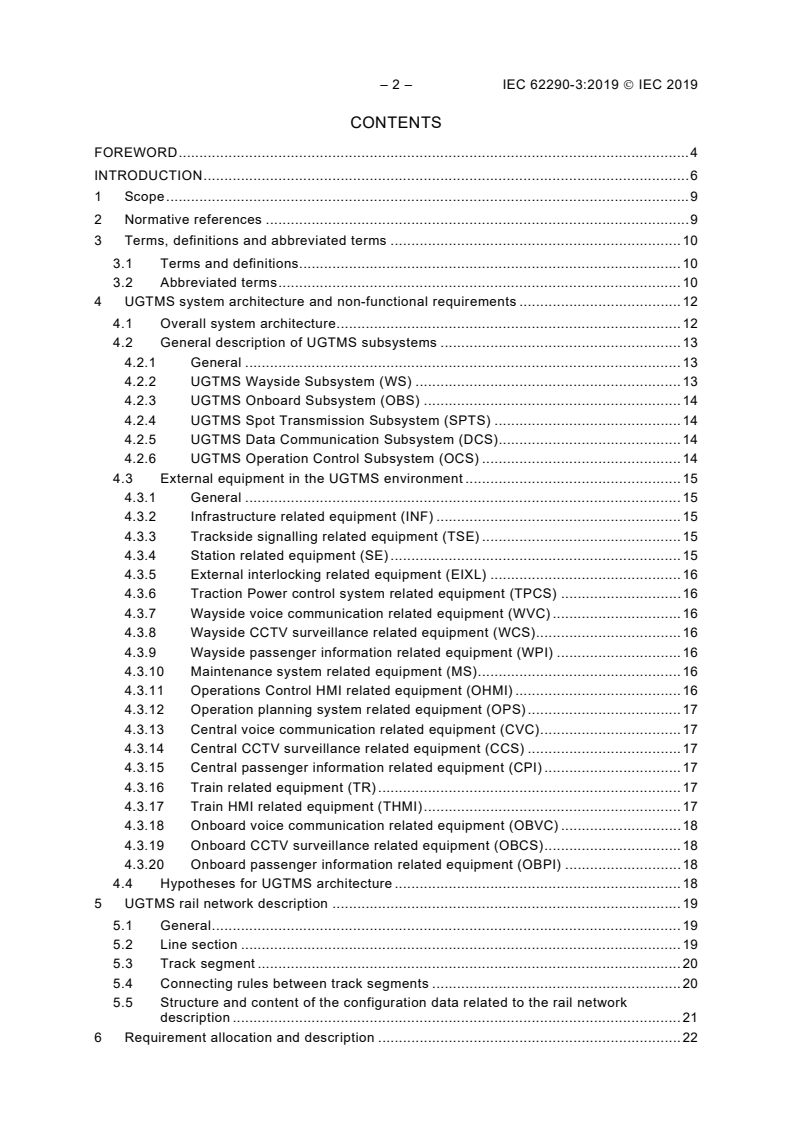
CONTENTS
FOREWORD . 4
INTRODUCTION . 6
1 Scope . 9
2 Normative references . 9
3 Terms, definitions and abbreviated terms . 10
3.1 Terms and definitions. 10
3.2 Abbreviated terms . 10
4 UGTMS system architecture and non-functional requirements . 12
4.1 Overall system architecture . 12
4.2 General description of UGTMS subsystems . 13
4.2.1 General . 13
4.2.2 UGTMS Wayside Subsystem (WS) . 13
4.2.3 UGTMS Onboard Subsystem (OBS) . 14
4.2.4 UGTMS Spot Transmission Subsystem (SPTS) . 14
4.2.5 UGTMS Data Communication Subsystem (DCS). 14
4.2.6 UGTMS Operation Control Subsystem (OCS) . 14
4.3 External equipment in the UGTMS environment . 15
4.3.1 General . 15
4.3.2 Infrastructure related equipment (INF) . 15
4.3.3 Trackside signalling related equipment (TSE) . 15
4.3.4 Station related equipment (SE) . 15
4.3.5 External interlocking related equipment (EIXL) . 16
4.3.6 Traction Power control system related equipment (TPCS) . 16
4.3.7 Wayside voice communication related equipment (WVC) . 16
4.3.8 Wayside CCTV surveillance related equipment (WCS). 16
4.3.9 Wayside passenger information related equipment (WPI) . 16
4.3.10 Maintenance system related equipment (MS) . 16
4.3.11 Operations Control HMI related equipment (OHMI) . 16
4.3.12 Operation planning system related equipment (OPS) . 17
4.3.13 Central voice communication related equipment (CVC) . 17
4.3.14 Central CCTV surveillance related equipment (CCS) . 17
4.3.15 Central passenger information related equipment (CPI) . 17
4.3.16 Train related equipment (TR) . 17
4.3.17 Train HMI related equipment (THMI) . 17
4.3.18 Onboard voice communication related equipment (OBVC) . 18
4.3.19 Onboard CCTV surveillance related equipment (OBCS) . 18
4.3.20 Onboard passenger information related equipment (OBPI) . 18
4.4 Hypotheses for UGTMS architecture . 18
5 UGTMS rail network description . 19
5.1 General . 19
5.2 Line section . 19
5.3 Track segment . 20
5.4 Connecting rules between track segments . 20
5.5 Structure and content of the configuration data related to the rail network
description . 21
6 Requirement allocation and description . 22
6.1 Functional and non-functional requirement allocation to UGTMS subsystems . 22
6.1.1 General principles . 22
6.1.2 Allocation of functional requirements from IEC 62290-2:2014 . 24
6.2 Summary of allocated functions and subfunctions from IEC 62290-2:2014 . 252
6.3 Identification of interfaces for the UGTMS subsystems . 259
6.3.1 General . 259
6.3.2 Identification of interfaces between UGTMS subsystems . 259
6.3.3 Interfaces between UGTMS subsystems and the environment . 265
Figure 1 – The three-step process followed by the UGTMS standard . 7
Figure 2 – UGTMS system environment (as defined in IEC 62290-1) . 12
Figure 3 – UGTMS system architecture, external systems and external interfaces . 13
Figure 4 – UGTMS concept of line section . 19
Figure 5 – UGTMS track segment definition . 20
Figure 6 – UGTMS track segment chaining . 21
Figure 7 – Example for the description of 6.1.2 . 23
Table 1 – Summary of allocated functions and subfunctions from IEC 62290-2:2014 . 252
Table 2 – Identification of interfaces between UGTMS subsystems . 259
Table 3 – Interfaces between UGTMS subsystems and the environment . 265
– 4 – IEC 62290-3:2019 IEC 2019
INTERNATIONAL ELECTROTECHNICAL COMMISSION
____________
RAILWAY APPLICATIONS –
URBAN GUIDED TRANSPORT MANAGEMENT
AND COMMAND/CONTROL SYSTEMS –
Part 3: System requirements specification
FOREWORD
1) The International Electrotechnical Commission (IEC) is a worldwide organization for standardization comprising
all national electrotechnical committees (IEC National Committees). The object of IEC is to promote
international co-operation on all questions concerning standardization in the electrical and electronic fields. To
this end and in addition to other activities, IEC publishes International Standards, Technical Specifications,
Technical Reports, Publicly Available Specifications (PAS) and Guides (hereafter referred to as “IEC
Publication(s)”). Their preparation is entrusted to technical committees; any IEC National Committee interested
in the subject dealt with may participate in this preparatory work. International, governmental and non-
governmental organizations liaising with the IEC also participate in this preparation. IEC collaborates closely
with the International Organization for Standardization (ISO) in accordance with conditions determined by
agreement between the two organizations.
2) The formal decisions or agreements of IEC on technical matters express, as nearly as possible, an international
consensus of opinion on the relevant subjects since each technical committee has representation from all
interested IEC National Committees.
3) IEC Publications have the form of recommendations for international use and are accepted by IEC National
Committees in that sense. While all reasonable efforts are made to ensure that the technical content of IEC
Publications is accurate, IEC cannot be held responsible for the way in which they are used or for any
misinterpretation by any end user.
4) In order to promote international uniformity, IEC National Committees undertake to apply IEC Publications
transparently to the maximum extent possible in their national and regional publications. Any divergence
between any IEC Publication and the corresponding national or regional publication shall be clearly indicated in
the latter.
5) IEC itself does not provide any attestation of conformity. Independent certification bodies provide conformity
assessment services and, in some areas, access to IEC marks of conformity. IEC is not responsible for any
services carried out by independent certification bodies.
6) All users should ensure that they have the latest edition of this publication.
7) No liability shall attach to IEC or its directors, employees, servants or agents including individual experts and
members of its technical committees and IEC National Committees for any personal injury, property damage or
other damage of any nature whatsoever, whether direct or indirect, or for costs (including legal fees) and
expenses arising out of the publication, use of, or reliance upon, this IEC Publication or any other IEC
Publications.
8) Attention is drawn to the Normative references cited in this publication. Use of the referenced publications is
indispensable for the correct application of this publication.
9) Attention is drawn to the possibility that some of the elements of this IEC Publication may be the subject of
patent rights. IEC shall not be held responsible for identifying any or all such patent rights.
International Standard IEC 62290-3 has been prepared by IEC technical committee 9:
Electrical equipment and systems for railways.
The text of this International Standard is based on the following documents:
FDIS Report on voting
9/2531/FDIS 9/2544/RVD
Full information on the voting for the approval of this International Standard can be found in
the report on voting indicated in the above table.
This publication has been drafted in accordance with the ISO/IEC Directives, Part 2.
A list of all parts of IEC 62290 series, under the general title Railway applications – Urban
guided transport management and command/control systems, can be found on the IEC
website.
The committee has decided that the contents of this publication will remain unchanged until
the stability date indicated on the IEC web site under "http://webstore.iec.ch" in the data
related to the specific publication. At this date, the publication will be
• reconfirmed,
• withdrawn,
• replaced by a revised edition, or
• amended.
IMPORTANT – The 'colour inside' logo on the cover page of this publication indicates
that it contains colours which are considered to be useful for the correct
understanding of its contents. Users should therefore print this document using a
colour printer.
– 6 – IEC 62290-3:2019 IEC 2019
INTRODUCTION
IEC 62290 standard series specifies the functional, system and interface requirements for the
command, control, and management systems intended to be used on urban, guided
passenger transport lines and networks. This series does not apply to lines that are operated
under specific railway regulations, unless otherwise specified by the authority having
jurisdiction.
These systems are designated herein as Urban Guided Transport Management and
Command/Control Systems (UGTMS). UGTMS cover a wide range of operations needs from
non-automated (GOA1) to unattended (GOA4) operation. A line may be equipped with
UGTMS on its full length or only partly equipped.
This series does not specifically address security issues. However, aspects of safety
requirements may apply to ensuring security within the urban guided transit system.
The main objective of this series is to achieve interoperability, interchangeability and
compatibility.
This series is a recommendation for those transport authorities wishing to introduce
interoperable, interchangeable and compatible equipment.
It is the responsibility of the transport authority concerned in accordance with the authority
having jurisdiction to decide on how to apply this series and to take into account their
particular needs.
IEC 62290 series is also intended to support applications for upgrading existing signalling and
command control systems. In this case, interchangeability and compatibility could be ensured
only for the additional UGTMS equipment. Checking the possibility for upgrading existing
equipment and the level of interoperability is the responsibility of the transport authority
concerned.
Application of the series should take into account the differences between the various
networks operated in different nations. Those differences include operational and regulatory
requirements as well as different safety cultures.
This series defines a catalogue of UGTMS requirements split into mandatory and optional
functions. The functions used are based on the given grade of automation. By fulfilling the
requirements, a supplier can create one or more generic applications including all mandatory
functions and all or a subset of optional functions. A generic application will achieve
interoperability within the defined specific application conditions. Customising a generic
application will create a specific application taking into account of local conditions such as
track layout and headway requirements. It is the choice of supplier and transport authority to
add additional functions to a generic or specific application. These additional functions are not
described in this series.
According to IEC 62278, it is the responsibility of the transport authority, in agreement with
the authority having jurisdiction, to decide, taking into account their risk acceptance principles
to conduct specific hazard and risk analysis for each specific application. The safety levels for
the functions of each specific application have to be determined by a specific risk analysis.
Terms like "safety related command", "safety conditions", "safe station departure" are
mentioned without having performed any hazard analysis.
Standard series IEC 62290 is intended to consist of four parts:
• Part 1 “System principles and fundamental concepts” provides an introduction to the
standard and deals with the main concepts, the system definition, the principles and
the basic functions of UGTMS (Urban Guided Transport Management and
Command/Control Systems).
The three other parts correspond to the three steps (see Figure 1) required in the process of
specifying UGTMS and are to be used accordingly.
• Part 2 “Functional requirements specification” specifies the functional requirements
associated to the basic functions provided by Part 1, within the system boundaries and
interfaces as defined in Figure 3 of Part 1.
The FRS (Functional Requirements Specification) identifies and defines the functions
that are necessary to operate an urban guided transport system. Two types of
functions are distinguished for a given grade of automation: mandatory functions (e.g.
train detection) and optional functions (e.g. interfaces to passenger information and
passenger surveillance systems). Requirements of functions have the same allocation,
unless they are marked otherwise.
• Part 3 “System requirements specifications” deals with the architecture of the system
and the allocation of the requirements and functions identified in Part 2 to architecture
constituents.
The SRS (System Requirement Specification) specifies the architecture of a UGTMS
system, with mandatory and optional constituents.
• Part 4 (under consideration) “Interface specifications” deals with the definition of the
interfaces, as well as the data exchanged by them (FIS and FFFIS), for the
interoperable and interchangeable constituents identified in Part 3.
For interfaces between UGTMS constituents, the logical interface or FIS (Functional
Interface Specification) and/or the physical and logical interface or FFFIS (Form Fit
Functional Interface Specification) will be considered.
NOTE The specific structures of Part 3 and Part 4 will be established following completion of Part 2 to
accommodate optional and mandatory constituents, and to reflect local conditions. In principle, only one FIS or/and
FFFIS will be defined for the same interface. However, when justified in some cases, several FISs or several
FFFISs will be defined for the same interface.
Figure 1 – The three-step process followed by the UGTMS standard
– 8 – IEC 62290-3:2019 IEC 2019
Requirements are those necessary to fulfil all operational needs for safe and orderly operation
requested by transport authorities without regard to technical solutions.
The chosen level of detail in describing requirements enables customers as well as authorities
having jurisdiction to be assured that generic applications delivered by different suppliers will
cover at least the same functionality as specified in this part of IEC 62290.
Requirements which are established by this series are indicated clearly with a requirement
identification number related to the function to be covered.
RAILWAY APPLICATIONS –
URBAN GUIDED TRANSPORT MANAGEMENT
AND COMMAND/CONTROL SYSTEMS –
Part 3: System requirements specification
1 Scope
This part of IEC 62290 specifies the system architecture for Urban Guided Transport
Management and Command/Control systems (UGTMS) as defined in IEC 62290-1 and
IEC 62290-2, and the allocation of functions and requirements defined in IEC 62290-2 to the
different UGTMS subsystems (designated as system constituents in IEC 62290-1 and
IEC 62290-2), for use in urban guided passenger transport lines and networks.
This document is applicable for new lines or for upgrading existing signalling and command
control systems.
This document is applicable to applications using:
• continuous data transmission
• continuous supervision of train movements by train protection profile
• localisation by reporting trains, and optionally by external wayside equipment for non-
reporting ones (e.g. in case of mixed operation or degraded operation)
This document is not applicable to existing command and control systems or projects in
progress prior to the effective date of this document.
The functional allocations of the UGTMS subsystems are mandatory (forming a sort of core
system) or optional, according to the mandatory/optional functions and requirements defined
in IEC 62290-2.
This document is applicable as a basis to define FIS and FFFIS. For specific applications,
some elements may be added to meet the requirements coming from additional functions or
equipment.
2 Normative references
The following documents are referred to in the text in such a way that some or all of their
content constitutes requirements of this document. For dated references, only the edition
cited applies. For undated references, the latest edition of the referenced document (including
any amendments) applies.
IEC 62290-1:2014, Railway applications – Urban guided transport management and
command/control systems – Part 1: System principles and fundamental concepts
IEC 62290-2:2014, Railway applications – Urban guided transport management and
command/control systems – Part 2: Functional requirements specification
– 10 – IEC 62290-3:2019 IEC 2019
3 Terms, definitions and abbreviated terms
For the purposes of this document, the terms and definitions given in IEC 62290-1 and the
following apply.
ISO and IEC maintain terminological databases for use in standardization at the following
addresses:
• IEC Electropedia: available at http://www.electropedia.org/
• ISO Online browsing platform: available at http://www.iso.org/obp
3.1 Terms and definitions
3.1.1
train consist
basic train units coupled together, which can be split or coupled depending on operation
needs
Note 1 to entry: When maintenance of IEC 62290-2:2014 is done, requirements in IEC 62290-2 will not use the
expression “train consists” any more, in order to be consistent with the meaning of “consist” in the latest edition of
IEC 60050-811:2017. IEC 62290-3 will not use as a consequence the expression “train consist” any more.
3.1.2
dwell time
time during which a train is berthed in a station served by the mission
3.1.3
headway
minimum time interval between consecutive trains allowed by the signalling system
Note 1 to entry: This definition comes from IEC 60050-821:2017, and is given for the term ‘signal headway’. In the
rest of this document, only the term ‘headway’ is used.
[SOURCE: IEC 60050-821:2017, 821-02-54]
3.1.4
rollaway
unintended movement of the train in either a forward or reverse direction
3.1.5
run type
predefined speed profile which is managed at OCS level (energy saving profile, minimum run
time, etc.)
3.1.6
safety-related command
operator triggered command whose execution has an impact on safety
3.2 Abbreviated terms
CCS Central CCTV Surveillance
CPI Central Passenger Information
CVC Central Voice Communication
DCS UGTMS Data Communication Subsystem
EB Emergency Braking
EIXL External Interlocking
FCN Function
HVCB High Voltage Circuit Breaker
INF Infrastructure
MS Maintenance System
OBCS Onboard CCTV Surveillance
OBPI Onboard Passenger Information
OBS UGTMS Onboard Subsystem
OBVC Onboard Voice Communication
OCS UGTMS Operations Control Subsystem
OHMI Operations Control HMI
OPS Operation Planning System
PSD Platform Screen Door
REQ Requirement
SE Station Equipment
SPTS UGTMS Spot Transmission Subsystem
THMI Train HMI
TPCS Traction Power Control System
TR Train (but not its HMI)
TSE Trackside Signalling Equipment
TSR Temporary Speed Restriction
WCS Wayside CCTV surveillance
WPI Wayside Passenger Information
WS UGTMS Wayside Subsystem
WVC Wayside Voice Communication
ZOP Zone of Protection
– 12 – IEC 62290-3:2019 IEC 2019
4 UGTMS system architecture and non-functional requirements
4.1 Overall system architecture
This clause provides the general description of UGTMS architecture, the list of UGTMS
subsystems, the identification of interfaces between UGTMS subsystems, and between
UGTMS subsystems and the environment.
Non-functional requirements (like the ones related to performance) are described as well, in
addition to the main choices made in this document, and having an impact on architecture.
Figure 2 and Figure 3 describe the UGTMS System architecture in consistency with the
environment described in IEC 62290-1:2014, and highlighting external interfaces with this
environment, and internal interfaces between UGTMS equipment.
Figure 2 – UGTMS system environment (as defined in IEC 62290-1)
In the rest of the document, following an architecture decision (as shown in Figure 3), the
Spot Transmission subsystem is considered as an independent UGTMS subsystem.
Figure 3 – UGTMS system architecture, external systems and external interfaces
It has to be noted that Figure 3 does not represent all the flows through the DCS subsystem,
in order to keep it readable. The direct flows through the DCS existing possibly between
external equipment and a UGTMS subsystem are described in detail in 4.3, in 6.1 and the
corresponding subclauses of 6.3.
It has to be noted as well that the allocation work done in Clause 6 has permitted to identify
the situations of direct link for external equipment through the DCS, but the document does
not cover all possible direct links through the DCS.
4.2 General description of UGTMS subsystems
4.2.1 General
As shown on Figure 3, UGTMS system is split into five subsystems:
– the UGTMS Wayside Subsystem
– the UGTMS Onboard Subsystem
– the UGTMS Spot Transmission Subsystem
– the UGTMS Data Communication Subsystem
– the UGTMS Operation Control Subsystem
4.2.2 UGTMS Wayside Subsystem (WS)
The UGTMS Wayside Subsystem corresponds to the UGTMS equipment located in technical
rooms.
A part of the equipment making the UGTMS Wayside Subsystem is able to manage trains on
a portion or the whole line.
– 14 – IEC 62290-3:2019 IEC 2019
The equipment included in the UGTMS Wayside Subsystem is able to perform the following
main functions:
– ensures safe route through interlocking related functions, or an interface with an external
interlocking,
– ensures the safe separation of train, for instance through the determination of movement
authority to be sent to trains, or contribution to it, and based on train locations,
– ensures the management of inputs/outputs to interface with trackside signalling equipment
(such as points, signals, etc.) or platform door control systems.
4.2.3 UGTMS Onboard Subsystem (OBS)
The UGTMS Onboard Subsystem corresponds to the UGTMS equipment located onboard.
The equipment included in the UGTMS Onboard Subsystem performs the following main
functions (depending on the GOA):
– determines the train location,
– ensures that the train proceeds safely in accordance with its movement authority and
permitted speed,
– drives and controls the train automatically,
– interfaces with the Spot Transmission Subsystem
4.2.4 UGTMS Spot Transmission Subsystem (SPTS)
The UGTMS Spot Transmission Subsystem includes transponders located at wayside, an
antenna for transmitting information, and a receiver located onboard.
The UGTMS Spot Transmission Subsystem performs synchronisation of train location.
4.2.5 UGTMS Data Communication Subsystem (DCS)
The UGTMS Data Communication Subsystem provides communication means between the
different UGTMS subsystems.
It can be used as well for exchange between UGTMS subsystems and external systems.
It is made up of a wayside related part, an onboard one and the Radio making the relation
between these two parts.
The Wayside Data Communication Network allows the interconnection between UGTMS
wayside equipment, such as the UGTMS Operation Control Subsystem, the UGTMS Wayside
Subsystem, or between UGTMS wayside equipment and external wayside systems.
The Onboard Data Communication Network interconnects the UGTMS Onboard equipment
within a train. Another possible configuration might be for instance to connect a UGTMS
Onboard Subsystem and a neighbouring subsystem, in the case of two trains coupled and
equipped with UGTMS equipment.
The Radio Data Communication Network provides a radio link between UGTMS Wayside
equipment and UGTMS Onboard subsystem.
4.2.6 UGTMS Operation Control Subsystem (OCS)
The UGTMS Operation Control Subsystem provides control and monitoring facilities to
supervise the traffic and other subsystems.
The Operations Control Human Machine Interface (OHMI) is out of UGTMS scope.
4.3 External equipment in the UGTMS environment
4.3.1 General
These external devices as shown on Figure 3 have been defined accordingly with Figure 3 of
IEC 62290-1:2014.
4.3.2 Infrastructure related equipment (INF)
The infrastructure related equipment covers:
– the track and related detectors (intrusion detection systems along the track, wayside
obstacle detection, broken rail detection),
– devices used as staff protection purposes (e.g. plungers for switching off the power),
– the tunnel ventilation,
– fire and smoke detectors deployed in tunnels or along the track,
– flood gates or blasting doors,
– emergency exits.
4.3.3 Trackside signalling related equipment (TSE)
The concerned devices are those installed along the track, and that are in relation with
signalling.
This covers:
– points, signals, track circuits and any other train detection devices like axle counters,
– equipment for displaying Train hold information,
– equipment for displaying wayside obstacle information,
– equipment for displaying working zone information,
– equipment for displaying station departure authorization,
– and equipment for initiating the unattended turnback.
4.3.4 Station related equipment (SE)
The concerned devices are those installed in stations.
The devices that are covered by this category are:
– fire detection/protection systems deployed in stations,
– auxiliaries like escalators and elevators,
– platform/track intrusion/fall detection systems,
– platform screen doors, and platform end doors,
– equipment for displaying platform screen door closing status,
– gap detection devices (falling or trapped objects/persons),
– gap filling devices,
– emergency handles,
– stop request devices,
– emergency call devices.
– 16 – IEC 62290-3:2019 IEC 2019
4.3.5 External interlocking related equipment (EIXL)
Such equipment is usually encountered when a choice has been made to retain an existing
interlocking when upgrading the train control system to UGTMS.
External interlocking equipment may be of several different types, e.g. fully electronic, where
both the control and safety functions are realised by a computer, all relay, where control and
safety functions are realised by electromechanical relays and their associated wiring, or
computer controlled relay interlockings, which are hybrid systems, where the control functions
are carried out by computer, but the safety functions are performed by relays.
4.3.6 Traction Power control system related equipment (TPCS)
This equipment is intended to control the traction power system which supplies the trains with
electrical power via the contact line or conductor rails.
The substations which feed the traction power system and their associated circuit-breakers
are controlled from the Traction Power control system which may (but not necessarily) be
located in the OCC.
4.3.7 Wayside voice communication related equipment (WVC)
This is equipment on the platform, and at other locations within a station or possibly along the
track, that allows a passenger or staff to talk with staff in OCC or in other locations.
Such equipment has to provide an interface with the DCS in accordance with the DCS
characteristics (e.g. communication protocols, or bandwidth, etc.).
4.3.8 Wayside CCTV surveillance related equipment (WCS)
The concerned devices are those installed along the track and in the stations (both in
platforms, technical rooms and other station’s rooms) for a real-time surveillance (monitoring
and storing for additional processing) ensuring passengers’ security and safety.
4.3.9 Wayside passenger information related equipment (WPI)
The interface between UGTMS and wayside passenger information related equipment allows
for real-time passenger information to be displayed at platforms, concourses and ticket
offices. It may include both predictions about arrival and departure times, as well as platform
and train formation information.
4.3.10 Maintenance system related equipment (MS)
The Maintenance system related equipment is in charge of the maintenance support for the
operation of a UGTMS system, and of the diagnostic for failures or accidents.
The Maintenance system covers the whole UGTMS system, and its subsystems, including the
DCS.
The Maintenance system is connected to the UGTMS DCS, to the UGTMS OCS or in some
cases to the UGTMS WS.
The maintenance support and diagnostic is performed by using data and reported statuses or
alarms from the different UGTMS subsystems.
4.3.11 Operations Control HMI related equipment (OHMI)
The OHMI is the external equipment permitting the operation staff to manage the operations
of UGTMS line through a set of displayed information and a set of commands.
Such equipment is located either in OCC, either decentralized in local facilities (e.g. station
room) or through handheld devices such as pads.
4.3.12 Operation planning system related equipment (OPS)
This is the external equipment which supports the staff to plan and manage timetables, and
provides to UGTMS the planned timetables for a given line, and see [H4] in 4.4.
4.3.13 Central voice communication related equipment (CVC)
This is equipment at the OCC that allows staff to talk with passengers or staff located in other
locations.
Such equipment has to provide an interface with the DCS in accordance with the DCS
characteristics (e.g. communication protocols, or bandwidth, etc.).
4.3.14 Central CCTV surveillance related equipment (CCS)
The concerned devices are those installed at the OCC in order to display, elaborate and
record real-time videos received from Wayside and Onboard CCTV surveillance related
equipment.
4.3.15 Central passenger information related equipment (CPI)
The interface between UGTMS and central passenger information related equipment allows
for the operator to organize and plan the real-time passenger information to be provided
wayside and onboard.
4.3.16 Train related equipment (TR)
The devices that are covered by this category are (items listed in “TRAIN” box of Figure 3 in
IEC 62290-1:2014):
– doors, propulsion, brakes, train length device (e.g. couplers),
– obstacle detection device, derailment detection device, fire/smoke detection device,
– gap detection device or gap closing device (gap fillers, moveable steps and similar
devices),
– emergency stop/door release handles/alarm buttons,
– other equipment interfaces (e.g. lighting, HVAC, battery),
– train diagnostics (for maintenance),
– train status (for fitness for operation),
– fare collection (location information).
4.3.17 Train HMI related equipment (THMI)
The train HMI related equipment is to receive commands, for instance about:
– changing driving modes,
– reset of emergency brake,
– train identification, train length,
– activation/resume of onboard equipment,
– destination of train journey, etc.
from train driver or staff, and to provide information, for instance:
– driving modes,
– 18 – IEC 62290-3:2019 IEC 2019
– door status,
– permitted maximum speed,
– failure information, test results,
– station departure authorization, etc.
to train driver or staff.
NOTE Those commands and information items are extracted from statements of the REQ whose allocation-Note
description includes the expression “by REQ_6.5.2#1”. The FCN 6.5.2 is “Manage the interface with the train HMI”.
4.3.18 Onboard voice communication related equipment (OBVC)
This is equipment on a train that allows a passenger or staff to communicate with staff (e.g
the driver, the OCC operator).
Such equipment has to provide an interface with the DCS in accordance with the DCS
characteristics (e.g. communication protocols, or bandwidth, etc.).
4.3.19 Onboard CCTV surveillance related equipment (OBCS)
The concerned devices are those installed on the vehicle for a real-time surveillance
(monitoring and storing for additional processing) ensuring passengers’ security and safety.
The corresponding data are made available for elaboration, recording and transmission to the
Central CCTV surveillance related equipment and possibly to the driver.
4.3.20 Onboard passenger information related equipment (OBPI)
The interface between UGTMS and onboard passenger information related equipment allows
for real-time passenger information to be displayed. It may include both predictions about
arrival times and connections, as well as information about the nature and causes of
disruptions.
4.4 Hypotheses for UGTMS architecture
This subclause describes the major choices identified in the standard and having an impact
on architecture, and that result from the allocation done in 6.1, and in 6.2.
While Figure 3 is an architecture prepared to achieve the allocation of functions and
requirements defined in IEC 62290-2:2014, some allocating works are difficult on this system
breakdown structure level of the figure. The following hypotheses complement the
representation of architecture to complete the allocations (tag with “H” is added to each item
in preparation to link related descriptions):
[H1] It is assumed that the external OHMI is connected to the UGTMS subsystems via the
OCS. As an option, according to the decided allocation for requirements from
IEC 62290-2:2014, the connection can be done directly though the DCS.
[H2] It is assumed that the external Train HMI is directly connected to the OBS. As an option,
it could be through the DCS
[H3] The architecture and the related allocation considered in this document is the one of the
current state of the art which involves both WS and OBS (different approaches induced
by technology evolution could be considered in the future maintenance of this
document, such as for insta
...