

IEC 60601-2-62:2013
(Main)Medical electrical equipment - Part 2-62: Particular requirements for the basic safety and essential performance of high intensity therapeutic ultrasound (HITU) equipment
General Information
- Abstract
IEC 60601-2-62:2013 applies to the basic safety and essential performance of HIGH INTENSITY THERAPEUTIC ULTRASOUND EQUIPMENT. This International Standard adds or replaces clauses listed in the IEC 60601-1 that are specific for HIGH INTENSITY THERAPEUTIC ULTRASOUND EQUIPMENT. If a clause or subclause is specifically intended to be applicable to such equipment only, or to related systems only, the title and content of that clause or subclause will say so. If that is not the case, the clause or subclause applies both to individual equipment and to systems, as relevant. Hazards inherent in the intended physiological function of the equipment or systems within the scope of this standard are not covered by specific requirements in this standard except in 7.2.13 and 8.4.1 of the general standard. This standard can also be applied to
- therapeutic equipment for thrombolysis through exposure to high-intensity therapeutic ultrasound;
- therapeutic equipment for the treatment of occluding feeding vessels through exposure to high-intensity focused ultrasound;
- and equipment intended to be used for relieving cancer pain due to bone metastases.
This particular standard does not apply to
- Ultrasound Equipment intended to be used for physiotherapy (use IEC 60601-2-5 and IEC 61689);
- Ultrasound Equipment intended to be used for lithotripsy (use IEC 60601-2-36);
- Ultrasound Equipment intended to be used for dedicated hyperthermia devices; and
- Ultrasound Equipment intended to be used for phacoemulsification.
- Status
- Published
- Publication Date
- 08-Jul-2013
- Technical Committee
- SC 62D - Particular medical equipment, software, and systems
- Drafting Committee
- MT 18 - TC 62/SC 62D/MT 18
- Current Stage
- PPUB - Publication issued
- Start Date
- 09-Jul-2013
- Completion Date
- 15-Jul-2013
Buy Documents
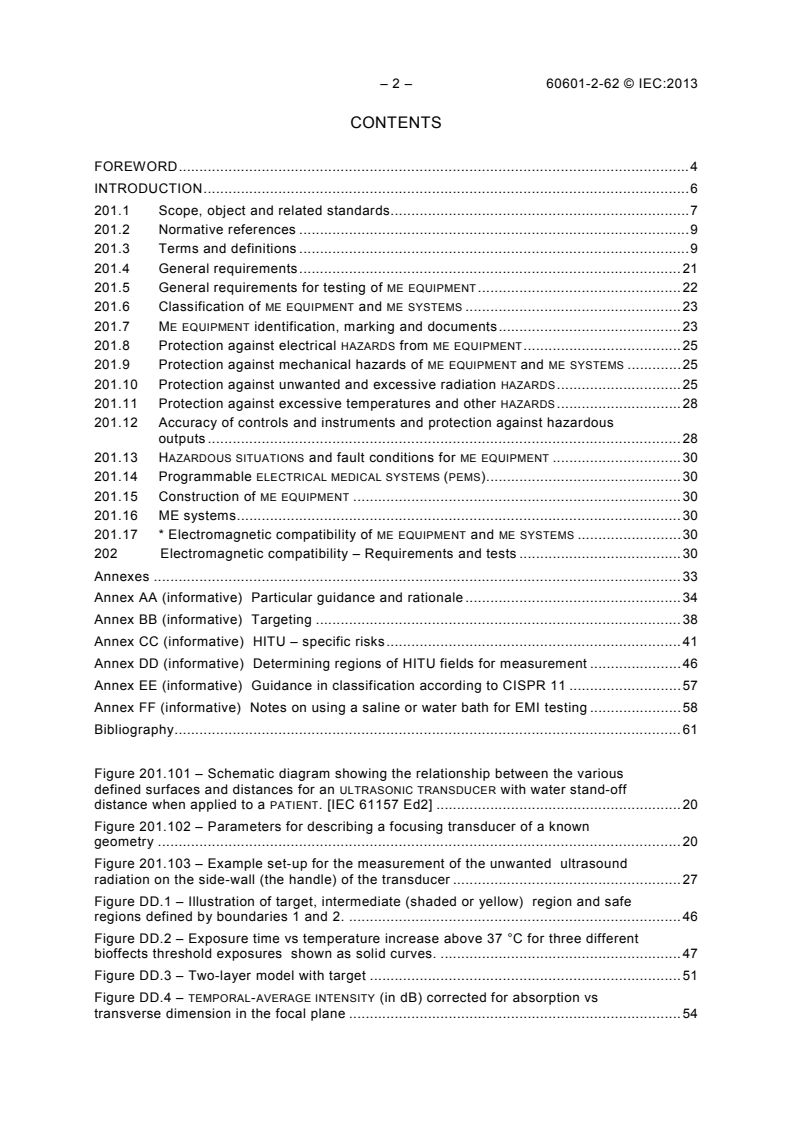
IEC 60601-2-62:2013 - Medical electrical equipment - Part 2-62: Particular requirements for the basic safety and essential performance of high intensity therapeutic ultrasound (HITU) equipment Released:7/9/2013
Overview
IEC 60601-2-62:2013 is an international standard published by the International Electrotechnical Commission (IEC) that specifies the particular requirements for the basic safety and essential performance of High Intensity Therapeutic Ultrasound (HITU) equipment. This standard supplements and modifies IEC 60601-1, the general standard for medical electrical equipment, focusing specifically on HITU devices used in therapeutic applications. It addresses risks, testing, and classification related to the unique operational characteristics of high intensity therapeutic ultrasound technology.
This standard covers equipment used for various therapeutic purposes, including thrombolysis, treatment of occluding feeding vessels via high-intensity focused ultrasound, and pain relief for cancer-related bone metastases. However, it excludes ultrasound equipment intended for physiotherapy, lithotripsy, dedicated hyperthermia devices, and phacoemulsification.
Key Topics
Scope and Application
IEC 60601-2-62:2013 applies to HITU devices delivering concentrated ultrasound energy for therapeutic use, emphasizing patient safety and functional reliability.Safety Requirements
The standard specifies protection requirements against:- Electrical hazards
- Mechanical hazards inherent in device operation
- Unwanted and excessive ultrasound radiation
- Excessive temperatures and other physiologic hazards
Performance and Testing
Detailed testing protocols ensure the accuracy of controls and instruments, safeguard against hazardous outputs, and verify device behavior under fault conditions.Programmable Electrical Medical Systems (PEMS)
Guidelines for software-controlled HITU equipment ensuring safe and reliable operation.Identification and Documentation
Requirements for clear labeling, user manuals, and maintenance instructions to facilitate safe use.Electromagnetic Compatibility (EMC)
EMC requirements and tests are included to prevent interference with other medical or electronic devices.Risk Management
Annexes provide comprehensive guidance on HITU-specific risks, focusing on issues such as image-to-focus misalignment, operator error, and equipment failures including transducers, generators, and cooling systems.
Applications
HITU equipment covered by IEC 60601-2-62:2013 finds application in:
- Therapeutic thrombolysis – non-invasive breaking down of blood clots using focused ultrasound.
- Targeted vascular treatments – occluding feeding vessels in tumors or other pathological conditions using high-intensity focused ultrasound.
- Cancer pain management – alleviating bone metastasis pain by applying therapeutic ultrasound.
This standard assures that devices used in these sensitive therapeutic applications meet stringent safety and performance criteria to protect both patients and operators, maintain treatment efficacy, and support regulatory compliance.
Related Standards
- IEC 60601-1: General requirements for basic safety and essential performance of medical electrical equipment.
- IEC 60601-2-5: Particular requirements for the safety of ultrasound equipment used for physiotherapy.
- IEC 60601-2-36: Particular requirements for extracorporeal shock wave lithotripsy equipment.
- IEC 61689: Additional standards applicable for physiotherapy ultrasound devices.
Summary
IEC 60601-2-62:2013 is an essential standard for manufacturers, healthcare providers, and regulatory bodies involved with high intensity therapeutic ultrasound equipment. By adhering to this standard, stakeholders ensure the delivery of safe, reliable, and effective therapeutic ultrasound treatments while minimizing risks associated with device operation. Compliance aids in market access, regulatory approval, and fosters confidence in HITU technology used for advanced medical therapies.
Buy Documents
IEC 60601-2-62:2013 - Medical electrical equipment - Part 2-62: Particular requirements for the basic safety and essential performance of high intensity therapeutic ultrasound (HITU) equipment Released:7/9/2013
Get Certified
Connect with accredited certification bodies for this standard

BSI Group
BSI (British Standards Institution) is the business standards company that helps organizations make excellence a habit.

TÜV Rheinland
TÜV Rheinland is a leading international provider of technical services.

TÜV SÜD
TÜV SÜD is a trusted partner of choice for safety, security and sustainability solutions.
Sponsored listings
Frequently Asked Questions
IEC 60601-2-62:2013 is a standard published by the International Electrotechnical Commission (IEC). Its full title is "Medical electrical equipment - Part 2-62: Particular requirements for the basic safety and essential performance of high intensity therapeutic ultrasound (HITU) equipment". This standard covers: IEC 60601-2-62:2013 applies to the basic safety and essential performance of HIGH INTENSITY THERAPEUTIC ULTRASOUND EQUIPMENT. This International Standard adds or replaces clauses listed in the IEC 60601-1 that are specific for HIGH INTENSITY THERAPEUTIC ULTRASOUND EQUIPMENT. If a clause or subclause is specifically intended to be applicable to such equipment only, or to related systems only, the title and content of that clause or subclause will say so. If that is not the case, the clause or subclause applies both to individual equipment and to systems, as relevant. Hazards inherent in the intended physiological function of the equipment or systems within the scope of this standard are not covered by specific requirements in this standard except in 7.2.13 and 8.4.1 of the general standard. This standard can also be applied to - therapeutic equipment for thrombolysis through exposure to high-intensity therapeutic ultrasound; - therapeutic equipment for the treatment of occluding feeding vessels through exposure to high-intensity focused ultrasound; - and equipment intended to be used for relieving cancer pain due to bone metastases. This particular standard does not apply to - Ultrasound Equipment intended to be used for physiotherapy (use IEC 60601-2-5 and IEC 61689); - Ultrasound Equipment intended to be used for lithotripsy (use IEC 60601-2-36); - Ultrasound Equipment intended to be used for dedicated hyperthermia devices; and - Ultrasound Equipment intended to be used for phacoemulsification.
IEC 60601-2-62:2013 applies to the basic safety and essential performance of HIGH INTENSITY THERAPEUTIC ULTRASOUND EQUIPMENT. This International Standard adds or replaces clauses listed in the IEC 60601-1 that are specific for HIGH INTENSITY THERAPEUTIC ULTRASOUND EQUIPMENT. If a clause or subclause is specifically intended to be applicable to such equipment only, or to related systems only, the title and content of that clause or subclause will say so. If that is not the case, the clause or subclause applies both to individual equipment and to systems, as relevant. Hazards inherent in the intended physiological function of the equipment or systems within the scope of this standard are not covered by specific requirements in this standard except in 7.2.13 and 8.4.1 of the general standard. This standard can also be applied to - therapeutic equipment for thrombolysis through exposure to high-intensity therapeutic ultrasound; - therapeutic equipment for the treatment of occluding feeding vessels through exposure to high-intensity focused ultrasound; - and equipment intended to be used for relieving cancer pain due to bone metastases. This particular standard does not apply to - Ultrasound Equipment intended to be used for physiotherapy (use IEC 60601-2-5 and IEC 61689); - Ultrasound Equipment intended to be used for lithotripsy (use IEC 60601-2-36); - Ultrasound Equipment intended to be used for dedicated hyperthermia devices; and - Ultrasound Equipment intended to be used for phacoemulsification.
IEC 60601-2-62:2013 is classified under the following ICS (International Classification for Standards) categories: 11.040.01 - Medical equipment in general; 17.140.50 - Electroacoustics; 19.040 - Environmental testing. The ICS classification helps identify the subject area and facilitates finding related standards.
IEC 60601-2-62:2013 is available in PDF format for immediate download after purchase. The document can be added to your cart and obtained through the secure checkout process. Digital delivery ensures instant access to the complete standard document.
Standards Content (Sample)
IEC 60601-2-62 ®
Edition 1.0 2013-07
INTERNATIONAL
STANDARD
NORME
INTERNATIONALE
colour
inside
Medical electrical equipment –
Part 2-62: Particular requirements for the basic safety and essential performance
of high intensity therapeutic ultrasound (HITU) equipment
Appareils électromédicaux –
Partie 2-62: Exigences particulières pour la sécurité de base et les performances
essentielles des appareils ultrasonores thérapeutiques de haute intensité (HITU)
All rights reserved. Unless otherwise specified, no part of this publication may be reproduced or utilized in any form
or by any means, electronic or mechanical, including photocopying and microfilm, without permission in writing from
either IEC or IEC's member National Committee in the country of the requester.
If you have any questions about IEC copyright or have an enquiry about obtaining additional rights to this publication,
please contact the address below or your local IEC member National Committee for further information.
Droits de reproduction réservés. Sauf indication contraire, aucune partie de cette publication ne peut être reproduite ni
utilisée sous quelque forme que ce soit et par aucun procédé, électronique ou mécanique, y compris la photocopie et les
microfilms, sans l'accord écrit de la CEI ou du Comité national de la CEI du pays du demandeur.
Si vous avez des questions sur le copyright de la CEI ou si vous désirez obtenir des droits supplémentaires sur cette
publication, utilisez les coordonnées ci-après ou contactez le Comité national de la CEI de votre pays de résidence.
IEC Central Office Tel.: +41 22 919 02 11
3, rue de Varembé Fax: +41 22 919 03 00
CH-1211 Geneva 20 info@iec.ch
Switzerland www.iec.ch
About the IEC
The International Electrotechnical Commission (IEC) is the leading global organization that prepares and publishes
International Standards for all electrical, electronic and related technologies.
About IEC publications
The technical content of IEC publications is kept under constant review by the IEC. Please make sure that you have the
latest edition, a corrigenda or an amendment might have been published.
Useful links:
IEC publications search - www.iec.ch/searchpub Electropedia - www.electropedia.org
The advanced search enables you to find IEC publications The world's leading online dictionary of electronic and
by a variety of criteria (reference number, text, technical electrical terms containing more than 30 000 terms and
committee,…). definitions in English and French, with equivalent terms in
It also gives information on projects, replaced and additional languages. Also known as the International
withdrawn publications. Electrotechnical Vocabulary (IEV) on-line.
IEC Just Published - webstore.iec.ch/justpublished Customer Service Centre - webstore.iec.ch/csc
Stay up to date on all new IEC publications. Just Published If you wish to give us your feedback on this publication
details all new publications released. Available on-line and or need further assistance, please contact the
also once a month by email. Customer Service Centre: csc@iec.ch.
A propos de la CEI
La Commission Electrotechnique Internationale (CEI) est la première organisation mondiale qui élabore et publie des
Normes internationales pour tout ce qui a trait à l'électricité, à l'électronique et aux technologies apparentées.
A propos des publications CEI
Le contenu technique des publications de la CEI est constamment revu. Veuillez vous assurer que vous possédez
l’édition la plus récente, un corrigendum ou amendement peut avoir été publié.
Liens utiles:
Recherche de publications CEI - www.iec.ch/searchpub Electropedia - www.electropedia.org
La recherche avancée vous permet de trouver des Le premier dictionnaire en ligne au monde de termes
publications CEI en utilisant différents critères (numéro de électroniques et électriques. Il contient plus de 30 000
référence, texte, comité d’études,…). termes et définitions en anglais et en français, ainsi que
Elle donne aussi des informations sur les projets et les les termes équivalents dans les langues additionnelles.
publications remplacées ou retirées. Egalement appelé Vocabulaire Electrotechnique
International (VEI) en ligne.
Just Published CEI - webstore.iec.ch/justpublished
Service Clients - webstore.iec.ch/csc
Restez informé sur les nouvelles publications de la CEI.
Just Published détaille les nouvelles publications parues. Si vous désirez nous donner des commentaires sur
Disponible en ligne et aussi une fois par mois par email. cette publication ou si vous avez des questions
contactez-nous: csc@iec.ch.
IEC 60601-2-62 ®
Edition 1.0 2013-07
INTERNATIONAL
STANDARD
NORME
INTERNATIONALE
colour
inside
Medical electrical equipment –
Part 2-62: Particular requirements for the basic safety and essential performance
of high intensity therapeutic ultrasound (HITU) equipment
Appareils électromédicaux –
Partie 2-62: Exigences particulières pour la sécurité de base et les performances
essentielles des appareils ultrasonores thérapeutiques de haute intensité (HITU)
INTERNATIONAL
ELECTROTECHNICAL
COMMISSION
COMMISSION
ELECTROTECHNIQUE
PRICE CODE
INTERNATIONALE
CODE PRIX XB
ICS 11.040.01; 17.140.50 ISBN 978-2-8322-0865-6
– 2 – 60601-2-62 © IEC:2013
CONTENTS
FOREWORD . 4
INTRODUCTION . 6
201.1 Scope, object and related standards. 7
201.2 Normative references . 9
201.3 Terms and definitions . 9
201.4 General requirements . 21
201.5 General requirements for testing of ME EQUIPMENT . 22
201.6 Classification of ME EQUIPMENT and ME SYSTEMS . 23
201.7 ME EQUIPMENT identification, marking and documents . 23
201.8 Protection against electrical HAZARDS from ME EQUIPMENT . 25
201.9 Protection against mechanical hazards of ME EQUIPMENT and ME SYSTEMS . 25
201.10 Protection against unwanted and excessive radiation HAZARDS . 25
201.11 Protection against excessive temperatures and other HAZARDS . 28
201.12 Accuracy of controls and instruments and protection against hazardous
outputs . 28
201.13 HAZARDOUS SITUATIONS and fault conditions for ME EQUIPMENT . 30
201.14 Programmable ELECTRICAL MEDICAL SYSTEMS (PEMS). 30
201.15 Construction of ME EQUIPMENT . 30
201.16 ME systems . 30
201.17 * Electromagnetic compatibility of ME EQUIPMENT and ME SYSTEMS . 30
202 Electromagnetic compatibility – Requirements and tests . 30
Annexes . 33
Annex AA (informative) Particular guidance and rationale . 34
Annex BB (informative) Targeting . 38
Annex CC (informative) HITU – specific risks . 41
Annex DD (informative) Determining regions of HITU fields for measurement . 46
Annex EE (informative) Guidance in classification according to CISPR 11 . 57
Annex FF (informative) Notes on using a saline or water bath for EMI testing . 58
Bibliography . 61
Figure 201.101 – Schematic diagram showing the relationship between the various
defined surfaces and distances for an ULTRASONIC TRANSDUCER with water stand-off
distance when applied to a PATIENT. [IEC 61157 Ed2] . 20
Figure 201.102 – Parameters for describing a focusing transducer of a known
geometry . 20
Figure 201.103 – Example set-up for the measurement of the unwanted ultrasound
radiation on the side-wall (the handle) of the transducer . 27
Figure DD.1 – Illustration of target, intermediate (shaded or yellow) region and safe
regions defined by boundaries 1 and 2. . 46
Figure DD.2 – Exposure time vs temperature increase above 37 °C for three different
bioffects threshold exposures shown as solid curves. . 47
Figure DD.3 – Two-layer model with target . 51
Figure DD.4 – TEMPORAL-AVERAGE INTENSITY (in dB) corrected for absorption vs
transverse dimension in the focal plane . 54
60601-2-62 © IEC:2013 – 3 –
Figure DD.5 – TEMPORAL-AVERAGE INTENSITY (in dB) vs axial distance z (mm) for a
beam from a spherical focusing transducer with a radius of 20 mm and a geometric
focal length of 40 mm at 1 MHz . 55
Figure DD.6 – Overlapping multiple exposure regions in a target region depicted by the
dark ellipse . 56
Figure FF.1 – Representing the patient or operator impedance. . 58
Figure FF.2 – Possible setup for artificial hand for HITU equipment. . 59
Figure FF.3 – Showing copper band in saline. . 60
Table 201.101 – List of symbols & abbreviations. 21
Table 201.102 – Distributed ESSENTIAL PERFORMANCE requirements . 22
Table CC.1 – Hazards related to image to focus misalignment . 41
Table CC.2 – Hazards related to use of HITU device by unskilled or untrained
personnel or reasonably foreseeable misuse . 41
Table CC.3 – Hazards arising from improper acoustic energy . 42
Table CC.4 – Lack of, or inadequate, specification for maintenance including
inadequate specification of post-maintenance functional checks . 43
Table CC.5 – Miscellaneous hazards . 43
Table CC.6 – Data transfer errors . 43
Table CC.7 – HITU transducer failure . 44
Table CC.8 – Generator failure . 44
Table CC.9 – Cooling system failure . 44
Table CC.10 – Software gets stuck in endless loop . 44
Table CC.11 – Wrong calculations by computer . 45
– 4 – 60601-2-62 © IEC:2013
INTERNATIONAL ELECTROTECHNICAL COMMISSION
____________
MEDICAL ELECTRICAL EQUIPMENT –
Part 2-62: Particular requirements for the basic safety and essential
performance of high intensity therapeutic ultrasound (HITU) equipment
FOREWORD
1) The International Electrotechnical Commission (IEC) is a worldwide organization for standardization comprising
all national electrotechnical committees (IEC National Committees). The object of IEC is to promote
international co-operation on all questions concerning standardization in the electrical and electronic fields. To
this end and in addition to other activities, IEC publishes International Standards, Technical Specifications,
Technical Reports, Publicly Available Specifications (PAS) and Guides (hereafter referred to as “IEC
Publication(s)”). Their preparation is entrusted to technical committees; any IEC National Committee interested
in the subject dealt with may participate in this preparatory work. International, governmental and non-
governmental organizations liaising with the IEC also participate in this preparation. IEC collaborates closely
with the International Organization for Standardization (ISO) in accordance with conditions determined by
agreement between the two organizations.
2) The formal decisions or agreements of IEC on technical matters express, as nearly as possible, an international
consensus of opinion on the relevant subjects since each technical committee has representation from all
interested IEC National Committees.
3) IEC Publications have the form of recommendations for international use and are accepted by IEC National
Committees in that sense. While all reasonable efforts are made to ensure that the technical content of IEC
Publications is accurate, IEC cannot be held responsible for the way in which they are used or for any
misinterpretation by any OPERATOR.
4) In order to promote international uniformity, IEC National Committees undertake to apply IEC Publications
transparently to the maximum extent possible in their national and regional publications. Any divergence
between any IEC Publication and the corresponding national or regional publication shall be clearly indicated in
the latter.
5) IEC itself does not provide any attestation of conformity. Independent certification bodies provide conformity
assessment services and, in some areas, access to IEC marks of conformity. IEC is not responsible for any
services carried out by independent certification bodies.
6) All users should ensure that they have the latest edition of this publication.
7) No liability shall attach to IEC or its directors, employees, servants or agents including individual experts and
members of its technical committees and IEC National Committees for any personal injury, property damage or
other damage of any nature whatsoever, whether direct or indirect, or for costs (including legal fees) and
expenses arising out of the publication, use of, or reliance upon, this IEC Publication or any other IEC
Publications.
8) Attention is drawn to the Normative references cited in this publication. Use of the referenced publications is
indispensable for the correct application of this publication.
9) Attention is drawn to the possibility that some of the elements of this IEC Publication may be the subject of
patent rights. IEC shall not be held responsible for identifying any or all such patent rights.
International standard IEC 60601-2-62 has been prepared by IEC subcommittee 62D:
[Therapy equipment] Electromedical equipment, of IEC technical committee 62: Electrical
equipment in medical practice. It has been prepared in close co-operation with TC 87
(Ultrasonics).
The text of this particular standard is based on the following documents:
FDIS Report on voting
62D/1069/FDIS 62D/1076/RVD
Full information on the voting for the approval of this particular standard can be found in the
report on voting indicated in the above table.
This publication has been drafted in accordance with the ISO/IEC Directives, Part 2.
In this standard, the following print types are used:
60601-2-62 © IEC:2013 – 5 –
– Requirements and definitions: roman type.
– Test specifications: italic type.
– Informative material appearing outside of tables, such as notes, examples and references: in smaller type.
Normative text of tables is also in a smaller type.
– TERMS DEFINED IN CLAUSE 3 OF THE GENERAL STANDARD, IN THIS PARTICULAR STANDARD OR AS
NOTED: SMALL CAPITALS.
In referring to the structure of this standard, the term
– “clause” means one of the seventeen numbered divisions within the table of contents,
inclusive of all subdivisions (e.g. Clause 7 includes subclauses 7.1, 7.2, etc.);
– “subclause” means a numbered subdivision of a clause (e.g. 7.1, 7.2 and 7.2.1 are all
subclauses of Clause 7).
References to clauses within this standard are preceded by the term “Clause” followed by the
clause number. References to subclauses within this particular standard are by number only.
In this standard, the conjunctive “or” is used as an “inclusive or” so a statement is true if any
combination of the conditions is true.
The verbal forms used in this standard conform to usage described in Annex H of the ISO/IEC
Directives, Part 2. For the purposes of this standard, the auxiliary verb:
– “shall” means that compliance with a requirement or a test is mandatory for compliance
with this standard;
– “should” means that compliance with a requirement or a test is recommended but is not
mandatory for compliance with this standard;
– “may” is used to describe a permissible way to achieve compliance with a requirement or
test.
An asterisk (*) as the first character of a title or at the beginning of a paragraph or table title
indicates that there is guidance or rationale related to that item in Annex AA.
A list of all parts of the IEC 60601 series, published under the general title Medical electrical
equipment, can be found on the IEC website.
The committee has decided that the contents of this publication will remain unchanged until
the stability date indicated on the IEC web site under "http://webstore.iec.ch" in the data
related to the specific publication. At this date, the publication will be
• reconfirmed,
• withdrawn,
• replaced by a revised edition, or
• amended.
IMPORTANT – The 'colour inside' logo on the cover page of this publication indicates
that it contains colours which are considered to be useful for the correct
understanding of its contents. Users should therefore print this document using a
colour printer.
– 6 – 60601-2-62 © IEC:2013
INTRODUCTION
In this particular standard, safety requirements additional to those in the general standard are
specified for HIGH INTENSITY THERAPEUTIC ULTRASOUND (HITU) EQUIPMENT.
This particular standard takes into account IEC 62555 and IEC/TS 62556.
The requirements are followed by specifications for the relevant tests.
A rationale for the more important requirements, where appropriate, is given in Annex AA. It is
considered that knowledge of the reasons for these requirements will not only facilitate the
proper application of the particular standard but will, in due course, expedite any revision
necessitated by changes in clinical practice or as a result of developments in technology.
However this annex does not form part of the requirements of this standard.
60601-2-62 © IEC:2013 – 7 –
MEDICAL ELECTRICAL EQUIPMENT –
Part 2-62: Particular requirements for the basic safety and essential
performance of high intensity therapeutic ultrasound (HITU) equipment
201.1 Scope, object and related standards
1)
Clause 1 of the general standard applies, except as follows:
201.1.1 Scope
Addition:
This International Standard applies to the BASIC SAFETY and ESSENTIAL PERFORMANCE of HIGH
INTENSITY THERAPEUTIC ULTRASOUND EQUIPMENT as defined in 201.3.218, hereafter referred to as
ME EQUIPMENT.
This International Standard adds or replaces clauses listed in the IEC 60601-1 that are
specific for HIGH INTENSITY THERAPEUTIC ULTRASOUND EQUIPMENT.
If a clause or subclause is specifically intended to be applicable to ME EQUIPMENT only, or to
ME SYSTEMS only, the title and content of that clause or subclause will say so. If that is not the
case, the clause or subclause applies both to ME EQUIPMENT and to ME SYSTEMS, as relevant.
HAZARDS inherent in the intended physiological function of ME EQUIPMENT or ME SYSTEMS
within the scope of this standard are not covered by specific requirements in this standard
except in 7.2.13 and 8.4.1 of the general standard.
NOTE 1 See also 4.2 of the general standard.
NOTE 2 As, in HITU fields, the acoustic waveform is expected to be extremely distorted due to non-linear
propagation effects, the ultrasonic measurements are to be made under quasi linear conditions and then
extrapolated following procedures given in IEC/TS 62556. See also IEC/TS 61949
This standard can also be applied to:
– therapeutic equipment for thrombolysis through exposure to high-intensity therapeutic
ultrasound;
– therapeutic equipment for the treatment of occluding feeding vessels through exposure to
high-intensity focused ultrasound;
– equipment intended to be used for relieving cancer pain due to bone metastases.
This particular standard does not apply to:
2)
• ULTRASOUND EQUIPMENT intended to be used for physiotherapy (use: IEC 60601-2-5 [1]
and IEC 61689);
• ULTRASOUND EQUIPMENT intended to be used for lithotripsy (use: IEC 60601-2-36 [2]);
• ULTRASOUND EQUIPMENT intended to be used for dedicated hyperthermia devices;
• ULTRASOUND EQUIPMENT intended to be used for phacoemulsification.
—————————
1)
The general standard is IEC 60601-1:2005, Medical electrical equipment – Part 1: General requirements for
basic safety and essential performance
2)
Numbers in square brackets refer to the Bibibliography.
– 8 – 60601-2-62 © IEC:2013
201.1.2 Object
Replacement:
The object of this particular standard is to establish particular BASIC SAFETY and ESSENTIAL
PERFORMANCE requirements for HIGH INTENSITY THERAPEUTIC ULTRASOUND (HITU) EQUIPMENT [as
defined in 201.3.218.]
201.1.3 Collateral standards
Addition:
This particular standard refers to those applicable collateral standards that are listed in
Clause 2 of the general standard and Clause 201.2 of this particular standard.
IEC 60601-1-2:2007 applies as modified in Clause 202. All other published collateral
standards in the IEC 60601-1 series apply as published.
201.1.4 Particular standards
Replacement:
In the IEC 60601 series, particular standards may modify, replace or delete requirements
contained in the general standard and collateral standards as appropriate for the particular
ME EQUIPMENT under consideration, and may add other BASIC SAFETY and ESSENTIAL
PERFORMANCE requirements.
A requirement of a particular standard takes priority over the general standard.
For brevity, IEC 60601-1 is referred to in this particular standard as the general standard.
Collateral standards are referred to by their document number.
The numbering of clauses and subclauses of this particular standard corresponds to that of
the general standard with the prefix “201” (e.g. 201.1 in this particular standard addresses the
content of Clause 1 of the general standard) or applicable collateral standard with the prefix
“20x” where x is the final digit(s) of the collateral standard document number (e.g. 202.4 in
this particular standard addresses the content of Clause 4 of the IEC 60601-1-2 collateral
standard, 203.4 in this particular standard addresses the content of Clause 4 of the
IEC 60601-1-3 collateral standard, etc.). The changes to the text of the general standard are
specified by the use of the following words:
"Replacement" means that the clause or subclause of the general standard or applicable
collateral standard is replaced completely by the text of this particular standard.
"Addition" means that the text of this particular standard is additional to the requirements of
the general standard or applicable collateral standard.
"Amendment" means that the clause or subclause of the general standard or applicable
collateral standard is amended as indicated by the text of this particular standard.
Subclauses, figures or tables which are additional to those of the general standard are
numbered starting from 201.101. However due to the fact that definitions in the general
standard are numbered 3.1 through 3.139, additional definitions in this standard are
numbered beginning from 201.3.201. Additional annexes are lettered AA, BB, etc., and
additional items aa), bb), etc.
60601-2-62 © IEC:2013 – 9 –
Subclauses, figures or tables which are additional to those of a collateral standard are
numbered starting from 20x, where “x” is the number of the collateral standard, e.g. 202 for
IEC 60601-1-2, 203 for IEC 60601-1-3, etc.
The term "this standard" is used to make reference to the general standard, any applicable
collateral standards and this particular standard taken together.
Where there is no corresponding clause or subclause in this particular standard, the clause or
subclause of the general standard or applicable collateral standard, although possibly not
relevant, applies without modification; where it is intended that any part of the general
standard or applicable collateral standard, although possibly relevant, is not to be applied, a
statement to that effect is given in this particular standard.
201.2 Normative references
Clause 2 of the general standard applies, except as follows:
NOTE Informative references [3,4,5,6,7,8,9,10 ] are listed in the bibliography beginning on page 61.
Replacement:
IEC 60601-1-2:2007, Medical electrical equipment – Part 1-2: General requirements for basic
safety and essential performance – Collateral standard: Electromagnetic compatibility –
Requirements and tests
Addition:
IEC 61689:2013, Ultrasonics – Physiotherapy systems – Field specifications and methods of
measurement in the frequency range 0,5 MHz to 5 MHz
IEC/TS 61949, Ultrasonics – Field characterization – In-situ exposure estimation in finite
amplitude ultrasonic beams
IEC 62127-1, Ultrasonics – Hydrophones – Part 1: Measurement and characterization of
medical ultrasonic fields up to 40 MHz
IEC 62127-2, Ultrasonics – Hydrophones – Part 2: Calibration for ultrasonic fields up to
40 MHz
IEC 62359, Ultrasonics – Field characterization – Test methods for the determination of
thermal and mechanical indices related to medical diagnostic ultrasonic fields
3),
IEC 62555 Ultrasonics – Power measurement – High intensity therapeutic ultrasound
(HITU) transducers and systems
)
IEC/TS 62556 , Ultrasonics – Field characterization – Specification and measurement of
field parameters for high intensity therapeutic ultrasound (HITU) transducers and systems
201.3 Terms and definitions
For the purposes of this document, the terms and definitions given in IEC 60601-1,
IEC 62359, IEC 62127-1 and IEC 61689, as well as the following additional terms and
definitions apply:
—————————
3)
To be published.
4)
To be published.
– 10 – 60601-2-62 © IEC:2013
NOTE 1 An index of defined terms is found after the Bibliography.
NOTE 2 A list of symbols used in this particular standard is found in Table 201.101
201.3.201
ARITHMETIC-MEAN ACOUSTIC-WORKING FREQUENCY
f
awf
arithmetic mean of the most widely separated frequencies f and f , within the range of three
1 2
times f , at which the magnitude of the acoustic pressure spectrum is 3 dB below the peak
magnitude
Note 1 to entry: This frequency is intended for pulse-wave equipment only.
Note 2 to entry: It is assumed that f < f .
1 2
Note 3 to entry: If f is not found within the range < 3f , f is to be understood as the lowest frequency above this
2 1 2
range at which the spectrum magnitude is 3dB below the peak magnitude.
Note 4 to entry: See IEC 62127-1 for methods of determining the ARITHMETIC-MEAN ACOUSTIC-WORKING
FREQUENCY.
[SOURCE: IEC 62127-1:2007 + Am1:2013, 3.3.2, modified – a note to entry has been added.]
201.3.202
BEAM AREA
A
A
b6, b20
area in a specified plane perpendicular to the BEAM AXIS consisting of all points at which the
PULSE-PRESSURE-SQUARED INTEGRAL is greater than a specified fraction of the maximum value
of the PULSE-PRESSURE-SQUARED INTEGRAL in that plane
Note 1 to entry: If the position of the plane is not specified, it is the plane passing through the point
corresponding to the maximum value of the PULSE-PRESSURE-SQUARED INTEGRAL in the whole acoustic field.
Note 2 to entry: In a number of cases, the term PULSE-PRESSURE-SQUARED INTEGRAL is replaced everywhere in the
above definition by any linearly related quantity, e.g.:
a) in the case of a continuous wave signal the term PULSE-PRESSURE-SQUARED INTEGRAL is replaced by mean
square acoustic pressure as defined in IEC 61689,
b) in cases where signal synchronisation with the scanframe is not available, the term PULSE-PRESSURE-SQUARED
INTEGRAL may be replaced by TEMPORAL AVERAGE INTENSITY.
Note 3 to entry: Some specified fractions are 0,25 and 0,01 for the -6 dB and -20 dB beam areas, respectively.
Note 4 to entry: Beam area is expressed in square metres (m ).
[SOURCE: IEC 62127-1:2007 + Am1:2013, 3.7, modified – the symbol has been changed]
201.3.203
BEAM AXIS
straight line that passes through the BEAM CENTREPOINTS of two planes perpendicular to the
PULSE-PRESSURE-SQUARED INTEGRAL with the centre
line which connects the point of maximal
of the TRANSDUCER OUTPUT FACE
Note 1 to entry: The location of the first plane is the location of the plane containing the maximum
PULSE-PRESSURE-SQUARED INTEGRAL or, alternatively, is one containing a single main lobe which is in the focal
Fraunhofer zone. The location of the second plane is as far as is practicable from the first plane and parallel to the
first with the same two orthogonal scan lines (x and y axes) used for the first plane.
Note 2 to entry: In a number of cases, the term PULSE-PRESSURE-SQUARED INTEGRAL is replaced in the above
definition by any linearly related quantity, e.g.:
a) in the case of a continuous wave signal the term PULSE-PRESSURE-SQUARED INTEGRAL is replaced by mean
square acoustic pressure as defined in IEC 61689,
b) in cases where signal synchronisation with the scanframe is not available the term PULSE-PRESSURE-SQUARED
INTEGRAL may be replaced by TEMPORAL AVERAGE INTENSITY.
60601-2-62 © IEC:2013 – 11 –
[SOURCE: IEC 62127-1: 2007, 3.8, modified – EXTERNAL TRANSDUCER APERTURE replaced by
TRANSDUCER OUTPUT FACE in the definition].
201.3.204
BEAM CENTREPOINT
position determined by the intersection of two lines passing through the BEAM WIDTH MIDPOINTS
of two orthogonal planes, xz and yz
[SOURCE: IEC 61828:2001, 4.2.13]
201.3.205
*BEAM WIDTH AT FOCUS
BEAM WIDTH AT BEAM MAXIMUM
w
6m
greatest distance between two points on a specified axis, perpendicular to the BEAM AXIS and
at z where the PULSE-PRESSURE-SQUARED INTEGRAL falls below its maximum on the
spta
specified axis by 6 dB
Note 1 to entry: In a number of cases, the term PULSE-PRESSURE-SQUARED INTEGRAL is replaced in the above
definition by any linearly related quantity, e.g.: in the case of a continuous wave signal the term
PULSE-PRESSURE-SQUARED INTEGRAL is replaced by mean square acoustic pressure as defined in IEC 61689,
Note 2 to entry: BEAM WIDTH AT FOCUS or BEAM WIDTH AT BEAM MAXIMUM is expressed in metres (m).
[SOURCE: IEC 62127-1: 2007, 3.11, modified – here it concerns the -6dB beamwidth as
defined in IEC62127-1]
201.3.206
BEAMWIDTH MIDPOINT
linear average of the location of the centres of BEAMWIDTHs in a plane
Note 1 to entry: The average is taken over as many BEAMWIDTH levels given in Table B.2 in IEC 61828 as signal
level permits.
[SOURCE: IEC 61828:2001, 4.2.17, modified – the second sentence of the definition has
been transformed into a note to entry.].
201.3.207
DISTANCE z
spta
z
spta
distance along the BEAM AXIS between the plane containing the SPATIAL-PEAK TEMPORAL-
AVERAGE INTENSITY and the TRANSDUCER OUTPUT FACE
Note 1 to entry: In practice DISTANCE z is equal to the distance where the maximum PULSE-PRESSURE SQUARED
spta
INTEGRAL occurs. In a number of cases, the term PULSE-PRESSURE-SQUARED INTEGRAL is replaced by any linearly
related quantity, e.g.: in the case of a continuous wave signal the term PULSE-PRESSURE-SQUARED INTEGRAL is
replaced by mean square acoustic pressure as defined in IEC 61689,
Note 2 to entry: The DISTANCE z is expressed in metres (m).
spta
[SOURCE: IEC 62127-1: 2007, 3.18, modified – EXTERNAL TRANSDUCER APERTURE has been
replaced by TRANSDUCER OUTPUT FACE in the definition and the first note to entry has been
expanded.]
201.3.208
DISTANCE z
slpta
z
slpta
distance along the BEAM AXIS between the plane containing the SIDE-LOBE PEAK TEMPORAL-
AVERAGE INTENSITY and the TRANSDUCER OUTPUT FACE
Note 1 to entry: The DISTANCE z is expressed in metres (m).
slpta
– 12 – 60601-2-62 © IEC:2013
[SOURCE: IEC/TS 62556:----, 3.19 SOURCE APERTURE PLANE has been replaced by
TRANSDUCER OUTPUT FACE]
201.3.209
DISTANCE z
E
z
E
distance along the BEAM AXIS between the PATIENT ENTRY PLANE and the TRANSDUCER OUTPUT
FACE
Note 1 to entry: The DISTANCE z is expressed in metres (m).
E
[SOURCE: IEC/TS 62556:----, 3.14, modified – EXTERNAL TRANSDUCER APERTURE PLANE has
been replaced by TRANSDUCER OUTPUT FACE.]
201.3.210
DISTANCE z
r
z
r
distance along the BEAM AXIS between the plane containing the PEAK-RAREFACTIONAL ACOUSTIC
PRESSURE and the TRANSDUCER OUTPUT FACE
Note 1 to entry: The DISTANCE z is expressed in metres (m).
r
[SOURCE: IEC 62127-1: 2007, 3.15, modified – EXTERNAL TRANSDUCER APERTURE has been
replaced by TRANSDUCER OUTPUT FACE]
201.3.211
DISTANCE z
T
TRANSITION DISTANCE
z
T
for a given LONGITUDINAL PLANE, the TRANSITION DISTANCE is defined based on the transducer
design (when known) or from measurement:
a) from design: the TRANSITION DISTANCE is the equivalent area of the ultrasonic TRANSDUCER
APERTURE WIDTH divided by π times the EFFECTIVE WAVELENGTH, λ;
b) for measurements, the TRANSITION DISTANCE is the equivalent area of the TRANSDUCER
APERTURE WIDTH divided by π times the EFFECTIVE WAVELENGTH.
Note 1 to entry: Using method a), an unapodized ULTRASONIC TRANSDUCER with circular symmetry about the BEAM
2 2
AXIS, the equivalent area is πa , where a is the radius. Therefore the TRANSITION DISTANCE is z = a /λ. For the first
T
example of a square ULTRASONIC TRANSDUCER, the equivalent area is (L ) , where L is the TRANSDUCER
TA TA
APERTURE WIDTH in the LONGITUDINAL PLANE. Therefore, the TRANSITION DISTANCE for both orthogonal LONGITUDINAL
PLANES containing the sides or TRANSDUCER APERTURE WIDTHs, is z = (L ) /(πλ). For the second example, for a
T TA
rectangular ULTRASONIC TRANSDUCER with TRANSDUCER APERTURE WIDTHs L and L , the equivalent area for the
TA1 TA2
first linear transducer aperture width for the purpose of calculating the TRANSITION DISTANCE for the associated
LONGITUDINAL PLANE is (L ) , where L is the TRANSDUCER APERTURE WIDTH in this LONGITUDINAL PLANE.
TA1 TA1
Therefore, the TRANSITION DISTANCE for this plane is z = (L ) /(πλ). For the orthogonal LONGITUDINAL PLANE that
T1 TA1
contains the other TRANSDUCER APERTURE WIDTH, L , the equivalent area for the other for the purpose of
TA2
calculating the transition distance for the associated LONGITUDINAL PLANE is (L ) , where L is the TRANSDUCER
TA2 TA2
APERTURE WIDTH in this LONGITUDINAL PLANE. Therefore, the TRANSITION DISTANCE for this plane is z = (L )
T2 TA2
/(πλ).
Note 2 to entry: Using method b) for measurements in a longitudinal plane, the TRANSDUCER APERTURE WIDTH,
L , in the same plane is used in z = (L ) /(πλ).
SA T SA
Note 3 to entry: TRANSITION DISTANCE is expressed in metres (m).
[SOURCE: IEC 62127-1:2007, Am1:2013, 3.88, modified – in Note 2 to entry, SOURCE
APERTURE WIDTH has been replaced by TRANSDUCER APERTURE WIDTH. ]
201.3.212
ENTRY POWER
P (z )
E E
time-average ultrasonic power measured under approximate free field conditions at the
DISTANCE z of the PATIENT ENTRY PLANE in a specified medium, preferably in water
E
60601-2-62 © IEC:2013 – 13 –
Note 1 to entry: For measurement purposes the PATIENT ENTRY PLANE is the position along the BEAM AXIS
where ultrasound in normal use enters the PATIENT
Note 2 to entry: ENTRY POWER is expressed in watt (W),
Note 3 to entry: OUTPUT POWER is defined in 201.3.223.
201.3.213
ENTRY EFFECTIVE INTENSITY
I
Eeff
intensity given by I = P /A where P is the ENTRY POWER and A is the ENTRY BEAM
Eeff E EB E EB
AREA
Note 1 to entry: ENTRY EFFECTIVE INTENSITY is expressed in watts per square metre (W/m )
201.3.214
ENTRY BEAM AREA
A
EB
area of the ultrasonic beam equal to the -12 dB BEAM AREA at the PATIENT ENTRY PLANE
Note 1 to entry: For reasons of measurement accuracy, the –12 dB ENTRY BEAM AREA may be derived from
measurements at a distance chosen to be as close as possible to the face of the transducer or PATIENT ENTRY
PLANE, if different, and, if possible, no more than 1 mm from the face or PATIENT ENTRY PLANE, if different,
Note 2 to entry: For contact transducers, this area can be taken as the geometrical area of the ULTRASONIC
TRANSDUCER or ULTRASONIC TRANSDUCER ELEMENT GROUP,
Note 3 to entry: The ENTRY BEAM AREA is expressed in square metres (m ).
201.3.215
*FOCAL DEPTH
BEAM MAXIMUM DEPTH
L
greatest distance between two points on the BEAM AXIS where the PULSE-PRESSURE-SQUARED
INTEGRAL falls below its maximum on the BEAM AXIS by 6 dB
Note 1 to entry: In a number of cases, the term PULSE-PRESSURE-SQUARED INTEGRAL is replaced in the above
definition by any linearly related quantity, e.g.: in the case of a continuous wave signal the term
PULSE-PRESSURE-SQUARED INTEGRAL is replaced by mean square acoustic pressure as defined in IEC 61689,
Note 2 to entry: FOCAL DEPTH or BEAM MAXIMUM DEPTH is expressed in metres (m).
[SOURCE: IEC/TS 62556:----, 3.15, modified – the term, the definition and the notes to entry
have all been modified.]
201.3.216
*FOCAL POINT
BEAM MAXIMUM POINT
position on the BEAM AXIS where the maximum PULSE-PRESSURE-SQUARED INTEGRAL is
measured
Note 1 to entry: In a number of cases, the term PULSE-PRESSURE-SQUARED INTEGRAL is replaced in the above
definition by any linearly related quantity, e.g.: in the case of a continuous wave signal the term
PULSE-PRESSURE-SQUARED INTEGRAL is replaced by mean square acoustic pressure as defined in IEC 61689.
[SOURCE: IEC/TS 62556:----, 3.12]
201.3.217
*FOCAL VOLUME
BEAM MAXIMUM VOLUME
V
foc
volume in a specified space consisting of all points at which the PULSE-PRESSURE-SQUARED
INTEGRAL is greater than - 6 dB of the PULSE-PRESSURE-SQUARED INTEGRAL value in the FOCAL
POINT or BEAM MAXIMUM POINT
– 14 – 60601-2-62 © IEC:2013
Note 1 to entry: In a number of cases, the term PULSE-PRESSURE-SQUARED INTEGRAL is replaced in the above
definition by any linearly related quantity, e.g.: in the case of a continuous wave signal the term
PULSE-PRESSURE-SQUARED INTEGRAL is replaced by mean square acoustic pressure as defined in IEC 61689,
Note 2 to entry: FOCAL VOLUME or BEAM MAXIMUM VOLUME is expressed in cubic metres (m ).
[SOURCE: IEC/TS 62556:----, 3.13]
201.3.218
* HIGH INTENSITY THERAPEUTIC ULTRASOUND (HITU) EQUIPMENT (hereinafter referred to as ME
EQUIPMENT)
EQUIPMENT for the generation and application of ultrasound to a PATIENT for therapeutic
purposes with the intention to destroy, disrupt or denature living tissues or non-tissue
elements (for example liquids, bubbles, micro-capsules) and which aims notably at making
treatments through actions of ultrasound having mechanical, thermal or more generally
physical, chemical or biochemical effects
Note 1 to entry: Essentially HITU Equipment comprises a generator of electric high-frequency power and a
transducer for converting this to ULTRASOUND. In a lot of cases this equipment also includes a targeting and
monitoring device,
Note 2 to entry: HITU Equipment may as a side effect induce hyperthermia, however it should not be confused
with this technique, which heats much less rapidly and to much lower therapeutic temperatures (in general 42 °C to
50 °C and thermal equivalent times of 0,2 min to 120 min). HITU Equipment typically causes temperature rises in
excess of 55°C and for much shorter times, alternatively, HITU may also induce bioeffects by non-thermal
mechanisms.
Note 3 to entry: This definition does not apply to: ULTRASOUND EQUIPMENT used for physiotherapy, ULTRASOUND
EQUIPMENT used for lithotripsy or ULTRASOUND EQUIPMENT used for dedicated hyperthermia.
Note 4 to entry: See Annex AA for a few examples of equipment for which this standard should be used.
201.3.219
INVASIVE TRANSDUCER ASSEMBLY
a transducer which, in whole or in part, penetrates inside the body, either through a body
orifice or through the surface of the body
201.3.220
LOCALIZATION DEVICE
device used to determine the position of the REGION OF INTEREST in (three-dimensional) space.
Note 1 to entry: Localization devices are e.g. a MRI or ultrasound imaging system.
201.3.221
LONGITUDINAL PLANE
the plane defined by the BEAM AXIS and a specified orthogonal axis
201.3.222
*ORTHOGONAL BEAM WIDTH AT FOCUS
ORTHOGONAL BEAM WIDTH AT BEAM MAXIMUM
w
6o
greatest distance between two points on a specified axis, perpendicular to the BEAM AXIS and
at z where the PULSE-PRESSURE-SQUARED INTEGRAL falls below its maximum on the
spta
BEAM WIDTH AT
specified axis by 6 dB in the direction perpendicular to the direction of the
FOCUS or BEAM WIDTH AT BEAM MAXIMUM
Note 1 to entry: In a number of cases, the term PULSE-PRESSURE-SQUARED INTEGRAL is replaced in the above
definition by any linearly related quantity, e.g.: in the case of a continuous wave signal the term
PULSE-PRESSURE-SQUARED INTEGRAL is replaced by mean square acoustic pressure as defined in IEC 61689,
Note 2 to entry: ORTHOGONAL BEAM WIDTH AT FOCUS or ORTHOGONAL BEAM WIDTH AT BEAM MAXIMUM is expressed in
metres (m).
60601-2-62 © IEC:2013 – 15 –
201.3.223
OUTPUT POWER
P
time-average ultrasonic power emitted by an ULTRASONIC TRANSDUCER into an approximately
free field under specified conditions in a specified medium, preferably in water
Note 1 to entry: OUTPUT POWER is expressed in watt (W),
Note 2 to entry: See IEC 62555 for methods of determining the OUTPUT PO
...