

IEC 61069-1:2016
(Main)Industrial-process measurement, control and automation - Evaluation of system properties for the purpose of system assessment - Part 1: Terminology and basic concepts
General Information
- Abstract
IEC 61069-1:2016 defines the terminology and outlines basic concepts in the assessment of a basic process control system (BPCS) and a basic discrete control system (BDCS). These two general system types cover the areas of discrete, batch and continuous applications. In IEC 61069 these two, BPCS and BDCS, together are referred to as "basic control system(s)", (BCS). This second edition cancels and replaces the first edition published in 1991. This edition constitutes a technical revision. This edition includes the following significant technical changes with respect to the previous edition:
- Reorganization of the material of IEC 61069-1:1991 to make the overall set of standards more organized and consistent;
- IEC TS 62603-1:2014 has been incorporated into this edition.
- Status
- Published
- Publication Date
- 14-Jun-2016
- Technical Committee
- SC 65A - System aspects
- Drafting Committee
- WG 16 - TC 65/SC 65A/WG 16
- Current Stage
- PPUB - Publication issued
- Start Date
- 15-Jun-2016
- Completion Date
- 30-Jun-2016
Buy Documents
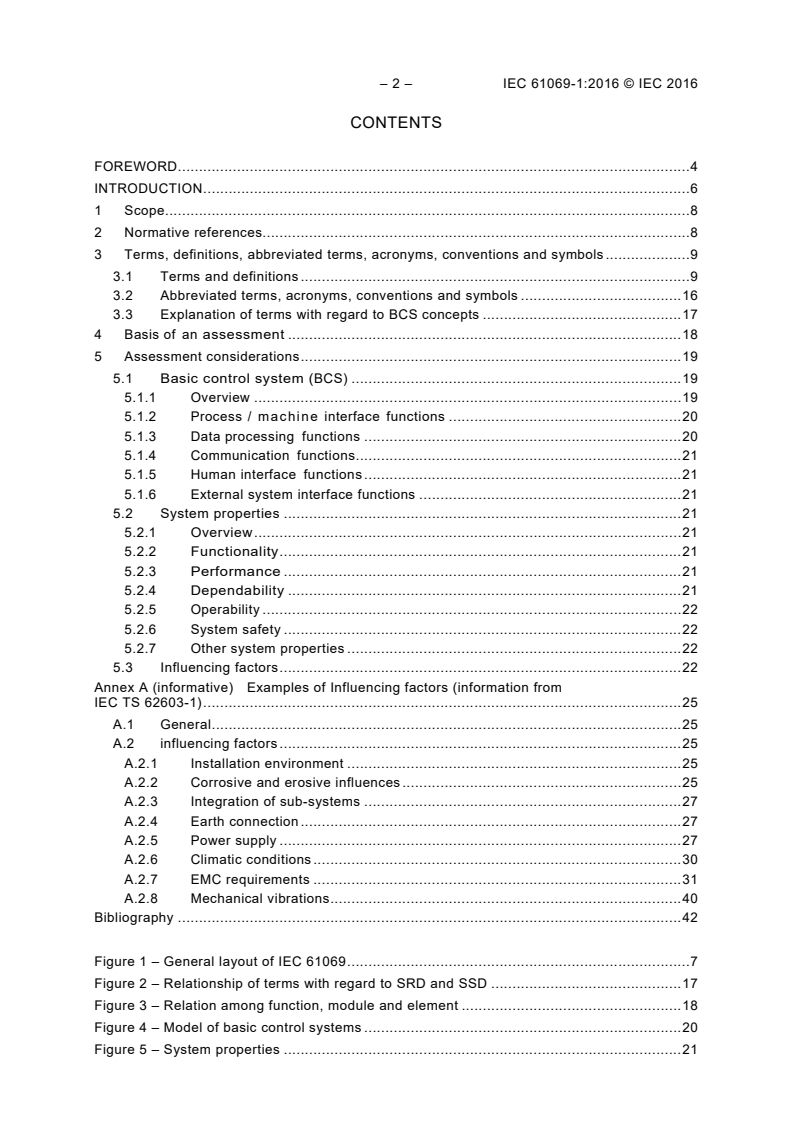
IEC 61069-1:2016 - Industrial-process measurement, control and automation - Evaluation of system properties for the purpose of system assessment - Part 1: Terminology and basic concepts Released:6/15/2016
Overview
IEC 61069-1:2016 is an international standard published by the International Electrotechnical Commission (IEC) focused on industrial-process measurement, control, and automation. It specifically addresses the evaluation of system properties for system assessment purposes. This Part 1 of the series defines terminology and basic concepts essential for the assessment of Basic Process Control Systems (BPCS) and Basic Discrete Control Systems (BDCS), collectively known as Basic Control Systems (BCS).
This second edition from 2016 replaces the original 1991 version, incorporating a reorganization of content for enhanced clarity and consistency, as well as integrating material from IEC TS 62603-1:2014. The standard is widely used for discrete, batch, and continuous control applications, providing a foundational framework for understanding and evaluating control systems in industrial environments.
Key Topics
Terminology and Definitions
- Establishes clear and standardized terms for use in the assessment of control systems.
- Covers abbreviations, acronyms, symbols, and conventions vital for consistent communication.
Basic Concepts of System Assessment
- Defines the structure and properties of Basic Control Systems (BCS), including BPCS and BDCS.
- Addresses system functionalities such as data processing, communication, human-machine interface, and external system interfaces.
System Properties Covered
- Functionality: The capability to perform required control tasks.
- Performance: Efficiency and effectiveness in executing system functions.
- Dependability: Reliability and availability under specified conditions.
- Operability: Ease of operation and maintenance of the system.
- Safety: Systems’ contribution to overall operational safety and hazard prevention.
Influencing Factors
- Identifies environmental and installation factors affecting system properties, including:
- Installation environment conditions (temperature, humidity, corrosive atmospheres)
- Electromagnetic compatibility (EMC)
- Power supply quality
- Mechanical vibrations and shocks
- Integration of subsystems and earth connections
Applications
IEC 61069-1:2016 is critical for engineers and professionals involved in designing, operating, and assessing industrial control systems. Its practical applications include:
- System Design and Validation: Assisting in defining system requirements and validating system properties against operational demands and safety standards.
- Performance Assurance: Guiding the evaluation of system performance to ensure efficient process control in industrial environments such as oil and gas, chemical plants, and manufacturing.
- Risk Management: Providing a basis for assessing dependability and safety, helping mitigate operational risks and comply with regulatory safety requirements.
- Maintenance Planning: Enhancing operability assessments to reduce downtime and streamline maintenance activities.
- Interdisciplinary Coordination: Offering a common terminology and framework that fosters collaboration between system designers, operators, and maintenance teams.
Related Standards
IEC 61069-1 is part of a broader series that comprehensively covers system property evaluations in industrial automation:
- IEC 61069-2: Assessment methodology outlining procedural approaches for system assessment.
- IEC 61069-3: Assessment of system functionality to verify control system operations.
- IEC 61069-4: Evaluation of system performance metrics.
- IEC 61069-5: Assessment of system dependability focusing on reliability and availability.
- IEC 61069-6: Operability assessment to ensure user-friendly maintenance and operation.
This standard is harmonized with IEC and ISO directives and integrates information from IEC TS 62603-1 for influencing factors, ensuring alignment with international best practices.
Keywords: IEC 61069-1, basic control system, industrial process control, control system assessment, BPCS, BDCS, system properties, system terminology, system evaluation, industrial automation standards, system dependability, IEC standards, process automation.
Buy Documents
IEC 61069-1:2016 - Industrial-process measurement, control and automation - Evaluation of system properties for the purpose of system assessment - Part 1: Terminology and basic concepts Released:6/15/2016
Get Certified
Connect with accredited certification bodies for this standard

DVS-ZERT GmbH
German welding certification society.
CARES (UK Certification Authority for Reinforcing Steels)
UK certification for reinforcing steels and construction.
EWF/IIW (European/International Welding Federation)
International welding personnel certification.
Sponsored listings
Frequently Asked Questions
IEC 61069-1:2016 is a standard published by the International Electrotechnical Commission (IEC). Its full title is "Industrial-process measurement, control and automation - Evaluation of system properties for the purpose of system assessment - Part 1: Terminology and basic concepts". This standard covers: IEC 61069-1:2016 defines the terminology and outlines basic concepts in the assessment of a basic process control system (BPCS) and a basic discrete control system (BDCS). These two general system types cover the areas of discrete, batch and continuous applications. In IEC 61069 these two, BPCS and BDCS, together are referred to as "basic control system(s)", (BCS). This second edition cancels and replaces the first edition published in 1991. This edition constitutes a technical revision. This edition includes the following significant technical changes with respect to the previous edition: - Reorganization of the material of IEC 61069-1:1991 to make the overall set of standards more organized and consistent; - IEC TS 62603-1:2014 has been incorporated into this edition.
IEC 61069-1:2016 defines the terminology and outlines basic concepts in the assessment of a basic process control system (BPCS) and a basic discrete control system (BDCS). These two general system types cover the areas of discrete, batch and continuous applications. In IEC 61069 these two, BPCS and BDCS, together are referred to as "basic control system(s)", (BCS). This second edition cancels and replaces the first edition published in 1991. This edition constitutes a technical revision. This edition includes the following significant technical changes with respect to the previous edition: - Reorganization of the material of IEC 61069-1:1991 to make the overall set of standards more organized and consistent; - IEC TS 62603-1:2014 has been incorporated into this edition.
IEC 61069-1:2016 is classified under the following ICS (International Classification for Standards) categories: 25.040.40 - Industrial process measurement and control. The ICS classification helps identify the subject area and facilitates finding related standards.
IEC 61069-1:2016 is available in PDF format for immediate download after purchase. The document can be added to your cart and obtained through the secure checkout process. Digital delivery ensures instant access to the complete standard document.
Standards Content (Sample)
IEC 61069-1 ®
Edition 2.0 2016-06
INTERNATIONAL
STANDARD
NORME
INTERNATIONALE
colour
inside
Industrial-process measurement, control and automation – Evaluation of system
properties for the purpose of system assessment –
Part 1: Terminology and basic concepts
Mesure, commande et automation dans les processus industriels – Appréciation
des propriétés d'un système en vue de son évaluation –
Partie 1: Terminologie et principes de base
All rights reserved. Unless otherwise specified, no part of this publication may be reproduced or utilized in any form
or by any means, electronic or mechanical, including photocopying and microfilm, without permission in writing from
either IEC or IEC's member National Committee in the country of the requester. If you have any questions about IEC
copyright or have an enquiry about obtaining additional rights to this publication, please contact the address below or
your local IEC member National Committee for further information.
Droits de reproduction réservés. Sauf indication contraire, aucune partie de cette publication ne peut être reproduite
ni utilisée sous quelque forme que ce soit et par aucun procédé, électronique ou mécanique, y compris la photocopie
et les microfilms, sans l'accord écrit de l'IEC ou du Comité national de l'IEC du pays du demandeur. Si vous avez des
questions sur le copyright de l'IEC ou si vous désirez obtenir des droits supplémentaires sur cette publication, utilisez
les coordonnées ci-après ou contactez le Comité national de l'IEC de votre pays de résidence.
IEC Central Office Tel.: +41 22 919 02 11
3, rue de Varembé Fax: +41 22 919 03 00
CH-1211 Geneva 20 info@iec.ch
Switzerland www.iec.ch
About the IEC
The International Electrotechnical Commission (IEC) is the leading global organization that prepares and publishes
International Standards for all electrical, electronic and related technologies.
About IEC publications
The technical content of IEC publications is kept under constant review by the IEC. Please make sure that you have the
latest edition, a corrigenda or an amendment might have been published.
IEC Catalogue - webstore.iec.ch/catalogue Electropedia - www.electropedia.org
The stand-alone application for consulting the entire The world's leading online dictionary of electronic and
bibliographical information on IEC International Standards, electrical terms containing 20 000 terms and definitions in
Technical Specifications, Technical Reports and other English and French, with equivalent terms in 15 additional
documents. Available for PC, Mac OS, Android Tablets and languages. Also known as the International Electrotechnical
iPad. Vocabulary (IEV) online.
IEC publications search - www.iec.ch/searchpub IEC Glossary - std.iec.ch/glossary
The advanced search enables to find IEC publications by a 65 000 electrotechnical terminology entries in English and
variety of criteria (reference number, text, technical French extracted from the Terms and Definitions clause of
committee,…). It also gives information on projects, replaced IEC publications issued since 2002. Some entries have been
and withdrawn publications. collected from earlier publications of IEC TC 37, 77, 86 and
CISPR.
IEC Just Published - webstore.iec.ch/justpublished
Stay up to date on all new IEC publications. Just Published IEC Customer Service Centre - webstore.iec.ch/csc
details all new publications released. Available online and If you wish to give us your feedback on this publication or
also once a month by email. need further assistance, please contact the Customer Service
Centre: csc@iec.ch.
A propos de l'IEC
La Commission Electrotechnique Internationale (IEC) est la première organisation mondiale qui élabore et publie des
Normes internationales pour tout ce qui a trait à l'électricité, à l'électronique et aux technologies apparentées.
A propos des publications IEC
Le contenu technique des publications IEC est constamment revu. Veuillez vous assurer que vous possédez l’édition la
plus récente, un corrigendum ou amendement peut avoir été publié.
Catalogue IEC - webstore.iec.ch/catalogue Electropedia - www.electropedia.org
Application autonome pour consulter tous les renseignements
Le premier dictionnaire en ligne de termes électroniques et
bibliographiques sur les Normes internationales,
électriques. Il contient 20 000 termes et définitions en anglais
Spécifications techniques, Rapports techniques et autres
et en français, ainsi que les termes équivalents dans 15
documents de l'IEC. Disponible pour PC, Mac OS, tablettes
langues additionnelles. Egalement appelé Vocabulaire
Android et iPad.
Electrotechnique International (IEV) en ligne.
Recherche de publications IEC - www.iec.ch/searchpub
Glossaire IEC - std.iec.ch/glossary
La recherche avancée permet de trouver des publications IEC 65 000 entrées terminologiques électrotechniques, en anglais
en utilisant différents critères (numéro de référence, texte, et en français, extraites des articles Termes et Définitions des
comité d’études,…). Elle donne aussi des informations sur les publications IEC parues depuis 2002. Plus certaines entrées
projets et les publications remplacées ou retirées. antérieures extraites des publications des CE 37, 77, 86 et
CISPR de l'IEC.
IEC Just Published - webstore.iec.ch/justpublished
Service Clients - webstore.iec.ch/csc
Restez informé sur les nouvelles publications IEC. Just
Published détaille les nouvelles publications parues. Si vous désirez nous donner des commentaires sur cette
Disponible en ligne et aussi une fois par mois par email. publication ou si vous avez des questions contactez-nous:
csc@iec.ch.
IEC 61069-1 ®
Edition 2.0 2016-06
INTERNATIONAL
STANDARD
NORME
INTERNATIONALE
colour
inside
Industrial-process measurement, control and automation – Evaluation of system
properties for the purpose of system assessment –
Part 1: Terminology and basic concepts
Mesure, commande et automation dans les processus industriels – Appréciation
des propriétés d'un système en vue de son évaluation –
Partie 1: Terminologie et principes de base
INTERNATIONAL
ELECTROTECHNICAL
COMMISSION
COMMISSION
ELECTROTECHNIQUE
INTERNATIONALE
ICS 25.040.40 ISBN 978-2-8322-3407-5
– 2 – IEC 61069-1:2016 © IEC 2016
CONTENTS
FOREWORD . 4
INTRODUCTION . 6
1 Scope . 8
2 Normative references. 8
3 Terms, definitions, abbreviated terms, acronyms, conventions and symbols . 9
3.1 Terms and definitions . 9
3.2 Abbreviated terms, acronyms, conventions and symbols . 16
3.3 Explanation of terms with regard to BCS concepts . 17
4 Basis of an assessment . 18
5 Assessment considerations . 19
5.1 Basic control system (BCS) . 19
5.1.1 Overview . 19
5.1.2 Process / machine interface functions . 20
5.1.3 Data processing functions . 20
5.1.4 Communication functions . 21
5.1.5 Human interface functions . 21
5.1.6 External system interface functions . 21
5.2 System properties . 21
5.2.1 Overview . 21
5.2.2 Functionality . 21
5.2.3 Performance . 21
5.2.4 Dependability . 21
5.2.5 Operability . 22
5.2.6 System safety . 22
5.2.7 Other system properties . 22
5.3 Influencing factors . 22
Annex A (informative) Examples of Influencing factors (information from
IEC TS 62603-1) . 25
A.1 General . 25
A.2 influencing factors . 25
A.2.1 Installation environment . 25
A.2.2 Corrosive and erosive influences . 25
A.2.3 Integration of sub-systems . 27
A.2.4 Earth connection . 27
A.2.5 Power supply . 27
A.2.6 Climatic conditions . 30
A.2.7 EMC requirements . 31
A.2.8 Mechanical vibrations . 40
Bibliography . 42
Figure 1 – General layout of IEC 61069 . 7
Figure 2 – Relationship of terms with regard to SRD and SSD . 17
Figure 3 – Relation among function, module and element . 18
Figure 4 – Model of basic control systems . 20
Figure 5 – System properties . 21
Figure 6 – Sources of influencing factors . 22
Table 1 – Influencing factors examples . 23
3 3
Table A.1 – Concentration of gas and vapour contaminants (in cm /m ) . 26
Table A.2 – Aerosol contaminants . 26
Table A.3 – Climatic condition parameters and severities for classes of location . 31
Table A.4 – Test levels for RF fields . 32
Table A.5 – Test levels for electrical fast transient/burst . 34
Table A.6 – Test levels for surge protection . 36
Table A.7 – Test levels for RF induced disturbances . 37
Table A.8 – Test levels for power frequency magnetic fields . 38
Table A.9 – Test levels for pulse magnetic field . 39
Table A.10 – Test levels for damped oscillatory magnetic field . 39
Table A.11 – Test levels for voltage dips . 40
Table A.12 – Test levels for short interruptions . 40
– 4 – IEC 61069-1:2016 © IEC 2016
INTERNATIONAL ELECTROTECHNICAL COMMISSION
____________
INDUSTRIAL-PROCESS MEASUREMENT, CONTROL AND AUTOMATION –
EVALUATION OF SYSTEM PROPERTIES
FOR THE PURPOSE OF SYSTEM ASSESSMENT –
Part 1: Terminology and basic concepts
FOREWORD
1) The International Electrotechnical Commission (IEC) is a worldwide organization for standardization comprising
all national electrotechnical committees (IEC National Committees). The object of IEC is to promote
international co-operation on all questions concerning standardization in the electrical and electronic fields. To
this end and in addition to other activities, IEC publishes International Standards, Technical Specifications,
Technical Reports, Publicly Available Specifications (PAS) and Guides (hereafter referred to as “IEC
Publication(s)”). Their preparation is entrusted to technical committees; any IEC National Committee interested
in the subject dealt with may participate in this preparatory work. International, governmental and non-
governmental organizations liaising with the IEC also participate in this preparation. IEC collaborates closely
with the International Organization for Standardization (ISO) in accordance with conditions determined by
agreement between the two organizations.
2) The formal decisions or agreements of IEC on technical matters express, as nearly as possible, an international
consensus of opinion on the relevant subjects since each technical committee has representation from all
interested IEC National Committees.
3) IEC Publications have the form of recommendations for international use and are accepted by IEC National
Committees in that sense. While all reasonable efforts are made to ensure that the technical content of IEC
Publications is accurate, IEC cannot be held responsible for the way in which they are used or for any
misinterpretation by any end user.
4) In order to promote international uniformity, IEC National Committees undertake to apply IEC Publications
transparently to the maximum extent possible in their national and regional publications. Any divergence
between any IEC Publication and the corresponding national or regional publication shall be clearly indicated in
the latter.
5) IEC itself does not provide any attestation of conformity. Independent certification bodies provide conformity
assessment services and, in some areas, access to IEC marks of conformity. IEC is not responsible for any
services carried out by independent certification bodies.
6) All users should ensure that they have the latest edition of this publication.
7) No liability shall attach to IEC or its directors, employees, servants or agents including individual experts and
members of its technical committees and IEC National Committees for any personal injury, property damage or
other damage of any nature whatsoever, whether direct or indirect, or for costs (including legal fees) and
expenses arising out of the publication, use of, or reliance upon, this IEC Publication or any other IEC
Publications.
8) Attention is drawn to the Normative references cited in this publication. Use of the referenced publications is
indispensable for the correct application of this publication.
9) Attention is drawn to the possibility that some of the elements of this IEC Publication may be the subject of
patent rights. IEC shall not be held responsible for identifying any or all such patent rights.
International Standard IEC 61069-1 has been prepared by subcommittee 65A: System
aspects, of IEC technical committee 65: Industrial-process measurement, control and
automation.
This second edition cancels and replaces the first edition published in 1991. This edition
constitutes a technical revision.
This edition includes the following significant technical changes with respect to the previous
edition:
a) Reorganization of the material of IEC 61069-1:1991 to make the overall set of standards
more organized and consistent;
b) IEC TS 62603-1:2014 has been incorporated into this edition.
The text of this standard is based on the following documents:
FDIS Report on voting
65A/788/FDIS 65A/798/RVD
Full information on the voting for the approval of this standard can be found in the report on
voting indicated in the above table.
This publication has been drafted in accordance with the ISO/IEC Directives, Part 2.
A list of all parts in the IEC 61069 series, published under the general title Industrial-process
measurement, control and automation – Evaluation of system properties for the purpose of
system assessment, can be found on the IEC website.
The committee has decided that the contents of this publication will remain unchanged until
the stability date indicated on the IEC website under "http://webstore.iec.ch" in the data
related to the specific publication. At this date, the publication will be
• reconfirmed,
• withdrawn,
• replaced by a revised edition, or
• amended.
IMPORTANT – The 'colour inside' logo on the cover page of this publication indicates
that it contains colours which are considered to be useful for the correct
understanding of its contents. Users should therefore print this document using a
colour printer.
– 6 – IEC 61069-1:2016 © IEC 2016
INTRODUCTION
IEC 61069 deals with the method which should be used to assess system properties of a
basic control system (BCS). IEC 61069 consists of the following parts:
Part 1: Terminology and basic concepts
Part 2: Assessment methodology
Part 3: Assessment of system functionality
Part 4: Assessment of system performance
Part 5: Assessment of system dependability
Part 6: Assessment of system operability
Part 7: Assessment of system safety
Part 8: Assessment of other system properties
Assessment of a system is the judgement, based on evidence, of the suitability of the system
for a specific mission or class of missions.
To obtain total evidence would require complete evaluation (for example under all influencing
factors) of all system properties relevant to the specific mission or class of missions.
Since this is rarely practical, the rationale on which an assessment of a system should be
based is:
– the identification of the importance of each of the relevant system properties;
– the planning for evaluation of the relevant system properties with a cost-effective
dedication of effort to the various system properties.
In conducting an assessment of a system, it is crucial to bear in mind the need to gain a
maximum increase in confidence in the suitability of a system within practical cost and time
constraints.
An assessment can only be carried out if a mission has been stated (or given), or if any
mission can be hypothesized. In the absence of a mission, no assessment can be made;
however, examination of the system to gather and organize data for a later assessment done
by others is possible. In such cases, the standard can be used as a guide for planning an
evaluation and it provides methods for performing evaluations, since evaluations are an
integral part of assessment.
In preparing the assessment, it can be discovered that the definition of the system is too
narrow. For example, a facility with two or more revisions of the control systems sharing
resources, e.g., a network, should consider issues of co-existence and inter-operability. In this
case, the system to be investigated should not be limited to the “new” BCS; it should include
both. That is, it should change the boundaries of the system to include enough of the other
system to address these concerns.
The part structure and the relationship among the parts of IEC 61069 are shown in Figure 1.
IEC 61069: Industrial-process measurement, control and automation –
Evaluation of system properties for the purpose of system assessment
Part 1: Terminology and basic concepts
• Basic concept
• Terminology ‐ Objective
‐ Common terms ‐ Description of system
‐ Terms for particular part ‐ System properties
‐ Influencing factors
Part 2: Assessment methodology
• Generic requirements of procedure of assessment
‐ Overview, approach and phases
‐ Requirements for each phase
‐ General description of evaluation techniques
Parts 3 to 8: Assessment of each system property
• Basics of assessment specific to each property
‐ Properties and influencing factors
• Assessment method for each property
• Evaluation techniques for each property
IEC
Figure 1 – General layout of IEC 61069
Some example assessment items are integrated in Annex A.
– 8 – IEC 61069-1:2016 © IEC 2016
INDUSTRIAL-PROCESS MEASUREMENT, CONTROL AND AUTOMATION –
EVALUATION OF SYSTEM PROPERTIES
FOR THE PURPOSE OF SYSTEM ASSESSMENT –
Part 1: Terminology and basic concepts
1 Scope
This part of IEC 61069 defines the terminology and outlines basic concepts in the assessment
of a basic process control system (BPCS) and a basic discrete control system (BDCS). These
two general system types cover the areas of discrete, batch and continuous applications. In
IEC 61069 these two, BPCS and BDCS, together are referred to as "basic control system(s)",
(BCS).
The treatment of safety in IEC 61069 is confined to hazards that can be present within the
BCS itself.
Considerations of hazards that can be introduced by the process or equipment under control,
of the BCS to be assessed, are excluded.
Where the BCS risk reduction is intended to be less than 10 (i.e. SIL < 1, per IEC 61508-4),
then assessment comes under IEC 61069.
A BCS with a safety integrity level (SIL) or performing any safety instrumented function (SIF)
is not covered by IEC 61069, where SIL is defined by IEC 61508-4 and SIF is defined by
IEC 61511-1.
This part of IEC 61069 is intended for the users and manufacturers of systems, and also for
those who are responsible for carrying out assessments as an independent party.
2 Normative references
The following documents, in whole or in part, are normatively referenced in this document and
are indispensable for its application. For dated references, only the edition cited applies. For
undated references, the latest edition of the referenced document (including any
amendments) applies.
IEC 61000-4-2, Electromagnetic compatibility (EMC) – Part 4-2: Testing and measurement
techniques – Electrostatic discharge immunity test
IEC 61000-6-4:2006, Electromagnetic compatibility (EMC) – Part 6-4: Generic standards –
Emission standard for industrial environments
IEC 61000-6-4:2006/AMD1:2010
IEC 61508-4:2010, Functional safety of electrical/electronic/programmable electronic safety-
related systems – Part 4: Definitions and abbreviations (see http://www.iec.ch/functionalsafety)
IEC 61511-1:2003, Functional safety – Safety instrumented systems for the process industry
sector – Part 1: Framework, definitions, system, hardware and software requirements
3 Terms, definitions, abbreviated terms, acronyms, conventions and symbols
3.1 Terms and definitions
For the purpose of this document, the following terms and definitions apply.
3.1.1
accuracy
closeness of agreement between the result of a measurement / output and the (conventional)
true value of the quantity being measured / calculated
3.1.2
assessment,
process of judgement, based on evidence, suitability of a system, for a specific mission or
class of missions
[SOURCE: ISO 15513:2000, 3.3, modified – “competency against prescribed standards of
performance” replaced with “, based on evidence, suitability of a system, for a specific
mission or class of missions”]
3.1.3
assessment activity
set of actions to evaluate one or more assessment items
3.1.4
assessment authority
body that has legal powers and rights of assessment
[SOURCE: ISO/IEC Guide 2:2004, 4.5, modified – The term itself has been modified (addition
of "assessment") and addition of the words “of assessment” at the end of the definition]
3.1.5
assessment item
set of a system property which is evaluated and an influencing factor which is considered for
the evaluation
3.1.6
assessment program
documented plan of coordinated set of assessment activities, not necessarily interdependent,
that continue over a period of time and are designed to conduct the assessment
3.1.7
assessment protocol
set of formal rules describing the assessment
3.1.8
assessment specification
document which specifies scope, requirements and constraints of the assessment
3.1.9
availability
ability of an item to be in a state to perform a required function under given conditions at a
given instant or over a given time interval, assuming that the required external resources are
provided
[SOURCE: IEC 60050-192:2015, 192-01-23, modified – The definition has been extended]
– 10 – IEC 61069-1:2016 © IEC 2016
3.1.10
base load
loading of the system when no SRD specified tasks are active, but includes system
diagnostics and similar functions
3.1.11
basic control system
basic discrete control system (BDCS) and/or basic process control system (BPCS)
3.1.12
basic discrete control system
BDCS
system which responds to input signals from the machine(s), its(their) associated equipment,
other programmable systems and/or an operator and generates output signals causing the
machine(s) and its(their) associated equipment to operate in the desired manner but which
does not perform any functional safety functions with a claimed SIL ≥ 1, realizing the
mission(s) and task(s)
[SOURCE: IEC 61511-1:2003, 3.2.3, modified – In the term, "process" replaced by "discrete"
and acronym corrected to “BDCS”. In the definition, “the process, its associated equipment”
and “safety instrumented functions” replaced with “the machine(s), its (their) associated
equipment” and “functional safety functions”, respectively.]
3.1.13
basic process control system
BPCS
system which responds to input signals from the process, its associated equipment, other
programmable systems and/or an operator and generates output signals causing the process
and its associated equipment to operate in the desired manner
[SOURCE: IEC 61511-1:2003, 3.2.3]
3.1.14
capacity
number of information translations which the system is able to execute without negatively
impacting any other system capabilities
Note 1 to entry: Capacity may be e.g.
1) quantity of information translations, of some type within a define period of time or
2) quantity of information translations, of some type or
3) quantity of information translations or
4) task quantity, or
5) task(s) completion within a defined period time.
3.1.15
class
abstraction of a set of similar objects
3.1.16
class of mission
abstraction of a collection of missions which share common requirements
3.1.17
coverage
extent to which the system provides functions to perform industrial-process measurement and
control tasks
3.1.18
configurability
extent to which the system facilitates selection, setting up and arrangement of its modules to
perform the given tasks
3.1.19
credibility
extent to which a system is able to recognize and signal the state of the system and to
withstand incorrect inputs or unauthorized access
3.1.20
cycle time
time span between two consecutive cyclically recurring events
[SOURCE: IEC 61800-7-1:2015, 3.3.5.5]
3.1.21
dead band
finite range of values of the input variable within which a variation of the input variable does
not produce any measurable change in the output variable
Note 1 to entry: When this type of characteristic is intentional, it is sometimes called a neutral zone.
[SOURCE: IEC 60050-351:2013, 351-45-15]
3.1.22
dependability
extent to which a system can be relied upon to perform exclusively and correctly a task under
given conditions at a given instant of time or over a given time interval, assuming that the
required external resources are provided
3.1.23
efficiency
extent to which the operating means provided by the system minimise operator time and effort
required in using the system to accomplish his tasks within stated constraints
3.1.24
element
part of system providing a single function that is indivisible and can be individually considered
and tested, comprised of hardware and/or software
3.1.25
evaluation,
systematic determination of the extent to which a system property meets its specified criteria
[SOURCE: ISO/IEC 12207:2008, 4.12, modified – Specific use of the term (“”)
added and “an entity” replaced with “a system property”]
3.1.26
fall-back
functional fall-back: capacity of returning to a known functional level or mode in case of failure
or abnormal operation
3.1.27
flexibility
extent to which the system can be adapted
– 12 – IEC 61069-1:2016 © IEC 2016
3.1.28
function
operation performed by (a) module(s) which enables the system to perform a task
3.1.29
functionality
extent to which the system provides functions to perform tasks required by the system mission
3.1.30
functional safety
part of the overall safety that depends on functional and physical units operating correctly in
response to their inputs
Note 1 to entry: See IEC TR 61508-0 [10] .
[SOURCE: IEC 60050-351:2013, 351-57-06]
3.1.31
harm
injury or damage to the health of people, or damage to property or the environment
[SOURCE: ISO/IEC Guide 51:2014, 3.1]
3.1.32
hazard
potential source of harm
[SOURCE: ISO/IEC Guide 51:2014, 3.2]
3.1.33
hysteresis
phenomenon represented by a characteristic curve which has a branch, called ascending
branch, for increasing values of the input variable, and a different branch, called descending
branch, for decreasing values of the input variable
[SOURCE: IEC 60050-351:2013, 351-45-16]
3.1.34
influencing factor
observable qualitative or measurable quantitative item that affects a system property
3.1.35
information translation
conversion or conveyance of information entering the system or module at its boundary into
derived information exiting the system or module at its boundary
Note 1 to entry: Information translation is a view of a function which represents a particular aspect of the function.
3.1.36
information translation function
function which executes information translation
__________
Numbers in square brackets refer to the Bibliography.
3.1.37
integrity
assurance provided by a system that the tasks will be performed correctly, unless notice is
given of any state of the system which could lead to the contrary
3.1.38
intuitiveness
extent to which the operating means provided by the system are immediately understandable
by the operators
3.1.39
maintainability
ability of a system under given conditions of use, to be retained in, or restored to, a state in
which it can perform a required function, when maintenance is performed under given
conditions and using stated procedures and resources
3.1.40
measurement
process of experimentally obtaining one or more quantity values that can reasonably be
attributed to a quantity
Note 1 to entry: Measurement does not apply to nominal properties.
Note 2 to entry: Measurement implies comparison of quantities, including counting of entities.
Note 3 to entry: The French word "mesure" has several meanings in everyday French language. It is for this
reason that the French word "mesurage" has been introduced to describe the act of measurement. Nevertheless,
the French word "mesure" occurs many times in forming terms, following current usage, and without ambiguity.
Examples are: unité de mesure (unit of measurement), méthode de mesure (measurement method), instrument de
mesure (measurement instrument). This does not mean that the use of the French word "mesurage" in place of
"mesure" in such terms is not permissible when advantageous.
[SOURCE: ISO/IEC Guide 99:2007, 2.1, modified – Note 3 to entry modified.]
3.1.41
mission,
collective task assigned to the system to achieve a defined goal in a defined period under
defined conditions
3.1.42
model
mathematical or physical representation of a system or a process, based with sufficient
precision upon known laws, identification or specified suppositions
[SOURCE: IEC 6005-351:2013, 351-42-26]
3.1.43
module
distinct unit, which is capable of performing distinct function(s), composed of element(s), and
which can be easily joined to or arranged with other units
3.1.44
observation
process of monitoring pattern response
[SOURCE: IEC 62528:2007, 3.1.34]
– 14 – IEC 61069-1:2016 © IEC 2016
3.1.45
operability
extent to which the operating means provided by the system are efficient, intuitive,
transparent and robust to accomplish the operators’ tasks
3.1.46
operating condition
condition prescribed for evaluating the performance of a measuring instrument or measuring
system or for comparison of measurement results with influencing factors in place
[SOURCE: ISO/IEC Guide 99:2007, 4.11, modified – Term modified ("reference" removed
from term) and Notes 1 and 2 to entry removed.]
3.1.47
operating load
loading of a system created by the tasks, as specified in the SRD, when those tasks operate
as designed
3.1.48
operator
person who uses the system to fulfil the mission
Note 1 to entry: In IEC 61069, operator is used in a generic way and includes all persons who may perform any
tasks to fulfil the mission.
3.1.49
performance
precision and speed with which the system executes its tasks under defined conditions
3.1.50
reliability
ability of an item to perform a required function under given conditions for a given time
interval
[SOURCE: IEC 60050-192:2015, 192-01-24]
3.1.51
repeatability error
algebraic difference between the extreme values obtained by a number of consecutive
measurements of the output over a short period of time for the same value of the input under
the same operating conditions, approaching from the same direction, for full range traverses
Note 1 to entry: Repeatability error is usually expressed in percentage of span and does not include hysteresis
and drift.
[SOURCE: IEC 61987-1:2006, 3.28, modified – "non-repeatability" removed from term.]
3.1.52
resolution
smallest change in the measurand, or quantity supplied, which causes a perceptible change in
the indication
[SOURCE: IEC 60050-311:2001, 311-03-10]
3.1.53
response time
time interval between the initiation of an information translation and the instant when the
associated response is made available under defined conditions
3.1.54
robustness
extent to which the system correctly interprets and responds to operator actions performed,
using unambiguous methods and procedures, and removes ambiguities by providing
appropriate feedback
3.1.55
safety
freedom from unacceptable risk to the outside from the functional and physical units
considered
Note 1 to entry: The definition of “safety” in combination with other words may gradually (as in “product safety”,
“machinery safety”) or completely (as in “workers safety”, “safety belt” or “functional safety”) change. For the use of
the word safety, see ISO/IEC Guide 51:2014, Clause 4. [ISO/IEC Guide 2, Standardization and related activities –
General vocabulary]
Note 2 to entry: In standardization the safety of products, processes and services is generally considered with a
view to achieving the optimum balance of a number of factors, including non-technical factors such as human
behaviour, that will eliminate avoidable risks of harm to persons and goods to an acceptable degree.
[ISO/IEC Guide 2]
Note 3 to entry: In many other languages than English there is only one word for safety and security.
[SOURCE: IEC 60050-351:2013, 351-57-05]
3.1.56
safety integrity level
SIL
discrete level (one out of a possible four), corresponding to a range of safety integrity values,
where safety integrity level 4 has the highest level of safety integrity and safety integrity
level 1 has the lowest
Note 1 to entry: The target failure measures (see IEC 61508-4:2010, 3.5.17) for the four safety integrity levels are
specified in Tables 2 and 3 of IEC 61508-1:2010.
Note 2 to entry: Safety integrity levels are used for specifying the safety integrity requirements of the safety
functions to be allocated to the E/E/PE safety-related systems.
Note 3 to entry: A safety integrity level (SIL) is not a property of a system, subsystem, element or component.
The correct interpretation of the phrase “SIL n safety-related system” (where n is 1, 2, 3 or 4) is that the system is
potentially capable of supporting safety functions with a safety integrity level up to n.
[SOURCE: IEC 61508-4:2010, 3.5.8]
3.1.57
security
freedom from unacceptable risk to the physical units considered from the outside
Note 1 to entry: In many other languages than English there is only one word for safety and security.
Note 2 to entry: Security in the context of this document is a general term encompassing physical security,
information security, cyber security and others.
[SOURCE: IEC 60050-351-07:2013, 351-57-06, modified – Note 2 to entry added.]
3.1.58
spare capacity
remaining system capacity to run additional tasks
3.1.59
system configuration
arrangement of the elements of a system
– 16 – IEC 61069-1:2016 © IEC 2016
[SOURCE: IEC 82045-1:2001, 3.4.5, modified – "system" added to term.]
3.1.60
system property
defined parameter suitable for the description and differentiation of BCS(s)
[SOURCE: ISO/IEC Guide 77-2:2008, 2.18, modified — "system" added to term, “products”
replaced with “BCS(s)” and notes to entry removed.]
3.1.61
System Requirements Document
SRD
description of the mission and needs of the BCS from the target application standpoint
3.1.62
System Specification Document
SSD
description of the BCS implementation based on the needs as described in the SRD
3.1.63
system safety
extent to which the system itself as a physical entity will not impose a hazard
Note 1 to entry: System safety does not include the safety of the process or equipment under control.
Note 2 to entry: System safety does not include functional safety.
3.1.64
task
logically complete operation forming a part of the system mission
3.1.65
test
empirical evaluation
3.1.66
transparency
extent to which the operating means provided by the system apparently places the operator in
direct contact with his tasks
3.2 Abbreviated terms, acronyms, conventions and symbols
This listing encompasses terms, acronyms, conventions and symbols used in IEC 61069-1
through IEC 61069-8.
BCS basic control system
BDCS basic discrete control system
BPCS basic process control system
CRT Cathode Ray Tube
EDI Electronic Data Interchange
E/E/PE electrical/electronic/programmable electronic
GPS Global positioning system
I/O Input and Output
IEC International Electrotechnical Committee
ISO International Organization for Standardization
PID Proportional-Integral-Derivative
QA Quality Assurance
QM Quality Management
SAT Site Acceptance Test
SIL safety integrity level
SRD system requirements document
SSD system specification document
TCP/IP Transmission Control Protocol / Internet Protocol
ZVEI German Electrical and Electronic Manufacturers' Association
3.3 Explanation of terms with regard to BCS concepts
Figure 2 provides a pictorial representation of the relationship between the System
Requirements Document (SRD) and the System Specification Document (SSD) of the BCS.
The hierarchy of capability of both the requirements and realization is shown.
Figure 2 also shows mappings of lower level requirements and how they are realized in the
system.
The SRD describes the mission and needs of the BCS from the target application standpoint.
The SSD describes the implementation based on the needs as described in the SRD.
SRD SSD
System Requirements Document System Specification Document
Requirements Realization
Mission 1 . Mission n
BCS
Basic Control System
Task 1 … Task n
Function 1 … Function n
Module 1 . Module n
Element 1 . Element n
IEC
Figure 2 – Relationship of terms with regard to SRD and SSD
Figure 3 depicts the mapping of multiple functions (requirements) onto multiple
modules/elements (realization) in an overlapping manner typical of an actual
application/implementation.
– 18 – IEC 61069-1:2016 © IEC 2016
F by M
3 3
M
F by M F by M
1 1 2 2
E E E E E E
1 2 3 4 5 6
M M
1 2
F by M
4 1
M = Module
n n
E = Element
n n
F = Function
n n
IEC
Figure 3 – Relation among function, module and element
4 Basis of an assessment
The purpose of the assessment of a system is to determine qualitatively and/or quantitatively
the capability of the system to accomplish a specific mission.
Assessment of a system is judgement, based on evidence, of suitability of relevant system
properties for a specific mission or class of missions.
To obtain total evidence would require complete (i.e. under all influencing factors) evaluation
of all system properties of relevance to the specific mission or class of missions.
Since total evidence is rarely practical, an assessment of a system needs:
mission;
– to identify the criticality of the relevant system properties to accomplish the
– to plan for evaluation of the relevant system properties with a cost- effective dedication
of effort to the various system properties.
In conducting the assessment of a system, it is crucial to bear in mind the need to gain a
maximum increase in confidence in the suitability of a system within practical cost and time
constraints.
To accomplish a mission, a system is expected to be capable of performing the tasks
necess
...