

IEC 62642-1:2010
(Main)Alarm systems - Intrusion and hold-up systems - Part 1: System requirements
General Information
- Abstract
IEC 62642-1:2010 specifies the requirements for intrusion and hold-up alarm systems (I&HAS) installed in buildings using specific or non-specific wired interconnections or wire-free interconnections. These requirements also apply to the components of an I&HAS installed in a building which are normally mounted on the external structure of a building e.g. ancillary control equipment or warning devices.
- Status
- Published
- Publication Date
- 15-Jun-2010
- Technical Committee
- TC 79 - Alarm and electronic security systems
- Current Stage
- PPUB - Publication issued
- Start Date
- 16-Jun-2010
- Completion Date
- 30-Jun-2010



Overview
IEC 62642-1:2010 - “Alarm systems - Intrusion and hold‑up systems - Part 1: System requirements” defines the system‑level requirements for intrusion and hold‑up alarm systems (I&HAS) installed in buildings. The standard covers systems using specific or non‑specific wired interconnections as well as wire‑free (wireless) interconnections, and applies to I&HAS components normally mounted on the building exterior (for example ancillary control equipment and warning devices). IEC 62642-1 is the first part of the IEC 62642 series and aligns with EN 50131‑1 (2006) and its Amendment 1 (2009).
Key topics and technical requirements
The standard sets out functional, environmental and reliability requirements for I&HAS, including:
- System functions and components: definition of I&HAS architecture, detector types, control panels, warning devices and ancillary equipment.
- Functional requirements: detection of intruders, hold‑up triggering, tamper detection, fault recognition and masking.
- Operation and access control: access levels, authorization methods, setting/unsetting, inhibit/isolate and testing procedures.
- Processing and messaging: which signals/messages must be generated and how intruder, hold‑up, tamper and fault events are processed.
- Indication and notification: local and remote indication requirements, notification pathways and alarm transmission performance criteria (informative annex).
- Tamper security and monitoring: tamper protection, substitution monitoring and timing/verification requirements.
- Interconnections and communications: availability, monitoring, verification intervals and security of communications for wired and wireless links.
- Power supply and reliability: primary and alternative power supply requirements, minimum backup durations and recharge expectations.
- Environmental and safety: environmental classification (Indoor/Outdoor classes I–IV), electromagnetic compatibility (EMC) and electrical safety.
- Documentation and marking: required system and component documentation, event recording and identification.
Applications and who uses it
IEC 62642-1 is used by:
- System designers and manufacturers - to design compliant I&HAS components and control systems.
- Installers and integrators - for correct installation, interconnection and commissioning of alarms.
- Security consultants and specifiers - to define performance and grading requirements in bids and specifications.
- Facility managers and end users - to understand operational behaviour, testing and maintenance obligations.
- Certification and conformity assessors - to evaluate system compliance with system‑level requirements.
Practical applications include designing building alarm systems, selecting compliant components, specifying alarm transmission performance, and producing installation and handover documentation.
Related standards
- EN 50131‑1 (system requirements basis)
- Other parts of IEC 62642 series (device‑ and installation‑level standards)
- EMC and electrical safety standards referenced by IEC 62642-1
Keywords: IEC 62642-1, intrusion and hold‑up alarm systems, I&HAS, system requirements, tamper detection, alarm transmission, security grading.
Relations
- Effective Date
- 10-Feb-2026
- Effective Date
- 10-Feb-2026
Get Certified
Connect with accredited certification bodies for this standard

CIS Institut d.o.o.
Personal Protective Equipment (PPE) certification body. Notified Body NB-2890 for EU Regulation 2016/425 PPE.

Kiwa BDA Testing
Building and construction product certification.
Kmetijski inštitut Slovenije
Agricultural Institute of Slovenia. Soil testing, plant health, agricultural product analysis.
Sponsored listings
Frequently Asked Questions
IEC 62642-1:2010 is a standard published by the International Electrotechnical Commission (IEC). Its full title is "Alarm systems - Intrusion and hold-up systems - Part 1: System requirements". This standard covers: IEC 62642-1:2010 specifies the requirements for intrusion and hold-up alarm systems (I&HAS) installed in buildings using specific or non-specific wired interconnections or wire-free interconnections. These requirements also apply to the components of an I&HAS installed in a building which are normally mounted on the external structure of a building e.g. ancillary control equipment or warning devices.
IEC 62642-1:2010 specifies the requirements for intrusion and hold-up alarm systems (I&HAS) installed in buildings using specific or non-specific wired interconnections or wire-free interconnections. These requirements also apply to the components of an I&HAS installed in a building which are normally mounted on the external structure of a building e.g. ancillary control equipment or warning devices.
IEC 62642-1:2010 is classified under the following ICS (International Classification for Standards) categories: 13.320 - Alarm and warning systems. The ICS classification helps identify the subject area and facilitates finding related standards.
IEC 62642-1:2010 has the following relationships with other standards: It is inter standard links to EN IEC 62820-3-2:2018, EN 60839-11-1:2013. Understanding these relationships helps ensure you are using the most current and applicable version of the standard.
IEC 62642-1:2010 is available in PDF format for immediate download after purchase. The document can be added to your cart and obtained through the secure checkout process. Digital delivery ensures instant access to the complete standard document.
Standards Content (Sample)
SLOVENSKI STANDARD
01-september-2024
Nadomešča:
SIST IEC 60839-1-1:1995
SIST IEC 60839-2-2:1995
Alarmni sistemi - Sistemi za javljanje vloma in ropa - 1. del: Sistemske zahteve
(IEC 62642-1:2010)
Alarm systems - Intrusion and hold-up systems - Part 1: System requirements
Systèmes d'alarme - Systèmes d'alarme contre l'intrusion et les hold-up - Partie 1:
Exigences système
Ta slovenski standard je istoveten z: IEC 62642-1:2010
ICS:
13.310 Varstvo pred kriminalom Protection against crime
13.320 Alarmni in opozorilni sistemi Alarm and warning systems
2003-01.Slovenski inštitut za standardizacijo. Razmnoževanje celote ali delov tega standarda ni dovoljeno.
IEC 62642-1 ®
Edition 1.0 2010-06
INTERNATIONAL
STANDARD
NORME
INTERNATIONALE
Alarm systems – Intrusion and hold-up systems –
Part 1: System requirements
Systèmes d'alarme – Systèmes d'alarme contre l’intrusion et les hold-up –
Partie 1: Exigences système
INTERNATIONAL
ELECTROTECHNICAL
COMMISSION
COMMISSION
ELECTROTECHNIQUE
PRICE CODE
INTERNATIONALE
X
CODE PRIX
ICS 13.320 ISBN 978-2-88910-970-8
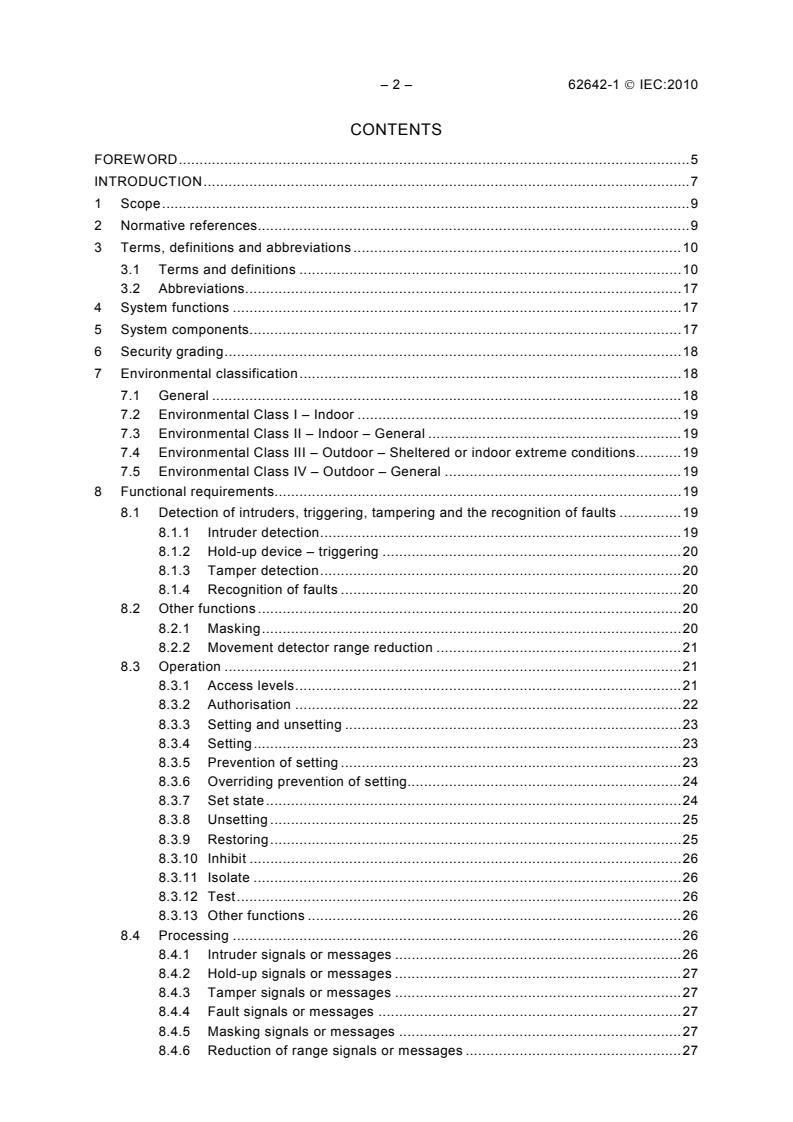
– 2 – 62642-1 © IEC:2010
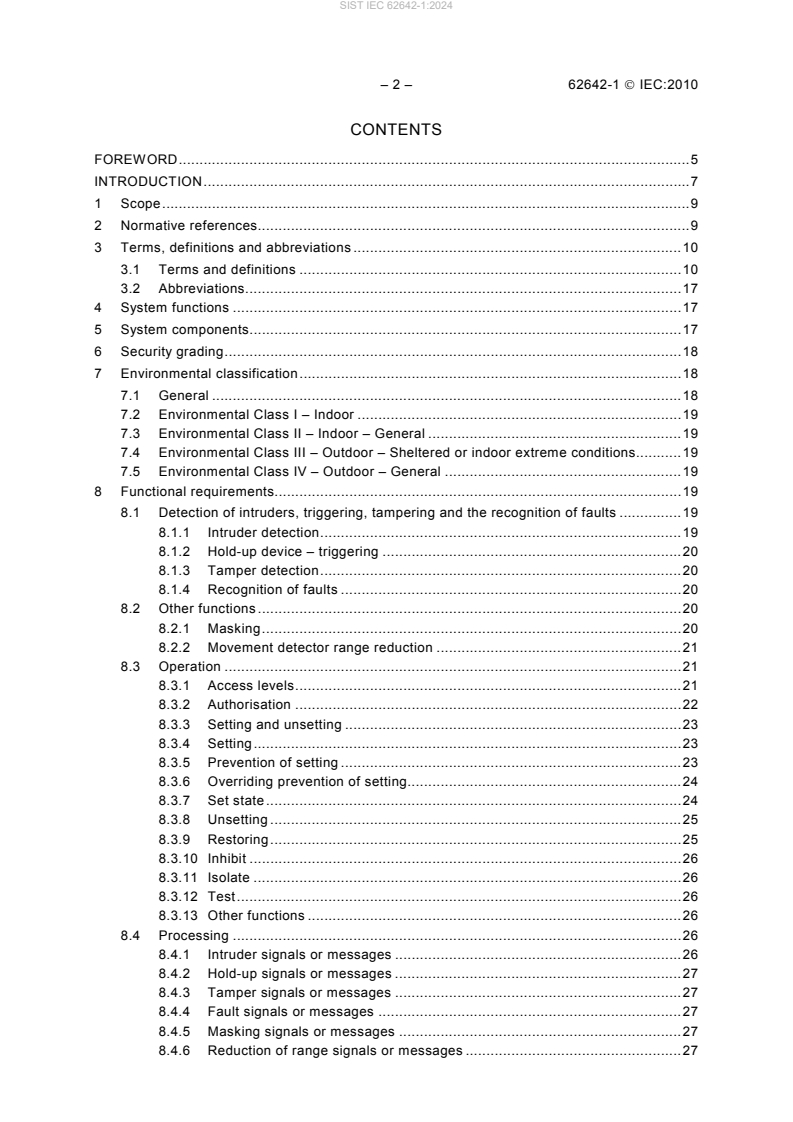
CONTENTS
FOREWORD.5
INTRODUCTION.7
1 Scope.9
2 Normative references.9
3 Terms, definitions and abbreviations .10
3.1 Terms and definitions .10
3.2 Abbreviations.17
4 System functions .17
5 System components.17
6 Security grading.18
7 Environmental classification.18
7.1 General .18
7.2 Environmental Class I – Indoor .19
7.3 Environmental Class II – Indoor – General .19
7.4 Environmental Class III – Outdoor – Sheltered or indoor extreme conditions.19
7.5 Environmental Class IV – Outdoor – General .19
8 Functional requirements.19
8.1 Detection of intruders, triggering, tampering and the recognition of faults .19
8.1.1 Intruder detection.19
8.1.2 Hold-up device – triggering .20
8.1.3 Tamper detection.20
8.1.4 Recognition of faults .20
8.2 Other functions .20
8.2.1 Masking.20
8.2.2 Movement detector range reduction .21
8.3 Operation .21
8.3.1 Access levels.21
8.3.2 Authorisation .22
8.3.3 Setting and unsetting .23
8.3.4 Setting.23
8.3.5 Prevention of setting .23
8.3.6 Overriding prevention of setting.24
8.3.7 Set state.24
8.3.8 Unsetting .25
8.3.9 Restoring.25
8.3.10 Inhibit .26
8.3.11 Isolate .26
8.3.12 Test.26
8.3.13 Other functions .26
8.4 Processing .26
8.4.1 Intruder signals or messages .26
8.4.2 Hold-up signals or messages .27
8.4.3 Tamper signals or messages .27
8.4.4 Fault signals or messages .27
8.4.5 Masking signals or messages .27
8.4.6 Reduction of range signals or messages .27
62642-1 © IEC:2010 – 3 –
8.5 Indications.29
8.5.1 General .29
8.5.2 Availability of indications .30
8.5.3 Cancelling indications .30
8.5.4 Indication – Intrusion detectors .30
8.6 Notification .31
8.7 Tamper security.32
8.7.1 Tamper protection.32
8.7.2 Tamper detection.33
8.7.3 Monitoring of substitution .33
8.7.4 Monitoring of substitution – Timing requirements.34
8.8 Interconnections .34
8.8.1 General .34
8.8.2 Availability of interconnections .34
8.8.3 Monitoring of interconnections.35
8.8.4 Verification .35
8.8.5 Security of communication .35
8.8.6 Signals or messages to be generated.36
8.9 I&HAS timing performance.36
8.9.1 Intruder detection, tampering, triggering, and the recognition of faults
– Timing requirements .36
8.9.2 Processing.36
8.10 Event recording .36
9 Power supply .38
9.1 Types of power supply .38
9.2 Requirements .38
10 Operational reliability .39
10.1 General .39
10.2 I&HAS components.39
11 Functional reliability .39
12 Environmental requirements .40
12.1 General .40
12.2 Electromagnetic compatibility.40
13 Electrical safety .40
14 Documentation .40
14.1 Intruder and hold-up alarm system documentation .40
14.2 Intruder and hold-up alarm system component documentation.40
15 Marking/Identification.41
Annex A (normative) Special national conditions.42
Annex B (informative) Alarm transmission system performance criteria.43
Bibliography .45
Table 1 – Faults .20
Table 2 – Levels of access .22
Table 3 – Authorisation code requirements .23
Table 4 – Prevention of setting .23
Table 5 – Overriding of prevention of setting conditions .24
– 4 – 62642-1 © IEC:2010
Table 6 – Restoring.25
Table 7 – Processing of intruder, hold-up, tamper alarm and fault signals/messages.28
Table 8 – Indication.29
Table 9 – Indications available during set and unset status at access level 1 .30
Table 10 – Notification requirements .31
Table 11 – Alarm transmission system performance criteria.32
Table 12 – Tamper detection – Components to include.33
Table 13 – Tamper detection – Means to be detected .33
Table 14 – Monitoring of substitution .34
Table 15 – Monitoring of substitution – Timing.34
Table 16 – Maximum unavailability of interconnections .35
Table 17 – Verification intervals.35
Table 18 – Maximum time period from last signal or message .35
Table 19 – Security of signals and messages .36
Table 20 – Signals or messages to be generated.36
Table 21 – Event recording – Memory .37
Table 22 – Event recording – Events to be recorded .37
Table 23 – Minimum duration of alternative power supply .39
Table 24 – Alternative power supply – Recharge periods .39
Table B.1 – Transmission time classification .43
Table B.2 – Transmission time – Maximum values.43
Table B.3 – Reporting time classification .43
62642-1 © IEC:2010 – 5 –
INTERNATIONAL ELECTROTECHNICAL COMMISSION
____________
ALARM SYSTEMS –
INTRUSION AND HOLD-UP SYSTEMS –
Part 1: System requirements
FOREWORD
1) The International Electrotechnical Commission (IEC) is a worldwide organization for standardization comprising
all national electrotechnical committees (IEC National Committees). The object of IEC is to promote
international co-operation on all questions concerning standardization in the electrical and electronic fields. To
this end and in addition to other activities, IEC publishes International Standards, Technical Specifications,
Technical Reports, Publicly Available Specifications (PAS) and Guides (hereafter referred to as “IEC
Publication(s)”). Their preparation is entrusted to technical committees; any IEC National Committee interested
in the subject dealt with may participate in this preparatory work. International, governmental and non-
governmental organizations liaising with the IEC also participate in this preparation. IEC collaborates closely
with the International Organization for Standardization (ISO) in accordance with conditions determined by
agreement between the two organizations.
2) The formal decisions or agreements of IEC on technical matters express, as nearly as possible, an international
consensus of opinion on the relevant subjects since each technical committee has representation from all
interested IEC National Committees.
3) IEC Publications have the form of recommendations for international use and are accepted by IEC National
Committees in that sense. While all reasonable efforts are made to ensure that the technical content of IEC
Publications is accurate, IEC cannot be held responsible for the way in which they are used or for any
misinterpretation by any end user.
4) In order to promote international uniformity, IEC National Committees undertake to apply IEC Publications
transparently to the maximum extent possible in their national and regional publications. Any divergence
between any IEC Publication and the corresponding national or regional publication shall be clearly indicated in
the latter.
5) IEC itself does not provide any attestation of conformity. Independent certification bodies provide conformity
assessment services and, in some areas, access to IEC marks of conformity. IEC is not responsible for any
services carried out by independent certification bodies.
6) All users should ensure that they have the latest edition of this publication.
7) No liability shall attach to IEC or its directors, employees, servants or agents including individual experts and
members of its technical committees and IEC National Committees for any personal injury, property damage or
other damage of any nature whatsoever, whether direct or indirect, or for costs (including legal fees) and
expenses arising out of the publication, use of, or reliance upon, this IEC Publication or any other IEC
Publications.
8) Attention is drawn to the Normative references cited in this publication. Use of the referenced publications is
indispensable for the correct application of this publication.
9) Attention is drawn to the possibility that some of the elements of this IEC Publication may be the subject of
patent rights. IEC shall not be held responsible for identifying any or all such patent rights.
International Standard IEC 62642-1 has been prepared by IEC technical committee 79: Alarm
and electronic security systems.
This standard is based on EN 50131-1 (2006) and its Amendment 1 (2009).
The text of this standard is based on the following documents:
FDIS Report on voting
79/280/FDIS 79/299/RVD
Full information on the voting for the approval of this standard can be found in the report on
voting indicated in the above table.
This publication has been drafted in accordance with the ISO/IEC Directives, Part 2.
– 6 – 62642-1 © IEC:2010
A list of all parts of the IEC 62642 series can be found, under the general title Alarm systems –
Intrusion and hold-up systems, on the IEC website.
The committee has decided that the contents of this publication will remain unchanged until the
stability result date indicated on the IEC web site under "http://webstore.iec.ch" in the data
related to the specific publication. At this date, the publication will be
• reconfirmed,
• withdrawn,
• replaced by a revised edition, or
• amended.
62642-1 © IEC:2010 – 7 –
INTRODUCTION
This standard is part of the IEC 62642 series of International Standards and Technical
Specifications “Alarm systems – Intrusion and hold-up systems”, written to include the following
parts:
Part 1 System requirements
Part 2-2 Intrusion detectors – Passive infrared detectors
Part 2-3 Intrusion detectors – Microwave detectors
Part 2-4 Intrusion detectors – Combined passive infrared / Microwave detectors
Part 2-5 Intrusion detectors – Combined passive infrared / Ultrasonic detectors
Part 2-6 Intrusion detectors – Opening contacts (magnetic)
Part 2-71 Intrusion detectors – Glass break detectors – Acoustic
Part 2-72 Intrusion detectors – Glass break detectors – Passive
Part 2-73 Intrusion detectors – Glass break detectors – Active
Part 3 Control and indicating equipment
Part 4 Warning devices
Part 5-3 Requirements for interconnections equipment using radio frequency techniques
Part 6 Power supplies
Part 7 Application guidelines
Part 8 Security fog devices
This International Standard applies to Intrusion and Hold-up Alarm Systems (I&HAS). The
standard is also intended to apply to Intruder Alarm Systems (IAS) which include only intrusion
detectors and to Hold-up Alarm Systems (HAS) which include only hold-up devices.
This International Standard is a specification for Intrusion and Hold-up Alarm Systems installed
in buildings, it includes four security grades and four environmental classes.
The purpose of an I&HAS is to enhance the security of the supervised premises. To maximise
its effectiveness an I&HAS should be integrated with appropriate physical security devices and
procedures. This is particularly important to higher grade I&HAS.
This standard is intended to assist insurers, intruder alarm companies, customers and the
police in achieving a complete and accurate specification of the supervision required in
particular premises, but it does not specify the type of technology, the extent or degree of
detection, nor does it necessarily cover all of the requirements for a particular installation.
All references to the requirements for I&HAS refer to basic minimum requirements and the
designers of such installed I&HAS should take into account the nature of the premises, the
value of the contents, the degree of risk of intrusion, the threat to personnel and any other
factors which may influence the choice of grade and content of an I&HAS.
Recommendations for design, planning, operation, installation and maintenance are given in
Application Guidelines EN/TS 50131-7.
This standard is not intended to be used for testing individual I&HAS components.
Requirements for testing individual I&HAS components are given in the relevant component
standards.
– 8 – 62642-1 © IEC:2010
I&HAS and components thereof are graded to provide the level of security required. The
security grades take into account the risk level which depends on the type of premises, the
value of the contents, and the typical intruder or robber expected.
62642-1 © IEC:2010 – 9 –
ALARM SYSTEMS –
INTRUSION AND HOLD-UP SYSTEMS –
Part 1: System requirements
1 Scope
This part of IEC 62642 specifies the requirements for Intrusion and Hold-up Alarm Systems
(I&HAS) installed in buildings using specific or non-specific wired interconnections or wire-free
interconnections. These requirements also apply to the components of an I&HAS installed in a
building which are normally mounted on the external structure of a building e.g. ancillary
control equipment or warning devices. The standard does not include requirements for exterior
I&HAS.
This International Standard specifies performance requirements for installed I&HAS but does
not include requirements for design, planning, installation, operation or maintenance.
These requirements also apply to I&HAS sharing means of detection, triggering,
interconnection, control, communication and power supplies with other applications. The
functioning of an I&HAS is not adversely influenced by other applications.
Requirements are specified for I&HAS components where the relevant environment is
classified. This classification describes the environment in which an I&HAS component may be
expected to function as designed. When the requirements of the four environmental classes
are inadequate, due to the extreme conditions experienced in certain geographic locations,
special national conditions are given in Annex A. General environmental requirements for
7.
I&HAS components are described in Clause
The requirements of this standard also apply to IAS and HAS when these systems are installed
independently.
When an I&HAS does not include functions relating to the detection of intruders, the
requirements relating to intrusion detection do not apply.
When an I&HAS does not include functions relating to hold-up, the requirements relating to
hold-up do not apply.
NOTE Unless otherwise stated, the abbreviation I&HAS is also intended to mean IAS and HAS.
2 Normative references
The following referenced documents are indispensable for the application of this document. For
dated references, only the edition cited applies. For undated references, the latest edition of
the referenced document (including any amendments) applies.
IEC 60065:2001, Audio, video and similar electronic apparatus – Safety requirements
IEC 60950-1:2005, Information technology equipment – Safety – Part 1: General requirements
IEC 61000-6-3:2006, Electromagnetic compatibility (EMC) – Part 6-3: Generic standards –
Emission standard for residential, commercial and light-industrial environments
IEC 62599-1:2010, Alarm systems – Part 1: Environmental test methods
– 10 – 62642-1 © IEC:2010
IEC 62599-2:2010, Alarm systems – Part 2: Electromagnetic compatibility – Immunity
requirements for components of fire and security alarm systems
EN/TS 50131-6:2008, Alarm systems – Intrusion and hold-up systems – Part 6: Power
supplies
EN 50136-1-1:1998, Alarm systems – Alarm transmission systems and equipment – Part 1-1:
General requirements for alarm transmission systems
3 Terms, definitions and abbreviations
3.1 Terms and definitions
For the purposes of this document, the following terms and definitions apply.
3.1.1
action
(relating to setting and unsetting) deliberate operation or act by the user which is part of the
setting or unsetting procedure
3.1.2
access level
level of access to particular functions of an I&HAS
3.1.3
active
state of a detector in the presence of a hazard
3.1.4
active period
period during which an alarm signal is present
3.1.5
alarm
warning of the presence of a hazard to life, property or the environment
3.1.6
alarm receiving centre
continuously manned centre to which information concerning the status of one or more I&HAS
is reported
3.1.7
alarm company
organization which provides services for I&HAS
3.1.8
alarm condition
condition of an I&HAS, or part thereof, which results from the response of the system to the
presence of a hazard
3.1.9
alarm notification
passing of an alarm condition to warning devices and/or alarm transmission systems
___________
The transformation of this document as IEC 62642-6 is under consideration.
62642-1 © IEC:2010 – 11 –
3.1.10
alarm system
electrical installation which responds to the manual or automatic detection of the presence of a
hazard
3.1.11
alarm transmission system
equipment and network used to transfer information from one or more I&HAS to one or more
alarm receiving centres
NOTE Alarm transmission systems exclude local direct connections, i.e. interconnections between parts of an
I&HAS which do not require an interface to transform the I&HAS information into a form suitable for transmission.
3.1.12
alert indication
audible and/or visual indication, available at access level 1, when an I&HAS is in the unset
state, indicating that further indication(s) are available to users at access levels 2, 3, or 4
3.1.13
alternative power source
power source capable of powering the I&HAS for a predetermined time when a prime power
source is unavailable
3.1.14
ancillary control equipment
equipment used for supplementary control purposes
3.1.15
application
electronic security system
EXAMPLE Social alarm, CCTV, access control or fire system or a non-security
electronic/electrical system such as heating, air conditioning, lighting, etc.
3.1.16
authorisation
permission to gain access to the various control functions of an I&HAS
3.1.17
authorisation codes
mechanical or logical keys which permit access to I&HAS functions
3.1.18
availability of interconnection
condition when an interconnection is capable of conveying a signal or message
3.1.19
component substitution
the replacement of I&HAS components with alternative devices which prevent an I&HAS
functioning as designed
3.1.20
communication
transmission of messages and/or signals between I&HAS components
NOTE The transmission of a signal may include the continual passing of an electrical current through a switch or
relay forming the interface between I&HAS components. It is not necessary to change the status of any such switch
or relay. Due to the nature of data communication, the transmission of a message may require deliberate initiation,
– 12 – 62642-1 © IEC:2010
e.g. in response to a poll or at specified time intervals, this initiation may or may not require the change of status of
a switch or relay.
3.1.21
continually
recurring frequently at regular intervals
3.1.22
control and indicating equipment
equipment for receiving, processing, controlling, indicating and initiating the onward
transmission of information
3.1.23
entry/exit route
route by which authorized entry or exit to the supervised premises or part thereof may be
achieved
3.1.24
event
condition arising from the operation of an I&HAS e.g. setting/unsetting or the functioning of an
I&HAS, e.g. alarm signal or message
3.1.25
event recording
storage of events arising from the operation e.g. setting or unsetting of an I&HAS or the
functioning of an I&HAS for future analysis
3.1.26
fault condition
condition of an alarm system which prevents an I&HAS or parts thereof from functioning
normally
3.1.27
fault signal
fault message
information generated due to the presence of a fault
3.1.28
hold-up alarm system
alarm system providing the means for a user to deliberately generate a hold-up alarm condition
3.1.29
hold-up device
device which when triggered causes a hold-up alarm signal or message to be generated
3.1.30
hold-up alarm condition
condition of an alarm system, or part thereof, which results from the response of an I&HAS to
the triggering of a hold-up device
3.1.31
indication
information (in audible, visual or any other form) provided to assist the user in the operation of
an I&HAS
62642-1 © IEC:2010 – 13 –
3.1.32
inhibit
status of a part of an I&HAS in which an alarm condition cannot be notified, such status
remaining until the I&HAS or part thereof passes from the set to the unset status
3.1.33
interconnection
means by which messages and/or signals are communicated between I&HAS components
3.1.34
interconnection media
medium by which signals or messages are conveyed
3.1.35
interference
corruption of signals and/or messages passing between I&HAS components
3.1.36
intruder alarm system
alarm system to detect and indicate the presence, entry or attempted entry of an intruder into
supervised premises
3.1.37
intruder alarm condition
condition of an I&HAS, or part thereof, which results from the response of the I&HAS to the
presence of an intruder
3.1.38
intruder signal
intruder message
information generated by an intruder detector
3.1.39
intrusion detector
device designed to generate an intruder signal or message in response to the sensing of an
abnormal condition indicating the presence of a hazard
3.1.40
intrusion and hold-up alarm system
combined intruder and hold-up alarm system
3.1.41
isolation
status of a part of an alarm system in which an alarm condition cannot be notified, such status
remaining until cancelled by a user
3.1.42
masked
condition whereby the field of view of a movement detector is blocked
3.1.43
message
series of signals routed via interconnections which include identification, function data and the
various means for providing its own integrity, immunity and proper reception
– 14 – 62642-1 © IEC:2010
3.1.44
message substitution
intentional or unintentional creation of alternative message between I&HAS components which
prevent the correct functioning of an I&HAS
3.1.45
monitoring
process of verifying that interconnections and equipment are functioning correctly
3.1.46
non-specific wired interconnection
interconnection conveying information pertaining to two or more applications
3.1.47
normal condition
state of an I&HAS where no conditions exist which would prevent the setting of an I&HAS
3.1.48
notification
passing of an alarm, tamper or fault condition to warning devices and/or alarm transmission
systems
3.1.49
operator
authorised individual (a user) using an I&HAS for its intended purpose
3.1.50
override
intervention, by a user, to permit setting when an I&HAS is not in a normal condition
3.1.51
part set
status of an I&HAS in which an intruder or hold-up alarm condition can be notified but part of
the I&HAS is unset
3.1.52
pending indication
means of indicating that further information is available for display when all information cannot
be displayed simultaneously
3.1.53
periodic communication
any valid signal or message
3.1.54
power supply
part of an alarm system which provides power for an I&HAS or any part thereof
3.1.55
prime power source
power source used to support an I&HAS under normal working conditions
3.1.56
restore
procedure of canceling an alarm, tamper, fault or other condition and returning an I&HAS to a
previous condition
62642-1 © IEC:2010 – 15 –
3.1.57
self powered device
device incorporating its own power sources
3.1.58
sensor
part of a detector which senses a change in condition
3.1.59
set
status of an I&HAS or part thereof in which an intruder or hold-up alarm condition can be
notified
3.1.60
signal
variable parameters by which information is conveyed
3.1.61
significant reduction of range
reduction of the detection range of a movement detector, measured on the central axis of the
detector, exceeding 50 % of specified range
3.1.62
site specific data
information relating to the configuration of an I&HAS e.g. processing parameters
3.1.63
specific wired interconnection
interconnection conveying information pertaining to one application
3.1.64
standby period
period during which the alternative power source is capable of supporting an I&HAS
3.1.65
subsystem
part of an I&HAS located in a clearly defined area of the supervised premises capable of
functioning independently of other parts of the I&HAS
3.1.66
supervised premises
part of a building and/or area in which an intrusion, attempted intrusion, or the triggering of a
hold-up device may be detected by an I&HAS
3.1.67
supplementary prime power source
energy source (independent of the prime power source) capable of supporting an I&HAS for
extended periods, without affecting the standby period of the alternate power source
3.1.68
system components
individual items of equipment which constitute an I&HAS when configured together
3.1.69
supervised premises transceiver
equipment at the supervised premises, including the interface to the I&HAS and the interface to
the alarm transmission network
– 16 – 62642-1 © IEC:2010
3.1.70
tamper
deliberate interference with an I&HAS or part thereof
3.1.71
tamper alarm
alarm generated by tamper detection
3.1.72
tamper condition
condition of an I&HAS in which tampering has been detected
3.1.73
tamper detection
detection of deliberate interference with an I&HAS or part thereof
3.1.74
tamper protection
methods or means used to protect an I&HAS or part thereof against deliberate interference
3.1.75
tamper security
methods or means used to protect an I&HAS or part thereof against deliberate interference and
the detection of deliberate interference with an I&HAS or part thereof
3.1.76
tamper signal
tamper message
information generated by a tamper detector
3.1.77
transmission path
a transmission path between an individual alarm system and its associated alarm receiving
centre(s)
3.1.78
triggering
deliberate operation of a hold-up device
3.1.79
unset
status of an I&HAS or part thereof in which an intruder and/or hold-up alarm condition cannot
be notified
3.1.80
user
person authorised to operate an I&HAS
3.1.81
user interface
means by which a user operates an I&HAS
3.1.82
warning device
a device that gives an audible alarm in response to a notification
NOTE 1 A warning device may also provide alert indications.
62642-1 © IEC:2010 – 17 –
NOTE 2 Such indications should be easily distinguishable from those related to the notification of an alarm
condition.
3.1.83
wire-free interconnection
interconnection conveying information between I&HAS components without physical media
3.1.84
zone
area of the supervised premises where an intrusion, attempted intrusion, or the triggering of a
hold-up device may be detected by an I&HAS
NOTE Although a zone could contain just one detector, the term “zone” is not synonymous with one detector input.
A zone may include any number of detectors. Examples of zones include: a storey of a building, the perimeter of a
building, an outbuilding.
3.2 Abbreviations
For the purposes of this document, the following abbreviations are used:
ARC – alarm receiving centre
ACE – ancillary control equipment
ATS – alarm transmission system
CIE – control and indicating equipment
HAS – hold-up alarm system(s)
IAS – intruder alarm system(s)
I&HAS – intrusion and hold-up alarm system(s)
WD – warning device
PS – power supply
SPT – supervised premises transceiver
4 System functions
I&HAS shall include, as appropriate to the configuration of the I&HAS, the functions specified in
this standard for the detection of intruders and/or triggering, processing of information,
notification of alarms and the means to operate an I&HAS.
Functions additional to the mandatory functions specified in this standard may be included in
I&HAS providing they do not influence the correct operation of the mandatory functions.
5 System components
I&HAS components shall be classified according to their environmental capability and graded
according to their performance.
I&HAS components shall be compatible within an I&HAS and selected according to the system
grade and appropriate environmental classification.
Components of other applications may be combined or integrated with an I&HAS, providing the
performance of the I&HAS components is not adversely influenced.
– 18 – 62642-1 © IEC:2010
6 Security grading
I&HAS shall be given a security grading which will determine its performance. The grading shall
be one of four grades with grade 1 being the lowest grade and grade 4 the highest. The grade
of an I&HAS shall be that of the lowest graded component.
When an I&HAS is divided into clearly defined sub-systems, an I&HAS may include
components of differing grades within each sub-system. The grade of a subsystem shall be
that of the lowest graded component within it.
Components shared by more than one sub-system shall have a grade equal to that of the
highest sub-system grade (e.g. control and indicating equipment/alarm transmission
systems/warning devices/power supplies).
If a function is provided that is optional for a particular grade and a claim of compliance is
made, it shall meet the applicable requirements for the grade for which compliance is claimed
(if any are given). If there are no specifications for the grade in question, the requirements for
any higher grade (as identified by the manufacturer) shall apply.
NOTE 1 For the guidance of specifiers and those responsible for the security of premises, the following grades are
given:
Grade 1: Low risk
An intruder or robber is expected to have little knowledge of I&HAS and be restricted to a limited range
of easily available tools.
Grade 2: Low to medium risk
An intruder or robber is expected to have a limited knowledge of I&HAS and the use of a general range
of tools and portable instruments (e.g. a multi-meter).
Grade 3: Medium to high risk
An intruder or robber is expected to be conversant with I&HAS and have a comprehensive range of tools
and portable electronic equipment.
Grade 4: High risk
To be used when security takes precedence over all other factors. An intruder or robber is expected to
have the ability or resource to plan an intrusion or robbery in detail and have a full range of equipment
including means of substitution of components in an I&HAS.
NOTE 2 In the all grades, the term “Intruder” is intended to embrace other types of threat (e.g. robbery or the
threat of physical violence, which might influence the design of an I&HAS).
7 Environmental classification
7.1 General
Components shall be suitable for use in one of the following environmental classes.
Environmental test requirements for I&HAS components are given in the individual component
standards. IEC 62599-1 describes the environmental test methods to be applied to I&HAS
components.
NOTE 1 Classes I, II, III and IV are progressively more severe and therefore Class IV components may, for
example, be used in Class III I&HAS.
I&HAS components shall operate correctly when exposed to environmental influences specified
in 7.2, 7.3, 7.4 and 7.5. For each class, typical information is given below.
NOTE 2 Annex A includes special national conditions for specified countries.
NOTE 3 The environmental conditions described in Clause 7 are those in which an I&HAS is expected to perform
correctly, they are not necessarily the conditions to be used during the testing of I&HAS components.
62642-1 © IEC:2010 – 19 –
7.2 Environmental Class I – Indoor
Environmental influences normally experienced indoors when the temperature is well
maintained (e.g. in a residential or commercial property).
NOTE Temperatures may be expected to vary between +5 °C and +40 °C with average relative humidity of
approximately 75 % non-condensing.
7.3 Environmental Class II – Indoor – General
Environmental influences normally experienced indoors when the temperature is not well
maintained (e.g. in corridors, halls or staircases and where condensation can occur on
windows and in unheated storage areas or warehouses where heating is intermittent).
NOTE Temperatures may be expected to vary between –10 °C and +40 °C with average relative humidity of
approximately 75 % non-condensing.
7.4 Environmental Class III – Outdoor – Sheltered or indoor extreme conditions
Environmental influences normally experienced out of doors when I&HAS components are not
fully exposed to the weather or indoors where environmental conditions are extreme.
NOTE Temperatures may be expected to vary between –25 °C and +50 °C with average relative humidity of
approximately 75 % non-condensing. For 30 days per year, relative humidity can be expected to vary between 85 %
and 95 % non-condensing.
7.5 Environmental Class IV – Outdoor – General
Environmental influences normally experienced out of doors when I&HAS components are fully
exposed to the weather.
NOTE Temperatures may be expected to vary between –25 °C and +60 °C with average relative humidity of
approximately 75 % non-condensing. For 30 days per year, relative humidity can be expected to vary between 85 %
and 95 % non-condensing.
8 Functional requirements
8.1 Detection of intruders, triggering, tampering
...
IEC 62642-1 ®
Edition 1.0 2010-06
INTERNATIONAL
STANDARD
NORME
INTERNATIONALE
Alarm systems – Intrusion and hold-up systems –
Part 1: System requirements
Systèmes d'alarme – Systèmes d'alarme contre l’intrusion et les hold-up –
Partie 1: Exigences système
All rights reserved. Unless otherwise specified, no part of this publication may be reproduced or utilized in any form or by
any means, electronic or mechanical, including photocopying and microfilm, without permission in writing from either IEC or
IEC's member National Committee in the country of the requester.
If you have any questions about IEC copyright or have an enquiry about obtaining additional rights to this publication,
please contact the address below or your local IEC member National Committee for further information.
Droits de reproduction réservés. Sauf indication contraire, aucune partie de cette publication ne peut être reproduite
ni utilisée sous quelque forme que ce soit et par aucun procédé, électronique ou mécanique, y compris la photocopie
et les microfilms, sans l'accord écrit de la CEI ou du Comité national de la CEI du pays du demandeur.
Si vous avez des questions sur le copyright de la CEI ou si vous désirez obtenir des droits supplémentaires sur cette
publication, utilisez les coordonnées ci-après ou contactez le Comité national de la CEI de votre pays de résidence.
IEC Central Office
3, rue de Varembé
CH-1211 Geneva 20
Switzerland
Email: inmail@iec.ch
Web: www.iec.ch
About the IEC
The International Electrotechnical Commission (IEC) is the leading global organization that prepares and publishes
International Standards for all electrical, electronic and related technologies.
About IEC publications
The technical content of IEC publications is kept under constant review by the IEC. Please make sure that you have the
latest edition, a corrigenda or an amendment might have been published.
ƒ Catalogue of IEC publications: www.iec.ch/searchpub
The IEC on-line Catalogue enables you to search by a variety of criteria (reference number, text, technical committee,…).
It also gives information on projects, withdrawn and replaced publications.
ƒ IEC Just Published: www.iec.ch/online_news/justpub
Stay up to date on all new IEC publications. Just Published details twice a month all new publications released. Available
on-line and also by email.
ƒ Electropedia: www.electropedia.org
The world's leading online dictionary of electronic and electrical terms containing more than 20 000 terms and definitions
in English and French, with equivalent terms in additional languages. Also known as the International Electrotechnical
Vocabulary online.
ƒ Customer Service Centre: www.iec.ch/webstore/custserv
If you wish to give us your feedback on this publication or need further assistance, please visit the Customer Service
Centre FAQ or contact us:
Email: csc@iec.ch
Tel.: +41 22 919 02 11
Fax: +41 22 919 03 00
A propos de la CEI
La Commission Electrotechnique Internationale (CEI) est la première organisation mondiale qui élabore et publie des
normes internationales pour tout ce qui a trait à l'électricité, à l'électronique et aux technologies apparentées.
A propos des publications CEI
Le contenu technique des publications de la CEI est constamment revu. Veuillez vous assurer que vous possédez
l’édition la plus récente, un corrigendum ou amendement peut avoir été publié.
ƒ Catalogue des publications de la CEI: www.iec.ch/searchpub/cur_fut-f.htm
Le Catalogue en-ligne de la CEI vous permet d’effectuer des recherches en utilisant différents critères (numéro de référence,
texte, comité d’études,…). Il donne aussi des informations sur les projets et les publications retirées ou remplacées.
ƒ Just Published CEI: www.iec.ch/online_news/justpub
Restez informé sur les nouvelles publications de la CEI. Just Published détaille deux fois par mois les nouvelles
publications parues. Disponible en-ligne et aussi par email.
ƒ Electropedia: www.electropedia.org
Le premier dictionnaire en ligne au monde de termes électroniques et électriques. Il contient plus de 20 000 termes et
définitions en anglais et en français, ainsi que les termes équivalents dans les langues additionnelles. Egalement appelé
Vocabulaire Electrotechnique International en ligne.
ƒ Service Clients: www.iec.ch/webstore/custserv/custserv_entry-f.htm
Si vous désirez nous donner des commentaires sur cette publication ou si vous avez des questions, visitez le FAQ du
Service clients ou contactez-nous:
Email: csc@iec.ch
Tél.: +41 22 919 02 11
Fax: +41 22 919 03 00
IEC 62642-1 ®
Edition 1.0 2010-06
INTERNATIONAL
STANDARD
NORME
INTERNATIONALE
Alarm systems – Intrusion and hold-up systems –
Part 1: System requirements
Systèmes d'alarme – Systèmes d'alarme contre l’intrusion et les hold-up –
Partie 1: Exigences système
INTERNATIONAL
ELECTROTECHNICAL
COMMISSION
COMMISSION
ELECTROTECHNIQUE
PRICE CODE
INTERNATIONALE
X
CODE PRIX
ICS 13.320 ISBN 978-2-88910-970-8
– 2 – 62642-1 © IEC:2010
CONTENTS
FOREWORD.5
INTRODUCTION.7
1 Scope.9
2 Normative references.9
3 Terms, definitions and abbreviations .10
3.1 Terms and definitions .10
3.2 Abbreviations.17
4 System functions .17
5 System components.17
6 Security grading.18
7 Environmental classification.18
7.1 General .18
7.2 Environmental Class I – Indoor .19
7.3 Environmental Class II – Indoor – General .19
7.4 Environmental Class III – Outdoor – Sheltered or indoor extreme conditions.19
7.5 Environmental Class IV – Outdoor – General .19
8 Functional requirements.19
8.1 Detection of intruders, triggering, tampering and the recognition of faults .19
8.1.1 Intruder detection.19
8.1.2 Hold-up device – triggering .20
8.1.3 Tamper detection.20
8.1.4 Recognition of faults .20
8.2 Other functions .20
8.2.1 Masking.20
8.2.2 Movement detector range reduction .21
8.3 Operation .21
8.3.1 Access levels.21
8.3.2 Authorisation .22
8.3.3 Setting and unsetting .23
8.3.4 Setting.23
8.3.5 Prevention of setting .23
8.3.6 Overriding prevention of setting.24
8.3.7 Set state.24
8.3.8 Unsetting .25
8.3.9 Restoring.25
8.3.10 Inhibit .26
8.3.11 Isolate .26
8.3.12 Test.26
8.3.13 Other functions .26
8.4 Processing .26
8.4.1 Intruder signals or messages .26
8.4.2 Hold-up signals or messages .27
8.4.3 Tamper signals or messages .27
8.4.4 Fault signals or messages .27
8.4.5 Masking signals or messages .27
8.4.6 Reduction of range signals or messages .27
62642-1 © IEC:2010 – 3 –
8.5 Indications.29
8.5.1 General .29
8.5.2 Availability of indications .30
8.5.3 Cancelling indications .30
8.5.4 Indication – Intrusion detectors .30
8.6 Notification .31
8.7 Tamper security.32
8.7.1 Tamper protection.32
8.7.2 Tamper detection.33
8.7.3 Monitoring of substitution .33
8.7.4 Monitoring of substitution – Timing requirements.34
8.8 Interconnections .34
8.8.1 General .34
8.8.2 Availability of interconnections .34
8.8.3 Monitoring of interconnections.35
8.8.4 Verification .35
8.8.5 Security of communication .35
8.8.6 Signals or messages to be generated.36
8.9 I&HAS timing performance.36
8.9.1 Intruder detection, tampering, triggering, and the recognition of faults
– Timing requirements .36
8.9.2 Processing.36
8.10 Event recording .36
9 Power supply .38
9.1 Types of power supply .38
9.2 Requirements .38
10 Operational reliability .39
10.1 General .39
10.2 I&HAS components.39
11 Functional reliability .39
12 Environmental requirements .40
12.1 General .40
12.2 Electromagnetic compatibility.40
13 Electrical safety .40
14 Documentation .40
14.1 Intruder and hold-up alarm system documentation .40
14.2 Intruder and hold-up alarm system component documentation.40
15 Marking/Identification.41
Annex A (normative) Special national conditions.42
Annex B (informative) Alarm transmission system performance criteria.43
Bibliography .45
Table 1 – Faults .20
Table 2 – Levels of access .22
Table 3 – Authorisation code requirements .23
Table 4 – Prevention of setting .23
Table 5 – Overriding of prevention of setting conditions .24
– 4 – 62642-1 © IEC:2010
Table 6 – Restoring.25
Table 7 – Processing of intruder, hold-up, tamper alarm and fault signals/messages.28
Table 8 – Indication.29
Table 9 – Indications available during set and unset status at access level 1 .30
Table 10 – Notification requirements .31
Table 11 – Alarm transmission system performance criteria.32
Table 12 – Tamper detection – Components to include.33
Table 13 – Tamper detection – Means to be detected .33
Table 14 – Monitoring of substitution .34
Table 15 – Monitoring of substitution – Timing.34
Table 16 – Maximum unavailability of interconnections .35
Table 17 – Verification intervals.35
Table 18 – Maximum time period from last signal or message .35
Table 19 – Security of signals and messages .36
Table 20 – Signals or messages to be generated.36
Table 21 – Event recording – Memory .37
Table 22 – Event recording – Events to be recorded .37
Table 23 – Minimum duration of alternative power supply .39
Table 24 – Alternative power supply – Recharge periods .39
Table B.1 – Transmission time classification .43
Table B.2 – Transmission time – Maximum values.43
Table B.3 – Reporting time classification .43
62642-1 © IEC:2010 – 5 –
INTERNATIONAL ELECTROTECHNICAL COMMISSION
____________
ALARM SYSTEMS –
INTRUSION AND HOLD-UP SYSTEMS –
Part 1: System requirements
FOREWORD
1) The International Electrotechnical Commission (IEC) is a worldwide organization for standardization comprising
all national electrotechnical committees (IEC National Committees). The object of IEC is to promote
international co-operation on all questions concerning standardization in the electrical and electronic fields. To
this end and in addition to other activities, IEC publishes International Standards, Technical Specifications,
Technical Reports, Publicly Available Specifications (PAS) and Guides (hereafter referred to as “IEC
Publication(s)”). Their preparation is entrusted to technical committees; any IEC National Committee interested
in the subject dealt with may participate in this preparatory work. International, governmental and non-
governmental organizations liaising with the IEC also participate in this preparation. IEC collaborates closely
with the International Organization for Standardization (ISO) in accordance with conditions determined by
agreement between the two organizations.
2) The formal decisions or agreements of IEC on technical matters express, as nearly as possible, an international
consensus of opinion on the relevant subjects since each technical committee has representation from all
interested IEC National Committees.
3) IEC Publications have the form of recommendations for international use and are accepted by IEC National
Committees in that sense. While all reasonable efforts are made to ensure that the technical content of IEC
Publications is accurate, IEC cannot be held responsible for the way in which they are used or for any
misinterpretation by any end user.
4) In order to promote international uniformity, IEC National Committees undertake to apply IEC Publications
transparently to the maximum extent possible in their national and regional publications. Any divergence
between any IEC Publication and the corresponding national or regional publication shall be clearly indicated in
the latter.
5) IEC itself does not provide any attestation of conformity. Independent certification bodies provide conformity
assessment services and, in some areas, access to IEC marks of conformity. IEC is not responsible for any
services carried out by independent certification bodies.
6) All users should ensure that they have the latest edition of this publication.
7) No liability shall attach to IEC or its directors, employees, servants or agents including individual experts and
members of its technical committees and IEC National Committees for any personal injury, property damage or
other damage of any nature whatsoever, whether direct or indirect, or for costs (including legal fees) and
expenses arising out of the publication, use of, or reliance upon, this IEC Publication or any other IEC
Publications.
8) Attention is drawn to the Normative references cited in this publication. Use of the referenced publications is
indispensable for the correct application of this publication.
9) Attention is drawn to the possibility that some of the elements of this IEC Publication may be the subject of
patent rights. IEC shall not be held responsible for identifying any or all such patent rights.
International Standard IEC 62642-1 has been prepared by IEC technical committee 79: Alarm
and electronic security systems.
This standard is based on EN 50131-1 (2006) and its Amendment 1 (2009).
The text of this standard is based on the following documents:
FDIS Report on voting
79/280/FDIS 79/299/RVD
Full information on the voting for the approval of this standard can be found in the report on
voting indicated in the above table.
This publication has been drafted in accordance with the ISO/IEC Directives, Part 2.
– 6 – 62642-1 © IEC:2010
A list of all parts of the IEC 62642 series can be found, under the general title Alarm systems –
Intrusion and hold-up systems, on the IEC website.
The committee has decided that the contents of this publication will remain unchanged until the
stability result date indicated on the IEC web site under "http://webstore.iec.ch" in the data
related to the specific publication. At this date, the publication will be
• reconfirmed,
• withdrawn,
• replaced by a revised edition, or
• amended.
62642-1 © IEC:2010 – 7 –
INTRODUCTION
This standard is part of the IEC 62642 series of International Standards and Technical
Specifications “Alarm systems – Intrusion and hold-up systems”, written to include the following
parts:
Part 1 System requirements
Part 2-2 Intrusion detectors – Passive infrared detectors
Part 2-3 Intrusion detectors – Microwave detectors
Part 2-4 Intrusion detectors – Combined passive infrared / Microwave detectors
Part 2-5 Intrusion detectors – Combined passive infrared / Ultrasonic detectors
Part 2-6 Intrusion detectors – Opening contacts (magnetic)
Part 2-71 Intrusion detectors – Glass break detectors – Acoustic
Part 2-72 Intrusion detectors – Glass break detectors – Passive
Part 2-73 Intrusion detectors – Glass break detectors – Active
Part 3 Control and indicating equipment
Part 4 Warning devices
Part 5-3 Requirements for interconnections equipment using radio frequency techniques
Part 6 Power supplies
Part 7 Application guidelines
Part 8 Security fog devices
This International Standard applies to Intrusion and Hold-up Alarm Systems (I&HAS). The
standard is also intended to apply to Intruder Alarm Systems (IAS) which include only intrusion
detectors and to Hold-up Alarm Systems (HAS) which include only hold-up devices.
This International Standard is a specification for Intrusion and Hold-up Alarm Systems installed
in buildings, it includes four security grades and four environmental classes.
The purpose of an I&HAS is to enhance the security of the supervised premises. To maximise
its effectiveness an I&HAS should be integrated with appropriate physical security devices and
procedures. This is particularly important to higher grade I&HAS.
This standard is intended to assist insurers, intruder alarm companies, customers and the
police in achieving a complete and accurate specification of the supervision required in
particular premises, but it does not specify the type of technology, the extent or degree of
detection, nor does it necessarily cover all of the requirements for a particular installation.
All references to the requirements for I&HAS refer to basic minimum requirements and the
designers of such installed I&HAS should take into account the nature of the premises, the
value of the contents, the degree of risk of intrusion, the threat to personnel and any other
factors which may influence the choice of grade and content of an I&HAS.
Recommendations for design, planning, operation, installation and maintenance are given in
Application Guidelines EN/TS 50131-7.
This standard is not intended to be used for testing individual I&HAS components.
Requirements for testing individual I&HAS components are given in the relevant component
standards.
– 8 – 62642-1 © IEC:2010
I&HAS and components thereof are graded to provide the level of security required. The
security grades take into account the risk level which depends on the type of premises, the
value of the contents, and the typical intruder or robber expected.
62642-1 © IEC:2010 – 9 –
ALARM SYSTEMS –
INTRUSION AND HOLD-UP SYSTEMS –
Part 1: System requirements
1 Scope
This part of IEC 62642 specifies the requirements for Intrusion and Hold-up Alarm Systems
(I&HAS) installed in buildings using specific or non-specific wired interconnections or wire-free
interconnections. These requirements also apply to the components of an I&HAS installed in a
building which are normally mounted on the external structure of a building e.g. ancillary
control equipment or warning devices. The standard does not include requirements for exterior
I&HAS.
This International Standard specifies performance requirements for installed I&HAS but does
not include requirements for design, planning, installation, operation or maintenance.
These requirements also apply to I&HAS sharing means of detection, triggering,
interconnection, control, communication and power supplies with other applications. The
functioning of an I&HAS is not adversely influenced by other applications.
Requirements are specified for I&HAS components where the relevant environment is
classified. This classification describes the environment in which an I&HAS component may be
expected to function as designed. When the requirements of the four environmental classes
are inadequate, due to the extreme conditions experienced in certain geographic locations,
special national conditions are given in Annex A. General environmental requirements for
7.
I&HAS components are described in Clause
The requirements of this standard also apply to IAS and HAS when these systems are installed
independently.
When an I&HAS does not include functions relating to the detection of intruders, the
requirements relating to intrusion detection do not apply.
When an I&HAS does not include functions relating to hold-up, the requirements relating to
hold-up do not apply.
NOTE Unless otherwise stated, the abbreviation I&HAS is also intended to mean IAS and HAS.
2 Normative references
The following referenced documents are indispensable for the application of this document. For
dated references, only the edition cited applies. For undated references, the latest edition of
the referenced document (including any amendments) applies.
IEC 60065:2001, Audio, video and similar electronic apparatus – Safety requirements
IEC 60950-1:2005, Information technology equipment – Safety – Part 1: General requirements
IEC 61000-6-3:2006, Electromagnetic compatibility (EMC) – Part 6-3: Generic standards –
Emission standard for residential, commercial and light-industrial environments
IEC 62599-1:2010, Alarm systems – Part 1: Environmental test methods
– 10 – 62642-1 © IEC:2010
IEC 62599-2:2010, Alarm systems – Part 2: Electromagnetic compatibility – Immunity
requirements for components of fire and security alarm systems
EN/TS 50131-6:2008, Alarm systems – Intrusion and hold-up systems – Part 6: Power
supplies
EN 50136-1-1:1998, Alarm systems – Alarm transmission systems and equipment – Part 1-1:
General requirements for alarm transmission systems
3 Terms, definitions and abbreviations
3.1 Terms and definitions
For the purposes of this document, the following terms and definitions apply.
3.1.1
action
(relating to setting and unsetting) deliberate operation or act by the user which is part of the
setting or unsetting procedure
3.1.2
access level
level of access to particular functions of an I&HAS
3.1.3
active
state of a detector in the presence of a hazard
3.1.4
active period
period during which an alarm signal is present
3.1.5
alarm
warning of the presence of a hazard to life, property or the environment
3.1.6
alarm receiving centre
continuously manned centre to which information concerning the status of one or more I&HAS
is reported
3.1.7
alarm company
organization which provides services for I&HAS
3.1.8
alarm condition
condition of an I&HAS, or part thereof, which results from the response of the system to the
presence of a hazard
3.1.9
alarm notification
passing of an alarm condition to warning devices and/or alarm transmission systems
___________
The transformation of this document as IEC 62642-6 is under consideration.
62642-1 © IEC:2010 – 11 –
3.1.10
alarm system
electrical installation which responds to the manual or automatic detection of the presence of a
hazard
3.1.11
alarm transmission system
equipment and network used to transfer information from one or more I&HAS to one or more
alarm receiving centres
NOTE Alarm transmission systems exclude local direct connections, i.e. interconnections between parts of an
I&HAS which do not require an interface to transform the I&HAS information into a form suitable for transmission.
3.1.12
alert indication
audible and/or visual indication, available at access level 1, when an I&HAS is in the unset
state, indicating that further indication(s) are available to users at access levels 2, 3, or 4
3.1.13
alternative power source
power source capable of powering the I&HAS for a predetermined time when a prime power
source is unavailable
3.1.14
ancillary control equipment
equipment used for supplementary control purposes
3.1.15
application
electronic security system
EXAMPLE Social alarm, CCTV, access control or fire system or a non-security
electronic/electrical system such as heating, air conditioning, lighting, etc.
3.1.16
authorisation
permission to gain access to the various control functions of an I&HAS
3.1.17
authorisation codes
mechanical or logical keys which permit access to I&HAS functions
3.1.18
availability of interconnection
condition when an interconnection is capable of conveying a signal or message
3.1.19
component substitution
the replacement of I&HAS components with alternative devices which prevent an I&HAS
functioning as designed
3.1.20
communication
transmission of messages and/or signals between I&HAS components
NOTE The transmission of a signal may include the continual passing of an electrical current through a switch or
relay forming the interface between I&HAS components. It is not necessary to change the status of any such switch
or relay. Due to the nature of data communication, the transmission of a message may require deliberate initiation,
– 12 – 62642-1 © IEC:2010
e.g. in response to a poll or at specified time intervals, this initiation may or may not require the change of status of
a switch or relay.
3.1.21
continually
recurring frequently at regular intervals
3.1.22
control and indicating equipment
equipment for receiving, processing, controlling, indicating and initiating the onward
transmission of information
3.1.23
entry/exit route
route by which authorized entry or exit to the supervised premises or part thereof may be
achieved
3.1.24
event
condition arising from the operation of an I&HAS e.g. setting/unsetting or the functioning of an
I&HAS, e.g. alarm signal or message
3.1.25
event recording
storage of events arising from the operation e.g. setting or unsetting of an I&HAS or the
functioning of an I&HAS for future analysis
3.1.26
fault condition
condition of an alarm system which prevents an I&HAS or parts thereof from functioning
normally
3.1.27
fault signal
fault message
information generated due to the presence of a fault
3.1.28
hold-up alarm system
alarm system providing the means for a user to deliberately generate a hold-up alarm condition
3.1.29
hold-up device
device which when triggered causes a hold-up alarm signal or message to be generated
3.1.30
hold-up alarm condition
condition of an alarm system, or part thereof, which results from the response of an I&HAS to
the triggering of a hold-up device
3.1.31
indication
information (in audible, visual or any other form) provided to assist the user in the operation of
an I&HAS
62642-1 © IEC:2010 – 13 –
3.1.32
inhibit
status of a part of an I&HAS in which an alarm condition cannot be notified, such status
remaining until the I&HAS or part thereof passes from the set to the unset status
3.1.33
interconnection
means by which messages and/or signals are communicated between I&HAS components
3.1.34
interconnection media
medium by which signals or messages are conveyed
3.1.35
interference
corruption of signals and/or messages passing between I&HAS components
3.1.36
intruder alarm system
alarm system to detect and indicate the presence, entry or attempted entry of an intruder into
supervised premises
3.1.37
intruder alarm condition
condition of an I&HAS, or part thereof, which results from the response of the I&HAS to the
presence of an intruder
3.1.38
intruder signal
intruder message
information generated by an intruder detector
3.1.39
intrusion detector
device designed to generate an intruder signal or message in response to the sensing of an
abnormal condition indicating the presence of a hazard
3.1.40
intrusion and hold-up alarm system
combined intruder and hold-up alarm system
3.1.41
isolation
status of a part of an alarm system in which an alarm condition cannot be notified, such status
remaining until cancelled by a user
3.1.42
masked
condition whereby the field of view of a movement detector is blocked
3.1.43
message
series of signals routed via interconnections which include identification, function data and the
various means for providing its own integrity, immunity and proper reception
– 14 – 62642-1 © IEC:2010
3.1.44
message substitution
intentional or unintentional creation of alternative message between I&HAS components which
prevent the correct functioning of an I&HAS
3.1.45
monitoring
process of verifying that interconnections and equipment are functioning correctly
3.1.46
non-specific wired interconnection
interconnection conveying information pertaining to two or more applications
3.1.47
normal condition
state of an I&HAS where no conditions exist which would prevent the setting of an I&HAS
3.1.48
notification
passing of an alarm, tamper or fault condition to warning devices and/or alarm transmission
systems
3.1.49
operator
authorised individual (a user) using an I&HAS for its intended purpose
3.1.50
override
intervention, by a user, to permit setting when an I&HAS is not in a normal condition
3.1.51
part set
status of an I&HAS in which an intruder or hold-up alarm condition can be notified but part of
the I&HAS is unset
3.1.52
pending indication
means of indicating that further information is available for display when all information cannot
be displayed simultaneously
3.1.53
periodic communication
any valid signal or message
3.1.54
power supply
part of an alarm system which provides power for an I&HAS or any part thereof
3.1.55
prime power source
power source used to support an I&HAS under normal working conditions
3.1.56
restore
procedure of canceling an alarm, tamper, fault or other condition and returning an I&HAS to a
previous condition
62642-1 © IEC:2010 – 15 –
3.1.57
self powered device
device incorporating its own power sources
3.1.58
sensor
part of a detector which senses a change in condition
3.1.59
set
status of an I&HAS or part thereof in which an intruder or hold-up alarm condition can be
notified
3.1.60
signal
variable parameters by which information is conveyed
3.1.61
significant reduction of range
reduction of the detection range of a movement detector, measured on the central axis of the
detector, exceeding 50 % of specified range
3.1.62
site specific data
information relating to the configuration of an I&HAS e.g. processing parameters
3.1.63
specific wired interconnection
interconnection conveying information pertaining to one application
3.1.64
standby period
period during which the alternative power source is capable of supporting an I&HAS
3.1.65
subsystem
part of an I&HAS located in a clearly defined area of the supervised premises capable of
functioning independently of other parts of the I&HAS
3.1.66
supervised premises
part of a building and/or area in which an intrusion, attempted intrusion, or the triggering of a
hold-up device may be detected by an I&HAS
3.1.67
supplementary prime power source
energy source (independent of the prime power source) capable of supporting an I&HAS for
extended periods, without affecting the standby period of the alternate power source
3.1.68
system components
individual items of equipment which constitute an I&HAS when configured together
3.1.69
supervised premises transceiver
equipment at the supervised premises, including the interface to the I&HAS and the interface to
the alarm transmission network
– 16 – 62642-1 © IEC:2010
3.1.70
tamper
deliberate interference with an I&HAS or part thereof
3.1.71
tamper alarm
alarm generated by tamper detection
3.1.72
tamper condition
condition of an I&HAS in which tampering has been detected
3.1.73
tamper detection
detection of deliberate interference with an I&HAS or part thereof
3.1.74
tamper protection
methods or means used to protect an I&HAS or part thereof against deliberate interference
3.1.75
tamper security
methods or means used to protect an I&HAS or part thereof against deliberate interference and
the detection of deliberate interference with an I&HAS or part thereof
3.1.76
tamper signal
tamper message
information generated by a tamper detector
3.1.77
transmission path
a transmission path between an individual alarm system and its associated alarm receiving
centre(s)
3.1.78
triggering
deliberate operation of a hold-up device
3.1.79
unset
status of an I&HAS or part thereof in which an intruder and/or hold-up alarm condition cannot
be notified
3.1.80
user
person authorised to operate an I&HAS
3.1.81
user interface
means by which a user operates an I&HAS
3.1.82
warning device
a device that gives an audible alarm in response to a notification
NOTE 1 A warning device may also provide alert indications.
62642-1 © IEC:2010 – 17 –
NOTE 2 Such indications should be easily distinguishable from those related to the notification of an alarm
condition.
3.1.83
wire-free interconnection
interconnection conveying information between I&HAS components without physical media
3.1.84
zone
area of the supervised premises where an intrusion, attempted intrusion, or the triggering of a
hold-up device may be detected by an I&HAS
NOTE Although a zone could contain just one detector, the term “zone” is not synonymous with one detector input.
A zone may include any number of detectors. Examples of zones include: a storey of a building, the perimeter of a
building, an outbuilding.
3.2 Abbreviations
For the purposes of this document, the following abbreviations are used:
ARC – alarm receiving centre
ACE – ancillary control equipment
ATS – alarm transmission system
CIE – control and indicating equipment
HAS – hold-up alarm system(s)
IAS – intruder alarm system(s)
I&HAS – intrusion and hold-up alarm system(s)
WD – warning device
PS – power supply
SPT – supervised premises transceiver
4 System functions
I&HAS shall include, as appropriate to the configuration of the I&HAS, the functions specified in
this standard for the detection of intruders and/or triggering, processing of information,
notification of alarms and the means to operate an I&HAS.
Functions additional to the mandatory functions specified in this standard may be included in
I&HAS providing they do not influence the correct operation of the mandatory functions.
5 System components
I&HAS components shall be classified according to their environmental capability and graded
according to their performance.
I&HAS components shall be compatible within an I&HAS and selected according to the system
grade and appropriate environmental classification.
Components of other applications may be combined or integrated with an I&HAS, providing the
performance of the I&HAS components is not adversely influenced.
– 18 – 62642-1 © IEC:2010
6 Security grading
I&HAS shall be given a security grading which will determine its performance. The grading shall
be one of four grades with grade 1 being the lowest grade and grade 4 the highest. The grade
of an I&HAS shall be that of the lowest graded component.
When an I&HAS is divided into clearly defined sub-systems, an I&HAS may include
components of differing grades within each sub-system. The grade of a subsystem shall be
that of the lowest graded component within it.
Components shared by more than one sub-system shall have a grade equal to that of the
highest sub-system grade (e.g. control and indicating equipment/alarm transmission
systems/warning devices/power supplies).
If a function is provided that is optional for a particular grade and a claim of compliance is
made, it shall meet the applicable requirements for the grade for which compliance is claimed
(if any are given). If there are no specifications for the grade in question, the requirements for
any higher grade (as identified by the manufacturer) shall apply.
NOTE 1 For the guidance of specifiers and those responsible for the security of premises, the following grades are
given:
Grade 1: Low risk
An intruder or robber is expected to have little knowledge of I&HAS and be restricted to a limited range
of easily available tools.
Grade 2: Low to
...