

IEC 62071-3:2005
(Main)Helical-scan compressed digital video cassette system using 6,35 mm magnetic tape - Format D-7 - Part 3: Data stream format
General Information
- Abstract
IEC 62071-3:2005 defines the format of the data stream for the synchronous exchange of DV-based audio, data, and compressed video (whose data structure is defined in SMPTE 314M) over the interface defined in SMPTE 305M. It covers the transmission of audio, subcode data and compressed video packets associated with DV-based 25 and 50 Mb/s data structures including faster-than-real-time transmission for 525/60 SDTI and 625/50 SDTI systems. This bilingual version (2013-07) corresponds to the monolingual English version, published in 2005-10.
- Status
- Published
- Publication Date
- 26-Oct-2005
- Technical Committee
- TA 6 - Storage media, storage data structures, storage systems and equipment
- Current Stage
- PPUB - Publication issued
- Start Date
- 27-Oct-2005
- Completion Date
- 15-Dec-2005
Buy Documents
IEC 62071-3:2005 - Helical-scan compressed digital video cassette system using 6,35 mm magnetic tape - Format D-7 - Part 3: Data stream format Released:10/27/2005


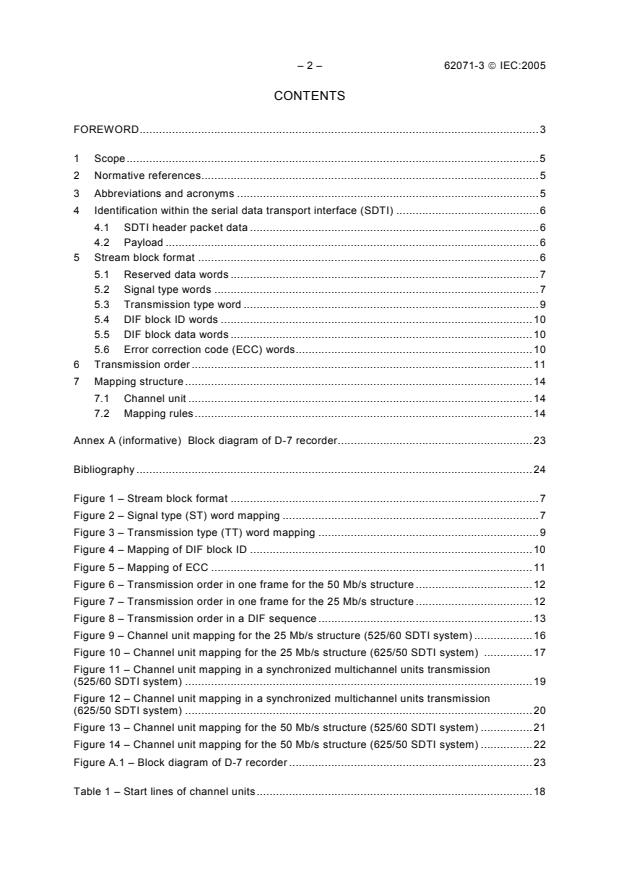
IEC 62071-3:2005 - Helical-scan compressed digital video cassette system using 6,35 mm magnetic tape - Format D-7 - Part 3: Data stream format Released:10/27/2005
Overview - IEC 62071-3:2005 (Format D-7) data stream format
IEC 62071-3:2005 defines the data stream format for the helical‑scan compressed digital video cassette system (Format D-7) using 6.35 mm magnetic tape. The standard specifies how DV‑based audio, data and compressed video (data structure per SMPTE 314M) are synchronously transported over the Serial Data Transport Interface (SDTI) defined in SMPTE 305M. It covers both 25 Mb/s and 50 Mb/s DV‑based structures, including faster‑than‑real‑time transmission scenarios for 525/60 and 625/50 SDTI systems. A bilingual edition (2013‑07) corresponds to the original English 2005 publication.
Key topics and technical requirements
- Stream block format: Payload is composed of fixed‑size stream blocks (170 words each) that include a secondary header, two DIF block IDs, two DIF block data areas and a 4‑word ECC block.
- SDTI identification: SDTI header packet values for this data stream are specified - SDTI data type word = 221; block type = 173 (with ECC) or 233 (without ECC).
- Secondary header fields:
- Reserved data words (3 words; default value 200).
- Signal type (ST) words (2 words) containing STVF ID and flags such as FF (field/frame frequency), DIF structure, DVF (DIF valid flag), FSNF (frame sequence number flag) and TRF (transmission rate flag).
- Transmission type (TT) word to indicate transmission parameters and sequencing.
- DIF mapping and ECC: Rules for DIF block ID mapping, DIF block data word layout and error correction code (ECC) placement and mapping are defined to ensure reliable transport.
- Transmission order & mapping structure: Detailed transmission ordering for frames and channel‑unit mapping for both 25 Mb/s and 50 Mb/s structures across 525/60 and 625/50 systems.
Practical applications and who uses it
- Broadcast and professional video equipment manufacturers implementing D‑7 VTR hardware and firmware.
- Systems integrators and broadcast engineers designing SDTI/SDI transport chains for archival ingest, slow/fast playback and faster‑than‑real‑time transfers.
- Archive managers and post‑production facilities that interoperate with tape formats and require precise stream mapping for DV‑based compressed video.
- Firmware/codec developers and test labs validating SDTI payload conformance, ECC behavior and DIF mappings.
Related standards
- SMPTE 305M - Serial Data Transport Interface (SDTI)
- SMPTE 314M - Data structure for DV‑based audio, data and compressed video
- SMPTE 322M - Format for transmission of DV compressed video (not covered by IEC 62071‑3)
Keywords: IEC 62071-3:2005, D‑7, data stream format, SDTI, SMPTE 305M, SMPTE 314M, DV‑based compressed video, 25 Mb/s, 50 Mb/s, ECC, DIF, stream block.
Relations
- Effective Date
- 05-Sep-2023
Buy Documents
IEC 62071-3:2005 - Helical-scan compressed digital video cassette system using 6,35 mm magnetic tape - Format D-7 - Part 3: Data stream format Released:10/27/2005
IEC 62071-3:2005 - Helical-scan compressed digital video cassette system using 6,35 mm magnetic tape - Format D-7 - Part 3: Data stream format Released:10/27/2005
Get Certified
Connect with accredited certification bodies for this standard

ANCE
Mexican certification and testing association.

Intertek Slovenia
Intertek testing, inspection, and certification services in Slovenia.

LNE (Laboratoire National de Métrologie et d'Essais)
French national laboratory for metrology and testing.
Sponsored listings
Frequently Asked Questions
IEC 62071-3:2005 is a standard published by the International Electrotechnical Commission (IEC). Its full title is "Helical-scan compressed digital video cassette system using 6,35 mm magnetic tape - Format D-7 - Part 3: Data stream format". This standard covers: IEC 62071-3:2005 defines the format of the data stream for the synchronous exchange of DV-based audio, data, and compressed video (whose data structure is defined in SMPTE 314M) over the interface defined in SMPTE 305M. It covers the transmission of audio, subcode data and compressed video packets associated with DV-based 25 and 50 Mb/s data structures including faster-than-real-time transmission for 525/60 SDTI and 625/50 SDTI systems. This bilingual version (2013-07) corresponds to the monolingual English version, published in 2005-10.
IEC 62071-3:2005 defines the format of the data stream for the synchronous exchange of DV-based audio, data, and compressed video (whose data structure is defined in SMPTE 314M) over the interface defined in SMPTE 305M. It covers the transmission of audio, subcode data and compressed video packets associated with DV-based 25 and 50 Mb/s data structures including faster-than-real-time transmission for 525/60 SDTI and 625/50 SDTI systems. This bilingual version (2013-07) corresponds to the monolingual English version, published in 2005-10.
IEC 62071-3:2005 is classified under the following ICS (International Classification for Standards) categories: 33.160.40 - Video systems. The ICS classification helps identify the subject area and facilitates finding related standards.
IEC 62071-3:2005 has the following relationships with other standards: It is inter standard links to IEC 62071:2000. Understanding these relationships helps ensure you are using the most current and applicable version of the standard.
IEC 62071-3:2005 is available in PDF format for immediate download after purchase. The document can be added to your cart and obtained through the secure checkout process. Digital delivery ensures instant access to the complete standard document.
Standards Content (Sample)
INTERNATIONAL IEC
STANDARD 62071-3
First edition
2005-10
Helical-scan compressed digital video
cassette system using 6,35 mm
magnetic tape – Format D-7 –
Part 3:
Data stream format
Reference number
Publication numbering
As from 1 January 1997 all IEC publications are issued with a designation in the
60000 series. For example, IEC 34-1 is now referred to as IEC 60034-1.
Consolidated editions
The IEC is now publishing consolidated versions of its publications. For example,
edition numbers 1.0, 1.1 and 1.2 refer, respectively, to the base publication, the
base publication incorporating amendment 1 and the base publication incorporating
amendments 1 and 2.
Further information on IEC publications
The technical content of IEC publications is kept under constant review by the IEC,
thus ensuring that the content reflects current technology. Information relating to
this publication, including its validity, is available in the IEC Catalogue of
publications (see below) in addition to new editions, amendments and corrigenda.
Information on the subjects under consideration and work in progress undertaken
by the technical committee which has prepared this publication, as well as the list
of publications issued, is also available from the following:
• IEC Web Site (www.iec.ch)
• Catalogue of IEC publications
The on-line catalogue on the IEC web site (www.iec.ch/searchpub) enables you to
search by a variety of criteria including text searches, technical committees
and date of publication. On-line information is also available on recently issued
publications, withdrawn and replaced publications, as well as corrigenda.
• IEC Just Published
This summary of recently issued publications (www.iec.ch/online_news/ justpub)
is also available by email. Please contact the Customer Service Centre (see
below) for further information.
• Customer Service Centre
If you have any questions regarding this publication or need further assistance,
please contact the Customer Service Centre:
Email: custserv@iec.ch
Tel: +41 22 919 02 11
Fax: +41 22 919 03 00
INTERNATIONAL IEC
STANDARD 62071-3
First edition
2005-10
Helical-scan compressed digital video
cassette system using 6,35 mm
magnetic tape – Format D-7 –
Part 3:
Data stream format
IEC 2005 Copyright - all rights reserved
No part of this publication may be reproduced or utilized in any form or by any means, electronic or
mechanical, including photocopying and microfilm, without permission in writing from the publisher.
International Electrotechnical Commission, 3, rue de Varembé, PO Box 131, CH-1211 Geneva 20, Switzerland
Telephone: +41 22 919 02 11 Telefax: +41 22 919 03 00 E-mail: inmail@iec.ch Web: www.iec.ch
PRICE CODE
Commission Electrotechnique Internationale T
International Electrotechnical Commission
МеждународнаяЭлектротехническаяКомиссия
For price, see current catalogue
– 2 – 62071-3 IEC:2005(E)
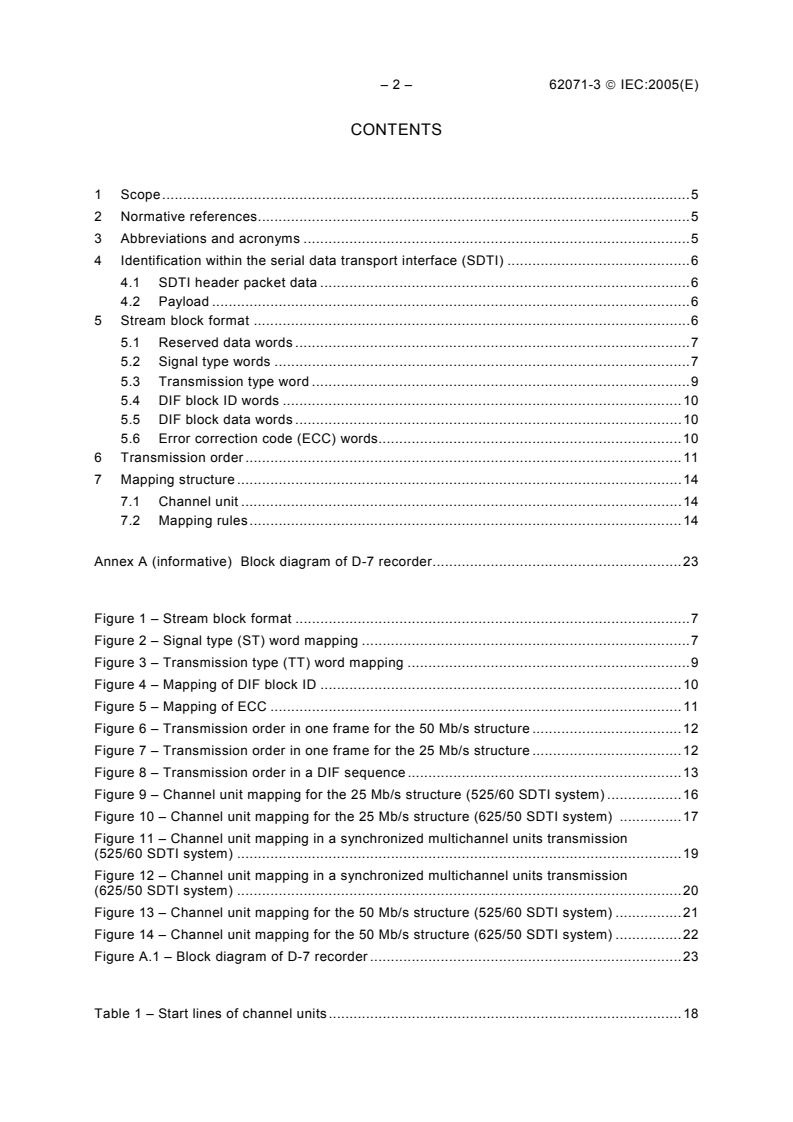
CONTENTS
1 Scope.5
2 Normative references.5
3 Abbreviations and acronyms .5
4 Identification within the serial data transport interface (SDTI) .6
4.1 SDTI header packet data .6
4.2 Payload .6
5 Stream block format .6
5.1 Reserved data words .7
5.2 Signal type words .7
5.3 Transmission type word .9
5.4 DIF block ID words .10
5.5 DIF block data words .10
5.6 Error correction code (ECC) words.10
6 Transmission order .11
7 Mapping structure .14
7.1 Channel unit .14
7.2 Mapping rules.14
Annex A (informative) Block diagram of D-7 recorder.23
Figure 1 – Stream block format .7
Figure 2 – Signal type (ST) word mapping .7
Figure 3 – Transmission type (TT) word mapping .9
Figure 4 – Mapping of DIF block ID .10
Figure 5 – Mapping of ECC .11
Figure 6 – Transmission order in one frame for the 50 Mb/s structure .12
Figure 7 – Transmission order in one frame for the 25 Mb/s structure .12
Figure 8 – Transmission order in a DIF sequence.13
Figure 9 – Channel unit mapping for the 25 Mb/s structure (525/60 SDTI system) .16
Figure 10 – Channel unit mapping for the 25 Mb/s structure (625/50 SDTI system) .17
Figure 11 – Channel unit mapping in a synchronized multichannel units transmission
(525/60 SDTI system) .19
Figure 12 – Channel unit mapping in a synchronized multichannel units transmission
(625/50 SDTI system) .20
Figure 13 – Channel unit mapping for the 50 Mb/s structure (525/60 SDTI system) .21
Figure 14 – Channel unit mapping for the 50 Mb/s structure (625/50 SDTI system) .22
Figure A.1 – Block diagram of D-7 recorder .23
Table 1 – Start lines of channel units.18
62071-3 IEC:2005(E) – 3 –
INTERNATIONAL ELECTROTECHNICAL COMMISSION
____________
HELICAL-SCAN COMPRESSED DIGITAL VIDEO CASSETTE SYSTEM
USING 6,35 mm MAGNETIC TAPE – FORMAT D-7 –
Part 3: Data stream format
FOREWORD
1) The International Electrotechnical Commission (IEC) is a worldwide organization for standardization comprising
all national electrotechnical committees (IEC National Committees). The object of IEC is to promote
international co-operation on all questions concerning standardization in the electrical and electronic fields. To
this end and in addition to other activities, IEC publishes International Standards, Technical Specifications,
Technical Reports, Publicly Available Specifications (PAS) and Guides (hereafter referred to as “IEC
Publication(s)”). Their preparation is entrusted to technical committees; any IEC National Committee interested
in the subject dealt with may participate in this preparatory work. International, governmental and non-
governmental organizations liaising with the IEC also participate in this preparation. IEC collaborates closely
with the International Organization for Standardization (ISO) in accordance with conditions determined by
agreement between the two organizations.
2) The formal decisions or agreements of IEC on technical matters express, as nearly as possible, an international
consensus of opinion on the relevant subjects since each technical committee has representation from all
interested IEC National Committees.
3) IEC Publications have the form of recommendations for international use and are accepted by IEC National
Committees in that sense. While all reasonable efforts are made to ensure that the technical content of IEC
Publications is accurate, IEC cannot be held responsible for the way in which they are used or for any
misinterpretation by any end user.
4) In order to promote international uniformity, IEC National Committees undertake to apply IEC Publications
transparently to the maximum extent possible in their national and regional publications. Any divergence
between any IEC Publication and the corresponding national or regional publication shall be clearly indicated in
the latter.
5) IEC provides no marking procedure to indicate its approval and cannot be rendered responsible for any
equipment declared to be in conformity with an IEC Publication.
6) All users should ensure that they have the latest edition of this publication.
7) No liability shall attach to IEC or its directors, employees, servants or agents including individual experts and
members of its technical committees and IEC National Committees for any personal injury, property damage or
other damage of any nature whatsoever, whether direct or indirect, or for costs (including legal fees) and
expenses arising out of the publication, use of, or reliance upon, this IEC Publication or any other IEC
Publications.
8) Attention is drawn to the Normative references cited in this publication. Use of the referenced publications is
indispensable for the correct application of this publication.
9) Attention is drawn to the possibility that some of the elements of this IEC Publication may be the subject of
patent rights. IEC shall not be held responsible for identifying any or all such patent rights.
International Standard IEC 62041-3 has been prepared by technical area 6: Higher data rate
storage media, data structures and equipment of IEC technical committee 100: Audio, video
and multimedia systems and equipment.
The text of this standard is based on the following documents:
CDV Report on voting
100/902/CDV 100/986/RVC
Full information on the voting for the approval of this standard can be found in the report on
voting indicated in the above table.
This publication has been drafted in accordance with the ISO/IEC Directives, Part 2.
– 4 – 62071-3 IEC:2005(E)
IEC 62071 consists of the following parts, under the general title Helical-scan compressed
digital video cassette system using 6,35 mm magnetic tape – Format D-7:
Part 1: VTR specifications
Part 2: Compression format
Part 3: Data stream format
This part 3 describes the specifications for transmission of DV-based compressed video and
audio data stream over 270Mb/s and 360 Mb/s serial digital interface.
Part 1 describes the VTR specifications which are tape, magnetization, helical recording,
modulation method and basic system data for video compressed data.
Part 2 describes the specifications for encoding process and data format for 525i and 625i
systems.
The committee has decided that the contents of this publication will remain unchanged until the
maintenance result date indicated on the IEC web site under "http://webstore.iec.ch" in the data
related to the specific publication. At this date, the publication will be
• reconfirmed;
• withdrawn;
• replaced by a revised edition, or
• amended.
A bililngual version of this publication may be issued at a later date.
62071-3 IEC:2005(E) – 5 –
HELICAL-SCAN COMPRESSED DIGITAL VIDEO CASSETTE SYSTEM
USING 6,35 mm MAGNETIC TAPE – FORMAT D-7
Part 3: Data stream format
1 Scope
This part of IEC 62071 defines the format of the data stream for the synchronous exchange of
DV-based audio, data, and compressed video (whose data structure is defined in SMPTE 314M)
over the interface defined in SMPTE 305M. It covers the transmission of audio, subcode data
and compressed video packets associated with DV-based 25 and 50 Mb/s data structures
including faster-than-real-time transmission for 525/60 SDTI and 625/50 SDTI systems.
This standard does not include the data stream of a DV-compressed structure as defined in
SMPTE 322M.
Space within SMPTE 305M not used by a data stream conforming to this standard may be used
for the transmission of data other than those representing DV-based audio, data and
compressed video.
In this standard, the 60 Hz system refers to the field frequency 59,94 Hz system and the 50 Hz
system refers to the field frequency 50,0 Hz system.
2 Normative references
The following referenced documents are indispensable for the application of this document. For
dated references, only the edition cited applies. For undated references, the latest edition of
the referenced document (including any amendments) applies.
SMPTE 305M: 2005, Television – Serial Data Transport Interface
SMPTE 314M: 1999, Television – Data Structure for DV-Based Audio, Data and Compressed
Video – 25 and 50 Mb/s
SMPTE 322M: 2004, Television – Format for Transmission of DV Compressed Video, Audio
and Data Over a Serial Data Transport Interface
3 Abbreviations and acronyms
DIF: Digital interface
DVF: DIF valid flag
ECC: Error correction code
FF: Field/frame frequency flag
FSNF: Frame sequence number flag
SDI: Serial digital interface
SDTI: Serial data transport interface
ST: Signal type
STVF: Signal type of video frame
TRF: Transmission rate flag
TT: Transmission type
– 6 – 62071-3 IEC:2005(E)
4 Identification within the serial data transport interface (SDTI)
4.1 SDTI header packet data
The header packet data words of the serial data transport interface (SDTI) associated with this
data stream format shall conform to SMPTE 305M. When the SDTI interface is transporting a
data stream conforming to this standard, the block type word within the SDTI header packet
shall have the value 173 for transported data contained in fixed-size blocks when ECC (error
h
correction code) is used and the value
233 when ECC is not used.
h
4.2 Payload
The payload is composed of consecutive fixed-size blocks (see Figure 1). The SDTI data type
word shall identify the data type of this payload with the value 221 .
h
5 Stream block format
The stream block format is shown in Figure 1. The length of each stream block is 170 words,
including a secondary header, two DIF (digital interface) block IDs, two DIF block data (of
stream data) and an ECC block. The secondary header contains reserved data words, signal
type words, and a transmission type word. The complete word structure of the stream block for
a compressed video data stream is defined below:
Reserved data : 3 words
Signal type : 2 words
Transmission type : 1 word
DIF block ID : 3 words
DIF block data : 77 words
DIF block ID : 3 words
DIF block data : 77 words
ECC : 4 words
62071-3 IEC:2005(E) – 7 –
Ancillary data Payload
S
E
Fixed Fixed Fixed Fixed
Header
A
A Space Space
block block block block
Data
V
V
170 words
1 word
SDTI
data
Stream block
type
( from SMPTE 305M, table 2)
Word 0 1 2 3 4 5 6 7 8 9 85 86 87 88 89 169
DIF DIF DIF DIF
Reserved
ST TT block block block block ECC
data
ID data ID data
(3 words) (3 words) (77 words) (3 words) (77 words) (4 words)
Signal type Transmission type
(2 words) (1 words)
IEC 1941/05
Figure 1 – Stream block format
5.1 Reserved data words
The reserved data words shall consist of 3 words and be positioned at the start of the stream
block. The default value for the reserved data is 200 .
h
5.2 Signal type words
The signal type word (ST) mapping is shown in Figure 2. The signal type words shall consist of
two words. The first word of ST (word 3) includes the specific type of video frame ID (STVF ID).
The second word of ST (word 4) includes the field/frame frequency flag (FF), the DIF structure
format, the DIF valid flag (DVF), the frame sequence number flag (FSNF), the transmission
rate flag (TRF) and reserved bits.
B9 B8 B7 B6 B5 B4 B3 B2 B1 B0
Reserved
Word 3 EP EP
STVF ID
EP EP s
Word 4 FF DIF structure Re DVF FSNF TRF
IEC 1942/05
Figure 2 – Signal type (ST) word mapping
– 8 – 62071-3 IEC:2005(E)
Word 3 of ST
The STVF ID shows information mainly related to pictures that have been 3:2 pull-down
converted from 480 line/ 29,98 frame rate progressive pictures.
In the 525/60 SDTI system, the following applies:
Bits B7 through B3 are reserved bits and shall be set to 00000 as default values.
b
Bits B2 through B0 indicate the specific type of video frame ID which shows the type of the
converted picture with the following values:
B2 B1 B0 Original Converted
0 0 0 : 480i / 29,97 -> No change
0 0 1 : 480p / 29,97 -> Segmented frame (see note)
0 1 0 : 480p / 23,98 -> No field sequence ID (3:2 pull down)
0 1 1 : 480p / 23,98 -> A frame (3:2 pull down)
1 0 0 : 480p / 23,98 -> B frame (3:2 pull down)
1 0 1 : 480p / 23,98 -> C frame (3:2 pull down)
1 1 0 : 480p / 23,98 -> D frame (3:2 pull down)
1 1 1 : 480p / 23,98 -> E frame (3:2 pull down)
NOTE Odd lines of 480p/29,97 are mapped to the first field and even lines of 480p/29,97 are mapped to the
second field.
In the 625/50 SDTI system, the following applies:
All values of bits B7 through B0 are set to 00 as default values.
h
Bit B8 of word 3 is equal to the even parity of B7 through B0.
Bit B9 of word 3 is equal to the complement of B8.
Word 4 of ST
Bit B7 indicates the field frequency of serial digital interface (SDI) with the following values:
B7
0 : 60 Hz (59,94 Hz)
1 : 50 Hz
Bits B6 through B4 indicate the DIF structure with the following values:
B6 B5 B4
0 0 0 : Reserved
0 0 1 : Reserved
0 1 0 : Reserved
0 1 1 : 25 Mb/s structure
1 0 0 : Reserved
1 0 1 : 50 Mb/s structure
1 1 0 : Reserved
1 1 1 : Reserved
Bit B3 is reserved bit and shall be set to 0 as default value.
b
62071-3 IEC:2005(E) – 9 –
Bit B2 is the DIF valid flag (DVF) and indicates the validity of the DIF data mapped into SDTI.
B2
0 : invalid
1 : valid
Bit B1 is the frame sequence number flag (FSNF) and indicates the validity of the frame
sequence number (see 5.3) with the following values:
B1
0 : valid
1 : invalid
Bit B0 is the transmission rate flag (TRF) and indicates the validity of the transmission rate
(see 5.3) with the following values:
B0
0 : valid
1 : invalid
Bit B8 is equal to the even parity of B7 through B0.
Bit B9 is equal to the complement of B8.
5.3 Transmission type word
The transmission type word (TT) mapping is shown in Figure 3. The transmission type word
shall consist of one word including the frame sequence number and the transmission rate.
B9 B8 B7 B6 B5 B4 B3 B2 B1 B0
Frame sequence Transmission
Word 5 EP EP
rate
number
IEC 1943/05
Figure 3 – Transmission type (TT) word mapping
Bits B7 through B4 indicate the frame sequence number with the following values:
0 : 1
h
1 : 2
h
|
Fh : 16
The frame sequence number identifies frames multiplexed within an SDTI frame.
Bits B3 through B0 indicate the transmission rate with the following values:
0 : 1 x (normal transmission rate) (see note)
h
1 : 2 x
h
2 : 3 x
h
3 : 4 x
h
4 : 5 x
h
5 : 6 x
h
6 : 7 x
h
7 : 8 x
h
8 – E : reserved
h h
F : 16 x
h
– 10 – 62071-3 IEC:2005(E)
NOTE The multiple of the normal transmission rate is represented by x. The normal transmission rate
corresponding to normal reproduction of the television picture is 1 x.
Bit B8 is equal to the even parity of B7 through B0;
Bit B9 is equal to the complement of B8.
5.4 DIF block ID words
The DIF block ID (ID0-2) shall consist of three words, contained in bits A23 through A0 as
shown in Figure 4. The lower 8-bit portion of these three words is specified in SMPTE 314M.
B9 B8 B7 B6 B5 B4 B3 B2 B1 B0
Word 6 and 86
EP1 EP1 A7 A6 A5 A4 A3 A2 A1 A0
Word 7 and 87 EP2 EP2 A15 A14 A13 A12 A11 A10 A9 A8
Word 8 and 88 EP3 EP3 A23 A22 A21 A20 A19 A18 A17 A16
IEC 1944/05
Figure 4 – Mapping of DIF block ID
EP1 is equal to the even parity of bits A7 through A0;
EP2 is equal to the even parity of bit
...
IEC 62071-3 ®
Edition 1.0 2005-10
INTERNATIONAL
STANDARD
NORME
INTERNATIONALE
Helical-scan compressed digital video cassette system using 6,35 mm magnetic
tape – Format D-7 –
Part 3: Data stream format
Système de magnétoscope numérique à cassette à balayage hélicoïdal à signal
compressé utilisant la bande magnétique de 6,35 mm – Format D-7 –
Partie 3: Format de suites de données
All rights reserved. Unless otherwise specified, no part of this publication may be reproduced or utilized in any form
or by any means, electronic or mechanical, including photocopying and microfilm, without permission in writing from
either IEC or IEC's member National Committee in the country of the requester.
If you have any questions about IEC copyright or have an enquiry about obtaining additional rights to this publication,
please contact the address below or your local IEC member National Committee for further information.
Droits de reproduction réservés. Sauf indication contraire, aucune partie de cette publication ne peut être reproduite ni
utilisée sous quelque forme que ce soit et par aucun procédé, électronique ou mécanique, y compris la photocopie et les
microfilms, sans l'accord écrit de la CEI ou du Comité national de la CEI du pays du demandeur.
Si vous avez des questions sur le copyright de la CEI ou si vous désirez obtenir des droits supplémentaires sur cette
publication, utilisez les coordonnées ci-après ou contactez le Comité national de la CEI de votre pays de résidence.
IEC Central Office Tel.: +41 22 919 02 11
3, rue de Varembé Fax: +41 22 919 03 00
CH-1211 Geneva 20 info@iec.ch
Switzerland www.iec.ch
About the IEC
The International Electrotechnical Commission (IEC) is the leading global organization that prepares and publishes
International Standards for all electrical, electronic and related technologies.
About IEC publications
The technical content of IEC publications is kept under constant review by the IEC. Please make sure that you have the
latest edition, a corrigenda or an amendment might have been published.
Useful links:
IEC publications search - www.iec.ch/searchpub Electropedia - www.electropedia.org
The advanced search enables you to find IEC publications The world's leading online dictionary of electronic and
by a variety of criteria (reference number, text, technical electrical terms containing more than 30 000 terms and
committee,…). definitions in English and French, with equivalent terms in
It also gives information on projects, replaced and additional languages. Also known as the International
withdrawn publications. Electrotechnical Vocabulary (IEV) on-line.
IEC Just Published - webstore.iec.ch/justpublished Customer Service Centre - webstore.iec.ch/csc
Stay up to date on all new IEC publications. Just Published If you wish to give us your feedback on this publication
details all new publications released. Available on-line and or need further assistance, please contact the
also once a month by email. Customer Service Centre: csc@iec.ch.
A propos de la CEI
La Commission Electrotechnique Internationale (CEI) est la première organisation mondiale qui élabore et publie des
Normes internationales pour tout ce qui a trait à l'électricité, à l'électronique et aux technologies apparentées.
A propos des publications CEI
Le contenu technique des publications de la CEI est constamment revu. Veuillez vous assurer que vous possédez
l’édition la plus récente, un corrigendum ou amendement peut avoir été publié.
Liens utiles:
Recherche de publications CEI - www.iec.ch/searchpub Electropedia - www.electropedia.org
La recherche avancée vous permet de trouver des Le premier dictionnaire en ligne au monde de termes
publications CEI en utilisant différents critères (numéro de électroniques et électriques. Il contient plus de 30 000
référence, texte, comité d’études,…). termes et définitions en anglais et en français, ainsi que
Elle donne aussi des informations sur les projets et les les termes équivalents dans les langues additionnelles.
publications remplacées ou retirées. Egalement appelé Vocabulaire Electrotechnique
International (VEI) en ligne.
Just Published CEI - webstore.iec.ch/justpublished
Service Clients - webstore.iec.ch/csc
Restez informé sur les nouvelles publications de la CEI.
Just Published détaille les nouvelles publications parues. Si vous désirez nous donner des commentaires sur
Disponible en ligne et aussi une fois par mois par email. cette publication ou si vous avez des questions
contactez-nous: csc@iec.ch.
IEC 62071-3 ®
Edition 1.0 2005-10
INTERNATIONAL
STANDARD
NORME
INTERNATIONALE
Helical-scan compressed digital video cassette system using 6,35 mm magnetic
tape – Format D-7 –
Part 3: Data stream format
Système de magnétoscope numérique à cassette à balayage hélicoïdal à signal
compressé utilisant la bande magnétique de 6,35 mm – Format D-7 –
Partie 3: Format de suites de données
INTERNATIONAL
ELECTROTECHNICAL
COMMISSION
COMMISSION
ELECTROTECHNIQUE
PRICE CODE
INTERNATIONALE
CODE PRIX T
ICS 33.160.40 ISBN 978-2-8322-0728-4
– 2 – 62071-3 IEC:2005
CONTENTS
FOREWORD . 3
1 Scope . 5
2 Normative references. 5
3 Abbreviations and acronyms . 5
4 Identification within the serial data transport interface (SDTI) . 6
4.1 SDTI header packet data . 6
4.2 Payload . 6
5 Stream block format . 6
5.1 Reserved data words . 7
5.2 Signal type words . 7
5.3 Transmission type word . 9
5.4 DIF block ID words . 10
5.5 DIF block data words . 10
5.6 Error correction code (ECC) words. 10
6 Transmission order . 11
7 Mapping structure . 14
7.1 Channel unit . 14
7.2 Mapping rules . 14
Annex A (informative) Block diagram of D-7 recorder . 23
Bibliography . 24
Figure 1 – Stream block format . 7
Figure 2 – Signal type (ST) word mapping . 7
Figure 3 – Transmission type (TT) word mapping . 9
Figure 4 – Mapping of DIF block ID . 10
Figure 5 – Mapping of ECC . 11
Figure 6 – Transmission order in one frame for the 50 Mb/s structure . 12
Figure 7 – Transmission order in one frame for the 25 Mb/s structure . 12
Figure 8 – Transmission order in a DIF sequence . 13
Figure 9 – Channel unit mapping for the 25 Mb/s structure (525/60 SDTI system) . 16
Figure 10 – Channel unit mapping for the 25 Mb/s structure (625/50 SDTI system) . 17
Figure 11 – Channel unit mapping in a synchronized multichannel units transmission
(525/60 SDTI system) . 19
Figure 12 – Channel unit mapping in a synchronized multichannel units transmission
(625/50 SDTI system) . 20
Figure 13 – Channel unit mapping for the 50 Mb/s structure (525/60 SDTI system) . 21
Figure 14 – Channel unit mapping for the 50 Mb/s structure (625/50 SDTI system) . 22
Figure A.1 – Block diagram of D-7 recorder . 23
Table 1 – Start lines of channel units . 18
62071-3 IEC:2005 – 3 –
INTERNATIONAL ELECTROTECHNICAL COMMISSION
____________
HELICAL-SCAN COMPRESSED DIGITAL VIDEO CASSETTE SYSTEM
USING 6,35 mm MAGNETIC TAPE – FORMAT D-7 –
Part 3: Data stream format
FOREWORD
1) The International Electrotechnical Commission (IEC) is a worldwide organization for standardization comprising
all national electrotechnical committees (IEC National Committees). The object of IEC is to promote
international co-operation on all questions concerning standardization in the electrical and electronic fields. To
this end and in addition to other activities, IEC publishes International Standards, Technical Specifications,
Technical Reports, Publicly Available Specifications (PAS) and Guides (hereafter referred to as “IEC
Publication(s)”). Their preparation is entrusted to technical committees; any IEC National Committee interested
in the subject dealt with may participate in this preparatory work. International, governmental and non-
governmental organizations liaising with the IEC also participate in this preparation. IEC collaborates closely
with the International Organization for Standardization (ISO) in accordance with conditions determined by
agreement between the two organizations.
2) The formal decisions or agreements of IEC on technical matters express, as nearly as possible, an international
consensus of opinion on the relevant subjects since each technical committee has representation from all
interested IEC National Committees.
3) IEC Publications have the form of recommendations for international use and are accepted by IEC National
Committees in that sense. While all reasonable efforts are made to ensure that the technical content of IEC
Publications is accurate, IEC cannot be held responsible for the way in which they are used or for any
misinterpretation by any end user.
4) In order to promote international uniformity, IEC National Committees undertake to apply IEC Publications
transparently to the maximum extent possible in their national and regional publications. Any divergence
between any IEC Publication and the corresponding national or regional publication shall be clearly indicated in
the latter.
5) IEC provides no marking procedure to indicate its approval and cannot be rendered responsible for any
equipment declared to be in conformity with an IEC Publication.
6) All users should ensure that they have the latest edition of this publication.
7) No liability shall attach to IEC or its directors, employees, servants or agents including individual experts and
members of its technical committees and IEC National Committees for any personal injury, property damage or
other damage of any nature whatsoever, whether direct or indirect, or for costs (including legal fees) and
expenses arising out of the publication, use of, or reliance upon, this IEC Publication or any other IEC
Publications.
8) Attention is drawn to the Normative references cited in this publication. Use of the referenced publications is
indispensable for the correct application of this publication.
9) Attention is drawn to the possibility that some of the elements of this IEC Publication may be the subject of
patent rights. IEC shall not be held responsible for identifying any or all such patent rights.
International Standard IEC 62071-3 has been prepared by technical area 6: Higher data rate
storage media, data structures and equipment of IEC technical committee 100: Audio, video
and multimedia systems and equipment.
This bilingual version (2013-07) corresponds to the monolingual English version, published in
2005-10.
The text of this standard is based on the following documents:
CDV Report on voting
100/902/CDV 100/986/RVC
Full information on the voting for the approval of this standard can be found in the report on
voting indicated in the above table.
The French version of this standard has not been voted upon.
– 4 – 62071-3 IEC:2005
This publication has been drafted in accordance with the ISO/IEC Directives, Part 2.
IEC 62071 consists of the following parts, under the general title Helical-scan compressed
digital video cassette system using 6,35 mm magnetic tape – Format D-7:
Part 1: VTR specifications
Part 2: Compression format
Part 3: Data stream format
This part 3 describes the specifications for transmission of DV-based compressed video and
audio data stream over 270Mb/s and 360 Mb/s serial digital interface.
Part 1 describes the VTR specifications which are tape, magnetization, helical recording,
modulation method and basic system data for video compressed data.
Part 2 describes the specifications for encoding process and data format for 525i and 625i
systems.
The committee has decided that the contents of this publication will remain unchanged until the
maintenance result date indicated on the IEC web site under "http://webstore.iec.ch" in the data
related to the specific publication. At this date, the publication will be
• reconfirmed;
• withdrawn;
• replaced by a revised edition, or
• amended.
62071-3 IEC:2005 – 5 –
HELICAL-SCAN COMPRESSED DIGITAL VIDEO CASSETTE SYSTEM
USING 6,35 mm MAGNETIC TAPE – FORMAT D-7 –
Part 3: Data stream format
1 Scope
This part of IEC 62071 defines the format of the data stream for the synchronous exchange of
DV-based audio, data, and compressed video (whose data structure is defined in SMPTE 314M)
over the interface defined in SMPTE 305M. It covers the transmission of audio, subcode data
and compressed video packets associated with DV-based 25 and 50 Mb/s data structures
including faster-than-real-time transmission for 525/60 SDTI and 625/50 SDTI systems.
This standard does not include the data stream of a DV-compressed structure as defined in
SMPTE 322M.
Space within SMPTE 305M not used by a data stream conforming to this standard may be used
for the transmission of data other than those representing DV-based audio, data and
compressed video.
In this standard, the 60 Hz system refers to the field frequency 59,94 Hz system and the 50 Hz
system refers to the field frequency 50,0 Hz system.
2 Normative references
The following referenced documents are indispensable for the application of this document. For
dated references, only the edition cited applies. For undated references, the latest edition of
the referenced document (including any amendments) applies.
SMPTE 305M: 2005, Television – Serial Data Transport Interface
SMPTE 314M: 1999, Television – Data Structure for DV-Based Audio, Data and Compressed
Video – 25 and 50 Mb/s
SMPTE 322M: 2004, Television – Format for Transmission of DV Compressed Video, Audio
and Data Over a Serial Data Transport Interface
3 Abbreviations and acronyms
DIF: Digital interface
DVF: DIF valid flag
ECC: Error correction code
FF: Field/frame frequency flag
FSNF: Frame sequence number flag
SDI: Serial digital interface
SDTI: Serial data transport interface
ST: Signal type
STVF: Signal type of video frame
TRF: Transmission rate flag
TT: Transmission type
– 6 – 62071-3 IEC:2005
4 Identification within the serial data transport interface (SDTI)
4.1 SDTI header packet data
The header packet data words of the serial data transport interface (SDTI) associated with this
data stream format shall conform to SMPTE 305M. When the SDTI interface is transporting a
data stream conforming to this standard, the block type word within the SDTI header packet
shall have the value 173 for transported data contained in fixed-size blocks when ECC (error
h
correction code) is used and the value
233h when ECC is not used.
4.2 Payload
The payload is composed of consecutive fixed-size blocks (see Figure 1). The SDTI data type
word shall identify the data type of this payload with the value 221 .
h
5 Stream block format
The stream block format is shown in Figure 1. The length of each stream block is 170 words,
including a secondary header, two DIF (digital interface) block IDs, two DIF block data (of
stream data) and an ECC block. The secondary header contains reserved data words, signal
type words, and a transmission type word. The complete word structure of the stream block for
a compressed video data stream is defined below:
Reserved data : 3 words
Signal type : 2 words
Transmission type : 1 word
DIF block ID : 3 words
DIF block data : 77 words
DIF block ID : 3 words
DIF block data : 77 words
ECC : 4 words
62071-3 IEC:2005 – 7 –
Ancillary data Payload
S
E
Fixed Fixed Fixed Fixed
Header
A
A Space Space
block block block block
Data
V
V
170 words
1 word
SDTI
data
Stream block
type
( from SMPTE 305M, table 2)
Word 0 1 2 3 4 5 6 7 8 9 85 86 87 88 89 169
DIF DIF DIF DIF
Reserved
ST TT block block block block ECC
data
ID data ID data
(3 words) (3 words) (77 words) (3 words) (77 words) (4 words)
Signal type Transmission type
(2 words) (1 words)
IEC 1941/05
Figure 1 – Stream block format
5.1 Reserved data words
The reserved data words shall consist of 3 words and be positioned at the start of the stream
block. The default value for the reserved data is 200 .
h
5.2 Signal type words
The signal type word (ST) mapping is shown in Figure 2. The signal type words shall consist of
two words. The first word of ST (word 3) includes the specific type of video frame ID (STVF ID).
The second word of ST (word 4) includes the field/frame frequency flag (FF), the DIF structure
format, the DIF valid flag (DVF), the frame sequence number flag (FSNF), the transmission
rate flag (TRF) and reserved bits.
B9 B8 B7 B6 B5 B4 B3 B2 B1 B0
Reserved
Word 3 EP EP
STVF ID
EP EP s
Word 4 FF DIF structure Re DVF FSNF TRF
IEC 1942/05
Figure 2 – Signal type (ST) word mapping
– 8 – 62071-3 IEC:2005
Word 3 of ST
The STVF ID shows information mainly related to pictures that have been 3:2 pull-down
converted from 480 line/ 29,98 frame rate progressive pictures.
In the 525/60 SDTI system, the following applies:
Bits B7 through B3 are reserved bits and shall be set to 00000 as default values.
b
Bits B2 through B0 indicate the specific type of video frame ID which shows the type of the
converted picture with the following values:
B2 B1 B0 Original Converted
0 0 0 : 480i / 29,97 -> No change
0 0 1 : 480p / 29,97 -> Segmented frame (see note)
0 1 0 : 480p / 23,98 -> No field sequence ID (3:2 pull down)
0 1 1 : 480p / 23,98 -> A frame (3:2 pull down)
1 0 0 : 480p / 23,98 -> B frame (3:2 pull down)
1 0 1 : 480p / 23,98 -> C frame (3:2 pull down)
1 1 0 : 480p / 23,98 -> D frame (3:2 pull down)
1 1 1 : 480p / 23,98 -> E frame (3:2 pull down)
NOTE Odd lines of 480p/29,97 are mapped to the first field and even lines of 480p/29,97 are mapped to the
second field.
In the 625/50 SDTI system, the following applies:
All values of bits B7 through B0 are set to 00 as default values.
h
Bit B8 of word 3 is equal to the even parity of B7 through B0.
Bit B9 of word 3 is equal to the complement of B8.
Word 4 of ST
Bit B7 indicates the field frequency of serial digital interface (SDI) with the following values:
B7
0 : 60 Hz (59,94 Hz)
1 : 50 Hz
Bits B6 through B4 indicate the DIF structure with the following values:
B6 B5 B4
0 0 0 : Reserved
0 0 1 : Reserved
0 1 0 : Reserved
0 1 1 : 25 Mb/s structure
1 0 0 : Reserved
1 0 1 : 50 Mb/s structure
1 1 0 : Reserved
1 1 1 : Reserved
Bit B3 is reserved bit and shall be set to 0 as default value.
b
62071-3 IEC:2005 – 9 –
Bit B2 is the DIF valid flag (DVF) and indicates the validity of the DIF data mapped into SDTI.
B2
0 : invalid
1 : valid
Bit B1 is the frame sequence number flag (FSNF) and indicates the validity of the frame
sequence number (see 5.3) with the following values:
B1
0 : valid
1 : invalid
Bit B0 is the transmission rate flag (TRF) and indicates the validity of the transmission rate
(see 5.3) with the following values:
B0
0 : valid
1 : invalid
Bit B8 is equal to the even parity of B7 through B0.
Bit B9 is equal to the complement of B8.
5.3 Transmission type word
The transmission type word (TT) mapping is shown in Figure 3. The transmission type word
shall consist of one word including the frame sequence number and the transmission rate.
B9 B8 B7 B6 B5 B4 B3 B2 B1 B0
Frame sequence Transmission
Word 5 EP EP
rate
number
IEC 1943/05
Figure 3 – Transmission type (TT) word mapping
Bits B7 through B4 indicate the frame sequence number with the following values:
0 : 1
h
1 : 2
h
|
Fh : 16
The frame sequence number identifies frames multiplexed within an SDTI frame.
Bits B3 through B0 indicate the transmission rate with the following values:
0 : 1 x (normal transmission rate) (see note)
h
1 : 2 x
h
2 : 3 x
h
3 : 4 x
h
4 : 5 x
h
5 : 6 x
h
6 : 7 x
h
7 : 8 x
h
8 – E : reserved
h h
F : 16 x
h
– 10 – 62071-3 IEC:2005
NOTE The multiple of the normal transmission rate is represented by x. The normal transmission rate
corresponding to normal reproduction of the television picture is 1 x.
Bit B8 is equal to the even parity of B7 through B0;
Bit B9 is equal to the complement of B8.
5.4 DIF block ID words
The DIF block ID (ID0-2) shall consist of three words, contained in bits A23 through A0 as
shown in Figure 4. The lower 8-bit portion of these three words is specified in SMPTE 314M.
B9 B8 B7 B6 B5 B4 B3 B2 B1 B0
Word 6 and 86 EP1 A5 A4 A3 A2 A1 A0
EP1 A7 A6
Word 7 and 87 EP2 EP2 A15 A14 A13 A12 A11 A10 A9 A8
Word 8 and 88 EP3 EP3 A23 A22 A21 A20 A19 A18 A17 A16
IEC 1944/05
Figure 4 – Mapping of DIF block ID
EP1 is equal to the even parity of bits A7 through A0;
EP2 is equal to the even parity of bits A15 through A8;
EP3 is equal to the even parity of bits A23 through A16;
and
EP1 is equal to the complement of EP1;
EP2 is equal to the complement of EP2;
EP3 is equal to the complement of EP3.
5.5 DIF block data words
The DIF block data shall consist of 77 words. The lower 8 bits of each DIF block word
represent the DIF block data, as specified in SMPTE 314M; the higher 2 bits are parity data.
Bits B7 through B0 are DIF block data; Bit B8 is equal to the even parity of B7 through B0;
Bit B9 is equal to the complement of B8.
5.6 Error correction code (ECC) words
Bits B7 through B0 of the words within a stream block (including reserved data words, the ST
word, the TT word and all words of the DIF block ID and DIF block data) are optionally
protected by an error correction code (ECC). The ECC shall consist of four words and be
inserted at the end of the stream block.
The error correction code is a (170,166) Reed-Solomon code in GF(256), whose field generator
polynomial is shown as:
8 4 3 2
+ X + X + X + 1
P(x) = X
i
where X are place-keeping variables in GF(2), the binary field.
The generator polynomial of the code in GF(256) is:
62071-3 IEC:2005 – 11 –
2 3 4
G(x) = (x+α)(x+α )(x+α )(x+α )
where α is given by 2 in GF(256).
h
When the value of the block type in the SDTI header (see 4.1) is 173 , the Reed-Solomon code
h
shall be contained in C31 through C0 as shown in Figure 5. When the value of the block type is
233 , the ECC shall have the fixed value 200 .
h h
B9 B8 B7 B6 B5 B4 B3 B2 B1 B0
Word 166
EP1 EP1 C7 C6 C5 C4 C3 C2 C1 C0
Word 167
EP2 EP2 C15 C14 C13 C12 C11 C10 C9 C8
Word 168 EP3 EP3 C23 C22 C21 C20 C19 C18 C17 C16
Word 169 EP4 EP4 C31 C30 C29 C28 C27 C26 C25 C24
IEC 1945/05
Figure 5 – Mapping of ECC
EP1 is equal to the even parity of bits C7 through C0;
EP2 is equal to the even parity of bits C15 through C8;
EP3 is equal to the even parity of bits C23 through C16;
EP4 is equal to the even parity of bits C31 through C24;
and
EP1 is equal to the complement of EP1;
EP2 is equal to the complement of EP2;
EP3 is equal to the complement of EP3;
EP4 is equal to the complement of EP4.
6 Transmission order
The transmission order within one frame for 25 and 50 Mb/s DV-based compression structures
consisting of DIF blocks is shown in Figures 6, 7, and 8.
In the 50 Mb/s structure, each frame is carried in two channels, which are transmitted in
sequence one after another. In the 25 Mb/s structure, only a single channel is used.
Each channel consists of 10 DIF sequences in the 60 Hz system or 12 DIF sequences in the
50 Hz system. DIF sequences within a frame are transmitted in a DIF sequence order from 0 to
n-1. Each DIF sequence is composed of 150 DIF blocks. DIF blocks within a DIF sequence are
transmitted sequentially from DIF block 0 to 149.
– 12 – 62071-3 IEC:2005
Data in one frame
First channel Second channel
DIF sequences
DIF Sequence 1,0 DIF sequence n-1,0 DIF sequence 0,1 DIF sequence 1,1 DIF sequence n-1,1
DIF sequence 0,0
DIF sequence number FSC
Structure of a DIF
Header section Subcode section VAUX section Audio & video section
sequence
Transmission order
H0,0 SC0,0 SC1,0 VA0,0 VA1,0 VA2,0 A0,0 V 0,0 V132,0 V133,0 V134,0
DIF blocks
Byte position number DIF block number FSC
0 1 2 3 - - - - - - - - - - - - - - - - - - - - - - - 79
Note
Structure of a DIF block ID Data
n = 10 for 525/60 system
n = 12 for 625/50 system
FSC : First/second channel
IEC 1946/05
Figure 6 – Transmission order in one frame for the 50 Mb/s structure
Data in one frame
DIF sequences
DIF sequence 0,0 DIF sequence 1,0 DIF sequence n-1,0
DIF sequence number FSC
Structure of a DIF
Header section Subcode section VAUX section Audio & video section
sequence
Transmission order
DIF blocks H0,0 SC0,0 SC1,0 VA0,0 VA1,0 VA2,0 A0,0 V 0,0 V132,0 V133,0 V134,0
Byte position number DIF block number FSC
0 1 2 3 - - - - - - - - - - - - - - - - - - - - - - - 79
Note
Structure of a DIF block
ID Data
n = 10 for 525/60 system
n = 12 for 625/50 system
FSC : First/second channel
IEC 1947/05
Figure 7 – Transmission order in one frame for the 25 Mb/s structure
62071-3 IEC:2005 – 13 –
TTTrrransansansmmmiiissssssiiion oron oron orderderder
DDDIIIFFF bl bl blococockkksss HHH0,0,0,iii SSSCCC0,0,0,iii SSSCCC1,1,1,iii VA0VA0VA0,,,iii VA1VA1VA1,,,iii VA2VA2VA2,,,iii
AAA0,0,0,iii VVV0,0,0,iii VVV1,1,1,iii VVV2,2,2,iii VVV3,3,3,iii VVV4,4,4,iii VVV5,5,5,iii VVV6,6,6,iii VVV7,7,7,iii VVV8,8,8,iii VVV9,9,9,iii VVV10,10,10,iii VVV11,11,11,iii VVV12,12,12,iii VVV13,13,13,iii VVV14,14,14,iii
AAA1,1,1,iii VVV15,15,15,iii VVV16,16,16,iii VVV17,17,17,iii VVV18,18,18,iii VVV19,19,19,iii VVV20,20,20,iii VVV21,21,21,iii VVV22,22,22,iii VVV23,23,23,iii VVV24,24,24,iii VVV25,25,25,iii VVV26,26,26,iii VVV27,27,27,iii VVV28,28,28,iii VVV29,29,29,iii
AAA2,2,2,iii VVV30,30,30,iii VVV31,31,31,iii VVV32,32,32,iii VVV33,33,33,iii VVV34,34,34,iii VVV35,35,35,iii VVV36,36,36,iii VVV37,37,37,iii VVV38,38,38,iii VVV39,39,39,iii VVV40,40,40,iii VVV41,41,41,iii VVV42,42,42,iii VVV43,43,43,iii VVV44,44,44,iii
AAA3,3,3,iii VVV45,45,45,iii VVV46,46,46,iii VVV47,47,47,iii VVV48,48,48,iii VVV49,49,49,iii VVV50,50,50,iii VVV51,51,51,iii VVV52,52,52,iii VVV53,53,53,iii VVV54,54,54,iii VVV55,55,55,iii VVV56,56,56,iii VVV57,57,57,iii VVV58,58,58,iii VVV59,59,59,iii
AAA4,4,4,iii VVV60,60,60,iii VVV61,61,61,iii VVV62,62,62,iii VVV63,63,63,iii VVV64,64,64,iii VVV65,65,65,iii VVV66,66,66,iii VVV67,67,67,iii VVV68,68,68,iii VVV69,69,69,iii VVV70,70,70,iii VVV71,71,71,iii VVV72,72,72,iii VVV73,73,73,iii VVV74,74,74,iii
AAA5,5,5,iii VVV75,75,75,iii VVV76,76,76,iii VVV77,77,77,iii VVV78,78,78,iii VVV79,79,79,iii VVV80,80,80,iii VVV81,81,81,iii VVV82,82,82,iii VVV83,83,83,iii VVV84,84,84,iii VVV85,85,85,iii VVV86,86,86,iii VVV87,87,87,iii VVV88,88,88,iii VVV89,89,89,iii
AAA6,6,6,iii VVV90,90,90,iii VVV91,91,91,iii VVV92,92,92,iii VVV93,93,93,iii VVV94,94,94,iii VVV95,95,95,iii VVV96,96,96,iii VVV97,97,97,iii VVV98,98,98,iii VVV99,99,99,iii VVV100,100,100,iii VVV101,101,101,iii VVV102,102,102,iii VVV103,103,103,iii VVV104,104,104,iii
AAA7,7,7,iii VVV105,105,105,iii VVV106,106,106,iii VVV107,107,107,iii VVV108,108,108,iii VVV109,109,109,iii VVV110,110,110,iii VVV111,111,111,iii VVV112,112,112,iii VVV113,113,113,iii VVV114,114,114,iii VVV115,115,115,iii VVV116,116,116,iii VVV117,117,117,iii VVV118,118,118,iii VVV119,119,119,iii
AAA8,8,8,iii VVV120,120,120,iii VVV121,121,121,iii VVV122,122,122,iii VVV123,123,123,iii VVV124,124,124,iii VVV125,125,125,iii VVV126,126,126,iii VVV127,127,127,iii VVV128,128,128,iii VVV129,129,129,iii VVV130,130,130,iii VVV131,131,131,iii VVV132,132,132,iii VVV133,133,133,iii VVV134,134,134,iii
DDIIFF bl blocockk nu nummberber FSFSCC
where
IEC 1948/05
i : FSC
i = 0 for 25 Mb/s structure
i = 0,1 for 50 Mb/s structure
H0,i : DIF block in header section
SC0,i to SC1,I : DIF blocks in subcode section
VA0,i to VA2,I : DIF blocks in VAUX section
A0,i to A8,i : DIF blocks in audio section
V0,i to V134,i : DIF blocks in video section
Figure 8 – Transmission order in a DIF sequence
– 14 – 62071-3 IEC:2005
7 Mapping structure
The mapping structure defines where SDTI stream blocks are mapped into SDTI frames.
An SDTI data block of the fixed-block variety (as used by this standard) is based on one
stream block; the stream block in turn includes two DIF blocks and associated words, as shown
in Figure 1.
– In the 525/60 SDTI system, the compressed video data stream within an SDTI frame is
composed of 750 SDTI data blocks (1 500 DIF blocks) for the 25 Mb/s compression
structure or 1 500 SDTI data blocks (3 000 DIF blocks) for the 50 Mb/s structure .
– In the 625/50 SDTI system, the compressed video data stream within an SDTI frame is
composed of 900 SDTI data blocks (1 800 DIF blocks) for the 25 Mb/s compression
structure or 1 800 SDTI data blocks (3 600 DIF blocks) for the 50 Mb/s structure .
7.1 Channel unit
The channel unit structure is shown in Figures 9, 10 and 11. A channel unit is a series of SDI
raster lines into which SDTI data blocks are mapped. In the case of 25 Mb/s structure
transmission, a channel unit is composed of the SDTI data blocks of one frame (see 7.2 for the
50 Mb/s structure).
A channel unit is thus composed of 750 SDTI data blocks for the 525/60 SDTI system or
900 SDTI data blocks for the 625/50 SDTI system.
In the 525/60 SDTI system, a channel unit occupies 94 lines in the 270 Mb/s interface or
69 lines in the 360 Mb/s interface; in the 625/50 SDTI system, a channel unit occupies 113
lines in the 270 Mb/s interface or 82 lines in the 360 Mb/s interface.
The remaining payload space within a channel unit should be filled with blocks with their value
set to the invalid type number 100 , as defined in SMPTE 305M.
h
7.2 Mapping rules
The mapping rules are as follows:
– channel units consist of contiguous lines with no gaps and shall not use lines 10, 11, 273,
or 274 in the 525/60 SDTI system, or lines 6, 7, 319, or 320 in the 625/50 SDTI system;
– the start lines in which a channel unit can be mapped are shown in Table 1;
– a channel unit shall be completely contained within an SDI video field;
– multiple channel units shall not be mapped into the same line and shall not be interleaved
with each other;
– for faster-than-real-time transmission, the mapping order of channel units shall be in time
sequence.
In the case of synchronized multichannel unit transmission, the mapping of channel units shall
be in fixed positions as shown in Figures 11 and 12. One SDTI frame shall contain 4-channel
units with the 270 Mb/s interface or 6-channel units with the 360 Mb/s interface.
In the case of 50 Mb/s structure transmission, one frame shall use two adjacent channel units
as shown in Figures 13 and 14. The first part of one frame shall use the first channel unit and
the second part of the frame shall use the second channel unit.
In the 525/60 system, 1 500 SDTI data blocks are mapped into 188 lines for the 270 Mb/s
interface or into 138 lines for the 360 Mb/s interface.
62071-3 IEC:2005 – 15 –
In the 625/50 system, 1 800 SDTI data blocks are mapped into 226 lines for the 270 Mb/s
interface or into 164 lines for the 360 Mb/s interface.
In the case of faster-than-real-time transmission, SDTI data blocks are mapped into adjacent
multiple channel units.
– 16 – 62071-3 IEC:2005
Ancillary data space Payload (1440 words)
Line 1
Line 2
•
171 words 72 words
SDTI block
•
•
0 1 2 3 4 5 6 7
Line K
8 9 10 11 12 13 14 15
16 17 18 19 20 21 22 23
94 lines
•
•
•
736 737 738 739 740 741 742 743
744 745 746 747 748 749
Channel unit
Invalid data
•
•
•
Note
Line 524
K = 21, 115, 284, 378
Line 525
a) for 270 Mb/s system
Ancillary data space Payload (1920 words)
Line 1
Line 2
•
171 words
SDTI block •
•
39 words
0 1 2 3 4 5 6 7 8 9 10
Line K
11 12 13 14 15 16 17 18 19 20 21
22 23 24 25 26 27 28 29 30 31 32
69 lines
•
•
•
737 738 739 740 741 742 743 744 745 746 747
748 749
Invalid data Channel unit
•
•
•
Note
Line 524
K = 21, 90, 159,
Line 525
284, 353, 422
b) for 360 Mb/s system
IEC 1949/05
Figure 9 – Channel unit mapping for the 25 Mb/s structure (525/60 SDTI system)
62071-3 IEC:2005 – 17 –
Ancillary data space Payload (1440 words)
Line 1
Line 2
•
171 words SDTI block 72 words
•
•
0 1 2 3 4 5 6 7
Line K
8 9 10 11 12 13 14 15
16 17 18 19 20 21 22 23
113 lines
•
•
•
888 889 890 891 892 893 894 895
896 897 898 899
Invalid data Channel unit
•
•
•
Note
Line 624
K = 23, 136, 336, 449
Line 625
a) for 270 Mb/s system
Ancillary data space Payload (1920 words)
Line 1
Line 2
•
171 words
SDTI block •
•
39 words
0 1 2 3 4 5 6 7 8 9 10
Line K
11 12 13 14 15 16 17 18 19 20 21
22 23 24 25 26 27 28 29 30 31 32
82 lines
•
•
•
880 881 882 883 884 885 886 887 888 889 890
891 892 893 894 895 896 897 898 899
Invalid data
Channel unit
•
•
•
Note
Line 624
K = 23, 105, 187,
336, 418, 500
Line 625
b) for 360 Mb/s system
IEC 1950/05
Figure 10 – Channel unit mapping for the 25 Mb/s structure (625/50 SDTI system)
– 18 – 62071-3 IEC:2005
Table 1 – Start lines of channel units
270 Mb/s 21, 115, 284, 378
525/60 SDTI system
360 Mb/s 21, 90, 159, 284, 353, 422
270 Mb/s 23, 136, 336, 449
625/50 SDTI system
360 Mb/s
23, 105, 187, 336, 418, 500
interface
62071-3 IEC:2005 – 19 –
Ancillary data space Payload (1440 words)
Line 1
94 lines Channel unit 0
Field 1
94 lines Channel unit 1
94 lines Channel unit 2
Field 2
94 lines Channel unit 3
Line 525
a) for 270 Mb/s system
Ancillary data space Payload (1920 words)
Line 1
69 lines Channel unit 0
69 lines
Channel unit 1
Field 1
69 lines
Channel unit 2
69 lines
Channel unit 3
69 lines
Channel unit 4
Field 2
69 lines
Channel unit 5
Line 525
b) for 360 Mb/s system
IEC 1951/05
Figure 11 – Channel unit mapping in a synchronized multichannel units transmission
(525/60 SDTI system)
– 20 – 62071-3 IEC:2005
Ancillary data space Payload (1440 words)
Line 1
113 lines
Field 1
Channel unit 0
113 lines
Channel unit 1
113 lines Channel unit 2
Field 2
113 lines Channel unit 3
Line 625
a) for 270 Mb/s system
Ancillary data space Payload (1920 words)
Line 1
82 lines Channel unit 0
82 lines
Channel unit 1
Field 1
82 lines
Channel unit 2
82 lines Channel unit 3
Field 2 82 lines Channel unit 4
82 lines Channel unit 5
Line 525
b) for 360 Mb/s system
IEC 1952/05
Figure 12 – Channel unit mapping in a synchronized multichannel units transmission
(625/50 SDTI system)
62071-3 IEC:2005 – 21 –
AAAncncnciiillllllarararyyy dadadatttaaa s s spapapaccceee PPPaaayyyllloadoadoad (((141414404040 w w wororordsdsds)))
LiLiLine 1ne 1ne 1
LiLiLine 2ne 2ne 2
•••
171171171 w w wooorrrdsdsds 72 w72 w72 wooorrrdsdsds
SSSDDDTTTIII bl bl blococockkk
•••
•••
0000 1111 2222 3333 4444 5555 6666 7777
LiLiLine Kne Kne K
8888 9999 10101010 11111111 12121212 13131313 14141414 15151515
94 l94 l94 liiinesnesnes •••
IIInvnvnvalalaliiid dad dad datttaaa
•••
•••
744744744744 745745745745 746746746746 747747747747 748748748748 749749749749
188188188 l l liiinesnesnes
CCChannhannhannelelel u u unininittt
750750750750 751751751751 752752752752 753753753753 754754754754 755755755755 756756756756 757757757757
LiLiLine Lne Lne L
758758758758 759759759759 760760760760 761761761761 762762762762 763763763763 764764764764 765765765765
•••
94 l94 l94 liiinesnesnes
IIInvnvnvalalaliiid dad dad datttaaa
•••
•••
1 41 41 41 494949494 1 41 41 41 495959595 1 41 41 41 496969696 1 41 41 41 497979797 1 41 41 41 498989898 1 41 41 41 499999999
•••
•••
NoNoNottteee
•••
(((KKK,,, L) L) L) === (((21,21,21, 115) 115) 115),,,
(((115,115,115, 284) 284) 284),,,
(((284,284,284, 378) 378) 378)
LiLiLine 5ne 5ne 5242424
LiLiLine 5ne 5ne 5252525
a)a)a) f f fororor 270 Mb/270 Mb/270 Mb/sss s s syyyssstttememem
AAAncncnciiillllllarararyyy dadadatttaaa s s spapapaccceee PPPaaayyyllloadoadoad (((191919202020 w w wororordsdsds)))
LiLiLine 1ne 1ne 1
LiLiLine 2ne 2ne 2
•••
171171171 w w wooorrrdsdsds
SSSDDDTTTIII bl bl blococockkk •••
•••
39 w39 w39 wooorrrdsdsds
000 111 222 333 444 555 666 777 888 999 101010
0 1 2 3 4 5 6 7 8 9 10
LiLiLine Kne Kne K
11111111 12121212 13131313 14141414 15151515 16161616 17171717 18181818 19191919 20202020 21212121
•••
69 l69 l69 liiinesnesnes
••• IIInvnvnvalalaliiid dad dad datttaaa
•••
748748748748 749749749749
CCChannhannhannelelel u u unininittt
138138138 l l liiinesnesnes
750750750750 751751751751 752752752752 753753753753 754754754754 755755755755 756756756756 757757757757 758758758758 759759759759 760760760760
LiLiLine Lne Lne L
761761761761 762762762762 763763763763 764764764764 765765765765 766766766766 767767767767 768768768768 769769769769 770770770770 771771771771
•••
69 l69 l69 liiinesnesnes
••• IIInvnvnvalalaliiid dad dad datttaaa
•••
1 491 491 491 4988881 491 491 491 499999 NoNoNottteee
(((KKK,,, L) L) L) === (((21,21,21, 90) 90) 90),,,
(((90,90,90, 159) 159) 159),,,
•••
(((159,159,159, 284) 284) 284),,,
•••
•••
(((284,284,284, 353) 353) 353),,,
(((353,353,353, 422) 422) 422)
LiLiLine 5ne 5ne 5242424
LiLiLine 5ne 5ne 5252525
b)b)b) f f fororor 360 Mb/360 Mb/360 Mb/sss s s syyyssstttememem
IEC 1953/05
Figure 13 – Channel unit mapping for the 50 Mb/s structure (525/60 SDTI system)
– 22 – 62071-3 IEC:2005
AAAncncnciiillllllarararyyy dadadatttaaa s s spapapaccceee PPPaaayyyllloadoadoad (((141414404040 w w wororordsdsds)))
LiLiLine 1ne 1ne 1
LiLiLine 2ne 2ne 2
•••
171171171 w w wooorrrdsdsds SSSDDDTTTIII bl bl blococockkk 72 w72 w72 wooorrrdsdsds
•••
•••
0000 1111 2222 3333 4444 5555 6666 7777
LiLiLine Kne Kne K
8888 9999 10101010 11111111 12121212 13131313 14141414 15151515
113113113 l l liiinesnesnes •••
IIInvnvnvalalaliiid dad dad datttaaa
•••
•••
896896896896 897897897897 898898898898 899899899899
226226226 l l liiinesnesnes
CCChannhannhannelelel u u unininittt
900900900900 901901901901 902902902902 903903903903 904904904904 905905905905 906906906906 907907907907
LiLiLine Lne Lne L
908908908908 909909909909 910910910910 911911911911 912912912912 913913913913 914914914914 915915915915
•••
113113113 l l liiinesnesnes
IIInvnvnvalalaliiid dad dad datttaaa
•••
•••
1 71 71 71 796969696 1 71 71 71 797979797 1 71 71 71 798989898 1 71 71 71 799999999
•••
•••
•••
NoNoNottteee
(((KKK,,, L) L) L) === (((23,23,23, 136) 136) 136),,,
(((136,136,136, 336) 336) 336),,,
LiLiLine 6ne 6ne 6242424
(((336,336,336, 449) 449) 449)
LiLiLine 6ne 6ne 6252525
a)a)a) f f fororor 270 Mb/270 Mb/270 Mb/sss s s syyyssstttememem
AAAncncnciiillllllarararyyy dadadatttaaa s s spapapaccceee PPPaaayyyllloadoadoad (((191919202020 w w wororordsdsds)))
LiLiLine 1ne 1ne 1
LiLiLine 2ne 2ne 2
•••
171171171 w w wooorrrdsdsds
SSSDDDTTTIII bl bl blococockkk •••
•••
39 w39 w39 wooorrrdsdsds
0000 1111 2222 3333 4444 5555 6666 7777 8888 9999 10101010
LiLiLine Kne Kne K
11111111 12121212 13131313 14141414 15151515 16161616 17171717 18181818 19191919 20202020 21212121
82 l82 l82 liiinesnesnes
•••
IIInvnvnvalalaliiid dad dad datttaaa
•••
•••
891891891891 892892892892 893893893893 894894894894 895895895895 896896896896 897897897897 898898898898 899899899899
164164164 l l liiinesnesnes
CCChannhannhannelelel u u unininittt
900900900900 901901901901 902902902902 903903903903 904904904904 905905905905 906906906906 907907907907 908908908908 909909909909 910910910910
LiLiLine Lne Lne L
911911911911 912912912912 913913913913 914914914914 915915915915 916916916916 917917917917 918918918918 919919919919 920920920920 921921921921
82 l82 l82 liiinesnesnes •••
IIInvnvnvalalaliiid dad dad datttaaa
•••
•••
1 791 791 791 7911111 791 791 791 7922221 791 791 791 7933331 791 791 791 7944441 791 791 791 7955551 791 791 791 7966661 791 791 791 7977771 791 791 791 7988881 791 791 791 799999
NoNoNottteee
(((KKK,,, L) L) L) === (((23,23,23, 105) 105) 105),,,
(((105,105,105
...