

IEC 60728-9:2000
(Main)Cabled distribution systems for television and sound signals - Part 9: Interfaces of cabled distribution systems for digitally modulated signals
General Information
- Abstract
Describes physical interfaces for the interconnection of signal processing devices for professional CATV/SMATV headend equipment or similar systems, such as up-link stations. Specifies, in particular, the transfer of MPEG-2 data signals.
- Status
- Published
- Publication Date
- 14-Nov-2000
- Technical Committee
- TC 100 - Audio, video and multimedia systems and equipment
- Drafting Committee
- WG 1 - TC 100/TA 5/WG 1
- Current Stage
- PPUB - Publication issued
- Start Date
- 15-Nov-2000
- Completion Date
- 15-Nov-2000

Overview
IEC 60728-9:2000 defines physical interfaces for interconnecting professional cable distribution equipment that exchange digitally modulated signals - in particular the transfer of MPEG‑2 transport streams (TS) between headend and signal‑processing devices. The standard targets professional CATV / SMATV headend equipment and similar systems (for example up‑link stations), specifying how MPEG‑2 packets are carried between devices over parallel, serial, coaxial and optical media.
Key topics and requirements
- Scope: Interfaces for the interconnection of signal‑processing devices carrying MPEG‑2 transport packets; RF interfaces and direct telecom network interfaces are excluded.
- Transport stream formats: Support for MPEG‑2 TS packetization (188‑byte packets and 204‑byte packets when Reed‑Solomon FEC is used). Terms such as PSYNC (packet sync) and DVALID (data valid) are defined.
- Specified interfaces (see clauses and annexes):
- SPI - Synchronous Parallel Interface (signal format, clock, electrical and connector details)
- SSI - Synchronous Serial Interface (normative Annex A)
- ASI - Asynchronous Serial Interface, with coaxial (ASI‑C) and optical (ASI‑O) variants (normative Annex B)
- 3WI - 3‑Wire Interface (informative Annex F)
- Coding and signalling: 8B/10B coding tables (informative Annex C) and running‑disparity/clock‑recovery considerations.
- Implementation guidance: Clock recovery, deriving clocks from MPEG‑2 packets and practical implementation notes provided in Annexes D and E.
- Mechanical and connector references: Normative references include common connector and fibre specifications (e.g., BNC, SC), and electrical interface recommendations.
Applications and users
IEC 60728-9 is used by:
- Headend equipment manufacturers (multiplexers, demultiplexers, QPSK demodulators, QAM modulators).
- System integrators and CATV/SMATV operators deploying professional distribution networks.
- Satellite uplink and contribution facilities that pass MPEG‑2 TS between processing stages.
- Test engineers specifying interface conformance, clock recovery and bit‑level interoperability.
Practical benefits include reliable device interoperability, consistent handling of MPEG‑2 TS packet lengths and clocking, and clear guidance for deploying ASI/SSI/SPI over coaxial and optical media.
Related standards
- ISO/IEC 13818‑1 (MPEG‑2 Systems) - transport stream definition
- ETS 300429 / ETS 300421 - related digital broadcasting framing and modulation guidance
- Other parts of IEC 60728 series (notably IEC 60728‑5 for RF/video/audio headend interfaces)
Keywords: IEC 60728-9, MPEG-2 transport stream, ASI, SSI, SPI, CATV headend, SMATV, MPEG-2 TS, optical fibre, coaxial, 8B/10B, clock recovery.
Relations
- Effective Date
- 05-Sep-2023
Get Certified
Connect with accredited certification bodies for this standard

BSI Group
BSI (British Standards Institution) is the business standards company that helps organizations make excellence a habit.

NYCE
Mexican standards and certification body.

ANCE
Mexican certification and testing association.
Sponsored listings
Frequently Asked Questions
IEC 60728-9:2000 is a standard published by the International Electrotechnical Commission (IEC). Its full title is "Cabled distribution systems for television and sound signals - Part 9: Interfaces of cabled distribution systems for digitally modulated signals". This standard covers: Describes physical interfaces for the interconnection of signal processing devices for professional CATV/SMATV headend equipment or similar systems, such as up-link stations. Specifies, in particular, the transfer of MPEG-2 data signals.
Describes physical interfaces for the interconnection of signal processing devices for professional CATV/SMATV headend equipment or similar systems, such as up-link stations. Specifies, in particular, the transfer of MPEG-2 data signals.
IEC 60728-9:2000 is classified under the following ICS (International Classification for Standards) categories: 33.040.40 - Data communication networks; 33.060.40 - Cabled distribution systems; 35.110 - Networking. The ICS classification helps identify the subject area and facilitates finding related standards.
IEC 60728-9:2000 has the following relationships with other standards: It is inter standard links to IEC 60728-9:2000/AMD1:2005. Understanding these relationships helps ensure you are using the most current and applicable version of the standard.
IEC 60728-9:2000 is available in PDF format for immediate download after purchase. The document can be added to your cart and obtained through the secure checkout process. Digital delivery ensures instant access to the complete standard document.
Standards Content (Sample)
INTERNATIONAL IEC
STANDARD
60728-9
First edition
2000-11
Cabled distribution systems for television
and sound signals –
Part 9:
Interfaces of cabled distribution systems
for digitally modulated signals
Systèmes de distribution par câbles destinés
aux signaux de radiodiffusion sonore et de télévision –
Partie 9:
Interfaces des systèmes de distribution par câbles utilisant
des signaux modulés numériques
Reference number
Publication numbering
As from 1 January 1997 all IEC publications are issued with a designation in the
60000 series. For example, IEC 34-1 is now referred to as IEC 60034-1.
Consolidated editions
The IEC is now publishing consolidated versions of its publications. For example,
edition numbers 1.0, 1.1 and 1.2 refer, respectively, to the base publication, the
base publication incorporating amendment 1 and the base publication incorporating
amendments 1 and 2.
Further information on IEC publications
The technical content of IEC publications is kept under constant review by the IEC,
thus ensuring that the content reflects current technology. Information relating to
this publication, including its validity, is available in the IEC Catalogue of
publications (see below) in addition to new editions, amendments and corrigenda.
Information on the subjects under consideration and work in progress undertaken
by the technical committee which has prepared this publication, as well as the list
of publications issued, is also available from the following:
• IEC Web Site (www.iec.ch)
• Catalogue of IEC publications
The on-line catalogue on the IEC web site (www.iec.ch/catlg-e.htm) enables
you to search by a variety of criteria including text searches, technical
committees and date of publication. On-line information is also available on
recently issued publications, withdrawn and replaced publications, as well as
corrigenda.
• IEC Just Published
This summary of recently issued publications (www.iec.ch/JP.htm) is also
available by email. Please contact the Customer Service Centre (see below) for
further information.
• Customer Service Centre
If you have any questions regarding this publication or need further assistance,
please contact the Customer Service Centre:
Email: custserv@iec.ch
Tel: +41 22 919 02 11
Fax: +41 22 919 03 00
INTERNATIONAL IEC
STANDARD
60728-9
First edition
2000-11
Cabled distribution systems for television
and sound signals –
Part 9:
Interfaces of cabled distribution systems
for digitally modulated signals
Systèmes de distribution par câbles destinés
aux signaux de radiodiffusion sonore et de télévision –
Partie 9:
Interfaces des systèmes de distribution par câbles utilisant
des signaux modulés numériques
IEC 2000 Copyright - all rights reserved
No part of this publication may be reproduced or utilized in any form or by any means, electronic or
mechanical, including photocopying and microfilm, without permission in writing from the publisher.
International Electrotechnical Commission 3, rue de Varembé Geneva, Switzerland
Telefax: +41 22 919 0300 e-mail: inmail@iec.ch IEC web site http://www.iec.ch
Commission Electrotechnique Internationale
PRICE CODE
X
International Electrotechnical Commission
For price, see current catalogue
– 2 – 60728-9 IEC:2000(E)
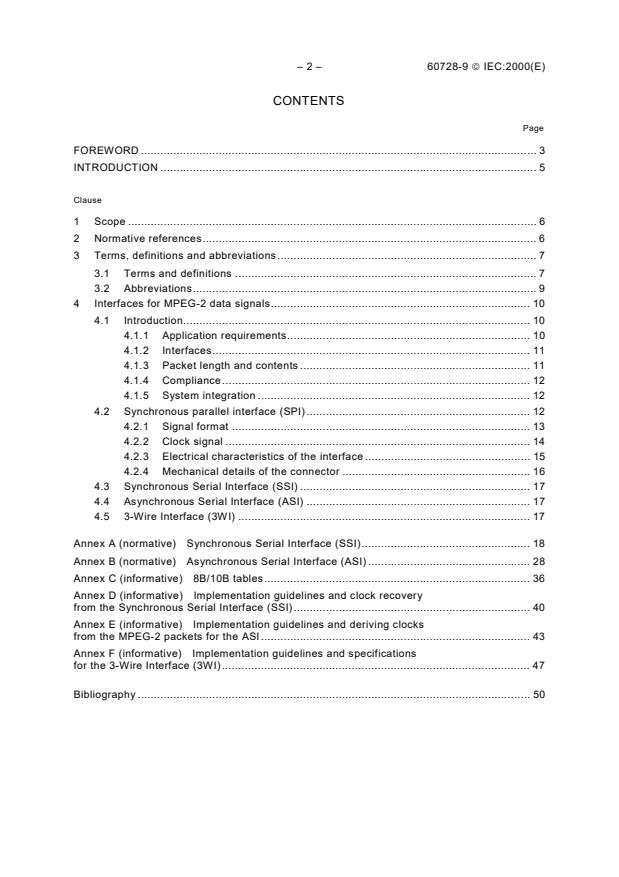
CONTENTS
Page
FOREWORD . 3
INTRODUCTION .5
Clause
1 Scope . 6
2 Normative references. 6
3 Terms, definitions and abbreviations. 7
3.1 Terms and definitions . 7
3.2 Abbreviations. 9
4 Interfaces for MPEG-2 data signals. 10
4.1 Introduction. 10
4.1.1 Application requirements. 10
4.1.2 Interfaces. 11
4.1.3 Packet length and contents . 11
4.1.4 Compliance. 12
4.1.5 System integration . 12
4.2 Synchronous parallel interface (SPI) . 12
4.2.1 Signal format . 13
4.2.2 Clock signal . 14
4.2.3 Electrical characteristics of the interface . 15
4.2.4 Mechanical details of the connector . 16
4.3 Synchronous Serial Interface (SSI) . 17
4.4 Asynchronous Serial Interface (ASI) . 17
4.5 3-Wire Interface (3WI) . 17
Annex A (normative) Synchronous Serial Interface (SSI). 18
Annex B (normative) Asynchronous Serial Interface (ASI) . 28
Annex C (informative) 8B/10B tables. 36
Annex D (informative) Implementation guidelines and clock recovery
from the Synchronous Serial Interface (SSI). 40
Annex E (informative) Implementation guidelines and deriving clocks
from the MPEG-2 packets for the ASI . 43
Annex F (informative) Implementation guidelines and specifications
for the 3-Wire Interface (3WI). 47
Bibliography . 50
60728-9 IEC:2000(E) – 3 –
INTERNATIONAL ELECTROTECHNICAL COMMISSION
____________
CABLED DISTRIBUTION SYSTEMS FOR TELEVISION
AND SOUND SIGNALS –
Part 9: Interfaces of cabled distribution systems
for digitally modulated signals
FOREWORD
1) The IEC (International Electrotechnical Commission) is a worldwide organization for standardization comprising
all national electrotechnical committees (IEC National Committees). The object of the IEC is to promote
international co-operation on all questions concerning standardization in the electrical and electronic fields. To
this end and in addition to other activities, the IEC publishes International Standards. Their preparation is
entrusted to technical committees; any IEC National Committee interested in the subject dealt with may
participate in this preparatory work. International, governmental and non-governmental organizations liaising
with the IEC also participate in this preparation. The IEC collaborates closely with the International
Organization for Standardization (ISO) in accordance with conditions determined by agreement between the
two organizations.
2) The formal decisions or agreements of the IEC on technical matters express, as nearly as possible, an
international consensus of opinion on the relevant subjects since each technical committee has representation
from all interested National Committees.
3) The documents produced have the form of recommendations for international use and are published in the form
of standards, technical specifications, technical reports or guides and they are accepted by the National
Committees in that sense.
4) In order to promote international unification, IEC National Committees undertake to apply IEC International
Standards transparently to the maximum extent possible in their national and regional standards. Any
divergence between the IEC Standard and the corresponding national or regional standard shall be clearly
indicated in the latter.
5) The IEC provides no marking procedure to indicate its approval and cannot be rendered responsible for any
equipment declared to be in conformity with one of its standards.
6) Attention is drawn to the possibility that some of the elements of this International Standard may be the subject
of patent rights. The IEC shall not be held responsible for identifying any or all such patent rights.
International Standard IEC 60728-9 has been prepared by subcommittee 100D: Cabled
distribution systems, of IEC technical committee 100: Audio, video and multimedia systems
and equipment.
The text of this standard is based on the following documents:
FDIS Report on voting
100/158/FDIS 100/180/RVD
Full information on the voting for the approval of this standard can be found in the report on
voting indicated in the above table.
This publication has been drafted in accordance with the ISO/IEC Directives, Part 3.
Annexes A and B form an integral part of this standard.
Annexes C, D, E and F are for information only.
– 4 – 60728-9 IEC:2000(E)
The committee has decided that the contents of this publication will remain unchanged until 2006.
At this date, the publication will be
• reconfirmed;
• withdrawn;
• replaced by a revised edition, or
• amended.
A bilingual version of this standard may be issued at a later date.
60728-9 IEC:2000(E) – 5 –
INTRODUCTION
Standards of the IEC 60728 series deal with cable networks for television signals, sound
signals and interactive services including equipment, systems and installations
– for headend reception, processing and distribution of television and sound signals and
their associated data signals, and
– for processing, interfacing and transmitting all kinds of signals for interactive services
using all applicable transmission media.
All kinds of networks like
– CATV-networks,
– MATV-networks and SMATV-networks,
– individual receiving networks
and all kinds of equipment, systems and installations installed in such networks, are within
the scope of this series.
The extent of this standardization work goes from the antennas, special signal source inputs
to the head-end, or other interface points to the network, up to the system outlet or the
terminal input, where no system outlet exists.
The standardization of any user terminals (i.e. tuners, receivers, decoders, multimedia
terminals, etc.) as well as of any coaxial and optical cables and accessories therefore is
excluded.
– 6 – 60728-9 IEC:2000(E)
CABLED DISTRIBUTION SYSTEMS FOR TELEVISION
AND SOUND SIGNALS –
Part 9: Interfaces of cabled distribution systems
for digitally modulated signals
1 Scope
This part of IEC 60728 describes physical interfaces for the interconnection of signal
processing devices for professional CATV/SMATV headend equipment or for similar systems,
such as in up-link stations. This standard, in particular, specifies the transfer of MPEG-2 data
signals in the standardized transport layer format between devices of different signal
processing functions.
RF interfaces and interfaces to telecom networks are not covered by this standard.
In addition references are made to all other parts of the IEC 60728 series and, in particular,
for RF, video and audio interfaces, to IEC 60728-5.
For connections to telecom networks, special Data Communication Equipment (DCE) is
necessary to adapt the serial or parallel interfaces specified in this document to the bitrates
and transmission formats of the public Plesiochronic Digital Hierarchy (PDH) networks. Other
emerging technologies such as Connectionless Broadband Data Services (CBDS),
Synchronous Digital Hierarchy (SDH), Asynchronous Transfer Mode (ATM), etc. can be used
for transmitting MPEG-2 Transport Streams (TS) between remote locations. ATM is
particularly suitable for providing bandwidth on demand and it allows for high data rates.
2 Normative references
The following normative documents contain provisions which, through reference in this text,
constitute provisions of this part of IEC 60728. For dated references, subsequent
amendments to, or revisions of, any of these publications do not apply. However, parties to
agreements based on this part of IEC 60728 are encouraged to investigate the possibility of
applying the most recent editions of the normative documents indicated below. For undated
references, the latest edition of the normative document referred to applies. Members of IEC
and ISO maintain registers of currently valid International Standards.
IEC 60169-8:1978, Radio-frequency connectors – Part 8: RF coaxial connectors with inner
diameter of outer conductor 6,5 mm (0,256 in) with bayonet lock – Characteristic impedance
50 ohms (type BNC)
IEC 60728 (all parts), Cabled distribution systems for television and sound signals
IEC 60728-5,— Cabled distribution systems for television and sound signals – Part 5: Head-end
1)
equipment
IEC 60728-6,— Cabled distribution systems for television and sound signals – Part 6: Optical
1)
equipment
IEC 60793-2:1998, Optical fibres – Part 2: Product specifications
________
1)
To be published.
60728-9 IEC:2000(E) – 7 –
IEC 60874-14:1993, Connectors for optical fibres and cables – Part 14: Sectional
specification for fibre optic connector – Type SC
ISO/IEC 13818-1:1996, Information technology – Generic coding of moving pictures and
associated audio information – Part 1: Systems
ISO/IEC 13818-9:1996, Information technology – Generic coding of moving pictures and
associated audio information – Part 9: Extension for real time interface for systems decoders
ISO/IEC 14165-111, Information technology – Fibre Channel – Part 1: Physical and signalling
1)
interface (FC-PH)
ISO 2110:1989, Information technology – Data communication – 25-pole DTE/DCE interface
connector and contact number assignments
ITU-R Recommendation BT.656-4:1994, Interfaces for digital component video signals in
525-line and 625-line television systems operating at the 4:2:2 level of Recommendation
ITU-R BT.601 (Part A)
ITU-T Recommendation G.654:1997, Characteristics of a cut-off shifted single-mode optical
fibre cable (Rev 1)
ITU-T Recommendation G.703:1998, Physical/electrical characteristics of hierarchical digital
interfaces (Rev 1)
ETS 300421:1994, Digital broadcasting for television, sound and data services – Framing
structure, channel coding and modulation for 11/12 GHz satellite services
ETS 300429:1994, Digital broadcasting for television, sound and data services – Framing
structure, channel coding and modulation for cable systems
3 Terms, definitions and abbreviations
3.1 Terms and definitions
For the purposes of this part of IEC 60728, the following definitions apply.
3.1.1
head-end
equipment connected between receiving antennas or other signal sources and the remainder
of the cable distribution system to process the signals to be distributed
NOTE The head-end may, for example, comprise antenna amplifiers, frequency converters, combiners, selectors
and generators.
3.1.2
Satellite Master Antenna Television system (SMATV)
system designed to provide sound and television signals to the households of a building or
group of buildings
NOTE Two system configurations are defined in ETS 300 473 as follows:
• SMATV system A, based on transparent transmodulation of QPSK satellite signals into QAM signals to be
distributed to the user;
• SMATV system B, based on direct distribution of QPSK signals to the user, with two options:
– SMATV-IF distribution in the satellite IF band (above 950 MHz);
SMATV-S distribution in the VHF/UHF band, for example in the extended S-band (230-470 MHz).
–
________
1)
To be published.
– 8 – 60728-9 IEC:2000(E)
3.1.3
biphase mark
line code which ensures DC balance, easy clock recovery and polarity freedom
3.1.4
transport stream
includes one or more programs with one or more independent time bases into a single
stream. The transport stream is designed for use in environments where errors are likely,
such as storage or transmission in lossy or noisy media
3.1.5
transport packet
packetized element of the transport stream. The packets are either 188 bytes or, in the case
where Reed Solomon FEC is used, 204 bytes in length
3.1.6
DVALID
signal which indicates in the 204-byte mode of a Transport Stream that the empty space is
filled with dummy bytes
3.1.7
PSYNC
flag which indicates the beginning of a packet
60728-9 IEC:2000(E) – 9 –
3.2 Abbreviations
8B/10B eight-to-ten bit conversion
ACCP Accumulated Phase
ACCT Accumulated Time
ASI Asynchronous Serial Interface
ASI-C Asynchronous Serial Interface on coaxial cable
ASI-O Asynchronous Serial Interface on optical fibre
ATM Asynchronous Transfer Mode
BER Bit Error Rate
CBDS Connectionless Broadband Data Services
DFB Distributed Feedback
DJ Deterministic Jitter
DVALID data valid
DVB Digital Video Broadcast
EN European Norm
FC Fibre Channel
FIFO First In First Out
FEC Forward Error Correction
FWHM Full Width Half Max
IEC International Electrotechnical Commission
ISO International Organization for Standardization
ITU-R International Telecommunication Union – Radiocommunication
ITU-T International Telecommunication Union – Telecommunication
LVDS Low-Voltage Differential Signalling
MPEG Moving Picture Experts Group
MSB Most Significant Bit
MUX Multiplex
NA not applicable
NRZ Non-Return-to-Zero
PDH Plesiosynchronic Digital Hierarchy
PLL Phase Lock Loop
PMD Physical Medium Dependent
PSYNC Packet Synchron
QAM Quadrature Amplitude Modulation
QPSK Quarternary Phase Shift Keying
RD Running Disparity
RIN Relative Intrinsic Noise
RJ Random Jitter
RS Reed Solomon
SDH Synchronous Digital Hierarchy
SMPT Society of Motion Picture and Television Engineers
SPI Synchronous Parallel Interface
SSI Synchronous Serial Interface
SSI-C Synchronous Serial Interface on coaxial cable
SSI-O Synchronous Serial Interface on optical fibre
Tr Rise-time
TS Transport Stream
UNC Unified National Coarse Thread
– 10 – 60728-9 IEC:2000(E)
4 Interfaces for MPEG-2 data signals
4.1 Introduction
This subclause describes possible interfaces for devices transmitting or receiving MPEG-2
data as transport packets, such as QPSK demodulators, QAM modulators, multiplexers,
demultiplexers, or telecom network adapters.
This specification is similar to ETS 300429 and ETS 300421.
NOTE Both standards describe a first functional block representing the MPEG2 source coding and multiplexing
as standardized in ISO/IEC 13818-1, a second functional block representing the channel adaptation, whereas an
interface in between shall be based on MPEG2 transport stream specification according to ISO/IEC 13818-1.
The function of the channel modulator/demodulator is to adapt the signal to the
characteristics of the transmission channel: satellite, terrestrial or cable as specified in the
DVB base line documents.
Also the case where data signals are transmitted to or from a headend via a telecom network,
or if a headend serves to insert data signals into such networks, is considered to be covered
by the generic channel modulator/demodulator functional block. The interface parameters
valid for this network have to be met. For the latter, reference is made to ITU-T G.703 for
Plesiochronic Digital Hierarchy (PDH) networks.
4.1.1 Application requirements
In order to avoid any unnecessary processing at the transmitting or receiving station of an
interface in certain applications, it is considered an application requirement that the interface
supports 204-byte packet length in such cases, in addition to or instead of the 188-byte
packet length specified in ISO/IEC 13818-1. These two cases are identified in the protocol
diagrams of figures 1 and 2, where also the scope of this specification is delineated. The
relevant associated packet structures are illustrated in figures 3 and 4.
MPEG2 TS packet MPEG2 TS Optional
extra data
(188 bytes) packet
(16 bytes)
(188 bytes)
Conversion to
Lower protocol
204-byte packets
layers
Lower protocol
layers
Transmission medium
Transmission medium
IEC 2181/2000 IEC 2182/2000
Figure 1 – Protocol stack for 188-byte packets Figure 2 – Protocol stack for 204-byte packets
NOTE Shaded areas identify the scope of this standard.
60728-9 IEC:2000(E) – 11 –
187 databytes (MPEG2 TS packet)
Sync byte
IEC 2183/2000
Figure 3 – Packet structure of 188-byte packet
187 databytes (MPEG2 TS packet) plus 16 extra
Sync byte
bytes
IEC 2184/2000
Figure 4 – Packet structure of 204-byte packet
4.1.2 Interfaces
Three interfaces and two serial transmission media are specified as follows:
• SPI (Synchronous Parallel Interface);
• SSI-C (Synchronous Serial Interface on coaxial cable);
• SSI-O (Synchronous Serial Interface on optical fibre);
• ASI-C (Asynchronous Serial Interface on coaxial cable);
• ASI-O (Asynchronous Serial Interface on optical fibre).
Each of these interfaces feature a BER such that FEC is not required for reliable data
transport.
The synchronous parallel interface is specified to cover short or medium distances, i.e. for devices
arranged near each other. Subclause 4.2 describes the definitions for such a parallel interface
derived from ITU-R Recommendation BT.656-4. Flags are provided to distinguish 188-byte packets
from 204-byte packets and to signal the existence of valid RS bytes. Note that the interface, as
such, is transparent to the RS bytes.
The synchronous serial interface (SSI) which can be seen as an extension of the parallel
interface, is briefly introduced in 4.3 and described in detail in annexes A and D. The packet
length and the existence of valid RS bytes are conveyed through suitable coding
mechanisms.
Subclause 4.4 introduces the Asynchronous Serial Interface (ASI). Details of the ASI are
provided in annexes B and E. The ASI is configurable to either convey 188-byte packets
(which is mandatory) or optionally 204-byte packets.
4.1.3 Packet length and contents
Each of the interface specifications can be used to convey either 188-byte packets or
204-byte packets in order to enable selection of the appropriate interface characteristics
dependent on the kind of equipment to be interconnected. Mandatory and optional packet
sizes are specified in table 1.
– 12 – 60728-9 IEC:2000(E)
Table 1 – Mandatory and optional packet lengths
Data packet carrying capability
Interface
204 bytes 204 bytes
188 bytes
(with 16 dummy bytes) (with 16 RS bytes)
SPI transmitter O M O
receiver M M M
SSI transmitter O M O
receiver M M M
ASI transmitter M O O
receiver M O O
M = mandatory O = optional
In case the data stream is packetized in 188-byte packets and the interface is configured to
convey 204-byte packets, the extra packet length can be used for additional data. The
contents of the 16 bytes in this extra packet length are not specified in this standard. One
application could be the transmission of 16 RS bytes associated with the preceding transport
package.
4.1.4 Compliance
For an equipment to be compliant to this standard it is sufficient for the equipment to show at
least one instance of at least one of the interface specifications as described in 4.1.2 and
specified in detail in subsequent subclauses of this standard, while at least the mandatory
packet sizes as indicated in 4.1.3 shall be supported.
4.1.5 System integration
The interfaces specified in this standard define physical connections between various pieces
of equipment. It is important to notice that various parameters which are important for
interoperation are not specified in this standard. This is intentional as it leaves maximum
implementation flexibility for different applications. In order to facilitate system integration,
equipment suppliers shall provide the following information about the characteristics of the
interfaces in their equipment:
• interface type (SPI, SSI-C, SSI-O, ASI-C, ASI-O);
• supported packet length (188 bytes, 204 bytes, both);
• maximum input jitter (jitter measured as specified in ISO/IEC 13818-9);
• output jitter (jitter measured as specified in ISO/IEC 13818-9);
• minimum input data rate (rate measured as specified in ISO/IEC 13818-1);
• maximum input data rate (rate measured as specified in ISO/IEC 13818-1).
Some of these parameters may not be applicable to certain types of equipment. If all relevant
parameters are provided by equipment suppliers, the proper functioning of the complete
system can be ensured.
4.2 Synchronous parallel interface (SPI)
This subclause describes an interface for a system for parallel transmission of variable data rates.
The data transfer is synchronized to the byte clock of the data stream, which is the MPEG
1)
Transport Stream. Transmission links use LVDS technology [2] and 25-pin connections.
________
1)
Figures in brackets refer to items in the bibliography.
60728-9 IEC:2000(E) – 13 –
Clock
Data (0-7)
TX
RX
DVALID
PSYNC
IEC 2185/2000
Figure 5 – System for parallel transmission
The data to be transmitted are MPEG-2 Transport Packets with 188 or 204 bytes. In the case
of the 204-byte packet format, packets may contain a 16-byte "empty space"; a DVALID
signal serves to identify these dummy bytes. A PSYNC flag labels the beginning of a packet.
The data are synchronized to the clock depending on the transmission rate.
Equipment which implements the parallel interface shall support the three transmission
formats as shown in figures 6, 7 and 8.
4.2.1 Signal format
The clock, data, and synchronization signals shall be transmitted in parallel: 8 data bits
together with one (MPEG-2) PSYNC signal and a DVALID signal which indicates in the
204-byte mode that the empty space is filled with dummy bytes. All signals are synchronous
to the clock signal. The signals are coded in NRZ form.
Clock
sync 12 186 187 sync 1 Data (0-7)
DVALID
PSYNC
IEC 2186/2000
Figure 6 – Transmission format with 188-byte packets
Clock
16 sync 1 2 186 187 12 16 sync 1
Data (0-7)
DVALID
PSYNC
IEC 2187/2000
Figure 7 – Transmission format with 204-byte packets
(188 data bytes and 16 dummy bytes)
– 14 – 60728-9 IEC:2000(E)
Clock
203 sync 12 201 202 203 sync 1 Data (0-7)
DVALID
PSYNC
IEC 2188/2000
Figure 8 – Transmission format with RS-coded packets (204 bytes) as specified in ETS 300 421
(188 data bytes and 16 valid extra bytes)
Data (0-7): Transport packet data word (8 bit: Data 0 to Data 7). Data 7 is the Most
Significant Bit (MSB).
DVALID: active logic "1". Indicates valid data at the interface. It is constantly high in the
188-byte mode. In the 204-byte mode a low logical state indicates not to check
the extra (dummy) bytes.
PSYNC: active logic "1". Indicates the beginning of a Transport Packet by signalling the
sync byte.
4.2.2 Clock signal
The clock is a square wave signal where the 0-1 transition represents the data transfer time.
The clock frequency f depends on the transmission rate.
p
• The Transport Packets are transmitted without insertion of additional bytes for RS coding
or padding (packet length 188 bytes):
f = f / 8
p u
• The Transport Packets are transmitted with insertion of additional bytes for RS coding or
padding (packet length 204 bytes):
f = (204 / 188) × f / 8
p u
The frequency f corresponds to the useful bitrate R of the MPEG-2 transport layer. The
u u
clock frequency f shall not exceed 13,5 MHz.
p
Timing reference for data and clock
Data
t
d
Clock
t
T
IEC 2189/2000
Figure 9 – Clock to data timing (at source)
60728-9 IEC:2000(E) – 15 –
Clock period: T =
f
p
T T
Clock pulse width: = ±
t
2 10
T T
Data hold time: t = ±
d
2 10
4.2.3 Electrical characteristics of the interface
The interface employs 11 line drivers and 11 line receivers. Each line driver (source) has a
balanced output and the corresponding line receiver (destination) a balanced input
(see figure 10). The line driver and receiver shall be LVDS-compatible, i.e. they shall permit
the use of LVDS for their drivers or receivers. All digital signal time intervals are measured
between the half-amplitude points.
a) Logic convention
The terminal A of the line driver is positive with respect to the terminal B for a binary 1
and negative for a binary 0 (see figure 10).
Destination
Source
A
A'
Z = Line
Line t
Transmission line
driver receiver
100 Ω
B B'
IEC 2190/2000
Figure 10 – Line-driver and line-receiver interconnection
b) Line-driver characteristics (source)
Output impedance: 100 Ω maximum
Common mode voltage: 1,125 V to 1,375 V
Signal amplitude: 247 mV to 454 mV
Rise and fall times: less than T / 7, measured between the 20 % and 80 % ampli-
tude points, with a 100 Ω resistive load. The difference between
rise and fall times shall not exceed T / 20.
c) Line receiver characteristics (destination)
Input impedance: 90 Ω to 132 Ω
Maximum input signal: 2,0 V peak-to-peak
Minimum input signal: 100 mV peak-to-peak
However, the line receiver shall sense correctly the binary data when a random data signal
produces the conditions represented by the eye diagram in figure 11 at the data detection point.
– 16 – 60728-9 IEC:2000(E)
Maximum common mode signal: ±0,5 V, comprising interference in the range of 0 - 15 kHz
(both terminals to ground).
Differential delay: Data shall be correctly sensed when the clock-to-data differential delay is
in the range between ±T/3 (see figure 11).
Reference transition of clock
U
min.
T T
min.
min.
IEC 2191/2000
T = T / 3, U = 100 mV
min min
Figure 11 – Idealized eye diagram corresponding to the minimum input signal level
4.2.4 Mechanical details of the connector
The interface uses the 25-contact type D subminiature connector specified in ISO 2110 with
the contact assignment shown in table 2.
Connectors are locked together with a screw lock, with male screws on the cable connector
and female threaded posts on the equipment connector. The threads are of type UNC 4-40[3].
Cable connectors employ pin contacts and equipment connectors employ socket contacts.
Shielding of the interconnecting cable and its connectors shall be employed.
Table 2 – Contact assignment of 25-contact type D subminiature connector (ISO 2110)
Pin Signal line Pin Signal line
1 Clock A 14 Clock B
2 System gnd 15 System gnd
3 Data 7 A(MSB) 16 Data 7 B
4 Data 6 A 17 Data 6 B
5 Data 5 A 18 Data 5 B
6 Data 4 A 19 Data 4 B
7 Data 3 A 20 Data 3 B
8 Data 2 A 21 Data 2 B
9 Data 1 A 22 Data 1 B
10 Data 0 A 23 Data 0 B
11 DVALID A 24 DVALID B
12 PSYNC A 25 PSYNC B
13 Cable shield
60728-9 IEC:2000(E) – 17 –
4.3 Synchronous Serial Interface (SSI)
The Synchronous Serial Interface (SSI) can be seen as the extension of the parallel interface
by means of an adaptation of the parallel format. SSI is synchronous to the Transport Stream
which is transmitted on the serial link.
A detailed specification of the SSI is provided in annex A and guidelines for its imple-
mentation are provided in annex D.
4.4 Asynchronous Serial Interface (ASI)
The Asynchronous Serial Interface (ASI) is a serial link operating at a fixed line clock rate.
A detailed specification of ASI is provided in annex B and guidelines for its implementation
are provided in annex E.
4.5 3-Wire Interface (3WI)
The 3-Wire Interface (3WI) can be used for either a Single Program Transport Stream (SPTS)
or a Multi-Program Transport Stream (MPTS).
A detailed specification of 3WI and guidelines for its implementation are provided in annex F.
– 18 – 60728-9 IEC:2000(E)
Annex A
(normative)
Synchronous Serial Interface (SSI)
This annex describes a system for serial encoded transmission of different data rates, with a
transmission rate equal to the data rate. It is based on a layered structure of MPEG-2
Transport Packets as a top layer (Layer-2), and a pair of bottom layers attached to physical
and coding aspects (Layer-0 and Layer-1).
The SSI is based on a line rate directly locked to the transport rate. The SSI is functionally
equivalent to the parallel interface, since the Transport Packets can either be transmitted
contiguously or separated by 16 bytes reserved for dummy bytes or extra bytes. Because the
link and the TS are synchronous, the bit justification operation is not needed. The system
shall be designed to fulfil the high stability requirements of the modulator clocks, even when
several links are cascaded.
As an example, consider a signal which passes through several re-broadcast steps, such as
the one depicted in figure A.1. In this chain, the last clock (that of the QAM modulator) is
slaved to the encoder/mux clock via four steps of clock regeneration circuits.
Mux Remux
PDH
QAM
SDH
QAM
Remux
QPSK
Mux Network
QPSK
demod
adapter
mod
Interfaces points
IEC 2192/2000
Figure A.1 – Example of cascaded interfaces
60728-9 IEC:2000(E) – 19 –
A.1 SSI transmission system overview
Figures A.2 and A.3 represent the primary components of this SSI method over copper
coaxial cable and fibre-optic cable, respectively.
Layer-2 Layer-1 Layer-0
Continuous byt-e
synchronous
Coupling/
Biphase
Parallel/serial Amplifier/
impedance
MPEG-2 TS Connector
conversion
Transport stream coding buffer matching
Coaxial
cable
Continuous byt-e
Clock
synchronous Coupling/
recovery
Amplifier/
MPEG-2 TS Serial/parallel impedance
Connector
biphase
buffer
Transport stream conversion
matching
decoding
IEC 2193/2000
Figure A.2 – Coaxial cable-based synchronous serial transmission link (SSI type)
Layer- 2
Layer- 1
Layer- 0
Continuous byte-
synchronous Parallel/serial Biphase
Optical
Amplifier/
MPEG-2 TS conversion
coding
Connector
buffer emitter
Transport stream
Fibre-
optic
Continuous byte-
Clock recovery
synchronous
Amplifier/
Optical
Serial/parallel
biphase Connector
MPEG-2 TS
buffer
conversion receiver
decoding
Transport stream
IEC 2194/2000
Figure A.3 – Fibre-optic-based synchronous serial transmission link (SSI type)
The main functions of the transmission system are described below.
a) Emission path
Data to be transmitted are presented in byte-synchronized form as MPEG-2 Transport
Packets. The Transport Stream is then passed through a parallel-to-serial converter. The
line data stream is locked to the TS data stream.
– 20 – 60728-9 IEC:2000(E)
The serial signal is Biphase Mark-encoded.
In the case of a coaxial cable application, the resulting signal is typically passed to a
buffer/driver circuit and then through a coupling network, which performs impedance
matching and optionally galvanic isolation, to a coaxial connector. In the case of fibre-
optic application, the serial bit stream is passed through a driver circuit which drives an
optical transmitter (LED or LASER) which is coupled to a fibre-optic cable through a
connector.
b) Reception path
The incoming data stream from the coaxial cable is first coupled through a connector and
coupling network to a circuit which recovers clock and data. In the case of fibre-optic
transmission, a light sensitive detector converts light levels to electrical levels which then
are passed to a clock and data recovery circuit.
Once the clock and data are recovered, the bit stream is passed to a Biphase Mark
decoder. In order to recover byte alignment, a decoder searches in the serial stream for
the synchronization word which is necessary to achieve the serial-to-parallel conversion.
Annex D provides further clarification of the characteristics of the SSI and implementation
guidelines for clock and data recovery.
A.2 SSI configuration
An SSI interconnection physically consists of two nodes: a transmitting node and a receiving
node. This unidirectional optical fibre or copper coaxial cable carrying data from the
transmitting node to the receiving node is referred to as a link. The link is used by the
interconnected ports to perform communication. Physical equipment such as video or audio
compressors, multiplexers, modulators, etc., can be interconnected through these links. This
SSI specification clause applies only to the point-to-point type link.
A.3 SSI protocol architecture description
The SSI protocol is divided into three architectural layers for purposes of development of the
standard: Layer-0, Layer-1, Layer-2.
A.3.1 Layer-0: Physical requirements
The physical layer defines the transmission media, the drivers and receivers. The
transmission uses Biphase Mark encoding.
This subclause provides specifications for the SSI physical layer (Layer-0). Interfaces for
coaxial and optical fibre applications are specified. The links are unidirectional point-to-point.
A.3.1.1 Coaxial cable Physical Medium Dependent (PMD) requirement
The nominal cable impedance shall be 75 Ω.
Considering that the transmission data rate is derived from the user data rate, longer links
can be achieved for lower user data rates. The physical medium specified in this subclause
has the following characteristics. It
– provides a means of coupling the SSI Layer-1 to the coaxial cable segment;
– provides the driving of coaxial cable between a transmitter and a receiver;
– specifies the type and grade of cable and connectors to be used in a synchronous serial
interface link.
60728-9 IEC:2000(E) – 21 –
a) Electrical medium connector
The required connector shall have mechanical characteristics conforming to the BNC type.
NOTE Due to its higher mechanical stability a 50 Ω BNC-type connector according to IEC 60169-8 is
recommended.
The electrical characteristics of the connector shall permit it to be used over the frequency
range of the specified interface.
The following table A.1 and figures A.4 and A.5 give the requirements for the serial signal
launched synchronously on the coaxial cable.
Table A.1 – Transmitter output characteristics
Pulse shape Conforming to masks shown in figures A.4 and A.5.
Peak-to-peak voltage 1 V ± 0,1 V
Rise/fall time (10 - 90 %)
≤4 ns
Transition timing tolerance (referred to the mean value Negative transition: ±0,2 ns
of the 50 % amplitude points of negative transition)
Positive transition at unit interval boundaries: ±1 ns
Positive transition at mid interval: ±0,7 ns
Return loss (75 Ω) –15 dB
over frequency range 3,5 MHz to 105 MHz
Maximum peak-to-peak jitter at the output port 2 ns
The digital signal presented at the input port shall conform to table A.2 and figures A.4 and
A.5 modified by the characteristics of the interconnecting coaxial pair. The attenuation of the
coaxial pair shall be assumed to follow an approximate f law. The cable shall have a
maximum insertion loss of 12 dB at a frequency of 70 MHz.
T able A.2 – Receiver input characteristics
Maximum attenuation at a frequency of 70 MHz –12 dB
assuming a f law
Maximum peak-to-peak jitter at the input port 4 ns
Return loss (75 Ω) –15 dB
over frequency range 3,5 MHz to 105 MHz
– 22 – 60728-9 IEC:2000(E)
T
V
0,60
(Note 1) (Note 1)
0,55
0,50
Nominal 2 ns
0,45
pulse
2 ns
1 ns 1 ns
0,40
0,2 ns
0,2 ns
0,05
– 0,05
T /2 T/2
2,7 ns
2,7 ns
2 ns
2 ns
– 0,40
T/4 T/4
– 0,45
– 0,50
– 0,55
(Note 1)
– 0,60
Negative
Positive
transition
transition
IEC 2195/2000
NOTE 1 The maximum "steady-state" amplitude should not exceed the 0,55 V limit. Overshoots and other
transients are permitted to fall into the dotted area, bounded by the amplitude levels 0,55 V and 0,6 V, provided
that they do not exceed the steady-state level by more than 0,05 V. The possibility of relaxing the amount by which
the overshoot may exceed the steady-state level is under study.
NOTE 2 For all measurements using these masks, the signal should be AC coupled, using a capacitor of not less
than 0,02 μF (for data rate = 70 Mbit/s), to the input of the oscilloscope used for measurements.
The nominal zero level for both masks should be aligned with the oscilloscope trace with no input signal. With the
signal then applied, the vertical position of the trace can be adjusted with the objective of meeting the limits of the
masks. Any such adjustment should be the same for both masks and should not exceed ±0,05 V. This may be
checked by removing the input signal again and verifying that the trace lies within ±0,05 V of the nominal zero
level of the masks.
NOTE 3 Each pulse in a coded pulse sequence should meet the limits of the relevant mask, irrespective of the
state of the preceding or succeeding pulses, with both pulse masks fixed in the same relation to a common timing
reference, i.e. with their nominal start and finish edges coincident. The masks allow for HF jitter present in the
timing signal associated with the source of interface signal.
When using an oscilloscope technique to determine pulse compliance with the mask, it is important that successive
traces of the pulses overlay in order to suppress the effects of low-frequency jitter. This can be accomplished by
several techniques; (such as, a) triggering the oscilloscope on the measured waveform, or b) providing both the
oscilloscope and the pulse output circuits with the same clock signal). These techniques require further study.
NOTE 4 For the purpose of these masks, the rise time and delay time should be measured between –0,4 V and
+0,4 V, and should not exceed 4 ns.
NOTE 5 The inverse pulse will have the same characteristics, noting that the timing tolerances at the level of the
negative and positive transitions are ±0,2 ns and ±1 ns respectively.
Figure A.4 – Pulse mask for logical 0
Nominal zero level
60728-9 IEC:2000(E) – 23 –
T
V
0,60
(Note 1) (Note 1)
0,55 Nominal
pulse
0,50
T /4
T/4
0,45
2 ns
2 ns
2 ns
0,40
0,2 ns 0,2 ns
0,2 ns
0,2 ns
0,7 ns 0,7 ns
0,05
0,05
2 ns
2 ns
2 ns
– 0,40
– 0,45
/4 /4
T T
– 0,50
– 0,55
Positive
(Note 1)
(Note 1)
transition
– 0,60
at mid-unit
interval
Negative
transition
IEC 2196/2000
NOTE 1 The maximum "steady-state" amplitude should not exceed the 0,55 V limit. Overshoots and other
transients are permitted to fall into the dotted area, bounded by the amplitude levels 0,55 V and 0,6 V, provided
that they do not exceed the steady-state level by more than 0,05 V. The possibility of relaxing the amount by which
the overshoot may exceed the steady-state level is under study.
NOTE 2 For all measurements using these masks, the signal should be AC coupled, using a capacitor of not less
than 0,02 μF (for data rate = 70 Mbit/s), to the input of the oscilloscope used for measurements.
...