

IEC 60076-7:2018
(Main)Power transformers - Part 7: Loading guide for mineral-oil-immersed power transformers
General Information
- Abstract
IEC 60076-7:2018 is applicable to mineral-oil-immersed transformers. It describes the effect of operation under various ambient temperatures and load conditions on transformer life. This document provides guidance for the specification and loading of power transformers from the point of view of operating temperatures and thermal ageing. It provides recommendations for loading above the nameplate rating and guidance for the planner to choose appropriate rated quantities and loading conditions for new installations. This edition includes the following significant technical changes with respect to the previous edition:
a) title has been updated from "oil-immersed power transformers" to "mineral-oil-immersed transformers";
b) insulation life is updated by considering latest research findings;
c) temperature limits have been reviewed and maximum core temperature is recommended;
d) number of fibre optic sensors is recommended for temperature rise test;
e) Q, S and H factors are considered;
f) thermal models are revised and rewritten in generally applicable mathematical form;
g) geomagnetic induced currents are briefly discussed and corresponding temperature limits are suggested;
h) extensive literature review has been performed and a number of references added to bibliography.
- Status
- Published
- Publication Date
- 11-Jan-2018
- Technical Committee
- TC 14 - Power transformers
- Drafting Committee
- MT 60076-7 - TC 14/MT 60076-7
- Current Stage
- PPUB - Publication issued
- Start Date
- 12-Jan-2018
- Completion Date
- 29-Dec-2017
Buy Documents
IEC 60076-7:2018 - Power transformers - Part 7: Loading guide for mineral-oil-immersed power transformers Released:1/12/2018
IEC 60076-7:2018 RLV - Power transformers - Part 7: Loading guide for mineral-oil-immersed power transformers Released:1/12/2018
Overview
IEC 60076-7:2018 - Power transformers: Part 7: Loading guide for mineral-oil-immersed transformers provides guidance on the thermal behaviour, loading and expected life of mineral-oil-immersed power transformers. The standard explains how ambient temperature, load duty and thermal ageing affect insulation life, and gives practical guidance for specifying, testing and loading transformers - including recommendations for operation above nameplate rating and selection of rated quantities for new installations.
Key topics and requirements
- Thermal ageing and insulation life
Guidance on relative ageing rate, insulation life expectancy and methods to calculate loss-of-life under varying temperature, moisture and oxygen conditions. - Loading beyond nameplate rating
Recommendations and limitations for short‑time and long‑time emergency overloading, and consequences for transformer life and safety. - Temperature determination methods
Procedures for estimating and measuring top-oil and hot-spot temperatures in steady state and during varying load (including exponential-equation and differential-difference-equation approaches). - Hot-spot measurement and testing
Recommendations on hot-spot factors and the number of fibre‑optic sensors to be used for temperature-rise tests. - Thermal models and parameters
Revised, generally applicable mathematical thermal models, winding/oil time-constant estimation and guidance on oil/winding exponents. - New technical considerations
Updates include revised insulation-life models (based on latest research), reviewed temperature limits with a recommended maximum core temperature, consideration of Q, S and H factors, and brief guidance on geomagnetic induced currents (GICs) with suggested temperature limits. - Annexes and examples
Informative annexes provide practical calculation examples, flowcharts, specification guidance for overloads, GIC discussion and bibliography of literature.
Applications - who uses this standard
- Transformer manufacturers (design and testing specifications)
- Utility planners and system operators (loadability studies, overload policies)
- Specifiers and consultants (selecting rated quantities, specifying temperature-rise tests)
- Test laboratories (instrumentation, fibre‑optic sensor placement)
- Asset managers (insulation life assessment and maintenance planning)
Practical value
- Enables safer, data-driven decisions on permissible overloads and emergency loading strategies.
- Provides methods for calculating transformer loss-of-life to optimize service life and replacement planning.
- Standardizes temperature measurement and thermal modelling practices for consistent testing and specification.
Related standards
- Other parts of the IEC 60076 series (general transformer requirements, temperature-rise tests, short-circuit withstand, etc.) should be consulted alongside IEC 60076-7 for complete technical specification and safety compliance.
For the official text, obtain IEC 60076-7:2018 from the IEC webstore or your national IEC member.
Relations
- Revises
IEC 60076-7:2005 - Power transformers - Part 7: Loading guide for oil-immersed power transformers - Effective Date
- 05-Sep-2023
Buy Documents
IEC 60076-7:2018 - Power transformers - Part 7: Loading guide for mineral-oil-immersed power transformers Released:1/12/2018
IEC 60076-7:2018 RLV - Power transformers - Part 7: Loading guide for mineral-oil-immersed power transformers Released:1/12/2018
Get Certified
Connect with accredited certification bodies for this standard

IMQ S.p.A. (Certification)
Italian electrical product certification.

SLG Prüf- und Zertifizierungs GmbH
German testing and certification body.

UL Solutions
Global safety science company with testing, inspection and certification.
Sponsored listings
Frequently Asked Questions
IEC 60076-7:2018 is a standard published by the International Electrotechnical Commission (IEC). Its full title is "Power transformers - Part 7: Loading guide for mineral-oil-immersed power transformers". This standard covers: IEC 60076-7:2018 is applicable to mineral-oil-immersed transformers. It describes the effect of operation under various ambient temperatures and load conditions on transformer life. This document provides guidance for the specification and loading of power transformers from the point of view of operating temperatures and thermal ageing. It provides recommendations for loading above the nameplate rating and guidance for the planner to choose appropriate rated quantities and loading conditions for new installations. This edition includes the following significant technical changes with respect to the previous edition: a) title has been updated from "oil-immersed power transformers" to "mineral-oil-immersed transformers"; b) insulation life is updated by considering latest research findings; c) temperature limits have been reviewed and maximum core temperature is recommended; d) number of fibre optic sensors is recommended for temperature rise test; e) Q, S and H factors are considered; f) thermal models are revised and rewritten in generally applicable mathematical form; g) geomagnetic induced currents are briefly discussed and corresponding temperature limits are suggested; h) extensive literature review has been performed and a number of references added to bibliography.
IEC 60076-7:2018 is applicable to mineral-oil-immersed transformers. It describes the effect of operation under various ambient temperatures and load conditions on transformer life. This document provides guidance for the specification and loading of power transformers from the point of view of operating temperatures and thermal ageing. It provides recommendations for loading above the nameplate rating and guidance for the planner to choose appropriate rated quantities and loading conditions for new installations. This edition includes the following significant technical changes with respect to the previous edition: a) title has been updated from "oil-immersed power transformers" to "mineral-oil-immersed transformers"; b) insulation life is updated by considering latest research findings; c) temperature limits have been reviewed and maximum core temperature is recommended; d) number of fibre optic sensors is recommended for temperature rise test; e) Q, S and H factors are considered; f) thermal models are revised and rewritten in generally applicable mathematical form; g) geomagnetic induced currents are briefly discussed and corresponding temperature limits are suggested; h) extensive literature review has been performed and a number of references added to bibliography.
IEC 60076-7:2018 is classified under the following ICS (International Classification for Standards) categories: 29.180 - Transformers. Reactors. The ICS classification helps identify the subject area and facilitates finding related standards.
IEC 60076-7:2018 has the following relationships with other standards: It is inter standard links to IEC 60076-7:2005. Understanding these relationships helps ensure you are using the most current and applicable version of the standard.
IEC 60076-7:2018 is available in PDF format for immediate download after purchase. The document can be added to your cart and obtained through the secure checkout process. Digital delivery ensures instant access to the complete standard document.
Standards Content (Sample)
IEC 60076-7 ®
Edition 2.0 2018-01
INTERNATIONAL
STANDARD
colour
inside
Power transformers –
Part 7: Loading guide for mineral-oil-immersed power transformers
All rights reserved. Unless otherwise specified, no part of this publication may be reproduced or utilized in any form
or by any means, electronic or mechanical, including photocopying and microfilm, without permission in writing from
either IEC or IEC's member National Committee in the country of the requester. If you have any questions about IEC
copyright or have an enquiry about obtaining additional rights to this publication, please contact the address below or
your local IEC member National Committee for further information.
IEC Central Office Tel.: +41 22 919 02 11
3, rue de Varembé info@iec.ch
CH-1211 Geneva 20 www.iec.ch
Switzerland
About the IEC
The International Electrotechnical Commission (IEC) is the leading global organization that prepares and publishes
International Standards for all electrical, electronic and related technologies.
About IEC publications
The technical content of IEC publications is kept under constant review by the IEC. Please make sure that you have the
latest edition, a corrigenda or an amendment might have been published.
IEC Catalogue - webstore.iec.ch/catalogue Electropedia - www.electropedia.org
The stand-alone application for consulting the entire The world's leading online dictionary of electronic and
bibliographical information on IEC International Standards, electrical terms containing 21 000 terms and definitions in
Technical Specifications, Technical Reports and other English and French, with equivalent terms in 16 additional
documents. Available for PC, Mac OS, Android Tablets and languages. Also known as the International Electrotechnical
iPad. Vocabulary (IEV) online.
IEC publications search - webstore.iec.ch/advsearchform IEC Glossary - std.iec.ch/glossary
The advanced search enables to find IEC publications by a 67 000 electrotechnical terminology entries in English and
variety of criteria (reference number, text, technical French extracted from the Terms and Definitions clause of
committee,…). It also gives information on projects, replaced IEC publications issued since 2002. Some entries have been
and withdrawn publications. collected from earlier publications of IEC TC 37, 77, 86 and
CISPR.
IEC Just Published - webstore.iec.ch/justpublished
Stay up to date on all new IEC publications. Just Published IEC Customer Service Centre - webstore.iec.ch/csc
details all new publications released. Available online and If you wish to give us your feedback on this publication or
also once a month by email. need further assistance, please contact the Customer Service
Centre: sales@iec.ch.
IEC 60076-7 ®
Edition 2.0 2018-01
INTERNATIONAL
STANDARD
colour
inside
Power transformers –
Part 7: Loading guide for mineral-oil-immersed power transformers
INTERNATIONAL
ELECTROTECHNICAL
COMMISSION
ICS 29.180 ISBN 978-2-8322-5082-2
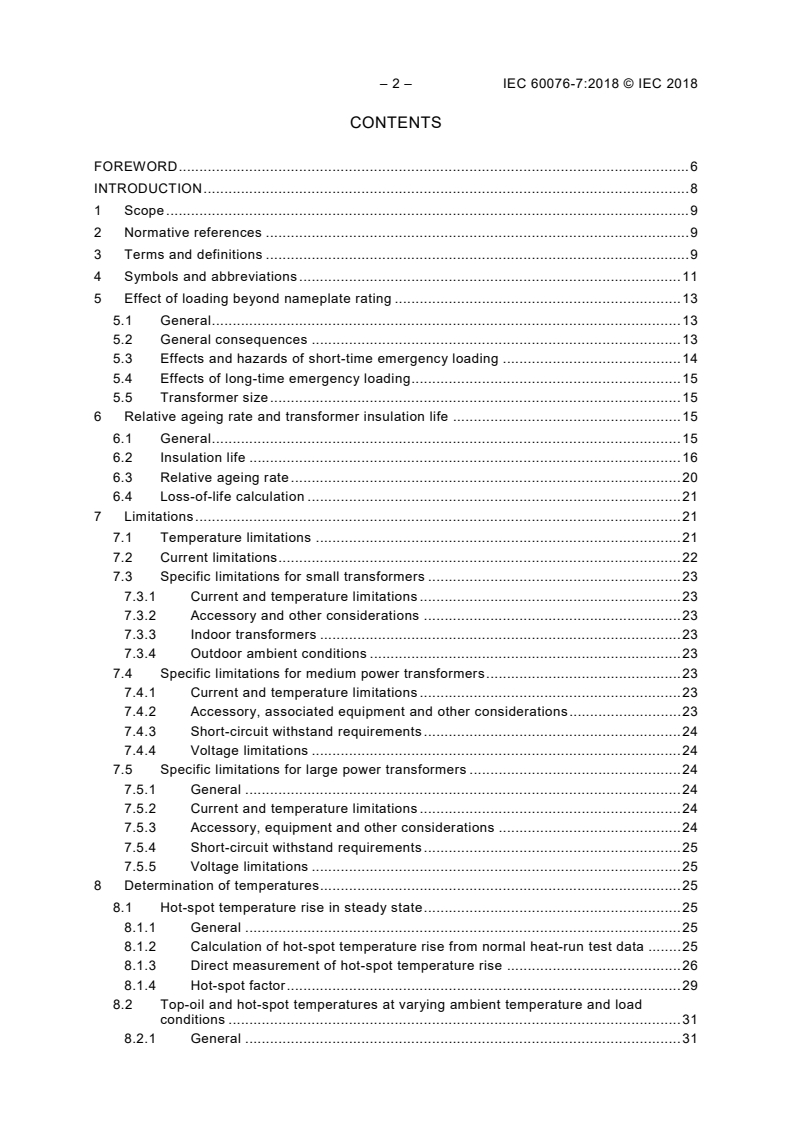
– 2 – IEC 60076-7:2018 © IEC 2018
CONTENTS
FOREWORD . 6
INTRODUCTION . 8
1 Scope . 9
2 Normative references . 9
3 Terms and definitions . 9
4 Symbols and abbreviations . 11
5 Effect of loading beyond nameplate rating . 13
5.1 General . 13
5.2 General consequences . 13
5.3 Effects and hazards of short-time emergency loading . 14
5.4 Effects of long-time emergency loading . 15
5.5 Transformer size . 15
6 Relative ageing rate and transformer insulation life . 15
6.1 General . 15
6.2 Insulation life . 16
6.3 Relative ageing rate . 20
6.4 Loss-of-life calculation . 21
7 Limitations . 21
7.1 Temperature limitations . 21
7.2 Current limitations . 22
7.3 Specific limitations for small transformers . 23
7.3.1 Current and temperature limitations . 23
7.3.2 Accessory and other considerations . 23
7.3.3 Indoor transformers . 23
7.3.4 Outdoor ambient conditions . 23
7.4 Specific limitations for medium power transformers . 23
7.4.1 Current and temperature limitations . 23
7.4.2 Accessory, associated equipment and other considerations . 23
7.4.3 Short-circuit withstand requirements . 24
7.4.4 Voltage limitations . 24
7.5 Specific limitations for large power transformers . 24
7.5.1 General . 24
7.5.2 Current and temperature limitations . 24
7.5.3 Accessory, equipment and other considerations . 24
7.5.4 Short-circuit withstand requirements . 25
7.5.5 Voltage limitations . 25
8 Determination of temperatures . 25
8.1 Hot-spot temperature rise in steady state . 25
8.1.1 General . 25
8.1.2 Calculation of hot-spot temperature rise from normal heat-run test data . 25
8.1.3 Direct measurement of hot-spot temperature rise . 26
8.1.4 Hot-spot factor . 29
8.2 Top-oil and hot-spot temperatures at varying ambient temperature and load
conditions . 31
8.2.1 General . 31
8.2.2 Exponential equations solution . 33
8.2.3 Difference equations solution . 37
8.3 Ambient temperature. 39
8.3.1 Outdoor air-cooled transformers . 39
8.3.2 Correction of ambient temperature for transformer enclosure . 39
8.3.3 Water-cooled transformers . 40
9 Influence of tap-changers . 40
9.1 General . 40
9.2 Load loss . 41
9.3 Ratio of losses . 41
9.4 Load factor . 41
Annex A (informative) Insulation life expectancy and relative ageing rate considering
oxygen and water effect . 42
A.1 Insulation life expectancy . 42
A.2 Relative ageing rate considering oxygen and water effect . 44
Annex B (informative) Core temperature . 47
B.1 General . 47
B.2 Core hot-spot locations . 47
Annex C (informative) Specification of loading beyond rated power . 48
Annex D (informative) Description of Q, S and H factors . 50
Annex E (informative) Calculation of winding and oil time constant . 53
Annex F (informative) Thermal model parameters . 55
F.1 General . 55
F.2 Thermal constant estimation: experimental approach . 55
F.3 Dynamic thermal modelling: further development . 57
Annex G (informative) Oil and winding exponents . 58
G.1 General . 58
G.2 Historical background . 58
G.3 Theoretical approach . 60
G.4 Extended temperature rise test approach . 62
Annex H (informative) Practical example of the exponential equations method . 64
H.1 General . 64
H.2 Time period 0 min to 190 min . 65
H.3 Time period 190 min to 365 min . 65
H.4 Time period 365 min to 500 min . 66
H.5 Time period 500 min to 705 min . 66
H.6 Time period 705 min to 730 min . 67
H.7 Time period 730 min to 745 min . 67
H.8 Comparison with measured values . 68
Annex I (informative) Application of the difference equation solution method . 70
I.1 General . 70
I.2 Example. 70
I.3 Use of measured top-oil temperature . 75
Annex J (informative) Flowchart, based on the example in Annex H . 76
Annex K (informative) Example of calculating and presenting overload data . 78
Annex L (informative) Geomagnetic induced currents . 82
L.1 Background. 82
– 4 – IEC 60076-7:2018 © IEC 2018
L.2 GIC capability of power transformers [54], [55]. 82
Annex M (informative) Alternative oils . 84
Bibliography . 85
Figure 1 – Structural formula of cellulose . 16
Figure 2 – Correlation between tensile strength and DP value . 17
Figure 3 – Accelerated ageing in mineral oil at 140 °C, oxygen and moisture contents
maintained at < 6 000 ppm and 0,5 %, respectively . 18
Figure 4 – Expected life for non-thermally upgraded paper and its dependence upon
moisture, oxygen and temperature . 19
Figure 5 – Expected life for thermally upgraded paper and its dependence upon
moisture, oxygen and temperature . 20
Figure 6 – Thermal diagram . 26
Figure 7 – Temperature rises above top-oil temperature (in tank) 65,8 °C of the zig-zag
cooled HV-winding of a 400 MVA ONAF cooled 3-phase transformer, load current 1,0
p.u., tap position (-) . 27
Figure 8 – Coil edges, where the sensors should be located in the edge with the higher
calculated temperature rise . 28
Figure 9 – Temperature rises above top-oil temperature at the end of an 8 h thermal
no-load test at 110 % supply voltage. 29
Figure 10 – Zigzag-cooled winding where the distance between all sections is the
same and the flow-directing washer is installed in the space between sections . 30
Figure 11 – Top view section of a rectangular winding with “collapsed cooling duct
arrangement” under the yokes . 31
Figure 12 – Block diagram representation of the differential equations . 32
Figure 13 – Temperature responses to step changes in the load current . 34
Figure 14 – The function ∆θ (t)/∆θ generated by the values given in Table 4 . 37
h hr
Figure 15 – Principle of losses as a function of the tap position . 41
Figure A.1 – Arrhenius plot for an ageing process . 43
Figure F.1 – Hot-spot and top-oil overall model . 57
Figure G.1 – Extended temperature rise test . 62
Figure G.2 – Transformer exponent estimation plots . 63
Figure H.1 – Hot-spot temperature response to step changes in the load current . 68
Figure H.2 – Top-oil temperature response to step changes in the load current . 68
Figure I.1 – Plotted input data for the example . 72
Figure I.2 – Plotted output data for the example . 75
Figure K.1 – OF large power transformers: permissible duties for normal loss of life . 81
Figure L.1 – GIC flow into a power transformer . 82
Table 1 – Relative ageing rates due to hot-spot temperature . 21
Table 2 – Maximum permissible temperature limits applicable to loading beyond
nameplate rating . 22
Table 3 – Recommended current limits applicable to loading beyond nameplate rating . 23
Table 4 – Recommended thermal characteristics for exponential equations . 36
Table 5 – Correction for increase in ambient temperature due to enclosure . 40
Table A.1 – Activation energy (E ) and environment factor (A) for oxidation, hydrolysis . 43
A
Table A.2 – Expected life of paper under various conditions . 44
Table A.3 – Relative ageing rates due to hot-spot temperature, oxygen and moisture
for non-upgraded paper insulation . 45
Table A.4 – Relative ageing rates due to hot-spot temperature, oxygen and moisture
for upgraded paper insulation . 46
Table H.1 – Load steps of the 250 MVA transformer . 64
Table H.2 – Temperatures at the end of each load step . 69
Table I.1 – Input data for example . 71
Table I.2 – Output data for the example . 74
Table K.1 – Example characteristics related to the loadability of transformers . 78
Table K.2 – An example table with the permissible duties and corresponding daily loss
of life (in “normal” days), and maximum hot-spot temperature rise during the load
cycle . 80
– 6 – IEC 60076-7:2018 © IEC 2018
INTERNATIONAL ELECTROTECHNICAL COMMISSION
____________
POWER TRANSFORMERS –
Part 7: Loading guide for mineral-oil-immersed
power transformers
FOREWORD
1) The International Electrotechnical Commission (IEC) is a worldwide organization for standardization comprising
all national electrotechnical committees (IEC National Committees). The object of IEC is to promote
international co-operation on all questions concerning standardization in the electrical and electronic fields. To
this end and in addition to other activities, IEC publishes International Standards, Technical Specifications,
Technical Reports, Publicly Available Specifications (PAS) and Guides (hereafter referred to as “IEC
Publication(s)”). Their preparation is entrusted to technical committees; any IEC National Committee interested
in the subject dealt with may participate in this preparatory work. International, governmental and non-
governmental organizations liaising with the IEC also participate in this preparation. IEC collaborates closely
with the International Organization for Standardization (ISO) in accordance with conditions determined by
agreement between the two organizations.
2) The formal decisions or agreements of IEC on technical matters express, as nearly as possible, an international
consensus of opinion on the relevant subjects since each technical committee has representation from all
interested IEC National Committees.
3) IEC Publications have the form of recommendations for international use and are accepted by IEC National
Committees in that sense. While all reasonable efforts are made to ensure that the technical content of IEC
Publications is accurate, IEC cannot be held responsible for the way in which they are used or for any
misinterpretation by any end user.
4) In order to promote international uniformity, IEC National Committees undertake to apply IEC Publications
transparently to the maximum extent possible in their national and regional publications. Any divergence
between any IEC Publication and the corresponding national or regional publication shall be clearly indicated in
the latter.
5) IEC itself does not provide any attestation of conformity. Independent certification bodies provide conformity
assessment services and, in some areas, access to IEC marks of conformity. IEC is not responsible for any
services carried out by independent certification bodies.
6) All users should ensure that they have the latest edition of this publication.
7) No liability shall attach to IEC or its directors, employees, servants or agents including individual experts and
members of its technical committees and IEC National Committees for any personal injury, property damage or
other damage of any nature whatsoever, whether direct or indirect, or for costs (including legal fees) and
expenses arising out of the publication, use of, or reliance upon, this IEC Publication or any other IEC
Publications.
8) Attention is drawn to the Normative references cited in this publication. Use of the referenced publications is
indispensable for the correct application of this publication.
9) Attention is drawn to the possibility that some of the elements of this IEC Publication may be the subject of
patent rights. IEC shall not be held responsible for identifying any or all such patent rights.
International Standard IEC 60076-7 has been prepared by IEC technical committee 14: Power
transformers.
This second edition cancels and replaces the first edition published in 2005. It constitutes a
technical revision. This edition includes the following significant technical changes with
respect to the previous edition:
a) title has been updated from "oil-immersed power transformers" to "mineral-oil-immersed
power transformers";
b) insulation life is updated by considering latest research findings;
c) temperature limits have been reviewed and maximum core temperature is recommended;
d) number of fibre optic sensors is recommended for temperature rise test;
e) Q, S and H factors are considered;
f) thermal models are revised and rewritten in generally applicable mathematical form;
g) geomagnetic induced currents are briefly discussed and corresponding temperature limits
are suggested;
h) extensive literature review has been performed and a number of references added to
bibliography.
The text of this standard is based on the following documents:
FDIS Report on voting
14/933/FDIS 14/942/RVD
Full information on the voting for the approval of this standard can be found in the report on
voting indicated in the above table.
This publication has been drafted in accordance with the ISO/IEC Directives, Part 2.
A list of all parts of the IEC 60076 series, under the general title Power transformers, can be
found on the IEC website.
The committee has decided that the contents of this publication will remain unchanged until
the stability date indicated on the IEC website under "http://webstore.iec.ch" in the data
related to the specific publication. At this date, the publication will be
• reconfirmed,
• withdrawn,
• replaced by a revised edition, or
• amended.
A bilingual version of this publication may be issued at a later date.
IMPORTANT – The 'colour inside' logo on the cover page of this publication indicates
that it contains colours which are considered to be useful for the correct
understanding of its contents. Users should therefore print this document using a
colour printer.
– 8 – IEC 60076-7:2018 © IEC 2018
INTRODUCTION
This part of IEC 60076 provides guidance for the specification and loading of power
transformers from the point of view of operating temperatures and thermal ageing. It provides
recommendations for loading above the nameplate rating and guidance for the planner to
choose appropriate rated quantities and loading conditions for new installations.
IEC 60076-2 is the basis for contractual agreements and it contains the requirements and
tests relating to temperature-rise figures for oil-immersed transformers during continuous
rated loading.
This part of IEC 60076 gives mathematical models for judging the consequence of different
loadings, with different temperatures of the cooling medium, and with transient or cyclical
variation with time. The models provide for the calculation of operating temperatures in the
transformer, particularly the temperature of the hottest part of the winding. This hot-spot
temperature is, in turn, used for evaluation of a relative value for the rate of thermal ageing
and the percentage of life consumed in a particular time period. The modelling refers to small
transformers, here called distribution transformers, and to power transformers.
A major change from the previous edition is the extensive work on the paper degradation that
has been carried out indicating that the ageing may be described by combination of the
oxidation, hydrolysis and pyrolysis. Also, providing possibility to estimate the expected
insulation life considering different ageing factors, i.e. moisture, oxygen and temperature, and
more realistic service scenarios. The title has been updated from "oil-immersed power
transformers" to "mineral-oil-immersed power transformers". The temperature and current
limits are reviewed and the maximum core temperature is recommended. The use of fibre
optic temperature sensors has become a standard practice, however, the number of installed
sensors per transformer highly varies. This issue and the description of Q, S and H factors
are now considered as well. The thermal models are revised and rewritten in generally
applicable mathematical form. The geomagnetic induced currents are briefly discussed and
corresponding temperature limits are suggested.
This part of IEC 60076 further presents recommendations for limitations of permissible
loading according to the results of temperature calculations or measurements. These
recommendations refer to different types of loading duty – continuous loading, normal cyclic
undisturbed loading or temporary emergency loading. The recommendations refer to
distribution transformers, to medium power transformers and to large power transformers.
Clauses 1 to 7 contain definitions, common background information and specific limitations for
the operation of different categories of transformers.
Clause 8 contains the determination of temperatures, presents the mathematical models used
to estimate the hot-spot temperature in steady state and transient conditions.
Clause 9 contains a short description of the influence of the tap position.
Application examples are given in Annexes A, B, C, D, E, F, G, H, I and K.
POWER TRANSFORMERS –
Part 7: Loading guide for mineral-oil-immersed
power transformers
1 Scope
This part of IEC 60076 is applicable to mineral-oil-immersed transformers. It describes the
effect of operation under various ambient temperatures and load conditions on transformer
life.
NOTE For furnace transformers, the manufacturer is consulted in view of the peculiar loading profile.
2 Normative references
The following documents are referred to in the text in such a way that some or all of their
content constitutes requirements of this document. For dated references, only the edition
cited applies. For undated references, the latest edition of the referenced document (including
any amendments) applies.
IEC 60076-2, Power transformers – Part 2: Temperature rise for liquid-immersed transformers
IEC 60076-14, Power transformers – Part 14: Liquid-immersed power transformers using
high-temperature insulation materials
3 Terms and definitions
For the purposes of this document, the following terms and definitions apply.
3.1
small power transformer
power transformer without attached radiators, coolers or tubes including corrugated tank
irrespective of rating
3.2
medium power transformer
power transformer with a maximum rating of 100 MVA three-phase or 33,3 MVA single-phase
3.3
large power transformer
power transformer with a maximum rating of greater than 100 MVA three-phase or greater
than 33,3 MVA single-phase
3.4
cyclic loading
loading with cyclic variations (the duration of the cycle usually being 24 h) which is regarded
in terms of the accumulated amount of ageing that occurs during the cycle
Note 1 to entry: The cyclic loading may either be a normal loading or a long-time emergency loading.
– 10 – IEC 60076-7:2018 © IEC 2018
3.5
normal cyclic loading
loading in which a higher ambient temperature or a higher-than-rated load current is applied
during part of the cycle, but which, from the point of view of relative thermal ageing rate
(according to the mathematical model), is equivalent to the rated load at normal ambient
temperature
Note 1 to entry: This is achieved by taking advantage of low ambient temperatures or low load currents during the
rest of the load cycle. For planning purposes, this principle can be extended to provide for long periods of time
whereby cycles with relative thermal ageing rates greater than unity are compensated for by cycles with thermal
ageing rates less than unity.
3.6
long-time emergency loading
loading resulting from the prolonged outage of some system elements that will not be
reconnected before the transformer reaches a new and higher steady-state temperature
3.7
short-time emergency loading
unusually heavy loading of a transient nature (less than 30 min) due to the occurrence of one
or more unlikely events which seriously disturb normal system loading
3.8
hot-spot
if not specially defined, hottest spot of the windings
3.9
relative thermal ageing rate
for a given hot-spot temperature, rate at which transformer insulation ageing is reduced or
accelerated compared with the ageing rate at a reference hot-spot temperature
3.10
transformer insulation life
total time between the initial state for which the insulation is considered new and the final
state for which the insulation is considered deteriorated due to thermal ageing, dielectric
stress, short-circuit stress, or mechanical movement (which could occur in normal service),
and at which a high risk of electrical failure exists
3.11
per cent loss of life
equivalent ageing in hours over a time period (usually 24 h) times 100 divided by the
expected transformer insulation life
Note 1 to entry: The equivalent ageing in hours is obtained by multiplying the relative ageing rate with the number
of hours.
3.12
non-thermally upgraded paper
kraft paper produced from unbleached softwood pulp under the sulphate process without
addition of stabilizers
3.13
thermally upgraded paper
cellulose-based paper which has been chemically modified to reduce the rate at which the
paper decomposes
Note 1 to entry: Ageing effects are reduced either by partial elimination of water forming agents (as in
cyanoethylation) or by inhibiting the formation of water through the use of stabilizing agents (as in amine addition,
dicyandiamide). A paper is considered as thermally upgraded if it meets the life criteria defined in
ANSI/IEEE C57.100 [1] ; 50 % retention in tensile strength after 65 000 h in a sealed tube at 110 °C or any other
time/temperature combination given by the equation:
15 000 15 000 15 000
− 28,082 −
( θ + 273 ) ( θ + 273 ) ( 110 + 273)
h h
(1)
Time (h) = e ≈ 65 000 × e
Because the thermal upgrading chemicals used today contain nitrogen, which is not present in kraft pulp, the
degree of chemical modification is determined by testing for the amount of nitrogen present in the treated paper.
Typical values for nitrogen content of thermally upgraded papers are between 1 % and 4 % when measured in
accordance with ASTM D-982 [2], but after the sealed tube test.
3.14
non-directed oil flow
OF
flow indicating that the pumped oil from heat exchangers or radiators flows freely inside the
tank, and is not forced to flow through the windings
Note 1 to entry: The oil flow inside the windings can be either axial in vertical cooling ducts or radial in horizontal
cooling ducts with or without zigzag flow.
3.15
non-directed oil flow
ON
flow indicating that the oil from the heat exchangers or radiators flows freely inside the tank
and is not forced to flow through the windings
Note 1 to entry: The oil flow inside the windings can be either axial in vertical cooling ducts or radial in horizontal
cooling ducts with or without zigzag flow.
3.16
directed oil flow
OD
flow indicating that the principal part of the pumped oil from heat exchangers or radiators is
forced to flow through the windings
Note 1 to entry: The oil flow inside the windings can be either axial in vertical cooling ducts or zigzag in horizontal
cooling ducts.
3.17
design ambient temperature
temperature at which the permissible average winding and top-oil and hot-spot temperature
over ambient temperature are defined
4 Symbols and abbreviations
Symbol Meaning Units
C Thermal capacity Ws/K
c
Specific heat Ws/(kg·K)
DP Degree of polymerization
D Difference operator, in difference equations
g
Average-winding-to-average-oil (in tank) temperature gradient at rated current K
r
H Hot-spot factor
k Thermal model constant
k Thermal model constant
______________
Numbers in square brackets refer to the bibliography.
– 12 – IEC 60076-7:2018 © IEC 2018
Symbol Meaning Units
k Thermal model constant
K Load factor (load current/rated current)
L
Total ageing over the time period considered h
m Mass of core and coil assembly kg
A
m Mass of the tank and fittings kg
T
m Mass of oil kg
O
m Mass of winding kg
W
n Number of each time interval
N Total number of intervals during the time period considered
OD Either ODAN, ODAF or ODWF cooling
OF Either OFAN, OFAF or OFWF cooling
ON Either ONAN or ONAF cooling
P
Supplied losses W
P Relative winding eddy loss p.u.
e
P Winding losses W
W
R
Ratio of load losses at rated current to no-load losses at rated voltage
R Ratio of load losses to no-load loss at principal tapping
r
R
Ratio of load losses to no-load loss at tapping r + 1
r+1
R Ratio of load losses to no-load loss at minimum tapping
min
R Ratio of load losses to no-load loss at maximum tapping
max
RTD Resistance Temperature Detector
RH Oil relative humidity %
s Laplace operator
t Time variable min
tap Principal tapping position
r
tap
Tapping position r + 1
r+1
tap Minimum tapping position
min
tap Maximum tapping position
max
V Relative ageing rate
V Relative ageing rate during interval n
n
WOP Water content of oil ppm
WCP Water content of paper insulation %
x Exponential power of total losses versus top-oil (in tank) temperature rise (oil exponent)
y Exponential power of current versus winding temperature rise (winding exponent)
Ambient temperature °C
θ
a
Yearly weighted ambient temperature °C
θ
E
θ Winding hot-spot temperature °C
h
Monthly average temperature °C
θ
ma
Monthly average temperature of the hottest month, according to IEC 60076-2 °C
θ
ma-max
θ Top-oil temperature (in the tank) at the load considered °C
o
Yearly average temperature, according to IEC 60076-2 °C
θ
ya
Oil time constant min
τ
o
τ Winding time constant min
W
∆θ Bottom oil (in tank) temperature rise at rated load (no-load losses + load losses) K
br
Symbol Meaning Units
Hot-spot-to-top-oil (in tank) gradient at the load considered K
∆θ
h
Hot-spot-to-top-oil (in tank) gradient at start K
∆θ
hi
∆θ Hot-spot-to-top-oil (in tank) gradient at rated current K
hr
Top-oil (in tank) temperature rise at the load considered K
∆θ
o
Top-oil (in tank) temperature rise at start K
∆θ
oi
∆θ Average oil (in tank) temperature rise at the load considered K
om
K
∆θ Average oil (in tank) temperature rise at rated load (no-load losses + load losses)
omr
K
∆θ Top-oil (in tank) temperature rise in steady state at rated losses (no-load losses + load
or
losses)
Corrected top-oil temperature rise (in tank) due to enclosure K
∆θ ′
or
Extra top-oil temperature rise (in tank) due to enclosure K
∆(∆θ )
or
5 Effect of loading beyond nameplate rating
5.1 General
The normal life expectancy is a conventional reference basis for continuous duty under design
ambient temperature and rated operating conditions. The application of a load in excess of
nameplate rating and/or an ambient temperature higher than design ambient temperature
involves a degree of risk and accelerated ageing. It is the purpose of this part of IEC 60076 to
identify such risks and to indicate how, within limitations, transformers may be loaded in
excess of the nameplate rating. These risks can be reduced by the purchaser clearly
specifying the maximum loading conditions and the supplier taking these into account in the
transformer design.
5.2 General consequences
The consequences of loading a transformer beyond its nameplate rating are as follows.
a) The temperatures of windings, cleats, leads, insulation and oil will increase and can reach
unacceptable levels.
b) The leakage flux density outside the core increases, causing additional eddy-current
heating in metallic parts linked by the leakage flux.
c) As the temperature changes, the moisture and gas content in the insulation and in the oil
will change.
d) Bushings, tap-changers, cable-end connections and current transformers will also be
exposed to higher stresses which encroach upon their design and application margins.
The combination of the main flux and increased leakage flux imposes restrictions on possible
core overexcitation [6], [7], [8].
NOTE For loaded core-type transformers having an energy flow from the outer winding (usually HV) to the inner
winding (usually LV), the maximum magnetic flux density in the core, which is the result of the combination of the
main flux and the leakage flux, appears in the yokes.
As tests have indicated, this flux is less than or equal to the flux generated by the same applied voltage on the
terminals of the outer winding at no-load of the transformer. The magnetic flux in the core legs of the loaded
transformer is determined by the voltage on the terminals of the inner winding and almost equals the flux generated
by the same voltage at no-load.
For core-type transformers with an energy flow from the inner winding, the maximum flux density is present in the
core-legs. Its value is only slightly higher than that at the same applied voltage under no-load. The flux density in
the yokes is then determined by the voltage on the outer winding.
– 14 – IEC 60076-7:2018 © IEC 2018
Voltages on both sides of the loaded transformer, therefore, are observed during loading beyond the nameplate
rating. As long as voltages at the energized side of a loaded transformer remain below the limits stated in
IEC 60076-1:2011 [5], Clause 4, no excitation restrictions are needed during the loading beyond nameplate rating.
When higher excitations occur to keep the loaded voltage in emergency conditions in an area where the network
can still be kept upright, then the magnetic flux densities in core parts never exceed values where straying of the
core flux outside the core can occur (for cold-rolled grain-oriented steel these saturation effects start rapidly above
1,9 T). Stray fluxes may cause unpredictably high temperatures at the core surface and in nearby metallic parts
such as winding clamps or even in the windings, due to the presence of high-frequency components in the stray
flux. They may jeopardize the transformer. In general, in all cases, the short overload times dictated by windings
are sufficiently short not to overheat the core at overexcitation. This is prevented by the long thermal time constant
of the core.
As a consequence, there will be a risk of premature failure associated with the increased
currents and temperatures. This risk may be of an immediate short-term character or come
from the cumulative effect of thermal ageing of the insulation in the transformer over many
years.
5.3 Effects and hazards of short-time emergency loading
Short-time increased loading will result in a service condition having an increased risk of
failure. Short-time emergency overloading causes the conductor hot-spot to reach a level
likely to result in a temporary reduction in the dielectric strength. However, acceptance of this
condition for a short time may be preferable to loss of supply. This type of loading is expected
to occur rarely, and it should be rapidly reduced or the transformer disconnected within a
short time in order to avoid its failure. The permissible duration of this load is shorter than the
thermal time constant of the whole transformer and depends on the operating temperature
before the increase in loading; typically, it would be less than half-an-hour.
The main risk for short-time failures is the reduction in dielectric strength due to the possible
presence of gas bubbles in a region of high electrical stress, that is the windings and leads.
These bubbles are likely to occur when the hot-spot temperature exceeds 140 °C f
...
IEC 60076-7 ®
Edition 2.0 2018-01
REDLINE VERSION
INTERNATIONAL
STANDARD
colour
inside
Power transformers –
Part 7: Loading guide for mineral-oil-immersed power transformers
All rights reserved. Unless otherwise specified, no part of this publication may be reproduced or utilized in any form
or by any means, electronic or mechanical, including photocopying and microfilm, without permission in writing from
either IEC or IEC's member National Committee in the country of the requester. If you have any questions about IEC
copyright or have an enquiry about obtaining additional rights to this publication, please contact the address below or
your local IEC member National Committee for further information.
IEC Central Office Tel.: +41 22 919 02 11
3, rue de Varembé info@iec.ch
CH-1211 Geneva 20 www.iec.ch
Switzerland
About the IEC
The International Electrotechnical Commission (IEC) is the leading global organization that prepares and publishes
International Standards for all electrical, electronic and related technologies.
About IEC publications
The technical content of IEC publications is kept under constant review by the IEC. Please make sure that you have the
latest edition, a corrigenda or an amendment might have been published.
IEC Catalogue - webstore.iec.ch/catalogue Electropedia - www.electropedia.org
The stand-alone application for consulting the entire The world's leading online dictionary of electronic and
bibliographical information on IEC International Standards, electrical terms containing 21 000 terms and definitions in
Technical Specifications, Technical Reports and other English and French, with equivalent terms in 16 additional
documents. Available for PC, Mac OS, Android Tablets and languages. Also known as the International Electrotechnical
iPad. Vocabulary (IEV) online.
IEC publications search - webstore.iec.ch/advsearchform IEC Glossary - std.iec.ch/glossary
The advanced search enables to find IEC publications by a 67 000 electrotechnical terminology entries in English and
variety of criteria (reference number, text, technical French extracted from the Terms and Definitions clause of
committee,…). It also gives information on projects, replaced IEC publications issued since 2002. Some entries have been
and withdrawn publications. collected from earlier publications of IEC TC 37, 77, 86 and
CISPR.
IEC Just Published - webstore.iec.ch/justpublished
Stay up to date on all new IEC publications. Just Published IEC Customer Service Centre - webstore.iec.ch/csc
details all new publications released. Available online and If you wish to give us your feedback on this publication or
also once a month by email. need further assistance, please contact the Customer Service
Centre: sales@iec.ch.
IEC 60076-7 ®
Edition 2.0 2018-01
REDLINE VERSION
INTERNATIONAL
STANDARD
colour
inside
Power transformers –
Part 7: Loading guide for mineral-oil-immersed power transformers
INTERNATIONAL
ELECTROTECHNICAL
COMMISSION
ICS 29.180 ISBN 978-2-8322-5279-6
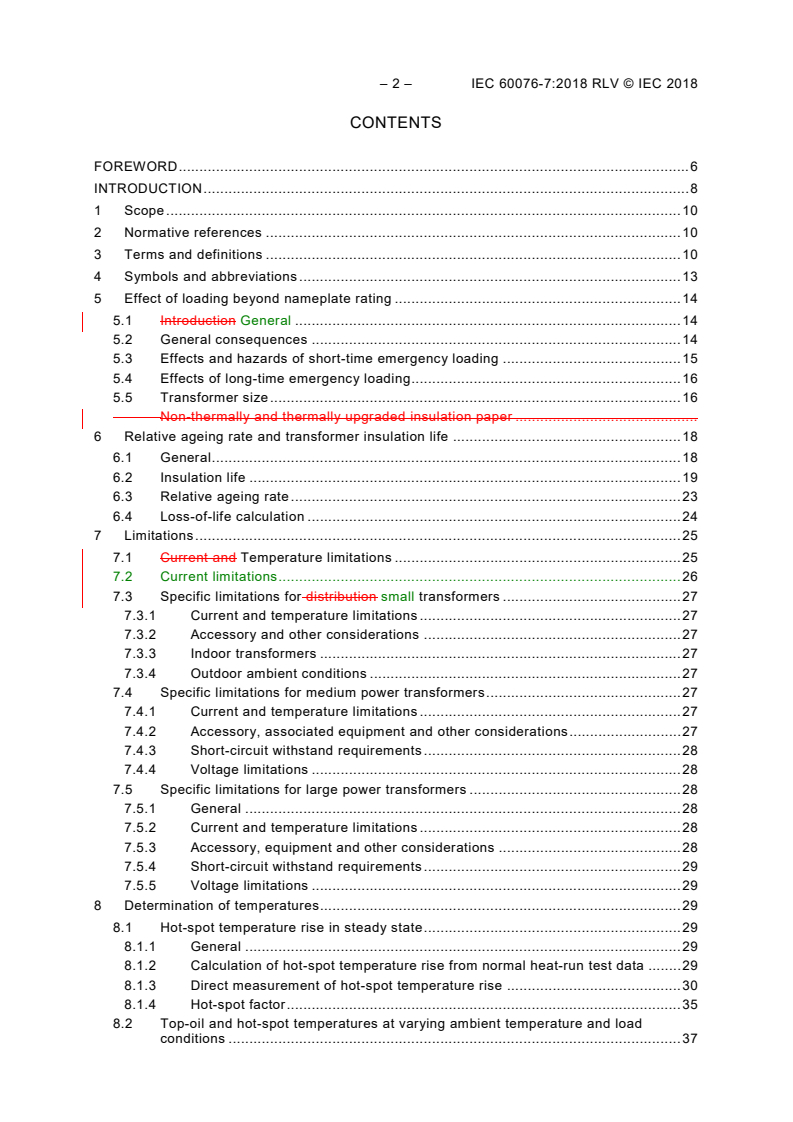
– 2 – IEC 60076-7:2018 RLV © IEC 2018
CONTENTS
FOREWORD . 6
INTRODUCTION . 8
1 Scope . 10
2 Normative references . 10
3 Terms and definitions . 10
4 Symbols and abbreviations . 13
5 Effect of loading beyond nameplate rating . 14
5.1 Introduction General . 14
5.2 General consequences . 14
5.3 Effects and hazards of short-time emergency loading . 15
5.4 Effects of long-time emergency loading . 16
5.5 Transformer size . 16
Non-thermally and thermally upgraded insulation paper .
6 Relative ageing rate and transformer insulation life . 18
6.1 General . 18
6.2 Insulation life . 19
6.3 Relative ageing rate . 23
6.4 Loss-of-life calculation . 24
7 Limitations . 25
7.1 Current and Temperature limitations . 25
7.2 Current limitations . 26
7.3 Specific limitations for distribution small transformers . 27
7.3.1 Current and temperature limitations . 27
7.3.2 Accessory and other considerations . 27
7.3.3 Indoor transformers . 27
7.3.4 Outdoor ambient conditions . 27
7.4 Specific limitations for medium power transformers . 27
7.4.1 Current and temperature limitations . 27
7.4.2 Accessory, associated equipment and other considerations . 27
7.4.3 Short-circuit withstand requirements . 28
7.4.4 Voltage limitations . 28
7.5 Specific limitations for large power transformers . 28
7.5.1 General . 28
7.5.2 Current and temperature limitations . 28
7.5.3 Accessory, equipment and other considerations . 28
7.5.4 Short-circuit withstand requirements . 29
7.5.5 Voltage limitations . 29
8 Determination of temperatures . 29
8.1 Hot-spot temperature rise in steady state . 29
8.1.1 General . 29
8.1.2 Calculation of hot-spot temperature rise from normal heat-run test data . 29
8.1.3 Direct measurement of hot-spot temperature rise . 30
8.1.4 Hot-spot factor . 35
8.2 Top-oil and hot-spot temperatures at varying ambient temperature and load
conditions . 37
8.2.1 General . 37
8.2.2 Exponential equations solution . 39
8.2.3 Differential Difference equations solution . 44
8.3 Ambient temperature. 46
8.3.1 Outdoor air-cooled transformers . 46
8.3.2 Correction of ambient temperature for transformer enclosure . 47
8.3.3 Water-cooled transformers . 48
9 Influence of tap-changers . 48
9.1 General . 48
9.2 Short-circuit losses Load loss . 48
9.3 Ratio of losses . 48
9.4 Load factor . 49
Annex A (informative) Insulation life expectancy and relative ageing rate considering
oxygen and water effect . 50
A.1 Insulation life expectancy . 50
A.2 Relative ageing rate considering oxygen and water effect . 52
Annex B (informative) Core temperature . 55
B.1 General . 55
B.2 Core hot-spot locations . 55
Annex C (informative) Specification of loading beyond rated power . 56
Annex D (informative) Description of Q, S and H factors . 58
Annex E (informative) Calculation of winding and oil time constant . 61
Annex F (informative) Thermal model parameters . 63
F.1 General . 63
F.2 Thermal constant estimation: experimental approach . 63
F.3 Dynamic thermal modelling: further development . 65
Annex G (informative) Oil and winding exponents . 66
G.1 General . 66
G.2 Historical background . 66
G.3 Theoretical approach . 68
G.4 Extended temperature rise test approach . 70
Annex H (informative) Practical example of the exponential equations method . 72
H.1 Introduction General . 72
H.2 Time period 0 min to 190 min . 73
H.3 Time period 190 min to 365 min . 74
H.4 Time period 365 min to 500 min . 74
H.5 Time period 500 min to 710 705 min . 75
H.6 Time period 710 705 min to 735 730 min . 76
H.7 Time period 735 730 min to 750 745 min . 77
H.8 Comparison with measured values . 77
Annex I (informative) Illustration Application of the differential difference equation
solution method . 79
I.1 General . 82
I.2 Example. 82
I.3 Use of measured top-oil temperature . 87
Annex J (informative) Flowchart, based on the example in Annex H . 88
Annex K (informative) Example of calculating and presenting overload data . 90
– 4 – IEC 60076-7:2018 RLV © IEC 2018
Annex L (informative) Geomagnetic induced currents . 94
L.1 Background. 94
L.2 GIC capability of power transformers [54], [55]. 94
Annex M (informative) Alternative oils . 96
Bibliography . 97
Figure – Sealed tube accelerated ageing in mineral oil at 150 °C .
Figure – Local temperature rises above air temperature in a 120 kV winding at a load
factor of 1,6 .
Figure – Local temperature rises above air temperature in a 410 kV winding at a load
factor of 1,6 .
Figure – Two fibre optic sensors installed in a spacer before the spacer was installed
in the 120 kV winding .
Figure 1 – Structural formula of cellulose . 18
Figure 2 – Correlation between tensile strength and DP value . 20
Figure 3 – Accelerated ageing in mineral oil at 140 °C, oxygen and moisture contents
maintained at < 6 000 ppm and 0,5 %, respectively . 21
Figure 4 – Expected life for non-thermally upgraded paper and its dependence upon
moisture, oxygen and temperature . 22
Figure 5 – Expected life for thermally upgraded paper and its dependence upon
moisture, oxygen and temperature . 23
Figure 6 – Thermal diagram . 30
Figure 7 – Temperature rises above top-oil temperature (in tank) 65,8 °C of the zig-zag
cooled HV-winding of a 400 MVA ONAF cooled 3-phase transformer, load current 1,0
p.u., tap position (-) . 33
Figure 8 – Coil edges, where the sensors should be located in the edge with the higher
calculated temperature rise . 34
Figure 9 – Temperature rises above top-oil temperature at the end of an 8 h thermal
no-load test at 110 % supply voltage. 35
Figure 10 – Zigzag-cooled winding where the distance between all sections is the
same and the flow-directing washer is installed in the space between sections . 36
Figure 11 – Top view section of a rectangular winding with “collapsed cooling duct
arrangement” under the yokes . 37
Figure 12 – Block diagram representation of the differential equations . 38
Figure 13 – Temperature responses to step changes in the load current . 40
Figure 14 – The function f (t) f (t) ∆θ (t)/∆θ generated by the values given in Table 4 . 44
2 2 h hr
Figure 15 – Principle of losses as a function of the tap position . 48
Figure A.1 – Arrhenius plot for an ageing process . 51
Figure F.1 – Hot-spot and top-oil overall model . 65
Figure G.1 – Extended temperature rise test . 70
Figure G.2 – Transformer exponent estimation plots . 71
Figure H.1 – Hot-spot temperature response to step changes in the load current . 77
Figure H.2 – Top-oil temperature response to step changes in the load current . 78
Figure I.1 – Plotted input data for the example . 84
Figure I.2 – Plotted output data for the example . 87
Figure K.1 – OF large power transformers: permissible duties for normal loss of life . 93
Figure L.1 – GIC flow into a power transformer . 94
Table – Life of paper under various conditions .
Table – Normal insulation life of a well-dried, oxygen-free thermally upgraded insulation
system at the reference temperature of 110 °C .
Table – Current and temperature limits applicable to loading beyond nameplate rating .
Table 1 – Relative ageing rates due to hot-spot temperature . 24
Table 2 – Maximum permissible temperature limits applicable to loading beyond
nameplate rating . 26
Table 3 – Recommended current limits applicable to loading beyond nameplate rating . 27
Table 4 – Recommended thermal characteristics for exponential equations . 43
Table 5 – Correction for increase in ambient temperature due to enclosure . 47
Table A.1 – Activation energy (E ) and environment factor (A) for oxidation, hydrolysis . 51
A
Table A.2 – Expected life of paper under various conditions . 52
Table A.3 – Relative ageing rates due to hot-spot temperature, oxygen and moisture
for non-upgraded paper insulation . 53
Table A.4 – Relative ageing rates due to hot-spot temperature, oxygen and moisture
for upgraded paper insulation . 54
Table H.1 – Load steps of the 250 MVA transformer . 72
Table H.2 – Temperatures at the end of each load step . 78
Table I.1 – Input data for example . 83
Table I.2 – Output data for the example . 86
Table K.1 – Example characteristics related to the loadability of transformers . 90
Table K.2 – An example table with the permissible duties and corresponding daily loss
of life (in “normal” days), and maximum hot-spot temperature rise during the load
cycle . 92
– 6 – IEC 60076-7:2018 RLV © IEC 2018
INTERNATIONAL ELECTROTECHNICAL COMMISSION
____________
POWER TRANSFORMERS –
Part 7: Loading guide for mineral-oil-immersed
power transformers
FOREWORD
1) The International Electrotechnical Commission (IEC) is a worldwide organization for standardization comprising
all national electrotechnical committees (IEC National Committees). The object of IEC is to promote
international co-operation on all questions concerning standardization in the electrical and electronic fields. To
this end and in addition to other activities, IEC publishes International Standards, Technical Specifications,
Technical Reports, Publicly Available Specifications (PAS) and Guides (hereafter referred to as “IEC
Publication(s)”). Their preparation is entrusted to technical committees; any IEC National Committee interested
in the subject dealt with may participate in this preparatory work. International, governmental and non-
governmental organizations liaising with the IEC also participate in this preparation. IEC collaborates closely
with the International Organization for Standardization (ISO) in accordance with conditions determined by
agreement between the two organizations.
2) The formal decisions or agreements of IEC on technical matters express, as nearly as possible, an international
consensus of opinion on the relevant subjects since each technical committee has representation from all
interested IEC National Committees.
3) IEC Publications have the form of recommendations for international use and are accepted by IEC National
Committees in that sense. While all reasonable efforts are made to ensure that the technical content of IEC
Publications is accurate, IEC cannot be held responsible for the way in which they are used or for any
misinterpretation by any end user.
4) In order to promote international uniformity, IEC National Committees undertake to apply IEC Publications
transparently to the maximum extent possible in their national and regional publications. Any divergence
between any IEC Publication and the corresponding national or regional publication shall be clearly indicated in
the latter.
5) IEC itself does not provide any attestation of conformity. Independent certification bodies provide conformity
assessment services and, in some areas, access to IEC marks of conformity. IEC is not responsible for any
services carried out by independent certification bodies.
6) All users should ensure that they have the latest edition of this publication.
7) No liability shall attach to IEC or its directors, employees, servants or agents including individual experts and
members of its technical committees and IEC National Committees for any personal injury, property damage or
other damage of any nature whatsoever, whether direct or indirect, or for costs (including legal fees) and
expenses arising out of the publication, use of, or reliance upon, this IEC Publication or any other IEC
Publications.
8) Attention is drawn to the Normative references cited in this publication. Use of the referenced publications is
indispensable for the correct application of this publication.
9) Attention is drawn to the possibility that some of the elements of this IEC Publication may be the subject of
patent rights. IEC shall not be held responsible for identifying any or all such patent rights.
This redline version of the official IEC Standard allows the user to identify the changes
made to the previous edition. A vertical bar appears in the margin wherever a change
has been made. Additions are in green text, deletions are in strikethrough red text.
International Standard IEC 60076-7 has been prepared by IEC technical committee 14: Power
transformers.
This second edition cancels and replaces the first edition published in 2005. It constitutes a
technical revision. This edition includes the following significant technical changes with
respect to the previous edition:
a) title has been updated from "oil-immersed power transformers" to "mineral-oil-immersed
power transformers";
b) insulation life is updated by considering latest research findings;
c) temperature limits have been reviewed and maximum core temperature is recommended;
d) number of fibre optic sensors is recommended for temperature rise test;
e) Q, S and H factors are considered;
f) thermal models are revised and rewritten in generally applicable mathematical form;
g) geomagnetic induced currents are briefly discussed and corresponding temperature limits
are suggested;
h) extensive literature review has been performed and a number of references added to
bibliography.
The text of this standard is based on the following documents:
FDIS Report on voting
14/933/FDIS 14/942/RVD
Full information on the voting for the approval of this standard can be found in the report on
voting indicated in the above table.
This publication has been drafted in accordance with the ISO/IEC Directives, Part 2.
A list of all parts of the IEC 60076 series, under the general title Power transformers, can be
found on the IEC website.
The committee has decided that the contents of this publication will remain unchanged until
the stability date indicated on the IEC website under "http://webstore.iec.ch" in the data
related to the specific publication. At this date, the publication will be
• reconfirmed,
• withdrawn,
• replaced by a revised edition, or
• amended.
IMPORTANT – The 'colour inside' logo on the cover page of this publication indicates
that it contains colours which are considered to be useful for the correct
understanding of its contents. Users should therefore print this document using a
colour printer.
– 8 – IEC 60076-7:2018 RLV © IEC 2018
INTRODUCTION
This part of IEC 60076 provides guidance for the specification and loading of power
transformers from the point of view of operating temperatures and thermal ageing. It provides
recommendations for loading above the nameplate rating and guidance for the planner to
choose appropriate rated quantities and loading conditions for new installations.
IEC 60076-2 is the basis for contractual agreements and it contains the requirements and
tests relating to temperature-rise figures for oil-immersed transformers during continuous
rated loading. It should be noted that IEC 60076-2 refers to the average winding temperature
rise while this part of IEC 60076 refers mainly to the hot-spot temperature and the stated
values are provided only for guidance.
This part of IEC 60076 gives mathematical models for judging the consequence of different
loadings, with different temperatures of the cooling medium, and with transient or cyclical
variation with time. The models provide for the calculation of operating temperatures in the
transformer, particularly the temperature of the hottest part of the winding. This hot-spot
temperature is, in turn, used for evaluation of a relative value for the rate of thermal ageing
and the percentage of life consumed in a particular time period. The modelling refers to small
transformers, here called distribution transformers, and to power transformers.
A major change from IEC 60354:1991 is the increased use of fibre optic temperature sensors
in transformers. This has radically increased the possibilities of obtaining a proper thermal
modelling of power transformers, especially at step changes in the load current. These
possibilities have also yielded some differences between the "oil exponent x" and the "winding
exponent y" used in this part of IEC 60076 and in IEC 60076-2:1993, for power transformers:
• x = 0,9 in IEC 60076-2, and x = 0,8 in this part of IEC 60076 at ON cooling.
• y = 1,6 in IEC 60076-2, and y = 1,3 in this part of IEC 60076 at ON and OF-cooling.
For distribution transformers, the same x and y values are used in this part of IEC 60076 as in
IEC 60076-2.
A major change from the previous edition is the extensive work on the paper degradation that
has been carried out indicating that the ageing may be described by combination of the
oxidation, hydrolysis and pyrolysis. Also, providing possibility to estimate the expected
insulation life considering different ageing factors, i.e. moisture, oxygen and temperature, and
more realistic service scenarios. The title has been updated from "oil-immersed power
transformers" to "mineral-oil-immersed power transformers". The temperature and current
limits are reviewed and the maximum core temperature is recommended. The use of fibre
optic temperature sensors has become a standard practice, however, the number of installed
sensors per transformer highly varies. This issue and the description of Q, S and H factors
are now considered as well. The thermal models are revised and rewritten in generally
applicable mathematical form. The geomagnetic induced currents are briefly discussed and
corresponding temperature limits are suggested.
This part of IEC 60076 further presents recommendations for limitations of permissible
loading according to the results of temperature calculations or measurements. These
recommendations refer to different types of loading duty – continuous loading, normal cyclic
undisturbed loading or temporary emergency loading. The recommendations refer to
distribution transformers, to medium power transformers and to large power transformers.
Clauses 1 to 7 contain definitions, common background information and specific limitations for
the operation of different categories of transformers.
Clause 8 contains the determination of temperatures, presents the mathematical models used
to estimate the hot-spot temperature in steady state and transient conditions.
Clause 9 contains a short description of the influence of the tap position.
Application examples are given in Annexes A, B, C, D, E, F, G, H, I and K.
– 10 – IEC 60076-7:2018 RLV © IEC 2018
POWER TRANSFORMERS –
Part 7: Loading guide for mineral-oil-immersed
power transformers
1 Scope
This part of IEC 60076 is applicable to mineral-oil-immersed transformers. It describes the
effect of operation under various ambient temperatures and load conditions on transformer
life.
NOTE For furnace transformers, the manufacturer should be is consulted in view of the peculiar loading profile.
2 Normative references
The following documents are referred to in the text in such a way that some or all of their
content constitutes requirements of this document. For dated references, only the edition
cited applies. For undated references, the latest edition of the referenced document (including
any amendments) applies.
IEC 60076-2:1993, Power transformers – Part 2: Temperature rise for liquid-immersed
transformers
IEC 60076-4:2002, Power transformers – Part 4: Guide to the lightning impulse and switching
impulse testing – Power transformers and reactors
IEC 60076-5:2000, power transformers – Part 5: Ability to withstand short circuit
IEC 60076-14, Power transformers – Part 14: Liquid-immersed power transformers using
high-temperature insulation materials
3 Terms and definitions
For the purposes of this document, the following terms and definitions apply.
3.1
distribution transformer
power transformer with a maximum rating of 2 500 kVA three-phase or 833 kVA single-phase
3.1
small power transformer
power transformer without attached radiators, coolers or tubes including corrugated tank
irrespective of rating
3.2
medium power transformer
power transformer with a maximum rating of 100 MVA three-phase or 33,3 MVA single-phase
3.3
large power transformer
power transformer exceeding the limits specified in 3.2 with a maximum rating of greater than
100 MVA three-phase or greater than 33,3 MVA single-phase
3.4
cyclic loading
loading with cyclic variations (the duration of the cycle usually being 24 h) which is regarded
in terms of the accumulated amount of ageing that occurs during the cycle
Note 1 to entry: The cyclic loading may either be a normal loading or a long-time emergency loading.
3.5
normal cyclic loading
loading in which a higher ambient temperature or a higher-than-rated load current is applied
during part of the cycle, but which, from the point of view of relative thermal ageing rate
(according to the mathematical model), is equivalent to the rated load at normal ambient
temperature
Note 1 to entry: This is achieved by taking advantage of low ambient temperatures or low load currents during the
rest of the load cycle. For planning purposes, this principle can be extended to provide for long periods of time
whereby cycles with relative thermal ageing rates greater than unity are compensated for by cycles with thermal
ageing rates less than unity.
3.6
long-time emergency loading
loading resulting from the prolonged outage of some system elements that will not be
reconnected before the transformer reaches a new and higher steady-state temperature
3.7
short-time emergency loading
unusually heavy loading of a transient nature (less than 30 min) due to the occurrence of one
or more unlikely events which seriously disturb normal system loading
3.8
hot-spot
if not specially defined, hottest spot of the windings
3.9
relative thermal ageing rate
for a given hot-spot temperature, rate at which transformer insulation ageing is reduced or
accelerated compared with the ageing rate at a reference hot-spot temperature
3.10
transformer insulation life
total time between the initial state for which the insulation is considered new and the final
state when for which the insulation is considered deteriorated due to thermal ageing,
dielectric stress, short-circuit stress, or mechanical movement (which could occur in normal
service), and result in at which a high risk of electrical failure exists
3.11
per cent loss of life
equivalent ageing in hours over a time period (usually 24 h) times 100 divided by the
expected transformer insulation life
Note 1 to entry: The equivalent ageing in hours is obtained by multiplying the relative ageing rate with the number
of hours.
3.12
non-thermally upgraded paper
kraft paper produced from unbleached softwood pulp under the sulphate process without
addition of stabilizers
– 12 – IEC 60076-7:2018 RLV © IEC 2018
3.13
thermally upgraded paper
cellulose-based paper which has been chemically modified to reduce the rate at which the
paper decomposes
Note 1 to entry: Ageing effects are reduced either by partial elimination of water forming agents (as in
cyanoethylation) or by inhibiting the formation of water through the use of stabilizing agents (as in amine addition,
dicyandiamide). A paper is considered as thermally upgraded if it meets the life criteria defined in
ANSI/IEEE C57.100 [1] ; 50 % retention in tensile strength after 65 000 h in a sealed tube at 110 °C or any other
time/temperature combination given by the equation:
15 000 15 000 15 000
− 28,082 −
( θ + 273 ) ( θ + 273 ) ( 110 + 273)
h h
(1)
Time (h) = e ≈ 65 000 × e
Because the thermal upgrading chemicals used today contain nitrogen, which is not present in kraft pulp, the
degree of chemical modification is determined by testing for the amount of nitrogen present in the treated paper.
Typical values for nitrogen content of thermally upgraded papers are between 1 % and 4 % when measured in
accordance with ASTM D-982 [2], but after the sealed tube test.
NOTE This definition was approved by the IEEE Transformers Committee Task Force for the Definition of
Thermally Upgraded Paper on 7 October 2003.
3.14
non-directed oil flow
OF
flow indicating that the pumped oil from heat exchangers or radiators flows freely inside the
tank, and is not forced to flow through the windings
Note 1 to entry: The oil flow inside the windings can be either axial in vertical cooling ducts or radial in horizontal
cooling ducts with or without zigzag flow.
3.15
non-directed oil flow
ON
flow indicating that the oil from the heat exchangers or radiators flows freely inside the tank
and is not forced to flow through the windings
Note 1 to entry: The oil flow inside the windings can be either axial in vertical cooling ducts or radial in horizontal
cooling ducts with or without zigzag flow.
3.16
directed oil flow
OD
flow indicating that the principal part of the pumped oil from heat exchangers or radiators is
forced to flow through the windings
Note 1 to entry: The oil flow inside the windings can be either axial in vertical cooling ducts or zigzag in horizontal
cooling ducts.
3.17
design ambient temperature
temperature at which the permissible average winding and top-oil and hot-spot temperature
over ambient temperature are defined
______________
Numbers in square brackets refer to the bibliography.
4 Symbols and abbreviations
Symbol Meaning Units
C Thermal capacity Ws/K
c Specific heat Ws/(kg·K)
DP Degree of polymerization
D Difference operator, in difference equations
g
Average-winding-to-average-oil (in tank) temperature gradient at rated current K
r
H Hot-spot factor
k Thermal model constant
k Thermal model constant
k Thermal model constant
K Load factor (load current/rated current)
L Total ageing over the time period considered h
m
Mass of core and coil assembly kg
A
m Mass of the tank and fittings kg
T
m Mass of oil kg
O
m
Mass of winding kg
W
n Number of each time interval
N Total number of intervals during the time period considered
OD Either ODAN, ODAF or ODWF cooling
OF Either OFAN, OFAF or OFWF cooling
ON Either ONAN or ONAF cooling
P Supplied losses W
P Relative winding eddy loss p.u.
e
P Winding losses W
W
R Ratio of load losses at rated current to no-load losses at rated voltage
R Ratio of load losses to no-load loss at principal tapping
r
R
Ratio of load losses to no-load loss at tapping r + 1
r+1
R
Ratio of load losses to no-load loss at minimum tapping
min
R Ratio of load losses to no-load loss at maximum tapping
max
RTD Resistance Temperature Detector
RH Oil relative humidity %
s Laplace operator
t Time variable min
tap Number of Principal tapping position
r
tap
Number of Tapping position r + 1
r+1
tap Number of Minimum tapping position
min
tap Number of Maximum tapping position
max
V Relative ageing rate
V Relative ageing rate during interval n
n
WOP Water content of oil ppm
WCP Water content of paper insulation %
x Exponential power of total losses versus top-oil (in tank) temperature rise (oil
exponent)
y Exponential power of current versus winding temperature rise (winding exponent)
– 14 – IEC 60076-7:2018 RLV © IEC 2018
Symbol Meaning Units
Ambient temperature °C
θ
a
Yearly weighted ambient temperature °C
θ
E
θ Winding hot-spot temperature °C
h
Monthly average temperature °C
θ
ma
Monthly average temperature of the hottest month, according to IEC 60076-2:1993 °C
θ
ma-max
θ Top-oil temperature (in the tank) at the load considered °C
o
Yearly average temperature, according to IEC 60076-2:1993 °C
θ
ya
Average Oil time constant min
τ
o
Winding time constant min
τ
W
∆θ Bottom oil (in tank) temperature rise at rated load (no-load losses + load losses) K
br
Hot-spot-to-top-oil (in tank) gradient at the load considered K
∆θ
h
Hot-spot-to-top-oil (in tank) gradient at start K
∆θ
hi
∆θ Hot-spot-to-top-oil (in tank) gradient at rated current K
hr
Top-oil (in tank) temperature rise at the load considered K
∆θ
o
Top-oil (in tank) temperature rise at start K
∆θ
oi
∆θ Average oil (in tank) temperature rise at the load considered K
om
K
∆θ Average oil (in tank) temperature rise at rated load (no-load losses + load losses)
omr
K
∆θ Top-oil (in tank) temperature rise in steady state at rated losses (no-load losses + load
or
losses)
Corrected top-oil temperature rise (in tank) due to enclosure K
′
∆θ
or
Extra top-oil temperature rise (in tank) due to enclosure K
∆(∆θ )
or
5 Effect of loading beyond nameplate rating
5.1 Introduction General
The normal life expectancy is a conventional reference basis for continuous duty under design
ambient temperature and rated operating conditions. The application of a load in excess of
nameplate rating and/or an ambient temperature higher than design ambient temperature
involves a degree of risk and accelerated ageing. It is the purpose of this part of IEC 60076 to
identify such risks and to indicate how, within limitations, transformers may be loaded in
excess of the nameplate rating. These risks can be reduced by the purchaser clearly
specifying the maximum loading conditions and the supplier taking these into account in the
transformer design.
5.2 General consequences
The consequences of loading a transformer beyond its nameplate rating are as follows.
a) The temperatures of windings, cleats, leads, insulation and oil will increase and can reach
unacceptable levels.
b) The leakage flux density outside the core increases, causing additional eddy-current
heating in metallic parts linked by the leakage flux.
c) As the temperature changes, the moisture and gas content in the insulation and in the oil
will change.
d) Bushings, tap-changers, cable-end connections and current transformers will also be
exposed to higher stresses which encroach upon their design and application margins.
The combination of the main flux and increased leakage flux imposes restrictions on possible
core overexcitation [6], [7], [8].
NOTE For loaded core-type transformers having an energy flow from the outer winding (usually HV) to the inner
winding (usuall
...