

IEC 62282-4-101:2014
(Main)Fuel cell technologies - Part 4-101: Fuel cell power systems for propulsion other than road vehicles and auxiliary power units (APU) - Safety of electrically powered industrial trucks
General Information
- Abstract
IEC 62282-4-101:2014 covers safety requirements for fuel cell power systems intended to be used in electrically powered industrial trucks. This standard is limited to electrically powered industrial trucks and is applicable to material-handling equipment, e.g. forklifts. It applies to gaseous hydrogen-fuelled fuel cell power systems and direct methanol fuel cell power systems for electrically powered industrial trucks.
- Status
- Published
- Publication Date
- 11-Aug-2014
- Technical Committee
- TC 105 - Fuel cell technologies
- Drafting Committee
- MT 301 - TC 105/MT 301
- Current Stage
- DELPUB - Deleted Publication
- Start Date
- 11-Aug-2022
- Completion Date
- 31-Dec-2019
Buy Documents
IEC 62282-4-101:2014 - Fuel cell technologies - Part 4-101: Fuel cell power systems for propulsion other than road vehicles and auxiliary power units (APU) - Safety of electrically powered industrial trucks Released:8/12/2014
Overview
IEC 62282-4-101:2014 is an international standard developed by the International Electrotechnical Commission (IEC), focused on safety requirements for fuel cell power systems used in electrically powered industrial trucks. This standard specifically addresses systems that use gaseous hydrogen or direct methanol as fuel and are intended for material-handling equipment, such as forklifts. The primary goal of IEC 62282-4-101:2014 is to ensure the safe integration and operation of fuel cell technologies in industrial vehicles, improving both safety and efficiency in industrial environments.
Key Topics
IEC 62282-4-101:2014 covers a range of crucial safety topics for fuel cell power systems in industrial trucks:
- Fuel Cell System Design: Requirements for construction and configuration of hydrogen-fuelled and direct methanol fuel cell systems, ensuring compatibility and safety.
- Electrical Safety: Limits on output voltage, internal and external wiring standards, and protection against electric shock for systems rated up to 150 V DC.
- Fuel Handling: Guidelines for the secure containment and handling of fuels, including permanently attached fuel source containers.
- Component Requirements: Specifications for piping, hoses, tanks, pumps, sensors, regulators, and electrical components within the fuel cell system.
- Ventilation and Emissions: Provisions to prevent the accumulation of flammable gases, manage effluents, and ensure safe discharge of vapors and liquids.
- Testing Protocols: Type tests for vibration, leakage, endurance, thermal cycling, dielectric strength, environmental resistance, and others to verify robust safety and performance.
- Markings and Instructions: Guidance on proper labeling, maintenance, operating, and installation procedures for end users.
Not within scope:
- Fuel cell systems for road vehicles, auxiliary power units (APUs), or those with detachable fuel sources, reformers, liquid hydrogen storage, hybrid internal combustion engines, or use in potentially explosive atmospheres.
Applications
The main application of IEC 62282-4-101:2014 is in advancing the use of fuel cell power systems for propulsion in electrically powered industrial trucks, such as:
- Forklifts: Promoting the safe deployment of hydrogen and methanol fuel cell systems in indoor and outdoor settings.
- Material-Handling Equipment: Widening the adoption of clean and efficient fuel cell technology in warehouse and logistics operations.
- Industrial Settings: Serving manufacturing, warehousing, and distribution sectors by supporting the shift toward low-emission vehicles.
By establishing clear, uniform safety requirements, this standard helps manufacturers, integrators, and operators ensure compliance, minimize risks, and improve operational reliability. Adherence to IEC 62282-4-101:2014 is essential for organizations considering the adoption of fuel cell-powered industrial equipment, helping to streamline certification and acceptance in global markets.
Related Standards
Several IEC and ISO standards are referenced or relevant to IEC 62282-4-101:2014, supporting comprehensive safety and performance practices:
- IEC 62282-2: Fuel cell modules - Performance and safety.
- IEC 60079 Series: Explosive atmospheres - Equipment safety.
- IEC 60204-1: Electrical equipment of machines - General requirements.
- ISO 3691 Series: Industrial trucks - Safety requirements.
- IEC 60529: Degrees of protection provided by enclosures (IP Code).
- IEC 60695 Series: Fire hazard testing for electrotechnical products.
For the latest information on related publications and updates, consult the IEC Webstore.
IEC 62282-4-101:2014 is critical for companies developing or integrating hydrogen and methanol fuel cell power systems in industrial trucks. By following this standard, stakeholders can promote safety, compliance, and increased adoption of sustainable fuel cell technologies in industrial logistics and material handling.
Relations
- Effective Date
- 05-Sep-2023
Buy Documents
IEC 62282-4-101:2014 - Fuel cell technologies - Part 4-101: Fuel cell power systems for propulsion other than road vehicles and auxiliary power units (APU) - Safety of electrically powered industrial trucks Released:8/12/2014
Get Certified
Connect with accredited certification bodies for this standard

DNV
DNV is an independent assurance and risk management provider.

Lloyd's Register
Lloyd's Register is a global professional services organisation specialising in engineering and technology.
DNV Energy Systems
Energy and renewable energy certification.
Sponsored listings
Frequently Asked Questions
IEC 62282-4-101:2014 is a standard published by the International Electrotechnical Commission (IEC). Its full title is "Fuel cell technologies - Part 4-101: Fuel cell power systems for propulsion other than road vehicles and auxiliary power units (APU) - Safety of electrically powered industrial trucks". This standard covers: IEC 62282-4-101:2014 covers safety requirements for fuel cell power systems intended to be used in electrically powered industrial trucks. This standard is limited to electrically powered industrial trucks and is applicable to material-handling equipment, e.g. forklifts. It applies to gaseous hydrogen-fuelled fuel cell power systems and direct methanol fuel cell power systems for electrically powered industrial trucks.
IEC 62282-4-101:2014 covers safety requirements for fuel cell power systems intended to be used in electrically powered industrial trucks. This standard is limited to electrically powered industrial trucks and is applicable to material-handling equipment, e.g. forklifts. It applies to gaseous hydrogen-fuelled fuel cell power systems and direct methanol fuel cell power systems for electrically powered industrial trucks.
IEC 62282-4-101:2014 is classified under the following ICS (International Classification for Standards) categories: 27.070 - Fuel cells. The ICS classification helps identify the subject area and facilitates finding related standards.
IEC 62282-4-101:2014 has the following relationships with other standards: It is inter standard links to IEC 62282-4-101:2022. Understanding these relationships helps ensure you are using the most current and applicable version of the standard.
IEC 62282-4-101:2014 is available in PDF format for immediate download after purchase. The document can be added to your cart and obtained through the secure checkout process. Digital delivery ensures instant access to the complete standard document.
Standards Content (Sample)
IEC 62282-4-101 ®
Edition 1.0 2014-08
INTERNATIONAL
STANDARD
NORME
INTERNATIONALE
Fuel cell technologies –
Part 4-101: Fuel cell power systems for propulsion other than road vehicles and
auxiliary power units (APU) – Safety of electrically powered industrial trucks
Technologies des piles à combustible –
Partie 4-101: Systèmes à piles à combustible pour la propulsion, autres que les
véhicules routiers et groupes auxiliaires de puissance (GAP) – Sécurité pour
chariots de manutention électriques
All rights reserved. Unless otherwise specified, no part of this publication may be reproduced or utilized in any form
or by any means, electronic or mechanical, including photocopying and microfilm, without permission in writing from
either IEC or IEC's member National Committee in the country of the requester. If you have any questions about IEC
copyright or have an enquiry about obtaining additional rights to this publication, please contact the address below or
your local IEC member National Committee for further information.
Droits de reproduction réservés. Sauf indication contraire, aucune partie de cette publication ne peut être reproduite
ni utilisée sous quelque forme que ce soit et par aucun procédé, électronique ou mécanique, y compris la photocopie
et les microfilms, sans l'accord écrit de l'IEC ou du Comité national de l'IEC du pays du demandeur. Si vous avez des
questions sur le copyright de l'IEC ou si vous désirez obtenir des droits supplémentaires sur cette publication, utilisez
les coordonnées ci-après ou contactez le Comité national de l'IEC de votre pays de résidence.
IEC Central Office Tel.: +41 22 919 02 11
3, rue de Varembé Fax: +41 22 919 03 00
CH-1211 Geneva 20 info@iec.ch
Switzerland www.iec.ch
About the IEC
The International Electrotechnical Commission (IEC) is the leading global organization that prepares and publishes
International Standards for all electrical, electronic and related technologies.
About IEC publications
The technical content of IEC publications is kept under constant review by the IEC. Please make sure that you have the
latest edition, a corrigenda or an amendment might have been published.
IEC Catalogue - webstore.iec.ch/catalogue Electropedia - www.electropedia.org
The stand-alone application for consulting the entire The world's leading online dictionary of electronic and
bibliographical information on IEC International Standards, electrical terms containing more than 30 000 terms and
Technical Specifications, Technical Reports and other definitions in English and French, with equivalent terms in 14
documents. Available for PC, Mac OS, Android Tablets and additional languages. Also known as the International
iPad. Electrotechnical Vocabulary (IEV) online.
IEC publications search - www.iec.ch/searchpub IEC Glossary - std.iec.ch/glossary
The advanced search enables to find IEC publications by a More than 55 000 electrotechnical terminology entries in
variety of criteria (reference number, text, technical English and French extracted from the Terms and Definitions
committee,…). It also gives information on projects, replaced clause of IEC publications issued since 2002. Some entries
and withdrawn publications. have been collected from earlier publications of IEC TC 37,
77, 86 and CISPR.
IEC Just Published - webstore.iec.ch/justpublished
Stay up to date on all new IEC publications. Just Published IEC Customer Service Centre - webstore.iec.ch/csc
details all new publications released. Available online and If you wish to give us your feedback on this publication or
also once a month by email. need further assistance, please contact the Customer Service
Centre: csc@iec.ch.
A propos de l'IEC
La Commission Electrotechnique Internationale (IEC) est la première organisation mondiale qui élabore et publie des
Normes internationales pour tout ce qui a trait à l'électricité, à l'électronique et aux technologies apparentées.
A propos des publications IEC
Le contenu technique des publications IEC est constamment revu. Veuillez vous assurer que vous possédez l’édition la
plus récente, un corrigendum ou amendement peut avoir été publié.
Catalogue IEC - webstore.iec.ch/catalogue Electropedia - www.electropedia.org
Application autonome pour consulter tous les renseignements
Le premier dictionnaire en ligne de termes électroniques et
bibliographiques sur les Normes internationales,
électriques. Il contient plus de 30 000 termes et définitions en
Spécifications techniques, Rapports techniques et autres
anglais et en français, ainsi que les termes équivalents dans
documents de l'IEC. Disponible pour PC, Mac OS, tablettes
14 langues additionnelles. Egalement appelé Vocabulaire
Android et iPad.
Electrotechnique International (IEV) en ligne.
Recherche de publications IEC - www.iec.ch/searchpub
Glossaire IEC - std.iec.ch/glossary
Plus de 55 000 entrées terminologiques électrotechniques, en
La recherche avancée permet de trouver des publications IEC
en utilisant différents critères (numéro de référence, texte, anglais et en français, extraites des articles Termes et
comité d’études,…). Elle donne aussi des informations sur les Définitions des publications IEC parues depuis 2002. Plus
projets et les publications remplacées ou retirées. certaines entrées antérieures extraites des publications des
CE 37, 77, 86 et CISPR de l'IEC.
IEC Just Published - webstore.iec.ch/justpublished
Service Clients - webstore.iec.ch/csc
Restez informé sur les nouvelles publications IEC. Just
Published détaille les nouvelles publications parues. Si vous désirez nous donner des commentaires sur cette
Disponible en ligne et aussi une fois par mois par email. publication ou si vous avez des questions contactez-nous:
csc@iec.ch.
IEC 62282-4-101 ®
Edition 1.0 2014-08
INTERNATIONAL
STANDARD
NORME
INTERNATIONALE
Fuel cell technologies –
Part 4-101: Fuel cell power systems for propulsion other than road vehicles and
auxiliary power units (APU) – Safety of electrically powered industrial trucks
Technologies des piles à combustible –
Partie 4-101: Systèmes à piles à combustible pour la propulsion, autres que les
véhicules routiers et groupes auxiliaires de puissance (GAP) – Sécurité pour
chariots de manutention électriques
INTERNATIONAL
ELECTROTECHNICAL
COMMISSION
COMMISSION
ELECTROTECHNIQUE
PRICE CODE
INTERNATIONALE
CODE PRIX XA
ICS 27.070 ISBN 978-2-8322-1811-2
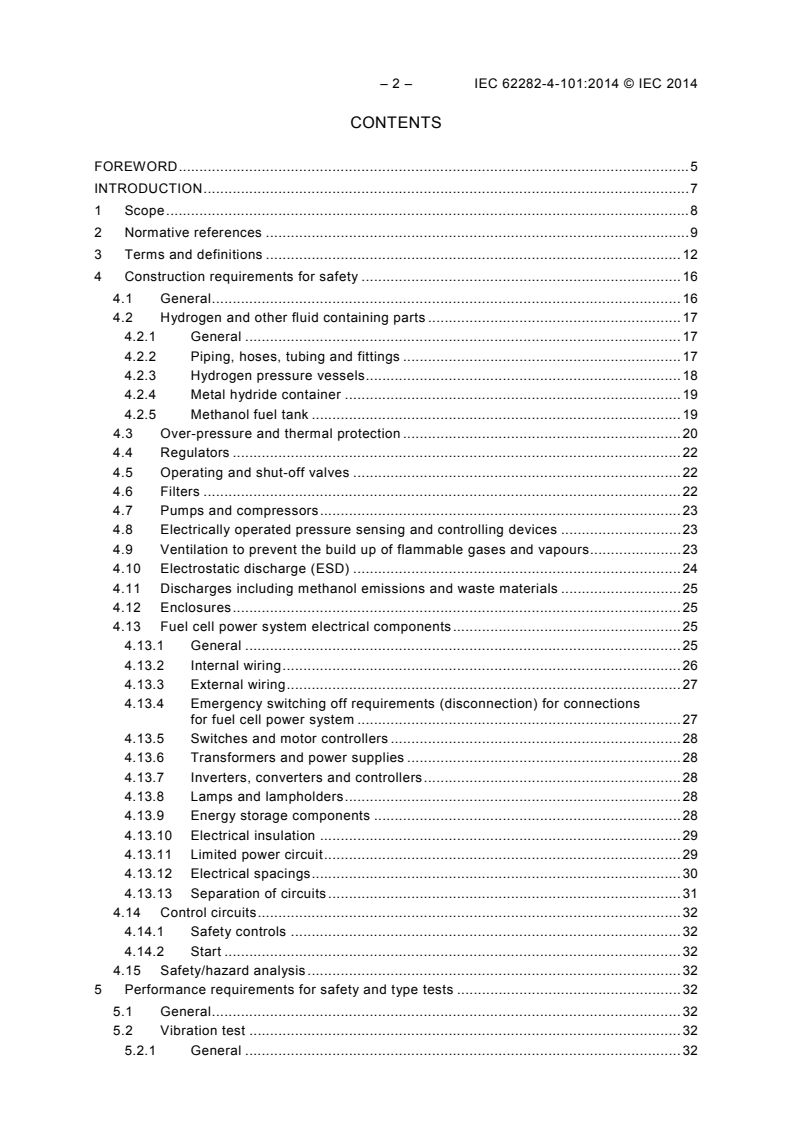
– 2 – IEC 62282-4-101:2014 © IEC 2014
CONTENTS
FOREWORD . 5
INTRODUCTION . 7
1 Scope . 8
2 Normative references . 9
3 Terms and definitions . 12
4 Construction requirements for safety . 16
4.1 General . 16
4.2 Hydrogen and other fluid containing parts . 17
4.2.1 General . 17
4.2.2 Piping, hoses, tubing and fittings . 17
4.2.3 Hydrogen pressure vessels. 18
4.2.4 Metal hydride container . 19
4.2.5 Methanol fuel tank . 19
4.3 Over-pressure and thermal protection . 20
4.4 Regulators . 22
4.5 Operating and shut-off valves . 22
4.6 Filters . 22
4.7 Pumps and compressors . 23
4.8 Electrically operated pressure sensing and controlling devices . 23
4.9 Ventilation to prevent the build up of flammable gases and vapours . 23
4.10 Electrostatic discharge (ESD) . 24
4.11 Discharges including methanol emissions and waste materials . 25
4.12 Enclosures . 25
4.13 Fuel cell power system electrical components . 25
4.13.1 General . 25
4.13.2 Internal wiring . 26
4.13.3 External wiring . 27
4.13.4 Emergency switching off requirements (disconnection) for connections
for fuel cell power system . 27
4.13.5 Switches and motor controllers . 28
4.13.6 Transformers and power supplies . 28
4.13.7 Inverters, converters and controllers . 28
4.13.8 Lamps and lampholders . 28
4.13.9 Energy storage components . 28
4.13.10 Electrical insulation . 29
4.13.11 Limited power circuit . 29
4.13.12 Electrical spacings . 30
4.13.13 Separation of circuits . 31
4.14 Control circuits . 32
4.14.1 Safety controls . 32
4.14.2 Start . 32
4.15 Safety/hazard analysis . 32
5 Performance requirements for safety and type tests . 32
5.1 General . 32
5.2 Vibration test . 32
5.2.1 General . 32
5.2.2 Vertical axis test . 33
5.2.3 Longitudinal and lateral axes tests . 33
5.3 Fuel container securement test . 33
5.4 Endurance test. 33
5.5 External leakage test . 33
5.5.1 External leakage – Hazardous gas containing portions (determination of
dilution boundary) . 33
5.5.2 External leakage – Hazardous liquid containing portions . 34
5.6 Ultimate strength test . 34
5.6.1 Ultimate strength – Hazardous liquids and pressurized parts . 34
5.6.2 Ultimate strength – Hazardous gas and pressurized parts . 34
5.6.3 Ultimate strength -Fuel cell modules . 34
5.7 Potential failure modes test . 34
5.8 Temperature test . 35
5.9 Continuity test . 37
5.10 Touch current test . 37
5.11 Dielectric voltage – Withstand test . 38
5.12 Non-metallic tubing test for accumulation of static electricity . 39
5.12.1 Passing criteria . 39
5.12.2 Test method . 39
5.13 Limited power circuit test . 39
5.14 Maximum VA test . 40
5.15 Abnormal operation test – Electric equipment failures . 40
5.16 Emission of effluents test (only for methanol fuel cells) . 41
5.17 Environmental test . 41
5.17.1 General . 41
5.17.2 Rain test . 41
5.17.3 Test of equipment – Exposure to wind . 42
5.18 Enclosure tests . 42
5.18.1 Enclosure loading test . 42
5.18.2 Test for thermoplastic enclosures . 42
5.19 20 mm moulded part needle flame test for thermoplastic materials . 42
5.20 Marking plate adhesion test . 43
5.21 Test for elastomeric seals, gaskets and tubing . 43
5.21.1 General . 43
5.21.2 Accelerated air-oven aging test . 43
5.21.3 Cold temperature exposure test . 43
5.21.4 Immersion test . 43
5.22 Test for permeation of non-metallic tubing and piping . 44
5.23 Test for electrical output leads . 44
6 Routine tests . 44
6.1 Dielectric voltage-withstand test . 44
6.2 External leakage . 44
7 Markings . 44
8 Instructions . 45
8.1 General . 45
8.2 Maintenance instructions . 45
8.3 Operating instructions . 46
8.4 Installation instructions . 46
– 4 – IEC 62282-4-101:2014 © IEC 2014
Annex A (informative) Comparison of pressure terms. 47
Bibliography . 48
Figure 1 – Fuel cell power systems for industrial trucks . 9
Figure 2 – Example of a diagram with vent system covering components downstream
of the regulator . 21
Figure 3 – Example of a diagram with vent system covering all components . 21
Figure 4 – Example of a diagram with vent system covering all components in a
multiple storage tank system . 22
Figure 5 – Measuring network, touch current weighted for perception or reaction . 38
Figure 6 – Diagram for touch current measurement test . 38
Table 1 – Appliance-wiring material . 26
Table 2 – Spacings . 31
Table 3 – Temperature rise limits . 35
Table 4 – Limits for inherently limited power sources . 40
Table 5 – Limits for power sources not inherently limited (overcurrent protection
required) . 40
Table 6 – Emission rate limits . 41
Table A.1 – Comparison table of pressure terms . 47
INTERNATIONAL ELECTROTECHNICAL COMMISSION
____________
FUEL CELL TECHNOLOGIES –
Part 4-101: Fuel cell power systems for propulsion other
than road vehicles and auxiliary power units (APU) –
Safety of electrically powered industrial trucks
FOREWORD
1) The International Electrotechnical Commission (IEC) is a worldwide organization for standardization comprising
all national electrotechnical committees (IEC National Committees). The object of IEC is to promote
international co-operation on all questions concerning standardization in the electrical and electronic fields. To
this end and in addition to other activities, IEC publishes International Standards, Technical Specifications,
Technical Reports, Publicly Available Specifications (PAS) and Guides (hereafter referred to as “IEC
Publication(s)”). Their preparation is entrusted to technical committees; any IEC National Committee interested
in the subject dealt with may participate in this preparatory work. International, governmental and non-
governmental organizations liaising with the IEC also participate in this preparation. IEC collaborates closely
with the International Organization for Standardization (ISO) in accordance with conditions determined by
agreement between the two organizations.
2) The formal decisions or agreements of IEC on technical matters express, as nearly as possible, an international
consensus of opinion on the relevant subjects since each technical committee has representation from all
interested IEC National Committees.
3) IEC Publications have the form of recommendations for international use and are accepted by IEC National
Committees in that sense. While all reasonable efforts are made to ensure that the technical content of IEC
Publications is accurate, IEC cannot be held responsible for the way in which they are used or for any
misinterpretation by any end user.
4) In order to promote international uniformity, IEC National Committees undertake to apply IEC Publications
transparently to the maximum extent possible in their national and regional publications. Any divergence
between any IEC Publication and the corresponding national or regional publication shall be clearly indicated in
the latter.
5) IEC itself does not provide any attestation of conformity. Independent certification bodies provide conformity
assessment services and, in some areas, access to IEC marks of conformity. IEC is not responsible for any
services carried out by independent certification bodies.
6) All users should ensure that they have the latest edition of this publication.
7) No liability shall attach to IEC or its directors, employees, servants or agents including individual experts and
members of its technical committees and IEC National Committees for any personal injury, property damage or
other damage of any nature whatsoever, whether direct or indirect, or for costs (including legal fees) and
expenses arising out of the publication, use of, or reliance upon, this IEC Publication or any other IEC
Publications.
8) Attention is drawn to the Normative references cited in this publication. Use of the referenced publications is
indispensable for the correct application of this publication.
9) Attention is drawn to the possibility that some of the elements of this IEC Publication may be the subject of
patent rights. IEC shall not be held responsible for identifying any or all such patent rights.
International Standard IEC 62282-4-101 has been prepared by IEC technical committee 105:
Fuel cell technologies.
The text of this standard is based on the following documents:
FDIS Report on voting
105/506/FDIS 105/513/RVD
Full information on the voting for the approval of this standard can be found in the report on
voting indicated in the above table.
This publication has been drafted in accordance with the ISO/IEC Directives, Part 2.
– 6 – IEC 62282-4-101:2014 © IEC 2014
A list of all parts of IEC 62282 series, published under the general title Full cell technologies,
can be found on the IEC website.
The committee has decided that the contents of this publication will remain unchanged until
the stability date indicated on the IEC web site under "http://webstore.iec.ch" in the data
related to the specific publication. At this date, the publication will be
• reconfirmed,
• withdrawn,
• replaced by a revised edition, or
• amended.
INTRODUCTION
IEC 62282-4 deals with categories such as safety, performance and interchangeability of fuel
cell power systems for propulsion other than road vehicles and auxiliary power units (APU).
Among the categories mentioned above, this standard, IEC 62282-4-101, focuses on safety of
industrial electric trucks with fuel cell power systems because such an application is urgently
demanded in the world. The future standards in the Part 4 series will deal with other
applications related to onboard vehicles other than road vehicles and auxiliary power units
(APU).
– 8 – IEC 62282-4-101:2014 © IEC 2014
FUEL CELL TECHNOLOGIES –
Part 4-101: Fuel cell power systems for propulsion other
than road vehicles and auxiliary power units (APU) –
Safety of electrically powered industrial trucks
1 Scope
1.1 This part of IEC 62282 covers safety requirements for fuel cell power systems intended
to be used in electrically powered industrial trucks.
1.2 This standard is limited to electrically powered industrial trucks and is applicable to
material-handling equipment, e.g. forklifts.
1.3 This standard applies to gaseous hydrogen-fuelled fuel cell power systems and direct
methanol fuel cell power systems for electrically powered industrial trucks.
1.4 The following fuels are considered within the scope of this standard:
– gaseous hydrogen
– methanol.
1.5 This standard covers the fuel cell power system as defined in 3.8 and Figure 1.
1.6 This standard applies to d.c. type fuel cell power systems, with a rated output voltage
not exceeding 150 V d.c. for indoor and outdoor use.
1.7 This standard covers fuel cell power systems whose fuel source container is
permanently attached to either the industrial truck or the fuel cell power system.
1.8 The following are not included in the scope of this standard:
– detachable type fuel source containers;
– hybrid trucks that include an internal combustion engine;
– reformer-equipped fuel cell power systems;
– fuel cell power systems intended for operation in potentially explosive atmospheres;
– fuel storage systems using liquid hydrogen.
Fuel (hydrogen, methanol)
Coolant
System boundary
Excess/released fuel
Fuel storage
(hydrogen,
Thermal
Waste heat
methanol)
management
Internal power needs
Fuel
Power
regulating &
Electrical
conditioning
piping
Conditioner power output
Fuel cell
system
and
Oxidant (air) module
processing
(stack)
system
Energy
storage
Ventilation air
Exhaust gases
Ventilation
system
Discharge water
Water
Water
(liquid or gaseous)
treatment and
Control
containment
system
EMD
Vibration,
EMI
wind, rain,
Noise,
temperature.
vibration
IEC
Key
EMD electromagnetic disturbance.
EMI electromagnetic interference.
NOTE A fuel cell power system may contain all or some of the above components.
Figure 1 – Fuel cell power systems for industrial trucks
2 Normative references
The following documents, in whole or in part, are normatively referenced in this document and
are indispensable for its application. For dated references, only the edition cited applies. For
undated references, the latest edition of the referenced document (including any
amendments) applies.
IEC 60079-0, Explosive atmospheres – Part 0: Equipment – General requirements
IEC 60079-10-1, Explosive atmospheres – Part 10-1: Classification of areas – Explosive gas
atmospheres
IEC 60079-29-1, Explosive atmospheres – Part 29-1: Gas detectors – Performance
requirements of detectors for flammable gases
IEC 60079-29-4, Explosive atmospheres – Part 29-4: Gas detectors – Performance
requirements of open path detectors for flammable gases
IEC 60204-1, Safety of machinery – Electrical equipment of machines – Part 1: General
requirements
IEC 60227-3, Polyvinyl chloride insulated cables of rated voltages up to and including
450/750 V – Part 3: Non-sheathed cables for fixed wiring
IEC 60227-5, Polyvinyl chloride insulated cables of rated voltages up to and including
450/750 V – Part 5: Flexible cables (cords)
– 10 – IEC 62282-4-101:2014 © IEC 2014
IEC 60335-2-41, Household and similar electrical appliances – Safety – Part 2-41: Particular
requirements for pumps
IEC 60335-2-80, Household and similar electrical appliances – Safety – Part 2-80: Particular
requirements for fans
IEC 60364-4-41:2005, Low-voltage electrical installations – Part 4-41: Protection for safety –
Protection against electric shock
IEC 60529, Degrees of protection provided by enclosures (IP Code)
IEC 60584-1, Thermocouples – Part 1: Reference tables
IEC 60664-1, Insulation coordination for equipment within low-voltage systems – Part 1:
Principles, requirements and tests
IEC 60695 (all parts), Fire hazard testing
IEC 60695-1-30, Fire hazard testing – Part 1-30: Guidance for assessing the fire hazard of
electrotechnical products – Preselection testing process – General guidelines
IEC 60695-10-2, Fire hazard testing – Part 10-2: Abnormal heat – Ball pressure test
IEC 60695-11-4, Fire hazard testing – Part 11-4: Test flames – 50 W flame – Apparatus and
confirmational test method
IEC 60695-11-10, Fire hazard testing – Part 11-10: Test flames – 50 W horizontal and vertical
flame test methods
IEC 60730-1:2013, Automatic electrical controls for household and similar use – Part 1:
General requirements
IEC 60730-2-17, Automatic electrical controls for household and similar use – Part 2-17:
Particular requirements for electrically operated gas valves, including mechanical
requirements
IEC 60947-3, Low-voltage switchgear and controlgear – Part 3: Switches, disconnectors,
switch-disconnectors and fuse-combination untis
IEC 60947-5-1, Low-voltage switchgear and controlgear – Part 5-1: Control circuit devices
and switching elements – Electromechanical control circuit devices
IEC 60950-1:2005, Information technology equipment – Safety – Part 1: General requirements
IEC 61204-7, Low-voltage power supplies, d.c. output – Part 7: Safety requirements
IEC TS 61430, Secondary cells and batteries – Test methods for checking the performance of
devices designed for reducing explosion hazards – Lead-acid starter batteries
IEC 61558-1, Safety os power transformers, power supplies, reactors and similar products –
Part 1: General requirements and tests
IEC 62103, Electronic equipment for use in power installations
IEC 62133, Secondary cells and batteries containing alkaline or other non-acid electrolytes –
Safety requirements for portable sealed secondary cells, and for batteries made from them,
for use in portable applications
IEC 62282-2, Fuel cell technologies – Part 2: Fuel cell modules
ISO 179 (all parts), Plastics – Determination of Charpy impact properties
ISO 180, Plastics – Determination of Izod impact strength
ISO 877 (all parts), Plastics – Methods of exposure to solar radiation
ISO 1419, Rubber- or plastics-coated fabrics – Accelerated-ageing tests
ISO 1421, Rubber- or plastics-coated fabrics – Determination of tensile strength and
elongation at break
ISO 1798, Flexible cellular polymeric materials – Determination of tensile strength and
elongation at break
ISO 2440, Flexible and rigid cellular polymeric materials – Accelerated ageing tests
ISO 2626, Copper – Hydrogen embrittlement test
ISO 3691-1, Industrial trucks – Safety requirements and verification – Part 1: Self-propelled
industrial trucks, other than driverless trucks, variable-reach trucks and burden-carrier trucks
ISO 3691-7, Industrial trucks – Safety requirements and verification – Part 7: Regional
requirements for countries within the European Community
ISO 3691-8, Industrial trucks – Safety requirements and verification – Part 8: Regional
requirements for countries outside the European Community
ISO 3864-1, Graphical symbols – Safety colours and safety signs – Part 1: Design principles
for safety signs and safety markings
ISO 3996, Road Vehicles – Brake hose assemblies for hydraulic braking systems used with a
non-petroleum-base brake fluid
ISO 4038, Road vehicles – Hydraulic braking systems – Simple flare pipes, tapped holes,
male fittings and hose end fittings
ISO 4080, Rubber and plastics hoses and hose assemblies – Determination of permeability to
gas
ISO 4675, Rubber- or plastics-coated fabrics – Low-temperature bend test
ISO 7010, Graphical symbols – Safety colours and safety signs – Registered safety signs
ISO 7866:2012, Gas cylinders – Refillable seamless aluminum alloy gas cylinders – Design,
construction and testing
ISO 9809-1, Gas cylinders – Refillable seamless steel gas cylinders – Design, construction
and testing – Part 1: Quenched and tempered steel cylinders with tensile strength less than
1 100 MPa
– 12 – IEC 62282-4-101:2014 © IEC 2014
ISO 10380, Pipework – Corrugated metal hoses and hose assemblies
ISO 10442, Petroleum, chemical and gas service industries – Packaged, integrally geared
centrifugal air compressors
ISO 10806, Pipework – Fittings for corrugated metal hoses
ISO 11114-4, Transportable gas cylinders – Compatibility of cylinder and valve materials with
gas contents – Part 4: Test methods for selecting metallic materials resistant to hydrogen
embrittlement
ISO 13226, Rubber – Standard reference elastomers (SREs) for characterizing the effect of
liquids on vulcanized rubbers
ISO 13849-1, Safety of machinery – Safety-related parts of control systems – Part 1: General
principles for design
ISO 14113, Gas welding equipment – Rubber and plastic hose and hose assemblies for use
with industrial gases up to 450 bar
ISO/TS 14687-2, Hydrogen fuel – Product specification – Part 2: Proton exchange membrane
(PEM) fuel cell applications for road vehicles
ISO 15500-12, Road vehicles – Compressed natural gas (CNG) fuel system components –
Part 12: Pressure relief valve (PRV)
ISO 15649, Petroleum and natural gas industries – Piping
ISO/TS 15869:2009, Gaseous hydrogen and hydrogen blends – Land vehicle fuel tanks
ISO 15916, Basic considerations for the safety of hydrogen systems
ISO 16010, Elastomeric seals – Material requirements for seals used in pipes and fittings
carrying gaseous fuels and hydrocarbon fluids
ISO 16111:2008, Transportable gas storage devices – Hydrogen absorbed in reversible metal
hydride
ISO 17268, Compressed hydrogen surface vehicle refuelling connection devices
ISO 21927-3, Smoke and heat control systems – Part 3: Specification for powered smoke and
heat exhaust ventilators
ISO 23551-1, Safety and control devices for gas burners and gas-burning appliances –
Particular requirements – Part 1: Automatic valves
3 Terms and definitions
For the purposes of this document, the following terms and definitions apply.
3.1
abnormal operation
operation of the fuel cell power system with any one electrical or control component
malfunction or failure, in any failure mode regarded as reasonably probable in the FMEA; but
excluding accidental rupture or breakdown of the containers of flammable liquids, vapours
and/or gases
3.2
bonding
permanent joining of metallic parts to form a positive electrically conductive path that provides
electrical continuity between non-current carrying metal parts and is capable of conducting
any fault current that may occur
Note 1 to entry: This applies to bonding within the fuel cell power system and between the fuel cell power system
and truck and does not refer to the means to ground the truck itself, such as with a grounding strap or with tyres.
Acceptable methods of bonding shall be by any positive means, such as by a clamp, rivet, bolt, screw, welded joint,
soldered or brazed joint, or a bonding jumper with a closed loop connector secured by a screw.
3.3
check-valve
fluid control device that allows fluids to flow in only one direction
3.4
circuit, limited power
circuit involving a potential greater than 42,4 V peak (30 V r.m.s.) or 60 V d.c and power after
60 s of operation comply with the values outlined in Tables 2B and 2C of IEC 60950-1:2005
Note 1 to entry: A circuit that is low voltage under both normal and single fault conditions is referred to in
IEC 60950-1 as a safety extra low voltage (SELV).
3.5
low-voltage circuit
circuit involving a peak open-circuit potential of not more than 42,4 V (30 V r.m.s.) or 60 V d.c.
supplied by a battery, a fuel cell, a transformer having a maximum volt-ampere (VA), rating of
less than 100 VA and a maximum secondary output of 30 V a.c. or by a combination of a
transformer and a fixed impedance that as a system, complies with IEC 61558-1
Note 1 to entry: A circuit derived by connecting a resistance in series with a voltage supply circuit as a means of
limiting the voltage and current, is not considered to be a low-voltage circuit.
3.6
dilution boundary
extent of a flammable area or zone created by a limited release of flammable gas or vapour,
internal to the fuel cell power system or truck in which it is mounted, and controlled by
mechanical ventilation or other effective means
Note 1 to entry: This is outlined in IEC 60079-10.
3.7
electrostatic discharge
ESD
discharge created by static electricity
3.8
fuel cell power system
generator system that uses one or more fuel cell module(s) to generate electric power and
heat
Note 1 to entry: See Figure 1 for a block diagram of a fuel cell power system. A fuel cell power system may
contain all or some of the components shown in Figure 1. The fuel cell power system for use with industrial trucks
will be in one of the forms as outlined in 3.9 and 3.10.
[SOURCE: IEC TS 62282-1:2013, 3.49, modified – Addition of second sentence to the Note to
entry]
– 14 – IEC 62282-4-101:2014 © IEC 2014
3.9
self-contained system
complete system incorporated into its own housing that is intended to replace or combine with
a battery system to power an industrial truck
Note 1 to entry: Display and control functions may be located outside the system's housing in proximity to the
operator's compartment. However, if counterweight is required outside the system’s housing or direct
communication is required between the system and the truck controller, then it will be considered an integrated
system (see 3.10).
3.10
integrated fuel cell power system
complete system of fuel cell components and parts that are incorporated into the industrial
truck with the various parts of the system potentially distributed throughout the truck
3.11
hazardous (classified) areas
any work area or space where combustible dust, ignitable fibres, or flammable, volatile liquids,
gases, vapours or mixtures are or may be present in the air in quantities sufficient to produce
explosive or ignitable mixtures as defined by IEC 60079-10-1
3.12
integral
something that is either contained within the fuel cell power system or is external, but is a part
of the fuel cell power system
3.13
lower flammability limit
LFL
minimum concentration of fuel in a fuel-air mixture where a combustion can be ignited by an
ignition source
Note 1 to entry: A fuel-air mixture is flammable when combustion can be started by an ignition source. The main
component concerns the proportions or composition of the fuel-air mixture. A mixture that has less than a critical
amount of fuel, known as the lower flammability limit (LFL) or more than a critical amount of fuel, known as the rich
or upper flammability limit (UFL), will not be flammable.
3.14
maximum allowable working pressure
MAWP
maximum gauge pressure at which a fuel cell or fuel cell power system may be operated
Note 1 to entry: See Annex A for a comparison table of pressure terms.
Note 2 to entry: The maximum allowable working pressure is expressed in Pa.
Note 3 to entry: The maximum allowable working pressure is the pressure used in determining the setting of
pressure limiting/relieving devices installed to protect a component or system from accidental over-pressuring.
[SOURCE: IEC TS 62282-1:2013, 3.86.3, modified – Addition of new Note 1 to entry]
3.15
maximum continuous load rating
maximum continuous power that can be sustained by the fuel cell power system independent
of any electrical energy storage device or storage component at 25 °C and ambient pressure
0,1 MPa
3.16
maximum operating pressure
MOP
highest gauge pressure of a component or the system that is expected during normal
operation
Note 1 to entry: See Annex A for a comparison table of pressure terms.
3.17
normal release
limited internal localized volumes of flammable vapour concentrations released during normal
operation that may include fuel cell purge
3.18
normal operation
all operating and non-operating modes encountered during product use that are not the result
of a failure
3.19
pressure relief device
PRD
pressure and/or temperature activated device used to prevent the pressure from rising above
a predetermined maximum and thereby prevent failure of a pressurized part or system
3.20
thermally activated pressure relief device
TPRD
pressure relief device that activated thermally
3.21
safety control
automatic controls and interlocks including relays, switches, sensors and other auxiliary
equipment used in conjunction therewith to form a safety control system, which is intended to
prevent unsafe operation of the controlled equipment
3.22
safety critical component
component, device, circuit, software or similar part whose failure would affect the safety of the
fuel cell power system as determined in 4.15
3.23
service pressure
nominal working pressure
pressure, as specified by the manufacturer, at a uniform gas temperature of 15 °C and full gas
content
Note 1 to entry: This term only relates to the hydrogen pressure vessel.
Note 2 to entry: See Annex A for a comparison table of pressure terms.
3.24
gas purge
protective operation to remove gases and/or liquids, such as fuel, hydrogen, air or water, from
a fuel cell power system
[SOURCE: IEC TS 62282-1:2013, 3.60]
3.25
touch current
electric current through a human body or an animal body when it touches one or more
accessible parts
3.26
zone system of classification
means for classifying areas within the fuel cell power system using the methods outlined in
IEC 60079-10-1
– 16 – IEC 62282-4-101:2014 © IEC 2014
Note 1 to entry: The potential zones of this system are as follows:
Group II, zone 0 – A location in which ignitable concentrations of flammable gases or vapours are present for long
periods of time (e.g. inside the fuel cell stack or other hydrogen carrying components).
Group II, zone 1 – A location:
a) in which ignitable concentrations of flammable gases or vapours are likely to exis
...