

IEC 60076-6:2007
(Main)Power transformers - Part 6: Reactors
General Information
- Abstract
Applies to the following types of reactors: shunt reactors; series reactors including current-limiting reactors, neutral-earthing reactors, power flow control reactors, motor starting reactors, arc-furnace series reactors; filter (tuning) reactors; capacitor damping reactors; capacitor discharge reactors; earthing transformers (neutral couplers); arc-suppression reactors; smoothing reactors for HVDC and industrial application.
- Status
- Published
- Publication Date
- 12-Dec-2007
- Technical Committee
- TC 14 - Power transformers
- Drafting Committee
- MT 3 - TC 14/MT 3
- Current Stage
- PPUB - Publication issued
- Start Date
- 13-Dec-2007
- Completion Date
- 28-Aug-2026
Overview
IEC 60076-6:2007 is an essential international standard published by the International Electrotechnical Commission (IEC) that specifies requirements for reactors used in power transformer systems. This standard applies to a wide range of reactor types including shunt reactors, series reactors (such as current-limiting, neutral-earthing, power flow control, motor starting, and arc-furnace series reactors), filter reactors, capacitor damping and discharge reactors, earthing transformers (neutral couplers), arc-suppression reactors, and smoothing reactors for high-voltage direct current (HVDC) and industrial applications.
The standard provides comprehensive guidance on design principles, testing methods, tolerances, and application criteria to ensure safety, reliability, and performance efficiency in electrical power systems. IEC 60076-6 helps manufacturers, engineers, and utility companies to maintain uniform quality standards across electrical transformers and reactors in global markets.
Key Topics
- Scope and Types of Reactors: Detailed categorization and definitions of shunt reactors, series reactors, and specialized reactors for capacitor circuits and arc suppression.
- Design Requirements: Criteria for mechanical, electrical, and thermal design ensuring reactor robustness under operating and fault conditions.
- Testing Procedures: Includes routine, type, and special tests for parameters such as reactance linearity, temperature rise, insulation levels, noise (acoustic sound level), vibration, and short-circuit withstand capability.
- Ratings and Tolerances: Defines rated voltage, current, power, impedance, and tolerances on reactance, loss, and mechanical parameters to ensure consistency and interchangeability.
- Service Conditions: Covers general usage environments and seismic resilience requirements to tailor design for varied geographical and operational contexts.
- Safety and Performance: Specifications on insulation coordination, temperature limits, and mechanical strength to guarantee operational reliability and personnel safety.
Applications
IEC 60076-6:2007 plays a pivotal role in the design, manufacture, and deployment of reactors within power systems worldwide. Key practical applications include:
- Voltage and Power Quality Management: Shunt reactors help to compensate reactive power and maintain voltage stability in transmission lines.
- Fault Current Limiting: Series reactors limit short-circuit currents, protecting transformers and downstream equipment from damage.
- Neutral Earthing: Neutral-earthing reactors provide controlled earth fault currents, improving system protection and safety.
- Harmonics Filtering: Filter reactors are critical components in mitigating harmonics generated by non-linear loads, ensuring compliance with power quality standards.
- Capacitor Bank Protection: Capacitor damping and discharge reactors limit transient overvoltages and currents during capacitor switching operations.
- HVDC Smoothing: Specialized smoothing reactors are used in HVDC converter stations to stabilize current and reduce ripple.
- Arc Suppression: Arc-suppression reactors minimize electrical arcs in industrial processes, enhancing equipment longevity and reducing downtime.
By following the IEC 60076-6 standard, engineers and manufacturers ensure that reactor equipment delivers optimal performance, withstands electrical and mechanical stresses, and meets international safety guidelines.
Related Standards
IEC 60076-6 is part of the broader IEC 60076 series focused on power transformers. Related standards that complement this document include:
- IEC 60076-1: Power transformers – Part 1: General requirements, covering basic transformer specifications.
- IEC 60076-2: Power transformers – Part 2: Temperature rise limits to ensure thermal performance.
- IEC 60076-3: Power transformers – Part 3: Insulation levels, dielectric tests, and external clearances.
- IEC 60076-10: Power transformers – Part 10: Determination of sound levels for transformers and reactors.
- IEC 60071: Insulation coordination standards for power systems.
- IEC 60270: High-voltage test techniques used for partial discharge measurement in transformers and reactors.
These standards collectively guide the industry towards harmonized practices in design, testing, and maintenance of transformers and reactors, facilitating enhanced system reliability and global market compatibility.
Keywords: IEC 60076-6, power transformers, reactors, shunt reactors, series reactors, current-limiting reactors, neutral-earthing reactors, filter reactors, capacitor damping reactors, HVDC smoothing reactors, arc-suppression reactors, electrical standards, transformer testing, reactor design, power system reliability, voltage stability, short-circuit current limiting, power quality.
Get Certified
Connect with accredited certification bodies for this standard

IMQ S.p.A. (Certification)
Italian electrical product certification.

SLG Prüf- und Zertifizierungs GmbH
German testing and certification body.

UL Solutions
Global safety science company with testing, inspection and certification.
Sponsored listings
Frequently Asked Questions
IEC 60076-6:2007 is a standard published by the International Electrotechnical Commission (IEC). Its full title is "Power transformers - Part 6: Reactors". This standard covers: Applies to the following types of reactors: shunt reactors; series reactors including current-limiting reactors, neutral-earthing reactors, power flow control reactors, motor starting reactors, arc-furnace series reactors; filter (tuning) reactors; capacitor damping reactors; capacitor discharge reactors; earthing transformers (neutral couplers); arc-suppression reactors; smoothing reactors for HVDC and industrial application.
Applies to the following types of reactors: shunt reactors; series reactors including current-limiting reactors, neutral-earthing reactors, power flow control reactors, motor starting reactors, arc-furnace series reactors; filter (tuning) reactors; capacitor damping reactors; capacitor discharge reactors; earthing transformers (neutral couplers); arc-suppression reactors; smoothing reactors for HVDC and industrial application.
IEC 60076-6:2007 is classified under the following ICS (International Classification for Standards) categories: 29.180 - Transformers. Reactors. The ICS classification helps identify the subject area and facilitates finding related standards.
IEC 60076-6:2007 is available in PDF format for immediate download after purchase. The document can be added to your cart and obtained through the secure checkout process. Digital delivery ensures instant access to the complete standard document.
Standards Content (Sample)
IEC 60076-6
Edition 1.0 2007-12
INTERNATIONAL
STANDARD
NORME
INTERNATIONALE
Power transformers –
Part 6: Reactors
Transformateurs de puissance –
Partie 6: Bobines d’inductance
All rights reserved. Unless otherwise specified, no part of this publication may be reproduced or utilized in any form or by
any means, electronic or mechanical, including photocopying and microfilm, without permission in writing from either IEC or
IEC's member National Committee in the country of the requester.
If you have any questions about IEC copyright or have an enquiry about obtaining additional rights to this publication,
please contact the address below or your local IEC member National Committee for further information.
Droits de reproduction réservés. Sauf indication contraire, aucune partie de cette publication ne peut être reproduite
ni utilisée sous quelque forme que ce soit et par aucun procédé, électronique ou mécanique, y compris la photocopie
et les microfilms, sans l'accord écrit de la CEI ou du Comité national de la CEI du pays du demandeur.
Si vous avez des questions sur le copyright de la CEI ou si vous désirez obtenir des droits supplémentaires sur cette
publication, utilisez les coordonnées ci-après ou contactez le Comité national de la CEI de votre pays de résidence.
IEC Central Office
3, rue de Varembé
CH-1211 Geneva 20
Switzerland
Email: inmail@iec.ch
Web: www.iec.ch
About the IEC
The International Electrotechnical Commission (IEC) is the leading global organization that prepares and publishes
International Standards for all electrical, electronic and related technologies.
About IEC publications
The technical content of IEC publications is kept under constant review by the IEC. Please make sure that you have the
latest edition, a corrigenda or an amendment might have been published.
ƒ Catalogue of IEC publications: www.iec.ch/searchpub
The IEC on-line Catalogue enables you to search by a variety of criteria (reference number, text, technical committee,…).
It also gives information on projects, withdrawn and replaced publications.
ƒ IEC Just Published: www.iec.ch/online_news/justpub
Stay up to date on all new IEC publications. Just Published details twice a month all new publications released. Available
on-line and also by email.
ƒ Electropedia: www.electropedia.org
The world's leading online dictionary of electronic and electrical terms containing more than 20 000 terms and definitions
in English and French, with equivalent terms in additional languages. Also known as the International Electrotechnical
Vocabulary online.
ƒ Customer Service Centre: www.iec.ch/webstore/custserv
If you wish to give us your feedback on this publication or need further assistance, please visit the Customer Service
Centre FAQ or contact us:
Email: csc@iec.ch
Tel.: +41 22 919 02 11
Fax: +41 22 919 03 00
A propos de la CEI
La Commission Electrotechnique Internationale (CEI) est la première organisation mondiale qui élabore et publie des
normes internationales pour tout ce qui a trait à l'électricité, à l'électronique et aux technologies apparentées.
A propos des publications CEI
Le contenu technique des publications de la CEI est constamment revu. Veuillez vous assurer que vous possédez
l’édition la plus récente, un corrigendum ou amendement peut avoir été publié.
ƒ Catalogue des publications de la CEI: www.iec.ch/searchpub/cur_fut-f.htm
Le Catalogue en-ligne de la CEI vous permet d’effectuer des recherches en utilisant différents critères (numéro de référence,
texte, comité d’études,…). Il donne aussi des informations sur les projets et les publications retirées ou remplacées.
ƒ Just Published CEI: www.iec.ch/online_news/justpub
Restez informé sur les nouvelles publications de la CEI. Just Published détaille deux fois par mois les nouvelles
publications parues. Disponible en-ligne et aussi par email.
ƒ Electropedia: www.electropedia.org
Le premier dictionnaire en ligne au monde de termes électroniques et électriques. Il contient plus de 20 000 termes et
définitions en anglais et en français, ainsi que les termes équivalents dans les langues additionnelles. Egalement appelé
Vocabulaire Electrotechnique International en ligne.
ƒ Service Clients: www.iec.ch/webstore/custserv/custserv_entry-f.htm
Si vous désirez nous donner des commentaires sur cette publication ou si vous avez des questions, visitez le FAQ du
Service clients ou contactez-nous:
Email: csc@iec.ch
Tél.: +41 22 919 02 11
Fax: +41 22 919 03 00
IEC 60076-6
Edition 1.0 2007-12
INTERNATIONAL
STANDARD
NORME
INTERNATIONALE
Power transformers –
Part 6: Reactors
Transformateurs de puissance –
Partie 6: Bobines d’inductance
INTERNATIONAL
ELECTROTECHNICAL
COMMISSION
COMMISSION
ELECTROTECHNIQUE
PRICE CODE
INTERNATIONALE
XF
CODE PRIX
ICS 29.180 ISBN 2-8318-9507-3
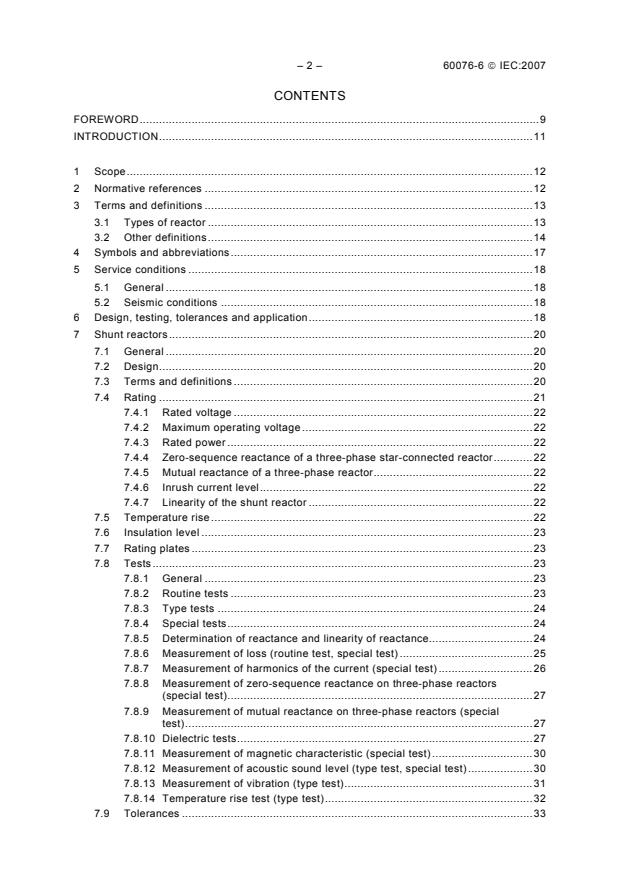
– 2 – 60076-6 © IEC:2007
CONTENTS
FOREWORD.9
INTRODUCTION.11
1 Scope.12
2 Normative references .12
3 Terms and definitions .13
3.1 Types of reactor .13
3.2 Other definitions.14
4 Symbols and abbreviations.17
5 Service conditions .18
5.1 General .18
5.2 Seismic conditions .18
6 Design, testing, tolerances and application.18
7 Shunt reactors.20
7.1 General .20
7.2 Design.20
7.3 Terms and definitions .20
7.4 Rating .21
7.4.1 Rated voltage .22
7.4.2 Maximum operating voltage .22
7.4.3 Rated power .22
7.4.4 Zero-sequence reactance of a three-phase star-connected reactor.22
7.4.5 Mutual reactance of a three-phase reactor.22
7.4.6 Inrush current level.22
7.4.7 Linearity of the shunt reactor .22
7.5 Temperature rise.22
7.6 Insulation level .23
7.7 Rating plates .23
7.8 Tests.23
7.8.1 General .23
7.8.2 Routine tests .23
7.8.3 Type tests .24
7.8.4 Special tests.24
7.8.5 Determination of reactance and linearity of reactance.24
7.8.6 Measurement of loss (routine test, special test) .25
7.8.7 Measurement of harmonics of the current (special test) .26
7.8.8 Measurement of zero-sequence reactance on three-phase reactors
(special test).27
7.8.9 Measurement of mutual reactance on three-phase reactors (special
test).27
7.8.10 Dielectric tests.27
7.8.11 Measurement of magnetic characteristic (special test) .30
7.8.12 Measurement of acoustic sound level (type test, special test).30
7.8.13 Measurement of vibration (type test).31
7.8.14 Temperature rise test (type test).32
7.9 Tolerances .33
60076-6 © IEC:2007 – 3 –
7.9.1 General .33
7.9.2 Tolerances on reactance at rated voltage and rated frequency .33
7.9.3 Tolerances on the linearity of reactance .33
7.9.4 Tolerance on loss .33
8 Current-limiting reactors and neutral-earthing reactors .33
8.1 General .33
8.2 Design.34
8.3 Terms and definitions .34
8.4 Rating .36
8.4.1 Rated continuous current.36
8.4.2 Rated thermal short-circuit current.37
8.4.3 Rated thermal short-circuit current duration .37
8.4.4 Rated mechanical short-circuit current.37
8.4.5 Rated short-time current.37
8.4.6 Rated short-time current duration or duty-cycle .37
8.4.7 Coupling factor .38
8.4.8 Rated short-circuit impedance .38
8.4.9 Rated short-time impedance .39
8.4.10 Rated continuous impedance.39
8.5 Ability to withstand rated thermal and rated mechanical short-circuit current .39
8.6 Temperature rise.39
8.6.1 Temperature rise at rated continuous current .39
8.6.2 Temperature due to rated thermal short-circuit current and rated
short-time current loading.40
8.7 Insulation level .40
8.7.1 General .40
8.8 Rating plates .40
8.9 Tests.41
8.9.1 General .41
8.9.2 Routine tests .41
8.9.3 Type tests .41
8.9.4 Special tests.42
8.9.5 Measurement of impedance at rated continuous current (routine test) .42
8.9.6 Measurement of impedance at rated short-time current (routine test).43
8.9.7 Measurement of loss (routine test, special test) .43
8.9.8 Separate source a.c. withstand voltage test (routine test, special
test).44
8.9.9 Winding overvoltage test for current-limiting reactors (routine test).44
8.9.10 Winding overvoltage test for neutral-earthing reactors (routine test) .45
8.9.11 Temperature rise test at rated continuous current (type test) .45
8.9.12 Lightning impulse test for current-limiting reactors (type test) .46
8.9.13 Short-circuit current test (special test) .46
8.9.14 Measurement of acoustic sound level at rated continuous current
(special test).47
8.9.15 Vibration measurement at rated continuous current (special test) .47
8.9.16 Switching impulse test (special test) .48
8.9.17 Double-ended lightning impulse test (special test) .48
8.9.18 Measurement of coupling factor (special test).49
8.9.19 Wet winding overvoltage test (special test) .49
– 4 – 60076-6 © IEC:2007
8.9.20 Wet separate source a.c. withstand voltage test (special test) .49
8.9.21 Measurement of reactance of the winding in the case of gapped-core
and magnetically-shielded air-core reactors (special test).49
8.10 Tolerances .50
8.10.1 Tolerance on impedances of reactors without compensation for
mutual coupling .50
8.10.2 Tolerance on impedance of reactors with compensation for mutual
coupling.50
8.10.3 Tolerance on loss .50
9 Filter, damping and discharge reactors associated with capacitors .50
9.1 General .50
9.2 Design.51
9.3 Terms and definitions .51
9.4 Rating .53
9.4.1 Rated power frequency current.53
9.4.2 Rated current spectrum .53
9.4.3 Rated inrush current .54
9.4.4 Rated inrush frequency.54
9.4.5 Rated discharge current .54
9.4.6 Rated discharge frequency .54
9.4.7 Rated thermal short-circuit current.54
9.4.8 Rated thermal short-circuit current duration .54
9.4.9 Rated mechanical short-circuit current.55
9.4.10 Rated inductance.55
9.4.11 Quality factor.55
9.5 Ability to withstand rated thermal and rated mechanical short-circuit current .55
9.6 Ability to withstand inrush or discharge current.56
9.7 Temperature rise.56
9.7.1 Temperature rise at equivalent current at power frequency.56
9.7.2 Temperature due to rated thermal short-circuit current loading .56
9.8 Insulation level .56
9.8.1 General .56
9.8.2 Insulation requirements .56
9.9 Rating plates .57
9.10 Tests.57
9.10.1 General .57
9.10.2 Routine tests.58
9.10.3 Type tests .58
9.10.4 Special tests .58
9.10.5 Measurement of inductance (routine test, type test) .58
9.10.6 Measurement of loss and quality factor (routine test, type test) .59
9.10.7 Winding overvoltage test (routine test) .59
9.10.8 Temperature rise test at rated continuous current (type test).60
9.10.9 Lightning impulse test (type test).60
9.10.10 Short-circuit current test (special test) .60
9.10.11 Measurement of acoustic sound level at rated continuous current
(special test) .61
9.10.12 Separate source a.c. withstand voltage test (special test) .62
9.10.13 Inrush current withstand test (special test) .62
9.10.14 Discharge current test (special test) .63
60076-6 © IEC:2007 – 5 –
9.10.15 Modified short-circuit/discharge current test (special test) .63
9.10.16 Mechanical resonance test (special test) .63
9.11 Tolerances .63
9.11.1 Tolerance on rated inductance .63
9.11.2 Tolerance on measured loss and quality factor .63
10 Earthing transformers (neutral couplers).63
10.1 General .63
10.2 Design.64
10.3 Terms and definitions .64
10.4 Rating .66
10.4.1 Rated voltage .66
10.4.2 Maximum operating voltage .66
10.4.3 Rated zero-sequence impedance.66
10.4.4 Rated continuous neutral current .66
10.4.5 Rated short-time neutral current .67
10.4.6 Rated short-time neutral current duration.67
10.4.7 Rated voltage of the secondary winding.67
10.4.8 Further ratings for the combination of an earthing transformer and an
arc-suppression reactor .67
10.5 Ability to withstand the rated short-time neutral current .67
10.6 Temperature rise.68
10.6.1 Temperature rise at rated voltage, rated continuous neutral current
and rated power of the secondary winding.68
10.6.2 Temperature after rated short-time neutral current loading .68
10.7 Insulation level .68
10.8 Rating plates .68
10.9 Tests.69
10.9.1 General .69
10.9.2 Routine tests.69
10.9.3 Type tests .70
10.9.4 Special tests .70
10.9.5 Measurement of zero-sequence impedance (routine test).70
10.9.6 Temperature rise test (type test) .71
10.9.7 Dielectric tests (routine test, type test) .72
10.9.8 Demonstration of ability to withstand rated short-time neutral
current (special test) .72
10.9.9 Measurement of loss at rated continuous neutral current (special
test) .73
10.9.10 Measurement of neutral current with three-phase excitation under
single-phase fault condition (type test) .73
10.10 Tolerances .73
11 Arc-suppression reactors.74
11.1 General .74
11.2 Design.74
11.3 Terms and definitions .74
11.4 Rating .75
11.4.1 Rated voltage .75
11.4.2 Maximum continuous voltage.75
11.4.3 Rated current .75
11.4.4 Rated current duration.76
– 6 – 60076-6 © IEC:2007
11.4.5 Adjustment range .76
11.4.6 Auxiliary winding .76
11.4.7 Secondary winding .76
11.4.8 Linearity of the arc-suppression reactor.76
11.5 Temperature rise.76
11.6 Insulation level .77
11.7 Rating plates .77
11.8 Tests.77
11.8.1 General .77
11.8.2 Routine tests.78
11.8.3 Type tests .78
11.8.4 Special tests .78
11.8.5 Measurement of current at rated voltage (type test), measurement
of current (routine test).78
11.8.6 Measurement of no-load voltage of the auxiliary and secondary
windings (routine test) .78
11.8.7 Temperature rise test (type test) .79
11.8.8 Dielectric tests (routine test, type test) .79
11.8.9 Measurement of loss (special test) .79
11.8.10 Measurement of linearity (special test) .80
11.8.11 Measurement of acoustic sound level (special test).80
11.8.12 Endurance tests of the inductance regulation mechanism (special
test) .80
11.8.13 Demonstration of ability to withstand the dynamic effects of the
rated current (special test) .80
11.9 Tolerances .81
12 Smoothing reactors .81
12.1 General .81
12.2 Design.81
12.3 Terms and definitions .81
12.4 Rating .82
12.4.1 Rated voltage .82
12.4.2 Maximum operating voltage .82
12.4.3 Rated continuous direct current .83
12.4.4 Rated continuous current spectrum .83
12.4.5 Short-time overload current, current spectrum and current duration or
duty-cycle.83
12.4.6 Rated transient fault current .83
12.4.7 Rated incremental inductance.83
12.4.8 Linearity of the smoothing reactor.83
12.4.9 Additional requirements for reactors with directly liquid cooled
windings .83
12.5 Temperature rise.84
12.6 Insulation levels .84
12.6.1 Lightning impulse levels .84
12.6.2 Switching impulse levels.84
12.6.3 Separate source d.c. withstand voltage level .84
12.6.4 Polarity-reversal withstand voltage level .84
12.6.5 Separate source a.c. withstand voltage level .84
12.7 Rating plates .85
60076-6 © IEC:2007 – 7 –
12.8 Tests.85
12.8.1 General .85
12.8.2 Routine tests.85
12.8.3 Type test .86
12.8.4 Special tests .86
12.8.5 Measurement of incremental inductance (routine test).86
12.8.6 Measurement of the harmonic current loss and calculation of the
total loss (routine test).87
12.8.7 Separate source a.c. withstand voltage test (routine test).88
12.8.8 Separate source d.c. withstand voltage test for liquid-immersed
reactors (routine test).88
12.8.9 Polarity-reversal withstand test for liquid-immersed reactors
(routine test) .89
12.8.10 Lightning impulse test (routine test).90
12.8.11 Switching impulse test (routine test, type test).90
12.8.12 Wet separate source d.c. withstand voltage test for dry-type
reactors (type test) .90
12.8.13 Temperature rise test (type test) .90
12.8.14 Measurement of acoustic sound level (special test).91
12.8.15 Measurement of high frequency impedance (special test).92
12.8.16 Test of the tightness of the liquid cooling circuit for reactors with
directly liquid cooled windings (routine test) .92
12.8.17 Measurement of the pressure drop for reactors with directly liquid
cooled windings (type test).93
12.8.18 Transient fault current test (special test) .93
12.8.19 Chopped wave impulse test for liquid-immersed reactors (special
test) .94
12.9 Tolerances .94
Annex A (informative) Information on shunt reactor switching and on special
applications .95
Annex B (informative) Magnetic characteristic of reactors .98
Annex C (informative) Mutual reactance, coupling factor and equivalent reactances of
three-phase reactors.105
Annex D (informative) Temperature correction of losses for liquid-immersed gapped-
core and magnetically-shielded air-core reactors . 108
Annex E (normative) Turn-to-turn overvoltage test for dry-type reactors. 110
Annex F (informative) Short-circuit testing .112
Annex G (informative) Resistors – Characteristics, specification and tests. 114
Bibliography.117
Figure 1 – Types of magnetic characteristics for reactors .15
Figure 2 – Parameters for non-linear magnetic characteristic.16
Figure 3 – Measurement of mutual reactance for three-phase reactors or banks of
three single-phase reactors .27
Figure 4 – Phase-to-earth test circuit for single-phase excitation .29
Figure 5 – Phase-to-phase test circuit for single-phase excitation .29
– 8 – 60076-6 © IEC:2007
Figure 6 – Single-phase excitation circuit for reactors with magnetic shield for zero-
sequence flux .29
Figure 7 – Measurement of mutual reactance for three-phase reactors or banks of
three single-phase reactors .49
Figure 8 – Single-phase fault test circuit with earthed neutral .73
Figure 9 – Single-phase fault test circuit with earthed voltage-supply.73
Figure 10 – Measuring circuit for determining incremental inductance of two identical
smoothing reactors .87
Figure 11 – Double reversal test voltage profile .89
Figure B.1 – Illustration of linked flux and current waveshapes with a sinusoidal
voltage applied to a reactor with a non-linear magnetic characteristic according to
Figure B.6.99
Figure B.2 – Circuit for measurement the magnetic characteristic according to B.7.1. 102
Figure B.3 – Equivalent circuit with the reactor short-circuited .102
Figure B.4 – Measured curves of a reactors d.c. charge and discharge current. 103
Figure B.5 – Calculated linked flux during discharge period (see equations B7 and B9) . 104
Figure B.6 – Magnetic characteristic .104
Figure C.1 – Equivalent scheme of a three-phase reactor including the magnetic
coupling between phases.105
Figure E.1 – Test circuit for turn-to-turn overvoltage test and sample oscillograms . 111
Table 1 – Temperature limits for winding terminals of dry-type reactors .19
Table 2 – Tolerances .74
Table 3 – Tolerances .81
Table C.1 – Reactance and flux ratios for reactors with uniform magnetic coupling. 106
Table C.2 – Coupling values for reactors with non-uniform magnetic coupling . 107
60076-6 © IEC:2007 – 9 –
INTERNATIONAL ELECTROTECHNICAL COMMISSION
____________
POWER TRANSFORMERS –
Part 6: Reactors
FOREWORD
1) The International Electrotechnical Commission (IEC) is a worldwide organization for standardization comprising
all national electrotechnical committees (IEC National Committees). The object of IEC is to promote
international co-operation on all questions concerning standardization in the electrical and electronic fields. To
this end and in addition to other activities, IEC publishes International Standards, Technical Specifications,
Technical Reports, Publicly Available Specifications (PAS) and Guides (hereafter referred to as “IEC
Publication(s)”). Their preparation is entrusted to technical committees; any IEC National Committee interested
in the subject dealt with may participate in this preparatory work. International, governmental and non-
governmental organizations liaising with the IEC also participate in this preparation. IEC collaborates closely
with the International Organization for Standardization (ISO) in accordance with conditions determined by
agreement between the two organizations.
2) The formal decisions or agreements of IEC on technical matters express, as nearly as possible, an international
consensus of opinion on the relevant subjects since each technical committee has representation from all
interested IEC National Committees.
3) IEC Publications have the form of recommendations for international use and are accepted by IEC National
Committees in that sense. While all reasonable efforts are made to ensure that the technical content of IEC
Publications is accurate, IEC cannot be held responsible for the way in which they are used or for any
misinterpretation by any end user.
4) In order to promote international uniformity, IEC National Committees undertake to apply IEC Publications
transparently to the maximum extent possible in their national and regional publications. Any divergence
between any IEC Publication and the corresponding national or regional publication shall be clearly indicated in
the latter.
5) IEC provides no marking procedure to indicate its approval and cannot be rendered responsible for any
equipment declared to be in conformity with an IEC Publication.
6) All users should ensure that they have the latest edition of this publication.
7) No liability shall attach to IEC or its directors, employees, servants or agents including individual experts and
members of its technical committees and IEC National Committees for any personal injury, property damage or
other damage of any nature whatsoever, whether direct or indirect, or for costs (including legal fees) and
expenses arising out of the publication, use of, or reliance upon, this IEC Publication or any other IEC
Publications.
8) Attention is drawn to the Normative references cited in this publication. Use of the referenced publications is
indispensable for the correct application of this publication.
9) Attention is drawn to the possibility that some of the elements of this IEC Publication may be the subject of
patent rights. IEC shall not be held responsible for identifying any or all such patent rights.
International Standard IEC 60076-6 has been prepared by IEC technical committee 14: Power
Transformers.
This first edition of IEC 60076-6 cancels and replaces the second edition of IEC 60289
published in 1988. This first edition constitutes a technical revision.
This edition included the following significant technical changes with respect to the previous
edition:
• wide extension of the “Definitions”, “Rating” and “Tests” Clauses,
• more consequent distinction between definition and rating,
• “Tests” subclauses take into account the latest revisions of relevant IEC 60076 standards,
• dielectric testing of reactors is now in line with dielectric testing of transformer according
IEC 60076-3:2000,
• consequent distinction between oil-immersed and dry-type reactor,
• document offers an easier handling and is a more stand-alone document than IEC 60289,
– 10 – 60076-6 © IEC:2007
• introduction of the discharge reactor as part of Clause 9,
• introduction of the turn-to-turn overvoltage test for dry-type reactors (Annex E),
• important background information given by newly introduced informative annexes,
– ANNEX A (informative) – Information on shunt reactor switching and on special
applications
– ANNEX B (informative) – Magnetic characteristic of reactors
– ANNEX C (informative) – Mutual reactance, coupling factor and equivalent reactances
of three-phase reactors
– ANNEX D (informative) – Temperature correction of losses for liquid-immersed
gapped-core and magnetically shielded air-core reactors
– ANNEX F (informative) – Short-circuit testing
– ANNEX G (informative) – Resistors – Characteristics, Specification, Tests
The text of this standard is based on the following documents:
CDV Report on voting
14/538/CDV 14/547A/RVC
Full information on the
...