

IEC 62488-2:2017
(Main)Power line communication systems for power utility applications - Part 2: Analogue power line carrier terminals or APLC
General Information
- Abstract
IEC 62488-2:2017 applies to Amplitude Modulation Single Sideband (AM-SSB) Analogue Power Line Carrier (APLC) Terminals and Systems used to transmit information over power lines (EHV/HV/MV). In particular this document covers basically baseband signals with bandwidths of 4 kHz and 2,5 kHz, or multiples thereof, corresponding to the same high frequency bandwidth/s for single or multi-channel APLC terminals.
The contents of the corrigendum of January 2020 and March 2023 have been included in this copy.
- Status
- Published
- Publication Date
- 25-Jul-2017
- Technical Committee
- TC 57 - Power systems management and associated information exchange
- Drafting Committee
- WG 20 - TC 57/WG 20
- Current Stage
- PPUB - Publication issued
- Start Date
- 26-Jul-2017
- Completion Date
- 28-Jul-2017
Buy Documents
IEC 62488-2:2017 - Power line communication systems for power utility applications - Part 2: Analogue power line carrier terminals or APLC Released:7/26/2017
IEC 62488-2:2017 - Power line communication systems for power utility applications - Part 2: Analogue power line carrier terminals or APLC Released:7/26/2017
Overview
IEC 62488-2:2017 specifies requirements for Analogue Power Line Carrier (APLC) terminals and systems used to transmit information over power lines in power utility networks (EHV/HV/MV). The standard addresses AM‑SSB (Amplitude Modulation Single Sideband) APLC equipment handling baseband signals with nominal bandwidths of 4 kHz and 2.5 kHz (or integer multiples for single and multi‑channel terminals). This edition integrates the corrigenda of January 2020 and March 2023.
Key topics and requirements
- Modulation & channeling
- Use of AM‑SSB modulation and channel bandwidth planning for single and multi‑channel APLC terminals (see informative Annex B).
- Low‑frequency interfaces
- Analog voice/telephony interfaces, teleprotection interfaces, narrowband telegraphic channels, and digital signaling interfaces.
- High‑frequency transmission
- Definition of APLC high‑frequency bands, frequency accuracy, nominal impedance, tapping loss, return loss and degree of unbalance to earth.
- Performance metrics
- Tests and limits for internally generated noise, automatic gain control, limiter action, attenuation and group‑delay distortion, harmonic distortion, selectivity and crosstalk attenuation.
- Testing procedures
- Test setups for link verification, return loss, tapping loss, spurious emissions and selectivity; normative and informative test methods.
- EMC & immunity
- Emission and immunity requirements, radiated/conducted emissions, low‑frequency disturbance emissions and immunity test lists.
- Safety, environmental & mechanical
- Classification of APLC terminals, ingress protection, type/routine tests, storage/transport and operating conditions, power supply requirements.
- Configuration & management
- Device configuration, network management interfaces and local alarms.
- Cybersecurity
- High‑level requirements (authentication and system protection) to safeguard APLC terminal operation.
- Supporting material
- Annex A on compandor characteristics for telephony, Annexs B and C on communication model and HF modulated power signals.
Applications and users
Who benefits from IEC 62488-2:
- Power utility engineers planning or operating power‑line communications for teleprotection, telecontrol, telephony and supervisory channels.
- APLC equipment manufacturers designing analogue carrier terminals to meet interoperability, EMC and safety requirements.
- System integrators and test laboratories validating performance, emission and immunity compliance.
- Regulators and procurement teams specifying technical acceptance criteria for EHV/HV/MV utility links.
Practical uses include secure teleprotection signaling, voice trunking (PBX interconnection), low‑rate telemetry and legacy analogue carrier modernization.
Related standards
- Refer to other parts of IEC 62488 for digital PLM systems and to applicable EMC, safety and telecommunication interface standards cited in IEC 62488-2 for full compliance and interoperability.
Relations
- Effective Date
- 05-Sep-2023
- Effective Date
- 05-Sep-2023
- Effective Date
- 05-Sep-2023
Buy Documents
IEC 62488-2:2017 - Power line communication systems for power utility applications - Part 2: Analogue power line carrier terminals or APLC Released:7/26/2017
IEC 62488-2:2017 - Power line communication systems for power utility applications - Part 2: Analogue power line carrier terminals or APLC Released:7/26/2017
Get Certified
Connect with accredited certification bodies for this standard

DVS-ZERT GmbH
German welding certification society.

ANCE
Mexican certification and testing association.
CARES (UK Certification Authority for Reinforcing Steels)
UK certification for reinforcing steels and construction.
Sponsored listings
Frequently Asked Questions
IEC 62488-2:2017 is a standard published by the International Electrotechnical Commission (IEC). Its full title is "Power line communication systems for power utility applications - Part 2: Analogue power line carrier terminals or APLC". This standard covers: IEC 62488-2:2017 applies to Amplitude Modulation Single Sideband (AM-SSB) Analogue Power Line Carrier (APLC) Terminals and Systems used to transmit information over power lines (EHV/HV/MV). In particular this document covers basically baseband signals with bandwidths of 4 kHz and 2,5 kHz, or multiples thereof, corresponding to the same high frequency bandwidth/s for single or multi-channel APLC terminals. The contents of the corrigendum of January 2020 and March 2023 have been included in this copy.
IEC 62488-2:2017 applies to Amplitude Modulation Single Sideband (AM-SSB) Analogue Power Line Carrier (APLC) Terminals and Systems used to transmit information over power lines (EHV/HV/MV). In particular this document covers basically baseband signals with bandwidths of 4 kHz and 2,5 kHz, or multiples thereof, corresponding to the same high frequency bandwidth/s for single or multi-channel APLC terminals. The contents of the corrigendum of January 2020 and March 2023 have been included in this copy.
IEC 62488-2:2017 is classified under the following ICS (International Classification for Standards) categories: 25.040.40 - Industrial process measurement and control; 33.200 - Telecontrol. Telemetering. The ICS classification helps identify the subject area and facilitates finding related standards.
IEC 62488-2:2017 has the following relationships with other standards: It is inter standard links to IEC TR 60663:1980, IEC 62488-2:2017/COR1:2020, IEC 62488-2:2017/COR2:2023. Understanding these relationships helps ensure you are using the most current and applicable version of the standard.
IEC 62488-2:2017 is available in PDF format for immediate download after purchase. The document can be added to your cart and obtained through the secure checkout process. Digital delivery ensures instant access to the complete standard document.
Standards Content (Sample)
IEC 62488-2 ®
Edition 1.0 2017-07
INTERNATIONAL
STANDARD
colour
inside
Power line communication systems for power utility applications –
Part 2: Analogue power line carrier terminals or APLC
All rights reserved. Unless otherwise specified, no part of this publication may be reproduced or utilized in any form
or by any means, electronic or mechanical, including photocopying and microfilm, without permission in writing from
either IEC or IEC's member National Committee in the country of the requester. If you have any questions about IEC
copyright or have an enquiry about obtaining additional rights to this publication, please contact the address below or
your local IEC member National Committee for further information.
IEC Central Office Tel.: +41 22 919 02 11
3, rue de Varembé Fax: +41 22 919 03 00
CH-1211 Geneva 20 info@iec.ch
Switzerland www.iec.ch
About the IEC
The International Electrotechnical Commission (IEC) is the leading global organization that prepares and publishes
International Standards for all electrical, electronic and related technologies.
About IEC publications
The technical content of IEC publications is kept under constant review by the IEC. Please make sure that you have the
latest edition, a corrigenda or an amendment might have been published.
IEC Catalogue - webstore.iec.ch/catalogue Electropedia - www.electropedia.org
The stand-alone application for consulting the entire The world's leading online dictionary of electronic and
bibliographical information on IEC International Standards, electrical terms containing 20 000 terms and definitions in
Technical Specifications, Technical Reports and other English and French, with equivalent terms in 16 additional
documents. Available for PC, Mac OS, Android Tablets and languages. Also known as the International Electrotechnical
iPad. Vocabulary (IEV) online.
IEC publications search - www.iec.ch/searchpub IEC Glossary - std.iec.ch/glossary
The advanced search enables to find IEC publications by a 65 000 electrotechnical terminology entries in English and
variety of criteria (reference number, text, technical French extracted from the Terms and Definitions clause of
committee,…). It also gives information on projects, replaced IEC publications issued since 2002. Some entries have been
and withdrawn publications. collected from earlier publications of IEC TC 37, 77, 86 and
CISPR.
IEC Just Published - webstore.iec.ch/justpublished
Stay up to date on all new IEC publications. Just Published IEC Customer Service Centre - webstore.iec.ch/csc
details all new publications released. Available online and If you wish to give us your feedback on this publication or
also once a month by email. need further assistance, please contact the Customer Service
Centre: csc@iec.ch.
IEC 62488-2 ®
Edition 1.0 2017-07
INTERNATIONAL
STANDARD
colour
inside
Power line communication systems for power utility applications –
Part 2: Analogue power line carrier terminals or APLC
INTERNATIONAL
ELECTROTECHNICAL
COMMISSION
ICS 33.200 ISBN 978-2-8322-4507-1
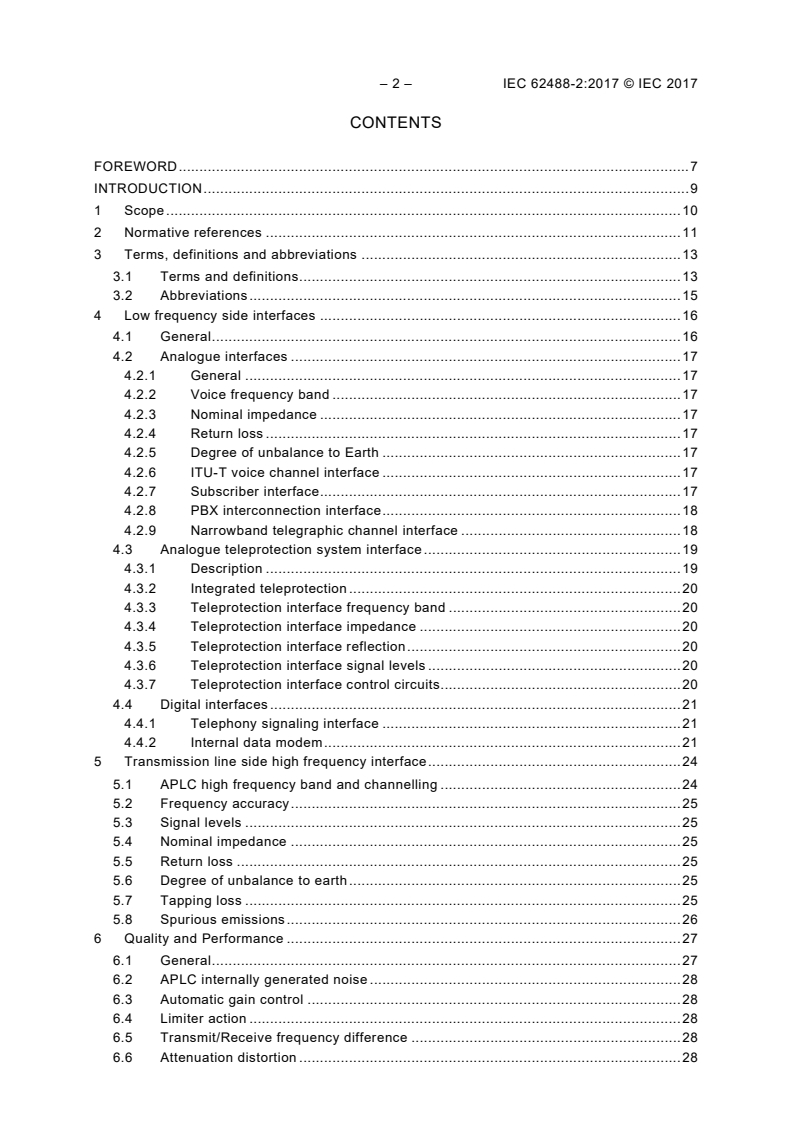
– 2 – IEC 62488-2:2017 © IEC 2017
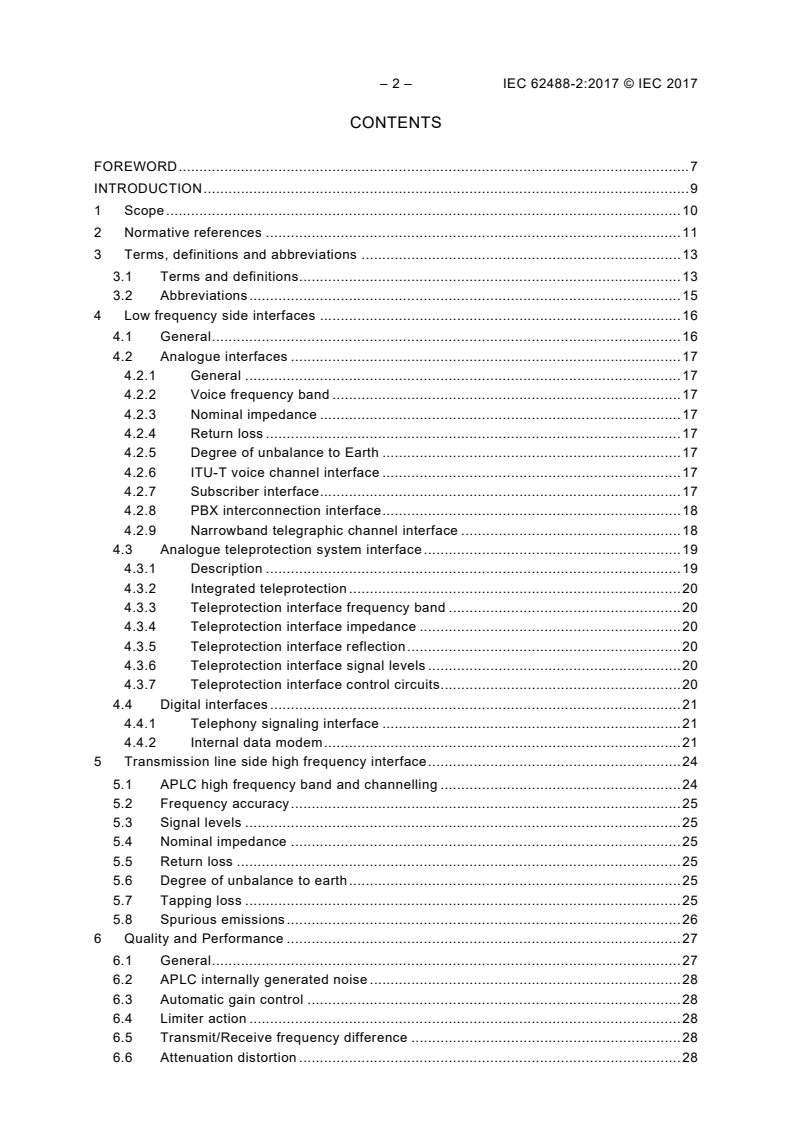
CONTENTS
FOREWORD . 7
INTRODUCTION . 9
1 Scope . 10
2 Normative references . 11
3 Terms, definitions and abbreviations . 13
3.1 Terms and definitions . 13
3.2 Abbreviations . 15
4 Low frequency side interfaces . 16
4.1 General . 16
4.2 Analogue interfaces . 17
4.2.1 General . 17
4.2.2 Voice frequency band . 17
4.2.3 Nominal impedance . 17
4.2.4 Return loss . 17
4.2.5 Degree of unbalance to Earth . 17
4.2.6 ITU-T voice channel interface . 17
4.2.7 Subscriber interface . 17
4.2.8 PBX interconnection interface . 18
4.2.9 Narrowband telegraphic channel interface . 18
4.3 Analogue teleprotection system interface . 19
4.3.1 Description . 19
4.3.2 Integrated teleprotection . 20
4.3.3 Teleprotection interface frequency band . 20
4.3.4 Teleprotection interface impedance . 20
4.3.5 Teleprotection interface reflection . 20
4.3.6 Teleprotection interface signal levels . 20
4.3.7 Teleprotection interface control circuits. 20
4.4 Digital interfaces . 21
4.4.1 Telephony signaling interface . 21
4.4.2 Internal data modem . 21
5 Transmission line side high frequency interface . 24
5.1 APLC high frequency band and channelling . 24
5.2 Frequency accuracy . 25
5.3 Signal levels . 25
5.4 Nominal impedance . 25
5.5 Return loss . 25
5.6 Degree of unbalance to earth . 25
5.7 Tapping loss . 25
5.8 Spurious emissions . 26
6 Quality and Performance . 27
6.1 General . 27
6.2 APLC internally generated noise . 28
6.3 Automatic gain control . 28
6.4 Limiter action . 28
6.5 Transmit/Receive frequency difference . 28
6.6 Attenuation distortion . 28
6.7 Group-delay distortion . 30
6.8 Harmonic distortion . 31
6.9 Selectivity . 31
6.10 Crosstalk attenuation . 31
6.10.1 Co-channel crosstalk attenuation . 31
6.10.2 Inter-channel crosstalk attenuation . 31
7 Testing . 32
7.1 General . 32
7.2 Test setup for APLC link tests . 32
7.3 Return loss . 32
7.4 Degree of unbalance to earth . 33
7.4.1 General . 33
7.4.2 LCL . 34
7.4.3 OSB . 34
7.5 Tapping loss . 35
7.6 Spurious emissions . 36
7.6.1 Single channel terminals . 36
7.6.2 Multi-channel terminals . 36
7.7 Selectivity . 36
7.8 Co-channel and inter-channel crosstalk attenuation . 37
8 Configuration and management . 37
8.1 General . 37
8.2 Configuration . 37
8.3 Network management system . 38
8.4 Local terminal alarms . 38
9 Cyber security . 38
9.1 General . 38
9.2 Authentication . 39
10 APLC safety . 39
10.1 General . 39
10.2 Safety reference standard . 39
10.3 Classification of APLC Terminals . 39
10.4 Ingress protection . 41
10.5 Type and routine tests . 41
11 Storage and transportation, operating conditions, power supply. 43
11.1 Storage and transportation . 43
11.1.1 Climatic conditions . 43
11.1.2 Mechanical . 44
11.2 Operating conditions . 45
11.2.1 Climatic conditions . 45
11.2.2 Mechanical . 46
11.2.3 Operating conditions set of tests . 47
11.3 Power supply . 48
11.3.1 AC supply . 48
11.3.2 DC supply . 48
12 EMC . 49
12.1 Emission and Immunity reference standards . 49
12.2 Emission . 50
– 4 – IEC 62488-2:2017 © IEC 2017
12.2.1 Radiated and conducted emission . 50
12.2.2 Low frequency disturbance emission . 54
12.3 Immunity . 54
12.3.1 EMC Environment . 54
12.3.2 Functional requirements . 56
12.3.3 Immunity test list . 56
Annex A (normative) Characteristics of compandors for telephony (based on the
withdrawn ITU-T Recommendation G.162) . 59
A.1 General . 59
A.2 Characteristics of compandors . 59
A.3 Definition and value of the unaffected level . 59
A.4 Ratio of compression and expansion . 59
A.5 Range of level . 60
A.6 Signal to noise ratio . 60
Annex B (informative) APLC communication model . 61
B.1 General . 61
B.2 AM-SSB modulation technique . 64
B.3 Functional blocks of an APLC terminal . 65
Annex C (informative) HF modulated power signal . 67
C.1 General . 67
C.2 Discrete tone signals . 67
C.3 Voice channels . 69
C.4 Composite channels . 70
C.5 Calculation examples . 72
C.5.1 General . 72
C.5.2 Calculation example 1: Load capacity and PEP . 72
C.5.3 Calculation example 2: Power distribution adjustment . 72
Bibliography . 74
Figure 1 – Schematic representation of the scope of IEC 62488-2 . 10
Figure 2 – Generic architecture of an APLC terminal. 16
Figure 3 – Subscriber PBX interfaces local and remote . 18
Figure 4 – Interfaces for PBX trunk interconnection through APLC link . 18
Figure 5 – Low symbol rate ITU-T telegraphic channelling . 19
Figure 6 – Commonly used EIA RS-232 connector . 22
Figure 7 – Commonly used V.11 connector . 22
Figure 8 – ETH IEEE 802.3 RJ45 type connector . 24
Figure 9 – ETH IEEE 802.3 SC type connector . 24
Figure 10 – Tapping loss limits for APLC terminals . 26
Figure 11 – Maximum level of spurious emissions outside the high frequency band . 27
Figure 12 – Reference points for measuring APLC parameters . 28
Figure 13 – Attenuation distortion limits for the voice frequency band of 300 Hz to
3400 Hz (ITU-T G.232) . 29
Figure 14 – Attenuation distortion limits for the voice frequency band of 300 Hz to
2400 Hz . 29
Figure 15 – Attenuation distortion limits for the voice frequency band of 300 Hz to
2000 Hz . 29
Figure 16 – Group delay distortion limits for the voice frequency band of 300 Hz to
3400 Hz . 30
Figure 17 – Group delay distortion limits for the voice frequency band of 300 Hz to
2400 Hz . 30
Figure 18 – Group delay distortion limits for the voice frequency band of 300 Hz to
2000 Hz . 31
Figure 19 – Test circuit for return loss measurement . 33
Figure 20 – Test circuit for LCL measurement (Tx port) . 34
Figure 21 – Test circuit for OSB measurement (Rx port) . 35
Figure 22 – Test circuit for Tapping Loss measurement . 35
Figure 23 – Test circuit for selectivity measurement . 37
Figure 24 – LF disturbances measurement setup . 54
Figure B.1 – Basic components of the APLC Terminal . 61
Figure B.2 – Baseband and pass band signals correspondence in SSB modulation . 61
Figure B.3 – APLC Terminal LF, baseband and HF interfaces identification . 62
Figure B.4 – Examples for low frequency signals with bandwidth 4 kHz (IEC 62488-1). 62
Figure B.5 – Composition of the modulating baseband for eight telephony channels
with signalling APLC terminal (source Japan NC). 62
Figure B.6 – Line-up limits of circuits for a 4 kHz channel terminal (ITU-T G.120) . 63
Figure B.7 – Example of HF channelling plan (4 kHz based – IEC 62488-1) . 64
Figure B.8 – Principle of phasing SSB modulator . 64
Figure B.9 – Principle of phasing SSB demodulator . 65
Figure B.10 – Generic APLC terminal main functional blocks . 66
Figure C.1 – Sine wave and its probability distribution . 68
Figure C.2 – Probability of combined sine waves . 69
Figure C.3 – Nominal high frequency band output power of multichannel PLC
terminals . 70
Table 1 – FSK symbol rate and related narrowband standards . 23
Table 2 – Basic insulation [Table C.6 of IEC 60255-27:2013] . 40
Table 3 – Double or reinforced insulation [Table C.10 of IEC 60255-27:2013] . 40
Table 4 – List of Type and Routine Tests [Table 12 of IEC 60255-27:2013] . 42
Table 5 – Classification of climatic conditions [Table 1 of IEC 60721-3-1:1997] . 43
Table 6 – Climatic tests for storage and transportation. 44
Table 7 – Classification of climatic conditions from Table 1 of IEC 60721-3-3:2002 . 46
Table 8 – Classification of mechanical conditions from Table 6 of IEC 60721-3-3:2002 . 47
Table 9 – Climatic tests . 47
Table 10 – Sinusoidal vibration test . 48
Table 11 – Non-repetitive shock test . 48
Table 12 – Emission – Enclosure port [Table 1 of IEC 61000-6-4:2011 (ed.2.1)] . 50
Table 13 – Emission – Low voltage AC mains port [Table 2 of IEC 61000-6-4:2011
(ed.2.1)] . 52
Table 14 – Emission – Telecommunications/network port [Table 3 of IEC 61000-6-
4:2011 (ed.2.1)] . 53
Table 15 – Characterization of the electromagnetic phenomena [Table 1 of IEC 61000-
6-5:2015] . 55
– 6 – IEC 62488-2:2017 © IEC 2017
Table 16 – Port classification . 56
Table 17 – Performance criteria . 56
Table 18 – Immunity test list . 57
Table C.1 – Load capacity of voice channels . 71
INTERNATIONAL ELECTROTECHNICAL COMMISSION
____________
POWER LINE COMMUNICATION SYSTEMS
FOR POWER UTILITY APPLICATIONS –
Part 2: Analogue power line carrier terminals or APLC
FOREWORD
1) The International Electrotechnical Commission (IEC) is a worldwide organization for standardization comprising
all national electrotechnical committees (IEC National Committees). The object of IEC is to promote
international co-operation on all questions concerning standardization in the electrical and electronic fields. To
this end and in addition to other activities, IEC publishes International Standards, Technical Specifications,
Technical Reports, Publicly Available Specifications (PAS) and Guides (hereafter referred to as “IEC
Publication(s)”). Their preparation is entrusted to technical committees; any IEC National Committee interested
in the subject dealt with may participate in this preparatory work. International, governmental and non-
governmental organizations liaising with the IEC also participate in this preparation. IEC collaborates closely
with the International Organization for Standardization (ISO) in accordance with conditions determined by
agreement between the two organizations.
2) The formal decisions or agreements of IEC on technical matters express, as nearly as possible, an international
consensus of opinion on the relevant subjects since each technical committee has representation from all
interested IEC National Committees.
3) IEC Publications have the form of recommendations for international use and are accepted by IEC National
Committees in that sense. While all reasonable efforts are made to ensure that the technical content of IEC
Publications is accurate, IEC cannot be held responsible for the way in which they are used or for any
misinterpretation by any end user.
4) In order to promote international uniformity, IEC National Committees undertake to apply IEC Publications
transparently to the maximum extent possible in their national and regional publications. Any divergence
between any IEC Publication and the corresponding national or regional publication shall be clearly indicated in
the latter.
5) IEC itself does not provide any attestation of conformity. Independent certification bodies provide conformity
assessment services and, in some areas, access to IEC marks of conformity. IEC is not responsible for any
services carried out by independent certification bodies.
6) All users should ensure that they have the latest edition of this publication.
7) No liability shall attach to IEC or its directors, employees, servants or agents including individual experts and
members of its technical committees and IEC National Committees for any personal injury, property damage or
other damage of any nature whatsoever, whether direct or indirect, or for costs (including legal fees) and
expenses arising out of the publication, use of, or reliance upon, this IEC Publication or any other IEC
Publications.
8) Attention is drawn to the Normative references cited in this publication. Use of the referenced publications is
indispensable for the correct application of this publication.
9) Attention is drawn to the possibility that some of the elements of this IEC Publication may be the subject of
patent rights. IEC shall not be held responsible for identifying any or all such patent rights.
International Standard IEC 62488-2 has been prepared by IEC technical committee 57: Power
systems management and associated information exchange.
This first edition of IEC 62488-2 cancels and replaces the relevant parts of IEC 60663 and
IEC 60495, which will be withdrawn at a later date.
This standard is to be used in conjunction with IEC 62488-1.
The text of this International Standard is based on the following documents:
FDIS Report on voting
57/1867/FDIS 57/1891/RVD
Full information on the voting for the approval of this International Standard can be found in
the report on voting indicated in the above table.
– 8 – IEC 62488-2:2017 © IEC 2017
This document has been drafted in accordance with the ISO/IEC Directives, Part 2.
A list of all the parts in the IEC 62488 series, published under the general title Power line
communication systems for power utility applications, can be found on the IEC website.
The committee has decided that the contents of this document will remain unchanged until the
stability date indicated on the IEC website under "http://webstore.iec.ch" in the data related to
the specific document. At this date, the document will be
• reconfirmed,
• withdrawn,
• replaced by a revised edition, or
• amended.
A bilingual version of this publication may be issued at a later date.
The contents of the corrigenda 1 (2020-01) and 2 (2023-03) have been included in this copy.
IMPORTANT – The 'colour inside' logo on the cover page of this publication indicates
that it contains colours which are considered to be useful for the correct
understanding of its contents. Users should therefore print this document using a
colour printer.
INTRODUCTION
IEC 62488 series is a family of standards dealing with all aspects of power line
communication systems operating over electricity power lines.
These international standards apply to power line carrier terminals and systems (PLC) used to
transmit information over power networks including extra high, high and medium voltage
(EHV/HV/MV) power lines. Both analogue and digital modulation as well as narrow and
broadband systems will be included.
The complexity and extensive size of present-day electricity generation, transmission and
distribution systems are such that it is possible to control them only by means of an
associated and often equally large and complex telecommunication system having a high
order of reliability.
The control of electrical networks and transmission and reception of data are through a
combination of analogue and digital communication systems controlling devices and systems
distributed throughout the electrical network.
The emergence of digital communication systems for controlling the devices of the electrical
distribution network enables faster data transmission. The traditional analogue communication
systems mainly due to legacy applications are still extensively used.
The ability to represent the various electrical parameters as an analogue signal and/or a
digital signal ensures the quality and quantitative aspects of seamless communication to be
maintained throughout the electrical power network.
Therefore, by using either analogue power line communication, digital power line
communication or a combination of both types of systems, seamless efficient communication
may be maintained throughout the power network.
In many countries, Power Line Carrier (PLC) channels represent a main part of the utility-
owned telecommunication system. A circuit which would normally be routed via a PLC
channel can also be routed via a channel using a different transmission medium, such as a
point to point radio or open-wire circuit. Since, in many cases, automatic switching is used,
the actual rerouting, although predetermined, is unpredictable.
It is important, therefore, that the input and output signals and criteria exchanged among all
terminal used in the communications system are compatible. This compatibility is also
beneficial in creating the ability to interchange and interconnect terminals from different
sources.
This document has been prepared to enable compatibility between APLC links from different
sources or between APLC links and other transmission medium to be achieved and to define
the terminal performance required in APLC networks.
– 10 – IEC 62488-2:2017 © IEC 2017
POWER LINE COMMUNICATION SYSTEMS
FOR POWER UTILITY APPLICATIONS –
Part 2: Analogue power line carrier terminals or APLC
1 Scope
This part of IEC 62488 applies to Amplitude Modulation Single Sideband (AM-SSB) Analogue
Power Line Carrier (APLC) Terminals and Systems used to transmit information over power
lines (EHV/HV/MV).
In particular this document covers basically baseband signals with bandwidths of 4 kHz and
2,5 kHz, or multiples thereof, corresponding to the same high frequency bandwidth/s for
single or multi-channel APLC terminals.
Figure 1 shows a schematic representation of the scope of the IEC 62488-2 standard within a
complete power line communication system installation.
EC
Figure 1 – Schematic representation of the scope of IEC 62488-2
2 Normative references
The following documents are referred to in the text in such a way that some or all of their
content constitutes requirements of this document. For dated references, only the edition
cited applies. For undated references, the latest edition of the referenced document (including
any amendments) applies.
IEC 60038, IEC standard voltages
IEC 60068-2-1, Environmental testing – Part 2-1: Tests – Test A: Cold
IEC 60068-2-2, Environmental testing – Part 2-2: Tests – Test B: Dry heat
IEC 60068-2-6, Environmental testing – Part 2-6: Tests – Test Fc: Vibration (sinusoidal)
IEC 60068-2-27, Environmental testing – Part 2-27: Tests – Test Ea and guidance: Shock
IEC 60068-2-30, Environmental testing – Part 2-30: Tests – Test Db: Damp heat, cyclic
(12 h + 12 h cycle)
IEC 60068-2-31, Environmental testing – Part 2-31: Tests – Test Ec: Rough handling shocks,
primarily for equipment-type specimens
IEC 60255-27:2013, Measuring relays and protection equipment – Part 27: Product safety
requirements
IEC 60529, Degrees of protection provided by enclosures (IP Code)
IEC 60721-3-1:1997, Classification of environmental conditions – Part 3 Classification of
groups of environmental parameters and their severities – Section 1: Storage
IEC 60721-3-2:1997, Classification of environmental conditions – Part 3: Classification of
groups of environmental parameters and their severities – Section 2: Transportation
IEC 60721-3-3:1994, Classification of environmental conditions – Part 3: Classification of
groups of environmental parameters and their severities – Section 3: Stationary use at
weatherprotected locations
IEC 60721-3-3:1994/AMD1:1995
IEC 60721-3-3:1994/AMD2:1996
IEC 60834-1, Teleprotection equipment of power systems – Performance and testing – Part 1:
Command systems
IEC 60950-1, Information technology equipment – Safety – Part 1: General requirements
IEC 61000-4-2, Electromagnetic compatibility (EMC) – Part 4-2: Testing and measurement
techniques – Electrostatic discharge immunity test
IEC 61000-4-3, Electromagnetic compatibility (EMC) – Part 4-3 : Testing and measurement
techniques – Radiated, radio-frequency, electromagnetic field immunity test
IEC 61000-4-4, Electromagnetic compatibility (EMC) – Part 4-4: Testing and measurement
techniques – Electrical fast transient/burst immunity test
IEC 61000-4-5, Electromagnetic compatibility (EMC) – Part 4-5: Testing and measurement
techniques – Surge immunity test
– 12 – IEC 62488-2:2017 © IEC 2017
IEC 61000-4-6, Electromagnetic compatibility (EMC) – Part 4-6: Testing and measurement
techniques – Immunity to conducted disturbances, induced by radio-frequency fields
IEC 61000-4-8, Electromagnetic compatibility (EMC) – Part 4-8: Testing and measurement
techniques – Power frequency magnetic field immunity test
IEC 61000-4-11, Electromagnetic compatibility (EMC) – Part 4-11: Testing and measurement
techniques – Voltage dips, short interruptions and voltage variations immunity tests
IEC 61000-4-16, Electromagnetic compatibility (EMC) – Part 4-16: Testing and measurement
techniques – Test for immunity to conducted, common mode disturbances in the frequency
range 0 Hz to 150 kHz
IEC 61000-4-17, Electromagnetic compatibility (EMC) – Part 4-17: Testing and measurement
techniques – Ripple on d.c. input power port immunity test
IEC 61000-4-18, Electromagnetic compatibility (EMC) – Part 4-18: Testing and measurement
techniques – Damped oscillatory wave immunity test
IEC 61000-4-20:2010, Electromagnetic compatibility (EMC) – Part 4-20: Testing and
measurement techniques – Emission and immunity testing in transverse electromagnetic
(TEM) waveguides
IEC 61000-4-29, Electromagnetic compatibility (EMC) – Part 4-29: Testing and measurement
techniques – Voltage dips, short interruptions and voltage variations on d.c. input power port
immunity tests
IEC 61000-6-2, Electromagnetic compatibility (EMC) – Part 6-2: Generic standards –
Immunity standard for industrial environments
IEC 61000-6-4:2006, Electromagnetic compatibility (EMC) – Part 6-4: Generic standards –
Emission standard for industrial environments
IEC 61000-6-4:2006/AMD1:2010
IEC 61000-6-5:2015, Electromagnetic compatibility (EMC) – Part 6-5: Generic standards –
Immunity for equipment used in power station and substation environment
IEC 62488-1:2012, Power line communication systems for power utility applications – Part 1:
Planning of analogue and digital power line carrier systems operating over EHV/HV/MV
electricity grids
CISPR 16-1-1:2015, Specification for radio disturbance and immunity measuring apparatus
and methods – Part 1-1: Radio disturbance and immunity measuring apparatus – Measuring
apparatus
CISPR 16-1-2:2014, Specification for radio disturbance and immunity measuring apparatus
and methods – Part 1-2: Radio disturbance and immunity measuring apparatus – Coupling
devices for conducted disturbance measurements
CISPR 16-1-4:2010, Specification for radio disturbance and immunity measuring apparatus
and methods – Part 1-4: Radio disturbance and immunity measuring apparatus – Antennas
and test sites for radiated disturbance measurements
CISPR 16-2-1:2014, Specification for radio disturbance and immunity measuring apparatus
and methods – Part 2-1: Methods of measurement of disturbances and immunity – Conducted
disturbance measurements
CISPR 16-2-3:2016, Specification for radio disturbance and immunity measuring apparatus
and methods – Part 2-3: Methods of measurement of disturbances and immunity – Radiated
disturbance measurements
CISPR 14-1:2016, Electromagnetic compatibility – Requirements for household appliances,
electric tools and similar apparatus – Part 1: Emission
CISPR 22:2008, Information technology equipment – Radio disturbance characteristics –
Limits and methods of measurement
3 Terms, definitions and abbreviations
3.1 Terms and definitions
For the purposes of this document, the terms and definitions given in IEC 62488-1 and the
following apply.
ISO and IEC maintain terminological databases for use in standardization at the following
addresses:
• IEC Electropedia: available at http://www.electropedia.org/
• ISO Online browsing platform: available at http://www.iso.org/obp
3.1.1
absolute power level
power of a signal expressed in decibels referred to 1mW as defined by Equation (1)
X [dBm] = 10 ×log (P 1mW ), (1)
where
P = signal power
3.1.2
APLC equipment
PLC equipment with an LF interface for each LF channel, applying AM-SSB modulation to the
signals at the input of each LF interface and transmitting over the power line the modulated
signals, which occupy adjacent frequency bands fully covering the HF transmission band of
the PLC
Note 1 to entry: The LF channel bandwidths are typically either 4,0 or 2,5 kHz, but can be different.
Note 2 to entry: In addition to the mentioned interfaces other interfaces may be present such as data interfaces,
LF teleprotection and control interfaces or teleprotection command interfaces.
3.1.3
basic high frequency band
elementary subdivision of the high frequency range or part thereof allocated to a single APLC
transmit or receive high frequency channel
3.1.4
effective transmitted voice band
that part of the voice-frequency baseband used for telephone communication, not including
the telephone signalling channel
3.1.5
level reference point
point in a system with the relative level 0 dBr
– 14 – IEC 62488-2:2017 © IEC 2017
Note 1 to entry: More specifically, a sinusoidal reference signal of 1020 Hz in the voice frequency band is thought
to pass the signal path under consideration with such amplitude that its absolute level is 0 dBm at the 0 dBr point.
[ITU-T G.100.1]
Note 2 to entry: The level reference point may exist physically or only hypothetically.
3.1.6
LF channel
frequency band used for the signal transmission of a low frequency interface
3.1.7
load capacity,
maximum single frequency sine wave power expressed in dBm0 which a multi-channel
amplifier must transmit without appreciable overloading
3.1.8
mean high frequency band output power
output power of an APLC terminal at nominal high frequency band terminal averaged over a
time sufficiently long compared with the cycle time of the lowest modulation frequency and
during which this average power assumes the highest value for which the terminal has been
designed
3.1.9
nominal high frequency band
frequency band in which a particular APLC transmitter or receiver is operating within the
carrier-frequency range
Note 1 to entry: The nominal high frequency band is also referred to as nominal carrier frequency band.
3.1.10
nominal high frequency band output power
output power of an APLC terminal at nominal high frequency band expressed as the peak
envelope power (PEP) for which the terminal has been designed, compatible with the
requirements for spurious emissions and inter-channel interference (for multi-channel PLC
terminals), available at the high frequency interface output across a resistive load equal to the
nominal impedance
3.1.11
power ratio
ratio between the powers P and P of two signals
1 2
Note 1 to entry: The power ratio X is usually expressed in decibels (dB) and is calculated according to equation
(2)
( ). (2)
X [d
...
IEC 62488-2 ®
Edition 1.0 2017-07
INTERNATIONAL
STANDARD
NORME
INTERNATIONALE
colour
inside
Power line communication systems for power utility applications –
Part 2: Analogue power line carrier terminals or APLC
Systèmes de communication sur lignes d'énergie pour les applications des
compagnies d'électricité –
Partie 2: Équipements terminaux à courants porteurs sur lignes d’énergie
analogiques ou APLC
All rights reserved. Unless otherwise specified, no part of this publication may be reproduced or utilized in any form
or by any means, electronic or mechanical, including photocopying and microfilm, without permission in writing from
either IEC or IEC's member National Committee in the country of the requester. If you have any questions about IEC
copyright or have an enquiry about obtaining additional rights to this publication, please contact the address below or
your local IEC member National Committee for further information.
Droits de reproduction réservés. Sauf indication contraire, aucune partie de cette publication ne peut être reproduite
ni utilisée sous quelque forme que ce soit et par aucun procédé, électronique ou mécanique, y compris la photocopie
et les microfilms, sans l'accord écrit de l'IEC ou du Comité national de l'IEC du pays du demandeur. Si vous avez des
questions sur le copyright de l'IEC ou si vous désirez obtenir des droits supplémentaires sur cette publication, utilisez
les coordonnées ci-après ou contactez le Comité national de l'IEC de votre pays de résidence.
IEC Central Office Tel.: +41 22 919 02 11
3, rue de Varembé info@iec.ch
CH-1211 Geneva 20 www.iec.ch
Switzerland
About the IEC
The International Electrotechnical Commission (IEC) is the leading global organization that prepares and publishes
International Standards for all electrical, electronic and related technologies.
About IEC publications
The technical content of IEC publications is kept under constant review by the IEC. Please make sure that you have the
latest edition, a corrigendum or an amendment might have been published.
IEC publications search - webstore.iec.ch/advsearchform Electropedia - www.electropedia.org
The advanced search enables to find IEC publications by a The world's leading online dictionary on electrotechnology,
variety of criteria (reference number, text, technical containing more than 22 000 terminological entries in English
committee,…). It also gives information on projects, replaced and French, with equivalent terms in 16 additional languages.
and withdrawn publications. Also known as the International Electrotechnical Vocabulary
(IEV) online.
IEC Just Published - webstore.iec.ch/justpublished
Stay up to date on all new IEC publications. Just Published IEC Glossary - std.iec.ch/glossary
details all new publications released. Available online and 67 000 electrotechnical terminology entries in English and
once a month by email. French extracted from the Terms and Definitions clause of
IEC publications issued since 2002. Some entries have been
IEC Customer Service Centre - webstore.iec.ch/csc collected from earlier publications of IEC TC 37, 77, 86 and
If you wish to give us your feedback on this publication or CISPR.
need further assistance, please contact the Customer Service
Centre: sales@iec.ch.
A propos de l'IEC
La Commission Electrotechnique Internationale (IEC) est la première organisation mondiale qui élabore et publie des
Normes internationales pour tout ce qui a trait à l'électricité, à l'électronique et aux technologies apparentées.
A propos des publications IEC
Le contenu technique des publications IEC est constamment revu. Veuillez vous assurer que vous possédez l’édition la
plus récente, un corrigendum ou amendement peut avoir été publié.
Recherche de publications IEC - Electropedia - www.electropedia.org
webstore.iec.ch/advsearchform Le premier dictionnaire d'électrotechnologie en ligne au
La recherche avancée permet de trouver des publications IEC monde, avec plus de 22 000 articles terminologiques en
en utilisant différents critères (numéro de référence, texte, anglais et en français, ainsi que les termes équivalents dans
comité d’études,…). Elle donne aussi des informations sur les 16 langues additionnelles. Egalement appelé Vocabulaire
projets et les publications remplacées ou retirées. Electrotechnique International (IEV) en ligne.
IEC Just Published - webstore.iec.ch/justpublished Glossaire IEC - std.iec.ch/glossary
Restez informé sur les nouvelles publications IEC. Just 67 000 entrées terminologiques électrotechniques, en anglais
Published détaille les nouvelles publications parues. et en français, extraites des articles Termes et Définitions des
Disponible en ligne et une fois par mois par email. publications IEC parues depuis 2002. Plus certaines entrées
antérieures extraites des publications des CE 37, 77, 86 et
Service Clients - webstore.iec.ch/csc CISPR de l'IEC.
Si vous désirez nous donner des commentaires sur cette
publication ou si vous avez des questions contactez-nous:
sales@iec.ch.
IEC 62488-2 ®
Edition 1.0 2017-07
INTERNATIONAL
STANDARD
NORME
INTERNATIONALE
colour
inside
Power line communication systems for power utility applications –
Part 2: Analogue power line carrier terminals or APLC
Systèmes de communication sur lignes d'énergie pour les applications des
compagnies d'électricité –
Partie 2: Équipements terminaux à courants porteurs sur lignes d’énergie
analogiques ou APLC
INTERNATIONAL
ELECTROTECHNICAL
COMMISSION
COMMISSION
ELECTROTECHNIQUE
INTERNATIONALE
ICS 33.200 ISBN 978-2-8322-7948-9
– 2 – IEC 62488-2:2017 © IEC 2017
CONTENTS
FOREWORD . 7
INTRODUCTION . 9
1 Scope . 10
2 Normative references . 11
3 Terms, definitions and abbreviations . 13
3.1 Terms and definitions . 13
3.2 Abbreviations . 15
4 Low frequency side interfaces . 16
4.1 General . 16
4.2 Analogue interfaces . 17
4.2.1 General . 17
4.2.2 Voice frequency band . 17
4.2.3 Nominal impedance . 17
4.2.4 Return loss . 17
4.2.5 Degree of unbalance to Earth . 17
4.2.6 ITU-T voice channel interface . 17
4.2.7 Subscriber interface . 17
4.2.8 PBX interconnection interface . 18
4.2.9 Narrowband telegraphic channel interface . 18
4.3 Analogue teleprotection system interface . 19
4.3.1 Description . 19
4.3.2 Integrated teleprotection . 20
4.3.3 Teleprotection interface frequency band . 20
4.3.4 Teleprotection interface impedance . 20
4.3.5 Teleprotection interface reflection . 20
4.3.6 Teleprotection interface signal levels . 20
4.3.7 Teleprotection interface control circuits. 20
4.4 Digital interfaces . 21
4.4.1 Telephony signaling interface . 21
4.4.2 Internal data modem . 21
5 Transmission line side high frequency interface . 24
5.1 APLC high frequency band and channelling . 24
5.2 Frequency accuracy . 25
5.3 Signal levels . 25
5.4 Nominal impedance . 25
5.5 Return loss . 25
5.6 Degree of unbalance to earth . 25
5.7 Tapping loss . 25
5.8 Spurious emissions . 26
6 Quality and Performance . 27
6.1 General . 27
6.2 APLC internally generated noise . 28
6.3 Automatic gain control . 28
6.4 Limiter action . 28
6.5 Transmit/Receive frequency difference . 28
6.6 Attenuation distortion . 28
6.7 Group-delay distortion . 30
6.8 Harmonic distortion . 31
6.9 Selectivity . 31
6.10 Crosstalk attenuation . 31
6.10.1 Co-channel crosstalk attenuation . 31
6.10.2 Inter-channel crosstalk attenuation . 31
7 Testing . 32
7.1 General . 32
7.2 Test setup for APLC link tests . 32
7.3 Return loss . 32
7.4 Degree of unbalance to earth . 33
7.4.1 General . 33
7.4.2 LCL . 34
7.4.3 OSB . 34
7.5 Tapping loss . 35
7.6 Spurious emissions . 36
7.6.1 Single channel terminals . 36
7.6.2 Multi-channel terminals . 36
7.7 Selectivity . 36
7.8 Co-channel and inter-channel crosstalk attenuation . 37
8 Configuration and management . 37
8.1 General . 37
8.2 Configuration . 37
8.3 Network management system . 38
8.4 Local terminal alarms . 38
9 Cyber security . 38
9.1 General . 38
9.2 Authentication . 39
10 APLC safety . 39
10.1 General . 39
10.2 Safety reference standard . 39
10.3 Classification of APLC Terminals . 39
10.4 Ingress protection . 41
10.5 Type and routine tests . 41
11 Storage and transportation, operating conditions, power supply. 43
11.1 Storage and transportation . 43
11.1.1 Climatic conditions . 43
11.1.2 Mechanical . 44
11.2 Operating conditions . 45
11.2.1 Climatic conditions . 45
11.2.2 Mechanical . 46
11.2.3 Operating conditions set of tests . 47
11.3 Power supply . 48
11.3.1 AC supply . 48
11.3.2 DC supply . 48
12 EMC . 49
12.1 Emission and Immunity reference standards . 49
12.2 Emission . 50
– 4 – IEC 62488-2:2017 © IEC 2017
12.2.1 Radiated and conducted emission . 50
12.2.2 Low frequency disturbance emission . 54
12.3 Immunity . 54
12.3.1 EMC Environment . 54
12.3.2 Functional requirements . 56
12.3.3 Immunity test list . 56
Annex A (normative) Characteristics of compandors for telephony (based on the
withdrawn ITU-T Recommendation G.162) . 59
A.1 General . 59
A.2 Characteristics of compandors . 59
A.3 Definition and value of the unaffected level . 59
A.4 Ratio of compression and expansion . 59
A.5 Range of level . 60
A.6 Signal to noise ratio . 60
Annex B (informative) APLC communication model . 61
B.1 General . 61
B.2 AM-SSB modulation technique . 64
B.3 Functional blocks of an APLC terminal . 65
Annex C (informative) HF modulated power signal . 67
C.1 General . 67
C.2 Discrete tone signals . 67
C.3 Voice channels . 69
C.4 Composite channels . 70
C.5 Calculation examples . 72
C.5.1 General . 72
C.5.2 Calculation example 1: Load capacity and PEP . 72
C.5.3 Calculation example 2: Power distribution adjustment . 72
Bibliography . 74
Figure 1 – Schematic representation of the scope of IEC 62488-2 . 10
Figure 2 – Generic architecture of an APLC terminal. 16
Figure 3 – Subscriber PBX interfaces local and remote . 18
Figure 4 – Interfaces for PBX trunk interconnection through APLC link . 18
Figure 5 – Low symbol rate ITU-T telegraphic channelling . 19
Figure 6 – Commonly used EIA RS-232 connector . 22
Figure 7 – Commonly used V.11 connector . 22
Figure 8 – ETH IEEE 802.3 RJ45 type connector . 24
Figure 9 – ETH IEEE 802.3 SC type connector . 24
Figure 10 – Tapping loss limits for APLC terminals . 26
Figure 11 – Maximum level of spurious emissions outside the high frequency band . 27
Figure 12 – Reference points for measuring APLC parameters . 28
Figure 13 – Attenuation distortion limits for the voice frequency band of 300 Hz to
3400 Hz (ITU-T G.232) . 29
Figure 14 – Attenuation distortion limits for the voice frequency band of 300 Hz to
2400 Hz . 29
Figure 15 – Attenuation distortion limits for the voice frequency band of 300 Hz to
2000 Hz . 29
Figure 16 – Group delay distortion limits for the voice frequency band of 300 Hz to
3400 Hz . 30
Figure 17 – Group delay distortion limits for the voice frequency band of 300 Hz to
2400 Hz . 30
Figure 18 – Group delay distortion limits for the voice frequency band of 300 Hz to
2000 Hz . 31
Figure 19 – Test circuit for return loss measurement . 33
Figure 20 – Test circuit for LCL measurement (Tx port) . 34
Figure 21 – Test circuit for OSB measurement (Rx port) . 35
Figure 22 – Test circuit for Tapping Loss measurement . 35
Figure 23 – Test circuit for selectivity measurement . 37
Figure 24 – LF disturbances measurement setup . 54
Figure B.1 – Basic components of the APLC Terminal . 61
Figure B.2 – Baseband and pass band signals correspondence in SSB modulation . 61
Figure B.3 – APLC Terminal LF, baseband and HF interfaces identification . 62
Figure B.4 – Examples for low frequency signals with bandwidth 4 kHz (IEC 62488-1). 62
Figure B.5 – Composition of the modulating baseband for eight telephony channels
with signalling APLC terminal (source Japan NC). 62
Figure B.6 – Line-up limits of circuits for a 4 kHz channel terminal (ITU-T G.120) . 63
Figure B.7 – Example of HF channelling plan (4 kHz based – IEC 62488-1) . 64
Figure B.8 – Principle of phasing SSB modulator . 64
Figure B.9 – Principle of phasing SSB demodulator . 65
Figure B.10 – Generic APLC terminal main functional blocks . 66
Figure C.1 – Sine wave and its probability distribution . 68
Figure C.2 – Probability of combined sine waves . 69
Figure C.3 – Nominal high frequency band output power of multichannel PLC
terminals . 70
Table 1 – FSK symbol rate and related narrowband standards . 23
Table 2 – Basic insulation [Table C.6 of IEC 60255-27:2013] . 40
Table 3 – Double or reinforced insulation [Table C.10 of IEC 60255-27:2013] . 40
Table 4 – List of Type and Routine Tests [Table 12 of IEC 60255-27:2013] . 42
Table 5 – Classification of climatic conditions [Table 1 of IEC 60721-3-1:1997] . 43
Table 6 – Climatic tests for storage and transportation. 44
Table 7 – Classification of climatic conditions from Table 1 of IEC 60721-3-3:2002 . 46
Table 8 – Classification of mechanical conditions from Table 6 of IEC 60721-3-3:2002 . 47
Table 9 – Climatic tests . 47
Table 10 – Sinusoidal vibration test . 48
Table 11 – Non-repetitive shock test . 48
Table 12 – Emission – Enclosure port [Table 1 of IEC 61000-6-4:2011 (ed.2.1)] . 50
Table 13 – Emission – Low voltage AC mains port [Table 2 of IEC 61000-6-4:2011
(ed.2.1)] . 52
Table 14 – Emission – Telecommunications/network port [Table 3 of IEC 61000-6-
4:2011 (ed.2.1)] . 53
Table 15 – Characterization of the electromagnetic phenomena [Table 1 of IEC 61000-
6-5:2015] . 55
– 6 – IEC 62488-2:2017 © IEC 2017
Table 16 – Port classification . 56
Table 17 – Performance criteria . 56
Table 18 – Immunity test list . 57
Table C.1 – Load capacity of voice channels . 71
INTERNATIONAL ELECTROTECHNICAL COMMISSION
____________
POWER LINE COMMUNICATION SYSTEMS
FOR POWER UTILITY APPLICATIONS –
Part 2: Analogue power line carrier terminals or APLC
FOREWORD
1) The International Electrotechnical Commission (IEC) is a worldwide organization for standardization comprising
all national electrotechnical committees (IEC National Committees). The object of IEC is to promote
international co-operation on all questions concerning standardization in the electrical and electronic fields. To
this end and in addition to other activities, IEC publishes International Standards, Technical Specifications,
Technical Reports, Publicly Available Specifications (PAS) and Guides (hereafter referred to as “IEC
Publication(s)”). Their preparation is entrusted to technical committees; any IEC National Committee interested
in the subject dealt with may participate in this preparatory work. International, governmental and non-
governmental organizations liaising with the IEC also participate in this preparation. IEC collaborates closely
with the International Organization for Standardization (ISO) in accordance with conditions determined by
agreement between the two organizations.
2) The formal decisions or agreements of IEC on technical matters express, as nearly as possible, an international
consensus of opinion on the relevant subjects since each technical committee has representation from all
interested IEC National Committees.
3) IEC Publications have the form of recommendations for international use and are accepted by IEC National
Committees in that sense. While all reasonable efforts are made to ensure that the technical content of IEC
Publications is accurate, IEC cannot be held responsible for the way in which they are used or for any
misinterpretation by any end user.
4) In order to promote international uniformity, IEC National Committees undertake to apply IEC Publications
transparently to the maximum extent possible in their national and regional publications. Any divergence
between any IEC Publication and the corresponding national or regional publication shall be clearly indicated in
the latter.
5) IEC itself does not provide any attestation of conformity. Independent certification bodies provide conformity
assessment services and, in some areas, access to IEC marks of conformity. IEC is not responsible for any
services carried out by independent certification bodies.
6) All users should ensure that they have the latest edition of this publication.
7) No liability shall attach to IEC or its directors, employees, servants or agents including individual experts and
members of its technical committees and IEC National Committees for any personal injury, property damage or
other damage of any nature whatsoever, whether direct or indirect, or for costs (including legal fees) and
expenses arising out of the publication, use of, or reliance upon, this IEC Publication or any other IEC
Publications.
8) Attention is drawn to the Normative references cited in this publication. Use of the referenced publications is
indispensable for the correct application of this publication.
9) Attention is drawn to the possibility that some of the elements of this IEC Publication may be the subject of
patent rights. IEC shall not be held responsible for identifying any or all such patent rights.
International Standard IEC 62488-2 has been prepared by IEC technical committee 57: Power
systems management and associated information exchange.
This first edition of IEC 62488-2 cancels and replaces the relevant parts of IEC 60663 and
IEC 60495, which will be withdrawn at a later date.
This standard is to be used in conjunction with IEC 62488-1.
This bilingual version (2020-03) corresponds to the monolingual English version, published in
2017-07.
– 8 – IEC 62488-2:2017 © IEC 2017
The text of this International Standard is based on the following documents:
FDIS Report on voting
57/1867/FDIS 57/1891/RVD
Full information on the voting for the approval of this International Standard can be found in
the report on voting indicated in the above table.
The French version of this standard has not been voted upon.
This document has been drafted in accordance with the ISO/IEC Directives, Part 2.
A list of all the parts in the IEC 62488 series, published under the general title Power line
communication systems for power utility applications, can be found on the IEC website.
The committee has decided that the contents of this document will remain unchanged until the
stability date indicated on the IEC website under "http://webstore.iec.ch" in the data related to
the specific document. At this date, the document will be
• reconfirmed,
• withdrawn,
• replaced by a revised edition, or
• amended.
The contents of the corrigendum of January 2020 have been included in this copy.
IMPORTANT – The 'colour inside' logo on the cover page of this publication indicates
that it contains colours which are considered to be useful for the correct
understanding of its contents. Users should therefore print this document using a
colour printer.
INTRODUCTION
IEC 62488 series is a family of standards dealing with all aspects of power line
communication systems operating over electricity power lines.
These international standards apply to power line carrier terminals and systems (PLC) used to
transmit information over power networks including extra high, high and medium voltage
(EHV/HV/MV) power lines. Both analogue and digital modulation as well as narrow and
broadband systems will be included.
The complexity and extensive size of present-day electricity generation, transmission and
distribution systems are such that it is possible to control them only by means of an
associated and often equally large and complex telecommunication system having a high
order of reliability.
The control of electrical networks and transmission and reception of data are through a
combination of analogue and digital communication systems controlling devices and systems
distributed throughout the electrical network.
The emergence of digital communication systems for controlling the devices of the electrical
distribution network enables faster data transmission. The traditional analogue communication
systems mainly due to legacy applications are still extensively used.
The ability to represent the various electrical parameters as an analogue signal and/or a
digital signal ensures the quality and quantitative aspects of seamless communication to be
maintained throughout the electrical power network.
Therefore, by using either analogue power line communication, digital power line
communication or a combination of both types of systems, seamless efficient communication
may be maintained throughout the power network.
In many countries, Power Line Carrier (PLC) channels represent a main part of the utility-
owned telecommunication system. A circuit which would normally be routed via a PLC
channel can also be routed via a channel using a different transmission medium, such as a
point to point radio or open-wire circuit. Since, in many cases, automatic switching is used,
the actual rerouting, although predetermined, is unpredictable.
It is important, therefore, that the input and output signals and criteria exchanged among all
terminal used in the communications system are compatible. This compatibility is also
beneficial in creating the ability to interchange and interconnect terminals from different
sources.
This document has been prepared to enable compatibility between APLC links from different
sources or between APLC links and other transmission medium to be achieved and to define
the terminal performance required in APLC networks.
– 10 – IEC 62488-2:2017 © IEC 2017
POWER LINE COMMUNICATION SYSTEMS
FOR POWER UTILITY APPLICATIONS –
Part 2: Analogue power line carrier terminals or APLC
1 Scope
This part of IEC 62488 applies to Amplitude Modulation Single Sideband (AM-SSB) Analogue
Power Line Carrier (APLC) Terminals and Systems used to transmit information over power
lines (EHV/HV/MV).
In particular this document covers basically baseband signals with bandwidths of 4 kHz and
2,5 kHz, or multiples thereof, corresponding to the same high frequency bandwidth/s for
single or multi-channel APLC terminals.
Figure 1 shows a schematic representation of the scope of the IEC 62488-2 standard within a
complete power line communication system installation.
EC
Figure 1 – Schematic representation of the scope of IEC 62488-2
2 Normative references
The following documents are referred to in the text in such a way that some or all of their
content constitutes requirements of this document. For dated references, only the edition
cited applies. For undated references, the latest edition of the referenced document (including
any amendments) applies.
IEC 60038, IEC standard voltages
IEC 60068-2-1, Environmental testing – Part 2-1: Tests – Test A: Cold
IEC 60068-2-2, Environmental testing – Part 2-2: Tests – Test B: Dry heat
IEC 60068-2-6, Environmental testing – Part 2-6: Tests – Test Fc: Vibration (sinusoidal)
IEC 60068-2-27, Environmental testing – Part 2-27: Tests – Test Ea and guidance: Shock
IEC 60068-2-30, Environmental testing – Part 2-30: Tests – Test Db: Damp heat, cyclic
(12 h + 12 h cycle)
IEC 60068-2-31, Environmental testing – Part 2-31: Tests – Test Ec: Rough handling shocks,
primarily for equipment-type specimens
IEC 60255-27:2013, Measuring relays and protection equipment – Part 27: Product safety
requirements
IEC 60529, Degrees of protection provided by enclosures (IP Code)
IEC 60721-3-1:1997, Classification of environmental conditions – Part 3 Classification of
groups of environmental parameters and their severities – Section 1: Storage
IEC 60721-3-2:1997, Classification of environmental conditions – Part 3: Classification of
groups of environmental parameters and their severities – Section 2: Transportation
IEC 60721-3-3:1994, Classification of environmental conditions – Part 3: Classification of
groups of environmental parameters and their severities – Section 3: Stationary use at
weatherprotected locations
IEC 60721-3-3:1994/AMD1:1995
IEC 60721-3-3:1994/AMD2:1996
IEC 60834-1, Teleprotection equipment of power systems – Performance and testing – Part 1:
Command systems
IEC 60950-1, Information technology equipment – Safety – Part 1: General requirements
IEC 61000-4-2, Electromagnetic compatibility (EMC) – Part 4-2: Testing and measurement
techniques – Electrostatic discharge immunity test
IEC 61000-4-3, Electromagnetic compatibility (EMC) – Part 4-3 : Testing and measurement
techniques – Radiated, radio-frequency, electromagnetic field immunity test
IEC 61000-4-4, Electromagnetic compatibility (EMC) – Part 4-4: Testing and measurement
techniques – Electrical fast transient/burst immunity test
IEC 61000-4-5, Electromagnetic compatibility (EMC) – Part 4-5: Testing and measurement
techniques – Surge immunity test
– 12 – IEC 62488-2:2017 © IEC 2017
IEC 61000-4-6, Electromagnetic compatibility (EMC) – Part 4-6: Testing and measurement
techniques – Immunity to conducted disturbances, induced by radio-frequency fields
IEC 61000-4-8, Electromagnetic compatibility (EMC) – Part 4-8: Testing and measurement
techniques – Power frequency magnetic field immunity test
IEC 61000-4-11, Electromagnetic compatibility (EMC) – Part 4-11: Testing and measurement
techniques – Voltage dips, short interruptions and voltage variations immunity tests
IEC 61000-4-16, Electromagnetic compatibility (EMC) – Part 4-16: Testing and measurement
techniques – Test for immunity to conducted, common mode disturbances in the frequency
range 0 Hz to 150 kHz
IEC 61000-4-17, Electromagnetic compatibility (EMC) – Part 4-17: Testing and measurement
techniques – Ripple on d.c. input power port immunity test
IEC 61000-4-18, Electromagnetic compatibility (EMC) – Part 4-18: Testing and measurement
techniques – Damped oscillatory wave immunity test
IEC 61000-4-20:2010, Electromagnetic compatibility (EMC) – Part 4-20: Testing and
measurement techniques – Emission and immunity testing in transverse electromagnetic
(TEM) waveguides
IEC 61000-4-29, Electromagnetic compatibility (EMC) – Part 4-29: Testing and measurement
techniques – Voltage dips, short interruptions and voltage variations on d.c. input power port
immunity tests
IEC 61000-6-2, Electromagnetic compatibility (EMC) – Part 6-2: Generic standards –
Immunity standard for industrial environments
IEC 61000-6-4:2006, Electromagnetic compatibility (EMC) – Part 6-4: Generic standards –
Emission standard for industrial environments
IEC 61000-6-4:2006/AMD1:2010
IEC 61000-6-5:2015, Electromagnetic compatibility (EMC) – Part 6-5: Generic standards –
Immunity for equipment used in power station and substation environment
IEC 62488-1:2012, Power line communication systems for power utility applications – Part 1:
Planning of analogue and digital power line carrier systems operating over EHV/HV/MV
electricity grids
CISPR 16-1-1:2015, Specification for radio disturbance and immunity measuring apparatus
and methods – Part 1-1: Radio disturbance and immunity measuring apparatus – Measuring
apparatus
CISPR 16-1-2:2014, Specification for radio disturbance and immunity measuring apparatus
and methods – Part 1-2: Radio disturbance and immunity measuring apparatus – Coupling
devices for conducted disturbance measurements
CISPR 16-1-4:2010, Specification for radio disturbance and immunity measuring apparatus
and methods – Part 1-4: Radio disturbance and immunity measuring apparatus – Antennas
and test sites for radiated disturbance measurements
CISPR 16-2-1:2014, Specification for radio disturbance and immunity measuring apparatus
and methods – Part 2-1: Methods of measurement of disturbances and immunity – Conducted
disturbance measurements
CISPR 16-2-3:2016, Specification for radio disturbance and immunity measuring apparatus
and methods – Part 2-3: Methods of measurement of disturbances and immunity – Radiated
disturbance measurements
CISPR 14-1:2016, Electromagnetic compatibility – Requirements for household appliances,
electric tools and similar apparatus – Part 1: Emission
CISPR 22:2008, Information technology equipment – Radio disturbance characteristics –
Limits and methods of measurement
3 Terms, definitions and abbreviations
3.1 Terms and definitions
For the purposes of this document, the terms and definitions given in IEC 62488-1 and the
following apply.
ISO and IEC maintain terminological databases for use in standardization at the following
addresses:
• IEC Electropedia: available at http://www.electropedia.org/
• ISO Online browsing platform: available at http://www.iso.org/obp
3.1.1
absolute power level
power of a signal expressed in decibels referred to 1mW as defined by Equation (1)
X [dBm] = 10 ×log (P 1mW ), (1)
where
P = signal power
3.1.2
APLC equipment
PLC equipment with an LF interface for each LF channel, applying AM-SSB modulation to the
signals at the input of each LF interface and transmitting ove
...