

IEC 60352-6:2022
(Main)Solderless connections - Part 6: Insulation piercing connections - General requirements, test methods and practical guidance
General Information
- Abstract
IEC 60352-6:2022 This part of IEC 60352 is applicable to insulation piercing connections made with stranded wires and tinsel wires, insulated flat conductors and flat flexible circuitries for use in electrical and electronic equipment. Information on materials and data from industrial experience is included in addition to the test procedures to provide electrically stable connections under prescribed environmental conditions. The object of this document is to: determine the suitability of insulation piercing connections under specified mechanical, electrical, and atmospheric conditions; provide a means of comparing test results when the tools used to make the connections, if any, are of different designs or manufacture.
- Status
- Published
- Publication Date
- 06-Dec-2022
- Technical Committee
- SC 48B - Electrical connectors
- Drafting Committee
- WG 6 - TC 48/SC 48B/WG 6
- Current Stage
- PPUB - Publication issued
- Start Date
- 07-Dec-2022
- Completion Date
- 23-Dec-2022
Overview
IEC 60352-6:2022 is an international standard developed by the International Electrotechnical Commission (IEC) focusing on solderless insulation piercing connections. This standard applies specifically to connections made with stranded wires, tinsel wires, insulated flat conductors, and flat flexible circuitries commonly used in electrical and electronic equipment. It establishes general requirements, test methods, and practical guidelines to ensure deployment of electrically stable connections under defined mechanical, electrical, and environmental conditions.
The primary objective of IEC 60352-6:2022 is to assess the suitability of insulation piercing connections through standardized qualification and application tests. This facilitates comparison of test results regardless of variations in connection tools or designs, supporting uniform safety and reliability.
Key Topics
Scope and Definitions
Establishes terms and criteria applicable to insulated conductors and piercing connections, including materials, dimensions, surface finishes, and design features.Workmanship and Tools
Specifies quality of workmanship and defines necessary tool characteristics to make reliable insulation piercing terminations without solder.Test Methods and Procedures
Comprehensive mechanical, electrical, and climatic testing protocols, such as:- Tensile strength and bending tests for wires and conductors
- Vibration resistance to simulate operational stresses
- Measurement of contact resistance to verify conductivity
- Electrical load and temperature endurance
- Rapid temperature changes and damp heat cyclic tests
- Corrosion resistance via flowing mixed gas exposure
Qualification and Application Test Schedules
Standardized schedules and flowcharts guide consistent testing of components and connections to verify performance across different environmental and mechanical conditions.Practical Guidance
Annexes provide detailed advice on selecting materials, tool usage, conductor specifications, current-carrying capacities, and axial load considerations critical for real-world applications.
Applications
IEC 60352-6:2022 serves as a vital reference for manufacturers, designers, and quality assurance engineers involved in producing and implementing solderless insulation piercing connections. Typical applications include:
Wiring in electrical appliances, automotive assemblies, communication equipment, and industrial electronics, where solderless connections offer a reliable alternative to soldered joints.
Environments requiring quick assembly or disassembly without compromising electrical contact integrity.
Cost-effective and durable solutions for flexible printed circuitries and flat conductor interconnections, often utilized in compact electronic devices.
Situations demanding connection robustness under mechanical vibrations, temperature cycling, humidity, and corrosive atmospheres, ensuring long-term operational reliability.
By adhering to IEC 60352-6:2022, industries can realize enhanced safety, performance consistency, and reduced failure rates in solderless connection technologies.
Related Standards
For broader context and complementary guidance, consider these associated IEC standards:
IEC 60352-1 - General requirements for solderless connections including joint integrity and reliability testing.
IEC 60352-2 to IEC 60352-5 - Covering other forms of solderless connections such as crimped, insulation displacement, and spring clamp types.
IEC 61189 - Test methods for electrical test measurements in electronic assembly technologies.
IEC 60512 - Testing sequences and procedures for connectors.
Integration with these standards supports comprehensive quality control and conformity assessment within electrical and electronic component manufacturing.
Keywords: IEC 60352-6:2022, insulation piercing connections, solderless connections, stranded wire, flat conductor, test methods, electrical connection standards, mechanical testing, environmental testing, connector qualification, electrical reliability, IEC standards.
Relations
- Effective Date
- 05-Sep-2023
Get Certified
Connect with accredited certification bodies for this standard

IMQ S.p.A. (Certification)
Italian electrical product certification.

SLG Prüf- und Zertifizierungs GmbH
German testing and certification body.

UL Solutions
Global safety science company with testing, inspection and certification.
Sponsored listings
Frequently Asked Questions
IEC 60352-6:2022 is a standard published by the International Electrotechnical Commission (IEC). Its full title is "Solderless connections - Part 6: Insulation piercing connections - General requirements, test methods and practical guidance". This standard covers: IEC 60352-6:2022 This part of IEC 60352 is applicable to insulation piercing connections made with stranded wires and tinsel wires, insulated flat conductors and flat flexible circuitries for use in electrical and electronic equipment. Information on materials and data from industrial experience is included in addition to the test procedures to provide electrically stable connections under prescribed environmental conditions. The object of this document is to: determine the suitability of insulation piercing connections under specified mechanical, electrical, and atmospheric conditions; provide a means of comparing test results when the tools used to make the connections, if any, are of different designs or manufacture.
IEC 60352-6:2022 This part of IEC 60352 is applicable to insulation piercing connections made with stranded wires and tinsel wires, insulated flat conductors and flat flexible circuitries for use in electrical and electronic equipment. Information on materials and data from industrial experience is included in addition to the test procedures to provide electrically stable connections under prescribed environmental conditions. The object of this document is to: determine the suitability of insulation piercing connections under specified mechanical, electrical, and atmospheric conditions; provide a means of comparing test results when the tools used to make the connections, if any, are of different designs or manufacture.
IEC 60352-6:2022 is classified under the following ICS (International Classification for Standards) categories: 29.120.20 - Connecting devices. The ICS classification helps identify the subject area and facilitates finding related standards.
IEC 60352-6:2022 has the following relationships with other standards: It is inter standard links to IEC 60352-6:1997. Understanding these relationships helps ensure you are using the most current and applicable version of the standard.
IEC 60352-6:2022 is available in PDF format for immediate download after purchase. The document can be added to your cart and obtained through the secure checkout process. Digital delivery ensures instant access to the complete standard document.
Standards Content (Sample)
IEC 60352-6 ®
Edition 2.0 2022-12
INTERNATIONAL
STANDARD
NORME
INTERNATIONALE
Solderless connections –
Part 6: Insulation piercing connections – General requirements, test methods
and practical guidance
Connexions sans soudure –
Partie 6: Connexions à percement d’isolant – Exigences générales, méthodes
d’essai et guide pratique
All rights reserved. Unless otherwise specified, no part of this publication may be reproduced or utilized in any form
or by any means, electronic or mechanical, including photocopying and microfilm, without permission in writing from
either IEC or IEC's member National Committee in the country of the requester. If you have any questions about IEC
copyright or have an enquiry about obtaining additional rights to this publication, please contact the address below or
your local IEC member National Committee for further information.
Droits de reproduction réservés. Sauf indication contraire, aucune partie de cette publication ne peut être reproduite ni
utilisée sous quelque forme que ce soit et par aucun procédé, électronique ou mécanique, y compris la photocopie et
les microfilms, sans l'accord écrit de l'IEC ou du Comité national de l'IEC du pays du demandeur. Si vous avez des
questions sur le copyright de l'IEC ou si vous désirez obtenir des droits supplémentaires sur cette publication, utilisez
les coordonnées ci-après ou contactez le Comité national de l'IEC de votre pays de résidence.
IEC Secretariat Tel.: +41 22 919 02 11
3, rue de Varembé info@iec.ch
CH-1211 Geneva 20 www.iec.ch
Switzerland
About the IEC
The International Electrotechnical Commission (IEC) is the leading global organization that prepares and publishes
International Standards for all electrical, electronic and related technologies.
About IEC publications
The technical content of IEC publications is kept under constant review by the IEC. Please make sure that you have the
latest edition, a corrigendum or an amendment might have been published.
IEC publications search - webstore.iec.ch/advsearchform IEC Products & Services Portal - products.iec.ch
The advanced search enables to find IEC publications by a Discover our powerful search engine and read freely all the
variety of criteria (reference number, text, technical publications previews. With a subscription you will always have
committee, …). It also gives information on projects, replaced access to up to date content tailored to your needs.
and withdrawn publications.
Electropedia - www.electropedia.org
IEC Just Published - webstore.iec.ch/justpublished
The world's leading online dictionary on electrotechnology,
Stay up to date on all new IEC publications. Just Published
containing more than 22 300 terminological entries in English
details all new publications released. Available online and once
and French, with equivalent terms in 19 additional languages.
a month by email.
Also known as the International Electrotechnical Vocabulary
(IEV) online.
IEC Customer Service Centre - webstore.iec.ch/csc
If you wish to give us your feedback on this publication or need
further assistance, please contact the Customer Service
Centre: sales@iec.ch.
A propos de l'IEC
La Commission Electrotechnique Internationale (IEC) est la première organisation mondiale qui élabore et publie des
Normes internationales pour tout ce qui a trait à l'électricité, à l'électronique et aux technologies apparentées.
A propos des publications IEC
Le contenu technique des publications IEC est constamment revu. Veuillez vous assurer que vous possédez l’édition la
plus récente, un corrigendum ou amendement peut avoir été publié.
Recherche de publications IEC - Découvrez notre puissant moteur de recherche et consultez
webstore.iec.ch/advsearchform gratuitement tous les aperçus des publications. Avec un
La recherche avancée permet de trouver des publications IEC abonnement, vous aurez toujours accès à un contenu à jour
en utilisant différents critères (numéro de référence, texte, adapté à vos besoins.
comité d’études, …). Elle donne aussi des informations sur les
projets et les publications remplacées ou retirées. Electropedia - www.electropedia.org
Le premier dictionnaire d'électrotechnologie en ligne au monde,
IEC Just Published - webstore.iec.ch/justpublished
avec plus de 22 300 articles terminologiques en anglais et en
Restez informé sur les nouvelles publications IEC. Just
français, ainsi que les termes équivalents dans 19 langues
Published détaille les nouvelles publications parues.
additionnelles. Egalement appelé Vocabulaire
Disponible en ligne et une fois par mois par email.
Electrotechnique International (IEV) en ligne.
Service Clients - webstore.iec.ch/csc
Si vous désirez nous donner des commentaires sur cette
publication ou si vous avez des questions contactez-nous:
sales@iec.ch.
IEC Products & Services Portal - products.iec.ch
IEC 60352-6 ®
Edition 2.0 2022-12
INTERNATIONAL
STANDARD
NORME
INTERNATIONALE
Solderless connections –
Part 6: Insulation piercing connections – General requirements, test methods
and practical guidance
Connexions sans soudure –
Partie 6: Connexions à percement d’isolant – Exigences générales, méthodes
d’essai et guide pratique
INTERNATIONAL
ELECTROTECHNICAL
COMMISSION
COMMISSION
ELECTROTECHNIQUE
INTERNATIONALE
ICS 29.120.20 ISBN 978-2-8322-6085-2
– 2 – IEC 60352-6:2022 © IEC 2022
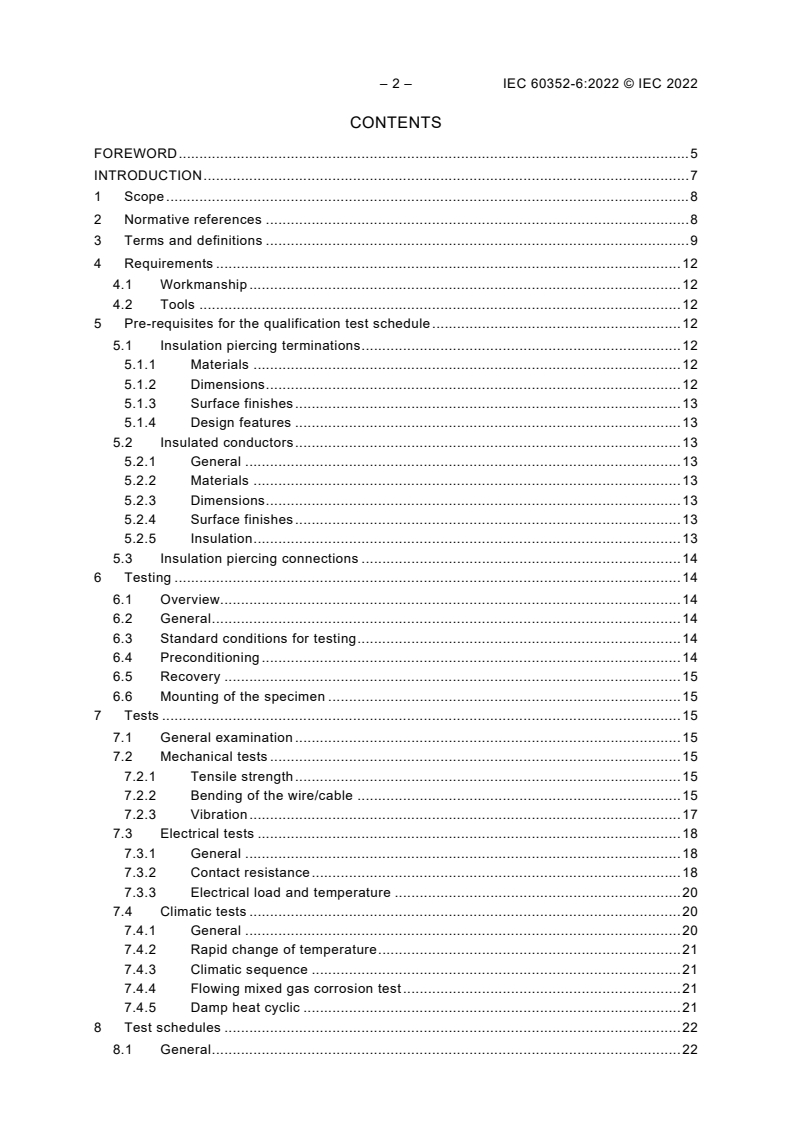
CONTENTS
FOREWORD . 5
INTRODUCTION . 7
1 Scope . 8
2 Normative references . 8
3 Terms and definitions . 9
4 Requirements . 12
4.1 Workmanship . 12
4.2 Tools . 12
5 Pre-requisites for the qualification test schedule . 12
5.1 Insulation piercing terminations . 12
5.1.1 Materials . 12
5.1.2 Dimensions . 12
5.1.3 Surface finishes . 13
5.1.4 Design features . 13
5.2 Insulated conductors . 13
5.2.1 General . 13
5.2.2 Materials . 13
5.2.3 Dimensions . 13
5.2.4 Surface finishes . 13
5.2.5 Insulation . 13
5.3 Insulation piercing connections . 14
6 Testing . 14
6.1 Overview. 14
6.2 General . 14
6.3 Standard conditions for testing . 14
6.4 Preconditioning . 14
6.5 Recovery . 15
6.6 Mounting of the specimen . 15
7 Tests . 15
7.1 General examination . 15
7.2 Mechanical tests . 15
7.2.1 Tensile strength . 15
7.2.2 Bending of the wire/cable . 15
7.2.3 Vibration . 17
7.3 Electrical tests . 18
7.3.1 General . 18
7.3.2 Contact resistance . 18
7.3.3 Electrical load and temperature . 20
7.4 Climatic tests . 20
7.4.1 General . 20
7.4.2 Rapid change of temperature . 21
7.4.3 Climatic sequence . 21
7.4.4 Flowing mixed gas corrosion test . 21
7.4.5 Damp heat cyclic . 21
8 Test schedules . 22
8.1 General . 22
8.1.1 Overview . 22
8.1.2 Insulation piercing connections with terminations suitable for a range of
wire diameters . 22
8.1.3 Multipole components . 22
8.2 Qualification test schedule . 23
8.2.1 General . 23
8.2.2 Initial examination . 23
8.2.3 Testing of insulation piercing connections . 23
8.3 Application test schedule . 25
8.3.1 General . 25
8.3.2 Initial examination . 25
8.3.3 Testing of insulation piercing connections . 25
8.4 Flow charts . 26
Annex A (informative) Practical guidance . 29
A.1 General information on insulation piercing terminations . 29
A.2 Current-carrying capacity . 29
A.3 Tool information . 29
A.4 Termination information . 30
A.4.1 General . 30
A.4.2 Materials . 31
A.4.3 Surface finishes . 31
A.4.4 Dimensions . 31
A.5 Conductor information . 31
A.5.1 General . 31
A.5.2 Material . 31
A.5.3 Dimensions . 31
A.5.4 Surface finishes . 31
A.5.5 Insulation . 31
A.5.6 Stripping information for cables (cords) and wires . 31
A.6 Connection information . 32
A.7 Axial load . 33
Bibliography . 34
Figure 1 – Example of an integrated insulation piercing connection (one connection
shown) . 10
Figure 2 – Example of an insulation piercing connection with insulated flat conductor . 11
Figure 3 – Example of an insulation piercing connection in a barrel with stranded wires . 11
Figure 4 – Test arrangement, bending of single wire . 16
Figure 5 – Test arrangement, bending of flat conductor, flat flexible circuitry . 17
Figure 6 – Test arrangement, vibration . 17
Figure 7 – Test arrangement, contact resistance (measuring method for tinsel wire,
flat conductor, flat flexible circuitry) . 19
Figure 8 – Test arrangement, contact resistance (measuring method for stranded
wires). 19
Figure 9 – Qualification test schedule (see 8.2) . 27
Figure 10 – Application test schedule (see 8.3) . 28
Figure A.1 – Example of an insulation piercing termination as an integral part of a
component . 30
– 4 – IEC 60352-6:2022 © IEC 2022
Figure A.2 – Example of an insulation piercing termination for flat conductor . 30
Figure A.3 – Example of an insulation piercing termination for stranded wires . 30
Figure A.4 – Examples of round, flat and flat oval sheath cable . 32
Figure A.5 – Example of a flexible circuitry . 32
Figure A.6 – Example of an integrated insulation piercing connection . 32
Figure A.7 – Example of an integrated insulation piercing connection in a barrel with
stranded wires . 33
Table 1 – Vibration, preferred test severities . 18
Table 2 – Contact resistance of insulation piercing connections, maximum permitted
values . 20
Table 3 – Number of specimens required . 22
Table 4 – Qualification test schedule – Test group A . 23
Table 5 – Qualification test schedule – Test group B . 23
Table 6 – Qualification test schedule – Test group C . 24
Table 7 – Qualification test schedule – Test group D . 25
Table 8 – Application test schedule – Test group 1 . 26
Table 9 – Application test schedule – Test group 2 . 26
Table A.1 – Axial load F . 33
INTERNATIONAL ELECTROTECHNICAL COMMISSION
____________
SOLDERLESS CONNECTIONS –
Part 6: Insulation piercing connections –
General requirements, test methods and practical guidance
FOREWORD
1) The International Electrotechnical Commission (IEC) is a worldwide organization for standardization comprising
all national electrotechnical committees (IEC National Committees). The object of IEC is to promote international
co-operation on all questions concerning standardization in the electrical and electronic fields. To this end and
in addition to other activities, IEC publishes International Standards, Technical Specifications, Technical Reports,
Publicly Available Specifications (PAS) and Guides (hereafter referred to as “IEC Publication(s)”). Their
preparation is entrusted to technical committees; any IEC National Committee interested in the subject dealt with
may participate in this preparatory work. International, governmental and non-governmental organizations liaising
with the IEC also participate in this preparation. IEC collaborates closely with the International Organization for
Standardization (ISO) in accordance with conditions determined by agreement between the two organizations.
2) The formal decisions or agreements of IEC on technical matters express, as nearly as possible, an international
consensus of opinion on the relevant subjects since each technical committee has representation from all
interested IEC National Committees.
3) IEC Publications have the form of recommendations for international use and are accepted by IEC National
Committees in that sense. While all reasonable efforts are made to ensure that the technical content of IEC
Publications is accurate, IEC cannot be held responsible for the way in which they are used or for any
misinterpretation by any end user.
4) In order to promote international uniformity, IEC National Committees undertake to apply IEC Publications
transparently to the maximum extent possible in their national and regional publications. Any divergence between
any IEC Publication and the corresponding national or regional publication shall be clearly indicated in the latter.
5) IEC itself does not provide any attestation of conformity. Independent certification bodies provide conformity
assessment services and, in some areas, access to IEC marks of conformity. IEC is not responsible for any
services carried out by independent certification bodies.
6) All users should ensure that they have the latest edition of this publication.
7) No liability shall attach to IEC or its directors, employees, servants or agents including individual experts and
members of its technical committees and IEC National Committees for any personal injury, property damage or
other damage of any nature whatsoever, whether direct or indirect, or for costs (including legal fees) and
expenses arising out of the publication, use of, or reliance upon, this IEC Publication or any other IEC
Publications.
8) Attention is drawn to the Normative references cited in this publication. Use of the referenced publications is
indispensable for the correct application of this publication.
9) Attention is drawn to the possibility that some of the elements of this IEC Publication may be the subject of patent
rights. IEC shall not be held responsible for identifying any or all such patent rights.
IEC 60352-6 has been prepared by subcommittee 48B: Electrical connectors, of IEC technical
committee 48: Electrical connectors and mechanical structures for electrical and electronic
equipment. It is an International Standard.
This second edition cancels and replaces the first edition published in 1997. This edition
constitutes a technical revision.
This edition includes the following significant technical changes with respect to the previous
edition:
a) axial load in 7.2.2 provided in a table in Annex A rather than as percentage of breaking load
of the wire;
b) different approach to measure contact resistance provided in 7.3.2.3.
– 6 – IEC 60352-6:2022 © IEC 2022
The text of this International Standard is based on the following documents:
Draft Report on voting
48B/3001/FDIS 48B/3009/RVD
Full information on the voting for its approval can be found in the report on voting indicated in
the above table.
The language used for the development of this International Standard is English.
This document was drafted in accordance with ISO/IEC Directives, Part 2, and developed in
accordance with ISO/IEC Directives, Part 1 and ISO/IEC Directives, IEC Supplement, available
at www.iec.ch/members_experts/refdocs. The main document types developed by IEC are
described in greater detail at www.iec.ch/standardsdev/publications.
A list of all parts in the IEC 60352 series, published under the general title Solderless
connections, can be found on the IEC website.
The committee has decided that the contents of this document will remain unchanged until the
stability date indicated on the IEC website under webstore.iec.ch in the data related to the
specific document. At this date, the document will be
• reconfirmed,
• withdrawn,
• replaced by a revised edition, or
• amended.
INTRODUCTION
This part of IEC 60352 applies to solderless connections made by insulation piercing (IP) and
includes requirements, tests and practical guidance information for such connection technology.
Two test schedules are provided:
– a qualification test schedule that applies to insulation piercing connections which conform
to all pre-requisites of Clause 5, which are derived from experience with successful
applications of such insulation piercing connections;
– an application test schedule that applies to insulation piercing connections made with
suitable IP termination which are integral part of a component and are already fulfilling the
pre-requisites of Clause 5.
IEC Guide 109 advocates the need to minimize the impact of a product on the natural
environment throughout the product life cycle. IEC 62430 provides principles, requirements and
guidance to implement environmentally conscious design.
It is understood that some of the materials permitted in this document may have a negative
environmental impact. As technological advances lead to acceptable alternatives to these
materials, they will be eliminated from this document.
– 8 – IEC 60352-6:2022 © IEC 2022
SOLDERLESS CONNECTIONS –
Part 6: Insulation piercing connections –
General requirements, test methods and practical guidance
1 Scope
This part of IEC 60352 is applicable to insulation piercing connections made with stranded wires
and tinsel wires, insulated flat conductors and flat flexible circuitries for use in electrical and
electronic equipment.
Information on materials and data from industrial experience is included in addition to the test
procedures to provide electrically stable connections under prescribed environmental
conditions.
The object of this document is to:
– determine the suitability of insulation piercing connections under specified mechanical,
electrical, and atmospheric conditions;
– provide a means of comparing test results when the tools used to make the connections, if
any, are of different designs or manufacture.
There are different designs and materials for insulation piercing terminations in use. For this
reason, only fundamental parameters of the termination, the performance requirements of the
conductor and the complete connection are specified in this document.
2 Normative references
The following documents are referred to in the text in such a way that some or all of their content
constitutes requirements of this document. For dated references, only the edition cited applies.
For undated references, the latest edition of the referenced document (including any
amendments) applies.
IEC 60068‑1:2013, Environmental testing – Part 1: General and guidance
IEC 60512‑1:2018, Connectors for electrical and electronic equipment – Tests and
measurements – Part 1: Generic specification
IEC 60512‑1‑1:2002, Connectors for electronic equipment – Tests and measurements –
Part 1‑1: General examination – Test 1a: Visual examination
IEC 60512‑1‑2:2002, Connectors for electronic equipment – Tests and measurements –
Part 1‑2: General examination – Test 1b: Examination of dimension and mass
IEC 60512‑2‑1:2002, Connectors for electronic equipment – Tests and measurements –
Part 2‑1: Electrical continuity and contact resistance tests – Test 2a: Contact resistance –
Millivolt level method
IEC 60512‑2‑2:2003, Connectors for electronic equipment – Tests and measurements –
Part 2‑2: Electrical continuity and contact resistance tests – Test 2b: Contact resistance –
Specified test current method
IEC 60512‑2‑5:2003, Connectors for electronic equipment – Tests and measurements –
Part 2‑5: Electrical continuity and contact resistance tests – Test 2e: Contact disturbance
IEC 60512‑6‑4:2002, Connectors for electronic equipment – Tests and measurements –
Part 6‑4: Dynamic stress tests – Test 6d: Vibration (sinusoidal)
IEC 60512‑9‑2:2011, Connectors for electronic equipment – Tests and measurements –
Part 9‑2: Endurance tests – Test 9b: Electrical load and temperature
IEC 60512-11-1:2019, Connectors for electrical and electronic equipment – Tests and
measurements – Part 11‑1: Climatic tests – Test 11a ‑ Climatic sequence
IEC 60512‑11‑4:2002, Connectors for electronic equipment – Tests and measurements –
Part 11‑4: Climatic tests – Test 11d: Rapid change of temperature
IEC 60512‑11‑7:2003, Connectors for electronic equipment – Tests and measurements –
Part 11‑7: Climatic tests – Test 11g: Flowing mixed gas corrosion test
IEC 60512‑11‑9:2002, Connectors for electronic equipment – Tests and measurements –
Part 11‑9: Climatic tests – Test 11i: Dry heat
IEC 60512‑11‑10:2002, Connectors for electronic equipment – Tests and measurements –
Part 11‑10: Climatic tests – Test 11j: Cold
IEC 60512‑11‑12:2002, Connectors for electronic equipment – Tests and measurements –
Part 11‑12: Climatic tests – Test 11m: Damp heat, cyclic
IEC 60512‑16‑20:1996, Electromechanical components for electronic equipment – Basic testing
procedures and measuring methods – Part 16: Mechanical tests on contacts and terminations
– Section 20: Test 16t: Mechanical strength (wired termination of solderless connections)
3 Terms and definitions
For the purposes of this document, the following terms and definitions apply.
ISO and IEC maintain terminological databases for use in standardization at the following
addresses:
• IEC Electropedia: available at http://www.electropedia.org/
• ISO Online browsing platform: available at http://www.iso.org/obp
3.1
conductor
part of the cable or wire intended to carry electric current
Note 1 to entry: The conductor may be
a) solid – made of a single strand of circular cross-section;
b) stranded – made of several strands of circular cross-section assembled either by laying up concentrically or by
bunching, and without insulation between them.
Note 2 to entry: The properties of the copper are in accordance with IEC 60228.
[SOURCE: IEC 60189-1:2018, 3.1]
– 10 – IEC 60352-6:2022 © IEC 2022
3.2
wire
insulated conductor or assembly of several insulated conductors, laid up together and which
may be provided with a screen
Note 1 to entry: The wire may be
a) single – consists of a single insulated conductor;
b) multiple – consists of several insulated conductors.
[SOURCE: IEC 60189-1:2018, 3.2 modified by deleting "low frequency" in the title and the
NOTE listing designations.]
3.3
insulation piercing (IP) connection
solderless connection made by metallic protruding elements, which pierce the insulation and
are intended to provide contact with the conductor by deforming or penetrating it
[SOURCE: IEC 60050-581:2008, 581-23-34, modified by adding “(IP)” (as abbreviation) and
deleting “(for electronic equipment)”.]
3.3.1
integrated insulation piercing (IP) termination for stranded wire or tinsel wire
insulation piercing termination which is integral part of a multipole connector, deemed to be
used for IP connection with stranded wire or tinsel wire (see Figure 1).
Figure 1 – Example of an integrated insulation piercing connection
(one connection shown)
Note 1 to entry: Usually, all IP connections of a connector with integrated IP terminations are made in one step.
Note 2 to entry: An example for the application is the free connector according to IEC 60603-7.
3.3.2
insulation piercing connection with insulated flat conductor or flat flexible circuitry
insulation piercing connection formed by lances which pierce and penetrate the insulated flat
conductor or flexible circuitry (see Figure 2)
Figure 2 – Example of an insulation piercing
connection with insulated flat conductor
3.3.3
insulation piercing barrel connection with stranded wire or tinsel wire
insulation piercing connection made by lances in a barrel which pierce the insulation, and make
contact with the conductor strands (see Figure 3)
Figure 3 – Example of an insulation piercing
connection in a barrel with stranded wires
3.4
insulation piercing termination
termination to accept different types of insulated conductors for the purpose of establishing an
insulation piercing connection
[SOURCE: IEC 60050-581:2008, 581-23-54]
3.5
insulation piercing zone
portion of the contact designed and intended to effect the piercing of the insulation and provide
contact with the conductor
[SOURCE: IEC 60050-581:2008, 581-23-44]
3.6
tinsel conductor
conductor comprising one or more elements stranded together, each element consisting of one
or more thin metal tapes helically wound on, and supported by a textile thread
[SOURCE: IEC 60050-461:2008, 461-01-18]
– 12 – IEC 60352-6:2022 © IEC 2022
3.7
tinsel wire
tinsel conductor jacketed with an insulating layer
4 Requirements
4.1 Workmanship
The manufacturer of insulation piercing connections or of a component using such connections
shall provide an instruction for the assembly of insulation piercing connections.
The insulation piercing connections shall be processed in a careful and workmanlike manner,
in accordance with good current practice.
Annex A (informative) provides practical guidance and may constitute a benchmark for the
assessment of workmanship.
4.2 Tools
Tools shall be used and inspected according to the instructions given by the manufacturer(s) of
the tool and/or the connector.
The tools shall be able to make uniformly reliable insulation piercing connections during their
lifetime.
The tools shall be designed to operate in such a manner that unacceptable damage to the
insulation piercing termination and/or conductors is avoided.
Hand tools shall be provided with a full cycle mechanism.
Automatic tools shall be provided with a full cycle mechanism or equivalent safeguard. Tools
are evaluated by testing insulation piercing connections made with the tools to be evaluated.
5 Pre-requisites for the qualification test schedule
5.1 Insulation piercing terminations
5.1.1 Materials
– Metallic parts
Suitable grades of copper or copper alloy such as copper-tin (bronze), copper-zinc (brass)
or beryllium copper shall be used.
– Insulating parts
For integrated insulation piercing connections according to 3.3.1 the component housing
material shall be polycarbonate or similar plastic material.
For insulation piercing barrel connections according to 3.3.3 the wire insulation shall be
PVC or another material appropriate for this connecting technique.
5.1.2 Dimensions
The quality of an insulation piercing connection depends on the dimensions of the insulation
piercing termination. The dimensions shall be suitable for stranded wires including tinsel wires,
insulated flat conductors or flat flexible circuitries, as specified in 5.2.
5.1.3 Surface finishes
The contact area of the termination shall be unplated or plated with tin or tin-lead or silver, gold,
palladium or their alloys.
The surface shall be free of contamination or corrosion which degrades performance.
5.1.4 Design features
Insulation piercing terminations shall be designed such that lances, peaks or sharp edges of
the insulation piercing zones penetrate the insulation of insulated conductor(s) and establish a
connection by penetration or controlled deformation of the conductor(s). The insulation piercing
zones and termination body shall deform around the conductor(s) to maintain the connection.
For integrated insulation piercing connections according to 3.3.1 the guiding function of the
component housing for the inserted insulated wires is important.
5.2 Insulated conductors
5.2.1 General
Wires with stranded wires, tinsel wires, flat conductors or flat flexible circuitries shall be used.
5.2.2 Materials
The conductors used shall be annealed copper.
5.2.3 Dimensions
5.2.3.1 Dimensions for insulated conductors used for integrated insulation piercing
terminations according to 3.3.1
Specified in the detail specification.
5.2.3.2 Dimensions for insulated conductors used for insulation piercing
connections with flat conductors or flat flexible circuitries according to 3.3.2
Specified in the detail specification.
5.2.3.3 Dimensions for insulated conductors used for insulation piercing barrel
connections with stranded wires or tinsel wires according to 3.3.3
Specified in the detail specification.
5.2.4 Surface finishes
Conductors shall be unplated or plated with tin, tin-lead or silver.
5.2.5 Insulation
The specification for the components using the insulation piercing termination shall specify:
– the insulation thickness of the wires, and
– the outer diameters or the outer dimensions of the wires that shall be accommodated.
The insulation material shall have properties compatible with the insulation piercing process,
i.e. the insulation material shall be capable of being readily pierced by the piercing zones. In
case of stranded conductors or tinsel wires the insulation shall additionally be capable of
keeping the strands in place so that they are not unduly moved when making the connection.
– 14 – IEC 60352-6:2022 © IEC 2022
For flat cables the insulation between the conductors, including any additional insulation
forming the cable, shall additionally be capable of being readily pierced by the piercing zones.
5.3 Insulation piercing connections
a) The combination of insulated conductors, termination and connection tools shall be
compatible.
b) During the connection process the insulation piercing termination of the component shall
– pierce the insulation without detrimental effect;
– deform or pierce the conductor so as to produce an electrical connection without
detrimental effect to the conductor, for example cracking.
c) The termination design shall control the relative position of the insulated conductor and the
piercing zone.
d) A conductor shall be correctly located in the insulation piercing termination as specified by
the detail specification. There shall be a sufficient distance between the termination and the
conductor end. The minimum value of the distance depends on the conductor used and shall
be as specified by the detail specification.
e) Where the termination is equipped with an insulation support or insulation grip, the insulation
shall be correctly located in the support or grip.
6 Testing
6.1 Overview
All tests shall be carried out with insulation piercing connections being in their normal operating
position, for example in their housings (e.g.: the connector insulating body).
Where an insulation piercing connecting device is designed to accommodate more than one
insulation piercing termination, each connection shall be tested individually.
6.2 General
As explained in the introduction to this document, there are two test schedules which shall be
applied according to the following conditions:
– insulation piercing connections which conform to all the pre-requisites of Clause 5 shall be
tested and shall meet the requirements of the qualification test schedule of 8.2;
– insulation piercing connections which are part of a component and are already qualified to
all the pre-requisites of Clause 5 shall be tested in accordance with and meet the
requirements of the application test schedule of 8.3, which shall be included in the detail
specification.
6.3 Standard conditions for testing
Unless otherwise specified, all tests shall be carried out under standard conditions for testing,
as specified in IEC 60512-1.
The ambient temperature and the relative humidity at which the measurements are made shall
be stated in the test report.
In case of dispute about the test results, the test shall be repeated at one of the referee
conditions of IEC 60068-1.
6.4 Preconditioning
Where specified, the connections shall be preconditioned under standard conditions for testing
for a period of 24 h, in accordance with IEC 60512-1.
6.5 Recovery
Where specified, the specimens shall be allowed to recover under standard conditions for
testing for a period of 1 h to 2 h after conditioning.
6.6 Mounting of the specimen
A test specimen shall consist of the component having one or a specified number of insulation
piercing connections with wires mounted according to manufacturer´s instruction to the
connection slots of each insulation piercing connections. The wires connected with a multipole
connector may be a multi-core cable or a number of single wires.
When mounting is required in a test, the specimens shall be mounted using the normal mounting
method, unless otherwise specified.
7 Tests
7.1 General examination
The tests shall be carried out in accordance with test 1a: Visual examination, of IEC 60512-1-1,
and test 1b: Examination of dimension and mass, of IEC 60512-1-2. The visual examination
test may be carried out with magnification up to five times.
All parts shall be examined to determine whether the pre-requisites and requirements of
Clause 5 and Clause 6 have been met.
7.2 Mechanical tests
7.2.1 Tensile strength
The test shall be carried out in accordance with test 16t: Mechanical strength (wired
terminations of solderless connections), of IEC 60512-16-20, Method A or Method B (as to be
agreed between user and manufacturer).
Requirement:
The tensile strength of insulation piercing connections shall be not less than 20 N per wire,
unless otherwise specified by the detail specification.
7.2.2 Bending of the wire/cable
The object of this test is to assess the ability of an insulation piercing connection to withstand
the mechanical stress caused by bending the connected insulated wire/cable, in a specified
manner.
The test specimen shall consist of:
– multiple connections to a multipole component. Such specimens may include multiple single
wires, wires in cable constructions or multiconductor flat cable according to 3.3.1 and 3.3.2
(see Figure 1 and Figure 2);
– a single wire connected to a single component according to 3.3.3 (see Figure 3).
The test specimen shall be securely held in such a position that the wire(s) or the flat conductor
hangs along its (their) longitudinal axis in the connection. An axial load F shall be applied to
the free end of the wire(s) or flat conductor, to keep it (them) straight.
– 16 – IEC 60352-6:2022 © IEC 2022
The value of this load shall be:
– 5 % to 10 % of the breaking strength of the wire where single wires are to be tested;
– 10 N to 50 N where flat conductors are to be tested. The applicable load depends on the
number of wires in the conductor, the wire diameter, the type and/or material of the
insulation and shall be specified by the detail specification. The load shall be evenly
distributed over the whole conductor.
NOTE Table A.1 provides a table, where this load has been calculated for different cross-sectional areas according
for annealed
to the requirement of 5 % to 10 % of the tensile strength, based on a tensile strength of 200 N/mm
copper conductors according to IEC 60228.
The wire shall then be bent perpendicular in both directions. A bending over the distances 1, 2
and 3 shall
...