

IEC TS 60034-27-5:2021
(Main)Rotating electrical machines - Part 27-5: Off-line measurement of partial discharge inception voltage on winding insulation under repetitive impulse voltage
General Information
- Abstract
IEC TS 60034-27-5:2021 provides an off-line measurement method of the partial discharge inception and extinction voltage on winding insulation under repetitive impulse voltage. This document is relevant to rotating machines supplied by a voltage source converter.
- Status
- Published
- Publication Date
- 06-Apr-2021
- Technical Committee
- TC 2 - Rotating machinery
- Drafting Committee
- MT 10 - TC 2/MT 10
- Current Stage
- PPUB - Publication issued
- Start Date
- 07-Apr-2021
- Completion Date
- 06-May-2021
Buy Documents

IEC TS 60034-27-5:2021 - Rotating electrical machines - Part 27-5: Off-line measurement of partial discharge inception voltage on winding insulation under repetitive impulse voltage Released:4/7/2021
Overview
IEC TS 60034-27-5:2021 specifies an off-line measurement method for partial discharge inception voltage (PDIV) and partial discharge extinction voltage (PDEV) on winding insulation of rotating electrical machines when exposed to repetitive impulse voltage. The Technical Specification focuses on test methods, measurement circuits and procedures relevant to machines that can be supplied by a voltage source converter (VSC). It complements the IEC 60034 series by addressing impulse-type stress and the measurement of PD under pulsed waveforms.
Key Topics and Requirements
- Scope and terminology: definitions, symbols and abbreviated terms used for impulse PD testing of rotating machines.
- Repetitive impulse voltages: characteristics of single impulses, typical waveform distortions at the test object, trains of impulses and stepped-by-step (SBS) voltage increase/decrease patterns used for PDIV/RPDEV measurement.
- Impulse waveform considerations: rise time, peak, overshoot, ringing and slow oscillation effects as they appear at the generator and at winding terminals.
- Measurement methods: electrical PD detection with coupling capacitors, HF current transformers (HFCT), electromagnetic or UHF couplers and required analogue filtering to suppress supply impulses.
- Detection threshold and data handling: recommendations on PD detection threshold, noise suppression and use of a PC-based measuring system to calculate RPDIV (repetitive PD inception voltage) and RPDEV.
- Test objects and connections: guidance for testing twisted-pair samples, motorettes/formettes and complete windings including three- and four-terminal connection schemes.
- Test procedure and safety: conditioning procedures, grounding/floating practices, environmental considerations and reporting requirements.
- Illustrative materials: block diagrams, impulse patterns, example connection schemes and annexes with typical PD data analysis and test parameter tables.
Applications
This specification is intended for:
- Manufacturers of motors and generators for end-of-line and type testing of winding insulation against repetitive impulse stresses.
- Testing and diagnostic laboratories performing off-line PD measurements and acceptance tests.
- Service engineers and condition-monitoring teams assessing insulation integrity following converter-fed operation or prior to service.
- R&D teams developing VSC-driven machines or insulation systems subject to repetitive impulse stress.
Practical uses include acceptance testing, insulation qualification, failure analysis and research into PD behaviour under converter-related impulse waveforms.
Related Standards
- IEC 60034 series (rotating electrical machines)
- IEC TS 61934:2011 (referenced in PD analysis examples)
- Other IEC documents on PD measurement and high-voltage testing (see normative references in IEC TS 60034-27-5:2021)
Keywords: IEC TS 60034-27-5:2021, partial discharge, PD inception voltage, repetitive impulse voltage, winding insulation, rotating electrical machines, voltage source converter, off-line PD measurement, RPDIV, RPDEV.
Buy Documents
IEC TS 60034-27-5:2021 - Rotating electrical machines - Part 27-5: Off-line measurement of partial discharge inception voltage on winding insulation under repetitive impulse voltage Released:4/7/2021
Get Certified
Connect with accredited certification bodies for this standard

IMQ S.p.A. (Certification)
Italian electrical product certification.

SLG Prüf- und Zertifizierungs GmbH
German testing and certification body.

UL Solutions
Global safety science company with testing, inspection and certification.
Sponsored listings
Frequently Asked Questions
IEC TS 60034-27-5:2021 is a technical specification published by the International Electrotechnical Commission (IEC). Its full title is "Rotating electrical machines - Part 27-5: Off-line measurement of partial discharge inception voltage on winding insulation under repetitive impulse voltage". This standard covers: IEC TS 60034-27-5:2021 provides an off-line measurement method of the partial discharge inception and extinction voltage on winding insulation under repetitive impulse voltage. This document is relevant to rotating machines supplied by a voltage source converter.
IEC TS 60034-27-5:2021 provides an off-line measurement method of the partial discharge inception and extinction voltage on winding insulation under repetitive impulse voltage. This document is relevant to rotating machines supplied by a voltage source converter.
IEC TS 60034-27-5:2021 is classified under the following ICS (International Classification for Standards) categories: 29.120.30 - Plugs, socket-outlets, couplers; 29.160.01 - Rotating machinery in general. The ICS classification helps identify the subject area and facilitates finding related standards.
IEC TS 60034-27-5:2021 is available in PDF format for immediate download after purchase. The document can be added to your cart and obtained through the secure checkout process. Digital delivery ensures instant access to the complete standard document.
Standards Content (Sample)
IEC TS 60034-27-5 ®
Edition 1.0 2021-04
TECHNICAL
SPECIFICATION
colour
inside
Rotating electrical machines –
Part 27-5: Off-line measurement of partial discharge inception voltage on
winding insulation under repetitive impulse voltage
All rights reserved. Unless otherwise specified, no part of this publication may be reproduced or utilized in any form
or by any means, electronic or mechanical, including photocopying and microfilm, without permission in writing from
either IEC or IEC's member National Committee in the country of the requester. If you have any questions about IEC
copyright or have an enquiry about obtaining additional rights to this publication, please contact the address below or
your local IEC member National Committee for further information.
IEC Central Office Tel.: +41 22 919 02 11
3, rue de Varembé info@iec.ch
CH-1211 Geneva 20 www.iec.ch
Switzerland
About the IEC
The International Electrotechnical Commission (IEC) is the leading global organization that prepares and publishes
International Standards for all electrical, electronic and related technologies.
About IEC publications
The technical content of IEC publications is kept under constant review by the IEC. Please make sure that you have the
latest edition, a corrigendum or an amendment might have been published.
IEC publications search - webstore.iec.ch/advsearchform IEC online collection - oc.iec.ch
The advanced search enables to find IEC publications by a Discover our powerful search engine and read freely all the
variety of criteria (reference number, text, technical publications previews. With a subscription you will always
committee, …). It also gives information on projects, replaced have access to up to date content tailored to your needs.
and withdrawn publications.
Electropedia - www.electropedia.org
IEC Just Published - webstore.iec.ch/justpublished
The world's leading online dictionary on electrotechnology,
Stay up to date on all new IEC publications. Just Published
containing more than 22 000 terminological entries in English
details all new publications released. Available online and
and French, with equivalent terms in 18 additional languages.
once a month by email.
Also known as the International Electrotechnical Vocabulary
(IEV) online.
IEC Customer Service Centre - webstore.iec.ch/csc
If you wish to give us your feedback on this publication or
need further assistance, please contact the Customer Service
Centre: sales@iec.ch.
IEC TS 60034-27-5 ®
Edition 1.0 2021-04
TECHNICAL
SPECIFICATION
colour
inside
Rotating electrical machines –
Part 27-5: Off-line measurement of partial discharge inception voltage on
winding insulation under repetitive impulse voltage
INTERNATIONAL
ELECTROTECHNICAL
COMMISSION
ICS 29.160.01 ISBN 978-2-8322-9648-6
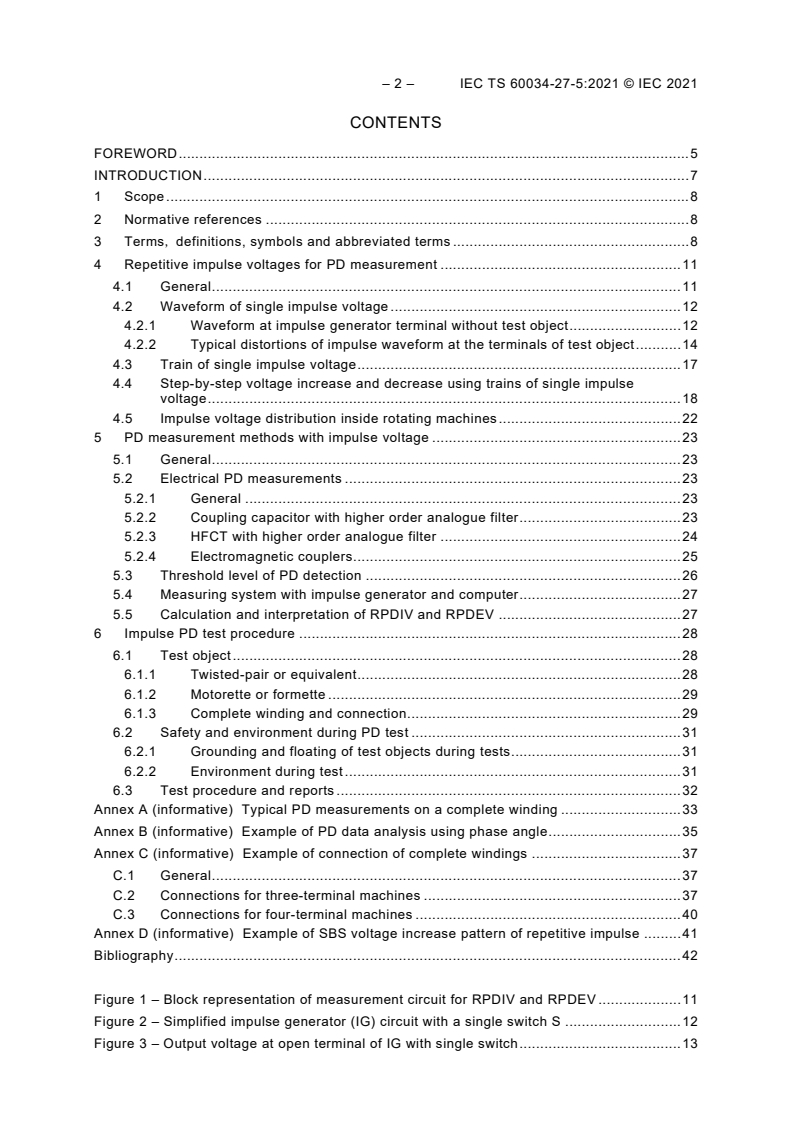
– 2 – IEC TS 60034-27-5:2021 © IEC 2021
CONTENTS
FOREWORD . 5
INTRODUCTION . 7
1 Scope . 8
2 Normative references . 8
3 Terms, definitions, symbols and abbreviated terms . 8
4 Repetitive impulse voltages for PD measurement . 11
4.1 General . 11
4.2 Waveform of single impulse voltage . 12
4.2.1 Waveform at impulse generator terminal without test object . 12
4.2.2 Typical distortions of impulse waveform at the terminals of test object . 14
4.3 Train of single impulse voltage . 17
4.4 Step-by-step voltage increase and decrease using trains of single impulse
voltage . 18
4.5 Impulse voltage distribution inside rotating machines . 22
5 PD measurement methods with impulse voltage . 23
5.1 General . 23
5.2 Electrical PD measurements . 23
5.2.1 General . 23
5.2.2 Coupling capacitor with higher order analogue filter . 23
5.2.3 HFCT with higher order analogue filter . 24
5.2.4 Electromagnetic couplers . 25
5.3 Threshold level of PD detection . 26
5.4 Measuring system with impulse generator and computer . 27
5.5 Calculation and interpretation of RPDIV and RPDEV . 27
6 Impulse PD test procedure . 28
6.1 Test object . 28
6.1.1 Twisted-pair or equivalent . 28
6.1.2 Motorette or formette . 29
6.1.3 Complete winding and connection . 29
6.2 Safety and environment during PD test . 31
6.2.1 Grounding and floating of test objects during tests . 31
6.2.2 Environment during test . 31
6.3 Test procedure and reports . 32
Annex A (informative) Typical PD measurements on a complete winding . 33
Annex B (informative) Example of PD data analysis using phase angle . 35
Annex C (informative) Example of connection of complete windings . 37
C.1 General . 37
C.2 Connections for three-terminal machines . 37
C.3 Connections for four-terminal machines . 40
Annex D (informative) Example of SBS voltage increase pattern of repetitive impulse . 41
Bibliography . 42
Figure 1 – Block representation of measurement circuit for RPDIV and RPDEV . 11
Figure 2 – Simplified impulse generator (IG) circuit with a single switch S . 12
Figure 3 – Output voltage at open terminal of IG with single switch . 13
Figure 4 – Two impulses at open terminal of IG with single switch . 13
Figure 5 – Simplified IG circuit with four-arm (switch) bridge circuit . 13
Figure 6 – Output voltages at open terminal of four-arm bridge circuit . 14
Figure 7 – Increase of rise time and decrease of peak voltage of triangular impulse . 15
Figure 8 – Increase of rise time and decrease of peak voltage of rectangular impulse. 15
Figure 9 – Overshoot of peak and following fast oscillation of triangular impulse . 15
Figure 10 – Overshoot of peak and following fast oscillation of rectangular impulse . 16
Figure 11 – Typical "ringing" observed during bipolar rectangular voltage test . 16
Figure 12 – Slow oscillating decay of triangular impulse . 17
Figure 13 – Slow oscillating decay of rectangular impulse . 17
Figure 14 – Schematic representation of train parameters of positive unipolar impulses . 18
Figure 15 – Schematic representation of train parameters of bipolar impulses . 18
Figure 16 – SBS parameters of positive unipolar impulses . 19
Figure 17 – SBS voltage pattern of positive unipolar impulses for RPDIV and RPDEV . 19
Figure 18 – SBS voltage pattern of bipolarly distorted positive unipolar impulse . 20
Figure 19 – SBS voltage increase of bipolar impulses . 20
Figure 20 – Representative scheme of conditioning procedure before RPDIV
measurement . 21
Figure 21 – Schematic representation of phase/phase, phase/ground and turn/turn
voltages of the winding of a rotating machine fed from a two-level converter [2] . 23
Figure 22 – Coupling capacitor with higher order analogue filter . 24
Figure 23 – Example of voltage impulse and PD pulse frequency spectra before (left)
and after (right) filtering . 24
Figure 24 – HFCT between supply and test object with higher order analogue filter . 25
Figure 25 – HFCT between test object and earth with higher order analogue filter . 25
Figure 26 – Circuit using an electromagnetic coupler (for example an antenna) to
suppress impulses from the test supply . 25
Figure 27 – Circuit using an electromagnetic UHF antenna . 26
Figure 28 – Schematic representation of noise, disturbance and threshold values . 26
Figure 29 – Example diagram of PD measurements with PC . 27
Figure 30 – Example of RPDIV and RPDEV calculation using a 50 % PD probability
against repetitive impulse voltage (Figure 12 of IEC TS 61934:2011, modified). 28
Figure 31 – Representative scheme of voltage terminals for three-terminal machine
and four-terminal machine . 30
Figure A.1 – Block diagram of PD measurement system used in RRT . 33
Figure A.2 – Impulse pattern used in RRT and PD inception . 33
Figure B.1 – Example of PD phase angle pattern of sinusoidal voltage . 35
Figure B.2 – Example of PD phase angle pattern of PWM voltage on the phase angle
of a sinusoidal one . 36
Figure B.3 – Example of PD phase angle pattern of PWM voltage on rectangular
voltage angle (PRPD pattern) . 36
Figure C.1 – Connection of six-terminal machines. 37
Figure C.2 – Connection of three- or four-terminal machines (with N terminal) . 37
Figure C.3 – Three-terminal machine connection, Type A (Table 2) . 38
Figure C.4 – Three-terminal machine connection, Type B (Table 2) . 38
Figure C.5 – Three-terminal machine connection, Type C (Table 2) . 38
– 4 – IEC TS 60034-27-5:2021 © IEC 2021
Figure C.6 – Three-terminal machine connection, Type D (Table 2) . 39
Figure C.7 – Three-terminal machine connection, Type E (Table 2) . 39
Figure C.8 – Three-terminal machine connection, Type F (Table 2) . 39
Figure C.9 – Four-terminal machine with earthed N terminal – Connection types
(Table 3) . 40
Figure D.1 – SBS voltage increase of alternating train of unipolar impulses . 41
Table 1 – Typical ranges of impulse voltage parameters at terminal of test object to be
reported . 21
Table 2 – Connection of complete winding of three-terminal machine . 30
Table 3 – Connection of complete winding of four-terminal machine . 31
Table A.1 – Parameters used in RRT . 33
INTERNATIONAL ELECTROTECHNICAL COMMISSION
____________
ROTATING ELECTRICAL MACHINES –
Part 27-5: Off-line measurement of partial discharge inception
voltage on winding insulation under repetitive impulse voltage
FOREWORD
1) The International Electrotechnical Commission (IEC) is a worldwide organization for standardization comprising
all national electrotechnical committees (IEC National Committees). The object of IEC is to promote international
co-operation on all questions concerning standardization in the electrical and electronic fields. To this end and
in addition to other activities, IEC publishes International Standards, Technical Specifications, Technical Reports,
Publicly Available Specifications (PAS) and Guides (hereafter referred to as "IEC Publication(s)"). Their
preparation is entrusted to technical committees; any IEC National Committee interested in the subject dealt with
may participate in this preparatory work. International, governmental and non-governmental organizations liaising
with the IEC also participate in this preparation. IEC collaborates closely with the International Organization for
Standardization (ISO) in accordance with conditions determined by agreement between the two organizations.
2) The formal decisions or agreements of IEC on technical matters express, as nearly as possible, an international
consensus of opinion on the relevant subjects since each technical committee has representation from all
interested IEC National Committees.
3) IEC Publications have the form of recommendations for international use and are accepted by IEC National
Committees in that sense. While all reasonable efforts are made to ensure that the technical content of IEC
Publications is accurate, IEC cannot be held responsible for the way in which they are used or for any
misinterpretation by any end user.
4) In order to promote international uniformity, IEC National Committees undertake to apply IEC Publications
transparently to the maximum extent possible in their national and regional publications. Any divergence between
any IEC Publication and the corresponding national or regional publication shall be clearly indicated in the latter.
5) IEC itself does not provide any attestation of conformity. Independent certification bodies provide conformity
assessment services and, in some areas, access to IEC marks of conformity. IEC is not responsible for any
services carried out by independent certification bodies.
6) All users should ensure that they have the latest edition of this publication.
7) No liability shall attach to IEC or its directors, employees, servants or agents including individual experts and
members of its technical committees and IEC National Committees for any personal injury, property damage or
other damage of any nature whatsoever, whether direct or indirect, or for costs (including legal fees) and
expenses arising out of the publication, use of, or reliance upon, this IEC Publication or any other IEC
Publications.
8) Attention is drawn to the Normative references cited in this publication. Use of the referenced publications is
indispensable for the correct application of this publication.
9) Attention is drawn to the possibility that some of the elements of this IEC Publication may be the subject of patent
rights. IEC shall not be held responsible for identifying any or all such patent rights.
The main task of IEC technical committees is to prepare International Standards. In exceptional
circumstances, a technical committee may propose the publication of a technical specification
when
• the required support cannot be obtained for the publication of an International Standard,
despite repeated efforts, or
• the subject is still under technical development or where, for any other reason, there is the
future but no immediate possibility of an agreement on an International Standard.
Technical specifications are subject to review within three years of publication to decide whether
they can be transformed into International Standards.
IEC TS 60034-27-5, which is a Technical Specification, has been prepared by IEC technical
committee 2: Rotating machinery.
– 6 – IEC TS 60034-27-5:2021 © IEC 2021
The text of this Technical Specification is based on the following documents:
Draft TS Report on voting
2/1955/DTS 2/1962A/RVDTS
Full information on the voting for the approval of this Technical Specification can be found in
the report on voting indicated in the above table.
This document has been drafted in accordance with the ISO/IEC Directives, Part 2.
NOTE A table of cross-references of all IEC TC 2 publications can be found on the IEC TC 2 dashboard on the IEC
website.
The committee has decided that the contents of this document will remain unchanged until the
stability date indicated on the IEC website under "http://webstore.iec.ch" in the data related to
the specific document. At this date, the document will be
• reconfirmed,
• withdrawn,
• replaced by a revised edition, or
• amended.
IMPORTANT – The 'colour inside' logo on the cover page of this publication indicates
that it contains colours which are considered to be useful for the correct understanding
of its contents. Users should therefore print this document using a colour printer.
INTRODUCTION
The recent development of power electronics technology has led to various power drive systems
(PDS) of variable-speed rotating electrical machines. The new influences of PDS on rotating
machines are introduced in IEC TS 60034-25 [1] . This document points out that electrical
insulation of machine winding is exposed to numerous voltage impulses due to the repetitive
fast switching of power devices in PDS. The severity of the impulses depends on ratings of
converter and machines, converter topology, length of cable between machine and converter,
filtering equipment and so on.
IEC 60034-18-41 [2], published in 2014, is the first International Standard which describes
design qualification and type tests for Type I (partial discharge free) insulation systems used in
converter-fed rotating electrical machines. In this document, both tests require partial discharge
(PD) tests with power frequency voltage or impulse excitation. As for PD measurements with
impulse excitation, IEC 60034-18-41 cites IEC TS 61934, which provides a technical
explanation and several PD measuring methods, in general. For practical test guidance specific
to winding insulation of rotating machines, this document was prepared as an off-line
measurement of PD inception and extinction voltages during repetitive impulse condition,
RPDIV and RPDEV.
___________
Numbers in square brackets refer to the Bibliography
– 8 – IEC TS 60034-27-5:2021 © IEC 2021
ROTATING ELECTRICAL MACHINES –
Part 27-5: Off-line measurement of partial discharge inception
voltage on winding insulation under repetitive impulse voltage
1 Scope
This document provides an off-line measurement method of the partial discharge inception and
extinction voltage on winding insulation under repetitive impulse voltage. This document is
relevant to rotating machines supplied by a voltage source converter.
2 Normative references
The following documents are referred to in the text in such a way that some or all of their content
constitutes requirements of this document. For dated references, only the edition cited applies.
For undated references, the latest edition of the referenced document (including any
amendments) applies.
IEC 60034-27-1, Rotating electrical machines – Part 27-1: Off-line partial discharge
measurements on the winding insulation
IEC TS 61934:2011, Electrical insulating materials and systems – Electrical measurement of
partial discharges (PD) under short rise time and repetitive voltage impulses
IEC TS 62478, High voltage test techniques – Measurement of partial discharges by
electromagnetic and acoustic methods
3 Terms, definitions, symbols and abbreviated terms
For the purposes of this document, the terms, definitions, symbols and abbreviated terms given
in IEC 60034-27-1, IEC TS 61934, and the following apply.
ISO and IEC maintain terminological databases for use in standardization at the following
addresses:
• IEC Electropedia: available at http://www.electropedia.org/
• ISO Online browsing platform: available at http://www.iso.org/obp
3.1
partial discharge
PD
localized electrical discharge that only partially bridges the insulation between conductors and
which can or cannot occur adjacent to a conductor
3.2
repetitive partial discharge inception voltage
RPDIV
minimum peak-to-peak impulse voltage at which more than five PD pulses occur on ten voltage
impulses of the same peak-to-peak values when the impulse voltage applied to the test object
is increased with step-by-step method
Note 1 to entry: This is a mean value for the specified test time and a test arrangement where the voltage applied
to the test object is increased with the step-by-step method. Details are mentioned in 5.5.
3.3
repetitive partial discharge extinction voltage
RPDEV
maximum peak-to-peak impulse voltage at which fewer than five PD pulses occur on ten voltage
impulses of the same peak-to-peak values when the voltage applied to the test object is
decreased with step-by-step method from a higher value at which such discharges are observed
Note 1 to entry: This is a mean value for the specified test time and a test arrangement where the voltage applied
to the test object is decreased with the step-by-step method. Details are mentioned in 5.5.
3.4
unipolar impulse
voltage impulse, the polarity of which is either positive or negative
Note 1 to entry: Details are mentioned in 4.2.
3.5
bipolar impulse
voltage impulse, the polarity of which changes alternately from positive to negative or vice versa
3.6
peak-to-peak impulse voltage
U
pk/pk
maximum numerical value of voltage reached from the lowest value impulse
Note 1 to entry: The definition of peak-to-peak voltage is clarified in Clause 4.
Note 2 to entry: U is used for the entire waveform of the impulse including distorted impulses.
pk/pk
3.7
impulse rise time
t
r
time for the voltage to rise from 10 % to 90 % of its final value
3.8
impulse decay time
t
d
time interval between the instants at which the instantaneous values of a triangular impulse
decrease from a specified upper value to a specified lower value
3.9
impulse fall time
t
f
time for the voltage of a rectangular impulse to fall from 90 % to 10 % of its initial value
3.10
impulse width
t
w
interval of time between the first and last instants at which the instantaneous value of a single
impulse reaches a specified fraction of its impulse magnitude or a specified threshold
3.11
time between two successive impulses
t
pp
time between two successive impulses with the same waveform – in a considered set of pulses,
for example, for one period
– 10 – IEC TS 60034-27-5:2021 © IEC 2021
3.12
impulse voltage repetition rate
f
r
average of the inverse of the time between two successive impulses t
pp
3.13
train of impulse
sequence of repetitive impulse voltages with the same waveform parameters, including peak-
to-peak impulse voltage, rise time, decay time, impulse width, fall time, polarity and time interval
between impulses
Note 1 to entry: Details are mentioned in 4.3.
3.14
step-by-step method
SBS method
method of impulse voltage application of trains of repetitive impulse with step-by-step increase
and decrease of peak values
Note 1 to entry: Details are mentioned in 4.4.
3.15
U
s
starting applied voltage U during step-by-step method
pk/pk
Note 1 to entry: See Figure 16 and Figure 17.
3.16
U
m
maximum applied voltage U during step-by-step method
pk/pk
Note 1 to entry: See Figure 16 and Figure 17.
3.17
∆U
increase or decrease voltage U during step-by-step method
pk/pk
Note 1 to entry: See Figure 16 and Figure 17.
3.18
N
p
number of impulses in a train during step-by-step method
Note 1 to entry: See Figure 16.
3.19
t
ss
rest time between two trains of impulses with voltage step ∆U during step-by-step method
Note 1 to entry: See Figure 16.
3.20
k
ratio of U value of distorted waveform to original U at open terminal of an impulse
pk/pk pk/pk
generator
3.21
conditioning
pre-application of conditioning voltage before PD test for stable measurement condition
3.22
ringing
transient oscillation of impulse voltage that is influenced by the circuit impedance
3.23
noise
electric noise caused by thermal white noise from PD detection circuit or impulse generator
which may lower PD detection sensitivity
3.24
disturbance
electric and electromagnetic transient impulse from impulse generator or adjacent electric
devices which may disturb PD pulse waveform observation
3.25
motorette
special test model used for the evaluation of the electrical insulation systems of random-wound
windings
3.26
formette
special test model used for the evaluation of the electrical insulation systems for form-wound
windings
3.27
parallel winding
special test winding in which the turn/turn insulation is simulated by at least two electrically
isolated conductors wound in parallel, one of which is grounded and the other is energized
4 Repetitive impulse voltages for PD measurement
4.1 General
This document describes RPDIV and RPDEV as repetitive partial discharge inception and
extinction voltage of test objects under repetitive impulse voltage. They were first defined in
IEC TS 61934 and are redefined in this document. Both RPDIV and RPDEV have two features
compared with the conventional PDIV and PDEV under sinusoidal voltage defined in IEC 60034-
27-1. The first feature is the clear definition of repetitive impulse voltage with distortion and the
second one is 50 % PD occurrence probability.
Figure 1 – Block representation of measurement circuit for RPDIV and RPDEV
Figure 1 shows a representative scheme of a measurement circuit for RPDIV and RPDEV as a
block diagram. Repetitive impulse voltage from an impulse generator (IG) are mentioned in
detail in this Clause 4. PD measuring methods are mentioned in Clause 5. Subclause 6.1
describes test objects of both model samples and complete windings. A four-terminal test object
– 12 – IEC TS 60034-27-5:2021 © IEC 2021
is illustrated in Figure 1 as a complete winding of a three-phase rotating machine with a neutral
point terminal. The combination of the possible connections is summarized in Table 2 and
Table 3 and in Annex C. PD behaviour reflects the internal voltage inside the winding of the test
object mentioned in 4.5. The relation between terminal voltage and internal voltage distribution
depends mainly on rise time t . For the detection of PD on turn-turn insulation, a short t is
r r
preferable, as rise time t is influenced not only by output from the IG, but also by whole circuit
r
parameters. The detail is discussed in 4.5.
This Clause 4 starts with the waveforms of single impulse voltage at the open terminals of two
types of impulse generator: a conventional IG circuit with one switch, and a four-arm (H type)
bridge circuit, like a converter itself as mentioned in 4.2.1. The output waveform of the IGs looks
like a triangular or rectangular impulse, respectively.
The impulse voltage waveforms are distorted due to test objects with capacitive, inductive and
resistive impedance. The distortion can occur through attenuation and dispersion, but also as
a result of reflection, resonance and cross-coupling phenomena. Three typical distortions of
single impulse waveform are discussed in 4.2.2. Next is the introduction of a "train of impulse"
which characterizes the repetition of a single impulse as mentioned in 4.3. Finally, the step-by-
step (SBS) increase and decrease of the train of repetitive impulses is mentioned in 4.4. Many
different types of impulse waveforms are presented in Clause 4. In practice the impulse
generators (IG) producing waveforms in Figure 12 and Figure 16 are the most common.
4.2 Waveform of single impulse voltage
4.2.1 Waveform at impulse generator terminal without test object
The waveform of a single impulse depends on the impulse generator and the test circuit
conditions. Impulse generators (IG) used in this document may be classified into two types of
circuit.
The first type of IG consists of capacitor C, switch S and an output impedance, resistance R
and inductance L as shown in Figure 2. The left-hand side is a charging circuit and the right-
hand side is an output terminal. It is noted that the capacitor is regarded as a current source
for transient phenomena rather than being a voltage source. Historically, gap discharge
between metal electrodes with a trigger was utilized for a long time as switch S. Today, however,
high voltage power devices are commonly used as the switch, such as a thyristor, MOSFET,
IGBT. When switch S is closed after charging the capacitor C, a triangular unipolar impulse
appears at open terminals of the impulse generator as shown in Figure 3. The rise time t
r
depends mainly on switching characteristics of the power device and resistance of the test
object in series. The decay time t depends on resistance R. Without a load or test object, t is
d d
longer than t and terminal voltage appears step-like. With a test object, t becomes shorter,
r d
and impulse becomes a familiar triangular waveform. The waveform becomes a unipolar
impulse with the same polarity as the capacitor. If impulses with both positive and negative
polarity are needed for bipolar waveforms, a cascade of the circuit in Figure 2 and the additional
switch circuit for polarity change may be necessary.
Figure 2 – Simplified impulse generator (IG) circuit with a single switch S
The repetition rate of the impulse may depend on the charging speed of the capacitor in IG,
after the first impulse. Figure 4 shows two impulses at open terminal of an IG with a single
switch. The time interval between the start of two consecutive impulses is defined as t , the
pp
inverse of which is the repetition frequency.
Figure 3 – Output voltage at open terminal of IG with single switch
Figure 4 – Two impulses at open terminal of IG with single switch
The other type of IG circuit consists of a so-called four-arm (or six-arm) bridge circuit of power
devices, similar to a converter, as shown in Figure 5. On the left-hand side is a charging circuit
and on the right-hand side is the output terminal. High voltage power devices such as IGBT are
used as switch. According to the open/close combination of four switches S1, S2, S3 and S4,
positive or negative rectangular impulses appear at the output terminal.
Figure 5 – Simplified IG circuit with four-arm (switch) bridge circuit
The rise time t and fall time t of the rectangular voltage depend mainly on switch-on and -off
r f
characteristics of the power device used. Although t and t are almost in the same range, they
r f
should be treated separately. As regards the distortions mentioned in 4.2.2, these values can
also influence the waveform.
With gate signals of suitable timing, a two-level pulse width modulation (PWM) waveform will
appear at the output terminal. For PD measurement, periodic gate signals lead to periodic
repetitive impulse voltage at open terminals. With a four-arm (or more) bridge circuit of power
– 14 – IEC TS 60034-27-5:2021 © IEC 2021
devices, both positive and negative rectangular voltage impulse can be created as desired with
the appropriate gate signals. Figure 6 a) and Figure 6 b) show both positive/positive unipolar
and positive/negative alternating impulses, respectively. For positive/positive unipolar impulses,
U and t can be defined in the same manner shown in Figure 4.
pk/pk pp
In the case of positive/negative alternating impulses, a set of positive/negative alternating
impulses should be treated as one bipolar impulse for PD detection, unless the time between
two successive positive and negative impulses is long enough to neglect the electrostatic
influence of the preceding impulse on the next one. U should be measured from negative
pk/pk
peak to positive peak values, and t should be measured between successive bipolar impulses.
pp
a) Two positive unipolar rectangular impulses
b) Alternating unipolar rectangular impulse (bipolar impulse)
Figure 6 – Output voltages at open terminal of four-arm bridge circuit
4.2.2 Typical distortions of impulse waveform at the terminals of test object
It is emphasized that with most test objects, the impulse voltage waveform is distorted due to
the circuit impedance of the entire test circuit, including IG, measuring circuit and test object.
The reason is that test objects in this document may have a wide variety of impedance. The
typical distortions may be classified into three patterns. The effect of the rotor on the waveform
distortion is also introduced.
a) Increase of rise time and decrease of peak voltage
Figure 7 and Figure 8 show the increase of rise time and decrease of peak voltage to
triangular and rectangular impulses, respectively, where dotted lines show the deformed
waveforms.
When the test object is a complete winding and the capacitance between the winding and
ground is large, the rise time of the impulse voltage applied to the test object may become
longer than the original rise time at the open terminal of the IG. This phenomenon may occur
when the IG cannot provide enough capacitive current for the test object to generate a
steep-fronted voltage rise. It might be overcome by increasing the current capacity and
output impedance of the impulse generator.
Figure 7 – Increase of rise time and decrease of peak voltage of triangular impulse
Figure 8 – Increase of rise time and decrease of peak voltage of rectangular impulse
b) Overshoot of peak and following fast oscillation (ringing)
Figure 9 and Figure 10 show the overshoot of the voltage peak, followed by fast oscillation
for triangular and rectangular impulses, respectively. The phenomenon is often observed in
real test objects and is called "ringing", since the circuit includes both stray capacitance and
inductive factors. Peak-to-peak impulse voltage U should be measured from maximum
pk/pk
peak of positive impulse to minimum peak of negative impulse of observed distorted
waveform. Figure 11 shows an example of an observed waveform for repetitive rectangular
impulses.
Figure 9 – Overshoot of peak and following fast oscillation of triangular impulse
– 16 – IEC TS 60034-27-5:2021 © IEC 2021
Figure 10 – Overshoot of peak and following fast oscillation of rectangular impulse
Figure 11 – Typical "ringing" observed during bipolar rectangular voltage test
c) Slow oscillating decay (reverse overshoot)
Figure 12 and Figure 13 show the slow oscillating decay of triangular and rectangular
impulses, respectively. When the inductance of the test object causes a slow oscillation
during/after decay, a positive unipolar impulse may become a bipolar one, and the peak-to-
peak voltage of impulse increases unintentionally. U should be measured from the top
pk/pk
of peak to the reverse peak of oscillation as shown in Figure 12 and Figure 13. When the
oscillation does not reach negative value, U should be measured from zero to positive
pk/pk
peak. It is also noted that impulse width t decreases greatly.
w
Figure 12 – Slow oscillating decay of triangular impulse
Figure 13 – Slow oscillating decay of rectangular impulse
As shown in Figure 13, the slow oscillation of the first impulse may be superposed on that
of the following impulses. When the oscillation is too slow compared with impulse waveform
at open terminal, multiple superpositions may result in complicated waveforms. Accordingly,
the recording of real impulse waveforms during PD measurement is strongly recommended.
d) Effect of rotor
Recently, the influence of a rotor on the internal voltage distribution of stator winding has
been reported [3]. Unlike sinusoidal voltage, high-frequency Fourier components of the
impulse voltage surge are sensitive to the existence of magnetic flux passing through the
rotor. According to [3] the waveform of the impulse may be strongly distorted with a rotor.
The distorted waveform or U can change the PD inception voltage. These effects
pk/pk
depend on the kinds and structures of rotors of three-phase AC machines. Therefore, the
presence of a rotor during PD measurement shall be reported with the recording of real
impulse waveforms.
4.3 Train of single impulse voltage
Power switching devices such as IGBTs or MOSFETs used in impulse generators are driven
with a gate signal, which means the repetition parameters may be controllable.
In this Subclause 4.3, the concept of "train of impulse" is described using rectangular impulses,
while the concept can be applied for both triangular and rectangular impulses. The output of a
PWM converter consists of a set of rectangular voltage impulses, the fundamental frequency
component of which determines the speed of a three-phase AC machine. For PD inception
voltage measurement, it is natural to use such repetitive impulses rather than a single impulse.
The pattern of PWM changes often in operation; it seems appropriate to define a train of a plural
number of single impulse voltages with a suitable time interval.
– 18 – IEC TS 60034-27-5:2021 © IEC 2021
In this document, a "train of single impulses" is defined with the following parameters. As shown
in Figure 14, the train of either positive or negative unipolar impulses is characterized with the
number N of repetitive single impulses with same waveform and with the same t . Clearly t
p pp pp
should be longer than the width of single impulse t . Repetition frequency f used in several
w r
publications is the inverse of t . Figure 15 shows the train of bipolar impulses at the output
pp
terminal, where it also involves alternating unipolar impulses as mentioned in 4.2.1. With test
objects, the waveforms of Figure 14 and Figure 15 may be distorted as shown in Figure 12 and
Figure 13. The train of positive unipolar impulse can be changed to a train of bipolar impulse.
Accordingly, U shall be measured on the distorted impulse waveform, not the original
pk/pk
waveform at open terminal of an impulse generator.
Figure 14 – Schematic representation of train parameters of positive unipolar impulses
Figure 15 – Schematic representation of train parameters of bipolar impulses
4.4 Step-by-step voltage increase and decrease using trains of single impulse
voltage
In this document, the step-by-step (SBS) method means the set of trains of single impulse
voltage with "SBS parameters" and "train parameters" mentioned in 4.3. SBS parameters are
given as follows:
a) start voltage U and maximum voltage U ;
s m
b) step voltage increase or decrease ∆U between successive trains;
c) rest time t between two trains of impulses with voltage step ∆U.
ss
Figure 16 shows an example of an SBS pattern for RPDIV measurement for positive unipolar
impulse without distortion. For the measurement of RPDIV, the SBS pattern should start from
U to U with step voltage increase ∆U and rest time t . As shown in Figure 17, both RPDIV
s m ss
and RPDEV are obtained in one test procedure, when the test voltage increases from U to U ,
s m
and decreases from U to U . While the SBS pattern may be generated manually, presetting of
m s
automatic SBS patterns may be possible with the recent IGs. Minimum values of both t and
pp
t depend on the specification of the IG used. Since U < RPDIV and RPDEV < U , preliminary
ss s m
tests to set up the suitable values of U and U may be beneficial. However, U may be limited
s m m
if the application of higher voltage might damage the insulation system. The other possible SBS
pattern is discussed in Annex D.
Key
t time interval between successive impulses with same peak value
pp
t rest time between two trains of impulses with voltage step ∆U
ss
Figure 16 – SBS parameters of positive unipolar impulses
Key
Shadow blocks show trains of unipolar impulses
Figure 17 – SBS voltage pattern of positive unipolar impulses for RPDIV and RPDEV
The maximum applied voltage U may be chosen arbitrarily for research, and it is usually higher
m
than the expected RPDIV and RPDEV values. For qualification and/or verification purposes of
complete windings, however, U may be chosen as a certain value. When lower than 50 % PD
m
, the RPDIV may be judged as being higher than the expected
occurrence is observed at U
m
value, while the RPDEV cannot be obtained. If highe
...