

IEC TS 62196-3-1:2020
(Main)Plugs, socket-outlets, vehicle connectors and vehicle inlets - Conductive charging of electric vehicles - Part 3-1: Vehicle connector, vehicle inlet and cable assembly for DC charging intended to be used with a thermal management system
General Information
- Abstract
IEC TS 62196-3-1:2020(E) applies to accessories and cable assemblies with the same configuration as specified in IEC 62196-3:2014 with rated operating voltage not exceeding 1 500 V DC and a rated current not exceeding 500 A that employ
- thermal sensing, or
- thermal transport and thermal sensing with the system architecture described in 4.101.
These accessories and cable assemblies are intended to be used in conductive charging systems for circuits specified in IEC 61851-23.
NOTE Edition 2 of IEC 61851-23 is under development.
The accessories covered by this document are intended to be used in charging mode 4 according to IEC 61851-1. These accessories are intended to be connected to cables according to the IEC 62893 series for DC cables.
- Status
- Published
- Publication Date
- 25-Mar-2020
- Technical Committee
- SC 23H - Plugs, Socket-outlets and Couplers for industrial and similar applications, and for Electric Vehicles
- Drafting Committee
- PT 62196-3-1 - TC 23/SC 23H/PT 62196-3-1
- Current Stage
- PPUB - Publication issued
- Start Date
- 26-Mar-2020
- Completion Date
- 14-Apr-2020
Buy Documents
IEC TS 62196-3-1:2020 - Plugs, socket-outlets, vehicle connectors and vehicle inlets - Conductive charging of electric vehicles - Part 3-1: Vehicle connector, vehicle inlet and cable assembly for DC charging intended to be used with a thermal management system Released:3/26/2020
Overview
IEC TS 62196-3-1:2020 specifies requirements for vehicle connectors, vehicle inlets and cable assemblies for DC conductive charging of electric vehicles that are intended to be used with a thermal management system. It applies to accessories and assemblies with the same configuration as IEC 62196-3:2014, having a rated operating voltage up to 1 500 V DC and a rated current up to 500 A. The Technical Specification covers devices that employ:
- thermal sensing, or
- thermal transport and thermal sensing (system architecture defined in clause 4.101).
These accessories are intended for DC charging circuits specified in IEC 61851-23, used in charging mode 4 per IEC 61851-1, and to be connected to DC cables per the IEC 62893 series.
Key topics and requirements
- Electrical ratings: limits for voltage (≤ 1 500 V DC) and current (≤ 500 A).
- Thermal management: requirements for thermal sensing, thermal transport and integrated thermal exchange to ensure safe operation at high currents.
- Safety & performance tests: provisions for insulation resistance, dielectric strength, temperature-rise testing, conditional short‑circuit withstand, and mechanical strength.
- Construction & dimensions: standardized dimensions, terminals, contact plating and interfaces consistent with IEC 62196-3 configurations.
- Protection & marking: requirements for protection against electric shock, degrees of protection (IP), marking and identification.
- Interoperability and test setups: annexes provide reference devices, test setups and data for configurations (e.g., AA, EE, FF) and recommended test sequences.
- System-level considerations: EMC, provision for protective earthing, liquid coolants (clause 101), and compatibility with IEC 61851-23 charging circuits.
Applications and users
Who will use IEC TS 62196-3-1:
- EV charging station manufacturers designing high-power DC fast chargers with active thermal management.
- Connector and cable assembly designers developing liquid-cooled or temperature-monitored DC cables and plugs.
- OEM vehicle engineers integrating vehicle inlets compatible with thermal-managed DC charging.
- Test laboratories and certification bodies conducting conformity and safety testing to IEC test sequences and annex guidance.
- Infrastructure planners and fleet operators specifying hardware for high-current charging (≤ 500 A) and high-voltage systems (≤ 1 500 V DC).
Practical use cases include high-power DC fast-charging stations, liquid-cooled charging cables for rapid charging, and vehicle inlet designs that require thermal sensing/transport to maintain performance and safety.
Related standards
- IEC 62196-3:2014 – baseline configurations for DC vehicle connectors.
- IEC 61851-23 – DC charging system circuits (Edition 2 under development).
- IEC 61851-1 – EV conductive charging mode definitions (mode 4).
- IEC 62893 series – requirements for DC cables used with these accessories.
Keywords: IEC TS 62196-3-1, vehicle connector, vehicle inlet, cable assembly, DC charging, thermal management system, conductive charging, electric vehicles, 1500 V DC, 500 A.
Relations
- Effective Date
- 09-Feb-2026
Buy Documents
IEC TS 62196-3-1:2020 - Plugs, socket-outlets, vehicle connectors and vehicle inlets - Conductive charging of electric vehicles - Part 3-1: Vehicle connector, vehicle inlet and cable assembly for DC charging intended to be used with a thermal management system Released:3/26/2020
Get Certified
Connect with accredited certification bodies for this standard

TÜV Rheinland
TÜV Rheinland is a leading international provider of technical services.

TÜV SÜD
TÜV SÜD is a trusted partner of choice for safety, security and sustainability solutions.

DEKRA Certification Inc.
DEKRA US certification services.
Sponsored listings
Frequently Asked Questions
IEC TS 62196-3-1:2020 is a technical specification published by the International Electrotechnical Commission (IEC). Its full title is "Plugs, socket-outlets, vehicle connectors and vehicle inlets - Conductive charging of electric vehicles - Part 3-1: Vehicle connector, vehicle inlet and cable assembly for DC charging intended to be used with a thermal management system". This standard covers: IEC TS 62196-3-1:2020(E) applies to accessories and cable assemblies with the same configuration as specified in IEC 62196-3:2014 with rated operating voltage not exceeding 1 500 V DC and a rated current not exceeding 500 A that employ - thermal sensing, or - thermal transport and thermal sensing with the system architecture described in 4.101. These accessories and cable assemblies are intended to be used in conductive charging systems for circuits specified in IEC 61851-23. NOTE Edition 2 of IEC 61851-23 is under development. The accessories covered by this document are intended to be used in charging mode 4 according to IEC 61851-1. These accessories are intended to be connected to cables according to the IEC 62893 series for DC cables.
IEC TS 62196-3-1:2020(E) applies to accessories and cable assemblies with the same configuration as specified in IEC 62196-3:2014 with rated operating voltage not exceeding 1 500 V DC and a rated current not exceeding 500 A that employ - thermal sensing, or - thermal transport and thermal sensing with the system architecture described in 4.101. These accessories and cable assemblies are intended to be used in conductive charging systems for circuits specified in IEC 61851-23. NOTE Edition 2 of IEC 61851-23 is under development. The accessories covered by this document are intended to be used in charging mode 4 according to IEC 61851-1. These accessories are intended to be connected to cables according to the IEC 62893 series for DC cables.
IEC TS 62196-3-1:2020 is classified under the following ICS (International Classification for Standards) categories: 29.120.30 - Plugs, socket-outlets, couplers; 43.120 - Electric road vehicles. The ICS classification helps identify the subject area and facilitates finding related standards.
IEC TS 62196-3-1:2020 has the following relationships with other standards: It is inter standard links to EN ISO 17409:2020. Understanding these relationships helps ensure you are using the most current and applicable version of the standard.
IEC TS 62196-3-1:2020 is available in PDF format for immediate download after purchase. The document can be added to your cart and obtained through the secure checkout process. Digital delivery ensures instant access to the complete standard document.
Standards Content (Sample)
IEC TS 62196-3-1 ®
Edition 1.0 2020-03
TECHNICAL
SPECIFICATION
colour
inside
Plugs, socket-outlets, vehicle connectors and vehicle inlets – Conductive
charging of electric vehicles –
Part 3-1: Vehicle connector, vehicle inlet and cable assembly for DC charging
intended to be used with a thermal management system
All rights reserved. Unless otherwise specified, no part of this publication may be reproduced or utilized in any form
or by any means, electronic or mechanical, including photocopying and microfilm, without permission in writing from
either IEC or IEC's member National Committee in the country of the requester. If you have any questions about IEC
copyright or have an enquiry about obtaining additional rights to this publication, please contact the address below or
your local IEC member National Committee for further information.
IEC Central Office Tel.: +41 22 919 02 11
3, rue de Varembé info@iec.ch
CH-1211 Geneva 20 www.iec.ch
Switzerland
About the IEC
The International Electrotechnical Commission (IEC) is the leading global organization that prepares and publishes
International Standards for all electrical, electronic and related technologies.
About IEC publications
The technical content of IEC publications is kept under constant review by the IEC. Please make sure that you have the
latest edition, a corrigendum or an amendment might have been published.
IEC publications search - webstore.iec.ch/advsearchform Electropedia - www.electropedia.org
The advanced search enables to find IEC publications by a The world's leading online dictionary on electrotechnology,
variety of criteria (reference number, text, technical containing more than 22 000 terminological entries in English
committee,…). It also gives information on projects, replaced and French, with equivalent terms in 16 additional languages.
and withdrawn publications. Also known as the International Electrotechnical Vocabulary
(IEV) online.
IEC Just Published - webstore.iec.ch/justpublished
Stay up to date on all new IEC publications. Just Published IEC Glossary - std.iec.ch/glossary
details all new publications released. Available online and 67 000 electrotechnical terminology entries in English and
once a month by email. French extracted from the Terms and Definitions clause of
IEC publications issued since 2002. Some entries have been
IEC Customer Service Centre - webstore.iec.ch/csc collected from earlier publications of IEC TC 37, 77, 86 and
If you wish to give us your feedback on this publication or CISPR.
need further assistance, please contact the Customer Service
Centre: sales@iec.ch.
IEC TS 62196-3-1 ®
Edition 1.0 2020-03
TECHNICAL
SPECIFICATION
colour
inside
Plugs, socket-outlets, vehicle connectors and vehicle inlets – Conductive
charging of electric vehicles –
Part 3-1: Vehicle connector, vehicle inlet and cable assembly for DC charging
intended to be used with a thermal management system
INTERNATIONAL
ELECTROTECHNICAL
COMMISSION
ICS 29.120.30; 43.120 ISBN 978-2-8322-8022-5
– 2 – IEC TS 62196-3-1:2020 © IEC 2020
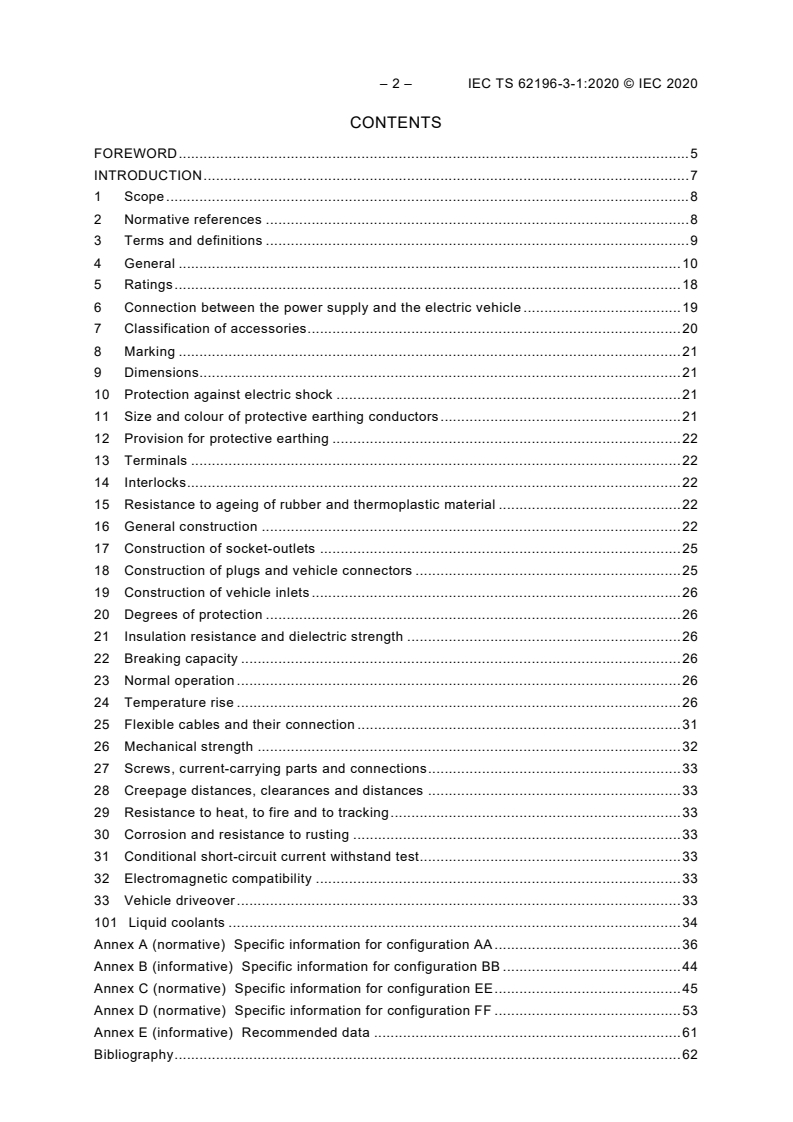
CONTENTS
FOREWORD . 5
INTRODUCTION . 7
1 Scope . 8
2 Normative references . 8
3 Terms and definitions . 9
4 General . 10
5 Ratings . 18
6 Connection between the power supply and the electric vehicle . 19
7 Classification of accessories . 20
8 Marking . 21
9 Dimensions. 21
10 Protection against electric shock . 21
11 Size and colour of protective earthing conductors . 21
12 Provision for protective earthing . 22
13 Terminals . 22
14 Interlocks . 22
15 Resistance to ageing of rubber and thermoplastic material . 22
16 General construction . 22
17 Construction of socket-outlets . 25
18 Construction of plugs and vehicle connectors . 25
19 Construction of vehicle inlets . 26
20 Degrees of protection . 26
21 Insulation resistance and dielectric strength . 26
22 Breaking capacity . 26
23 Normal operation . 26
24 Temperature rise . 26
25 Flexible cables and their connection . 31
26 Mechanical strength . 32
27 Screws, current-carrying parts and connections . 33
28 Creepage distances, clearances and distances . 33
29 Resistance to heat, to fire and to tracking . 33
30 Corrosion and resistance to rusting . 33
31 Conditional short-circuit current withstand test . 33
32 Electromagnetic compatibility . 33
33 Vehicle driveover . 33
101 Liquid coolants . 34
Annex A (normative) Specific information for configuration AA . 36
Annex B (informative) Specific information for configuration BB . 44
Annex C (normative) Specific information for configuration EE . 45
Annex D (normative) Specific information for configuration FF . 53
Annex E (informative) Recommended data . 61
Bibliography . 62
Figure 101 – DC EV supply equipment with thermal sensing . 17
Figure 102 – DC EV supply equipment with thermal sensing, thermal transport and
thermal exchange . 18
Figure A.1 – Reference device AA_0 . 36
Figure A.2 – Test setup AA_0 . 37
Figure A.3 – Test setup AA_1 . 38
Figure A.4 – Test setup AA_2 . 39
Figure A.5 – Reference device AA_1 . 39
Figure A.6 – Test setup AA_3 . 40
Figure A.7 – Reference device AA_2 . 41
Figure A.8 – Test setup AA_4 . 42
Figure A.9 – General test setup for temperature rise tests and thermal sensing device
tests (configuration AA) . 42
Figure A.10 – Plating of contacts for configuration AA . 43
Figure C.1 – Reference device EE_0 . 46
Figure C.2 – Test setup EE_0 . 47
Figure C.3 – Test setup EE_1 . 47
Figure C.4 – Test setup EE_2 . 48
Figure C.5 – Reference device EE_1 . 48
Figure C.6 – Test setup EE_3 . 49
Figure C.7 – Reference device EE_2 . 49
Figure C.8 – Test setup EE_4 . 50
Figure C.9 – General test setup for temperature rise tests and thermal sensing device
tests (configuration EE) . 50
Figure C.10 – Plating of contacts for configuration EE . 52
Figure D.1 – Reference device FF_0 . 54
Figure D.2 – Test setup FF_0 . 55
Figure D.3 – Test setup FF_1 . 55
Figure D.4 – Test setup FF_2 . 56
Figure D.5 – Reference device FF_1 . 57
Figure D.6 – Test setup FF_3 . 57
Figure D.7 – Reference device FF_2 . 58
Figure D.8 – Test setup FF_4 . 58
Figure D.9 – General test setup for temperature rise tests and thermal sensing device
tests (configuration FF) . 59
Figure D.10 – Plating of contacts for configuration FF . 60
Table 101 – Overview of applicable tests for different classifications of accessories . 11
Table 102 – Test sequence A . 15
Table 103 – Test sequence B . 15
Table 104 – Test sequence C . 16
Table 105 – Test sequence D . 16
Table 106 – Overview of the DC vehicle interface . 19
Table 107 – Overview of the combined AC/DC vehicle interface . 20
– 4 – IEC TS 62196-3-1:2020 © IEC 2020
Table 108 – Interface overview . 21
Table 109 – Short-time test currents . 22
Table 110 – Properties of DC accessory contact plating for pin . 25
Table 111 – Normal operation . 26
Table 112 – Pull force and torque test values for cable anchorage . 31
Table 113 – Impact energy for ball impact test . 32
Table 114 – Mechanical load flexing test . 33
Table A.1 – Maximum contact resistances and dimensions of reference device AA_0 . 37
Table A.2 – Dimensions for reference device conductor . 43
Table C.1 – Contact resistances and dimensions of reference device EE_0 . 46
Table C.2 – Dimensions for reference device conductor (configuration EE) . 51
Table D.1 – Contact resistances and dimensions of reference device FF_0 . 54
Table D.2 – Dimensions for reference device conductor (configuration FF) . 59
INTERNATIONAL ELECTROTECHNICAL COMMISSION
___________
PLUGS, SOCKET-OUTLETS, VEHICLE CONNECTORS AND VEHICLE
INLETS – CONDUCTIVE CHARGING OF ELECTRIC VEHICLES –
Part 3-1: Vehicle connector, vehicle inlet and cable assembly for
DC charging intended to be used with a thermal management system
FOREWORD
1) The International Electrotechnical Commission (IEC) is a worldwide organization for standardization
comprising all national electrotechnical committees (IEC National Committees). The object of IEC is
to promote international co-operation on all questions concerning standardization in the electrical and
electronic fields. To this end and in addition to other activities, IEC publishes International Standards,
Technical Specifications, Technical Reports, Publicly Available Specifications (PAS) and Guides
(hereafter referred to as "IEC Publication(s)"). Their preparation is entrusted to technical committees;
any IEC National Committee interested in the subject dealt with may participate in this preparatory
work. International, governmental and non-governmental organizations liaising with the IEC also
participate in this preparation. IEC collaborates closely with the International Organization for
Standardization (ISO) in accordance with conditions determined by agreement between the two
organizations.
2) The formal decisions or agreements of IEC on technical matters express, as nearly as possible, an
international consensus on the relevant subjects since each technical committee has representation
from all interested IEC National Committees.
3) IEC Publications have the form of recommendations for international use and are accepted by IEC
National Committees in that sense. While all reasonable efforts are made to ensure that the technical
content of IEC Publications is accurate, IEC cannot be held responsible for the way in which they are
used or for any misinterpretation by any end user.
4) In order to promote international uniformity, IEC National Committees undertake to apply IEC
Publications transparently to the maximum extent possible in their national and regional publications.
Any divergence between any IEC Publication and the corresponding national or regional publication
shall be clearly indicated in the latter.
5) IEC itself does not provide any attestation of conformity. Independent certification bodies provide
conformity assessment services and, in some areas, access to IEC marks of conformity. IEC is not
responsible for any services carried out by independent certification bodies.
6) All users should ensure that they have the latest edition of this publication.
7) No liability shall attach to IEC or its directors, employees, servants or agents including individual
experts and members of its technical committees and IEC National Committees for any personal injury,
property damage or other damage of any nature whatsoever, whether direct or indirect, or for costs
(including legal fees) and expenses arising out of the publication, use of, or reliance upon, this IEC
Publication or any other IEC Publications.
8) Attention is drawn to the normative references cited in this publication. Use of the referenced
publications is indispensable for the correct application of this publication.
9) Attention is drawn to the possibility that some of the elements of this IEC Publication may be the
subject of patent rights. IEC shall not be held responsible for identifying any or all such patent rights.
The main task of IEC technical committees is to prepare International Standards. In exceptional
circumstances, a technical committee may propose the publication of a Technical Specification
when
• the required support cannot be obtained for the publication of an International Standard,
despite repeated efforts, or
• the subject is still under technical development or where, for any other reason, there is the
future but no immediate possibility of an agreement on an International Standard.
Technical Specifications are subject to review within three years of publication to decide
whether they can be transformed into International Standards.
– 6 – IEC TS 62196-3-1:2020 © IEC 2020
IEC TS 62196-3-1, which is a Technical Specification, has been prepared by subcommittee 23H:
Plugs, Socket-outlets and Couplers for industrial and similar applications, and for Electric
Vehicles, of IEC technical committee TC 23: Electrical accessories.
The text of this Technical Specification is based on the following documents:
Draft TS Report on voting
23H/448/DTS 23H/460/RVDTS
Full information on the voting for the approval of this Technical Specification can be found in
the report on voting indicated in the above table.
This document has been drafted in accordance with the ISO/IEC Directives, Part 2.
A list of all the parts in the IEC 62196 series, published under the general title Plugs,
socketoutlets, vehicle connectors and vehicle inlets – Conductive charging of electrical
vehicles, can be found on the IEC website.
This document is to be read in conjunction with IEC 62196-1:2014 and IEC 62196-3:2014. The
particular requirements in this document supplement or modify the corresponding clauses in
Part 3, which, in turn, is based on Part 1. Where the text indicates an "addition" to or a
"replacement" of the relevant requirement, test specification or explanation of Part 3, these
changes are made to the relevant text of Part 3 or Part 1, which then becomes part of this
document. Where no change is necessary, the words "Clause X of IEC 62196-3:2014 applies"
are used.
Subclauses, figures, tables or notes which are additional to those in IEC 62196-3 are numbered
starting from 101.
In this document, the following print types are used:
– requirements proper: in roman type;
– test specifications: in italic type;
– notes: in smaller roman type.
The committee has decided that the contents of this document will remain unchanged until the
stability date indicated on the IEC website under "http://webstore.iec.ch" in the data related to
the specific document. At this date, the document will be
• transformed into an International Standard,
• reconfirmed,
• withdrawn,
• replaced by a revised edition, or
• amended.
IMPORTANT – The 'colour inside' logo on the cover page of this publication indicates
that it contains colours which are considered to be useful for the correct understanding
of its contents. Users should therefore print this document using a colour printer.
INTRODUCTION
Responding to global challenges of CO reduction and energy safety, the automobile industries
have been accelerating the development and commercialization of electric vehicles (EV) and
hybrid electric vehicles. In addition to the prevailing hybrid electric vehicles, battery electric
vehicles including plug-in hybrid electric vehicles are going to be mass-marketed. To support
the diffusion of such vehicles, this document provides the standard interface configurations of
vehicle couplers and accessories to be used in conductive charging of electric vehicles, taking
the most frequent charging situations into consideration.
To meet the market demand for increased electric vehicle ranges, batteries with larger
capacities need to be integrated. To charge those batteries with larger capacity in similar times
as existing charging times or even faster, the charging power needs to be increased. Besides
increasing the charging voltage, the charging current also needs to be increased to boost the
charging power. The larger charging current implies either larger conductor cross sections for
the cable assembly according to existing standards or additional measures in the cable
assembly.
The large conductor cross sections that are required according to the existing design
requirements and test methods result in significantly thicker and heavier cable assemblies.
These are difficult to handle and thus less desirable for public use. Therefore, to improve the
usability of charging systems this document makes use of thermal management techniques to
enhance the performance of the accessories.
This document provides definitions, requirements, and tests for EV couplers up to rated current
according to IEC 62196-1, which supports backward compatibility to couplers according to
IEC 62196-3:2014.
IEC 62196 is divided into several parts as follows:
– Part 1: General requirements, comprising clauses of a general character.
– Part 2: Dimensional compatibility requirements for AC pin and contact-tube accessories.
– Part 3: Dimensional compatibility requirements for DC and AC/DC pin and contact-tube
vehicle couplers.
– Part 4 : Dimensional compatibility requirements for DC pin and contact-tube accessories for
Class II or Class III applications.
– Part 6 : Dimensional compatibility requirements for DC pin and contact-tube couplers for
applications using a system of protective electrical separation.
——————
Under preparation.
Under consideration.
– 8 – IEC TS 62196-3-1:2020 © IEC 2020
PLUGS, SOCKET-OUTLETS, VEHICLE CONNECTORS AND VEHICLE
INLETS – CONDUCTIVE CHARGING OF ELECTRIC VEHICLES –
Part 3-1: Vehicle connector, vehicle inlet and cable assembly for
DC charging intended to be used with a thermal management system
1 Scope
This document applies to accessories and cable assemblies with the same configuration as
specified in IEC 62196-3:2014 with rated operating voltage not exceeding 1 500 V DC and a
rated current not exceeding 500 A that employ
– thermal sensing, or
– thermal transport and thermal sensing
with the system architecture described in 4.101.
These accessories and cable assemblies are intended to be used in conductive charging
systems for circuits specified in IEC 61851-23.
NOTE Edition 2 of IEC 61851-23 is under development.
The accessories covered by this document are intended to be used in charging mode 4
according to IEC 61851-1. These accessories are intended to be connected to cables according
to the IEC 62893 series for DC cables.
2 Normative references
Clause 2 of IEC 62196-3:2014 applies, except as follows:
Additional normative references:
IEC 60364-5-54:2011, Lowvoltage electrical installations – Part 554: Selection and erection
of electrical equipment – Earthing arrangements and protective conductors
IEC 60811-501, Electric and optical fibre cables – Test methods for nonmetallic materials –
Part 501: Mechanical tests – Tests for determining the mechanical properties of insulating and
sheathing compounds
IEC 61851-23:— , Electric vehicle conductive charging system – Part 23: DC electric vehicle
supply equipment
IEC 62196-1:2014, Plugs, socketoutlets, vehicle connectors and vehicle inlets – Conductive
charging of electric vehicles – Part 1: General requirements
IEC 62196-2:2016, Plugs, socketoutlets, vehicle connectors and vehicle inlets – Conductive
charging of electric vehicles – Part 2: Dimensional compatibility and interchangeability
requirements for AC pin and contacttube accessories
——————
Second edition under preparation. Stage at the time of publication: IEC CDV 61851-23:2020.
IEC 62196-3:2014, Plugs, socketoutlets, vehicle connectors and vehicle inlets – Conductive
charging of electric vehicles – Part 3: Dimensional compatibility and interchangeability
requirements for DC and AC/DC pin and contacttube vehicle couplers
IEC 62893-4-1:— , Charging cables for electric vehicles of rated voltages up to and including
0,6/1 kV – Part 41: Cables for DC charging according to mode 4 of IEC 618511 – DC charging
without use of a thermal management system
ISO 2719:2016, Determination of flash point – PenskyMartens closed cup method
ISO 17409:2020, Electrically propelled road vehicles – Conductive power transfer – Safety
requirements
ISO 25178-1:2016, Geometrical product specifications (GPS) – Surface texture: Areal – Part 1:
Indication of surface texture
Globally Harmonized System of Classification and Labelling of Chemicals (GHS), Eighth revised
edition, United Nations, 2019
OECD Guidelines for the Testing of Chemicals, Section 3, Test No. 301: Ready Biodegradability,
17 Jul 1992
3 Terms and definitions
Clause 3 of IEC 62196-3:2014 applies, except as follows:
Additional terms and definitions:
3.101
thermal sensing
method for obtaining temperature data of accessories, cable assemblies or parts thereof
3.102
thermal sensing device
means for providing temperature data of accessories, cable assemblies or parts thereof
3.103
thermal transport
method for managing the heat dissipation of accessories, cable assemblies or parts thereof,
independent of changing the current
3.104
thermal transport device
means for managing the heat dissipation of accessories, cable assemblies or parts thereof,
independent of changing the current
3.105
thermal exchange
method for cooling and dissipating thermal energy from the thermal transport
3.106
thermal exchange device
means for cooling and dissipating thermal energy from the thermal transport
——————
Under preparation. Stage at the time of publication: IEC FDIS 62893-4-1:2020.
– 10 – IEC TS 62196-3-1:2020 © IEC 2020
3.107
thermal management system
combination of thermal sensing, thermal transport and thermal exchange in order to regulate
temperature
3.108
rated pressure
maximum pressure assigned by the manufacturer to the thermal transport coolant liquid of a
cable assembly under normal and continuous operating conditions
3.109
maximum allowed pressure
maximum pressure assigned by the manufacturer to the thermal transport coolant liquid of a
cable assembly
3.110
accessory
vehicle connector or vehicle inlet or cable assembly for use in conductive charging systems or
electric vehicles
4 General
Clause 4 of IEC 62196-3:2014 applies, except as follows:
4.1 General requirements
Addition after the second paragraph:
Accessories with thermal sensing and without thermal transport are intended for use with cables
in accordance with IEC 62893-4-1 .
Accessories with thermal sensing and thermal transport are intended for use with cables in
accordance with IEC 62893-4-2 .
Replacement of the existing text of 4.2.2, 4.2.3, 4.2.4 with the following:
4.2.2 Unless otherwise specified, the samples are tested as delivered and under normal
conditions of use at an ambient temperature of (20 ± 5) °C.
4.2.3 Unless otherwise specified, the tests shall be performed in the order shown in 4.2.4.
4.2.4 The tests shall be performed as indicated, if applicable.
Table 101 is intended to give an overview of applicable tests for different classifications of
accessories. However, the requirements are contained within the clauses of this document.
Tests are grouped in test sequences A to D. Each sequence shall be performed in accordance
with the test sequences indicated in Table 102 to Table 105 with new sets of samples for each
sequence. On request of the manufacturer the same set of samples may be subjected to more
than one of these test sequences.
——————
Under preparation. Stage at the time of publication: IEC FDIS 62893-4-1:2020.
Under consideration.
Further, tests indicated as "to be checked by inspection" and not included in Table 101 shall be
performed. These tests may use samples already used in tests mentioned in Table 101.
Table 101 – Overview of applicable tests for different classifications of accessories
Clause/
subcla
use
8 Marking
8.8 X Durability of marking X X X X X X
9 Dimensions
9.1 X Compatibility with configurations X X X X X X
9.3 X Single-pole connections X X X X X X
9.4 X Misinsertion X X X X X X
10 Protection against electrical shock
10.1 X Accessibility of live parts X X X X X X
1) 1) 1) 1) 1) 1) 1) 1) 1)
10.2 Shutters
X X X X X X X X X
10.3 X X Contact sequence X X X X X X
10.4 X X Misassembly X X X X X X
12 Provision for protective earthing
12.1 X Provision for protective earthing X X X X X X
12.2 X PE connection to accessible metal X X X X X X
parts
12.3 X X X Short-time test X X X X X X
12.5 X Clean data earth contact X X X X X X
13 Terminals
13.1.4 X Material analysis of terminals X X X X X X
13.1.5 X Material analysis of body X X X X X X
13.1.6 X Terminal fixing X X
13.1.8 X Terminal loosening X X
13.1.9 X Loose strands X X
13.2 X Screw type terminal X X
13.3 X Test for terminals X X
14 Interlocks
14.1.4 X Latching device holding X X X X X X
14.1.5 X Latch pull test X X X X X X
14.1.6 X Latch moment pull test X X X X X X
14.3 X Cycling of switching devices X X X X X X
14.4 X Pilot contacts and auxiliary circuits X X X X X X
14.301 X Latching function X X X X X X
2)
IEC 62196-1:2014
2)
IEC 62196-3:2014
2)
Cable assembly (thermal
sensing only, rewireable)
Cable assembly (thermal
sensing only, non-rewireable)
Cable assembly (thermal
sensing and thermal transport,
non-rewireable)
Vehicle inlet (thermal sensing
only, rewireable)
Vehicle inlet (thermal sensing
only, non-rewireable)
Vehicle inlet
(thermal sensing and thermal
transport, non-rewireable)
– 12 – IEC TS 62196-3-1:2020 © IEC 2020
Clause/
subcla
use
15 X Resistance to ageing X X X X X X
16 General construction
16.3 X Position of PE X X X X X X
16.4 X Degree of protection X X X X X X
16.5 X Surface temperature X X X X X X
16.6 X Contact pressure X X X X X X
16.8 X Retention means, pull test X X X
16.10 X X Construction of rewireable X X
accessories
16.12 X Mechanical strength against electric X X X X X X
shock
16.13 X Cable entries X X X
16.14 X Mechanical strength of insulation X X X X X X
16.15 X X Force to insert and withdraw X X X
16.101 X Thermal sensing device X X X X X X
16.102 X Loss of thermal transport X X
16.103 X Accessories using thermal sensing X X X X X X
16.104 X Rated current for accessory X X X X X X
18 Construction of plugs and vehicle
connectors
18.1 X Conductors properly connected X
18.2 X Reliable fixing of parts X X X
18.4 X IP when plugged in X X X
18.101 X DC contact surface X X X
19 Construction of vehicle inlets
19.1 X IP when plugged in X X X
19.3 X Drain-hole X X X
19.101 X DC contact surface X X X
20 Degrees of protection
20.1 X Minimum degrees of protection X X X X X X
20.2 X Water exposure test (IP) X X X X X X
20.3 X Proof against humid conditions X X X X X X
21 Insulation resistance and dielectric
strength
21.2 X Insulation resistance X X X X X X
21.3 X Dielectric strength X X X X X X
21.4 X Non-interchangeability X X X X X X
2)
IEC 62196-1:2014
2)
IEC 62196-3:2014
2)
Cable assembly (thermal
sensing only, rewireable)
Cable assembly (thermal
sensing only, non-rewireable)
Cable assembly (thermal
sensing and thermal transport,
non-rewireable)
Vehicle inlet (thermal sensing
only, rewireable)
Vehicle inlet (thermal sensing
only, non-rewireable)
Vehicle inlet
(thermal sensing and thermal
transport, non-rewireable)
Clause/
subcla
use
23 Normal operation
23.1 X X Normal operation X X X X X X
23.2 X X Mating cycle X X X X X X
23.4 X Lid springs X X X
24 Temperature rise
24.102 X Temperature rise test for cable X X X
assembly
24.103 X Test for thermal sensing device of X X X
cable assembly
24.104 X Temperature rise test for vehicle X X X
inlet
Test for thermal sensing device of
24.105 X X X X
vehicle inlet
25 Flexible cables and their connection
25.3 X X Strain relief X X X
25.301 X Pull out test X X X X X X
26 Mechanical strength
26.2 X X Ball impact X X X
26.3 X X Drop test X X X
26.4 X X Flexing test X X X
26.5 X Cable glands test X X X
1) 1) 1) 1) 1) 1)
26.6 X Shutter tests
X X X X X X
1) 1) 1) 1) 1) 1)
26.7 X Insulated end caps test
X X X X X X
1) 1) 1) 1) 1) 1)
26.8 X Insulated end caps – change of
X X X X X X
temperature
1) 1) 1) 1) 1) 1)
26.9 X Insulated end caps – pull test
X X X X X X
27 Screws, current-carrying parts and
connections
27.1 X Screws transmitting contact X X
pressure
27.2 X Screws in insulating material X X X X X X
27.4 X Screws as electrical and mechanical X X X X X X
connections
27.5 X Current-carrying parts X X X X X X
other than terminals
27.6 X Contacts, subjected to a sliding X X X X X X
action
28 Creepage distances, clearances
28.1 X Creepage distances, clearances X X X X X X
28.4 X Tracking test (CTI), if applicable X X X X X X
2)
IEC 62196-1:2014
2)
IEC 62196-3:2014
2)
Cable assembly (thermal
sensing only, rewireable)
Cable assembly (thermal
sensing only, non-rewireable)
Cable assembly (thermal
sensing and thermal transport,
non-rewireable)
Vehicle inlet (thermal sensing
only, rewireable)
Vehicle inlet (thermal sensing
only, non-rewireable)
Vehicle inlet
(thermal sensing and thermal
transport, non-rewireable)
– 14 – IEC TS 62196-3-1:2020 © IEC 2020
Clause/
subcla
use
29 Resistance to heat, to fire and to
tracking
29.2 X Heat only (oven) X X X X X X
29.3 X Ball pressure X X X X X X
29.5 X Glow-wire test X X X X X X
29.6 X Resistant to tracking PTI X X X X X X
30 X Corrosion and resistance to rusting X X X X X X
33.2 X X Vehicle driveover (5 000 N) X X X
101 Liquid coolants
101.1 X Type of coolant X X
101.3 X Flammability X X
101.5 X Material compatibility X X
101.6 X Overpressure test X X
1) If any.
2) A cross indicates which parts of the IEC 62196 series shall be considered for the respective test.
2)
IEC 62196-1:2014
2)
IEC 62196-3:2014
2)
Cable assembly (thermal
sensing only, rewireable)
Cable assembly (thermal
sensing only, non-rewireable)
Cable assembly (thermal
sensing and thermal transport,
non-rewireable)
Vehicle inlet (thermal sensing
only, rewireable)
Vehicle inlet (thermal sensing
only, non-rewireable)
Vehicle inlet
(thermal sensing and thermal
transport, non-rewireable)
Table 102 – Test sequence A
Test sequence A
No. of samples: 3
Order Subclause
1 26.2 Ball impact X X X
2 26.3 Drop test X X X
3 20.2 Water exposure test (IP) X X X X X X
4 21.2 Insulation resistance X X X X X X
5 21.3 Dielectric strength X X X X X X
6 26.4 Flexing test X X X
7 21.3 Dielectric strength X X X
8 24.103 Test for thermal sensing X X X
device of cable assembly
9 24.105 Test for thermal sensing X X X
device of vehicle inlet
Table 103 – Test sequence B
Test sequence B
No. of samples: 3
Order Subclause
1 23.1 Normal operation X X X X X X
2 24.102 Temperature rise test for X X X
cable assembly
2 24.104 Temperature rise test for X X X
vehicle inlet
Cable assembly (thermal Cable assembly (thermal
sensing only, rewireable) sensing only, rewireable)
Cable assembly (thermal Cable assembly (thermal
sensing only, non-rewireable) sensing only, non-rewireable)
Cable assembly (thermal Cable Assembly (thermal
sensing and thermal transport, sensing and thermal transport,
non-rewireable) non-rewireable)
Vehicle inlet Vehicle inlet
(thermal sensing only,
(thermal sensing only,
rewireable)
rewireable)
Vehicle inlet Vehicle inlet
(thermal sensing only,
(thermal sensing only,
non-rewireable)
non-rewireable)
Vehicle inlet Vehicle inlet
(thermal sensing and thermal
(thermal sensing and thermal
transport, non-rewireable)
transport, non-rewireable)
– 16 – IEC TS 62196-3-1:2020 © IEC 2020
Table 104 – Test sequence C
Test sequence C
No. of samples: 3
Order Subclause
1 20.3 Humidity conditioning test X X X X X X
2 21.2 Insulation resistance test X X X X X X
3 21.3 Dielectric strength test X X X X X X
4 33.2 Vehicle driveover (5 000 N) X X X
5 20.2 Water exposure test (IP) X X X
6 21.3 Dielectric strength test X X X
Test for thermal sensing
7 24.103 X X X
device of cable assembly
Table 105 – Test sequence D
Test sequence D
No. of samples: 3
Order Subclause
1 101.6 Overpressure test X X
4.2.6 Addition at the end of the subclause:
Table 7 of IEC 62196-1:2014 does not apply. Accessories are tested according to
manufacturer's specification.
Additional subclauses:
Cable assembly (thermal Cable assembly (thermal
sensing only, rewireable) sensing only, rewireable)
Cable assembly (thermal Cable assembly (thermal
sensing only, non-rewireable) sensing only, non-rewireable)
Cable assembly (thermal Cable assembly (thermal
sensing and thermal transport, sensing and thermal transport,
non-rewireable) non-rewireable)
Vehicle inlet Vehicle inlet
(thermal sensing only, (thermal sensing only,
rewireable) rewireable)
Vehicle inlet Vehicle inlet
(thermal sensing only, (thermal sensing only, non-
non-rewireable) rewireable)
Vehicle inlet Vehicle inlet
(thermal sensing and thermal (thermal sensing and thermal
transport, non-rewireable) transport, non-rewireable)
4.101 System architecture
Accessories and cable assemblies according to this document shall be provided with either:
– thermal sensing without thermal transport; or
– thermal transport and thermal sensing.
For examples, see Figure 101 and Figure 102.
Key See Figure 102
Figure 101 – DC EV supply equipment with thermal sensing
– 18 – IEC TS 62196-3-1:2020 © IEC 2020
Key
1 DC EV charging station 9 Vehicle connector
2 Cable assembly 10 Thermal sensing
3 Thermal sensing 11 Vehicle inlet
4 Thermal exchange 12 Wiring harness
5 Control unit 13 System boundary
6 Thermal management system 14 Energy thermal
7 Cable 15 Energy electric
8 Thermal transport 16 Temperature information
Figure 102 – DC EV supply equipment with thermal sensing, thermal transport and
thermal exchange
4.102 Thermal stabilisation
Thermal stabilisation is considered to have occurred when three successive readings, taken at
intervals of not less than 10 min, indicate no increase greater than 2 K.
4.103 Manufacturers data sheet
The manufacturer shall provide a data sheet. For recommended data, see Annex E.
Compliance is checked by inspection.
5 Ratings
Clause 5 of IEC 62196-3:2014 applies, except as follows.
5.2.1 Addition at the end of the list of preferred currents:
300 A (DC only)
500 A (DC only).
6 Connection between the power supply and the electric vehicle
Clause 6 of IEC 62196-3:2014 applies, except as follows:
Replacement of Table 4 of IEC 621961:2014 by the following Table 106:
Table 106 – Overview of the DC vehicle interface
Configuration
AA BB
Position
number
a
U I U I
max max max max
Symbol Function
V A V A
1 1 000 400 950 250 DC + DC +
2 1 000 400 950 250 DC – DC −
3 30 10 30 2 CP Control Pilot 1
4 30 10 30 2 CP2 Control Pilot 2
5 30 10 - - CP3 Control Pilot 3
6 30 2 30 2 COM1 Communication 1 (+)
7 30 2 30 2 COM2 Communication 1 (−)
8 30 2 - - IM Isolation Monitor
- -
9 950 Rated E Protective earth
b
for fault
10 30 2 - - PP or CS Proximity detection or
connection switch
- -
11 30 20 AUX1 Auxiliary Power Supply 1 (+)
- -
12 30 20 AUX2 Auxiliary Power Supply 1 (−)
a
Position number does not refer to the location and/or identification of the contact in the
accessory.
b
"Rated for fault" means "rated for the highest fault current".
NOTE For DC vehicle interface, see IEC 62196-3:2014.
– 20 –
...