IEC 61954:1999/COR1:1999
(Corrigendum)Corrigendum 1 - Power electronics for electrical transmission and distribution systems - Testing of thyristor valves for static VAR compensators
Corrigendum 1 - Power electronics for electrical transmission and distribution systems - Testing of thyristor valves for static VAR compensators
Corrigendum 1 - Electronique de puissance pour les réseaux électriques de transport et de distribution - Essais des valves à thyristors pour les compensateurs statiques d'énergie réactive
General Information
Relations
Standards Content (Sample)
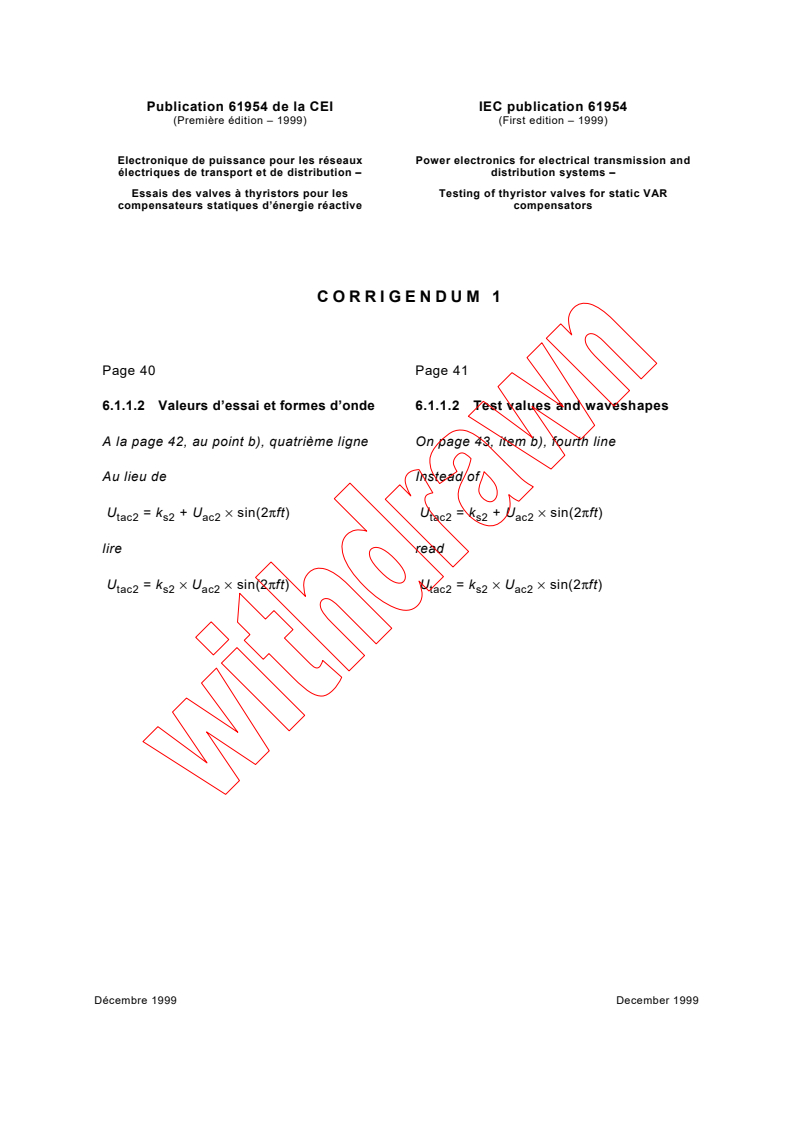
Publication 61954 de la CEI IEC publication 61954
(Première édition – 1999) (First edition – 1999)
Electronique de puissance pour les réseaux Power electronics for electrical transmission and
électriques de transport et de distribution – distribution systems –
Essais des valves à thyristors pour les Testing of thyristor valves for static VAR
compensateurs statiques d’énergie réactive compensators
CORRIGENDUM 1
Page
...
This May Also Interest You
- Standard1 pageEnglish and French languagesale 15% off
IEC 61954:2021 defines type, production and optional tests on thyristor valves used in thyristor controlled reactors (TCR), thyristor switched reactors (TSR) and thyristor switched capacitors (TSC) forming part of static VAR compensators (SVC) for power system applications. The requirements of the document apply both to single valve units (one phase) and to multiple valve units (several phases). Clauses 4 to 7 detail the type tests, i.e. tests which are carried out to verify that the valve design meets the requirements specified. Clause 8 covers the production tests, i.e. tests which are carried out to verify proper manufacturing. Clauses 9 and 10 detail optional tests, i.e. tests additional to the type and production tests. This edition includes the following significant technical changes with respect to the previous edition: important clarifications were made in 4.4.1.2, 5.1.2.2, 5.1.3.2, 5.2.3.2, 6.1.2.2, 6.1.2.4, 6.1.3.2, 6.2.2.2, 6.2.2.4, 6.3.2.2 and 9.3.2.
The contents of the corrigendum of June 2024 have been included in this copy.
- Standard138 pagesEnglish languagesale 15% off
- Standard88 pagesEnglish and French languagesale 15% off
- Standard8 pagesEnglish and French languagesale 15% off
- Standard5 pagesEnglish and French languagesale 15% off
IEC 61954:2011 defines type, production and optional tests on thyristor valves used in thyristor controlled reactors (TCR), thyristor switched reactors (TSR) and thyristor switched capacitors (TSC) forming part of static VAR compensators (SVC) for power system applications. The requirements of the standard apply both to single valve units (one phase) and to multiple valve units (several phases). This edition includes the following significant technical changes with respect to the previous edition:
a) Definitions of terms "thyristor level", "valve section", "valve base electronics" and "redundant thyristor levels" have been changed for clarification;
b) Conditions of testing thyristor valve sections instead of a complete thyristor valve have been defined;
c) The requirement has been added that if, following a type test, one thyristor level has become short-circuited, then the failed level shall be restored and this type test repeated;
d) The time period of increasing the initial test voltage from 50 % to 100 % during type a.c. dielectric tests on TSC, TCR or TSR valves has been set equal to approximately 10 s;
e) The duration of test voltage Uts2 during type a.c.-d.c. dielectric tests between TSC valve terminals and earth as well as the duration of test voltage Utvv2 during dielectric tests between TSC valves (for MVU only) has been changed from 30 min to 3 h;
f) The reference on the number of pulses per minute of the periodic partial discharge recorded during a.c.-d.c. dielectric tests on TSC valves and exceeding the permissible level has been deleted.
- Standard91 pagesEnglish and French languagesale 15% off
- Standard182 pagesEnglish and French languagesale 15% off
- Standard91 pagesEnglish and French languagesale 15% off
Defines type, production and optional test on thyristor valves used in thyristor controlled reactots (TCR), Thyristor switched reactor (TSR) and thyristor switched capacitors (TSC) forming part of static VAR compensators (SVC) for power system applications. the requirements of the standard apply both to single valve units (one phase) and to multiple valve units (several phases). Clauses 4 to 7 detail the type tests, clause 8 covers the production tests, clauses 9 and 7 detail optional tests.
- Standard85 pagesEnglish and French languagesale 15% off
IEC TR 61169-1-8:2025 provides a test method for voltage standing wave ratio (VSWR, hereinafter) of single RF connector by double-connector method. This document is applicable to single RF cable connectors and single microstrip RF connectors as well as single adapters if an estimation of the VSWR of a single completely installed RF-connector is used and a time domain feature is not available on the vector network analyzer.
- Technical report18 pagesEnglish languagesale 15% off
IEC 62541-100:2025 defines the information model associated with Devices. This document describes three models which build upon each other as follows:
• The (base) Device Model is intended to provide a unified view of devices and their hardware and software parts irrespective of the underlying device protocols.
• The Device Communication Model adds Network and Connection information elements so that communication topologies can be created.
• The Device Integration Host Model finally adds additional elements and rules required for host systems to manage integration for a complete system. It enables reflecting the topology of the automation system with the devices as well as the connecting communication networks.
This document also defines AddIns that can be used for the models in this document but also for models in other information models. They are:
• Locking model – a generic AddIn to control concurrent access,
• Software update model – an AddIn to manage software in a Device.
This second edition cancels and replaces the first edition published in 2015. This edition constitutes a technical revision.
This edition includes the following significant technical changes with respect to the previous edition:
a a ComponentType that can be used to model any HW or SW element of a device has been defined and a SoftwareType has been added as subtype of ComponentType;
b the new OPC UA interface concept and defined interfaces for Nameplate, DeviceHealth, and SupportInfo has been added.
c) a new model for Software Update (Firmware Update) has been added;
d) a new entry point for documents where each document is represented by a FileType instance has been specified;
e) a model that provides information about the lifetime, related limits and semantic of the lifetime of things like tools, material or machines has been added.
- Standard152 pagesEnglish languagesale 15% off
- Standard158 pagesFrench languagesale 15% off
- Standard310 pagesEnglish and French languagesale 15% off
IEC 62541-4:2025 is available as IEC 62541-4:2025 RLV which contains the International Standard and its Redline version, showing all changes of the technical content compared to the previous edition.IEC 62541-4:2025 defines the OPC Unified Architecture (OPC UA) Services. The Services defined are the collection of abstract Remote Procedure Calls (RPC) that are implemented by OPC UA Servers and called by OPC UA Clients. All interactions between OPC UA Clients and Servers occur via these Services. The defined Services are considered abstract because no particular RPC mechanism for implementation is defined in this document. IEC 62541‑6 specifies one or more concrete mappings supported for implementation. For example, one mapping in IEC 62541‑6 is to UA-TCP UA-SC UA-Binary. In that case the Services described in this document appear as OPC UA Binary encoded payload, secured with OPC UA Secure Conversation and transported via OPC UA TCP. Not all OPC UA Servers implement all of the defined Services. IEC 62541‑7 defines the Profiles that dictate which Services must be implemented in order to be compliant with a particular Profile. A BNF (Backus-Naur form) for browse path names is described in Annex A. This fourth edition cancels and replaces the third edition published in 2020. This edition constitutes a technical revision.
This edition includes the following significant technical changes with respect to the previous edition:
a) addition of new definitions to Method Call Service to allow optional Method arguments;
b)addition of reference to SystemStatusChangeEventType for event monitored item error scenarios;
c) enhancement of the general description of how determining if a Certificate is trusted;
d) addition of support for ECC;
e) addition of revisedAggregateConfiguration to AggregateFilterResult structure;
f) addition of INVALID to the BrowseDirection enumeration data type;
g) addition of INVALID to the TimestampsToReturn enumeration data type;
h) addition of definitions that make sure the subscription functionality works if retransmission queues are optional;
i) addition of client checks has been added to be symmetric to the Server Certificate check has been added;
j) clarification that ‘local’ top level domain is not appended by server into certificate and not checked by client when returned from LDS-ME;
k) addition of a definition for expiration behaviour of IssuedIdentityTokens;
l) addition of status code Good_PasswordChangeRequired to ActivateSession;
m) restriction of AdditionalInfo to servers in debug mode;
n) addition of new status code Bad_ServerTooBusy;
o) addition of definition for cases where server certificate must be contained in GetEndpoints response.
- Standard245 pagesEnglish languagesale 15% off
- Standard257 pagesFrench languagesale 15% off
- Standard502 pagesEnglish and French languagesale 15% off
IEC TS 62876-3-4:2025, which is a Technical Specification, establishes a standardized guideline to assess
• reliability of metallic interfaces
of Ohmic-contacted field-effect transistors (FETs) using 2D nano-materials by quantifying
• linearity of current-voltage (I-V) output curves
for devices with various materials combinations of van der Waals (vdW) interfaces.
For metallic interfaces with 2D materials (eg. graphene, MoS2, MoTe2, WS2, WSe2, etc) and metals (eg. Ti, Cr, Au, Pd, In, Sb, etc), the reliability of Ohmic contact is quantified.
For FETs consisting of 2D materials-based channels (eg. MoS2, MoTe2, WS2, WSe2, etc), the reliability of Ohmic contact when varying contacting metal, channel length, channel thickness, applied voltage, and surface treatment condition is quantified.
The reliability of the metallic contacts is quantified from the linearity of I-V characteristics measured over extended time periods.
- Technical specification24 pagesEnglish languagesale 15% off


Questions, Comments and Discussion
Ask us and Technical Secretary will try to provide an answer. You can facilitate discussion about the standard in here.
Loading comments...