

IEC 62629-12-1:2014
(Main)3D Display devices - Part 12-1: Measuring methods for stereoscopic displays using glasses - Optical
General Information
- Abstract
IEC 62629-12-1:2014 determines the following measuring methods for characterizing the performance of stereoscopic display devices using either active or passive glasses. This standard focuses on the types of stereoscopic displays using glasses as follows:
The types of stereoscopic displays reproducing temporally interlaced images and applicable glasses are:
- displays representing temporally interlaced (high frame rate) images and active glasses (time dividing shutter glasses), and
- displays with front screen switchable polarizer representing temporally interlaced images and linear or circular polarizer passive glasses. The types of stereoscopic displays reproducing spatially interlaced images and applicable glasses are:
- displays with patterned retarder representing spatially interlaced images and linear or circular polarizer passive glasses. Some parts of these measuring methods may also be applied to other types of stereoscopic displays using glasses not listed above.
- Status
- Published
- Publication Date
- 08-Jan-2014
- Technical Committee
- TC 110 - Electronic displays
- Drafting Committee
- WG 6 - TC 110/WG 6
- Current Stage
- PPUB - Publication issued
- Start Date
- 09-Jan-2014
- Completion Date
- 15-Jan-2014
Overview
IEC 62629-12-1:2014 specifies standardized optical measuring methods for characterizing the performance of 3D stereoscopic display devices that require glasses, covering both active and passive types. Published by the International Electrotechnical Commission (IEC), this standard addresses key optical measurement practices and conditions needed to independently and objectively assess stereoscopic (3D) display quality when using specialized glasses.
This international standard applies to various categories of stereoscopic displays:
- Displays using active glasses (shutter glasses) for temporally interlaced (high frame rate) images,
- Displays using passive glasses (linear or circular polarizers) for temporally interlaced images with a front screen switchable polarizer,
- Displays with patterned retarders and passive glasses for spatially interlaced images.
Some measurement methods within this standard may be adapted for other types of stereoscopic displays using glasses.
Key Topics
IEC 62629-12-1:2014 focuses on the following core areas:
Performance Measurements for 3D Displays with Glasses:
- Luminance and luminance uniformity
- Interocular luminance and contrast differences
- Dark-room contrast ratio
- Colour gamut and chromaticity
- Uniformity, crosstalk, and their position dependencies (e.g., interocular crosstalk uniformity)
- Viewing direction, distance, and angle dependencies
Measurement Procedures for 3D Glasses:
- Transmittance and extinction ratio
- Colour shift and chromaticity difference between eyes
- Response time for active glasses (open/closed lens states)
- Angular and temperature dependencies
- Lens uniformity
Measurement Conditions and Layouts:
- Standardized measuring equipment
- Measuring setups simulating realistic viewing situations (viewing distance, angle, and environmental conditions)
Applications
IEC 62629-12-1:2014 delivers practical value for manufacturers, quality assurance professionals, engineers, and testing laboratories working with 3D displays and accompanying glasses. Its standardized methods help to:
- Ensure Consistent Quality: By defining clear test procedures, manufacturers can deliver reliable and repeatable data on key optical performance indicators for 3D display devices.
- Facilitate Comparison: Common measurement methods improve comparability between different devices and brands, supporting market transparency.
- Support R&D and Product Development: Engineers and designers can use the standard’s methods to optimize display and glasses parameters for enhanced 3D viewing experiences.
- Assist Testing and Certification: Testing laboratories and certification bodies use the standard as a reference to verify product compliance and performance claims.
Industries and use-cases include:
- Consumer electronics (televisions, monitors)
- Professional visualization (medical imaging, simulation)
- Digital cinema and entertainment
- 3D display research and development
Related Standards
For comprehensive evaluation and terminology related to 3D display devices and optical measurements, the following IEC standards are relevant:
- IEC 62629-1-2: 3D display devices - Terminology and letter symbols
- IEC 60068-1: Environmental testing - General and guidance
- IEC 60107-1: Methods of measurement on receivers for television broadcast transmissions - General considerations
Users implementing IEC 62629-12-1:2014 may find these standards helpful in supporting related testing, reporting, and terminology needs.
Keywords: IEC 62629-12-1, stereoscopic display, 3D display, optical measuring methods, active glasses, passive glasses, shutter glasses, patterned retarder, display performance, 3D measurement standard, luminance, crosstalk, contrast ratio, color gamut, transmittance, international standard, 3D display testing.
Frequently Asked Questions
IEC 62629-12-1:2014 is a standard published by the International Electrotechnical Commission (IEC). Its full title is "3D Display devices - Part 12-1: Measuring methods for stereoscopic displays using glasses - Optical". This standard covers: IEC 62629-12-1:2014 determines the following measuring methods for characterizing the performance of stereoscopic display devices using either active or passive glasses. This standard focuses on the types of stereoscopic displays using glasses as follows: The types of stereoscopic displays reproducing temporally interlaced images and applicable glasses are: - displays representing temporally interlaced (high frame rate) images and active glasses (time dividing shutter glasses), and - displays with front screen switchable polarizer representing temporally interlaced images and linear or circular polarizer passive glasses. The types of stereoscopic displays reproducing spatially interlaced images and applicable glasses are: - displays with patterned retarder representing spatially interlaced images and linear or circular polarizer passive glasses. Some parts of these measuring methods may also be applied to other types of stereoscopic displays using glasses not listed above.
IEC 62629-12-1:2014 determines the following measuring methods for characterizing the performance of stereoscopic display devices using either active or passive glasses. This standard focuses on the types of stereoscopic displays using glasses as follows: The types of stereoscopic displays reproducing temporally interlaced images and applicable glasses are: - displays representing temporally interlaced (high frame rate) images and active glasses (time dividing shutter glasses), and - displays with front screen switchable polarizer representing temporally interlaced images and linear or circular polarizer passive glasses. The types of stereoscopic displays reproducing spatially interlaced images and applicable glasses are: - displays with patterned retarder representing spatially interlaced images and linear or circular polarizer passive glasses. Some parts of these measuring methods may also be applied to other types of stereoscopic displays using glasses not listed above.
IEC 62629-12-1:2014 is classified under the following ICS (International Classification for Standards) categories: 01 - GENERALITIES. TERMINOLOGY. STANDARDIZATION. DOCUMENTATION; 31.120 - Electronic display devices; 31.260 - Optoelectronics. Laser equipment. The ICS classification helps identify the subject area and facilitates finding related standards.
IEC 62629-12-1:2014 is available in PDF format for immediate download after purchase. The document can be added to your cart and obtained through the secure checkout process. Digital delivery ensures instant access to the complete standard document.
Standards Content (Sample)
IEC 62629-12-1 ®
Edition 1.0 2014-01
INTERNATIONAL
STANDARD
NORME
INTERNATIONALE
3D Display devices –
Part 12-1: Measuring methods for stereoscopic displays using glasses – Optical
Dispositifs d'affichage 3D –
Partie 12-1: Méthodes de mesure pour les écrans stéréoscopiques utilisant des
lunettes – Optique
All rights reserved. Unless otherwise specified, no part of this publication may be reproduced or utilized in any form
or by any means, electronic or mechanical, including photocopying and microfilm, without permission in writing from
either IEC or IEC's member National Committee in the country of the requester. If you have any questions about IEC
copyright or have an enquiry about obtaining additional rights to this publication, please contact the address below or
your local IEC member National Committee for further information.
Droits de reproduction réservés. Sauf indication contraire, aucune partie de cette publication ne peut être reproduite
ni utilisée sous quelque forme que ce soit et par aucun procédé, électronique ou mécanique, y compris la photocopie
et les microfilms, sans l'accord écrit de l'IEC ou du Comité national de l'IEC du pays du demandeur. Si vous avez des
questions sur le copyright de l'IEC ou si vous désirez obtenir des droits supplémentaires sur cette publication, utilisez
les coordonnées ci-après ou contactez le Comité national de l'IEC de votre pays de résidence.
IEC Central Office Tel.: +41 22 919 02 11
3, rue de Varembé Fax: +41 22 919 03 00
CH-1211 Geneva 20 info@iec.ch
Switzerland www.iec.ch
About the IEC
The International Electrotechnical Commission (IEC) is the leading global organization that prepares and publishes
International Standards for all electrical, electronic and related technologies.
About IEC publications
The technical content of IEC publications is kept under constant review by the IEC. Please make sure that you have the
latest edition, a corrigenda or an amendment might have been published.
IEC Catalogue - webstore.iec.ch/catalogue Electropedia - www.electropedia.org
The stand-alone application for consulting the entire The world's leading online dictionary of electronic and
bibliographical information on IEC International Standards, electrical terms containing more than 30 000 terms and
Technical Specifications, Technical Reports and other definitions in English and French, with equivalent terms in 14
documents. Available for PC, Mac OS, Android Tablets and additional languages. Also known as the International
iPad. Electrotechnical Vocabulary (IEV) online.
IEC publications search - www.iec.ch/searchpub IEC Glossary - std.iec.ch/glossary
The advanced search enables to find IEC publications by a More than 55 000 electrotechnical terminology entries in
variety of criteria (reference number, text, technical English and French extracted from the Terms and Definitions
committee,…). It also gives information on projects, replaced clause of IEC publications issued since 2002. Some entries
and withdrawn publications. have been collected from earlier publications of IEC TC 37,
77, 86 and CISPR.
IEC Just Published - webstore.iec.ch/justpublished
Stay up to date on all new IEC publications. Just Published IEC Customer Service Centre - webstore.iec.ch/csc
details all new publications released. Available online and If you wish to give us your feedback on this publication or
also once a month by email. need further assistance, please contact the Customer Service
Centre: csc@iec.ch.
A propos de l'IEC
La Commission Electrotechnique Internationale (IEC) est la première organisation mondiale qui élabore et publie des
Normes internationales pour tout ce qui a trait à l'électricité, à l'électronique et aux technologies apparentées.
A propos des publications IEC
Le contenu technique des publications IEC est constamment revu. Veuillez vous assurer que vous possédez l’édition la
plus récente, un corrigendum ou amendement peut avoir été publié.
Catalogue IEC - webstore.iec.ch/catalogue Electropedia - www.electropedia.org
Application autonome pour consulter tous les renseignements
Le premier dictionnaire en ligne de termes électroniques et
bibliographiques sur les Normes internationales,
électriques. Il contient plus de 30 000 termes et définitions en
Spécifications techniques, Rapports techniques et autres
anglais et en français, ainsi que les termes équivalents dans
documents de l'IEC. Disponible pour PC, Mac OS, tablettes
14 langues additionnelles. Egalement appelé Vocabulaire
Android et iPad.
Electrotechnique International (IEV) en ligne.
Recherche de publications IEC - www.iec.ch/searchpub
Glossaire IEC - std.iec.ch/glossary
La recherche avancée permet de trouver des publications IEC Plus de 55 000 entrées terminologiques électrotechniques, en
en utilisant différents critères (numéro de référence, texte, anglais et en français, extraites des articles Termes et
comité d’études,…). Elle donne aussi des informations sur les Définitions des publications IEC parues depuis 2002. Plus
projets et les publications remplacées ou retirées. certaines entrées antérieures extraites des publications des
CE 37, 77, 86 et CISPR de l'IEC.
IEC Just Published - webstore.iec.ch/justpublished
Service Clients - webstore.iec.ch/csc
Restez informé sur les nouvelles publications IEC. Just
Published détaille les nouvelles publications parues. Si vous désirez nous donner des commentaires sur cette
Disponible en ligne et aussi une fois par mois par email. publication ou si vous avez des questions contactez-nous:
csc@iec.ch.
IEC 62629-12-1 ®
Edition 1.0 2014-01
INTERNATIONAL
STANDARD
NORME
INTERNATIONALE
3D Display devices –
Part 12-1: Measuring methods for stereoscopic displays using glasses – Optical
Dispositifs d'affichage 3D –
Partie 12-1: Méthodes de mesure pour les écrans stéréoscopiques utilisant des
lunettes – Optique
INTERNATIONAL
ELECTROTECHNICAL
COMMISSION
COMMISSION
ELECTROTECHNIQUE
PRICE CODE
INTERNATIONALE
CODE PRIX XB
ICS 31.120; 31.260 ISBN 978-2-8322-1309-4
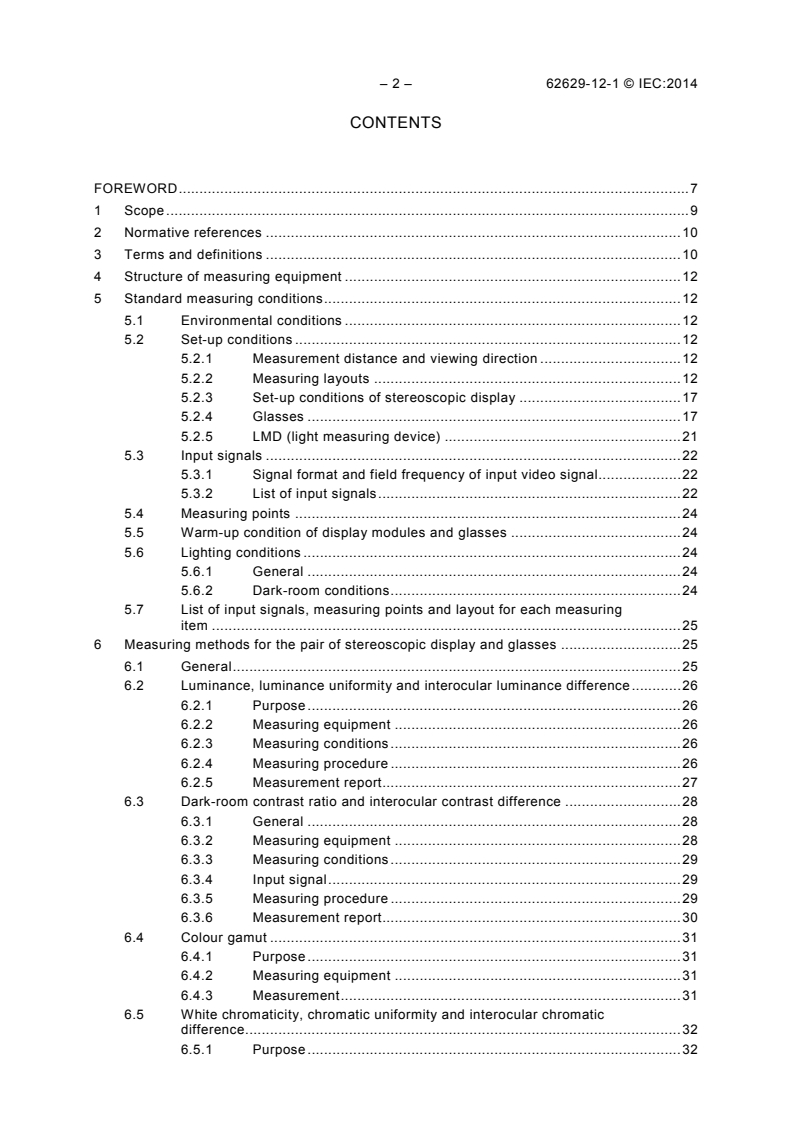
– 2 – 62629-12-1 © IEC:2014
CONTENTS
FOREWORD . 7
1 Scope . 9
2 Normative references . 10
3 Terms and definitions . 10
4 Structure of measuring equipment . 12
5 Standard measuring conditions . 12
5.1 Environmental conditions . 12
5.2 Set-up conditions . 12
5.2.1 Measurement distance and viewing direction . 12
5.2.2 Measuring layouts . 12
5.2.3 Set-up conditions of stereoscopic display . 17
5.2.4 Glasses . 17
5.2.5 LMD (light measuring device) . 21
5.3 Input signals . 22
5.3.1 Signal format and field frequency of input video signal. 22
5.3.2 List of input signals . 22
5.4 Measuring points . 24
5.5 Warm-up condition of display modules and glasses . 24
5.6 Lighting conditions . 24
5.6.1 General . 24
5.6.2 Dark-room conditions . 24
5.7 List of input signals, measuring points and layout for each measuring
item . 25
6 Measuring methods for the pair of stereoscopic display and glasses . 25
6.1 General . 25
6.2 Luminance, luminance uniformity and interocular luminance difference . 26
6.2.1 Purpose . 26
6.2.2 Measuring equipment . 26
6.2.3 Measuring conditions . 26
6.2.4 Measuring procedure . 26
6.2.5 Measurement report. 27
6.3 Dark-room contrast ratio and interocular contrast difference . 28
6.3.1 General . 28
6.3.2 Measuring equipment . 28
6.3.3 Measuring conditions . 29
6.3.4 Input signal . 29
6.3.5 Measuring procedure . 29
6.3.6 Measurement report. 30
6.4 Colour gamut . 31
6.4.1 Purpose . 31
6.4.2 Measuring equipment . 31
6.4.3 Measurement . 31
6.5 White chromaticity, chromatic uniformity and interocular chromatic
difference . 32
6.5.1 Purpose . 32
62629-12-1 © IEC:2014 – 3 –
6.5.2 Measuring equipment . 32
6.5.3 Measurement . 32
6.6 Interocular crosstalk at screen centre. 33
6.6.1 General . 33
6.6.2 Measuring equipment . 34
6.6.3 Measuring conditions . 34
6.6.4 Selection of the method (selection of applied signals) . 34
6.6.5 Input signal . 34
6.6.6 Procedure for 4 % window method . 35
6.6.7 Procedure for full screen method . 35
6.6.8 Calculation of interocular crosstalk . 35
6.6.9 Measurement report. 36
6.7 Interocular crosstalk screen position dependency (interocular crosstalk
uniformity). 37
6.7.1 General . 37
6.7.2 Measuring equipment . 37
6.7.3 Measuring conditions . 37
6.7.4 Measuring layout . 38
6.7.5 Use of two-dimensional LMD . 38
6.7.6 Selection of the method (selection of applied signals) . 38
6.7.7 Input signal of full screen and 0,44 % windows methods . 38
6.7.8 Procedure using full screen or 0,44 % windows signals for a
two-dimensional LMD . 39
6.7.9 Procedure using full screen or 0,44 % windows signals with a
point-measurement LMD . 40
6.7.10 Measurement report. 40
6.8 Viewing direction dependency . 41
6.8.1 General . 41
6.8.2 Viewing direction (angle) . 41
6.8.3 Measuring item . 41
6.8.4 Measuring equipment . 41
6.8.5 Input signals . 42
6.8.6 Measuring conditions . 42
6.8.7 Measuring procedure . 42
6.8.8 Measurement report. 42
6.9 Characteristics depending on the in-plane rotation of the glass lens . 44
6.9.1 Purpose . 44
6.9.2 Measurement in-plane rotation . 44
6.9.3 Measuring item . 44
6.9.4 Measuring equipment . 44
6.9.5 Input signals . 44
6.9.6 Measuring conditions . 44
6.9.7 Measuring procedure . 44
6.9.8 Measurement report. 45
6.10 Characteristics depending on the tilt of the glass lens . 45
6.10.1 Purpose . 45
6.10.2 Measurement . 45
6.10.3 Measurement report. 45
6.11 Viewing distance dependency . 45
6.11.1 General . 45
– 4 – 62629-12-1 © IEC:2014
6.11.2 Measurement distance . 46
6.11.3 Measuring item . 46
6.11.4 Measuring equipment . 46
6.11.5 Input signals . 46
6.11.6 Measuring conditions . 46
6.11.7 Measuring procedure . 46
6.11.8 Measurement report. 47
7 Measuring methods for the glasses . 48
7.1 General . 48
7.2 Additional equipment for the measurement of glasses . 49
7.2.1 General . 49
7.2.2 Light source . 49
7.2.3 Polarizer . 49
7.2.4 Optical band pass filter . 49
7.2.5 Fast response light measuring device (fast response LMD) . 50
7.3 Measuring conditions of glasses . 50
7.3.1 General . 50
7.3.2 Designed centre of glass lens . 50
7.3.3 Standard measuring layout of glasses . 50
7.3.4 Driving conditions (frequency and open-close duty) of active
glasses . 51
7.3.5 Lighting condition . 52
7.3.6 Temperature conditions of glasses . 52
7.4 Transmittance at open and closed states, colour shift, extinction ratio,
interocular transmittance, interocular extinction ratio and interocular
chromaticity difference . 53
7.4.1 General . 53
7.4.2 Description of colour shift . 53
7.4.3 Measuring equipment . 53
7.4.4 Measuring conditions . 53
7.4.5 Measuring procedure . 53
7.5 Response time (open state to/from closed state) of active glasses . 59
7.5.1 General . 59
7.5.2 Measuring equipment . 60
7.5.3 Measuring conditions . 60
7.5.4 Measuring procedure . 60
7.5.5 Analysis of response time . 61
7.5.6 Measurement report. 62
7.6 Angular characteristic . 62
7.6.1 General . 62
7.6.2 Measuring item . 62
7.6.3 Measuring conditions . 62
7.6.4 Layout of the glasses . 62
7.6.5 Procedure . 63
7.6.6 Measurement report. 63
7.7 Temperature dependency . 63
7.7.1 General . 63
7.7.2 Measuring item . 63
7.7.3 Additional measuring equipment . 63
62629-12-1 © IEC:2014 – 5 –
7.7.4 Measuring conditions . 63
7.7.5 Layout of glasses . 63
7.7.6 Procedure . 63
7.7.7 Measurement report. 64
7.8 Lens uniformity . 64
7.8.1 General . 64
7.8.2 Measuring equipment . 64
7.8.3 Measuring conditions . 64
7.8.4 Measuring procedure . 65
Annex A (informative) Symbols . 67
Bibliography . 69
Figure 1 – Standard measuring layout (side view, centre point measurement) . 13
Figure 2 – Measuring layout for multi-point measurement with head-still (eye-turn)
condition (side view) . 14
Figure 3 – Measuring layout for multi-point measurement with head-turn (point-
observation) condition (side view) . 14
Figure 4 – Head-turn and head-still conditions (top views) . 15
Figure 5 – Measuring layout for designed viewing point (side view) . 15
Figure 6 – Measuring layout for horizontal viewing direction dependency . 16
Figure 7 – Measuring layout for vertical viewing direction dependency . 17
Figure 8 – Example of designed configuration of glasses . 18
Figure 9 – Position of glasses . 19
Figure 10 – In-plane rotation of glasses (front view) . 19
Figure 11 – Layout of glasses for larger aperture LMD . 20
Figure 12 – Example image in the view finder . 20
Figure 13 – Layout of glasses for larger aperture LMD for multi-point measurement
with head-still condition . 21
Figure 14 – Layout of glasses for larger aperture LMD for multi-point measurement
with head-turn condition . 21
Figure 15 – 4 % window . 23
Figure 16 – Offset 4 % window . 23
Figure 17 – Measuring points for the centre and multi-point measurement . 24
Figure 18 – Example measurement result of colour gamut . 32
Figure 19 – 0,44 % white windows at level 100 % for the measurement of interocular
crosstalk screen position dependency . 38
Figure 20 – Signals of 0,44 % white windows methods for interocular crosstalk screen
position dependency . 39
Figure 21 – Standard measuring layout of glasses . 51
Figure 22 – Some classification examples of stereoscopic displays using a polarizer . 51
Figure 23 – Standard driving timing chart for active glasses . 52
Figure 24 – Temperature chamber . 52
Figure 25 – Configuration of measurement for the response time of the glasses . 60
Figure 26 – Example of observed response waveform . 61
Figure 27 – Example analysis of response waveform . 61
Figure 28 – Measuring layout of lens uniformity using a point-measurement LMD . 65
– 6 – 62629-12-1 © IEC:2014
Figure 29 – Measuring layout of lens uniformity using a two-dimensional LMD . 65
Figure 30 – Measuring points of lens uniformity measurement . 65
Figure A.1 – Subscripts of symbols (example 1) . 67
Figure A.2 – Subscripts of symbols (example 2) . 67
Table 1 – List of input signals, measuring points and layout for each measuring item . 25
Table 2 – Example of measurement result for full screen white luminance, 4 % white
window luminance and luminance uniformity . 27
Table 3 – Example of full screen white luminance, 4 % white window luminance and
interocular luminance difference . 28
Table 4 – Example table of 4 % window dark-room contrast ratio and interocular
contrast difference . 31
Table 5 – Example of white chromaticity measurement result. 33
Table 6 – Example of measurement result of interocular crosstalk at screen centre . 37
Table 7 – Example of measurement summary of interocular crosstalk screen position
dependency for left view by 9-point measurement . 40
Table 8 – Example of measurement result for viewing direction dependency of full
screen white luminance, 4 % white window luminance, dark-room contrast ratio and
interocular crosstalk at screen centre . 43
Table 9 – Example of measurement result for viewing distance dependency . 48
Table 10 – Active glasses (1) . 58
Table 11 – Active glasses (2) . 58
Table 12 – Passive glasses with circular polarizer and linear polarizer (1) . 59
Table 13 – Passive glasses with circular polarizer and linear polarizer (2) . 59
Table 14 – Example result of response time measurement . 62
Table 15 – Example result of colour response time measurement . 62
Table A.1 – List of typical symbols . 68
62629-12-1 © IEC:2014 – 7 –
INTERNATIONAL ELECTROTECHNICAL COMMISSION
____________
3D DISPLAY DEVICES –
Part 12-1: Measuring methods
for stereoscopic displays using glasses –
Optical
FOREWORD
1) The International Electrotechnical Commission (IEC) is a worldwide organization for standardization comprising
all national electrotechnical committees (IEC National Committees). The object of IEC is to promote
international co-operation on all questions concerning standardization in the electrical and electronic fields. To
this end and in addition to other activities, IEC publishes International Standards, Technical Specifications,
Technical Reports, Publicly Available Specifications (PAS) and Guides (hereafter referred to as “IEC
Publication(s)”). Their preparation is entrusted to technical committees; any IEC National Committee interested
in the subject dealt with may participate in this preparatory work. International, governmental and non-
governmental organizations liaising with the IEC also participate in this preparation. IEC collaborates closely
with the International Organization for Standardization (ISO) in accordance with conditions determined by
agreement between the two organizations.
2) The formal decisions or agreements of IEC on technical matters express, as nearly as possible, an international
consensus of opinion on the relevant subjects since each technical committee has representation from all
interested IEC National Committees.
3) IEC Publications have the form of recommendations for international use and are accepted by IEC National
Committees in that sense. While all reasonable efforts are made to ensure that the technical content of IEC
Publications is accurate, IEC cannot be held responsible for the way in which they are used or for any
misinterpretation by any end user.
4) In order to promote international uniformity, IEC National Committees undertake to apply IEC Publications
transparently to the maximum extent possible in their national and regional publications. Any divergence
between any IEC Publication and the corresponding national or regional publication shall be clearly indicated in
the latter.
5) IEC itself does not provide any attestation of conformity. Independent certification bodies provide conformity
assessment services and, in some areas, access to IEC marks of conformity. IEC is not responsible for any
services carried out by independent certification bodies.
6) All users should ensure that they have the latest edition of this publication.
7) No liability shall attach to IEC or its directors, employees, servants or agents including individual experts and
members of its technical committees and IEC National Committees for any personal injury, property damage or
other damage of any nature whatsoever, whether direct or indirect, or for costs (including legal fees) and
expenses arising out of the publication, use of, or reliance upon, this IEC Publication or any other IEC
Publications.
8) Attention is drawn to the Normative references cited in this publication. Use of the referenced publications is
indispensable for the correct application of this publication.
9) Attention is drawn to the possibility that some of the elements of this IEC Publication may be the subject of
patent rights. IEC shall not be held responsible for identifying any or all such patent rights.
International Standard IEC 62629-12-1 has been prepared by IEC technical committee 110:
Electronic display devices.
The text of this standard is based on the following documents:
FDIS Report on voting
110/524/FDIS 110/537/RVD
Full information on the voting for the approval of this standard can be found in the report on
voting indicated in the above table.
This publication has been drafted in accordance with the ISO/IEC Directives, Part 2.
– 8 – 62629-12-1 © IEC:2014
A list of all the parts in the IEC 62629 series, under the general title 3D display devices, can
be found on the IEC website.
The committee has decided that the contents of this publication will remain unchanged until
the stability date indicated on the IEC web site under "http://webstore.iec.ch" in the data
related to the specific publication. At this date, the publication will be
• reconfirmed,
• withdrawn,
• replaced by a revised edition, or
• amended.
62629-12-1 © IEC:2014 – 9 –
3D DISPLAY DEVICES –
Part 12-1: Measuring methods
for stereoscopic displays using glasses –
Optical
1 Scope
This part of IEC 62629 determines the following measuring methods for characterizing the
performance of stereoscopic display devices using either active or passive glasses.
This standard focuses on the types of stereoscopic displays using glasses as follows:
The types of stereoscopic displays reproducing temporally interlaced images and applicable
glasses are:
– displays representing temporally interlaced (high frame rate) images and active glasses
(time dividing shutter glasses), and
– displays with front screen switchable polarizer representing temporally interlaced images
and linear or circular polarizer passive glasses.
The types of stereoscopic displays reproducing spatially interlaced images and applicable
glasses are:
– displays with patterned retarder representing spatially interlaced images and linear or
circular polarizer passive glasses.
Some parts of these measuring methods may also be applied to other types of stereoscopic
displays using glasses not listed above.
The measuring items for the sets of stereoscopic display and glasses are as follows:
a) luminance,
b) luminance uniformity,
c) interocular luminous difference,
d) dark-room contrast ratio,
e) interocular contrast difference,
f) colour gamut,
g) white chromaticity,
h) white chromatic uniformity,
i) interocular chromatic difference,
j) interocular crosstalk, and
k) interocular crosstalk screen position dependency (interocular crosstalk uniformity).
The measuring parameters are as follows:
l) viewing direction dependency,
m) dependency on in-plane rotation of lens,
n) dependency on tilt angle of lens, and
o) viewing distance dependency.
– 10 – 62629-12-1 © IEC:2014
The measuring items for the glasses are as follows:
p) transmittance (open state),
q) extinction ratio,
r) colour shift (open state, on-state),
s) interocular transmittance,
t) interocular contrast difference,
u) interocular chromatic difference,
v) response time (open state to/from closed state) of active glasses, and
w) uniformity of lens.
The measuring parameters are as follows:
x) angular characteristic, and
y) temperature dependency.
2 Normative references
The following documents, in whole or in part, are normatively referenced in this document and
are indispensable for its application. For dated references, only the edition cited applies. For
undated references, the latest edition of the referenced document (including any
amendments) applies.
IEC 60068-1, Environmental testing – Part 1: General and guidance
IEC 60107-1, Methods of measurement on receivers for television broadcast transmissions –
Part 1: General considerations – Measurements at radio and video frequencies
IEC 62629-1-2, 3D display devices – Part 1-2: Generic – Terminology and letter symbols
3 Terms and definitions
For the purposes of this document, the terms and definitions given in IEC 62629-1-2,
IEC 60068-1 and IEC 60107-1, as well as the following apply.
3.1
active glasses
glasses whose left and right lenses alternate their optical characteristics, synchronizing with
displayed time-sequential images on a stereoscopic display (e.g. synchronizing to TV fields,
TV frame, etc.) to separate the displayed images into left and right monocular views
Note 1 to entry: Usually left and right images are displayed alternately on a screen. When a left image is displayed,
the left lens of active glasses is turned on to transmit the image and the right lens is turned off to cut off the image.
The lenses need no function of focusing light.
3.2
closed state of glass lens
optical condition of a glass lens in the on-state of active glasses with the emitted left or right
light of a stereoscopic display at the minimum light transmittance (a low light transmittance
condition)
3.3
designed viewing distance
viewing distance recommended by the manufacturer of 3D display
62629-12-1 © IEC:2014 – 11 –
Note 1 to entry: Measurements in this document are usually carried out from the designed viewing distance.
3.4
extinction ratio of glass lens
ratio of the transmittance at open and closed conditions of a glass lens
Note 1 to entry: Two stacked linear polarizer sheets show the maximum transmittance when the polarization axes
are parallel and the minimum transmittance when they are orthogonal to each other.
3.5
glasses
eye attachment having a characteristic by which displayed images on a stereoscopic display
are divided into left and right parallax images
Note 1 to entry: In this document the term “glasses” means special glasses for stereoscopic views and the term
“ordinary glasses” is used for conventional glasses. See passive glasses and active glasses.
3.6
head-still condition
measurement configuration of glasses to measure some measuring points on a display screen,
where the position and the angle between the glasses and the screen are kept at constant
values and only the LMD (light measuring device) rotates and changes its position
Note 1 to entry: This condition simulates a whole screen observation at a glance or an area observation only using
eye movement.
3.7
head-turn condition
measurement configuration of the glasses to measure some measuring points on a display
screen, where the designed centre of the glasses is aligned to the optical axes of the LMD
Note 1 to entry: This condition simulates the point observation of some positions on a display screen or the area
observation on a display screen using head movement.
3.8
off-state of active glasses
powered-off (not in busy) state of active glasses, where both lenses of the glasses are at a
fixed light transmittance
Note 1 to entry: Typically, both lenses are set to the maximum light transmission (high transmittance condition).
3.9
on-state of active glasses
powered-on (in busy) state of active glasses, where each lens of the glasses is alternately
changing the conditions from open to closed and closed to open, synchronizing to the
displayed time-sequential images on a stereoscopic display
3.10
open state of glass lens
optical condition of a glass lens in the on-state of active glasses, at the maximum light
transmittance through the lens for either the left or right image of a stereoscopic display (high
light transmittance condition)
3.11
passive glasses
glasses whose left and right lenses have complementary but fixed optical characteristics to
separate displayed images on a stereoscopic display into left and right monocular views
Note 1 to entry: Usually spatially divided left and right segmental images are displayed at the same time on a
screen; each divided segment of the screen emits polarized light to display the images and the left and right
segments have an opposite orientation of polarization. The left lens of the passive glasses has a polarization to
pass the emitted light of the left images and to cut off that of the right images, while the right lens passes the right
images and cuts off the left images.
– 12 – 62629-12-1 © IEC:2014
4 Structure of measuring equipment
The system diagrams and/or driving conditions of the measuring equipment shall comply with
the structure specified in each item.
5 Standard measuring conditions
5.1 Environmental conditions
Measurements shall be carried out under the standard environmental conditions, e.g. at a
temperature of 25 °C ± 3 °C, a relative humidity of 45 % to 75 %, and a pressure of 86 kPa to
106 kPa. When different environmental conditions are used, these shall be noted in the report.
5.2 Set-up conditions
5.2.1 Measurement distance and viewing direction
5.2.1.1 General
The measurement distance and viewing direction from the screen centre shall be the
M
standard measurement distance and the standard measurement direction; if not, a designed
viewing distance or a designed viewing direction is defined in the relevant specification. The
measurement distance and the viewing direction applied to the measurement shall be noted in
the report.
5.2.1.2 Standard measurement distance and direction
is 3V, where V is the height of the active area. The
The standard measurement distance
M,S
standard measurement direction from the screen centre is perpendicular to the screen. When
a designed viewing distance is specified in the relevant specification, it shall be used as the
measurement distance.
5.2.1.3 Designed viewing distance and direction
A designed viewing distance can be defined in the relevant specification. Then the designed
viewing distance shall be applied and the designed measurement distance shall be noted in
the report.
A designed viewing direction can be defined in the relevant specification. Then the viewing
direction shall be applied and the viewing direction shall be noted in the report.
5.2.2 Measuring layouts
5.2.2.1 Standard measuring layout for a stereoscopic display and glasses
Measurements shall be carried out at the standard measuring layout; if not, a designed
viewing distance or a designed viewing direction is defined in the relevant specification. The
standard measuring layout is shown in Figure 1, Figure 2 and Figure 3, for a centre point
measurement, a multi-point measurement with the head-still condition and a multi-point
measurement with the head-turn condition, respectively. Figure 1, Figure 2 and Figure 3 are
side views and show the vertical alignments of the layouts. The horizontal alignments are
defined similarly. The configurations of the lens of the glasses and the light measuring device
(LMD) in these multi-point measurements are shown in Figure 4. The aperture of the LMD
shall be set at the observing point. The lens of the glasses shall be set at the front of the
object lens of the LMD and parallel or at the designed direction to the object lens.
The use of the measuring layout shown in Figure 1, Figure 2 or Figure 3 is defined in each
measuring item. When a measuring layout is required for some measuring items in the
62629-12-1 © IEC:2014 – 13 –
relevant specification, the required layout shall be used
...