

IEC 62828-2:2017
(Main)Reference conditions and procedures for testing industrial and process measurement transmitters - Part 2: Specific procedures for pressure transmitters
General Information
- Abstract
IEC 62828-2:2017 establishes specific procedures for testing pressure process measurement transmitters (PMT) used in measuring and control systems for industrial processes and for machinery control systems. A pressure PMT can feature a remote seal to bring the process variable to the sensing element in the PMT. When the remote seal cannot be separated from the PMT, the complete device is tested.
- Status
- Published
- Publication Date
- 06-Nov-2017
- Technical Committee
- SC 65B - Measurement and control devices
- Drafting Committee
- WG 6 - TC 65/SC 65B/WG 6
Buy Documents

IEC 62828-2:2017 - Reference conditions and procedures for testing industrial and process measurement transmitters - Part 2: Specific procedures for pressure transmitters Released:11/7/2017
Overview
IEC 62828-2:2017 is an international standard developed by the International Electrotechnical Commission (IEC) that defines reference conditions and specific testing procedures for pressure process measurement transmitters (PMTs). These devices are critical components in industrial process automation and machinery control systems, ensuring accurate monitoring, measurement, and control of pressure in various industrial applications. This standard focuses exclusively on pressure transmitters, including those with remote or diaphragm seals integral to the measurement chain.
IEC 62828-2:2017 provides clear procedures and requirements for testing the performance, reliability, and consistency of pressure transmitters under reference conditions. Its systematic approach supports both manufacturers and end users in verifying transmitter quality and compliance, essential for safety, process control efficiency, and regulatory adherence in industrial operations.
Key Topics
- Scope and Application: Defines specific test methods for pressure process measurement transmitters, including both direct and remote-seal types.
- Reference Test Conditions: Establishes environmental and operational reference points under which testing should occur to ensure comparable and reliable results.
- Testing Procedures:
- Methodology for accuracy, overpressure, static pressure influence, long-term drift, and leakage.
- Special considerations for transmitters with remote or diaphragm seals, particularly regarding influence of process temperature and seal integrity.
- Terms and Definitions: Provides consistent terminology for pressure measurement (absolute, gauge, and differential pressure; overpressure; measuring range; leakage rate; etc.)
- Test Reporting: Specifies requirements for documenting results, including error calculations, data tabulation, and graphical representation for clarity and traceability.
Applications
IEC 62828-2:2017 applies to manufacturers, integrators, and end-users of pressure transmitters in industrial process automation and machinery control. Its practical value lies in:
- Manufacturing Quality Control: Ensuring that pressure transmitters meet international performance and safety standards before deployment.
- Procurement Specifications: Providing an objective basis for evaluating and selecting pressure transmitters from suppliers.
- Regulatory Compliance: Supporting adherence to industrial safety and process accuracy regulations by applying standardized test procedures.
- Maintenance and Calibration: Offering procedures that can be integrated into ongoing calibration and verification programs, minimizing operational risks due to instrument drift or failure.
- Process Optimization: Enhancing process reliability and reducing downtime by ensuring the transmitters provide accurate and consistent data, which is vital for automation and safety interlock systems.
Industries benefiting from this standard include oil and gas, chemical processing, power generation, water treatment, pharmaceuticals, and any sector relying on precise process pressure measurement.
Related Standards
IEC 62828-2:2017 is part of the broader IEC 62828 series, which provides a modular approach for standardized testing of various process measurement transmitters. Key related standards include:
- IEC 62828-1: General procedures for all types of transmitters (overarching framework covering terminology, general test procedures, and reference conditions).
- IEC 62828-3: Specific procedures for temperature transmitters.
- IEC 62828-4: Specific procedures for level transmitters.
- IEC 62828-5: Specific procedures for flow transmitters.
Other key references include IEC 61298 (testing for industrial and process measurement and control devices) and IEC 61518 (manifolds for process measurement instruments).
Keywords: IEC 62828-2, pressure transmitter testing, industrial process measurement, process control, reference conditions, remote seal pressure transmitter, pressure measurement standard, transmitter calibration procedures, IEC standards for pressure sensors.
Relations
- Effective Date
- 05-Sep-2023
- Effective Date
- 05-Sep-2023
- Effective Date
- 05-Sep-2023
- Effective Date
- 05-Sep-2023
Buy Documents
IEC 62828-2:2017 - Reference conditions and procedures for testing industrial and process measurement transmitters - Part 2: Specific procedures for pressure transmitters Released:11/7/2017
Get Certified
Connect with accredited certification bodies for this standard

DVS-ZERT GmbH
German welding certification society.
BSMI (Bureau of Standards, Metrology and Inspection)
Taiwan's standards and inspection authority.
CARES (UK Certification Authority for Reinforcing Steels)
UK certification for reinforcing steels and construction.
Sponsored listings
Frequently Asked Questions
IEC 62828-2:2017 is a standard published by the International Electrotechnical Commission (IEC). Its full title is "Reference conditions and procedures for testing industrial and process measurement transmitters - Part 2: Specific procedures for pressure transmitters". This standard covers: IEC 62828-2:2017 establishes specific procedures for testing pressure process measurement transmitters (PMT) used in measuring and control systems for industrial processes and for machinery control systems. A pressure PMT can feature a remote seal to bring the process variable to the sensing element in the PMT. When the remote seal cannot be separated from the PMT, the complete device is tested.
IEC 62828-2:2017 establishes specific procedures for testing pressure process measurement transmitters (PMT) used in measuring and control systems for industrial processes and for machinery control systems. A pressure PMT can feature a remote seal to bring the process variable to the sensing element in the PMT. When the remote seal cannot be separated from the PMT, the complete device is tested.
IEC 62828-2:2017 is classified under the following ICS (International Classification for Standards) categories: 17.100 - Measurement of force, weight and pressure; 25.040.40 - Industrial process measurement and control. The ICS classification helps identify the subject area and facilitates finding related standards.
IEC 62828-2:2017 has the following relationships with other standards: It is inter standard links to IEC 60770-1:2010, IEC 60770-3:2014, IEC 60770-2:2010, IEC 62828-2:2026. Understanding these relationships helps ensure you are using the most current and applicable version of the standard.
IEC 62828-2:2017 is available in PDF format for immediate download after purchase. The document can be added to your cart and obtained through the secure checkout process. Digital delivery ensures instant access to the complete standard document.
Standards Content (Sample)
IEC 62828-2 ®
Edition 1.0 2017-11
INTERNATIONAL
STANDARD
NORME
INTERNATIONALE
colour
inside
Reference conditions and procedures for testing industrial and process
measurement transmitters –
Part 2: Specific procedures for pressure transmitters
Conditions de référence et procédures pour l’essai des transmetteurs de mesure
industrielle et de processus –
Partie 2: Procédures spécifiques pour les transmetteurs de pression
All rights reserved. Unless otherwise specified, no part of this publication may be reproduced or utilized in any form
or by any means, electronic or mechanical, including photocopying and microfilm, without permission in writing from
either IEC or IEC's member National Committee in the country of the requester. If you have any questions about IEC
copyright or have an enquiry about obtaining additional rights to this publication, please contact the address below or
your local IEC member National Committee for further information.
Droits de reproduction réservés. Sauf indication contraire, aucune partie de cette publication ne peut être reproduite
ni utilisée sous quelque forme que ce soit et par aucun procédé, électronique ou mécanique, y compris la photocopie
et les microfilms, sans l'accord écrit de l'IEC ou du Comité national de l'IEC du pays du demandeur. Si vous avez des
questions sur le copyright de l'IEC ou si vous désirez obtenir des droits supplémentaires sur cette publication, utilisez
les coordonnées ci-après ou contactez le Comité national de l'IEC de votre pays de résidence.
IEC Central Office Tel.: +41 22 919 02 11
3, rue de Varembé Fax: +41 22 919 03 00
CH-1211 Geneva 20 info@iec.ch
Switzerland www.iec.ch
About the IEC
The International Electrotechnical Commission (IEC) is the leading global organization that prepares and publishes
International Standards for all electrical, electronic and related technologies.
About IEC publications
The technical content of IEC publications is kept under constant review by the IEC. Please make sure that you have the
latest edition, a corrigenda or an amendment might have been published.
IEC Catalogue - webstore.iec.ch/catalogue Electropedia - www.electropedia.org
The stand-alone application for consulting the entire The world's leading online dictionary of electronic and
bibliographical information on IEC International Standards, electrical terms containing 20 000 terms and definitions in
Technical Specifications, Technical Reports and other English and French, with equivalent terms in 16 additional
documents. Available for PC, Mac OS, Android Tablets and languages. Also known as the International Electrotechnical
iPad. Vocabulary (IEV) online.
IEC publications search - www.iec.ch/searchpub IEC Glossary - std.iec.ch/glossary
The advanced search enables to find IEC publications by a 65 000 electrotechnical terminology entries in English and
variety of criteria (reference number, text, technical French extracted from the Terms and Definitions clause of
committee,…). It also gives information on projects, replaced IEC publications issued since 2002. Some entries have been
and withdrawn publications. collected from earlier publications of IEC TC 37, 77, 86 and
CISPR.
IEC Just Published - webstore.iec.ch/justpublished
Stay up to date on all new IEC publications. Just Published IEC Customer Service Centre - webstore.iec.ch/csc
details all new publications released. Available online and If you wish to give us your feedback on this publication or
also once a month by email. need further assistance, please contact the Customer Service
Centre: csc@iec.ch.
A propos de l'IEC
La Commission Electrotechnique Internationale (IEC) est la première organisation mondiale qui élabore et publie des
Normes internationales pour tout ce qui a trait à l'électricité, à l'électronique et aux technologies apparentées.
A propos des publications IEC
Le contenu technique des publications IEC est constamment revu. Veuillez vous assurer que vous possédez l’édition la
plus récente, un corrigendum ou amendement peut avoir été publié.
Catalogue IEC - webstore.iec.ch/catalogue Electropedia - www.electropedia.org
Application autonome pour consulter tous les renseignements
Le premier dictionnaire en ligne de termes électroniques et
bibliographiques sur les Normes internationales,
électriques. Il contient 20 000 termes et définitions en anglais
Spécifications techniques, Rapports techniques et autres
et en français, ainsi que les termes équivalents dans 16
documents de l'IEC. Disponible pour PC, Mac OS, tablettes
langues additionnelles. Egalement appelé Vocabulaire
Android et iPad.
Electrotechnique International (IEV) en ligne.
Recherche de publications IEC - www.iec.ch/searchpub
Glossaire IEC - std.iec.ch/glossary
65 000 entrées terminologiques électrotechniques, en anglais
La recherche avancée permet de trouver des publications IEC
en utilisant différents critères (numéro de référence, texte, et en français, extraites des articles Termes et Définitions des
comité d’études,…). Elle donne aussi des informations sur les publications IEC parues depuis 2002. Plus certaines entrées
projets et les publications remplacées ou retirées. antérieures extraites des publications des CE 37, 77, 86 et
CISPR de l'IEC.
IEC Just Published - webstore.iec.ch/justpublished
Service Clients - webstore.iec.ch/csc
Restez informé sur les nouvelles publications IEC. Just
Published détaille les nouvelles publications parues. Si vous désirez nous donner des commentaires sur cette
Disponible en ligne et aussi une fois par mois par email. publication ou si vous avez des questions contactez-nous:
csc@iec.ch.
IEC 62828-2 ®
Edition 1.0 2017-11
INTERNATIONAL
STANDARD
NORME
INTERNATIONALE
colour
inside
Reference conditions and procedures for testing industrial and process
measurement transmitters –
Part 2: Specific procedures for pressure transmitters
Conditions de référence et procédures pour l’essai des transmetteurs de
mesure industrielle et de processus –
Partie 2: Procédures spécifiques pour les transmetteurs de pression
INTERNATIONAL
ELECTROTECHNICAL
COMMISSION
COMMISSION
ELECTROTECHNIQUE
INTERNATIONALE
ICS 17.100; 25.040.40 ISBN 978-2-8322-4850-8
– 2 – IEC 62828-2:2017 IEC 2017
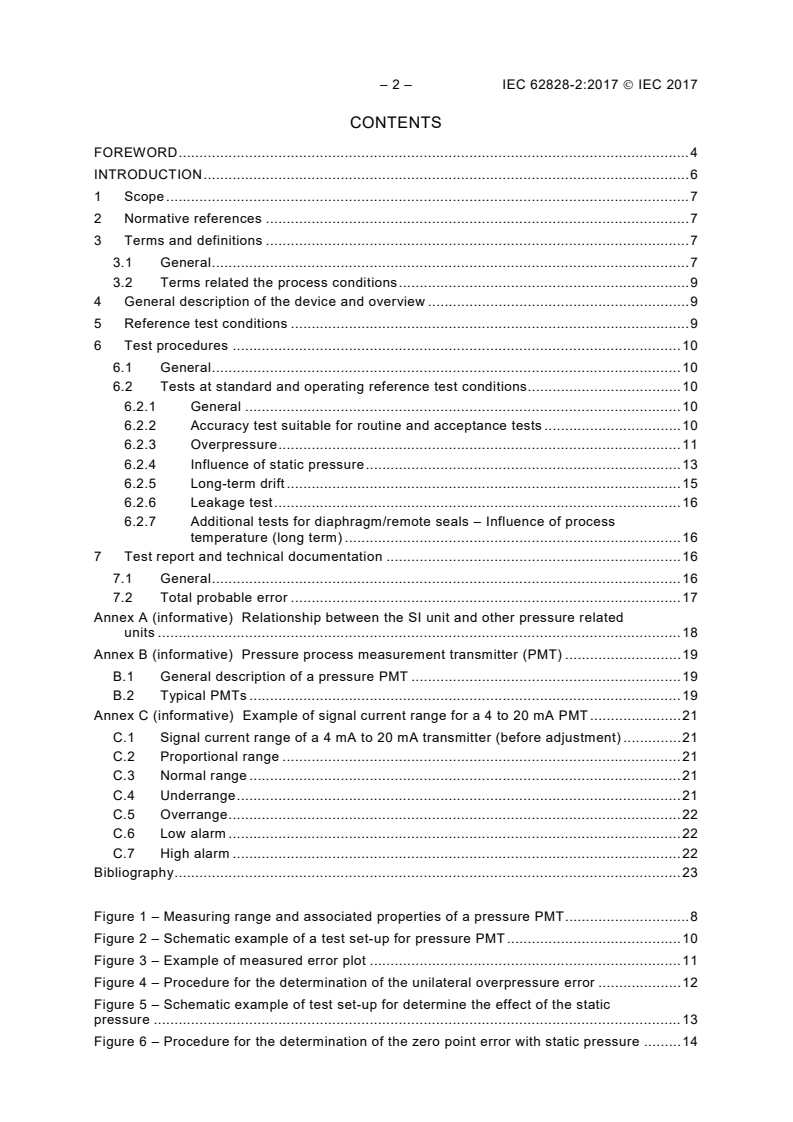
CONTENTS
FOREWORD . 4
INTRODUCTION . 6
1 Scope . 7
2 Normative references . 7
3 Terms and definitions . 7
3.1 General . 7
3.2 Terms related the process conditions . 9
4 General description of the device and overview . 9
5 Reference test conditions . 9
6 Test procedures . 10
6.1 General . 10
6.2 Tests at standard and operating reference test conditions. 10
6.2.1 General . 10
6.2.2 Accuracy test suitable for routine and acceptance tests . 10
6.2.3 Overpressure . 11
6.2.4 Influence of static pressure . 13
6.2.5 Long-term drift . 15
6.2.6 Leakage test . 16
6.2.7 Additional tests for diaphragm/remote seals – Influence of process
temperature (long term) . 16
7 Test report and technical documentation . 16
7.1 General . 16
7.2 Total probable error . 17
Annex A (informative) Relationship between the SI unit and other pressure related
units . 18
Annex B (informative) Pressure process measurement transmitter (PMT) . 19
B.1 General description of a pressure PMT . 19
B.2 Typical PMTs . 19
Annex C (informative) Example of signal current range for a 4 to 20 mA PMT . 21
C.1 Signal current range of a 4 mA to 20 mA transmitter (before adjustment) . 21
C.2 Proportional range . 21
C.3 Normal range . 21
C.4 Underrange . 21
C.5 Overrange . 22
C.6 Low alarm . 22
C.7 High alarm . 22
Bibliography . 23
Figure 1 – Measuring range and associated properties of a pressure PMT . 8
Figure 2 – Schematic example of a test set-up for pressure PMT . 10
Figure 3 – Example of measured error plot . 11
Figure 4 – Procedure for the determination of the unilateral overpressure error . 12
Figure 5 – Schematic example of test set-up for determine the effect of the static
pressure . 13
Figure 6 – Procedure for the determination of the zero point error with static pressure . 14
Figure 7 – Procedure for the determination of the span error for static pressure . 15
Figure B.1 – Schematic example of intelligent PMT model . 20
Figure C.1 – Signal current range of a 4 mA – 20 mA transmitter (before adjustment) . 21
Table 1 – Example of measured errors. 11
Table A.1 – Relationship between the SI unit and other pressure related units. 18
– 4 – IEC 62828-2:2017 IEC 2017
INTERNATIONAL ELECTROTECHNICAL COMMISSION
____________
REFERENCE CONDITIONS AND PROCEDURES FOR TESTING INDUSTRIAL
AND PROCESS MEASUREMENT TRANSMITTERS –
Part 2: Specific procedures for pressure transmitters
FOREWORD
1) The International Electrotechnical Commission (IEC) is a worldwide organization for standardization comprising
all national electrotechnical committees (IEC National Committees). The object of IEC is to promote
international co-operation on all questions concerning standardization in the electrical and electronic fields. To
this end and in addition to other activities, IEC publishes International Standards, Technical Specifications,
Technical Reports, Publicly Available Specifications (PAS) and Guides (hereafter referred to as "IEC
Publication(s)"). Their preparation is entrusted to technical committees; any IEC National Committee interested
in the subject dealt with may participate in this preparatory work. International, governmental and non-
governmental organizations liaising with the IEC also participate in this preparation. IEC collaborates closely
with the International Organization for Standardization (ISO) in accordance with conditions determined by
agreement between the two organizations.
2) The formal decisions or agreements of IEC on technical matters express, as nearly as possible, an international
consensus of opinion on the relevant subjects since each technical committee has representation from all
interested IEC National Committees.
3) IEC Publications have the form of recommendations for international use and are accepted by IEC National
Committees in that sense. While all reasonable efforts are made to ensure that the technical content of IEC
Publications is accurate, IEC cannot be held responsible for the way in which they are used or for any
misinterpretation by any end user.
4) In order to promote international uniformity, IEC National Committees undertake to apply IEC Publications
transparently to the maximum extent possible in their national and regional publications. Any divergence
between any IEC Publication and the corresponding national or regional publication shall be clearly indicated in
the latter.
5) IEC itself does not provide any attestation of conformity. Independent certification bodies provide conformity
assessment services and, in some areas, access to IEC marks of conformity. IEC is not responsible for any
services carried out by independent certification bodies.
6) All users should ensure that they have the latest edition of this publication.
7) No liability shall attach to IEC or its directors, employees, servants or agents including individual experts and
members of its technical committees and IEC National Committees for any personal injury, property damage or
other damage of any nature whatsoever, whether direct or indirect, or for costs (including legal fees) and
expenses arising out of the publication, use of, or reliance upon, this IEC Publication or any other IEC
Publications.
8) Attention is drawn to the Normative references cited in this publication. Use of the referenced publications is
indispensable for the correct application of this publication.
9) Attention is drawn to the possibility that some of the elements of this IEC Publication may be the subject of
patent rights. IEC shall not be held responsible for identifying any or all such patent rights.
International Standard IEC 62828-2 has been prepared by subcommittee 65B: Measurement
and control devices, of IEC technical committee 65: Industrial-process measurement, control
and automation.
The text of this International Standard is based on the following documents:
FDIS Report on voting
65B/1098/FDIS 65B/1101/RVD
Full information on the voting for the approval of this International Standard can be found in
the report on voting indicated in the above table.
This document has been drafted in accordance with the ISO/IEC Directives, Part 2.
This International Standard is to be used in conjunction with IEC 62828-1:2017.
A list of all parts in the IEC 62828 series, published under the general title Reference
conditions and procedures for testing industrial and process measurement transmitters, can
be found on the IEC website.
The committee has decided that the contents of this document will remain unchanged until the
stability date indicated on the IEC website under "http://webstore.iec.ch" in the data related to
the specific document. At this date, the document will be
• reconfirmed,
• withdrawn,
• replaced by a revised edition, or
• amended.
IMPORTANT – The 'colour inside' logo on the cover page of this publication indicates
that it contains colours which are considered to be useful for the correct
understanding of its contents. Users should therefore print this document using a
colour printer.
– 6 – IEC 62828-2:2017 IEC 2017
INTRODUCTION
Most of the current IEC standards on industrial and process measurement transmitters are
rather old and were developed having in mind devices based on analogue technologies.
Today’s digital industrial and process measurement transmitters are quite different from those
analogue transmitters: they include more functions and newer interfaces, both towards the
computing section (mostly digital electronic) and towards the measuring section (mostly
mechanical). Even if some standards dealing with digital process measurement transmitters
already exist, they are not sufficient, since some aspects of the performance are not covered
by appropriate test methods.
In addition, existing IEC test standards for industrial and process measurement transmitters
are spread over many documents, so that for manufacturers and users it is difficult,
impractical and time-consuming to identify and select all the standards to be applied to a
device measuring a specific process quantity (pressure, temperature, flow, level, etc.).
To help manufacturers and users, it was decided to review, complete and reorganize the
relevant IEC standards and to create a more suitable, effective and comprehensive standard
series that provides in a systematic way all the necessary specifications and tests required for
different industrial and process measurement transmitters.
To solve the issues mentioned above and to provide an added value for the stakeholders, the
new standard series on industrial and process measurement transmitters covers the following
main aspects:
• applicable normative references;
• specific terms and definitions;
• typical configurations and architectures for the various types of industrial and process
measurement transmitters;
• hardware and software aspects;
• interfaces (to the process, to the operator, to the other measurement and control devices);
• physical, mechanical and electrical requirements and relevant tests; clear definition of the
test categories: type tests, acceptance tests and routine tests;
• performance (its specification, tests and verification);
• environmental protection, hazardous areas application, functional safety, etc.;
• structure of the technical documentation.
To cover in a systematic way all the topics to be addressed, the standard series is organized
in several parts. At the moment of the publication of this document, the IEC 62828 series
consists of the following parts:
• IEC 62828-1: General procedures for all types of transmitters
• IEC 62828-2: Specific procedures for pressure transmitters
• IEC 62828-3: Specific procedures for temperature transmitters
• IEC 62828-4: Specific procedures for level transmitters
• IEC 62828-5: Specific procedures for flow transmitters
In preparing IEC 62828 (all parts), many test procedures were taken, with the necessary
improvements, from IEC 61298 (all parts). As IEC 61298 (all parts) is currently applicable to
all process measurement and control devices, when IEC 62828 (all parts) is completed,
IEC 61298 (all parts) will be revised to harmonise it with IEC 62828 (all parts), taking out from
its scope the industrial and process measurement transmitters. During the time when the
scope of IEC 61298 (all parts) is being updated, the new IEC 62828 series takes precedence
for industrial and process measurement transmitters.
REFERENCE CONDITIONS AND PROCEDURES FOR TESTING INDUSTRIAL
AND PROCESS MEASUREMENT TRANSMITTERS –
Part 2: Specific procedures for pressure transmitters
1 Scope
This part of IEC 62828 establishes specific procedures for testing pressure process
measurement transmitters (PMT) used in measuring and control systems for industrial
processes and for machinery control systems.
A pressure PMT can feature a remote seal to bring the process variable to the sensing
element in the PMT. When the remote seal cannot be separated from the PMT, the complete
device is tested.
For general test procedures, reference is made to IEC 62828-1, which is applicable to all
types of process measurement transmitters.
NOTE In industrial and process applications, to indicate the process measurement transmitters, it is common also
to use the terms "industrial transmitters", or "process transmitters".
2 Normative references
The following documents are referred to in the text in such a way that some or all of their
content constitutes requirements of this document. For dated references, only the edition
cited applies. For undated references, the latest edition of the referenced document (including
any amendments) applies.
IEC 62828-1, Reference conditions and procedures for testing industrial and process
measurement transmitters – Part 1: General procedures for all types of transmitters
3 Terms and definitions
For the purposes of this document, the terms and definitions given in IEC 62828-1 and the
following apply.
ISO and IEC maintain terminological databases for use in standardization at the following
addresses:
• IEC Electropedia: available at http://www.electropedia.org/
• ISO Online browsing platform: available at http://www.iso.org/obp
3.1 General
3.1.1
absolute pressure
p
abs
pressure using absolute vacuum as the datum point
Note 1 to entry: The CDD code of this entry for Electronic Data Exchange is ABB181.
3.1.2
ambient atmospheric pressure
p
amb
pressure exerted by the atmospheric air at a given altitude and temperature
Note 1 to entry: The atmospheric pressure decreases with the altitude by about 10 Pa/m (Pascal per metre).
– 8 – IEC 62828-2:2017 IEC 2017
3.1.3
differential pressure
∆p
p
1,2
difference between the two (absolute) pressures that act simultaneously on opposite sides of
a membrane or a primary element
Note 1 to entry: The CDD code of this entry for Electronic Data Exchange is ABB995.
3.1.4
gauge pressure
p
g
pressure using atmospheric pressure as the datum point
p = p – p
g abs amb
Note 1 to entry: Gauge pressure assumes positive values when the absolute pressure is greater than the ambient
atmospheric pressure; it assumes negative values when the absolute pressure is less than the ambient
atmospheric pressure.
Note 2 to entry: In certain industrial environments, "gauge pressure" may be referred to as "pressure".
Note 3 to entry: The term "relative pressure" to indicate gauge pressure is obsolete and conceptually wrong, so it
should be avoided.
Note 4 to entry:Tthe CDD code of this entry for Electronic Data Exchange is ABB182.
3.1.5
line pressure
static pressure
pressure applied on both sides of a differential pressure PMT
Note 1 to entry: For differential pressure PMTs, it is an influence factor that is bilateral and does not represent the
measurand.
3.1.6
leakage rate
leakage, permeation and/or diffusion effects of the medium through the PMT and/or its
mounting devices over the testing period under static pressure conditions, expressed as
normal volume flow rate
Note 1 to entry: The CDD code of this entry for Electronic Data Exchange is ABD632.
3.1.7
measuring range
range related to the measurement of absolute and gauge pressure
PMTs
Note 1 to entry: For a pressure PMT with variable (adjustable or programmable) span, the measuring range and
associated terms are shown in Figure 2.
Note 2 to entry: See also Annex C for an example of signal current range of a 4 mA to 20 mA PMT.
Vacuum Burst pressure
Zero
MPa
Minimum overpressure limit Lower range Upper range Maximum overpressure limit
Lower limiting value limit (LRL) limit (URL) Upper limiting value
of process pressure Set span of process pressure
Lower range value (LRV)
Upper range value (URV)
Measuring range
(maximum span)
IEC
Figure 1 – Measuring range and associated properties of a pressure PMT
3.1.8
overpressure limit
proof pressure
multiple of indicated range with which the device may be subjected to pressure without
permanent damage
Note 1 to entry: The output signal at the overpressure limit is sometimes unreliable and/or not predictable. The
specification applies to the maximum permitted medium temperature.
Note 2 to entry: After returning to the measuring range, the guaranteed metrological properties shall remain
unchanged.
Note 3 to entry: The CDD code of this entry for Electronic Data Exchange is ABC027.
3.1.9
pressure
force per unit area applied in a direction perpendicular to a surface
Note 1 to entry: The SI unit for pressure is the Pascal (Pa), equal to one Newton per square metre (N/m or
−1 −2
kg·m ·s ).
Note 2 to entry: In Annex A, a table shows the relationship between the SI unit and other units, often used for
process measurement transmitter applications.
Note 3 to entry: For the purpose of this document, a simplified definition could be accepted as follows: "Ratio of
orthogonal component of the force per unit area to that unit area".
3.1.10
variable scale pressure transmitter
pressure transmitter with an adjustable measuring range (turn-down ratio)
3.2 Terms related the process conditions
3.2.1
diaphragm seal
remote seal
functional component that transfers the pressure to be measured to the PMT by hydraulic
path and decouples the PMT from influence factors stemming from the process
Note 1 to entry: A remote seal is connected to the transmitter by a capillary; the diaphragm seal is usually an
integral part of the transmitter.
Note 2 to entry: The primary purpose of using diaphragm/remote seals is to protect the sensing element against
high process temperatures or aggressive media.
Note 3 to entry: A diaphragm made of suitable material is responsible for the separation of the measured
fluids/gases and transmitter. A fluid adapted to the measurement task is responsible for the transfer of the
pressure to the measuring element.
Note 4 to entry: The diaphragm seal is included in the treatment of the total measurement error (e.g. temperature
influence, step response time, vacuum stability, etc.).
3.2.2
manifold
pipe fitting or similar device, such as a flanged joint, that connects multiple inputs or outputs,
allowing differential pressure PMTs to connect to the process
4 General description of the device and overview
The general description outlined in Clause 4 of IEC 62828-1:2017 is applicable.
For the scope of this document, see a more detailed description of the functional blocks of an
intelligent pressure PMT in Annex B.
5 Reference test conditions
To verify the influence of external quantities on accuracy as well as the mechanical and
electrical conditions which a device can withstand and still work within specification, Clause 5
of IEC 62828-1:2017 applies, both for standard reference test conditions and for operating
reference test conditions.
– 10 – IEC 62828-2:2017 IEC 2017
6 Test procedures
6.1 General
Clause 6 of IEC 62828-1:2017 shall apply, with the following additional specifications. ®
An example of schematic test set-up with an optional HART digital output is shown in
Figure 3.
Optional
Standard pressure
Power Supply
wireless output
measuring
(internal or
signal
instrument
external)
Test Analogue or
PMT
pressure digital output
under test
source signal
Pressure
port
IEC
The test pressure source and the standard pressure measuring instrument could be the same, as for example for
the application of pressure calibrators or pressure balances, namely also dead weight calibrators.
Usually the power supply is necessary except for wireless PMTs working with internal battery.
The optional digital output signal is provided for smart and Intelligent PMTs and is detected by handheld or PC
communicator.
Usually for differential pressure PMTs the pressure is generated in the high pressure port with the low pressure
port open to the atmospheric pressure. ®
Analogue and digital output signals are mutually exclusive, unless HART is in use.
Figure 2 – Schematic example of a test set-up for pressure PMT
6.2 Tests at standard and operating reference test conditions
6.2.1 General
For the majority of the tests, 6.2.1 of IEC 62828-1:2017 applies. In particular see
• Annex B in IEC 62828-1:2017 for the summary of the tests at the standard reference
conditions, and
• Annex C in IEC 62828-1:2017 for the summary of the tests at the operating reference
conditions.
In addition, the specific tests in 6.2.1 to 6.2.7 apply to pressure PMTs.
6.2.2 Accuracy test suitable for routine and acceptance tests
6.2.2.1 General
The input-output characteristic under reference conditions shall be measured in one
measurement cycle, traversing the full range in each direction. For this, at least five points of
measurement should be evenly distributed over the range; they should include points at or
near (within 10 % of span) the 0 % and 100 % values of the span.
NOTE For instruments with a non-linear input-output relationship (e.g. square law), the test points are chosen so
as to obtain output values equally distributed over the output span.
6.2.2.2 Measurement procedure
Initially, an input signal equal to the lower range value is generated and the value of the
corresponding input and output signal is recorded. Then the input signal is slowly (the rate of
change depending from the DUT) increased to reach without overshoot the first test point.
After a sufficient stabilization period (e.g. reaching a steady state), the value of the
corresponding input and output signal is recorded.
___________
HART® is the trade name of a communication protocol specified by FieldComm Group. This information is
given for the convenience of users of this document and does not constitute an endorsement by IEC of the
product named. Equivalent products may be used if they can be shown to lead to the same results.
The operation is repeated for all the predetermined values up to 100 % of the input span.
After measurement at this point, the input signal is slowly decreased without overshoot to the
test value directly below 100 % of input span and then to all other values in turn down to 0 %
of input span, thus closing the measurement cycle.
6.2.2.3 Elaboration data
The difference between the output signal values obtained at the test points for each upscale
and downscale traverse and the corresponding ideal values are recorded and their algebraic
differences are reported as measured errors. The errors shall generally be expressed as
percent of the ideal output span. All the error values obtained shall be shown in a tabular form
(see Table 1) and presented graphically (see Figure 6).
Table 1 – Example of measured errors
Output (% of span) 0 20 40 60 80 100
Measured error up 0,09 −0,04 −0,23 −0,22 0,10
Measured error down −0,06 0,26 0,17 −0,08 −0,13
Maximum measured error −0,06 0,26 0,17 −0,23 −0,22 0,10
Hysteresis 0,17 0,21 0,15 0,09
From Table 1, the maximum measured error found is 0,26 % and the maximum hysteresis is
0,21 %. The repeatability is the maximum deviation of the corresponding values of the up-and
down cycle.
For differential pressure PMTs, the measurement cycle is done for the positive side as well as
for the negative side of the pressure transmitter. For measurement of the negative side, the
current output of transmitters with analog output 4 mA to 20 mA shall be configured to match
this pressure range.
The data from Table 1 are plotted in Figure 4.
0,3
0,2
Maximum
measured error
0,1
Maximum
hysteresis
0 10 20 30 40 50 60 70 80 90 100
–0,1
–0,2
–0,3
Output (% span)
IEC
Figure 3 – Example of measured error plot
6.2.3 Overpressure
6.2.3.1 General
For gauge pressure and absolute pressure PMTs, the test shall be carried out following the
procedure described in 6.2.3.9 of IEC 62828-1:2017, i.e. by measuring any residual changes
in lower range-value and span which result from overranging the input at a level between
150 % to 200 % of full scale, if not otherwise specified by the manufacturer.
Deviation (% output span)
– 12 – IEC 62828-2:2017 IEC 2017
For differential pressure PMTs, the additional tests in 6.2.4 shall be performed.
The results shall be reported according to Clause 7.
6.2.3.2 Influence of bilateral overpressure for differential pressure PMT
The test shall be carried out following the procedure described in the 6.2.3.9 of
IEC 62828-1:2017, i.e. by measuring any residual changes in lower range-value and span
which result from overranging the input by 50 % at the minimum and maximum span settings,
if not otherwise specified by the manufacturer, and applying the overpressure in turn on both
the inputs of the pressure differential PMT ports.
Unless otherwise specified, as common practice, minimum overpressure conditions are as
follows:
• pressure rising time: < 1 min;
• exposition time: minimum 5 min;
• remaining time: maximum 30 min;
• remaining zero-error within the reference accuracy.
Restrictions after returning from the overload range shall be specified in the documentation.
6.2.3.3 Influence of alternating unilateral overpressure for differential pressure PMT
The test is performed applying successively the maximum positive and then the maximum
negative allowed overpressure to one side of a differential pressure transmitter. The maximum
deviation (in % of the span) between t to t or t to t of zero pressure reading after the test
1 2 2 3
shall be recorded. Figure 5 gives additional information and with an example explains how to
perform the test and calculate the error.
P
N
Time to wait < t < 10 min
≤ 40 s
Ambient pressure
t t t Time
1 2 3
t > 1 min
Unit under pressure
IEC
Key
p maximum static pressure
N
max. p − p
ti ti+1
F = x 100
w
M
span
where
F is the measurement error with unilateral overpressure;
w
M is the maximum span;
span
p is the pressure at time t ;
ti i
p is the specification p in bar/100.
ti+1 n
Figure 4 – Procedure for the determination of the unilateral overpressure error
Pressure rising time (P)
6.2.3.4 Influence of alternating bilateral overpressure for differential pressure PMT
The test is performed by applying the maximum positive and then the maximum negative
allowed overpressure successively to both sides of a differential pressure transmitter. The
maximum deviation (in % of the span) between t to t or t to t of zero pressure reading
1 2 2 3
after the test shall be recorded. Figure 5 gives additional information and with an example
explains how to perform the test and calculate the error.
6.2.4 Influence of static pressure
6.2.4.1 General
For differential pressure PMTs, the tests in 6.2.4.2 shall be performed. Results shall be
reported according to Clause 7.
6.2.4.2 Influence of static pressure on zero and span
This test is conducted to determine the effect on the output due to changes in process static
pressure applied on both sides (bilateral application) of a differential pressure transmitter and
to measure the influence on zero and on span per given pressure interval.
The static pressure error is the difference between the output at each static pressure and the
output at atmospheric pressure.
The recommended test set-up is shown in Figure 6.
The input difference is set by adjustment of V and V to maintain a constant value as
2 3
measured by the high pressure differential instrument, whilst the static pressure is varied by
means of V .
During the test it is important to avoid the generation of false effects, for example differential
pressures within the unit, which would invalidate the test results. Such differential pressures
may be caused by quickly changing static pressure or by changes in ambient temperature
(see Note 1).
Static pressure
measuring
instrument
I/1
Static
High
Output
pressure
signal
source
I/2 monitor
DUT
Low
I/3 To atmosphere
High pressure
differential
instrument
IEC
Figure 5 – Schematic example of test set-up for determine
the effect of the static pressure
NOTE 1 Due attention is given to the effect of change in pressure in a closed system caused by changes in
ambient temperature, and the difficulty of measuring the change of span at high static pressure.
NOTE 2 A standardized manifold (according IEC 61518) to connect the high and low ports of the PMT could be
used.
The test is carried out at 10 % and 90 % of input by recording the changes in output at each
25 % increment of the static pressure between atmospheric pressure and the maximum
working static pressure of the DUT.
NOTE 3 When is not possible to simulate the 10 and 90 % of input, the test is done with the same static pressure
at both inputs, checking, for every increment of the static pressure the variations of the zero of the PMT.
– 14 – IEC 62828-2:2017 IEC 2017
If the span is adjustable, the test shall be conducted at the nominal or arithmetic mean of
maximum and minimum spans.
With reference to Figure 7, the zero point error p for bilateral applied static pressure is the
KN
maximum deviation between t to t or t to t .
1 2 2 3
Figure 7 also provides additional information and shows an example of how to perform the
test and calculate the error.
With reference to Figure 8, the span error p for bilateral applied static pressure (without
KS
zero point error) is the maximum deviation between t to t or t to t .
1 2 2 3
Figure 8 also provides additional information and shows an example of how to perform the
test and calculate the error.
t
P 2
Pressure rising time ≤ 40 s
Ambient pressure
t t Time
1 3
Time to wait
5 < t < 10 min
t > 1 min
Unit under pressure
IEC
max. p − p
ti+1 ti
p = x 100
kn
p
n
M ×
span
where
p is the deviation of the zero output for bilateral applied static pressure;
KN
M is the maximum span;
span
p is the maximum static pressure;
N
p is the pressure at time t ;
ti i
p is the specification p in bar/100.
ti + 1 N
Figure 6 – Procedure for the determination of the zero point error with static pressure
P Measuring range │∆p
t
Pressure rising time ≤ 40 s
Measuring range │∆p
t
t
Ambient pressure
Time
t > 1 min
Unit under pressure
IEC
max. p − p
ti+1 ti
p = x 100
ks
p
n
M ×
span
where
p is the deviation of the span signals for bilateral applied static pressure;
KS
M is the maximum span;
span
p is the maximum static pressure;
N
p is the pressure at time t ;
ti i
p is the specification p in bar/100.
ti + 1 N
Figure 7 – Procedure for the determination of the span error for static pressure
The results of the test are recorded, according to Clause 7, in terms of deviation of pressure
reading from zero and in terms of difference between the actual span and the maximum span,
expressed as percentage of maximum span.
In certain cases, especially at high pressure, it may not be possible to generate and measure
the changes in span: in these cases only the influence on zero shall be measured and in the
test report the reason for not completing the test shall be justified.
6.2.5 Long-term drift
6.2.5.1 General procedure
The long-term drift shall be determined with the test set-up as shown in Figure 3 as follows.
Vent the transmitter to record the 0 % pressure value (zero) and use a pressure calibrator
with suitable accuracy for the generation of the 100 % pressure value.
Then, operate the PMT for 30 days with a steady input signal to provide 90 % output(s) with
an accuracy of 5 %.
Measurement of the PMT response shall be read, if possible, every day and duly recorded.
From 0 % and 100 % pressure, the drift from zero and span can be calculated by a simple
comparison of the recorded values with the zero value.
During the measurement, care is taken that time is sufficient for all signals to stabilize. Care
shall also be taken to ensure that changes due to environmental conditions, other than time,
do not mask the effects of long-term drift.
– 16 – IEC 62828-2:2017 IEC 2017
6.2.5.2 Test procedure for gauge pressure PMTs
Operate the transmitter for 30 days with the minimum specified absolute pressure as steady
input signal. Vent the input and record the output automatically preferably every hour or even
more frequently. Care shall be taken to ensure that changes due to environmental conditions,
other than time, do not mask the effects of long-term drift.
6.2.5.3 Test procedure for differential pressure PMTs
Operate both lines of the transmitter for 30 days with the minimum specified absolute
pressure as steady input signal. Record the input and output automatically preferably every
hour or even more frequently. Care shall be taken to ensure that changes due to
environmental conditions, other than time, do not mask the effects of long-term drift.
6.2.6 Leakage test
For all mounted sealing connections the test pressure correlates to the stability of the system
and requires a test pressure corresponding to the over pressure limit.
The test measures the stability of all mounted sealing connections and shall be performed at
a test pressure that corresponds to the over-pressure limit specified by the manufacturer.
The allowed leakage rate declared by the manufacturer determines the choice of the testing
procedure (EN 12266-1).
Basic conditions for the leakage test are the following:
• related temperature defined at reference conditions;
• kind of gas used as test medium;
• overpressure limit;
• time to achieve the maximum test pressure >10 s;
• leakage rate in Pa m /s, the test pressure, and the test method;
• test duration time ≥ 1min.
The measured leakage shall be within the specification declared by the manufacturer.
6.2.7 Additional tests for diaphragm/remote seals – Influence of process temperature
(long term)
In order to determine the drift of the output signal due to the process temperature, a 30 day
long-term test shall be performed. The DUT is exposed to a temperature higher than the
steam point of the fill fluid relevant to the process at the minimum absolute pressure. During
the test time, the zero output signal shall be periodically r
...