

IEC 62522:2024
(Main)Calibration of tuneable laser sources
General Information
- Abstract
IEC 62552:2024 provides a stable and reproducible procedure to calibrate the wavelength and power output of a tuneable laser against reference instrumentation such as optical power meters and optical wavelength meters (including optical frequency meters) that have been previously traceably calibrated.
- Status
- Published
- Publication Date
- 19-Jun-2024
- Technical Committee
- TC 86 - Fibre optics
- Drafting Committee
- WG 4 - TC 86/WG 4
- Current Stage
- PPUB - Publication issued
- Start Date
- 20-Jun-2024
- Completion Date
- 28-Jun-2024
Buy Documents

IEC 62522:2024 RLV - Calibration of tuneable laser sources Released:6/20/2024


IEC 62522:2024 - Calibration of tuneable laser sources Released:6/20/2024
Overview
IEC 62522:2024 - Calibration of tuneable laser sources is the second edition international standard from the IEC (Technical Committee 86: Fibre optics). It defines a stable, reproducible procedure to calibrate the wavelength and optical power output of tuneable laser sources against traceably calibrated reference instruments (optical power meters, optical wavelength meters and optical frequency meters). This edition (2024) is a technical revision of the 2014 edition and adds uncertainty tables and references (including IEC 61315).
Key topics and technical requirements
- Scope and traceability
- Calibration must be traceable to previously calibrated reference instruments and documented reference conditions.
- Preparation and reference conditions
- Organizational and environmental preparation, equipment setup, and documentation of calibration conditions.
- Wavelength calibration
- Measurement setups, required calibration equipment, procedures for calibration at reference conditions and operating conditions, and assessment of dependencies (temperature, optical power, stability).
- Includes sources of uncertainty and methods to evaluate measurement uncertainty (see Annex A).
- Optical power calibration
- Procedures for intrinsic power calibration, power meter settings, dependence on conditions (temperature, stability, connector repeatability), and uncertainty evaluation.
- Additional tests and metrics
- Informative annexes cover averaged deviation metrics, wavelength/power tuning resolution, signal-to-spontaneous-emission ratio, side‑mode suppression ratio (SMSR), and dB conversions for uncertainties.
- Documentation and reporting
- Required calibration data, uncertainty budgets, and description of calibration conditions for reproducible results.
- Uncertainty management
- Tabled sources of uncertainty (Tables 1 and 2) and mathematical basis for Type A/B evaluations and combined uncertainty reporting.
Practical applications and users
IEC 62522:2024 is intended for:
- Calibration laboratories and national metrology institutes performing traceable calibrations of tuneable lasers.
- Manufacturers and test houses validating tuneable laser sources used in fiber‑optic systems.
- Optical network operators and system integrators who require validated source performance for WDM (wavelength-division multiplexing) testbeds.
- R&D teams and quality assurance groups working on optical transceivers, coherent systems, and metrology-grade light sources.
Using this standard helps ensure consistent wavelength accuracy, reliable power measurements, and trustworthy uncertainty statements-critical for deployment and testing of WDM systems and high‑precision optical metrology.
Related standards and references
- IEC 61315 (referenced in 2024 edition)
- ITU‑T Recommendations for WDM grids (e.g., G.694 series)
- Other IEC and ISO/IEC directives for calibration and measurement uncertainty
Keywords: IEC 62522:2024, tuneable laser calibration, wavelength calibration, optical power calibration, traceability, measurement uncertainty, WDM testing, optical metrology.
Relations
- Effective Date
- 05-Sep-2023
Buy Documents
IEC 62522:2024 RLV - Calibration of tuneable laser sources Released:6/20/2024
IEC 62522:2024 - Calibration of tuneable laser sources Released:6/20/2024
Get Certified
Connect with accredited certification bodies for this standard

ANCE
Mexican certification and testing association.

Intertek Slovenia
Intertek testing, inspection, and certification services in Slovenia.

LNE (Laboratoire National de Métrologie et d'Essais)
French national laboratory for metrology and testing.
Sponsored listings
Frequently Asked Questions
IEC 62522:2024 is a standard published by the International Electrotechnical Commission (IEC). Its full title is "Calibration of tuneable laser sources". This standard covers: IEC 62552:2024 provides a stable and reproducible procedure to calibrate the wavelength and power output of a tuneable laser against reference instrumentation such as optical power meters and optical wavelength meters (including optical frequency meters) that have been previously traceably calibrated.
IEC 62552:2024 provides a stable and reproducible procedure to calibrate the wavelength and power output of a tuneable laser against reference instrumentation such as optical power meters and optical wavelength meters (including optical frequency meters) that have been previously traceably calibrated.
IEC 62522:2024 is classified under the following ICS (International Classification for Standards) categories: 31.260 - Optoelectronics. Laser equipment; 33.180.01 - Fibre optic systems in general. The ICS classification helps identify the subject area and facilitates finding related standards.
IEC 62522:2024 has the following relationships with other standards: It is inter standard links to IEC 62522:2014. Understanding these relationships helps ensure you are using the most current and applicable version of the standard.
IEC 62522:2024 is available in PDF format for immediate download after purchase. The document can be added to your cart and obtained through the secure checkout process. Digital delivery ensures instant access to the complete standard document.
Standards Content (Sample)
IEC 62522 ®
Edition 2.0 2024-06
REDLINE VERSION
INTERNATIONAL
STANDARD
colour
inside
Calibration of tuneable laser sources
All rights reserved. Unless otherwise specified, no part of this publication may be reproduced or utilized in any form
or by any means, electronic or mechanical, including photocopying and microfilm, without permission in writing from
either IEC or IEC's member National Committee in the country of the requester. If you have any questions about IEC
copyright or have an enquiry about obtaining additional rights to this publication, please contact the address below or
your local IEC member National Committee for further information.
IEC Secretariat Tel.: +41 22 919 02 11
3, rue de Varembé info@iec.ch
CH-1211 Geneva 20 www.iec.ch
Switzerland
About the IEC
The International Electrotechnical Commission (IEC) is the leading global organization that prepares and publishes
International Standards for all electrical, electronic and related technologies.
About IEC publications
The technical content of IEC publications is kept under constant review by the IEC. Please make sure that you have the
latest edition, a corrigendum or an amendment might have been published.
IEC publications search - webstore.iec.ch/advsearchform IEC Products & Services Portal - products.iec.ch
The advanced search enables to find IEC publications by a Discover our powerful search engine and read freely all the
variety of criteria (reference number, text, technical publications previews, graphical symbols and the glossary.
committee, …). It also gives information on projects, replaced With a subscription you will always have access to up to date
and withdrawn publications. content tailored to your needs.
IEC Just Published - webstore.iec.ch/justpublished
Electropedia - www.electropedia.org
Stay up to date on all new IEC publications. Just Published
The world's leading online dictionary on electrotechnology,
details all new publications released. Available online and once
containing more than 22 500 terminological entries in English
a month by email.
and French, with equivalent terms in 25 additional languages.
Also known as the International Electrotechnical Vocabulary
IEC Customer Service Centre - webstore.iec.ch/csc
(IEV) online.
If you wish to give us your feedback on this publication or need
further assistance, please contact the Customer Service
Centre: sales@iec.ch.
IEC 62522 ®
Edition 2.0 2024-06
REDLINE VERSION
INTERNATIONAL
STANDARD
colour
inside
Calibration of tuneable laser sources
INTERNATIONAL
ELECTROTECHNICAL
COMMISSION
ICS 31.260; 33.180.01 ISBN 978-2-8322-9273-0
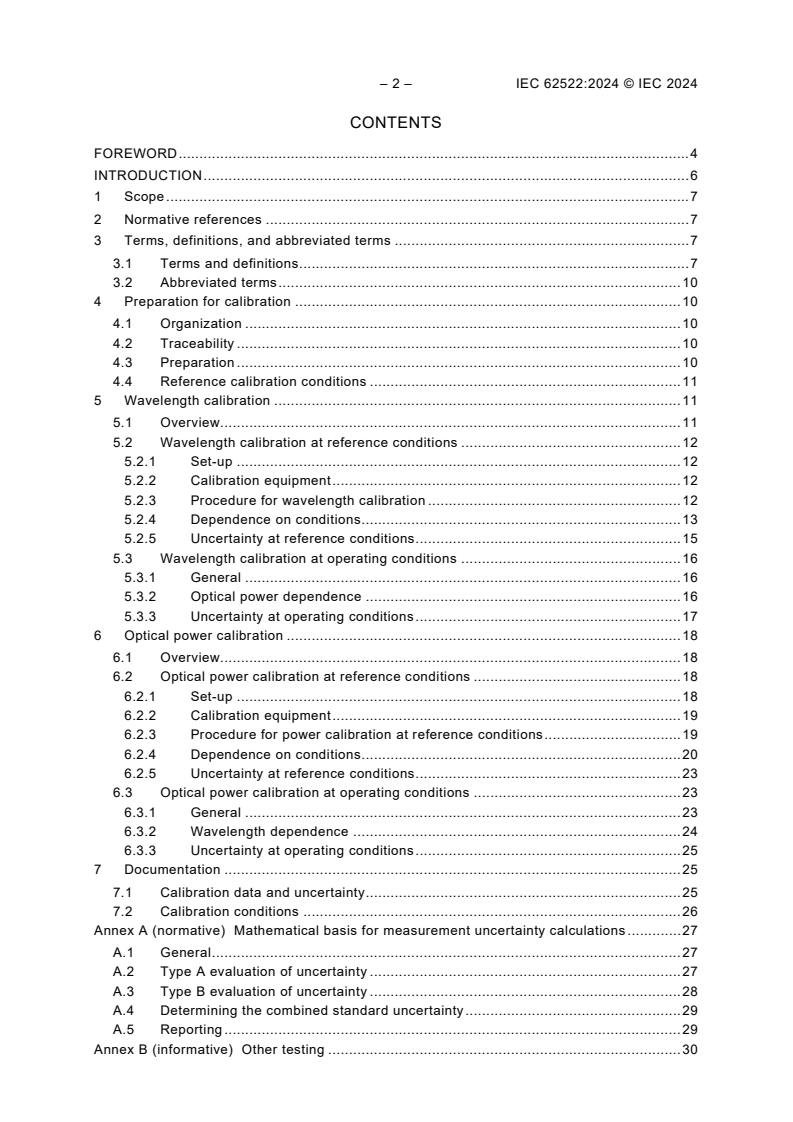
– 2 – IEC 62522:2024 RLV © IEC 2024
CONTENTS
FOREWORD . 4
INTRODUCTION . 6
1 Scope . 7
2 Normative references . 7
3 Terms, definitions, and abbreviated terms . 7
3.1 Terms and definitions . 7
3.2 Abbreviated terms . 10
4 Preparation for calibration . 10
4.1 Organization . 10
4.2 Traceability . 11
4.3 Preparation . 11
4.4 Reference calibration conditions . 11
5 Wavelength calibration . 12
5.1 Overview. 12
5.2 Wavelength calibration at reference conditions . 12
5.2.1 Set-up . 12
5.2.2 Calibration equipment . 12
5.2.3 Procedure for wavelength calibration . 13
5.2.4 Dependence on conditions . 14
5.2.5 Uncertainty at reference conditions . 16
5.3 Wavelength calibration at operating conditions . 17
5.3.1 General . 17
5.3.2 Optical power dependence . 17
5.3.3 Uncertainty at operating conditions . 18
6 Optical power calibration . 18
6.1 Overview. 18
6.2 Optical power calibration at reference conditions . 19
6.2.1 Set-up . 19
6.2.2 Calibration equipment . 19
6.2.3 Procedure for power calibration at reference conditions . 20
6.2.4 Dependence on conditions . 21
6.2.5 Uncertainty at reference conditions . 24
6.3 Optical power calibration at operating conditions . 25
6.3.1 General . 25
6.3.2 Wavelength dependence . 25
6.3.3 Uncertainty at operating conditions . 26
7 Documentation . 26
7.1 Calibration data and uncertainty . 26
7.2 Calibration conditions . 27
Annex A (normative) Mathematical basis for measurement uncertainty calculations . 28
A.1 General . 28
A.2 Type A evaluation of uncertainty . 28
A.3 Type B evaluation of uncertainty . 29
A.4 Determining the combined standard uncertainty . 30
A.5 Reporting . 30
Annex B (informative) Averaged wavelength (or power) deviation over a certain range .
Annex CB (informative) Other testing . 33
B.1 General . 33
B.2 Wavelength tuning resolution . 33
B.2.1 Set-up . 33
B.2.2 Testing equipment . 33
B.2.3 Testing procedure for determining wavelength resolution . 33
B.3 Optical power tuning resolution . 34
B.3.1 Set-up . 34
B.3.2 Testing equipment . 34
B.3.3 Testing procedure for optical power resolution . 34
B.4 Signal-to-source spontaneous emission ratio . 35
B.4.1 General . 35
B.4.2 Set-up . 35
B.4.3 Testing equipment . 35
B.4.4 Testing procedure for determining signal-to-source spontaneous
emission ratio . 35
B.5 Side-mode suppression ratio . 36
B.5.1 General . 36
B.5.2 Set-up . 36
B.5.3 Testing equipment . 37
B.5.4 Testing procedure for determining the side-mode suppression ratio . 37
Annex C (informative) Linear to dB scale conversion of uncertainties . 40
C.1 Definition of decibel . 40
C.2 Conversion of relative uncertainties . 40
Bibliography . 42
Figure 1 – Measurement set-up for wavelength calibration . 12
Figure 2 – Measurement set-up for temperature dependence . 14
Figure 3 – Measurement set-up for wavelength stability . 15
Figure 4 – Measurement set-up for optical power dependence . 17
Figure 5 – Measurement set-up for intrinsic optical power calibration . 19
Figure 6 – Measurement set-up for temperature dependence . 21
Figure 7 – Measurement set-up for optical power stability . 22
Figure 8 – Measurement set-up for connection repeatability/reproducibility . 23
Figure 9 – Measurement set-up for wavelength dependence . 25
Figure B.1 – Measurement set-up for wavelength resolution . 33
Figure B.2 – Measurement set-up for optical power resolution setting test . 34
Figure B.3 – Measurement set-up for signal to total source spontaneous emission ratio . 35
Figure B.4 – Measurement of the signal to spontaneous emission ratio. 36
Figure B.5 – Measurement set-up for the side-mode suppression ratio test . 37
Figure B.6 – Optical spectrum of tuneable laser source . 38
Figure B.7 – Measurement set-up for SMSR . 39
Table 1 – Source of uncertainty for wavelength calibration . 12
Table 2 – Source of uncertainty for optical power calibration . 19
– 4 – IEC 62522:2024 RLV © IEC 2024
INTERNATIONAL ELECTROTECHNICAL COMMISSION
____________
CALIBRATION OF TUNEABLE LASER SOURCES
FOREWORD
1) The International Electrotechnical Commission (IEC) is a worldwide organization for standardization comprising
all national electrotechnical committees (IEC National Committees). The object of IEC is to promote international
co-operation on all questions concerning standardization in the electrical and electronic fields. To this end and
in addition to other activities, IEC publishes International Standards, Technical Specifications, Technical Reports,
Publicly Available Specifications (PAS) and Guides (hereafter referred to as "IEC Publication(s)"). Their
preparation is entrusted to technical committees; any IEC National Committee interested in the subject dealt with
may participate in this preparatory work. International, governmental and non-governmental organizations liaising
with the IEC also participate in this preparation. IEC collaborates closely with the International Organization for
Standardization (ISO) in accordance with conditions determined by agreement between the two organizations.
2) The formal decisions or agreements of IEC on technical matters express, as nearly as possible, an international
consensus of opinion on the relevant subjects since each technical committee has representation from all
interested IEC National Committees.
3) IEC Publications have the form of recommendations for international use and are accepted by IEC National
Committees in that sense. While all reasonable efforts are made to ensure that the technical content of IEC
Publications is accurate, IEC cannot be held responsible for the way in which they are used or for any
misinterpretation by any end user.
4) In order to promote international uniformity, IEC National Committees undertake to apply IEC Publications
transparently to the maximum extent possible in their national and regional publications. Any divergence between
any IEC Publication and the corresponding national or regional publication shall be clearly indicated in the latter.
5) IEC itself does not provide any attestation of conformity. Independent certification bodies provide conformity
assessment services and, in some areas, access to IEC marks of conformity. IEC is not responsible for any
services carried out by independent certification bodies.
6) All users should ensure that they have the latest edition of this publication.
7) No liability shall attach to IEC or its directors, employees, servants or agents including individual experts and
members of its technical committees and IEC National Committees for any personal injury, property damage or
other damage of any nature whatsoever, whether direct or indirect, or for costs (including legal fees) and
expenses arising out of the publication, use of, or reliance upon, this IEC Publication or any other IEC
Publications.
8) Attention is drawn to the Normative references cited in this publication. Use of the referenced publications is
indispensable for the correct application of this publication.
9) IEC draws attention to the possibility that the implementation of this document may involve the use of (a)
patent(s). IEC takes no position concerning the evidence, validity or applicability of any claimed patent rights in
respect thereof. As of the date of publication of this document, IEC had not received notice of (a) patent(s), which
may be required to implement this document. However, implementers are cautioned that this may not represent
the latest information, which may be obtained from the patent database available at https://patents.iec.ch. IEC
shall not be held responsible for identifying any or all such patent rights.
This redline version of the official IEC Standard allows the user to identify the changes
made to the previous edition IEC 62522:2014. A vertical bar appears in the margin
wherever a change has been made. Additions are in green text, deletions are in
strikethrough red text.
IEC 62522 has been prepared by IEC technical committee 86: Fibre optics. It is an International
Standard.
This second edition cancels and replaces the first edition published in 2014. This edition
constitutes a technical revision.
This edition includes the following significant technical changes with respect to the previous
edition:
a) addition of references to IEC 61315;
b) addition of Table 1 and Table 2 on uncertainties;
c) clarification of the reference power meter settings in 6.2.3 and 6.3.2.3.
The text of this International Standard is based on the following documents:
Draft Report on voting
86/639/FDIS 86/643/RVD
Full information on the voting for its approval can be found in the report on voting indicated in
the above table.
The language used for the development of this International Standard is English.
This document was drafted in accordance with ISO/IEC Directives, Part 2, and developed in
accordance with ISO/IEC Directives, Part 1 and ISO/IEC Directives, IEC Supplement, available
at www.iec.ch/members_experts/refdocs. The main document types developed by IEC are
described in greater detail at www.iec.ch/publications.
The committee has decided that the contents of this document will remain unchanged until the
stability date indicated on the IEC website under webstore.iec.ch in the data related to the
specific document. At this date, the document will be
• reconfirmed,
• withdrawn, or
• revised.
IMPORTANT – The "colour inside" logo on the cover page of this document indicates
that it contains colours which are considered to be useful for the correct understanding
of its contents. Users should therefore print this document using a colour printer.
– 6 – IEC 62522:2024 RLV © IEC 2024
INTRODUCTION
Wavelength-division multiplexing (WDM) transmission systems have been deployed in optical
trunk lines. ITU-T Recommendations in the G.694 series describe the frequency and wavelength
grids for WDM applications. For example, the frequency grid of ITU-T Recommendation G.694.1
supports a variety of channel spacing ranging from 12,5 GHz to 100 GHz and wider. WDM
devices, such as arrayed waveguide grating (AWG), thin film filter or grating based multiplexers
(MUX), and demultiplexers (DMUX) with narrow channel spacing are incorporated in the WDM
transmission systems. When measuring the characteristics of such devices, wavelength
tuneable laser sources are commonly used and are required to have well-calibrated
performances; wavelength uncertainty, wavelength tuning repeatability, wavelength stability,
and output optical power stability are important parameters.
The tuneable laser source (TLS) is generally equipped with the following features:
a) the output wavelength is continuously tuneable in a wavelength range starting at 1 260 nm
or higher and ending at less than 1 675 nm (the output should excite only the fundamental
LP01 fibre mode);
b) an output port for optical fibre connectors.
The envelope of the spectrum is a single longitudinal mode with a full-width at half-maximum
(FWHM) of at most 0,1 nm. Any adjacent modes are at least 20 dB lower than the main spectral
mode (for example, a distributed feedback laser diode (DFB-LD), external cavity laser, etc.).
CALIBRATION OF TUNEABLE LASER SOURCES
1 Scope
This document provides a stable and reproducible procedure to calibrate the wavelength and
power output of a tuneable laser against reference instrumentation such as optical power
meters and optical wavelength meters (including optical frequency meters) that have been
previously traceably calibrated.
2 Normative references
The following documents are referred to in the text in such a way that some or all of their content
constitutes requirements of this document. For dated references, only the edition cited applies.
For undated references, the latest edition of the referenced document (including any
amendments) applies.
IEC 60793-2-50, Optical fibres – Part 2-50: Product specifications – Sectional specification for
class B single-mode fibres
IEC 60825-1, Safety of laser products – Part 1: Equipment classification and requirements
IEC 60825-2, Safety of laser products – Part 2: Safety of optical fibre communication systems
(OFCSs)
IEC 61315, Calibration of fibre-optic power meters
IEC 62129-2, Calibration of wavelength/optical frequency measurement instruments – Part 2:
Michelson interferometer single wavelength meters
ISO/IEC 17025, General requirements for the competence of testing and calibration
laboratories
ISO/IEC Guide 98-3:2008, Uncertainty of measurement – Part 3: Guide to the expression of
uncertainty in measurement (GUM:1995)
ISO/IEC Guide 99:2007, International vocabulary of metrology – Basic and general concepts
and associated terms (VIM)
3 Terms, definitions, and abbreviated terms
3.1 Terms and definitions
For the purposes of this document, the following terms and definitions apply.
ISO and IEC maintain terminology databases for use in standardization at the following
addresses:
• IEC Electropedia: available at https://www.electropedia.org/
• ISO Online browsing platform: available at https://www.iso.org/obp
– 8 – IEC 62522:2024 RLV © IEC 2024
3.1.1
accredited calibration laboratory
calibration laboratory authorized by an appropriate national organization to issue calibration
certificates that demonstrates traceability to national standards
3.1.2
adjustment
set of operations carried out on an instrument in order that it provides given indications
corresponding to given values of the measurand
Note 1 to entry: For more information, see ISO/IEC Guide 99:2007, 3.11.
[SOURCE: IEC 60050-300:2001, 311-03-16, modified – minor editorial change, omission of the
NOTE]
[See also ISO/IEC Guide 99:2007, 3.11, modified – 3 NOTES omitted].
[SOURCE: IEC 60050-311:2001, 311-03-16, modified – Domain deleted, words "measuring
instrument" deleted in the definition, and omission of the Note to entry therein.]
3.1.3
calibration
set of operations that establish, under specified conditions, the relationship between the values
of quantities indicated by a measuring instrument and the corresponding values realized by
standards
Note 1 to entry: The results of a calibration permit either the assignment of measurand values to the indications or
the determination of corrections with respect to the indications.
Note 2 to entry: A calibration may can also determine other metrological properties such as the effects of influence
quantities.
Note 3 to entry: The result of a calibration may can be recorded in a document, called a calibration certificate or a
calibration report.
Note 4 to entry: See also ISO/IEC Guide 99:2007, 2.39.
[SOURCE: ISO/IEC Guide 99:2007, 2.39, modified – shortened; the two NOTES replaced by 3
new NOTES].
3.1.4
calibration conditions
conditions of measurement in which the calibration is performed
3.1.5
calibration at reference conditions
calibration which includes the evaluation of the uncertainty at reference conditions of the light
source under calibration
3.1.6
calibration at operating conditions
calibration which includes the evaluation of the uncertainty at operating conditions of the light
source under calibration
3.1.7
level of confidence
estimated probability that the true value of a measured parameter lies in the given range
3.1.8
coverage factor
k
factor used to calculate the expanded uncertainty U from the standard uncertainty u
3.1.9
decibels
dB, dBm
sub-multiple of the Bel, B, unit used to express values of optical power on a logarithmic scale
Note 1 to entry: The power level is always relative to a reference power P
P
L = 10 × log
P / P 10
P
0
where P and P are expressed in the same linear units.
The unit symbol dBm is used to indicate power level relative to 1 mW:
P
L = 10 × log
P /1mW 10
1mW
The linear ratio, R , of two radiant powers, P and P , can alternatively be expressed as an power level difference
lin 1 2
in decibels (dB):
P
∆L = 10 ×log (R ) = 10 ×log = 10 ×log (P ) −10 ×log (P )
P 10 lin 10 10 1 10 2
P
2
Similarly, relative uncertainties, U , or relative deviations, can be alternatively expressed in decibels:
lin
U = 10 × log (1− U )
dB 10 lin
Note 2 to entry: For mathematical treatment all measurement results should be expressed in linear units (e.g. watts)
and all uncertainties should be expressed in linear form. This is recommended because the accumulation of
uncertainties in logarithmic units is mathematically difficult. The final statement of an uncertainty may be either in
the linear or in the dB form.
Note 3 to entry: ISO 80000-3 and IEC 60027-3 should be consulted for further details. The rules of IEC 60027-3 do
not permit attachments to unit symbols. However the unit symbol dBm is accepted in this standard because it is
widely used and accepted by users of fibre optic instrumentation.
3.1.9
optical power deviation
D
P
difference between the set power of the light source under calibration, P , and the
TLS
corresponding reference power, P , measured by the reference power meter
meas
P − P
TLS meas
D =
P
P
meas
Note 1 to entry: Power P is expressed in linear units, for example W.
Note 2 to entry: This deviation is relative, it has no unit (it can be expressed in %).
3.1.10
operating conditions
appropriate set of specified ranges of values with influence quantities usually wider than the
reference conditions for which the uncertainties of a measuring instrument are specified
– 10 – IEC 62522:2024 RLV © IEC 2024
Note 1 to entry: Operating conditions and the uncertainty at operating conditions are usually specified by the
manufacturer for the convenience of the user.
3.1.11
reference conditions
conditions used for testing the performance of a measuring instrument or for the
intercomparison of the measurement results
Note 1 to entry: Reference conditions generally include reference values or reference ranges for the quantities
influencing and affecting the measuring instrument.
3.1.12
side-mode suppression ratio
SMSR
peak power ratio between the main mode spectrum and the largest side mode spectrum in a
single-mode laser diode such as a DFB-LD
Note 1 to entry: Side-mode suppression ratio is usually expressed in dB.
3.1.13
wavelength
wavelength (in a vacuum) of a light source
3.1.14
wavelength deviation
D
λ
difference between the target wavelength, set on the light source under calibration, λ , and
TLS
the measured wavelength, λ , in nm or µm
meas
D λλ−
λ TLS meas
3.2 Abbreviated terms
APC angled physical contact
AWG arrayed waveguide grating
DFB-LD distributed feedback laser diode
DMUX demultiplexers
FWHM full-width/ at half-maximum
MUX multiplexers
O/E optical-electrical
OSA optical spectrum analyser
RIN relative intensity noise
SMSR side-mode suppression ratio
TLS tuneable laser source
WDM wavelength-division multiplexing
4 Preparation for calibration
4.1 Organization
The calibration laboratory should satisfy requirements of ISO/IEC 17025.
The calibration laboratory should ensure that suitable requirements for calibration are followed.
NOTE Guidance about good practices for calibration can be found in ISO/IEC 17025.
=
There shall should be a documented measurement procedure for each type of calibration
performed, giving step-by-step operating instructions and equipment to be used.
4.2 Traceability
The requirements of ISO/IEC 17025 should be met.
The calibration laboratory should ensure that suitable requirements are followed.
NOTE Guidance about good practices for calibration can be found in ISO/IEC 17025.
All standards used in the calibration process shall be calibrated according to a documented
program with traceability to national standards laboratories or to accredited calibration
laboratories.
It is advisable to maintain more than one standard on each hierarchical level, so that the
performance of the standard can be verified by comparisons on the same level. Make sure that
any other calibration equipment which have a significant influence on the calibration results are
calibrated.
4.3 Preparation
The environmental conditions shall be commensurate with the level of uncertainty that is
required for calibration:
a) calibrations shall be carried out in a clean environment;
b) temperature monitoring and control is required;
c) all laser sources shall be safely operated (according to IEC 60825-1 and IEC 60825-2);
d) the output of the TLS should be examined with an optical spectrum analyser (OSA) having
sufficient resolution to resolve the longitudinal mode structure to check for single mode
operation.
The recommended temperature is 23 °C, for example, (23 ± 2) °C. Give the calibration
equipment a minimum of 2 h enough time prior to testing (2 h is recommended) to reach
equilibrium within its environment. Allow the TLS a warm-up period in accordance with the
manufacturer's instructions.
4.4 Reference calibration conditions
The reference calibration conditions usually include the following parameters and, if necessary,
their tolerance bands: date, temperature, relative humidity, atmospheric pressure, displayed
optical power, displayed wavelength, fibre, connector-adapter combination, (spectral)
bandwidth and resolution bandwidth (spectral resolution) set. Unless otherwise specified, use
a single-mode optical fibre category B1.1 or B1.3 pigtail as prescribed by specified in
IEC 60793-2-50, having a length of at least 2 m. It is desirable to perform all the calibration in
a situation where back-reflections are negligible. Thus, angled connectors and isolators should
be used wherever the situation permits.
Operate the TLS in accordance with the manufacturer's specifications and operating
procedures. Where practical, select a range of calibration conditions and parameters that
emulate the actual field operating conditions of the TLS under calibration. Choose these
parameters to optimize the tuneable laser source's accuracy, as specified by the manufacturer's
operating procedures.
Document the conditions as specified in Clause 7.
NOTE The calibration results only apply to the set of calibration conditions used in the calibration process.
– 12 – IEC 62522:2024 RLV © IEC 2024
5 Wavelength calibration
5.1 Overview
The factors making up the uncertainty in the wavelength of the light source under calibration
consist of:
a) the intrinsic uncertainty of the light source under calibration as found in the calibration at
reference conditions, including temperature and time dependences for these tight
conditions, and;
b) the uncertainties due to dependences on optical power, temperature and time as found in
the calibrations at broader operating conditions.
The list of the source of uncertainty is summarized in Table 1.
Table 1 – Source of uncertainty for wavelength calibration
Source of uncertainty Type of origin Symbol
Repeatability Measurement
s
λ
j
Temperature Environment
u
λ ,ΔΘ
j
Stability Light source under calibration
u
λt,Δ
j
Wavelength resolution Reference wavelength meter
u
λ ,res
j
Wavelength meter calibration Reference wavelength meter
u
WM
λ
j
Optical power Light source under calibration
u
λP,
j
The wavelength calibration at reference conditions for discrete wavelengths, as described in
5.2, is mandatory. The calibration at operating conditions, described in 5.3, is optional.
5.2 Wavelength calibration at reference conditions
5.2.1 Set-up
Figure 1 shows a system for wavelength calibration. The calibration is performed under the
given reference conditions.
Figure 1 – Measurement set-up for wavelength calibration
5.2.2 Calibration equipment
A wavelength meter shall be used for the calibration. The wavelength meter should shall be
calibrated according to IEC 62129-2.
5.2.3 Procedure for wavelength calibration
The calibration procedure is as follows:
a) Regarding the calibration system shown in Figure 1, the set wavelength of the light source
is given by λ and the measured values are given by λ . The uncertainty of the
TLS j meas i, j
wavelength measurement takes into account the tuning repeatability and hysteresis of the
TLS. Hysteresis is defined as the deviation resulting from tuning the desired wavelength
from both the shorter and the longer wavelengths.
b) It is recommended to repeat the wavelength measurement at least ten (m) times. Ensure
that the TLS is tuned to λ prior to each measurement. The target wavelength (j) should
TLS j
be approached in such a way that tuning occurs from both longer and shorter wavelengths.
c) Calculate the average measured wavelength λ :
meas j
m
λλ=
(1)
∑
meas, j measi, j
m
i=1
where
m is the number of measurements performed.
λ
Each is suggested to be an averaged value from the wavelength meter.
meas i, j
d) Calculate the wavelength deviation D :
λ
j
D λλ−
λjTLS measj (2)
j
where λ is the tuned wavelength of the TLS.
TLS j
d) Calculate the standard deviation for λ from the (m) wavelength measurement results
j
λ :
meas i, j
m
2
(3)
s λλ−
∑ ( )
λ measi,j measj
j
m −1
i = 1
e) Calculate the wavelength tuning repeatability S :
rep,λ
j
Ss2×
rep,λλ (4)
jj
NOTE A default level of confidence of 95 % is used in Formula (4).
This calibration procedure shall be performed for each calibration wavelength. A minimum of
10 discrete wavelengths or every 10 nm, including the first, the central and the last wavelength
of the range, shall be measured.
=
=
=
– 14 – IEC 62522:2024 RLV © IEC 2024
5.2.4 Dependence on conditions
5.2.4.1 Temperature dependence (optional if known)
5.2.4.1.1 Set-up
Figure 2 shows a calibration system for temperature dependence. This calibration is performed
under the reference calibration conditions with the exception of temperature.
Figure 2 – Measurement set-up for temperature dependence
5.2.4.1.2 Calibration equipment
The calibration equipment is as follows:
a) A wavelength meter capable of detecting wavelength fluctuations at least ten times smaller
than the wavelength stability of the TLS deviation of the TLS due to temperature.
b) Temperature-controlled chamber: make sure that the measurement results are immune to
the inner temperature distribution.
5.2.4.1.3 Calibration procedure for determining temperature dependence
The calibration procedure is as follows:
a) Regarding the calibration system of Figure 2, measure the nominal wavelength (j) of the
TLS at optical power P at reference conditions: λ . The wavelength used should
TLSj j,ref
possess the maximum response to temperature variations. Otherwise, characterization of
several output wavelengths should be performed.
b) Measure the wavelength of the TLS at temperature (i): Wavelength readings
λ
j,Θ
i
.
corresponding to each temperature setting should be averaged to determine
λ
j,Θ
i
c) Calculate the relative wavelength deviation:
D λλ−
λ jj,Θ ,ref (5)
j,Θ i
i
d) Repeat steps b) and c) with (m) different temperature settings ensuring that the
Θ
i
instrument is allowed the necessary time to eliminate sufficiently any thermal gradients.
i=m i=m
max D min D
e) Calculate the maximum and minimum wavelength
( λ ) ( λ )
j,Θ j,Θ
i i
i=1 i=1
deviations.
=
u
f) The standard uncertainty for wavelength temperature dependence at the calibration
λ
j,ΔΘ
wavelength (j) using a rectangular distribution model is:
im im
u max DD− min (6)
λ λλ
( ) ( )
j,ΔΘ jj,,Θ Θ
ii
23 ii11
where
ΔΘ
is the temperature variation.
It is recommended that a wavelength acquisition be performed with the optical wavelength
meter for the duration of this calibration.
5.2.4.2 Wavelength stability
5.2.4.2.1 Set-up
Figure 3 shows a calibration system for wavelength stability. This calibration is performed under
the reference calibration conditions with the exception of time.
Figure 3 – Measurement set-up for wavelength stability
5.2.4.2.2 Calibration equipment
It is recommended to use a wavelength meter capable of detecting wavelength fluctuations at
least ten times smaller than the wavelength stability of the TLS.
5.2.4.2.3 Calibration procedure for wavelength stability
The calibration procedure is as follows:
a) Regarding the calibration system in Figure 3, the measurement is performed after the light
source is switched on and has been warmed up for some time in accordance with the
manufacturer’s instructions.
a) A specific time period (∆t), for example 10 min, must shall be chosen that is long enough to
permit at least 10 wavelength measurements with the reference wavelength meter (in the
case of the example, a stability over 10 min will be measured).
b) A continuous wavelength acquisition shall should be performed with wavelength data and
time stamp saved to a computer compatible format.
c) Ensure to correlate (m) measurements per time period where (m > 10) and conforms exactly
to the desired time period (∆t).
d) Calculate the standard deviation of the (m) wavelength measurements corresponding to time
period (∆t)
mm 2
(7)
u ()λλ−
λ ,Δt ∑∑j,,t jt
j ii
mm−1
ii11
==
=
==
=
==
– 16 – IEC 62522:2024 RLV © IEC 2024
e) A minimum of 1 time period is required to evaluate the wavelength stability of the TLS
source. In this case, the wavelength stability uncertainty becomes:
Su2×
(8)
stab,λt,ΔΔλt,
jj
NOTE A default level of confidence of 95 % is used in Formula (8).
The wavelength of the light source should be measured more than ten times (m times)
consecutively; at least a few measurements per minute is recommended. The time interval
between the repeated measurements should be longer than the response time of the light
source. It is preferred to calculate several time periods from the acquisition data using a sliding
window and report the maximum value.
5.2.5 Uncertainty at reference conditions
The uncertainty for the calibration wavelength (j) at reference conditions is given by:
2
s
λ
j
22 2 2
(9)
u = + u + uu+ + u
λ λ ,ΔΘ λt,Δ λ ,res WM
j,ref j jj λ
j
m
where
u u
and are evaluated for the reference conditions as defined in 5.2.4;
λ ,ΔΘ λt,Δ
j j
u
ud= λ / 2 3
is the uncertainty of wavelength resolution defined by
λ ,res λ ,res j
j
j
( is the wavelength resolution of the wavelength meter);
dλ
j
u
is the uncertainty of the wavelength meter at wavelength (j) as described in
WM
λ
j
its certification.
U
The expanded uncertainty for the calibration wavelength (j) at reference conditions, , with
λ
j,ref
a coverage factor k is expressed as follows:
U = ±ku
λ λ
j,ref j,ref
U = ku
λλ (10)
j,ref j,ref
where
k corresponds to an appropriate level of confidence as described in Clause A.5.
If the wavelength has to be corrected based on the results of the calibration results, the
corrections are normally implemented by making software corrections to the instrument,
mathematical corrections to the results or hardware adjustments on the instrument. Once the
=
adjustments are made, it is advisable to repeat the calibrations to verify that the corrections are
correct.
Refer to Annex A and Annex C for information on uncertainties.
When adjustments are made to the instrument based on the calibration results, it is advisable
to repeat the calibrations after these adjustments to verify the corrections.
5.3 Wavelength calibration at operating conditions
5.3.1 General
Perform the calibration procedure when the light source is used beyond the reference
conditions.
The individual factors in wavelength uncertainty at operating conditions consist of following:
a) optical power dependence;
b) temperature dependence;
c) wavelength stability.
5.3.2 Optical power dependence
5.3.2.1 General
Figure 4 shows a calibration system for optical power dependence. This calibration should be
performed under the reference calibration conditions with the exception of the optical power. It
shall be performed after the optical power calibration (6.2.3).
Figure 4 – Measurement set-up for optical power dependence
5.3.2.2 Calibration equipment
The calibration equipment is as follows:
– A wavelength meter capable of detecting wavelength fluctuations at least ten times smaller
than the wavelength stability of the TLS.
The wavelength meter shall be calibrated according to IEC 62129-2.
5.3.2.3 Calibration procedures for determining power dependence
The calibration procedures are as follows:
a) The wavelength (j) is measured at m optical powers (more than 5) of the light source,
P
TLS ij,
including the upper and lower limits of the specified power range. The interval between
these neighbouring levels should be smaller than 10 dB.
b) Regarding the calibration system of Figure 4, the set wavelength of the light source is given
λ
by , and the instrument reading of the wavelength meter is given by .
λ
P
TLS ij,
i, j
λ
c) Record the measured wavelength for all (m) output power settings used.
P
P
TLS ij,
i, j
– 18 – IEC 62522:2024 RLV © IEC 2024
d) Calculate the standard uncertainty of wavelength (j) due to TLS output optical power
according to
mm
2
(11)
u ()λλ−
∑∑
λ PP
j,P i,,j i j
mm−1
ii11
5.3.3 Uncertainty at operating conditions
The uncertainty for the calibration wavelength (j) for any operating conditions is given by
22 2 2 2 2 2
(12)
u = su++ u + u + u + u
λ λ λP, λ ,ΔΘ λ ,Δt λ ,res WM
j,op jj j j j λ
j
where
u u u
, and are evaluated for the operating conditions;
λP, λ ,ΔΘ λt,Δ
j j j
u
ud= λ / 2 3
is the uncertainty of wavelength resolution defined by
λ ,res λj,res
j j
( is wavelength resolution of the wavelength meter);
dλ
j
u
is the uncertainty of the wavelength meter at wavelength (j) as
WM
λ
j
described in its certification.
The expanded uncertainty for the calibration wavelength (j) under all operating conditions,
U
, with a coverage factor k, is expressed as follows:
λ
j,op
...
IEC 62522 ®
Edition 2.0 2024-06
INTERNATIONAL
STANDARD
NORME
INTERNATIONALE
Calibration of tuneable laser sources
Étalonnage des sources laser accordables
All rights reserved. Unless otherwise specified, no part of this publication may be reproduced or utilized in any form
or by any means, electronic or mechanical, including photocopying and microfilm, without permission in writing from
either IEC or IEC's member National Committee in the country of the requester. If you have any questions about IEC
copyright or have an enquiry about obtaining additional rights to this publication, please contact the address below or
your local IEC member National Committee for further information.
Droits de reproduction réservés. Sauf indication contraire, aucune partie de cette publication ne peut être reproduite ni
utilisée sous quelque forme que ce soit et par aucun procédé, électronique ou mécanique, y compris la photocopie et
les microfilms, sans l'accord écrit de l'IEC ou du Comité national de l'IEC du pays du demandeur. Si vous avez des
questions sur le copyright de l'IEC ou si vous désirez obtenir des droits supplémentaires sur cette publication, utilisez
les coordonnées ci-après ou contactez le Comité national de l'IEC de votre pays de résidence.
IEC Secretariat Tel.: +41 22 919 02 11
3, rue de Varembé info@iec.ch
CH-1211 Geneva 20 www.iec.ch
Switzerland
About the IEC
The International Electrotechnical Commission (IEC) is the leading global organization that prepares and publishes
International Standards for all electrical, electronic and related technologies.
About IEC publications
The technical content of IEC publications is kept under constant review by the IEC. Please make sure that you have the
latest edition, a corrigendum or an amendment might have been published.
IEC publications search - webstore.iec.ch/advsearchform IEC Products & Services Portal - products.iec.ch
The advanced search enables to find IEC publications by a Discover our powerful search engine and read freely all the
variety of criteria (reference number, text, technical publications previews, graphical symbols and the glossary.
committee, …). It also gives information on projects, replaced With a subscription you will always have access to up to date
and withdrawn publications. content tailored to your needs.
IEC Just Published - webstore.iec.ch/justpublished
Electropedia - www.electropedia.org
Stay up to date on all new IEC publications. Just Published
The world's leading online dictionary on electrotechnology,
details all new publications released. Available online and once
containing more than 22 500 terminological entries in English
a month by email.
and French, with equivalent terms in 25 additional languages.
Also known as the International Electrotechnical Vocabulary
IEC Customer Service Centre - webstore.iec.ch/csc
(IEV) online.
If you wish to give us your feedback on this publication or need
further assistance, please contact the Customer Service
Centre: sales@iec.ch.
A propos de l'IEC
La Commission Electrotechnique Internationale (IEC) est la première organisation mondiale qui élabore et publie des
Normes internationales pour tout ce qui a trait à l'électricité, à l'électronique et aux technologies apparentées.
A propos des publications IEC
Le contenu technique des publications IEC est constamment revu. Veuillez vous assurer que vous possédez l’édition la
plus récente, un corrigendum ou amendement peut avoir été publié.
Recherche de publications IEC - IEC Products & Services Portal - products.iec.ch
webstore.iec.ch/advsearchform Découvrez notre puissant moteur de recherche et consultez
La recherche avancée permet de trouver des publications IEC gratuitement tous les aperçus des publications, symboles
en utilisant différents critères (numéro de référence, texte, graphiques et le glossaire. Avec un abonnement, vous aurez
comité d’études, …). Elle donne aussi des informations sur les toujours accès à un contenu à jour adapté à vos besoins.
projets et les publications remplacées ou retirées.
Electropedia - www.electropedia.org
IEC Just Published - webstore.iec.ch/justpublished
Le premier dictionnaire d'électrotechnologie en ligne au monde,
Restez informé sur les nouvelles publications IEC. Just
avec plus de 22 500 articles terminologiques en anglais et en
Published détaille les nouvelles publications parues.
français, ainsi que les termes équivalents dans 25 langues
Disponible en ligne et une fois par mois par email.
additionnelles. Egalement appelé Vocabulaire
Electrotechnique International (IEV) en ligne.
Service Clients - webstore.iec.ch/csc
Si vous désirez nous donner des commentaires sur cette
publication ou si vous avez des questions contactez-nous:
sales@iec.ch.
IEC 62522 ®
Edition 2.0 2024-06
INTERNATIONAL
STANDARD
NORME
INTERNATIONALE
Calibration of tuneable laser sources
Étalonnage des sources laser accordables
INTERNATIONAL
ELECTROTECHNICAL
COMMISSION
COMMISSION
ELECTROTECHNIQUE
INTERNATIONALE
ICS 31.260, 33.180.01 ISBN 978-2-8322-9034-7
– 2 – IEC 62522:2024 © IEC 2024
CONTENTS
FOREWORD . 4
INTRODUCTION . 6
1 Scope . 7
2 Normative references . 7
3 Terms, definitions, and abbreviated terms . 7
3.1 Terms and definitions . 7
3.2 Abbreviated terms . 10
4 Preparation for calibration . 10
4.1 Organization . 10
4.2 Traceability . 10
4.3 Preparation . 10
4.4 Reference calibration conditions . 11
5 Wavelength calibration . 11
5.1 Overview. 11
5.2 Wavelength calibration at reference conditions . 12
5.2.1 Set-up . 12
5.2.2 Calibration equipment . 12
5.2.3 Procedure for wavelength calibration . 12
5.2.4 Dependence on conditions . 13
5.2.5 Uncertainty at reference conditions . 15
5.3 Wavelength calibration at operating conditions . 16
5.3.1 General . 16
5.3.2 Optical power dependence . 16
5.3.3 Uncertainty at operating conditions . 17
6 Optical power calibration . 18
6.1 Overview. 18
6.2 Optical power calibration at reference conditions . 18
6.2.1 Set-up . 18
6.2.2 Calibration equipment . 19
6.2.3 Procedure for power calibration at reference conditions . 19
6.2.4 Dependence on conditions . 20
6.2.5 Uncertainty at reference conditions . 23
6.3 Optical power calibration at operating conditions . 23
6.3.1 General . 23
6.3.2 Wavelength dependence . 24
6.3.3 Uncertainty at operating conditions . 25
7 Documentation . 25
7.1 Calibration data and uncertainty . 25
7.2 Calibration conditions . 26
Annex A (normative) Mathematical basis for measurement uncertainty calculations . 27
A.1 General . 27
A.2 Type A evaluation of uncertainty . 27
A.3 Type B evaluation of uncertainty . 28
A.4 Determining the combined standard uncertainty . 29
A.5 Reporting . 29
Annex B (informative) Other testing . 30
B.1 General . 30
B.2 Wavelength tuning resolution . 30
B.2.1 Set-up . 30
B.2.2 Testing equipment . 30
B.2.3 Testing procedure for determining wavelength resolution . 30
B.3 Optical power tuning resolution . 31
B.3.1 Set-up . 31
B.3.2 Testing equipment . 31
B.3.3 Testing procedure for optical power resolution . 31
B.4 Signal-to-source spontaneous emission ratio . 32
B.4.1 General . 32
B.4.2 Set-up . 32
B.4.3 Testing equipment . 32
B.4.4 Testing procedure for determining signal-to-source spontaneous
emission ratio . 32
B.5 Side-mode suppression ratio . 33
B.5.1 General . 33
B.5.2 Set-up . 33
B.5.3 Testing equipment . 34
B.5.4 Testing procedure for determining the side-mode suppression ratio . 34
Annex C (informative) Linear to dB scale conversion of uncertainties . 37
C.1 Definition of decibel . 37
C.2 Conversion of relative uncertainties . 37
Bibliography . 39
Figure 1 – Measurement set-up for wavelength calibration . 12
Figure 2 – Measurement set-up for temperature dependence . 13
Figure 3 – Measurement set-up for wavelength stability . 14
Figure 4 – Measurement set-up for optical power dependence . 16
Figure 5 – Measurement set-up for intrinsic optical power calibration . 18
Figure 6 – Measurement set-up for temperature dependence . 20
Figure 7 – Measurement set-up for optical power stability . 21
Figure 8 – Measurement set-up for connection repeatability/reproducibility . 22
Figure 9 – Measurement set-up for wavelength dependence . 24
Figure B.1 – Measurement set-up for wavelength resolution . 30
Figure B.2 – Measurement set-up for optical power resolution setting test . 31
Figure B.3 – Measurement set-up for signal to total source spontaneous emission ratio . 32
Figure B.4 – Measurement of the signal to spontaneous emission ratio. 33
Figure B.5 – Measurement set-up for the side-mode suppression ratio test . 33
Figure B.6 – Optical spectrum of tuneable laser source . 35
Figure B.7 – Measurement set-up for SMSR . 35
Table 1 – Source of uncertainty for wavelength calibration . 11
Table 2 – Source of uncertainty for optical power calibration . 18
– 4 – IEC 62522:2024 © IEC 2024
INTERNATIONAL ELECTROTECHNICAL COMMISSION
____________
CALIBRATION OF TUNEABLE LASER SOURCES
FOREWORD
1) The International Electrotechnical Commission (IEC) is a worldwide organization for standardization comprising
all national electrotechnical committees (IEC National Committees). The object of IEC is to promote international
co-operation on all questions concerning standardization in the electrical and electronic fields. To this end and
in addition to other activities, IEC publishes International Standards, Technical Specifications, Technical Reports,
Publicly Available Specifications (PAS) and Guides (hereafter referred to as "IEC Publication(s)"). Their
preparation is entrusted to technical committees; any IEC National Committee interested in the subject dealt with
may participate in this preparatory work. International, governmental and non-governmental organizations liaising
with the IEC also participate in this preparation. IEC collaborates closely with the International Organization for
Standardization (ISO) in accordance with conditions determined by agreement between the two organizations.
2) The formal decisions or agreements of IEC on technical matters express, as nearly as possible, an international
consensus of opinion on the relevant subjects since each technical committee has representation from all
interested IEC National Committees.
3) IEC Publications have the form of recommendations for international use and are accepted by IEC National
Committees in that sense. While all reasonable efforts are made to ensure that the technical content of IEC
Publications is accurate, IEC cannot be held responsible for the way in which they are used or for any
misinterpretation by any end user.
4) In order to promote international uniformity, IEC National Committees undertake to apply IEC Publications
transparently to the maximum extent possible in their national and regional publications. Any divergence between
any IEC Publication and the corresponding national or regional publication shall be clearly indicated in the latter.
5) IEC itself does not provide any attestation of conformity. Independent certification bodies provide conformity
assessment services and, in some areas, access to IEC marks of conformity. IEC is not responsible for any
services carried out by independent certification bodies.
6) All users should ensure that they have the latest edition of this publication.
7) No liability shall attach to IEC or its directors, employees, servants or agents including individual experts and
members of its technical committees and IEC National Committees for any personal injury, property damage or
other damage of any nature whatsoever, whether direct or indirect, or for costs (including legal fees) and
expenses arising out of the publication, use of, or reliance upon, this IEC Publication or any other IEC
Publications.
8) Attention is drawn to the Normative references cited in this publication. Use of the referenced publications is
indispensable for the correct application of this publication.
9) IEC draws attention to the possibility that the implementation of this document may involve the use of (a)
patent(s). IEC takes no position concerning the evidence, validity or applicability of any claimed patent rights in
respect thereof. As of the date of publication of this document, IEC had not received notice of (a) patent(s), which
may be required to implement this document. However, implementers are cautioned that this may not represent
the latest information, which may be obtained from the patent database available at https://patents.iec.ch. IEC
shall not be held responsible for identifying any or all such patent rights.
IEC 62522 has been prepared by IEC technical committee 86: Fibre optics. It is an International
Standard.
This second edition cancels and replaces the first edition published in 2014. This edition
constitutes a technical revision.
This edition includes the following significant technical changes with respect to the previous
edition:
a) addition of references to IEC 61315;
b) addition of Table 1 and Table 2 on uncertainties;
c) clarification of the reference power meter settings in 6.2.3 and 6.3.2.3.
The text of this International Standard is based on the following documents:
Draft Report on voting
86/639/FDIS 86/643/RVD
Full information on the voting for its approval can be found in the report on voting indicated in
the above table.
The language used for the development of this International Standard is English.
This document was drafted in accordance with ISO/IEC Directives, Part 2, and developed in
accordance with ISO/IEC Directives, Part 1 and ISO/IEC Directives, IEC Supplement, available
at www.iec.ch/members_experts/refdocs. The main document types developed by IEC are
described in greater detail at www.iec.ch/publications.
The committee has decided that the contents of this document will remain unchanged until the
stability date indicated on the IEC website under webstore.iec.ch in the data related to the
specific document. At this date, the document will be
• reconfirmed,
• withdrawn, or
• revised.
– 6 – IEC 62522:2024 © IEC 2024
INTRODUCTION
Wavelength-division multiplexing (WDM) transmission systems have been deployed in optical
trunk lines. ITU-T Recommendations in the G.694 series describe the frequency and wavelength
grids for WDM applications. For example, the frequency grid of ITU-T Recommendation G.694.1
supports a variety of channel spacing ranging from 12,5 GHz to 100 GHz and wider. WDM
devices, such as arrayed waveguide grating (AWG), thin film filter or grating based multiplexers
(MUX), and demultiplexers (DMUX) with narrow channel spacing are incorporated in the WDM
transmission systems. When measuring the characteristics of such devices, wavelength
tuneable laser sources are commonly used and are required to have well-calibrated
performances; wavelength uncertainty, wavelength tuning repeatability, wavelength stability,
and output optical power stability are important parameters.
The tuneable laser source (TLS) is generally equipped with the following features:
a) the output wavelength is continuously tuneable in a wavelength range starting at 1 260 nm
or higher and ending at less than 1 675 nm (the output should excite only the fundamental
LP01 fibre mode);
b) an output port for optical fibre connectors.
The envelope of the spectrum is a single longitudinal mode with a full-width at half-maximum
(FWHM) of at most 0,1 nm. Any adjacent modes are at least 20 dB lower than the main spectral
mode (for example, a distributed feedback laser diode (DFB-LD), external cavity laser, etc.).
CALIBRATION OF TUNEABLE LASER SOURCES
1 Scope
This document provides a stable and reproducible procedure to calibrate the wavelength and
power output of a tuneable laser against reference instrumentation such as optical power
meters and optical wavelength meters (including optical frequency meters) that have been
previously traceably calibrated.
2 Normative references
The following documents are referred to in the text in such a way that some or all of their content
constitutes requirements of this document. For dated references, only the edition cited applies.
For undated references, the latest edition of the referenced document (including any
amendments) applies.
IEC 60793-2-50, Optical fibres – Part 2-50: Product specifications – Sectional specification for
class B single-mode fibres
IEC 60825-1, Safety of laser products – Part 1: Equipment classification and requirements
IEC 60825-2, Safety of laser products – Part 2: Safety of optical fibre communication systems
(OFCSs)
IEC 61315, Calibration of fibre-optic power meters
IEC 62129-2, Calibration of wavelength/optical frequency measurement instruments – Part 2:
Michelson interferometer single wavelength meters
ISO/IEC Guide 98-3:2008, Uncertainty of measurement – Part 3: Guide to the expression of
uncertainty in measurement (GUM:1995)
3 Terms, definitions, and abbreviated terms
3.1 Terms and definitions
For the purposes of this document, the following terms and definitions apply.
ISO and IEC maintain terminology databases for use in standardization at the following
addresses:
• IEC Electropedia: available at https://www.electropedia.org/
• ISO Online browsing platform: available at https://www.iso.org/obp
3.1.1
accredited calibration laboratory
calibration laboratory authorized by an appropriate national organization to issue calibration
certificates that demonstrates traceability to national standards
– 8 – IEC 62522:2024 © IEC 2024
3.1.2
adjustment
set of operations carried out on an instrument in order that it provides given indications
corresponding to given values of the measurand
Note 1 to entry: For more information, see ISO/IEC Guide 99:2007, 3.11.
[SOURCE: IEC 60050-311:2001, 311-03-16, modified – Domain deleted, words "measuring
instrument" deleted in the definition, and omission of the Note to entry therein.]
3.1.3
calibration
set of operations that establish, under specified conditions, the relationship between the values
of quantities indicated by a measuring instrument and the corresponding values realized by
standards
Note 1 to entry: The results of a calibration permit either the assignment of measurand values to the indications or
the determination of corrections with respect to the indications.
Note 2 to entry: A calibration can also determine other metrological properties such as the effects of influence
quantities.
Note 3 to entry: The result of a calibration can be recorded in a document, called a calibration certificate or a
calibration report.
Note 4 to entry: See also ISO/IEC Guide 99:2007, 2.39.
3.1.4
calibration conditions
conditions of measurement in which the calibration is performed
3.1.5
calibration at reference conditions
calibration which includes the evaluation of the uncertainty at reference conditions of the light
source under calibration
3.1.6
calibration at operating conditions
calibration which includes the evaluation of the uncertainty at operating conditions of the light
source under calibration
3.1.7
level of confidence
estimated probability that the true value of a measured parameter lies in the given range
3.1.8
coverage factor
k
factor used to calculate the expanded uncertainty U from the standard uncertainty u
3.1.9
optical power deviation
D
P
difference between the set power of the light source under calibration, P , and the
TLS
corresponding reference power, P , measured by the reference power meter
meas
P − P
TLS meas
D =
P
P
meas
Note 1 to entry: Power P is expressed in linear units, for example W.
Note 2 to entry: This deviation is relative, it has no unit (it can be expressed in %).
3.1.10
operating conditions
appropriate set of specified ranges of values with influence quantities usually wider than the
reference conditions for which the uncertainties of a measuring instrument are specified
Note 1 to entry: Operating conditions and the uncertainty at operating conditions are usually specified by the
manufacturer for the convenience of the user.
3.1.11
reference conditions
conditions used for testing the performance of a measuring instrument or for the
intercomparison of the measurement results
Note 1 to entry: Reference conditions generally include reference values or reference ranges for the quantities
influencing and affecting the measuring instrument.
3.1.12
side-mode suppression ratio
SMSR
peak power ratio between the main mode spectrum and the largest side mode spectrum in a
single-mode laser diode such as a DFB-LD
Note 1 to entry: Side-mode suppression ratio is usually expressed in dB.
3.1.13
wavelength
wavelength (in a vacuum) of a light source
3.1.14
wavelength deviation
D
λ
difference between the target wavelength, set on the light source under calibration, λ , and
TLS
the measured wavelength, λ , in nm or µm
meas
D λλ−
λ TLS meas
=
– 10 – IEC 62522:2024 © IEC 2024
3.2 Abbreviated terms
APC angled physical contact
AWG arrayed waveguide grating
DFB-LD distributed feedback laser diode
DMUX demultiplexers
FWHM full-width at half-maximum
MUX multiplexers
O/E optical-electrical
OSA optical spectrum analyser
RIN relative intensity noise
SMSR side-mode suppression ratio
TLS tuneable laser source
WDM wavelength-division multiplexing
4 Preparation for calibration
4.1 Organization
The calibration laboratory should ensure that suitable requirements for calibration are followed.
NOTE Guidance about good practices for calibration can be found in ISO/IEC 17025.
There should be a documented measurement procedure for each type of calibration performed,
giving step-by-step operating instructions and equipment to be used.
4.2 Traceability
The calibration laboratory should ensure that suitable requirements are followed.
NOTE Guidance about good practices for calibration can be found in ISO/IEC 17025.
All standards used in the calibration process shall be calibrated according to a documented
program with traceability to national standards laboratories or to accredited calibration
laboratories.
It is advisable to maintain more than one standard on each hierarchical level, so that the
performance of the standard can be verified by comparisons on the same level. Make sure that
any other calibration equipment which have a significant influence on the calibration results are
calibrated.
4.3 Preparation
The environmental conditions shall be commensurate with the level of uncertainty that is
required for calibration:
a) calibrations shall be carried out in a clean environment;
b) temperature monitoring and control is required;
c) all laser sources shall be safely operated (according to IEC 60825-1 and IEC 60825-2);
d) the output of the TLS should be examined with an optical spectrum analyser (OSA) having
sufficient resolution to resolve the longitudinal mode structure to check for single mode
operation.
The recommended temperature is 23 °C, for example, (23 ± 2) °C. Give the calibration
equipment enough time prior to testing (2 h is recommended) to reach equilibrium within its
environment. Allow the TLS a warm-up period in accordance with the manufacturer's
instructions.
4.4 Reference calibration conditions
The reference calibration conditions usually include the following parameters and, if necessary,
their tolerance bands: date, temperature, relative humidity, atmospheric pressure, displayed
optical power, displayed wavelength, fibre, connector-adapter combination, (spectral)
bandwidth and resolution bandwidth (spectral resolution) set. Unless otherwise specified, use
a single-mode optical fibre category B1.1 or B1.3 pigtail as specified in IEC 60793-2-50, having
a length of at least 2 m. It is desirable to perform all the calibration in a situation where back-
reflections are negligible. Thus, angled connectors and isolators should be used wherever the
situation permits.
Operate the TLS in accordance with the manufacturer's specifications and operating
procedures. Where practical, select a range of calibration conditions and parameters that
emulate the actual field operating conditions of the TLS under calibration. Choose these
parameters to optimize the tuneable laser source's accuracy, as specified by the manufacturer's
operating procedures.
Document the conditions as specified in Clause 7.
NOTE The calibration results only apply to the set of calibration conditions used in the calibration process.
5 Wavelength calibration
5.1 Overview
The factors making up the uncertainty in the wavelength of the light source under calibration
consist of:
a) the intrinsic uncertainty of the light source under calibration as found in the calibration at
reference conditions, including temperature and time dependences for these tight
conditions, and;
b) the uncertainties due to dependences on optical power, temperature and time as found in
the calibrations at broader operating conditions.
The list of the source of uncertainty is summarized in Table 1.
Table 1 – Source of uncertainty for wavelength calibration
Source of uncertainty Type of origin Symbol
Repeatability Measurement
s
λ
j
Temperature Environment
u
λ ,ΔΘ
j
Stability Light source under calibration
u
λt,Δ
j
Wavelength resolution Reference wavelength meter
u
λ ,res
j
Wavelength meter calibration Reference wavelength meter
u
WM
λ
j
Optical power Light source under calibration
u
λP,
j
– 12 – IEC 62522:2024 © IEC 2024
The wavelength calibration at reference conditions for discrete wavelengths, as described in
5.2, is mandatory. The calibration at operating conditions, described in 5.3, is optional.
5.2 Wavelength calibration at reference conditions
5.2.1 Set-up
Figure 1 shows a system for wavelength calibration. The calibration is performed under the
given reference conditions.
Figure 1 – Measurement set-up for wavelength calibration
5.2.2 Calibration equipment
A wavelength meter shall be used for the calibration. The wavelength meter shall be calibrated
according to IEC 62129-2.
5.2.3 Procedure for wavelength calibration
The calibration procedure is as follows:
a) Regarding the calibration system shown in Figure 1, the set wavelength of the light source
is given by λ and the measured values are given by λ . The uncertainty of the
TLS j meas i, j
wavelength measurement takes into account the tuning repeatability and hysteresis of the
TLS. Hysteresis is defined as the deviation resulting from tuning the desired wavelength
from both the shorter and the longer wavelengths.
b) It is recommended to repeat the wavelength measurement ten (m) times. Ensure that the
TLS is tuned to λ prior to each measurement. The target wavelength (j) should be
TLS j
approached in such a way that tuning occurs from both longer and shorter wavelengths.
λ :
c) Calculate the average measured wavelength
meas j
m
λλ=
(1)
meas, j ∑ measi, j
m
i=1
where
m is the number of measurements performed.
Each λ is suggested to be an averaged value from the wavelength meter.
meas i, j
d) Calculate the wavelength deviation D :
λ
j
D λλ−
(2)
λjTLS measj
j
where λ is the tuned wavelength of the TLS.
TLS j
=
e) Calculate the standard deviation for λ from the (m) wavelength measurement results
j
:
λ
meas i, j
m 2
(3)
s λλ−
( )
λ ∑ measi,j measj
j
m−1
i= 1
f) Calculate the wavelength tuning repeatability S :
rep,λ
j
Ss2×
rep,λλ (4)
jj
NOTE A default level of confidence of 95 % is used in Formula (4).
This calibration procedure shall be performed for each calibration wavelength. A minimum of
10 discrete wavelengths or every 10 nm, including the first, the central and the last wavelength
of the range, shall be measured.
5.2.4 Dependence on conditions
5.2.4.1 Temperature dependence (optional if known)
5.2.4.1.1 Set-up
Figure 2 shows a calibration system for temperature dependence. This calibration is performed
under the reference calibration conditions with the exception of temperature.
Figure 2 – Measurement set-up for temperature dependence
5.2.4.1.2 Calibration equipment
The calibration equipment is as follows:
a) A wavelength meter capable of detecting wavelength deviation of the TLS due to
temperature.
b) Temperature-controlled chamber: make sure that the measurement results are immune to
the inner temperature distribution.
5.2.4.1.3 Calibration procedure for determining temperature dependence
The calibration procedure is as follows:
a) Regarding the calibration system of Figure 2, measure the nominal wavelength (j) of the
TLS at optical power P at reference conditions: λ . The wavelength used should
TLSj j,ref
possess the maximum response to temperature variations. Otherwise, characterization of
several output wavelengths should be performed.
=
=
– 14 – IEC 62522:2024 © IEC 2024
b) Measure the wavelength of the TLS at temperature (i): λ Wavelength readings
j,Θ
i
corresponding to each temperature setting should be averaged to determine λ .
j,Θ
i
c) Calculate the wavelength deviation:
D λλ−
λ jj,Θ ,ref
(5)
j,Θ i
i
d) Repeat steps b) and c) with (m) different temperature settings Θ ensuring that the
i
instrument is allowed the necessary time to eliminate sufficiently any thermal gradients.
i=m i=m
e) Calculate the maximum max D and minimum min D wavelength
( λ ) ( λ )
j,Θ j,Θ
i i
i=1 i=1
deviations.
u
f) The standard uncertainty for wavelength temperature dependence at the calibration
λ
j,ΔΘ
wavelength (j) using a rectangular distribution model is:
im im
u max DD− min
(6)
λ ( λλ) ( )
j,ΔΘ jj,,Θ Θ
ii
ii11
where
ΔΘ
is the temperature variation.
It is recommended that a wavelength acquisition be performed with the optical wavelength
meter for the duration of this calibration.
5.2.4.2 Wavelength stability
5.2.4.2.1 Set-up
Figure 3 shows a calibration system for wavelength stability. This calibration is performed under
the reference calibration conditions with the exception of time.
Figure 3 – Measurement set-up for wavelength stability
5.2.4.2.2 Calibration equipment
It is recommended to use a wavelength meter capable of detecting wavelength fluctuations of
the TLS.
==
=
==
=
5.2.4.2.3 Calibration procedure for wavelength stability
The calibration procedure is as follows:
a) A time period (∆t), for example 10 min, shall be chosen that is long enough to permit at least
10 wavelength measurements with the reference wavelength meter (in the case of the
example, a stability over 10 min will be measured).
b) A continuous wavelength acquisition should be performed with wavelength data and time
stamp.
c) Ensure to correlate (m) measurements per time period where (m > 10) and conforms exactly
to the desired time period (∆t).
d) Calculate the standard deviation of the (m) wavelength measurements corresponding to time
period (∆t)
mm 2
(7)
u ()λλ−
λ ,Δt ∑∑j,,t jt
j ii
mm−1
ii11
e) A minimum of 1 time period is required to evaluate the wavelength stability of the TLS
source. In this case, the wavelength stability uncertainty becomes:
Su2×
stab,λt,ΔΔλt,
(8)
jj
NOTE A default level of confidence of 95 % is used in Formula (8).
The wavelength of the light source should be measured more than ten times (m times)
consecutively; at least a few measurements per minute is recommended. The time interval
between the repeated measurements should be longer than the response time of the light
source. It is preferred to calculate several time periods from the acquisition data using a sliding
window and report the maximum value.
5.2.5 Uncertainty at reference conditions
The uncertainty for the calibration wavelength (j) at reference conditions is given by:
2
s
λ
j
22 2 2
(9)
u = + u + uu+ + u
λ λ ,ΔΘ λt,Δ λ ,res WM
j,ref j jj λ
m j
where
u and u are evaluated for the reference conditions as defined in 5.2.4;
λ ,ΔΘ λt,Δ
j j
u is the uncertainty of wavelength resolution defined by ud= λ / 2 3
λ ,res λ ,res j
j j
( dλ is the wavelength resolution of the wavelength meter);
j
u is the uncertainty of the wavelength meter at wavelength (j) as described in
WM
λ
j
its certification.
=
==
=
– 16 – IEC 62522:2024 © IEC 2024
The expanded uncertainty for the calibration wavelength (j) at reference conditions, U , with
λ
j,ref
a coverage factor k is expressed as follows:
U = ku
λλ
(10)
j,ref j,ref
where
k corresponds to an appropriate level of confidence as described in Clause A.5.
Refer to Annex A and Annex C for information on uncertainties.
When adjustments are made to the instrument based on the calibration results, it is advisable
to repeat the calibrations after these adjustments to verify the corrections.
5.3 Wavelength calibration at operating conditions
5.3.1 General
Perform the calibration procedure when the light source is used beyond the reference
conditions.
The individual factors in wavelength uncertainty at operating conditions consist of following:
a) optical power dependence;
b) temperature dependence;
c) wavelength stability.
5.3.2 Optical power dependence
5.3.2.1 General
Figure 4 shows a calibration system for optical power dependence. This calibration should be
performed under the reference calibration conditions with the exception of the optical power. It
shall be performed after the optical power calibration (6.2.3).
Figure 4 – Measurement set-up for optical power dependence
5.3.2.2 Calibration equipment
The wavelength meter shall be calibrated according to IEC 62129-2.
5.3.2.3 Calibration procedures for determining power dependence
The calibration procedures are as follows:
a) The wavelength (j) is measured at m optical powers of the light source, including the
P
TLS ij,
upper and lower limits of the specified power range. The interval between these
neighbouring levels should be smaller than 10 dB.
b) Regarding the calibration system of Figure 4, the set wavelength of the light source is given
by λ , and the instrument reading of the wavelength meter is given by λ .
TLS ij, P
i, j
c) Record the measured wavelength λ for all (m) output power settings P used.
P TLS ij,
i, j
d) Calculate the standard uncertainty of wavelength (j) due to TLS output optical power
according to
mm
2
(11)
u ()λλ−
λ ∑∑PP
j,P i,,j i j
mm−1
ii11
5.3.3 Uncertainty at operating conditions
The uncertainty for the calibration wavelength (j) for any operating conditions is given by
2
22 2 2 2 2
(12)
u = su++ u + u + u + u
λ λ λP, λ ,ΔΘ λ ,Δt λ ,res WM
j,op jj j j j λ
j
where
u , u and u are evaluated for the operating conditions;
λP, λ ,ΔΘ λt,Δ
j j j
u is the uncertainty of wavelength resolution defined by ud= λ / 2 3
λ ,res λj,res
j j
( dλ is wavelength resolution of the wavelength meter);
j
u is the uncertainty of the wavelength meter at wavelength (j) as
WM
λ
j
described in its certification.
The expanded uncertainty for the calibration wavelength (j) under all operating conditions,
U , with a coverage factor k, is expressed as follows:
λ
j,op
U = ku
λλ (13)
jj,op ,op
where
k corresponds to an appropriate level of confidence as described in Clause A.5.
==
=
– 18 – IEC 62522:2024 © IEC 2024
6 Optical power calibration
6.1 Overview
The factors making up the uncertainty in the set optical power of the light source under
calibration consists of
a) the intrinsic uncertainty of the light source under calibration as found in the calibration at
reference conditions including temperature, time, and connection
repeatability/reproducibility dependences for these tight conditions, and
b) the uncertainties due to dependences on wavelength, temperature, time and connection
repeatability/reproducibility, as found in the calibrations at broader operating conditions.
The list of the source of uncertainty is summarized in Table 2.
Table 2 – Source of uncertainty for optical power calibration
Source of uncertainty Type of origin Symbol
Repeatability Measurement
s
D
P
j
Temperature Environment
u
D
P ,ΔΘ
j
Stability Light source under calibration
u
D
P ,Δt
j
Connection reproducibility Light source under calibration
u
D
P ,con
j
Optical power resolution Reference optical power meter
u
D
P ,res
j
...