

IEC 61820-1:2019
(Main)Electrical installations for aeronautical ground lighting at aerodromes - Part 1: Fundamental principles
General Information
- Abstract
IEC 61820-1:2019 covers principles of design and installation requirements for AGL systems including control, monitoring and transformation of energy, the cables and any electrical component utilized to produce the light intended to be used as a visual aid for air and ground navigation. This document defines in general the fundamental principles to provide safe, reliable and efficient operation of AGL systems independent of the particular system design. Where certain aspects of design are specific to a particular type of system (e.g. series-circuit), these are supplemented in the applicable part.
- Status
- Published
- Publication Date
- 01-May-2019
- Technical Committee
- TC 97 - Electrical installations for lighting and beaconing of aerodromes
- Drafting Committee
- PT 61820 - TC 97/PT 61820
- Current Stage
- PPUB - Publication issued
- Start Date
- 02-May-2019
- Completion Date
- 24-May-2019
Overview
IEC 61820-1:2019 is an international standard published by the International Electrotechnical Commission (IEC) that defines the fundamental principles for electrical installations related to Aeronautical Ground Lighting (AGL) systems at aerodromes. This standard focuses on the design and installation requirements necessary to ensure the safe, reliable, and efficient operation of AGL systems which serve as visual aids for air and ground navigation.
AGL systems are critical for supporting aviation activities, guiding aircraft during landing, taxiing, and takeoff-especially under low visibility conditions. IEC 61820-1:2019 addresses the electrical components, energy control, monitoring, cabling, and transformation needed for these lighting systems, with an emphasis on fundamental safety and performance principles applicable irrespective of specific system configurations.
Key Topics
Design Principles for AGL Systems
The standard outlines general requirements for electrical design, equipment selection, and system layout to maintain operational integrity and minimize failure risks. It emphasizes safe, effective operation across various types of AGL systems including series circuit designs.Installation and Environmental Requirements
IEC 61820-1:2019 specifies environmental classification for AGL installations, covering outdoor and indoor conditions (e.g., weather-protected or harsh environments), ensuring equipment and wiring withstand local climate and installation site specifics.Voltage and Safety Protocols
It sets clear voltage classifications-ranging from extra-low voltage (ELV) to high voltage limits suitable for aeronautical environments-alongside protective measures against electrical shocks, automatic disconnection, insulation monitoring, and protection against transient overvoltages like lightning.Electromagnetic Compatibility (EMC)
The document enforces EMC compliance to prevent interference in sensitive navigation equipment, mandating immunity and emission standards adherence for industrial environments consistent with aviation safety.Competency and Documentation
The standard mandates qualified personnel for installation and maintenance, coupled with comprehensive documentation for system design, operation, and compliance verification to ensure ongoing safety and reliability.
Applications
IEC 61820-1:2019 is essential for:
Aerodrome Safety Infrastructure
Ensuring the correct installation and maintenance of electrical systems that power runway, taxiway, and apron lighting, contributing to aircraft and personnel safety.Electrical Contractors and Engineers
Providing a standardized framework for designing and implementing AGL systems compatible with international and national aviation regulations.Aerodrome Operators and Maintenance Teams
Offering guidelines to maintain lighting system reliability, optimize servicing schedules, and manage system upgrades or modifications with minimal downtime.Regulatory and Certification Bodies
Establishing compliance benchmarks for inspections, certifications, and safety audits related to aeronautical ground lighting installations.
Related Standards
- IEC 60364-4-41 – Protection against electric shock in low-voltage electrical installations.
- IEC 60721-3-3 & IEC 60721-3-4 – Environmental classification standards applicable to equipment at weather-protected or exposed locations.
- IEC 61000-6-2 & IEC 61000-6-4 – Electromagnetic compatibility standards governing immunity and emission in industrial contexts.
- IEC 62870 – Safety secondary circuits in AGL series circuits, providing specific safety requirements for series-operated lighting systems.
Conclusion
IEC 61820-1:2019 plays a crucial role in harmonizing the electrical installation practices for aeronautical ground lighting systems worldwide. By advocating fundamental design principles, environmental considerations, and safety measures, this standard helps to safeguard aerodrome operations, ensuring visualization aids are consistently effective and compliant with international benchmarks. Stakeholders involved in aerodrome infrastructure should prioritize adherence to this standard to promote aviation safety, operational efficiency, and long-term system reliability.
Get Certified
Connect with accredited certification bodies for this standard

IMQ S.p.A. (Certification)
Italian electrical product certification.

SLG Prüf- und Zertifizierungs GmbH
German testing and certification body.

UL Solutions
Global safety science company with testing, inspection and certification.
Sponsored listings
Frequently Asked Questions
IEC 61820-1:2019 is a standard published by the International Electrotechnical Commission (IEC). Its full title is "Electrical installations for aeronautical ground lighting at aerodromes - Part 1: Fundamental principles". This standard covers: IEC 61820-1:2019 covers principles of design and installation requirements for AGL systems including control, monitoring and transformation of energy, the cables and any electrical component utilized to produce the light intended to be used as a visual aid for air and ground navigation. This document defines in general the fundamental principles to provide safe, reliable and efficient operation of AGL systems independent of the particular system design. Where certain aspects of design are specific to a particular type of system (e.g. series-circuit), these are supplemented in the applicable part.
IEC 61820-1:2019 covers principles of design and installation requirements for AGL systems including control, monitoring and transformation of energy, the cables and any electrical component utilized to produce the light intended to be used as a visual aid for air and ground navigation. This document defines in general the fundamental principles to provide safe, reliable and efficient operation of AGL systems independent of the particular system design. Where certain aspects of design are specific to a particular type of system (e.g. series-circuit), these are supplemented in the applicable part.
IEC 61820-1:2019 is classified under the following ICS (International Classification for Standards) categories: 29.140.50 - Lighting installation systems; 93.120 - Construction of airports. The ICS classification helps identify the subject area and facilitates finding related standards.
IEC 61820-1:2019 is available in PDF format for immediate download after purchase. The document can be added to your cart and obtained through the secure checkout process. Digital delivery ensures instant access to the complete standard document.
Standards Content (Sample)
IEC 61820-1 ®
Edition 1.0 2019-05
INTERNATIONAL
STANDARD
NORME
INTERNATIONALE
Electrical installations for aeronautical ground lighting at aerodromes –
Part 1: Fundamental principles
Installations électriques pour le balisage aéronautique au sol
dans les aérodromes –
Partie 1: Principes fondamentaux
All rights reserved. Unless otherwise specified, no part of this publication may be reproduced or utilized in any form
or by any means, electronic or mechanical, including photocopying and microfilm, without permission in writing from
either IEC or IEC's member National Committee in the country of the requester. If you have any questions about IEC
copyright or have an enquiry about obtaining additional rights to this publication, please contact the address below or
your local IEC member National Committee for further information.
Droits de reproduction réservés. Sauf indication contraire, aucune partie de cette publication ne peut être reproduite
ni utilisée sous quelque forme que ce soit et par aucun procédé, électronique ou mécanique, y compris la photocopie
et les microfilms, sans l'accord écrit de l'IEC ou du Comité national de l'IEC du pays du demandeur. Si vous avez des
questions sur le copyright de l'IEC ou si vous désirez obtenir des droits supplémentaires sur cette publication, utilisez
les coordonnées ci-après ou contactez le Comité national de l'IEC de votre pays de résidence.
IEC Central Office Tel.: +41 22 919 02 11
3, rue de Varembé info@iec.ch
CH-1211 Geneva 20 www.iec.ch
Switzerland
About the IEC
The International Electrotechnical Commission (IEC) is the leading global organization that prepares and publishes
International Standards for all electrical, electronic and related technologies.
About IEC publications
The technical content of IEC publications is kept under constant review by the IEC. Please make sure that you have the
latest edition, a corrigendum or an amendment might have been published.
IEC publications search - webstore.iec.ch/advsearchform Electropedia - www.electropedia.org
The advanced search enables to find IEC publications by a The world's leading online dictionary on electrotechnology,
variety of criteria (reference number, text, technical containing more than 22 000 terminological entries in English
committee,…). It also gives information on projects, replaced and French, with equivalent terms in 16 additional languages.
and withdrawn publications. Also known as the International Electrotechnical Vocabulary
(IEV) online.
IEC Just Published - webstore.iec.ch/justpublished
Stay up to date on all new IEC publications. Just Published IEC Glossary - std.iec.ch/glossary
details all new publications released. Available online and 67 000 electrotechnical terminology entries in English and
once a month by email. French extracted from the Terms and Definitions clause of
IEC publications issued since 2002. Some entries have been
IEC Customer Service Centre - webstore.iec.ch/csc collected from earlier publications of IEC TC 37, 77, 86 and
If you wish to give us your feedback on this publication or CISPR.
need further assistance, please contact the Customer Service
Centre: sales@iec.ch.
A propos de l'IEC
La Commission Electrotechnique Internationale (IEC) est la première organisation mondiale qui élabore et publie des
Normes internationales pour tout ce qui a trait à l'électricité, à l'électronique et aux technologies apparentées.
A propos des publications IEC
Le contenu technique des publications IEC est constamment revu. Veuillez vous assurer que vous possédez l’édition la
plus récente, un corrigendum ou amendement peut avoir été publié.
Recherche de publications IEC - Electropedia - www.electropedia.org
webstore.iec.ch/advsearchform Le premier dictionnaire d'électrotechnologie en ligne au
La recherche avancée permet de trouver des publications IEC monde, avec plus de 22 000 articles terminologiques en
en utilisant différents critères (numéro de référence, texte, anglais et en français, ainsi que les termes équivalents dans
comité d’études,…). Elle donne aussi des informations sur les 16 langues additionnelles. Egalement appelé Vocabulaire
projets et les publications remplacées ou retirées. Electrotechnique International (IEV) en ligne.
IEC Just Published - webstore.iec.ch/justpublished Glossaire IEC - std.iec.ch/glossary
Restez informé sur les nouvelles publications IEC. Just 67 000 entrées terminologiques électrotechniques, en anglais
Published détaille les nouvelles publications parues. et en français, extraites des articles Termes et Définitions des
Disponible en ligne et une fois par mois par email. publications IEC parues depuis 2002. Plus certaines entrées
antérieures extraites des publications des CE 37, 77, 86 et
Service Clients - webstore.iec.ch/csc CISPR de l'IEC.
Si vous désirez nous donner des commentaires sur cette
publication ou si vous avez des questions contactez-nous:
sales@iec.ch.
IEC 61820-1 ®
Edition 1.0 2019-05
INTERNATIONAL
STANDARD
NORME
INTERNATIONALE
Electrical installations for aeronautical ground lighting at aerodromes –
Part 1: Fundamental principles
Installations électriques pour le balisage aéronautique au sol
dans les aérodromes –
Partie 1: Principes fondamentaux
INTERNATIONAL
ELECTROTECHNICAL
COMMISSION
COMMISSION
ELECTROTECHNIQUE
INTERNATIONALE
ICS 29.140.50; 93.120 ISBN 978-2-8322-6867-4
– 2 – IEC 61820-1:2019 © IEC 2019
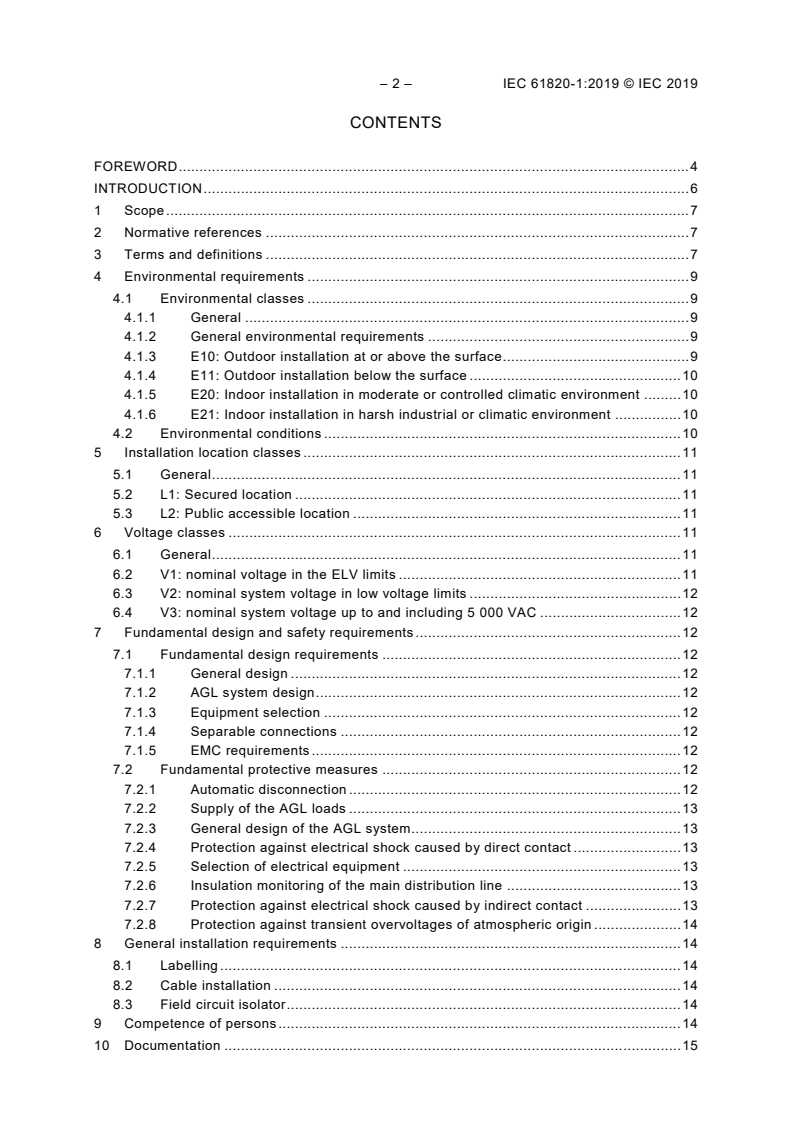
CONTENTS
FOREWORD . 4
INTRODUCTION . 6
1 Scope . 7
2 Normative references . 7
3 Terms and definitions . 7
4 Environmental requirements . 9
4.1 Environmental classes . 9
4.1.1 General . 9
4.1.2 General environmental requirements . 9
4.1.3 E10: Outdoor installation at or above the surface . 9
4.1.4 E11: Outdoor installation below the surface . 10
4.1.5 E20: Indoor installation in moderate or controlled climatic environment . 10
4.1.6 E21: Indoor installation in harsh industrial or climatic environment . 10
4.2 Environmental conditions . 10
5 Installation location classes . 11
5.1 General . 11
5.2 L1: Secured location . 11
5.3 L2: Public accessible location . 11
6 Voltage classes . 11
6.1 General . 11
6.2 V1: nominal voltage in the ELV limits . 11
6.3 V2: nominal system voltage in low voltage limits . 12
6.4 V3: nominal system voltage up to and including 5 000 VAC . 12
7 Fundamental design and safety requirements . 12
7.1 Fundamental design requirements . 12
7.1.1 General design . 12
7.1.2 AGL system design . 12
7.1.3 Equipment selection . 12
7.1.4 Separable connections . 12
7.1.5 EMC requirements . 12
7.2 Fundamental protective measures . 12
7.2.1 Automatic disconnection . 12
7.2.2 Supply of the AGL loads . 13
7.2.3 General design of the AGL system . 13
7.2.4 Protection against electrical shock caused by direct contact . 13
7.2.5 Selection of electrical equipment . 13
7.2.6 Insulation monitoring of the main distribution line . 13
7.2.7 Protection against electrical shock caused by indirect contact . 13
7.2.8 Protection against transient overvoltages of atmospheric origin . 14
8 General installation requirements . 14
8.1 Labelling . 14
8.2 Cable installation . 14
8.3 Field circuit isolator . 14
9 Competence of persons . 14
10 Documentation . 15
Bibliography . 16
Table 1 – Environmental conditions for AGL systems . 10
Table 2 – Installation part requirements . 11
Table 3 – Minimum installation depth of AGL cable in the field . 14
– 4 – IEC 61820-1:2019 © IEC 2019
INTERNATIONAL ELECTROTECHNICAL COMMISSION
____________
ELECTRICAL INSTALLATIONS FOR AERONAUTICAL
GROUND LIGHTING AT AERODROMES –
Part 1: Fundamental principles
FOREWORD
1) The International Electrotechnical Commission (IEC) is a worldwide organization for standardization comprising
all national electrotechnical committees (IEC National Committees). The object of IEC is to promote
international co-operation on all questions concerning standardization in the electrical and electronic fields. To
this end and in addition to other activities, IEC publishes International Standards, Technical Specifications,
Technical Reports, Publicly Available Specifications (PAS) and Guides (hereafter referred to as “IEC
Publication(s)”). Their preparation is entrusted to technical committees; any IEC National Committee interested
in the subject dealt with may participate in this preparatory work. International, governmental and non-
governmental organizations liaising with the IEC also participate in this preparation. IEC collaborates closely
with the International Organization for Standardization (ISO) in accordance with conditions determined by
agreement between the two organizations.
2) The formal decisions or agreements of IEC on technical matters express, as nearly as possible, an international
consensus of opinion on the relevant subjects since each technical committee has representation from all
interested IEC National Committees.
3) IEC Publications have the form of recommendations for international use and are accepted by IEC National
Committees in that sense. While all reasonable efforts are made to ensure that the technical content of IEC
Publications is accurate, IEC cannot be held responsible for the way in which they are used or for any
misinterpretation by any end user.
4) In order to promote international uniformity, IEC National Committees undertake to apply IEC Publications
transparently to the maximum extent possible in their national and regional publications. Any divergence
between any IEC Publication and the corresponding national or regional publication shall be clearly indicated in
the latter.
5) IEC itself does not provide any attestation of conformity. Independent certification bodies provide conformity
assessment services and, in some areas, access to IEC marks of conformity. IEC is not responsible for any
services carried out by independent certification bodies.
6) All users should ensure that they have the latest edition of this publication.
7) No liability shall attach to IEC or its directors, employees, servants or agents including individual experts and
members of its technical committees and IEC National Committees for any personal injury, property damage or
other damage of any nature whatsoever, whether direct or indirect, or for costs (including legal fees) and
expenses arising out of the publication, use of, or reliance upon, this IEC Publication or any other IEC
Publications.
8) Attention is drawn to the Normative references cited in this publication. Use of the referenced publications is
indispensable for the correct application of this publication.
9) Attention is drawn to the possibility that some of the elements of this IEC Publication may be the subject of
patent rights. IEC shall not be held responsible for identifying any or all such patent rights.
International Standard IEC 61820-1 has been prepared by IEC technical committee 97:
Electrical installations for lighting and beaconing of aerodromes.
The text of this International Standard is based on the following documents:
FDIS Report on voting
97/198/FDIS 97/200/RVD
Full information on the voting for the approval of this International Standard can be found in
the report on voting indicated in the above table.
This document has been drafted in accordance with the ISO/IEC Directives, Part 2.
A list of all parts in the IEC 61820 series, published under the general title Electrical
installations for aeronautical ground lighting at aerodromes, can be found on the IEC website.
The committee has decided that the contents of this document will remain unchanged until the
stability date indicated on the IEC website under "http://webstore.iec.ch" in the data related to
the specific document. At this date, the document will be
• reconfirmed,
• withdrawn,
• replaced by a revised edition, or
• amended.
– 6 – IEC 61820-1:2019 © IEC 2019
INTRODUCTION
This document is part of IEC 61820, a series of standards that defines the requirements
throughout the lifecycle of an Aeronautical Ground Lighting (AGL) system including design,
installation, commissioning, maintenance, decommissioning and disposal.
This document contains fundamental design requirements for AGL systems.
According to ICAO or national standards, the AGL fixtures are subject to specific
requirements for photometric output and serviceability level.
The AGL system is provided to support airfield activities. Therefore, the focus of AGL system
design is to maintain the lighting against any possible failure. This document pertains to
personnel and operational safety.
ELECTRICAL INSTALLATIONS FOR AERONAUTICAL
GROUND LIGHTING AT AERODROMES –
Part 1: Fundamental principles
1 Scope
This part of IEC 61820 covers principles of design and installation requirements for AGL
systems including control, monitoring and transformation of energy, the cables and any
electrical component utilized to produce the light intended to be used as a visual aid for air
and ground navigation.
This document defines in general the fundamental principles to provide safe, reliable and
efficient operation of AGL systems independent of the particular system design. Where certain
aspects of design are specific to a particular type of system (e.g. series-circuit), these are
supplemented in the applicable part.
NOTE Local / national regulations can be different from the provisions of this document.
2 Normative references
The following documents are referred to in the text in such a way that some or all of their
content constitutes requirements of this document. For dated references, only the edition
cited applies. For undated references, the latest edition of the referenced document (including
any amendments) applies.
IEC 60364-4-41, Low-voltage electrical installations – Part 4-41: Protection for safety –
Protection against electric shock
IEC 60721-3-3, Classification of environmental conditions – Part 3: Classification of groups of
environmental parameters and their severities – Section 3: Stationary use at weatherprotected
locations
IEC 60721-3-4, Classification of environmental conditions – Part 3: Classification of groups of
environmental parameters and their severities – Section 4: Stationary use at non-
weatherprotected locations
IEC 61000-6-2, Electromagnetic compatibility (EMC) – Part 6-2: Generic standards –
Immunity standard for industrial environments
IEC 61000-6-4, Electromagnetic compatibility (EMC) – Part 6-4: Generic standards –
Emission standard for industrial environments
IEC 62870, Electrical installations for lighting and beaconing of aerodromes –Safety
secondary circuits in series circuits – General safety requirements
3 Terms and definitions
For the purposes of this document, the following terms and definitions apply.
ISO and IEC maintain terminological databases for use in standardization at the following
addresses:
– 8 – IEC 61820-1:2019 © IEC 2019
• IEC Electropedia: available at http://www.electropedia.org/
• ISO Online browsing platform: available at http://www.iso.org/obp
3.1
AGL
aeronautical ground lighting
any light specially provided as an aid to air navigation, other than a light displayed on an
aircraft
Note 1 to entry: This note applies to the French language only.
[SOURCE: ICAO Annex 14 to the Convention on International Civil Aviation:2018.]
3.2
lifecycle
series of identifiable stages through which an item goes, from its conception to disposal
Note 1 to entry: See IEC TS 62143 for AGL systems lifecycle.
3.3
electric insulation
part of an electrotechnichal product which separates conducting parts at different electric
potentials during operation or insulates such parts from the surroundings
[SOURCE: IEC 60050-212:2010, 212-11-07]
3.4
insulation resistance
resistance under specified conditions between two conductive elements separated by
insulating materials
[SOURCE: IEC 60050-151:2001, 151-15-43]
3.5
insulation monitoring
continuous determination of the state or condition of the system electrical insulation
3.6
equipotentiality
state when conductive parts are at a substantially equal electric potential
[SOURCE: IEC 60050-195:1998, 195-01-09]
3.7
equipotential bonding
provision of electric connections between conductive parts, intended to achieve
equipotentiality
[SOURCE: IEC 60050-195:1998, 195-01-10]
3.8
field circuit isolator
device which provides, in the dedicated position, an isolating distance between the power
supply and cables feeding AGL loads
3.9
load, noun
device intended to absorb power supplied by another device or an electric power system
[SOURCE: IEC 60050-151:2001, 151-15-15]
3.10
AGL loads
any load fed by a dedicated AGL power supply
Note 1 to entry: AGL loads can be, but are not limited to: lights, signs, or sensors.
3.11
nominal voltage
value of the voltage by which the electrical installation or part of the electrical installation is
designated and identified
[SOURCE: IEC 60050-826:2004, 826-11-01]
3.12
rated insulation voltage
rated value of the rms withstand voltage assigned by the manufacturer to the equipment or to
a part of it, characterizing the specified (long-term) withstand capability of its insulation
Note 1 to entry: The rated insulation voltage is not necessarily equal to the rated voltage of equipment which is
primarily related to functional performance.
[SOURCE: IEC 60050-312:2001/AMD1:2015, 312-06-02]
3.13
exposed conductive part
conductive part which can readily be touched and which is not normally alive, but which may
become alive under fault conditions
Note 1 to entry: Typical exposed conductive parts are walls of enclosures, operating handles, etc.
[SOURCE: IEC 60050-441:2000, 441-11-10]
3.14
field circuit
part of the AGL system that starts from the output terminals of the power source or, if a field
circuit isolator is installed, from the output terminals of the field circuit isolator
4 Environmental requirements
4.1 Environmental classes
4.1.1 General
To harmonize the equipment requirements, environmental classes are defined. Equipments
are to be selected according to the environmental class of the place of installation.
4.1.2 General environmental requirements
The equipment shall be designed for continuous operation without derating under the defined
conditions of the assigned environmental class.
4.1.3 E10: Outdoor installation at or above the surface
Environmental class E10 is applicable to any part of the installation intended to be placed
outside in the field.
– 10 – IEC 61820-1:2019 © IEC 2019
The equipment is not intended to operate below the surface and cannot be submersed in
water and is not suitable for direct burial.
4.1.4 E11: Outdoor installation below the surface
Environmental class E11 is applicable to any part of the installation according to E10 but
intended to operate below the surface and can be submersible in fluids and can be suitable
for direct burial.
4.1.5 E20: Indoor installation in moderate or controlled climatic environment
Environmental class E20 is applicable to any part of the installation in a building or enclosure
that limits the influence from climatic conditions.
4.1.6 E21: Indoor installation in harsh industrial or climatic environment
Environmental class E21 is applicable to any part of the installation in a building or enclosure
that protects the parts of the installation against the extremes of climatic influences.
4.2 Environmental conditions
The design of the AGL installation shall take into account the environmental conditions to
which it will be subjected, and shall meet the minimum requirements contained in Table 1 and
based on IEC 60721-3-3 or IEC 60721-3-4 (as relevant).
Table 1 – Environmental conditions for AGL systems
Classes E10 E11 E20 E21
a
Climatic conditions (K) 4K4 (with 4K4 (with 3K3 3K3
minimum minimum
temperature - temperature -
40 °C) 40 °C)
3Z12
Special condition (Z) 4Z5 4Z5 3Z11
4Z7 4Z9 3Z12
b
Biological conditions (B) 4B1 4B1 3B1 3B1
Chemically active substances (C) 4C3 4C3 3C2 3C2
Mechanically active substances 4S3 4S1 for 3S1 3S1
(S) installation in
manholes or
ducts
Mechanical conditions (M) 4M1 to 4M2 4M1 to 4M2 for 3M2 3M2
areas not
intended to be
used by aircrafts
or vehicles
(e.g.taxiways
shoulders,
runway
shoulders);
4M6 for areas
intended to be
used by aircrafts
or vehicles (e.g.
taxiways,
runways, de-
icing pads,
aprons)
a
Climatic conditions include: temperature, humidity, air pressure, solar radiation, rain intensity, wind, water,
formation of ice.
b
Biological conditions include: rodents, mould, fungus, etc.
NOTE 1 More details on environmental conditions can be found in IEC 60721-3-3 and 60721-3-4.
Each part of the installation shall also comply with the requirements of Table 2.
Table 2 – Installation part requirements
Classes E10 E11 E20 E21
Minimum IP code IP54 IP67 IP2x IP2x
Electromagnetic IEC 61000-6-2 IEC 61000-6-2 IEC 61000-6-2 IEC 61000-6-2
compatibility
Allowed to direct No Yes Not applicable Not applicable
burial
NOTE 2 IP codes are presented in IEC 60529.
5 Installation location classes
5.1 General
In areas accessible to the public, additional protection shall be provided. To assign that
requirements to the location of the installation two different location classes are defined.
The airport authority shall define which part of the airport is L1 or L2.
5.2 L1: Secured location
A location that is accessible for trained and competent personnel only.
5.3 L2: Public accessible location
A location that is accessible to persons other than trained and competent personnel and AGL
equipment is present.
6 Voltage classes
6.1 General
To define general suitable electrical safety requirements the power distribution systems are
divided in three classes, as the voltage level in AGL power distribution could rise up to
5 000 VAC.
6.2 V1: nominal voltage in the ELV limits
All distribution lines or equipment that use nominal voltages up to 50V AC or 120 V DC ripple
free.
NOTE Ripple-free is conventionally defined as an r.m.s. ripple voltage of not more than 10 % of the DC
component.
– 12 – IEC 61820-1:2019 © IEC 2019
6.3 V2: nominal system voltage in low voltage limits
All distribution lines or equipment that use nominal voltages above 50 VAC or 120 VDC and
up to 1 000 VAC or 1 500 VDC.
6.4 V3: nominal system voltage up to and including 5 000 VAC
All distribution lines or equipment that use nominal voltages above 1 000 VAC and up to
5 000 VAC.
7 Fundamental design and safety requirements
7.1 Fundamental design requirements
7.1.1 General design
AGL system shall be designed so that one earth fault to ground does not cause a circuit
failure. Earth fault shall be alarmed. The AGL installation shall be designed by competent
persons to provide for:
– the proper functioning of the AGL installation for the intended use;
– the protection of persons, livestock and property.
7.1.2 AGL system design
AGL system design shall be in accordance with the relevant requirements of IEC 61820 as
applicable.
7.1.3 Equipment selection
Equipment selection shall be in accordance with the relevant requirements of IEC 61820 as
applicable.
7.1.4 Separable connections
If the voltage class level is not V1 (ELV), direct contact with a live conductor shall not be
possible by connector design, tools or maintenance procedures.
7.1.5 EMC requirements
AGL components shall comply with the requirements of IEC 61000-6-2 and IEC 61000-6-4.
7.2 Fundamental protective measures
7.2.1 Automatic disconnection
Due to the aviation risk, no automatic disconnection of the electrical supply to an AGL load
shall occur in the event of the loss of a protective measure.
Exceptions:
– The nature of the failure permits the AGL system to provide inadequate visual cues to the
pilot (e.g. open circuit detection in series circuits, overload that causes a total damage of
all light sources in a short time).
– The electrical supply to an AGL system that has been declared by airport authority as not
relevant for the aviation safety.
– A safety study shows that possible damages or electrical hazards by the operation of a
protection measure could cause a higher risk than the influence to the aviation safety.
– Any permanent exception related to a particular AGL system shall be explicitly defined in
the relevant requirements of IEC 61820.
7.2.2 Supply of the AGL loads
AGL loads should be supplied by a safety extra low voltage (SELV) or protective extra low
voltage (PELV) power source.
Exception: If the load requires a supply voltage greater than 50 V AC or 120 VDC the system
shall not be marked as ELV.
For series circuits ELV systems, IEC 62870 applies.
For parallel ELV systems, IEC 60364-4-41 applies.
Suitable and sufficient maintenance procedures shall be developed based on the installed
system.
7.2.3 General design of the AGL system
The field circuit shall be galvanically separated from the mains.
7.2.4 Protection against electrical shock caused by direct contact
Persons or livestock shall be protected against the dangers that may arise from contact with
live parts of the AGL installation.
This protection can be achieved by one of the following methods:
– preventing a current from passing through the body of any person or any livestock;
– limiting the current which can pass through a body to a non-hazardous value.
7.2.5 Selection of electrical equipment
Every item of electrical equipment shall have suitable characteristics appropriate to the values
and conditions on which the design of the AGL installation is based.
7.2.6 Insulation monitoring of the main distribution line
The insulation resistance of the primary field circuit when supplied from either a voltage class
system type V2 or V3 shall be regularly monitored at a frequency adapted to the system
condition and the measurements readily available to competent persons such as maintenance
personnel.
The airport authority (duty holder) is responsible for identifying and maintaining an
appropriate insulation resistance level sufficient to prevent danger to persons and livestock,
or to take alternative mitigation measures.
7.2.7 Protection against electrical shock caused by indirect contact
Each exposed conductive part of the AGL equipment shall be connected to a local
equipotential bonding system unless the equipment is located in the secured L1 area and
connected to a V1 ELV supply. The extent of the local equipotential bonding shall incorporate
all parts accessible by a person at the same time.
The equipotential bonding shall be designed so that the maximum touch voltage between
parts accessible by a person at the same time shall not exceed 50 V AC.
– 14 – IEC 61820-1:2019 © IEC 2019
7.2.8 Protection against transient overvoltages of atmospheric origin
A risk assessment should be carried out in accordance with IEC 62305-2.
To prevent damage to circuit components, all AGL circuits shall include suitable overcurrent
protections.
8 General installation requirements
8.1 Labelling
Each item of AGL equipment shall be visually labelled to provide clear circuit identification.
The identification is consistent throughout the full length of the AGL circuit. The labelling shall
be provided at each location where maintenance or repair may be performed (e.g. power
vaults, service pits, transformer pits, distribution boxes, etc.). The labelling shall be suitable
for the environmental requirements of the installation location. The labelling is to be legible
over the equipment lifetime.
NOTE In addition, electronic tags can be used for lifecycle management.
8.2 Cable installation
AGL cables shall be either installed in ducts or directly buried at a sufficient depth to prevent
danger to persons or livestock. Where direct burial is used, the cables shall be buried in
suitably sieved sand, or a similar material, to prevent damage.
A warning device shall be installed over buried ducts or cables. For ducts inside concrete, this
device is not mandatory.
The minimum depth of cover above the duct or cable for a type L1 location shall be in
accordance with Table 3. Where AGL cables are installed in type L2 locations, a greater depth
may be required.
Table 3 – Minimum installation depth of AGL cable in the field
Secured Location L1
Voltage Level Earth Concrete Asphalt
V1 (ELV) 300 mm 20 mm 20 mm
V2 (up to 1 000 V AC) 450 mm 40 mm 40 mm
V3 (up to 5 000 V AC) 450 mm 150 mm 150 mm
8.3 Field circuit isolator
Each AGL field circuit shall be equipped with a means of isolation from the power source.
9 Competence of persons
Only competent persons shall be involved in AGL systems.
NOTE IEC 61821 and IEC TS 62143 define specifications for competence of persons.
10 Documentation
An AGL system shall be documented.
The airport authority shall ensure that documentation allows the verification of the conformity
of the design and be used as a reliable support for maintenance and operation purpose
throughout the lifecycle.
NOTE The following is a typical and non-exhaustive documentation list:
– data sheet,
– circuit calculations,
– diagrams,
– layouts,
– lightning risk assessment,
– factory acceptance test (FAT),
– general arrangement of equipment installation,
– commissioning report,
– site acceptance test (SAT),
– training documentation,
– maintenance manual,
– as-build drawings.
– 16 – IEC 61820-1:2019 © IEC 2019
Bibliography
IEC 60050-151:2001, International Electrotechnical Vocabulary – Part 151: Electrical and
magnetic devices
IEC 60050-151:2001/AMD1:2013
IEC 60050-151:2001/AMD2:2014
IEC 60050-195:1998, International Electrotechnical Vocabulary – Part 195: Earthing and
protection against electric shock
IEC 60050-195:1998/AMD1:2001
IEC 60050-212:2010, International Electrotechnical Vocabulary – Part 212: Electrical
insulating solids, liquids, and gases
IEC 60050-312:2001, International Electrotechnical Vocabulary – Electrical and electronic
measurements and measuring instruments – Part 312: General terms relating to electrical
measurements
IEC 60050-312:2001/AMD1:2015
IEC 60050-441:1984, International Electrotechnical Vocabulary – Chapter 441: Switchgear,
controlgear and fuses
IEC 60050-441:1984/AMD1:2000
IEC 60050-826:2004, International Electrotechnical Vocabulary – Part 826: Electrical
installations
IEC 60364-4-41, Low-voltage electrical installations – Part 4-41: Protection for safety –
Protection against electric shock
IEC 60529, Degrees of protection provided by enclosures (IP Code)
IEC 61140, Protection against electric shock – Common aspects for installations and
equipment
IEC 61820 (all parts), Electrical installations for aeronautical ground lighting at aerodromes
IEC 61821, Electrical installations for lighting and beaconing of aerodromes – Maintenance of
aeronautical ground lighting constant current series circuits
IEC TS 62143, Electrical installations for lighting and beaconing of aerodromes – Aeronautical
ground lighting systems – Guidelines for the development of a safety lifecycle methodology
IEC 62305-2, Protection against lightning – Part 2: Risk management
ICAO Annex 14 to the Convention on International Civil Aviation, Aerodromes – Volume 1:
Aerodrome Design and Operations, 8th Ed., July 2018
___________
– 18 – IEC 61820-1:2019 © IEC 2019
SOMMAIRE
AVANT-PROPOS . 20
INTRODUCTION . 22
1 Domaine d'application . 23
2 Références normatives . 23
3 Termes et définitions . 23
4 Exigences environnementales . 25
4.1 Classes d’environnements . 25
4.1.1 Généralités . 25
4.1.2 Exigences environnementales générales . 26
4.1.3 E10: installation extérieure au-dessus ou au niveau de la surface . 26
4.1.4 E11: installation extérieure sous la surface . 26
4.1.5 E20: installation intérieure dans un environnement climatique modéré
ou contrôlé . 26
4.1.6 E21: installation intérieure dans un environnement climatique ou
industriel hostile . 26
4.2 Conditions d’environnement . 26
5 Classes de lieux d'installation . 28
5.1 Généralités . 28
5.2 L1: zone sécurisée . 28
5.3 L2: zone accessible au public . 28
6 Classes de tensions . 28
6.1 Généralités . 28
6.2 V1: tension nominale ne dépassant pas les limites des très basses tensions
(TBT) . 28
6.3 V2: tension nominale du système dans la limite des basses tensions . 28
6.4 V3: tension alternative nominale du système jusqu’à 5 000 V inclus . 28
7 Exigences fondamentales de conception et de sécurité . 29
7.1 Exigences fondamentales de conception . 29
7.1.1 Conception générale . 29
7.1.2 Conception du système AGL . 29
7.1.3 Choix des matériels . 29
7.1.4 Connexions séparables . 29
7.1.5 Exigences relatives à la CEM . 29
7.2 Mesures de protection fondamentales . 29
7.2.1 Déconnexion automatique . 29
7.2.2 Alimentation des charges d'AGL . 29
7.2.3 Conception générale du système AGL . 30
7.2.4 Protection contre les chocs électriques causés par un contact direct . 30
7.2.5 Choix des matériels électriques . 30
7.2.6 Contrôle de l'isolement de la ligne de distribution de l'alimentation
secteur . 30
7.2.7 Protection contre les chocs électriques causés par un contact indirect . 30
7.2.8 Protection contre les surtensions transitoires d'origine atmosphérique . 30
8 Exigences générales relatives à l'installation . 31
8.1 Etiquetage . 31
8.2 Installation des câbles . 31
8.3 Isolateur de circuit de terrain . 31
9 Compétence des personnes . 31
10 Documentation . 31
Bibliographie . 33
Tableau 1 – Conditions d'environnement pour des systèmes AGL . 27
Tableau 2 – Exigences relatives aux parties de l'installation . 28
Tableau 3 – Profondeur minimale d'installation d'un câble d'AGL sur le terrain . 31
– 20 – IEC 61820-1:2019 © IEC 2019
COMMISSION ÉLECTROTECHNIQUE INTERNATIONALE
____________
INSTALLATIONS ÉLECTRIQUES POUR LE BALISAGE
AÉRONAUTIQUE AU SOL DANS LES AÉRODROMES –
Partie 1: Principes fondamentaux
AVANT-PROPOS
1) La Commission Electrotechnique Internationale (IEC) est une organisation mondiale de normalisation
composée de l'ensemble des comités électrotechniques nationaux (Comités nationaux de l'IEC). L’IEC a pour
objet de favoriser la coopération internationale pour toutes les questions de normalisation dans les domaines
de l'électricité et de l'électronique. A cet effet, l'IEC – entre autres activités – publie des Normes
internationales, des Spécifications techniques, des Rapports techniques, des Spécifications accessibles au
public (PAS) et des Guides (ci-après dénommés "Publication(s) de l'IEC"). Leur élaboration est confiée à des
comités d'études, aux travaux desquels tout Comité national intéressé par le sujet traité peut participer. Les
organisations internationales, gouvernementales et non gouvernementales, en liaison avec l'IEC, participent
également aux travaux. L’IEC collabore étroitement avec l'Organisation Internationale de Normalisation (ISO),
selon des conditions fixées par accord entre les deux organisations.
2) Les décisions ou accords officiels de l'IEC concernant les questions techniques représentent, dans la mesure
du possible, un accord international sur les sujets étudiés, étant donné que les Comités nationaux de l'IEC
intér
...