

IEC TR 63162:2025
(Main)Electric components - Reliability - Failure rates at reference conditions
General Information
- Abstract
IEC TR 63162:2025, which is a Technical Specification, provides failure rates at reference conditions for electric components, considering reference conditions defined in IEC 61709.
Reference conditions are useful since they provide a known standard basis from which failure rates can be modified to account for differences in environment from the environments taken as reference conditions.
To perform reliability prediction, which is described in IEC 61709:2017, Annex C, failure rates, together with assumptions and limitations, are used.
IEC 61709 does not provide failure rates for components, but only provides models that allow failure rates obtained by other means to be converted from one operating condition to another operating condition.
This document provides generic failure rates considering those contained in the list of selected sources, calculated at reference conditions, as defined in IEC 61709. In fact, although models are different, calculated values at reference conditions do not appear to be so different, hence allowing a consistent converging process. See also IEC 61709:2017, 4.6.
Each user can easily calculate failure rates at any condition using IEC 61709.
- Status
- Published
- Publication Date
- 10-Jun-2025
- Technical Committee
- TC 56 - Dependability
- Current Stage
- PPUB - Publication issued
- Start Date
- 11-Jun-2025
- Completion Date
- 11-Apr-2025
Overview
IEC TR 63162:2025 - Electric components - Reliability - Failure rates at reference conditions is an IEC Technical Report from TC 56 (Dependability) that compiles generic failure rates for a wide range of electric components calculated at the reference conditions defined in IEC 61709. The document is intended as guidance to support reliability prediction and provides a consistent, standard basis from which failure rates can be adjusted for differing operating environments.
Key topics and technical content
- Reference conditions: Recommended environmental and mechanical stress parameters used as the baseline for failure rates (aligned with IEC 61709 reference definitions).
- Failure rate tables: Generic failure rates at reference conditions for many component families (ICs, discrete semiconductors, optoelectronics, capacitors, resistors, inductors, connectors, relays, switches, PCBs, microwave devices, etc.), usually expressed in FIT (failures in time).
- Failure modes and mechanisms: Informative annex describing common failure modes across component types to support correct interpretation and modelling.
- Thermal modelling and voltage conditions: Guidance on thermal considerations and specific reference voltages for integrated circuits and semiconductors.
- Sources and assumptions: Bibliography and informative annex listing selected reliability data sources, plus guidance on assumptions, limitations and useful-life considerations.
- Conversion and modification: Use of IEC 61709 models to convert these reference-condition failure rates to other operating conditions (temperature, humidity, mechanical stress).
Practical applications
- Early-stage reliability prediction for product design and system architecture.
- Comparative evaluation of design alternatives and supplier components based on a common failure-rate basis.
- Planning of logistics, maintenance strategies and spare parts provisioning using standardized failure-rate estimates.
- Inputs to quantitative dependability analyses, safety cases, and lifecycle risk assessments.
Who should use this standard
- Reliability engineers and dependability analysts performing failure-rate predictions.
- Design engineers evaluating component-level reliability and trade-offs.
- Maintenance planners and logistic support teams estimating spare-part needs.
- Organizations lacking proprietary failure-data who need a standard, vetted baseline.
Related standards
- IEC 61709:2017 - Main reference for reliability prediction models and for converting failure rates between operating conditions (see Annex C and clauses referenced in IEC TR 63162).
- Other IEC dependability and component standards referenced in the report’s bibliography and informative annex.
IEC TR 63162:2025 is a guidance tool - use it with awareness of its assumptions and preferences for user, manufacturer, then handbook data when available.
Get Certified
Connect with accredited certification bodies for this standard

BSI Group
BSI (British Standards Institution) is the business standards company that helps organizations make excellence a habit.

Bureau Veritas
Bureau Veritas is a world leader in laboratory testing, inspection and certification services.

DNV
DNV is an independent assurance and risk management provider.
Sponsored listings
Frequently Asked Questions
IEC TR 63162:2025 is a technical report published by the International Electrotechnical Commission (IEC). Its full title is "Electric components - Reliability - Failure rates at reference conditions". This standard covers: IEC TR 63162:2025, which is a Technical Specification, provides failure rates at reference conditions for electric components, considering reference conditions defined in IEC 61709. Reference conditions are useful since they provide a known standard basis from which failure rates can be modified to account for differences in environment from the environments taken as reference conditions. To perform reliability prediction, which is described in IEC 61709:2017, Annex C, failure rates, together with assumptions and limitations, are used. IEC 61709 does not provide failure rates for components, but only provides models that allow failure rates obtained by other means to be converted from one operating condition to another operating condition. This document provides generic failure rates considering those contained in the list of selected sources, calculated at reference conditions, as defined in IEC 61709. In fact, although models are different, calculated values at reference conditions do not appear to be so different, hence allowing a consistent converging process. See also IEC 61709:2017, 4.6. Each user can easily calculate failure rates at any condition using IEC 61709.
IEC TR 63162:2025, which is a Technical Specification, provides failure rates at reference conditions for electric components, considering reference conditions defined in IEC 61709. Reference conditions are useful since they provide a known standard basis from which failure rates can be modified to account for differences in environment from the environments taken as reference conditions. To perform reliability prediction, which is described in IEC 61709:2017, Annex C, failure rates, together with assumptions and limitations, are used. IEC 61709 does not provide failure rates for components, but only provides models that allow failure rates obtained by other means to be converted from one operating condition to another operating condition. This document provides generic failure rates considering those contained in the list of selected sources, calculated at reference conditions, as defined in IEC 61709. In fact, although models are different, calculated values at reference conditions do not appear to be so different, hence allowing a consistent converging process. See also IEC 61709:2017, 4.6. Each user can easily calculate failure rates at any condition using IEC 61709.
IEC TR 63162:2025 is classified under the following ICS (International Classification for Standards) categories: 03.120 - Quality; 29.060 - Electrical wires and cables. The ICS classification helps identify the subject area and facilitates finding related standards.
IEC TR 63162:2025 is available in PDF format for immediate download after purchase. The document can be added to your cart and obtained through the secure checkout process. Digital delivery ensures instant access to the complete standard document.
Standards Content (Sample)
IEC TR 63162 ®
Edition 1.0 2025-06
TECHNICAL
REPORT
Electric components – Reliability – Failure rates at reference conditions
ICS 03.120; 29.060 ISBN 978-2-8327-0428-8
All rights reserved. Unless otherwise specified, no part of this publication may be reproduced or utilized in any form or
by any means, electronic or mechanical, including photocopying and microfilm, without permission in writing from either
IEC or IEC's member National Committee in the country of the requester. If you have any questions about IEC copyright
or have an enquiry about obtaining additional rights to this publication, please contact the address below or your local
IEC member National Committee for further information.
IEC Secretariat Tel.: +41 22 919 02 11
3, rue de Varembé info@iec.ch
CH-1211 Geneva 20 www.iec.ch
Switzerland
About the IEC
The International Electrotechnical Commission (IEC) is the leading global organization that prepares and publishes
International Standards for all electrical, electronic and related technologies.
About IEC publications
The technical content of IEC publications is kept under constant review by the IEC. Please make sure that you have the
latest edition, a corrigendum or an amendment might have been published.
IEC publications search - IEC Products & Services Portal - products.iec.ch
webstore.iec.ch/advsearchform Discover our powerful search engine and read freely all the
publications previews, graphical symbols and the glossary.
The advanced search enables to find IEC publications by a
variety of criteria (reference number, text, technical With a subscription you will always have access to up to date
committee, …). It also gives information on projects, content tailored to your needs.
replaced and withdrawn publications.
Electropedia - www.electropedia.org
The world's leading online dictionary on electrotechnology,
IEC Just Published - webstore.iec.ch/justpublished
Stay up to date on all new IEC publications. Just Published containing more than 22 500 terminological entries in English
details all new publications released. Available online and and French, with equivalent terms in 25 additional languages.
once a month by email. Also known as the International Electrotechnical Vocabulary
(IEV) online.
IEC Customer Service Centre - webstore.iec.ch/csc
If you wish to give us your feedback on this publication or
need further assistance, please contact the Customer
Service Centre: sales@iec.ch.
– 2 – IEC TR 63162:2025 © IEC 2025
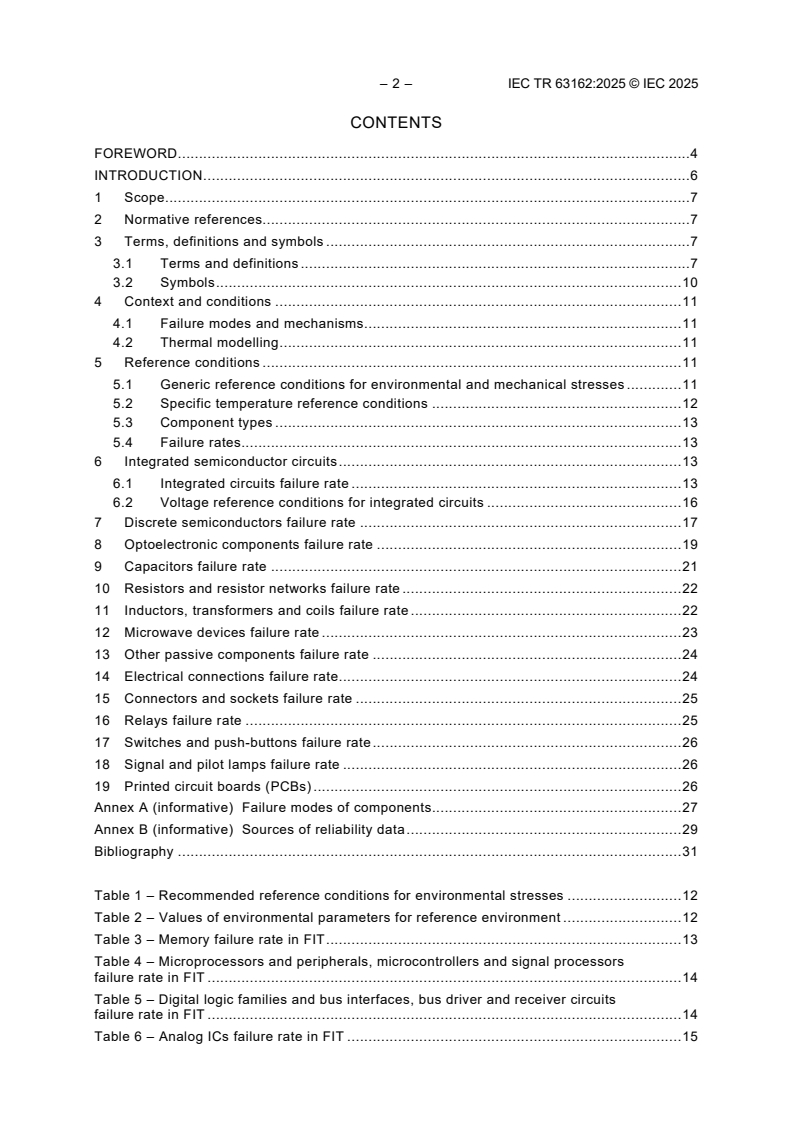
CONTENTS
FOREWORD . 4
INTRODUCTION . 6
1 Scope . 7
2 Normative references. 7
3 Terms, definitions and symbols . 7
3.1 Terms and definitions . 7
3.2 Symbols . 10
4 Context and conditions . 11
4.1 Failure modes and mechanisms . 11
4.2 Thermal modelling . 11
5 Reference conditions . 11
5.1 Generic reference conditions for environmental and mechanical stresses . 11
5.2 Specific temperature reference conditions . 12
5.3 Component types . 13
5.4 Failure rates. 13
6 Integrated semiconductor circuits . 13
6.1 Integrated circuits failure rate . 13
6.2 Voltage reference conditions for integrated circuits . 16
7 Discrete semiconductors failure rate . 17
8 Optoelectronic components failure rate . 19
9 Capacitors failure rate . 21
10 Resistors and resistor networks failure rate . 22
11 Inductors, transformers and coils failure rate . 22
12 Microwave devices failure rate . 23
13 Other passive components failure rate . 24
14 Electrical connections failure rate . 24
15 Connectors and sockets failure rate . 25
16 Relays failure rate . 25
17 Switches and push-buttons failure rate . 26
18 Signal and pilot lamps failure rate . 26
19 Printed circuit boards (PCBs) . 26
Annex A (informative) Failure modes of components . 27
Annex B (informative) Sources of reliability data . 29
Bibliography . 31
Table 1 – Recommended reference conditions for environmental stresses . 12
Table 2 – Values of environmental parameters for reference environment . 12
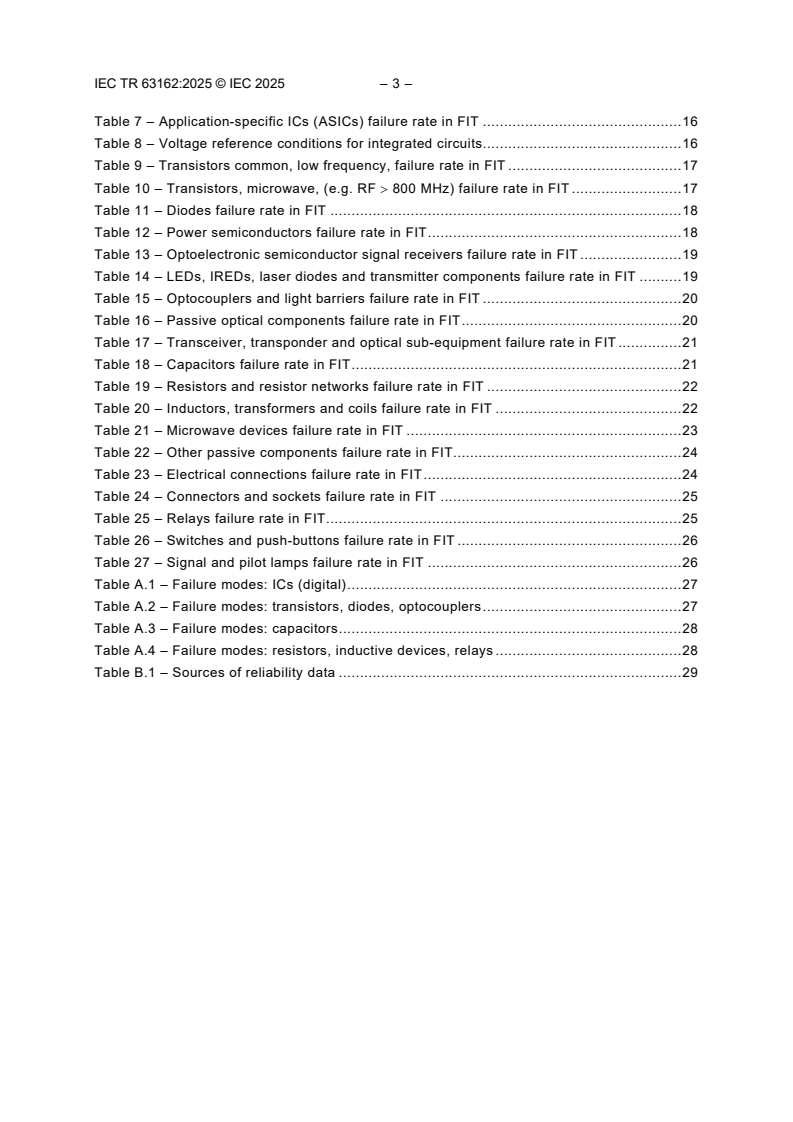
Table 3 – Memory failure rate in FIT . 13
Table 4 – Microprocessors and peripherals, microcontrollers and signal processors
failure rate in FIT . 14
Table 5 – Digital logic families and bus interfaces, bus driver and receiver circuits
failure rate in FIT . 14
Table 6 – Analog ICs failure rate in FIT . 15
Table 7 – Application-specific ICs (ASICs) failure rate in FIT . 16
Table 8 – Voltage reference conditions for integrated circuits . 16
Table 9 – Transistors common, low frequency, failure rate in FIT . 17
Table 10 – Transistors, microwave, (e.g. RF > 800 MHz) failure rate in FIT . 17
Table 11 – Diodes failure rate in FIT . 18
Table 12 – Power semiconductors failure rate in FIT . 18
Table 13 – Optoelectronic semiconductor signal receivers failure rate in FIT . 19
Table 14 – LEDs, IREDs, laser diodes and transmitter components failure rate in FIT . 19
Table 15 – Optocouplers and light barriers failure rate in FIT . 20
Table 16 – Passive optical components failure rate in FIT . 20
Table 17 – Transceiver, transponder and optical sub-equipment failure rate in FIT . 21
Table 18 – Capacitors failure rate in FIT . 21
Table 19 – Resistors and resistor networks failure rate in FIT . 22
Table 20 – Inductors, transformers and coils failure rate in FIT . 22
Table 21 – Microwave devices failure rate in FIT . 23
Table 22 – Other passive components failure rate in FIT . 24
Table 23 – Electrical connections failure rate in FIT . 24
Table 24 – Connectors and sockets failure rate in FIT . 25
Table 25 – Relays failure rate in FIT . 25
Table 26 – Switches and push-buttons failure rate in FIT . 26
Table 27 – Signal and pilot lamps failure rate in FIT . 26
Table A.1 – Failure modes: ICs (digital) . 27
Table A.2 – Failure modes: transistors, diodes, optocouplers . 27
Table A.3 – Failure modes: capacitors . 28
Table A.4 – Failure modes: resistors, inductive devices, relays . 28
Table B.1 – Sources of reliability data . 29
– 4 – IEC TR 63162:2025 © IEC 2025
INTERNATIONAL ELECTROTECHNICAL COMMISSION
____________
ELECTRIC COMPONENTS –
RELIABILITY – FAILURE RATES
AT REFERENCE CONDITIONS
FOREWORD
1) The International Electrotechnical Commission (IEC) is a worldwide organization for standardization comprising
all national electrotechnical committees (IEC National Committees). The object of IEC is to promote international
co-operation on all questions concerning standardization in the electrical and electronic fields. To this end and
in addition to other activities, IEC publishes International Standards, Technical Specifications, Technical Reports,
Publicly Available Specifications (PAS) and Guides (hereafter referred to as “IEC Publication(s)”). Their
preparation is entrusted to technical committees; any IEC National Committee interested in the subject dealt with
may participate in this preparatory work. International, governmental and non-governmental organizations liaising
with the IEC also participate in this preparation. IEC collaborates closely with the International Organization for
Standardization (ISO) in accordance with conditions determined by agreement between the two organizations.
2) The formal decisions or agreements of IEC on technical matters express, as nearly as possible, an international
consensus of opinion on the relevant subjects since each technical committee has representation from all
interested IEC National Committees.
3) IEC Publications have the form of recommendations for international use and are accepted by IEC National
Committees in that sense. While all reasonable efforts are made to ensure that the technical content of IEC
Publications is accurate, IEC cannot be held responsible for the way in which they are used or for any
misinterpretation by any end user.
4) In order to promote international uniformity, IEC National Committees undertake to apply IEC Publications
transparently to the maximum extent possible in their national and regional publications. Any divergence between
any IEC Publication and the corresponding national or regional publication shall be clearly indicated in the latter.
5) IEC itself does not provide any attestation of conformity. Independent certification bodies provide conformity
assessment services and, in some areas, access to IEC marks of conformity. IEC is not responsible for any
services carried out by independent certification bodies.
6) All users should ensure that they have the latest edition of this publication.
7) No liability shall attach to IEC or its directors, employees, servants or agents including individual experts and
members of its technical committees and IEC National Committees for any personal injury, property damage or
other damage of any nature whatsoever, whether direct or indirect, or for costs (including legal fees) and
expenses arising out of the publication, use of, or reliance upon, this IEC Publication or any other IEC
Publications.
8) Attention is drawn to the Normative references cited in this publication. Use of the referenced publications is
indispensable for the correct application of this publication.
9) IEC draws attention to the possibility that the implementation of this document may involve the use of (a)
patent(s). IEC takes no position concerning the evidence, validity or applicability of any claimed patent rights in
respect thereof. As of the date of publication of this document, IEC had not received notice of (a) patent(s), which
may be required to implement this document. However, implementers are cautioned that this may not represent
the latest information, which may be obtained from the patent database available at https://patents.iec.ch. IEC
shall not be held responsible for identifying any or all such patent rights.
IEC TR 63162 has been prepared by IEC technical committee 56: Dependability. It is a
Technical Report.
The text of this Technical Report is based on the following documents:
Draft Report on voting
56/2043/DTR 56/2082A/RVDTR
Full information on the voting for its approval can be found in the report on voting indicated in
the above table.
The language used for the development of this Technical Report is English.
This document was drafted in accordance with ISO/IEC Directives, Part 2, and developed in
accordance with ISO/IEC Directives, Part 1 and ISO/IEC Directives, IEC Supplement, available
at www.iec.ch/members_experts/refdocs. The main document types developed by IEC are
described in greater detail at www.iec.ch/publications.
The committee has decided that the contents of this document will remain unchanged until the
stability date indicated on the IEC website under webstore.iec.ch in the data related to the
specific document. At this date, the document will be
• reconfirmed,
• withdrawn, or
• revised.
– 6 – IEC TR 63162:2025 © IEC 2025
INTRODUCTION
This document is intended to support the reliability prediction of electric components as used
in equipment and is aimed at organizations that do not have their own data. It can be used in
conjunction with IEC 61709, which is its main purpose, but it can also be used as a supplement
to any other reliability prediction technique.
Reliability prediction is most useful in the early design phase of equipment. It can be used, for
example, to identify potential reliability problems, the planning of logistic support strategies and
the evaluation of design alternatives.
It is important to appreciate that a failure rate is not an intrinsic and immutable property of a
piece of equipment. It is important for an engineer involved either in collecting or using data to
fully understand the factors that influence failure rate derivation and use.
When performing reliability prediction, data are used coming from the following sources in the
given order of preference:
– user data;
– manufacturer's data;
– handbook data.
If user data are available for the prediction, then they are used. If no user data is available then
the manufacturer’s data are examined and, if judged suitable, used. If no manufacturer’s data
is available then handbook data or other data are examined and, if judged suitable, used.
IEC 61709:2017, H.5.3, provides a list of handbooks and standards containing failure rates
data. Selected sources were considered for this document and are listed. Failure rate data
stated in this document were set considering these selected sources.
The failure rates given in this document are assumed constant, either for an unlimited period of
operation (general case) or for limited periods (see IEC 61709). This limitation of life is called
useful life and it is assumed that, during this useful life, failure rate can be considered constant
for practical purposes.
For the purposes of this document, the term "electric component" includes the commonly used
terms "electronic component", "electrical component" and "electromechanical component".
This document is for guidance only. It provides a common basis for reliability predictions, for
comparing and evaluating reliability predictions of related or competitive designs. However, like
any tool, reliability prediction requires to be used with care, with due consideration of its
limitations. Failure rates are in fact impacted by operational scenarios, operator characteristics,
maintenance practices, measurement techniques and differences in definition of failure.
While preparing this document it was chosen to list all component categories considered
relevant as "electric components", even when failure rate data were not yet available, in order
to present a complete list of components for future updates.
ELECTRIC COMPONENTS –
RELIABILITY – FAILURE RATES
AT REFERENCE CONDITIONS
1 Scope
This document provides failure rates at reference conditions for electric components,
considering reference conditions defined in IEC 61709.
Reference conditions are useful since they provide a known standard basis from which failure
rates can be modified to account for differences in environment from the environments taken
as reference conditions.
To perform reliability prediction, which is described in IEC 61709:2017, Annex C, failure rates,
together with assumptions and limitations, are used.
IEC 61709 does not provide failure rates for components, but only provides models that allow
failure rates obtained by other means to be converted from one operating condition to another
operating condition.
This document provides generic failure rates considering those contained in the list of selected
sources, calculated at reference conditions, as defined in IEC 61709. In fact, although models
are different, calculated values at reference conditions do not appear to be so different, hence
allowing a consistent converging process. See also IEC 61709:2017, 4.6.
Each user can easily calculate failure rates at any condition using IEC 61709.
2 Normative references
The following documents are referred to in the text in such a way that some or all of their content
constitutes requirements of this document. For dated references, only the edition cited applies.
For undated references, the latest edition of the referenced document (including any
amendments) applies.
IEC 60050-192, International Electrotechnical Vocabulary (IEV) – Part 192: Dependability,
available at https://www.electropedia.org/
3 Terms, definitions and symbols
3.1 Terms and definitions
For the purposes of this document, the terms and definitions given in IEC 60050-192, and the
following apply.
ISO and IEC maintain terminology databases for use in standardization at the following
addresses:
• IEC Electropedia: available at https://www.electropedia.org/
• ISO Online browsing platform: available at https://www.iso.org/obp
– 8 – IEC TR 63162:2025 © IEC 2025
3.1.1
electric component
component with conductive terminals through which voltages or currents can be applied or
delivered
Note 1 to entry: The term electric component includes the commonly used terms "electronic component", "electrical
component" and "electromechanical component".
3.1.2
failure
loss of ability to perform as required
Note 1 to entry: A failure of an item is an event that results in a fault of that item: see fault (IEV 192-04-01).
Note 2 to entry: Qualifiers, such as catastrophic, critical, major, minor, marginal and insignificant, can be used to
categorize failures according to the severity of consequences, the choice and definitions of severity criteria
depending upon the field of application.
Note 3 to entry: Qualifiers, such as misuse, mishandling and weakness, can be used to categorize failures
according to the cause of failure.
[SOURCE: IEC 60050-192:2015, 192-03-01]
3.1.3
failure mode
manner in which failure occurs
Note 1 to entry: A failure mode may be defined by the function lost or other state transition that occurred.
[SOURCE: IEC 60050-192:2015, 192-03-17, modified – The deprecated term "fault mode" has
been deleted.]
3.1.4
instantaneous failure rate
failure rate
limit, if it exists, of the quotient of the conditional probability that the failure of a non-repairable
item occurs within time interval (t, t + ∆t), by ∆t, when ∆t tends to zero, given that failure has not
occurred within time interval (0, t)
( ) ( ) ( )
1 F t +Δt – F t f t
λ(t) = lim =
Δt R(t) R(t)
Δt →0
where F(t) and f(t) are, respectively, the distribution function and the probability density at the
failure instant, and where R(t) is the reliability function, related to the reliability R(t , t ) by
1 2
R(t) = R(0, t).
Note 1 to entry: See IEC 61703 for more detail.
Note 2 to entry: Other terms used for instantaneous failure rate are: "hazard function"; "hazard rate"; and "force of
mortality" (abbreviation FOM).
Note 3 to entry: λ(t) in this document is assumed to be constant over time unless explicitly stated otherwise.
[SOURCE: IEC 60050-192:2015, 192-05-06, modified – Note 3 to entry has been added.]
3.1.5
reference conditions
stresses selected so as to correspond to the majority of applications and usage of components
in equipment
Note 1 to entry: Stresses include electrical stress, temperature and environmental conditions.
3.1.6
reference failure rate
failure rate stated under reference conditions given in IEC 61709
Note 1 to entry: The reference failure rate is specific to the component, i.e. it includes the effect of complexity,
technology of the casing, dependence on manufacturers and the manufacturing process, etc.
[SOURCE: IEC 61709:2017, 3.1.6]
3.1.7
prediction
computation process used to obtain the predicted value of a quantity
[SOURCE: IEC 60050-192:2015, 192-11-01]
3.1.8
device
material element or assembly of such elements intended to perform a required function
Note 1 to entry: A device may form part of a larger device.
[SOURCE: IEC 60050-151:2001, 151-11-20
3.1.9
component
constituent part of a device which cannot be physically divided into smaller parts without losing
its particular function
[SOURCE: IEC 60050-151:2001, 151-11-21]
3.1.10
equipment
single apparatus or set of devices or apparatuses, or the set of main devices of an installation,
or all devices necessary to perform a specific task
Note 1 to entry: Examples of equipment are a power transformer, the equipment of a substation, measuring
equipment.
[SOURCE: IEC 60050-151:2001, 151-11-25]
3.1.11
useful life
time interval, from first use until user requirements are no longer met, due to
economics of operation and maintenance, or obsolescence
Note 1 to entry: In this context, "first use" excludes testing activities prior to hand-over of the item to the end-user.
[SOURCE: IEC 60050-192:2015, 192-02-27]
3.1.12
drift
difference between the final value of a characteristic at the end of a specified long period and
the initial value, all other operating conditions being held constant
Note 1 to entry: The use of the term "drift" to refer to the immediate change of a characteristic in direct response
to changed operating conditions (for example, temperature) is deprecated.
– 10 – IEC TR 63162:2025 © IEC 2025
3.1.13
virtual temperature
internal equivalent temperature
theoretical temperature which is based on a simplified
representation of the thermal and electrical behaviour of the semiconductor device
Note 1 to entry: The virtual temperature is not necessarily the highest temperature in the device.
[SOURCE: IEC 60050-521:2002, 521-05-14, modified – Note 2 to entry has been deleted.]
3.1.14
virtual (equivalent) junction temperature
virtual temperature of the junction of a semiconductor device
[SOURCE: IEC 60050-521:2002, 521-05-15]
3.1.15
ambient temperature
temperature, determined under prescribed conditions, of the air surrounding the complete
device
Note 1 to entry: For devices installed inside an enclosure, it is the temperature of the air outside the enclosure.
[SOURCE: IEC 61709:2017, 3.1.20, modified – In the term, "air" has been deleted.]
3.2 Symbols
In this document the following symbols are used.
λ
failure rate of a component under reference conditions
ref
λ
component failure rate of a component under generic conditions
λ
component failure rate in specific failure mode
mode
I
rated current
rat
I
reference current
ref
P
reference power dissipation
ref
P
rated power dissipation
rat
S
reference number of operating cycles per hour
ref
U
rated voltage
rat
U
reference voltage
ref
θ
reference ambient temperature in degrees Celsius
θ
reference temperature in degrees Celsius
ref
– for ICs the reference virtual (equivalent) junction temperature;
– for discrete semiconductors and optoelectronic components the reference
junction temperature;
– for capacitors the reference temperature of the capacitor;
– for resistors the reference temperature of the resistor element;
– for inductors the reference temperature of the winding;
– for other electric components the reference temperature of the component.
4 Context and conditions
4.1 Failure modes and mechanisms
The characteristic preferred for reliability data of electric components is the (instantaneous)
failure rate. It is noted that, although it is often generically defined as failure, the exact observed
event that is measured is a failure mode.
In equipment a failure or functional loss is caused by a component failure where component
failure mode is relevant to the application being carried out by the equipment.
A component has many features and only some can be used in the specific application. A
function loss at the equipment level occurs only when there is a loss of the component feature
that is used to support that function.
Furthermore, a circuit requires the presence of component features according to what was
defined by the designer; it is possible that this will not encompass the total feature set of the
component and will not use a particular feature to its full capacity as defined by the data sheet
in terms of functional characteristics and ratings.
Handbooks usually define failure rate as an overall value, which includes all failure modes. This
implies that component failure rate can be considered as the sum of the failure rates of all the
modes, as follows:
n
λ = (λ )
(1)
component ∑ mode i
i=1
where is the component failure rate in a given failure mode, where the failure mode i
(λ )
mode
i
occurs and n is the number of failure modes.
Failure modes of components are listed in Annex A of this document as well as in
IEC 61709:2017, Annex A.
4.2 Thermal modelling
Temperature is a relevant factor affecting failure rate. It is in fact known that temperature and
temperature change have an effect on component reliability. The temperature effect is more
significant for some families (active components and aluminium capacitors with non-solid
electrolyte).
Therefore it is important for thermal modelling of components to be as accurate as possible. In
particular, thermal resistance for semiconductors are measured to ensure accurate evaluation
of the internal temperature.
5 Reference conditions
5.1 Generic reference conditions for environmental and mechanical stresses
Environmental and mechanical stresses reference conditions are those values of environmental
factors that are defined by an organization as being typical of the sorts of environment the
organization's equipment is subjected to during normal operations. Table 1 defines the
environmental reference conditions at component level considered in this document.
– 12 – IEC TR 63162:2025 © IEC 2025
The ambient temperature for the purposes of this document is the temperature of the medium
next to the component during equipment operation, not taking into account any possible self-
heating of the component.
The chosen values represent the majority of component operating conditions.
Table 1 – Recommended reference conditions for environmental stresses
Type of stress Reference condition
Ambient temperature
θ = 40 °C
Environmental condition Environment E1 – Stationary use at weather-protected
locations (see Table 2)
Special stresses None
The environment contributes to failures that occur in the life of the equipment. As a
consequence, the duration and intensity of environmental stresses are included in the
operational scenario of the equipment.
A more severe environment can cause failures to occur more frequently than one that is less
severe.
In this document, the reference environment is "Stationary use at weather-protected locations",
as defined in IEC 60721-3-3 and IEC 61709.
Table 2 – Values of environmental parameters for reference environment
Environment E1
Environmental Stationary use at weather-protected
parameters locations
Temperature rate of change ≤ 0,5 °C/min
Stationary vibration, sinusoidal 2 Hz to 9 Hz < 1,5 mm
9 Hz to 200 Hz ≤ 5 m/s
Non-stationary vibration including
≤ 70 m/s
shock
IEC 60721-3-3 Classes 3K20, 3K21, 3K22, 3K23,
3M10, 3M11, 3M12
ETSI 300 019-1-3 Classes 3.1-3.2-3.3
ETSI 300 019-1-4 Classes -
ETSI 300 019-1-8 Classes
8.1 and Note
5.2 Specific temperature reference conditions
Considering generic reference conditions for environmental stresses at component level as
defined in 5.1, for each component type a specific temperature reference condition can be
defined ( ) that corresponds to the majority of applications of components in equipment.
θ
ref
Specific reference conditions are listed for each component type, considering typical self-
heating.
5.3 Component types
IEC 61709 considers a certain number of component types, taking into account component
technology as well as other factors, but in such a way that for each component type the same
reference conditions are applicable.
When defining failure rate at reference conditions, other characteristics are considered, for
example the complexity for integrated circuits.
Entries taken from IEC 61709 are then expanded to consider other applicable characteristics,
as presented in specific tables for component types (see Table 3 to Table 27).
5.4 Failure rates
−9 −1
All failure rates are expressed in FIT (10 h ).
6 Integrated semiconductor circuits
6.1 Integrated circuits failure rate
Table 3 – Memory failure rate in FIT
Component Complex
...