

IEC 62586-1:2013
(Main)Power quality measurement in power supply systems - Part 1: Power quality instruments (PQI)
General Information
- Abstract
IEC 62586-1:2013 specifies product and performance requirements for instruments whose functions include measuring, recording and possibly monitoring power quality parameters in power supply systems, and whose measuring methods (class A or class S) are defined in IEC 61000-4-30. These requirements are applicable in single, dual- (split phase) and 3-phase a.c. power supply systems at 50 Hz or 60 Hz. These instruments can be used in the generation, transmission and distribution of electricity, for example inside a power station, substation or a distributed generator connection and at the interface point between the installation and the network, e.g. in order to check the compliance of the connection agreement between a network operator and the customer. These instruments are fixed-installed or portable. They are intended to be used indoors and/or outdoors. Devices such as digital fault recorders, energy/power meters, protection relays or circuit breakers may include power quality functions defined in 61000-4-30 class A or class S. If such devices are specified according to this standard, then this standard fully applies and applies in addition to the relevant product standard. This standard does not replace the relevant product standard.
- Status
- Published
- Publication Date
- 11-Dec-2013
- Technical Committee
- TC 85 - Measuring equipment for electrical and electromagnetic quantities
- Drafting Committee
- WG 20 - TC 85/WG 20
- Current Stage
- DELPUB - Deleted Publication
- Start Date
- 23-May-2017
- Completion Date
- 28-Aug-2026
Overview
IEC 62586-1:2013 is an international standard published by the International Electrotechnical Commission (IEC) that specifies the product and performance requirements for power quality instruments (PQI). These instruments are designed for measuring, recording, and monitoring power quality parameters in power supply systems operating at 50 Hz or 60 Hz, including single-phase, split-phase, and three-phase AC systems. The standard defines testing and measurement methods according to IEC 61000-4-30 classifications (Class A and Class S), ensuring consistent and accurate power quality assessment across various environments.
This standard applies to all types of power quality instruments, whether fixed-installed or portable, used in generation, transmission, and distribution networks. It also covers devices integrating power quality functions, such as digital fault recorders, energy and power meters, protection relays, and circuit breakers. IEC 62586-1:2013 complements, rather than replaces, other product-specific standards and specifies additional requirements to maintain the integrity and reliability of power quality measurements.
Key Topics
Scope and Application
The standard targets instruments used for monitoring power quality at any point within power supply systems, including power stations, substations, distributed generators, or interface points between installations and networks.Measurement Classes
Instruments are categorized based on IEC 61000-4-30 definitions:- Class A instruments (high precision, suitable for legal measurements and compliance verification)
- Class S instruments (simplified functionality for general monitoring)
Environmental Conditions
Requirements cover indoor and outdoor use, including robust mechanical and climatic specifications to withstand diverse environmental influences such as temperature variations, humidity, and mechanical impacts.Design and Construction
Instruments must adhere to strict architectural guidelines ensuring reliability, data accuracy, and safety. This includes resolution standards, uncertainty constraints, temperature drift limitations, electromagnetic compatibility (EMC), and safety compliance.Testing and Calibration
The standard outlines comprehensive type, routine, functional, safety, EMC, climatic, and mechanical tests. It also specifies requirements for recalibration and re-verification to guarantee sustained performance over time.Marking and Documentation
Clear marking and comprehensive operating instructions are mandatory, facilitating correct installation, operation, and maintenance of PQI devices.
Applications
Power Quality Monitoring
Continuous assessment of electrical supply quality in generation plants, substations, and distribution networks helps in detecting disturbances, harmonics, voltage sags/swells, flicker, and interruptions.Regulatory Compliance
Ensuring compliance with network operator agreements and national or international power quality standards to avoid penalties and improve network stability.Integration with Protection Systems
PQI functionalities embedded in protection relays and circuit breakers enhance system protection by allowing real-time monitoring and event recording.Customer Interface Verification
PQI instruments are used at points where customer installations connect to grids, helping verify contractual power quality requirements are met.Portable and Fixed Installations
Devices are applicable in both permanent installations for ongoing monitoring and portable units for field testing and troubleshooting.
Related Standards
IEC 61000-4-30
Defines measurement methods and classes (Class A and S) for power quality parameters which are foundational to IEC 62586-1.Other Product Standards
Applicable product-specific standards complement IEC 62586-1 when power quality functions are integrated into devices such as energy meters, fault recorders, and protection equipment.IEC/TS 61000-6-5
Provides guidance on environments H and G, referenced in IEC 62586-1 for power quality instrument operation conditions particularly in industrial settings.
Conclusion
IEC 62586-1:2013 is critical for standardizing power quality measurement instruments to ensure reliable, accurate, and uniform data collection essential for maintaining power system integrity. It supports utilities, network operators, manufacturers, and regulatory bodies in optimizing power quality monitoring, compliance verification, and system protection. Adherence to this standard ensures that power quality instruments perform under diverse environmental conditions while meeting stringent safety and performance criteria aligned with global industry practices.
Relations
- Effective Date
- 05-Sep-2023
Get Certified
Connect with accredited certification bodies for this standard

ANCE
Mexican certification and testing association.

BSMI (Bureau of Standards, Metrology and Inspection)
Taiwan's standards and inspection authority.

Intertek Slovenia
Intertek testing, inspection, and certification services in Slovenia.
Sponsored listings
Frequently Asked Questions
IEC 62586-1:2013 is a standard published by the International Electrotechnical Commission (IEC). Its full title is "Power quality measurement in power supply systems - Part 1: Power quality instruments (PQI)". This standard covers: IEC 62586-1:2013 specifies product and performance requirements for instruments whose functions include measuring, recording and possibly monitoring power quality parameters in power supply systems, and whose measuring methods (class A or class S) are defined in IEC 61000-4-30. These requirements are applicable in single, dual- (split phase) and 3-phase a.c. power supply systems at 50 Hz or 60 Hz. These instruments can be used in the generation, transmission and distribution of electricity, for example inside a power station, substation or a distributed generator connection and at the interface point between the installation and the network, e.g. in order to check the compliance of the connection agreement between a network operator and the customer. These instruments are fixed-installed or portable. They are intended to be used indoors and/or outdoors. Devices such as digital fault recorders, energy/power meters, protection relays or circuit breakers may include power quality functions defined in 61000-4-30 class A or class S. If such devices are specified according to this standard, then this standard fully applies and applies in addition to the relevant product standard. This standard does not replace the relevant product standard.
IEC 62586-1:2013 specifies product and performance requirements for instruments whose functions include measuring, recording and possibly monitoring power quality parameters in power supply systems, and whose measuring methods (class A or class S) are defined in IEC 61000-4-30. These requirements are applicable in single, dual- (split phase) and 3-phase a.c. power supply systems at 50 Hz or 60 Hz. These instruments can be used in the generation, transmission and distribution of electricity, for example inside a power station, substation or a distributed generator connection and at the interface point between the installation and the network, e.g. in order to check the compliance of the connection agreement between a network operator and the customer. These instruments are fixed-installed or portable. They are intended to be used indoors and/or outdoors. Devices such as digital fault recorders, energy/power meters, protection relays or circuit breakers may include power quality functions defined in 61000-4-30 class A or class S. If such devices are specified according to this standard, then this standard fully applies and applies in addition to the relevant product standard. This standard does not replace the relevant product standard.
IEC 62586-1:2013 is classified under the following ICS (International Classification for Standards) categories: 17.220.20 - Measurement of electrical and magnetic quantities; 33.180.20 - Fibre optic interconnecting devices. The ICS classification helps identify the subject area and facilitates finding related standards.
IEC 62586-1:2013 has the following relationships with other standards: It is inter standard links to IEC 62586-1:2017. Understanding these relationships helps ensure you are using the most current and applicable version of the standard.
IEC 62586-1:2013 is available in PDF format for immediate download after purchase. The document can be added to your cart and obtained through the secure checkout process. Digital delivery ensures instant access to the complete standard document.
Standards Content (Sample)
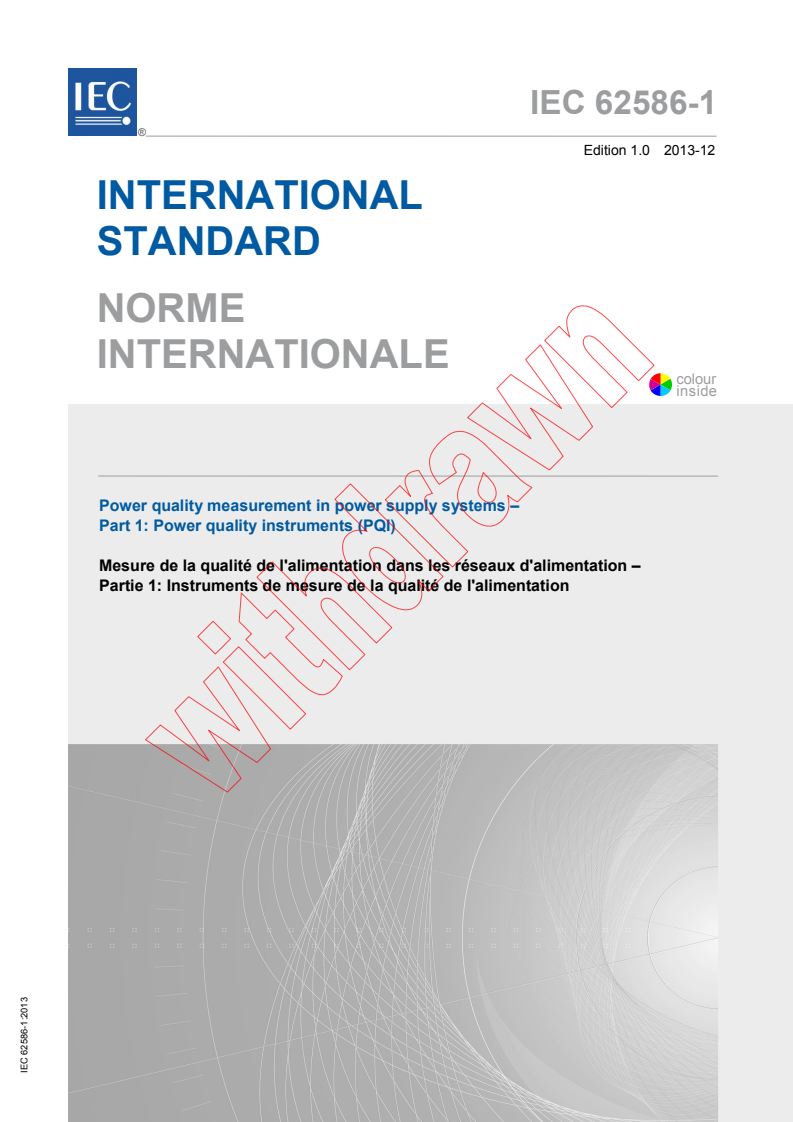
IEC 62586-1 ®
Edition 1.0 2013-12
INTERNATIONAL
STANDARD
NORME
INTERNATIONALE
colour
inside
Power quality measurement in power supply systems –
Part 1: Power quality instruments (PQI)
Mesure de la qualité de l'alimentation dans les réseaux d'alimentation –
Partie 1: Instruments de mesure de la qualité de l'alimentation
All rights reserved. Unless otherwise specified, no part of this publication may be reproduced or utilized in any form
or by any means, electronic or mechanical, including photocopying and microfilm, without permission in writing from
either IEC or IEC's member National Committee in the country of the requester.
If you have any questions about IEC copyright or have an enquiry about obtaining additional rights to this publication,
please contact the address below or your local IEC member National Committee for further information.
Droits de reproduction réservés. Sauf indication contraire, aucune partie de cette publication ne peut être reproduite ni
utilisée sous quelque forme que ce soit et par aucun procédé, électronique ou mécanique, y compris la photocopie et les
microfilms, sans l'accord écrit de la CEI ou du Comité national de la CEI du pays du demandeur.
Si vous avez des questions sur le copyright de la CEI ou si vous désirez obtenir des droits supplémentaires sur cette
publication, utilisez les coordonnées ci-après ou contactez le Comité national de la CEI de votre pays de résidence.
IEC Central Office Tel.: +41 22 919 02 11
3, rue de Varembé Fax: +41 22 919 03 00
CH-1211 Geneva 20 info@iec.ch
Switzerland www.iec.ch
About the IEC
The International Electrotechnical Commission (IEC) is the leading global organization that prepares and publishes
International Standards for all electrical, electronic and related technologies.
About IEC publications
The technical content of IEC publications is kept under constant review by the IEC. Please make sure that you have the
latest edition, a corrigenda or an amendment might have been published.
Useful links:
IEC publications search - www.iec.ch/searchpub Electropedia - www.electropedia.org
The advanced search enables you to find IEC publications The world's leading online dictionary of electronic and
by a variety of criteria (reference number, text, technical electrical terms containing more than 30 000 terms and
committee,…). definitions in English and French, with equivalent terms in
It also gives information on projects, replaced and additional languages. Also known as the International
withdrawn publications. Electrotechnical Vocabulary (IEV) on-line.
IEC Just Published - webstore.iec.ch/justpublished Customer Service Centre - webstore.iec.ch/csc
Stay up to date on all new IEC publications. Just Published If you wish to give us your feedback on this publication
details all new publications released. Available on-line and or need further assistance, please contact the
also once a month by email. Customer Service Centre: csc@iec.ch.
A propos de la CEI
La Commission Electrotechnique Internationale (CEI) est la première organisation mondiale qui élabore et publie des
Normes internationales pour tout ce qui a trait à l'électricité, à l'électronique et aux technologies apparentées.
A propos des publications CEI
Le contenu technique des publications de la CEI est constamment revu. Veuillez vous assurer que vous possédez
l’édition la plus récente, un corrigendum ou amendement peut avoir été publié.
Liens utiles:
Recherche de publications CEI - www.iec.ch/searchpub Electropedia - www.electropedia.org
La recherche avancée vous permet de trouver des Le premier dictionnaire en ligne au monde de termes
publications CEI en utilisant différents critères (numéro de électroniques et électriques. Il contient plus de 30 000
référence, texte, comité d’études,…). termes et définitions en anglais et en français, ainsi que
Elle donne aussi des informations sur les projets et les les termes équivalents dans les langues additionnelles.
publications remplacées ou retirées. Egalement appelé Vocabulaire Electrotechnique
International (VEI) en ligne.
Just Published CEI - webstore.iec.ch/justpublished
Service Clients - webstore.iec.ch/csc
Restez informé sur les nouvelles publications de la CEI.
Just Published détaille les nouvelles publications parues. Si vous désirez nous donner des commentaires sur
Disponible en ligne et aussi une fois par mois par email. cette publication ou si vous avez des questions
contactez-nous: csc@iec.ch.
IEC 62586-1 ®
Edition 1.0 2013-12
INTERNATIONAL
STANDARD
NORME
INTERNATIONALE
colour
inside
Power quality measurement in power supply systems –
Part 1: Power quality instruments (PQI)
Mesure de la qualité de l'alimentation dans les réseaux d'alimentation –
Partie 1: Instruments de mesure de la qualité de l'alimentation
INTERNATIONAL
ELECTROTECHNICAL
COMMISSION
COMMISSION
ELECTROTECHNIQUE
PRICE CODE
INTERNATIONALE
CODE PRIX V
ICS 17.220.20 ISBN 978-2-8322-1290-5
– 2 – 62586-1 © IEC:2013
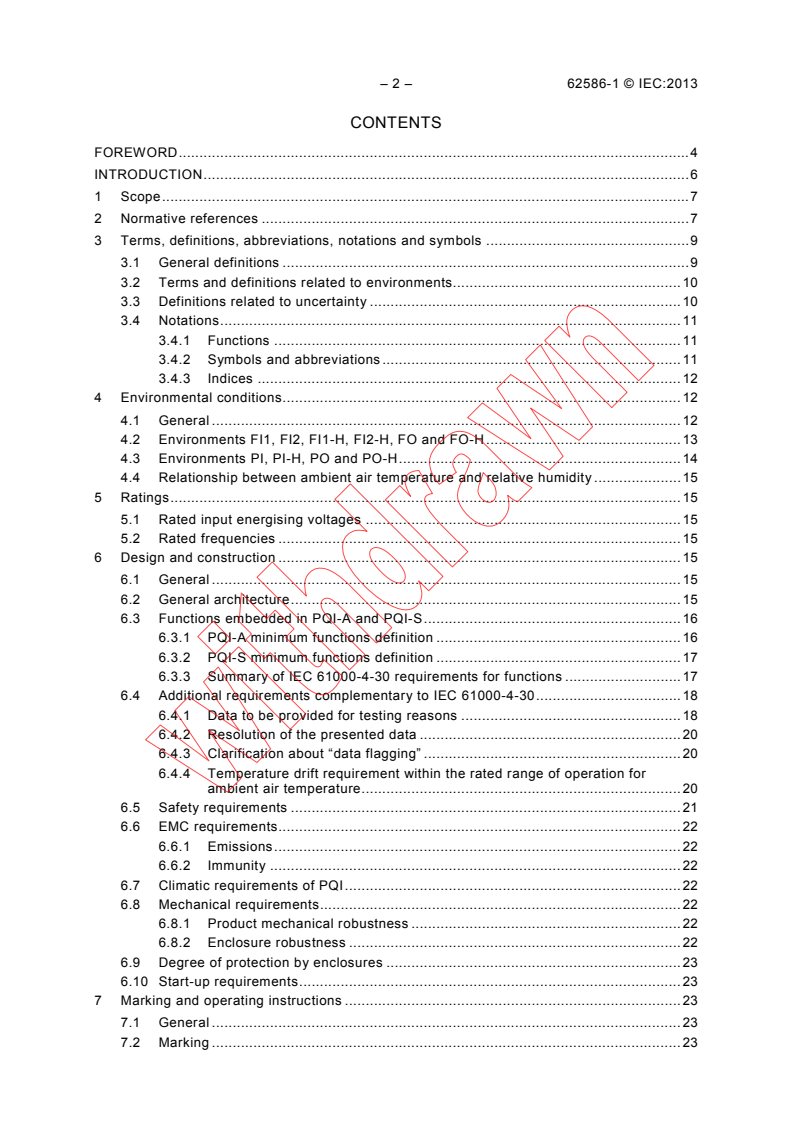
CONTENTS
FOREWORD . 4
INTRODUCTION . 6
1 Scope . 7
2 Normative references . 7
3 Terms, definitions, abbreviations, notations and symbols . 9
3.1 General definitions . 9
3.2 Terms and definitions related to environments. 10
3.3 Definitions related to uncertainty . 10
3.4 Notations . 11
3.4.1 Functions . 11
3.4.2 Symbols and abbreviations . 11
3.4.3 Indices . 12
4 Environmental conditions . 12
4.1 General . 12
4.2 Environments FI1, FI2, FI1-H, FI2-H, FO and FO-H . 13
4.3 Environments PI, PI-H, PO and PO-H . 14
4.4 Relationship between ambient air temperature and relative humidity . 15
5 Ratings . 15
5.1 Rated input energising voltages . 15
5.2 Rated frequencies . 15
6 Design and construction . 15
6.1 General . 15
6.2 General architecture . 15
6.3 Functions embedded in PQI-A and PQI-S . 16
6.3.1 PQI-A minimum functions definition . 16
6.3.2 PQI-S minimum functions definition . 17
6.3.3 Summary of IEC 61000-4-30 requirements for functions . 17
6.4 Additional requirements complementary to IEC 61000-4-30 . 18
6.4.1 Data to be provided for testing reasons . 18
6.4.2 Resolution of the presented data . 20
6.4.3 Clarification about “data flagging” . 20
6.4.4 Temperature drift requirement within the rated range of operation for
ambient air temperature . 20
6.5 Safety requirements . 21
6.6 EMC requirements . 22
6.6.1 Emissions . 22
6.6.2 Immunity . 22
6.7 Climatic requirements of PQI . 22
6.8 Mechanical requirements . 22
6.8.1 Product mechanical robustness . 22
6.8.2 Enclosure robustness . 22
6.9 Degree of protection by enclosures . 23
6.10 Start-up requirements . 23
7 Marking and operating instructions . 23
7.1 General . 23
7.2 Marking . 23
62586-1 © IEC:2013 – 3 –
7.3 Operating instructions . 23
8 Functional, environmental and safety type tests . 24
8.1 General . 24
8.2 Reference conditions for type tests . 24
8.3 Safety tests . 25
8.4 EMC tests . 25
8.4.1 Emissions . 25
8.4.2 Immunity . 25
8.5 Climatic tests . 26
8.6 Mechanical tests . 27
8.6.1 Product mechanical robustness . 27
8.6.2 Degree of protection provide by enclosures for electrical equipment
against external mechanical impacts (IK code) . 28
8.6.3 Degree of protection by enclosure (IP code) . 28
8.7 Functional and uncertainty tests . 28
9 Routine tests . 28
9.1 General . 28
9.2 Protective bonding test . 28
9.3 Dielectric strength test . 28
9.4 Intrinsic uncertainty test . 28
10 Certificates and declarations . 28
11 Re-calibration and re-verification . 28
Annex A (informative) Information about environment H and G described in
IEC/TS 61000-6-5 . 29
Bibliography . 30
Figure 1 – Instrument generic measurement chain . 16
Figure 2 – Uncertainty requirement as a function of temperature . 21
Figure A.1 – Example of power station and substation: selection of the specification
for apparatus and the related connections . 29
Table 1 – Products coding table . 12
Table 2 – Definition of class A products . 12
Table 3 – Definition of class S products . 13
Table 4 – Description of FI1, FI2, FI1-H, FI2-H, FO, FO-H environments . 13
Table 5 – Description of PI, PI-H, PO and PO-H environments . 14
Table 6 – PQI-A functions . 16
Table 7 – PQI-S minimum functions . 17
Table 8 – Summary of measurements requested for testing . 19
Table 9 – Uncertainty multipliers for different temperature ranges . 21
Table 10 – Enclosure mechanical requirements . 22
Table 11 – Minimum IP requirements . 23
Table 12 – Characteristics specification template . 24
Table 13 – Reference conditions for testing . 25
Table 14 – Climatic requirements . 26
Table 15 – Product mechanical requirements . 27
– 4 – 62586-1 © IEC:2013
INTERNATIONAL ELECTROTECHNICAL COMMISSION
____________
POWER QUALITY MEASUREMENT IN POWER SUPPLY SYSTEMS –
Part 1: Power quality instruments (PQI)
FOREWORD
1) The International Electrotechnical Commission (IEC) is a worldwide organization for standardization comprising
all national electrotechnical committees (IEC National Committees). The object of IEC is to promote
international co-operation on all questions concerning standardization in the electrical and electronic fields. To
this end and in addition to other activities, IEC publishes International Standards, Technical Specifications,
Technical Reports, Publicly Available Specifications (PAS) and Guides (hereafter referred to as “IEC
Publication(s)”). Their preparation is entrusted to technical committees; any IEC National Committee interested
in the subject dealt with may participate in this preparatory work. International, governmental and non-
governmental organizations liaising with the IEC also participate in this preparation. IEC collaborates closely
with the International Organization for Standardization (ISO) in accordance with conditions determined by
agreement between the two organizations.
2) The formal decisions or agreements of IEC on technical matters express, as nearly as possible, an international
consensus of opinion on the relevant subjects since each technical committee has representation from all
interested IEC National Committees.
3) IEC Publications have the form of recommendations for international use and are accepted by IEC National
Committees in that sense. While all reasonable efforts are made to ensure that the technical content of IEC
Publications is accurate, IEC cannot be held responsible for the way in which they are used or for any
misinterpretation by any end user.
4) In order to promote international uniformity, IEC National Committees undertake to apply IEC Publications
transparently to the maximum extent possible in their national and regional publications. Any divergence
between any IEC Publication and the corresponding national or regional publication shall be clearly indicated in
the latter.
5) IEC itself does not provide any attestation of conformity. Independent certification bodies provide conformity
assessment services and, in some areas, access to IEC marks of conformity. IEC is not responsible for any
services carried out by independent certification bodies.
6) All users should ensure that they have the latest edition of this publication.
7) No liability shall attach to IEC or its directors, employees, servants or agents including individual experts and
members of its technical committees and IEC National Committees for any personal injury, property damage or
other damage of any nature whatsoever, whether direct or indirect, or for costs (including legal fees) and
expenses arising out of the publication, use of, or reliance upon, this IEC Publication or any other IEC
Publications.
8) Attention is drawn to the Normative references cited in this publication. Use of the referenced publications is
indispensable for the correct application of this publication.
9) Attention is drawn to the possibility that some of the elements of this IEC Publication may be the subject of
patent rights. IEC shall not be held responsible for identifying any or all such patent rights.
International Standard IEC 62586-1 has been prepared by IEC technical committee 85:
Measuring equipment for electrical and electromagnetic quantities.
The text of this standard is based on the following documents:
FDIS Report on voting
85/460/FDIS 85/466/RVD
Full information on the voting for the approval of this standard can be found in the report on
voting indicated in the above table.
This publication has been drafted in accordance with the ISO/IEC Directives, Part 2.
A list of all parts of the IEC 62586 series, published under the general title Power quality
measurement in power supply systems, can be found on the IEC website.
62586-1 © IEC:2013 – 5 –
The committee has decided that the contents of this publication will remain unchanged until
the stability date indicated on the IEC web site under "http://webstore.iec.ch" in the data
related to the specific publication. At this date, the publication will be
• reconfirmed,
• withdrawn,
• replaced by a revised edition, or
• amended.
IMPORTANT – The 'colour inside' logo on the cover page of this publication indicates
that it contains colours which are considered to be useful for the correct
understanding of its contents. Users should therefore print this document using a
colour printer.
– 6 – 62586-1 © IEC:2013
INTRODUCTION
Electricity as delivered to the network users has several characteristics which are variable
and which affect its usefulness to the network user.
Power quality instruments on the market have different characteristics. This standard provides
a common system of references in order to facilitate their selection, comparison and
evaluation. This standard specifies a classification based on product performances,
environment and safety.
It is acknowledged that IEC 61000-4-30 is a basic EMC publication. Detailed guidance on
instrument performance, performance verification methods, additional influence quantities and
other similar information should, in general, be found in a product standard.
IEC 62586-1 is a product standard that refers to IEC 61000-4-30, IEC 61000-4-7 and
IEC 61000-4-15 for measuring methods. IEC 62586-2 specifies functional tests and
uncertainty requirements for instruments in the scope of IEC 62586-1.
IEC 62586-1 is therefore complementing basic EMC standards with environmental, safety and
performance requirements.
62586-1 © IEC:2013 – 7 –
POWER QUALITY MEASUREMENT IN POWER SUPPLY SYSTEMS –
Part 1: Power quality instruments (PQI)
1 Scope
This part of IEC 62586 specifies product and performance requirements for instruments
whose functions include measuring, recording and possibly monitoring power quality
parameters in power supply systems, and whose measuring methods (class A or class S) are
defined in IEC 61000-4-30.
These requirements are applicable in single, dual- (split phase) and 3-phase a.c. power
supply systems at 50 Hz or 60 Hz.
These instruments can be used:
– in the generation, transmission and distribution of electricity, for example inside a power
station, substation or a distributed generator connection.
– at the interface point between the installation and the network, e.g. in order to check the
compliance of the connection agreement between a network operator and the customer.
NOTE 1 These instruments can also be used for other applications, e.g. inside commercial / industrial
installations especially where comparable measurements are needed (i.e. data centers or petrochemical plants).
These instruments are fixed-installed or portable. They are intended to be used indoors
and/or outdoors.
Devices such as digital fault recorders, energy/power meters, protection relays or circuit
breakers may include power quality functions defined in 61000-4-30 class A or class S. If
such devices are specified according to this standard, then this standard fully applies and
applies in addition to the relevant product standard. This standard does not replace the
relevant product standard.
NOTE 2 It is not the intent of this standard to address user interface or topics unrelated to device measurement
performance.
NOTE 3 The standard does not cover post-processing and interpretation of the data, for example with a dedicated
software.
2 Normative references
The following documents, in whole or in part, are normatively referenced in this document and
are indispensable for its application. For dated references, only the edition cited applies. For
undated references, the latest edition of the referenced document (including any
amendments) applies.
IEC 60068-1, Environmental testing – Part 1: General and guidance
IEC 60068-2-1, Environmental testing – Part 2-1: Tests – Tests A: Cold
IEC 60068-2-2, Environmental testing – Part 2-2: Tests – Tests B: Dry heat
IEC 60068-2-6, Environmental testing – Part 2-6: Tests – Test Fc: Vibration (sinusoidal)
– 8 – 62586-1 © IEC:2013
IEC 60068-2-14, Environmental testing – Part 2-14 Tests – Test N: Change of temperature
IEC 60068-2-27, Environmental testing – Part 2-27: Tests – Test Ea and guidance: Shock
IEC 60068-2-31, Environmental testing – Part 2-31: Tests – Test Ec: Rough handling shocks,
primarily for equipment-type specimens
IEC 60068-2-52, Environmental testing – Part 2-52: Tests – Test Kb: Salt mist, cyclic (sodium
chloride solution)
IEC 60068-2-57, Environmental testing – Part 2-57: Tests – Test Ff: Vibration – Time-history
and sine-beat method
IEC 60068-2-78, Environmental testing – Part 2-78: Tests – Test Cab: Damp heat, steady
state
IEC 60529, Degrees of protection provided by enclosures (IP Code)
IEC 60654-1, Industrial-process measurement and control equipment – Operating conditions –
Part 1: Climatic conditions
IEC 60664-1:2007, Insulation coordination for equipment within low-voltage systems – Part 1:
Principles, requirements and tests
IEC 60721-3-1, Classification of environmental conditions – Part 3: Classification of groups of
environmental parameters and their severities – Section 1: Storage
IEC 60721-3-2, Classification of environmental conditions – Part 3: Classification of groups of
environmental parameters and their severities – Section 2: Transportation
IEC 60721-3-3, Classification of environmental conditions – Part 3: Classification of groups of
environmental parameters and their severities – Section 3: Stationary use at weatherprotected
locations
IEC 61000-4-7:2002, Electromagnetic compatibility (EMC) – Part 4-7: Testing and
measurement techniques – General guide on harmonics and interharmonics measurements
and instrumentation, for power supply systems and equipment connected thereto
Amendment 1:2008
IEC 61000-4-15:2010, Electromagnetic compatibility (EMC) – Part 4-15: Testing and
measurement techniques – Flickermeter – Functional and design specifications
IEC 61000-4-30:2008, Electromagnetic compatibility (EMC) – Part 4-30: Testing and
measurement techniques – Power quality measurement methods
IEC /TS 61000-6-5, Electromagnetic compatibility (EMC) – Part 6-5: Generic standards –
Immunity for power station and substation environments
IEC 61010-1:2010, Safety requirements for electrical equipment for measurement, control,
and laboratory use – Part 1: General requirements
IEC 61010-2-030, Safety requirements for electrical equipment for measurement, control, and
laboratory use – Part 2-030: Particular requirements for testing and measuring circuits
IEC 62262, Degrees of protection provided by enclosures for electrical equipment against
external mechanical impacts (IK code)
62586-1 © IEC:2013 – 9 –
IEC 62586-2, Power quality measurement in power supply systems – Part 2: Functional tests
and uncertainty requirements
CISPR 22, Information technology equipment – Radio disturbance characteristics – Limits and
methods of measurement
3 Terms, definitions, abbreviations, notations and symbols
For the purposes of this document, the terms and definitions given in IEC 61000-4-30 as well
as the following terms and definitions apply.
3.1 General definitions
3.1.1
power quality instrument
PQI
instrument whose main function is to measure, record and possibly monitor power quality
parameters in power supply systems, and whose measuring methods (class A or class S) are
defined in IEC 61000-4-30
3.1.2
power quality instrument class A
PQI-A
PQI whose measuring methods comply with class A of IEC 61000-4-30
3.1.3
power quality instrument class S
PQI-S
PQI whose measuring methods comply with class S of IEC 61000-4-30
3.1.4
portable instrument
portable measuring instrument
measuring instrument designed to be easily carried by hand and to be connected and
disconnected by the user
[SOURCE: IEC 60050-300:2001, 312-02-18]
3.1.5
fixed installed instrument
fixed installed measuring instrument
measuring instrument designed to be permanently mounted and which is intended to be
connected by means of permanently installed connectors
[SOURCE: IEC 60050-300:2001, 312-02-17, modified – “conductors” has been replaced by
“connectors”.]
3.1.6
panel mounted instrument
fixed installed instrument intended to be mounted in a cut out of a panel or a chassis
3.1.7
modular instrument fixed on DIN rail
fixed installed instrument intended to be used in switchgear or control gear, fixed on a DIN rail
– 10 – 62586-1 © IEC:2013
3.1.8
housing instrument fixed on DIN rail
fixed installed instrument, intended to be fixed on a DIN rail within a control panel
3.2 Terms and definitions related to environments
3.2.1
EMC environment H
harsh EMC environment
EXAMPLES High voltage stations, arc furnaces, welding, aluminium plants.
Note 1 to entry: This environment is described in IEC 61000-6-5 as H environment. A summary description of
such environments is given in Annex A.
3.2.2
EMC environment G
general EMC environment
EXAMPLES Power stations, MV and LV substations, extended industrial applications.
Note 1 to entry: This environment is described in IEC 61000-6-5 as G environment. A summary description of
such environments is given in Annex A.
3.2.3
uncontrolled environment
environment where climatic conditions such as temperature and humidity depend on external
climatic conditions and on housing of products
Note 1 to entry: Shelter or housing can be used to minimize the impact of environment.
3.2.4
controlled environment
environment where climatic conditions such as temperature and humidity are under control
Note 1 to entry: This kind of environment is usually controlled by HVAC systems.
3.2.5
limit range of operation
extreme conditions that an measuring instrument can withstand without damage and without
degradation of its metrological characteristics when it is subsequently operated within its
rated operating conditions
Note 1 to entry: Measuring instrument should be able to function within the limit range of operation
3.2.6
rated range of operation
range of values of a single influence quantity that forms a part of the rated operating
conditions
Note 1 to entry: Uncertainty requirements should be met within the rated range of operation
3.3 Definitions related to uncertainty
3.3.1
intrinsic uncertainty
uncertainty of a measuring instrument when used under reference conditions
Note 1 to entry: In this standard, it is the uncertainty of a measured value defined in its rated range and with all
influence quantities under reference conditions, unless otherwise stated.
[SOURCE: IEC 60359:2001, 3.2.10, modified – Note 1 to entry has been added.]
62586-1 © IEC:2013 – 11 –
3.3.2
influence quantity
quantity which is not the subject of the measurement and whose change affects the
relationship between the indication and the result of the measurement
Note 1 to entry: Influence quantities can originate from the measured system, the measuring equipment or the
environment.
Note 2 to entry: As the calibration diagram depends on the influence quantities, in order to assign the result of a
measurement it is necessary to know whether the relevant influence quantities lie within the specified range.
[SOURCE: IEC 60359:2001, 3.1.14, modified – Note 3 has been deleted.]
3.3.3
variation
variation due to a single influence quantity
difference between the value measured under reference conditions and any value measured
within the rated operating range (for this specific influence quantity)
Note 1 to entry: The other performance characteristics and the other influence quantities should stay within the
ranges specified for the reference conditions.
3.3.4
rated operating conditions
set of conditions that must be fulfilled during the measurement in order that a calibration
diagram may be valid
Note 1 to entry: Beside the specified measuring range and rated operating ranges for the influence quantities, the
conditions may include specified ranges for other performance characteristics and other indications that cannot be
expressed as ranges of quantities.
[SOURCE: IEC 60359:2001, 3.3.13]
3.3.5
operating uncertainty
uncertainty under the rated operating conditions
Note 1 to entry: The operating instrumental uncertainty, like the intrinsic one, is not evaluated by the user of the
instrument, but is stated by its manufacturer or calibrator. The statement may be expressed by means of an
algebraic relation involving the intrinsic instrumental uncertainty and the values of one or several influence
quantities, but such a relation is just a convenient means of expressing a set of operating instrumental
uncertainties under different operating conditions, not a functional relation to be used for evaluating the
propagation of uncertainty inside the instrument.
[SOURCE: IEC 60359:2001, 3.2.11, modified – the word "instrumental" has been removed
from both the term and the definition.]
3.3.6
overall system uncertainty
uncertainty including the uncertainty of all components related to the measurement system
(sensors, wires, measuring instrument, etc.) under the rated operating conditions
3.4 Notations
3.4.1 Functions
See functions defined in IEC 61000-4-30.
3.4.2 Symbols and abbreviations
N.R. Not requested
N.A. Not applicable
– 12 – 62586-1 © IEC:2013
3.4.3 Indices
min minimum value
max maximum value
4 Environmental conditions
4.1 General
This standard classifies power quality instruments according to the following criterion:
• instruments that are complying either with class A measurement methods of
IEC 61000-4-30 (PQI-A) or with class S measurement methods of IEC 61000-4-30 (PQI-
S);
• instruments that are either fixed installed (F), or portable (P);
• instruments that are intended to be used either Indoor (I) or Outdoor (O);
• instruments that are intended to be used in generic EMC environment G or in specific
harsh EMC environment H. See Annex A.
Instruments shall be named according to coding of Table 1. The list of all allowed instruments
is given in Table 2 and Table 3.
Table 1 – Products coding table
Power quality Functions class Fixed installed (F) Indoor (I) or EMC environment
instrument (PQI) according to or Portable (P) Outdoor (O) G (blank) or H (-H)
IEC 61000-4-30 (A instrument application
or S)
a a
PQI-A or PQI-S -FI1, -FI2, -FO, -PI or -PO Blank or -H
a
See Table 4 and Table 5.
Table 2 – Definition of class A products
Fixed installed Portable
Indoor application Outdoor Indoor application Outdoor
application application
EMC PQI-A-FI1 PQI-A-FO PQI-A-PI PQI-A-PO
environment G
PQI-A-FI2
EMC PQI-A-FI1-H PQI-A-FO-H PQI-A-PI-H PQI-A-PO-H
environment H
PQI-A-FI2-H
NOTE FI1 is an indoor environment with uncontrolled temperature variations, while FI2 is an indoor
environment with controlled temperature variations
62586-1 © IEC:2013 – 13 –
Table 3 – Definition of class S products
Fixed installed Portable
Indoor application Outdoor Indoor application Outdoor
application application
EMC PQI-S-FI1 PQI-S-FO PQI-S-PI PQI-S-PO
environment G
PQI-S-FI2
EMC PQI-S-FI1-H PQI-S-FO-H PQI-S-PI-H PQI-S-PO-H
environment H
PQI-S-FI2-H
NOTE FI1 is an indoor environment with uncontrolled temperature variations, while FI2 is an indoor
environment with controlled temperature variations
4.2 Environments FI1, FI2, FI1-H, FI2-H, FO and FO-H
Those environments are dedicated to fixed-installed instruments, used:
– in EMC environment G or in EMC environment H;
– for indoor operation or outdoor operation.
Table 4 – Description of FI1, FI2, FI1-H, FI2-H, FO, FO-H environments
Environmental parameters Storage and transport Indoor operation Outdoor operation
Ambient temperature: limit IEC 60721-3-1 / 1K5 FI1: IEC 60721-3-3 / 3K6 Depends on the
a
range of operation geographic regions or
-40 °C to + 70 °C -25 °C to + 55 °C
g
the application
IEC 60721-3-2 / 2K4 FI2: IEC 60721-3-3 / 3K5
At least the
-40 °C to + 70 °C mod.: 0 °C to +45 °C
requirements for indoor
operation are mandatory
Ambient temperature: rated --- FI1:IEC 60721-3-3 / 3K5 IEC 60721-3-3 / 3K6
b
range of operation
mod. -10 °C to + 45° -25 °C to + 55 °C
FI2:IEC 60721-3-3 / 3K5
mod. 0 °C to + 45 °C
d d d
Relative humidity: 24 h average from 5 % to 95 % from 5 % to 95 % from 5 % to 95 %
2 2
Solar radiations Negligible 700 W/m 1120 W/m
Wind-driven precipitation (rain, Negligible Negligible Significant precipitation.
snow, hail, etc.)
Air pollution by dust, salt, No significant air No significant air Significant air pollution
c c
smoke, corrosive/flammable pollution pollution by dust and salt.
gas, vapours
Vibration, earth tremors IEC 60721-3-1 / 1M1 IEC 60721-3-3 / 3M1 IEC 60721-3-3 / 3M1
IEC 60721-3-2 / 2M1
Electromagnetic Environment --- IEC 61000-6-5 IEC 61000-6-5
disturbances s FI1, FI2, environment G environment G
immunity FO
Environment --- IEC 61000-6-5 IEC 61000-6-5
s FI1-H, FI2- environment H environment H
H, FO-H
Altitude ---
≤ 2 000 m ≤ 2 000 m
Pollution degree --- 2 according to IEC 61010 2 or 3 according to
IEC 61010
– 14 – 62586-1 © IEC:2013
Environmental parameters Storage and transport Indoor operation Outdoor operation
Overvoltage category (related --- IEC 61010 Overvoltage IEC 61010 Overvoltage
e f e f
to the mains supply) category III category III
Measurement category (related --- IEC 61010 Measurement IEC 61010 Measurement
e f e f
to the measurement inputs) category III or IV category III or IV
a
See definition. Temperature may be lower on the front face of panel mounted instruments.
b
See definition.
c
These conditions correspond to maximum values given for classes 3C1 and 3S1 in IEC 60721-3-3.
d
No condensation or ice is considered. See Figure 1.
e
If the instrument is supplied by the circuit being measured, then Overvoltage category and Measurement
category shall be the same category number.
f
For guidance on the selection of the correct measurement category, see IEC 61010-2-030. For guidance on
the overvoltage category, see IEC 61010-1.
g
Limit range of operation shall be specified by manufacturer.
4.3 Environments PI, PI-H, PO and PO-H
Those environments are dedicated to portable instruments,
– used in EMC environment G or in EMC environment H
– for indoor applications or outdoor applications.
Table 5 – Description of PI, PI-H, PO and PO-H environments
Environmental parameters Storage Indoor operation outdoor operation
Ambient temperature: limit IEC 60721-3-1/ 1K5 IEC 60721-3-3 / 3K5 Depends on the
a
range of operation geographic regions or
–40 °C to + 70 °C –5 °C to + 45 °C
g
the application
IEC 60721-3-2 / 2K4
At least the
–40 °C to + 70 °C
requirements for indoor
operation are mandatory
Ambient temperature: rated --- IEC 60721-3-3 / 3K5 IEC 60721-3-3 / 3K6
b
range of operation mod. 0 °C to + 40 °C -5 °C to + 45 °C
d d d
Relative humidity: 24 h average from 5 % to 95 % from 5 % to 95 % from 5 % to 95 %
Solar radiations Negligible 700 W/m² 1 120 W/m²
Wind-driven precipitation (rain, Negligible Negligible Significant precipitation.
snow, hail, etc.)
Air pollution by dust, salt, No significant air No significant air Significant air pollution
c c
smoke, corrosive/flammable pollution pollution by dust and salt.
gas, vapours
Vibration, earth tremors IEC 60721-3-1 / 1M1 IEC 60721-3-3 / 3M2 IEC 60721-3-3 / 3M2
IEC 60721-3-2 / 2M1
Electromagnetic Environment --- IEC 61000-6- 5 IEC 61000-6- 5
disturbances s PI or PO environment G environment G
immunity
Environment --- IEC 61000-6- 5 IEC 61000-6- 5
s PI-H or PO- environment H environment H
H
Altitude
≤ 2 000 m ≤ 2 000 m ≤ 2 000 m
Pollution degree --- 2 2 or 3
Overvoltage category (related --- IEC 61010 overvoltage IEC 61010 overvoltage
e f e f
to the mains) category III category III
Measurement category (related --- IEC 61010 measurement IEC 61010 measurement
e f e f
to the measurement inputs) category III or IV category III or IV
62586-1 © IEC:2013 – 15 –
a
See definition.
b
See definition.
c
These conditions correspond to maximum values given for classes 3C1 and 3S1 in IEC 60721-3-3.
d
No condensation or ice is considered. See Figure 1.
e
If the instrument is supplied by the circuit being measured, then Overvoltage category and Measurement
category shall be the same category number.
f
For guidance on the selection of the correct measurement category, see IEC 61010-2-030. For guidance on
the overvoltage category, see IEC 61010-1.
g
Limit range of operation shall be specified by manufacturer.
4.4 Relationship between ambient air temperature and relative humidity
Classes C1 and C2 defined in IEC 60654-1 apply taking into account the values of Table 4
and Table 5.
5 Ratings
5.1 Rated input energising voltages
The preferred rated values of voltages for a.c. (r.m.s.) are those given below, together with
those values multiplied by √3 or 1/√3: 100 V; 110 V; 115 V; 120 V; 200 V; 220 V; 230 V; 240 V;
480 V; 600 V and 690 V.
The values above are preferred values however if a PQI complies with a specific country’s
requirement not covered by the above, this shall be stated by the manufacturer.
5.2 Rated frequencies
The standard rated values of frequency shall be selected from the following:
50 Hz; 60 Hz.
6 Design and construction
6.1 General
The following requirements as well as those given in IEC 62586-2 shall apply.
NOTE IEC 62586-2 specifies functional tests and uncertainty requirements for instruments in the scope of this
standard.
6.2 General architecture
Organisation of the measurement chain: the electrical quantity to be measured may be either
directly accessible, as it is generally the case in low-voltage systems, or accessible via
measurement sensor like voltage sensors (VS) or current sensors (CS).
It shall be possible to download data stored in the instrument, for example with a
communication network, or through a removable memory.
Figure 1 below specifies the general architecture of the instrument, the dotted lines show
optional units of the instrument.
– 16 – 62586-1 © IEC:2013
Communication
protocol
Communication
Data storage
unit management
Processing and
Measurement
Acquisition Management Display
evaluation
sensors
unit
unit unit
unit
Digital I/O
management
Electrical
Input signal to Measureme
input
be measured nt results
signals
Digital I/O
IEC 2947/13
Figure 1 – Instrument generic measurement chain
6.3 Functions embedded in PQI-A and PQI-S
6.3.1 PQI-A minimum functions definition
Any PQI-A shall include all the mandatory functions specified in Table 6.
Table 6 – PQI-A functions
c a
Function and data provided Requirement
Measurement method, measuring
uncertainty and measuring range
according to IEC 61000-4-30
Power Frequency M class A
10 sec data
M class A
Magnitude of the Supply Voltage
150/180 cycles, 10 minutes and 2-hours data.
Flicker M class A
10 minutes Pst and 2-hours Plt data.
Supply voltage dips and Swells M class A
Residual voltage, swell voltage and duration
Supply voltage interruptions M class A
Residual voltage and duration
Supply voltage unbalance M class A
150/180 cycles, 10 minutes and 2-hours data.
Voltage Harmonics M class A
150/180 cycles, 10 minu
...