

IEC 62819:2022
(Main)Live working - Eye, face and head protectors against the effects of electric arc - Performance requirements and test methods
General Information
- Abstract
IEC 62819:2022 is applicable to eye, face and head protectors used in work where there is a risk of exposure to an electric arc hazard. Such protectors consist of one or several devices (e.g. hood, goggles, balaclavas, face shields, helmets, etc.), which might need to be combined together in order to give protection to eye, face and head for the intended use. This document covers the performance requirements for protectors and single protective devices considering thermal, optical and mechanical hazards of an electric arc. The product covered by this document can have an impact on the environment during some or all stages of its life cycle. These impacts can range from slight to significant, be short-term or long-term, and occur at the global, regional or local level. This document does not include requirements and test provisions for the manufacturers of the product or recommendations to the users of the product for environmental improvement. However, all parties intervening in its design, manufacture, packaging, distribution, use, maintenance, repair, reuse, recovery and disposal are invited to take account of environmental considerations. Products designed and manufactured in accordance with this document contribute to the safety of the users provided they are used by skilled persons, in accordance with safe methods of work and the instructions for use.
The contents of the corrigendum of March 2024 have been included in this copy.
- Status
- Published
- Publication Date
- 15-Sep-2022
- Technical Committee
- TC 78 - Live working
- Drafting Committee
- PT 62819 - TC 78/PT 62819
- Current Stage
- PPUB - Publication issued
- Start Date
- 16-Sep-2022
- Completion Date
- 14-Oct-2022
Overview
IEC 62819:2022 is an international standard developed by the International Electrotechnical Commission (IEC) that specifies performance requirements and test methods for eye, face, and head protectors used during live working where there is a risk of electric arc exposure. The standard applies to protective devices such as hoods, goggles, balaclavas, face shields, and helmets, which may be combined to provide comprehensive protection for workers exposed to electric arc hazards. This standard addresses thermal, optical, and mechanical hazards associated with electric arcs, ensuring reliable protection to reduce injury risk.
It emphasizes the importance of design, performance testing, marking, and instructions for use, contributing to occupational safety for electricians and live working professionals. Environmental impacts of the products throughout their life cycle are acknowledged, encouraging stakeholders to consider sustainable practices during design, manufacture, and disposal.
Key Topics
- Scope and Application
IEC 62819:2022 covers protectors designed for environments with electric arc hazards, focusing on occupational safety in live electrical work. It establishes requirements that apply to individual protective devices and their combinations, designed to protect the eyes, face, and head. - Performance Requirements
The standard specifies design criteria that protect against arc-induced thermal effects, mechanical impacts, and optical hazards. This includes parameters related to heat resistance, impact resistance, transparency, and insulation. - Test Methods
Detailed test procedures verify the performance of protective devices under simulated electric arc conditions, including:- Type testing for arc rating values such as ATPV (Arc Thermal Performance Value), EBT (Energy Breakopen Threshold), and ELIM (Arc Energy Limitation).
- Assessment of 360° protection, durability of markings, optical properties, and mechanical strength.
- Tests applicable to both full assemblies and individual components.
- Marking and Instructions
Products must be clearly marked with protection ratings and manufacturing details. Comprehensive instructions for proper use, maintenance, and disposal are mandated to ensure ongoing effectiveness and safety in the field.
Applications
IEC 62819:2022 is crucial for industries and workplaces where live electrical work and maintenance are performed, such as:
- Electric power generation, transmission, and distribution
- Industrial electrical installations and maintenance
- Substations and switchgear operations
- Utilities and infrastructure maintenance teams
- Electrical safety equipment manufacturers designing and certifying protective gear
Compliance with this standard improves safety by reducing risks of severe burns, eye injury, and head trauma resulting from electric arc flashes. It supports occupational health programs and workplace safety regulations in sectors dealing with high voltage and live electrical systems.
Related Standards
To achieve comprehensive electrical safety, IEC 62819:2022 should be used alongside related IEC and ISO standards such as:
- IEC 61482 – Protective clothing against the thermal hazards of electric arcs
- IEC 60903 – Live working – Insulating gloves for electrical protection
- IEC 60529 – Degrees of protection provided by enclosures (IP Code)
- ISO 11611 and ISO 11612 – Protective clothing for welding and heat resistance
- National and regional regulations regarding electrical personal protective equipment (PPE) usage and certification
These standards collectively provide guidelines for a broad range of personal protective equipment used in electrical safety, ensuring coordinated and effective protection against arc flash and electrical hazards.
Keywords: IEC 62819, electric arc protection, eye face head protectors, live working safety, arc flash PPE, electrical safety standards, arc thermal performance, protective helmets, face shields, goggles, electric arc hazard compliance, occupational electrical safety, PPE testing methods.
Relations
- Effective Date
- 02-Feb-2024
Get Certified
Connect with accredited certification bodies for this standard

IMQ S.p.A. (Certification)
Italian electrical product certification.

SLG Prüf- und Zertifizierungs GmbH
German testing and certification body.

UL Solutions
Global safety science company with testing, inspection and certification.
Sponsored listings
Frequently Asked Questions
IEC 62819:2022 is a standard published by the International Electrotechnical Commission (IEC). Its full title is "Live working - Eye, face and head protectors against the effects of electric arc - Performance requirements and test methods". This standard covers: IEC 62819:2022 is applicable to eye, face and head protectors used in work where there is a risk of exposure to an electric arc hazard. Such protectors consist of one or several devices (e.g. hood, goggles, balaclavas, face shields, helmets, etc.), which might need to be combined together in order to give protection to eye, face and head for the intended use. This document covers the performance requirements for protectors and single protective devices considering thermal, optical and mechanical hazards of an electric arc. The product covered by this document can have an impact on the environment during some or all stages of its life cycle. These impacts can range from slight to significant, be short-term or long-term, and occur at the global, regional or local level. This document does not include requirements and test provisions for the manufacturers of the product or recommendations to the users of the product for environmental improvement. However, all parties intervening in its design, manufacture, packaging, distribution, use, maintenance, repair, reuse, recovery and disposal are invited to take account of environmental considerations. Products designed and manufactured in accordance with this document contribute to the safety of the users provided they are used by skilled persons, in accordance with safe methods of work and the instructions for use. The contents of the corrigendum of March 2024 have been included in this copy.
IEC 62819:2022 is applicable to eye, face and head protectors used in work where there is a risk of exposure to an electric arc hazard. Such protectors consist of one or several devices (e.g. hood, goggles, balaclavas, face shields, helmets, etc.), which might need to be combined together in order to give protection to eye, face and head for the intended use. This document covers the performance requirements for protectors and single protective devices considering thermal, optical and mechanical hazards of an electric arc. The product covered by this document can have an impact on the environment during some or all stages of its life cycle. These impacts can range from slight to significant, be short-term or long-term, and occur at the global, regional or local level. This document does not include requirements and test provisions for the manufacturers of the product or recommendations to the users of the product for environmental improvement. However, all parties intervening in its design, manufacture, packaging, distribution, use, maintenance, repair, reuse, recovery and disposal are invited to take account of environmental considerations. Products designed and manufactured in accordance with this document contribute to the safety of the users provided they are used by skilled persons, in accordance with safe methods of work and the instructions for use. The contents of the corrigendum of March 2024 have been included in this copy.
IEC 62819:2022 is classified under the following ICS (International Classification for Standards) categories: 13.260 - Protection against electric shock. Live working; 29.240.99 - Other equipment related to power transmission and distribution networks; 29.260.99 - Other electrical equipment for working in special conditions. The ICS classification helps identify the subject area and facilitates finding related standards.
IEC 62819:2022 has the following relationships with other standards: It is inter standard links to IEC 62819:2022/COR1:2024. Understanding these relationships helps ensure you are using the most current and applicable version of the standard.
IEC 62819:2022 is available in PDF format for immediate download after purchase. The document can be added to your cart and obtained through the secure checkout process. Digital delivery ensures instant access to the complete standard document.
Standards Content (Sample)
IEC 62819 ®
Edition 1.0 2022-09
INTERNATIONAL
STANDARD
NORME
INTERNATIONALE
colour
inside
Live working – Eye, face and head protectors against the effects of electric arc –
Performance requirements and test methods
Travaux sous tension – Protecteurs des yeux, du visage et de la tête contre les
effets de l’arc electrique – Exigences de performances et méthodes d'essai
All rights reserved. Unless otherwise specified, no part of this publication may be reproduced or utilized in any form
or by any means, electronic or mechanical, including photocopying and microfilm, without permission in writing from
either IEC or IEC's member National Committee in the country of the requester. If you have any questions about IEC
copyright or have an enquiry about obtaining additional rights to this publication, please contact the address below or
your local IEC member National Committee for further information.
Droits de reproduction réservés. Sauf indication contraire, aucune partie de cette publication ne peut être reproduite ni
utilisée sous quelque forme que ce soit et par aucun procédé, électronique ou mécanique, y compris la photocopie et
les microfilms, sans l'accord écrit de l'IEC ou du Comité national de l'IEC du pays du demandeur. Si vous avez des
questions sur le copyright de l'IEC ou si vous désirez obtenir des droits supplémentaires sur cette publication, utilisez
les coordonnées ci-après ou contactez le Comité national de l'IEC de votre pays de résidence.
IEC Secretariat Tel.: +41 22 919 02 11
3, rue de Varembé info@iec.ch
CH-1211 Geneva 20 www.iec.ch
Switzerland
About the IEC
The International Electrotechnical Commission (IEC) is the leading global organization that prepares and publishes
International Standards for all electrical, electronic and related technologies.
About IEC publications
The technical content of IEC publications is kept under constant review by the IEC. Please make sure that you have the
latest edition, a corrigendum or an amendment might have been published.
IEC publications search - webstore.iec.ch/advsearchform IEC Products & Services Portal - products.iec.ch
The advanced search enables to find IEC publications by a Discover our powerful search engine and read freely all the
variety of criteria (reference number, text, technical publications previews. With a subscription you will always have
committee, …). It also gives information on projects, replaced access to up to date content tailored to your needs.
and withdrawn publications.
Electropedia - www.electropedia.org
IEC Just Published - webstore.iec.ch/justpublished
The world's leading online dictionary on electrotechnology,
Stay up to date on all new IEC publications. Just Published
containing more than 22 300 terminological entries in English
details all new publications released. Available online and once
and French, with equivalent terms in 19 additional languages.
a month by email.
Also known as the International Electrotechnical Vocabulary
(IEV) online.
IEC Customer Service Centre - webstore.iec.ch/csc
If you wish to give us your feedback on this publication or need
further assistance, please contact the Customer Service
Centre: sales@iec.ch.
A propos de l'IEC
La Commission Electrotechnique Internationale (IEC) est la première organisation mondiale qui élabore et publie des
Normes internationales pour tout ce qui a trait à l'électricité, à l'électronique et aux technologies apparentées.
A propos des publications IEC
Le contenu technique des publications IEC est constamment revu. Veuillez vous assurer que vous possédez l’édition la
plus récente, un corrigendum ou amendement peut avoir été publié.
Recherche de publications IEC - Découvrez notre puissant moteur de recherche et consultez
webstore.iec.ch/advsearchform gratuitement tous les aperçus des publications. Avec un
La recherche avancée permet de trouver des publications IEC abonnement, vous aurez toujours accès à un contenu à jour
en utilisant différents critères (numéro de référence, texte, adapté à vos besoins.
comité d’études, …). Elle donne aussi des informations sur les
projets et les publications remplacées ou retirées. Electropedia - www.electropedia.org
Le premier dictionnaire d'électrotechnologie en ligne au monde,
IEC Just Published - webstore.iec.ch/justpublished
avec plus de 22 300 articles terminologiques en anglais et en
Restez informé sur les nouvelles publications IEC. Just
français, ainsi que les termes équivalents dans 19 langues
Published détaille les nouvelles publications parues.
additionnelles. Egalement appelé Vocabulaire
Disponible en ligne et une fois par mois par email.
Electrotechnique International (IEV) en ligne.
Service Clients - webstore.iec.ch/csc
Si vous désirez nous donner des commentaires sur cette
publication ou si vous avez des questions contactez-nous:
sales@iec.ch.
IEC Products & Services Portal - products.iec.ch
IEC 62819 ®
Edition 1.0 2022-09
INTERNATIONAL
STANDARD
NORME
INTERNATIONALE
colour
inside
Live working – Eye, face and head protectors against the effects of electric arc –
Performance requirements and test methods
Travaux sous tension – Protecteurs des yeux, du visage et de la tête contre les
effets de l’arc electrique – Exigences de performances et méthodes d'essai
INTERNATIONAL
ELECTROTECHNICAL
COMMISSION
COMMISSION
ELECTROTECHNIQUE
INTERNATIONALE
ICS 13.260; 29.240.99; 29.260.99 ISBN 978-2-8322-5690-9
– 2 – IEC 62819:2022 © IEC 2022
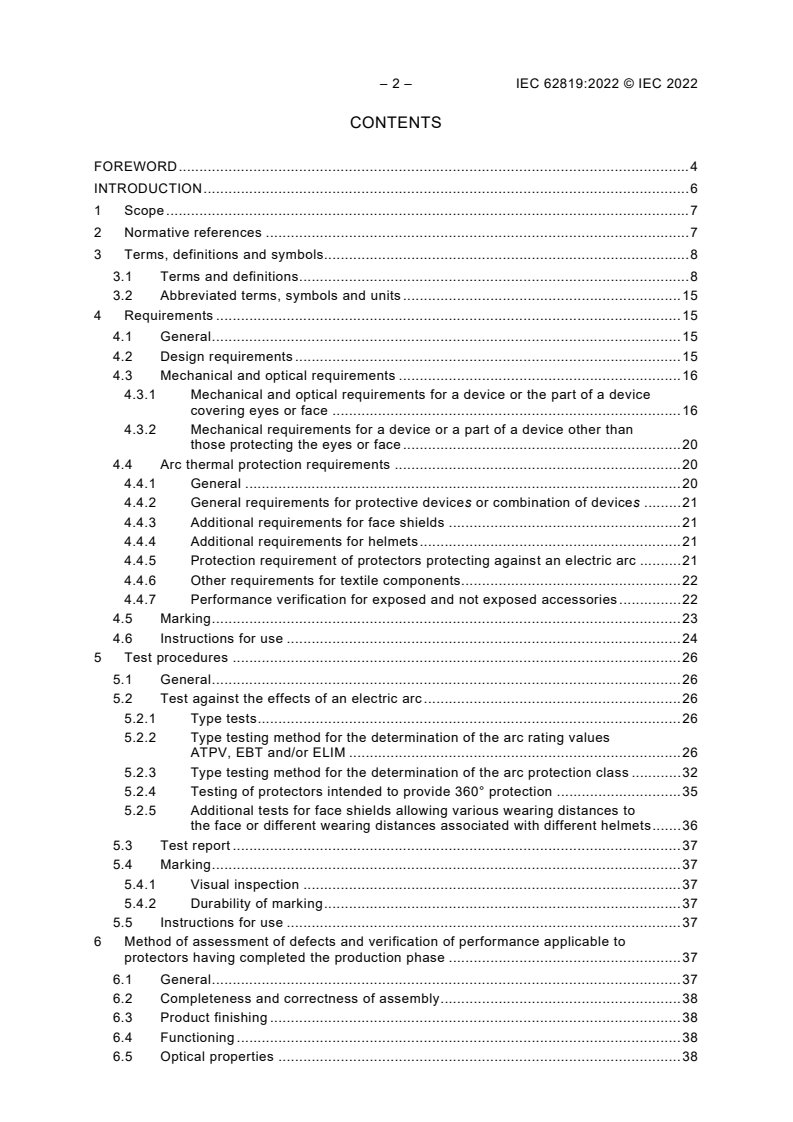
CONTENTS
FOREWORD . 4
INTRODUCTION . 6
1 Scope . 7
2 Normative references . 7
3 Terms, definitions and symbols. 8
3.1 Terms and definitions . 8
3.2 Abbreviated terms, symbols and units . 15
4 Requirements . 15
4.1 General . 15
4.2 Design requirements . 15
4.3 Mechanical and optical requirements . 16
4.3.1 Mechanical and optical requirements for a device or the part of a device
covering eyes or face . 16
4.3.2 Mechanical requirements for a device or a part of a device other than
those protecting the eyes or face . 20
4.4 Arc thermal protection requirements . 20
4.4.1 General . 20
4.4.2 General requirements for protective devices or combination of devices . 21
4.4.3 Additional requirements for face shields . 21
4.4.4 Additional requirements for helmets . 21
4.4.5 Protection requirement of protectors protecting against an electric arc . 21
4.4.6 Other requirements for textile components. 22
4.4.7 Performance verification for exposed and not exposed accessories . 22
4.5 Marking . 23
4.6 Instructions for use . 24
5 Test procedures . 26
5.1 General . 26
5.2 Test against the effects of an electric arc . 26
5.2.1 Type tests . 26
5.2.2 Type testing method for the determination of the arc rating values
ATPV, EBT and/or ELIM . 26
5.2.3 Type testing method for the determination of the arc protection class . 32
5.2.4 Testing of protectors intended to provide 360° protection . 35
5.2.5 Additional tests for face shields allowing various wearing distances to
the face or different wearing distances associated with different helmets . 36
5.3 Test report . 37
5.4 Marking . 37
5.4.1 Visual inspection . 37
5.4.2 Durability of marking . 37
5.5 Instructions for use . 37
6 Method of assessment of defects and verification of performance applicable to
protectors having completed the production phase . 37
6.1 General . 37
6.2 Completeness and correctness of assembly . 38
6.3 Product finishing . 38
6.4 Functioning . 38
6.5 Optical properties . 38
6.6 Alternative means to test protectors against the effects of an electric arc
when the production phase has been completed . 38
6.7 Packaging and labelling . 38
7 Modifications . 38
Annex A (normative) Symbol: Protection against the thermal effect of the electric arc
(IEC 60417-6353:2016-02) . 39
Annex B (informative) Marking examples . 40
Annex C (informative) Use and maintenance . 42
C.1 Use . 42
C.2 Maintenance . 42
Annex D (normative) Chronological order of type tests . 43
Annex E (normative) Classification of defects . 45
Annex F (informative) Rationale for the classification of defects . 46
Bibliography . 47
Figure 1 – Reference points . 19
Figure 2 – Schematic view of test set-up, indicating vertical and horizontal positioning
of test head on top of mannequin with respect to arc electrodes for open-arc test . 29
Figure 3 – Test head with four calorimetric sensors for open-arc test . 30
Figure 4 – Test set-up: Schematic view of test set-up, indicating vertical and horizontal
positioning of test head on top of torso with respect to arc electrodes for box-test . 33
Figure 5 – Test head with four calorimetric sensors for the box-test . 34
Table 1 – LT classes . 17
Table 2 – Minimum of specimens mounted on a test head exposed to an arc from the
side and/or the back . 36
Table B.1 – Protective performance information . 41
Table D.1 – List of type tests . 43
Table E.1 – Classification of defects and associated requirements and tests . 45
Table F.1 – Justification for the type of defect . 46
– 4 – IEC 62819:2022 © IEC 2022
INTERNATIONAL ELECTROTECHNICAL COMMISSION
____________
LIVE WORKING – EYE, FACE AND HEAD PROTECTORS
AGAINST THE EFFECTS OF ELECTRIC ARC –
PERFORMANCE REQUIREMENTS AND TEST METHODS
FOREWORD
1) The International Electrotechnical Commission (IEC) is a worldwide organization for standardization comprising
all national electrotechnical committees (IEC National Committees). The object of IEC is to promote international
co-operation on all questions concerning standardization in the electrical and electronic fields. To this end and
in addition to other activities, IEC publishes International Standards, Technical Specifications, Technical Reports,
Publicly Available Specifications (PAS) and Guides (hereafter referred to as "IEC Publication(s)"). Their
preparation is entrusted to technical committees; any IEC National Committee interested in the subject dealt with
may participate in this preparatory work. International, governmental and non-governmental organizations liaising
with the IEC also participate in this preparation. IEC collaborates closely with the International Organization for
Standardization (ISO) in accordance with conditions determined by agreement between the two organizations.
2) The formal decisions or agreements of IEC on technical matters express, as nearly as possible, an international
consensus of opinion on the relevant subjects since each technical committee has representation from all
interested IEC National Committees.
3) IEC Publications have the form of recommendations for international use and are accepted by IEC National
Committees in that sense. While all reasonable efforts are made to ensure that the technical content of IEC
Publications is accurate, IEC cannot be held responsible for the way in which they are used or for any
misinterpretation by any end user.
4) In order to promote international uniformity, IEC National Committees undertake to apply IEC Publications
transparently to the maximum extent possible in their national and regional publications. Any divergence between
any IEC Publication and the corresponding national or regional publication shall be clearly indicated in the latter.
5) IEC itself does not provide any attestation of conformity. Independent certification bodies provide conformity
assessment services and, in some areas, access to IEC marks of conformity. IEC is not responsible for any
services carried out by independent certification bodies.
6) All users should ensure that they have the latest edition of this publication.
7) No liability shall attach to IEC or its directors, employees, servants or agents including individual experts and
members of its technical committees and IEC National Committees for any personal injury, property damage or
other damage of any nature whatsoever, whether direct or indirect, or for costs (including legal fees) and
expenses arising out of the publication, use of, or reliance upon, this IEC Publication or any other IEC
Publications.
8) Attention is drawn to the Normative references cited in this publication. Use of the referenced publications is
indispensable for the correct application of this publication.
9) Attention is drawn to the possibility that some of the elements of this IEC Publication may be the subject of patent
rights. IEC shall not be held responsible for identifying any or all such patent rights.
IEC 62819 has been prepared by IEC technical committee 78: Live working. It is an International
Standard.
The text of this International Standard is based on the following documents:
Draft Report on voting
78/1397/FDIS 78/1399/RVD
Full information on the voting for its approval can be found in the report on voting indicated in
the above table.
The language used for the development of this International Standard is English.
This document was drafted in accordance with ISO/IEC Directives, Part 2, and developed in
accordance with ISO/IEC Directives, Part 1 and ISO/IEC Directives, IEC Supplement, available
at www.iec.ch/members_experts/refdocs. The main document types developed by IEC are
described in greater detail at www.iec.ch/standardsdev/publications.
Terms defined in Clause 3 are given in italic print throughout this document.
The committee has decided that the contents of this document will remain unchanged until the
stability date indicated on the IEC website under webstore.iec.ch in the data related to the
specific document. At this date, the document will be
• reconfirmed,
• withdrawn,
• replaced by a revised edition, or
• amended.
IMPORTANT – The "colour inside" logo on the cover page of this document indicates that it
contains colours which are considered to be useful for the correct understanding of its
contents. Users should therefore print this document using a colour printer.
– 6 – IEC 62819:2022 © IEC 2022
INTRODUCTION
This document has been prepared in accordance with the requirements of IEC 61477 where
applicable.
The product covered by this document can have an impact on the environment during some or
all stages of its life cycle. These impacts can range from slight to significant, be short-term or
long-term, and occur at the global, regional or local level.
This document does not include requirements and test provisions for the manufacturers of the
product or recommendations to the users of the product for environmental improvement.
However, all parties intervening in its design, manufacture, packaging, distribution, use,
maintenance, repair, reuse, recovery and disposal are invited to take account of environmental
considerations.
LIVE WORKING – EYE, FACE AND HEAD PROTECTORS
AGAINST THE EFFECTS OF ELECTRIC ARC –
PERFORMANCE REQUIREMENTS AND TEST METHODS
1 Scope
This document is applicable to eye, face and head protectors used in work where there is a risk
of exposure to an electric arc hazard.
Such protectors consist of one or several devices (e.g. hood, goggles, balaclavas, face shields,
helmets, etc.), which might need to be combined together in order to give protection to eye,
face and head for the intended use.
This document covers the performance requirements for protectors and single protective
devices considering thermal, optical and mechanical hazards of an electric arc.
Because of the limitations of test apparatus at very high energy arcs, no arc rating above
2 2
4 100 kJ/m (100 cal/cm ) can be assigned to protectors.
This document does not cover protection against electric shock, noise, the consequences of
physical and mental shock and the toxic influences caused by an electric arc.
This document does not cover protectors for work intentionally using an electric arc, e.g. arc
welding, plasma torch.
This document does not cover face-screens for the reduction of an electric field inside
conductive clothing in accordance with IEC 60895.
Any other claims of the manufacturer for protection against other hazards to eye or face (e.g.
welding radiation, hazards occurring during fire-fighting) are outside the scope of the document.
Products designed and manufactured in accordance with this document contribute to the safety
of the users provided they are used by skilled persons, in accordance with safe methods of
work and the instructions for use.
2 Normative references
The following documents are referred to in the text in such a way that some or all of their content
constitutes requirements of this document. For dated references, only the edition cited applies.
For undated references, the latest edition of the referenced document (including any
amendments) applies.
IEC 60417, Graphical symbols for use on equipment (available at http://www.graphical-
symbols.info/equipment)
IEC 61318:2021, Live working – Methods for assessment of defects and verification of
performance applicable to tools, devices and equipment
IEC 61477:2009, Live working – Minimum requirements for the utilization of tools, devices and
equipment
– 8 – IEC 62819:2022 © IEC 2022
IEC 61482-1-1:2019, Live working – Protective clothing against the thermal hazards of an
electric arc – Part 1-1: Test methods – Method 1: Determination of the arc rating (ELIM, ATPV
and/or EBT) of clothing materials and of protective clothing using an open arc
IEC 61482-1-2:2014, Live working – Protective clothing against the thermal hazards of an
electric arc – Part 1-2: Test methods – Method 2: Determination of arc protection class of
material and clothing by using a constrained and directed arc (box test)
IEC 61482-2:2018, Live working – Protective clothing against the thermal hazards of an electric
arc – Part 2: Requirements
ISO 3758:2012, Textiles – Care labelling code using symbols
ISO 15025:2016, Protective clothing – Protection against flame – Method of test for limited
flame spread
ISO 16321-1:2021, Eye and face protection for occupational use – Part 1: General requirements
ISO 16321-2:2021, Eye and face protection for occupational use – Part 2: Additional
requirements for protectors used during welding and related techniques
ISO 16976 (all parts), Respiratory protective devices – Human factors
ISO 18526-2:2020, Eye and face protection – Test methods – Part 2: Physical optical properties
ISO 18526-3:2020, Eye and face protection – Test methods – Part 3: Physical and mechanical
properties
3 Terms, definitions and symbols
3.1 Terms and definitions
For the purposes of this document, the following terms and definitions apply.
ISO and IEC maintain terminological databases for use in standardization at the following
addresses:
• ISO Online browsing platform: available at https://www.iso.org/obp
• IEC Electropedia: available at http://www.electropedia.org/
3.1.1
arc protection class
APC
class of arc thermal protection of a product tested in accordance with the
box test method
Note 1 to entry: The arc protection class is characterized by the test energy level of arc exposure (arc energy and
incident energy).
Note 2 to entry: The box test method defines two arc protection classes APC 1 and APC 2.
[SOURCE: IEC 60050-651:2022,651-27-03]
3.1.2
arc rating
quantity, attributed to a product, that describes the protective performance
when tested in accordance with the open arc test
Note 1 to entry: The arc rating can be the arc thermal performance value (ATPV), the breakopen threshold energy
(EBT) or the incident energy limit (ELIM).
2 2
Note 2 to entry: The arc rating values are expressed in kJ/m (cal/cm ).
[SOURCE: IEC 60050-651:2022, 651-27-04]
3.1.3
arc thermal performance value
ATPV
quantity of incident energy attributed to a product that describes its
properties of attenuating the thermal effect of energy generated by an open arc
Note 1 to entry: The ATPV of a product is calculated in principle using logistic regression analysis applied to the
data points obtained from testing a sufficiently large set of test specimens. It is the value of incident energy at which
the heat transfer through the test specimens is enough to reach the Stoll criteria with 50 % probability.
Note 2 to entry: However, the ATPV attributed to a product in accordance with this document is either equal to or
lower than the ATPV of the product calculated by taking only the Stoll criteria into account, depending on whether
the tested specimen(s) fulfil also additional visual design and performance assessment criteria.
Note 3 to entry: Depending on further visual design and performance assessment criteria, the calculation of the
value of the ATPV attributed to a product can be based on a smaller set of test specimens than needed for the
determination of the ATPV by logistic regression analysis.
[SOURCE: IEC 60050-651:2022, 651-27-05, modified – The notes to entry have been added.]
3.1.4
arc thermal protection
degree of thermal protection offered against an electric arc under specific
arc testing conditions indicated by either an arc rating or an arc protection class
[SOURCE: IEC 60050-651:2022, 651-27-06]
3.1.5
auto darkening filter
optical filter which varies the transmittance in the visible region of the spectrum depending on
the presence of light emitted by an electric arc
Note 1 to entry: An auto darkening filter combines a filter with automatically adapting light transmittance with a
passive UV and a passive IR filter. It varies the transmittance in the visible region of the spectrum, depending on the
presence of light emitted by an electric arc. The luminous transmittance of the auto darkening filter has an initial high
value (light state). After ignition of the arc, within a certain switching time, the luminous transmittance of the filter
changes to a low value (dark state). Auto darkening filters include a (clear or tinted) cover plate and a (clear or tinted)
inside plate.
Note 2 to entry: Luminous transmittance (shade), switching time, variations of luminous transmittance
(homogeneity) and angle dependence are the main specific characteristics of an auto darkening filter.
3.1.6
balaclava
one-piece garment designed to fit closely over the entire head and to extend downwards to
cover the neck, but leaving the area of the eyes and at most the area of the eyes, nose and
mouth uncovered
[SOURCE: ISO/TR 11610:2004, 3.22, modified – The area of the head not covered has been
specified.]
– 10 – IEC 62819:2022 © IEC 2022
3.1.7
breakopen
material response evidenced by the formation of one or more openings in
the material specimen
[SOURCE: IEC 60050-651:2022, 651-27-09]
3.1.8
breakopen threshold energy
EBT
quantity of incident energy attributed to a product (material or equipment)
that describes the properties of a breakopen when exposed to heat energy generated by an
open arc test
Note 1 to entry: The EBT of a product is calculated in principle using logistic regression analysis applied to the data
points obtained from testing a sufficiently large set of test specimens. It is the value of incident energy at which
breakopen occurs with 50 % probability.
Note 2 to entry: However, the EBT attributed to a product according to this document is either equal to or lower
than the calculated EBT of the product, depending on whether the tested specimen(s) fulfil also additional visual
design and performance assessment criteria.
Note 3 to entry: Depending on further visual design and performance assessment criteria, the calculation of the
value of the EBT attributed to a product can be based on a smaller set of test specimens than needed for the
determination of the EBT by logistic regression analysis.
[SOURCE: IEC 60050-651:2022, 651-27-10, modified – The notes to entry have been added.]
3.1.9
burning time
time for which a flaming of the test specimen is visible after the end of the electric arc duration
Note 1 to entry: Burning time is expressed in seconds (s).
[SOURCE: IEC 61482-1-1:2019, 3.1.11, modified – The second preferred term has been
deleted.]
3.1.10
component
part of a protective device, such as a window in a hood or a bracket to a face shield
3.1.11
charring
formation of carbonaceous residue as the result of pyrolysis or incomplete combustion
[SOURCE: ISO 17492:2019, 3.3]
3.1.12
chin protector
component specifically designed to protect the chin
EXAMPLE Chin-cups, chin-curtains.
Note 1 to entry: Chin protection can be provided by a scarf, which also protects the neck.
3.1.13
closed hood
bee keeper hood
hood with an integrated face shield
Note 1 to entry: The term "bee keeper hood" is used as a synonym for "closed hood".
Note 2 to entry: In some countries, safety helmets are mandatory for a closed hood design.
3.1.14
device
product (e.g. goggles, eye-guard/eye shield/face shield, balaclava,
helmet), possibly combined with additional products for the side and/or the top of the head
and/or the neck in order to give protection to eye, face and head for the intended use
3.1.15
electric arc
self-maintained gas conduction for which most of the charge carriers are electrons supplied by
primary-electron emission
Note 1 to entry: During live working, the electric arc is generated by gas ionization arising from an unintentional
electrical conducting connection or electric breakdown between live parts or a live part and the earth path of an
electrical installation or an electrical device.
Note 2 to entry: During testing, the electric arc is initiated by the current through a fuse wire and its vaporization.
[SOURCE: IEC 60050-121:1998, 121-13-12, modified – Two notes to entry applicable to live
working have been added.]
3.1.16
electrically insulating helmet
safety helmet which protects the wearer against electric shocks by preventing the passage of
dangerous current through the body via the head
[SOURCE: EN 50365:2002, 3.1]
3.1.17
eye shield
device which provides protection to the eye area
[SOURCE: ISO 4007:2018, 3.5.1.4, modified – In the definition, "protector" has been replaced
by "device".]
3.1.18
face shield
eye protective device covering the eyes and all, or a substantial part, of the face, which can be
mounted directly or by help of an adjustable or non-adjustable carrier on the head using a
support (headband) and/or harness, or mounted by help of an adjustable or non-adjustable
carrier on a helmet
Note 1 to entry: See also visor (3.1.35).
Note 2 to entry: Coverage can include parts or all of the scalp, the ears, the throat and the neck.
Note 3 to entry: The areas to be protected are defined in the relevant standard, and should not automatically be
assumed to be the same as the areas covered.
[SOURCE: ISO 4007:2018, 3.5.1.6, modified – The definition has been modified to include use
of adjustable or non-adjustable carriers. Note 1 to entry has been deleted.]
– 12 – IEC 62819:2022 © IEC 2022
3.1.19
filter
optical filter
lens intended to protect the eye from excessive incident radiation by attenuating that radiation,
generally within a given wavelength range
Note 1 to entry: Attenuation can be by reflection and/or absorption; it might be neutral (i.e. relatively uniform) or
selective (i.e. coloured) across the wavelength range of optical radiation, and might be polarizing.
Note 2 to entry: A notch filter, usually made by multi-layer interference coating, is substantially neutral but has a
pronounced absorption over a narrow bandwidth of wavelengths in order to absorb radiation from, for example, an
LED or laser source.
[SOURCE ISO 4007:2018, 3.10.1.1, modified – The definition has been modified by added
"excessive". Note 3 to entry has been deleted.]
3.1.20
frame
structural component which supports and/or supplements the lens
Note 1 to entry: A frame can be transparent or not.
Note 2 to entry: Chin cups and chin curtains are considered as supplements.
3.1.21
goggle
eye protective device that fully encloses the orbital area and fits firmly on the face
[SOURCE: ISO 4007:2018, 3.5.1.7, modified – In the definition, "protector" has been replaced
by "eye protective device".]
3.1.22
helmet
device which covers a substantial part of the head
[SOURCE: ISO 4869-1:2018, 3.4]
3.1.23
hood
product covering all areas of the head including or not the face and covering the neck (possibly
offering 360° coverage, and if not an integral part of the clothing), covering also the shoulder
area of the protective clothing, and not fitting closely over the entire head, possibly designed
for being supported by a helmet
3.1.24
ignition
initiation of flaming and combustion
[SOURCE: IEC 61482-1-1:2019, 3.1.22]
3.1.25
incident energy
E
i
heat energy resulting from an electric arc, received at a unit surface area
at a specified distance from the electric arc
[SOURCE: IEC 60050-651:2022, 651-27-11]
3.1.26
incident energy limit
ELIM
quantity of incident energy attributed to a product (material or equipment),
below which the values of all product responses are underneath the Stoll curve and without
leading to a breakopen
Note 1 to entry: The ELIM of a material or material assembly is calculated from data points obtained from testing a
set of test specimens, which are also used for the determination of the ATPV and/or EBT.
Note 2 to entry: However, the value of the ELIM attributed to a product in accordance with this document is either
equal to or lower than the calculated ELIM of the product, depending on whether the tested specimen(s) fulfil also
additional visual design and performance assessment criteria.
Note 3 to entry: Depending on further visual design and performance assessment criteria, the calculation of the
value of the ELIM attributed to a product can be based on a smaller set of test specimens than needed for the
determination of the ATPV and/or EBT.
[SOURCE: IEC 60050-651:2022, 651-27-12, modified – Three notes to entry have been added.]
3.1.27
lens
DEPRECATED: ocular
light transmitting part of an eye or face protective device that permits vision
Note 1 to entry: The word "ocular" has mostly been used in Europe, "lens" in many other countries. For the purposes
of eye and face protection, the word "lens" includes a focal lenses, corrective lenses, prescription lenses and is
sometimes also used, for example, in sunglasses, for tinted lenses, although these are generally termed filters.
Note 2 to entry: For the purposes of eye and face protection, the word "lens" includes both lenses covering a single
eye and lenses covering both eyes.
Note 3 to entry: When used as an adjective in eye and face protection standards, the word "ocular" has its normal
dictionary meaning, i.e. relating to the eye.
Note 4 to entry: The lens can be made of glass or plastic.
3.1.28
material
substance of which an item of protective equipment is made
[SOURCE: IEC 60050-651:2022, 651-27-20, modified – In the definition, the words "excluding
hardware" have been deleted.]
3.1.29
open hood
hood where the eyes and part of the face are not covered
Note 1 to entry: It requires additional device(s) for providing eye and full-face protection.
3.1.30
protector
product that can consist of one or more protective devices that offers protective performance
required by this document for the area which is covered by the device
Note 1 to entry: The required protective performance is defined by the corresponding product standard.
[SOURCE: IEC 60050-651:2022, 651-27-22, modified – The type of protective performance is
specified in the definition.]
– 14 – IEC 62819:2022 © IEC 2022
3.1.31
Stoll curve
empirical model used to predict skin burn injury from thermal energy exposure
Note 1 to entry: The Stoll curve defines a relationship between the absorbed energy rate and the human skin
tolerance time.
Note 2 to entry: The Stoll curve is defined in [1].
[SOURCE: IEC 60050-651:2022, 651-27-23]
3.1.32
textile component
part of a device, which is made from textiles
Note 1 to entry: Textile components describe protection relevant components made from textiles, like the textile
part of hoods. Small textile parts, like ribbons or yarns, cannot be arc-rated and are not included in this definition.
3.1.33
trained observer
person trained in testing of eye and face protectors with a binocular visual acuity of a minimum
of 1,0 (6/6 or 20/20) and wearing the appropriate refractive correction, if necessary, for the
observation distance of the test
[SOURCE: ISO 4007:2018, 3.11.1, modified – In the definition, "decimal" has been deleted.]
3.1.34
transmitted incident energy
E
it
incident energy received at a calorimeter when testing a product
Note 1 to entry: Transmitted incident energy is the fraction of the emitted incident energy which is transmitted
through the specimen.
2 2 2 2
Note 2 to entry: Transmitted incident energy is expressed in kJ/m or kWs/m (cal/cm ) where 1 cal/cm =
2 2 2
41,840 kJ/m ; 1 kJ/m = 0,023 900 6 cal/cm .
[SOURCE: IEC 61482-1-2:2014, 3.1.34, modified – The word "incident" has been added to the
term, the words "material or clothing" have been replaced with "a product", and Note 2 to entry
has been extended for clarification.]
3.1.35
visor
eye protector covering either the eye area or both the eye area and all or parts of the face and
offering protective performance required by this document for the area which is covered by the
device
Note 1 to entry: This term has variable common usage:
• it is sometimes used to mean the same as face shield;
• it is sometimes used to mean only the lens and its surround, if any, part of a face shield that provides the
protection to the eyes and face (the deprecated term "window" is sometimes also used for this);
• it is sometimes used to mean the lens and its surround, if any, that is mounted on a helmet; and
• it is sometimes used to mean the lens and its surround, if any, in a full face tight- or loose-fitting respiratory
protective device.
Note 2 to entry: The areas to be protected are defined in the relevant standard and should not automatically be
assumed to be the same as the areas covered.
[SOURCE: ISO 4007:2018, 3.5.1.13, modified – The definition has been adapted to this
document with respect to the specific coverage aspects to gain the protective performance.]
3.2 Abbreviated terms, symbols and units
APC arc protection class
2 2
ATPV arc thermal performance value kJ/m (cal/cm )
2 2
EBT breakopen threshold energy kJ/m (cal/cm )
E 2
i incident energy kJ/m
2 2
ELIM incident energy limit kJ/m (cal/cm )
LT luminous transmittance
T temperature K
t time s
τ
light transmitted %
4 Requirements
4.1 General
Protectors and single protective devices in accordance with this document typically consist of
or are assembled from the following components:
• a lens (filter) in front of the eyes that may also cover other parts of face and head. Such a
filter may provide coverage
– only to the eyes (e.g. when incorporated into goggles or eye shields), or
– to the eyes and part of the face (e.g. when used as – or as a part of – a face shield or
as a window of a hood), or
– to the full face (e.g. when being the full-face covering component of a full face shield);
• components to carry this lens (e.g. filters, goggles, eye shield, face shield) directly on the
head or to mount to a headband, head-harness or helmet bracket (face shield carrier);
• a helmet to carry, for example, a face shield or a hood;
• further components providing additional face and/or head coverage, such as lateral
protection, chin protection (e.g. chin-cup, chin-curtain), neck protection, protection for top
and back of head;
• further components for special applications (e.g. carriers for respirators, etc.).
Textile components of the protector shall meet the relevant requirements in accordance with
IEC 61482-2:2018, 4.2, and all the requirements for materials in accordance with
IEC 61482-2:2018, 4.3.
Where a protector consists of different components and/or devices, it shall be assembled according
to the instructions for use and shall be evaluated for its arc protective performance as a complete
protector.
Protectors requiring supply of breathing air (e.g. some designs of balaclavas or hoods) shall
meet also the requirements of applicable national standards and/or the ISO 16976 series.
4.2 Design requirements
General design requirements for eye, face and head protective devices and combinations of
devices are given in
• ISO 16321-1:2021, 4.2 "Physiological compatibility",
• ISO 16321-1:2021, 4.3 "Construction and adjustment",
– 16 – IEC 62819:2022 © IEC 2022
• ISO 16321-1:2021, 4.4 "Cleaning and/or Disinfection",
• ISO 16321-1:2021, 4.5 "Head forms",
• ISO 16321-1:2021, 7.2 "Headbands and harnesses", and
• ISO 16321-1:2021, 7.3 "Quality of material and surface of mounted and un-mounted lenses,
visors and filters".
Protective devices shall have no exposed metal parts. All external edges of the protector shall
be radiused, chamfered or otherwise treated to eliminate sharp edges (see also Annex C).
Hoods shall be designed to provide 360° coverage of the head (closed hoods) or provide
coverage to the full head except for the eyes and part of the face (open hoods). They shall
cover the head and the neck down to the shoulder if this protection is not provided as an integral
part of the protective clothing worn by the worker. Closed hoods may not fit closely over the
entire head and may be designed to be supported by a helmet.
Hoods shall be designed to provide the same arc thermal protection to all parts of the face,
head and body covered by the hood. Hoods may not fit closely over the entire head and may
be designed for being supported by a helmet.
If a h
...