

IEC 61754-7-2:2017
(Main)Fibre optic interconnecting devices and passive components - Fibre optic connector interfaces - Part 7-2: Type MPO connector family - Two fibre rows
General Information
- Abstract
IEC 61754-7-2:2017 defines the standard interface dimensions for the type MPO family of connectors with two rows of fibres. This first edition of IEC 61754-7-2, along with the first edition of IEC 61754-7-1, cancels and replaces the third edition of IEC 61754-7 published in 2008. This first edition of IEC 61754-7-2 includes the two fibre row MPO variants including the addition of active device receptacles and up-angled plugs. The first edition of IEC 61754-7-1 includes the one fibre row MPO variants and related active device receptacles and up-angled plugs.
Keywords: interface dimensions for the type MPO family of connectors with two rows of fibres
- Status
- Published
- Publication Date
- 12-Dec-2017
- Technical Committee
- SC 86B - Fibre optic interconnecting devices and passive components
- Current Stage
- PPUB - Publication issued
- Start Date
- 13-Dec-2017
- Completion Date
- 22-Dec-2017
Buy Documents
IEC 61754-7-2:2017 - Fibre optic interconnecting devices and passive components - Fibre optic connector interfaces - Part 7-2: Type MPO connector family - Two fibre rows Released:12/13/2017
IEC 61754-7-2:2017 - Fibre optic interconnecting devices and passive components - Fibre optic connector interfaces - Part 7-2: Type MPO connector family - Two fibre rows Released:7/27/2020
Overview
IEC 61754-7-2:2017 specifies the interface dimensions for the type MPO family of connectors with two rows of fibres. This first edition defines standardized mechanical interfaces for MPO connectors carrying 16–24 fibres arranged in two rows. It updates and splits the previous IEC 61754-7 (2008) into two parts (61754-7-1 for one-row variants and 61754-7-2 for two-row variants) and adds support for active device receptacles and up-angled plugs.
Key topics and technical requirements
- Standard interface dimensions for the MPO two-row family, enabling consistent mating across manufacturers.
- Connector geometry: the parent MPO ferrule is typically 6.4 mm × 2.5 mm and uses two 0.7 mm alignment pins.
- Fibre counts and arrangement: supports arrays of 16 to 24 fibres in a two-layer (two-row) configuration.
- Connector types covered:
- MPO female plug (without pins) and MPO male plug (with fixed pins)
- Angled interfaces: down-angled and up-angled plugs
- Flat interfaces
- Adaptors with opposed or aligned keyway configurations
- Backplane and printed circuit board housings
- Active device receptacles (angled and flat interfaces)
- Mechanical features and mating:
- Push–pull coupling mechanism and ferrule spring loaded toward the optical axis
- Single male key to orient and limit relative mating position
- Defined intermateability rules: which plug types and adaptor/key configurations can mate (opposed vs aligned keyways determine compatible up/down or mixed angled plugs)
- Documentation includes detailed figures, gauge definitions and dimensional tables to support design and conformity assessment.
- Note on intellectual property: the standard flags potential patent claims related to MPO connectors and lists known contacts; implementers should review patent information.
Practical applications and users
IEC 61754-7-2 is used by:
- Connector and cable manufacturers designing compliant MPO plugs, adaptors, housings and active-device receptacles
- Data center architects and system integrators specifying high-density MPO deployments for 40/100 G and parallel optics
- Equipment designers creating backplane/PCB receptacles and optical transceiver modules
- Test labs and quality teams verifying intermateability and dimensional conformance
- Standards and procurement teams ensuring cross-vendor compatibility for multi-fibre MPO links
Adopting IEC 61754-7-2 ensures reliable mechanical mating, predictable alignment, and interoperability for two-row MPO assemblies.
Related standards
- IEC 61754-7-1 (one fibre row MPO variants and related receptacles)
- Other parts of the IEC 61754 series covering fibre optic connector interfaces
Keywords: interface dimensions for the type MPO family of connectors with two rows of fibres, MPO two-row interface, MPO connector dimensions, MPO intermateability.
Relations
- Effective Date
- 05-Sep-2023
Buy Documents
IEC 61754-7-2:2017 - Fibre optic interconnecting devices and passive components - Fibre optic connector interfaces - Part 7-2: Type MPO connector family - Two fibre rows Released:12/13/2017
IEC 61754-7-2:2017 - Fibre optic interconnecting devices and passive components - Fibre optic connector interfaces - Part 7-2: Type MPO connector family - Two fibre rows Released:7/27/2020
Get Certified
Connect with accredited certification bodies for this standard

ANCE
Mexican certification and testing association.

BSMI (Bureau of Standards, Metrology and Inspection)
Taiwan's standards and inspection authority.

Intertek Slovenia
Intertek testing, inspection, and certification services in Slovenia.
Sponsored listings
Frequently Asked Questions
IEC 61754-7-2:2017 is a standard published by the International Electrotechnical Commission (IEC). Its full title is "Fibre optic interconnecting devices and passive components - Fibre optic connector interfaces - Part 7-2: Type MPO connector family - Two fibre rows". This standard covers: IEC 61754-7-2:2017 defines the standard interface dimensions for the type MPO family of connectors with two rows of fibres. This first edition of IEC 61754-7-2, along with the first edition of IEC 61754-7-1, cancels and replaces the third edition of IEC 61754-7 published in 2008. This first edition of IEC 61754-7-2 includes the two fibre row MPO variants including the addition of active device receptacles and up-angled plugs. The first edition of IEC 61754-7-1 includes the one fibre row MPO variants and related active device receptacles and up-angled plugs. Keywords: interface dimensions for the type MPO family of connectors with two rows of fibres
IEC 61754-7-2:2017 defines the standard interface dimensions for the type MPO family of connectors with two rows of fibres. This first edition of IEC 61754-7-2, along with the first edition of IEC 61754-7-1, cancels and replaces the third edition of IEC 61754-7 published in 2008. This first edition of IEC 61754-7-2 includes the two fibre row MPO variants including the addition of active device receptacles and up-angled plugs. The first edition of IEC 61754-7-1 includes the one fibre row MPO variants and related active device receptacles and up-angled plugs. Keywords: interface dimensions for the type MPO family of connectors with two rows of fibres
IEC 61754-7-2:2017 is classified under the following ICS (International Classification for Standards) categories: 17.140.50 - Electroacoustics; 33.180.20 - Fibre optic interconnecting devices. The ICS classification helps identify the subject area and facilitates finding related standards.
IEC 61754-7-2:2017 has the following relationships with other standards: It is inter standard links to IEC 61754-7:2008. Understanding these relationships helps ensure you are using the most current and applicable version of the standard.
IEC 61754-7-2:2017 is available in PDF format for immediate download after purchase. The document can be added to your cart and obtained through the secure checkout process. Digital delivery ensures instant access to the complete standard document.
Standards Content (Sample)
IEC 61754-7-2 ®
Edition 1.0 2017-12
INTERNATIONAL
STANDARD
Fibre optic interconnecting devices and passive components – Fibre optic
connector interfaces –
Part 7-2: Type MPO connector family – Two fibre rows
All rights reserved. Unless otherwise specified, no part of this publication may be reproduced or utilized in any form
or by any means, electronic or mechanical, including photocopying and microfilm, without permission in writing from
either IEC or IEC's member National Committee in the country of the requester. If you have any questions about IEC
copyright or have an enquiry about obtaining additional rights to this publication, please contact the address below or
your local IEC member National Committee for further information.
IEC Central Office Tel.: +41 22 919 02 11
3, rue de Varembé Fax: +41 22 919 03 00
CH-1211 Geneva 20 info@iec.ch
Switzerland www.iec.ch
About the IEC
The International Electrotechnical Commission (IEC) is the leading global organization that prepares and publishes
International Standards for all electrical, electronic and related technologies.
About IEC publications
The technical content of IEC publications is kept under constant review by the IEC. Please make sure that you have the
latest edition, a corrigenda or an amendment might have been published.
IEC Catalogue - webstore.iec.ch/catalogue Electropedia - www.electropedia.org
The stand-alone application for consulting the entire The world's leading online dictionary of electronic and
bibliographical information on IEC International Standards, electrical terms containing 20 000 terms and definitions in
Technical Specifications, Technical Reports and other English and French, with equivalent terms in 16 additional
documents. Available for PC, Mac OS, Android Tablets and languages. Also known as the International Electrotechnical
iPad. Vocabulary (IEV) online.
IEC publications search - www.iec.ch/searchpub IEC Glossary - std.iec.ch/glossary
The advanced search enables to find IEC publications by a 65 000 electrotechnical terminology entries in English and
variety of criteria (reference number, text, technical French extracted from the Terms and Definitions clause of
committee,…). It also gives information on projects, replaced IEC publications issued since 2002. Some entries have been
and withdrawn publications. collected from earlier publications of IEC TC 37, 77, 86 and
CISPR.
IEC Just Published - webstore.iec.ch/justpublished
Stay up to date on all new IEC publications. Just Published IEC Customer Service Centre - webstore.iec.ch/csc
details all new publications released. Available online and If you wish to give us your feedback on this publication or
also once a month by email. need further assistance, please contact the Customer Service
Centre: csc@iec.ch.
IEC 61754-7-2 ®
Edition 1.0 2017-12
INTERNATIONAL
STANDARD
Fibre optic interconnecting devices and passive components – Fibre optic
connector interfaces –
Part 7-2: Type MPO connector family – Two fibre rows
INTERNATIONAL
ELECTROTECHNICAL
COMMISSION
ICS 33.180.20 ISBN 978-2-8322-5066-2
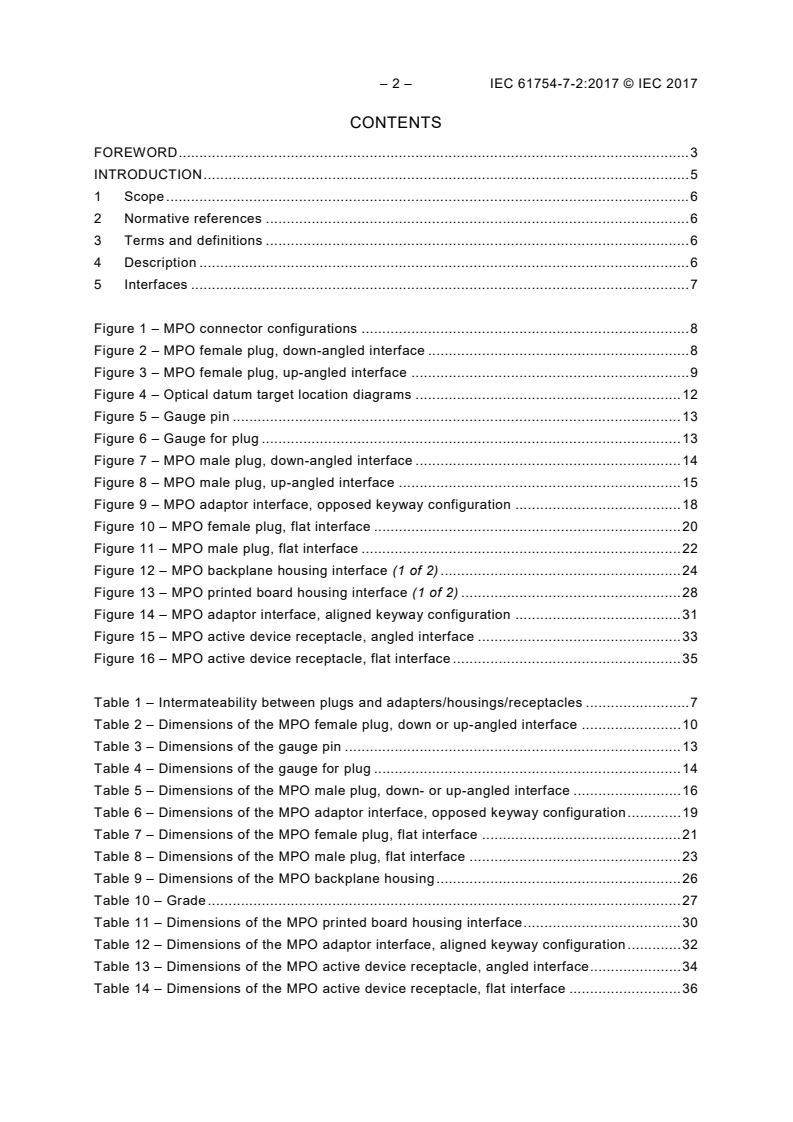
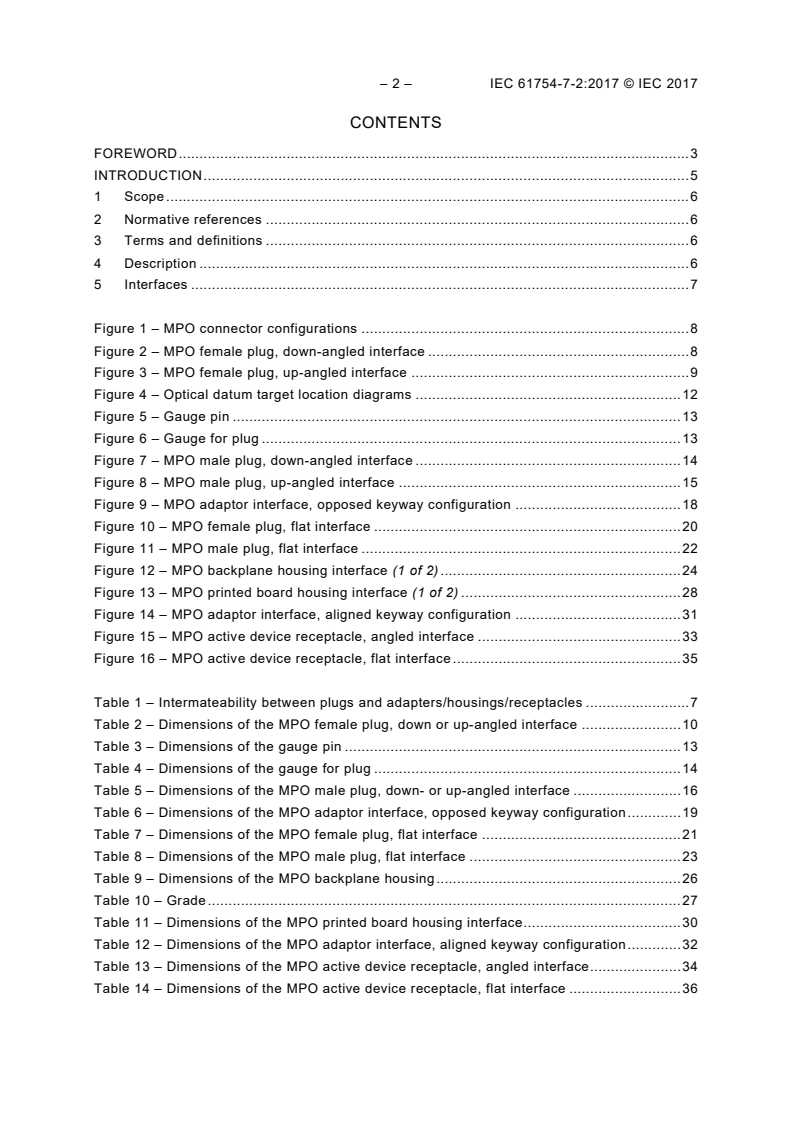
– 2 – IEC 61754-7-2:2017 © IEC 2017
CONTENTS
FOREWORD . 3
INTRODUCTION . 5
1 Scope . 6
2 Normative references . 6
3 Terms and definitions . 6
4 Description . 6
5 Interfaces . 7
Figure 1 – MPO connector configurations . 8
Figure 2 – MPO female plug, down-angled interface . 8
Figure 3 – MPO female plug, up-angled interface . 9
Figure 4 – Optical datum target location diagrams . 12
Figure 5 – Gauge pin . 13
Figure 6 – Gauge for plug . 13
Figure 7 – MPO male plug, down-angled interface . 14
Figure 8 – MPO male plug, up-angled interface . 15
Figure 9 – MPO adaptor interface, opposed keyway configuration . 18
Figure 10 – MPO female plug, flat interface . 20
Figure 11 – MPO male plug, flat interface . 22
Figure 12 – MPO backplane housing interface (1 of 2) . 24
Figure 13 – MPO printed board housing interface (1 of 2) . 28
Figure 14 – MPO adaptor interface, aligned keyway configuration . 31
Figure 15 – MPO active device receptacle, angled interface . 33
Figure 16 – MPO active device receptacle, flat interface . 35
Table 1 – Intermateability between plugs and adapters/housings/receptacles . 7
Table 2 – Dimensions of the MPO female plug, down or up-angled interface . 10
Table 3 – Dimensions of the gauge pin . 13
Table 4 – Dimensions of the gauge for plug . 14
Table 5 – Dimensions of the MPO male plug, down- or up-angled interface . 16
Table 6 – Dimensions of the MPO adaptor interface, opposed keyway configuration . 19
Table 7 – Dimensions of the MPO female plug, flat interface . 21
Table 8 – Dimensions of the MPO male plug, flat interface . 23
Table 9 – Dimensions of the MPO backplane housing . 26
Table 10 – Grade . 27
Table 11 – Dimensions of the MPO printed board housing interface . 30
Table 12 – Dimensions of the MPO adaptor interface, aligned keyway configuration . 32
Table 13 – Dimensions of the MPO active device receptacle, angled interface . 34
Table 14 – Dimensions of the MPO active device receptacle, flat interface . 36
INTERNATIONAL ELECTROTECHNICAL COMMISSION
____________
FIBRE OPTIC INTERCONNECTING
DEVICES AND PASSIVE COMPONENTS –
FIBRE OPTIC CONNECTOR INTERFACES –
Part 7-2: Type MPO connector family –
Two fibre rows
FOREWORD
1) The International Electrotechnical Commission (IEC) is a worldwide organization for standardization comprising
all national electrotechnical committees (IEC National Committees). The object of IEC is to promote
international co-operation on all questions concerning standardization in the electrical and electronic fields. To
this end and in addition to other activities, IEC publishes International Standards, Technical Specifications,
Technical Reports, Publicly Available Specifications (PAS) and Guides (hereafter referred to as “IEC
Publication(s)”). Their preparation is entrusted to technical committees; any IEC National Committee interested
in the subject dealt with may participate in this preparatory work. International, governmental and non-
governmental organizations liaising with the IEC also participate in this preparation. IEC collaborates closely
with the International Organization for Standardization (ISO) in accordance with conditions determined by
agreement between the two organizations.
2) The formal decisions or agreements of IEC on technical matters express, as nearly as possible, an international
consensus of opinion on the relevant subjects since each technical committee has representation from all
interested IEC National Committees.
3) IEC Publications have the form of recommendations for international use and are accepted by IEC National
Committees in that sense. While all reasonable efforts are made to ensure that the technical content of IEC
Publications is accurate, IEC cannot be held responsible for the way in which they are used or for any
misinterpretation by any end user.
4) In order to promote international uniformity, IEC National Committees undertake to apply IEC Publications
transparently to the maximum extent possible in their national and regional publications. Any divergence
between any IEC Publication and the corresponding national or regional publication shall be clearly indicated in
the latter.
5) IEC itself does not provide any attestation of conformity. Independent certification bodies provide conformity
assessment services and, in some areas, access to IEC marks of conformity. IEC is not responsible for any
services carried out by independent certification bodies.
6) All users should ensure that they have the latest edition of this publication.
7) No liability shall attach to IEC or its directors, employees, servants or agents including individual experts and
members of its technical committees and IEC National Committees for any personal injury, property damage or
other damage of any nature whatsoever, whether direct or indirect, or for costs (including legal fees) and
expenses arising out of the publication, use of, or reliance upon, this IEC Publication or any other IEC
Publications.
8) Attention is drawn to the Normative references cited in this publication. Use of the referenced publications is
indispensable for the correct application of this publication.
9) Attention is drawn to the possibility that some of the elements of this IEC Publication may be the subject of
patent rights. IEC shall not be held responsible for identifying any or all such patent rights.
International Standard IEC 61754-7-2 has been prepared by subcommittee 86B: Fibre optic
interconnecting devices and passive components, of IEC technical committee 86: Fibre optics.
This first edition of IEC 61754-7-2, along with the first edition of IEC 61754-7-1, cancels and
replaces the third edition of IEC 61754-7 published in 2008.
This first edition of IEC 61754-7-2 includes the two fibre row MPO variants including the
addition of active device receptacles and up-angled plugs.
The first edition of IEC 61754-7-1 includes the one fibre row MPO variants and related active
device receptacles and up-angled plugs.
– 4 – IEC 61754-7-2:2017 © IEC 2017
Following the publication of both IEC 61754-7-1 and IEC 61754-7-2, IEC 61754-7 will be
withdrawn.
The text of this International Standard is based on the following documents:
FDIS Report on voting
86B/4099/FDIS 86B/4110/RVD
Full information on the voting for the approval of this International Standard can be found in
the report on voting indicated in the above table.
This document has been drafted in accordance with the ISO/IEC Directives, Part 2.
A list of all the parts in the IEC 61754 series, published under the general title Fibre optic
interconnecting devices and passive components – Fibre optic connector interfaces, can be
found on the IEC website.
The committee has decided that the contents of this document will remain unchanged until the
stability date indicated on the IEC website under "http://webstore.iec.ch" in the data related to
the specific document. At this date, the document will be
• reconfirmed,
• withdrawn,
• replaced by a revised edition, or
• amended.
A bilingual version of this publication may be issued at a later date.
INTRODUCTION
The International Electrotechnical Commission (IEC) draws attention to the fact that it is
claimed that compliance with this document may involve the use of patents concerning MPO
connectors.
The IEC takes no position concerning the evidence, validity and scope of these patent rights.
The holders of these patent rights have assured the IEC that they are willing to negotiate
licences under reasonable and non-discriminatory terms and conditions with applicants
throughout the world. In this respect, the statement of the holders of these patent rights is
registered with the IEC. Information may be obtained from:
Intellectual Property Department,
NTT Nippon Telegraph and Telephone Corporation,
3-19-2, Nishishinjuku, Shinjuku-ku
JP – Tokyo 163-19
Assistant Secretary
Laura Thomas
CommScope, Inc. of North Carolina
Hickory, North Carolina, USA
Attention is drawn to the possibility that some of the elements of this document may be the
subject of patent rights other than those identified above. IEC shall not be held responsible for
identifying any or all such patent rights.
ISO (www.iso.org/patents) and IEC (http://patents.iec.ch) maintain on-line data bases of
patents relevant to their standards. Users are encouraged to consult the data bases for the
most up to date information concerning patents.
– 6 – IEC 61754-7-2:2017 © IEC 2017
FIBRE OPTIC INTERCONNECTING
DEVICES AND PASSIVE COMPONENTS –
FIBRE OPTIC CONNECTOR INTERFACES –
Part 7-2: Type MPO connector family –
Two fibre rows
1 Scope
This part of IEC 61754 defines the standard interface dimensions for the type MPO family of
connectors with two rows of fibres.
2 Normative references
The following documents are referred to in the text in such a way that some or all of their
content constitutes requirements of this document. For dated references, only the edition
cited applies. For undated references, the latest edition of the referenced document (including
any amendments) applies.
There are no normative references in this document.
3 Terms and definitions
No terms and definitions are listed in this document.
ISO and IEC maintain terminological databases for use in standardization at the following
addresses:
• IEC Electropedia: available at http://www.electropedia.org/
• ISO Online browsing platform: available at http://www.iso.org/obp
4 Description
The parent connector for the type MPO connector family is a multiway plug connector charac-
terized by a rectangular ferrule normally 6,4 mm × 2,5 mm which utilizes two pins of 0,7 mm
diameter as its alignment. The variant in this document provides a joint of 16 to 24 fibres by
arraying them between two pin-positioning holes in the ferrule in a two-layer (two-row)
arrangement. The connector includes a push-pull coupling mechanism and a ferrule spring
loaded in the direction of the optical axis. The connector has a single male key which may be
used to orient and limit the relative position between the connector and the component to
which it is mated.
Connector interfaces are configured using a female plug without pins, a male plug with pins
fixed and an adaptor as shown in Figure 1. The female plug is intermateable with the male
plug. There are two angled-interface plugs, one called down-angled and the other up-angled.
They are defined for both male and female plugs. The up and down descriptors refer to the tilt
direction of the ferrule’s angled end face relative to the fibre axis when looking toward the end
face with the plug’s key feature on the top. For down-angled plugs, the angled surface faces
slightly downward. For up-angled plugs, the angled surface faces slightly upward. These
different angles affect intermateability for the two adaptor types. An opposed keyway adaptor
mates two plugs with the keys in opposite orientations, for example one side keyway-up and
the other keyway-down. In contrast, an aligned keyway adaptor mates two plugs with the keys
in the same orientation. When using an opposed keyway adaptor with angled interfaces, two
down-angled plugs or two up-angled plugs shall be connected. For aligned keyway adaptors
with angled interfaces, one down-angled plug and one up-angled plug shall be connected.
Moreover, connector interfaces between the female plug and the male plug are configured by
applying a backplane housing and a printed board housing instead of the adaptor.
Additionally, the female plug interface is intermateable with the active device receptacle.
5 Interfaces
This document contains the following standard interfaces:
Interface IEC 61754-7-2-1: MPO female plug, down-angled interface for 16 to 24 fibres
Interface IEC 61754-7-2-2: MPO male plug, down-angled interface for 16 to 24 fibres
Interface IEC 61754-7-2-3: MPO adaptor interface – Opposed keyway configuration
Interface IEC 61754-7-2-4: MPO female plug, flat interface for 16 to 24 fibres
Interface IEC 61754-7-2-5: MPO male plug, flat interface for 16 to 24 fibres
Interface IEC 61754-7-2-6: MPO backplane housing interface
Interface IEC 61754-7-2-7: MPO printed board housing interface
Interface IEC 61754-7-2-8: MPO adaptor interface – Aligned keyway configuration
Interface IEC 61754-7-2-9: MPO active device receptacle, angled interface
Interface IEC 61754-7-2-10: MPO active device receptacle, flat interface
Interface IEC 61754-7-2-11: MPO female plug, up-angled interface for 16 to 24 fibres
Interface IEC 61754-7-2-12: MPO male plug, up-angled interface for 16 to 24 fibres
The interfaces showed in Table 1 are intermateable.
Table 1 – Intermateability between plugs and adapters/housings/receptacles
Female plugs Adaptors/housings/receptacles Male plugs
61754-7-2-1 61754-7-2-3 61754-7-2-2
61754-7-2-1 61754-7-2-8 61754-7-2-12
61754-7-2-11 61754-7-2-8 61754-7-2-2
61754-7-2-4 61754-7-2-3 and 61754-7-2-8 61754-7-2-5
61754-7-2-1 or 61754-7-2-6 and 61754-7-2-7 61754-7-2-2 or
61754-7-2-11 61754-7-2-12
61754-7-2-4 61754-7-2-6 and 61754-7-2-7 61754-7-2-5
61754-7-2-1 61754-7-2-9 N/A
61754-7-2-4 61754-7-2-10 N/A
NOTE Connector interfaces with 16 to 24 fibres will intermate and will correctly align the lower defined numbers
of optical datum targets (see Figure 4).
– 8 – IEC 61754-7-2:2017 © IEC 2017
Figure 1 shows MPO connector configurations.
IEC
Figure 1 – MPO connector configurations
Figures 2 and 3 show the down-angled and up-angled interface of the MPO female plug.
Table 2 gives the dimensions of the down- or up-angled interfaces of the MPO female plug.
IEC
Figure 2 – MPO female plug, down-angled interface
IEC
Figure 3 – MPO female plug, up-angled interface
– 10 – IEC 61754-7-2:2017 © IEC 2017
Table 2 – Dimensions of the MPO female plug, down
or up-angled interface
Dimensions
Reference Remarks
Minimum Maximum
a
A 0,699 mm 0,701 mm
b
C 4,597 mm 4,603 mm
D 6,3 mm 6,5 mm
g
D1 6,7 mm -
E 8,34 mm 8,54 mm
F 9,49 mm 9,59 mm
G 10,85 mm 11,05 mm
H 12,19 mm 12,59 mm
c,f
I 8,8 mm 9,2 mm
J 7,9 mm 8,1 mm
K 1,4 mm –
d,e
L 0,2 mm 0,8 mm
M 2,4 mm 2,6 mm
N 2,8 mm 3,0 mm
O 4,89 mm 4,99 mm
P 5,59 mm 5,69 mm
Q 5,7 mm –
R – 7,7 mm
S 2,9 mm 3,1 mm
T – 0,8 mm
U 2,4 mm 2,5 mm
g
U1 2,7 mm -
AA 42° 45°
AB – 45°
AC – 45°
h,i
AD 7,5° 8,5°
The mating/unmating force between an MPO connector and adaptor shall not exceed 40,0 N.
a
Each pin-hole shall accept a gauge pin as shown in Figure 5 to a depth of 5,5 mm with a maximum force of 1,7 N.
In addition, two pin-holes of a plug shall accept a gauge as shown in Figure 6 to a depth of 5,5 mm with a
maximum force of 3,4 N.
b
Dimension C is defined as the distance between two pin-hole centres.
c
Dimension I is given for a fibre end face centre of a plug end when not mated. It is noticed that a ferrule is
movable by a certain axial compression force, and therefore dimension I is variable. Ferrule compression
force shall be 18,0 N to 22,0 N when a position of the fibre end face from datum Z is in the range of 8,2 mm
to 8,4 mm.
d
The coupling sleeve shall be movable by a certain axial compression force. Dimension L is given for a
coupling sleeve end when not mated. Coupling sleeve compression force shall be 2,9 N to 6,9 N when the
position of the coupling sleeve end face from datum Z is in the range of 0 mm to 0,1 mm to the right or to the
left of datum Z.
e
An adaptor coupling part shall be unlocked by a left-direction movement of a coupling sleeve, when
...
IEC 61754-7-2 ®
Edition 1.0 2017-12
INTERNATIONAL
STANDARD
NORME
INTERNATIONALE
Fibre optic interconnecting devices and passive components – Fibre optic
connector interfaces –
Part 7-2: Type MPO connector family – Two fibre rows
Dispositifs d’interconnexion et composants passifs fibroniques – Interfaces de
connecteurs fibroniques –
Partie 7-2: Famille de connecteurs de type MPO – Deux rangées de fibres
All rights reserved. Unless otherwise specified, no part of this publication may be reproduced or utilized in any form
or by any means, electronic or mechanical, including photocopying and microfilm, without permission in writing from
either IEC or IEC's member National Committee in the country of the requester. If you have any questions about IEC
copyright or have an enquiry about obtaining additional rights to this publication, please contact the address below or
your local IEC member National Committee for further information.
Droits de reproduction réservés. Sauf indication contraire, aucune partie de cette publication ne peut être reproduite ni
utilisée sous quelque forme que ce soit et par aucun procédé, électronique ou mécanique, y compris la photocopie et
les microfilms, sans l'accord écrit de l'IEC ou du Comité national de l'IEC du pays du demandeur. Si vous avez des
questions sur le copyright de l'IEC ou si vous désirez obtenir des droits supplémentaires sur cette publication, utilisez
les coordonnées ci-après ou contactez le Comité national de l'IEC de votre pays de résidence.
IEC Central Office Tel.: +41 22 919 02 11
3, rue de Varembé info@iec.ch
CH-1211 Geneva 20 www.iec.ch
Switzerland
About the IEC
The International Electrotechnical Commission (IEC) is the leading global organization that prepares and publishes
International Standards for all electrical, electronic and related technologies.
About IEC publications
The technical content of IEC publications is kept under constant review by the IEC. Please make sure that you have the
latest edition, a corrigendum or an amendment might have been published.
IEC publications search - webstore.iec.ch/advsearchform Electropedia - www.electropedia.org
The advanced search enables to find IEC publications by a The world's leading online dictionary on electrotechnology,
variety of criteria (reference number, text, technical containing more than 22 000 terminological entries in English
committee,…). It also gives information on projects, replaced and French, with equivalent terms in 16 additional languages.
and withdrawn publications. Also known as the International Electrotechnical Vocabulary
(IEV) online.
IEC Just Published - webstore.iec.ch/justpublished
Stay up to date on all new IEC publications. Just Published IEC Glossary - std.iec.ch/glossary
details all new publications released. Available online and once 67 000 electrotechnical terminology entries in English and
a month by email. French extracted from the Terms and Definitions clause of IEC
publications issued since 2002. Some entries have been
IEC Customer Service Centre - webstore.iec.ch/csc collected from earlier publications of IEC TC 37, 77, 86 and
If you wish to give us your feedback on this publication or need CISPR.
further assistance, please contact the Customer Service
Centre: sales@iec.ch.
A propos de l'IEC
La Commission Electrotechnique Internationale (IEC) est la première organisation mondiale qui élabore et publie des
Normes internationales pour tout ce qui a trait à l'électricité, à l'électronique et aux technologies apparentées.
A propos des publications IEC
Le contenu technique des publications IEC est constamment revu. Veuillez vous assurer que vous possédez l’édition la
plus récente, un corrigendum ou amendement peut avoir été publié.
Recherche de publications IEC - Le premier dictionnaire d'électrotechnologie en ligne au monde,
webstore.iec.ch/advsearchform avec plus de 22 000 articles terminologiques en anglais et en
La recherche avancée permet de trouver des publications IEC français, ainsi que les termes équivalents dans 16 langues
en utilisant différents critères (numéro de référence, texte, additionnelles. Egalement appelé Vocabulaire
comité d’études,…). Elle donne aussi des informations sur les Electrotechnique International (IEV) en ligne.
projets et les publications remplacées ou retirées.
Glossaire IEC - std.iec.ch/glossary
IEC Just Published - webstore.iec.ch/justpublished 67 000 entrées terminologiques électrotechniques, en anglais
Restez informé sur les nouvelles publications IEC. Just et en français, extraites des articles Termes et Définitions des
Published détaille les nouvelles publications parues. publications IEC parues depuis 2002. Plus certaines entrées
Disponible en ligne et une fois par mois par email. antérieures extraites des publications des CE 37, 77, 86 et
CISPR de l'IEC.
Service Clients - webstore.iec.ch/csc
Si vous désirez nous donner des commentaires sur cette
publication ou si vous avez des questions contactez-nous:
sales@iec.ch.
Electropedia - www.electropedia.org
IEC 61754-7-2 ®
Edition 1.0 2017-12
INTERNATIONAL
STANDARD
NORME
INTERNATIONALE
Fibre optic interconnecting devices and passive components – Fibre optic
connector interfaces –
Part 7-2: Type MPO connector family – Two fibre rows
Dispositifs d’interconnexion et composants passifs fibroniques – Interfaces de
connecteurs fibroniques –
Partie 7-2: Famille de connecteurs de type MPO – Deux rangées de fibres
INTERNATIONAL
ELECTROTECHNICAL
COMMISSION
COMMISSION
ELECTROTECHNIQUE
INTERNATIONALE
ICS 33.180.20 ISBN 978-2-8322-8694-4
– 2 – IEC 61754-7-2:2017 © IEC 2017
CONTENTS
FOREWORD . 3
INTRODUCTION . 5
1 Scope . 6
2 Normative references . 6
3 Terms and definitions . 6
4 Description . 6
5 Interfaces . 7
Figure 1 – MPO connector configurations . 8
Figure 2 – MPO female plug, down-angled interface . 8
Figure 3 – MPO female plug, up-angled interface . 9
Figure 4 – Optical datum target location diagrams . 12
Figure 5 – Gauge pin . 13
Figure 6 – Gauge for plug . 13
Figure 7 – MPO male plug, down-angled interface . 14
Figure 8 – MPO male plug, up-angled interface . 15
Figure 9 – MPO adaptor interface, opposed keyway configuration . 18
Figure 10 – MPO female plug, flat interface . 20
Figure 11 – MPO male plug, flat interface . 22
Figure 12 – MPO backplane housing interface (1 of 2) . 24
Figure 13 – MPO printed board housing interface (1 of 2) . 28
Figure 14 – MPO adaptor interface, aligned keyway configuration . 31
Figure 15 – MPO active device receptacle, angled interface . 33
Figure 16 – MPO active device receptacle, flat interface . 35
Table 1 – Intermateability between plugs and adapters/housings/receptacles . 7
Table 2 – Dimensions of the MPO female plug, down or up-angled interface . 10
Table 3 – Dimensions of the gauge pin . 13
Table 4 – Dimensions of the gauge for plug . 14
Table 5 – Dimensions of the MPO male plug, down- or up-angled interface . 16
Table 6 – Dimensions of the MPO adaptor interface, opposed keyway configuration . 19
Table 7 – Dimensions of the MPO female plug, flat interface . 21
Table 8 – Dimensions of the MPO male plug, flat interface . 23
Table 9 – Dimensions of the MPO backplane housing . 26
Table 10 – Grade . 27
Table 11 – Dimensions of the MPO printed board housing interface . 30
Table 12 – Dimensions of the MPO adaptor interface, aligned keyway configuration . 32
Table 13 – Dimensions of the MPO active device receptacle, angled interface . 34
Table 14 – Dimensions of the MPO active device receptacle, flat interface . 36
INTERNATIONAL ELECTROTECHNICAL COMMISSION
____________
FIBRE OPTIC INTERCONNECTING
DEVICES AND PASSIVE COMPONENTS –
FIBRE OPTIC CONNECTOR INTERFACES –
Part 7-2: Type MPO connector family –
Two fibre rows
FOREWORD
1) The International Electrotechnical Commission (IEC) is a worldwide organization for standardization comprising
all national electrotechnical committees (IEC National Committees). The object of IEC is to promote
international co-operation on all questions concerning standardization in the electrical and electronic fields. To
this end and in addition to other activities, IEC publishes International Standards, Technical Specifications,
Technical Reports, Publicly Available Specifications (PAS) and Guides (hereafter referred to as “IEC
Publication(s)”). Their preparation is entrusted to technical committees; any IEC National Committee interested
in the subject dealt with may participate in this preparatory work. International, governmental and non-
governmental organizations liaising with the IEC also participate in this preparation. IEC collaborates closely
with the International Organization for Standardization (ISO) in accordance with conditions determined by
agreement between the two organizations.
2) The formal decisions or agreements of IEC on technical matters express, as nearly as possible, an international
consensus of opinion on the relevant subjects since each technical committee has representation from all
interested IEC National Committees.
3) IEC Publications have the form of recommendations for international use and are accepted by IEC National
Committees in that sense. While all reasonable efforts are made to ensure that the technical content of IEC
Publications is accurate, IEC cannot be held responsible for the way in which they are used or for any
misinterpretation by any end user.
4) In order to promote international uniformity, IEC National Committees undertake to apply IEC Publications
transparently to the maximum extent possible in their national and regional publications. Any divergence
between any IEC Publication and the corresponding national or regional publication shall be clearly indicated in
the latter.
5) IEC itself does not provide any attestation of conformity. Independent certification bodies provide conformity
assessment services and, in some areas, access to IEC marks of conformity. IEC is not responsible for any
services carried out by independent certification bodies.
6) All users should ensure that they have the latest edition of this publication.
7) No liability shall attach to IEC or its directors, employees, servants or agents including individual experts and
members of its technical committees and IEC National Committees for any personal injury, property damage or
other damage of any nature whatsoever, whether direct or indirect, or for costs (including legal fees) and
expenses arising out of the publication, use of, or reliance upon, this IEC Publication or any other IEC
Publications.
8) Attention is drawn to the Normative references cited in this publication. Use of the referenced publications is
indispensable for the correct application of this publication.
9) Attention is drawn to the possibility that some of the elements of this IEC Publication may be the subject of
patent rights. IEC shall not be held responsible for identifying any or all such patent rights.
International Standard IEC 61754-7-2 has been prepared by subcommittee 86B: Fibre optic
interconnecting devices and passive components, of IEC technical committee 86: Fibre optics.
This first edition of IEC 61754-7-2, along with the first edition of IEC 61754-7-1, cancels and
replaces the third edition of IEC 61754-7 published in 2008.
This first edition of IEC 61754-7-2 includes the two fibre row MPO variants including the
addition of active device receptacles and up-angled plugs.
The first edition of IEC 61754-7-1 includes the one fibre row MPO variants and related active
device receptacles and up-angled plugs.
– 4 – IEC 61754-7-2:2017 © IEC 2017
Following the publication of both IEC 61754-7-1 and IEC 61754-7-2, IEC 61754-7 will be
withdrawn.
The text of this International Standard is based on the following documents:
FDIS Report on voting
86B/4099/FDIS 86B/4110/RVD
Full information on the voting for the approval of this International Standard can be found in
the report on voting indicated in the above table.
This document has been drafted in accordance with the ISO/IEC Directives, Part 2.
A list of all the parts in the IEC 61754 series, published under the general title Fibre optic
interconnecting devices and passive components – Fibre optic connector interfaces, can be
found on the IEC website.
The committee has decided that the contents of this document will remain unchanged until the
stability date indicated on the IEC website under "http://webstore.iec.ch" in the data related to
the specific document. At this date, the document will be
• reconfirmed,
• withdrawn,
• replaced by a revised edition, or
• amended.
INTRODUCTION
The International Electrotechnical Commission (IEC) draws attention to the fact that it is
claimed that compliance with this document may involve the use of patents concerning MPO
connectors.
The IEC takes no position concerning the evidence, validity and scope of these patent rights.
The holders of these patent rights have assured the IEC that they are willing to negotiate
licences under reasonable and non-discriminatory terms and conditions with applicants
throughout the world. In this respect, the statement of the holders of these patent rights is
registered with the IEC. Information may be obtained from:
Intellectual Property Department,
NTT Nippon Telegraph and Telephone Corporation,
3-19-2, Nishishinjuku, Shinjuku-ku
JP – Tokyo 163-19
Assistant Secretary
Laura Thomas
CommScope, Inc. of North Carolina
Hickory, North Carolina, USA
Attention is drawn to the possibility that some of the elements of this document may be the
subject of patent rights other than those identified above. IEC shall not be held responsible for
identifying any or all such patent rights.
ISO (www.iso.org/patents) and IEC (http://patents.iec.ch) maintain on-line data bases of
patents relevant to their standards. Users are encouraged to consult the data bases for the
most up to date information concerning patents.
– 6 – IEC 61754-7-2:2017 © IEC 2017
FIBRE OPTIC INTERCONNECTING
DEVICES AND PASSIVE COMPONENTS –
FIBRE OPTIC CONNECTOR INTERFACES –
Part 7-2: Type MPO connector family –
Two fibre rows
1 Scope
This part of IEC 61754 defines the standard interface dimensions for the type MPO family of
connectors with two rows of fibres.
2 Normative references
The following documents are referred to in the text in such a way that some or all of their
content constitutes requirements of this document. For dated references, only the edition
cited applies. For undated references, the latest edition of the referenced document (including
any amendments) applies.
There are no normative references in this document.
3 Terms and definitions
No terms and definitions are listed in this document.
ISO and IEC maintain terminological databases for use in standardization at the following
addresses:
• IEC Electropedia: available at http://www.electropedia.org/
• ISO Online browsing platform: available at http://www.iso.org/obp
4 Description
The parent connector for the type MPO connector family is a multiway plug connector charac-
terized by a rectangular ferrule normally 6,4 mm × 2,5 mm which utilizes two pins of 0,7 mm
diameter as its alignment. The variant in this document provides a joint of 16 to 24 fibres by
arraying them between two pin-positioning holes in the ferrule in a two-layer (two-row)
arrangement. The connector includes a push-pull coupling mechanism and a ferrule spring
loaded in the direction of the optical axis. The connector has a single male key which may be
used to orient and limit the relative position between the connector and the component to
which it is mated.
Connector interfaces are configured using a female plug without pins, a male plug with pins
fixed and an adaptor as shown in Figure 1. The female plug is intermateable with the male
plug. There are two angled-interface plugs, one called down-angled and the other up-angled.
They are defined for both male and female plugs. The up and down descriptors refer to the tilt
direction of the ferrule’s angled end face relative to the fibre axis when looking toward the end
face with the plug’s key feature on the top. For down-angled plugs, the angled surface faces
slightly downward. For up-angled plugs, the angled surface faces slightly upward. These
different angles affect intermateability for the two adaptor types. An opposed keyway adaptor
mates two plugs with the keys in opposite orientations, for example one side keyway-up and
the other keyway-down. In contrast, an aligned keyway adaptor mates two plugs with the keys
in the same orientation. When using an opposed keyway adaptor with angled interfaces, two
down-angled plugs or two up-angled plugs shall be connected. For aligned keyway adaptors
with angled interfaces, one down-angled plug and one up-angled plug shall be connected.
Moreover, connector interfaces between the female plug and the male plug are configured by
applying a backplane housing and a printed board housing instead of the adaptor.
Additionally, the female plug interface is intermateable with the active device receptacle.
5 Interfaces
This document contains the following standard interfaces:
Interface IEC 61754-7-2-1: MPO female plug, down-angled interface for 16 to 24 fibres
Interface IEC 61754-7-2-2: MPO male plug, down-angled interface for 16 to 24 fibres
Interface IEC 61754-7-2-3: MPO adaptor interface – Opposed keyway configuration
Interface IEC 61754-7-2-4: MPO female plug, flat interface for 16 to 24 fibres
Interface IEC 61754-7-2-5: MPO male plug, flat interface for 16 to 24 fibres
Interface IEC 61754-7-2-6: MPO backplane housing interface
Interface IEC 61754-7-2-7: MPO printed board housing interface
Interface IEC 61754-7-2-8: MPO adaptor interface – Aligned keyway configuration
Interface IEC 61754-7-2-9: MPO active device receptacle, angled interface
Interface IEC 61754-7-2-10: MPO active device receptacle, flat interface
Interface IEC 61754-7-2-11: MPO female plug, up-angled interface for 16 to 24 fibres
Interface IEC 61754-7-2-12: MPO male plug, up-angled interface for 16 to 24 fibres
The interfaces showed in Table 1 are intermateable.
Table 1 – Intermateability between plugs and adapters/housings/receptacles
Female plugs Adaptors/housings/receptacles Male plugs
61754-7-2-1 61754-7-2-3 61754-7-2-2
61754-7-2-1 61754-7-2-8 61754-7-2-12
61754-7-2-11 61754-7-2-8 61754-7-2-2
61754-7-2-4 61754-7-2-3 and 61754-7-2-8 61754-7-2-5
61754-7-2-1 or 61754-7-2-6 and 61754-7-2-7 61754-7-2-2 or
61754-7-2-11 61754-7-2-12
61754-7-2-4 61754-7-2-6 and 61754-7-2-7 61754-7-2-5
61754-7-2-1 61754-7-2-9 N/A
61754-7-2-4 61754-7-2-10 N/A
NOTE Connector interfaces with 16 to 24 fibres will intermate and will correctly align the lower defined numbers
of optical datum targets (see Figure 4).
– 8 – IEC 61754-7-2:2017 © IEC 2017
Figure 1 shows MPO connector configurations.
IEC
Figure 1 – MPO connector configurations
Figures 2 and 3 show the down-angled and up-angled interface of the MPO female plug.
Table 2 gives the dimensions of the down- or up-angled interfaces of the MPO female plug.
IEC
Figure 2 – MPO female plug, down-angled interface
IEC
Figure 3 – MPO female plug, up-angled interface
– 10 – IEC 61754-7-2:2017 © IEC 2017
Table 2 – Dimensions of the MPO female plug, down
or up-angled interface
Dimensions
Reference Remarks
Minimum Maximum
a
A 0,699 mm 0,701 mm
b
C 4,597 mm 4,603 mm
D 6,3 mm 6,5 mm
g
D1 6,7 mm -
E 8,34 mm 8,54 mm
F 9,49 mm 9,59 mm
G 10,85 mm 11,05 mm
H 12,19 mm 12,59 mm
c,f
I 8,8 mm 9,2 mm
J 7,9 mm 8,1 mm
K 1,4 mm –
d,e
L 0,2 mm 0,8 mm
M 2,4 mm 2,6 mm
N 2,8 mm 3,0 mm
O 4,89 mm 4,99 mm
P 5,59 mm 5,69 mm
Q 5,7 mm –
R – 7,7 mm
S 2,9 mm 3,1 mm
T – 0,8 mm
U 2,4 mm 2,5 mm
g
U1 2,7 mm -
AA 42° 45°
AB – 45°
AC – 45°
h,i
AD 7,5° 8,5°
The mating/unmating force between an MPO connector and adaptor shall not exceed 40,0 N.
a
Each pin-hole shall accept a gauge pin as shown in Figure 5 to a depth of 5,5 mm with a maximum force of 1,7 N.
In addition, two pin-holes of a plug shall accept a gauge as shown in Figure 6 to a depth of 5,5 mm with a
maximum force of 3,4 N.
b
Dimension C is defined as the distance between two pin-hole centres.
c
Dimension I is given for a fibre end face centre of a plug end when not mated. It is noticed that a ferrule is
movable by a certain axial compression force, and therefore dimension I is variable. Ferrule compression
force shall be 18,0 N to 22,0 N when a position of the fibre end face from datum Z is in the range of 8,2 mm
to 8,4 mm.
d
The coupling sleeve shall be movable by a certain axial compression force. Dimension L is given for a
coupling sleeve end when not mated. Coupling sleeve compression force shall be 2,9 N to 6,9 N when the
position of the coupling sleeve end face from datum Z is in the range of 0 mm to 0,1 mm to the right or to the
left of datum Z.
e
An adaptor coupling part shall be unlocked by a left-direction movement of a coupling sleeve, when it is
separate from an adaptor. When the coupling sleeve is moved for unlocking, the position of the coupling
sleeve end face shall be larger than 2,0 mm in the left direction from datum Z.
f
Dimension I is defined at the centre line between the two pin-hole centres.
g
Dimensions D1 and U1 are defined only at the end of the connector as shown.
h
The down-angled and up-angled plugs shall be clearly marked to distinguish them from each other and flat
interfaces through the use of colour, labelling, or other appropriate identification method. This identification
method shall be visible when the plug is in the mated or unmated condition.
i
Since angled MPO connectors require a Y-offset of the fibre holes in relation to the guide pin holes, and the
Y-offset is referenced from the epoxy window of the ferrule, the angle shall be polished as a down-angle
from the epoxy window. The orientation of the ferrule epoxy window may be reversed in the MPO connector
to produce the up-angle variant.
– 12 – IEC 61754-7-2:2017 © IEC 2017
Figure 4 shows the optical datum target location diagrams. Figure 5 shows the gauge pin, and
its dimensions are given in Table 3.
Dimensions in millimetres
0,250
0,250
0,250
0,250
Y
Y
Sixteen fibres
Twenty fibres
0,250 0,250
Y
Twenty four fibres
IEC
NOTE The optical datum target location diagram is shown in the figure. Here, datum X is defined as the line
passing through two pin-hole centres, and datum Y is defined as the line perpendicular to datum X and passing
through the midpoint of two pin-hole centres.
Figure 4 – Optical datum target location diagrams
0,125 0,125 0,125 0,125
X
X
0,375 0,375
0,375 0,375
0,625
0,625
0,625 0,625
0,875 0,875
0,875 0,875
1,125
1,125
1,375 1,375
0,125 0,125
X
0,375
0,375
0,625
0,625
0,875
0,875
1,125
1,125
BB
BC
B
IEC
Figure 5 – Gauge pin
Table 3 – Dimensions of the gauge pin
Dimensions
mm
Reference Remarks
Minimum Maximum
a
A 0,698 5 0,699 0
b
B 10,8 11,2
BA 0,2 0,4
BB 0,2 0,5
BC 6,0 –
a
Surface roughness R = 0,1 µm for the length of dimension BC.
z
b
Typical dimensions.
Figure 6 shows the gauge for the plug, and its dimensions are given in Table 4.
∅0,001
W
W
BB
U
BC
0,000 5
IEC
Figure 6 – Gauge for plug
∅BA
∅A
D
C
∅BA
∅A
0,0005
– 14 – IEC 61754-7-2:2017 © IEC 2017
Table 4 – Dimensions of the gauge for plug
Dimensions
mm
Reference Remarks
Minimum Maximum
a
A 0,698 5 0,699 0
C 4,599 5 4,600 5
b
D 6,3 6,5
b
U 2,4 2,5
BA 0,2 0,4
BB 0,2 0,5
BC 6,0 6,5
a
Surface roughness R = 0,1 µm.
z
b
Typical dimensions.
Figure 7 and 8 show the down-angled and up-angled interface of the MPO male plug,
respectively. Table 5 gives the dimensions of the down- or up-angled interfaces of the MPO
male plug.
IEC
Figure 7 – MPO male plug, down-angled interface
IEC
Figure 8 – MPO male plug, up-angled interface
– 16 – IEC 61754-7-2:2017 © IEC 2017
Table 5 – Dimensions of the MPO male plug,
down- or up-angled interface
Dimensions
Reference Remarks
Minimum Maximum
a
A 0,697 mm 0,699 mm
b
C 4,597 mm 4,603 mm
D 6,3 mm 6,5 mm
h
D1 6,7 mm -
E 8,34 mm 8,54 mm
F 9,49 mm 9,59 mm
G 10,85 mm 11,05 mm
H 12,19 mm 12,59 mm
c,g
I 8,8 mm 9,2 mm
J 7,9 mm 8,1 mm
K 1,4 mm –
d,e
L 0,2 mm 0,8 mm
M 2,4 mm 2,6 mm
N 2,8 mm 3,0 mm
O 4,89 mm 4,99 mm
P 5,59 mm 5,69 mm
Q 5,7 mm –
R – 7,7 mm
S 2,9 mm 3,1 mm
T – 0,8 mm
U 2,4 mm 2,5 mm
h
U1 2,7 mm -
AA 42º 45º
AB – 45º
AC – 45º
i,j
AD 7,5º 8,5º
f
BA 0,2 mm 0,4 mm
BB 0,2 mm 0,5 mm
CA 1,6 mm 3,3 mm
The mating/unmating force between an MPO connector and adaptor shall not exceed 40,0 N.
a
Each guide pin shall be retained with a minimum force of 19,6 N. Surface roughness R shall be below
z
0,5 µm.
b
Dimension C is defined as the distance between two guide-pin centres.
c
Dimension I is given for a fibre end face centre of a plug end when not mated. It is noticed that a ferrule is
movable by a certain axial compression force, and therefore the dimension I is variable. Ferrule compression
force shall be 18,0 N to 22,0 N when a position of the fibre end face from datum Z is in the range of 8,2 mm to
8,4 mm.
d
Coupling sleeve shall be movable by a certain axial compression force. Dimension L is given for a coupling
sleeve end when not mated. Coupling sleeve compression force shall be 2,9 N to 6,9 N when a position of
the coupling sleeve end face from datum Z is in the range of 0 mm to 0,1 mm to the right or to the left of
datum Z.
e
An adaptor coupling part shall be unlocked by a left-direction movement of a coupling sleeve, when it is
separate from an adaptor. When the coupling sleeve is moved for unlocking, a position of the coupling
sleeve end face shall be larger than 2,0 mm in the left direction from datum Z.
f
The top shape of guide-pin may be a round shape that is symmetrical about the guide-pin axis with a
minimum radius of 0,15 mm.
g
Dimension I is defined at the centre line between the two guide-pin centres.
h
Dimensions D1 and U1 are defined only at the end of the connector as shown.
i
The down-angled and up-angled plugs shall be clearly marked to distinguish them from each other and flat
interfaces through the use of colour, labelling, or other appropriate identification method. This identification
method shall be visible when the plug is in the mated or unmated condition.
j
Since angled MPO connectors require a Y-offset of the fibre holes in relation to the guide pin holes, and the
Y-offset is referenced from the epoxy window of the ferrule, the angle shall be polished as a down-angle
from the epoxy window. The orientation of the ferrule epoxy window may be reversed in the MPO connector
to produce the up-angle variant.
– 18 – IEC 61754-7-2:2017 © IEC 2017
Figure 9 shows the opposed keyway configuration of the MPO adaptor interface. Table 6
gives the dimensions of the MPO adaptor, opposed keyway configuration.
R
P
O
X
N
Z
I
A
AB
B
B
K
AA
A
L
Keyways opposed
M
Section A-A
Section B-B
IEC
Figure 9 – MPO adaptor interface, opposed keyway configuration
S
∅H
∅W
∅F
V ∅E V
Table 6 – Dimensions of the MPO adaptor interface,
opposed keyway configuration
Dimensions
mm
Reference Remarks
Minimum Maximum
E 8,54 mm 8,74 mm
F 9,6 mm 9,7 mm
a
H 12,6 mm –
I 8,2 mm 8,4 mm
K – 1,39 mm
b
L 0 0,1 mm
M 1,6 mm 2,0 mm
N 2,4 mm 2,6 mm
O 5,0 mm 5,1 mm
P 5,7 mm 5,9 mm
R 7,8 mm –
S 3,4 mm 3,6 mm
V 0,95 mm 1,15 mm
a
W - 12,2 mm
X 3,4 mm –
AA 45° 48°
AB 45° 50°
The mating/unmating force between an MPO connector and adaptor shall not exceed 40,0 N.
a
An adaptor latch shall be allowed the maximum deflection given by the connector and adaptor requirements.
To ensure intermateability, the following requirement shall be met:
(φH−φW )
> 0,53 mm
b
Dimension L is the distance from datum Z to a latch-ledge end. The latch-ledge end may be located to the
right or to the left of datum Z.
– 20 – IEC 61754-7-2:2017 © IEC 2017
Figure 10 shows the flat interface of the MPO female plug interface. Table 7 gives the
dimensions of the flat interface of the MPO female plug.
IEC
Figure 10 – MPO female plug, flat interface
Table 7 – Dimensions of the MPO female plug, flat interface
Dimensions
Reference Remarks
Minimum Maximum
a
A 0,699 mm 0,701 mm
b
C 4,597 mm 4,603 mm
D 6,3 mm 6,5 mm
g
D1 6,7 mm -
E 8,34 mm 8,54 mm
F 9,49 mm 9,59 mm
G 10,85 mm 11,05 mm
H 12,19 mm 12,59 mm
c,f
I 8,8 mm 9,2 mm
J 7,9 mm 8,1 mm
K 1,4 mm –
d,e
L 0,2 mm 0,8 mm
M 2,4 mm 2,6 mm
N 2,8 mm 3,0 mm
O 4,89 mm 4,99 mm
P 5,59 mm 5,69 mm
Q 5,7 mm –
R – 7,7 mm
S 2,9 mm 3,1 mm
U 2,4 mm 2,5 mm
g
U1 2,7 mm -
AA 42° 45°
AB – 45°
AC – 45°
The mating/unmating force between an MPO connector and adaptor shall not exceed 40,0 N.
a
Each pin-hole shall accept a gauge pin as shown in Figure 5 to a depth of 5,5 mm with a maximum force of
1,7 N. In addition, two pin-holes of a plug shall accept a gauge as shown in Figure 6 to a depth of 5,5 mm
with a maximum force of 3,4 N.
b
Dimension C is defined as the distance between two pin-hole centres.
c
Dimension I is given for a fibre end face centre of a plug end when not mated. It is noticed that a ferrule is
movable by a certain axial compression force, and therefore the dimension I is variable. Ferrule compression
force shall be 18,0 N to 22,0 N when a position of the fibre end face from datum Z is in the range of 8,2 mm to
8,4 mm.
d
The coupling sleeve shall be movable by a certain axial compression force. Dimension L is given for a
coupling sleeve end when not mated. Coupling sleeve compression force shall be 2,9 N to 6,9 N when the
position of the coupling sleeve end face from datum Z is in the range of 0 mm to 0,1 mm to the right or to the
left of datum Z.
e
An adaptor coupling part shall be unlocked by a movement away from the adaptor of a coupling sleeve, when
it is separate from the adaptor. When the coupling sleeve is moved for unlocking, the position of the coupling
sleeve end face shall be larger than 2,0 mm in the left direction from datum Z.
f
Dimension I is defined at the centre line between the two pin-hole centres.
g
Dimensions D1 and U1 are defined only at the end of the connector as shown.
– 22 – IEC 61754-7-2:2017 © IEC 2017
Figure 11 shows the flat interface of the MPO male plug. Table 8 gives the dimensions of the
flat interface of the MPO male plug.
IEC
Figure 11 – MPO male plug, flat interface
Table 8 – Dimensions of the MPO male plug, flat interface
Dimensions
Reference Remarks
Minimum Maximum
a
A 0,697 mm 0,699 mm
b
C 4,597 mm 4,603 mm
D 6,3 mm 6,5 mm
h
D1 6,7 mm -
E 8,34 mm 8,54 mm
F 9,49 mm 9,59 mm
G 10,85 mm 11,05 mm
H 12,19 mm 12,59 mm
c,g
I 8,8 mm 9,2 mm
J 7,9 mm 8,1 mm
K 1,4 mm –
d,e
L 0,2 mm 0,8 mm
M 2,4 mm 2,6 mm
N 2,8 mm 3,0 mm
O 4,89 mm 4,99 mm
P 5,59 mm 5,69 mm
Q 5,7 mm –
R – 7,7 mm
S 2,9 mm 3,1 mm
U 2,4 mm 2,5 mm
h
U1 2,7 mm -
AA 42° 45°
AB – 45°
AC – 45°
f
BA 0,2 mm 0,4 mm
BB 0,2 mm 0,5 mm
CA 1,6 mm 3,3 mm
The mating/unmating force between an MPO connector and adaptor shall not exceed 40,0 N.
a
Each guide-pin shall be retained with a minimum force of 19,6 N. Surface roughness R shall be below
z
0,5 µm.
b
Dimension C is defined as the distance between two guide-pin centres.
c
Dimension I is given for a fibre end face centre of a plug end when not mated. It is noticed that a ferrule is
movable by a certain axial compression force, and therefore the dimension I is variable. Ferrule compression
force shall be 18,0 N to 22,0 N when a position of the fibre end face from datum Z is in the range of 8,2 mm to
8,4 mm.
d
The coupling sleeve shall be movable by a certain axial compression force. Dimension L is given for a
coupling sleeve end when not mated. Coupling sleeve compression force shall be 2,9 N to 6,9 N when the
position of the coupling sleeve end face from datum Z is in the range of 0 mm to 0,1 mm to the right or to the
left of datum Z.
e
An adaptor coupling part shall be unlocked by a movement away from the adaptor of a coupling sleeve, when
it is separate from the adaptor. When the coupling sleeve is moved for unlocking, the position of the coupling
sleeve end face shall be larger than 2,0 mm in the left direction from datum Z.
f
The top shape of guide-pin may be a round shape that is symmetrical about the guide-pin axis with a
minimum radius of 0,15 mm.
g
Dimension I is defined at the centre line between the two guide-pin centres.
h
Dimensions D1 and U1 are defined only at the end of the connector as shown.
– 24 – IEC 61754-7-2:2017 © IEC 2017
Figure 12 shows the MPO backplane housing interface. Table 9 gives the dimensions of the
MPO backplane housing interface.
Backplane Backplane Inner housing
Backplane
Back housing Outer housing Outer housing
D E
A C
B
DA
DB DC
C
Projected from A
B
Projected from C
(Side view)
(Rear view)
(Front view)
Backplane
A
Projected from B (Bottom view)
P
O
X
N
Expanded view D
IEC
Figure 12 – MPO backplane housing interface (1 of 2)
S
DE
DD
Backplane
A
EE
Projected from F (Top view)
A
DI DF
DH
DG
Backplane DJ DK
F
DL
G
AB
Outer housing
K EF EG
AA
H
H
a
Inner housing
G
L
ED
M
EC
Cross-section G-G Expanded view E (Front view)
EJ
Inner latch
I
DO
b
spring
DU
DP
Inner latch
C
EI
Backplane
DT
Expanded cross-section I Cross-section H-H
IEC
a
In the figure of cross-section G-G, the inner housing shall be movable to the right at least 0,9 mm under the
condition that the inner latch is completed. In addition, the inner housing shall be movable at least 2 mm to
the left when the inner latch is released.
b
In the figure of expanded cross-section I, the inner latch spring shall be moved by more than 0,65 mm to the
right when the inner latch is released or latched.
Figure 12 (2 of 2)
∅H
∅
DR
∅F
DS
V
EK V
∅E
EL
EH
DM
DN
DQ
EB
EA
– 26 – IEC 61754-7-2:2017 © IEC 2017
Table 9 – Dimensions of the MPO backplane housing
Dimensions
Reference Remarks
Minimum Maximum
E 8,54 mm 8,74 mm A part of diameter
F 9,6 mm 9,7 mm A part of diameter
H 12,6 mm – A part of diameter
K 1,19 mm 1,39 mm
L 0 0,1 mm
M 1,6 mm 2,0 mm
N 2,4 mm 2,6 mm
O 5,0 mm 5,1 mm
P 5,7 mm 5,9 mm
S 3,4 mm 3,6 mm
V 0,95 mm 1,15 mm
W 11,8 mm 12,2 mm A part of diameter
X 3,4 mm –
AA 45° 48°
AB 45° 50°
DA See Table 10
DB See Table 10
DC 12,25 mm 12,35 mm
DD 16,5 mm 16,6 mm
DE 14,3 mm 14,4 mm
DF 9,91 mm 10,01 mm
DG 8,2 mm 8,4 mm
a
DH 7,9 mm 8,1 mm
a
DI 4,15 mm 4,45 mm
DJ 2,65 mm 2,75 mm
DK 4,1 mm 4,3 mm
DL 3,35 mm 3,45 mm
DM 0,9 mm 1,0 mm
DN 0,55 mm 0,65 mm
DO 11,55 mm 11,65 mm
DP 9,91 mm 10,01 mm
DQ 9,15 mm 9,25 mm
DR 0,35 mm 0,45 mm
DS 0,25 mm 0,35 mm
DT 0,55 mm 0,65 mm
DU 0,55 mm 0,70 mm
EA 12,14 mm 12,2 mm
EB 4,95 mm 5,05 mm
EC 7,94 mm 8,00 mm
ED 5,6 mm 5,8 mm
EE 8,15 mm 8,25 mm
Dimensions
Reference Remarks
Minimum Maximum
EF 5,55 mm 5,65 mm
EG 2,55 mm 2,65 mm
EH 0,85 mm 0,95 mm
EI 8,6 mm 8,7 mm
EJ 1,45 mm 1,55 mm
EK 1,9 mm 2,0 mm
EL 0,35 mm 0,45 mm
a
These dimensions are given when the inner housing is moved in its most left-side position on condition that
the inner latch is engaged.
Table 10 gives the grade.
Table 10 – Grade
Dimensions
mm
Grade Reference Remarks
Minimum Maximum
a
DA 2,0 2,1 Backplane thickness
DB 2,65 2,75 2,4 mm
a
2 DA 2,0 2,1 Backplane thickness
DB 3,45 3,55 3,2 mm
a
Add grade number to the interface reference number.
– 28 – IEC 61754-7-2:2017 © IEC 2017
Figure 13 shows the MPO printed board housing interface. Table 11 gives the dimensions of
the MPO printed board housing interface.
D E
A
A C
B
DG
Main latch spring
DF
Printed board
Printed board B Printed board
Projected from A
Projected from C
(Side view)
(Front view)
(Rear view)
C
Printed board
Projected from B
(Bottom view)
IEC
Figure 13 – MPO printed board housing interface (1 of 2)
DD
DE
FA
IEC
Figure 13 (2 of 2)
– 30 – IEC 61754-7-2:2017 © IEC 2017
Table 11 – Dimensions of the MPO printed board housing interface
Dimensions
Reference Remarks
Minimum Maximum
E 8,54 mm 8,74 mm A part of diameter
F 9,6 mm 9,7 mm A part of diameter
H 12,6 mm – A part of diameter
K 1,19 mm 1,39 mm
L 0 0,1 mm
M 1,6 mm 2,0 mm
N 2,4 mm 2,6 mm
O 5,0 mm 5,1 mm
P 5,7 mm 5,9 mm
R 7,8 mm –
S 3,4 mm 3,6 mm
V 0,95 mm 1,15 mm
W 11,8 mm 12,2 mm A part of diameter
X 3,4 mm –
AA 45° 48°
AB 45° 50°
a
DD 16,5 mm 16,6 mm
DE 14, 05 mm 14,15 mm
DF 9,8 mm 9,9 mm
DG 7,9 mm 8,1 mm
DP 9,8 mm 9,9 mm
EA 12,21 mm 12,27 mm
EB 5,1 mm 5,2 mm
EC 8,01 mm 8,07 mm
ED 5,9 mm 6,1 mm
EH 0,75 mm 0,85 mm
FA 9,1 mm 9,3 mm
FB 0,6 mm 0,8 mm
FC 1,35 mm 1,65 mm
FD 0,25 mm 0,35 mm
FE 11,05 mm 11,15 mm
FF 1,55 mm 1,65 mm
FG 8,9 mm 9,0 mm
FH 1,4 mm 1,6 mm
FI 1,9 mm 2,2 mm
FJ 6,35 mm 6,55 mm
FK 2,9 mm 3,0 mm
FL 0,35 mm 0,45 mm
a
The dimension DD is defined at the top of the main latch spring. The dimension DD shall become greater than
18,6 mm when the printed board housing is coupled to, or removed from, a backplane housing.
Figure 14 shows the aligned keyway configuration of the MPO adaptor interface. Table 12
gives dimensions of the MPO adaptor interface, aligned keyway configuration.
R
P
O
X
N
Z
I
A
AB
B B
K
AA
A
L
Keyways aligned
M
Section A-A
Section B-B
IEC
Figure 14 – MPO adaptor interface, aligned keyway configuration
S
∅H
∅W
∅F
V ∅E V
– 32 – IEC 61754-7-2:2017 © IEC 2017
Table 12 – Dimensions of the MPO adaptor interface,
aligned keyway configuration
Dimensions
Reference Remarks
Minimum Maximum
E 8,54 mm 8,74 mm
F 9,6 mm 9,7 mm
a
H 12,6 mm –
c
I 8,2 mm 8,4 mm
K – 1,39 mm
b
L 0 0,1 mm
M 1,6 mm 2,0 mm
N 2,4 mm 2,6 mm
O 5,0 mm 5,1 mm
P 5,7 mm 5,9 mm
R 7,8 mm –
S 3,4 mm 3,6 mm
V 0,95 mm 1,15 mm
a
W 11,8 mm 12,2 mm
X 3,4 mm –
AA 45° 48°
AB 45° 50°
The mating/unmating force between an MPO connector and adaptor shall not exceed 40,0 N.
a
An adaptor latch shall be allowed the maximum deflection given by the connector and adaptor requirements.
To ensure intermateability, the following requirement shall be met:
(φH−φW )
> 0,53 mm
b
Dimension L is the distance from datum Z to a latch-ledge end. The latch-ledge end may be located to the
right or to the left of datum Z.
c
The keyways for each MPO plug are aligned on the same side of the adaptor. Dimension I is the distance
from datum Z to the adaptor centreline.
Figure 15 shows the angled interface of the MPO active device receptacle, and Table 13
gives dimensions of the angled interface of the MPO active device receptacle.
IEC
Figure 15 – MPO active device receptacle, angled interface
...