

IEC 61643-351:2016
(Main)Components for low-voltage surge protective devices - Part 351: Performance requirements and test methods for telecommunications and signalling network surge isolation transformers (SIT)
General Information
- Abstract
IEC 61643-351:2016 defines test circuits and test methods for determining and verifying the SIT surge parameters. Preferred performance values for key parameters are given. Surge isolation transformers (SITs) are used for signal transformer applications with signal levels up to 400 V peak to peak. SITs are transformers, with or without an internal-winding screen, with a rated impulse withstand voltage greater than the peak voltage of the expected common-mode surge environment. SITs are applicable to components for surge protection against indirect and direct effects of lightning or other transient overvoltage. SITs are used to mitigate the onward propagation of common-mode voltage surges. This part of IEC 61643 does not cover SIT operation under differential-mode lightning surge conditions. Keywords: Surge isolation transformers (SITs)
- Status
- Published
- Publication Date
- 27-Oct-2016
- Technical Committee
- SC 37B - Components for low-voltage surge protection
- Drafting Committee
- WG 3 - TC 37/SC 37B/WG 3
- Current Stage
- PPUB - Publication issued
- Start Date
- 28-Oct-2016
- Completion Date
- 31-Dec-2016
Buy Documents
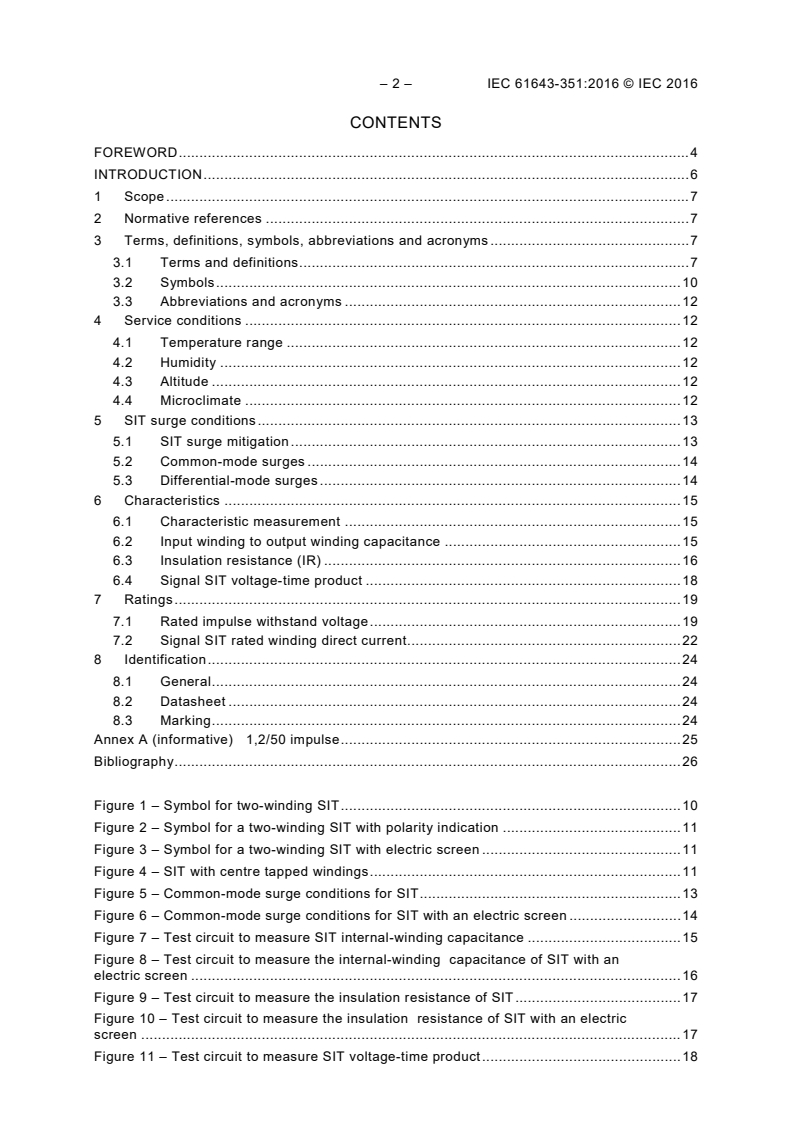
IEC 61643-351:2016 - Components for low-voltage surge protective devices - Part 351: Performance requirements and test methods for telecommunications and signalling network surge isolation transformers (SIT) Released:10/28/2016
Overview
IEC 61643-351:2016 is an international standard published by the International Electrotechnical Commission (IEC) that defines the performance requirements and test methods for surge isolation transformers (SITs) used in telecommunications and signalling networks. SITs are a specific type of component designed to provide surge protection by isolating and mitigating transient overvoltages caused by indirect or direct lightning strikes and other electrical surges.
This standard focuses on SITs intended for signal transformer applications with signal levels up to 400 V peak-to-peak. It specifies methods for determining key surge parameters, preferred performance values, and test circuits to verify SIT surge withstand capabilities.
Key Topics
Surge Isolation Transformers (SITs): Devices designed to reduce the propagation of common-mode voltage surges by electrically isolating signal circuits. SITs may include internal-winding screens to enhance surge attenuation.
Performance Requirements: The standard defines ratings such as the impulse withstand voltage that SITs must achieve to withstand surge environments typical in telecom and signalling networks. Performance metrics include insulation resistance, capacitance between windings, and voltage-time waveforms.
Test Methods and Circuits: IEC 61643-351 describes standardized test setups for measuring impulse withstand voltages, insulation resistance, winding capacitance, and temperature rise under surge conditions, ensuring reliability and safety of the SIT components.
Surge Conditions: It distinguishes between common-mode surges-which SITs are designed to mitigate-and differential-mode surges, which are outside this standard’s scope.
Signal Characteristics: Guidance on the measurement of signal-related parameters such as voltage-time product and allowable signal current ensures SITs do not degrade normal telecommunications signals.
Applications
The IEC 61643-351 standard is critical for manufacturers, designers, and testing laboratories working with low-voltage surge protective devices in telecommunications and signalling systems. Typical applications include:
Telecom network interfaces where surge isolation transformers protect sensitive signal lines from lightning-induced or switching transient voltages.
Signalling networks in industrial and transportation infrastructure, where transient overvoltages could compromise communication reliability.
Integration into surge protective devices (SPDs) that combine SITs with current diversion components such as gas discharge tubes (GDTs) or metal-oxide varistors (MOVs).
By applying this standard, stakeholders ensure that SITs provide effective surge attenuation while maintaining the integrity and quality of telecommunications signals.
Related Standards
IEC 61643 Series: IEC 61643 is a broader series of standards covering components for low-voltage surge protective devices. Part 351 complements other parts by focusing specifically on SITs used in telecommunications and signalling environments.
IEC 61643-11: This part addresses surge protective devices connected to low-voltage power systems, which often work in conjunction with SITs in communication network protection.
IEC 61000 Series: Standards related to electromagnetic compatibility (EMC) and immunity testing provide the environmental context in which SITs must perform.
Industry-Specific Guidelines: Standards governing telecommunications infrastructure often reference IEC 61643-351 for specifying surge isolation requirements.
Keywords: IEC 61643-351, surge isolation transformers, SIT, telecommunications surge protection, signalling network, low-voltage surge protective devices, impulse withstand voltage, surge mitigation, common-mode surges, surge protective devices, IEC standards.
Buy Documents
IEC 61643-351:2016 - Components for low-voltage surge protective devices - Part 351: Performance requirements and test methods for telecommunications and signalling network surge isolation transformers (SIT) Released:10/28/2016
Get Certified
Connect with accredited certification bodies for this standard

ANCE
Mexican certification and testing association.

Intertek Slovenia
Intertek testing, inspection, and certification services in Slovenia.

LNE (Laboratoire National de Métrologie et d'Essais)
French national laboratory for metrology and testing.
Sponsored listings
Frequently Asked Questions
IEC 61643-351:2016 is a standard published by the International Electrotechnical Commission (IEC). Its full title is "Components for low-voltage surge protective devices - Part 351: Performance requirements and test methods for telecommunications and signalling network surge isolation transformers (SIT)". This standard covers: IEC 61643-351:2016 defines test circuits and test methods for determining and verifying the SIT surge parameters. Preferred performance values for key parameters are given. Surge isolation transformers (SITs) are used for signal transformer applications with signal levels up to 400 V peak to peak. SITs are transformers, with or without an internal-winding screen, with a rated impulse withstand voltage greater than the peak voltage of the expected common-mode surge environment. SITs are applicable to components for surge protection against indirect and direct effects of lightning or other transient overvoltage. SITs are used to mitigate the onward propagation of common-mode voltage surges. This part of IEC 61643 does not cover SIT operation under differential-mode lightning surge conditions. Keywords: Surge isolation transformers (SITs)
IEC 61643-351:2016 defines test circuits and test methods for determining and verifying the SIT surge parameters. Preferred performance values for key parameters are given. Surge isolation transformers (SITs) are used for signal transformer applications with signal levels up to 400 V peak to peak. SITs are transformers, with or without an internal-winding screen, with a rated impulse withstand voltage greater than the peak voltage of the expected common-mode surge environment. SITs are applicable to components for surge protection against indirect and direct effects of lightning or other transient overvoltage. SITs are used to mitigate the onward propagation of common-mode voltage surges. This part of IEC 61643 does not cover SIT operation under differential-mode lightning surge conditions. Keywords: Surge isolation transformers (SITs)
IEC 61643-351:2016 is classified under the following ICS (International Classification for Standards) categories: 33.040.99 - Other equipment for telecommunication systems. The ICS classification helps identify the subject area and facilitates finding related standards.
IEC 61643-351:2016 is available in PDF format for immediate download after purchase. The document can be added to your cart and obtained through the secure checkout process. Digital delivery ensures instant access to the complete standard document.
Standards Content (Sample)
IEC 61643-351 ®
Edition 1.0 2016-10
INTERNATIONAL
STANDARD
NORME
INTERNATIONALE
Components for low-voltage surge protective devices –
Part 351: Performance requirements and test methods for telecommunications
and signalling network surge isolation transformers (SIT)
Composants pour parafoudres basse tension –
Partie 351: Exigences de performance et méthodes d'essai pour les
transformateurs d'isolement contre les surtensions dans les réseaux de
signalisation et de télécommunications
All rights reserved. Unless otherwise specified, no part of this publication may be reproduced or utilized in any form
or by any means, electronic or mechanical, including photocopying and microfilm, without permission in writing from
either IEC or IEC's member National Committee in the country of the requester. If you have any questions about IEC
copyright or have an enquiry about obtaining additional rights to this publication, please contact the address below or
your local IEC member National Committee for further information.
Droits de reproduction réservés. Sauf indication contraire, aucune partie de cette publication ne peut être reproduite
ni utilisée sous quelque forme que ce soit et par aucun procédé, électronique ou mécanique, y compris la photocopie
et les microfilms, sans l'accord écrit de l'IEC ou du Comité national de l'IEC du pays du demandeur. Si vous avez des
questions sur le copyright de l'IEC ou si vous désirez obtenir des droits supplémentaires sur cette publication, utilisez
les coordonnées ci-après ou contactez le Comité national de l'IEC de votre pays de résidence.
IEC Central Office Tel.: +41 22 919 02 11
3, rue de Varembé Fax: +41 22 919 03 00
CH-1211 Geneva 20 info@iec.ch
Switzerland www.iec.ch
About the IEC
The International Electrotechnical Commission (IEC) is the leading global organization that prepares and publishes
International Standards for all electrical, electronic and related technologies.
About IEC publications
The technical content of IEC publications is kept under constant review by the IEC. Please make sure that you have the
latest edition, a corrigenda or an amendment might have been published.
IEC Catalogue - webstore.iec.ch/catalogue Electropedia - www.electropedia.org
The stand-alone application for consulting the entire The world's leading online dictionary of electronic and
bibliographical information on IEC International Standards, electrical terms containing 20 000 terms and definitions in
Technical Specifications, Technical Reports and other English and French, with equivalent terms in 15 additional
documents. Available for PC, Mac OS, Android Tablets and languages. Also known as the International Electrotechnical
iPad. Vocabulary (IEV) online.
IEC publications search - www.iec.ch/searchpub IEC Glossary - std.iec.ch/glossary
The advanced search enables to find IEC publications by a 65 000 electrotechnical terminology entries in English and
variety of criteria (reference number, text, technical French extracted from the Terms and Definitions clause of
committee,…). It also gives information on projects, replaced IEC publications issued since 2002. Some entries have been
and withdrawn publications. collected from earlier publications of IEC TC 37, 77, 86 and
CISPR.
IEC Just Published - webstore.iec.ch/justpublished
Stay up to date on all new IEC publications. Just Published IEC Customer Service Centre - webstore.iec.ch/csc
details all new publications released. Available online and If you wish to give us your feedback on this publication or
also once a month by email. need further assistance, please contact the Customer Service
Centre: csc@iec.ch.
A propos de l'IEC
La Commission Electrotechnique Internationale (IEC) est la première organisation mondiale qui élabore et publie des
Normes internationales pour tout ce qui a trait à l'électricité, à l'électronique et aux technologies apparentées.
A propos des publications IEC
Le contenu technique des publications IEC est constamment revu. Veuillez vous assurer que vous possédez l’édition la
plus récente, un corrigendum ou amendement peut avoir été publié.
Catalogue IEC - webstore.iec.ch/catalogue Electropedia - www.electropedia.org
Application autonome pour consulter tous les renseignements
Le premier dictionnaire en ligne de termes électroniques et
bibliographiques sur les Normes internationales,
électriques. Il contient 20 000 termes et définitions en anglais
Spécifications techniques, Rapports techniques et autres
et en français, ainsi que les termes équivalents dans 15
documents de l'IEC. Disponible pour PC, Mac OS, tablettes
langues additionnelles. Egalement appelé Vocabulaire
Android et iPad.
Electrotechnique International (IEV) en ligne.
Recherche de publications IEC - www.iec.ch/searchpub
Glossaire IEC - std.iec.ch/glossary
65 000 entrées terminologiques électrotechniques, en anglais
La recherche avancée permet de trouver des publications IEC
en utilisant différents critères (numéro de référence, texte, et en français, extraites des articles Termes et Définitions des
comité d’études,…). Elle donne aussi des informations sur les publications IEC parues depuis 2002. Plus certaines entrées
projets et les publications remplacées ou retirées. antérieures extraites des publications des CE 37, 77, 86 et
CISPR de l'IEC.
IEC Just Published - webstore.iec.ch/justpublished
Service Clients - webstore.iec.ch/csc
Restez informé sur les nouvelles publications IEC. Just
Published détaille les nouvelles publications parues. Si vous désirez nous donner des commentaires sur cette
Disponible en ligne et aussi une fois par mois par email. publication ou si vous avez des questions contactez-nous:
csc@iec.ch.
IEC 61643-351 ®
Edition 1.0 2016-10
INTERNATIONAL
STANDARD
NORME
INTERNATIONALE
Components for low-voltage surge protective devices –
Part 351: Performance requirements and test methods for telecommunications
and signalling network surge isolation transformers (SIT)
Composants pour parafoudres basse tension –
Partie 351: Exigences de performance et méthodes d'essai pour les
transformateurs d'isolement contre les surtensions dans les réseaux de
signalisation et de télécommunications
INTERNATIONAL
ELECTROTECHNICAL
COMMISSION
COMMISSION
ELECTROTECHNIQUE
INTERNATIONALE
ICS 33.040.99 ISBN 978-2-8322-3717-5
– 2 – IEC 61643-351:2016 © IEC 2016
CONTENTS
FOREWORD . 4
INTRODUCTION . 6
1 Scope . 7
2 Normative references . 7
3 Terms, definitions, symbols, abbreviations and acronyms . 7
3.1 Terms and definitions . 7
3.2 Symbols . 10
3.3 Abbreviations and acronyms . 12
4 Service conditions . 12
4.1 Temperature range . 12
4.2 Humidity . 12
4.3 Altitude . 12
4.4 Microclimate . 12
5 SIT surge conditions . 13
5.1 SIT surge mitigation . 13
5.2 Common-mode surges . 14
5.3 Differential-mode surges . 14
6 Characteristics . 15
6.1 Characteristic measurement . 15
6.2 Input winding to output winding capacitance . 15
6.3 Insulation resistance (IR) . 16
6.4 Signal SIT voltage-time product . 18
7 Ratings . 19
7.1 Rated impulse withstand voltage . 19
7.2 Signal SIT rated winding direct current . 22
8 Identification . 24
8.1 General . 24
8.2 Datasheet . 24
8.3 Marking . 24
Annex A (informative) 1,2/50 impulse . 25
Bibliography . 26
Figure 1 – Symbol for two-winding SIT . 10
Figure 2 – Symbol for a two-winding SIT with polarity indication . 11
Figure 3 – Symbol for a two-winding SIT with electric screen . 11
Figure 4 – SIT with centre tapped windings . 11
Figure 5 – Common-mode surge conditions for SIT . 13
Figure 6 – Common-mode surge conditions for SIT with an electric screen . 14
Figure 7 – Test circuit to measure SIT internal-winding capacitance . 15
Figure 8 – Test circuit to measure the internal-winding capacitance of SIT with an
electric screen . 16
Figure 9 – Test circuit to measure the insulation resistance of SIT . 17
Figure 10 – Test circuit to measure the insulation resistance of SIT with an electric
screen . 17
Figure 11 – Test circuit to measure SIT voltage-time product . 18
Figure 12 – Generator and SIT secondary voltage waveforms . 18
Figure 13 – SIT rated impulse voltage test circuit . 19
Figure 14 – Rated impulse voltage test circuit for SIT with an electric screen . 20
Figure 15 – Construction of pass/fail template from the 1,2/50 open-circuit waveform . 20
Figure 16 – Pass/fail template and test waveforms . 21
Figure 17 – Winding conductor temperature rise test circuit . 23
Figure A.1 – 1,2/50 time periods and voltage amplitudes . 25
Table 1 – Classification of microclimate condition . 12
Table 2 – Impulse withstand test voltage for rated impulse voltage . 22
Table A.1 – 1,2/50 voltage impulse generator parameters . 25
– 4 – IEC 61643-351:2016 © IEC 2016
INTERNATIONAL ELECTROTECHNICAL COMMISSION
____________
COMPONENTS FOR LOW-VOLTAGE SURGE PROTECTIVE DEVICES –
Part 351: Performance requirements and test methods
for telecommunications and signalling network surge
isolation transformers (SIT)
FOREWORD
1) The International Electrotechnical Commission (IEC) is a worldwide organization for standardization comprising
all national electrotechnical committees (IEC National Committees). The object of IEC is to promote
international co-operation on all questions concerning standardization in the electrical and electronic fields. To
this end and in addition to other activities, IEC publishes International Standards, Technical Specifications,
Technical Reports, Publicly Available Specifications (PAS) and Guides (hereafter referred to as “IEC
Publication(s)”). Their preparation is entrusted to technical committees; any IEC National Committee interested
in the subject dealt with may participate in this preparatory work. International, governmental and non-
governmental organizations liaising with the IEC also participate in this preparation. IEC collaborates closely
with the International Organization for Standardization (ISO) in accordance with conditions determined by
agreement between the two organizations.
2) The formal decisions or agreements of IEC on technical matters express, as nearly as possible, an international
consensus of opinion on the relevant subjects since each technical committee has representation from all
interested IEC National Committees.
3) IEC Publications have the form of recommendations for international use and are accepted by IEC National
Committees in that sense. While all reasonable efforts are made to ensure that the technical content of IEC
Publications is accurate, IEC cannot be held responsible for the way in which they are used or for any
misinterpretation by any end user.
4) In order to promote international uniformity, IEC National Committees undertake to apply IEC Publications
transparently to the maximum extent possible in their national and regional publications. Any divergence
between any IEC Publication and the corresponding national or regional publication shall be clearly indicated in
the latter.
5) IEC itself does not provide any attestation of conformity. Independent certification bodies provide conformity
assessment services and, in some areas, access to IEC marks of conformity. IEC is not responsible for any
services carried out by independent certification bodies.
6) All users should ensure that they have the latest edition of this publication.
7) No liability shall attach to IEC or its directors, employees, servants or agents including individual experts and
members of its technical committees and IEC National Committees for any personal injury, property damage or
other damage of any nature whatsoever, whether direct or indirect, or for costs (including legal fees) and
expenses arising out of the publication, use of, or reliance upon, this IEC Publication or any other IEC
Publications.
8) Attention is drawn to the Normative references cited in this publication. Use of the referenced publications is
indispensable for the correct application of this publication.
9) Attention is drawn to the possibility that some of the elements of this IEC Publication may be the subject of
patent rights. IEC shall not be held responsible for identifying any or all such patent rights.
International Standard IEC 61643-351 has been prepared by subcommittee 37B: Specific
components for surge arresters and surge protective devices, of IEC technical committee 37:
Surge arresters.
The text of this standard is based on the following documents:
FDIS Report on voting
37B/155/FDIS 37B/156/RVD
Full information on the voting for the approval of this International Standard can be found in
the report on voting indicated in the above table.
This document has been drafted in accordance with the ISO/IEC Directives, Part 2.
A list of all parts in the IEC 61643 series, published under the general title Components for
low-voltage surge protective devices, can be found on the IEC website.
Future standards in this series will carry the new general title as cited above. Titles of existing
standards in this series will be updated at the time of the next edition.
The committee has decided that the contents of this document will remain unchanged until the
stability date indicated on the IEC website under "http://webstore.iec.ch" in the data related to
the specific document. At this date, the document will be
• reconfirmed,
• withdrawn,
• replaced by a revised edition, or
• amended.
– 6 – IEC 61643-351:2016 © IEC 2016
INTRODUCTION
This part of IEC 61643 covers surge isolation transformers whose rated impulse withstand
voltage coordinates with the expected surge environment of the installation. This type of
surge protective component, SPC, isolates and attenuates transient voltages in conjunction
with current diverting components (e.g. GDT, MOV, etc.) or surge protective devices (SPDs).
It can be used in SPDs.
COMPONENTS FOR LOW-VOLTAGE SURGE PROTECTION –
Part 351: Performance requirements and test methods
for telecommunications and signalling network surge
isolation transformers (SIT)
1 Scope
Surge isolation transformers (SITs) are used for signal transformer applications with signal
levels up to 400 V peak to peak. SITs are transformers, with or without an internal-winding
screen, with a rated impulse withstand voltage greater than the peak voltage of the expected
common-mode surge environment. SITs are applicable to components for surge protection
against indirect and direct effects of lightning or other transient overvoltage. SITs are used to
mitigate the onward propagation of common-mode voltage surges. This part of IEC 61643
defines test circuits and test methods for determining and verifying the SIT surge parameters.
Preferred performance values for key parameters are given.
This part of IEC 61643 does not cover SIT operation under differential-mode lightning surge
conditions.
2 Normative references
The following documents are referred to in the text in such a way that some or all of their
content constitutes requirements of this document. For dated references, only the edition
cited applies. For undated references, the latest edition of the referenced document (including
any amendments) applies.
IEC 60721-3-3, Classification of environmental conditions – Part 3: Classification of groups of
environmental parameters and their severities – Section 3: Stationary use at weatherprotected
locations
IEC TR 60664-2-1:2011, Insulation coordination for equipment within low-voltage systems –
Part 2-1: Application guide – Explanation of the application of the IEC 60664 series,
dimensioning examples and dielectric testing
3 Terms, definitions, symbols, abbreviations and acronyms
3.1 Terms and definitions
For the purposes of this document, the following terms and definitions apply.
ISO and IEC maintain terminological databases for use in standardization at the following
addresses:
• IEC Electropedia: available at http://www.electropedia.org/
• ISO Online browsing platform: available at http://www.iso.org/obp
3.1.1
surge isolation transformer
SIT
isolation transformer which has high impulse withstand voltage with/without electric screen
between input and output windings
– 8 – IEC 61643-351:2016 © IEC 2016
3.1.2
electric screen
ES
screen of conductive material intended to reduce the penetration of an electric field into a
given region
[SOURCE: IEC 60050-151:2001, 151-13-10]
3.1.3
breakdown
failure, at least temporarily, of the insulating properties of an insulating medium under electric
stress
[SOURCE: IEC TR 61340-1:2012, 3.4]
3.1.4
component type
manufacturer’s type of a component, e.g. its product name
3.1.5
clearance
shortest distance in air between two conductive parts
[SOURCE: IEC TR 60664-2-1:2011, 3.4]
3.1.6
creepage distance
shortest distance along the surface of a solid insulating material between two conductive
parts
[SOURCE: IEC TR 60664-2-1:2011, 3.7]
3.1.7
guarded measurement
measurement technique in a three terminal network that allows the direct impedance between
two terminals to be measured correctly by applying a compensating voltage to the third
terminal that removes the shunting effects of any impedances to the third terminal
3.1.8
insulation resistance
resistance under specified conditions between two conductive elements separated by
insulating materials
[SOURCE: IEC TS 61994-4-2:2011, 3.10]
3.1.9
impulse withstand voltage
highest peak value of impulse voltage of prescribed form and polarity which does not cause
breakdown of insulation under specified conditions
[SOURCE: IEC TR 60664-2-1:2011, 3.15]
3.1.10
isolating transformer
transformer with protective separation between the input and output windings
[SOURCE: IEC 60065:2014, 2.7.1]
3.1.11
insulation
that part of an electrotechnical product which separates the conducting parts at different
electrical potentials
[SOURCE: IEC TR 60664-2-1:2011, 3.17]
3.1.12
insulation coordination
mutual correlation of insulation characteristics of electrical equipment taking into account the
expected micro-environment and other influencing stresses
[SOURCE: IEC TR 60664-2-1:2011, 3.18]
3.1.13
overvoltage
any voltage having a peak value exceeding the corresponding peak value of maximum
steady-state voltage at normal operating conditions
[SOURCE: IEC TR 60664-2-1:2011, 3.21]
3.1.14
lightning overvoltage
transient overvoltage at any point of the system due to a specific lightning discharge
[SOURCE: IEC 60664-1:2007, 3.7.4]
3.1.15
thermal equilibrium
variation of less than 1 K between any two out of three consecutive measurements made at
an interval of 5 min
[SOURCE: IEC 61810-1:2014, 3.3.13]
3.1.16
thermal resistance
quotient of the temperature difference between two specified points or regions and the heat
flow between these two points or regions under conditions of thermal equilibrium
Note 1 to entry: For most cases, the heat flow can be assumed to be equal to the power dissipation.
[SOURCE: IEC 62590:2010, 3.9.1]
3.1.17
microclimate
climatic condition at the place where a component is installed in the product
Note 1 to entry: Only the inside product maximum air temperature (classes X1 to X7) and, optionally, the
maximum air humidity class (classes Y1 to Y4) are taken into account.
[SOURCE: IEC 60721-3-9:1993, 3.1, modified – addition of Note 1 to entry]
– 10 – IEC 61643-351:2016 © IEC 2016
3.1.18
virtual front time
T
1/0,6 times the interval T between the instants when the impulse is
30 % and 90 % of the peak value
SEE: Figure A.1
[SOURCE: IEC 60060-1:2010, 7.1.18, modified]
3.1.19
virtual origin
O
instant at which a straight line drawn through the 30 %
and 90 % amplitude values crosses the time axis
SEE: Figure A.1
[SOURCE: IEC 60060-1:2010, 7.1.19, modified]
3.1.20
virtual time to half-value
T
interval of time between the instant of virtual origin O and the instant when the voltage or
current has decreased to half the peak value
SEE: Figure A.1
3.1.21
designation of an impulse shape
combination of two numbers, the first representing the virtual front time (T ) and the second
the virtual time to half-value on the tail (T )
Note 1 to entry: It is written as T /T , both in microseconds, the sign "/" having no mathematical meaning.
1 2
[SOURCE: IEC 60099-4:2014, 3.13]
3.2 Symbols
For the purposes of this document, the following symbols apply.
Figure 1 shows the symbol for a two-winding SIT.
P1 S1
S2
P2
IEC
Key
P1: Primary winding terminal 1 S1: Secondary winding terminal 1
P2: Primary winding terminal 2 S2: Secondary winding terminal 2
Figure 1 – Symbol for two-winding SIT
Figure 2 shows the symbol for a two-winding SIT with instantaneous voltage polarity
indicators, similar to the S00843 symbol of IEC 60617 made with terminal connections.
P1 S1
P2 S2
IEC
Key
P1: Primary winding terminal 1 S1: Secondary winding terminal 1
P2: Primary winding terminal 2 S2: Secondary winding terminal 2
Figure 2 – Symbol for a two-winding SIT with polarity indication
Figure 3 shows the symbol for a two-winding SIT with an electric screen between the windings,
similar to the S00853 symbol of IEC 60617 made with terminal connections.
P1 S1
P2 S2
E
IEC
Key
P1: Primary winding terminal 1 S1: Secondary winding terminal 1
P2: Primary winding terminal 2 S2: Secondary winding terminal 2
E : Earth terminal (electric screen terminal)
Figure 3 – Symbol for a two-winding SIT with electric screen
Figure 4 shows the symbol for a SIT centre tapped windings, similar to the S00855 symbol of
IEC 60617 made with two centre tapped windings and terminal connections. When testing is
done with shorted windings the centre tap is also connected to the short, other testing is done
without any connection to the centre tap terminal.
P1 S1
CT CT
P2 S2
IEC
Key
P1: Primary winding terminal 1 S1: Secondary winding terminal 1
P2: Primary winding terminal 2 S2: Secondary winding terminal 2
CT: Centre tap terminal
Figure 4 – SIT with centre tapped windings
– 12 – IEC 61643-351:2016 © IEC 2016
3.3 Abbreviations and acronyms
For the purposes of this document, the following abbreviations and acronyms apply.
ES electric screen
ICT information and communications technology
IR insulation resistance
rms root-mean-square
SIT surge isolation transformer
SPD surge protective device
4 Service conditions
4.1 Temperature range
Normal range: −20 °C to 40 °C
Extended range: This range is decided based on agreement between manufacturer and user.
4.2 Humidity
Not exceeding 90 %.
4.3 Altitude
Normal range: Not exceeding 1 000 m.
Extended range: This range is decided based on agreement between manufacturer and user.
4.4 Microclimate
When microclimate conditions apply, use one of the classes given in Table 1.
Table 1 – Classification of microclimate condition
High air temperature Class Typical component Product application
severity temperature range
°C °C
55 X1
70 X2 0 to 70 Commercial
85 X3 −40 to 85 Industrial
100 X4
125 X5 −55 to 125 Military
a
155 X6 −65 to 150 Storage
200 X7
a
Storage temperature rating verification is outside the scope of this document. See IEC 60068-2-1:2007 and
IEC 60068-2-2:2007.
5 SIT surge conditions
5.1 SIT surge mitigation
An SIT couples a service across the transformer insulation by magnetic induction. When
common-mode surges occur on the incoming service the insulation is voltage-stressed. The
insulation has three physical paths:
a) solid insulation – insulation material interposed between the two-windings;
b) creepage distance;
c) clearance.
Clearance distances shall be set so that the maximum expected voltage difference does not
break down the clearance. Creepage distances shall be set so that the maximum expected
voltage difference and pollution degree do not cause surface flashover or breakdown
(tracking). Solid insulation thickness shall be set so that the maximum expected voltage
difference does not cause breakdown.
The higher frequency components of a surge impulse will be electrostatic coupled by SIT
internal-winding capacitance (shown as C + C ) from one winding to the other (see
P-SA P-SB
Figure 5).
C
P-SA
Z W W Z
S P S T
R
C
P-SB
IEC
Key
W : Primary winding C , C : Primary to secondary capacitance, paths A and B
P P-SA P-SB
W : Secondary winding
S
Z : Terminating or load impedance R: Reference plane or point
T
Z : Service source impedance
S
Figure 5 – Common-mode surge conditions for SIT
To reduce internal-winding capacitance, a conducting electric screen can be used between
the windings (see Figure 6). The electric screen decouples most of the winding capacitance
(shown as C , C , C and C ), leaving a much smaller value
P-Screen A P-Screen B S-Screen A S-Screen B
+ C ).
of internal-winding capacitance (shown as C
P-SA P-SB
– 14 – IEC 61643-351:2016 © IEC 2016
C
P-SA
C
C
S-Screen A
P-Screen A
Z
S W W Z
P S T
ES
C
C
S-Screen B
P-Screen B
R
C
P-SB IEC
Key
C C :
W : Primary winding
P-Screen A, P-Screen B Primary to screen capacitance, paths A and B
P
W : Secondary winding C , C :
Secondary to screen capacitance, paths A and B
S S-Screen A S-Screen B
ES: Electric screen C , C : Primary to secondary unscreened capacitance, paths A and B
P-SA P-SB
Z : Service source
S
impedance
R: Reference plane or point Z : Terminating or load impedance
T
Figure 6 – Common-mode surge conditions for SIT with an electric screen
5.2 Common-mode surges
Figure 6 shows SIT under common-mode surge conditions. The insulation rated impulse
voltage shall be equal to or greater than the peak common-mode surge voltage for insulation
coordination (see 7.1). Any primary to secondary capacitance (shown as C + C ) that
P-SA P-SB
is not decoupled by the electric screen (ES) provides a capacitive current flow path from the
primary to secondary circuit (see 6.2).
The major parameters for common-mode surges are the rated impulse voltage and the
internal-winding capacitance, plus a post-test insulation resistance check on the insulation
integrity.
5.3 Differential-mode surges
Differential-mode surges are typically caused by system asymmetry converting what should
be common-mode surges to differential ones. SIT action occurs on differential-mode surges
and the SIT does little to mitigate them. In some cases SIT bandwidth will result in filtering of
the output surge frequency spectrum.
Signal SITs may suffer core saturation, which truncates the secondary voltage. Some
standards specify testing for differential power faults, requiring the signal SIT to have a
primary winding current rating.
6 Characteristics
6.1 Characteristic measurement
Characteristics are measureable component parameters at the time of test and the values
obtained are for the component tested. Characteristics may be specified by the manufacturer
as typical, maximum, minimum or combinations of these quantities.
The temperature and humidity environment for the characteristic measurements shall be
IEC 60721-3-3, class 3K1:
a) low temperature 20 °C ± 2 °C;
b) high temperature 25 °C ± 2 °C;
c) low relative humidity 20 %;
d) high relative humidity 75 %.
6.2 Input winding to output winding capacitance
This test measures the effective internal-winding capacitance of SIT.
a) Test method
Figure 7 shows a test circuit to measure SIT internal-winding capacitance. In Figure 7,
and secondary
only SIT capacitive component is shown. Both the primary winding W
P
winding W are short-circuited. The internal-winding capacitance is measured between the
S
two shorts.
W
P W
S
C
P-S
F
IEC
Key
W : Primary winding C : Primary to secondary capacitance
P P-S
W : Secondary winding F: Capacitance meter
S
Figure 7 – Test circuit to measure SIT internal-winding capacitance
Figure 8 shows a test circuit to measure the internal-winding capacitance of SIT with an
electric screen, ES. In Figure 8, only SIT capacitive components are shown. Both the
primary winding W and secondary winding W are short-circuited. The internal-winding
P S
capacitance is measured between the two shorts. A guarded measurement of the internal-
winding capacitance shall be made to remove the winding to electric screen capacitances.
Guarded measurements are done using either three-wire (Hi, Lo, Guard) or six-wire (Hi,
Lo, Guard feed and Hi, Lo, Guard sense) techniques. Figure 8 shows the use of a
Blumlein three-wire transformer ratio arm bridge. The use of coaxial cables removes the
connecting cable shunting capacitance from the measurement.
– 16 – IEC 61643-351:2016 © IEC 2016
W W
P S
C
P-S
G
G
C
C
S-Screen
P-Screen
ES
C
C
L
H
G G
F
IEC
Key
C : Primary to Screen capacitance
W : Primary winding
P-Screen
P
W : Secondary winding C : Secondary to Screen capacitance
S S-Screen
ES: Electric screen C : Primary to Secondary residual capacitance
P-S
C : Capacitance measurement connection Hi G: Guard connection (coaxial cables screen)
H
C : Capacitance measurement connection Lo F: Guarded measurement capacitance bridge
L
Figure 8 – Test circuit to measure the internal-winding
capacitance of SIT with an electric screen
By connecting the guard G to the primary and the measurement leads to the two
remaining connections, the secondary to electric screen capacitance C may be
S-Screen
measured. Similarly, connecting the guard G to the secondary and the measurement leads
to the two remaining connections, the primary to electric screen capacitance C
P-Screen
may be measured.
b) Values
This document covers AC low frequency power, high frequency switching of any size and
construction. With this degree of variation, it is impractical to create a list of preferred
values. The internal-winding capacitance value can be used to predict the level of
capacitive surge current passed on to the following circuitry.
c) Criteria
The measured value of internal-winding capacitance shall be within the manufacturer’s
specified limits. When the manufacturer only gives a typical value, if the measured value is
outside ±30 % the typical value, the manufacturer should be contacted to verify the
measurement technique and product parameter distribution.
6.3 Insulation resistance (IR)
This test measures the resistance of the insulation at a defined DC voltage.
a) Test method
The insulation resistance meter shall be set for the specified value of DC test voltage, see
6.3 b). The test voltage shall be applied for at least 60 s before the insulation resistance
value is taken. Figure 9 shows the test circuit to measure the insulation resistance of SIT.
Both the primary winding W and secondary winding W are short-circuited. The insulation
P S
resistance is measured between the two shorts.
W W
S
P
Ω
IEC
Key
W : Primary winding Ω: IR meter with defined DC bias
P
W : Secondary winding
S
Figure 9 – Test circuit to measure the insulation resistance of SIT
Figure 10 shows the test circuit to measure the insulation resistance of SIT with an electric
screen. Both the primary winding W and secondary winding W are short-circuited. The
P S
insulation resistance is measured between the two shorts. Unless otherwise specified, two
measurements are taken: once with the selector switch SW connecting the electric screen
, and once with the selector switch SW connecting the
ES to the primary winding W
P
electric screen ES to the secondary winding W .
S
W
W
S
P
ES
SW
Ω
IEC
Key
W : Primary winding Ω: IR meter with defined DC bias
P
W : Secondary winding SW: Two-position selector switch
S
ES: Electric screen
Figure 10 – Test circuit to measure the insulation
resistance of SIT with an electric screen
b) Value
The preferred test value of DC voltage is 500 V and the resistance reading is made after
the DC voltage has been applied for 60 s minimum.
c) Criteria
The insulation resistance values shall be 2 MΩ or more, measured at 500 V DC.
– 18 – IEC 61643-351:2016 © IEC 2016
6.4 Signal SIT voltage-time product
This test measures SIT voltage-time product, a measure of the secondary winding differential-
mode surge let-through.
a) Test method
Figure 11 shows the test circuit for voltage-time measurement. The pulse generator, G has
adjustable voltage amplitude and pulse duration.
W W
P S
G
V
O
S
IEC
Key
W : Primary winding G: Pulse generator, 50 Ω source impedance
P
W : Secondary winding O: Oscilloscope monitoring V
S S
V : Instantaneous secondary winding voltage
S
Figure 11 – Test circuit to measure SIT voltage-time product
Figure 12 shows the generator open-circuit output voltage and the resultant secondary
winding voltage. The generator pulse voltage amplitude V and duration are adjusted to
G
cause SIT core saturation. Core saturation is shown by the secondary winding voltage
pulse being truncated, having a shorter duration t than the generator pulse. To allow
S
accurate measurement, the generator voltage amplitude shall be adjusted such that the
core saturation time t is not less than 10 μs.
S
0,5V
S
t
S
IEC
Key
: Open-circuit pulse generator peak voltage t : Secondary winding voltage time above 50 % V
V
G S S
V : Instantaneous secondary winding peak voltage
S
Figure 12 – Generator and SIT secondary voltage waveforms
On the instantaneous secondary winding voltage V , measure the peak amplitude V and
S S
the 50 % V duration time t . SIT voltage-time product is given by V × t expressed in
S S S S
μV·s.
b) Value
SIT voltage-time product depends on SIT size, construction and the information and
communications technology (ICT) system. With this degree of variation, it is impractical to
create a list of preferred values. As an example, Ethernet SITs typically have a voltage-
time product in the 50 μV·s region. The voltage-time product value can be used to predict
the peak secondary voltage level before truncation resulting from a defined surge
waveform when there are no secondary voltages limiting components.
c) Criteria
The measured value of voltage-time product shall be within the manufacturer’s specified
limits. When the manufacturer only gives a typical value, if the measured value is outside
V
V
G
S
±30 % the typical value, the manufacturer should be contacted to verify the measurement
technique and product parameter distribution.
7 Ratings
7.1 Rated impulse withstand voltage
This test verifies the insulation rated impulse voltage specified by SIT manufacturer for the
component type.
a) Test method
The insulation rated impulse voltage is traditionally tested using a 1,2/50 voltage impulse,
see Annex A. This document only specifies insulation impulse testing as it is a universal
approach that can be used for component, device and equipment port testing. Figure 13
shows the test circuit used for insulation voltage withstand testing of SIT. A 1,2/50 impulse
generator, whose voltage waveform is monitored by oscilloscope O, has its impulse
voltage applied to the insulation separating windings W and W . Both the primary
P S
winding W and secondary winding W are short circuited.
P S
W W
P S
O
G
1,2/50
IEC
Key
W : Primary winding G: 1,2/50 surge generator
P
W : Secondary winding O: Oscilloscope or equivalent monitoring impulse voltage
S
Figure 13 – SIT rated impulse voltage test circuit
Figure 14 shows the test circuit used for insulation voltage withstand testing of SIT with an
electric screen. A 1,2/50 impulse generator, whose voltage waveform is monitored by
oscilloscope O, has its impulse voltage applied to the insulation separating windings W
P
and W . Both the primary winding W and secondary winding W are short circuited.
S P S
Unless otherwise specified, two measurements are taken: once with the selector switch,
SW connecting the electric screen ES to the primary winding W , and once with the
P ,
selector switch SW connecting the electric screen ES to the secondary winding W .
S
– 20 – IEC 61643-351:2016 © IEC 2016
W W
P ES S
SW
O
G
1,2/50
IEC
Key
W : Primary winding G: 1,2/50 surge generator
P
W : Secondary winding O: Oscilloscope or equivalent monitoring impulse voltage
S
ES: Electric screen SW: Two-position selector switch
Figure 14 – Rated impulse voltage test circuit for SIT with an electric screen
Before testing the insulation, a test pass/fail template shall be determined. First set the
generator G voltage to the impulse withstand voltage listed in Table 2 that corresponds to
SIT rated impulse voltage. Record the generator G voltage waveform. Construct a
template from the generator G open-circuit 1,2/50 waveform consisting of an upper limit,
created by moving the waveform up by 10 % of the peak amplitude, and a lower limit,
created by moving the waveform down by 10 % of the peak amplitude (see Figure 15).
IEC
Key
d: Positive and negative vertical waveform displacement distance of the 1,2/50 open-circuit voltage waveform
Distance d is equal to 10 % of the peak open-circuit voltage.
Figure 15 – Construction of pass/fail template from the 1,2/50 open-circuit waveform
An example use of the template is shown in Figure 16, in which the template is shown as a
shaded area. To pass the insulation test, any waveform aberrations during the insulation
test shall not be outside the template area (see Figure 16 a)). Any insulation breakdown
causing aberrations such as waveform serration (Figure 16 b)) and truncation
(Figure 16 c)) are outside the template area and are test failures.
d d
IEC IEC
IEC
a) Pass, test waveform within the b) Test failure, serrated test c) Test failure, truncated test
template constructed from the waveform outside the waveform outside the
1,2/50 open circuit voltage template area template area
waveform
Figure 16 – Pass/fail template and test waveforms
Using the test circuits of Figure 13 or Figure 14, as appropriate, apply the impulse
withstand test voltage corresponding to SIT insulation rated impulse voltage to the
insulation from the impulse generator G, while recording the impulse waveform on
oscilloscope O. Check if the recorded voltage complies with Figure 16 a). For SIT with an
electric screen, see Figure 14, repeat the test with the selector switch SW set in the
alternative position and check if the recorded voltage
...