

IEC 61643-331:2017
(Main)Components for low-voltage surge protective devices - Part 331: Performance requirements and test methods for metal oxide varistors (MOV)
General Information
- Abstract
IEC 61643-331:2017 is a test specification for metal oxide varistors (MOV), which are used for applications up to 1 000 V AC or 1 500 V DC in power line, or telecommunication, or signalling circuits. They are designed to protect apparatus or personnel, or both, from high transient voltages. This specification applies to MOVs having two electrodes and hybrid overvoltage protection components. This specification also does not apply to mountings and their effect on the MOV’s characteristics. Characteristics given apply solely to the MOV mounted only in the ways described for the tests. This second edition cancels and replaces the first edition published in 2003. This edition constitutes a technical revision. This edition includes the following significant technical changes with respect to the previous edition:
a) Update of the nominal varistor voltage test method;
b) Addition of thermally protected varistors – component symbol and test methods;
c) Addition of nominal discharge current – test methods;
d) Addition of voltage ratings for disc types (Table 1);
e) Addition of test currents for clamping voltage of disc types (Table 2);
f) Addition of typical voltage ratings of SMD types (Table 3); and
g) Addition of Limited current and temporary overvoltage tests for thermally protected varistors.
Keywords: metal oxide varistors (MOV), high transient voltages.
- Status
- Published
- Publication Date
- 06-Dec-2017
- Technical Committee
- SC 37B - Components for low-voltage surge protection
- Drafting Committee
- MT 1 - TC 37/SC 37B/MT 1
- Current Stage
- DELPUB - Deleted Publication
- Start Date
- 19-Mar-2020
- Completion Date
- 19-Oct-2018
Buy Documents
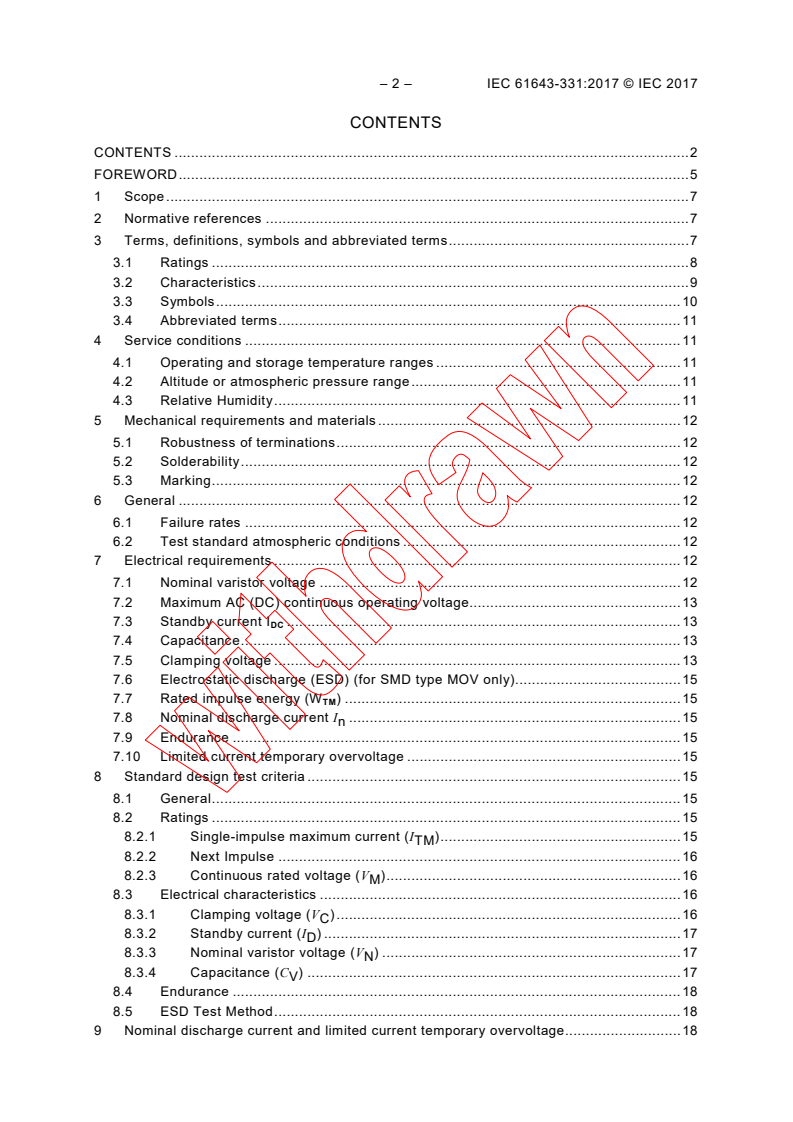
IEC 61643-331:2017 - Components for low-voltage surge protective devices - Part 331: Performance requirements and test methods for metal oxide varistors (MOV) Released:12/7/2017
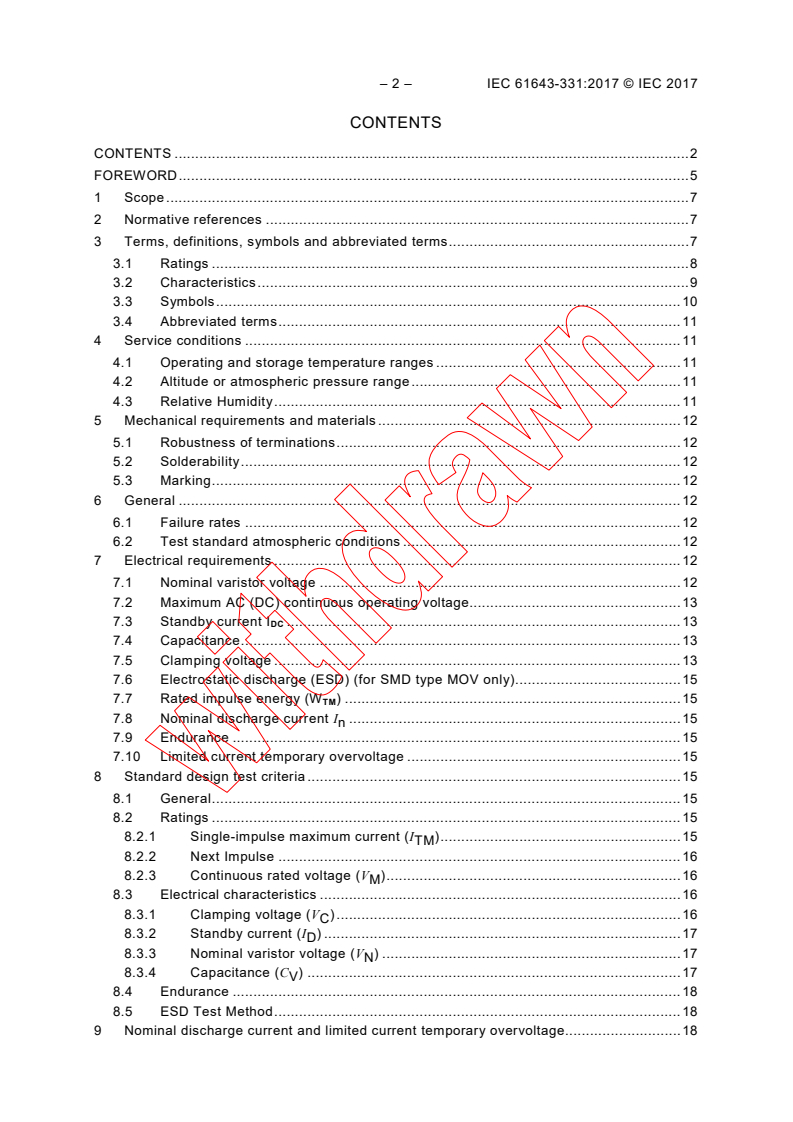
IEC 61643-331:2017 - Components for low-voltage surge protective devices - Part 331: Performance requirements and test methods for metal oxide varistors (MOV) Released:12/7/2017
Overview
IEC 61643-331:2017 - Components for low-voltage surge protective devices - Part 331 - specifies performance requirements and test methods for metal oxide varistors (MOV). It applies to two‑electrode MOVs and hybrid overvoltage protection components used in circuits up to 1 000 V AC or 1 500 V DC for power line, telecommunication, and signalling applications. This second edition (2017) replaces the 2003 edition and introduces several technical revisions including test updates for nominal varistor voltage, thermally protected MOVs, and nominal discharge current.
Key Topics and Requirements
The standard defines measurable electrical, mechanical and environmental requirements and standardized test procedures, including:
- Nominal varistor voltage - updated test method to determine the V‑I characteristic reference point.
- Maximum continuous operating voltage and standby (leakage) current tests.
- Clamping voltage measurement at peak impulse current (test circuits and currents defined).
- Rated impulse energy and nominal discharge current (In) - new test methods and pass/fail criteria.
- Endurance and accelerated ageing tests to verify long‑term performance under repeated transient stress.
- Thermally protected varistors - added component symbol, test procedures, and limited current / temporary overvoltage tests specific to these devices.
- SMD and disc type specifics - addition of voltage rating tables and test currents for disc and typical ratings for SMD MOVs.
- ESD testing (for SMD MOVs), capacitance measurement, dielectric and robustness tests (solderability, terminations, marking).
- Environmental and service conditions - operating/storage temperature ranges, humidity and altitude considerations.
- Informative annexes: cross‑references to IEC 61643‑11 testing, IEC 61051 varistor background, accelerated screening, and methods for estimating mean time to failure (MTTF).
Note: The standard excludes effects introduced by specific mountings; test characteristics apply only to the MOV mounting methods described.
Applications and Who Uses It
IEC 61643-331 is essential for:
- MOV manufacturers for product specification, design verification and marking.
- Test laboratories and certification bodies performing type and routine testing.
- Surge protective device (SPD) designers integrating MOVs into power, telecom and signalling protective solutions.
- Compliance engineers and procurement teams who specify components to meet safety and performance requirements.
- OEMs of power distribution, industrial control and telecommunications equipment where protection against high transient voltages is required.
Using this standard helps ensure MOVs reliably limit high transient voltages, meet safety expectations, and perform predictably in specified service conditions.
Related Standards
- IEC 61643 series (e.g., IEC 61643‑11) - SPDs for power systems (referenced in Annex A).
- IEC 61051 - varistor guidance for electronic equipment (referenced in Annex B).
- Other IEC test and safety standards relevant to SPD design and qualification.
Relations
- Effective Date
- 05-Sep-2023
- Effective Date
- 05-Sep-2023
Buy Documents
IEC 61643-331:2017 - Components for low-voltage surge protective devices - Part 331: Performance requirements and test methods for metal oxide varistors (MOV) Released:12/7/2017
IEC 61643-331:2017 - Components for low-voltage surge protective devices - Part 331: Performance requirements and test methods for metal oxide varistors (MOV) Released:12/7/2017
Frequently Asked Questions
IEC 61643-331:2017 is a standard published by the International Electrotechnical Commission (IEC). Its full title is "Components for low-voltage surge protective devices - Part 331: Performance requirements and test methods for metal oxide varistors (MOV)". This standard covers: IEC 61643-331:2017 is a test specification for metal oxide varistors (MOV), which are used for applications up to 1 000 V AC or 1 500 V DC in power line, or telecommunication, or signalling circuits. They are designed to protect apparatus or personnel, or both, from high transient voltages. This specification applies to MOVs having two electrodes and hybrid overvoltage protection components. This specification also does not apply to mountings and their effect on the MOV’s characteristics. Characteristics given apply solely to the MOV mounted only in the ways described for the tests. This second edition cancels and replaces the first edition published in 2003. This edition constitutes a technical revision. This edition includes the following significant technical changes with respect to the previous edition: a) Update of the nominal varistor voltage test method; b) Addition of thermally protected varistors – component symbol and test methods; c) Addition of nominal discharge current – test methods; d) Addition of voltage ratings for disc types (Table 1); e) Addition of test currents for clamping voltage of disc types (Table 2); f) Addition of typical voltage ratings of SMD types (Table 3); and g) Addition of Limited current and temporary overvoltage tests for thermally protected varistors. Keywords: metal oxide varistors (MOV), high transient voltages.
IEC 61643-331:2017 is a test specification for metal oxide varistors (MOV), which are used for applications up to 1 000 V AC or 1 500 V DC in power line, or telecommunication, or signalling circuits. They are designed to protect apparatus or personnel, or both, from high transient voltages. This specification applies to MOVs having two electrodes and hybrid overvoltage protection components. This specification also does not apply to mountings and their effect on the MOV’s characteristics. Characteristics given apply solely to the MOV mounted only in the ways described for the tests. This second edition cancels and replaces the first edition published in 2003. This edition constitutes a technical revision. This edition includes the following significant technical changes with respect to the previous edition: a) Update of the nominal varistor voltage test method; b) Addition of thermally protected varistors – component symbol and test methods; c) Addition of nominal discharge current – test methods; d) Addition of voltage ratings for disc types (Table 1); e) Addition of test currents for clamping voltage of disc types (Table 2); f) Addition of typical voltage ratings of SMD types (Table 3); and g) Addition of Limited current and temporary overvoltage tests for thermally protected varistors. Keywords: metal oxide varistors (MOV), high transient voltages.
IEC 61643-331:2017 is classified under the following ICS (International Classification for Standards) categories: 31.040.20 - Potentiometers, variable resistors. The ICS classification helps identify the subject area and facilitates finding related standards.
IEC 61643-331:2017 has the following relationships with other standards: It is inter standard links to IEC 61643-331:2020, IEC 61643-331:2003. Understanding these relationships helps ensure you are using the most current and applicable version of the standard.
IEC 61643-331:2017 is available in PDF format for immediate download after purchase. The document can be added to your cart and obtained through the secure checkout process. Digital delivery ensures instant access to the complete standard document.
Standards Content (Sample)
IEC 61643-331 ®
Edition 2.0 2017-12
INTERNATIONAL
STANDARD
colour
inside
Components for low-voltage surge protective devices –
Part 331: Performance requirements and test methods for metal oxide varistors
(MOV)
All rights reserved. Unless otherwise specified, no part of this publication may be reproduced or utilized in any form
or by any means, electronic or mechanical, including photocopying and microfilm, without permission in writing from
either IEC or IEC's member National Committee in the country of the requester. If you have any questions about IEC
copyright or have an enquiry about obtaining additional rights to this publication, please contact the address below or
your local IEC member National Committee for further information.
IEC Central Office Tel.: +41 22 919 02 11
3, rue de Varembé Fax: +41 22 919 03 00
CH-1211 Geneva 20 info@iec.ch
Switzerland www.iec.ch
About the IEC
The International Electrotechnical Commission (IEC) is the leading global organization that prepares and publishes
International Standards for all electrical, electronic and related technologies.
About IEC publications
The technical content of IEC publications is kept under constant review by the IEC. Please make sure that you have the
latest edition, a corrigenda or an amendment might have been published.
IEC Catalogue - webstore.iec.ch/catalogue Electropedia - www.electropedia.org
The stand-alone application for consulting the entire The world's leading online dictionary of electronic and
bibliographical information on IEC International Standards, electrical terms containing 20 000 terms and definitions in
Technical Specifications, Technical Reports and other English and French, with equivalent terms in 16 additional
documents. Available for PC, Mac OS, Android Tablets and languages. Also known as the International Electrotechnical
iPad. Vocabulary (IEV) online.
IEC publications search - www.iec.ch/searchpub IEC Glossary - std.iec.ch/glossary
The advanced search enables to find IEC publications by a 65 000 electrotechnical terminology entries in English and
variety of criteria (reference number, text, technical French extracted from the Terms and Definitions clause of
committee,…). It also gives information on projects, replaced IEC publications issued since 2002. Some entries have been
and withdrawn publications. collected from earlier publications of IEC TC 37, 77, 86 and
CISPR.
IEC Just Published - webstore.iec.ch/justpublished
Stay up to date on all new IEC publications. Just Published IEC Customer Service Centre - webstore.iec.ch/csc
details all new publications released. Available online and If you wish to give us your feedback on this publication or
also once a month by email. need further assistance, please contact the Customer Service
Centre: csc@iec.ch.
IEC 61643-331 ®
Edition 2.0 2017-12
INTERNATIONAL
STANDARD
colour
inside
Components for low-voltage surge protective devices –
Part 331: Performance requirements and test methods for metal oxide varistors
(MOV)
INTERNATIONAL
ELECTROTECHNICAL
COMMISSION
ICS 31.040.20 ISBN 978-2-8322-5095-2
– 2 – IEC 61643-331:2017 © IEC 2017
CONTENTS
CONTENTS . 2
FOREWORD . 5
1 Scope . 7
2 Normative references . 7
3 Terms, definitions, symbols and abbreviated terms . 7
3.1 Ratings . 8
3.2 Characteristics . 9
3.3 Symbols . 10
3.4 Abbreviated terms . 11
4 Service conditions . 11
4.1 Operating and storage temperature ranges . 11
4.2 Altitude or atmospheric pressure range . 11
4.3 Relative Humidity . 11
5 Mechanical requirements and materials . 12
5.1 Robustness of terminations . 12
5.2 Solderability . 12
5.3 Marking . 12
6 General . 12
6.1 Failure rates . 12
6.2 Test standard atmospheric conditions . 12
7 Electrical requirements . 12
7.1 Nominal varistor voltage . 12
7.2 Maximum AC (DC) continuous operating voltage. 13
7.3 Standby current I . 13
DC
7.4 Capacitance . 13
7.5 Clamping voltage . 13
7.6 Electrostatic discharge (ESD) (for SMD type MOV only). 15
7.7 Rated impulse energy (W ) . 15
TM
7.8 Nominal discharge current I . 15
n
7.9 Endurance . 15
7.10 Limited current temporary overvoltage . 15
8 Standard design test criteria . 15
8.1 General . 15
8.2 Ratings . 15
8.2.1 Single-impulse maximum current (I ) . 15
TM
8.2.2 Next Impulse . 16
8.2.3 Continuous rated voltage (V ) . 16
M
8.3 Electrical characteristics . 16
8.3.1 Clamping voltage (V ) . 16
C
8.3.2 Standby current (I ) . 17
D
8.3.3 Nominal varistor voltage (V ) . 17
N
8.3.4 Capacitance (C ) . 17
V
8.4 Endurance . 18
8.5 ESD Test Method . 18
9 Nominal discharge current and limited current temporary overvoltage. 18
9.1 Thermally protected varistors – Sequence of tests . 18
9.2 Temperature and humidity cycle conditioning . 18
9.3 Nominal discharge current I(n) test description . 19
9.3.1 General . 19
9.3.2 Pass/fail criteria . 21
9.4 Limited current temporary overvoltage test description and procedure for
thermally protected varistors . 21
9.4.1 General . 21
9.4.2 Sample preparation . 21
9.4.3 Test conditions . 21
9.4.4 Pass/fail criteria . 22
9.5 Dielectric testing . 24
9.5.1 Test conditions . 24
9.5.2 Setup from foil to leads . 24
9.5.3 Pass criteria . 24
Annex A (informative) MOV testing according to IEC 61643-11:2011 – Surge
protective devices for the Class I, II and III . 25
A.1 General . 25
A.2 MOV selection . 25
A.3 Cross reference list of abbreviations, descriptions and definitions . 25
A.4 Operating duty test . 26
A.4.1 General . 26
A.4.2 Measured limiting voltage . 28
A.4.3 Class I and II operating duty tests (8.3.4.3) . 31
A.4.4 Additional duty test for test class I . 31
A.4.5 Class III operating duty tests . 32
A.4.6 Pass criteria for all operating duty tests and for the additional duty test
for test class I . 33
A.4.7 Preferred parameters of impulse discharge current I used for Class I
imp
additional duty tests . 33
A.4.8 Preferred values of impulse discharge current I used for Class I and
n
Class II residual voltage and operating duty tests . 33
A.4.9 Preferred values of combination waveshape used for Class III tests . 34
Annex B (informative) IEC 61051 Varistors for use in electronic equipment . 36
Annex C (informative) Accelerated endurance screening test . 37
C.1 Accelerated endurance screening test . 37
C.2 Preparation of sample . 37
C.3 Test conditions . 37
C.4 Pass criteria . 38
Annex D (informative) Proposed test method for determination of mean time to failure
(MTTF) . 39
D.1 Sampling plans . 39
D.2 Total test hours . 39
D.3 Samples. 39
D.4 Intermediate measurements . 40
D.5 Failure criteria . 40
D.6 Acceptance criteria . 40
Bibliography . 41
– 4 – IEC 61643-331:2017 © IEC 2017
Figure 1 – V-I characteristic of a MOV . 10
Figure 2 – Symbol for MOV . 10
Figure 3 – Symbol for thermally protected MOV . 11
Figure 4 – Test circuit for impulse peak current clamping voltage (V ) at peak impulse
C
current (I ) . 16
P
Figure 5 – Test circuit for measuring leakage current . 17
Figure 6 – Test circuit for measuring nominal varistor voltage (V ) . 17
V
Figure 7 – Nominal Discharge Current Flowchart . 20
Figure 8 – Sequence of the I Test . 21
n
Figure 9 – Temporary Overvoltage Limited Current test procedure Flowchart. 23
Figure A.1 – Flow chart of the operating duty test . 27
Figure A.2 – Test set-up for operating duty test . 28
Figure A.3 – Flow chart of testing to determine the measured limiting voltage . 30
Figure A.4 – Operating duty test timing diagram for test classes I and II . 31
Figure A.5 – Additional duty test timing diagram for test class I . 32
Figure A.6 – Operating duty test timing diagram for test class III . 32
Figure C.1 – Circuit of accelerated ageing test . 37
Figure D.1 – Test Circuit of MTTF . 40
Table 1 – Voltage ratings for disc types . 13
Table 2 – Typical Voltage Ratings for SMD types . 14
Table A.1 – Comparison of IEC 61643-11 and IEC 61643-311 . 26
Table A.2 – Preferred parameters for class I test . 33
Table A.3 – Preferred values for class I and class II tests . 34
Table A.4 – Preferred values for class III tests . 35
Table D.1 – Sampling plans . 39
INTERNATIONAL ELECTROTECHNICAL COMMISSION
____________
COMPONENTS FOR LOW-VOLTAGE SURGE PROTECTIVE DEVICES –
Part 331: Performance requirements and test methods
for metal oxide varistors (MOV)
FOREWORD
1) The International Electrotechnical Commission (IEC) is a worldwide organization for standardization comprising
all national electrotechnical committees (IEC National Committees). The object of IEC is to promote
international co-operation on all questions concerning standardization in the electrical and electronic fields. To
this end and in addition to other activities, IEC publishes International Standards, Technical Specifications,
Technical Reports, Publicly Available Specifications (PAS) and Guides (hereafter referred to as “IEC
Publication(s)”). Their preparation is entrusted to technical committees; any IEC National Committee interested
in the subject dealt with may participate in this preparatory work. International, governmental and non-
governmental organizations liaising with the IEC also participate in this preparation. IEC collaborates closely
with the International Organization for Standardization (ISO) in accordance with conditions determined by
agreement between the two organizations.
2) The formal decisions or agreements of IEC on technical matters express, as nearly as possible, an international
consensus of opinion on the relevant subjects since each technical committee has representation from all
interested IEC National Committees.
3) IEC Publications have the form of recommendations for international use and are accepted by IEC National
Committees in that sense. While all reasonable efforts are made to ensure that the technical content of IEC
Publications is accurate, IEC cannot be held responsible for the way in which they are used or for any
misinterpretation by any end user.
4) In order to promote international uniformity, IEC National Committees undertake to apply IEC Publications
transparently to the maximum extent possible in their national and regional publications. Any divergence
between any IEC Publication and the corresponding national or regional publication shall be clearly indicated in
the latter.
5) IEC itself does not provide any attestation of conformity. Independent certification bodies provide conformity
assessment services and, in some areas, access to IEC marks of conformity. IEC is not responsible for any
services carried out by independent certification bodies.
6) All users should ensure that they have the latest edition of this publication.
7) No liability shall attach to IEC or its directors, employees, servants or agents including individual experts and
members of its technical committees and IEC National Committees for any personal injury, property damage or
other damage of any nature whatsoever, whether direct or indirect, or for costs (including legal fees) and
expenses arising out of the publication, use of, or reliance upon, this IEC Publication or any other IEC
Publications.
8) Attention is drawn to the Normative references cited in this publication. Use of the referenced publications is
indispensable for the correct application of this publication.
9) Attention is drawn to the possibility that some of the elements of this IEC Publication may be the subject of
patent rights. IEC shall not be held responsible for identifying any or all such patent rights.
International Standard IEC 61643-331 has been prepared by subcommittee 37B: Specific
components for surge arresters and surge protective devices, of IEC technical committee 37:
Surge arresters.
This second edition cancels and replaces the first edition published in 2003. This edition
constitutes a technical revision.
This edition includes the following significant technical changes with respect to the previous
edition:
a) Update of the nominal varistor voltage test method;
b) Addition of thermally protected varistors – component symbol and test methods;
c) Addition of nominal discharge current – test methods;
d) Addition of voltage ratings for disc types (Table 1);
– 6 – IEC 61643-331:2017 © IEC 2017
e) Addition of test currents for clamping voltage of disc types (Table 2);
f) Addition of typical voltage ratings of SMD types (Table 3); and
g) Addition of Limited current and temporary overvoltage tests for thermally protected
varistors.
The text of this International Standard is based on the following documents:
FDIS Report on voting
37B/160/FDIS 37B/164/RVD
Full information on the voting for the approval of this International Standard can be found in
the report on voting indicated in the above table.
This document has been drafted in accordance with the ISO/IEC Directives, Part 2.
A list of all parts of IEC 61643 series, under the general title Components for low-voltage
surge protective devices, can be found on the IEC website.
The committee has decided that the contents of this document will remain unchanged until the
stability date indicated on the IEC website under "http://webstore.iec.ch" in the data related to
the specific document. At this date, the document will be
• reconfirmed,
• withdrawn,
• replaced by a revised edition, or
• amended.
A bilingual version of this publication may be issued at a later date.
IMPORTANT – The 'colour inside' logo on the cover page of this publication indicates
that it contains colours which are considered to be useful for the correct
understanding of its contents. Users should therefore print this document using a
colour printer.
COMPONENTS FOR LOW-VOLTAGE SURGE PROTECTIVE DEVICES –
Part 331: Performance requirements and test methods
for metal oxide varistors (MOV)
1 Scope
This part of IEC 61643 is a test specification for metal oxide varistors (MOV), which are used
for applications up to 1 000 V AC or 1 500 V DC in power line, or telecommunication, or
signalling circuits. They are designed to protect apparatus or personnel, or both, from high
transient voltages.
This specification applies to MOVs having two electrodes and hybrid overvoltage protection
components. This specification also does not apply to mountings and their effect on the
MOV’s characteristics. Characteristics given apply solely to the MOV mounted only in the
ways described for the tests.
2 Normative references
The following documents are referred to in the text in such a way that some or all of their
content constitutes requirements of this document. For dated references, only the edition
cited applies. For undated references, the latest edition of the referenced document (including
any amendments) applies.
IEC 60068-1:2013, Environmental testing – Part 1: General and guidance
IEC 60068-2-20:2008, Environmental testing – Part 2-20: Tests – Test T: Test methods for
solderability and resistance to soldering heat of devices with leads
IEC 60068-2-21:2006, Environmental testing – Part 2-21: Tests – Test U: Robustness of
terminations and integral mounting devices
IEC 60068-2-78:2012, Environmental testing – Part 2-78: Tests – Test Cab: Damp heat,
steady state
IEC 61643-11:2011, Low-voltage surge protective devices – Part 11: Surge protective devices
connected to low-voltage power systems – Requirements and test methods
IEC 61000-4-2:2008, Electromagnetic compatibility (EMC) – Part 4-2: Testing and
measurement techniques – Electrostatic discharge immunity test
3 Terms, definitions, symbols and abbreviated terms
For the purposes of this document, the following terms, definitions, symbols and abbreviated
terms apply.
ISO and IEC maintain terminological databases for use in standardization at the following
addresses:
• IEC Electropedia: available at http://www.electropedia.org/
• ISO Online browsing platform: available at http://www.iso.org/obp
– 8 – IEC 61643-331:2017 © IEC 2017
3.1 Ratings
3.1.1
absolute maximum ratings
limiting values of operating and environmental conditions applicable to a component, device,
equipment or machine as defined by its published specification data, which should not be
exceeded under the worst possible conditions
Note 1 to entry: A limiting condition may be either a maximum or a minimum or both.
[SOURCE: MODIFIED: IEC 62240-1:2013, Clause 3.1.1, modified ("any semiconductor
device of a specific type" replaced by "a component, device, equipment or machine", addition
of Note 1 to entry)]
3.1.2
single-impulse [transient] maximum current
I
TM
rated maximum value of current which may be applied for a single impulse of specified
waveform
Note 1 to entry: For power distribution surge protective devices (SPDs), IEC 61643-11, Maximum Discharge
Current I is used.
MAX
3.1.3
nominal discharge current
I
n
crest value of the current through the MOV having a current waveshape of 8/20
3.1.4
impulse life characteristic
graphical representation between impulse current peak (I), equivalent rectangular pulse width
(T), and impulse numbers (n) for which the varistor can withstand
Note 1 to entry: Unless otherwise specified, the range of T shall be 20 µs to 10 ms, the range of n shall be 10 ,
5 4 3 2 1 0
10 ,10 , 10 , 10 , 10 and 10 temperature derating curve.
3.1.5
temperature derating curve
graphical representation of parameter derating against temperature
Note 1 to entry: Typical parameters are rated voltage, impulse current, energy and average power dissipation.
3.1.6
single-pulse [transient] maximum energy
W
TM
rated maximum value which may be absorbed for a single pulse of a specified waveform
Note 1 to entry: Unless otherwise specified, 2 ms rectangular pulse is used (IEC 60060).
3.1.7
maximum continuous voltage
V
M
voltage that may be applied continuously at a specified temperature
Note 1 to entry: May also be called U or maximum continuous operating voltage (MCOV).
C
Note 2 to entry: See Figure 1.
3.1.8
maximum continuous AC voltage
V
M(AC)
value of rms. power frequency voltage (less than 5 % total harmonic distortion) that may be
applied continuously at a specified temperature
3.1.9
maximum continuous DC voltage
V
M(DC)
DC voltage that may be applied continuously at a specified temperature
3.1.10
Mean Time To Failure
MTTF
basic measure of reliability for non-repairable items, the total number of life units of an item
divided by the total number of failures within that population, during a particular measurement
interval under stated conditions
3.2 Characteristics
3.2.1
characteristic
inherent and measurable property of an MOV
3.2.2
standby current
I
D
current passing through MOV at maximum continuous voltage V
M
Note 1 to entry: The current passing through the MOV at less than V is called leakage current.
M
3.2.3
nominal varistor voltage
V
N
voltage across the MOV measured at a specified current of specific duration
Note 1 to entry: See Figure 1.
3.2.4
clamping voltage
V
C
peak voltage across the MOV measured under conditions of a specified peak pulse current
(I ) and specified waveform
P
Note 1 to entry: See Figure 1.
Note 2 to entry: Unless otherwise specified, a typical value of this parameter is measured with a pulsed current
8/20 waveform.
Note 3 to entry: Clamping voltage, V , is referred to as Measured Limiting Voltage in IEC 61643-11.
C
3.2.5
capacitance
C
V
capacitance across the MOV measured at a specified frequency, voltage and time
3.2.6
metal oxide varistor
MOV
component whose conductance, at a given temperature, increases rapidly with voltage
Note 1 to entry: This is also known as a voltage dependant resistor (VDR).
– 10 – IEC 61643-331:2017 © IEC 2017
3.2.7
thermally protected metal oxide varistor
varistor which includes a series non-resettable element that will disconnect the MOV when it
is overheated due to excessive dissipation
+ i
I
TM
I
p
I
N
I
D
-v +v
V V V
M V C
- i IEC
Figure 1 – V-I characteristic of an MOV
3.3 Symbols
Figures 2 and 3 represent the IEC 60617 symbols for MOV and thermally protected MOV,
respectively.
U
IEC
Figure 2 – Symbol for MOV
θ
Monitor lead
U
IEC
Figure 3 – Symbol for thermally protected MOV
NOTE IEC 60027 recommends the letters V and v only as reserve symbols for voltage; however, in the field of
MOV components, these are so widely used that in this publication they are preferred to U and u.
3.4 Abbreviated terms
DUT Device Under Test
ESD Electrostatic Discharge
MCOV Maximum Continuous Operating Voltage
MOV Metal Oxide Varistor
MTTF Mean Time To Failure
SMD Surface Mount Device
SPD Surge Protective Device
VDR Voltage Dependent Resistor
4 Service conditions
4.1 Operating and storage temperature ranges
Operating range
– Normal: –5 °C to +55 °C
– Extended: −40 °C to +85 °C
Storage range MOV
– Normal: –40 °C to +85 °C
– Extended: −40 °C to +125 °C
Storage range thermally protected MOV
– Normal: –40 °C to +85 °C
– Extended: −40 °C to +85 °C
4.2 Altitude or atmospheric pressure range
The altitude of air pressure is within 80 kPa to 106 kPa (refer to IEC 60068-1).
4.3 Relative Humidity
Normal range: 5 % to 95 % at 25 °C (refer to IEC 60068-1 and IEC 60068-2-78).
– 12 – IEC 61643-331:2017 © IEC 2017
5 Mechanical requirements and materials
5.1 Robustness of terminations
If applicable, the user shall specify a suitable test from IEC 60068-2-21.
5.2 Solderability
Solder terminations shall meet the requirements of IEC 60068-2-20, test Ta, method 1.
5.3 Marking
Legible and permanent marking shall be applied to the MOV as necessary to ensure that the
user can determine the following information by inspection:
Each MOV shall be marked with the following information:
Date of manufacture or batch number
Manufacturer name or trademark
Part number
Safety approval markings
NOTE 1 The necessary information can also be coded.
When the space is not sufficient for printing this data, it should be provided in the technical
documentation after agreement between the manufacturer and the purchaser.
6 General
6.1 Failure rates
Sampling size, electrical characteristics to be tested, etc. should be covered by the quality
assurance requirements, which are not covered by this document.
6.2 Test standard atmospheric conditions
The following tests shall be performed on the MOVs as required by the application. Unless
otherwise specified, ambient test conditions shall be as follows:
• temperature: 15 °C to 35 °C;
• relative humidity: 25 % to 75 %;
MOVs of various types should have the characteristics listed in Table 1 when tested in
accordance with Clause 8.
7 Electrical requirements
7.1 Nominal varistor voltage
When tested according to 8.3.3, varistor voltage should be within the specified manufacturer’s
limits. Table 1 shows the nominal varistor voltages of high voltage and low voltage disc types
that are commonly used; their allowable tolerances are ±10 %.
The nominal varistor voltages and tolerances listed in Table 2 are typical for surface mount
Device (SMD) types.
7.2 Maximum AC (DC) continuous operating voltage
Unless otherwise specified, MOVs shall have a maximum AC (DC) continuous voltage
V /V as given in Tables 1 and 2, the conformity shall be evaluated according to 8.2.3.
M(AC) M(DC)
NOTE Maximum AC (DC) continuous operating voltage is sometimes referred to as U .
C
7.3 Standby current I
DC
When tested according to 8.3.2, the standby current, DC, under maximum continuous DC
voltage V , shall be less than the maximum value specified by the manufacturer and there
DC
shall be no upward drifting during the application of the test voltage V .
DC
7.4 Capacitance
When tested according to 8.3.4, the measured value of capacitance shall not exceed the
value specified by the manufacturer.
7.5 Clamping voltage
The measured clamping voltage (see 8.3.1) at a specified impulse current shall be no more
than the specified values or the values indicated in Tables 1 and 2. Unless otherwise
specified, 8/20 impulse current having the peak as specified in shall be used.
NOTE Clamping voltage V is referred to as Measured Limiting Voltage in IEC 61643-11.
C
Table 1 – Typical voltage ratings for disc types
Max. continuous voltage (V ) Clamping voltage (Note), V (V)
Nominal varistor M C
voltage V (V)
N AC (rms) V /V DC V 8/20, V
M(AC) M(DC)
DC C
18 11 14 36
22 14 18 43
27 17 22 53
33 20 26 65
39 25 31 77
47 30 38 93
56 35 45 110
68 40 56 135
82 50 65 135
100 60 85 165
120 75 100 200
150 95 125 250
180 115 150 300
200 130 170 340
220 140 180 360
240 150 200 395
275 175 225 455
300 195 250 505
330 210 270 545
360 230 300 595
390 250 320 650
430 275 350 710
– 14 – IEC 61643-331:2017 © IEC 2017
Max. continuous voltage (V ) Clamping voltage (Note), V (V)
Nominal varistor M C
voltage V (V)
N AC (rms) V /V DC V 8/20, V
M(AC) M(DC)
DC C
470 300 385 775
510 320 410 845
560 350 450 930
620 385 505 1 025
680 420 560 1 120
715 440 585 1 180
750 460 615 1 240
820 510 670 1 355
910 550 745 1 500
1 000 625 825 1 650
1 100 680 895 1 815
1 200 750 970 2 000
1 600 1 000 1 280 2 650
1 800 1 100 1 465 2 970
NOTE Clamping voltage V is referred to as Measured Limiting Voltage in IEC 61643-11.
C
Table 2 – Typical voltage ratings for SMD types
Nominal varistor Maximum continuous voltage (V )
M
Voltage V (V) AC (rms) V DC V
N AC DC
5,6 ± 20 % 2,5 4
6,8± 20 % 3,5 4,5
8,2 ± 20 % 4 5,5
10 ± 20 % 5 7
12± 20 % 6 8,5
15± 20 % 7,5 10,5
18 ± 20 % 9 13
22 ± 10 % 14 18
27 ± 10 % 17 22
33 ± 10 % 20 26
39 ± 10 % 25 31
47 ± 10 % 30 38
56 ± 10 % 35 45
68 ± 10 % 40 56
82 ± 10 % 50 65
NOTE Clamping voltage V is referred to as Measured Limiting Voltage in
C
IEC 61643-11.
During the tests, there shall be no flashover or puncture of the samples, the MOV voltage of
the samples shall be tested prior to and after the tests, the change of which shall not exceed
±10 %, when tested according to 8.3.3.
7.6 Electrostatic discharge (ESD) (for SMD type MOV only)
The SMD MOVs shall be subjected to electrostatic discharge (ESD) contact discharge test of
8 kV for 10 applications with an interval of 1 s according to 8.5.
During the tests, there shall be no evidence of flashover or puncture of the samples, and the
Varistor voltage of the samples shall be tested prior to and after the tests, the change of
which shall not exceed ±30 %.
7.7 Rated impulse energy (W )
TM
The MOV shall be capable of absorbing the impulse energy specified by the manufacturer
when subjected to one impulse current of 2 ms or 10/1000 wave and tested according to
8.2.1.
7.8 Nominal discharge current I
n
The MOV shall be subjected to 15 applications of impulse currents of 8/20 wave with the peak
specified by the manufacturer, and tested according to 9.3.
7.9 Endurance
The MOV used for power supply circuitry shall be subjected to an endurance test under the
conditions of maximum operating temperature and maximum continuous operating voltage for
1 000 h and tested according to 8.4.
If all concerned parties agree the optional accelerated endurance screening test in Annex C
may be used.
7.10 Limited current temporary overvoltage
This is an AC step stress test to evaluate MOV components for potential ignition sources
when the component is subjected to a.c. overload, (see 9.4).
8 Standard design test criteria
8.1 General
The design tests described in 8.3 provide standardized methods for measuring specified
characteristics of a MOV for the purpose of component selection for a surge protective device
(SPD). These characteristics may vary from MOV to MOV, making it necessary to measure all
components to be selected for a SPD. MOVs are bi-directional and they shall be tested with
both positive and negative voltages.
8.2 Ratings
8.2.1 Single-impulse maximum current (I )
TM
In the absence of specified requirements, the test current shall be an 8/20 waveshape.
NOTE See Figure 4.
– 16 – IEC 61643-331:2017 © IEC 2017
S1 S2 L
R2
R1
V
V
PS C R3 MOV OSC
I
R4
IEC
Components
C Energy storage capacitor R3 Impulse-shaping resistor
L Impulse-shaping inductor R2 Impulse-shaping and current-limiting resistor
MOV Device under test (MOV) R4 Current-sensing resistor (coaxial). Alterna-
tively, a current transformer probe of adequate
rating may be used
OSC Oscilloscope for observing current and S1 Charging switch
voltage
PS DC charging power supply S2 Discharge switch
R1 Charging resistor
Caution: The circuit shown is for description only; Measurement techniques for high-current and high-frequency
testing should be observed, such as four-point Kelvin contact, differential oscilloscope, short leads, etc.
Figure 4 – Test circuit for single-impulse maximum current
8.2.2 Next Impulse
The next impulse shall be applied after the device under test (DUT) has returned to thermal
equilibrium (for example, the initial conditions before the impulses were applied). In the
absence of specified requirements, the test current shall be an 8/20 waveshape.
NOTE 1 MOVs intended for service in IEC 61643-11 surge protective devices require special class I, class II and
class III testing procedures and waveforms. These tests are covered in Annex A.
NOTE 2 See Figure 4.
8.2.3 Continuous rated voltage (V )
M
This rating is verified in 8.3.2.
8.3 Electrical characteristics
8.3.1 Clamping voltage (V )
C
Maximum clamping voltage shall be measured during the single impulse current (I ), see
C
clause 8.2.1. The peak clamping voltage and peak test current are not necessarily coincident
in time. In the absence of specified requirements, the test current shall be an 8/20
waveshape.
NOTE 1 MOVs intended for service in IEC 61643-11 surge protective devices require special class II or class III
testing procedures and waveforms. These tests are covered in Annex A.
NOTE 2 See Figure 4.
8.3.2 Standby current (I )
D
In this measurement, voltage should be maintained at a steady value regardless of the load
impedance. A power supply of constant voltage source should be used. It is not recommended
that the voltmeter be connected across the DUT due to the current bleeding through the
meter. The leakage current reading would be inaccurate. The Voltage supplied PS should be
set to the specified Maximum Continuous Operating Voltage V of the MOV under test.
M(DC)
NOTE See Figure 5.
A
V
PS V MOV
IEC
Components
A Current meter
PS Voltage source (DC)
V Voltmeter
Figure 5 – Test circuit for measuring leakage current
8.3.3 Nominal varistor voltage (V )
N
In this measurement, current should be maintained at a steady value regardless of the load
impedance. A power supply of constant current source should be used. The time of applied
test current (I ) shall be between 10 to 100 ms. Unless otherwise specified, the test current
N
shall be 1 mA DC.
NOTE See Figure 6.
A
V
V
P
IEC
Components
A Current meter
P Bipolar pulsed current source
V Voltmeter
Figure 6 – Test circuit for measuring nominal varistor voltage (V )
N
8.3.4 Capacitance (C )
V
This should be measured at a specified sinusoidal frequency and voltage at a specified
temperature. Unless otherwise specified, a signal of 0,1 V rms. of 1 kHz at 25 C is
°
recommended.
– 18 – IEC 61643-331:2017 © IEC 2017
8.4 Endurance
The nominal varistor voltage V and the leakage current of the samples are measured and
N
recorded prior to this test.
º
The MOV is heated to the maximum operating temperature of 100 C unless otherwise
specified for the duration of 1 000 h.
The test voltage shall be V for AC and/or V for DC The test should be performed in
.
M (AC) M (DC)
a chamber, at a temperature that shall be maintained within 5 oC. When the test is finished,
the samples should be cooled down for not less than 1 h nor more than 2 h. The nominal
varistor voltage, V , and the leakage current should be within the specified limits when
N
measured at ambient temperature.
8.5 ESD Test Method
Initial measurements: Varistor voltage and clamping voltage.
The samples shall be mounted on a circuit board with a large ground plane. The circuit board
shall have a convenient discharge point for the ESD gun in contact mode and the SMD shall
be mounted between the ESD gun discharge point and the board ground. The circuit board is
then placed at the center of a minimum 0,5 m metal ground plane as described in ANSI/ESD
SP5.6. The ground plane of the circuit board and the metallic ground plane shall make good
electrical contact.
The samples shall be subjected to the test using the contact discharge method at 8 kV ± 5 %
for 10 applications using an IEC 61000-4-2-compliant ESD gun. The ground strap of the ESD
gun shall be connected to a corner of the metal ground plane. During and after the test, there
shall be no evidence of flashover or puncture of the samples.
9 Nominal discharge current and limited current temporary overvoltage
9.1 Thermally protected varistors – Sequence of tests
• Temperature humidity and conditioning 9.2
• Dielectric test 9.5
• Nominal discharge current testing as described in 9.3
• Limited current test as specified in 9.4
• Dielectric test 9.5
9.2 Temperature and humidity cycle conditioning
The samples shall be subjected to three complete conditioning cycles. Each cycle shall
consist of 24 h at 85 °C followed immediately (within 15 min) by at least 24 h at (35 ± 5) °C
...
IEC 61643-331 ®
Edition 2.0 2017-12
INTERNATIONAL
STANDARD
NORME
INTERNATIONALE
colour
inside
Components for low-voltage surge protective devices –
Part 331: Performance requirements and test methods for metal oxide
varistors (MOV)
Composants pour parafoudres basse tension –
Partie 331: Exigences de performances et méthodes d'essai pour varistances
à oxyde métallique (VOM)
All rights reserved. Unless otherwise specified, no part of this publication may be reproduced or utilized in any form
or by any means, electronic or mechanical, including photocopying and microfilm, without permission in writing from
either IEC or IEC's member National Committee in the country of the requester. If you have any questions about IEC
copyright or have an enquiry about obtaining additional rights to this publication, please contact the address below or
your local IEC member National Committee for further information.
Droits de reproduction réservés. Sauf indication contraire, aucune partie de cette publication ne peut être reproduite ni
utilisée sous quelque forme que ce soit et par aucun procédé, électronique ou mécanique, y compris la photocopie et
les microfilms, sans l'accord écrit de l'IEC ou du Comité national de l'IEC du pays du demandeur. Si vous avez des
questions sur le copyright de l'IEC ou si vous désirez obtenir des droits supplémentaires sur cette publication, utilisez
les coordonnées ci-après ou contactez le Comité national de l'IEC de votre pays de résidence.
IEC Central Office Tel.: +41 22 919 02 11
3, rue de Varembé info@iec.ch
CH-1211 Geneva 20 www.iec.ch
Switzerland
About the IEC
The International Electrotechnical Commission (IEC) is the leading global organization that prepares and publishes
International Standards for all electrical, electronic and related technologies.
About IEC publications
The technical content of IEC publications is kept under constant review by the IEC. Please make sure that you have the
latest edition, a corrigendum or an amendment might have been published.
IEC publications search - webstore.iec.ch/advsearchform Electropedia - www.electropedia.org
The advanced search enables to find IEC publications by a The world's leading online dictionary on electrotechnology,
variety of criteria (reference number, text, technical containing more than 22 000 terminological entries in English
committee,…). It also gives information on projects, replaced and French, with equivalent terms in 16 additional languages.
and withdrawn publications. Also known as the International Electrotechnical Vocabulary
(IEV) online.
IEC Just Published - webstore.iec.ch/justpublished
Stay up to date on all new IEC publications. Just Published IEC Glossary - std.iec.ch/glossary
details all new publications released. Available online and once 67 000 electrotechnical terminology entries in English and
a month by email. French extracted from the Terms and Definitions clause of IEC
publications issued since 2002. Some entries have been
IEC Customer Service Centre - webstore.iec.ch/csc collected from earlier publications of IEC TC 37, 77, 86 and
If you wish to give us your feedback on this publication or need CISPR.
further assistance, please contact the Customer Service
Centre: sales@iec.ch.
A propos de l'IEC
La Commission Electrotechnique Internationale (IEC) est la première organisation mondiale qui élabore et publie des
Normes internationales pour tout ce qui a trait à l'électricité, à l'électronique et aux technologies apparentées.
A propos des publications IEC
Le contenu technique des publications IEC est constamment revu. Veuillez vous assurer que vous possédez l’édition la
plus récente, un corrigendum ou amendement peut avoir été publié.
Recherche de publications IEC - Le premier dictionnaire d'électrotechnologie en ligne au monde,
webstore.iec.ch/advsearchform avec plus de 22 000 articles terminologiques en anglais et en
La recherche avancée permet de trouver des publications IEC français, ainsi que les termes équivalents dans 16 langues
en utilisant différents critères (numéro de référence, texte, additionnelles. Egalement appelé Vocabulaire
comité d’études,…). Elle donne aussi des informations sur les Electrotechnique International (IEV) en ligne.
projets et les publications remplacées ou retirées.
Glossaire IEC - std.iec.ch/glossary
IEC Just Published - webstore.iec.ch/justpublished 67 000 entrées terminologiques électrotechniques, en anglais
Restez informé sur les nouvelles publications IEC. Just et en français, extraites des articles Termes et Définitions des
Published détaille les nouvelles publications parues. publications IEC parues depuis 2002. Plus certaines entrées
Disponible en ligne et une fois par mois par email. antérieures extraites des publications des CE 37, 77, 86 et
CISPR de l'IEC.
Service Clients - webstore.iec.ch/csc
Si vous désirez nous donner des commentaires sur cette
publication ou si vous avez des questions contactez-nous:
sales@iec.ch.
Electropedia - www.electropedia.org
IEC 61643-331 ®
Edition 2.0 2017-12
INTERNATIONAL
STANDARD
NORME
INTERNATIONALE
colour
inside
Components for low-voltage surge protective devices –
Part 331: Performance requirements and test methods for metal oxide
varistors (MOV)
Composants pour parafoudres basse tension –
Partie 331: Exigences de performances et méthodes d'essai pour varistances
à oxyde métallique (VOM)
INTERNATIONAL
ELECTROTECHNICAL
COMMISSION
COMMISSION
ELECTROTECHNIQUE
INTERNATIONALE
ICS 31.040.20 ISBN 978-2-8322-6824-7
– 2 – IEC 61643-331:2017 © IEC 2017
CONTENTS
CONTENTS . 2
FOREWORD . 5
1 Scope . 7
2 Normative references . 7
3 Terms, definitions, symbols and abbreviated terms . 7
3.1 Ratings . 8
3.2 Characteristics . 9
3.3 Symbols . 10
3.4 Abbreviated terms . 11
4 Service conditions . 11
4.1 Operating and storage temperature ranges . 11
4.2 Altitude or atmospheric pressure range . 11
4.3 Relative Humidity . 11
5 Mechanical requirements and materials . 12
5.1 Robustness of terminations . 12
5.2 Solderability . 12
5.3 Marking . 12
6 General . 12
6.1 Failure rates . 12
6.2 Test standard atmospheric conditions . 12
7 Electrical requirements . 12
7.1 Nominal varistor voltage . 12
7.2 Maximum AC (DC) continuous operating voltage. 13
7.3 Standby current I . 13
DC
7.4 Capacitance . 13
7.5 Clamping voltage . 13
7.6 Electrostatic discharge (ESD) (for SMD type MOV only). 15
7.7 Rated impulse energy (W ) . 15
TM
7.8 Nominal discharge current I . 15
n
7.9 Endurance . 15
7.10 Limited current temporary overvoltage . 15
8 Standard design test criteria . 15
8.1 General . 15
8.2 Ratings . 15
8.2.1 Single-impulse maximum current (I ) . 15
TM
8.2.2 Next Impulse . 16
8.2.3 Continuous rated voltage (V ) . 16
M
8.3 Electrical characteristics . 16
8.3.1 Clamping voltage (V ) . 16
C
8.3.2 Standby current (I ) . 17
D
8.3.3 Nominal varistor voltage (V ) . 17
N
8.3.4 Capacitance (C ) . 17
V
8.4 Endurance . 18
8.5 ESD Test Method . 18
9 Nominal discharge current and limited current temporary overvoltage. 18
9.1 Thermally protected varistors – Sequence of tests . 18
9.2 Temperature and humidity cycle conditioning . 18
9.3 Nominal discharge current I(n) test description . 19
9.3.1 General . 19
9.3.2 Pass/fail criteria . 21
9.4 Limited current temporary overvoltage test description and procedure for
thermally protected varistors . 21
9.4.1 General . 21
9.4.2 Sample preparation . 21
9.4.3 Test conditions . 21
9.4.4 Pass/fail criteria . 22
9.5 Dielectric testing . 24
9.5.1 Test conditions . 24
9.5.2 Setup from foil to leads . 24
9.5.3 Pass criteria . 24
Annex A (informative) MOV testing according to IEC 61643-11:2011 – Surge
protective devices for the Class I, II and III . 25
A.1 General . 25
A.2 MOV selection . 25
A.3 Cross reference list of abbreviations, descriptions and definitions . 25
A.4 Operating duty test . 26
A.4.1 General . 26
A.4.2 Measured limiting voltage . 28
A.4.3 Class I and II operating duty tests (8.3.4.3) . 31
A.4.4 Additional duty test for test class I . 31
A.4.5 Class III operating duty tests . 32
A.4.6 Pass criteria for all operating duty tests and for the additional duty test
for test class I . 33
A.4.7 Preferred parameters of impulse discharge current I used for Class I
imp
additional duty tests . 33
A.4.8 Preferred values of impulse discharge current I used for Class I and
n
Class II residual voltage and operating duty tests . 33
A.4.9 Preferred values of combination waveshape used for Class III tests . 34
Annex B (informative) IEC 61051 Varistors for use in electronic equipment . 36
Annex C (informative) Accelerated endurance screening test . 37
C.1 Accelerated endurance screening test . 37
C.2 Preparation of sample . 37
C.3 Test conditions . 37
C.4 Pass criteria . 38
Annex D (informative) Proposed test method for determination of mean time to failure
(MTTF) . 39
D.1 Sampling plans . 39
D.2 Total test hours . 39
D.3 Samples. 39
D.4 Intermediate measurements . 40
D.5 Failure criteria . 40
D.6 Acceptance criteria . 40
Bibliography . 41
– 4 – IEC 61643-331:2017 © IEC 2017
Figure 1 – V-I characteristic of a MOV . 10
Figure 2 – Symbol for MOV . 10
Figure 3 – Symbol for thermally protected MOV . 11
Figure 4 – Test circuit for impulse peak current clamping voltage (V ) at peak impulse
C
current (I ) . 16
P
Figure 5 – Test circuit for measuring leakage current . 17
Figure 6 – Test circuit for measuring nominal varistor voltage (V ) . 17
V
Figure 7 – Nominal Discharge Current Flowchart . 20
Figure 8 – Sequence of the I Test . 21
n
Figure 9 – Temporary Overvoltage Limited Current test procedure Flowchart. 23
Figure A.1 – Flow chart of the operating duty test . 27
Figure A.2 – Test set-up for operating duty test . 28
Figure A.3 – Flow chart of testing to determine the measured limiting voltage . 30
Figure A.4 – Operating duty test timing diagram for test classes I and II . 31
Figure A.5 – Additional duty test timing diagram for test class I . 32
Figure A.6 – Operating duty test timing diagram for test class III . 32
Figure C.1 – Circuit of accelerated ageing test . 37
Figure D.1 – Test Circuit of MTTF . 40
Table 1 – Voltage ratings for disc types . 13
Table 2 – Typical Voltage Ratings for SMD types . 14
Table A.1 – Comparison of IEC 61643-11 and IEC 61643-311 . 26
Table A.2 – Preferred parameters for class I test . 33
Table A.3 – Preferred values for class I and class II tests . 34
Table A.4 – Preferred values for class III tests . 35
Table D.1 – Sampling plans . 39
INTERNATIONAL ELECTROTECHNICAL COMMISSION
____________
COMPONENTS FOR LOW-VOLTAGE SURGE PROTECTIVE DEVICES –
Part 331: Performance requirements and test methods
for metal oxide varistors (MOV)
FOREWORD
1) The International Electrotechnical Commission (IEC) is a worldwide organization for standardization comprising
all national electrotechnical committees (IEC National Committees). The object of IEC is to promote
international co-operation on all questions concerning standardization in the electrical and electronic fields. To
this end and in addition to other activities, IEC publishes International Standards, Technical Specifications,
Technical Reports, Publicly Available Specifications (PAS) and Guides (hereafter referred to as “IEC
Publication(s)”). Their preparation is entrusted to technical committees; any IEC National Committee interested
in the subject dealt with may participate in this preparatory work. International, governmental and non-
governmental organizations liaising with the IEC also participate in this preparation. IEC collaborates closely
with the International Organization for Standardization (ISO) in accordance with conditions determined by
agreement between the two organizations.
2) The formal decisions or agreements of IEC on technical matters express, as nearly as possible, an international
consensus of opinion on the relevant subjects since each technical committee has representation from all
interested IEC National Committees.
3) IEC Publications have the form of recommendations for international use and are accepted by IEC National
Committees in that sense. While all reasonable efforts are made to ensure that the technical content of IEC
Publications is accurate, IEC cannot be held responsible for the way in which they are used or for any
misinterpretation by any end user.
4) In order to promote international uniformity, IEC National Committees undertake to apply IEC Publications
transparently to the maximum extent possible in their national and regional publications. Any divergence
between any IEC Publication and the corresponding national or regional publication shall be clearly indicated in
the latter.
5) IEC itself does not provide any attestation of conformity. Independent certification bodies provide conformity
assessment services and, in some areas, access to IEC marks of conformity. IEC is not responsible for any
services carried out by independent certification bodies.
6) All users should ensure that they have the latest edition of this publication.
7) No liability shall attach to IEC or its directors, employees, servants or agents including individual experts and
members of its technical committees and IEC National Committees for any personal injury, property damage or
other damage of any nature whatsoever, whether direct or indirect, or for costs (including legal fees) and
expenses arising out of the publication, use of, or reliance upon, this IEC Publication or any other IEC
Publications.
8) Attention is drawn to the Normative references cited in this publication. Use of the referenced publications is
indispensable for the correct application of this publication.
9) Attention is drawn to the possibility that some of the elements of this IEC Publication may be the subject of
patent rights. IEC shall not be held responsible for identifying any or all such patent rights.
International Standard IEC 61643-331 has been prepared by subcommittee 37B: Specific
components for surge arresters and surge protective devices, of IEC technical committee 37:
Surge arresters.
This bilingual version (2019-04) corresponds to the monolingual English version, published in
2017-12.
This second edition cancels and replaces the first edition published in 2003. This edition
constitutes a technical revision.
This edition includes the following significant technical changes with respect to the previous
edition:
a) Update of the nominal varistor voltage test method;
– 6 – IEC 61643-331:2017 © IEC 2017
b) Addition of thermally protected varistors – component symbol and test methods;
c) Addition of nominal discharge current – test methods;
d) Addition of voltage ratings for disc types (Table 1);
e) Addition of test currents for clamping voltage of disc types (Table 2);
f) Addition of typical voltage ratings of SMD types (Table 3); and
g) Addition of Limited current and temporary overvoltage tests for thermally protected
varistors.
The text of this International Standard is based on the following documents:
FDIS Report on voting
37B/160/FDIS 37B/164/RVD
Full information on the voting for the approval of this International Standard can be found in
the report on voting indicated in the above table.
The French version of this standard has not been voted upon.
This document has been drafted in accordance with the ISO/IEC Directives, Part 2.
A list of all parts of IEC 61643 series, under the general title Components for low-voltage
surge protective devices, can be found on the IEC website.
The committee has decided that the contents of this document will remain unchanged until the
stability date indicated on the IEC website under "http://webstore.iec.ch" in the data related to
the specific document. At this date, the document will be
• reconfirmed,
• withdrawn,
• replaced by a revised edition, or
• amended.
IMPORTANT – The 'colour inside' logo on the cover page of this publication indicates
that it contains colours which are considered to be useful for the correct
understanding of its contents. Users should therefore print this document using a
colour printer.
COMPONENTS FOR LOW-VOLTAGE SURGE PROTECTIVE DEVICES –
Part 331: Performance requirements and test methods
for metal oxide varistors (MOV)
1 Scope
This part of IEC 61643 is a test specification for metal oxide varistors (MOV), which are used
for applications up to 1 000 V AC or 1 500 V DC in power line, or telecommunication, or
signalling circuits. They are designed to protect apparatus or personnel, or both, from high
transient voltages.
This specification applies to MOVs having two electrodes and hybrid overvoltage protection
components. This specification also does not apply to mountings and their effect on the
MOV’s characteristics. Characteristics given apply solely to the MOV mounted only in the
ways described for the tests.
2 Normative references
The following documents are referred to in the text in such a way that some or all of their
content constitutes requirements of this document. For dated references, only the edition
cited applies. For undated references, the latest edition of the referenced document (including
any amendments) applies.
IEC 60068-1:2013, Environmental testing – Part 1: General and guidance
IEC 60068-2-20:2008, Environmental testing – Part 2-20: Tests – Test T: Test methods for
solderability and resistance to soldering heat of devices with leads
IEC 60068-2-21:2006, Environmental testing – Part 2-21: Tests – Test U: Robustness of
terminations and integral mounting devices
IEC 60068-2-78:2012, Environmental testing – Part 2-78: Tests – Test Cab: Damp heat,
steady state
IEC 61643-11:2011, Low-voltage surge protective devices – Part 11: Surge protective devices
connected to low-voltage power systems – Requirements and test methods
IEC 61000-4-2:2008, Electromagnetic compatibility (EMC) – Part 4-2: Testing and
measurement techniques – Electrostatic discharge immunity test
3 Terms, definitions, symbols and abbreviated terms
For the purposes of this document, the following terms, definitions, symbols and abbreviated
terms apply.
ISO and IEC maintain terminological databases for use in standardization at the following
addresses:
• IEC Electropedia: available at http://www.electropedia.org/
• ISO Online browsing platform: available at http://www.iso.org/obp
– 8 – IEC 61643-331:2017 © IEC 2017
3.1 Ratings
3.1.1
absolute maximum ratings
limiting values of operating and environmental conditions applicable to a component, device,
equipment or machine as defined by its published specification data, which should not be
exceeded under the worst possible conditions
Note 1 to entry: A limiting condition may be either a maximum or a minimum or both.
[SOURCE: MODIFIED: IEC 62240-1:2013, Clause 3.1.1, modified ("any semiconductor
device of a specific type" replaced by "a component, device, equipment or machine", addition
of Note 1 to entry)]
3.1.2
single-impulse [transient] maximum current
I
TM
rated maximum value of current which may be applied for a single impulse of specified
waveform
Note 1 to entry: For power distribution surge protective devices (SPDs), IEC 61643-11, Maximum Discharge
Current I is used.
MAX
3.1.3
nominal discharge current
I
n
crest value of the current through the MOV having a current waveshape of 8/20
3.1.4
impulse life characteristic
graphical representation between impulse current peak (I), equivalent rectangular pulse width
(T), and impulse numbers (n) for which the varistor can withstand
Note 1 to entry: Unless otherwise specified, the range of T shall be 20 µs to 10 ms, the range of n shall be 10 ,
5 4 3 2 1 0
10 ,10 , 10 , 10 , 10 and 10 temperature derating curve.
3.1.5
temperature derating curve
graphical representation of parameter derating against temperature
Note 1 to entry: Typical parameters are rated voltage, impulse current, energy and average power dissipation.
3.1.6
single-pulse [transient] maximum energy
W
TM
rated maximum value which may be absorbed for a single pulse of a specified waveform
Note 1 to entry: Unless otherwise specified, 2 ms rectangular pulse is used (IEC 60060).
3.1.7
maximum continuous voltage
V
M
voltage that may be applied continuously at a specified temperature
Note 1 to entry: May also be called U or maximum continuous operating voltage (MCOV).
C
Note 2 to entry: See Figure 1.
3.1.8
maximum continuous AC voltage
V
M(AC)
value of rms. power frequency voltage (less than 5 % total harmonic distortion) that may be
applied continuously at a specified temperature
3.1.9
maximum continuous DC voltage
V
M(DC)
DC voltage that may be applied continuously at a specified temperature
3.1.10
Mean Time To Failure
MTTF
basic measure of reliability for non-repairable items, the total number of life units of an item
divided by the total number of failures within that population, during a particular measurement
interval under stated conditions
3.2 Characteristics
3.2.1
characteristic
inherent and measurable property of an MOV
3.2.2
standby current
I
D
current passing through MOV at maximum continuous voltage V
M
Note 1 to entry: The current passing through the MOV at less than V is called leakage current.
M
3.2.3
nominal varistor voltage
V
N
voltage across the MOV measured at a specified current of specific duration
Note 1 to entry: See Figure 1.
3.2.4
clamping voltage
V
C
peak voltage across the MOV measured under conditions of a specified peak pulse current
(I ) and specified waveform
P
Note 1 to entry: See Figure 1.
Note 2 to entry: Unless otherwise specified, a typical value of this parameter is measured with a pulsed current
8/20 waveform.
Note 3 to entry: Clamping voltage, V , is referred to as Measured Limiting Voltage in IEC 61643-11.
C
3.2.5
capacitance
C
V
capacitance across the MOV measured at a specified frequency, voltage and time
3.2.6
metal oxide varistor
MOV
component whose conductance, at a given temperature, increases rapidly with voltage
Note 1 to entry: This is also known as a voltage dependant resistor (VDR).
– 10 – IEC 61643-331:2017 © IEC 2017
3.2.7
thermally protected metal oxide varistor
varistor which includes a series non-resettable element that will disconnect the MOV when it
is overheated due to excessive dissipation
+ i
I
TM
I
p
I
N
I
D
-v +v
V V V
M V C
- i IEC
Figure 1 – V-I characteristic of an MOV
3.3 Symbols
Figures 2 and 3 represent the IEC 60617 symbols for MOV and thermally protected MOV,
respectively.
U
IEC
Figure 2 – Symbol for MOV
θ
Monitor lead
U
IEC
Figure 3 – Symbol for thermally protected MOV
NOTE IEC 60027 recommends the letters V and v only as reserve symbols for voltage; however, in the field of
MOV components, these are so widely used that in this publication they are preferred to U and u.
3.4 Abbreviated terms
DUT Device Under Test
ESD Electrostatic Discharge
MCOV Maximum Continuous Operating Voltage
MOV Metal Oxide Varistor
MTTF Mean Time To Failure
SMD Surface Mount Device
SPD Surge Protective Device
VDR Voltage Dependent Resistor
4 Service conditions
4.1 Operating and storage temperature ranges
Operating range
– Normal: –5 °C to +55 °C
– Extended: −40 °C to +85 °C
Storage range MOV
– Normal: –40 °C to +85 °C
– Extended: −40 °C to +125 °C
Storage range thermally protected MOV
– Normal: –40 °C to +85 °C
– Extended: −40 °C to +85 °C
4.2 Altitude or atmospheric pressure range
The altitude of air pressure is within 80 kPa to 106 kPa (refer to IEC 60068-1).
4.3 Relative Humidity
Normal range: 5 % to 95 % at 25 °C (refer to IEC 60068-1 and IEC 60068-2-78).
– 12 – IEC 61643-331:2017 © IEC 2017
5 Mechanical requirements and materials
5.1 Robustness of terminations
If applicable, the user shall specify a suitable test from IEC 60068-2-21.
5.2 Solderability
Solder terminations shall meet the requirements of IEC 60068-2-20, test Ta, method 1.
5.3 Marking
Legible and permanent marking shall be applied to the MOV as necessary to ensure that the
user can determine the following information by inspection:
Each MOV shall be marked with the following information:
Date of manufacture or batch number
Manufacturer name or trademark
Part number
Safety approval markings
NOTE 1 The necessary information can also be coded.
When the space is not sufficient for printing this data, it should be provided in the technical
documentation after agreement between the manufacturer and the purchaser.
6 General
6.1 Failure rates
Sampling size, electrical characteristics to be tested, etc. should be covered by the quality
assurance requirements, which are not covered by this document.
6.2 Test standard atmospheric conditions
The following tests shall be performed on the MOVs as required by the application. Unless
otherwise specified, ambient test conditions shall be as follows:
• temperature: 15 °C to 35 °C;
• relative humidity: 25 % to 75 %;
MOVs of various types should have the characteristics listed in Table 1 when tested in
accordance with Clause 8.
7 Electrical requirements
7.1 Nominal varistor voltage
When tested according to 8.3.3, varistor voltage should be within the specified manufacturer’s
limits. Table 1 shows the nominal varistor voltages of high voltage and low voltage disc types
that are commonly used; their allowable tolerances are ±10 %.
The nominal varistor voltages and tolerances listed in Table 2 are typical for surface mount
Device (SMD) types.
7.2 Maximum AC (DC) continuous operating voltage
Unless otherwise specified, MOVs shall have a maximum AC (DC) continuous voltage
V /V as given in Tables 1 and 2, the conformity shall be evaluated according to 8.2.3.
M(AC) M(DC)
NOTE Maximum AC (DC) continuous operating voltage is sometimes referred to as U .
C
7.3 Standby current I
DC
When tested according to 8.3.2, the standby current, DC, under maximum continuous DC
voltage V , shall be less than the maximum value specified by the manufacturer and there
DC
shall be no upward drifting during the application of the test voltage V .
DC
7.4 Capacitance
When tested according to 8.3.4, the measured value of capacitance shall not exceed the
value specified by the manufacturer.
7.5 Clamping voltage
The measured clamping voltage (see 8.3.1) at a specified impulse current shall be no more
than the specified values or the values indicated in Tables 1 and 2. Unless otherwise
specified, 8/20 impulse current having the peak as specified in shall be used.
NOTE Clamping voltage V is referred to as Measured Limiting Voltage in IEC 61643-11.
C
Table 1 – Typical voltage ratings for disc types
Max. continuous voltage (V ) Clamping voltage (Note), V (V)
Nominal varistor M C
voltage V (V)
N AC (rms) VM(AC)/VM(DC DC V 8/20, V
)
DC C
18 11 14 36
22 14 18 43
27 17 22 53
33 20 26 65
39 25 31 77
47 30 38 93
56 35 45 110
68 40 56 135
82 50 65 135
100 60 85 165
120 75 100 200
150 95 125 250
180 115 150 300
200 130 170 340
220 140 180 360
240 150 200 395
275 175 225 455
300 195 250 505
330 210 270 545
360 230 300 595
390 250 320 650
430 275 350 710
– 14 – IEC 61643-331:2017 © IEC 2017
Max. continuous voltage (V ) Clamping voltage (Note), V (V)
Nominal varistor M C
voltage V (V)
N
AC (rms) VM(AC)/VM(DC DC V 8/20, V
)
DC C
470 300 385 775
510 320 410 845
560 350 450 930
620 385 505 1 025
680 420 560 1 120
715 440 585 1 180
750 460 615 1 240
820 510 670 1 355
910 550 745 1 500
1 000 625 825 1 650
1 100 680 895 1 815
1 200 750 970 2 000
1 600 1 000 1 280 2 650
1 800 1 100 1 465 2 970
NOTE Clamping voltage V is referred to as Measured Limiting Voltage in IEC 61643-11.
C
Table 2 – Typical voltage ratings for SMD types
Maximum continuous voltage (V )
Nominal varistor
M
Voltage V (V) AC (rms) V DC V
N AC DC
5,6 ± 20 % 2,5 4
6,8± 20 % 3,5 4,5
8,2 ± 20 % 4 5,5
10 ± 20 % 5 7
12± 20 % 6 8,5
15± 20 % 7,5 10,5
18 ± 20 % 9 13
22 ± 10 % 14 18
27 ± 10 % 17 22
33 ± 10 % 20 26
39 ± 10 % 25 31
47 ± 10 % 30 38
56 ± 10 % 35 45
68 ± 10 % 40 56
82 ± 10 % 50 65
NOTE Clamping voltage V is referred to as Measured Limiting Voltage in
C
IEC 61643-11.
During the tests, there shall be no flashover or puncture of the samples, the MOV voltage of
the samples shall be tested prior to and after the tests, the change of which shall not exceed
±10 %, when tested according to 8.3.3.
7.6 Electrostatic discharge (ESD) (for SMD type MOV only)
The SMD MOVs shall be subjected to electrostatic discharge (ESD) contact discharge test of
8 kV for 10 applications with an interval of 1 s according to 8.5.
During the tests, there shall be no evidence of flashover or puncture of the samples, and the
Varistor voltage of the samples shall be tested prior to and after the tests, the change of
which shall not exceed ±30 %.
7.7 Rated impulse energy (W )
TM
The MOV shall be capable of absorbing the impulse energy specified by the manufacturer
when subjected to one impulse current of 2 ms or 10/1000 wave and tested according to
8.2.1.
7.8 Nominal discharge current I
n
The MOV shall be subjected to 15 applications of impulse currents of 8/20 wave with the peak
specified by the manufacturer, and tested according to 9.3.
7.9 Endurance
The MOV used for power supply circuitry shall be subjected to an endurance test under the
conditions of maximum operating temperature and maximum continuous operating voltage for
1 000 h and tested according to 8.4.
If all concerned parties agree the optional accelerated endurance screening test in Annex C
may be used.
7.10 Limited current temporary overvoltage
This is an AC step stress test to evaluate MOV components for potential ignition sources
when the component is subjected to a.c. overload, (see 9.4).
8 Standard design test criteria
8.1 General
The design tests described in 8.3 provide standardized methods for measuring specified
characteristics of a MOV for the purpose of component selection for a surge protective device
(SPD). These characteristics may vary from MOV to MOV, making it necessary to measure all
components to be selected for a SPD. MOVs are bi-directional and they shall be tested with
both positive and negative voltages.
8.2 Ratings
8.2.1 Single-impulse maximum current (I )
TM
In the absence of specified requirements, the test current shall be an 8/20 waveshape.
NOTE See Figure 4.
– 16 – IEC 61643-331:2017 © IEC 2017
S1 S2 L
R2
R1
V
V
PS C R3 MOV OSC
I
R4
IEC
Components
C Energy storage capacitor R3 Impulse-shaping resistor
L Impulse-shaping inductor R2 Impulse-shaping and current-limiting resistor
MOV Device under test (MOV) R4 Current-sensing resistor (coaxial). Alterna-
tively, a current transformer probe of adequate
rating may be used
OSC Oscilloscope for observing current and S1 Charging switch
voltage
PS DC charging power supply S2 Discharge switch
R1 Charging resistor
Caution: The circuit shown is for description only; Measurement techniques for high-current and high-frequency
testing should be observed, such as four-point Kelvin contact, differential oscilloscope, short leads, etc.
Figure 4 – Test circuit for single-impulse maximum current
8.2.2 Next Impulse
The next impulse shall be applied after the device under test (DUT) has returned to thermal
equilibrium (for example, the initial conditions before the impulses were applied). In the
absence of specified requirements, the test current shall be an 8/20 waveshape.
NOTE 1 MOVs intended for service in IEC 61643-11 surge protective devices require special class I, class II and
class III testing procedures and waveforms. These tests are covered in Annex A.
NOTE 2 See Figure 4.
8.2.3 Continuous rated voltage (V )
M
This rating is verified in 8.3.2.
8.3 Electrical characteristics
8.3.1 Clamping voltage (V )
C
Maximum clamping voltage shall be measured during the single impulse current (I ), see
C
clause 8.2.1. The peak clamping voltage and peak test current are not necessarily coincident
in time. In the absence of specified requirements, the test current shall be an 8/20
waveshape.
NOTE 1 MOVs intended for service in IEC 61643-11 surge protective devices require special class II or class III
testing procedures and waveforms. These tests are covered in Annex A.
NOTE 2 See Figure 4.
8.3.2 Standby current (I )
D
In this measurement, voltage should be maintained at a steady value regardless of the load
impedance. A power supply of constant voltage source should be used. It is not recommended
that the voltmeter be connected across the DUT due to the current bleeding through the
meter. The leakage current reading would be inaccurate. The Voltage supplied PS should be
set to the specified Maximum Continuous Operating Voltage VM(DC) of the MOV under test.
NOTE See Figure 5.
A
V
PS V MOV
IEC
Components
A Current meter
PS Voltage source (DC)
V Voltmeter
Figure 5 – Test circuit for measuring leakage current
8.3.3 Nominal varistor voltage (V )
N
In this measurement, current should be maintained at a steady value regardless of the load
impedance. A power supply of constant current source should be used. The time of applied
test current (I ) shall be between 10 to 100 ms. Unl
...