

IEC 61978-1:2009
(Main)Fibre optic interconnecting devices and passive components - Fibre optic passive chromatic dispersion compensators - Part 1: Generic specification
General Information
- Abstract
IEC 61978-1:2009 applies to fibre optic passive chromatic dispersion compensators, all exhibiting the following features:
- they are optically passive;
- they have an optical input and an optical output for transmitting optical power;
- they are wavelength sensitive;
- they may be polarization sensitive.
This standard establishes uniform requirements for the passive chromatic dispersion compensator. Changes from the previous edition of this standard are to reconsider the requirements.
- Status
- Published
- Publication Date
- 25-Nov-2009
- Technical Committee
- SC 86B - Fibre optic interconnecting devices and passive components
- Drafting Committee
- WG 7 - TC 86/SC 86B/WG 7
- Current Stage
- DELPUB - Deleted Publication
- Start Date
- 23-May-2014
- Completion Date
- 28-Aug-2026
Buy Documents
IEC 61978-1:2009 - Fibre optic interconnecting devices and passive components - Fibre optic passive chromatic dispersion compensators - Part 1: Generic specification Released:11/26/2009
IEC 61978-1:2009 Overview
IEC 61978-1:2009 is an international standard issued by the International Electrotechnical Commission (IEC) that provides uniform requirements for fibre optic passive chromatic dispersion compensators. This standard specifically addresses fibre optic interconnecting devices and passive components designed to compensate chromatic dispersion-an optical phenomenon affecting signal quality in fibre optic communications.
The scope of IEC 61978-1:2009 applies to passive chromatic dispersion compensators with the following characteristics:
- Optically passive devices without active electronic components
- Optical input and output for transmitting optical power
- Use of optical fibres or optical fibre connectors at the ports
- Wavelength sensitivity affecting optical signal propagation
- Potential polarization sensitivity
The current edition represents a technical revision, updating requirements to align with evolving technologies and industry needs.
Key Topics in IEC 61978-1:2009
Passive Chromatic Dispersion Compensation: Devices covered are designed to mitigate chromatic dispersion which causes different wavelengths of light to travel at different speeds, distorting transmitted signals over fiber optic links.
Device Classification: The standard defines classification by type, style, variants, and assessment levels to enable clear specification, manufacturing, and testing protocols.
Performance Parameters: Uniform performance measurement methods and reliability standards ensure chromatic dispersion compensators meet optical communication system demands.
Design and Construction: Guidelines on materials, workmanship, and device construction support quality and interoperability across components from different manufacturers.
Documentation Requirements: IEC 61978-1 emphasizes comprehensive documentation including symbols, specification systems, drawings, and test data sheets to support manufacturer-user communication.
Safety and Marking: The standard mandates identification, marking, and packaging requirements to aid traceability and safe use in the field.
Standardization Framework: Outlines interlinking with other IEC standards related to optical fibres, connectors, and passive components to support integrated system design.
Applications of IEC 61978-1:2009
Fibre optic passive chromatic dispersion compensators specified under IEC 61978-1:2009 have broad applications in optical telecommunications and data networks where maintaining signal integrity over long distances is critical. Typical application areas include:
Long-Haul Optical Fibre Networks: Compensation of dispersion in single-mode fibres to enhance transmission quality in cross-country and submarine cables.
Metro and Access Networks: Passive compensators in urban network infrastructures to improve bandwidth and reduce signal distortion.
High-Speed Data Centres: Ensuring optical pathways maintain signal fidelity for large-scale data transmission.
Optical Component Manufacturing: Standard helps manufacturers produce compatible and reliable chromatic dispersion compensators.
By standardizing key attributes of these passive components, IEC 61978-1 contributes to interoperable, efficient, and scalable optical network infrastructure worldwide.
Related IEC Standards
To fully implement IEC 61978-1:2009 requirements, it is essential to consider complementary IEC standards including:
- IEC 60050(731) - International Electrotechnical Vocabulary: Optical fibre communication terminology.
- IEC 60793-2-50 - Single-mode optical fibre product specifications.
- IEC 60874 (all parts) - Connectors for optical fibres and cables.
- IEC 61300 (all parts) - Basic test and measurement procedures for fibre optic devices.
- IEC 61073-1 - Mechanical splices and fusion splice protectors for optical fibres.
These related standards help ensure cohesive integration of fibre optic components and systems while supporting industry best practices for quality, safety, and performance.
Adhering to IEC 61978-1:2009 enables telecommunications service providers, equipment manufacturers, and network engineers to implement reliable and efficient fibre optic passive chromatic dispersion compensators essential for modern optical communication technologies. This standard supports enhanced transmission performance and interoperability in an increasingly wavelength-sensitive optical communication landscape.
Relations
- Revises
IEC 61978-1:2000 - Fibre optic passive dispersion compensators - Part 1: Generic specification - Effective Date
- 05-Sep-2023
- Effective Date
- 05-Sep-2023
Buy Documents
IEC 61978-1:2009 - Fibre optic interconnecting devices and passive components - Fibre optic passive chromatic dispersion compensators - Part 1: Generic specification Released:11/26/2009
Get Certified
Connect with accredited certification bodies for this standard

ANCE
Mexican certification and testing association.

Intertek Slovenia
Intertek testing, inspection, and certification services in Slovenia.

LNE (Laboratoire National de Métrologie et d'Essais)
French national laboratory for metrology and testing.
Sponsored listings
Frequently Asked Questions
IEC 61978-1:2009 is a standard published by the International Electrotechnical Commission (IEC). Its full title is "Fibre optic interconnecting devices and passive components - Fibre optic passive chromatic dispersion compensators - Part 1: Generic specification". This standard covers: IEC 61978-1:2009 applies to fibre optic passive chromatic dispersion compensators, all exhibiting the following features: - they are optically passive; - they have an optical input and an optical output for transmitting optical power; - they are wavelength sensitive; - they may be polarization sensitive. This standard establishes uniform requirements for the passive chromatic dispersion compensator. Changes from the previous edition of this standard are to reconsider the requirements.
IEC 61978-1:2009 applies to fibre optic passive chromatic dispersion compensators, all exhibiting the following features: - they are optically passive; - they have an optical input and an optical output for transmitting optical power; - they are wavelength sensitive; - they may be polarization sensitive. This standard establishes uniform requirements for the passive chromatic dispersion compensator. Changes from the previous edition of this standard are to reconsider the requirements.
IEC 61978-1:2009 is classified under the following ICS (International Classification for Standards) categories: 33.180.01 - Fibre optic systems in general. The ICS classification helps identify the subject area and facilitates finding related standards.
IEC 61978-1:2009 has the following relationships with other standards: It is inter standard links to IEC 61978-1:2000, IEC 61978-1:2014. Understanding these relationships helps ensure you are using the most current and applicable version of the standard.
IEC 61978-1:2009 is available in PDF format for immediate download after purchase. The document can be added to your cart and obtained through the secure checkout process. Digital delivery ensures instant access to the complete standard document.
Standards Content (Sample)
IEC 61978-1 ®
Edition 2.0 2009-11
INTERNATIONAL
STANDARD
NORME
INTERNATIONALE
colour
inside
Fibre optic interconnecting devices and passive components – Fibre optic
passive chromatic dispersion compensators –
Part 1: Generic specification
Dispositifs d’interconnexion et composants passifs à fibres optiques –
Compensateurs de dispersion chromatique passifs à fibres optiques –
Partie 1: Spécification générique
All rights reserved. Unless otherwise specified, no part of this publication may be reproduced or utilized in any form or by
any means, electronic or mechanical, including photocopying and microfilm, without permission in writing from either IEC or
IEC's member National Committee in the country of the requester.
If you have any questions about IEC copyright or have an enquiry about obtaining additional rights to this publication,
please contact the address below or your local IEC member National Committee for further information.
Droits de reproduction réservés. Sauf indication contraire, aucune partie de cette publication ne peut être reproduite
ni utilisée sous quelque forme que ce soit et par aucun procédé, électronique ou mécanique, y compris la photocopie
et les microfilms, sans l'accord écrit de la CEI ou du Comité national de la CEI du pays du demandeur.
Si vous avez des questions sur le copyright de la CEI ou si vous désirez obtenir des droits supplémentaires sur cette
publication, utilisez les coordonnées ci-après ou contactez le Comité national de la CEI de votre pays de résidence.
IEC Central Office
3, rue de Varembé
CH-1211 Geneva 20
Switzerland
Email: inmail@iec.ch
Web: www.iec.ch
About the IEC
The International Electrotechnical Commission (IEC) is the leading global organization that prepares and publishes
International Standards for all electrical, electronic and related technologies.
About IEC publications
The technical content of IEC publications is kept under constant review by the IEC. Please make sure that you have the
latest edition, a corrigenda or an amendment might have been published.
ƒ Catalogue of IEC publications: www.iec.ch/searchpub
The IEC on-line Catalogue enables you to search by a variety of criteria (reference number, text, technical committee,…).
It also gives information on projects, withdrawn and replaced publications.
ƒ IEC Just Published: www.iec.ch/online_news/justpub
Stay up to date on all new IEC publications. Just Published details twice a month all new publications released. Available
on-line and also by email.
ƒ Electropedia: www.electropedia.org
The world's leading online dictionary of electronic and electrical terms containing more than 20 000 terms and definitions
in English and French, with equivalent terms in additional languages. Also known as the International Electrotechnical
Vocabulary online.
ƒ Customer Service Centre: www.iec.ch/webstore/custserv
If you wish to give us your feedback on this publication or need further assistance, please visit the Customer Service
Centre FAQ or contact us:
Email: csc@iec.ch
Tel.: +41 22 919 02 11
Fax: +41 22 919 03 00
A propos de la CEI
La Commission Electrotechnique Internationale (CEI) est la première organisation mondiale qui élabore et publie des
normes internationales pour tout ce qui a trait à l'électricité, à l'électronique et aux technologies apparentées.
A propos des publications CEI
Le contenu technique des publications de la CEI est constamment revu. Veuillez vous assurer que vous possédez
l’édition la plus récente, un corrigendum ou amendement peut avoir été publié.
ƒ Catalogue des publications de la CEI: www.iec.ch/searchpub/cur_fut-f.htm
Le Catalogue en-ligne de la CEI vous permet d’effectuer des recherches en utilisant différents critères (numéro de référence,
texte, comité d’études,…). Il donne aussi des informations sur les projets et les publications retirées ou remplacées.
ƒ Just Published CEI: www.iec.ch/online_news/justpub
Restez informé sur les nouvelles publications de la CEI. Just Published détaille deux fois par mois les nouvelles
publications parues. Disponible en-ligne et aussi par email.
ƒ Electropedia: www.electropedia.org
Le premier dictionnaire en ligne au monde de termes électroniques et électriques. Il contient plus de 20 000 termes et
définitions en anglais et en français, ainsi que les termes équivalents dans les langues additionnelles. Egalement appelé
Vocabulaire Electrotechnique International en ligne.
ƒ Service Clients: www.iec.ch/webstore/custserv/custserv_entry-f.htm
Si vous désirez nous donner des commentaires sur cette publication ou si vous avez des questions, visitez le FAQ du
Service clients ou contactez-nous:
Email: csc@iec.ch
Tél.: +41 22 919 02 11
Fax: +41 22 919 03 00
IEC 61978-1 ®
Edition 2.0 2009-11
INTERNATIONAL
STANDARD
NORME
INTERNATIONALE
colour
inside
Fibre optic interconnecting devices and passive components – Fibre optic
passive chromatic dispersion compensators –
Part 1: Generic specification
Dispositifs d’interconnexion et composants passifs à fibres optiques –
Compensateurs de dispersion chromatique passifs à fibres optiques –
Partie 1: Spécification générique
INTERNATIONAL
ELECTROTECHNICAL
COMMISSION
COMMISSION
ELECTROTECHNIQUE
PRICE CODE
INTERNATIONALE
U
CODE PRIX
ICS 33.180.01 ISBN 978-2-88910-595-3
– 2 – 61978-1 © IEC:2009
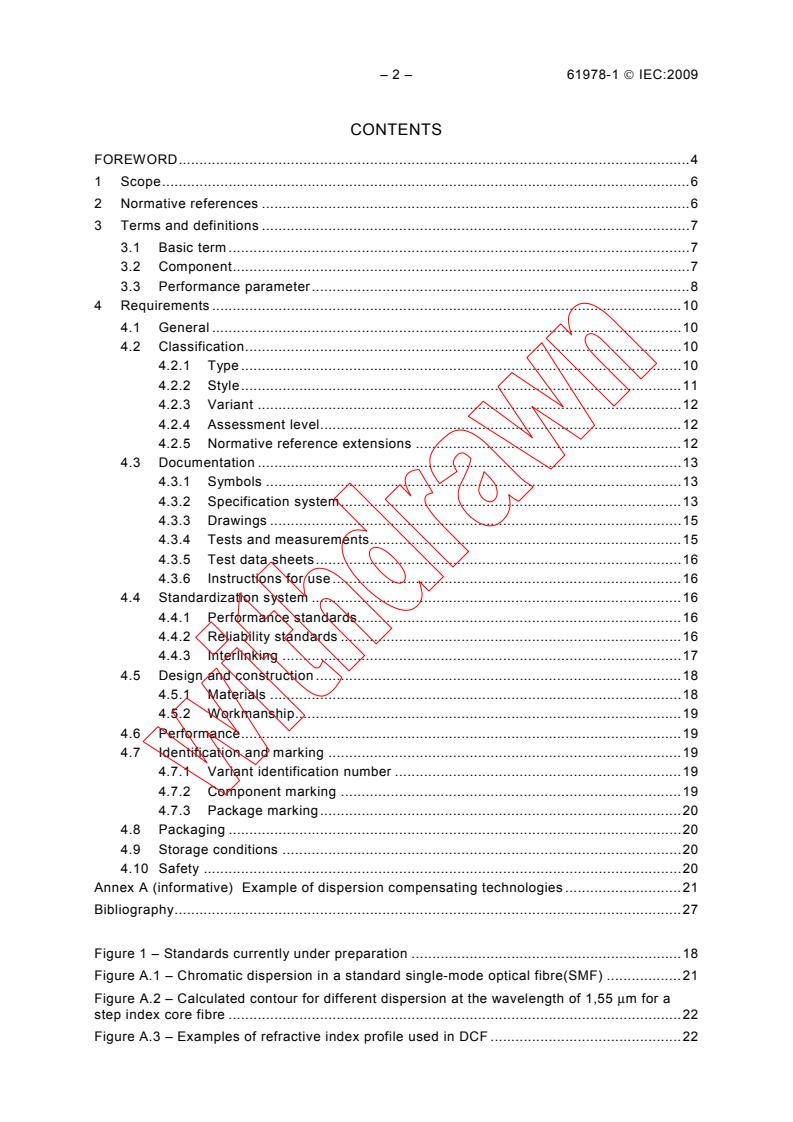
CONTENTS
FOREWORD.4
1 Scope.6
2 Normative references .6
3 Terms and definitions .7
3.1 Basic term .7
3.2 Component.7
3.3 Performance parameter.8
4 Requirements .10
4.1 General .10
4.2 Classification.10
4.2.1 Type.10
4.2.2 Style.11
4.2.3 Variant .12
4.2.4 Assessment level.12
4.2.5 Normative reference extensions .12
4.3 Documentation .13
4.3.1 Symbols .13
4.3.2 Specification system.13
4.3.3 Drawings .15
4.3.4 Tests and measurements.15
4.3.5 Test data sheets.16
4.3.6 Instructions for use.16
4.4 Standardization system .16
4.4.1 Performance standards.16
4.4.2 Reliability standards .16
4.4.3 Interlinking .17
4.5 Design and construction .18
4.5.1 Materials .18
4.5.2 Workmanship.19
4.6 Performance.19
4.7 Identification and marking .19
4.7.1 Variant identification number .19
4.7.2 Component marking .19
4.7.3 Package marking.20
4.8 Packaging .20
4.9 Storage conditions .20
4.10 Safety .20
Annex A (informative) Example of dispersion compensating technologies .21
Bibliography.27
Figure 1 – Standards currently under preparation .18
Figure A.1 – Chromatic dispersion in a standard single-mode optical fibre(SMF) .21
Figure A.2 – Calculated contour for different dispersion at the wavelength of 1,55 μm for a
step index core fibre .22
Figure A.3 – Examples of refractive index profile used in DCF .22
61978-1 © IEC:2009 – 3 –
Figure A.4 – Illustration of the use of a chirped fibre Bragg grating for chromatic dispersion
compensation .23
Figure A.5 – Zoom over 10 nm of the insertion loss spectrum including the optical circulator
(Figure A.5 a)) and the group delay spectrum (Figure A.5 b)) of a multi-channel FBG tailored
for the compensation of the chromatic dispersion accumulated over 100 km of single-mode
fibre .24
Figure A.6 – Structure of virtually imaged phased array (VIPA).25
Figure A.7 – Detailed light path and mechanism of generating chromatic dispersion .25
Figure A.8 – Gires-Tournois interferometer .26
Table 1 – Types of passive chromatic dispersion compensators.11
Table 2 – Three-level IEC specification structure .14
Table 3 – Standards interlink matrix.18
Table 4 – Quality assurance options .18
– 4 – 61978-1 © IEC:2009
INTERNATIONAL ELECTROTECHNICAL COMMISSION
____________
FIBRE OPTIC INTERCONNECTING
DEVICES AND PASSIVE COMPONENTS –
FIBRE OPTIC PASSIVE CHROMATIC DISPERSION COMPENSATORS –
Part 1: Generic specification
FOREWORD
1) The International Electrotechnical Commission (IEC) is a worldwide organization for standardization comprising
all national electrotechnical committees (IEC National Committees). The object of IEC is to promote
international co-operation on all questions concerning standardization in the electrical and electronic fields. To
this end and in addition to other activities, IEC publishes International Standards, Technical Specifications,
Technical Reports, Publicly Available Specifications (PAS) and Guides (hereafter referred to as “IEC
Publication(s)”). Their preparation is entrusted to technical committees; any IEC National Committee interested
in the subject dealt with may participate in this preparatory work. International, governmental and non-
governmental organizations liaising with the IEC also participate in this preparation. IEC collaborates closely
with the International Organization for Standardization (ISO) in accordance with conditions determined by
agreement between the two organizations.
2) The formal decisions or agreements of IEC on technical matters express, as nearly as possible, an international
consensus of opinion on the relevant subjects since each technical committee has representation from all
interested IEC National Committees.
3) IEC Publications have the form of recommendations for international use and are accepted by IEC National
Committees in that sense. While all reasonable efforts are made to ensure that the technical content of IEC
Publications is accurate, IEC cannot be held responsible for the way in which they are used or for any
misinterpretation by any end user.
4) In order to promote international uniformity, IEC National Committees undertake to apply IEC Publications
transparently to the maximum extent possible in their national and regional publications. Any divergence
between any IEC Publication and the corresponding national or regional publication shall be clearly indicated in
the latter.
5) IEC itself does not provide any attestation of conformity. Independent certification bodies provide conformity
assessment services and, in some areas, access to IEC marks of conformity. IEC is not responsible for any
services carried out by independent certification bodies.
6) All users should ensure that they have the latest edition of this publication.
7) No liability shall attach to IEC or its directors, employees, servants or agents including individual experts and
members of its technical committees and IEC National Committees for any personal injury, property damage or
other damage of any nature whatsoever, whether direct or indirect, or for costs (including legal fees) and
expenses arising out of the publication, use of, or reliance upon, this IEC Publication or any other IEC
Publications.
8) Attention is drawn to the Normative references cited in this publication. Use of the referenced publications is
indispensable for the correct application of this publication.
9) Attention is drawn to the possibility that some of the elements of this IEC Publication may be the subject of
patent rights. IEC shall not be held responsible for identifying any or all such patent rights.
International Standard IEC 61978-1 has been prepared by subcommittee 86B: Fibre optic
interconnecting devices and passive components, of IEC technical committee 86: Fibre optics.
This second edition cancels and replaces the first edition published in 2000. It constitutes a
technical revision. Changes from the previous edition of this standard are to reconsider the
requirements.
The text of this standard is based on the following documents:
FDIS Report on voting
86B/2908/FDIS 86B/2946/RVD
Full information on the voting for the approval of this standard can be found in the report on
voting indicated in the above table.
61978-1 © IEC:2009 – 5 –
This publication has been drafted in accordance with the ISO/IEC Directives, Part 2.
The committee has decided that the contents of this publication will remain unchanged until
the maintenance result date indicated on the IEC web site under "http://webstore.iec.ch" in
the data related to the specific publication. At this date, the publication will be
• reconfirmed,
• withdrawn,
• replaced by a revised edition, or
• amended.
IMPORTANT – The “colour inside” logo on the cover page of this publication indicates
that it contains colours which are considered to be useful for the correct understanding
of its contents. Users should therefore print this publication using a colour printer.
– 6 – 61978-1 © IEC:2009
FIBRE OPTIC INTERCONNECTING
DEVICES AND PASSIVE COMPONENTS –
FIBRE OPTIC PASSIVE CHROMATIC DISPERSION COMPENSATORS –
Part 1: Generic specification
1 Scope
This part of IEC 61978 applies to fibre optic passive chromatic dispersion compensators, all
exhibiting the following features:
– they are optically passive;
– they have an optical input and an optical output for transmitting optical power;
– the ports are optical fibres or optical fibre connectors;
– they are wavelength sensitive;
– they may be polarization sensitive.
This standard establishes uniform requirements for the passive chromatic dispersion
compensator.
2 Normative references
The following referenced documents are indispensable for the application of this document.
For dated references, only the edition cited applies. For undated references, the latest edition
of the referenced document (including any amendments) applies.
IEC 60027 (all parts), Letter symbols to be used in electrical technology
IEC 60050(731), International Electrotechnical Vocabulary (IEV) – Chapter 731: Optical fibre
communication
IEC 60617 (all parts), Graphical symbols for diagrams
IEC 60695-11-5, Fire hazard testing – Part 11-5: Test flames – Needle-flame test method –
Apparatus, confirmatory test arrangement and guidance
IEC 60793-2-50, Optical fibres – Part 2-50: Product specifications – Sectional specification for
class B single-mode fibres
IEC 60825 (all parts), Safety of laser products
IEC 60869-1, Fibre optic attenuators - Part 1: Generic specification
IEC 60874 (all parts), Connectors for optical fibres and cables
IEC 60974 (all parts), Arc welding equipment
IEC 61073-1, Fibre optic interconnecting devices and passive components – Mechanical
splices and fusion splice protectors for optical fibres and cables – Part 1: Generic
specification
61978-1 © IEC:2009 – 7 –
IEC 61300 (all parts), Fibre optic interconnecting devices and passive components – Basic
test and measurement procedures
IEC 61754-4, Fibre optic connector interfaces – Part 4: Type SC connector family
IEC 61754-13, Fibre optic connector interfaces – Part 13: Type FC-PC connector
IEC 61754-15, Fibre optic connector interfaces – Part 15: Type LSH connector family
IEC/TR 61930, Fibre optic graphical symbology
IEC Guide 102, Electronic components — Specification structures for quality Assessment
(Qualification approval and capability approval)
IECQ 01, IEC Quality Assessment System for Electronic Components (IECQ System) Basic
Rules
IECQ QC 001002-3, IEC Quality Assessment System for Electronic Components (IECQ) –
Rules of Procedure – Part 3: Approval procedures
ISO 129-1, Technical drawings – Indication of dimensions and tolerances – Part 1: General
principles
ISO 286-1, ISO system of limits and fits – Part 1: Bases of tolerances, deviations and fits
ISO 1101, Geometrical Product Specifications (GPS) – Geometrical tolerancing -- Tolerances
of form, orientation, location and run-out
ISO 8601, Data elements and interchange formats – Information interchange –
Representation of dates and times
3 Terms and definitions
For the purposes of this document, the terms and definitions given in IEC 60050(731), as well
as the following definitions apply.
3.1 Basic term
3.1.1
port
optical fibre or optical fibre connector attached to a passive component for the entry and/or
exit of the optical power (input and/or output port)
3.2 Component
3.2.1
passive chromatic dispersion compensator
PCDC
two-port in-line passive device used to perform chromatic dispersion compensation. PCDCs
are commonly used to compensate the chromatic dispersion of an optical path by adding the
opposite sign chromatic dispersion. The typical optical paths are single-mode fibre, dispersion
shifted fibre and non-zero dispersion shifted fibre. PCDCs have either negative or positive
chromatic dispersion values depending on the chromatic dispersion sign of the optical path
– 8 – 61978-1 © IEC:2009
3.2.2
dispersion compensating fibre
DCF
DCF is a speciality fibre to compensate chromatic dispersion of an optical path. By the control
of the refractive index profile of the fibre, DCF realises opposite sign chromatic dispersion
characteristics to that of the optical path
3.2.3
fibre Bragg grating
FBG
FBG is a fibre type optical device which has modulated refractive index profile in the core.
PCDC is realised by a chirped FBG which has gradually changed refractive index along the
fibre axis
3.2.4
virtually imaged phased array
VIPA
VIPA is an optical device which consists of coated glass plate, focusing lens and 3-
dimensional mirror. VIPA produces both positive and negative chromatic dispersion by the
move of the 3-dimensional mirror, in order to compensate the chromatic dispersion of an
optical path
3.2.5
etalon
etalon is an optical cavity which consists of a pair of parallel reflective mirror. PCDC is
realised by the etalon application called Gires-Tournois interferometer
3.3 Performance parameter
3.3.1
chromatic dispersion compensation
process by which a certain amount of chromatic dispersion is removed in order to mitigate the
system impairment caused by this excessive unwanted amount
3.3.2
group delay
time by which a pulse is delayed by an optical device. The group delay generally varies with
the operating wavelength
3.3.3
chromatic dispersion
derivative of group delay with respect to wavelength or frequency. A typical unit is ps/nm or
)
. The chromatic dispersion generally varies with the operating wavelength
ps/GHz
3.3.4
dispersion slope
derivative of chromatic dispersion with respect to wavelength or frequency. A typical unit is
2 1)
ps/nm or ps/GHz . The dispersion slope generally varies with the operating wavelength
3.3.5
operating wavelength
nominal wavelength λ at which a passive device operates with the specified performance
___________
Units of ps/GHz are generally considered as better definition, even though it is not widely used.
61978-1 © IEC:2009 – 9 –
3.3.6
operating wavelength range
specified range of wavelengths from λ to λ about an operating wavelength λ, within
min max
which a passive component operates with the specified performance
3.3.7
figure of merit
FoM
ratio of the dispersion to the insertion loss of a PCDC at a particular operating wavelength
3.3.8
passband ripple
maximum peak-to-peak variation of insertion loss in the passband
3.3.9
group delay ripple
maximum peak-to-peak variation of group delay in the operating wavelength range
3.3.10
phase ripple
maximum peak-to-peak variation of optical phase in the operating wavelength range
3.3.11
insertion loss
reduction in optical power between an input and output port of a passive component
expressed in decibels. It is defined as follows:
P
a
a = −10log
P
where
P is the optical power launched into the input port;
P is the optical power received from the output port
a
3.3.12
return loss
fraction of input power that is returned from the input port of a passive component expressed
in decibels. It is defined as follows:
P
r
RL = −10log
P
where
P is the optical power launched into the input port;
P is the optical power received back from the same port
r
3.3.13
reflectance
negative of the return loss
3.3.14
polarization dependent loss
PDL
maximum variation of insertion loss due to a variation of the state of polarization (SOP) over
all the SOPs
– 10 – 61978-1 © IEC:2009
3.3.15
wavelength dependent loss
WDL
maximum variation of the insertion loss over operating wavelength range
3.3.16
polarization mode dispersion
PMD
when an optical signal passes through an optical fibre, component or subsystem, the change
in the shape and width of the pulse due to the average delay of the travelling time between
the two principal states of polarization (PSP), differential group delay (DGD), and/or to the
waveform distortion for each PSP, is called PMD
NOTE PMD, together with polarization dependent loss (PDL) and polarization dependent gain (PDG), when
applicable, may introduce waveform distortion leading to unacceptable bit error rate increase.
4 Requirements
4.1 General
The requirements for PCDCs covered by this clause are intended to aid in classifying this
device in a relevant specification. Additional or more severe requirements may be imposed by
the relevant blank detail specification and by the detail specification.
4.2 Classification
PCDCs shall be classified as follows:
– type;
– style;
– variant;
– assessment level;
– normative reference extensions.
4.2.1 Type
PCDCs are divided into types by their main characteristics as follows.
PCDCs for WDM applications are divided into single channel type and multi-channel type.
Operating wavelength range of multi-channel type PCDCs covers at least two channels of
WDM systems. Multi-channel type PCDCs are divided into narrow band type and wide band
type according to its spectral characteristics:
– for TDM or for WDM;
– single channel or multi-channel;
– narrow or wide;
– any combination of the above.
61978-1 © IEC:2009 – 11 –
Table 1 – Types of passive chromatic dispersion compensators
Operating
Applications Channel number Technologies
wavelength range
TDM Single channel Narrow Dispersion compensating fibre (DCF)
Fibre Bragg grating (FBG)
Etalon
WDM Single channel Narrow FBG
a)
Multi-channel Narrow FBG
Etalon
Virtually imaged phased array (VIPA)
Wide DCF
a
Can be used as fixed, although it has tuneable function.
Each type shall be applied to the following optical paths with negative or positive chromatic
dispersion:
– for single-mode fibre or for dispersion shifted fibre or for non-zero dispersion shifted fibre;
– to add negative chromatic dispersion to compensate the positive chromatic dispersion of
an optical path or to add positive chromatic dispersion to compensate the negative
chromatic dispersion of an optical path.
4.2.2 Style
PCDC may be classified into styles based on the fibre type(s), the connector type(s), cable
type(s), housing shape, temperature control and the configuration. Style is not intended to
define material or design. The configurations of PCDC ports are classified as follows.
4.2.2.1 Configuration A
A device containing integral fibre optic pigtails, without connectors.
PCDC
Pigtail
IEC 1687/2000
4.2.2.2 Configuration B
A device containing integral fibre optic pigtails, with a connector on each pigtail.
Connector
PCDC
Pigtail
IEC 1688/2000
4.2.2.3 Configuration C
A device containing fibre optic connectors as an integral part of the device housing.
– 12 – 61978-1 © IEC:2009
Connector
PCDC
IEC 1689/2000
4.2.2.4 Configuration D
A device containing some combination of the interfacing features of the preceding configurations.
4.2.3 Variant
The PCDC variant identifies those common features which encompass structurally similar
components.
Examples of features which define a variant include, but are not limited to, the following:
– fibre type;
– connector type.
4.2.4 Assessment level
Detail specifications shall specify one or more assessment levels, each of which shall be
designated by a capital letter. The assessment level defines the relationship between the
inspection levels of groups A and B and the periodicity of inspection of groups C and D.
The following are the preferred levels.
Assessment level A:
– group A inspection: inspection level II, AQL = 4 %;
– group B inspection: inspection level II, AQL = 4 %;
– group C inspection: 24-month periods;
– group D inspection: 48-month periods.
Assessment level B:
– group A inspection: inspection level II, AQL = 1 %;
– group B inspection: inspection level II, AQL = 1 %;
– group C inspection: 18-month periods;
– group D inspection: 36-month periods.
Assessment level C:
– group A inspection: inspection level II, AQL = 0,4 %;
– group B inspection: inspection level II, AQL = 0,4 %;
– group C inspection: 12-month periods;
– group D inspection: 24-month periods.
NOTE 1 AQL stands for acceptable quality level.
One additional assessment level (other than those specified above) can be given in the detail
specification. When this is done, the capital letter X shall be used.
NOTE 2 Groups A and B are subject to lot-by-lot inspection. Groups C and D are subject to periodic inspection.
4.2.5 Normative reference extensions
Normative reference extensions are used to identify integrated independent standards,
specifications or other reference documents into blank detail specifications.
61978-1 © IEC:2009 – 13 –
Unless a specified exception is noted, additional requirements imposed by an extension are
mandatory. Usage is primarily intended to merge associated components to form hybrid
devices, or integrated functional application requirements that are dependent on technical
expertise other than fibre optics.
Published reference documents produced by ITU consistent with the scope statements of the
relevant IEC specification series may be used as an extension. Published documents
produced by other regional standardization bodies such as TIA, ETSI, JIS, etc., may be
referenced in a bibliography attached to the generic specification.
Some optical fibre splice configurations require special qualification provisions that shall not
be imposed universally. This accommodates individual component design configurations,
specialized field tooling, or specific application processes. In this case, requirements are
necessary to assure repeatable performance or adequate safety, and provide additional
guidance for complete product specification. These extensions are mandatory whenever used
to prepare, assemble or install an optical fibre splice either for field application usage or
preparation of qualification test specimens. The relevant specification shall clarify all
stipulations. However, design- and style-dependent extensions shall not be imposed universally.
In the event of conflicting requirements, precedence shall be given, in descending order, as
follows: generic over mandatory extension, over blank detail, over detail, over application
specific extension.
Examples of optical connector extensions are given as follows.
• Using IEC 61754-4 and IEC 61754-15 to partially define a future specification of the
IEC 60874 series for a duplex type “SC/LSH” hybrid connector adapter.
• Using IEC 61754-13 and IEC 60869-1 to partially define a future specification of the
IEC 60874 series for an integrated type “FC” preset attenuated optical connector.
• Using IEC 61754-15 and IEC 61073-1 to partially define a future specification of the
IEC 60974 series for a duplex “LSH” receptacle incorporating integral mechanical splices.
Other examples of requirements for normative extensions are as follows:
a) some commercial or residential building applications may require direct reference to
specific safety codes and regulations or incorporate other specific material flammability or
toxicity requirements for specialized locations;
b) specialized field tooling may require an extension to implement specific ocular safety,
electrical shock or burn hazard avoidance requirements, or require isolation procedures to
prevent potential ignition of combustible gases.
4.3 Documentation
4.3.1 Symbols
Graphical and letter symbols shall, whenever possible, be taken from IEC 60027 series,
IEC 60617 and IEC/TR 61930.
4.3.2 Specification system
This specification is part of a three-level IEC specification system. Subsidiary specifications
shall consist of blank detail specifications and detail specifications. This system is shown in
Table 2. There are no sectional specifications for passive dispersion compensators.
– 14 – 61978-1 © IEC:2009
Table 2 – Three-level IEC specification structure
Specification level Examples of information to be included Applicable to
Assessment system rules
Basic Two or more component
Inspection rules families or subfamilies
Optical measuring methods
Environmental test methods
Sampling plans
Identification rule
Marking standards
Dimensional standards
Terminology standards
Symbol standards
Preferred number series
SI units
Specific terminology
Generic
Component family
Specific symbols
Specific units
Preferred values
Marking
Quality assessment procedures
Selection of tests
Qualification approval and/or capability
approval procedures
Quality conformance test schedule
Blank detail Groups of types having a
Inspection requirements common test schedule
Information common to a number of types
Individual values
Detail
Individual type
Specific information
Completed quality conformance test schedules
4.3.2.1 Blank detail specifications
The blank detail specification lists all of the parameters and features applicable to a PCDC,
including the type, operating characteristics, housing configurations, test methods, and
performance requirements. The blank detail specification is applicable to any PCDC design
and quality assessment requirement. The blank detail specification contains the preferred
format for stating the required information in the detail specification.
Blank detail specifications are not, by themselves, a specification level. They are associated
with the generic specification.
Each blank detail specification shall be limited to one environmental category.
Each blank detail specification shall contain
– the minimum mandatory test schedules and performance requirements;
– one or more assessment levels;
– the preferred format for stating the required information in the detail specification;
– in case of hybrid components, including connectors, addition of appropriate entry fields to
show the reference normative document, document title and issue date.
4.3.2.2 Detail specifications
A specific PCDC is described by a corresponding detail specification, which is prepared by
filling in the blanks of the blank detail specification. Within the constraints imposed by this
generic specification, the blank detail specification may be filled in by any national committee
of the IEC, thereby defining a particular PCDC as an IEC standard.
61978-1 © IEC:2009 – 15 –
Detail specifications shall specify the following as applicable:
– type (see 4.2.1);
– style (see 4.2.2);
– variant(s) (see 4.2.3);
– assessment level (see 4.2.4);
– part identification number for each variant (see 4.7.1);
– drawings, dimensions required (see 4.3.3);
– quality assessment test schedules (see 4.2.4);
– performance requirements (see 4.6).
4.3.3 Drawings
The drawings and dimensions given in detail specifications shall not restrict themselves to
details of construction, nor shall they be used as manufacturing drawings.
4.3.3.1 Projection system
Either first angle or third angle projection shall be used for the drawings in documents
covered by this specification. All drawings within a document shall use the same projection
system and the drawings shall state which system is used.
4.3.3.2 Dimensional system
All dimensions shall be given in accordance with ISO 129, ISO 286-1 and ISO 1101.
The metric system shall be used in all specifications.
Dimensions shall not contain more than five significant digits.
When units are converted, a note shall be added in each relevant specification and the
conversion between systems of units shall use a factor of 25,4 mm to 1 inch
4.3.4 Tests and measurements
4.3.4.1 Test and measurement procedures
The test and measurement procedures for optical, mechanical, climatic, and environmental
characteristics of passive dispersion compensators to be used shall be defined and selected
preferentially from the IEC 61300 series.
The size measurement method to be used shall be specified in the detail specification for
dimensions, which are specified within a total tolerance of 0,01 mm or less.
4.3.4.2 Reference components
Reference components for measurement purposes, if required, shall be specified in the
relevant specification.
4.3.4.3 Gauges
Gauges, if required, shall be specified in the relevant specification.
– 16 – 61978-1 © IEC:2009
4.3.5 Test data sheets
Test data sheets shall be prepared for each test conducted as required by a relevant
specification. The data sheets shall be included in the qualification report and in the periodic
inspection report.
Data sheets shall contain the following information as a minimum:
– title of test and date;
– specimen description including the type of fibre, connector or other coupling device. The
description shall also include the variant identification number (see 4.7.1);
– test equipment used and date of latest calibration;
– all applicable test details;
– all measurement values and observations;
– sufficiently detailed documentation to provide traceable information for failure analysis.
4.3.6 Instructions for use
Instructions for use, when required, shall be given by the manufacturer and shall include
– assembly and connection instructions;
– cleaning method;
– safety aspects;
– additional information as necessary.
4.4 Standardization system
4.4.1 Performance standards
Performance standards contain a series of tests and measurements (which may or may not be
grouped into a specified schedule depending on the requirements of that standard) with
clearly defined conditions, severities, and “pass/fail” criteria. The tests are intended to be run
on a “once-off” basis to prove any product’s ability to satisfy the “performance standards”
requirement. Each performance standard has a different set of tests, and/or severities (and/or
groupings) and represents the requirements of a market sector, user group or system location.
A product that has been shown to meet all the requirements of a performance standard can
be declared as complying with a performance but should then be controlled by a quality
assurance/quality conformance programme.
It is possible to define a key point of the test and measurements standards, for their
application (particularly with regard to insertion loss and return loss) in conjunction with the
interface standards of inter product compatibility. The certain conformance of each individual
product to this standard will be ensured.
4.4.2 Reliability standards
Reliability standards are intended to ensure that a component can meet performance
specifications under stated conditions for a stated time period.
For each type of component, the following shall be identified (and appear in the standard):
• failure modes (observable general mechanical or optical effects of failure);
• failure mechanisms (general causes of failure, common to several components);
• failure effects (detailed causes of failure, specific to component).
These are all related to environmental and material aspects.
61978-1 © IEC:2009 – 17 –
Initially, just after component manufacture, there is an “infant mortality phase” during which
many components would fail if they were deployed in the field. To avoid early field failure, all
components may be subjected to screen process in the factory, involving environmental
stresses that may be mechanical, thermal, or humidity-related. This is to induce known failure
mechanisms in a controlled environmental situation to occur earlier than would normally be
seen in the unscreened population. For those components that survive (and are then sold),
there is a reduced failure rate since these mechanisms have been eliminated.
Screening is an optional part of the manufacturing process, rather than a test method. It will
not affect the “useful life” of a component defined as the period during which it performs
according to specifications. Eventually other failure mechanisms appear, and the failure rate
increases beyond the defined threshold. At this point the useful life ends and the “wear-out
region” begins, and the component shall be replaced.
At the beginning of useful life, performance testing on a sampled population of components
may be applied by the supplier, by the manufacturer, or by a third party. This is to ensure that
the component meets performance specifications over the range of intended environments at
this initial time. Reliability testing, on the other hand, is applied to ensure that the component
meets performance specifications for at least a specified minimum useful lifetime or specified
maximum failure rate. These tests are usually done by utilizing the performance testing, but
increasing duration and severity to accelerate the failure mechanisms.
A reliability theory relates component reliability testing to component parameters and to
lifetime or failure rate under testing. The theory then extrapolates these to lifetime or failure
rate under less stressful service conditions. The reliability specifications include values of the
component parameters needed to ensure the specified minimum lifetime or maximum failure
rate in service.
4.4.3 Interlinking
Standards currently under preparation are given in Figure 1. A large number of the test and
measurements standards already exist, and the quality assurance qualification approval
recognized by the term IECQ already exists and has done so for many years. As previously
mentioned, alternative methods of quality assurance/quality conformance are being developed
under the headings of capability approval and technology approval which are covered by
IECQ 01, IECQ QC 001002-3, and IEC Guide 102.
With regard to interface, performance and reliability standards, once all three of these
standards are in place, the matrix given in Table 3 demonstrates some of the other options
available for product standardization.
Product A is fully IEC standardized, having a standard interface and meeting defined
performance and reliability standards.
Product B is a product with a proprietary interface but which meets a defined IEC performance
and reliability standard.
Product C is a product that complies with an IEC standard interface but does not meet the
requirements of either an IEC performance or reliability standard.
Product D is a product that complies with both an IEC standard interface and a performance
standard but does not meet any reliability requirements.
Obviously, the matrix is more complex than shown since there will be a number of interface,
performance and reliability standards which may cross-refer. In addition, the products may all
be subject to a quality assurance programme that could be under IEC qualification approval,
capability approval, technology approval (as Table 4 atte
...