

IEC 60136:2024
(Main)Dimensions, marking and testing of carbon brushes and dimensions of brush-holders for electrical machinery
General Information
- Abstract
IEC 60136:2024 applies primarily to brushes and brush-holders for cylindrical commutators and slip rings for electrical rotating machines. Some clauses of this document may cover other configurations, such as flat commutators or plain disks. It defines the dimensions of brushes and their components, together with their tolerances:
- dimensions of brush block (t, a, r),
- angles α and β,
- chamfer,
- flexibles (shunts),
- standard terminals.
It also covers the conventional designation of principal dimensions, the marking of brushes and the testing methods for the qualification of brushes after their manufacturing (except the brush grade material, covered by IEC 60413). This third edition cancels and replaces the second edition published in 1986 and Amendment 1:1995. This edition constitutes a technical revision.
Please refer to the Foreword of the document for a comprehensive listing of the changes with respect to the previous edition.
- Status
- Published
- Publication Date
- 07-May-2024
- Technical Committee
- TC 2 - Rotating machinery
- Drafting Committee
- MT 14 - TC 2/MT 14
- Current Stage
- PPUB - Publication issued
- Start Date
- 08-May-2024
- Completion Date
- 17-May-2024
Overview
IEC 60136:2024 is the international standard published by the International Electrotechnical Commission (IEC) that specifies the dimensions, marking, and testing requirements for carbon brushes and brush-holders used in electrical rotating machinery. This standard applies primarily to brushes and brush-holders for cylindrical commutators and slip rings, but it also offers guidance for flat commutators and plain disk configurations.
By defining the critical dimensions, designations, tolerances, marking, and qualification tests, IEC 60136:2024 supports the consistent quality, compatibility, and interchangeability of carbon brushes and brush-holders in the electrical machinery sector.
Key Topics
Dimensional Standardization:
The standard outlines the required principal dimensions (t, a, r) of the brush block, including associated tolerances. Angles such as contact bevel (α) and top bevel (β), chamfer requirements, and complementary dimensions (e.g., pressure area width, depth of insertion) are described in detail to ensure proper fit and function.Brush Components:
Covers all principal elements and assembly features of carbon brushes, including flexibles (shunts), standard terminals, as well as definitions for chamfer height and angles.Brush-holder Specifications:
Specifies the dimensions and configurations relevant to brush-holders, including the internal sizes of brush boxes, chamfer details, serration profiles, and mounting considerations, all critical for alignment and secure operation.Marking and Designation:
Establishes procedures for marking brushes and brush-holders with conventional designation systems to enable accurate identification, traceability, and replacement.Testing and Qualification:
Provides standard methods for testing physical properties of carbon brushes, such as measurement of electrical resistance, pull strength of connections, and inspection of dimensional accuracy, ensuring that manufactured parts achieve consistent quality.Updates and Revisions:
This third edition introduces technical revisions, including clarification and extension of scope, new and updated clauses, enhanced marking requirements, expanded definitions, and revised dimensional tables.
Applications
IEC 60136:2024 is highly relevant to a wide range of industries and applications that utilize electrical rotating machinery, such as:
Electric motors and generators:
For the manufacturing and maintenance of DC and AC machines with commutators or slip rings, such as those used in industrial drives, railway traction, wind turbines, and household appliances.Brush manufacturers and suppliers:
Ensures suppliers and OEMs adhere to globally accepted brush and brush-holder designs, improving supply chain reliability.Quality assurance & testing laboratories:
Provides standardized testing procedures for the validation and certification of carbon brushes, vital for ensuring safety and performance.Maintenance and repair operations:
Standardizes brush marking for proper identification and replacement, simplifying inventory management and reducing downtime in field service and repairs.
Related Standards
The requirements in IEC 60136:2024 are supported by several related international standards, including:
IEC 60276:2018 - Carbon brushes, brush holders, commutators, and slip-rings - Definitions and nomenclature
Provides terminology and definitions directly referenced by IEC 60136.IEC 60413 - Specification for the chemical composition of brush grade materials
Covers material grades for carbon brushes, which are out of the scope of IEC 60136.IEC 60560 - Definitions and terminology of brush-holders for electrical machines
Defines terms for brush-holders referenced in this standard.ISO 129-1 - Technical product documentation - Presentation of dimensions and tolerances
Guides documentation and dimensional presentation for compliance.ISO 286-2 - Geometrical product specifications - ISO code system for tolerances
Standardizes tolerance specifications for brush and brush-holder components.
By following IEC 60136:2024, manufacturers, designers, and users of electrical rotating machines can achieve global compatibility, ease maintenance operations, and promote product safety and efficiency through standardized carbon brush and brush-holder solutions.
Get Certified
Connect with accredited certification bodies for this standard

IMQ S.p.A. (Certification)
Italian electrical product certification.

SLG Prüf- und Zertifizierungs GmbH
German testing and certification body.

UL Solutions
Global safety science company with testing, inspection and certification.
Sponsored listings
Frequently Asked Questions
IEC 60136:2024 is a standard published by the International Electrotechnical Commission (IEC). Its full title is "Dimensions, marking and testing of carbon brushes and dimensions of brush-holders for electrical machinery". This standard covers: IEC 60136:2024 applies primarily to brushes and brush-holders for cylindrical commutators and slip rings for electrical rotating machines. Some clauses of this document may cover other configurations, such as flat commutators or plain disks. It defines the dimensions of brushes and their components, together with their tolerances: - dimensions of brush block (t, a, r), - angles α and β, - chamfer, - flexibles (shunts), - standard terminals. It also covers the conventional designation of principal dimensions, the marking of brushes and the testing methods for the qualification of brushes after their manufacturing (except the brush grade material, covered by IEC 60413). This third edition cancels and replaces the second edition published in 1986 and Amendment 1:1995. This edition constitutes a technical revision. Please refer to the Foreword of the document for a comprehensive listing of the changes with respect to the previous edition.
IEC 60136:2024 applies primarily to brushes and brush-holders for cylindrical commutators and slip rings for electrical rotating machines. Some clauses of this document may cover other configurations, such as flat commutators or plain disks. It defines the dimensions of brushes and their components, together with their tolerances: - dimensions of brush block (t, a, r), - angles α and β, - chamfer, - flexibles (shunts), - standard terminals. It also covers the conventional designation of principal dimensions, the marking of brushes and the testing methods for the qualification of brushes after their manufacturing (except the brush grade material, covered by IEC 60413). This third edition cancels and replaces the second edition published in 1986 and Amendment 1:1995. This edition constitutes a technical revision. Please refer to the Foreword of the document for a comprehensive listing of the changes with respect to the previous edition.
IEC 60136:2024 is classified under the following ICS (International Classification for Standards) categories: 29.160.10 - Components for rotating machines. The ICS classification helps identify the subject area and facilitates finding related standards.
IEC 60136:2024 is available in PDF format for immediate download after purchase. The document can be added to your cart and obtained through the secure checkout process. Digital delivery ensures instant access to the complete standard document.
Standards Content (Sample)
IEC 60136 ®
Edition 3.0 2024-05
INTERNATIONAL
STANDARD
NORME
INTERNATIONALE
Dimensions, marking and testing of carbon brushes and dimensions of brush-
holders for electrical machinery
Dimensions, marquages et essais des balais et dimensions des porte-balais
pour machines électriques
All rights reserved. Unless otherwise specified, no part of this publication may be reproduced or utilized in any form
or by any means, electronic or mechanical, including photocopying and microfilm, without permission in writing from
either IEC or IEC's member National Committee in the country of the requester. If you have any questions about IEC
copyright or have an enquiry about obtaining additional rights to this publication, please contact the address below or
your local IEC member National Committee for further information.
Droits de reproduction réservés. Sauf indication contraire, aucune partie de cette publication ne peut être reproduite ni
utilisée sous quelque forme que ce soit et par aucun procédé, électronique ou mécanique, y compris la photocopie et
les microfilms, sans l'accord écrit de l'IEC ou du Comité national de l'IEC du pays du demandeur. Si vous avez des
questions sur le copyright de l'IEC ou si vous désirez obtenir des droits supplémentaires sur cette publication, utilisez
les coordonnées ci-après ou contactez le Comité national de l'IEC de votre pays de résidence.
IEC Secretariat Tel.: +41 22 919 02 11
3, rue de Varembé info@iec.ch
CH-1211 Geneva 20 www.iec.ch
Switzerland
About the IEC
The International Electrotechnical Commission (IEC) is the leading global organization that prepares and publishes
International Standards for all electrical, electronic and related technologies.
About IEC publications
The technical content of IEC publications is kept under constant review by the IEC. Please make sure that you have the
latest edition, a corrigendum or an amendment might have been published.
IEC publications search - webstore.iec.ch/advsearchform IEC Products & Services Portal - products.iec.ch
The advanced search enables to find IEC publications by a Discover our powerful search engine and read freely all the
variety of criteria (reference number, text, technical publications previews, graphical symbols and the glossary.
committee, …). It also gives information on projects, replaced With a subscription you will always have access to up to date
and withdrawn publications. content tailored to your needs.
IEC Just Published - webstore.iec.ch/justpublished
Electropedia - www.electropedia.org
Stay up to date on all new IEC publications. Just Published
The world's leading online dictionary on electrotechnology,
details all new publications released. Available online and once
containing more than 22 500 terminological entries in English
a month by email.
and French, with equivalent terms in 25 additional languages.
Also known as the International Electrotechnical Vocabulary
IEC Customer Service Centre - webstore.iec.ch/csc
(IEV) online.
If you wish to give us your feedback on this publication or need
further assistance, please contact the Customer Service
Centre: sales@iec.ch.
A propos de l'IEC
La Commission Electrotechnique Internationale (IEC) est la première organisation mondiale qui élabore et publie des
Normes internationales pour tout ce qui a trait à l'électricité, à l'électronique et aux technologies apparentées.
A propos des publications IEC
Le contenu technique des publications IEC est constamment revu. Veuillez vous assurer que vous possédez l’édition la
plus récente, un corrigendum ou amendement peut avoir été publié.
Recherche de publications IEC - IEC Products & Services Portal - products.iec.ch
webstore.iec.ch/advsearchform Découvrez notre puissant moteur de recherche et consultez
La recherche avancée permet de trouver des publications IEC gratuitement tous les aperçus des publications, symboles
en utilisant différents critères (numéro de référence, texte, graphiques et le glossaire. Avec un abonnement, vous aurez
comité d’études, …). Elle donne aussi des informations sur les toujours accès à un contenu à jour adapté à vos besoins.
projets et les publications remplacées ou retirées.
Electropedia - www.electropedia.org
IEC Just Published - webstore.iec.ch/justpublished
Le premier dictionnaire d'électrotechnologie en ligne au monde,
Restez informé sur les nouvelles publications IEC. Just
avec plus de 22 500 articles terminologiques en anglais et en
Published détaille les nouvelles publications parues.
français, ainsi que les termes équivalents dans 25 langues
Disponible en ligne et une fois par mois par email.
additionnelles. Egalement appelé Vocabulaire
Electrotechnique International (IEV) en ligne.
Service Clients - webstore.iec.ch/csc
Si vous désirez nous donner des commentaires sur cette
publication ou si vous avez des questions contactez-nous:
sales@iec.ch.
IEC 60136 ®
Edition 3.0 2024-05
INTERNATIONAL
STANDARD
NORME
INTERNATIONALE
Dimensions, marking and testing of carbon brushes and dimensions of brush-
holders for electrical machinery
Dimensions, marquages et essais des balais et dimensions des porte-balais
pour machines électriques
INTERNATIONAL
ELECTROTECHNICAL
COMMISSION
COMMISSION
ELECTROTECHNIQUE
INTERNATIONALE
ICS 29.160.10 ISBN 978-2-8322-8835-1
– 2 – IEC 60136:2024 © IEC 2024
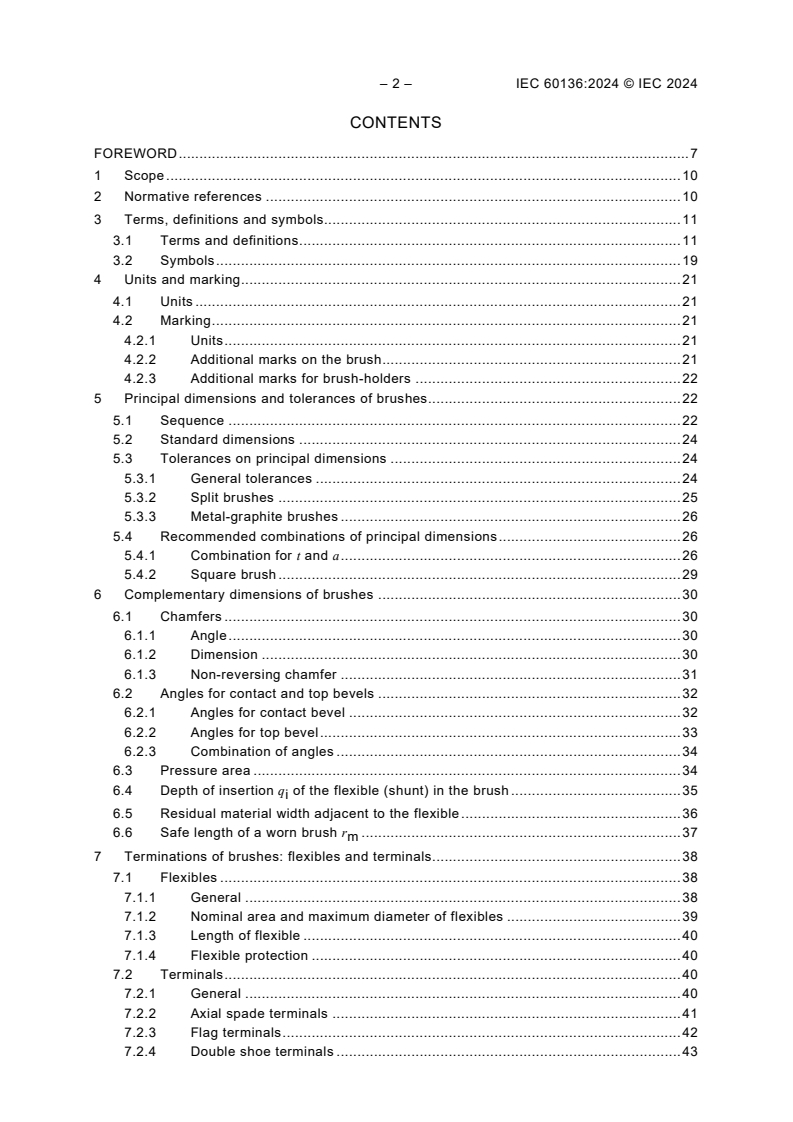
CONTENTS
FOREWORD . 7
1 Scope . 10
2 Normative references . 10
3 Terms, definitions and symbols. 11
3.1 Terms and definitions . 11
3.2 Symbols . 19
4 Units and marking . 21
4.1 Units . 21
4.2 Marking . 21
4.2.1 Units . 21
4.2.2 Additional marks on the brush. 21
4.2.3 Additional marks for brush-holders . 22
5 Principal dimensions and tolerances of brushes. 22
5.1 Sequence . 22
5.2 Standard dimensions . 24
5.3 Tolerances on principal dimensions . 24
5.3.1 General tolerances . 24
5.3.2 Split brushes . 25
5.3.3 Metal-graphite brushes . 26
5.4 Recommended combinations of principal dimensions . 26
5.4.1 Combination for t and a . 26
5.4.2 Square brush . 29
6 Complementary dimensions of brushes . 30
6.1 Chamfers . 30
6.1.1 Angle . 30
6.1.2 Dimension . 30
6.1.3 Non-reversing chamfer . 31
6.2 Angles for contact and top bevels . 32
6.2.1 Angles for contact bevel . 32
6.2.2 Angles for top bevel . 33
6.2.3 Combination of angles . 34
6.3 Pressure area . 34
6.4 Depth of insertion q of the flexible (shunt) in the brush . 35
i
6.5 Residual material width adjacent to the flexible . 36
6.6 Safe length of a worn brush r . 37
m
7 Terminations of brushes: flexibles and terminals. 38
7.1 Flexibles . 38
7.1.1 General . 38
7.1.2 Nominal area and maximum diameter of flexibles . 39
7.1.3 Length of flexible . 40
7.1.4 Flexible protection . 40
7.2 Terminals . 40
7.2.1 General . 40
7.2.2 Axial spade terminals . 41
7.2.3 Flag terminals . 42
7.2.4 Double shoe terminals . 43
7.2.5 Tubular terminals . 44
7.2.6 Soldered terminals . 45
7.2.7 Current capacity of terminals . 46
8 Test procedures for determining physical properties of brushes . 47
8.1 General . 47
8.2 Measurement of electrical resistance of brush/flexible connection . 47
8.2.1 General . 47
8.2.2 Test equipment . 48
8.2.3 Test procedure . 50
8.2.4 Test procedure for method b) (mathematical). 55
8.2.5 Calculation and report . 56
8.3 Measurement of the pull strength of tamped or moulded connections . 56
8.3.1 General . 56
8.3.2 Principle . 56
8.3.3 Test equipment . 56
8.3.4 Test procedure . 59
8.3.5 Calculation and report . 59
9 Brush-holder dimensions and configuration . 59
9.1 General . 59
9.2 Dimensions of the inside of the brush-box . 59
9.2.1 Main dimensions . 59
9.2.2 Tolerances and clearances on brush-box t and a . 59
9.2.3 Dimensions and tolerances on brush-box chamfer . 60
9.3 Check of brush-box dimensions . 61
9.3.1 General . 61
9.3.2 Gauging of dimensions t and a . 61
9.3.3 Gauging of chamfers . 61
9.4 Serrations on fixing face of the brush-holder . 61
9.4.1 General . 61
9.4.2 Profile and dimensions of serrations . 61
9.4.3 Location of serrations . 62
9.5 Brush-holder mounting position . 62
Annex A (normative) Equivalent dimensions in inches . 63
Annex B (normative) Values of the principal dimensions of metal-graphite brushes . 66
Annex C (informative) Considerations relative to brush stability . 67
C.1 General . 67
C.2 Radial brush without top bevel angle operating in bidirectional rotation . 68
C.3 Radial brush with top bevel angle operating in the forward direction . 70
C.4 Radial brush with top bevel angle operating in the reverse direction . 71
C.5 Trailing type brushes . 72
C.6 Reaction type brush with top bevel angle . 74
Annex D (informative) Flexibles configuration . 77
Annex E (informative) Flexible location . 78
Annex F (informative) Recommended values of thickness for spade, flag and double
shoe terminals . 79
Annex G (informative) Technical questionnaire for the definition of a carbon brush . 80
Bibliography . 82
– 4 – IEC 60136:2024 © IEC 2024
Figure 1 – Examples of brush components . 11
Figure 2 – Chamfer height . 12
Figure 3 – Contact bevel angle α . 12
Figure 4 – Top bevel angle β . 13
Figure 5 – Pressure area width for commutator and for slip-ring . 13
Figure 6 – Depth of insertion . 14
Figure 7 – Residual material width . 14
Figure 8 – Safe length of a worn brush . 15
Figure 9 – Flexible dimensions l and d for different examples of brushes . 16
S S
Figure 10 – Definition of distance d for different types of brush connection . 17
P
Figure 11 – Brush-holder box chamfer height . 18
Figure 12 – Definition of serration location distance . 19
Figure 13 – Safe remaining length mark for different brush designs . 22
Figure 14 – Main dimensions for a wedge-edge brush. 23
Figure 15 – Preferred orientation for anisotropic grades depending on the application . 30
Figure 16 – Angle of chamfers . 30
Figure 17 – Split brush . 31
Figure 18 – Non-reversing chamfer height . 31
Figure 19 – Sharp edge when a contact bevel angle α is applied . 33
Figure 20 – Flat surface of edge when a top bevel angle β is applied . 33
Figure 21 – Flexible configuration illustration . 38
Figure 22 – Definition of shape and dimensions of axial spades terminals . 41
Figure 23 – Definition of shape and dimensions of flag terminals . 42
Figure 24 – Definition of shape and dimensions of double shoe terminals . 43
Figure 25 – Definition of shape and dimensions of tubular terminals . 44
Figure 26 – Definition of shape (example) and dimensions of formed spade terminal . 45
Figure 27 – Definition of shape (examples) and dimensions of two types of pin
terminals . 46
Figure 28 – Examples of testing device for the measurement of the connection
electrical resistance . 48
Figure 29 – Example of contact probe for flexible . 49
Figure 30 – Example of contact probe for brush . 49
Figure 31 – Measurement of connection resistance for a moulded or tamped
connection . 51
Figure 32 – Measurement of connection resistance for a riveted connection . 52
Figure 33 – Alternative method for the measurement of connection resistance in case
of 2 rivets. 53
Figure 34 – Connection with a metal top soldered or riveted to the block . 54
Figure 35 – Iterated determination of location P of Probe 2 . 55
Figure 36 – Test equipment for the measurement of the pull out force . 57
Figure 37 – Example of support device for brushes with inclined connection hole . 58
Figure 38 – Profile of serrations – cross-sectional view . 62
Figure C.1 – Illustration of rotational moments for a radial brush . 69
Figure C.2 – Illustration of forces applied on a radial brush with top bevel angle
operating in the forward rotation . 70
Figure C.3 – Illustration of forces applied on a radial brush with top bevel angle
operating in the reverse direction . 72
Figure C.4 – Illustration of forces applied on a trailing brush with a top bevel angle
operating in the forward direction . 73
Figure C.5 – Illustration of forces applied on a reaction brush . 75
Figure E.1 – Flexible location . 78
Figure G.1 – Main dimensions . 80
Figure G.2 – Brush operation . 81
Table 1 – Symbols for each unit system . 21
Table 2 – Standard dimensions of brush block . 24
Table 3 – Tolerances on t, a and r . 25
Table 4 – Recommended combination of t, a and r. 27
Table 5 – Dimension of chamfer height c . 31
Table 6 – Recommended values of non-reversing chamfer height . 32
Table 7 – Preferred values for contact bevel angle α and top bevel angle β . 33
Table 8 – Typical combination values for contact bevel angle α and top bevel angle β . 34
Table 9 – Recommended minimum values of pressure area width w . 35
p
Table 10 – Maximum values of depth of insertion q . 35
i
Table 11 – Example of maximum values of q for an EG grade . 36
i
Table 12 – Minimum width of residual material . 37
Table 13 – Recommended nominal area for flexibles and their corresponding maximum
diameter . 39
Table 14 – Standard lengths of flexibles l and tolerances . 40
S
Table 15 – Standard values of spades terminals dimensions . 42
Table 16 – Standard values of flag terminals dimensions . 43
Table 17 – Standard values of double shoe terminals dimensions . 44
Table 18 – Standard values of tubular terminals dimensions . 45
Table 19 – Standard values of formed spade terminals dimensions and tolerances . 46
Table 20 – Minimum values of current capacity for terminals . 47
Table 21 – Tolerances on brush box dimensions and clearances . 60
Table 22 – Maximum value of the brush-box chamfer height c . 60
H
Table A.1 – Standard dimensions and tolerances on brush dimensions t ⨯ a ⨯ r in inch
system . 63
Table A.2 – Nominal and maximum dimensions of chamfer height c to be used in inch
system . 64
Table A.3 – Recommended minimum value of w to be used in inch system . 64
p
Table A.4 – Maximum values of depth of insertion q . 64
i
Table A.5 – Recommended nominal area for flexibles (shunts) and their corresponding
maximum diameter. 65
Table A.6 – Standard lengths of flexibles l and tolerances . 65
S
Table B.1 – t ⨯ a ⨯ r tolerances and clearance for metal graphite grades . 66
– 6 – IEC 60136:2024 © IEC 2024
Table C.1 – Overview of the different mechanical configurations (bevel angles) in
operation . 67
Table D.1 – Configuration of flexibles . 77
Table F.1 – Recommended thickness for spade, flag and double shoe terminals
corresponding to screws diameter . 79
Table G.1 – Elements to be included in a form . 80
INTERNATIONAL ELECTROTECHNICAL COMMISSION
____________
DIMENSIONS, MARKING AND TESTING OF CARBON BRUSHES AND
DIMENSIONS OF BRUSH-HOLDERS FOR ELECTRICAL MACHINERY
FOREWORD
1) The International Electrotechnical Commission (IEC) is a worldwide organization for standardization comprising
all national electrotechnical committees (IEC National Committees). The object of IEC is to promote international
co-operation on all questions concerning standardization in the electrical and electronic fields. To this end and
in addition to other activities, IEC publishes International Standards, Technical Specifications, Technical Reports,
Publicly Available Specifications (PAS) and Guides (hereafter referred to as “IEC Publication(s)”). Their
preparation is entrusted to technical committees; any IEC National Committee interested in the subject dealt with
may participate in this preparatory work. International, governmental and non-governmental organizations liaising
with the IEC also participate in this preparation. IEC collaborates closely with the International Organization for
Standardization (ISO) in accordance with conditions determined by agreement between the two organizations.
2) The formal decisions or agreements of IEC on technical matters express, as nearly as possible, an international
consensus of opinion on the relevant subjects since each technical committee has representation from all
interested IEC National Committees.
3) IEC Publications have the form of recommendations for international use and are accepted by IEC National
Committees in that sense. While all reasonable efforts are made to ensure that the technical content of IEC
Publications is accurate, IEC cannot be held responsible for the way in which they are used or for any
misinterpretation by any end user.
4) In order to promote international uniformity, IEC National Committees undertake to apply IEC Publications
transparently to the maximum extent possible in their national and regional publications. Any divergence between
any IEC Publication and the corresponding national or regional publication shall be clearly indicated in the latter.
5) IEC itself does not provide any attestation of conformity. Independent certification bodies provide conformity
assessment services and, in some areas, access to IEC marks of conformity. IEC is not responsible for any
services carried out by independent certification bodies.
6) All users should ensure that they have the latest edition of this publication.
7) No liability shall attach to IEC or its directors, employees, servants or agents including individual experts and
members of its technical committees and IEC National Committees for any personal injury, property damage or
other damage of any nature whatsoever, whether direct or indirect, or for costs (including legal fees) and
expenses arising out of the publication, use of, or reliance upon, this IEC Publication or any other IEC
Publications.
8) Attention is drawn to the Normative references cited in this publication. Use of the referenced publications is
indispensable for the correct application of this publication.
9) Attention is drawn to the possibility that some of the elements of this IEC Publication may be the subject of patent
rights. IEC shall not be held responsible for identifying any or all such patent rights.
IEC 60136 has been prepared by IEC technical committee TC 2: Rotating machinery. It is an
International Standard.
This third edition cancels and replaces the second edition published in 1986 and
Amendment 1:1995. This edition constitutes a technical revision.
– 8 – IEC 60136:2024 © IEC 2024
This edition includes the following significant technical changes with respect to the previous
edition:
Title: modified.
Clause or Previous
Change
subclause clause
1 I-1 Clarification and extension of the scope.
2 None New clause introduced.
3 None New clause introduced.
4 I-4 and II-7.5 Addition of units and extension of marking.
5.1 I-2 Addition of cylindrical and wedge-shape brushes.
5.2 I-3 Distinction of dimensions between t, a and r.
Revision of the chamfer dimension table and addition of
6.1 II-7.1
non-reversing chamfer.
6.2 II-7.2 Revision of angles dimensions and addition of typical
combination of angles.
6.4 II-7.4 Clarification of the definition of the depth of insertion and
modification of maximum values.
6.5 None New subclause introducing the concept of residual
material width.
7.1.2 II-8.7 Change of definition of flexibles area and diameter.
7.1.4 None Addition of flexible protection.
7.2 II-8.1 to II-8.5 Clarification. Addition of other types of terminals.
8 Annex C Clarification of the method of measurement of electrical
resistance and addition of graphical method.
9.2 and 9.3 Clause A.3 Brush-holder: Separation of Dimensions and Control of
brush box in two different subclauses.
Annex A None Compilation of tables with inches dimensions from the
previous edition.
Annex B None Addition of recommended dimensions for metal-graphite
grades.
Annex C None Explanation of stability of brushes (linked to 6.2).
Annex D II-8.7 Addition of examples of configuration of flexibles.
Annex E None Addition of recommended standardization of flexibles'
location
Annex F Annex D and II- Link between the thickness of terminals and the screw
8.8 diameter.
Annex G Annex B Simplification of the questionnaire, to include only
elements defined in this document.
The text of this International Standard is based on the following documents:
Draft Report on voting
2/2180/FDIS 2/2189/RVD
Full information on the voting for its approval can be found in the report on voting indicated in
the above table.
The language used for the development of this International Standard is English.
This document was drafted in accordance with ISO/IEC Directives, Part 2, and developed in
accordance with ISO/IEC Directives, Part 1 and ISO/IEC Directives, IEC Supplement, available
at www.iec.ch/members_experts/refdocs. The main document types developed by IEC are
described in greater detail at www.iec.ch/publications.
The committee has decided that the contents of this document will remain unchanged until the
stability date indicated on the IEC website under webstore.iec.ch in the data related to the
specific document. At this date, the document will be
• reconfirmed,
• withdrawn,
• replaced by a revised edition, or
• amended.
IMPORTANT – The "colour inside" logo on the cover page of this document indicates
that it contains colours which are considered to be useful for the correct understanding
of its contents. Users should therefore print this document using a colour printer.
– 10 – IEC 60136:2024 © IEC 2024
DIMENSIONS, MARKING AND TESTING OF CARBON BRUSHES AND
DIMENSIONS OF BRUSH-HOLDERS FOR ELECTRICAL MACHINERY
1 Scope
This document applies primarily to brushes and brush-holders for cylindrical commutators and
slip rings for electrical rotating machines. Some clauses of this document may cover other
configurations, such as flat commutators or plain disks.
It defines the dimensions of brushes and their components, together with their tolerances:
– dimensions of brush block (t, a, r),
– angles α and β,
– chamfer,
– flexibles (shunts),
– standard terminals.
It also covers the conventional designation of principal dimensions, the marking of brushes and
the testing methods for the qualification of brushes after their manufacturing (except the brush
grade material, covered by IEC 60413).
And finally, it specifies dimensions of the brush-holders that are linked to brushes.
2 Normative references
The following documents are referred to in the text in such a way that some or all of their content
constitutes requirements of this document. For dated references, only the edition cited applies.
For undated references, the latest edition of the referenced document (including any
amendments) applies.
IEC 60276:2018, Carbon brushes, brush holders, commutators and slip-rings – Definitions and
nomenclature
IEC 60560, Definitions and terminology of brush-holders for electrical machines
ISO 129-1, Technical product documentation (TPD) – Presentation of dimensions and
tolerances – Part 1: General principles
ISO 197-1:1983, Copper and copper alloys – Terms and definitions – Part 1: Materials
ISO 286-2:2010, Geometrical product specifications (GPS) – ISO code system for tolerances
on linear sizes – Part 2: Tables of standard tolerance classes and limit deviations for holes and
shafts
3 Terms, definitions and symbols
3.1 Terms and definitions
For the purposes of this document, the terms and definitions given in IEC 60276:2018 and
IEC 60560, and the following apply.
ISO and IEC maintain terminology databases for use in standardization at the following
addresses:
• IEC Electropedia: available at https://www.electropedia.org/
• ISO Online browsing platform: available at https://www.iso.org/obp
3.1.1
component
element assembled onto the brush block and having a specific feature
Note 1 to entry: Figure 1 shows an example of a carbon brush designed for a DC machine, comprising the following
components: two flexibles, two terminals and one top plate.
Key
1 block
2 flexible
3 terminal
4 top plate
t tangential dimension of the brush
a axial dimension of the brush
r radial dimension of the brush
Figure 1 – Examples of brush components
3.1.2
chamfer height
c
smaller side of the isosceles rectangle triangle formed by the chamfer, as illustrated by Figure 2
– 12 – IEC 60136:2024 © IEC 2024
Figure 2 – Chamfer height
Note 1 to entry: c is expressed in millimetres (mm).
Note 2 to entry: In USA, c is also named depth of chamfer.
Note 3 to entry: The source of Figure 2 is IEC 60276:2018, item 147.
3.1.3
contact bevel angle
bottom bevel angle
α
angle between the centre line of the brush and the radial axis of the commutator or slip-ring, as
shown in Figure 3
Figure 3 – Contact bevel angle α
Note 1 to entry: α is expressed in degrees (°).
[SOURCE: IEC 60276:2018, item 106]
3.1.4
top bevel angle
β
angle between the centre line and the top surface of the carbon brush, as shown in Figure 4
Figure 4 – Top bevel angle β
Note 1 to entry: β is expressed in degrees (°).
Note 2 to entry: The source of Figure 4 is IEC 60276:2018, item 110.
3.1.5
pressure area width
w
p
width of the area on the top of the brush where the pressure system applies, as shown in
Figure 5
a) Commutator b) Slip-ring
Figure 5 – Pressure area width for commutator and for slip-ring
Note 1 to entry: w is expressed in millimetres (mm).
p
3.1.6
depth of insertion
q
i
distance between the extremity of flexible inside the brush and its insertion location onto the
top of the brush, along the flexible direction axis, as illustrated by Figure 6
– 14 – IEC 60136:2024 © IEC 2024
a) Radial brush b) Inclined brush c) Bevelled edge brush
Figure 6 – Depth of insertion
Note 1 to entry: q is expressed in millimetres (mm).
i
3.1.7
residual material width
w
i
width of the residual material adjacent to the flexible (see Figure 7), defined by the distance
between:
– the closest side of the brush block, and
– the periphery of the hole drilled for the insertion of the flexible
Key
1 brush
2 flexible
3 hole (for the flexible insertion)
Figure 7 – Residual material width
Note 1 to entry: w is expressed in millimetres (mm).
i
3.1.8
safe length of a worn brush
r
m
distance between two planes perpendicular to the centre line, passing over the extremities of:
– the contact surface at its minimum safe wear limit, and
– the elements of brush or parts of elements, which take part in the pressure application
Note 1 to entry: Figure 8 illustrates the definition of r for two examples.
m
a) Radial brush (α = 0 / β = 0) b) Inclined brush with a bevelled top and a top plate (α ≠ 0 /
β ≠ 0)
Key
1 worn brush
2 initial brush
3 rotating surface
r initial radial dimension
r safe length of the worn brush
m
NOTE Dash lines represent the worn part of the brush.
Figure 8 – Safe length of a worn brush
Note 2 to entry: r is expressed in millimetres (mm).
m
3.1.9
length of flexible
l
S
distance of the flexible between the brush-flexible connection (onto the brush top) and the screw
connection axis of the terminal, as illustrated by Figure 9
Note 1 to entry: l is expressed in millimetres (mm).
S
Note 2 to entry: When there is no terminal, the screw connection axis in the definition above is naturally replaced
by the free extremity of the flexible.
3.1.10
distance for the application of the flexible probe
d
S
distance, along the flexible direction axis, from a location S onto the flexible to the brush-flexible
connection (location O), as shown in Figure 9
– 16 – IEC 60136:2024 © IEC 2024
Key
O brush-flexible connection location on the top of the brush
S location onto the flexible
d distance for the application of the flexible probe
S
l length of the flexible
S
Figure 9 – Flexible dimensions l and d for different examples of brushes
S S
Note 1 to entry: d is expressed in millimetres (mm).
S
3.1.11
distance for application of the block probe
d
P
distance from a point P of a side of the block to a point P of the same side, which is the closest
to the outside of the connection mean, as shown in Figure 10
a) Tamped or moulded connection – b) Tamped or moulded connection – lateral
on the brush top
c) Riveted connection d) Connection by a riveted or soldered metal plate
Key
P location onto the side of the brush block
P location onto the same side of the brush block as P and closed to the brush-flexible connection
d distance for the application of the brush block probe
P
Figure 10 – Definition of distance d for different types of brush connection
P
Note 1 to entry: For any type of brush, the axis passing through both points P and P is parallel to its centre line.
The side of the block is chosen so that the distance from the axis (P;P ) and the centre line is minimum.
Note 2 to entry: d is expressed in millimetres (mm).
P
3.1.12
electrical resistance of the brush-flexible connection
R
f
electrical resistance measured between a point S onto the flexible (see Figure 9) and a point P
onto the brush body (see Figure 10)
Note 1 to entry: R is expressed in milliohms (mΩ).
f
– 18 – IEC 60136:2024 © IEC 2024
3.1.13
pull-out force of the brush-flexible connection
F
f
force required to pull out the flexible from the brush in the direction of the flexible axis
Note 1 to entry: F is expressed in newtons (N).
f
3.1.14
brush-holder box chamfer height
c
H
smaller side of the isosceles rectangle triangle formed by the chamfer of the brush-box
Note 1 to entry: By extension, the height of the brush box non-reversing chamfer c can be defined. Figure 11
HX
illustrates the definitions.
a) Chamfer b) Non-reversing chamfer
Key
1 brush
2 brush-box
c height of the brush box chamfer
H
c height of the brush box non-reversing chamfer
HX
Figure 11 – Brush-holder box chamfer height
Note 2 to entry: c is expressed in millimetres (mm).
H
3.1.15
serration location distance
d
H
distance from any tooth root of the serrated side of the brush-holder to the bottom of the brush
box, in vertical direction, as illustrated by Figure 12
Key
1 brush-holder box
2 serrated face of the fixation of the brush-holder
3 any tooth root of the serrated face
4 bottom of the brush box
5 brush centre line
d serration location distance
H
d mounting distance
M
e distance between the tip of the tooth and the axis of application of the mounting distance
H
Figure 12 – Definition of serration location distance
Note 1 to entry: d is an integer and is expressed in millimetres (mm).
H
Note 2 to entry: The profile and
...