

IEC 61207-6:2014
(Main)Expression of performance of gas analyzers - Part 6: Photometric analyzers
General Information
- Abstract
IEC 61207-6:2014 applies to all aspects of analyzers using photometric techniques for the measurement of concentration of one or more components in a mixture of gases or vapors. It should be used in conjunction with IEC 61207-1. It specifies:
- the terminology and definitions related to the functional performance of gas analyzers, utilizing a photometric analyzer, for the continuous measurement of gas or vapor concentration in a source gas;
- it unifies methods used in making and verifying statements on the functional performance of such analyzers;
- it specifies what tests should be performed to determine the functional performance and how such tests should be carried out and it provides basic documents to support the application of standards of quality assurance ISO 9001. This second edition cancels and replaces the first edition published in 1994 and constitutes a technical revision. The major changes are:
- All references (normative and informative) have been updated, deleted or added to as appropriate.
- All the terms and definitions relating to the document have been updated where appropriate.
- New definitions have been added for generic photometric equipment and measurements.
- All references to "errors" have been replaced by "uncertainties" and appropriate updated definitions applied.
- Figures A.1, A.2.
- Status
- Published
- Publication Date
- 24-Nov-2014
- Technical Committee
- SC 65B - Measurement and control devices
- Drafting Committee
- WG 14 - TC 65/SC 65B/WG 14
- Current Stage
- PPUB - Publication issued
- Start Date
- 25-Nov-2014
- Completion Date
- 15-Dec-2014
Overview
IEC 61207-6:2014 is an international standard published by the International Electrotechnical Commission (IEC) that defines the expression of performance for gas analyzers using photometric analysis techniques. This standard focuses on analyzers designed to measure the concentration of one or more components in a gas or vapor mixture by detecting light absorption, emission, or scattering within a wavelength range from 0.1 µm to 50 µm. It provides comprehensive guidance on terminology, performance specifications, and testing procedures to ensure accurate and reliable measurement results.
The standard is intended to be used in conjunction with IEC 61207-1, which covers general aspects of gas analyzer performance, and complements IEC 61207-7 for tuneable semiconductor laser absorption spectroscopy (TSLAS) based measurements. IEC 61207-6 is essential for manufacturers, testing laboratories, and quality assurance professionals involved with photometric gas analyzers.
Key Topics
Scope and Application
Applies to photometric gas analyzers using non-dispersive and dispersive wavelength selection and techniques such as absorption, emission, wavelength derivative, and scattering. It covers analyzers measuring gas directly in the sample or in a conditioned sample, under vacuum, ambient, or pressurized conditions.Terminology and Definitions
Establishes standardized terms for components of photometric systems, including:- Light source (lasers, LEDs, electric discharge sources)
- Light detector (photomultiplier tubes, photodiodes, pyroelectric detectors)
- Wavelength selection techniques
This promotes clear communication and consistent interpretation of functional performance.
Performance Expression and Testing
Defines methods for specifying and verifying functional performance parameters, such as:- Linearity uncertainty
- Interference uncertainty
- Delay time, rise time, and fall time
It specifies the type of tests to be conducted, required simulation of sample gas conditions, and test equipment setups, ensuring consistency in performance claims.
Quality Assurance Support
Supports the application of ISO 9001 quality management principles in the design, manufacture, and testing of photometric gas analyzers.Updated Concepts
Emphasizes the use of "uncertainties" instead of "errors" to describe measurement deviations, reflecting modern metrological best practices.
Applications
IEC 61207-6:2014 is vital for industries and applications requiring precise gas concentration monitoring and analysis, including:
- Environmental monitoring of air pollutants
- Industrial process control and safety, notably in combustion and chemical manufacturing processes
- Emission control and regulatory compliance measurements
- Detection of flammable or toxic gases in hazardous atmospheres
- Research and development involving gas mixtures
By standardizing performance criteria, IEC 61207-6 aids manufacturers in producing reliable photometric analyzers and helps end users compare and validate analyzer capabilities against recognized benchmarks.
Related Standards
- IEC 61207-1: General – Provides overarching terminology, performance expression, and testing principles for all types of gas analyzers.
- IEC 61207-7: Tuneable Semiconductor Laser Gas Analyzers – Specific rules for analyzers using semiconductor lasers for high precision gas measurements.
- IEC 60079 Series – Standards for gas detectors in explosive atmospheres, relevant for safety-critical applications where photometric analyzers are used.
- IEC 60654 Series – Defines operating conditions for industrial process measurement and control equipment.
- ISO 9001: Quality Management Systems – Framework for maintaining consistent product quality and performance, which IEC 61207-6 supports in analyzer manufacturing and testing.
Keywords: IEC 61207-6, photometric gas analyzers, gas concentration measurement, gas analyzer performance, photometric techniques, absorption spectroscopy, emission spectroscopy, gas analyzer testing, measurement uncertainty, ISO 9001 quality assurance, industrial gas monitoring, environmental gas analysis, photometric sensor standards.
Get Certified
Connect with accredited certification bodies for this standard

ECOCERT
Organic and sustainability certification.

Eurofins Food Testing Global
Global leader in food, environment, and pharmaceutical product testing.

IMP NDT d.o.o.
Non-destructive testing services. Radiography, ultrasonic, magnetic particle, penetrant, visual inspection.
Sponsored listings
Frequently Asked Questions
IEC 61207-6:2014 is a standard published by the International Electrotechnical Commission (IEC). Its full title is "Expression of performance of gas analyzers - Part 6: Photometric analyzers". This standard covers: IEC 61207-6:2014 applies to all aspects of analyzers using photometric techniques for the measurement of concentration of one or more components in a mixture of gases or vapors. It should be used in conjunction with IEC 61207-1. It specifies: - the terminology and definitions related to the functional performance of gas analyzers, utilizing a photometric analyzer, for the continuous measurement of gas or vapor concentration in a source gas; - it unifies methods used in making and verifying statements on the functional performance of such analyzers; - it specifies what tests should be performed to determine the functional performance and how such tests should be carried out and it provides basic documents to support the application of standards of quality assurance ISO 9001. This second edition cancels and replaces the first edition published in 1994 and constitutes a technical revision. The major changes are: - All references (normative and informative) have been updated, deleted or added to as appropriate. - All the terms and definitions relating to the document have been updated where appropriate. - New definitions have been added for generic photometric equipment and measurements. - All references to "errors" have been replaced by "uncertainties" and appropriate updated definitions applied. - Figures A.1, A.2.
IEC 61207-6:2014 applies to all aspects of analyzers using photometric techniques for the measurement of concentration of one or more components in a mixture of gases or vapors. It should be used in conjunction with IEC 61207-1. It specifies: - the terminology and definitions related to the functional performance of gas analyzers, utilizing a photometric analyzer, for the continuous measurement of gas or vapor concentration in a source gas; - it unifies methods used in making and verifying statements on the functional performance of such analyzers; - it specifies what tests should be performed to determine the functional performance and how such tests should be carried out and it provides basic documents to support the application of standards of quality assurance ISO 9001. This second edition cancels and replaces the first edition published in 1994 and constitutes a technical revision. The major changes are: - All references (normative and informative) have been updated, deleted or added to as appropriate. - All the terms and definitions relating to the document have been updated where appropriate. - New definitions have been added for generic photometric equipment and measurements. - All references to "errors" have been replaced by "uncertainties" and appropriate updated definitions applied. - Figures A.1, A.2.
IEC 61207-6:2014 is classified under the following ICS (International Classification for Standards) categories: 19.080 - Electrical and electronic testing; 71.040.40 - Chemical analysis. The ICS classification helps identify the subject area and facilitates finding related standards.
IEC 61207-6:2014 is available in PDF format for immediate download after purchase. The document can be added to your cart and obtained through the secure checkout process. Digital delivery ensures instant access to the complete standard document.
Standards Content (Sample)
IEC 61207-6 ®
Edition 2.0 2014-11
INTERNATIONAL
STANDARD
NORME
INTERNATIONALE
Expression of performance of gas analyzers –
Part 6: Photometric analyzers
Expression des performances des analyseurs de gaz –
Partie 6: Analyseurs photométriques
All rights reserved. Unless otherwise specified, no part of this publication may be reproduced or utilized in any form
or by any means, electronic or mechanical, including photocopying and microfilm, without permission in writing from
either IEC or IEC's member National Committee in the country of the requester. If you have any questions about IEC
copyright or have an enquiry about obtaining additional rights to this publication, please contact the address below or
your local IEC member National Committee for further information.
Droits de reproduction réservés. Sauf indication contraire, aucune partie de cette publication ne peut être reproduite
ni utilisée sous quelque forme que ce soit et par aucun procédé, électronique ou mécanique, y compris la photocopie
et les microfilms, sans l'accord écrit de l'IEC ou du Comité national de l'IEC du pays du demandeur. Si vous avez des
questions sur le copyright de l'IEC ou si vous désirez obtenir des droits supplémentaires sur cette publication, utilisez
les coordonnées ci-après ou contactez le Comité national de l'IEC de votre pays de résidence.
IEC Central Office Tel.: +41 22 919 02 11
3, rue de Varembé Fax: +41 22 919 03 00
CH-1211 Geneva 20 info@iec.ch
Switzerland www.iec.ch
About the IEC
The International Electrotechnical Commission (IEC) is the leading global organization that prepares and publishes
International Standards for all electrical, electronic and related technologies.
About IEC publications
The technical content of IEC publications is kept under constant review by the IEC. Please make sure that you have the
latest edition, a corrigenda or an amendment might have been published.
IEC Catalogue - webstore.iec.ch/catalogue Electropedia - www.electropedia.org
The stand-alone application for consulting the entire The world's leading online dictionary of electronic and
bibliographical information on IEC International Standards, electrical terms containing more than 30 000 terms and
Technical Specifications, Technical Reports and other definitions in English and French, with equivalent terms in 14
documents. Available for PC, Mac OS, Android Tablets and additional languages. Also known as the International
iPad. Electrotechnical Vocabulary (IEV) online.
IEC publications search - www.iec.ch/searchpub IEC Glossary - std.iec.ch/glossary
The advanced search enables to find IEC publications by a More than 55 000 electrotechnical terminology entries in
variety of criteria (reference number, text, technical English and French extracted from the Terms and Definitions
committee,…). It also gives information on projects, replaced clause of IEC publications issued since 2002. Some entries
and withdrawn publications. have been collected from earlier publications of IEC TC 37,
77, 86 and CISPR.
IEC Just Published - webstore.iec.ch/justpublished
Stay up to date on all new IEC publications. Just Published IEC Customer Service Centre - webstore.iec.ch/csc
details all new publications released. Available online and If you wish to give us your feedback on this publication or
also once a month by email. need further assistance, please contact the Customer Service
Centre: csc@iec.ch.
A propos de l'IEC
La Commission Electrotechnique Internationale (IEC) est la première organisation mondiale qui élabore et publie des
Normes internationales pour tout ce qui a trait à l'électricité, à l'électronique et aux technologies apparentées.
A propos des publications IEC
Le contenu technique des publications IEC est constamment revu. Veuillez vous assurer que vous possédez l’édition la
plus récente, un corrigendum ou amendement peut avoir été publié.
Catalogue IEC - webstore.iec.ch/catalogue Electropedia - www.electropedia.org
Application autonome pour consulter tous les renseignements
Le premier dictionnaire en ligne de termes électroniques et
bibliographiques sur les Normes internationales,
électriques. Il contient plus de 30 000 termes et définitions en
Spécifications techniques, Rapports techniques et autres
anglais et en français, ainsi que les termes équivalents dans
documents de l'IEC. Disponible pour PC, Mac OS, tablettes
14 langues additionnelles. Egalement appelé Vocabulaire
Android et iPad.
Electrotechnique International (IEV) en ligne.
Recherche de publications IEC - www.iec.ch/searchpub
Glossaire IEC - std.iec.ch/glossary
Plus de 55 000 entrées terminologiques électrotechniques, en
La recherche avancée permet de trouver des publications IEC
en utilisant différents critères (numéro de référence, texte, anglais et en français, extraites des articles Termes et
comité d’études,…). Elle donne aussi des informations sur les Définitions des publications IEC parues depuis 2002. Plus
projets et les publications remplacées ou retirées. certaines entrées antérieures extraites des publications des
CE 37, 77, 86 et CISPR de l'IEC.
IEC Just Published - webstore.iec.ch/justpublished
Service Clients - webstore.iec.ch/csc
Restez informé sur les nouvelles publications IEC. Just
Published détaille les nouvelles publications parues. Si vous désirez nous donner des commentaires sur cette
Disponible en ligne et aussi une fois par mois par email. publication ou si vous avez des questions contactez-nous:
csc@iec.ch.
IEC 61207-6 ®
Edition 2.0 2014-11
INTERNATIONAL
STANDARD
NORME
INTERNATIONALE
Expression of performance of gas analyzers –
Part 6: Photometric analyzers
Expression des performances des analyseurs de gaz –
Partie 6: Analyseurs photométriques
INTERNATIONAL
ELECTROTECHNICAL
COMMISSION
COMMISSION
ELECTROTECHNIQUE
PRICE CODE
INTERNATIONALE
CODE PRIX S
ICS 19.080: 71.040.40 ISBN 978-2-8322-1936-2
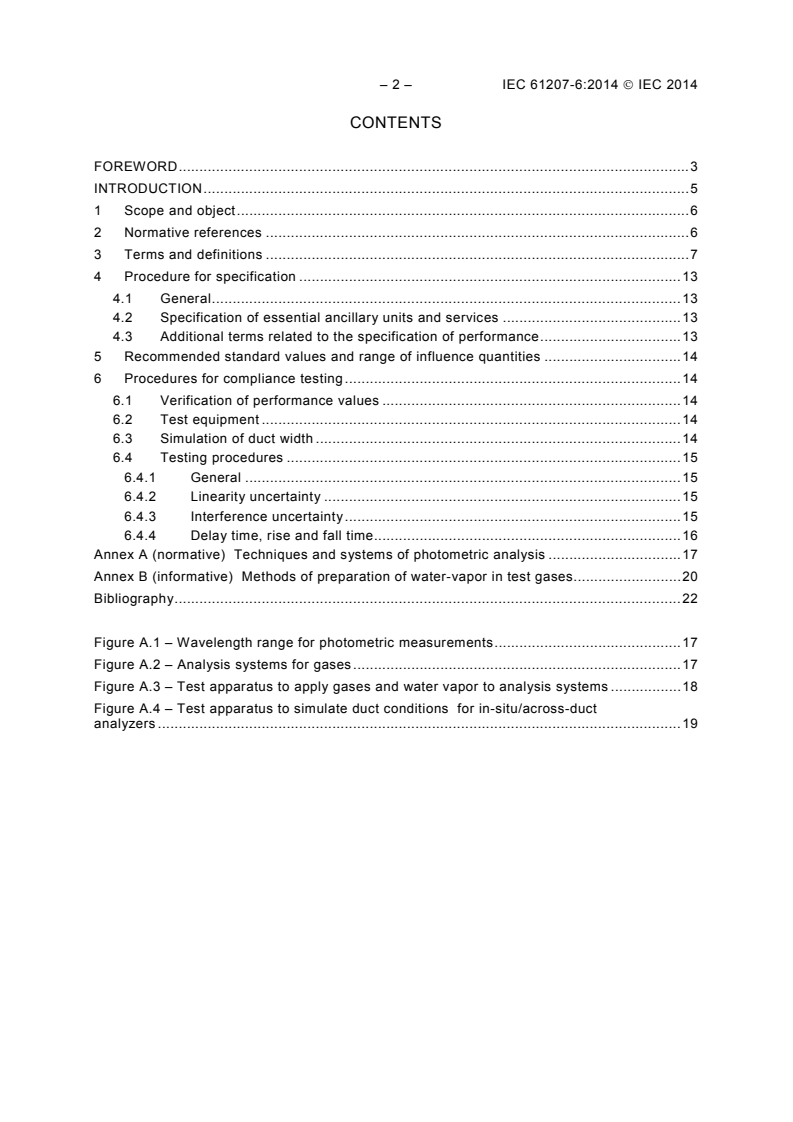
– 2 – IEC 61207-6:2014 IEC 2014
CONTENTS
FOREWORD . 3
INTRODUCTION . 5
1 Scope and object . 6
2 Normative references . 6
3 Terms and definitions . 7
4 Procedure for specification . 13
4.1 General . 13
4.2 Specification of essential ancillary units and services . 13
4.3 Additional terms related to the specification of performance . 13
5 Recommended standard values and range of influence quantities . 14
6 Procedures for compliance testing . 14
6.1 Verification of performance values . 14
6.2 Test equipment . 14
6.3 Simulation of duct width . 14
6.4 Testing procedures . 15
6.4.1 General . 15
6.4.2 Linearity uncertainty . 15
6.4.3 Interference uncertainty . 15
6.4.4 Delay time, rise and fall time . 16
Annex A (normative) Techniques and systems of photometric analysis . 17
Annex B (informative) Methods of preparation of water-vapor in test gases. 20
Bibliography . 22
Figure A.1 – Wavelength range for photometric measurements . 17
Figure A.2 – Analysis systems for gases . 17
Figure A.3 – Test apparatus to apply gases and water vapor to analysis systems . 18
Figure A.4 – Test apparatus to simulate duct conditions for in-situ/across-duct
analyzers . 19
INTERNATIONAL ELECTROTECHNICAL COMMISSION
____________
EXPRESSION OF PERFORMANCE OF GAS ANALYZERS –
Part 6: Photometric analyzers
FOREWORD
1) The International Electrotechnical Commission (IEC) is a worldwide organization for standardization comprising
all national electrotechnical committees (IEC National Committees). The object of IEC is to promote
international co-operation on all questions concerning standardization in the electrical and electronic fields. To
this end and in addition to other activities, IEC publishes International Standards, Technical Specifications,
Technical Reports, Publicly Available Specifications (PAS) and Guides (hereafter referred to as “IEC
Publication(s)”). Their preparation is entrusted to technical committees; any IEC National Committee interested
in the subject dealt with may participate in this preparatory work. International, governmental and non-
governmental organizations liaising with the IEC also participate in this preparation. IEC collaborates closely
with the International Organization for Standardization (ISO) in accordance with conditions determined by
agreement between the two organizations.
2) The formal decisions or agreements of IEC on technical matters express, as nearly as possible, an international
consensus of opinion on the relevant subjects since each technical committee has representation from all
interested IEC National Committees.
3) IEC Publications have the form of recommendations for international use and are accepted by IEC National
Committees in that sense. While all reasonable efforts are made to ensure that the technical content of IEC
Publications is accurate, IEC cannot be held responsible for the way in which they are used or for any
misinterpretation by any end user.
4) In order to promote international uniformity, IEC National Committees undertake to apply IEC Publications
transparently to the maximum extent possible in their national and regional publications. Any divergence
between any IEC Publication and the corresponding national or regional publication shall be clearly indicated in
the latter.
5) IEC itself does not provide any attestation of conformity. Independent certification bodies provide conformity
assessment services and, in some areas, access to IEC marks of conformity. IEC is not responsible for any
services carried out by independent certification bodies.
6) All users should ensure that they have the latest edition of this publication.
7) No liability shall attach to IEC or its directors, employees, servants or agents including individual experts and
members of its technical committees and IEC National Committees for any personal injury, property damage or
other damage of any nature whatsoever, whether direct or indirect, or for costs (including legal fees) and
expenses arising out of the publication, use of, or reliance upon, this IEC Publication or any other IEC
Publications.
8) Attention is drawn to the Normative references cited in this publication. Use of the referenced publications is
indispensable for the correct application of this publication.
9) Attention is drawn to the possibility that some of the elements of this IEC Publication may be the subject of
patent rights. IEC shall not be held responsible for identifying any or all such patent rights.
International Standard IEC 61207-6 has been prepared by sub-committee 65B: Measurement
and control devices, of IEC technical committee 65: Industrial-process measurement, control
and automation.
This second edition cancels and replaces the first edition published in 1994. This edition
constitutes a technical revision.
The major changes with respect to the previous edition are as follows.
– All references (normative and informative) have been updated, deleted or added to as
appropriate.
– All the terms and definitions relating to the document have been updated where
appropriate.
– New definitions have been added for generic photometric equipment and measurements.
– 4 – IEC 61207-6:2014 IEC 2014
– All references to “errors” have been replaced by “uncertainties” and appropriate updated
definitions applied.
– Figures A.1, A.2 and A.4 have been updated.
The text of this standard is based on the following documents:
FDIS Report on voting
65B/947/FDIS 65B/956/RVD
Full information on the voting for the approval of this standard can be found in the report on
voting indicated in the above table.
This publication has been drafted in accordance with the ISO/IEC Directives, Part 2.
A list of all parts in the IEC 61207 series, published under the general title Expression of
performance of gas analyzers, can be found on the IEC website.
The committee has decided that the contents of this publication will remain unchanged until
the stability date indicated on the IEC web site under "http://webstore.iec.ch" in the data
related to the specific publication. At this date, the publication will be
• reconfirmed,
• withdrawn,
• replaced by a revised edition, or
• amended.
INTRODUCTION
Photometric analyzers utilize detectors which respond to wavelengths in the ultraviolet, visible
and infrared part of the electromagnetic spectrum within the wavelength range 0,1 µm to
50 µm (see Figure A.1). Within this range of wavelengths, many gases have absorption and/or
emission bands. Analyzers designed to utilize these bands employ several techniques,
including sensing of specific absorbed radiation by the sample gas or emitted radiation from
the gas sample after artificial excitation. The volume of gas measured may be contained
within a sample cell and this sample may or may not be conditioned, or (for in-situ analyzers)
the concentration may be directly measured within the sample gas itself (see Figure A.2).
– 6 – IEC 61207-6:2014 IEC 2014
EXPRESSION OF PERFORMANCE OF GAS ANALYZERS –
Part 6: Photometric analyzers
1 Scope and object
This part of IEC 61207 applies to all aspects of analyzers using photometric techniques for
the measurement of concentration of one or more components in a mixture of gases or
vapors. It should be used in conjunction with IEC 61207-1.
For photometric analyzers utilizing tuneable semiconductor laser absorption spectroscopy
(TSLAS) for gas measurements, IEC 61207-7 should also be referred to.
This part of IEC 61207 applies to analyzers using non-dispersive and dispersive wavelength
selection and using absorption, emission, wavelength derivative or scattering techniques.
It applies to analyzers which receive either a conditioned or unconditioned sample of gas
either under vacuum, at ambient pressure or pressurized.
It applies to analyzers which measure gas concentrations directly within the sample gas.
The object of this part is:
– to specify the terminology and definitions related to the functional performance of gas
analyzers, utilizing a photometric analyzer, for the continuous measurement of gas or
vapor concentration in a source gas;
– to unify methods used in making and verifying statements on the functional performance of
such analyzers;
– to specify what tests should be performed to determine the functional performance and
how such tests should be carried out;
– to provide basic documents to support the application of standards of quality assurance
ISO 9001.
2 Normative references
The following documents, in whole or in part, are normatively referenced in this document and
are indispensable for its application. For dated references, only the edition cited applies. For
undated references, the latest edition of the referenced document (including any
amendments) applies.
IEC 60079-29-1, Explosive atmospheres – Part 29-1: Gas detectors – Performance
requirements of detectors for flammable gases
IEC 60079-29-4, Explosive atmospheres – Part 29-4: Gas detectors – Performance
requirements of open path detectors for flammable gases
IEC 60654 (all parts), Operating conditions for industrial-process measurement and control
equipment
IEC 61207-1, Expression of performance of gas analyzers – Part 1: General
IEC 61207-7, Expression of performance of gas analyzers – Part 7: Tuneable semiconductor
laser gas analyzers
ISO 9001, Quality management systems – Requirements
3 Terms and definitions
For the purposes of the present document, the following terms and definitions apply.
NOTE The following definitions and examples of equipment and measuring techniques are for illustration and do
not constitute a complete list of all possible measurement types. See Figure A.1 for the relationship between the
different optical wavelength ranges.
3.1
light source
device that emits light within the wavelength range 0,1 µm to 50 µm
Note 1 to entry: A source may be, but is not limited to: a gas or solid state laser, semiconductor laser diode, light
emitting diode, electric discharge source or incandescent filament.
3.2
light detector
device that is sensitive to light and that may be used to detect light within the wavelength
range 0,1 µm to 50 µm
Note 1 to entry: A light detector may be, but is not limited to: a photomultiplier tube, semiconductor device
(photovoltaic or photoconductive) such as a photodiode, avalanche photodiode or charge coupled device (CCD)
and, additionally, in the infrared region: pyroelectric detector, bolometer or thermopile.
3.3
wavelength selection
wavelength or range of wavelengths selected for use in particular measurement
Note 1 to entry: A suitable wavelength transmission range may be selected by using an appropriate means
including a band-pass optical filter or dispersive element such as a diffraction grating.
Note 2 to entry: The wavelength from the light source may be tuned or modulated such as by using the current or
temperature for a semiconductor laser diode, varying the temperature of an incandescent source or varying the
input angle to a band-pass filter.
3.4
optical sample cell
enclosed volume where the optical measurement of the sample gas takes place
Note 1 to entry: The optical measurement may take place by measuring the absorption or emission of the analyte
after light of a suitable wavelength has been passed through an optical sample cell.
Note 2 to entry: The sample cell shall have some means of gas inlet and outlet, which may be via piping for flow
or pressure driven systems or via diffusion through a mechanical filter.
Note 3 to entry: The cell may require a high integrity seal from the outside environment for extractive systems
other than the gas inlet and outlet means.
Note 4 to entry: Cell windows of the appropriate optical transmission band are required for the light ingress and
egress.
Note 5 to entry: Internal mechanical or optical features of the sample cell may be used to decrease stray light
interference or to direct or concentrate the light where appropriate.
Note 6 to entry: The cell is designed to give an optical path length which is appropriate to the analyte and range
required.
– 8 – IEC 61207-6:2014 IEC 2014
3.5
multi-pass sample cell
optical sample cell with increased effective absorption light path achieved by multiple
reflections within the optical cavity of the sample cell
Note 1 to entry: The effect of the multi-pass cell is to increase the sensitivity of the measurement for the same
total cell length.compared to a single pass cell.
Note 2 to entry: Typical design models used include Herriott or White cells.
3.6
environmental monitoring gas analyzer
photometric gas analyzer used for environmental monitoring purposes
3.6.1
open path monitoring
optical measurement where no containment for the sample gas is required
Note 1 to entry: This may be across a large space or an external measurement path.
Note 2 to entry: Typically, the light source and detector are separated by a distance and aligned to give a straight
line absorption pathway.
Note 3 to entry: The net absorption will be the integrated effect across the whole of the absorption path length.
3.6.2
point monitoring
monitoring giving localized gas concentration information
Note 1 to entry: This gives monitoring information from a localized position rather than averaged data across an
extended path length as per 3.6.1.
3.7
in-situ analyzer
analyzer where the volume of gas sensed, that is gas within the measuring path for a
photometric analyzer, is situated within the process source fluid
Note 1 to entry: An in-situ analyzer may contain a fixed-length measuring cell within the duct and hence its
calibration is not affected by the dimensions of the duct.
3.7.1
across duct or cross stack analyzer
analyzer where the measuring path is formed by the entire width of a process duct or stack
Note 1 to entry: The radiation source and detector can be mounted on opposite sides of the duct, or both can be
mounted on the same side and a retroreflector employed. Where the retroreflector is within the duct, the analyzer
is of the in-situ type.
3.7.2
across process line or pipe analyzer
analyzer where the measuring path is formed by the entire width of a process pipe
Note 1 to entry: The radiation source and detector can be mounted on opposite sides of the pipe, or both can be
mounted on the same side and a retroreflector employed. Where the retroreflector is within the duct, the analyzer
is of the in-situ type.
3.7.3
across firebox or other open process analyzer
analyzer where the measuring path is formed by the entire width of a firebox or other open
process path
3.7.4
inside process line or duct analyzer
analyzer where the measuring path or point is inside the process duct itself
3.8
extractive analyzer
analyzer which receives a continuous stream of gas withdrawn from a process by a sample
handling system
3.8.1
close coupled extractive analyzer
gas analyzer where the sensors are mounted at, or as close as possible to, the process take
off point with a short extraction loop (typically <1 m) and with minimal sample handling,
typically just particulate filtration
3.8.2
remote extractive analyzer
gas analyzer which is situated remote from the process to be measured (typically >1 m)
Note 1 to entry: This may require further sample handling, including maintaining the sample at an elevated
temperature to avoid condensation.
3.9
sample-handling system
system which connects one or more process analyzers with the source fluid and the disposal
points
Note 1 to entry: The performance of this system is not dealt with in this part except for dilution sampling systems.
3.10
dilution sampling system
system which samples process fluid and adds a diluent to the sample stream prior to
measurement
Note 1 to entry: This type of system generally applies calibration gas prior to the dilution point and hence the
dilution system is treated as part of an in-situ analyzer for the purposes of this part of IEC 61207.
3.11
conditioned sample
continuous stream of gas withdrawn from the source gas and filtered, cooled, and dried to
within specified limits before application to a sampling analyzer
3.12
heated sample
continuous stream of gas withdrawn from the source gas, which may or may not be filtered
but is maintained at a temperature above its dew-point, including within the analyzer
3.13
opacity
absorption of radiation, at the wavelengths used for measurement, by components of the
sample gas, other than the component to be measured
Note 1 to entry: For example, this may be produced by dust or other contamination.
3.14
essential ancillary units
units without which the analyzer will not operate, e.g. ancillary electronic units processing
sensor signals to produce the reading, dilution sampling system, air purge or other optical
cleaning system, automatic calibration system, temperature or pressure compensation system
– 10 – IEC 61207-6:2014 IEC 2014
3.15
analyzers using light absorption
analyzers which detect the amount of light absorbed by a gas of interest from a light source
through a sample gas to a light detector at a particular wavelength or wavelength range in
order to determine its concentration
3.15.1
infrared absorption analyzer
electro-optical instrument consisting of a single source or multiple sources of infrared
radiation and one or more infrared detectors separated from the source by a measuring path,
wherein the specific spectral absorption of the component of interest is determined within the
wavelength range 0,7 µm to 50 µm
Note 1 to entry: For the purpose of this part of IEC 61207, the analyzer is adjusted by the manufacturer to select
only the spectral band(s) at which the component to be determined has its characteristic absorption, and the
measuring path dimensions are appropriate for the rated range of concentration and application of the analyzer.
Note 2 to entry: Specific spectral sensitivity is obtained by a selective component such as a selective source,
selective detector or selective filter, gas-filled cell or dispersive element, or any combination of these components.
3.15.2
ultraviolet (visible) absorption analyzer
analyzer as defined in 3.15.1 but where the spectral absorption of the component determined
occurs at wavelengths between 0,1 µm and 0,7 µm, hence the source(s), detector(s) and
other optical components operate in the visible light or ultraviolet part of the electromagnetic
spectrum
Note 1 to entry: The visible part of the spectrum is included in this definition for ease of reference.
3.15.3
dual-beam analyzer
analyzer whereby the radiation passage through the measured gas and a reference gas
follows separate physical paths
3.15.4
single-beam analyzer
analyzer whereby the radiation follows a single path through the sample gas, and measuring
and reference signals are derived from wavelength selection (see 3.3 for example), or for a
single-beam single-wavelength analyzer, no reference signal is generated
3.15.5
dual-wavelength filter-correlation analyzer
analyzer where measuring and reference signals are derived by optical filter wavelength
selection within and outside an absorption band respectively
Note 1 to entry: These two signals are processed to derive a concentration value.
3.15.6
gas filter correlation analyzer
analyzer where measuring and reference signals are derived by utilizing a cell (gas filter)
filled with the gas to be measured to absorb selectively radiation corresponding to the fine
structure of the absorption line spectrum of that gas and another, otherwise identical cell,
filled with a non-absorbing reference gas
Note 1 to entry: The two signals are processed to derive a concentration value.
Note 2 to entry: The gas-filled filter component may be part of the detector.
3.15.7
direct absorption analyzer
absorption measurements where the change in signal magnitude at the light detector due to
optical absorption by the gas of interest is directly used as a means to determine the
concentration of the gas of interest in a sample gas
3.15.8
wavelength derivative analyzer
analyzer which measures gas-component concentrations using wavelength modulation of the
radiation, and thereby uses the first derivative or second derivative of intensity versus
wavelength to measure the shape of the absorption band
3.15.9
tuneable semiconductor laser absorption spectroscopy
TSLAS
method of gas measurement using a tuneable semiconductor laser diode to determine the
amount of light absorbed after transmission through a sample gas
Note 1 to entry: The light output wavelength from a laser diode may be tuned by using temperature and/or drive
current of the laser diode. This allows the laser output wavelength to be scanned across an individual absorption
band or bands of an absorbing gas species. The absorption information gained may be used to determine the gas
concentration of the target species.
Note 2 to entry: In addition to note 1, a higher frequency modulation may be superimposed onto this lower
frequency scan across the absorption band, in order to obtain enhanced speciation and/or measurement accuracy.
3.15.10
wavelength modulation spectroscopy
WMS
technique using TSLAS (see 3.15.9) where the laser optical frequency is typically modulated
in the 10 kHz to 1 000 kHz region, usually in addition to a much lower frequency scan over the
gas absorption line of interest
Note 1 to entry: The modulated laser beam is passed through the sample gas and the transmitted beam is
detected using a fast photo-detector and the signal is then processed (demodulated) to obtain the gas absorption
profile with high signal to noise ratio.
3.15.11
frequency modulation spectroscopy
FMS
technique similar to WMS (see 3.15.10) however, in FMS the optical frequency of the laser is
modulated at a much higher frequency (tens of MHz to GHz region)
Note 1 to entry: The higher frequency modulation of FMS compared to WMS provides a performance
improvement.
3.15.12
cavity ring down spectroscopy
method of gas measurement using the decay profile of optical energy with time within a multi-
pass sample cell
Note 1 to entry: Laser light is coupled into an optical cavity usually using highly reflective mirrors for the intended
wavelength.
Note 2 to entry: The decay of optical energy in the cell with time is monitored. The decay profile will be a function
both of the reflectivity of the cell and any absorption taking place due to the presence of an absorbing sample gas.
Note 3 to entry: Due to the high reflectivity of the cavity, long effective absorption path lengths are obtained,
leading to high sensitivity measurements.
3.15.13
fourier transform infrared (FTIR) analyzer
analyzer using an infrared spectrum as a means of calculating the absorption by the gas of
interest
– 12 – IEC 61207-6:2014 IEC 2014
Note 1 to entry: The infrared spectrum is obtained by first collecting an interferogram of a sample signal using an
interferometer, and then performing a Fourier Transform on the interferogram to obtain the absorption spectrum.
3.15.14
photoacoustic gas analyzer
analyzer for gas measurement using the acoustic signal generated by thermally induced
pressure waves caused by the absorption of optical energy by gas molecules in a sample gas
Note 1 to entry: The sample gas is excited by a modulated light source, but instead of directly measuring the light
absorbed, the signal due to thermally induced pressure waves caused by the absorption of optical energy by the
gas molecules is detected as sound waves by a microphone. The characteristics of this acoustic signal are then
used to determine the gas concentration.
Note 2 to entry: Strictly speaking, this is not a photometric measurement, since the detector is not an optical
device, however, this technique has been included due to the fact that it is well known and uses optical excitation
to generate the signal.
3.16
analyzers using light emission
analyzers which detect the amount of light emitted by a sample gas at a particular wavelength
or wavelength range after being artificially excited, in order to determine the concentration of
a component species
Note 1 to entry: The excitation of the gas of interest may occur by several different methods, examples of which
are shown in 3.16.1, 3.16.2 and 3.16.3.
3.16.1
fluorescence analyzer
analyzer which measures gas-component concentrations by detecting the emission of
radiation from excited state molecules on relaxation to a lower energy state
Note 1 to entry: This may be a steady state or time-resolved measurement. The components that cause excitation
are part of the analyzer.
Note 2 to entry: Fluorescence can occur when molecules absorb short-wavelength radiation, an electron is
excited to a higher energy level and subsequently relaxes with emission of radiation.
Note 3 to entry: Chemiluminescence analyzers utilize a chemical reaction to produce molecules in an excited
state.
Note 4 to entry: The component concentration may be measured directly by excitation of the component of
interest or may be deduced by the quenching (reduction in excited state lifetime) by the component of interest of
another excited state molecule present.
3.16.2
plasma emission analyzer
analyzer for gas measurement using light emission from an artificially generated plasma
Note 1 to entry: A plasma is generated within the sample background gas.
Note 2 to entry: Impurities within a sample gas may be determined by measuring the light detected at particular
wavelengths from emission due to those impurities after excitation from the plasma.
Note 3 to entry: An impurity within a sample gas may be deduced by the quenching (reduction in excited state
lifetime) by the impurity of interest of another excited state molecule present.
3.16.3
infrared emission spectroscopy
method for gas measurement detecting the amount of light emitted by a gas of interest in the
range 0,7 µm and 50 µm after being artificially excited in order to determine its concentration
Note 1 to entry: A gas sample is artificially excited to produce light emission in the infrared range from the gas of
interest, which is then detected and measured by a variety of techniques, including FTIR and under continuous and
time-resolved configurations.
3.17
analyzers using scattered light
analyzers which detect the scattered light from a light source after being passed though a
sample gas in order to obtain both qualitative and quantitive information
3.17.1
Raman analyzer
analyzer for gas measurement using inelastic scattering of monochromatic light from a laser
Note 1 to entry: Raman spectroscopy is a spectroscopic technique used to study vibrational and rotational modes
in a system. It relies on inelastic scattering (Raman scattering) of monochromatic light from a laser. The laser light
interacts with molecular excitations in the system, resulting in the energy of the laser, photons being shifted up or
down. The shift in energy gives information about the excitation modes in the system. This can also be used for
quantitative measurements.
4 Procedure for specification
4.1 General
The procedures for specification are detailed in IEC 61207-1. This covers:
– specification of values and ranges;
– operation and storage requirements;
– limits of uncertainties;
– recommended standard values and ranges of influence quantities (see IEC 60654).
In this part of IEC 61207, specifications of ranges for ancillary equipment are given. Additional
terms for specification of performance, and important aspects of performance relevant to
photometric analyzers, are also detailed. The following documents may also be referred to
where appropriate: IEC 60079-29-1 and IEC 60079-29-4.
4.2 Specification of essential ancillary units and services
The following should be specified where appropriate:
a) auxiliary supply requirements (e.g. compressed air, reference gases);
b) facilities for in-situ calibration or electronic and optical integrity checking;
c) facilities for automatic compensation for gas temperature or pressure variations;
d) methods and frequency of essential maintenance (e.g. cleaning of optical components or
replacement of integral filter elements on across-duct or in situ analyzers).
4.3 Additional terms related to the specification of performance
To utilize a photometric analyzer, the gas to be measured shall be presented to the analysis
system under defined conditions. The point in the system where these conditions are defined
will vary, depending on the type of system. This standard refers to the analyzer as well as all
parts subsequent to this point of application, which can be as follows:
– for an across-duct analyzer; the gas between the source and detector units, or
source/detector unit and retro-reflector;
– for an in situ analyzer; the gas environment within which the measurement path is placed;
– for a dilution sampling system; the gas environment within which the dilution element is
placed, that is normally the end of the probe;
– for an extractive system; the point at which the gas passes from the sampling system (not
covered by this part) to the analyzer unit containing the optical cavity.
The following additional statements (a) to (f) are required to define the performance of the
analyzer in terms of the conditions at this point of application:
– 14 – IEC 61207-6:2014 IEC 2014
a) rated range of gas temperature;
b) rated range of gas pressure;
c) rated range for duct width (appropriate for across-duct analyzers);
d) rated range of duct opacity (across-duct analyzers only);
e) rated range of interfering components;
NOTE These can normally include water vapor, carbon dioxide, nitric oxide, oxygen, hydrogen chloride and
carbon monoxide.
f) rated range of flow rate or gas velocity.
5 Recommended standard values and range of influence quantities
The rated ranges and use of influence quantities for climatic conditions, mechanical
conditions and mains supply conditions shall be in accord with those defined in IEC 60654.
6 Procedures for compliance testing
6.1 Verification of performance values
For the verification of values specifying the performance, see IEC 61207-1, together with
Subclauses 6.2 to 6.4.
6.2 Test equipment
Test equipment for in-situ and across-duct analyzers shall include mechanical components
required to present test gases to the measurement path at the appropriate temperature and
pressure. For in-situ analyzers this may be a sealed end-cap for the probe, with appropriate
gas connections. This entire assembly can then be placed within a furnace.
For across-duct monitors, a large optical cell is required with windows transparent to the
wavelengths used by the analyzer. This optical cell should be of sufficient diameter to
accommodate the analyzer beam width and of sufficient length to simulate the highest test
gas concentrations required (e.g. for influence quantities). This optical cell should be placed
in a furnace and arrangements made to measure the temperature of test gases within the
optical cell.
P L
Minimum gas cell length = m (1)
P
where
P is the pressure within the duct;
P is the partial pressure in the duct of component to be tested (referring to the component of
highest concentration);
L is the duct width to be simulated.
NOTE Apparatus which can be used to apply test gases to in-situ mounted and across-duct analyzers is
illustrated in Figures A.3 and A.4.
6.3 Simulation of duct width
For across-duct analyzers, a duct of width L m can be simulated using a cell of length L m by
c
selecting test concentrations to give appropriate concentration × length products as follows:
(P )
(P )
2 3
L= L (2)
c
P P
1 1
where
P is the partial pressure of test component;
L is the length of test cell;
c
hence
(P )
is the concentration of test gas within the optical cell.
P
NOTE This approximation is valid only at sufficiently low partial pressures such that the component
to be simulated exhibits negligible resonance line broadening of the spectrum at the wavelengths used for
measurements. It is valid for simulating parts per million concentrations of CO, NO, CO or SO when P is the
2 2 1
atmospheric pressure, but is not accurate when simulating percentage range concentrations of water vapor when
P is the atmospheric pressure.
6.4 Testing procedures
6.4.1 General
The following relevant testing procedures are detailed in IEC 61207-1:
– intrinsic uncertainty;
– linearity uncertainty;
– repeatability uncertainty;
– output fluctuation;
– drift;
– delay time, rise time and fall time;
– warm-up time;
– variations (influence uncertainties);
– interference uncertainties.
Additional test details required for photometric analyzers are given in Subclauses 6.4.2 to
6.4.4.
6.4.2 Linearity uncertainty
Spectroscopic properties of compounds are rarely a linear function of concentration, and most
analyzers incorporate a linearizing function to provide an output signal that is linear with
concentration. Where the output is provided as a non-linear function of concentration, linear
regression analysis should not be performed.
6.4.3 Interference uncertainty
6.4.3.1 General
The specific interfering components and physical parameters shall be specified for each
application. The values for testing and statement of interference uncertainties shall be agreed
between the manufacturer and the user prior to testing. The manufacturer bears an obligation
to indicate components and parameters that are expected, from experience, to provide
interference equal to, or greater than, the minimum detectable concentration. In most cases,
this will include water vapor and sample pressure.
6.4.3.2 Determining cross interference
Interference uncertainties are determined by first presenting the analyzer with calibration gas
and then sequentially with gases which contain the two concentrations of interfering
components, and which are otherwise identical to the calibration gas.
– 16 – IEC 61207-6:2014 IEC 2014
Zero calibration gas may be used where the interference uncertainty is not expected to vary
significantly through the effective range.
Each test is repeated three times, and the average uncertainties are determined and recorded
in terms of the equivalent concentration of the component to be determined.
6.4.3.3 Water vapor interference
Water vapor interference, after allowance for dilution, can be determined by the same
procedures as stated in 6.4.3.2. However, as the method of preparation of gases with a
known concentration of water vapor requires care, the following procedures may be applied
where water vapor is not to be the primary measured component.
A
...