

IEC 61850-7-410:2012
(Main)Communication networks and systems for power utility automation - Part 7-410: Basic communication structure - Hydroelectric power plants - Communication for monitoring and control
General Information
- Abstract
IEC 61850-7-410:2012 specifies the additional common data classes, logical nodes and data objects required for the use of IEC 61850 in a hydropower plant. The main changes with respect to the previous edition are as follows:
- the logical nodes in IEC 61850-7-410:2007 that were not specific to hydropower plants have been transferred to IEC 61850-7-4:2010;
- the definitions of logical nodes in this edition of IEC 61850-7-410 have been updated;
- most of the modelling examples and background information included in IEC 61850-7-410:2007 have been transferred to IEC/TR 61850-7-510.
This new edition of IEC 61850-7-410 includes additional general-purpose logical nodes that were not included in IEC 61850-7-4:2010, but are required in order to represent the complete control and monitoring system of a hydropower plant.
- Status
- Published
- Publication Date
- 11-Nov-2015
- Technical Committee
- TC 57 - Power systems management and associated information exchange
- Drafting Committee
- WG 18 - TC 57/WG 18
Buy Documents

IEC 61850-7-410:2012 - Communication networks and systems for power utility automation - Part 7-410: Basic communication structure - Hydroelectric power plants - Communication for monitoring and control Released:10/30/2012


IEC 61850-7-410:2012+AMD1:2015 CSV - Communication networks and systems for power utility automation - Part 7-410: Basic communication structure - Hydroelectric power plants - Communication for monitoring and control Released:11/12/2015
Overview
IEC 61850-7-410:2012 is an international standard developed by the International Electrotechnical Commission (IEC) focusing on communication networks and systems specifically designed for power utility automation in hydroelectric power plants. This standard forms Part 7-410 of the IEC 61850 series, concentrating on the basic communication structure for monitoring and control within hydropower plants.
The 2012 edition, including amendments up to 2015, updates and reflects enhancements over the previous 2007 version. It specifies additional common data classes, logical nodes, and data objects crucial to implementing IEC 61850 protocols in the hydropower sector. Essential modifications include transferring non-hydropower-specific logical nodes to another part of IEC 61850, updated logical node definitions, and expanded general-purpose logical nodes to cover the complete control and monitoring systems of hydroelectric facilities.
This standard supports interoperability, reliability, and efficiency in hydropower plant automation by providing a comprehensive data model and communication framework.
Key Topics
Logical Node Classes and Groups: Defines specialized logical nodes grouped into categories such as automatic functions, hydropower-specific nodes, protection, supervision, mechanical equipment interfaces, and general purpose nodes.
Hydropower-Specific Logical Nodes: Includes specialized nodes like turbine shaft bearing, dam control, gate position indicators, water level and leakage supervision, hydraulic turbine control, and runner blades management.
Communication for Monitoring and Control: Establishes structured data models enabling effective real-time monitoring, control, and automation of hydroelectric plant equipment and processes.
Data Attribute Semantics and Common Data Classes: Specifies detailed attribute semantics for data naming, maintenance tags, operational restrictions, and standardizes data handling for consistent communication.
Updates and Amendments: Incorporates new logical nodes necessary for more granular representation of hydropower plant components and harmonizes with other IEC 61850 parts for broader application.
Applications
Hydroelectric Power Plant Automation
Implementing IEC 61850-7-410 enables automated control and monitoring systems to interact seamlessly with turbines, generators, gates, and connected electrical equipment.Interoperability Across Systems
Facilitates standardized communication protocols among various manufacturers’ devices, ensuring system components operate cohesively within hydroelectric installations.Asset and Condition Monitoring
Logical nodes dedicated to supervision and mechanical equipment provide detailed status indicators such as bearing conditions, water levels, and leakage detection to improve maintenance and reliability.Protection and Safety Systems
Supports advanced protection functions and related processes essential for secure and reliable operation of hydroelectric plants, including dam safety and gate control.Integration with Power Utility Networks
Enables hydropower plants to integrate smoothly with wider utility automation systems, contributing to grid stability and optimized energy production.
Related Standards
IEC 61850-7-4:2010
Contains logical nodes applicable across various power plants, with hydropower-specific nodes transferred here from IEC 61850-7-410’s earlier editions.IEC/TR 61850-7-510
Provides modeling examples and detailed background information originally part of IEC 61850-7-410:2007, supporting practical implementation.IEC 61850 Series
Comprehensive series covering communication networks and systems for power utility automation, covering aspects from basic communication structures to system configuration language.IEC 61850-8-1
Defines specific communication profiles used in power utility automation for Ethernet-based data exchange.
Utilizing IEC 61850-7-410:2012 enhances reliability, interoperability, and efficiency in monitoring and control communication systems for hydroelectric power plants, driving forward technical standards in renewable energy automation.
Relations
- Effective Date
- 05-Sep-2023
- Effective Date
- 05-Sep-2023
- Effective Date
- 05-Sep-2023
Buy Documents
IEC 61850-7-410:2012 - Communication networks and systems for power utility automation - Part 7-410: Basic communication structure - Hydroelectric power plants - Communication for monitoring and control Released:10/30/2012
IEC 61850-7-410:2012+AMD1:2015 CSV - Communication networks and systems for power utility automation - Part 7-410: Basic communication structure - Hydroelectric power plants - Communication for monitoring and control Released:11/12/2015
Get Certified
Connect with accredited certification bodies for this standard

ANCE
Mexican certification and testing association.

Intertek Slovenia
Intertek testing, inspection, and certification services in Slovenia.

LNE (Laboratoire National de Métrologie et d'Essais)
French national laboratory for metrology and testing.
Sponsored listings
Frequently Asked Questions
IEC 61850-7-410:2012 is a standard published by the International Electrotechnical Commission (IEC). Its full title is "Communication networks and systems for power utility automation - Part 7-410: Basic communication structure - Hydroelectric power plants - Communication for monitoring and control". This standard covers: IEC 61850-7-410:2012 specifies the additional common data classes, logical nodes and data objects required for the use of IEC 61850 in a hydropower plant. The main changes with respect to the previous edition are as follows: - the logical nodes in IEC 61850-7-410:2007 that were not specific to hydropower plants have been transferred to IEC 61850-7-4:2010; - the definitions of logical nodes in this edition of IEC 61850-7-410 have been updated; - most of the modelling examples and background information included in IEC 61850-7-410:2007 have been transferred to IEC/TR 61850-7-510. This new edition of IEC 61850-7-410 includes additional general-purpose logical nodes that were not included in IEC 61850-7-4:2010, but are required in order to represent the complete control and monitoring system of a hydropower plant.
IEC 61850-7-410:2012 specifies the additional common data classes, logical nodes and data objects required for the use of IEC 61850 in a hydropower plant. The main changes with respect to the previous edition are as follows: - the logical nodes in IEC 61850-7-410:2007 that were not specific to hydropower plants have been transferred to IEC 61850-7-4:2010; - the definitions of logical nodes in this edition of IEC 61850-7-410 have been updated; - most of the modelling examples and background information included in IEC 61850-7-410:2007 have been transferred to IEC/TR 61850-7-510. This new edition of IEC 61850-7-410 includes additional general-purpose logical nodes that were not included in IEC 61850-7-4:2010, but are required in order to represent the complete control and monitoring system of a hydropower plant.
IEC 61850-7-410:2012 is classified under the following ICS (International Classification for Standards) categories: 33.200 - Telecontrol. Telemetering. The ICS classification helps identify the subject area and facilitates finding related standards.
IEC 61850-7-410:2012 has the following relationships with other standards: It is inter standard links to IEC 61850-7-410:2012/AMD1:2015, IEC 61850-7-410:2007, IEC 61850-7-410:2026. Understanding these relationships helps ensure you are using the most current and applicable version of the standard.
IEC 61850-7-410:2012 is available in PDF format for immediate download after purchase. The document can be added to your cart and obtained through the secure checkout process. Digital delivery ensures instant access to the complete standard document.
Standards Content (Sample)
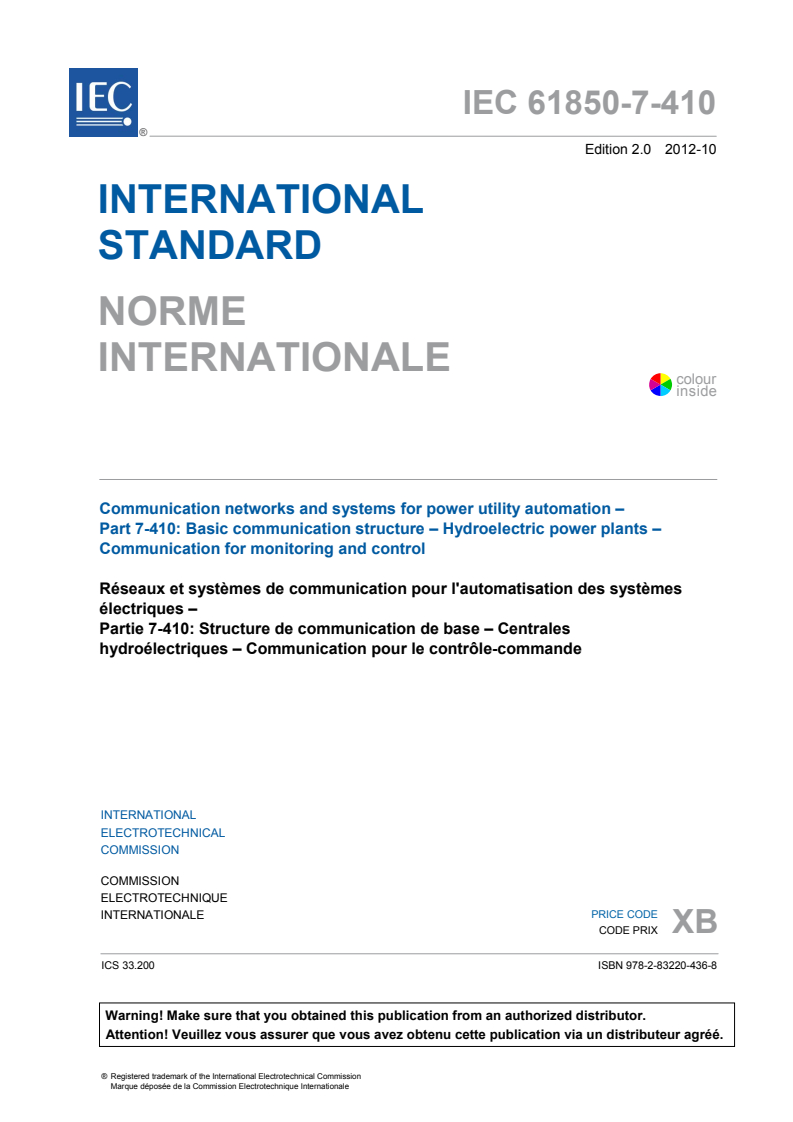
IEC 61850-7-410 ®
Edition 2.0 2012-10
INTERNATIONAL
STANDARD
NORME
INTERNATIONALE
colour
inside
Communication networks and systems for power utility automation –
Part 7-410: Basic communication structure – Hydroelectric power plants –
Communication for monitoring and control
Réseaux et systèmes de communication pour l'automatisation des systèmes
électriques –
Partie 7-410: Structure de communication de base – Centrales
hydroélectriques – Communication pour le contrôle-commande
All rights reserved. Unless otherwise specified, no part of this publication may be reproduced or utilized in any form
or by any means, electronic or mechanical, including photocopying and microfilm, without permission in writing from
either IEC or IEC's member National Committee in the country of the requester.
If you have any questions about IEC copyright or have an enquiry about obtaining additional rights to this publication,
please contact the address below or your local IEC member National Committee for further information.
Droits de reproduction réservés. Sauf indication contraire, aucune partie de cette publication ne peut être reproduite ni
utilisée sous quelque forme que ce soit et par aucun procédé, électronique ou mécanique, y compris la photocopie et les
microfilms, sans l'accord écrit de la CEI ou du Comité national de la CEI du pays du demandeur.
Si vous avez des questions sur le copyright de la CEI ou si vous désirez obtenir des droits supplémentaires sur cette
publication, utilisez les coordonnées ci-après ou contactez le Comité national de la CEI de votre pays de résidence.
IEC Central Office Tel.: +41 22 919 02 11
3, rue de Varembé Fax: +41 22 919 03 00
CH-1211 Geneva 20 info@iec.ch
Switzerland www.iec.ch
About the IEC
The International Electrotechnical Commission (IEC) is the leading global organization that prepares and publishes
International Standards for all electrical, electronic and related technologies.
About IEC publications
The technical content of IEC publications is kept under constant review by the IEC. Please make sure that you have the
latest edition, a corrigenda or an amendment might have been published.
Useful links:
IEC publications search - www.iec.ch/searchpub Electropedia - www.electropedia.org
The advanced search enables you to find IEC publications The world's leading online dictionary of electronic and
by a variety of criteria (reference number, text, technical electrical terms containing more than 30 000 terms and
committee,…). definitions in English and French, with equivalent terms in
It also gives information on projects, replaced and additional languages. Also known as the International
withdrawn publications. Electrotechnical Vocabulary (IEV) on-line.
IEC Just Published - webstore.iec.ch/justpublished Customer Service Centre - webstore.iec.ch/csc
Stay up to date on all new IEC publications. Just Published If you wish to give us your feedback on this publication
details all new publications released. Available on-line and or need further assistance, please contact the
also once a month by email. Customer Service Centre: csc@iec.ch.
A propos de la CEI
La Commission Electrotechnique Internationale (CEI) est la première organisation mondiale qui élabore et publie des
Normes internationales pour tout ce qui a trait à l'électricité, à l'électronique et aux technologies apparentées.
A propos des publications CEI
Le contenu technique des publications de la CEI est constamment revu. Veuillez vous assurer que vous possédez
l’édition la plus récente, un corrigendum ou amendement peut avoir été publié.
Liens utiles:
Recherche de publications CEI - www.iec.ch/searchpub Electropedia - www.electropedia.org
La recherche avancée vous permet de trouver des Le premier dictionnaire en ligne au monde de termes
publications CEI en utilisant différents critères (numéro de électroniques et électriques. Il contient plus de 30 000
référence, texte, comité d’études,…). termes et définitions en anglais et en français, ainsi que
Elle donne aussi des informations sur les projets et les les termes équivalents dans les langues additionnelles.
publications remplacées ou retirées. Egalement appelé Vocabulaire Electrotechnique
International (VEI) en ligne.
Just Published CEI - webstore.iec.ch/justpublished
Service Clients - webstore.iec.ch/csc
Restez informé sur les nouvelles publications de la CEI.
Just Published détaille les nouvelles publications parues. Si vous désirez nous donner des commentaires sur
Disponible en ligne et aussi une fois par mois par email. cette publication ou si vous avez des questions
contactez-nous: csc@iec.ch.
IEC 61850-7-410 ®
Edition 2.0 2012-10
INTERNATIONAL
STANDARD
NORME
INTERNATIONALE
colour
inside
Communication networks and systems for power utility automation –
Part 7-410: Basic communication structure – Hydroelectric power plants –
Communication for monitoring and control
Réseaux et systèmes de communication pour l'automatisation des systèmes
électriques –
Partie 7-410: Structure de communication de base – Centrales
hydroélectriques – Communication pour le contrôle-commande
INTERNATIONAL
ELECTROTECHNICAL
COMMISSION
COMMISSION
ELECTROTECHNIQUE
PRICE CODE
INTERNATIONALE
CODE PRIX XB
ICS 33.200 ISBN 978-2-83220-436-8
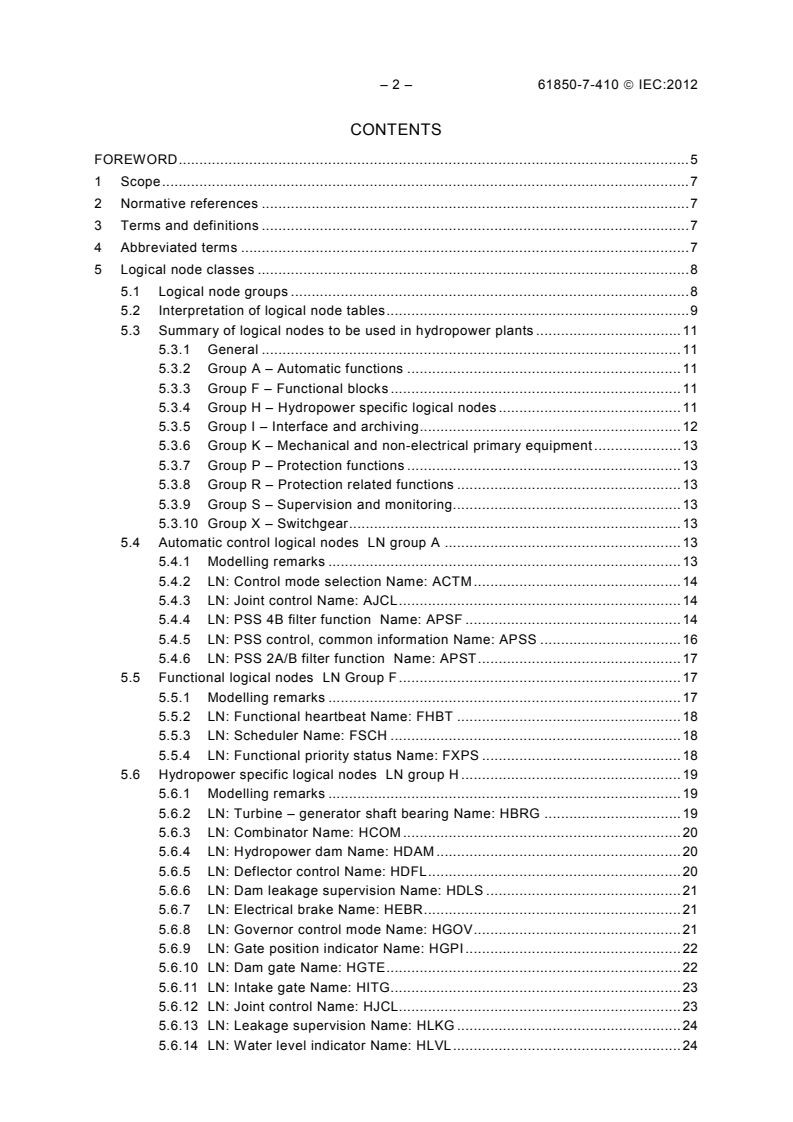
– 2 – 61850-7-410 IEC:2012
CONTENTS
FOREWORD . 5
1 Scope . 7
2 Normative references . 7
3 Terms and definitions . 7
4 Abbreviated terms . 7
5 Logical node classes . 8
5.1 Logical node groups . 8
5.2 Interpretation of logical node tables . 9
5.3 Summary of logical nodes to be used in hydropower plants . 11
5.3.1 General . 11
5.3.2 Group A – Automatic functions . 11
5.3.3 Group F – Functional blocks . 11
5.3.4 Group H – Hydropower specific logical nodes . 11
5.3.5 Group I – Interface and archiving . 12
5.3.6 Group K – Mechanical and non-electrical primary equipment . 13
5.3.7 Group P – Protection functions . 13
5.3.8 Group R – Protection related functions . 13
5.3.9 Group S – Supervision and monitoring . 13
5.3.10 Group X – Switchgear . 13
5.4 Automatic control logical nodes LN group A . 13
5.4.1 Modelling remarks . 13
5.4.2 LN: Control mode selection Name: ACTM . 14
5.4.3 LN: Joint control Name: AJCL . 14
5.4.4 LN: PSS 4B filter function Name: APSF . 14
5.4.5 LN: PSS control, common information Name: APSS . 16
5.4.6 LN: PSS 2A/B filter function Name: APST . 17
5.5 Functional logical nodes LN Group F . 17
5.5.1 Modelling remarks . 17
5.5.2 LN: Functional heartbeat Name: FHBT . 18
5.5.3 LN: Scheduler Name: FSCH . 18
5.5.4 LN: Functional priority status Name: FXPS . 18
5.6 Hydropower specific logical nodes LN group H . 19
5.6.1 Modelling remarks . 19
5.6.2 LN: Turbine – generator shaft bearing Name: HBRG . 19
5.6.3 LN: Combinator Name: HCOM . 20
5.6.4 LN: Hydropower dam Name: HDAM . 20
5.6.5 LN: Deflector control Name: HDFL . 20
5.6.6 LN: Dam leakage supervision Name: HDLS . 21
5.6.7 LN: Electrical brake Name: HEBR . 21
5.6.8 LN: Governor control mode Name: HGOV . 21
5.6.9 LN: Gate position indicator Name: HGPI . 22
5.6.10 LN: Dam gate Name: HGTE . 22
5.6.11 LN: Intake gate Name: HITG . 23
5.6.12 LN: Joint control Name: HJCL. 23
5.6.13 LN: Leakage supervision Name: HLKG . 24
5.6.14 LN: Water level indicator Name: HLVL . 24
61850-7-410 IEC:2012 – 3 –
5.6.15 LN: Mechanical brake Name: HMBR . 25
5.6.16 LN: Needle control Name: HNDL . 25
5.6.17 LN: Water net head data Name: HNHD . 26
5.6.18 LN: Dam over-topping protection Name: HOTP . 26
5.6.19 LN: Hydropower / water reservoir Name: HRES . 27
5.6.20 LN: Hydropower unit sequencer Name: HSEQ . 27
5.6.21 LN: Speed monitoring Name: HSPD . 27
5.6.22 LN: Surge shaft Name: HSST . 28
5.6.23 LN: Guide vanes (wicket gate) Name: HTGV . 29
5.6.24 LN: Runner blades Name: HTRB . 29
5.6.25 LN: Trash rack Name: HTRK . 30
5.6.26 LN: Turbine Name: HTUR . 30
5.6.27 LN: Hydropower unit Name: HUNT . 31
5.6.28 LN: Valve (butterfly valve, ball valve) Name: HVLV . 32
5.6.29 LN: Water control Name: HWCL . 33
5.7 Logical nodes for interface and archiving LN group I . 34
5.7.1 Modelling remarks . 34
5.7.2 LN: Fire detection and alarm Name: IFIR . 34
5.7.3 LN: Hand interface Name: IHND . 34
5.8 Logical nodes for mechanical and non-electric primary equipment LN group
K . 35
5.8.1 Modelling remarks . 35
5.8.2 LN: Heater, cubicle heater Name: KHTR . 35
5.9 Logical nodes for protection functions LN group P . 35
5.9.1 Modelling remarks . 35
5.9.2 LN: Rotor protection Name: PRTR . 35
5.10 Logical nodes for protection related functions LN group R . 36
5.10.1 Modelling remarks . 36
5.10.2 LN: Field breaker configuration Name: RFBC . 36
5.11 Logical nodes for supervision and monitoring LN group S. 36
5.11.1 Modelling remarks . 36
5.11.2 LN: Supervision of media flow Name: SFLW . 36
5.11.3 LN: Supervision of media level Name: SLVL . 37
5.11.4 LN: Supervision of the position of a device Name: SPOS . 38
5.11.5 LN: Supervision media pressure Name: SPRS . 39
5.12 Logical nodes for switchgear LN group X . 41
5.12.1 Modelling remarks . 41
5.12.2 LN: Switching control for field flashing Name: XFFL . 41
6 Data name semantics . 41
7 Common data classes . 54
7.1 General . 54
7.2 Maintenance and operational tag (TAG) . 54
7.3 Operational restriction (RST) . 55
8 Data attribute semantics . 55
Bibliography . 59
Table 1 – Abbreviated terms . 8
Table 2 – List of logical node groups . 9
– 4 – 61850-7-410 IEC:2012
Table 3 – Interpretation of logical node tables . 10
Table 4 – Logical nodes for automatic functions . 11
Table 5 – Logical nodes representing functional blocks. 11
Table 6 – Hydropower specific logical nodes . 11
Table 7 – Logical nodes for interface and archiving . 12
Table 8 – Logical nodes for mechanical and non-electric primary equipment. 13
Table 9 – Logical nodes for protections. 13
Table 10 – Logical nodes for protection related functions . 13
Table 11 – Logical nodes for supervision and monitoring . 13
Table 12 – Logical nodes for switchgear . 13
Table 13 – PSS filter comparison . 16
Table 14 – Description of data . 41
Table 15 – Semantics of data attributes . 56
61850-7-410 IEC:2012 – 5 –
INTERNATIONAL ELECTROTECHNICAL COMMISSION
____________
COMMUNICATION NETWORKS AND SYSTEMS
FOR POWER UTILITY AUTOMATION –
Part 7-410: Basic communication structure –
Hydroelectric power plants –
Communication for monitoring and control
FOREWORD
1) The International Electrotechnical Commission (IEC) is a worldwide organization for standardization comprising
all national electrotechnical committees (IEC National Committees). The object of IEC is to promote
international co-operation on all questions concerning standardization in the electrical and electronic fields. To
this end and in addition to other activities, IEC publishes International Standards, Technical Specifications,
Technical Reports, Publicly Available Specifications (PAS) and Guides (hereafter referred to as “IEC
Publication(s)”). Their preparation is entrusted to technical committees; any IEC National Committee interested
in the subject dealt with may participate in this preparatory work. International, governmental and non-
governmental organizations liaising with the IEC also participate in this preparation. IEC collaborates closely
with the International Organization for Standardization (ISO) in accordance with conditions determined by
agreement between the two organizations.
2) The formal decisions or agreements of IEC on technical matters express, as nearly as possible, an international
consensus of opinion on the relevant subjects since each technical committee has representation from all
interested IEC National Committees.
3) IEC Publications have the form of recommendations for international use and are accepted by IEC National
Committees in that sense. While all reasonable efforts are made to ensure that the technical content of IEC
Publications is accurate, IEC cannot be held responsible for the way in which they are used or for any
misinterpretation by any end user.
4) In order to promote international uniformity, IEC National Committees undertake to apply IEC Publications
transparently to the maximum extent possible in their national and regional publications. Any divergence
between any IEC Publication and the corresponding national or regional publication shall be clearly indicated in
the latter.
5) IEC itself does not provide any attestation of conformity. Independent certification bodies provide conformity
assessment services and, in some areas, access to IEC marks of conformity. IEC is not responsible for any
services carried out by independent certification bodies.
6) All users should ensure that they have the latest edition of this publication.
7) No liability shall attach to IEC or its directors, employees, servants or agents including individual experts and
members of its technical committees and IEC National Committees for any personal injury, property damage or
other damage of any nature whatsoever, whether direct or indirect, or for costs (including legal fees) and
expenses arising out of the publication, use of, or reliance upon, this IEC Publication or any other IEC
Publications.
8) Attention is drawn to the Normative references cited in this publication. Use of the referenced publications is
indispensable for the correct application of this publication.
9) Attention is drawn to the possibility that some of the elements of this IEC Publication may be the subject of
patent rights. IEC shall not be held responsible for identifying any or all such patent rights.
International Standard IEC 61850-7-410 has been prepared by technical committee 57: Power
systems management and associated information exchange.
This second edition cancels and replaces the first edition published in 2007, and constitutes a
technical revision. This edition includes the following significant technical changes with
respect to the previous edition:
a) The logical nodes in IEC 61850-7-410:2007 that were not specific to hydropower plants
have been transferred to IEC 61850-7-4:2010 and have been removed from this edition of
IEC 61850-7-410.
b) The definitions of logical nodes in this edition of IEC 61850-7-410 have been updated
using the format introduced in IEC 61850-7-4:2010.
c) Most of the modelling examples and background information that was included in
IEC 61850-7-410:2007 has been transferred to IEC/TR 61850-7-510.
– 6 – 61850-7-410 IEC:2012
d) However, this edition of IEC 61850-7-410 includes additional general-purpose logical
nodes that were not included in IEC 61850-7-4:2010, but are required in order to represent
the complete control and monitoring system of a hydropower plant.
The text of this standard is based on the following documents:
FDIS Report on voting
57/1274/FDIS 57/1289/RVD
Full information on the voting for the approval of this standard can be found in the report on
voting indicated in the above table.
This publication has been drafted in accordance with the ISO/IEC Directives, Part 2.
A list of all the parts in the IEC 61850 series, published under the general title
Communication networks and systems for power utility automation can be found on the IEC
website.
The committee has decided that the contents of this publication will remain unchanged until
the stability date indicated on the IEC web site under "http://webstore.iec.ch" in the data
related to the specific publication. At this date, the publication will be
• reconfirmed,
• withdrawn,
• replaced by a revised edition, or
• amended.
IMPORTANT – The 'colour inside' logo on the cover page of this publication indicates
that it contains colours which are considered to be useful for the correct
understanding of its contents. Users should therefore print this document using a
colour printer.
61850-7-410 IEC:2012 – 7 –
COMMUNICATION NETWORKS AND SYSTEMS
FOR POWER UTILITY AUTOMATION –
Part 7-410: Basic communication structure –
Hydroelectric power plants –
Communication for monitoring and control
1 Scope
This part of IEC 61850 specifies the additional common data classes, logical nodes and data
objects required for the use of IEC 61850 in a hydropower plant.
2 Normative references
The following documents, in whole or in part, are normatively referenced in this document and
are indispensable for its application. For dated references, only the edition cited applies. For
undated references, the latest edition of the referenced document (including any
amendments) applies.
IEC/TS 61850-2, Communication networks and systems in substations – Part 2: Glossary
IEC 61850-7-1, Communication networks and systems for power utility automation – Part 7-1:
Basic communication structure – Principles and models
IEC 61850-7-2:2010, Communication networks and systems for power utility automation –
Part 7-2: Basic information and communication structure – Abstract communication service
interface (ACSI)
IEC 61850-7-3:2010, Communication networks and systems for power utility automation –
Part 7-3: Basic communication structure for substations and feeder equipment – Common
data classes
IEC 61850-7-4:2010, Communication networks and systems for power utility automation –
Part 7-4: Basic communication structure – Compatible logical node classes and data object
classes
3 Terms and definitions
For the purpose of this document, the terms and definitions given in IEC 61850-2 apply.
4 Abbreviated terms
The terms listed in Table 1 are used to build concatenated Data Object Names in this
document. IEC 61850-7-410 inherits all the abbreviated terms described in Clause 4 of
IEC 61850-7-4:2010.
NOTE Data Object Names in the logical nodes representing PSS filter functions follow names in IEEE 421.5 as
closely as possible. These names are not included in Table 1.
– 8 – 61850-7-410 IEC:2012
Table 1 – Abbreviated terms
Term Description Term Description
a
Act Action, activity, active, activate Lkg Leakage
Atr Actuator Lub Lubrication
BG Before Gain Man Manual (- operation selected)
Brg Bearing Mnt Maintenance
Brk Brake Ndl Needle (used in Pelton turbines)
Bt Heartbeat Nhd Net head
BtB Back-to-Back Nrm Normal
Cam Cam, e.g. rotating non-circular disk Nxt Next
a
Cap Capacity, capability Off Device disengaged (= off)
Cbr Calibration On Device applied (= on)
Cff coefficient Operate Operate order to any device
a
Cm Centimetres Opn
Open, opened, opening
Cmpl Completed, completion, complete Pe Electric power
Cnd Condenser, synchronous compensator Pmp Pump
Crl Correlation Polytr Polytropic
Crp Creeping, slow movement Prec Precondition, initial status
Cwb Crowbar Prt Priority
De Remove Psk Penstock
Deg Degrees, for angle indication in ˚ Pss PSS, power system stabiliser function
Dfl Deflector (used in Pelton turbines) Qu Queue
Dia Diaphragm Rb Runner blade
Dith Dither Reg Regulation
Dn Down, below, downstream, lowest Req Requested
Drtb Draft tube Rng Range
Droop Droop Rpt Repeat, repetition
Dtc Detection Rtg Rating, rated
Dvc Device Rwy Runaway, e.g. in runaway speed
Dw Delta Omega Saf Safety
a
Ena Sft Soft (as in soft start)
Enable, allow operation
Fa “Fire all” sequence (to thyristors) Shft Shaft
Fbc Field breaker configuration Sld Solidity
Fir Fire SM Servo, servo-motor
Flm Flame SNL Speed-no-load, connected but not generating
Flsh Flashing (e.g. field flashing) Spir Spiral
Flt Fault Srv Service
Flw Flow, flowing Stl Still, not moving
Fst Fast Stnd Stand, standing
Gdv Guide vane Syn Synchronous, synchronism
Grd Gradient Twt Tailwater, water level at outlet
Gte Gate, dam gate Tp Test Point
Hd Head Trb Turbine
Hwt Headwater, water level at intake Trg Trigger
Hys Hysteresis Unt Unit, production unit
I Intermediate Up Up, above, upstream, upper
J Joint Vsi Voltage stabilizer input
Lft Lifting, lift Vst Voltage stabilizer terminal (output)
a
Lo Low, lower (position)
Lkd Locked
a
Extended description of IEC 61850-7-4
5 Logical node classes
5.1 Logical node groups
Logical nodes are grouped together with nodes of similar or related functions having the same
first letter. Table 2 shows presently assigned letters, letters marked “reserved” may be used
in future extensions to the standard series. Names of logical nodes shall start with the letter of
61850-7-410 IEC:2012 – 9 –
the group to which the LN belongs. E.g. most of the logical nodes, defined in this document,
are specific for hydropower use and thus have names that start with the letter H.
Table 2 – List of logical node groups
A Automatic control functions
B Reserved
C Control functions
D Functions specific to distributed energy resources (DER)
E Reserved
F Logical nodes representing functional blocks
G Generic references
H Functions specific to hydropower plants
I Interface and archiving functions
J Reserved
K Kinetic energy, mechanical devices and equipment
L Physical devices and common logical nodes
M Metering and measurement
N Reserved
O Reserved
P Electrical protections
Q Power quality
R Protection related functions
S Supervision and monitoring
T Sensors and transmitters (including instrument transformers)
U Reserved
V Reserved
W Functions specific to wind power plants
X Switchgear
Y Power transformers
Z Power system equipment
5.2 Interpretation of logical node tables
The interpretation of the headings for the logical node tables is presented in Table 3.
– 10 – 61850-7-410 IEC:2012
Table 3 – Interpretation of logical node tables
Data Object Name Function of the Data Object
Common Data Class Common Data Class that defines the structure of the Data Object. See IEC 61850-7-3.
Explanation Short explanation of the data and how it is used.
Transient Data – the status of data with this designation is momentary and shall be logged
or reported to provide evidence of their momentary state. Some T may be only valid on a
T
modelling level. The TRANSIENT property of DATA only applies to BOOLEAN process
data attributes (FC=ST) of that DATA. Transient DATA is identical to normal DATA, except
that for the process state change from TRUE to FALSE no event may be generated for
reporting and for logging.
This column defines whether data, data sets, control blocks or services are mandatory (M)
or optional (O) for the instantiation of a specific logical node.
In some cases a data object can be instantiated; this is marked by “multi”, i.e. Omulti or
M/O
Mmulti. Instantiation shall be made by numbers 01 to 99, added directly after the data
object name. The part of the data object that is instatiated is marked by {inst} in the data
object explanation
The attributes for data that are instantiated may also be mandatory or optional based on
the CDC (Attribute Type) definition in IEC 61850-7-3.
Where the letter C is used for “conditional”, at least one of the items of data labelled with
C shall be used from each category where C occurs.
All data object names are listed alphabetically in Clause 8. Despite some overlapping, the
data in the logical node classes are grouped for the convenience of the reader into some of
the following categories.
Common logical node information
Common logical node information is information independent of the dedicated function
represented by the LN class. Mandatory data (M) are common to all LN classes; optional data
(O) are valid for a reasonable subset of LN classes.
Status information
Status information is data which shows either the status of the process or of the function
allocated to the LN class. This information is produced locally and cannot be changed
remotely unless substitution is applicable. Data such as “start” or “trip” are listed in this
category. Most of these data are mandatory. The data can only be read and not set from an
external source.
Settings
Settings are data which are needed for the function to operate. Since many settings are
dependent on the implementation of the function, only a commonly agreed minimum is
standardised. They may be changed remotely, but normally not very often. The setting can
not always be read back; whether it is possible or not depends on the data class used for the
setting.
Measured values
Measured values are analogue data measured from the process or calculated in the functions
such as currents, voltages, power, etc. This information is produced locally and cannot be
changed remotely unless substitution is applicable.
Controls
Controls are data which are changed by commands such as switchgear state (ON/OFF), tap
changer position or reset-able counters. They are typically changed remotely, and are
changed during operation much more than settings. Data objects under controls cannot be
read back.
61850-7-410 IEC:2012 – 11 –
5.3 Summary of logical nodes to be used in hydropower plants
5.3.1 General
This document specifies the compatible logical node classes to be used in hydropower plants
listed in Tables 4 to 12. For other logical node classes that might be of use also in
hydropower plants, see IEC 61850-7-4.
5.3.2 Group A – Automatic functions
Table 4 – Logical nodes for automatic functions
LN Class Description
ACTM Control mode selection. Overall LN for controllers with different possible modes.
AJCL Joint control function, to balance total power from different sources.
APSS PSS Control. Common information of a PSS function.
APST PSS 2A/B filter. Represents a filter according to IEEE 421.5-2005.
APSF PSS 4B filter. Represents a filter according to IEEE 421.5-2005.
5.3.3 Group F – Functional blocks
Table 5 – Logical nodes representing functional blocks
LN Class Description
FHBT Heart-beat. This LN represents the heart-beat function of a controlling device. I.e. the function used
to ensure that a specific device or program in a device is running.
FSCH Scheduler. This LN represents a task scheduler that will perform predefined tasks at given times.
FXPS Functional priority status. This LN is used to specify in which order devices should be started or
activated.
5.3.4 Group H – Hydropower specific logical nodes
Table 6 – Hydropower specific logical nodes
LN Class Description
HBRG Turbine – generator shaft bearing. This LN holds data pertaining to bearings, such as temperatures
and lubrication oil flows.
HCOM Combinator (3D-CAM or 2D-CAM), optimises the relation between net head, guide vanes and
runner blades. It is used in power plants with Kaplan turbines with moveable runner blades. The
combinatory function will also use the FCSD LN to hold the relation curves for different net heads.
HDAM Hydropower dam. A logical node that is used to represent the physical aspects of the dam.
HDFL Deflector control. This logical node represents the deflector control of a Pelton turbine
HDLS Dam leakage supervision. Represents a device that will supervise and give alarm in case of dam
leakage. The actual measurement can be based on water flow.
HEBR Electrical brake. This logical node represents an electrical brake system of a turbine.
HGPI Gate position indicator. A device that provides the position of a dam gate. The position is given
either as an angular displacement in case of sector gates or as distance from fully closed position
in case of straight gates. For aperture gates and valves where the position is given as percent of
full opening, either the HVLV or the SPOS logical nodes are recommended.
HGOV Governor control. A logical node that represents the overall control of a turbine governor and the
various control modes.
HGTE Dam gate. This LN is intended to hold information about the gate. It can also present a calculated
water flow through the gate, in which case the FCSD LN shall be included in the same logical
device, to provide the relations. Note that in this LN the position set-point is listed under Controls
instead of Settings. The normal way of controlling a gate is to send a position set-point.
– 12 – 61850-7-410 IEC:2012
LN Class Description
HITG Intake gate. This LN can be used to represent intake gates. The gates will almost never be placed
in any other position than fully closed or fully open. However to cater for step-wise or other
controls, the gate is normally provided with a number of position switches.
HJCL Power plant joint control function. In plants with more than one gate or several turbines, this LN will
represent the joint control function that is used to supervise the total water flow or to maintain a
constant water level. The LN shall be instantiated to provide one instance for each gate and each
turbine to be supervised.
HLKG Leakage supervision. This LN can be used to measure any leakage in the plant, it is more generic
than HDLS
HLVL Water level indicator. The LN represents the water level sensing device. The output is a distance
including an offset from a base level (commonly the distance above sea).
HMBR Mechanical brake for the generator shaft. This is a LN for the brake control. The brake is used for
stopping the unit during shut-down and to hold the shaft still, once the unit is stopped.
HNDL Needle control. A specialised LN that represents the control of needles in Pelton turbines.
HNHD Net head data. A LN that can be used to present the calculated net head data (difference between
upper and lower water levels) in a hydropower plant.
HOTP Dam overtopping protection. A protection function that will act by opening one or more gates in
case of a risk for overtopping the dam. The protection will sometimes include its own water
measurement device; hence an optional measured value for water level.
HRES Water reservoir. A logical node that is used to represent the logical function of a reservoir. If the
content is to be calculated, the FSCD LN shall be used to provide the relation between water level
and content.
HSEQ Start / stop sequencer. A simple LN that only presents what the sequencer is doing (inactive –
starting – stopping) and in case it is active, what step it is presently working on.
HSPD Speed monitoring. This LN is normally located in a stand-alone logical device, separated from but
monitoring the turbine governor. It will also act as a placeholder for various speed limits and set-
points used by the start sequencer and other control functions.
HSST Surge shaft or surge tank. A function that is used to mitigate pressure surges in the system.
HTGV Guide vanes (wicket gate). This logical node represents the physical device of guide vanes in a
hydropower turbine.
HTRB Runner blades. This logical node represents the physical device of runner blades in e.g. a Kaplan
turbine where the runner blades can be controlled.
HTRK Trash rack, used to prevent floating debris getting into the turbine.
HTUR Turbine. This logical node holds extended rating plate data for a turbine in a hydropower plant.
HUNT Hydropower production unit. This LN represents the physical device of the turbine and generator
combination in a hydropower plant. It is intended as an extended rating plate that allows temporary
settings of data. It also acts as a placeholder for the current operating conditions of the unit.
HVLV Valve. This logical node represents a large valve, e.g. a valve in a penstock, butterfly or ball type
valve.
HWCL Water control function. This LN will represent one physical device that can modify the water flow
though the plant, either a gate or a turbine. In case of a plant with a joint control function, the HJCL
LN will provide the flow set-point to be used by HWCL.
5.3.5 Group I – Interface and archiving
Table 7 – Logical nodes for interface and archiving
LN Class Description
IFIR Generic fire detection and alarm function.
IHND Generic physical human – machine interface. E.g. a push-button or another physical device that
can be used as input to a controller.
61850-7-410 IEC:2012 – 13 –
5.3.6 Group K – Mechanical and non-electrical primary equipment
Table 8 – Logical nodes for mechanical and non-electric primary equipment
LN Class Description
KHTR Heater. The LN represents a heater, cubicle heater or any other heater that can be controlled.
5.3.7 Group P – Protection functions
NOTE Most of the logical nodes that represent protective functions are defined in the substation part of the
document series.
Table 9 – Logical nodes for protections
LN Class Description
PRTR Rotor protection. Field short-circuit protection.
5.3.8 Group R – Protection related functions
Table 10 – Logical nodes for protection related functions
LN Class Description
RFBC Field breaker configuration.
5.3.9 Group S – Supervision and monitoring
Table 11 – Logical nodes for supervision and monitoring
LN Class Description
SFLW Media flow supervision. This logical node represents a generic media flow supervision system that
can provide alarm and trip signals. In an application, the LN shall be instantiated with one instance
per flow being measured.
SLEV Media level supervision. This logical node represents a generic level supervision system that can
provide alarm and trip signals. In an application, the LN shall be instantiated with one instance per
surface being measured.
SPOS Device position supervision. This logical node represents a generic position supervision system that
can provide alarm and trip signals. In an application, the LN shall be instantiated with one device
being measured.
SPRS Media pressure supervision. This logical node represents a generic pressure supervision system
that can provide alarm and trip signals. In an application, the LN shall be instantiated with one
instance per pressure point being measured.
5.3.10 Group X – Switchgear
Table 12 – Logical nodes for switchgear
LN Class Description
XFFL Field flashing. A logical node to represent the switching control for start excitation (field flashing) of
a generator.
5.4 Automatic control logical nodes LN group A
5.4.1 Modelling remarks
Logical nodes in this group are intended for automatic control functions of general use, i.e.
not for any specific area of technology. The logical nodes APSS, APST and APSF below are
intended for use in power system stabilizer (PSS) control functions used for large generators.
– 14 – 61850-7-410 IEC:2012
5.4.2 LN: Control mode selection Name: ACTM
Logical node ACTM shall be used to present information about different control modes of any
control or regulating system. One logical node ACTM must be created for each available
control mode.
ACTM class
Data Object Common Explanation T M/O
Name Data Class
LNName The name shall be composed of the class name, the LN-Prefix
and LN-Instance-ID according to Clause 22 of IEC 61850-7-
2:2010.
Data Objects
Status information
LocKey SPS Local or remote key O
Loc SPS Local control behaviour O
Flt SPS Fault in the controller {inst} Mmulti
Controls
LocSta SPC Remote control blocked O
ModAct SPC If TRUE this mode is active M
5.4.3 LN: Joint control Name: AJCL
The joint control logical node is used to co-ordinate the power production of a power plant
with more than one production unit. The joint control function will normally try to optimise the
power production between units already in operation. In this control mode, the power plant
can be controlled as a single unit. The data attributes shall be instantiated to provide one
instance per generating unit to be included in the joint control. Compare also with the HJCL
logical node, which can be used to control water flow through a single object of a hydropower
plant. Instantiated parts shall be defined in the extended private parts.
AJCL class
Data Object Common Explanation T M/O
Name Data Class
LNName The name shall be composed of the class name, the LN-Prefix
and LN-Instance-ID according to Clause 22 of IEC 61850-7-
2:2010.
Data Objects
Status information
LocKey SPS Local or remote key O
Loc SPS Local control behaviour O
Unt SPS Generation unit {inst} contributing (true = contributing) Omulti
RSpt SPS Raise set-point in IED for unit {inst} T Omulti
LSpt SPS Lower set-point in IED for unit {inst} T Omulti
Measured values
PwrOut MV Contributing power output of the plant (included in the joint O
control)
PwrOutTot MV Total power output of the plant O
Controls
LocSta SPC Remote control blocked O
JCtlTag TAG Joint Control Maintenance tag affixed to the equipment O
UntSpt APC
...
IEC 61850-7-410 ®
Edition 2.1 2015-11
CONSOLIDATED VERSION
INTERNATIONAL
STANDARD
NORME
INTERNATIONALE
colour
inside
Communication networks and systems for power utility automation –
Part 7-410: Basic communication structure – Hydroelectric power plants –
Communication for monitoring and control
Réseaux et systèmes de communication pour l'automatisation des systèmes
électriques –
Partie 7-410: Structure de communication de base – Centrales
hydroélectriques – Communication pour le contrôle-commande
All rights reserved. Unless otherwise specified, no part of this publication may be reproduced or utilized in any form
or by any means, electronic or mechanical, including photocopying and microfilm, without permission in writing from
either IEC or IEC's member National Committee in the country of the requester. If you have any questions about IEC
copyright or have an enquiry about obtaining additional rights to this publication, please contact the address below or
your local IEC member National Committee for further information.
Droits de reproduction réservés. Sauf indication contraire, aucune partie de cette publication ne peut être reproduite
ni utilisée sous quelque forme que ce soit et par aucun procédé, électronique ou mécanique, y compris la photocopie
et les microfilms, sans l'accord écrit de l'IEC ou du Comité national de l'IEC du pays du demandeur. Si vous avez des
questions sur le copyright de l'IEC ou si vous désirez obtenir des droits supplémentaires sur cette publication, utilisez
les coordonnées ci-après ou contactez le Comité national de l'IEC de votre pays de résidence.
IEC Central Office Tel.: +41 22 919 02 11
3, rue de Varembé Fax: +41 22 919 03 00
CH-1211 Geneva 20 info@iec.ch
Switzerland www.iec.ch
About the IEC
The International Electrotechnical Commission (IEC) is the leading global organization that prepares and publishes
International Standards for all electrical, electronic and related technologies.
About IEC publications
The technical content of IEC publications is kept under constant review by the IEC. Please make sure that you have the
latest edition, a corrigenda or an amendment might have been published.
IEC Catalogue - webstore.iec.ch/catalogue Electropedia - www.electropedia.org
The stand-alone application for consulting the entire The world's leading online dictionary of electronic and
bibliographical information on IEC International Standards, electrical terms containing more than 30 000 terms and
Technical Specifications, Technical Reports and other definitions in English and French, with equivalent terms in 15
documents. Available for PC, Mac OS, Android Tablets and additional languages. Also known as the International
iPad. Electrotechnical Vocabulary (IEV) online.
IEC publications search - www.iec.ch/searchpub IEC Glossary - std.iec.ch/glossary
The advanced search enables to find IEC publications by a More than 60 000 electrotechnical terminology entries in
variety of criteria (reference number, text, technical English and French extracted from the Terms and Definitions
committee,…). It also gives information on projects, replaced clause of IEC publications issued since 2002. Some entries
and withdrawn publications. have been collected from earlier publications of IEC TC 37,
77, 86 and CISPR.
IEC Just Published - webstore.iec.ch/justpublished
Stay up to date on all new IEC publications. Just Published IEC Customer Service Centre - webstore.iec.ch/csc
details all new publications released. Available online and If you wish to give us your feedback on this publication or
also once a month by email. need further assistance, please contact the Customer Service
Centre: csc@iec.ch.
A propos de l'IEC
La Commission Electrotechnique Internationale (IEC) est la première organisation mondiale qui élabore et publie des
Normes internationales pour tout ce qui a trait à l'électricité, à l'électronique et aux technologies apparentées.
A propos des publications IEC
Le contenu technique des publications IEC est constamment revu. Veuillez vous assurer que vous possédez l’édition la
plus récente, un corrigendum ou amendement peut avoir été publié.
Catalogue IEC - webstore.iec.ch/catalogue Electropedia - www.electropedia.org
Application autonome pour consulter tous les renseignements
Le premier dictionnaire en ligne de termes électroniques et
bibliographiques sur les Normes internationales,
électriques. Il contient plus de 30 000 termes et définitions en
Spécifications techniques, Rapports techniques et autres
anglais et en français, ainsi que les termes équivalents dans
documents de l'IEC. Disponible pour PC, Mac OS, tablettes
15 langues additionnelles. Egalement appelé Vocabulaire
Android et iPad.
Electrotechnique International (IEV) en ligne.
Recherche de publications IEC - www.iec.ch/searchpub
Glossaire IEC - std.iec.ch/glossary
La recherche avancée permet de trouver des publications IEC Plus de 60 000 entrées terminologiques électrotechniques, en
en utilisant différents critères (numéro de référence, texte, anglais et en français, extraites des articles Termes et
comité d’études,…). Elle donne aussi des informations sur les Définitions des publications IEC parues depuis 2002. Plus
projets et les publications remplacées ou retirées. certaines entrées antérieures extraites des publications des
CE 37, 77, 86 et CISPR de l'IEC.
IEC Just Published - webstore.iec.ch/justpublished
Service Clients - webstore.iec.ch/csc
Restez informé sur les nouvelles publications IEC. Just
Published détaille les nouvelles publications parues. Si vous désirez nous donner des commentaires sur cette
Disponible en ligne et aussi une fois par mois par email. publication ou si vous avez des questions contactez-nous:
csc@iec.ch.
IEC 61850-7-410 ®
Edition 2.1 2015-11
CONSOLIDATED VERSION
INTERNATIONAL
STANDARD
NORME
INTERNATIONALE
colour
inside
Communication networks and systems for power utility automation –
Part 7-410: Basic communication structure – Hydroelectric power plants –
Communication for monitoring and control
Réseaux et systèmes de communication pour l'automatisation des systèmes
électriques –
Partie 7-410: Structure de communication de base – Centrales
hydroélectriques – Communication pour le contrôle-commande
INTERNATIONAL
ELECTROTECHNICAL
COMMISSION
COMMISSION
ELECTROTECHNIQUE
INTERNATIONALE
ICS 33.200 ISBN 978-2-8322-3000-8
IEC 61850-7-410 ®
Edition 2.1 2015-11
CONSOLIDATED VERSION
REDLINE VERSION
VERSION REDLINE
colour
inside
Communication networks and systems for power utility automation –
Part 7-410: Basic communication structure – Hydroelectric power plants –
Communication for monitoring and control
Réseaux et systèmes de communication pour l'automatisation des systèmes
électriques –
Partie 7-410: Structure de communication de base – Centrales
hydroélectriques – Communication pour le contrôle-commande
– 2 – IEC 61850-7-410:2012+AMD1:2015 CSV
IEC 2015
CONTENTS
FOREWORD . 5
1 Scope . 7
2 Normative references . 7
3 Terms and definitions . 7
4 Abbreviated terms . 7
5 Logical node classes . 9
5.1 Logical node groups . 9
5.2 Interpretation of logical node tables . 9
5.3 Summary of logical nodes groups to be used in hydropower plants . 11
5.3.1 General . 11
5.3.2 Group A – Automatic functions . 11
5.3.3 Group F – Functional blocks . 12
5.3.4 Group H – Hydropower specific logical nodes . 12
5.3.5 Group I – Interface and archiving . 13
5.3.6 Group K – Mechanical and non-electrical primary equipment . 13
5.3.7 Group P – Protection functions . 13
5.3.8 Group R – Protection related functions . 14
5.3.9 Group S – Supervision and monitoring . 14
5.3.10 Group X – Switchgear . 14
5.3.11 Group E – Thermal power plant specific logical nodes (“Enthalpy”) . 11
5.3.12 Group G – Logical nodes for general purposes . 12
5.3.13 Group T – Transducers and instrument transformers . 14
5.4 Automatic control logical nodes LN group A . 14
5.4.1 Modelling remarks . 14
5.4.2 LN: Control mode selection Name: ACTM . 15
5.4.3 LN: Joint control Name: AJCL . 15
5.4.4 LN: PSS 4B filter function Name: APSF . 16
5.4.5 LN: PSS control, common information Name: APSS . 17
5.4.6 LN: PSS 2A/B filter function Name: APST . 18
5.13 Logical nodes for thermal power LN group E . 19
5.13.1 LN: Block coordination function Name: EBCF . 19
5.13.2 LN: Fuel Control Valve Name: EFCV . 19
5.13.3 LN Gas turbine unit Name: EGTU . 20
5.13.4 LN: Steam Control Valve Name: ESCV . 20
5.13.5 LN: Speed monitoring Name: ESPD. 21
5.13.6 LN Steam turbine unit Name: ESTU . 22
5.5 Functional Logical nodes for functional blocks LN Group F . 22
5.5.1 Modelling remarks . 22
5.5.2 LN: Functional heartbeat Name: FHBT . 24
5.5.3 LN: Scheduler Name: FSCH . 24
5.5.4 LN: Functional priority status Name: FXPS . 25
5.5.5 LN: Deadband filter Name: FDBF . 23
5.5.6 LN: Trip Matrix Name: FMTX . 23
5.6 Hydropower specific logical nodes LN group H . 25
5.6.1 Modelling remarks . 25
5.6.2 LN: Turbine – generator shaft bearing Name: HBRG . 25
IEC 2015
5.6.3 LN: Combinator Name: HCOM . 26
5.6.4 LN: Hydropower dam Name: HDAM . 26
5.6.5 LN: Deflector control Name: HDFL . 27
5.6.6 LN: Dam leakage supervision Name: HDLS . 27
5.6.7 LN: Electrical brake Name: HEBR. 27
5.6.8 LN: Governor control mode Name: HGOV. 28
5.6.9 LN: Gate position indicator Name: HGPI . 28
5.6.10 LN: Dam gate Name: HGTE . 28
5.6.11 LN: Intake gate Name: HITG . 29
5.6.12 LN: Joint control Name: HJCL . 30
5.6.13 LN: Leakage supervision Name: HLKG . 30
5.6.14 LN: Water level indicator Name: HLVL . 31
5.6.15 LN: Mechanical brake Name: HMBR . 31
5.6.16 LN: Needle control Name: HNDL . 31
5.6.17 LN: Water net head data Name: HNHD . 32
5.6.18 LN: Dam over-topping protection Name: HOTP . 32
5.6.19 LN: Hydropower / water reservoir Name: HRES . 33
5.6.20 LN: Hydropower unit sequencer Name: HSEQ . 33
5.6.21 LN: Speed monitoring Name: HSPD . 33
5.6.22 LN: Surge shaft Name: HSST . 34
5.6.23 LN: Guide vanes (wicket gate) Name: HTGV . 35
5.6.24 LN: Runner blades Name: HTRB . 36
5.6.25 LN: Trash rack Name: HTRK . 36
5.6.26 LN: Turbine Name: HTUR . 36
5.6.27 LN: Hydropower unit Name: HUNT
Logical nodes for general purposes LN group G . 37
5.6.28 LN: Valve (butterfly valve, ball valve) Name: HVLV . 39
5.6.29 LN: Water control Name: HWCL . 40
5.7 Logical nodes for interface and archiving LN group I . 41
5.7.1 Modelling remarks . 41
5.7.2 LN: Fire detection and alarm Name: IFIR . 41
5.7.3 LN: Hand interface Name: IHND . 41
5.8 Logical nodes for mechanical and non-electric primary equipment
LN group K . 42
5.8.1 Modelling remarks . 42
5.8.2 LN: Heater, cubicle heater Name: KHTR . 42
5.9 Logical nodes for protection functions LN group P . 42
5.9.1 Modelling remarks . 42
5.9.2 LN: Rotor protection Detection of under impedance
Name: PRTR PTUI . 43
5.10 Logical nodes for protection related functions LN group R . 43
5.10.1 Modelling remarks . 43
5.10.2 LN: Field breaker configuration Name: RFBC . 43
5.11 Logical nodes for supervision and monitoring LN group S. 43
5.11.1 Modelling remarks . 43
5.11.2 LN: Supervision of media flow Name: SFLW . 44
5.11.3 LN: Supervision of media level Name: SLVL . 45
5.11.4 LN: Supervision of the position of a device Name: SPOS . 46
5.11.5 LN: Supervision media pressure Name: SPRS . 47
5.11.6 LN: Supervision of electrical conductivity in water Name: SECW . 44
– 4 – IEC 61850-7-410:2012+AMD1:2015 CSV
IEC 2015
5.12 Logical nodes for switchgear LN group X . 48
5.12.1 Modelling remarks . 48
5.12.2 LN: Switching control for field flashing Name: XFFL . 48
5.15 Logical nodes for instrument transformers and sensors LN group T . 49
5.15.1 LN: Measurement of electrical conductivity in water Name: TECW . 49
6 Data name attribute semantics . 49
7 Common data classes . 63
7.1 General . 63
7.2 Maintenance and operational tag (TAG) . 63
7.3 Operational restriction (RST) . 64
8 Data attribute semantics . 64
Bibliography . 68
Table 1 – Abbreviated terms . 8
Table 2 – List of logical node groups . 9
Table 3 – Interpretation of logical node tables . 10
Table 4 – Logical nodes for automatic functions . 11
Table 5 – Logical nodes representing functional blocks. 12
Table 6 – Hydropower specific logical nodes . 12
Table 7 – Logical nodes for interface and archiving . 13
Table 8 – Logical nodes for mechanical and non-electric primary equipment. 13
Table 9 – Logical nodes for protections. 13
Table 10 – Logical nodes for protection related functions . 14
Table 11 – Logical nodes for supervision and monitoring . 14
Table 12 – Logical nodes for switchgear . 14
Table 13 – PSS filter comparison . 17
Table 14 – Description of data . 49
Table 15 – Semantics of data attributes . 65
Table 16 – Logical nodes representing thermal power . 11
Table 17 – Logical nodes representing generic functions references . 12
Table 18 – Logical nodes for transducers . 14
IEC 2015
INTERNATIONAL ELECTROTECHNICAL COMMISSION
____________
COMMUNICATION NETWORKS AND SYSTEMS
FOR POWER UTILITY AUTOMATION –
Part 7-410: Basic communication structure –
Hydroelectric power plants –
Communication for monitoring and control
FOREWORD
1) The International Electrotechnical Commission (IEC) is a worldwide organization for standardization comprising
all national electrotechnical committees (IEC National Committees). The object of IEC is to promote
international co-operation on all questions concerning standardization in the electrical and electronic fields. To
this end and in addition to other activities, IEC publishes International Standards, Technical Specifications,
Technical Reports, Publicly Available Specifications (PAS) and Guides (hereafter referred to as “IEC
Publication(s)”). Their preparation is entrusted to technical committees; any IEC National Committee interested
in the subject dealt with may participate in this preparatory work. International, governmental and non-
governmental organizations liaising with the IEC also participate in this preparation. IEC collaborates closely
with the International Organization for Standardization (ISO) in accordance with conditions determined by
agreement between the two organizations.
2) The formal decisions or agreements of IEC on technical matters express, as nearly as possible, an international
consensus of opinion on the relevant subjects since each technical committee has representation from all
interested IEC National Committees.
3) IEC Publications have the form of recommendations for international use and are accepted by IEC National
Committees in that sense. While all reasonable efforts are made to ensure that the technical content of IEC
Publications is accurate, IEC cannot be held responsible for the way in which they are used or for any
misinterpretation by any end user.
4) In order to promote international uniformity, IEC National Committees undertake to apply IEC Publications
transparently to the maximum extent possible in their national and regional publications. Any divergence
between any IEC Publication and the corresponding national or regional publication shall be clearly indicated in
the latter.
5) IEC itself does not provide any attestation of conformity. Independent certification bodies provide conformity
assessment services and, in some areas, access to IEC marks of conformity. IEC is not responsible for any
services carried out by independent certification bodies.
6) All users should ensure that they have the latest edition of this publication.
7) No liability shall attach to IEC or its directors, employees, servants or agents including individual experts and
members of its technical committees and IEC National Committees for any personal injury, property damage or
other damage of any nature whatsoever, whether direct or indirect, or for costs (including legal fees) and
expenses arising out of the publication, use of, or reliance upon, this IEC Publication or any other IEC
Publications.
8) Attention is drawn to the Normative references cited in this publication. Use of the referenced publications is
indispensable for the correct application of this publication.
9) Attention is drawn to the possibility that some of the elements of this IEC Publication may be the subject of
patent rights. IEC shall not be held responsible for identifying any or all such patent rights.
This consolidated version of the official IEC Standard and its amendment has been prepared
for user convenience.
IEC 61850-7-410 edition 2.1 contains the second edition (2012-10) [documents 57/1274/FDIS and
57/1289/RVD] and its amendment 1 (2015-11) [documents 57/1607/FDIS and 57/1633/RVD].
In this Redline version, a vertical line in the margin shows where the technical content is
modified by amendment 1. Additions are in green text, deletions are in strikethrough red text. A
separate Final version with all changes accepted is available in this publication.
– 6 – IEC 61850-7-410:2012+AMD1:2015 CSV
IEC 2015
International Standard IEC 61850-7-410 has been prepared by technical committee 57: Power
systems management and associated information exchange.
This edition includes the following significant technical changes with respect to the previous
edition:
a) The logical nodes in IEC 61850-7-410:2007 that were not specific to hydropower plants
have been transferred to IEC 61850-7-4:2010 and have been removed from this edition of
IEC 61850-7-410.
b) The definitions of logical nodes in this edition of IEC 61850-7-410 have been updated
using the format introduced in IEC 61850-7-4:2010.
c) Most of the modelling examples and background information that was included in
IEC 61850-7-410:2007 has been transferred to IEC/TR 61850-7-510.
d) However, this edition of IEC 61850-7-410 includes additional general-purpose logical
nodes that were not included in IEC 61850-7-4:2010, but are required in order to represent
the complete control and monitoring system of a hydropower plant.
This publication has been drafted in accordance with the ISO/IEC Directives, Part 2.
A list of all the parts in the IEC 61850 series, published under the general title
Communication networks and systems for power utility automation can be found on the IEC
website.
The committee has decided that the contents of the base publication and its amendment will
remain unchanged until the stability date indicated on the IEC web site under
"http://webstore.iec.ch" in the data related to the specific publication. At this date, the
publication will be
• reconfirmed,
• withdrawn,
• replaced by a revised edition, or
• amended.
IMPORTANT – The 'colour inside' logo on the cover page of this publication indicates
that it contains colours which are considered to be useful for the correct
understanding of its contents. Users should therefore print this document using a
colour printer.
IEC 2015
COMMUNICATION NETWORKS AND SYSTEMS
FOR POWER UTILITY AUTOMATION –
Part 7-410: Basic communication structure –
Hydroelectric power plants –
Communication for monitoring and control
1 Scope
This part of IEC 61850 specifies the additional common data classes, logical nodes and data
objects required for the use of IEC 61850 in a hydropower plant.
2 Normative references
The following documents, in whole or in part, are normatively referenced in this document and
are indispensable for its application. For dated references, only the edition cited applies. For
undated references, the latest edition of the referenced document (including any
amendments) applies.
IEC/TS 61850-2, Communication networks and systems in substations – Part 2: Glossary
IEC 61850-7-1, Communication networks and systems for power utility automation – Part 7-1:
Basic communication structure – Principles and models
IEC 61850-7-2:2010, Communication networks and systems for power utility automation –
Part 7-2: Basic information and communication structure – Abstract communication service
interface (ACSI)
IEC 61850-7-3:2010, Communication networks and systems for power utility automation –
Part 7-3: Basic communication structure for substations and feeder equipment – Common
data classes
IEC 61850-7-4:2010, Communication networks and systems for power utility automation –
Part 7-4: Basic communication structure – Compatible logical node classes and data object
classes
3 Terms and definitions
For the purpose of this document, the terms and definitions given in IEC 61850-2 apply.
4 Abbreviated terms
The terms listed in Table 1 are used to build concatenated Data Object Names in this
document. IEC 61850-7-410 inherits all the abbreviated terms described in Clause 4 of
IEC 61850-7-4:2010.
NOTE Data Object Names in the logical nodes representing PSS filter functions follow names in IEEE 421.5 as
closely as possible. These names are not included in Table 1.
– 8 – IEC 61850-7-410:2012+AMD1:2015 CSV
IEC 2015
Table 1 – Abbreviated terms
Term Description Term Description
a
Act Action, activity, active, activate Lkg Leakage
a
Atr Actuator Lo Low, lower (position)
BG Before Gain LoPress Low pressure
Brg Bearing Lub Lubrication
Boil Boiler Man Manual (- operation selected)
Brk Brake Mft Main fuel trip
Bt Heartbeat Mnt Maintenance
BtB Back-to-Back Msk Mask
Cam Cam, e.g. rotating non-circular disk Mtx Matrix
a
Cap Capacity, capability Ndl Needle (used in Pelton turbines)
Cbr Calibration Nhd Net head
Cff Coefficient Nrm Normal
Cm Centimetres Nxt Next
Cmpl Completed, completion, complete Off Device disengaged (= off)
Cmpr Compressor On Device applied (= on)
Cnd Condenser, synchronous compensator Operate Operate order to any device
Cndtc Electrical conductivity [S] Opn Open, opened, openinga
Crl Correlation Pe Electric power
Crp Creeping, slow movement Pmp Pump
Ctl Control Polytr Polytropic
Cwb Crowbar Prec Precondition, initial status
De Remove Prt Priority
Deg Degrees, for angle indication in ˚ Psk Penstock
Dfl Deflector (used in Pelton turbines) Pss PSS, power system stabiliser function
Dia Diaphragm Qu Queue
Dith Dither Rb Runner blade
Dn Down, below, downstream, lowest Reg Regulation
Drtb Draft tube Req Requested
Droop Droop Rh Re-heat
Dtc Detection Rlf Relief
Dvc Device Rng Range
Dw Delta Omega Rpt Repeat, repetition
a
Ena Enable, allow operation Rtg Rating, rated
Fa “Fire all” sequence (to thyristors) Rwy Runaway, e.g. in runaway speed
Fbc Field breaker configuration Saf Safety
Fir Fire Sft Soft (as in soft start)
Flm Flame Shft Shaft
Flsh Flashing (e.g. field flashing) Sld Solidity
Flt Fault SM Servo, servo-motor
Flw Flow, flowing SNL Speed-no-load, connected but not generating
Fst Fast Spir Spiral
Gdv Guide vanes Src Source
Grd Gradient Srv Service
Gte Gate, dam gate Stl Still, not moving
Hd Head Stm Steam
HiPres High pressure Stnd Stand, standing
Hwt Headwater, water level at intake Syn Synchronous, synchronism
Hys Hysteresis Tp Test Point
I Intermediate Trg Trigger
Icp Intercept TrbTur Turbine
Ign Ignition Twt Tailwater, water level at outlet
Iner Inertia Unt Unit, production unit
Inlet Inlet (to turbine) Up Up, above, upstream, upper
Ip Intermediate pressure Va Variable
Jnt Joint Vsi Voltage stabilizer input
Lft Lifting, lift Vst Voltage stabilizer terminal (output)
Lkd Locked
a
Extended description of IEC 61850-7-4
IEC 2015
5 Logical node classes
5.1 Logical node groups
Logical nodes are grouped together with nodes of similar or related functions having the same
first letter. Table 2 shows presently assigned letters, letters marked “reserved” may be used
in future extensions to the standard series. Names of logical nodes shall start with the letter of
the group to which the LN belongs. E.g. most of the logical nodes, defined in this document,
are specific for hydropower use and thus have names that start with the letter H.
Table 2 – List of logical node groups
A Automatic control functions
B Reserved
C Control functions
D Functions specific to distributed energy resources (DER)
E Reserved
F Logical nodes representing functional blocks
G Generic references
H Functions specific to hydropower plants
I Interface and archiving functions
J Reserved
K Kinetic energy, mechanical devices and equipment
L Physical devices and common logical nodes
M Metering and measurement
N Reserved
O Reserved
P Electrical protections
Q Power quality
R Protection related functions
S Supervision and monitoring
T Sensors and transmitters (including instrument transformers)
U Reserved
V Reserved
W Functions specific to wind power plants
X Switchgear
Y Power transformers
Z Power system equipment
5.2 Interpretation of logical node tables
The interpretation of the headings for the logical node tables is presented in Table 3.
– 10 – IEC 61850-7-410:2012+AMD1:2015 CSV
IEC 2015
Table 3 – Interpretation of logical node tables
Data Object Name Function of the Data Object
Common Data Class Common Data Class that defines the structure of the Data Object. See IEC 61850-7-3.
Explanation Short explanation of the data and how it is used.
Transient Data – the status of data with this designation is momentary and shall be logged
or reported to provide evidence of their momentary state. Some T may be only valid on a
T
modelling level. The TRANSIENT property of DATA only applies to BOOLEAN process
data attributes (FC=ST) of that DATA. Transient DATA is identical to normal DATA, except
that for the process state change from TRUE to FALSE no event may be generated for
reporting and for logging.
This column defines whether data, data sets, control blocks or services are mandatory (M)
or optional (O) for the instantiation of a specific logical node.
In some cases a data object can be instantiated; this is marked by “multi”, i.e. Omulti or
M/O
Mmulti. Instantiation shall be made by numbers 01 to 99, added directly after the data
object name. The part of the data object that is instatiated is marked by {inst} in the data
object explanation
The attributes for data that are instantiated may also be mandatory or optional based on
the CDC (Attribute Type) definition in IEC 61850-7-3.
Where the letter C is used for “conditional”, at least one of the items of data labelled with
C shall be used from each category where C occurs.
All data object names are listed alphabetically in Clause 8. Despite some overlapping, the
data in the logical node classes are grouped for the convenience of the reader into some of
the following categories.
Common logical node information
Common logical node information is information independent of the dedicated function
represented by the LN class. Mandatory data (M) are common to all LN classes; optional data
(O) are valid for a reasonable subset of LN classes.
Status information
Status information is data which shows either the status of the process or of the function
allocated to the LN class. This information is produced locally and cannot be changed
remotely unless substitution is applicable. Data such as “start” or “trip” are listed in this
category. Most of these data are mandatory. The data can only be read and not set from an
external source.
Settings
Settings are data which are needed for the function to operate. Since many settings are
dependent on the implementation of the function, only a commonly agreed minimum is
standardised. They may be changed remotely, but normally not very often. The setting can
not always be read back; whether it is possible or not depends on the data class used for the
setting.
Measured values
Measured values are analogue data measured from the process or calculated in the functions
such as currents, voltages, power, etc. This information is produced locally and cannot be
changed remotely unless substitution is applicable.
Controls
Controls are data which are changed by commands such as switchgear state (ON/OFF), tap
changer position or reset-able counters. They are typically changed remotely, and are
changed during operation much more than settings. Data objects under controls cannot be
read back.
IEC 2015
5.3 Summary of logical nodes groups to be used in hydropower plants
5.3.1 General
This document specifies the compatible logical node classes to be used in hydropower plants
listed in Tables 4 to 12. For other logical node classes that might be of use also in
hydropower plants, see IEC 61850-7-4.
5.3.2 Group A – Automatic functions
Table 4 – Logical nodes for automatic functions
LN Class Description
ACTM Control mode selection. Overall LN for controllers with different possible modes.
AJCL Joint control function, to balance total power from different sources.
APSS PSS Control. Common information of a PSS function.
APST PSS 2A/B filter. Represents a filter according to IEEE 421.5-2005.
APSF PSS 4B filter. Represents a filter according to IEEE 421.5-2005.
ASEQ Generic control action sequencer
5.3.11 Group E – Thermal power plant specific logical nodes (“Enthalpy”)
Table 16 – Logical nodes representing thermal power
LN Class Description
EBCF Block control function. This LN will represent one physical device that coordinates the control
of the thermal pressure of the steam generator and the electrical power regulation of turbine /
generator system.
EFCV Fuel control valve. This LN will represent the physical device of fuel control valve related to the
gas turbine in a thermal power plant.
EGTU Gas turbine production unit. This LN represents the physical device of the GT and the
generator combination in a thermal power plant. It is intended as an extended rating plate that
allows settings of data. It also acts as a placeholder for the current operating conditions of the
unit.
ESCV Steam control valve. This LN will represent the physical device of inlet control valve of the
steam turbine in a thermal power plant.
ESPD Speed monitoring. This LN is derived from HSPD.
ESTU Steam turbine production unit. This LN represents the physical device of the ST and the
generator combination in a thermal power plant. It is intended as an extended rating plate that
allows settings of data. It also acts as a placeholder for the current operating conditions of the
unit.
EUNT Thermal unit operating mode. The present status of the production unit.
– 12 – IEC 61850-7-410:2012+AMD1:2015 CSV
IEC 2015
5.3.3 Group F – Functional blocks
Table 5 – Logical nodes representing functional blocks
LN Class Description
FDBF Dead-band filter. This LN represents a settable filter for dead-band.
FHBT Heart-beat. This LN represents the heart-beat function of a controlling device. I.e. the function used
to ensure that a specific device or program in a device is running.
FMTX Trip matrix. This LN represents a matrix for linking various trip functions to equipment that shall be
tripped or controlled during a fault.
FSCH Scheduler. This LN represents a task scheduler that will perform predefined tasks at given times.
FXPS Functional priority status. This LN is used to specify in which order devices should be started or
activated.
5.3.12 Group G – Logical nodes for general purposes
Table 17 – Logical nodes representing generic functions references
LN Class Description
GUNT Production unit operating mode. The present status of the production unit.
5.3.4 Group H – Hydropower specific logical nodes
Table 6 – Hydropower specific logical nodes
LN Class Description
HSEQ Start / stop sequencer. A simple LN that only presents what the sequencer is doing (inactive –
ASEQ starting – stopping) and in case it is active, what step it is presently working on.
HUNT Hydropower production unit. This LN represents the physical device of the turbine and generator
GUNT combination in a hydropower plant. It is intended as an extended rating plate that allows temporary
settings of data. It also acts as a placeholder for the current operating conditions of the unit.
HBRG Turbine – generator shaft bearing. This LN holds data pertaining to bearings, such as temperatures
and lubrication oil flows.
HCOM Combinator (3D-CAM or 2D-CAM), optimises the relation between net head, guide vanes and
runner blades. It is used in power plants with Kaplan turbines with moveable runner blades. The
combinatory function will also use the FCSD LN to hold the relation curves for different net heads.
HDAM Hydropower dam. A logical node that is used to represent the physical aspects of the dam.
HDFL Deflector control. This logical node represents the deflector control of a Pelton turbine
HDLS Dam leakage supervision. Represents a device that will supervise and give alarm in case of dam
leakage. The actual measurement can be based on water flow.
HEBR Electrical brake. This logical node represents an electrical brake system of a turbine.
HGPI Gate position indicator. A device that provides the position of a dam gate. The position is given
either as an angular displacement in case of sector gates or as distance from fully closed position
in case of straight gates. For aperture gates and valves where the position is given as percent of
full opening, either the HVLV or the SPOS logical nodes are recommended.
HGOV Governor control. A logical node that represents the overall control of a turbine governor and the
various control modes.
HGTE Dam gate. This LN is intended to hold information about the gate. It can also present a calculated
water flow through the gate, in which case the FCSD LN shall be included in the same logical
device, to provide the relations. Note that in this LN the position set-point is listed under Controls
instead of Settings. The normal way of controlling a gate is to send a position set-point.
HITG Intake gate. This LN can be used to represent intake gates. The gates will almost never be placed
in any other position than fully closed or fully open. However to cater for step-wise or other
controls, the gate is normally provided with a number of position switches.
HJCL Power plant joint control function. In plants with more than one gate or several turbines, this LN will
represent the joint control function that is used to supervise the total water flow or to maintain a
constant water level. The LN shall be instantiated to provide one instance for each gate and each
turbine to be supervised.
IEC 2015
LN Class Description
HLKG Leakage supervision. This LN can be used to measure any leakage in the plant, it is more generic
than HDLS
HLVL Water level indicator. The LN represents the water level sensing device. The output is a distance
including an offset from a base level (commonly the distance above sea).
HMBR Mechanical brake for the generator shaft. This is a LN for the brake control. The brake is used for
stopping the unit during shut-down and to hold the shaft still, once the unit is stopped.
HNDL Needle control. A specialised LN that represents the control of needles in Pelton turbines.
HNHD Net head data. A LN that can be used to present the calculated net head data (difference between
upper and lower water levels) in a hydropower plant.
HOTP Dam overtopping protection. A protection function that will act by opening one or more gates in
case of a risk for overtopping the dam. The protection will sometimes include its own water
measurement device; hence an optional measured value for water level.
...